
The Fourteenth Sunday after Trinity – Pr. Faugstad sermon
Text: St. Luke 17:11-19
In Christ Jesus, whose every thought, action, and word were love toward those He met, and who still shows mercy to us today with the same perfect love, dear fellow redeemed:
Labor Day has been a federal holiday since 1894. It was adopted to recognize the achievements and the value of the American worker. It is good for us on this “day off” to celebrate both the benefits of work and the benefits of leisure. Work is a gift from God that started with Adam tending the Garden of Eden even before the fall into sin. If we don’t have work, we don’t have purpose. But if life is only and all about our work, we won’t have any leisure time to appreciate all that we have and are able to do.
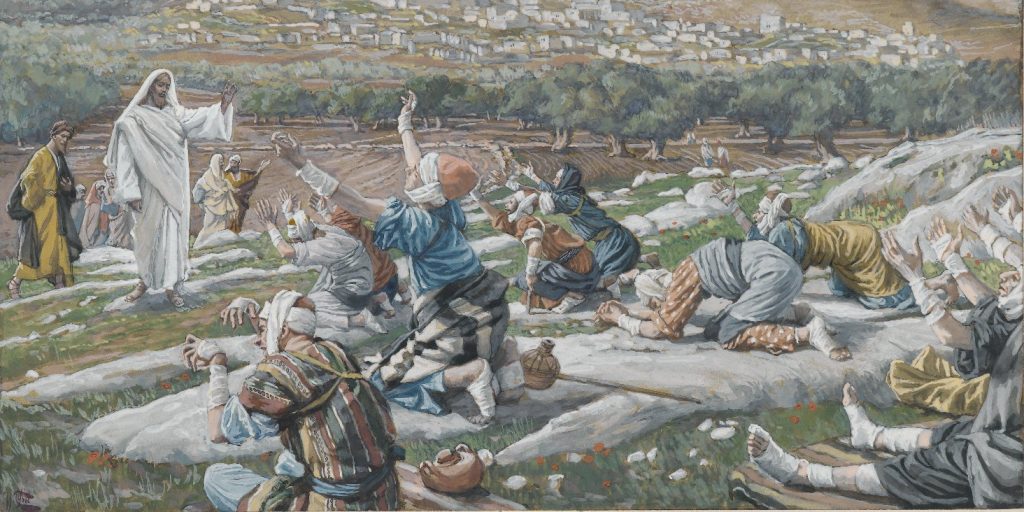
The ten men in today’s account were certainly aware of what they once had and what they had been able to do. This had been taken from them by a skin disease called leprosy. Once this disease was detected on their skin, they were forced to move away from their families and communities, and they joined the company of other suffering lepers. Many who contracted leprosy had little hope of ever being healed. We might complain about the work we have to do, but these men would have given anything to go back to their homes and their work.
We learn an interesting detail about this group of men. Jews and Samaritans did not like each other and interacted with each other as little as possible. But nine Jews and one Samaritan co-existed in this group. The long-standing prejudices and animosities did not matter much when they had all lost everything, like when war or economic problems or disease affect all classes in a society. We might live in different kinds of homes, dress in different types of clothing, enjoy different sorts of foods, come from different places, but every human being has something in common: a sinful nature that results in our death.
These ten lepers had something else in common besides their misery. They also somehow heard about the miraculous power of Jesus and trusted that He could help them. As they saw Him enter a village, they stood at a distance and cried out to Him for mercy. Bible commentators point out that “lifting up their voices” is a remarkable detail, since leprosy often affected the ability to speak with any kind of volume. They were desperate for Jesus to hear them. They were desperate for His help.
And He did hear. We might expect that He would reach out His hand to touch them and heal them or declare them clean like He had done for others on previous occasions. Instead He gave them a simple instruction: “Go and show yourselves to the priests.” This was consistent with Old Testament Law which required a priest to examine someone who had a skin disease before he would be allowed to return to his home. The men knew this Law, so they knew that Jesus was telling them to have the priest examine their leprous skin. In another remarkable detail in this account, they turned and went on their way before their skin was healed. “And as they went they were cleansed.”
If this is where the story ended, we would praise the Lord for yet another healing, and we would admire the men who trusted His Word even before they saw any change in their condition. But that is not where the story ends. We learn that out of the ten who were healed, one of them turned back as soon as he saw he was well—that lone Samaritan—and used his now strong voice to praise God loudly. He no longer kept his distance from Jesus but fell right at His feet giving thanks to Him, acknowledging Him as God in the flesh.
What Jesus said next is important for us to dwell on. He said, “Were not ten cleansed? Where are the nine? Was no one found to return and give praise to God except this foreigner?” Jesus expected a response of gratitude from each of the men. He had given them what they asked for. He had mercy on them and healed them. And yet they were now going further away from Him instead of coming closer. We could excuse them by saying that they just missed their families or were just following Jesus’ directions, but He had just cured them of a disease that they thought they would never be cured of! And the thought didn’t cross their minds that Jesus might be someone to stay close to?!?
But now think of all the millions and even billions of Christians living today who have received the healing gifts of Jesus in Word and Sacrament. How many have been cleansed and healed of the leprosy of sin at the baptismal font? How many have heard the words of absolution that Jesus has commissioned His Church to proclaim? How many have partaken of His body and blood in His holy Supper for the remission of their sins? And how many have walked away from all of it, taken it for granted, and day in and day out, offer Him no thanksgiving and praise for His mercy toward them?
Of every ten sinners whom the Triune God has called to holy Baptism to become His own children, to receive His eternal gifts, to be joined to the body of believers with Jesus as its Head, how many return to church week after week to hear the words of Jesus and give Him thanks? Do nine out of ten humbly and regularly fall at His feet? Is it half of the baptized? How about one out of ten? I’m not even sure the number is that high.
It is a great sin to live as though we have only ourselves to thank for our good health, our good-paying job, our success, our good reputation, our honor, our faith and salvation. Children have to be reminded every now and then that it is a privilege and gift that they get to live under our roof, wear the clothes we buy, and eat our food. They do not deserve this; they have not earned it. They receive it because their parents are merciful and responsible for their care, and our children should be thankful for what they have.
The same goes for us grown-ups. We need to be reminded that it is God who gives us health, home, food, family, possessions, protection from danger, and everything else we enjoy on earth. Besides all that, in His grace He credits us with the perfect life of Jesus who kept the holy Law of God on our behalf. He forgives us all our sins since Jesus paid the penalty for them in full on the cross. He promises us a resurrection from the dead and eternal life with Him because He rose from the dead and went on to prepare a place for us in His heavenly kingdom.
For all this, we are, as Martin Luther writes, “in duty bound to thank and praise, to serve and obey Him” (Explanation to First Article). The heart that He has redeemed and cleansed by His precious blood should be filled with fear, love, and trust for Him. The hands that He freed by offering His hands to the nails should be employed in God-pleasing work and for the help of our neighbors. The voices that He has loosed from the cries of misery and woe in our former lost condition should be utilized for the praise of His glorious name and the proclamation of His grace.
We thank Him by using all the gifts and abilities He has endowed us with for His glory. My heart is not to be given over to pursuits and passions that break His Commandments. My hands are not to be used for greedy gain or for harm. My voice is not to be used to curse, to spread lies, or to spout hatred.
We learn the proper use of our heart, hands, and voices in the Divine Service each week. The Holy Spirit moves us to confess that our heart is sinful and unclean by nature, like the lepers crying out for mercy, and then He imparts the forgiveness of Christ to us in His Word of absolution. He shapes the thoughts and intentions of our heart through the powerful Word and fills it with joy and praise.
Like the Samaritan who fell at Jesus’ feet, we come before Him with praise and thanksgiving, hands folded in submission and prayer to Him. Like the Samaritan praising Jesus with a loud voice, we sing with joy and thankfulness for what He has done to save us, and with our voices we confess our faith in Him. The patterns and postures we learn in the Divine Service as we receive the Lord’s gifts prepare us for what to do when we leave here and carry out the duties of our callings.
At the end of the Divine Service in the Benediction, we hear our Lord’s own Word of blessing, when He says essentially what He said to the Samaritan: “Rise and go your way; your faith has made you well.” By faith in Jesus, we receive all that we need for this life and for the life to come. For His mercy and grace toward us, We Thank God with Heart, Hands, and Voices. We thank Him whether we are laboring at work or enjoying times of leisure, whether we are healthy and happy or sick and hurting. We thank Him at all times and in every situation because He is our Savior who loves us and forgives us and who mercifully and abundantly provides all that we need. As the hymnwriter says:
Now thank we all our God / With heart and hands and voices,
Who wondrous things hath done, / In whom His world rejoices,
Who from our mother’s arms / Hath blessed us on our way
With countless gifts of love / And still is ours today.
(Evangelical Lutheran Hymnary #63, v. 1)
Glory be to the Father and to the Son and to the Holy Ghost; as it was in the beginning, is now, and ever shall be, forevermore. Amen.
+ + +
(picture from “The Healing of Ten Lepers” by James Tissot, 1836-1902)


Copyright 2020 © Saude, Jerico, & Redeemer Lutherans. All rights reserved.