
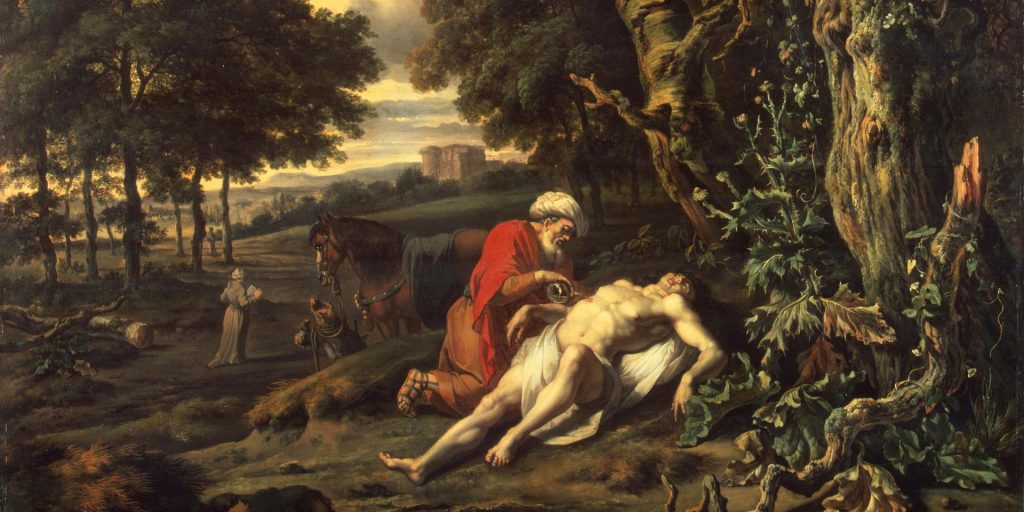
The Thirteenth Sunday after Trinity – Pr. Faugstad sermon
Text: St. Luke 10:23-37
In Christ Jesus, who perfectly obeyed His Father’s compassionate will and bought back all of His sinful neighbors on earth from sin, death, and the devil by His perfect life and the shedding of His precious blood, dear fellow redeemed:
Last week we heard about Jesus opening the ears and loosening the tongue of a man who was deaf and mute. Today we are going to talk about the eyes. Sight is such a tremendous gift. The world is full of beautiful and amazing things to look at. In the Midwest at this time of year, we see green fields full of crops and flourishing gardens. In other parts of the country, people look out over great bodies of water or at tall, snow-covered mountains. But there is something more important for us to see than nice scenery, and that is the people around us.
How you view your neighbor, which means any person you come in contact with, is the central theme of today’s reading. What you see as important is typically what puts your body into motion. So if you see a child in danger or in need of help, your feet and hands move quickly to provide assistance. If you see someone struggling to carry something, you head over to lend a hand. If you see someone hungry or hurting, you do what you can to address the problem.
But sometimes we see someone in need, and our body does not start moving. We have a different focus or different plan, and we decide we can’t spare the time and effort. Someone else will have to step in. It can certainly happen that there is neither the time nor the energy to help all the people around us who need it. We do at times have to decide what neighbor is most in need and give our attention to that.
The issue that Jesus addresses is our sinful inclination to put our own needs and our own comfort well before the needs of others. He sets before us a scenario with an obvious solution. A man got beat up by robbers who left him dying on the side of the road. If we watched this happen in a movie, we would hope that someone would come along quickly to assist this poor man. He wouldn’t last long in his condition without medical care.
Finally another person did come along—a priest! Surely this holy man would help. He “saw him” lying there. But hardly hesitating, he crossed to the other side of the road and kept walking. Then a Levite came along—a worker in the temple, one who was supposed to uphold the teachings of God. He “saw him” too and passed by on the other side.
They might have had reasonable excuses for not stopping. Maybe they were needed to help prepare the temple sacrifices that God required and conduct services, and if the man died, they would be ineligible to perform their duties for a time according to God’s Law. Perhaps a family member or friend was in a difficult situation, and they were on their way to support them. Whatever got the man on the road into this predicament, they figured it was not their responsibility or it was outside their expertise to help him. And besides that, no one else was around to see them pass him by. No one had to know they were even there….
A good test for how you see your neighbor is how you conduct yourself and what you say when no one else is looking. For example, do you act and speak kindly and with understanding to your spouse when nobody else can hear? How do you parents interact with your children, or you children with your parents? It is generally easier to treat your neighbors well who are not very close to you, people you only see every now and then. It is harder to treat your neighbors well with whom you are in contact many times throughout a day.
God’s command is that we love our neighbors as we love ourselves. Sometimes people say: “First you need to learn to love yourself before you can love others.” But that is not true. Even in little children, their self-centered approach to life is quite clear: “I don’t want to share my toys! I don’t want to eat this food! I don’t want to take a nap!” We don’t outgrow our sinful nature. Love for ourselves comes naturally. The sinful nature always points me inward toward what I need, rather than outward to what my neighbors need.
So the priest and the Levite walked by the dying man and never looked back. The man’s condition was getting worse by the minute. Eventually a Samaritan came by. As soon as the lawyer with Jesus heard mention of a Samaritan, he probably tensed up. The Jews and the Samaritans lived next to each other, and they hated each other. But in this case, the Samaritan saw this Jewish man lying beaten on the road, and he did not quickly pass by. “[W]hen he saw him, he had compassion.”
The word translated “compassion” comes from a great Greek word—splagnizomai. It means literally to be “moved in the gut,” to have a deep feeling or inner churning of pity toward another. When the Samaritan saw the man in agony and pain, bruised and bleeding, he no longer thought about where he needed to be or what he needed to do. Nothing was more important than the care of this man. You heard what happened next: the Samaritan dressed this stranger’s wounds, took him to an inn, watched over him through a fitful night, and provided the means for his ongoing care.
The steps he took to help this man seem unbelievable. Would anyone really do this much for a stranger? Jesus says this is what it means to love your neighbor. It is not helping only when it is convenient for you or when you have plenty of time. It is setting aside your own plans to assist others. It is pouring out yourself for others, even if they don’t acknowledge it or treat you very well in return. It is continuing to give even when you feel like you have nothing left.
How is this going for you? If we could see through each other’s eyes while thinking each other’s thoughts, would we be impressed by how each of us looks at our neighbors? Or would we be embarrassed and appalled? I suppose that would depend on the day and the circumstance. Sometimes we might look pretty good like the self-sacrificing Samaritan, but other times, not much better than that priest and Levite.
If we try to justify ourselves by how much good we have done, like the lawyer wanted to do, we will be crushed under the weight of our guilt. For every person we have helped, there are many more whom we have ignored. For every service we cheerfully rendered, there are many other times that we grumbled and complained and resented what was asked of us. If God loved me based on how well I love others, God would not love me much at all.
But I can’t earn His love, and neither can you. We don’t have to. That’s what makes Christianity unique among all the religions of the world. Every man-made religion is about what we have to do for God in order to save ourselves. Christianity is about what God did for us to save us. In the parable that Jesus tells, we would be the man dying on the side of the road. We have been robbed of all honor by the sins we have committed. We have been beaten up by the perfect Law of God that condemns us. We cannot nurse ourselves back to good health and strength. We are helpless. We are dying.
But then Jesus comes along, an outsider rejected by many. He looked upon us in our sin, in terrible shape, without hope, and “he had compassion” on us. But Jesus went further than the Samaritan. He didn’t just help us get better. He offered to take the beating we deserved for our sin. He willingly sacrificed Himself in our place, so that we would not die eternally but live with Him in Paradise.
You have not perfectly loved your neighbors, but Jesus perfectly loved you. If you could look through His eyes and see how He thinks of you, you would be stunned. How could anyone love me like that? He loved you all the way to the cross where He paid for your sins of self-centeredness, pride, and resentment. He suffered there as though He were the heartless priest and Levite who ignored the dying man. He gave Himself fully to redeem you, to justify you, to save you.
God the Father accepted the sacrifice of His Son to atone for your sin. He declares you “not guilty” of any wrong. He accounts you as righteous in His sight because you are covered in the righteousness of Jesus—His perfect life of love—by faith in Him. You don’t have to earn anything from God. Everything is already yours as a gracious gift from Him and through Him.
Jesus said, “Blessed are the eyes that see what you see! For I tell you that many prophets and kings desired to see what you see, and did not see it, and to hear what you hear, and did not hear it.” On the pages of the Bible, the promises of a Savior in the Old Testament and the record of His saving work in the New Testament, you are blessed to see what “many prophets and kings desired to see.” Your eyes have been opened to God’s grace toward you and the salvation that is yours by faith in Him.
Knowing what He has done for you and His fulfillment of the Law in your place, you see that you are now free to love your neighbors. Loving your neighbors is sharing with them what you have already received from God. Loving your neighbors is looking at them as God looks at them and you. Can You See Your Neighbor’s Need? If you can, thank God that He has opened your eyes and your heart toward your neighbor and then serve gladly with the compassion and the strength that He supplies.
Glory be to the Father and to the Son and to the Holy Ghost; as it was in the beginning, is now, and ever shall be, forevermore. Amen.
+ + +
(picture from “Parable of the Good Samaritan” by Jan Wijnants, 1632-1684)


Copyright 2020 © Saude, Jerico, & Redeemer Lutherans. All rights reserved.