

The Last Sunday of the Church Year – Pr. Faugstad sermon
Text: St. Matthew 25:1-13
In Christ Jesus, who has not delayed His return due to disinterest or other distractions but out of patience and love for you and all sinners, so there is time for us to repent (2Pe. 3:9), dear fellow redeemed:
One of the most exciting moments in sports across the board, is the moment just before the action begins. At that moment, anything is possible. The kicker starts his approach to the ball, the referee throws the basketball into the air at center court, the pitcher on the mound begins his windup. But where this moment is most intense is on a racetrack.
The runners are called to the starting line: “On your mark!” They jump up and down a few times and shake their arms. They crouch down and dig their feet into the blocks. They carefully plant their fingers behind the line. Then silence. The anticipation builds. Hearts beat faster. You can hear a pin drop. “Set!” Backs raise, legs straighten, muscle power pushes down to the toes to provide the catapult forward. The runners have to be especially careful right now. This is the time when many get disqualified. They can’t wait. The pop of the gun seems to take forever.
If you remember being in races as a kid, this was the toughest part. “On your mark! Get set!” Sometimes your parent or your coach would hold off on the “Go!” longer than usual. They wanted to teach you discipline. You have to be patient. If a sibling or friend started the race slow like this, they just wanted to see you suffer. You can picture it now: kids anticipating the call and leaning forward, then flailing their arms and falling in a heap on the ground. It’s so hard to wait for that “Go!” while staying ready to explode off the blocks.
That sort of waiting is what we find in today’s reading. Jesus shared this parable with His disciples to teach them and us how to prepare for His return. He speaks about ten virgins who went out to meet the bridegroom in order to join him at the wedding feast. Their description as “virgins” indicates that they were pure in faith, holy by virtue of their connection with the bridegroom.
It is a picture of the righteousness you have because you are united with Jesus. It is a strange reversal. A virgin who joins bodily with another is no longer a virgin. But we whose bodies are joined through Baptism with Jesus’ holy body, change from ones who are sinful and guilty to those who are clean and pure. Paul described this change in his letter to the Corinthian Christians. He wrote, “I betrothed you to one husband to present you as a pure virgin to Christ” (2Co. 11:2).
That is stunning language! Paul was writing at a time that was much like ours, with a culture just as much focused on personal pleasure and sexual permissiveness as ours is. Many of the people who had joined those congregations organized by Paul were ashamed of the things they had done in their past. They wished they could go back and undo what they had done, but they couldn’t.
Paul directed them to the work of Jesus to save them. After listing sins that keep people out of the kingdom of God, sins like sex outside of marriage, homosexuality, greed, and drunkenness, Paul acknowledged the reality, “And such were some of you.” Christians are not those who are unstained by sin. Some have sinned so much, that they might think it is impossible for their many sins to be forgiven. Then Paul continued with this comfort: “And such were some of you. But you were washed, you were sanctified, you were justified in the name of the Lord Jesus Christ and by the Spirit of our God” (1Co. 6:11).
You know the sins of your past. You wish you could go back and change a lot of things. But even if you did that, you would still be a sinner. You could change your actions in certain situations, you might be able to avoid some things, but other temptations would have come up. You weren’t just a bad choice or two away from perfection, you were far from it.
But in Jesus, you are holy. You were baptized into His victory over sin. Although you were impure, you have become pure. Although you were guilty, you have been absolved. Although you were dead in your sins, you have become alive in Christ Jesus by the power of the Holy Spirit. He cleansed you and all the members of His church, as Ephesians says, “by the washing of water with the word, so that he might present the church to himself in splendor, without spot or wrinkle or any such thing, that she might be holy and without blemish” (Eph. 5:26-27). That is a description of you, a virgin holding a lamp of faith, called out of the darkness to meet your Bridegroom.
So you are ready, but are you set? All ten virgins were ready at first, but only half of them were actually set. I’ll tell you what being set does not mean. It does not mean being able to say that you were baptized and confirmed in the church, or that you have been a member here your whole life. It does not even mean that you regularly go to church and contribute to the church’s work. Those things do not ensure that you are set.
The important thing is that the flame of your faith is being fueled. Going through the motions or keeping your name on a membership list does not fuel your faith. But humbly repenting of your sin, eagerly hearing the pure Word of God, and receiving the Sacraments—that does fuel your faith.
All Christians must take this seriously. Just because you once had faith, does not mean you will always have faith. The five foolish virgins took their faith for granted, and when the Bridegroom was delayed, they became weary. They did not prioritize fuel for their faith, and when they realized their error, it was too late. The door to the wedding banquet was shut, and they weren’t allowed in.
This is a powerful warning for us. You couldn’t tell the difference between the wise and foolish virgins by looking at them. But there certainly was a difference. At one point, they all had their eye on the finish line; they were all ready to go. But not all of them were set. They relaxed too much. They took their eye off the prize. They became disqualified. They did not finish the race.
And notice that in fact all the virgins—all ten of them—relaxed too much. “They all became drowsy and slept.” The gun did not go off fast enough for them. And here we are, still waiting. The Bridegroom called us out of the darkness into His marvelous light (1Pe. 2:9). The midnight cry has gone out, “Here is the bridegroom! Come out to meet him.” But He has yet to return.
So what are we supposed to do? Jesus says, “Watch therefore, for you know neither the day nor the hour.” But how do we watch? We watch by keeping our eyes on the Leader of the race, the Man standing ahead at the finish line. He has been in our shoes. He knows the difficulties and challenges we face. But He never slowed down. He never changed course. He never took His eyes off the prize, not even when the whole world stood against Him, not even when they nailed Him to a cross to suffer and die.
The author of Hebrews writes, “[F]or the joy that was set before him [Jesus] endured the cross, despising the shame, and is seated at the right hand of the throne of God” (Heb. 12:2). He endured that for you. He kept going, moving forward, for you. The Bridegroom knew what He was competing for; it was for you, His bride, His Church. The course He took was hard, harder than we can imagine, but He finished in victory. He won the victory over sin, devil, and death for you.
You stay ready and set by keeping your eyes on Him, your Savior. You watch for His return by listening to His promises. He speaks them to you today. He is not far away from you. He is present through His Word and His Sacraments to give you His encouragement and strength. He speaks His forgiveness as oil for your faith to keep it burning strong. He gives you His grace when you grow weary and drowsy along the way. He blesses you with His unseen presence now, so that you are prepared to rise up and go when He comes in glory.
That time is approaching and coming soon. The midnight cry was no false alarm. Now is the time to be ready for the Bridegroom’s return. We don’t know if His return will be sooner or later, so we stay set, alert, watchful, by continuing to fuel our faith through the powerful means that God has given us. We wait with patience for that day when a sharp sound will pierce the air, like a bullet from a gun.
Jesus will come “with a cry of command, with the voice of an archangel, and with the sound of the trumpet of God” (1Th. 4:16). And if we are no longer living here on earth, if we are sleeping the sleep of death, that sharp sound will awaken us. Then we will surge with power out of the tomb, up into the sky, and directly to our Lord.
That’s the day that we will “Go!” Until then, we stay Ready, we get Set, and with the help that God provides, we Wait.
Glory be to the Father and to the Son and to the Holy Ghost; as it was in the beginning, is now, and ever shall be, forevermore. Amen.
+ + +
(picture from 11th century painting from the Rossano Gospel)

Thanksgiving – Vicar Lehne homily
Text: Psalm 100
In Christ Jesus, who is our ultimate reason to give thanks, dear fellow redeemed:
Thanksgiving is many things to many people. To some, it’s the Thanksgiving Day Parade, in which giant parade balloons of their favorite characters float down the street. To others, it’s the Thanksgiving Day football game, complete with a halftime show that’s performed by some of their favorite celebrities. Still, to others, it’s simply getting to spend time with their friends and family. But, of course, if Thanksgiving is anything, it has to be Thanksgiving dinner: turkey; stuffing; mashed potatoes and gravy; pumpkin pie! In fact, Thanksgiving dinner is such a big part of Thanksgiving that many people go without eating all day in preparation for the massive feast.
Now, these are all perfectly fine things to do on Thanksgiving, but what many people fail to realize is that the true meaning of the holiday is right there in the name: Thanksgiving. It’s a day in which we are to give thanks, but give thanks for what? The psalmist answers this question by saying in verses 4 and 5 of our reading for today, “Give thanks to [the Lord]; bless his name! For the Lord is good; his steadfast love endures forever, and his faithfulness to all generations.” Through the love and faithfulness that he shows us, God proves that he is good and worthy of our thanks. But how does God show his love and faithfulness to us? The psalmist also answers this question by saying in verse 3 of our reading, “It is he who made us, and we are his; we are his people, and the sheep of his pasture.”
This verse paints God in two ways: as our Creator and our Good Shepherd. As our Creator, God shows his love for us by giving us life. Without him, none of us would even exist in the first place. As Psalm 139:13 says, “[Y]ou formed my inward parts; you knitted me together in my mother’s womb.” As our Good Shepherd, God shows his love for us by preserving us and protecting us. Everything that we have comes from God, and God makes sure that we have everything that we need, like a shepherd leading his sheep to green pastures and flowing water. As Psalm 145:15 says, “The eyes of all look to you, and you give them their food in due season.” But it isn’t just because God provides for us that we’re alive, it’s also because God protects us, like a shepherd who fights off the hungry wolves that are after his sheep. As Psalm 91:11 says, “He will command his angels concerning you to guard you in all your ways.”
God being our Creator and Good Shepherd in our earthly lives is enough of a reason to give thanks to him, but God is also our Creator and Good Shepherd in our spiritual lives. God wants us to be with him in heaven, where we will never want for anything. However, because of the countless sins that we committed, we were not able to stand in the presence of a perfect God and were doomed to be cast out from his presence into hell, where we would pay the price for our sins for all eternity.
There was no way that we could change our fate and enter God’s presence on our own, but God the Father didn’t want to leave us to our fate. He loved us too much to do that. So, he sent his only begotten Son, Jesus, to earn the honor of entering his presence for us. Jesus died an innocent death on the cross, taking all of our sins on himself and paying the price for them, so that our prefect, heavenly Father would no longer see our imperfections. He also applied his perfect life to our lives so that we are able to enter the presence of our perfect Father in heaven. These blessings that Jesus won for us are brought to us and made our own through the waters of baptism. In those holy waters, our old sinful self is drowned, and our new holy self is born, uniting with Christ and rising to the surface. While we were once spiritually dead, God has given us new life in Christ.
However, our faith is just like our physical bodies: it needs nourishment, or it will die. Thankfully, God does not leave us alone once he brings us to faith but continues to nourish our faith by feeding us his Word. Every time we enter his presence in this life, gather around his Word with other believers, we hear the good news of what Jesus has done to save us and of how God continues to work to preserve us and protect us.
Because of this, our faith is strengthened, but our faith needs more than just nourishment. It also needs protection, protection from our spiritual enemies (the devil, the world, and our own sinful nature) who are constantly trying to lead us astray so that we won’t get to enter God’s perfect presence. These spiritual enemies of ours try every trick in the book on us: they tell us that our sins aren’t so bad, and that everyone else is doing them anyway; they tell us that we need to reject God in order to fit in with the rest of the world and be accepted by them; they tell us that God is a liar and that he doesn’t do the things that he says he does, so we shouldn’t follow him; and they tell us that there is no way that God could ever forgive us of our sins, so we should just give up hope. Our spiritual enemies play the role of both friend and foe, whatever it takes to win against us.
But there is no need for us to fear our spiritual enemies, for God is always there to protect us from them. They cannot harm us, nor do their accusations succeed against us, for Jesus has paid the price for all our sins, and as a result, eternal life in heaven is ours. As Jesus says in John 10:28, “I give them eternal life, and they will never perish, and no one will snatch them out of my hand.”
So, we see that God is not only our Creator, Preserver, and Protector in our earthly lives, but also in our spiritual lives. For all this, we ought to give thanks to God. But there are times when we are tempted to think that there isn’t much to give thanks to God for at all, especially when we take a look around us and see the troubles that we all face every day. Prices continue to go up on everything, making it harder and harder to provide for ourselves and our families. Our loved ones continue to get sick and die. There continues to be war and violence throughout the world. And the world continues to encourage sinful behavior, seemingly wanting us to accept every kind of lifestyle, no matter how sinful it is, while, at the same time, rejecting those who are Christians, and even attacking them. Because of everything that’s going wrong in the world, it can sometimes make us wonder: is God truly in control? And if that thought starts to creep into our minds, it can tempt us to abandon God and turn to others for answers.
Thankfully, even though there are times when we aren’t faithful to God, God always remains faithful to us. Like a shepherd, he does not abandon his sheep that have wandered off, but he drops everything to find his lost sheep and lead them back to his flock. He accomplishes this through the preaching of his Word, the same Word that he uses to create and nourish our faith. When the Word is preached to us, we are made aware of the sins that we committed that caused us to go astray. But then, we receive the comfort that we have the forgiveness of sins because Jesus has paid the price for all our sins by his innocent death on the cross, that he willingly endured out of his great love for us.
Knowing all that God has done for us, and especially knowing what he has done to save us from our sins and open the gates of heaven to us, we are moved to give him thanks. But this thanksgiving is not limited to just one day of the year, nor is it limited to just when we go to church, but we show thanksgiving to God every day in all that we say and do, as the light that we now have in Christ shines before men. In fact, we can’t help but give thanks to God, because in every area of our lives, in how God made us, sent his only begotten Son to save us, and continues to provide for our needs, guard us from danger, and keep our faith alive, we know that God’s love endures forever. As the explanation to the First Article of the Creed says, “[F]or all this it is my duty to thank and praise, to serve and obey Him.”
Glory be to the Father and to the Son and to the Holy Ghost; as it was in the beginning, is now, and ever shall be, forevermore. Amen.
+ + +
(picture from stained glass window in St. John the Baptist’s Anglican Church in New South Wales)

The Festival of the Reformation – Pr. Faugstad exordium & sermon
Flung to the heedless winds
Or on the waters cast,
The martyrs’ ashes, watched,
Shall gathered be at last.
And from that scattered dust,
Around us and abroad,
Shall spring a plenteous seed
Of witnesses for God. (Evangelical Lutheran Hymnary #556, v. 1)
These words were inspired by Martin Luther’s first hymn, a commemoration of the deaths of two monks named Henry and John. These monks were arrested for their “evangelical” preaching, which meant they proclaimed salvation through Jesus alone and not through a person’s own efforts or works. After eight months of imprisonment and interrogation, they were put on trial.
At the trial, they were told to bow to the authority of the pope and the church fathers. They said they would as long as their writings did not contradict the Holy Scriptures. They were told that it was sinful to read Luther’s writings, since the pope had banned them. They replied that it was wrong to ban writings that faithfully teach the Word of God. When it became clear that the two men would not repent of what they were teaching, they were sentenced to death by fire.
They were led quickly to the place of their execution. A yellow tunic was put on Henry to mock him and a black gown on John to symbolize his sinfulness. They were tied to the stake. They waited for half an hour as their executioners tried to get the fire going. Then as the flames advanced, the two men said the Creed, and they sang Psalms and hymns. Their last song was an old Christian hymn, the Te Deum Laudamus, which means, “We praise You, O God.” Finally they cried out, “Lord, Jesus, Son of David, have mercy on us!” And then they were overwhelmed by the smoke and after a while were reduced to ashes.
The monks Henry and John were the first martyrs of the Lutheran Reformation. They died on July 1, 1523—five hundred years and a few months ago. They did not go to the stake because they believed in the man Martin Luther. They learned from Luther’s writings to put their trust in Jesus. They died confessing Jesus as their Savior and Lord, even when the whole world seemed opposed to them.
Their example is an encouragement to us, encouragement to resist the temptations of the devil and the appeal of going along with the crowd, and encouragement to firmly believe and clearly confess God’s truth with honest hearts. We pray that our Lord equips us as He did these two faithful men, so that we also are kept in the saving faith until our earthly end.
We join in the prayer of hymn #18, the fourth stanza, “Triune God, Be Thou Our Stay”:
Triune God, be Thou our Stay;
O let us perish never!
Cleanse us from our sins, we pray,
And grant us life forever.
Keep us from the evil one;
Uphold our faith most holy;
Grant us to trust Thee solely
With humble hearts and lowly.
Let us put God’s armor on,
With all true Christians running
Our heavenly race and shunning
The devil’s wiles and cunning.
Amen, amen! This be done;
So sing we, Alleluia! (ELH, #18, v. 4)
+ + +
Sermon text: Ephesians 6:10-17
In Christ Jesus, the great Conqueror who willingly joined Himself with us losers and single-handedly destroyed our terrible enemies, dear fellow redeemed:
If you had to go to the front lines of a battle, what would you want to have with you? What would you need in order to feel safe, or at least to feel like you had a fighting chance? Maybe it would be body armor like a bullet-proof vest and a helmet that could protect you from shrapnel and bullets. Maybe it would be a thick wall in front of you or well-trained soldiers on either side of you. Perhaps what would make you feel safest is a powerful weapon in your hands that causes your enemy to duck for cover.
The apostle Paul talks about a battle situation like this, except that the battle he refers to is a spiritual one. It happens around us and inside us, and we can’t see the enemy. But we can see the enemy’s work; we can see his “schemes.” Paul writes that our conflict is not primarily “against flesh and blood”; our greatest enemies are not other human beings. Rather our conflict is against the rulers, authorities, cosmic powers of darkness, and forces of evil in the spiritual realm.
Paul is describing a hierarchy of wickedness with the devil at the top and his fellow demons sowing destruction and chaos around him. They are the ones who tempt and incite human beings to do the bad things they do. If we do not recognize that the devil and demons are behind the evil in the world, we might think that every human problem can be solved by a human solution. But there is no human solution that can overcome the devil.
This is what the Roman Church was attempting to do at the time of the Reformation. The people were taught that they could make satisfaction for their sins by the good works they did, by the prayers and gifts they offered, or even by purchasing a piece of paper, an indulgence authorized by the pope. On October 31, 1517, Martin Luther posted his Ninety-Five Theses, which argued that a soul could be saved only through repentance and not through the purchase of indulgences.
As he continued to study the Scriptures, Luther came further in his understanding of salvation. He realized that only God could supply the righteousness that His holy law required, and that this righteousness was fulfilled by His only-begotten Son in the flesh, Jesus the Christ. A sinner could have his sins forgiven and be justified before God not because of anything he did, but because of God’s grace toward him and the faith worked in his heart by the Holy Spirit to receive these gifts.
When Paul writes about putting on “the whole armor of God,” this is what he is talking about. He is talking about putting our trust in God alone as we face the devil’s attacks. What is the armor we wear? “The belt of truth”—that doesn’t mean our own personal truth, what is true for each one of us. It is God’s truth, the truth about our sinful weakness and about His gracious plan to save us. “The breastplate of righteousness” is Jesus’ righteousness. A breastplate protects a soldier’s vital organs, and so it is Jesus’ perfect life that covers and protects us, so that we are kept alive and well in Him.
The “shoes for [our] feet” is the readiness to stand firm in the Gospel of peace, to conquer by the message of grace which has conquered our own hearts. Paul tells us what “the shield of faith” is for. It is to “extinguish all the flaming darts of the evil one.” Whenever the devil tries to accuse us for our sins, we point in faith to Jesus, who already paid the penalty for all our sins. “[T]he helmet of salvation” is what protects our minds from the devil’s schemes as he tries to work doubts in our heads or anger toward others or sinful desires for what God has not given us.
Finally, we have “the sword of the Spirit, which is the word of God.” We do not advance in this battle by physical force. We speak God’s powerful Word, and the devil and the demons have to retreat. They cannot stand against the power of God’s Word. Whenever Jesus comes through the Word, the devil’s head starts hurting, since Jesus stomped on it and crushed his power by dying in our place and rising from the dead for our victory.
But if we want to give the devil the advantage over us, we can set aside the armor of God and try to face him on our own. We do this whenever we feel pride for the great things we have accomplished, and fail to give God the glory. We do this when we embrace what God says is sinful, instead of repenting of sin and running away from it. We give the devil the upper hand when we don’t speak up when the truth is challenged, when we compare our good works with those of others, when we trust our own reason or strength, when we stop regularly hearing and learning the Word of our God.
The devil will defeat us if we are not wearing the armor of God. He has done it before. He schemed against us, and his schemes were successful. We lost ground in our faith, and perhaps at certain points, we lost our faith altogether. But even though the devil has won many battles against us, he has not won the victory. This is clear by the attention you are giving to God’s Word right now. You know that you are weak. You know that you have sinned. And you also know that Jesus saved you from your sin and death and still fights for you against “our ancient foe” (ELH #251, v. 1).
That is what Martin Luther’s hymn, “A Mighty Fortress Is Our God” is about, a hymn that is called “The Battle Hymn of the Reformation.” Based on the Forty-Sixth Psalm, it describes God as a Fortress of strength, a Shield of protection, and a Weapon of defense. We need His help because of our powerful enemy who wants to destroy us, whose strength has no equal on earth (v. 1). On our own we would lose, but One stronger than the devil fights for us, the Man of God’s choosing. This is God’s Son come from heaven to earth, the Lord of hosts, who is victorious in every field of battle (v. 2).
Even a world full of devils cannot defeat us when Jesus fights for us. They are overthrown by a Word, the Word of God (v. 3). Their arms go limp when God speaks His Word. They have to run and hide, because they know they are beaten. As long as our Lord is with us in the fight “with His good gifts and Spirit,” with His power imparted to us through His Word and Sacraments, we remain in the kingdom of God, and His kingdom remains ours (v. 4).
This is what it means to “be strong in the Lord and in the strength of His might.” This is what it means to “take up the whole armor of God” and “to stand firm.” It means repenting of our weak efforts on the battlefield that could not win the victory, and it means trusting in Jesus’ righteousness and blood for our salvation.
We are not lost. We are not forsaken. We are not destined for eternal damnation—because God the Father loves us, His Son redeemed us, and the Holy Spirit sanctifies and keeps us in the true faith. A Mighty Fortress Is Our God. We give Him thanks that the Gospel was proclaimed and bore fruit at the time of the Reformation, and that His saving Word is still proclaimed among us today, despite our unworthiness to receive it.
Glory be to the Father and to the Son and to the Holy Ghost; as it was in the beginning, is now, and ever shall be, forevermore. Amen.
+ + +
(picture from “Martin Luther at Worms” by Anton von Werner, 1877)

The Twelfth Sunday after Trinity – Pr. Faugstad sermon
Text: St. Mark 7:31-37
In Christ Jesus, who came to bring healing not just for bodies but also for souls, not just for this life but for the life to come, dear fellow redeemed:
If you could change one thing about your body, one thing that would make you happier and more content, what would it be? For some of us (maybe many of us), it would be our weight—“I wish I could trim off a few pounds.” Others of us might say, “I wish I were a little bit taller.” “I wish I were stronger.” “I wish I were prettier.” Most of these wishes have to do with how other people see us. We want them to think we look good, because that helps us feel better about ourselves.
Or maybe what you would like to change is not so much your appearance, but your health. “I wish this pain in my joints or my back would go away.” “I wish I could get back the energy and mobility I used to have.” “I wish my heart were more reliable.” “I wish this cancer were gone.” And there is no question that being healed of these things would be a great relief. But how far would it take you? Would you actually be happier and more content if you received exactly what you wanted?
Today we hear about a man who was deaf and had a speech impediment. Those two things often go together. If you grow up being unable to hear, or unable to hear correctly, you won’t know how to control the sounds that you make with your mouth. Communication for this man was certainly difficult, but he had gotten along so far. He did not have a life-threatening illness or demon-possession like other people Jesus had healed. But the people figured that if Jesus could help with those things, He could “lay His hand on” this man and heal him too.
While the people had confidence in Jesus, it isn’t exactly the case that they believed in Him. They believed that He had special powers, and they were really hoping to see Him use them. But they did not believe He was the promised Savior of the world. What they were hoping for was a miracle of physical healing and not much more.
Jesus of course knew this about them. We see how He took the deaf man away from the crowd, because He wasn’t interested in making a spectacle of it. He sighed deeply—even groaned—as He looked toward heaven, saddened by the whole situation. And then after the miracle had been performed, He charged the people not to tell anyone what He had done—an order which they totally ignored.
But why would Jesus order them not to tell? Well what kind of message do you think they shared? Would you guess that they talked more about who He was, or about what He was able to do? “He has done all things well!” they cried. “He even makes the deaf hear and the mute speak!” The message was that Jesus mattered because of the physical healing He could perform.
This message could have led some to wonder, “Who is Jesus anyway? How is He able to do the things He does?” Those are the questions all the people should have been asking. But many just looked at Him as a means to get what they wanted. “If Jesus could take away this problem, or this problem, I would be so free. Then I could do whatever I wanted again.”
You can see how getting healed by Jesus did not guarantee that people would follow Him. We see the same thing today. Our merciful Lord regularly blesses the medical treatment people receive, so that their life is extended. Or He preserves people from greater harm when they could have easily died. Many who have been through these things will even express that they have “a new lease on life.” But their attitude toward God doesn’t change. They don’t give thanks to the One who gives them their daily bread, who gives them everything they have and everything they need for this life.
And the same often goes for us. We might fervently pray for one thing, one physical gift, whether it be healing from an infection or disease, or for improved health. We say that we will dedicate our whole life to God if only He will fix this one thing. But how much changes for us if that healing comes? It usually doesn’t take long before we forget what God has done for us. And then we take up a new petition, a new concern, that would make our lives so much better if only God would help.
There is always another problem. This makes me think of the animated movie Aladdin by Disney. When dirt-poor Aladdin learned he had three wishes to ask for whatever he wanted, he figured he really only needed one and said he would happily use one of the wishes to free the genie. But that first wish didn’t accomplish everything Aladdin wanted. More issues and needs kept coming up. That’s how life is in this sinful world. We cannot have a perfect existence here.
Instead of looking for happiness and contentment through the relief of our physical problems, Jesus wants us to look to Him. That was the message for Paul, who pleaded for the Lord to remove his “thorn in the flesh.” Surely God would grant this request to His loyal servant, who endured tremendous affliction for preaching the Gospel! Paul prayed specifically for this three times, and this was the Lord’s answer, “My grace is sufficient for you, for my power is made perfect in weakness” (2Co. 12:9).
The question is not whether God has the power to heal us. Of course He does. The question is whether that healing is the best thing for us. God’s response to Paul was that his thorn in the flesh would be a reminder to Paul of His grace toward him. Paul would have to rely on the Lord’s strength instead of his own, which is what he realized and confessed. Paul said, “Therefore I will boast all the more gladly of my weaknesses, so that the power of Christ may rest upon me…. For when I am weak, then I am strong” (vv. 9, 10).
What Jesus does for us—that is what matters. Today’s Epistle lesson is about the change brought by our Savior’s coming. It contrasts the ministry of condemnation and death with the ministry of righteousness and life (2Co. 3:4-11). The ministry of condemnation is the work of God’s Law on our hearts which convicts us of our sin, sins like worry and impatience in our suffering, and sins like forgetting the mercy of God toward us. The ministry of righteousness is the Holy Spirit applying the gracious work of Jesus to us sinners.
God sent His Son to infuse life into this world of death. We see this so vividly in Jesus’ healing touch. The man’s ears and tongue which were “broken” because of sin in this world, Jesus touched with His holy hands. Then He spoke His powerful Word. The man didn’t have the physical ability to hear this Word, but Jesus’ Word made its way through the damaged parts of his outer ear, middle ear, or inner ear and into his brain and set all those mechanisms right again.
That’s what Jesus’ Word does, it sets everything right. His Word sets our hearts right and our minds right. His Word sets our homes right and the teaching of our churches right. His Word sets our priorities and our plans and our hopes right. When the man’s tongue was released, we are told that he was now able to speak rightly (Greek: orthos).
The people said, “He even makes the deaf hear and the mute speak,” as though that were the most he could do or the height of what He could do. But He came to do something much bigger and much better than physical healing. Putting His fingers into the man’s ears was just a small sign of who He is and what He came to do. The Son of God put His whole divine self into our human flesh. “For in [Christ] the whole fullness of deity dwells bodily” (Col. 2:9).
He came to be the Minister of Righteousness, to serve us in His righteousness and to distribute His righteous acts to us. All the good He accomplished according to the holy Law, fulfilling its demands in full, He gives to us. He credits us with His perfect listening which covers over all the times we used our hearing to listen to what is false and wrong. He credits us with His perfect speaking which covers over all the times we used our mouths to speak what is untrue and unkind. The life we have lived in our sin has been wrong in so many ways, and Jesus set us right again with the Father by His perfect life. And the debt we owed to God for breaking all His commands, Jesus paid it by shedding His holy blood on the cross.
So whether or not everything is all right for you or for me in our bodies and in the world, we are right with God through our Lord Jesus Christ. This is our confidence and this is our comfort when we suffer. Our suffering might not quickly go away, and it may be God’s will that it does not go away as long as we live here. But He promises to keep touching us with His mercy and grace in both the good days and the bad ones.
He does not tire of coming to minister to us and serve us with His healing presence in the means of grace. He does not tire of encouraging us in our weakness. He does not tire of speaking His promises to us again and again, opening our ears and filling us with His righteousness and with His enduring peace. The people were right that Jesus “has done all things well,” but they didn’t fully appreciate what “all things” meant.
Jesus “has done all things well,” all things right, because He is Righteousness. He is the Righteousness of God sent down from heaven to free us from our bondage to sin and death, and free us to hear His Word rightly and confess His truth clearly. In Him, we can be happy and content, even if not everything is right with our bodies on the outside or the inside. Jesus, the Minister of Righteousness is the one blessing we truly need.
Glory be to the Father and to the Son and to the Holy Ghost; as it was in the beginning, is now, and ever shall be, forevermore. Amen.
+ + +
(picture from the morning of the annual outdoor service)

The Second Sunday after Trinity – Pr. Faugstad sermon
Text: St. Luke 14:16-24
In Christ Jesus, who fills the hungry with good things, but who sends the self-secure away empty, dear fellow redeemed:
“I’d like to throw a party at our house soon, and you are invited! I just need a little bit of help from you to make it happen. I’m going to need about ten people to come early to clean the house and five more to get the yard set up. I’ll need a few of you to decorate, make things look nice. Then I’m going to need a bunch of you to work on the main dish and the rest of you to bring side dishes and desserts. And of course we will need you to help clean up afterward. ‘What will I be doing?’ you ask. Don’t worry, I’ll be at the party on time. It’s going to be great!”
How many people do you suppose will come to my party? I expect there would be a lot of excuses, a lot of conflicts in the schedule. Who wants to go to a party where they have to do all the work? We attend parties such as graduation open houses and wedding receptions to celebrate and have fun. We look forward to the good food and the good company. It is a privilege to be invited to attend.
In the same way, it was a tremendous honor to be invited to attend the party that Jesus speaks about in today’s parable. This was no backyard barbeque, no small gathering of relatives or friends. This was “a great banquet” that the guests had been informed about far in advance. “Many” were invited. They knew this banquet was coming; it didn’t catch them by surprise.
But when the master of the house sent his servant to tell those who were invited, “Come, for everything is now ready,” they started making excuses—not just some of them—all of them! Not one of them intended to come. What an insult to the host! You would be crushed if this happened to you. Then you would probably be angry. “All that work, and no one could trouble themselves to come?! Do I really mean so little to them?!”
That’s how the master of the house reacted. He became “very angry” and told his servant to invite anyone he found in the city, “the poor and crippled and blind and lame,” and the strangers way out in the country. The honored guests who were first invited lost their place to the dishonored and the downtrodden. And the master’s house was filled, and the great banquet was enjoyed by many.
Jesus spoke this parable to teach how the invitation to salvation came first to the Israelites, the chosen people of God. They should have known this salvation was coming because they had the Old Testament Scriptures which clearly pointed to the promised Messiah. But the devil tempted them to give attention to other things. He got them to focus not on the commands and promises of God, but on making and keeping their own self-righteous laws. These were too busy with their possessions, their work, and their families to listen to the Messiah when He came. They did not follow Jesus their Savior, but rejected Him.
So God turned His merciful help to the Gentiles. These were the dishonorable and downtrodden ones who did not have the Scriptures or live according to God’s holy law. They were not worthy to receive an invitation to salvation, but God graciously extended it to them. Jesus made this clear when He said just before His ascension into heaven, “Go therefore and make disciples of all nations” (Mat. 28:19). And the apostle Paul wrote by inspiration that God “desires all people to be saved and to come to the knowledge of the truth” (1Ti. 2:4).
But “all nations” have not been converted to the Lord, and “all people” have not come to the knowledge of the truth. Why is that? Why does anyone reject the summons to God’s great banquet of salvation? It is because so many think they have better things to do with their time. Some people focus on their fields, their possessions in this life, building up more and more, better and nicer things. Some focus on their work, getting more done, making progress, building a legacy. And some focus on their family and friends, enjoying new experiences together, making memories, having fun.
All of those things can seem more important than the saving Word of God. We typically don’t go to the Word of God when we want to make money, when we want to move up in our job, when we want to have fun. Part of this is because of our misunderstanding about where all good things come from—they come from God who gives us our daily bread. And part of it comes from our own sinfulness, our stubborn tendency to overlook the best things in favor of the lesser things.
You wouldn’t miss your own child’s graduation party, but missing the great banquet of salvation is infinitely more serious. God doesn’t have our whole heart, soul, and mind until nothing matters more to us than His holy Word. The “field” can wait, the “five yoke of oxen” can be examined later, spouse and family must be led to the banquet and not away from it. “But seek first the kingdom of God and his righteousness,” said Jesus, “and all these things—all these earthly blessings—will be added to you” (Mat. 6:33).
“[S]eek first the kingdom of God and his righteousness”—tell me why this priority is not possible, and I will sympathize with you. All of us think we have better things to do than to occupy our heart, soul, and mind with “the kingdom of God and his righteousness.” All of us have excuses, and they can sound pretty good and reasonable: “I am exhausted. I don’t have time to read the Bible or pray.” “We are on the go constantly! It just isn’t possible to have devotions at the dinner table or the bedside.” “I don’t feel qualified to have devotions with my family. What if I can’t answer their questions? What if I tell them something wrong?”
As reasonable as these excuses sound, they are all bad excuses. I’m especially talking to Christian fathers. It is our job to make sure our families are trained in the Word. It is our job to spend ourselves and sacrifice ourselves, even when we don’t feel like we have anything left to give. God tells us do this. Ephesians 6:4 says, “Fathers, do not provoke your children to anger, but bring them up in the discipline and instruction of the Lord.” It is not first of all the mother’s job or the church’s job. It is our job as fathers, whom God the Father has placed on this earth to be examples of His love and care for His dear children.
But here’s the important point, here’s the thing to remember: not one of us has to come up with the plan for the banquet; not one of us has to prepare the food. All of that is done. God the Father is the Master of the House, and His only Son is the Food, and this Food is enjoyed by all who are brought to faith by the Holy Spirit’s invitation.
This is not a party (like the one I am planning) where the people who are invited do all the work. This is a party where all the work is done—the table is set, the food is prepared, your spot is reserved, everything is ready. All of this was done by Jesus for you. He won your place at God’s table by setting aside His glory to suffer and die for you.
Your excuses for doing what you knew you shouldn’t and for not doing what you knew you should—Jesus took them on Himself. He accepted these excuses, not as valid reasons for acting the way you did, but as what they are, violations of God’s holy law and stains on His perfect creation of you. He took the blame for all of them.
Jesus offered no excuses to set aside His work of suffering and dying for you. He willingly went in your place, suffering the eternal anger of God, so that you would have “redemption through his blood, the forgiveness of [your] trespasses, according to the riches of his grace” (Eph. 1:7). God does not say, “You missed your chance! The door to the banquet hall is shut! Go away!” He says and keeps saying to you, “Come, for Everything Is Now Ready.”
That is often what I say after the Lord’s Supper has been prepared. Christ’s Words of Institution have been spoken, we sing the Agnus Dei, “O Christ, the Lamb of God, You take away the sin of the world, have mercy on us,” and you are summoned to the great banquet of salvation. Jesus is here for you. He is here to feed you with His holy body and blood. He is here to cleanse your heart and mind and give you a clear conscience. He is here to strengthen you for the work He has called you to do. So I say to all who have examined themselves—confessing their sin and their trust in Jesus and His Word—“Come, for Everything Is Now Ready.”
You haven’t had to do anything. God has prepared this banquet for you, His guest. Many are invited to this banquet, but they make excuses for why they cannot come. Those who do come when they are summoned are the ones who are done making excuses. These are the ones who recognize that they don’t deserve to be at the banquet, and that they have nothing to offer God that could ever compare with what He gives them.
God made no mistake when He invited you to this banquet. No matter how spiritually “poor and crippled and blind and lame” you have been, no matter how far down the highway of this sinful world you have gone, there is a place for you in the Lord’s kingdom. Listening to His Word, faithfully partaking of His Sacraments, you are tasting the rich food of His banquet.
And the foretaste that you enjoy right now with the Christian friends who sit beside you in the pews and kneel or stand beside you at the Communion rail—this delicious feast you will enjoy in all its fullness in the great banquet hall of your heavenly Father’s house.
Glory be to the Father and to the Son and to the Holy Ghost; as it was in the beginning, is now, and ever shall be, forevermore. Amen.
+ + +
(woodcut of the poor, the blind, and the lame being invited to the banquet, from the 1880 edition of The Story of the Bible from Genesis to Revelation)
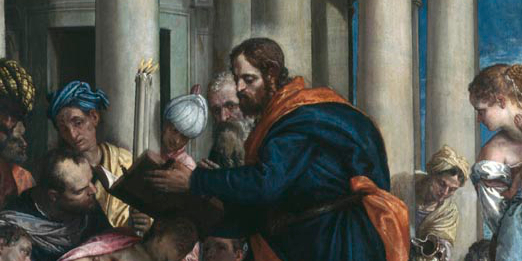
St. Barnabas, Apostle – Pr. Faugstad sermon
Text: Acts 11:19-30, 13:1-3
In Christ Jesus, whose name is above every name, who shares His saving name with us, and who guides and protects us as members of His holy family, dear fellow redeemed:
On Pentecost Sunday, three thousand Jews heard the preaching of the apostles and were baptized. As the apostles continued boldly to proclaim the truth about Jesus, that number grew to five thousand souls. It was a time of beautiful peace and unity. These new Christians shared what they had with one another. Some of them even sold their land and brought the proceeds to the apostles to distribute to the needy.
One of them in particular is mentioned in the fourth chapter of Acts, a man named Joseph. We are told that he “sold a field that belonged to him and brought the money and laid it at the apostles’ feet” (Act. 4:37). This man was a Levite descended from the line of priests, and he was a native of the island of Cyprus in the eastern part of the Mediterranean Sea. He was known for more than his generosity. We learn this by the name the apostles gave him, the name “Barnabas (which means son of encouragement)” (v. 36).
Barnabas was an encourager, a consoler. He was a tremendous supporter of the apostles and a dedicated worker in the church. In today’s reading, he is described in glowing terms as “a good man, full of the Holy Spirit and of faith.” Barnabas was the one who brought Saul to meet the apostles after Saul was converted. Everyone was afraid of Saul, since he had severely persecuted the church. But Barnabas encouraged them to welcome him, and testified to them about Saul’s conversion on the road to Damascus, and how ‘he had preached boldly in the name of Jesus” (9:27).
We can see how highly Barnabas was regarded by the fact that the apostles sent him to Antioch after the Gospel had taken root there. When Barnabas “came and saw the grace of God, he was glad, and he exhorted them all—encouraged them all—to remain faithful to the Lord with steadfast purpose.” The people liked Barnabas. They respected him. Maybe you have a relative like that—someone who was always supportive, or a teacher who motivated you to work harder, or a coach who inspired you to give your best.
You especially appreciate the people who gave you good encouragement along the way. But not all encouragement is good encouragement. The people who encourage you to put yourself first, who encourage you to ignore your conscience, who encourage you to join them in doing what is wrong—these people are giving bad encouragement, bad guidance.
But it isn’t always easy to recognize what encouragement is good and what is bad. Bad encouragement conflicts with the Word of God, but it agrees with our sinful inclinations, our sinful nature. We like hearing the encouragement to do whatever our passions and desires lead us to do. We like hearing the encouragement to follow our own heart, focus on our own plans, and determine our own future.
The encouragement to follow God’s Word, focus on His plan for us, and trust Him to guide us into the future—even if it isn’t the plan and future we wanted—this encouragement is not always welcome. I know as a pastor, I have often thought how much easier it would be if I just encouraged the people I serve to do whatever seems best to them. I wouldn’t have to challenge anyone to change the way they are thinking or to repent of the wrongs they have done. I could just “go with the flow,” and say, “I’m just here to support you being you!”
That would be easier. You know how much easier it is to be the parent or grandparent who says “yes” all the time, instead of being the parent or grandparent who says “no.” But what would the world be like without any “no”?
Barnabas was not just an encourager. He was an encourager of what is good. He encouraged the Christians in Antioch “to remain faithful to the Lord with steadfast purpose,” to love the Lord their God with all their heart, soul, strength, and mind (Luk. 10:27) and to cling to His saving Word of grace. He encouraged them in this way because “he was a good man, full of the Holy Spirit and of faith.”
This good encouragement to remain with the Lord in faith comes from the Holy Spirit. It is the encouragement you receive whenever you hear the Word of God. Those who stop listening to the Word of God open their ears to other things. That’s when bad encouragement starts to sound reasonable, and right is exchanged for wrong. Then ears will no longer hear the good encouragement, and God’s truth sounds strange and even offensive.
The very things that God warns us away from because they cause injury and pain, are the things the world tells us to celebrate and take pride in. And if we challenge those things out of love for our neighbor’s soul, we are accused of being hateful and bigoted. That is discouraging. It is easy to feel discouraged when you know that what you believe and confess is right, but so many around you say it is wrong.
That’s why you and I need the continued encouragement of the Holy Spirit. The name “Barnabas” means “son of encouragement,” and the Greek word for “encouragement” sounds like para’klesis. Jesus used a very similar word to describe the work of the Holy Spirit. He called the Holy Spirit the para’kletos, which means the Helper/ Counselor/ Encourager (Joh. 15:26). The Holy Spirit encourages you by taking what belongs to Jesus Christ and declaring it to you (Joh. 16:14-15).
Today’s reading tells us something very interesting about the disciples in Antioch. It says that because of the teaching of Barnabas and Saul, “the disciples were first called Christians.” What were they called before? When Saul went on his rampage against the Church, he was looking to arrest anyone who belonged to “the Way” (Act. 9:2). That was how believers identified themselves, probably based on Jesus words, “I am the way, and the truth, and the life” (Joh. 14:6).
Now they became known as “Christians”—followers of Christ, those who were baptized into His death and resurrection, who listened to His Word of truth, who partook of the holy food and drink of His body and blood. By the powerful work of the Holy Spirit through the Word, you also are one of those Christians.
You are baptized into Christ, clothed in His righteousness. You are cleansed of all your sins by His holy blood. You are an heir of eternal life by faith in Him. You are a holy one, a saint, one who is set apart by the grace of God. There is nothing more encouraging than to know that your Savior smiles upon you. He forgives you all your sins. He is present through His Word and Sacraments to strengthen you and guide you. He fights for you against the powers of darkness and the temptations of this fallen world. He calls you by His name, which means your future is tied to His future. What an honor to be called a Christian!
But it is not an honor in the world, and it is getting more and more unpopular to be called by the name of Christ. When Barnabas and Saul went on their missionary journey, preaching the good news of Jesus’ saving work, they faced constant opposition and persecution. They wanted to share the greatest, most encouraging message there is, and many did not want to hear anything about it.
Jesus had warned His disciples, “If anyone would come after me, let him deny himself and take up his cross and follow me” (Mat. 16:24). He told them that they would have to suffer for His name. He did not say this to discourage them, but to prepare them. He was encouraging them to stay the course and keep their eyes on the finish line. Again He said, “If the world hates you, know that it has hated me before it hated you…. But all these things they will do to you on account of my name, because they do not know him who sent me” (Joh. 15:18,21).
We Need Good Encouragement, the encouragement of God’s Word of grace. We need to be reminded that all the things of this world will pass away, but the everlasting treasures stored up for us by God will never pass away. Kingdoms rise and fall, rulers come and go. Christian congregations in various locations flourish and diminish, pastors and church leaders come and go, “but the word of our God will stand forever” (Isa. 40:8).
The Holy Spirit called Barnabas to preach and toil and suffer in the name of Christ and then called him to his eternal rest. Tradition indicates that he died a martyr’s death by being stoned in his home country of Cyprus. But through his work, many were encouraged by him, and we still find encouragement from his life of faithfulness. He did not trust in his own work, his own abilities. He trusted in his Savior Jesus. He found his encouragement and strength through the unchanging promises of Christ.
This encouragement he shared with others is the encouragement we share with one another, the encouragement “to remain faithful to the Lord with steadfast purpose.” We do not face the challenges, temptations, and persecutions of the world alone. We face them together in the body of Christ, over which He reigns as our Head.
These persecutions can also be a source of encouragement, because they show we are not of the world; we are of Christ. The apostle Peter writes, “If you are insulted for the name of Christ, you are blessed, because the Spirit of glory and of God rests upon you,” and “if anyone suffers as a Christian, let him not be ashamed, but let him glorify God in that name” (1Pe. 4:14,16).
Glory be to the Father and to the Son and to the Holy Ghost; as it was in the beginning, is now, and ever shall be, forevermore. Amen.
+ + +
(picture of “Barnabas curing the sick” by Paolo Veronese, c. 1566)

The Festival of Pentecost – Pr. Faugstad exordium & sermon
Festival exordium:
Wings. Water. Wind.
The first time we hear about God the Holy Spirit in the Bible is at the beginning of Genesis 1: “In the beginning, God created the heavens and the earth. The earth was without form and void, and darkness was over the face of the deep. And the Spirit of God was hovering over the face of the waters” (vv. 1-2). “The Spirit of God was hovering.” That makes us think of the way a bird hovers in the sky. Fly forward.
After Jesus was baptized, “the heavens were opened to him, and he saw the Spirit of God descending like a dove and coming to rest on him” (Mat. 3:16). Once again, the Spirit was hovering over the waters. Fly forward.
Jesus spoke with a man named Nicodemus and said to him, “unless one is born of water and the Spirit, he cannot enter the kingdom of God” (Joh. 3:5). He spoke about the wind blowing where it wishes, flying wherever it flies, and declared, “So it is with everyone who is born of the Spirit” (v. 8). Fly forward.
Ten days after Jesus’ ascension, His disciples heard a sound from heaven “like a mighty rushing wind, and it filled the entire house where they were sitting” (Act. 2:2). The Holy Spirit did not appear in the form of a dove, but He revealed His presence by the tongues of fire resting on each disciple. They began boldly to preach God’s truth in Jerusalem, and by the end of the day, three thousand souls believed the truth and were baptized. Fly forward.
When you were brought to the baptismal font, the Spirit of God was hovering over those waters. No one could see Him, but He was there with power. “[B]y the washing of regeneration and renewal” (Ti. 3:5), He caused you to be born again. He made you alive in Christ.
He still comes through the powerful Word and Sacraments, not bound by the laws of nature, not confined to space and time. He flies to you with the grace, forgiveness, and peace that are yours through the death and resurrection of Jesus. And He flies forward on His soul-saving, life-changing mission, adding more members to the church of God.
In praise of His magnificent work, we sing our festival hymn—hymn #399, “O Light of God’s Most Wondrous Love”:
O Light of God’s most wondrous love,
Who dost our darkness brighten,
Shed on Thy Church from heav’n above,
Our eye of faith enlighten!
As in Thy light we gather here,
Show us that Christ’s own promise clear
Is Yea and Amen ever.
O risen and ascended Lord,
We wait fulfillment of Thy Word;
O bless us with Thy favor!
+ + +
Sermon text: St. John 14:23-31
In Christ Jesus, whose ascension was the crowning moment of His saving work on earth, and who then sent out the Holy Spirit to distribute this salvation to sinners until the end of time, dear fellow redeemed:
It is very clear to all of you here why you needed God the Son to take on human flesh. You know that you are a sinner, and that you could not satisfy your debt to God. You needed Jesus to take your place, keep the holy Law for you, and die on the cross for your sins. But why was it so crucial that Jesus return to His Father? And why did the Father and the Son need to send out the Holy Spirit?
Jesus said to His disciples, “If you loved Me, you would rejoice because I said ‘I am going to the Father.’” That does not seem like cause for rejoicing. Why would they rejoice when their great Teacher left them? He left them to suffer and die on the cross to make atonement for all sin. He had to go alone, because no one but Him could endure the wrath of God against sin. No one but Him could make peace between God and mankind.
When that work on the cross was complete, Jesus cried out, “Father, into your hands I commit my spirit!” (Luk. 23:46). And the Father received the spirit of His Son. He accepted His Son’s sacrifice. We know He accepted it, because He raised Jesus from the dead on the third day. Jesus’ state of humiliation and suffering had ended. Now all authority in heaven and on earth were given to Him (Mat. 28:18), and He ascended to the right hand of His Father in the flesh.
Since salvation had been won, it was time for these glad tidings to be distributed. Ten days after His ascension, Jesus made good on His promise to send the Holy Spirit. Suddenly the disciples, common men from Galilee, could speak in languages they had never known before. They now stood up and spoke, not to draw attention to themselves, but to draw attention to Jesus and what He had done for all sinners.
And the Holy Spirit did more than give the disciples the gift of multiple languages. Through the Word they preached, the Holy Spirit was also giving the gift of faith to those who listened. We are told that the people “were cut to the heart” when they heard what was said. They did not realize that Jesus was more than a prophet. Now they knew they had crucified the Son of God, and that death could not keep Him in the grave. After what they had done to Him, how could they expect Him to be merciful toward them? “Brothers, what shall we do?” they cried.
And Peter said, “Repent and be baptized every one of you in the name of Jesus Christ for the forgiveness of your sins, and you will receive the gift of the Holy Spirit.” That sounds simple. All they had to do was say they were sorry for their sins and claim to have faith in Jesus, and the gift of the Holy Spirit would be theirs. But that’s not really what happened. It was not a cause and effect. It was not, “They do their part, and God does His part.” God did it all.
I guarantee that none of the people who were baptized on Pentecost Sunday woke up that day thinking, “It’s about time I admitted that I was wrong about Jesus. I should just believe that He is the eternal Son of the Father who died and rose again, and I should be baptized in the name of the Triune God.” It was the Holy Spirit who led them to repentance and faith and who prompted them to be baptized. All of it was gift; none of it was earned.
The same is true for you. You did not choose to be a believer in Jesus. Your parents or others brought you to the baptismal font and to church where the Holy Spirit worked faith in you. God had to do this work for you, because you were dead in your sins. An unholy person cannot make himself holy. Martin Luther put it this way, “If you yourself were holy, then you would not need the Holy Spirit at all; but since we are sinful and unclean in ourselves, the Holy Spirit must perform His work in us” (Luther’s Works, Vol. 24, p. 169).
That’s why Jesus said, “Peace I leave with you; My peace I give you; not as the world gives do I give to you.” The world says the kind of peace you want to aim for is peace among nations and communities or an inner peace and calmness. But these kinds of peace are not permanent. The peace that Jesus left with us is the peace of His atoning death which reconciled us with our perfect heavenly Father. This is the peace the Holy Spirit imparts to us through the Word and Sacraments—the peace of sins forgiven, of eternal life secured, of a temporary rest in the grave before the resurrection of the body on the last day.
The Holy Spirit brings you what you cannot get anywhere else. He brings you the gifts of God. But He doesn’t send these gifts directly from heaven to your heart like a bolt of lightning, or through a feeling you have that He is near. He brings you the gifts of God through the Word of God. Jesus says, “If anyone loves Me, he will keep My word; and My Father will love him, and We will come to him and make Our home with him.” That is why we come to church and have devotions at home, because it is through the Word that God comes to dwell with us.
And it is through the Word that God teaches us the truth and comforts us. Jesus said that the Holy Spirit “will teach you all things and bring to your remembrance all things that I said to you.” Unless you have learned “all things” that God has to teach you, you still need to be a student in the school of the Holy Spirit. Unless you are perfectly holy, you still need the Holy Spirit to sanctify you through the Word.
And the Holy Spirit is glad to do this work. He is glad to take the forgiveness and life won for you by God the Son and apply it to you. He is glad to bring you comfort in your distress. He is glad to strengthen your faith in trials. He is glad to guide you on the path of righteousness. He is glad to prepare you for eternal life in heaven.
You can see how important the work of the Holy Spirit is. Without His work, we would have no faith. We would be without hope and without God in the world (Eph. 2:12). We would live for a short time and die and be dead forever. God the Father and God the Son sent out God the Holy Spirit at Pentecost, so that everything Jesus accomplished according to the gracious will of His Father would be applied to sinners.
You and I are some of those sinners, sinners who deserve God’s wrath for our sins, who deserve eternal punishment in hell. But what we have received instead is the cleansing blood of Jesus that washed away all our sins. We have received His righteousness that makes us acceptable to the Father. We have received His mercy and peace and goodwill. By the power of the Holy Spirit through the Word, we have received all the fullness of Christ’s redemptive work, grace upon grace (Joh. 1:16).
This is why we rejoice today. This is why Pentecost is such a pivotal day for the church. This is the day that all the gifts Jesus won for sinners came pouring out of heaven like stores of grain for the hungry, like waterfalls for the thirsty, like rain on parched earth. “Come, Holy Spirit, and fill the hearts of Your faithful people, and kindle in them the fire of Your love.”
Glory be to the Father and to the Son and to the Holy Ghost; as it was in the beginning, is now, and ever shall be, forevermore. Amen.
+ + +
(picture from Saude Lutheran Church stained glass)
The Third Sunday of Easter – Pr. Faugstad sermon
Text: St. John 10:11-16
In Christ Jesus, who is constantly seeking after lost sheep to bring them into His holy flock of believers, dear fellow redeemed:
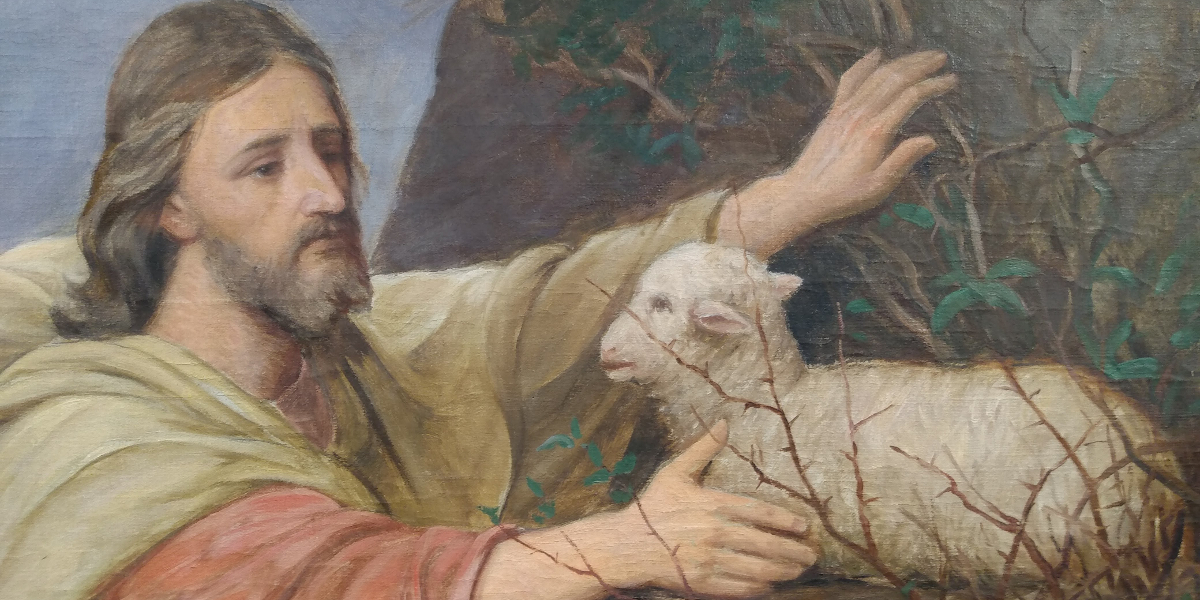
If you search online for “Good Shepherd paintings,” you will find depictions of lambs being carried on Jesus’ shoulders, held in His arms, led by Him to pasture and water, and rescued by Him. The Saude altar painting shows the Good Shepherd rescuing a lost lamb. What you never see in these paintings is the sheep taking charge, blazing their own trail, and conquering their enemies. That is not something sheep do—or if they try, they don’t do it very successfully.
Domestic sheep require constant care and protection. They are quite vulnerable to predators and are prone to wandering. But they are also very loyal and are able to discern the difference between their shepherd’s voice and the voices of strangers. In these ways, little lambs are something like little children.
Children come into the world through the union of a man and a woman, because God wants every child to have the care and protection of a mother and a father. Little children often don’t recognize the dangers around them. They try to touch things that are too hot or too sharp. They want to go exploring on their own and climb on things that are too high. So their parents (or their siblings) keep a close eye on them: “Don’t touch that!” they say. “Come back!” “Get down!”
Do children listen? Sometimes yes and sometimes no. You have probably seen the look in a child’s eyes when he hears his parents say something, but he wishes he hadn’t heard it, and he acts like he didn’t hear it. So a parent says, “Did you hear what I said? Listen to me!” That listening is important. It keeps children safe. It teaches and guides them.
Children who will not listen to their parents will bring harm on themselves and distress and sadness to those who care for them. But children who do listen to their parents learn early on the difference between what is good and bad, right and wrong, safe and unsafe. Children who listen grow in wisdom and knowledge. They bring joy to their parents.
The same goes for you and me before God. We are His children. He made us and continues to provide for us. He sent His only Son to redeem us, so that we would be adopted into His holy family. Our primary responsibility as His children is to listen to what He says. The apostle Peter wrote, “Like newborn infants, long for the pure spiritual milk—the Word of God—, that by it you may grow up into salvation” (1Pe. 2:2). And Jesus says, “My sheep hear my voice, and I know them, and they follow me” (Joh. 11:27).
The shepherd does not follow the sheep; the sheep follow the shepherd. The sheep do not tell the shepherd what to do; they listen to what he tells them. Just as it is not right for children to be disrespectful to their parents, to question everything they say, or to blame them for all their problems, so it is not right for the sheep—for you and me—to act like this toward God. We do not have the power and the authority; He does. We do not know what is best for ourselves; He does.
That is difficult for us to accept. When we are giving in to our passions, going a direction we have been taught to avoid, doing things we have been told not to do, we feel like we are in control. “I can make decisions for myself!” we think. “It’s my life! No one can stop me from doing what I want!” We learn the hard way that the path of sinful indulgence is not where we find fulfillment and happiness. It is where we find pain and heartache, and where we receive deep cuts and wounds that don’t heal easily.
The young woman who gives herself to one boyfriend after another hoping that the latest relationship will last, knows this to be true. So does the young man who has taken the bait of pornography and is now helplessly stuck on the hook. They thought they could give up part of themselves to get what they wanted. They thought they could maintain control. But their sin controls them. And now they wish they could get everything back that they gave up.
What does a little lamb do who has gotten himself or herself into a thorny situation, who doesn’t know where to turn? That little lamb does the only thing it can do. It cries out for help. It sends out a mournful, desperate cry right from the heart. That’s what we do when our conscience is troubled, when guilt gnaws inside us, when we find ourselves in a difficult situation that we can’t find our way out of. We cry for rescue and deliverance. And the Good Shepherd hears that cry. “I know My own,” He says.
A mother can hear her child’s cry from the other side of a room full of people. Jesus not only hears your cry, He knows your pain before you express it. He knows exactly how to help before you even open your mouth. That is how well He knows you. That is how much He cares for you. But you already know this about your Good Shepherd, because you know what He gave up for you. “The Good Shepherd lays down His life for the sheep.”
Even though you and I have tested God’s patience again and again by our sinful choices, even though we have wandered so far away from Him that we could no longer hear His voice, even though we can hardly imagine why He would want us, the Good Shepherd willingly gave up His life for us. In His eyes, we were worth saving. We were worth the anguish and thorns and piercing of the nails. We were worth the righteous wrath of God and the fires of hell.
Jesus stepped between us and the wolfish devil, the one who is constantly tempting us to sin and then torturing us for committing it. Jesus let all accusation come upon Him. He took the place of us sheep who love to wander and made all our transgressions His. He paid the debt that we owed God for breaking His Commandments by our actions, words, and thoughts.
The cold jaws of death fastened around Jesus instead of us. But how could the sheep survive without the Shepherd? The night of His arrest, Jesus quoted this Old Testament passage about Himself and His followers, “I will strike the shepherd, and the sheep of the flock will be scattered” (Mat. 26:31). What a terrible outcome! But then Jesus added these stunning words, “after I am raised up, I will go before you to Galilee” (v. 32).
“After I am raised up….” What an amazing prediction! Immediately following today’s Gospel reading, Jesus said the same thing, “I lay down my life that I may take it up again. No one takes it from me, but I lay it down of my own accord” (Joh. 10:17-18). The death of the Good Shepherd would not mark the end of His care for the sheep. He rose from the dead in triumph to demonstrate that nothing could stop His love for His sheep—not even death (Rom. 8:35-39).
You were brought into His care and became His little lamb when you were baptized. He took you up in His arms like He did those little children so many years ago and He blessed you. He washed away all your sins in His blood. He made you spotless like the bright wool of a lamb, clothing you in His righteousness. He rescued you from the darkness of sin and death where you had gotten utterly lost, and He brought you into His kingdom of light and life.
And what does He ask of you? Only that you listen to His voice and hear His comforting and saving words. “If you abide in my word, you are truly my disciples,” He says, “and you will know the truth, and the truth will set you free” (Joh. 8:31-32). To listen to Jesus is to have truth and life and freedom. To ignore Him is to become prey to the devil’s lies and death.
Listening is hard for us little lambs, us little children, because we like to do things that are bad for us. None of us listens perfectly. We sin all the time. But Jesus keeps calling out to us, calling us back to His care and protection. That call goes out every time you attend divine service and open your Bible or devotion book for study at home. “Come to me,” Jesus says, “and I will give you rest” (Mat. 11:28).
He calls you to the green pastures and still waters of His Word and Sacraments. He invites you to eat and drink for your fulfillment and strength. He trains you to listen better and follow Him more closely. This happens all through your life. You never get to the point where you are strong enough to set out on your own. You always need your Shepherd’s care.
To keep you in His care, your Lord has given you under-shepherds, who speak nothing more or less than what He has spoken. The way to tell the difference between a faithful pastor and a hired hand is to compare what each one says with what Jesus says. My call as your pastor, your shepherd in this place, is to pay careful attention to myself and to all the flock, in which the Holy Spirit has made me an overseer, to care for the church of God, which He obtained with His own blood (Act. 20:28).
My call is to remind you that You Are Jesus’ Little Lamb. You need His forgiveness. You need His guidance. You need His constant protection as you walk through the valley of the shadow of death. He brings all these blessings to you through His powerful Word. “My sheep hear my voice,” He says, “and I know them, and they follow me” (Joh. 11:27).
Glory be to the Father and to the Son and to the Holy Ghost; as it was in the beginning, is now, and ever shall be, forevermore. Amen.
+ + +
(picture from Saude Lutheran Church altar painting)

The Second Sunday in Lent – Pr. Faugstad sermon
Text: St. Matthew 15:21-28
In Christ Jesus, who judges us not by what we accomplish in our faithfulness, but by what He has done for us in His mercy, dear fellow redeemed:
I have never heard a Christian say, “I wish my faith were weaker.” Every Christian wants to have a stronger faith, a faith that will stand firm in temptation, that will endure in difficult times, that will shine brightly through this life until we reach eternal life. Today’s reading gives us an example of a faith like this, a faith that Jesus Himself describes as “great.”
The people in Jesus’ day might have expected “great faith” to be found among the religious leaders like the scribes and Pharisees. Or maybe they would have looked to the dedicated priests serving day and night in the temple. Or they might have thought that the twelve disciples hand-picked by Jesus were the best examples of faith.
None of these things was the case. Just before the events of today’s reading, Jesus called the Pharisees “blind guides” (Mat. 15:14), indicating that they had no faith at all. At least twice He cleared the temple courts of those who were buying and selling there, showing that the priests were negligent in their duty. And several times He rebuked the disciples for their “little faith” (Mat. 8:26, 14:31, 16:8, 17:20), when they failed to put their trust in Him.
Jesus’ announcement of a great faith comes from a most unlikely source—a Gentile woman living in the pagan territory of Tyre and Sidon. Now we live in a time when everyone wants to assert his or her “rights.” “I have the right to this” and “the right to that,” and “if I don’t get what I think I deserve, I’ll be taking names and calling my lawyer!” This is not how the Canaanite woman approached Jesus.
She did not come with a power play trying to impress or intimidate Him: “I know people in high places.” She did not try to convince Him why she was worthy of His help: “I do what I can for my neighbors. I give to charity. I’m a good person.” No, she came looking for mercy. Mercy does not depend on a person’s own position or good qualities. Mercy depends on the one who has the ability to help. Mercy can’t be taken; it has to be given.
“Have mercy on me, O Lord, Son of David” cried the woman; “my daughter is severely oppressed by a demon.” And she didn’t just say it once. The form of the Greek word indicates that she kept crying out. She wouldn’t stop. This makes sense since the disciples soon came to Jesus and were begging that He send her away. So much for Jesus taking time to rest—first the woman came crying to Him and now the disciples kept complaining too!
Why didn’t Jesus just help her? Well why should He? He was a Jew sent to save the people of Israel. He told His disciples, “I was sent only to the lost sheep of the house of Israel.” The woman didn’t deny this. She called Him the “Son of David.” She knew where He came from. But she did not believe that disqualified her from receiving His help. What made her so certain? What is it that she based her hope on?
The very words of Jesus that seemed to disqualify her were the words she held tightly to and wouldn’t let go. Jesus said, “It is not right to take the children’s bread and throw it to the dogs.” We don’t know how Jesus said this whether gently or harshly. But how many of us would stick around if He said this to us? The Canaanite woman didn’t budge, and she didn’t try to contradict Jesus. She completely accepted what He said: “Yes, Lord, yet even the dogs eat the crumbs that fall from their masters’ table.”
Do you see what she did? She pinned her hopes to the very words of Jesus that seemed to shut her out. She agreed that bread should not be taken away from the children of Israel. Jesus was the “Son of David,” the King of the Jews. But if there was plenty of bread for the children, which she wholeheartedly believed, then certainly there must be some crumbs for the dogs. “Oh to be a dog that could eat those crumbs—what a privilege that would be!” she said. This is when Jesus declared, “great is your faith!” and granted her request, the healing of her daughter.
So what are some of the characteristics of this woman’s faith? She did not appeal to her own worthiness, but came pleading for mercy. She did not give up, but kept crying to Jesus for help. She did not take offense when Jesus seemed to turn His back on her. She held Him to His Word, even when it appeared the door was closed. We can learn a lot from her example. But the biggest lesson is not gained by looking at her. The biggest lesson is looking where she looked.
Her eyes were on Jesus the whole time, not on herself. And when she walked away from Him, she didn’t go away thinking how strong her faith was. She walked away thinking how merciful her Savior was. The greatest error we make in pursuing a strong faith is looking inside ourselves to make it happen. We can think to ourselves, “I need to be more patient, more trusting, more accepting of God’s will, more dedicated to His Word.” And those things are certainly true.
But our faith will never get stronger because of what we do. Faith gets stronger because of what God does. The Bible says, “faith comes from hearing” (Rom. 10:17), which means passively receiving what God gives, not doing something to get it. Ephesians 2:8-9 says, “For by grace you have been saved through faith. And this is not your own doing; it is the gift of God, not a result of works, so that no one may boast.” In our Catechism we confess the truth that “I cannot by my own reason or strength believe in Jesus Christ, my Lord, or come to Him; but the Holy Ghost has called me by the Gospel, enlightened me with His gifts, sanctified and kept me in the true faith” (Explanation to the Third Article of the Creed).
If you want a stronger faith, it’s not going to come because you try harder or stay more focused on doing what is right. A stronger faith comes when you stop looking inside yourself where you will only find worry, doubt, and pride. Faith increases when you forget yourself and keep your eyes fixed on Jesus only.
That is what we do at the Divine Service each week. We don’t come thinking about what we can do for God, or making appeals for His help because of how good we have been or how worthy we are. We come with the cry, “Have mercy on me, O Lord, Son of David!” We beg for His mercy because we know we can’t live without it.
We remember how easily we have been led to doubt God’s Word at the slightest challenge we have faced. We think of how impatient we have been in suffering, and how quickly we have given up on prayer. We know how ready we were to question God when He did not give us exactly what we wanted and on the timetable we expected it.
But even though the devil tries to convince us that Jesus has turned His back on us, that Jesus doesn’t care, this is nothing but a lie. Today’s reading shows us that when Jesus seems to be uninterested in our troubles, that is only how it seems. Jesus did not fail to help the woman who put her trust in Him, and neither will He fail you.
When you come to Him looking for mercy, He shows you His cross. That is where mercy shines most vividly. That is where God the Father proved His mercy toward you by punishing His innocent Son for your sins instead of you. Jesus willingly did that for you. He went to the cross, so that all your worries, doubts, and pride would be atoned for. He went there so that no matter where you come from and no matter what you have done, you would be presented holy and righteous before God the Father by faith in Him.
This same Savior now gives His own body as your food and His own blood as your drink. He has not forgotten about you. He has not forsaken you. You would gladly have the crumbs that fall from His table, but He freely gives Himself for you to eat and drink in abundance. It is His presence through His Word and Sacrament that strengthens your faith. It is His presence that brings you healing and eases your burdens. It is His presence that increases your love toward God and your neighbor.
You have nothing to offer God that isn’t already His. The world is His! You are His! But He has everything to give you. Keep your eyes on Him like a child waiting for his birthday present or a dog eagerly anticipating his treat. He has given His gifts to you before, and He promises to keep giving them. Like the Canaanite woman did, you can trust His promises. Even if everyone else rejects you and you feel totally alone, Jesus does not reject you. Your cries for mercy will not go unanswered. You will not leave empty-handed. Your faith in the Lord Jesus will not be disappointed.
Glory be to the Father and to the Son and to the Holy Ghost; as it was in the beginning, is now, and ever shall be, forevermore. Amen.
+ + +
(picture from 15 century French Gothic manuscript painting)

Sexagesima Sunday – Vicar Anderson sermon
Text: St. Luke 8:4-15
In Christ Jesus, who sows the Seed of the Word of God for all to hear, sowing forgiveness and grace in you, dear fellow redeemed:
Living in Iowa, there is one part of the scenery that I have gotten used too. The land is flat, and since it is flat, there will be corn. Miles and miles of corn. Jesus’ parable is very straight forward and knowing these congregations, you should hear Christ speaking directly to you. This message is very fitting. You know what it takes to get that corn to grow. The field has to be tilled. The rocks have to be picked out of the field and thrown to the side. The field has to be treated so that the weeds don’t attack and kill the baby corn stalk. Lastly, you pray to God for rain and look expectantly for it to grow. Jesus has designed this parable for you. Now as you are the sowers of your fields, in our text we see Jesus, the sower of the Word. Jesus warns us how the Word is under threat. He teaches that this is not just a parable of categories and where you fit in. Jesus is teaching us the truth that we can’t grow His Word on our own. We have to rely on him.
Jesus uses imagery that easily sticks in our minds. The parallels are very easy to spot. Pesky birds fly down and eat the seeds on the road. The Devil is a hunting lion stalking his prey and ready to strike. He is constantly working to make those who hear the Word reject it. The seed is eaten with almost no chance for it to ever come back. The seed can be planted multiple times and a person can reject it every time. Where the field’s edge sits, the rocks are thrown. The Word is believed and quickly forgotten. Many people love how the Word can be refreshing and comforting. But when the troubles and absolute hard times put us on our knees, those refreshing words can be tossed aside because what can they do to help me now?
Where weed killer isn’t used, the thorns grow. When God’s Word isn’t active, then faith is choked out. Jesus shows the crowd how easily the pleasures and riches of world can be those temptations that make faith wither. They saw the life He was living, yet they looked at all of their possessions and they did not want to give them up. The good fruit that comes from the Word is twisted into fruit selfishly used for oneself.
Did you hear yourself in any of those categories? A misconception of this text is to think that this text only applies to the world and not to those who believe. Most of the time if not all of the time we will consider ourselves in that field, holding onto the Word and yielding a hundredfold. A key verse to think about is when Jesus called out, “He who has ears to hear, let him hear.” How often do we let the Word of God go in one ear and out the other ear? We hear; honor your parents, honor authority, don’t covet, don’t look at someone with lust, whoever hates his brother is a murderer. When we sin, we are rejecting God’s Word and Satan lies in wait.
Jesus tells his disciples that, “To you it has been given to know the secrets of the kingdom of God, but for others they are in parables, so that ‘seeing they may not see, and hearing they may not understand.’ Jesus has given us the understanding of this parable. But like the unbelievers, who can harden their hearts again and again, we also can harden our hearts. We cave to the pressures of the world and fail to live our Christian lives. We sin often which puts us under intense scrutiny. The more that we behave like the unbelievers do, the more we let God’s Word drift away.
When we are not listening to God’s Word, our faith will not grow. And if we set aside the Word long enough, our faith will die out. God says to rely on him, yet the pleasure of this life, the pleasures of our sins make us feel so good. It might not even be the pleasures of life either. We might ignore the comfort that Word brings in the hardest times in our lives. The budget might be tight, we begin to worry that God is not providing for us. Just because we have ears, doesn’t mean that we actually hear and learn. As we get caught up in our sins and problems, Jesus’ parable does point to a solution. The question to be answered is, why is Jesus so concerned that we listen to what He says? Why should we listen?
The reason that Jesus is so concerned about us listening to Him is because He is the one who is sowing the seed. “God desires all people to be saved and to come to the knowledge of the truth” (1 Timothy 2:4). The truth is taught to us in the Word of God. The Word of God is a Means of Grace. It brings forgiveness of sins, life and salvation. The Word shows us that Christ is the one who saves us. It teaches how He died on the cross, taking away our sins, and rising from the dead. Why should we listen? This is how Christ comes to us. He comes to us directly in His Word. He doesn’t hide himself. This is where we find understanding. It’s not in what the world has to offer. We find it in the Word.
With your ears you hear that the Word of God is powerful and effective because it is how Jesus comes to you. Your sins are many and there are many times that you have failed to listen to God’s Word. You can’t grow the seed, but when you acknowledge that you have sinned against God, it is Jesus’ Words that you hear when the pastor says to you “I forgive you all your sins.” That word of absolution works powerfully within you. Jesus sows His forgiveness and grace in you. He takes and not only plants the seed, He waters it and He makes it grow. The Word brings you assurance. Your sins are not attached to you.
As you grow in the Word, it provides you with strength and comfort when the temptations come and the thorns grow. This is how you know that you are in the good soil. Jesus says, “as for that in the good soil, they are those who, hearing the word, hold it fast in an honest and good heart, and bear fruit with patience.” Jesus planted His Word in you and made your heart into good soil.
Holding fast to the Word of God, the honest and good heart is revealed. It is nurtured by Christ. We know that by nature our hearts are sinful. The heart is against God all the time and knows can’t rely on itself. But Christ comes to our hearts through the Word and dwells in us. With growing and patience in God’s Word, Jesus produces fruit in us, fruit that is shared with those around us.
Jesus teaches with this parable that the Word is not going out only to believers. After hearing God’s Word, and hearing how plainly the truth is taught, some people will still reject it. This is a sad truth and an all too familiar one. But knowing that the truth is rejected does not stop us from sharing it. We want people to hear how their salvation has been won. The Gospel has the power to change hearts. The Law reveals that we are fallen people. We needed to be redeemed. The Gospel proclaims the truth, that we are saved by faith alone. The Word brings us comfort and joy as we continue to grow in it.
As the Word works, we see how powerful it is. The Word is powerful through the working of the Holy Spirit. This is what we confess in the third article of the Apostle’s Creed. We can’t increase our faith on our own. It is the Holy Spirit who calls us by the Gospel. He opens our ears so that we hear the saving message. He is the reason we keep our faith. Not only does He keep us in the true faith through the preaching of the Word but He keeps the whole Christian Church on earth with Jesus Christ in the one true faith. The Word is working throughout our entire life.
The spring and fall are the two seasons that are looked on with great anticipation. It is the time for seeds to be planted and for them to rise up for harvest. Thankfully the Word of God does not work in seasons. The Word continues to work when we are in it, exploring, and hearing all that God has done for us. As we learn and hear His Word, Jesus comes to us. The world wants a personal Christ. He doesn’t get more personal than in His Word. We hear the comfort that He brings us which helps us through our trials and temptations. The Word of God tells us what Christ has done. The Word keeps us strong in our faith. The Word grows our fruit, fruit that is meant for the world. A testimony of Christ’s constant love to the world that comes from hearing the Word of the Gospel. “He who has ears to hear, let him hear.” Amen.
Glory be to the Father and to the Son and to the Holy Ghost; as it was in the beginning, is now, and ever shall be, forevermore. Amen.
+ + +
(picture from Hortus Diliciarum, a book compiled by Herrad of Landsberg in the 12th century)