

The Twelfth Sunday after Trinity – Pr. Faugstad sermon
Text: 2 Kings 5:1-15
In Christ Jesus, who through His own flesh delivered the eternal cure for our sin and death, dear fellow redeemed:
If you think of the stories of King Arthur’s brave knights or perhaps of the courageous heroes in modern war movies, you can get a sense of Naaman, the commander of the army of the king of Syria. He is described as “a great man with his master and in high favor” and as “a mighty man of valor.” He was a man’s man, bold, and strong. We can suppose that he wasn’t afraid of anyone, that he never backed down from a fight. Wherever the danger was greatest or the odds were most against him, Naaman went forward.
And Naaman won. He was held in high esteem by his master because he was so successful. A ruler cannot be effective without loyal and capable men around him ready to carry out his orders. But neither the king nor Naaman realized where their success came from. We learn in today’s reading that “the LORD had given victory to Syria.” Syria’s strength was part of the LORD’s plan. And so was Naaman’s leprosy. Leprosy was a serious and debilitating skin disease. Naaman had probably prayed to his own gods for relief and healing, but none came. It bothered him enough that even his servants were aware of his struggle.
We don’t expect to see weakness in our heroes. We’re surprised when our nation’s leaders get sidelined by the cold or flu, or when elite athletes pull a muscle and have to take time off. These instances are good reminders that the people we look up to are human also. Because of sin in the world, hardships come on the strong and the weak, the wealthy and the poor, the famous and the obscure. This also teaches us that the people who seem to have it all probably have troubles and pains that we wouldn’t want to touch with a ten foot pole.
So Naaman, who knew military strategy, who knew his way around a battlefield, had been outflanked by a skin disease. He had no answer for it; he couldn’t beat it. It was going to kill him. And now we see the LORD’s strategy in play. Through a little girl who was carried away from Israel and made a slave in Naaman’s house, the LORD made Naaman aware of a prophet in Israel. The little girl confidently told Naaman’s wife that this prophet “would cure him of his leprosy.”
If Naaman’s skin disease did not bother him very much, he would have ignored what the little girl said. What would a Syrian commander want with an Israelite prophet! But that was not his response. He took the message to his king—as farfetched as it sounded—, and the king sent Naaman to Israel with a letter and a load of gifts. Naaman was willing to try even this if it meant he could be healed.
When he was sent to the house of the prophet Elisha, what Naaman expected was that he would have the opportunity to make the case for why he should be healed. Or perhaps he thought he would flatter the prophet and impress him with the gifts he had brought. Certainly it wasn’t every day that Elisha had such esteemed visitors come to his door with all their horses and chariots.
But Elisha was not impressed by these things. He was nobody’s tool but the LORD’s. When Naaman arrived, Elisha didn’t even come out of his house to greet him. He sent a messenger with simple instructions: “Go and wash in the Jordan seven times, and your flesh shall be restored, and you shall be clean.” This is not at all what Naaman expected. In fact, he found it very offensive. The prophet wouldn’t even speak to him directly?!? He was supposed to wash himself in the dirty waters of the Jordan River?!? No thanks.
Many people make the same judgment about the Christian Church. “If Christianity were true,” they think, “and if the Christian God is supposedly a God of love, then why wouldn’t He come and make the problems in the world go away? Or if He truly cares about His people, why wouldn’t He at least make their troubles go away?” When told about the basics of the Christian faith, they say, “How can regular water make me a child of God? How can eating bread and drinking wine be a Communion with the body and blood of Jesus? How can these simple things bring salvation?”
Looked at from the unbeliever’s perspective, we can see how strange this all seems. We don’t have anything like Naaman expected—someone waving his hands and saying the magic words and all our troubles disappear. How could washing in the Jordan River seven times do anything good? People expect that salvation should be harder to come by. Shouldn’t we have to do something to be saved? “If it sounds too good to be true, it probably is.”
Initially, Naaman rejected the Word. He drove away in his chariot angry, perhaps thinking thoughts of war against Israel for treating him like this. Then his servants meekly approached and said, “Did you not hear what the prophet said? Has he actually said to you, ‘Wash, and be clean’?” So Naaman consented. He went down to the Jordan and dipped himself “according to the word of the man of God” once, twice, up to seven times—the number for perfection, holiness. And what happened? The flesh that was infected with leprosy “was restored like the flesh of a little child.” He was clean.
Now bold Naaman, mighty Naaman, Naaman the conqueror returned to Elisha’s house and said, “Behold, I know that there is no God in all the earth but in Israel.” What had changed him? Was it the water? Did it have some special quality that when applied resulted in healing? No, it was the Word of the Most High God. The Word attached to the water brought healing to Naaman. The Word brought faith to his heart.
Naaman had been conquered by the LORD’s Word, and he didn’t even see it coming! Many other enemies of the LORD have also been conquered by Him and brought into His kingdom in the same way. You were one of them. Like Naaman, you had something like a disease clinging to and afflicting you, a disease for which you had no cure. It was worse than leprosy; it was sin.
People try all sorts of remedies for this: trying to do enough good to cancel out their bad, pointing to the worse failures of others to make themselves look better, even arguing that what used to be considered sinful isn’t really sinful anymore. But we can’t escape it. The sin of Adam has been passed along to us, and this sin has captured our hearts. Ignoring this infection doesn’t make it go away; it only makes our condition worse. So what can we do to make our condition better?
Jesus says, “There is nothing that you can do. But there is something that I can do.” The Son of God took on our weak human flesh, so that He could reverse the fortunes of Adam’s line. He came to bring salvation to us who were sick, and life to us who were dying. For the official beginning of His public work, Jesus stepped down into that same dirty river as Naaman had some eight hundred years before, and He was baptized by John “to fulfill all righteousness” (Mat. 3:15).
At His Baptism, your sin was poured over Him, and He carried that sin all the way to His death on the cross. His death on the cross was the cure for your sinful condition. It was the remedy for the Fall of all mankind. The perfect Son of God made full satisfaction for all your sins against the holy God. By His death and resurrection, He declares you righteous and pure in God’s sight.
To make sure that you know this righteousness is for you, He has sent messengers to tell you. Your parents brought you to the baptismal font, where you received “the washing of regeneration and renewing of the Holy Spirit” (Ti. 3:5), so that like Naaman, you were made new, “like the flesh of a little child”—born again by water and the Word. It was a perfect cleansing, removing all your sin from you, and placing Jesus’ righteousness over you. At your Baptism, God gave you a tremendous gift. And since that time, your parents and sponsors and fellow believers and pastors have reminded you about this gift.
The humble appearance of Baptism makes some think it is powerless. It’s like Naaman stating that there must be better options for bathing than the Jordan River. But where Jesus’ Word is spoken according to His promise, there is power—life-giving, heart-changing power, the power to heal and save. Today’s Holy Gospel presents an excellent example of the power of His Word (Mar. 7:31-37). Jesus said, “Ephphatha—Be opened,” and the deaf and mute man was healed.
The Word attached to the water of Baptism is what brought you healing and salvation from the LORD. You return to these waters every time you repent of your sins and cast off the things that hinder your faith in Him. Like mighty Naaman humbly obeying the Word and dipping his leprous skin in the water, you and I bring our sins to God, but not only our sins. We bring our weaknesses and strengths, our past and our present, our worries, struggles, and pain, our abilities, our dreams, and our plans, our imperfect hearts and minds. We bring them all to the cleansing waters of Christ and drown them all in faith.
We want everything we do to be washed in Him, to flow from Him, to be sanctified through Him. We need Him to guide our thoughts, words, and actions. We need Him to carry us and keep us true to Him, so that we are not misled by other gods that cannot save. His method for keeping us faithful is not what we expect—the proclamation of His Word and the administration of water, bread, and wine with His promise. These are the powerful means that bring us His forgiveness and salvation, that conquer and cleanse our sinful hearts.
Glory be to the Father and to the Son and to the Holy Ghost; as it was in the beginning, is now, and ever shall be, forevermore. Amen.
+ + +
(picture from Saude Lutheran Church stained glass)
The Eighth Sunday after Trinity – Pr. Faugstad sermon
Text: 1 Kings 12:26-33
In Christ Jesus, who faithfully carried out His work of redeeming love for the salvation of our weak and sinful hearts, dear fellow redeemed:
For seven years, King Solomon built a beautiful temple in Jerusalem. Its dimensions were estimated to be 90 feet in length, 30 feet in width, and 45 feet in height. The walls and floors were lined with boards of cedar and cypress. Intricate carvings were made in the wood, and then the wood was overlaid with pure gold. The Holy Place and the Most Holy Place were built within the temple. The Most Holy Place is where the Ark of the Covenant of the LORD was kept. When the Ark was brought into the temple, the LORD came in a cloud, and His glory filled the temple (1Ki. 8:10-11).
The LORD was pleased with Solomon’s faithful work. He told Solomon that if he would walk “with integrity of heart and uprightness” as David had and would follow His Commandments, then Solomon’s throne would be established over Israel forever (1Ki. 9:4-5). But He warned that if Solomon turned aside from following Him and followed other gods, his great kingdom would crumble, and even the temple would become a heap of ruins.
As the chronicle of Solomon’s life continues, we learn that he took for himself 700 wives and 300 concubines. When he was old, these wives who came from foreign lands turned his heart away from the LORD to serve their gods. Solomon built altars to their gods and joined his wives in worshipping them. So the LORD raised up adversaries against Solomon, one of whom was a man named Jeroboam. This is the Jeroboam we hear about in today’s reading.
When Solomon died, his son Rehoboam began to reign in his place. And when the people from the northern tribes of Israel asked Rehoboam to be more merciful than his father Solomon had been, Rehoboam listened to bad advice and said that he would be much harsher than his father had been. So the people in the northern tribes of Israel rebelled against Rehoboam and decided to make Jeroboam their king. This all happened according to God’s will because of Solomon’s unfaithfulness. The LORD told Jeroboam that if he would be faithful to Him, his kingdom would be firmly established.
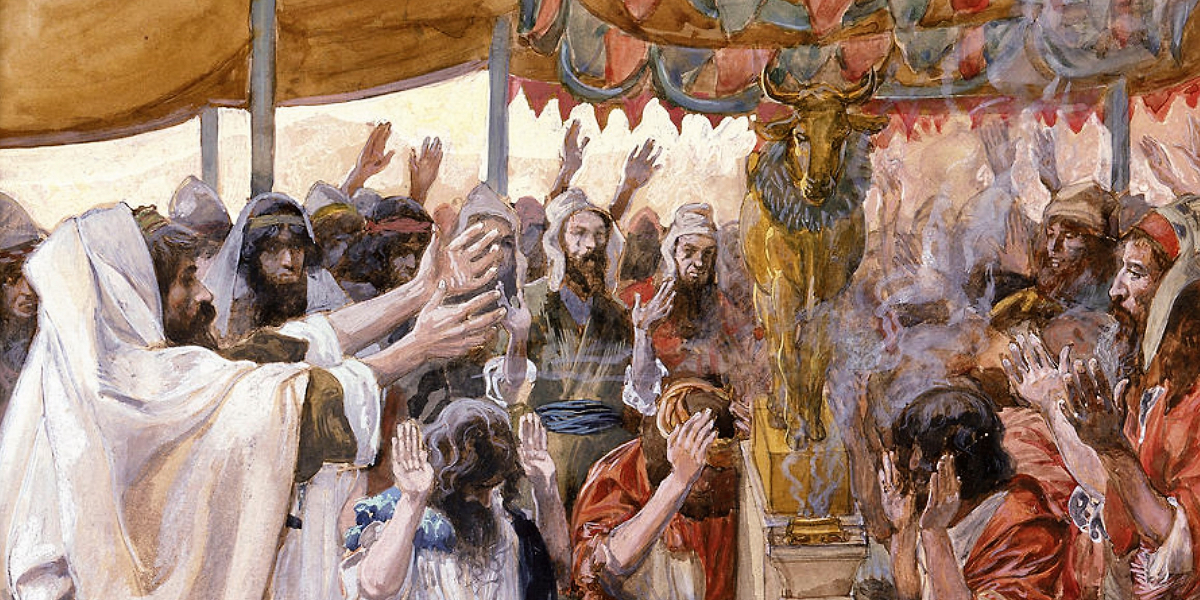
But Jeroboam did not remain faithful, as we learn about today. He was jealous to keep his power. He worried that if the Israelites went to the temple in Jerusalem to make sacrifices to the LORD, then Rehoboam might win them back. So he made a plan. He would set up new places of worship where the people could go, so they wouldn’t go to Jerusalem. He set up two calves of gold, one in Bethel and the other in Dan. And where have we heard about golden calves before? That’s the idol the Israelites made right after the LORD led them out of their slavery in Egypt.
What the Israelites said then is basically what Jeroboam said now about the golden calves, “Behold your gods, O Israel, who brought you up out of the land of Egypt.” Jeroboam’s idolatrous plan “became a sin,” as our reading says. He promoted this idolatry by making temples on high places, appointing priests not from the Levites, and establishing a feast day “in the month that he had devised from his own heart.” This grand idea started in his heart and was guided all along the way by his heart. He would have fit right in in our culture today.
We often hear that we can’t go wrong if we just follow our heart. Following your heart is seen as the path to happiness. Ignoring what your heart tells you could lead to a lifetime of regret and unhappiness. But why do people think the heart is such a reliable guide? Has anyone’s heart ever led him wrong? Listen to how the heart is described in the time before the Flood: “The LORD saw that the wickedness of man was great in the earth, and that every intention of the thoughts of his heart was only evil continually” (Gen. 6:5). Through the prophet Jeremiah, the LORD said, “The heart is deceitful above all things, and desperately sick” (17:9). Then we have Jesus’ own words about the heart: “For out of the heart come evil thoughts, murder, adultery, sexual immorality, theft, false witness, slander” (Mat. 15:19).
Clearly the heart can steer us wrong. It is not a trustworthy guide. It can and often has led us astray. So how can we know if the feelings and thoughts of our heart are good and beneficial, or if they are leading us in the wrong direction? We know this by comparing what we are thinking and feeling with what God tells us in his holy Law.
So if my heart is telling me to disobey my parents and do things they tell me I shouldn’t, then my heart is contradicting the Fourth Commandment. If my heart tells me to pursue a sexual relationship outside the blessed boundaries of marriage, then my heart is going against the Sixth Commandment. If my heart tells me to attack someone else’s reputation in an attempt to elevate myself, then my heart is violating the Eighth Commandment.
The theme of today’s service is “Beware of False Prophets.” The false prophet to be most aware of is the false prophet that lives within us, within our heart. It is the old Adam that disobeys God, and that looks with desire at what God says is sin. There are two ways that the old Adam in coordination with the devil works: One is outright opposing what God says in His Word; the other is twisting what God says in His Word.
The first is when we are tempted to reject or ignore what God says because it doesn’t agree with the way we think. We don’t want to be outsiders in the world; we want to fit in. Maybe we want to accommodate our own sin or the sin of someone else, so we write off something in the Bible as being outdated or unclear or unhelpful for the mission of the church. The other way the old Adam operates is to subtly change the Word of God, soften it, explain away something that challenges us. Maybe we excuse someone’s sin and even lend our support to it because, after all, God tells us to love our neighbor, and we interpret love as never questioning someone’s choices.
Jeroboam directly contradicted the Holy Scriptures in everything he did and said to keep the Israelites away from Jerusalem. How does Jesus tell us in today’s Holy Gospel that we will recognize false prophets? He says we will “recognize them by their fruits” (Mat. 7:16), especially by what they say. Do we say things that contradict what the Bible says? Then that is the old Adam talking and not our new man of faith.
Jesus says that those who will enter the kingdom of heaven are those who by faith do the will of His Father who is in heaven. Doing the Father’s will is believing and following exactly what He says in His Word. This is how we “hallow His name,” as we say in the Lord’s Prayer. We hallow God’s name by teaching His Word in its truth and purity and by living holy lives according to it as His dear children (Luther’s Explanation to the First Petition).
There is a reason we have to pray for this. A pure life lived according to God’s Word doesn’t come naturally to us. We struggle to hold to His Word. We struggle to do what is right. Our life is full of failures to “fear, love, and trust in God above all things” (Luther’s Explanation to the First Commandment). We have at times followed the god of self-satisfaction. We have followed the god of pride and personal glory. We have followed the god of popularity and acceptance by the world.
We pray along with King David, “Create in me a clean heart, O God” (Psa. 51:10), because we know how unclean our heart has been. David wrote these words after following his heart and succumbing to terrible sins. God forgave him those sins, just as He forgives you your sins. He knows how evil and desperately sick your heart is by nature. If it were good or even neutral, He would not have needed to send His Son to die on the cross in your place.
But He did send His Son. The coming of His Son in the flesh was necessary for you and every sinner. We needed Him to apply His perfectly pure heart to keeping the Law of God in our place, so we would be credited with His perfect love toward God and neighbor. We needed Him to hallow God’s name in every way by obeying His Father’s will and offering up His holy life for you and me.
You can’t find what you need for life and salvation in your own heart with all its wayward passions and desires. But you can find what you need in Jesus’ heart. He makes His love known to you by inviting you to partake of His means of grace, to hear His Word of truth and salvation and to feast on His holy body and blood.
What He gives you here through His Word and Sacraments may not seem as exciting or impressive as what is going on with the golden calves of prosperity, power, and pleasure that are worshipped by the world. But just as the LORD promised to be present in the Most Holy Place of the temple, so He has promised to be present here in this most holy place, where He comes to bless you with His gifts.
This is where He expresses His faithfulness to you, and where He strengthens your faithfulness to Him. This is where He cleanses your heart and pours His love into it, so it is ready for fruitful service to the people around you. This is the good plan and purpose for your life that the LORD formed in His own heart and revealed to you in His holy Word. By hearing and trusting His Word, you are submitting your heart to His will. And when you follow His heart, you will ever have His joy, His life, and His peace.
Glory be to the Father and to the Son and to the Holy Ghost; as it was in the beginning, is now, and ever shall be, forevermore. Amen.
+ + +
(picture from “The Golden Calf” by James Tissot, 1836-1902)

The Fifth Sunday after Trinity – Pr. Faugstad sermon
Text: 1 Samuel 15:1-15
In Christ Jesus, no counterfeit ruler, no charlatan who deceives for personal gain, but a King who gave up His life for your salvation, dear fellow redeemed:
Everyone liked Absalom. For one thing, he was very good looking. The Scriptures say that “From the sole of his foot to the crown of his head there was no blemish in him” (2Sa. 14:25). Once a year, he cut his hair because it got so heavy, and what he cut off weighed about five pounds. There was no one like him.
The other reason Absalom was so well-liked was because he was very good at telling people what they wanted to hear. He was a master of flattery. He would sit each day at the city gate in Jerusalem, and he would warmly receive everyone who arrived there. He would pretend to care about their business, and he would act like his father, King David, had no real interest in their concerns. He would say, “Oh that I were judge in the land! Then every man with a dispute or cause might come to me, and I would give him justice.” And when anyone would honor him, he would return the honor in a show of humility. In this way, we are told, “Absalom stole the hearts of the men of Israel.”
Absalom behaved in this manner for four years. What I haven’t mentioned yet, is that Absalom was a murderer. He took revenge against his brother Amnon and had Amnon killed. After doing this Absalom fled, and King David did not allow him to return to Jerusalem for three years. When Absalom did return, David refused to see him. Two years after this, Absalom manipulated one of David’s servants and gained access again to his father. And David forgave his son.
That interaction comes immediately before what we learn about today with Absalom actively working against his father. So all Israel was being drawn to the king’s son, a murderer, who had no respect for his father or his office as king. The main Commandment in view in today’s reading is the Fourth Commandment, “Honor your father and your mother, that it may be well with you, and that you may live long on the earth.”
You might recall the way David referred to King Saul while King Saul in his jealousy was trying to have David killed. David referred to him as “the Lord’s anointed” and as “my Lord” (1Sa. 24, 26). Even though Saul was not respectable, David showed respect for the office. In the same way, we are to show respect for the authorities starting in our own homes. Colossians 3:20 says, “Children, obey your parents in everything, for this pleases the Lord.”
Children are to honor, respect, and obey their parents at all times. If their parents tell them to clean their room, help around the house, or whatever they tell them to do, their children are to obey them as though the Lord Himself told them to do this. The only exception to this Commandment is if parents tell their children to do something that God says is wrong; for example, to do harm to someone or to take someone’s possessions.
This respect also applies to authority outside the home. We are to have respect for teachers, employers, pastors, and government officials, among others. We respect these individuals not because they are always respectable, and not because we like everything they do, but because God has established these authorities. If there were no authority, there would be no law and order. There would be chaos. God has given authority for our good, even if it doesn’t always seem good.
The people of Israel knew the Fourth Commandment. They knew they were to honor the king. They knew Absalom was honoring neither the king nor his father. That should have been a tremendous red flag. That should have told them that perhaps Absalom was not king material. But they let themselves be duped by him. He was an important person—a prince. He was good looking. He made them feel special.
He also told them what they wanted to hear. He told them that all their claims, their ideas, and their concerns, were good and right. That is a danger for us, too, in both civil and spiritual matters. We can be all too eager to listen to the politician who makes promises that he probably can’t keep, but that we love to hear. We like to be told that all our claims, our ideas, and our concerns, are good and right. And in being greedy to get what we want, it is only too easy to ignore the needs and concerns of our neighbors.
In spiritual matters, if we are only looking for a preacher or teacher who tells us what we want to hear, then we will be less and less willing to be corrected and challenged and taught by the Word of God. St. Paul says that in the last days people will have “itching ears.” “They will accumulate for themselves teachers to suit their own passions, and will turn away from listening to the truth and wander off into myths” (2Ti. 4:3-4). We don’t need an echo chamber. We need the Holy Spirit through the powerful Word to change us and shape us and mold us into what God has called us to be.
This is what Jesus did for Peter and the other disciples. He gave them a tremendous catch of fish, when previously they had been unable to catch anything. When he saw this, Peter fell down before Jesus and said, “Depart from me, for I am a sinful man, O Lord” (Luk. 5:8). Now Jesus going away is the last thing that Peter needed, but he clearly saw that he was not worthy to be in the Lord’s presence which was certainly true. Instead of going away, Jesus said, “Do not be afraid; from now on you will be catching men” (v. 10).
Jesus authorized Peter and the other disciples to preach the powerful Word. They would not be selfishly trying to draw people away from Jesus; they would be pointing people to Jesus. Jesus was not going to steal the throne of any earthly king. He already was the King of all heaven and earth. So what was He doing down here in human flesh? What was His purpose? What was His plan?
Absalom commissioned fifty men to run in front of him, while he rode on a chariot to take his position at the city gate. He wanted everyone to think he was important. Then he told whatever lie he had to to please them. Jesus did the opposite of all this. The Son of God entered the world through a lowly woman named Mary, a descendant of King David, and His coming was heralded by none but the shepherds. Jesus gained followers for Himself not through flattery and deceit but through teaching the truth.
He did not sit at the city gate coaxing people away from the authorities. He did not come to put on a show of His greatness or to manipulate people to do what He wanted. He came in all humility as a servant to redeem the world of sinners. He went from place to place telling people the good news of the kingdom. He healed the sick and the hurting. He fed the hungry and spared the demon-possessed. He did not look out for His own interests but for the interests of others.
As a leader, He was nothing like Absalom. There were no red flags with Jesus. Everything He said was good and right. He upheld the Commandments perfectly, including God’s command to honor father and mother and every authority. He didn’t just talk the talk; He walked the walk.
And that is why you are presented righteous before God today. However you have disrespected and dishonored your parents, your teachers, your employers, law enforcement officials, or anyone else in governing positions, God forgives these sins. They were counted against Jesus who paid for every sin on the cross. By faith in Him, His righteousness is now credited to you, so that God sees you as having no sin, as having no blemish on your record that stands between you and the perfection of heaven.
This is what He tells you in His holy Word. This is what He continues to commission men to preach and teach to you. Like Simon Peter, your pastors are imperfect men, and they know it. But they point you to the perfect Savior. This Gospel message is how sinners are “caught” for the kingdom of God. It is not a message to work against the ruling authorities or destroy the institutions of government. It is a message of peace between God and man because Jesus the God-Man stepped in as our Substitute.
We want to fix our hope on this message. Popular, influential people like Absalom will keep coming along with their plots and plans. They will appeal to us with their smooth talk and flattering words. They will promise us great personal gain and prosperity. But almost as soon as they gain power, they are gone again. Psalm 146 says, “Put not your trust in princes, in a son of man, in whom there is no salvation. When his breath departs, he returns to the earth; on that very day his plans perish” (vv. 3-4).
We put our trust not in princes, but in the King of kings and Lord of lords. An earthly son of man cannot save us, but the Son of God and Son of Man can. He is “the way, and the truth, and the life” (Joh. 14:6). His Word does not mislead us. His Word “is a lamp to [our] feet and a light to [our] path” (Psa. 119:105). He calls us to follow His Word in good times and in bad, in times of prosperity and times of trouble.
No matter how strange, outdated, or ineffective people think God’s Word is today, it remains powerful just as He is powerful. His Word is the source of our faith and the means by which He grants us eternal life. His strong Word will endure as rulers come and go and as kingdoms rise and fall. Everything in this world eventually fails and falls apart, but “the word of our God will stand forever” (Isa. 40:8).
Glory be to the Father and to the Son and to the Holy Ghost; as it was in the beginning, is now, and ever shall be, forevermore. Amen.
+ + +
(picture of the miraculous catch of fish by Raphael, 1515)

The Second Sunday of Easter – Pr. Faugstad sermon
Text: Joshua 5:13-6:6
In Christ Jesus, who waits for just the right time to give just the right blessings, dear fellow redeemed:
The Lord’s apostle Thomas had a tough week. Mary Magdalene and the other women said, “We have seen the Lord!” The two Emmaus disciples said, “We have seen the Lord!” His fellow chosen disciples said, “We have seen the Lord!” Why did Thomas seem to be the only one who hadn’t seen the Lord that Easter Sunday? Why would Jesus leave him out? He couldn’t bear the thought; they must be mistaken.
So all week long, no matter who talked to him, and no matter what evidence they offered of Jesus’ resurrection, Thomas defiantly replied, “Unless I see in his hands the mark of the nails, and place my finger into the mark of the nails, and place my hand into his side, I will never believe” (Joh. 20:25). But did he also have some doubts about his firm position? As each day passed without the Lord appearing, did he wonder, “O Lord, what are You waiting for?” Or did the passing of each day without the Lord’s appearance make him more firm in his denials?
He asked for proof, real tangible evidence. He wanted to see it, or he said he would never believe it. This showed a misunderstanding of what it means to “believe.” It is not a decision that a person makes when the evidence is convincing enough. It is not a scientific process of gathering facts until there is no possible conclusion but one. To “believe” is to trust that something is so, or that something will be, even when there is no tangible evidence or logical basis to support it.
The Israelites were operating by faith as they marched around the walls of Jericho. They trusted that the LORD would give them the victory He promised. But we could understand if their faith wavered a bit. Like Thomas who had to wait a week before Jesus revealed Himself to him, the Israelites had to wait a week before the LORD delivered Jericho into their hands.
Each day for six days, they were directed to march one time all the way around the city. The only sound to be made was seven priests blowing seven rams’ horns. The men of war were to march in silence. As each day passed with nothing happening, did those Israelites wonder within themselves, “What are You waiting for?” What if nothing happened at all? They would be the laughing-stock of all the land of Canaan if they marched around a city for a week and nothing happened. Possibly while they marched they could hear the inhabitants of Jericho yelling down at them, taunting them, ridiculing them.
But as strange as it seemed to do what God said, they held onto His promise. They followed the LORD’s instructions. For six days, they marched around once, and on the seventh day, they marched around the city seven times in the same manner as before. Then the seven priests blew their trumpets. On their cue, the men of war sent up a great shout, and the walls of Jericho dropped straight down just like a skyscraper that is imploded.
The Israelites’ seven-day wait was rewarded with a complete victory over the city and its inhabitants. Their faith in the LORD’s promise was confirmed. The wait was definitely worth it. Because the LORD made them wait and made the walls of Jericho fall without anything touching them, the Israelites saw more clearly that the victory was the LORD’s.
The “sevens” in the account emphasize this. The number seven in the Bible is closely tied to God, so it represents His holiness or perfection. He directed seven priests to march for seven days carrying seven horns, with seven trips around the city on the seventh day. This was the work of the holy LORD; this was His doing out of love for His people.
The same holy LORD still works on your behalf, to give you blessings. But when you have to do something you don’t want to do, or when relief is taking longer than you want, it is easy to ask Him, “What are You waiting for?” You may have asked that when you were sick and didn’t seem to be getting better. You may have asked that when you were being mistreated by a classmate or co-worker or member of the community. You may have asked that when a close relationship was strained, when great troubles loomed in your future, when the questions kept piling up but no answers—“What Are You Waiting For?”
It is natural to ask this. We even have examples of wording like this in the Psalms of lament. But the psalmists don’t stop with that question. They go on to express their confidence that the LORD will act, that He will deliver them at the right time. We need to remember who is calling the shots, who has the Master plan. This is brought home to us by the first part of today’s reading, when Joshua comes face to face with a mysterious Man of war. Joshua asked Him, “Are You for us, or for our adversaries?” It’s a simple choice. We think the answer will be “I am for you.” But instead the Man replied, “No; but I am the commander of the army of the LORD. Now I have come.”
God is not interested in taking the side of sinners, as though He is just another weapon in our arsenal. He wants us to take His side, to put our trust in Him. This is instructive for when we wonder if we should pray for our favorite sports team, as though God is a fan like we are, or that our team is more righteous than another. God is above all this. He doesn’t want us to be so focused on sides in this life. He wants us to stay focused on His Word.
This is the crucial step when we ask Him, “What are You waiting for?” Instead of just staring up in the sky and waiting for something to happen, the LORD wants us to hear His holy Word. He wants us to review His promises, take them to heart, understand anew His love for us. He wants us to believe that He sent His only-begotten Son to take on flesh for us. He wants us to believe that Jesus satisfied the requirements of God’s holy Law in our place and died to make satisfaction for all our sin. He wants us to believe that Jesus rose on the third day in victory over death just as He said He would.
This was Thomas’ failing. He might have thought that His friends were playing a cruel trick on him, but he should not have rejected Jesus’ clear word. Before His death, Jesus told all twelve of the disciples, “See, we are going up to Jerusalem. And the Son of Man will be delivered over to the chief priests and scribes, and they will condemn him to death and deliver him over to the Gentiles to be mocked and flogged and crucified, and he will be raised on the third day” (Mat. 20:18-19). Thomas heard those words, but like his fellow disciples, he did not believe them.
They did not believe until they saw Jesus, until they had tangible proof. And Jesus said to them, “Blessed are those who have not seen and yet have believed” (Joh. 20:29). Sometimes Christians will ask God for some special sign of His love, some evidence that will show them He is really present, that He really cares. And the LORD says to us, “Blessed are those who have not seen and yet have believed.”
He calls you to trust His love even when it seems like He is angry with you, to rely on Him even when there appears to be no end to your troubles, to follow His Word even when you can’t see a “light at the end of the tunnel.” Because He is only waiting for the right time. He will not forget about you. Everything He does is for your good.
Day seven was the right time for the walls of Jericho to come crashing down just as the LORD promised they would. Seven days was the right time to hide Himself from Thomas, so Thomas would learn to trust Jesus’ Word and not his own reason. And however long you must wait for relief or help or deliverance is the right amount of time. Whatever you go through, Jesus is with you. Did you notice how He repeated Thomas’ words showing that He had seen all and heard all? Thomas didn’t know it, but Jesus was with Him the whole time.
And so He is with you always, even to the end of your life, even to the end of the age (Mat. 28:20). He is with you “where two or three are gathered in [His] name” (Mat. 18:20). He is with you when He brings forgiveness right to your heart in the absolution. He is with you when you come forward to His holy table. These are the means of His grace by which He makes the walls of your sin and doubt come crashing down. This is where He gives you strength for today and for tomorrow. This is where He turns your desire for proof of His love into the assurance that He loves you with a perfect love.
This is where He changes your impatient, “What are You waiting for?” into a faithful and eager waiting for His grace. We join the psalmist in this faithful waiting and say, “I wait for the LORD, my soul waits, And in His word I do hope. My soul waits for the Lord More than those who watch for the morning—Yes, more than those who watch for the morning. O Israel, hope in the LORD; For with the LORD there is mercy, And with Him is abundant redemption” (Psa. 130:5-7, NKJV).
Glory be to the Father and to the Son and to the Holy Ghost; as it was in the beginning, is now, and ever shall be, forevermore. Amen.
+ + +
(woodcut from “Doubting Thomas” by Julius Schnorr von Carolsfeld, 1794-1872)

Ash Wednesday – Pr. Faugstad homily
Text: St. Matthew 6:16-21
In Christ Jesus, who served us in all humility, so His perfect righteousness would be credited to us by faith, dear fellow redeemed:
Today we observe Ash Wednesday, the day that marks the beginning of the penitential season of Lent. Lent is forty days long not counting Sundays to tie in with Jesus’ forty days and nights in the wilderness. Over those forty days, He fasted and was tempted by the devil as He prepared for His public work. We walk with Jesus through these forty days, hearing His Word, receiving His strength, and dedicating all we do to Him.
But the devil is actively tempting us just as he tempted Jesus, and we are not as resilient as our Savior. We are weak. We are prone to sin. We have often fallen for the devil’s temptations. We have followed the lead of our first father Adam, who knew God’s command but chose to reject it. This is why when ashes are applied to the foreheads of the baptized on Ash Wednesday, it is accompanied by the LORD’s word to Adam and all sinners, “For you are dust, and to dust you shall return” (Gen. 3:19).
Dust and ashes are often paired together. When Abraham prayed for the people of Sodom and continued to lower the number of believers for which God would spare the city, he said, “Behold, I have undertaken to speak to the Lord, I who am but dust and ashes” (Gen. 18:27). Job described himself as having become “like dust and ashes” in the depths of his suffering (Job 30:19). We hear the same phrase in our hymns: “Though I lie in dust and ashes” (246:4), “Though dust and ashes in Thy sight” (382:1), “See, I but ashes am and dust” (320:6).
This is a confession that apart from God, we have no life in us. Apart from God, we have nothing to look forward to but death and our bodies turning to dust. That is why it is strange that we spend any time boasting about our own greatness. But we do—all of us do. Jesus calls it out in today’s reading from His “Sermon on the Mount.” He points to our tendency to want others to see when we are making sacrifices, when we are doing something good.
He says, “And when you fast, do not look gloomy like the hypocrites, for they disfigure their faces that their fasting may be seen by others.” Fasting is a sacrifice. It is going without food for a period of time. It makes the stomach growl. A person may start to feel weak. Why would anyone ever put himself through this?
In one of his Catechism sections on the Sacrament of the Altar, Martin Luther wrote, “Fasting and bodily preparation are indeed a fine outward training.” The reason that God’s people have fasted throughout history is so that they would be reminded of their weakness, and also so that they would prepare themselves to receive the gifts of God through His Word and Sacraments. The fasting that is most common among Lutherans today is fasting in preparation for the Lord’s Supper. As we feel physical hunger, it reminds us of our need for the greatest food there is—our Lord’s body and blood.
But imagine if someone were fasting, and he or she posted regular updates on social media to let everyone know that “I’m fasting today,” and “It’s really hard to do.” That is the hypocrisy Jesus points out, that something that is supposed to be done in secret out of love for God is done in public out of love for man’s approval. This could apply to any part of our life: going to school, doing our job, taking care of our families, helping others. Do we do these things for recognition? Or do we do them out of thankfulness to God for giving us the opportunities and giving us the skills and the strength to do them?
The approval and praise of the world and whatever riches or possessions we might gain in this life are only temporary. It will all slip through our fingers one day. Jesus says, “Do not lay up for yourselves treasures on earth, where moth and rust destroy and where thieves break in and steal.” We may certainly enjoy what we have on earth. God has given many blessings to us for our own needs and for the good of others. We are stewards of these things, and we want to manage them well.
But we must not put our trust in them or let them become the primary focus of our life. “Instead,” says Jesus, “lay up for yourselves treasures in heaven, where neither moth nor rust destroys and where thieves do not break in and steal. For where your treasure is, there your heart will be also.” And what are those treasures in heaven that you are to lay up? They are all the gifts you have by faith in Jesus: everlasting righteousness, innocence, and blessedness; perfect love, joy, and peace; fullness of life and light.
You have all these things now, but you cannot see them or experience them fully until you are delivered from this sinful life. While you are here, God has prepared wonderful works for you to do to the glory of His name. He has given you important tasks in your callings as a member of your family, as a member of the church, as an employee, and as a neighbor in your community. He sees all the good things you do in these callings. He sees the sacrifices you make. He sees the hardships you endure. He sees the many ways you show love to others, whether or not you are recognized for that love or thanked for it.
You do these things for your Father who is in heaven. “And your Father who sees in secret will reward you.” This is not a reward for earning His grace. It is the reward of faith, which is always active in bearing fruit. Your faith was a gift from God to you, and so are the good works you carry out in His name.
And when you have not been so good, when you have looked for praise from others, when you pursued the world’s treasure as the best treasure, then you can join Abraham and Job in their words of repentance and faith, “I am nothing but dust and ashes. Apart from You, I am lost. But in You, I have all I need.” This connection between repentance and faith comes through beautifully in the hymns I mentioned before:
Though I lie in dust and ashes
Faith’s assurance brightly flashes:
Baptism has the strength divine
To make life immortal mine. (246:4)
Though dust and ashes in Thy sight,
We may, we must draw near. (382:1)
Lord, I believe, dear Lord, I trust;
Help for faith’s weakness give me!
See, I but ashes am and dust;
Ne’er of Your Word deprive me!
Your Baptism, Supper, and Your Word
My comfort here below afford;
Here lies my heart’s true treasure. (320:6)
Our treasure lies in our Lord’s Word and Sacraments. This is a gift that keeps giving day after day, year after year, until we are delivered from dust and ashes here to feast and to rejoice in His eternal kingdom.
Glory be to the Father and to the Son and to the Holy Ghost; as it was in the beginning, is now, and ever shall be, forevermore. Amen.
+ + +
(woodcut of the poor, the blind, and the lame being invited to the banquet from the 1880 edition of The Story of the Bible from Genesis to Revelation)

The Epiphany of Our Lord – Pr. Faugstad sermon
Text: Genesis 26:1-6
In Christ Jesus, the Light shining in the thick darkness of the earth, to whom sinners from all nations come in faith, receiving from Him life and salvation, dear fellow redeemed:
Last week, we heard about God’s command to Abraham to sacrifice his son Isaac as a burnt offering. As painful as this command was for father and son, they were willing to go through with it because they trusted God’s promise that nations would come from them, including the Savior of the world. Abraham was ready to sacrifice his son because he believed that God would bring Isaac back to life (Heb. 11:19).
The LORD stopped Abraham just as he was taking up the knife to slaughter his son, and He provided a ram for the sacrifice instead. He then repeated the promise to Abraham and Isaac that their descendants would be as many “as the stars of heaven and as the sand that is on the seashore,” and in their offspring “all the nations of the earth [would] be blessed” (Gen. 22:17,18).
It was a grand promise, so grand that it must have been difficult to imagine. This family did not have the appearance of a great dynasty. Abraham and Sarah were very old. They had one child. They lived as nomads in the land of Canaan. They didn’t own any land until Sarah died and Abraham bought a field with a cave to bury her in. Isaac was thirty-seven years old when his dear mother died, and he grieved for her.
When Isaac was forty, Abraham sent a servant to the land of his relatives to find a wife for his son. Rebekah agreed to return and marry Isaac. It was a happy marriage, except that they were unable to have children for a long time. Just as the LORD made Abraham and Sarah wait, so He made Isaac and Rebekah wait. We are told that “Isaac prayed to the LORD for his wife…. And the LORD granted his prayer” (Gen. 25:21). Twenty years after they were married, God gave Isaac and Rebekah not just one child, but twin sons!
Isaac might have thought everything was going well. As he aged, he could give thanks for a good wife, two sons including the heir of God’s promise, and sufficient means to support his household. The difficult times perhaps were behind them! But then, as today’s reading says, “there was a famine in the land….”
We can relate to this. You can think of times when things were going well for you, and you started to think you could be getting somewhere. But then something happened at work that threatened your livelihood. Or there was a family crisis or a health issue, and your plans had to be set aside, maybe never to be picked up again.
As we go through life, we learn again and again how little we can actually control. We don’t know how the economy will do, how business will go, how our health will be. We don’t know how many years or months or days we have left. Not knowing how life will play out can cause us to be anxious and worried. Those worries start in our youth and continue through the different stages of our life, worries like:
- How will I be able to make friends in a new classroom?
- How will I do on the big test?
- What will I be when I grow up?
- Will I find someone to marry?
- Will we be able to have children?
- How will we raise children if we have them?
- Will the work I do be appreciated?
- Will I have enough to live on?
- Will I have enough for retirement?
- Will I be healthy enough to enjoy what I have earned?
- Will I be able to stay in my home when I’m old?
We worry about what could happen in the future. When the future arrives, we usually recognize that we didn’t need to worry about that. Or we wonder why we were so worried about those little things when there are much bigger things to worry about now. Today’s account about Isaac and the troubles he faced is a good reminder that God keeps His promises.
Isaac could not see what the future held for him and his family. But the LORD could, and He wasn’t worried! The LORD appeared to Isaac and told him there was no need to be anxious. Even though Isaac’s situation seemed tenuous in a foreign land under a godless ruler, the LORD said, “I will be with you and will bless you, for to you and to your offspring I will give all these lands.” So his offspring would have a place. More than that, his offspring would be many, as many “as the stars of heaven.” And in his offspring “all the nations of the earth shall be blessed”—blessed because the Savior of the world would come from Isaac’s line.
Isaac could not see exactly how all this would come about. He did not know when these promises would be fulfilled. All he could see in that moment was trouble. But he believed what God said. He waited in faith for the Lord to act for his good and at the right time. Such quiet confidence is expressed by one of the characters in the Bright Valley of Love book that we are starting next week. He said, “When human thinking has come to a dead end and can see no way out of its problems… then faith is able to spread its wings. The climate has never been better—for faith” (p. 80).
Times of trouble are the perfect times for faith to “spread its wings.” Faith is for the things that are out of your control, which is most everything! Hebrews 11:1 defines faith as “the assurance of things hoped for, the conviction of things not seen.” The same chapter goes on to describe the faith of Noah who started building an ark long before the rain fell (v. 7), and the faith of Abraham who left his home country to live in the land that God promised to his descendants (vv. 8-9). They trusted God’s promises, fully knowing that some of these would not be fulfilled in their lifetime.
The times you must wait for the Lord in your trials, your suffering, your uncertainties, your pain—these are the times when God builds up faith. These are the times when He teaches you to rely on Him, to lean on Him. But when things are going well for you, when everything seems to be in place, when your plans are working out exactly as you intended, these can be dangerous times for faith. In our sinful thinking, we might imagine that it is our efforts, our abilities, our talents that have led to our success. And if that is the case, then what do you really need God for? If I am in control, if I am the master of my fate, then the Lord can just wait until possibly sometime down the road when I need Him.
In these times of little faith or no faith at all, God often sends us trials. He does not send these to destroy us or drive us from Him, but to draw us closer. In His love for us, He wants to give us opportunities to exercise our faith, to remind us of our need for His mercy, to strengthen our confidence in His grace and forgiveness.
You might remember with guilt those times in your self-assurance and pride when you took God’s gifts for granted. You became aware of how faithless you had been and how unworthy you were to be called a child of God. You maybe even had a difficult time coming to church because of your guilt. But what did you hear when God brought you back through these doors? Not words of judgment for poor sinners. Not condemnation. You heard God’s promise of forgiveness for your sins, the promise that you are reconciled with God the Father through the blood of His Son, the promise of eternal joy in His heavenly kingdom when your life here comes to an end.
These promises are as sure as God’s Son hanging on the cross and His tomb sitting empty on the third day because He had risen. He was the ultimate fulfillment of the LORD’s promise to Abraham and Isaac. It is through Jesus Christ, the Son of God incarnate, that “all the nations of the earth [are] blessed”—both the descendants of Abraham and Isaac and people from other nations like those wise men from the east. Jesus died and rose again for all, including you.
And that is true no matter what trouble God calls you to face in this life, or how often you have failed to trust in Him. You are a beloved child of God, fearfully and wonderfully made, redeemed by the blood of His Son, sanctified and kept in the true faith by the Holy Spirit. Like He did for Isaac when he was afflicted by a famine and wandering around with his family, the LORD promises to be with you and guide you and bless you. The LORD did not fail to keep His promises to Isaac, and He will not fail to keep His promises to you.
So in your suffering, in your pain, in your trouble, you say with the psalmist, “I wait for the LORD, my soul waits, And in His word I do hope” (Psa. 130:5). Those who wait for the LORD and hope in His Word shall, as the Holy Scriptures say, “renew their strength; they shall mount up with wings like eagles; they shall run and not be weary; they shall walk and not faint” (Isa. 40:31)—ever strong in the LORD.
Glory be to the Father and to the Son and to the Holy Ghost; as it was in the beginning, is now, and ever shall be, forevermore. Amen.
+ + +
(picture from “Sacrifice of Isaac” by Orazio Riminaldi, 1625)

The Last Sunday of the Church Year – Pr. Faugstad sermon
Text: 1 Thessalonians 5:1-11
In Christ Jesus, the Light and Day, who drives the night and gloom away; the Light of light, whose Word does show the light of heav’n to us below (ELH 571, v. 1), dear fellow redeemed:
In the Scripture readings for today, we get a very strong sense of time—time moving, the days advancing, the sun dropping down toward the horizon as dusk sets in. The Holy Gospel describes a bridegroom delayed, light giving way to darkness, drowsiness and sleep overcoming those who watch and wait (Mat. 25:1-13). These are fitting readings for this time of the year when the daylight is diminishing and we reluctantly head into the cold of winter. They are also fitting readings for this time in the church year as we make preparations for the sunset of our life and for our Lord’s return.
In his inspired First Letter to the Thessalonians, Paul acknowledges what those believers already knew, “that the day of the Lord will come like a thief in the night.” In other words, nobody will be able to guess when it is that Jesus will come in glory to judge the living and the dead. That hasn’t stopped some from trying. A simple internet search lists hundreds of predictions throughout history of the end of time. Many of you remember the increase in these predictions leading up to the year 2000 and then again with the Mayan calendar excitement in 2012.
The people who try to predict the end on the basis of the Bible have a way of reading prophecies and adding up dates, so that they think they can discover secrets from God. They are trying to sort out “times and seasons” in a way that God has not invited them to do. Jesus said very clearly, “But concerning that day and hour no one knows, not even the angels of heaven, nor the Son, but the Father only” (Mat. 24:36). He said this during His state of humiliation when He was not making full use of His divine powers. Now in His state of exaltation Jesus knows that day, but no one else does know it or can know it.
We can, however, see the signs that the end is near. Jesus prophesied that false christs would appear and lead many astray. There would be “wars and rumors of wars,” “earthquakes in various places,” and “famines” (Mar. 13:6-8). We see these things all around us. They should make us prepare for Judgment Day and look for it. Today’s reading indicates that many are not looking for Jesus’ return. His return will catch them by surprise: “While people are saying, ‘There is peace and security,’ then sudden destruction will come upon them as labor pains come upon a pregnant woman, and they will not escape.”
How is it that you can stay prepared, so “sudden destruction” does not fall upon you? Paul writes, “you are not in darkness, brothers, for that day to surprise you like a thief.” Being in darkness means living in unbelief. It means going along with the world, whether along with the world’s worries or the world’s sins. It means being spiritually asleep and spiritually inebriated or impaired when we need to be spiritually alert and sober.
Now you are not unbelievers, dear friends, but you are tempted. You are tempted to look out into the world’s darkness and think that is actually light. We like the idea, for example, of unchecked freedom, freedom to say whatever we want, do whatever we want, use our bodies however we want, satisfy our every desire with food or drink or fun. It looks like freedom, but it is actually slavery—slavery to sin, slavery to the devil, and ultimately slavery to death. If freedom to do whatever we want is the recipe for happiness, then why are so many people so hopeless?
We do not live for this day, for getting as much as we can in the present. We live for that day, for Jesus’ return, when all our present sadness and trouble and pain will come to an end. We look for that day with eyes wide open. “For you are all children of light, children of the day,” writes Paul. You can see everything clearly. You can see how empty the world’s promises are. You can see how much damage the devil has done to families and friendships. You can see your own weaknesses and failings.
But you also know what God has done to rescue you from the darkness. God sent His Son to shine the light of His forgiveness and life into the deepest, darkest corners of the earth and into the deepest, darkest corners of your heart. He willingly accepted every sin done in the dark and suffered the eternal agony of hell for them all. He died on the cross as the sacrifice for your sins, and then He rose from the dead on the third day in total and complete triumph over your death.
You have His light and life in you by faith in Him. Jesus said, “I am the light of the world. Whoever follows me—believes in me—will not walk in darkness, but will have the light of life” (Joh. 8:12). At another time Jesus said, “You are the light of the world” (Mat. 5:14). His light of love shines in you, and it shines through you. “[L]et your light shine before others,” He said, “so that they may see your good works and give glory to your Father who is in heaven” (v. 16).
The light of faith that shines in you, connecting you to the true Light, is why our reading refers to believers as “children of light, children of the day.” Children of the day stay awake and sober, alert and clear-minded. They put on “the breastplate of faith and love,” so they are ready for the devil’s accusations and the attacks from the world and our sinful flesh. They wear as a helmet “the hope of salvation,” which means minds that are filled with the promises of God, with His holy Word, which assures us that we will be kept safe until the day of our Lord’s return.
But what if you don’t feel completely confident about this? You don’t feel like you can see clearly to the last day. You have doubts. You have fears. Will you be accepted by Jesus when He comes? Will He look on you with grace or with anger? Will He judge you favorably or unfavorably? These are common questions and concerns that Christians have. We are always anxious about things in the future that we have never experienced, things that are out of our control. And we know how often we have sinned against God’s Commandments.
The best way to address these questions and concerns is to pray for God’s peace in your mind and heart, and then to listen to His Word where He delivers that peace. This is exactly what happens each week in the Divine Service. We confess our sins and pray for God’s mercy, and then we hear His Word of grace, His absolution, which frees us from our sin and strengthens us. Through the Word and Sacraments, God pours His light into us. It flows in and searches out the darkness of our doubt and despair. Like good medicine, His Word brings us healing. It improves our spiritual health, so we lift up our eyes and look forward with eagerness.
We have heard the cry go out, “Here is the bridegroom! Come out to meet him!” (Mat. 25:6). We know Jesus is coming. He tells us He is coming soon (Rev. 22:20). It is not for us to know more about it than that. We wait with our lamp of faith burning brightly, and we supply fuel to it through our continued hearing of God’s Word. We prepare for the last day especially on the Lord’s Day, when we gather together at church. This is what God teaches us to do. Hebrews 10 says, “And let us consider how to stir up one another to love and good works, not neglecting to meet together, as is the habit of some, but encouraging one another, and all the more as you see the Day drawing near” (vv. 24-25).
“The day is surely drawing near / When God’s Son, the Anointed, / Shall with great majesty appear / As Judge of all appointed” (ELH 538, v. 1). We don’t need to know exactly when He is coming; we just need to recognize that He is. We have hope even as darkness settles in around us. We believe what God says to us, that He “has not destined us for wrath, but to obtain salvation through our Lord Jesus Christ, who died for us so that whether we are awake or asleep we might live with Him.”
We don’t need to despair in the darkness of these days. We don’t need to be afraid at what the future holds. Our Lord Jesus is with us always, “even to the end of the age” (Mat. 28:20), through His Word and Sacraments. And He promises that He will come again in glory on the last day to take us to be with Him. The Bridegroom is coming. The marriage feast is prepared. This feast is for you and me and for all the children of day.
The day of our Lord’s return is a day worth waiting for. It is a day to watch for and stay awake for. “‘Wake, awake, for night is flying,’ / The watchmen on the heights are crying, ‘Awake, Jerusalem, arise!’… The Bridegroom comes, awake! / Arise! Your lamps now take! / Alleluia! / With bridal care / Yourselves prepare / To feast with Him, your Groom most fair” (ELH 544, v. 1).
Glory be to the Father and to the Son and to the Holy Ghost; as it was in the beginning, is now, and ever shall be, forevermore. Amen.
+ + +
(picture from 11th century painting from the Rossano Gospel)

The Twenty-Fourth Sunday after Trinity – Pr. Faugstad sermon
Text: 1 Thessalonians 4:13-18
In Christ Jesus, whose work and word is life for us, dear fellow redeemed:
Jairus was desperate. His daughter, just twelve years old, was sick, and she wasn’t getting better. The doctors said there was nothing more they could do. Her parents’ hearts were broken; their tears flowed. They would gladly have taken her place. They would die if only she could live. They felt hopeless. Then Jairus learned that Jesus had just come to the area. He hurried to meet Him, knelt before Him, and begged Him to lay His healing hand on the girl so she would live. Jesus agreed to go. Jairus felt a glimmer of hope.
But while they were on their way, a friend from Jairus’ home met them with terrible news, “Your daughter is dead; do not trouble the Teacher any more” (Luk. 8:49). They were too late. The girl’s time had run out. Her soul had left her body and gone to be with the Lord. Her body lay at rest. But then Jesus turned to Jairus in his anguish and said something strange, “Do not fear; only believe, and she will be well” (v. 50). They kept going. When they got to the house, a great crowd had gathered, “weeping and wailing loudly” (Mar. 5:38). Jesus now addressed them. “Do not weep,” He said, “Go away, for the girl is not dead but sleeping” (Luk. 8:52, Mat. 9:24).
The people in the crowd did not respond like Jairus did. They laughed at Jesus. It was not a laugh of joy or even of surprise. It was a laugh that showed their offense at Jesus’ words and their disdain for His message. They knew the difference between sleep and death! They knew the signs: her heart had stopped, she wasn’t breathing, her skin had gone cold. There was no doubt about it—the girl was dead.
And no doubt she was. But just like the people today who tell us to “trust science” since nothing can be verified apart from science, the people in the crowd failed to account for the power of God. Death was too powerful for the people to overcome, but it wasn’t too powerful for Jesus. They were helpless in the face of death, but Jesus was not.
Jesus sent the crowd out of the house and approached the girl’s bedside. She lay there so still, so peaceful, while all around her was so much pain and sadness. Jesus reached down, took her by the hand, and said two words in Aramaic, “Talitha cumi,” which means, “Little girl, I say to you, arise” (Mar. 5:41). Immediately the girl got up and started walking.
You and I have also stood at the side of deceased people before. We have seen them lying there peacefully, maybe even touched their hands. We looked at their faces and wished that their eyes might open, that they would start breathing again, that they would step out of the casket and be reunited with us. Why doesn’t God do this for us? Why doesn’t He work a miracle? It’s obvious that He can. Nothing is impossible for Him (Luk. 1:37).
But He does not call us to put our hope in what He can do or might do. He calls us to trust in what He has promised. And He does promise to raise our loved ones from the dead, even if it is not as soon as we want. The inspired words of 1 Thessalonians address this pain of loss and the difficulty of waiting for the day of our final redemption. St. Paul wrote to the Thessalonian Christians, “we do not want you to be uninformed, brothers, about those who are asleep, that you may not grieve as others do who have no hope.”
It is clear that these Christians were concerned that some among them were dying before the return of Jesus. Would these believers lose out on their chance to be in heaven with glorified body and soul? “No,” says Paul echoing the words of Jesus, “they are only sleeping. Through Jesus, God will bring with Him those who have fallen asleep.” But how could they be certain of this? Where was the proof? They needed to look no further than Jesus, who “died and rose again.”
When Jesus died on Good Friday, no one called that a sleep. The soldiers found Him dead on the cross and thrust a spear into His side to make sure of it. Joseph and Nicodemus took down His body, put it in a new tomb, and sealed the tomb with a big stone. No one expected Jesus to come out again. The women made plans to return for a better burial. But everything changed on Easter Sunday. Everything changed for Jesus’ disciples who saw Him alive that day, and everything changed that day for you and me as we approach our own death.
Paul writes that the One who died and rose again, who triumphed over death, is going to return to raise us from the dead. He is going to come and wake us up, just as though we had been sleeping, just as He woke up the little girl. “For the Lord Himself will descend from heaven with a cry of command, with the voice of an archangel, and with the sound of the trumpet of God.” We think of Jesus coming on the clouds with all the angels. But did you remember this passage which says He will come down with a shout, “with a cry of command”?
What is it that He will cry out? Perhaps we have an insight from Jesus raising the young man from Nain to life when He said, “Young man, I say to you, arise” (Luk. 7:14). Or when He called to his friend Lazarus in the tomb, “Lazarus, come out” (Joh. 11:43). Or when He said to Jairus’ daughter, “Little girl, I say to you, arise” (Mar. 5:41). Whatever Jesus’ calls out on the last day—whether “arise!” or “come out!” or something else—our reading tells us clearly what will happen, “the dead in Christ will rise.”
Jesus’ word of command will awaken the dead. It will wake them up just as though they had been sleeping, just as you might wake up someone from a nap. That’s what His Word has the power to do. It gives life. His Word is how you and I were brought to faith in Him. It wasn’t by a decision we made. It wasn’t because we put ourselves in a good position to be influenced by God. It is because God in His mercy and grace looked with love upon us and called us to believe through the Gospel, through the good news of what Jesus did to save us.
When we hear this message, God the Holy Spirit is at work. He is working to plant faith in the hearts of unbelievers and to strengthen faith in the hearts of believers. This Gospel message comforts us when we mourn the death of our loved ones, and it prepares us for our own death. The promises of Jesus are why, though we are certainly saddened by death, we do “not grieve as others do who have no hope.”
Grieving without hope is celebrating a life without celebrating the life of Jesus and the life He won for us. Grieving without hope is looking for some sign of a loved one’s presence in nature or in the coincidences of daily life instead of rejoicing in their bliss in the presence of God. Grieving without hope is removing all trace of a loved one’s life because it hurts too much to think of them, or setting up shrines to them in our homes as though we can keep their spirit with us.
Grieving without hope is separating ourselves from the means God has given for our comfort and strength—His holy Word and Sacraments. There is no hope apart from God in the face of death. The crowd showed their hopelessness when Jesus told them the girl was “not dead but sleeping.” They laughed at Him. They did not trust His Word, so they received no comfort and encouragement.
But how can we be sure that what the Bible says about the last day will happen? How can we know that the dead will be raised, that we will see the people we love again, that we ourselves will wake up from the sleep of death? Besides the fact that there is no hopeful alternative to what God says, the Bible has never been proven false. Everything the Old Testament said about the coming Savior was clearly fulfilled in Jesus. Everything Jesus said would happen, including His suffering, death, and resurrection, did happen.
So why should we doubt what He tells us about His return in glory on the last day? Paul did not make up the words of today’s reading. “For this we declare to you by a word from the Lord,” he wrote. And, “encourage one another with these words.” The words we are privileged to hear today are words of life. They are words that cut through our pain, dispel our sadness, break up the clouds of doubt we have. These words point us to what Jesus has done—died on the cross and rose again for our salvation—and to what He will do—descend from heaven in glory to bring all believers with Him to heaven.
So rest well, dear friends in Christ. At the end of your life, you can close your eyes without a care knowing that through Christ your sins are forgiven and eternal life is yours. By His grace, you will drift into the gentle slumber of death. Your soul will immediately fly to the Lord, and your body will lie in peaceful sleep until the day of our Lord’s appearing.
Lord, let at last Thine angels come,
To Abram’s bosom bear me home,
That I may die unfearing;
And in its narrow chamber keep
My body safe in peaceful sleep
Until Thy reappearing.
And then from death awaken me
That these mine eyes with joy may see,
O Son of God, Thy glorious face,
My Savior and my Fount of grace.
Lord Jesus Christ,
My prayer attend, my prayer attend,
And I will praise Thee without end. Amen. (ELH #406, v. 3)
Glory be to the Father and to the Son and to the Holy Ghost; as it was in the beginning, is now, and ever shall be, forevermore. Amen.
+ + +
(picture from painting by Gabriel von Max, 1878)

The Twenty-First Sunday after Trinity – Pr. Faugstad sermon
Text: Ephesians 6:10-17
In Christ Jesus, who rallies His soldiers around a manger, a cross, and an empty tomb and sends the terrible army of darkness scurrying away from His piercing light, dear fellow redeemed:
“It’s time to take a stand!” “Seize the moment!” “Stand up and be counted!” “Your future and your children’s future are at stake!” We have been hearing these messages a lot lately. They are attached to appeals for the citizens of this country to get active and go vote. People from both sides of the political aisle are calling this the most important presidential election in our lifetime. Each side says that if the other candidate wins, it will be the end of democracy as we know it.
It is not my job to tell you who to vote for. It is not even my job to tell you to vote. That is a right and privilege you have that you can choose to exercise or not. But it is my job to tell you not to get too caught up with the candidates you support or the candidates you oppose. God can use bad rulers as well as good rulers for His purposes. After this November 5th, our almighty Lord will still reign over all things in heaven and on earth just as He does now.
We are reminded of this in today’s reading, where our chief enemy is identified along with the battle plan for his defeat. Paul writes that we must take our stand “against the schemes of the devil.” Jesus described the devil as “a murderer from the beginning, [who] has nothing to do with the truth, because there is no truth in him…. he is a liar and the father of lies” (Joh. 8:44). The devil’s goal is that we join him in the eternal torments of hell. He is pure evil. He does not play fair. He will do whatever it takes to separate us from the forgiveness and salvation we have in Christ.
The devil is our number one opponent. We can never forget that he is on the march against us. Bad people—including bad politicians and government officials—come and go (Psa. 146:3-4). The devil has been carrying out his destructive work since the beginning (1Jo. 3:8). Our reading says, “For we do not wrestle against flesh and blood, but against the rulers, against the authorities, against the cosmic powers over this present darkness, against the spiritual forces of evil in the heavenly places.” When people pursue bad things and do bad things, we have to remember who is behind it—the great tempter and deceiver and his fellow demons.
He has his sights set on you, too, especially you. You confess Jesus to be your Savior and Lord, which puts you at odds with the devil. He hates you. He wants to destroy you. The unbelievers can go their merry way, but not you. You have to pay for your devotion to Jesus. He will attack wherever he thinks you are vulnerable, wherever he thinks he can cause the most pain and do the most damage to your faith. In Job’s case, he attacked his possessions and his family and then Job’s own health. But he did not prevail against Job, and it is not a foregone conclusion that he will prevail against you.
So how can you withstand his attacks? What is your battle strategy? If you knew someone was going to try to break into your home, you would stay awake and alert. Or if someone was going to physically attack you or take shots at you, you would wear protective body armor and carry weapons to defend yourself. But physical defenses and weapons don’t work against the devil. You need spiritual protection for this spiritual battle.
That is why Paul says, “Put on” and “take up the whole armor of God.” Only God’s armor can protect you against the devil. God knows the dark and imminent threats to your faith. He sees the dangers and pitfalls that are hidden from your eyes. He knows how to equip you, so that you “stand firm.”
The first piece of God’s armor is “the belt of truth.” This is not your truth or anyone else’s truth; this is God’s truth. His is the only truth that matters. His is the only truth that is most certainly true. We know the truth because He has delivered it to us in the Holy Scriptures. Jesus said, “If you abide in my word, you are truly my disciples, and you will know the truth, and the truth will set you free” (Joh. 8:31-32). And He said in prayer to His Father, “Sanctify them by the truth; your word is truth” (Joh. 17:17). We learn the truth by listening to and studying God’s Word, and in this way we also learn to identify the devil’s lies.
The next piece of God’s armor is “the breastplate of righteousness.” A breastplate protects your vital organs. What is it that covers your heart, so you are safe from the devil’s attacks? Some think that their heart is protected by their own good works and good intentions. Their heart is pure because they work hard to keep it pure. But this kind of self-righteousness is not a strength; it is a terrible weakness. The only righteousness that can cover and protect your heart is Jesus’ righteousness. The devil cannot pierce through the armor of His righteousness because He has perfectly kept the holy Law, and He kept it on your behalf.
The next part of God’s armor is sturdy shoes that help you to stand firm. You are ready for battle when you stand on “the Gospel of peace.” Now that doesn’t sound very strong. What about “the Gospel of power” or “the Gospel of victory”? The Gospel is those things too. But “peace” is where you stand with God. Paul wrote about this to the Christians in Rome, “since we have been justified by faith, we have peace with God through our Lord Jesus Christ” (Rom. 5:1). And, “Through him we have also obtained access by faith into this grace in which we stand” (v. 2). As long as you have peace with God and remain in His grace by faith, you have firm footing against the devil.
God also supplies you with “the shield of faith.” This part of His armor provides some insight into how active the devil is. Paul speaks about “all the flaming darts of the evil one.” Picture thousands after thousands of burning arrows flying at you through the darkness. Or if that isn’t scary enough, picture thousands upon thousands of missiles screaming your way. God provides a shield to protect you—the shield of faith. The devil’s unending accusations cannot land on you as long as your trust is in Jesus. Those flaming darts are quenched like matches flicked toward a waterfall.
By faith you wear “the helmet of salvation.” You put this on when the water was poured on your head while Jesus’ words were spoken at your Baptism. The sign of the cross was made over your forehead and heart that day, and the sign of the cross still starts at your forehead and ends over your heart. God does not let the devil hang your sins over your head or bury you under them. You are protected by the salvation Jesus secured through His death and resurrection.
So you have the belt of truth, the breastplate of righteousness, shoes standing on the Gospel of peace, the shield of faith, and the helmet of salvation. Finally you take in your hand “the sword of the Spirit, which is the Word of God.” There is no more powerful defense than the Word. The Second Letter to Timothy says, “All Scripture is breathed out by God and profitable for teaching, for reproof, for correction, and for training in righteousness, that the man of God may be competent, equipped for every good work” (3:16-17). Everything you need in your battle against the devil is supplied by the Word. You also learn through God’s Word how to pray, speaking back to God in petitions and praises for what He has promised you (Eph. 6:18).
The inspired words of today’s reading make it very clear where we should stand and where our strength is found. We stand “in the Lord and in the strength of His might.” The parts of the armor of God that we have reviewed today are all gifts from Him. None of them depend on our own strength or our own abilities. In other words, the only way to stand firm against the devil’s attacks is to recognize our own weakness. The only way to win is to admit how poor and unprepared we are by ourselves.
Our powerful Lord must fight for us. This is exactly what Martin Luther wrote in “the Battle Hymn of the Reformation”:
Stood we alone in our own might,
Our striving would be losing;
For us the one true Man doth fight,
The Man of God’s own choosing.
Who is this chosen One?
’Tis Jesus Christ, the Son,
The Lord of hosts ’tis He
Who wins the victory
In ev’ry field of battle. (Evangelical Lutheran Hymnary #251, v. 2)
Jesus fights for us in every field of battle. We stand with Him. Or better yet, He stands with us. He comes to strengthen and keep us in the faith through His Word and Sacraments. This is how He keeps us ready for the cosmic conflict against the devil. This is how He picks us up when are staggered by the devil’s blows and have fallen into sin. This is how He fortifies and tightens our armor, so there are no gaps and weak spots for the devil to exploit.
Today and every day is the Time to Take a Stand. Not on the shaky ground of a politician’s promises or an important person’s power because they will disappoint us. Not on the mushy ground of our own strength or our good intentions because they will fail us. We take our stand on the solid rock of Jesus Christ and His Word. Even the gates of hell cannot prevail against His Word (Mat. 16:18). “The word of our God will stand forever” (Isa. 40:8).
Glory be to the Father and to the Son and to the Holy Ghost; as it was in the beginning, is now, and ever shall be, forevermore. Amen.
+ + +
(picture from “The Temptation of Christ by the Devil” by Félix Joseph Barrias, 1822-1907)

The Tenth Sunday after Trinity – Pr. Faugstad sermon
Text: 1 Corinthians 12:1-11
In Christ Jesus, whom we confess as Lord by the power of the Holy Spirit, dear fellow redeemed:
If you had to decide between losing an arm or losing a leg, which would you choose? How about between your sight or your hearing? How about the ability to talk or the ability to walk? Those are difficult questions. We wouldn’t consider any of our body parts expendable, though we might give up an appendix or our tonsils if we had to (and maybe you have).
Just after today’s reading, St. Paul writes about how absurd and destructive it would be for the body to rebel against itself, so for example, for the eye to rebel against the hand or for the head to reject the feet (12:21). This would not help the body in any way. It would hurt the whole. Paul continues that “God has so composed the body, giving greater honor to the part that lacked it, that there may be no division in the body, but that the members may have the same care for one another” (vv. 24-25).
What he is talking about is the Church of all believers, which he calls “the body of Christ” (v. 27). Each believer is a member of the body of Christ. So it should be the concern of every one of us that we do not conduct ourselves in such a way that we do harm to the body. We are not just to look out for ourselves. We are not to elevate ourselves, as though we are more important members of the body of Christ while others are less important.
After all, we did not attach ourselves to Christ’s body by our own power or ability. We were joined to His body through Holy Baptism by the power of the Holy Spirit. Paul writes, “For in one Spirit we were all baptized into one body [the body of Christ]… and all were made to drink of one Spirit” (v. 13). “[B]y the washing of regeneration and renewal of the Holy Spirit” (Ti. 3:5), we were brought into the body of Christ, and by the ongoing work of the Holy Spirit through the Word, we remain active members of the body of Christ.
In today’s reading, Paul speaks about the work that is done in the Church by the power of the Spirit. It is tempting to think of success in the church according to the abilities of the members. As in, “that church is doing so well because of the programs it offers,” or “that church is growing because the pastor is such a good preacher,” or “that church is successful because of the services it provides to the community.” Whatever good may be seen to happen in the church on earth, the glory must go to God alone.
Again and again, Paul connects spiritual gifts among Christians to the Holy Spirit. Whether it is the gift of wisdom or knowledge or healing or miracles or prophecy, it is “through the Spirit,” “according to the same Spirit,” “by the same Spirit,” and “by the one Spirit.” “All these are empowered by one and the same Spirit,” he writes, “who apportions to each one individually as He wills.”
As we think about the gifts of the Spirit, we need to recognize that there is no limit to what the Holy Spirit is able to do on earth if He wills it. If He wanted, He could make us a hundred times healthier or a thousand times smarter. If He wanted, He could give us the ability to jump over great distances or even to fly. He could make it so that we never feel pain or sorrow or fear and would go about our work with perfect courage and strength.
But while there is no limit to what He could do, the Holy Spirit limits His activity to what will build up the Church, what will strengthen the body of Christ. He does not act as a rogue Person of God. He operates within the Godhead in perfect conformity with God the Father and God the Son. Jesus said, “When the Spirit of truth comes, he will guide you into all the truth, for he will not speak on his own authority, but whatever he hears he will speak, and he will declare to you the things that are to come” (Joh. 16:13). Then He added, “He will glorify me, for he will take what is mine and declare it to you” (v. 14).
The Holy Spirit employs His power to glorify Christ and the Father who sent Him, and to take the gifts obtained by Jesus and distribute them to us. Those gifts are not mentioned in today’s reading, but they are the forgiveness of sin through Jesus’ death on the cross, the bestowal of His righteousness through His perfect life, the victory over death and eternal life through His resurrection. These are the things Jesus had in mind when He looked upon the city of Jerusalem with tears in His eyes and said, “Would that you, even you, had known on this day the things that make for peace!” (Luk. 19:42).
You do know “the things that make for peace,” because the Holy Spirit has given you faith in Jesus’ saving work. You recognize that every good thing you have from God—most importantly your salvation—comes to you by grace. You deserve punishment and eternal damnation in hell, but you receive the opposite—forgiveness and eternal life in heaven. It didn’t cost you an arm or a leg, but it cost Jesus His life which He willingly gave up for you. You believe and confess that “Jesus is Lord,” because the Holy Spirit has planted this comforting truth in your sinful heart.
But the sin in your heart does not want to give up its place so easily. The old Adam in you, your sinful nature, wants you to follow after and cling to lies. It might be the lie that the church could not survive without you—the lie that if not for your talents, if not for your efforts and offerings and gifts, all would be lost—the lie that you are a more important member in the body of Christ than all the other members. Pastors are tempted in the same way too, with the thought that the good things that happen in the congregation are because of their hard work and their abilities.
“The god of what I do” or “the god of what you do” are some of those “mute idols” that formerly led the Corinthian Christians astray. The things we sinfully put our trust in will not speak for us before the throne of God on the last day. Our bank accounts will not speak for us, no matter how full they are. Our possessions will not speak for us. Our positions of power and influence will not speak for us. Our popularity in the world will not speak for us. If we gathered all these things around us to validate that we had lived a good life and accomplished good things, they would not and could not say a word on our behalf. Their mouths would stay shut no matter how much we begged for their support.
It is no good to appeal for salvation to anything we have done. If we have done any good, it is only because the Holy Spirit has worked it in us as a gift of His grace, as a fruit of faith. These are the gifts He gives for the building up of the Church. The gifts that each of us has, whatever they may be, are not meant for our own benefit or our own glory. They are for the good of the whole body, for the Christian brothers and sisters around us and even around the world.
The work of the Holy Spirit among us may not look the same as it did in the days of the apostles when the Church was first being established. “Gifts of healing,” “working of miracles,” and the speaking of “various kinds of tongues” are not common in the Church like they used to be. They seem to have faded when the New Testament books were written by the apostles and disseminated. As exciting as those spiritual gifts may be, we have all we need today for the building up of the Church. We have God’s Word and Sacraments, the holy means of grace, for our growth in wisdom, faith, and strength.
St. Paul wrote to the Church in Ephesus that God’s Word is the foundation we are built on as “members of the household of God” (Eph. 2:19). Christ Jesus is the cornerstone in whom the whole structure is joined together, a holy temple, “a dwelling place for God by the Spirit” (vv. 20-22). The Holy Spirit is just as powerfully active today as He was in the early Church. He still comes among us and works through us “for the common good.”
This is just what we pray for in the Lord’s Prayer when we say, “Thy kingdom come.” As we learn in the Catechism, “The kingdom of God comes when our heavenly Father gives us His Holy Spirit, so that by His grace we believe His holy Word and live godly lives here in time and hereafter in eternity.” That is the purpose of the Spirit’s work among us, to increase our faith in Jesus and to help us live godly lives—lives of service and love toward God and neighbor.
This is how The Holy Spirit Builds Up the Church. This is how He blesses us here on earth, and how He prepares us for our heavenly home where we will perfectly receive, utilize, and praise Him for His holy gifts.
Glory be to the Father and to the Son and to the Holy Ghost; as it was in the beginning, is now, and ever shall be, forevermore. Amen.
+ + +
(picture from “The Outpouring of the Holy Ghost” by Julius Schnorr von Carolsfeld, 1794-1872)