

The Sixth Sunday after Trinity – Pr. Faugstad sermon
Text: Deuteronomy 6:4-15
In Christ Jesus, through whose saving work we have been united with the one true God, dear fellow redeemed:
At various times during His public work, Jesus spoke this phrase: “He who has ears to hear, let him hear.” That phrase should make our ears perk up. We should be asking the question: what does Jesus want me to learn and keep in mind? In our reading for today, Moses begins with the same message: “Hear, O Israel.” What should they hear? What should they pay attention to and remember? They should hear this: “The LORD our God, the LORD is one.” And then, “You shall love the LORD your God with all your heart and with all your soul and with all your might.”
First of all, “The LORD our God, the LORD is one.” We worship one God, the God called Yahweh—I AM—, the name He told Moses to say to the people of Israel. This God is uncreated, infinite, eternal. He is omnipotent (almighty), omniscient (all-knowing), and omnipresent. This one LORD and God is the only God. There are other made-up gods, other make-believe gods, but there are no other true gods.
This is why Moses warned the people, “You shall not go after other gods, the gods of the peoples who are around you.” There were plenty of false gods in Old Testament times, just as there are plenty of false gods today. Humankind has been creating its own gods ever since the fall into sin. In Romans 1, St. Paul writes that fallen mankind “exchanged the glory of the immortal God for images resembling mortal man and birds and animals and creeping things…. [They] worshiped and served the creature rather than the Creator” (vv. 23, 25).
The devil and the demons tempt us to do this. These demons are not gods, but they are more powerful than we are. They try to trick us into thinking there are other gods, and that those gods can help us. So some people think “the gods” send them special messages through their dreams, through the stars, through tarot cards or ouija boards, or through certain individuals who claim they can connect with these powers.
Even we Christians who have been chosen by God as His own dear children can be taken in by these things. Maybe we want to find a supernatural way to punish those who have hurt us. We want to connect with the spirits of the dead. We want to know what will happen in our future. We want answers to deep questions or concerns or ways to find out other people’s secrets. The devil is only too willing to encourage this thinking which leads us away from God and His promises.
And if the devil does not succeed in turning us toward other gods, he tries another tactic. He seeks to confuse us about the true God. We are taught in the Bible that God is triune—one God in three Persons. That means God the Father, God the Son, and God the Holy Spirit have always existed and always will exist—three Persons of the same essence and power. As one God, the three Persons work in perfect unity. The Son is eternally begotten of the Father, and the Holy Spirit proceeds from the Father and the Son.
It is wrong to think of the Triune God in a hierarchical way, as though the Father were the most powerful, followed by the Son, and then the Holy Spirit. Or that the Son of God did not fully exist until creation or until He took on flesh in Mary’s womb. Or that the Holy Spirit is a motion or a force but not really a Person of God. In recent times, we hear people changing the terms for God by teaching that the Holy Spirit is feminine, or that God is not “Father” but “Mother.”
These attacks on God’s unchanging truth will keep happening until the end of time. But we must not be taken in by them. Our fear, love, and trust should be in the LORD our God only. That is the second thing Moses wanted Israel to hear: “You shall love the LORD your God with all your heart and with all your soul and with all your might.” There is no part of you that should love anything besides God. All your heart should be committed to Him. All your soul should be bound to Him. All your might—every ounce of your power and the force of your will—should be applied to His truth and His service.
But if we are supposed to love God with every part of ourselves, how can we also love our neighbors, including our parents or siblings or spouse or children? Wouldn’t that divide our love? Well God doesn’t tell us to love our neighbors instead of Him. We show love for our neighbors because of our love for God. And He counts the love we show to others as love shown to Him (Mat. 25:40).
We wouldn’t know anything about love if we did not first learn it from God. Love did not begin in the world. It came from outside the world to us. It came from God. The apostle John writes, “for love is from God, and whoever loves has been born of God and knows God…. In this the love of God was made manifest among us, that God sent his only Son into the world, so that we might live through him” (1Jo. 4:7,9).
God the Father showed His love for sinners by sending His only-begotten Son to save us. The Son of God became one with us by taking on our flesh. He was “incarnate,” He was made man (Nicene Creed). He did this, so that He could live the life of perfect love on our behalf that God requires of us.
You might think this was easy for Him, since He is God. But Jesus in His state of humiliation did not make full use of His divine powers. He was able to feel weakness and pain. The author to the Hebrews writes that Jesus can certainly sympathize with us, because He “in every respect has been tempted as we are, yet without sin” (4:15). His righteousness far exceeded that of the scribes and Pharisees (Mat. 5:20). He fulfilled every tiny detail of God’s holy law (Mat. 5:18), so that perfect life of love could be credited to us.
And so it is! You and I have not perfectly used our ears in hearing and learning the Word of God. We have not perfectly honored the true God and loved Him with all our heart, soul, and might. But Jesus perfectly kept the Scriptures and obeyed His Father’s will in our place. He dedicated every part of Himself in love for us sinners. He did nothing out of selfishness and everything for our salvation, including sacrificing Himself on the cross as the payment for all sin.
This victory over sin and death is yours. You don’t have to earn it by being good enough or by proving your love for God and neighbor. It is yours as a gift from God through His Word. For many of you, perhaps all of you, this gift first came to you through the water and the Word of Holy Baptism, “through the washing of regeneration and renewing of the Holy Spirit” (Ti. 3:5). At the baptismal font, you were baptized in the name of the Triune God—“in the name of the Father and of the Son and of the Holy Spirit” (Mat. 28:19).
Through Baptism, the one holy God caused you to be united with Him. Baptism made you a member of the body of Christ. All that is His—His perfect love toward God and neighbor, His perfect life of righteousness—belongs to you and covers over you, so that God does not see your sin or count it against you anymore. St. Paul writes that you who have been baptized into Christ “must consider yourselves dead to sin and alive to God in Christ Jesus” (Rom. 6:11).
You live in God and for God. You are one with Him. Jesus prayed for this to His Father, and the Father heard His prayer, just as He hears every prayer in the name of His Son. Jesus said, “The glory that you have given me I have given to them, that they may be one even as we are one, I in them and you in me, that they may become perfectly one, so that the world may know that you sent me and loved them even as you loved me” (Joh. 17:22-23). The one true God—the Triune God—loves you. He gives you every good gift from above (Jam. 1:17). No other god can do this for you, because there are no other gods.
So we gladly hear and learn the Word of the true God. We teach it diligently to our children. We talk about it in our homes and while we are out and about (including at camp). We meditate on the Word from morning to evening. We commit it to our memory, we wear it on our clothes, and we put it on our walls. There is nothing better than God’s gracious, life-giving Word. “He who has ears to hear, let him hear.”
Glory be to the Father and to the Son and to the Holy Ghost; as it was in the beginning, is now, and ever shall be, forevermore. Amen.
+ + +
(picture from “Jesus in Prison” by James Tissot, 1836-1902)
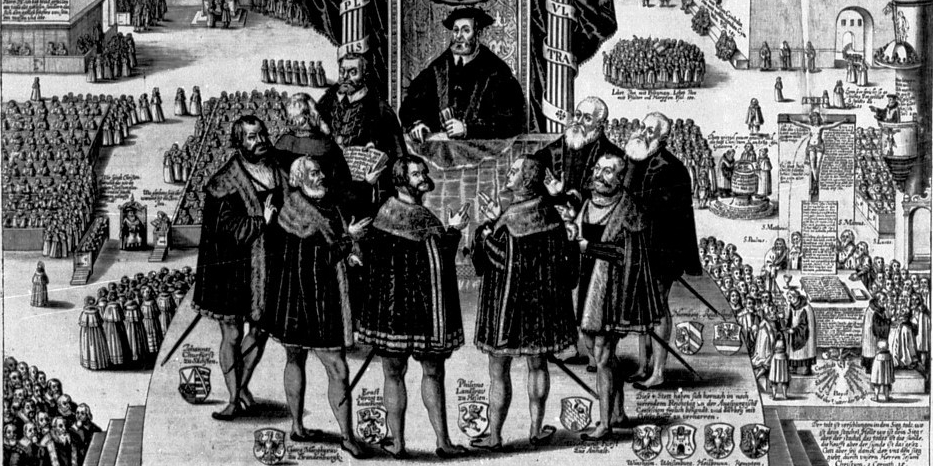
Presentation of the Augsburg Confession – Pr. Faugstad homily
On June 25, 1530, the Lutheran princes of Germany stood before Emperor Charles V in the German town of Augsburg and publicly read their confession of faith. They stated that they would rather die than compromise the truth of God’s Word.
Text: Romans 10:5-17
In Christ Jesus, whose perfect confession of the truth covers over our times of doubt, weakness, and faithlessness, dear fellow redeemed:
In the parts of the Augsburg Confession we have heard so far, there are two major themes that are brought up again and again. Those themes are righteousness and faith. In the Bible, “righteousness” is what it takes to be right with God. We don’t have to guess about the standard, because God has given us His standard for righteousness. He has given us ten statements—Commandments—which outline a life of righteousness.
Just ten commands—if you can live by them and keep them, you are right with God. But if you cannot keep them, then you cannot make yourself right with God. Already in the second article of the Augsburg Confession, the Reformers said this: We condemn those who “argue that a person can be justified before God by his own strength and reason” (ELH p. 9). In article four, they repeated the same thing, “We teach that men cannot be justified before God by their own strength, merits, or works” (ELH p. 9).
This teaching that there is nothing we can do to make ourselves right with God does not shock us, but it certainly shocked the people in Germany and beyond in 1530. Many believed that their good works, their merits, did contribute to their righteousness before God. The Roman theologians who responded to the Augsburg Confession put it like this, “All Catholics admit that our works of themselves have no merit but God’s grace makes them worthy to earn eternal life” (“The Confutation of the Augsburg Confession” in Sources and Contexts of The Book of Concord, p. 109). So is it ultimately God’s power or our power? Is it His work or our work?
St. Paul does not leave this ambiguous or unclear in today’s reading. He writes about “the righteousness that is based on the law” and “the righteousness based on faith.” The righteousness based on the law is our attempts to do what God tells us. If we kept His Commandments perfectly, He would let us into heaven because of our own good work. But if we have not kept them perfectly, we stand condemned in our sin. It’s all or nothing. Either you are perfect according to God’s standard, or you are not.
Now “the righteousness based on faith” is not a different kind of righteousness. It is still the perfect keeping of God’s Commandments, but this righteousness comes to us apart from our works. We do not earn this righteousness; we are given this righteousness. It is the righteousness of Jesus, who did perfectly keep the Commandments. He is the only human being to accomplish this. We were all conceived and born in sin, and we continued sinning. But He was conceived in the virgin Mary’s womb by the power of the Holy Spirit, and therefore He entered the world without sin.
Though in every respect He was tempted as we are, He never sinned (Heb. 4:15). He perfectly feared, loved, and trusted His heavenly Father. He perfectly loved everyone around Him. And that perfect keeping of God’s law is counted to each one of you by faith, and faith alone. Again from the Augsburg Confession, article four: “We teach that men… are freely justified for Christ’s sake through faith, when they believe that they are received into favor and that their sins are forgiven for Christ’s sake, who by His death has made satisfaction for our sins” (ELH p. 9).
For this faithful confession before one of the most powerful rulers in the world, the Reformers were risking their very necks! They were willing to die for this truth. They were fully convinced that what St. Paul wrote is true: “if you confess with your mouth that Jesus is Lord and believe in your heart that God raised Him from the dead, you will be saved.” Paul says nothing about God’s grace making us worthy to earn salvation, or about faith working through love that somehow earns us heaven. He speaks of the righteousness of Jesus becoming ours by faith in Him.
But where does faith come from? Is that a work you do? Paul writes, “So faith comes from hearing, and hearing through the word of Christ.” The power to save you and to work faith in you is in the Gospel, the good news of Jesus’ perfect life and atoning death on behalf of sinners. That is why you can be certain of your righteousness and salvation. They are gifts from God to you, received through the faith the Holy Spirit worked in you through the Word.
God has saved you. He justifies you. He caused you to believe this soul-saving truth. You Are Righteous before God by Faith. This is what the Lutheran laymen and pastors confessed 494 years ago, and by God’s enduring grace, we still confess it today to His glory alone. Amen.
+ + +
(picture of Emperor Charles V receiving the Augsburg Confession)

The Third Sunday after Trinity – Pr. Faugstad sermon
Text: 1 Peter 5:6-11
In Christ Jesus, who promises to defend and keep His Holy Church, so that not even the gates of hell shall prevail against it (Mat. 16:18), dear fellow redeemed:
Some of the most popular movies are the ones about resistance efforts against powerful rulers. This is what Star Wars was about with the rebel alliance versus the evil empire, or more recently with the Hunger Games series. We enjoy rooting for the underdog. We enjoy watching them come up with plans to topple the bad guys.
Have you ever imagined yourself in a scenario like this? What if you were part of a resistance group? How would you try to undermine the work of wicked rulers? What risks would you be willing to take? What sacrifices would you make? Is there anything that could make you give in or give up?
Our reading for today says that as followers of Jesus, You Are Part of the Resistance. This means it is important that you know your enemy and his tactics, that you know who your allies are, and that you have a good plan for engaging and standing firm against those who stand against you.
So who is your chief enemy? Who wants to destroy you? The apostle Peter writes, “Your adversary the devil prowls around like a roaring lion, seeking someone to devour.” Lions are nothing to take lightly. If lions inhabited our part of the world, we would have to be ready all the time. But as powerful as they are, lions don’t just charge across an open field at their prey. They sneak up slowly and quietly, waiting for the opportunity to strike when their target is vulnerable.
That’s how the devil is with us. He waits for the right opportunity, watching for signs of weakness. He tempts us to think that we are strong, that we have nothing to be concerned about. We can make our own choices. We should do whatever feels right to us, even if it isn’t in line with what the Bible teaches. The devil wants you to believe that you can be a good Christian even if you don’t follow the Word of Christ.
But that isn’t the only weapon in his arsenal. When he is unable to coax us away from the Word, he tries to make us suffer for our faithfulness. That suffering could come when unbelievers ridicule us or even attack us for what we believe. You might get picked on at school, because you won’t go along with the crowd. You might get passed over at work, because you won’t participate in what is unethical. I recently listened to a presentation by a Christian man who was charged with various crimes, because he would not create something that went against his beliefs.
The devil wants to make life as rough on you as he possibly can. The world is his kingdom. If you will not join him, you are not welcome here. He mobilizes all his diabolical forces against you. He won’t let you pass through the world in peace. Martin Luther in his famous hymn says this about the devil: “The old evil foe / Now means deadly woe; / Deep guile and great might / Are his dread arms in fight; / On earth is not his equal” (Evangelical Lutheran Hymnary 250, v. 1).
But you don’t face the devil all by yourself. If you did, you would certainly lose; he is too powerful. God has called you to stand with others, to be part of a mighty community, “the communion of saints.” Peter makes reference to this fellowship in the body of Christ when he says, “Resist [the devil], firm in your faith, knowing that the same kinds of suffering are being experienced by your brotherhood throughout the world.”
You are not the first to suffer trials and difficulties for your faith, and you won’t be the last. Jesus said, “If anyone would come after me, let him deny himself and take up his cross and follow me” (Mat. 16:24). Every follower of Jesus must “take up his cross.” Every follower of Jesus must expect trouble in the world. Every follower of Jesus must prepare for suffering.
But like teammates who cheer each other on, or like medics who bind up the wounds of warriors, we stand shoulder to shoulder with our brothers and sisters in Christ, ready to give support and help. We “consider how to stir up one another to love and good works, not neglecting to meet together, as is the habit of some, but encouraging one another, and all the more as [we] see the Day drawing near” (Heb. 10:24-25). We “bear one another’s burdens” (Gal. 6:2). We are “kind to one another, tenderhearted, forgiving one another, as God in Christ forgave [us]” (Eph. 4:32).
We do these things for one another, because this is the way of our Lord Jesus. He did all these things perfectly for us. That was His plan for victory. It wasn’t to conquer His enemies by being more brutal, more violent, or more deceptive than they were. It was to come in humility, to love, serve, and sacrifice for the sinners who did not welcome Him or honor Him, but who despised Him and conspired to kill Him.
That hardly seems like a recipe for success, and for many Christians still it does not seem like a proper strategy for battle or a plan for victory. They don’t want to hear about humility or suffering or love. They want to meet the unbelievers of the world on their own battlefield while giving no thought to working from higher ground. For some Christians, everything depends on getting certain people elected to government positions or getting certain laws passed. “Then,” they think, “then we have a chance at victory.”
But that sort of victory will always be out of reach. Jesus said, “My kingdom is not of this world” (Joh. 18:36). Earthly rulers come and go, governments rise and fall. “The grass withers, the flower fades, but the word of our God will stand forever” (Isa. 40:8). In our resistance efforts in this world, the only weapon the Church has and the only weapon we need is the Word of God.
The powerful Word is what routes the devil and frustrates his plans. He has no answer for the Word. As Luther says again, “The world’s prince may still / Scowl fierce as he will, / He can harm us none, / He’s judged; the deed is done; / One little word can fell him” (ELH 250, v. 3). The devil is sent packing every time Jesus says to us, “I forgive you all your sins,” or when He says, “This is My body, which is given for you; this is My blood which is shed for you for the remission of sins.”
What can the devil say against you if Jesus speaks this way for you? Jesus makes it abundantly clear that He stands with you, and you stand with Him, which can only mean that the devil has to go hungry. That roaring lion can roar all he wants and “scowl fierce as he will.” He can accuse us, attack us, throw all he has at us. But he cannot overcome us, because he is overcome by Jesus.
John the apostle writes that this is “the reason the Son of God appeared.” It was “to destroy the works of the devil” (1Jo. 3:8). In the days leading up to His crucifixion, Jesus told the crowds, “Now is the judgment of this world; now will the ruler of this world be cast out. And I, when I am lifted up from the earth, will draw all people to myself” (Joh. 12:31-32). The very means by which Jesus seemed to be defeated was the means He used to destroy Satan.
His suffering and His death on the cross was the payment for all sin. And since sin has been paid for, there is nothing more for the devil to say. If the devil is in your ear, tempting you away from Jesus, and you think his temptations sound reasonable, it is because of one of two things (or both)—you have forgotten you are a sinner, or you have forgotten what Jesus did to redeem you from your sin.
This is why Peter says in his epistle, “Humble yourselves, therefore, under the mighty hand of God so that at the proper time He may exalt you.” You humble yourself by acknowledging your weakness, by repenting of your sin and trusting in God’s unchanging love for you. You “[cast] all your anxieties on Him,” knowing that “He cares for you.” You don’t carry out resistance work against the devil on your own. You don’t rely on your own abilities, your own strength, your own cunning. You rely on Jesus, your Savior and your King, the Conqueror of the devil and death.
You may often feel overmatched in this fallen world which does not honor Jesus. It may seem like the odds are hopelessly against His Church here on earth. It may seem like you and all believers are certain to lose and lose badly. But the Lord Jesus is on the march! He comes boldly and powerfully through His Word and Sacraments. He comes to “seek the lost,” “bring back the strayed,” “bind up the injured,” and “strengthen the weak” (Eze. 34:16). He is the Good Shepherd who comes looking for us wherever we have wandered and carries us home on His shoulders rejoicing (Luk. 15:5).
The devil has not won, and he cannot win. Even though you will suffer in the shadow of his dark kingdom for a little while, you have the promise that “the God of all grace, who has called you to His eternal glory in Christ, will Himself restore, confirm, strengthen, and establish you.” Because of what Jesus did for you, you are at peace with the God who rules over all things for your good. Jesus says, “In the world you will have tribulation. But take heart; I have overcome the world” (Joh. 16:33). In Jesus, you cannot lose.
To Him be the dominion forever and ever. Amen.
+ + +
(picture from “The Good Shepherd” by James Tissot, 1836-1902)

The Festival of Pentecost – Pr. Faugstad exordium & sermon
Festival exordium:
When children are counting the days to their birthday, the days leading up to it go so slow. The anticipation builds and builds until finally… the day is here!
Just before His ascension, Jesus told the disciples, “you will be baptized with the Holy Spirit not many days from now” (Act. 1:5). What would that baptism be like? Jesus said it was not like the baptism that John administered with water. John had said of Jesus that He would baptize “with the Holy Spirit and with fire” (Luk. 3:16).
The disciples’ anticipation grew with each passing day. Now it had been one day since the Lord’s ascension, then two, three, four, five. What did the disciples do while they waited? Filled with joy at Jesus’ promise, they together devoted themselves to prayer in Jerusalem (Act. 1:14). They also frequently worshipped in the temple, blessing God (Luk. 24:53).
Day six passed, then seven and eight and nine. Finally on day ten—a Sunday—the baptism promised by Jesus happened. They were baptized with the Holy Spirit and with fire. If the candles on a birthday cake cause excitement, this fire was infinitely more exciting. Tongues of fire rested on the disciples, but we are not told where. Artists often depict it above their heads, but it may well have flashed from their mouths.
That’s where the power was—it was in the Word, God’s Word, the glad tidings spoken by the disciples. That’s where the power still is. We don’t see the fire, but the Holy Spirit still shines the light of salvation through the Word of God, which He has recorded for us in the Bible. This light flashes forth to enlighten our minds and gladden our hearts—even more gladness than little children feel on their birthday.
In celebration of Pentecost, the birthday of the Christian Church, let us rise to sing our festival hymn, #399:
O Light of God’s most wondrous love,
Who dost our darkness brighten,
Shed on Thy Church from heav’n above,
Our eye of faith enlighten!
As in Thy light we gather here,
Show us that Christ’s own promise clear
Is Yea and Amen ever.
O risen and ascended Lord,
We wait fulfillment of Thy Word;
O bless us with Thy favor!
+ + +
Sermon text: Acts 2:1-13
In Christ Jesus, who sent out the Holy Spirit from the Father to bear witness about His saving work to the whole world (Joh. 15:26), dear fellow redeemed:
It’s amazing how the same message can be heard in completely different ways depending on who the listener is. The disciples on Pentecost were speaking in other tongues, languages they had never known or spoken before. Some who heard them said, “we hear them telling in our own tongues the mighty works of God.” But others just heard gibberish. They mocked the disciples and said, “They are filled with new wine—they are just babbling incoherently!”
This statement showed their ignorance. They did not understand what was being spoken, so they immediately brushed it aside. These skeptics were the first ones Peter addressed, when he spoke just after today’s reading. “Men of Judea and all who dwell in Jerusalem,” he said, “let this be known to you, and give ear to my words. For these people are not drunk, as you suppose, since it is only the third hour of the day” (Act. 2:14-15)—9:00am!
They were not full of alcohol at this time of day. They were filled with God the Holy Spirit. He had been poured out upon them by God the Father and God the Son. Peter continued by quoting the words of the prophet Joel, “And in the last days it shall be, God declares, that I will pour out my Spirit on all flesh” (v. 17). The Holy Spirit had come just as Jesus promised. The Holy Spirit had come to distribute the gifts that Jesus won for all sinners.
The Holy Spirit still works among us today. He works today in the same way that He worked on Pentecost. No, not with the sound of a “mighty rushing wind” or with “divided tongues as of fire,” as awesome as that would be. He works among us through words. That is especially what got the people’s attention. They heard about “the mighty works of God” in their own language. Their hearing of this powerful Word is what led 3,000 people that day to believe and be baptized “in the name of the Father and of the Son and of the Holy Spirit” (Mat. 28:19).
You have also been baptized in this way, and the Holy Spirit was poured out on you through the powerful Word. It is interesting to note that the evil spirits, the demons, hate the water. Jesus said, “When the unclean spirit has gone out of a person, it passes through waterless places seeking rest, but finds none” (Mat. 12:43). But the Holy Spirit has been tied to water since the beginning. Genesis 1 says that “the Spirit of God was hovering over the face of the waters” (v. 2). And now the Spirit fills us—He is poured out on us—through the water and Word of Holy Baptism.
The apostle Paul encourages us to continue to “be filled with the Spirit” (Eph. 5:18). He wrote this in his inspired letter to the Ephesians, again highlighting the contrast between the consumption of alcohol and the pouring out of the Spirit. He writes, “Therefore do not be foolish, but understand what the will of the Lord is. And do not get drunk with wine, for that is debauchery, but be filled with the Spirit” (5:17-18).
“Debauchery” is a word that refers to wild parties, carousing, the excessive indulgence of ungodly appetites. That is the door that drunkenness opens. The over-consumption of alcohol impairs good sense, it dulls the conscience, it makes us more willing to do what we know we should not do. It puts ourselves and others at risk physically and especially spiritually. That is foolishness and not the will of the Lord.
The Lord’s will is that we are filled with the Spirit, and Paul outlines what this results in. He writes that those who are filled with the Spirit “[address] one another in psalms and hymns and spiritual songs.” This is why we sing in church, even if we don’t think we can sing very well. We’re not singing to win any competitions. We sing to encourage one another. We sing the message of salvation to each other. We Lutherans have the best hymns ever produced, because we believe, teach, confess, and sing the pure Gospel by the grace of God.
We who are filled with the Spirit also “[sing] and [make] melody to the Lord with [our] heart, giving thanks always and for everything to God the Father in the name of our Lord Jesus Christ” (vv. 19-20). This has to be the Spirit’s work, because our hearts are not always filled with a song of praise toward God the Father. We do not give thanks “for everything” to God. But we should.
We were created by God the Father and redeemed by God the Son to praise Him through our actions, words, and thoughts. This praise should never stop, no matter what pain or sadness or turmoil we are feeling, because there is no goodness and no mercy apart from our God.
But as willing as our sanctified spirit may be, our sinful flesh is weak (Mat. 26:41). We focus on the troubles more than the blessings. We see what is going badly instead of what is going well. This perspective leads many to look for help in the wrong places, to temporary fixes that create lasting problems, like the bottle. These temptations only leave us more parched and more desperate than we were before. Only the Spirit can quench our thirst for help and salvation.
Jesus once told a woman at a well, a woman who had filled up her life with sin, that everyone who drinks regular water will be thirsty again. But He had a different kind of water to give, living water (Joh. 4:10-14). On another occasion, Jesus cried out, “If anyone thirsts, let him come to me and drink. Whoever believes in me, as the Scripture has said, ‘Out of his heart will flow rivers of living water’” (Joh. 7:37-38). This “living water” is the Holy’s Spirit work to bring us the salvation of Jesus.
The Holy Spirit is poured into believers through the Word and Sacraments. This is where we drink deeply of the Spirit, where we are filled with the living water of Jesus that washes away our sin. We come thirsty, parched from our wandering in the world’s wilderness, desperate for forgiveness. We come with our ears wide open and eager to hear the truth. We come to hear in our own tongue “the mighty works of God.”
We want to hear again and again what Jesus has accomplished for us, how He saved us from our foolish behavior, from our desire for what harms us, from our addiction to sin. He died for all these sins, and He rose again to declare that none of them is counted against you or me anymore.
The Spirit fills you with the forgiveness and life of Jesus. He covers you in His righteousness. Jesus said, “When the Spirit of truth comes, he will guide you into all the truth…. He will glorify me, for he will take what is mine and declare it to you” (Joh. 16:13,14). This is what the Holy Spirit does for you. He refuels your faith. He refreshes your spirit. He brings you the fruits of Jesus’ perfect work, so that you are comforted and strengthened in this life and prepared for the eternal life to come.
Glory be to the Father and to the Son and to the Holy Ghost; as it was in the beginning, is now, and ever shall be, forevermore. Amen.
+ + +
(picture from stained glass at Saude Lutheran Church)

The Festival of Our Lord’s Ascension – Vicar Lehne exordium & sermon
Festival exordium:
“It is finished.” These are the words that Jesus spoke on the cross after he had completed everything that was necessary to save us from our sins. But just because Jesus’ work to save us was finished didn’t mean that he was done with us. There is still so much that he does for us from the position of authority that he has in heaven. He ascended to the right hand of his Father in order to be our Prophet, High Priest, and King. As our Prophet, Jesus sends out believers to spread the good news about what he has done for us and works through the good news of Scripture to bring the unbelieving world to faith. As our High Priest, Jesus intercedes for us on our behalf to the Father. And as our King, Jesus rules over not just heaven, which is his kingdom of glory, and earth, which is his kingdom of power, but also over his Holy Church, which is his kingdom of grace.
This is what Jesus ascended on high to do for you. He was seated at the right hand of the Father in glory in order to share the finished work of redemption with you. He is not done with you. He continues to give you these gifts. As your Prophet, he tells you the good news that he has finished the work to save you. As your High Priest, he reminds the Father of his sacrifice that he made on your behalf, and the Father sees your sins no more. And as your King, he rules over all things for your good so that you can be safely led by him to heaven to be with him forever. For these wonderful gifts, we praise and glorify his name by rising to sing “O Wondrous Conqueror and Great,” as it is printed in your service folders.
O wondrous Conqueror and great,
Scorned by the world You did create,
Your work is all completed!
Your toilsome course is at an end;
You to the Father do ascend,
In royal glory seated,
Lowly,
Holy,
Now victorious,
High and glorious:
Earth and heaven
To Your rule, O Christ, are given.
+ + +
Sermon text: Acts 1:1-11
In Christ Jesus, who did not leave us but continues to be with us always, dear fellow redeemed:
The disciples didn’t want Jesus to leave them. They had spent three years of their lives following Jesus and getting to know him well. During that time, they heard his words and saw his miraculous power. Because of these things that they saw and heard, they were hoping that Jesus would use his power to establish a kingdom on earth. But then, Jesus “began to show his disciples that he must go to Jerusalem and suffer many things from the elders and chief priests and scribes, and be killed, and on the third day be raised” (Matthew 16:21). This was not what the disciples wanted. Peter even “took [Jesus] aside and began to rebuke him, saying, ‘Far be it from you, Lord! This shall never happen to you’” (Matthew 16:22). But, even though it wasn’t what the disciples wanted, Jesus did suffer and die, just as he said he would, and his disciples were left alone and afraid.
Thankfully, that wasn’t the end. Jesus had also told his disciples that he would rise again on the third day, and that’s just what he did. When the disciples heard that he had risen, they didn’t believe it at first, but when Jesus appeared before them, they could no longer deny it. Jesus had risen, just as he said! He hadn’t left them after all. Now, the disciples were sure that Jesus would establish a kingdom on earth, and they would get to be with him as he ruled. But that’s not what happened. Instead, Jesus told them to “[g]o into all the world and proclaim the gospel to the whole creation” (Mark 16:15). As they did, they were to baptize all nations “in the name of the Father and of the Son and of the Holy Spirit [and teach] them to observe all that [Jesus had] commanded [them]” (Matthew 28:19–20). Then, after telling them this, Jesus was taken up into the sky before their very eyes, until he was hidden from their sight by a cloud. Jesus had just told his disciples, “I am with you always, to the end of the age” (Matthew 28:20), but now, the disciples appeared to be alone once again, this time for good.
Do we ever feel like Jesus has left us? While we would certainly love to say that we’ve never felt this way, all we have to do is look at the sinful world around us, and it becomes extremely difficult not to feel alone. Sinful lifestyles that we know are wrong are regularly practiced and encouraged by those around us. Even though the world claims to be a tolerant one, it seems to be tolerant of everything except Christianity, making it harder and harder for us to live as Christians. Like the disciples, we want Jesus to be visible and establish a kingdom on earth that is free from trouble, but we look around for him and can’t seem to find him anywhere. During times like these, it can be very easy for us to say, “Jesus, where are you? Why have you left us all alone?”
But Jesus has not left us all alone, just as he hadn’t left his disciples alone. As our gospel reading for today says, “[the disciples] went out and preached everywhere, while the Lord worked with them and confirmed the message by accompanying signs” (Mark 16:20). Jesus wasn’t visibly with his disciples, but he was still with them. He was with his disciples as they carried out the mission he had given them by preaching the Word and administering the Sacraments. In the same way, Jesus is with us as the Word is preached to us and the Sacraments are administered to us.
When Jesus’ Word is preached to you, or when you read his Word on your own, Jesus is present as he tells you everything that he did to save you from your sins. You were unable to follow God’s command to live a perfect life, but Jesus says through his Word, “I lived a perfect life for you, and that perfect life is now yours.” Your sins needed to be paid for with blood, and Jesus says through his Word, “My blood was shed on the cross for you. I have paid the price for your sins.” There are times when you may fear death, not wanting to leave your loved ones behind, but Jesus says through his Word, “I have risen from the dead, which means that you too will one day rise from the dead when I return in the same way that I was taken up into heaven.” You may wonder if the work to save you has truly been finished, but Jesus says through his Word, “My ascension into heaven is proof that everything that was necessary to save you was completed by me.”
How comforting it is to know that you can see Jesus whenever you want by simply opening up and reading your Bible. And because Jesus is present in his Word, that means that he is also present in the Sacraments, since they get their power from the Word. One of those Sacraments is baptism. When the water was applied in the name of the Father and of the Son and of the Holy Spirit at your baptism, all of your sins were washed away. At that moment, Jesus gave you the forgiveness of sins that he won for you by his death on the cross. He clothed you in the white garments of his perfect life, the perfect life that he lived for you. And he sent his Holy Spirit into your heart to create faith, a faith that trusts in him.
So, Jesus is with us in the preaching of his Word and in the waters of baptism, which are connected with his Word, even though we can’t see him, but he isn’t bodily present with us, right? After all, at his ascension, he was bodily taken up into heaven, which means that his body must be stuck in heaven. But this simply isn’t true. Jesus’s body and blood are present in the Sacrament of Holy Communion. Whenever we come to his table to receive the bread and the wine, which have been connected with his Word, we are receiving Jesus’ true body and blood. Even though we can’t see him, Jesus is with us in his meal to personally give us the forgiveness of sins that he won for us with the shedding of his blood.
You may not feel worthy of receiving the forgiveness of sins from Jesus in his supper. When you look at your sins, you are burdened with guilt. You don’t feel like Jesus is with you, and so, you think that he must have left you because your sins are too great to be forgiven. But Jesus didn’t come to save the worthy. He came to save the unworthy. He invites you to join him at his table so that he can freely offer you the forgiveness of sins. He freely forgives your sins not because you deserve it, but because he loves you. And you can leave his table knowing that the forgiveness that he just personally gave to you through his true body and blood was for you.
From his throne in heaven, our ascended Lord works through these means of grace, which he has promised to be present in, for our good, for the good of his church. This may not be how we expect Jesus to work things for our good. Like the disciples, who asked Jesus if he was going to restore the kingdom of Israel, we may want Jesus to give us a heaven on earth. But Jesus didn’t come to establish an earthly kingdom, nor does he rule over all things from his position of authority to make our lives a heaven on earth. He came to give us something far better: a perfect life of endless joy in heaven. The doors to heaven were opened to us when Jesus died on the cross, and then, he ascended into heaven after his resurrection to “prepare a place” for us (John 14:3). Until that time comes when Jesus returns “in the same way as [his disciples] saw him go into heaven” (verse 11), he comes to us in his means of grace, his Word and Sacraments, to prepare us for the day when we will leave this world and enter heaven to be with him forever. We are only strangers here. “Our citizenship is in heaven” (Philippians 3:20). And everything that our ascended Lord is doing for us here on earth is preparing us to come home to heaven.
When Jesus was taken up into heaven and hidden from the disciples, they were no longer able to see him. But that didn’t mean that Jesus had left them. He continued to be with them throughout the rest of their earthly lives, and when their time on earth was over, Jesus led them safely to his side in heaven. In the same way, even if you can’t see him or feel him, you know that Jesus is with you, because he gives you the same promise that he gave to his disciples “I am with you always, to the end of the age” (Matthew 28:20). He speaks to you through his Word. He washes you in the waters of baptism. And he personally feeds you at his supper. Your ascended Lord may not be present in the ways that you want him to be, but he is present in the ways that he promised to be and in the ways that you need him to be. Jesus hasn’t left you. He is with you always and will continue to be with you throughout your life, until he takes you up into heaven to be with him forever.
Glory be to the Father and to the Son and to the Holy Ghost; as it was in the beginning, is now, and ever shall be, forevermore. Amen.
+ + +
(picture from painting by John Singleton Copley, 1775)
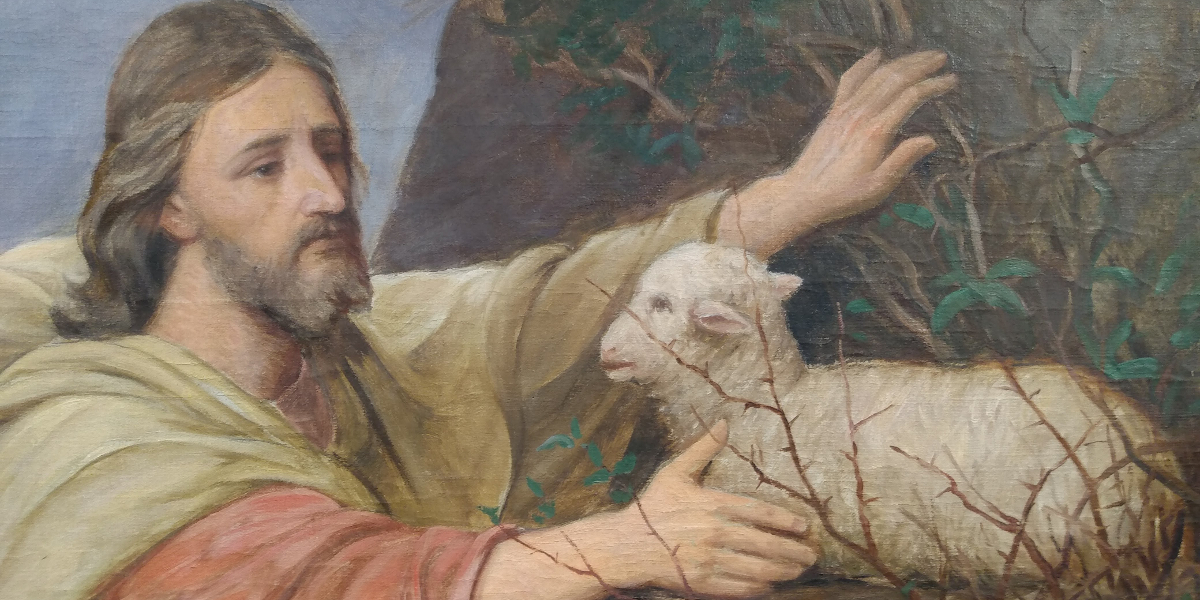
The Third Sunday of Easter – Vicar Lehne sermon
Text: St. John 10:11-16
In Christ Jesus, who laid down his life for us that he might take it up again, dear fellow redeemed:
The sheep were all jumbled together. Several shepherds had brought their sheep to the same pen for the night. The pen had only one gate that was guarded by a watchman, and it had walls that were tall enough to keep the sheep from wandering away during the night and to keep thieves and predators, such as wolves, out. But if all of the sheep were in the same pen, how would the shepherds know whose sheep were whose when they came back for them in the morning? It actually wasn’t a problem at all. Why? Because the sheep knew the voice of their shepherd. When they heard their shepherd’s voice, they followed him, while the other sheep, who did not recognize his voice, stayed behind. The shepherds led their sheep by their word.
In our reading for today, we are called “sheep,” and if we are sheep, then that means that we must have a shepherd whose voice we follow. Who is that shepherd? He is none other than Jesus, the Good Shepherd. When we call Jesus “the Good Shepherd,” we don’t mean that he is simply good at being a shepherd. We mean that he is the best shepherd that we could possibly have, and Jesus shows this in what he was willing to do for us.
You were once lost sheep, wandering every which way and being hunted by wolves. These wolves are your spiritual enemies: the devil, the world, and your sinful nature. Led by the devil, your spiritual enemies had completely surrounded you. You were doomed to be snatched by them and dragged away into the fires of hell. But even though you were already in the deadly clutches of your enemies, Jesus did not want to leave you to that fate. So, he left the green pastures of heaven and entered the wilderness of Earth to save you. When Jesus appeared, the wolves attacked him and killed him. In this moment, your spiritual enemies thought they had won, but it was by Jesus’ death, by the shedding of his blood, that the price that was necessary to save you was paid. By the shedding of Jesus’ blood, you were made his own. Jesus saved you from the clutches of your enemies by laying down his life of you. This is what sets Jesus apart from all other shepherds. “The good shepherd lays down his life for the sheep” (verse 11). Other shepherds are willing to protect their sheep, but they wouldn’t go so far as laying down their lives for their sheep. It is through this act, through willingly laying down his own life for you, that Jesus shows just how much he loves you.
But Jesus didn’t leave you without a shepherd. As he says in the verses following our reading for today, “I lay down my life that I may take it up again” (John 10:17). Death had no power over Jesus. On the third day, he rose again from the dead, declaring his victory over your spiritual enemies. Because Jesus is risen, you remain safe from the attacks of your spiritual enemies and are led to green pastures and still waters that nourish the faith that you have been given. As the psalmist says, “He makes me lie down in green pastures. He leads me beside still waters. He restores my soul” (Psalm 23:2–3). These green pastures and still waters that your Good Shepherd nourishes you with are the means of grace, the Word and Sacraments.
Just like real sheep, who are led by the word of their shepherds, you are led by the Word of your Good Shepherd. You know Jesus’ voice because he speaks to you through his Word, and the words that he speaks to you are very comforting. When there are sins that are troubling you, Jesus says to you, “I forgive you all your sins.” When you feel like you are in danger from the wolves that surround you, Jesus says to you, “They will never snatch you out of my hand.” When you feel lost, Jesus says to you, “Follow me.” And when you feel like you are all alone, with no one to turn to, Jesus says to you, “I will be with you always, even to the end of the age.” Your Good Shepherd not only leads you with these comforting words. He also nourishes you and strengthens you with them, just like he does with the Sacraments of Holy Baptism and Holy Communion.
In the Sacrament of Holy Baptism, you are marked for eternal life, which Jesus promises to give to his sheep in the verses following our reading for today (verse 28). You are marked for eternal life when the waters of baptism wash your sins away. These waters continue to wash you to this day. For every day, your new self rises up out of the waters of your baptism and your old self is drowned in them. Through baptism, you are comforted and strengthened, knowing that you have been washed clean. For since you have been washed clean, you have been marked as Jesus’ own, meaning that the eternal life that he promises to give his sheep is yours.
While you wait for the day when you will receive your promised eternal life, you receive a foretaste of it in the Sacrament of Holy Communion. During this holy supper, you feast on the true body and blood of your Good Shepherd who laid down his life for you to win you that eternal life. Jesus willingly went to the cross and shed his blood for you, and through the shedding of his blood, you receive the forgiveness of sins. When you come to his table, along with your fellow sheep, the forgiveness of sins that he won for you on the cross is brought to you when you eat and drink Jesus’ true body and blood in the bread and the wine. Then, you leave his table strengthened and nourished in the confidence that you have been forgiven. These means of grace truly are the best green pastures and still waters that your Good Shepherd can provide you with in this life.
You are blessed to have a Good Shepherd who continues to provide for your spiritual needs and protect you from your spiritual enemies. But that doesn’t mean that you can let your guard down. Your spiritual enemies are cunning, and there are lots of tricks that they have up their sleeves that they use against you to try and lure you away from your Good Shepherd. One of their most cunning tricks is to use false teachers to leave you defenseless to their attacks. Even though Jesus is your Good Shepherd, he has left you with shepherds who he has tasked with watching over his sheep. These shepherds are your pastors. But not all pastors are true shepherds who serve the Good Shepherd. Some of them look good and sound good, but in reality, all they care about is themselves. They do not feel responsible for you. All they want is to make a living off of you. So, when the wolves attack, they show their true colors and leave the flock to fend for themselves. Jesus compares these false teachers to the hired hands who watch the sheep. He says, “He who is a hired hand and not a shepherd, who does not own the sheep, sees the wolf coming and leaves the sheep and flees, and the wolf snatches them and scatters them. He flees because he is a hired hand and cares nothing for the sheep” (verses 12–13). What a blessing it is to have a pastor who truly cares about you and is always willing to be there for you.
But that is only one of the tricks that you have to look out for. Another one of your spiritual enemies’ most cunning tricks is making their voices sound like the voice of your Good Shepherd. You look to God’s Word to hear the words of Jesus, but when you read them, the devil, the father of lies, says to you, “When Jesus said this, what he really meant was that.” As the world continues to live in sin and encourages you to join in with them, you point to what Jesus has said to you in his Word. But in response, the world says to you, “Those things only applied to the people of the Bible. We don’t have to follow those things anymore.” When your sinful nature tempts you to sin, you remember the words that Jesus spoke to you. But your sinful nature responds by saying, “You still have faith in Jesus, don’t you? It doesn’t matter what you do, because faith is all you need.” These, along with all other ways that your spiritual enemies attempt to lead you astray, can sound very convincing and can trick you into thinking that their voices are the voice of your Good Shepherd. But unfortunately, there are even times when you and I know that we are not hearing Jesus’ voice, yet we decide to listen to the false voices and follow them anyway. We must be careful, because these wolves are only trying to get us into their jaws so that they can snatch us and drag us away from our Good Shepherd, away from the green pastures and still waters of the means of grace, and into the fires of hell.
Even though we are sheep that love to wander and constantly fall for the tricks that our spiritual enemies use against us, we don’t need to fear losing our place in green pastures of heaven, because we belong to Jesus. As Jesus says in the verses following our reading for today, “No one will snatch [my sheep] out of my hand” (John 10:28). When we do wander into the clutches of our spiritual enemies, Jesus will be there to rescue us from them. No matter how far we’ve wandered away from him, Jesus is willing to go to the ends of the earth to lead us back to him. Jesus knows who his sheep are, and he will never abandon them, especially not when they need him most.
The sheep know the voice of their shepherd, but this knowing isn’t one-sided. Your Good Shepherd also knows you. But this knowing is much more than simply recognizing each other. Even the devil, the leader of the wolves, recognizes who Jesus is. This knowing is a knowledge that unites you with your Savior in love. You love Jesus, your Good Shepherd, and desire to follow him. But this love does not have its origin in you. It has its origin in Jesus and what he did for you. As the apostle John says, “We love because he first loved us” (1 John 4:19). Jesus loved you so much that he was willing to lay down his own life so that you may experience eternal life in the green pastures of heaven. And Jesus still shows his love for you in that, as your risen Lord, he leads you safely though the dangers of this world until you reach those green pastures of heaven. As the psalmist says, “Even though I walk through the valley of the shadow of death, I will fear no evil, for you are with me; your rod and your staff, they comfort me” (Psalm 23:4). Jesus, your Good Shepherd is better than any other shepherd because no one has love that matches his. So, you can be confident that your Good Shepherd knows you and will lead you to the green pastures of heaven. As Jesus says, “I give [my sheep] eternal life, and they will never perish” (John 10:28).
Glory be to the Father and to the Son and to the Holy Ghost; as it was in the beginning, is now, and ever shall be, forevermore. Amen.
+ + +
(picture from Saude Lutheran Church altar painting)

The Second Sunday of Easter – Vicar Lehne sermon
Text: St. John 20:19-31
In Christ Jesus, who dispels our every doubt, dear fellow redeemed:
How could Thomas be so stubborn? The other disciples saw Jesus with their own eyes. They saw the mark of the nails on his hands and the hole in his side from the spear. Why did Thomas refuse to believe his fellow disciples “[u]nless [he saw] in [Jesus’] hands the mark of the nails, and [placed his] finger into the mark of the nails, and [placed his] hand into [Jesus’] side” (verse 25)? What reason did he have to not believe the men whom he had traveled with for so long and gotten to know so well? But even though Thomas was wrong to doubt that Jesus had risen from the dead, the other disciples were no better.
The first people to hear the good news that Jesus had risen from the dead were the women who went to anoint Jesus’ body early in the morning after the Sabbath had ended. When they arrived at the tomb, they discovered that the stone, which blocked the entrance to the tomb, had been rolled away. Inside the tomb, Jesus’ body was gone, which perplexed the women. Then, two angels appeared to them and said, “Why do you seek the living among the dead? He is not here, but has risen. Remember how he told you, while he was still in Galilee, that the Son of Man must be delivered into the hands of sinful men and be crucified and on the third day rise” (Luke 24:5–7). Then the women remembered Jesus’ words and went to tell the disciples what they had seen and heard. The women were told to tell them these things not only by the angels, but also by Jesus himself, who appeared to them as they returned from the tomb.
What good news the women gave the disciples! Jesus, who had been betrayed by one of their own and arrested, who had died on the cross, as witnessed by John, and who had been placed in a tomb, the entrance to which was blocked by a large stone, was not dead, but alive! He had accomplished the work that he had come to do. He had paid the price for the world’s sins on the cross and declared his victory over sin, death, and the devil by his rising from the dead. The disciples should have been rejoicing when they heard the report of the women. But, when the women told these things to the disciples, “these words seemed to them an idle tale, and they did not believe them” (Luke 24:11).
The disciples had no reason to think that the women were just telling them an idle tale and that Jesus hadn’t actually risen from the dead. He had told them many times what was going to happen to him. We hear in the gospel according to St. Matthew that, after Peter confessed that Jesus is the Christ, “[f]rom that time Jesus began to show his disciples that he must go to Jerusalem and suffer many things from the elders and chief priests and scribes, and be killed, and on the third day be raised” (Matthew 16:21). He predicted his death and resurrection to his disciples two more times after that. Then, shortly before he was to be handed over to the religious authorities and arrested, he said to his disciples, “You know that after two days the Passover is coming, and the Son of Man will be delivered up to be crucified” (Matthew 26:2). And finally, on the night that he was to be arrested and sentenced to death, Jesus said to his disciples, “[A]fter I am raised up, I will go before you to Galilee” (Matthew 26:32).
When the disciples heard the report of the women, they should have remembered Jesus’ words and believed that he had risen from the dead, just like the women did. But instead, they doubted. It took Jesus appearing before the disciples and showing them the mark of the nails on his hands and the hole in his side from the spear for them to believe. The words that Jesus spoke to Thomas in our text for today may as well have been spoken to all of the disciples: “Have you believed because you have seen me? Blessed are those who have not seen and yet have believed” (verse 29).
You are “those who have not seen and yet have believed.” It was two thousand years ago that Jesus walked the earth. There’s no way that any of you could have seen him. All you have are the words that the Holy Spirit inspired the disciples and the other writers of the Bible to write down. Those words tell you that you are by nature sinful and that you deserve only God’s wrath and punishment. They tell you that there is no way for you to escape God’s wrath and punishment or to earn your way into heaven. But those words also tell you that God the Father loved you so much that he didn’t want to leave you to that dreadful fate. So, he sent his only begotten Son, Jesus Christ, to take all of your sin on himself and experience all of the wrath and punishment from God that you rightfully deserved. The mark of the nails on his hands and the hole in his side from the spear is proof of Jesus’ love for you. Jesus was nailed to the cross for you. His side was pierced for you. His death on the cross was so that you would not have to experience that death.
But what God tells us through his Word doesn’t end with Jesus’ death, because if Jesus had remained dead, then you would have no hope. As the apostle Paul writes in his first letter to the Corinthians, “[I]f Christ has not been raised, your faith is futile and you are still in your sins” (1 Corinthians 15:17). If Jesus had not been raised, then that would mean that his sacrifice was not sufficient enough to pay for your sins. The good news is that Jesus has been raised from the dead, which means that his sacrifice was sufficient and that your sins have been paid for and forgiven. You have heard the same words that the disciples heard. The disciples were not willing to believe this good news without seeing evidence that Jesus truly had risen. Even though you have not seen any evidence that Jesus has risen, it is through the work of the Holy Spirit that you believe that it’s true.
Does that make you better or more faithful than the disciples? Even though we don’t doubt that Jesus has died on the cross and risen from the dead, there are other things that God has revealed to us through his Word that we do doubt. God tells us that he will be with us in times of trouble, but how do we know for sure that he is with us during those times? After all, it is often during our times of trouble that we feel the most alone. God also tells us that he loves us and will always do what is best for us, but how do we know that this is true? After all, so many others seem to have it better than we do, and not just other Christians, but unbelievers. If unbelievers seem to have it better than we do, how do we know for sure that he loves us and is doing what is best for us? And even though we believe that Jesus truly did die on the cross for the sins of the world, how do we know for sure that Jesus died for our sins? After all, the sins that we have done are so horrible, and they continue to weigh us down. If Jesus really did die for our sins, why do we continue to feel so guilty? What if that means that our sins haven’t actually been forgiven because they are just too great? In all of these instances, as well as many others, our doubts can lead us to not trust in the words that God has spoken to us through Scripture alone. Our doubts can lead us to seek evidence from God that what he has told us is true. In moments like these, we are no better than the disciples, who needed to see the risen Jesus to believe that he had truly risen from the dead.
Whenever we have doubts about what God has revealed to us in his Word and shut the doors of our hearts to him, Jesus passes through the shut doors of our hearts and says to us, “Peace be with you” (verses 19, 26). Jesus brings his peace to us through the means of grace, his Word and Sacraments, and through Holy Absolution. Whenever we doubt that God loves us or that he is with us in times of trouble, Jesus dispels our doubts by pointing us to the promises that he made to us in his Word and saying, “I do love you and will always be with you.” Whenever we doubt that we have been forgiven, Jesus comforts and strengthens us by pointing us to our baptisms and saying, “I have washed away your sins.” Whenever we are burdened with guilt, Jesus leads us to his table to give us his true body and blood in the bread and the wine and says to us, “I forgive you all your sins.” And in Holy Absolution, he uses his called servants of the Word to announce to all of us, “By the authority of Christ, I forgive you all your sins in the name of the Father and of the Son and of the Holy Spirit.” It is not through evidence that our hearts are put at peace. It is Jesus, working through the Word, Sacraments, and Absolution, that puts our hearts at peace.
While it would certainly be amazing to have evidence from God presented to us that what he was revealed to us through his Word is true, we don’t need it, because we already have the eyewitness accounts from the apostles about what Jesus did. Even though those apostles thought that they needed to see proof of Jesus’ resurrection before they could believe, they now tell us to believe without getting any further proof. As the apostle John writes in our text for today, “[T]hese have been written in order that you may believe that Jesus is the Christ, the Son of God, and in order that by believing, you may have life in his name” (verse 31). God’s Word is enough. It is through God’s Word that we know why we need a Savior. It is through God’s Word that we know what our Savior has done to save us. It is through God’s Word that we know that the victory has been won for us by our Savior. Whenever we have doubts, we don’t demand that God give us new evidence that what he says is true. We turn to his Word and hear of his great love for us, love that led our Savior, Jesus, to lay down his own life for us, and to hear of the comfort and hope that Jesus used to dispel our doubts, comfort and hope that we have through Jesus’ resurrection from the dead.
Glory be to the Father and to the Son and to the Holy Ghost; as it was in the beginning, is now, and ever shall be, forevermore. Amen.
+ + +
(woodcut from “Doubting Thomas” by Julius Schnorr von Carolsfeld, 1794-1872)

The Fifth Sunday in Lent – Vicar Lehne sermon
Text: St. John 8:46-59
In Christ Jesus, the Son of God, who made you the children of God, dear fellow redeemed:
Looking up who your ancestors are can be really fun and interesting. You can find out that you are descended from a certain nationality, such as Germans, Norwegians, or Irish. You can even find out that you are the descendant of someone famous, such as a king or a well-known general. If you find out things like these, you can end up priding yourself on your ancestry. But how would you react to finding out that you were the descendant of someone infamous? In our reading for today, we find out how the Jews reacted to that news.
The Jews prided themselves on their ancestry. Not only could they all trace their family trees back to Abraham, but their bloodlines remained pure. None of them had married people from foreign nations, like the Samaritans had. Surely, because of this, they had a favorable status in the eyes of God the Father, making them not just children of Abraham but also children of God. But, while it was true that they were the physical descendants of Abraham, this did not actually mean anything to God. God does not look at our physical ancestry but at our spiritual ancestry, and spiritually, the Jews were not children of God, but children of the devil.
Jesus revealed this harsh truth to the Jews in the verses prior to our reading for today, and he revealed it to them very clearly. He said, “You are of your father the devil” (John 8:44). How could Jesus make a such a bold claim like that? Jesus explains, “Whoever is of God hears the words of God. The reason why you do not hear them is that you are not of God” (verse 47).
Jesus spoke the words of God, and the words of God were the clear truth. In the verses prior to our reading, Jesus said, “If you abide in my word, you are truly my disciples, and you will know the truth, and the truth will set you free” (John 8:31–32). Why would anyone need to be set free? Because everyone is by nature sinful, which makes everyone a slave to sin and a child of the devil. As a result, the only thing we could do was continue to sin, and “the wages of sin is death” (Romans 6:23). But God the Father did not want to leave us enslaved to sin and the devil and doomed to face eternal death. He wanted us to be his own dear children and live forever with him in heaven. So, he sent his only begotten Son, Jesus, into the world to break our chains and set us free from sin, death, and the devil. And by believing in him, that freedom becomes ours.
The Jews heard these words of God, but they did not believe them. In fact, they were upset and offended by them. Who was Jesus to say that they were slaves? Even though they were currently living under Roman rule, they claimed that they had never truly been slaves to anyone. Why? Because they could trace their ancestry back to a free man, Abraham, which meant that they were free in the eyes of God. So, the Jews decided to respond to Jesus by attacking his ancestry. They said to him, “Are we not right in saying that you are a Samaritan and have a demon” (verse 48)? Jesus was claiming that they were children of the devil? Well, two could play at that game! But the Jews weren’t just claiming that Jesus was actually the one who was a child of the devil. They were also claiming that he was not a pure descendent of Abraham, like they were. He was a mixed race, like the Samaritans were, and therefore, he did not deserve a place in the kingdom of God.
Like the Jews, we don’t like it when our sins are pointed out to us. Because of how much the truth of God’s Word can hurt us, there are times when we are tempted not to believe it. In those moments, we can react like the Jews, and refuse to accept that our sin could be controlling us. After all, we’re free people. We can make our own decisions, decisions that aren’t causing harm to anyone else, and we can choose to stop whenever we want. Besides, Jesus has already forgiven us all our sins. So, what’s the harm in committing a few more sins? This way of thinking might make sense to us in those moments. But in reality, we are just lying to ourselves, like the Jews were, so that we can convince ourselves that it’s okay to continue living in the sin that we love so much. And if we continue to lie to ourselves and refuse to listen to God’s Word, then we are attacking Jesus, like the Jews were. We may not be attacking Jesus’ ancestry, but in those moments, we are claiming that he has not spoken the truth. We are claiming that God is a liar, and what a dark claim to make that is.
Our sinful nature clouds us in darkness, and there’s no way for us to get out of that darkness on our own. Thankfully, Jesus provides us with the solution. He says, “I am the light of the world. Whoever follows me will not walk in darkness, but will have the light of life” (John 8:12). We once wandered in the darkness, and if we stayed in that darkness, we would end up in the eternal darkness of hell. But unlike us, who refused to listen to God’s Word and keep it, Jesus kept his Father’s word perfectly. He was a light that cut through the darkness, a light that seemed to be put out when he was put to death on the cross. But death was not the end for Jesus. Early in the morning on the third day, he rose again from the dead. Jesus defeated death with his atoning death, and now, his light leads us out of the darkness that leads to eternal death in hell and into the light of eternal life in heaven.
The Jews stubbornly refused to believe the words that Jesus spoke. He revealed to the Jews that he would save the world from eternal death by saying, “Truly, truly, I say to you, if anyone keeps my word, he will never see death” (verse 51). Jesus had already made a lot of bold claims, but with this claim, it sounded as though he was claiming to be better than Abraham, the ancestor whom the Jews prided their connection to. After all, even Abraham died eventually. How could Jesus claim that everyone who believed in him would never experience death when the greatest man of all, Abraham, could not escape death?
In their unbelief, the Jews thought that Jesus was only speaking these words to bring himself honor and glory. But in reality, it was really the Jews who were doing that. They were seeking honor and glory through their pure ancestral connection to Abraham, which they thought would earn them a place in heaven. But they were completely missing the point. They did not need to be physically related to Abraham. They needed to have a faith like Abraham, a faith that allowed him to see the day of Jesus, which he rejoiced in. As Genesis 15:6 and Romans 4:3 say, “Abraham believed God, and it was counted to him as righteousness.” The Jews may have been physical descendants of Abraham, but they were not living as descendants of Abraham, nor were they living as children of God. They were living as children of the devil.
We may not think that we’ve earned a place in God’s kingdom by being the descendants of someone famous, such as Abraham. But we can be tempted to rely on something else: our membership in our church. We’ve taken instruction classes. We’ve been confirmed as members. We’ve been baptized into the church. Surely all of that is enough to guarantee that we have a place in heaven, isn’t it? But what do we do as members of the church? Do we mean what we say when we repent of our sin in church, and do we recognize how much we need God’s grace, or are we just going to church because we think we are supposed to? Do we continue to stay in the Word outside of church, or do we only hear the Word when we go to church? We may say that we are Christians, but do we live like Christians, or do we continue to sin in our thoughts, words, and actions, despite knowing that what we are doing is wrong? If we do not make time to remain in the Word, and if we don’t repent of our sins, it won’t matter how many instruction classes we’ve taken, if we’ve been confirmed as a member of the church, or if we’ve been baptized into the church. What God looks at is the heart.
Thankfully, despite what the Jews thought, Jesus did not seek honor and glory for himself. He sought honor and glory for you. He followed God’s law to the letter, he only spoke the truth, and he never once dishonored God the Father. He carried out his Father’s will perfectly, even allowing himself to be mocked, tortured, and put to death on a cross. But, unlike when you try to glorify yourself, Jesus’ perfect obedience actually amounted to something. By living a perfect life, Jesus was the innocent sacrifice that was needed to pay the price for your sins. On the cross, he took your sins on himself, and in exchange, he gave you his perfect life, so that you appear perfect before God, your heavenly Father. Jesus was able to accomplish all of this because he is the eternal Son of God. As he confessed to the Jews, “Truly, truly, I say to you, before Abraham was, I am” (verse 58).
When the Jews heard Jesus confess that he is God, they were furious. Because they did not believe in him, they thought that Jesus was blaspheming. But through the faith that the Holy Spirit has given you, you know that Jesus spoke the truth. Knowing that Jesus is God is a great comfort for you. Because Jesus is God, you know that he was able to perfectly obey the words of his Father, in every place that you failed. Because Jesus is God, you know that his sacrifice was not for himself but for you. And because Jesus is God, you know that he is with you today and that he continues to give you the blessings that he won for you on the cross through the Word and Sacraments.
Who is your father? You could answer this question by naming your physical father, but when it comes to your soul, the only thing that matters is who your spiritual father is. Because you are by nature sinful, you once would have had to say that your father was the devil. But through the faith that the Holy Spirit has given you through the preaching of the Word and the administering of the Sacraments, faith that is like that of Abraham’s, you know that you are no longer a child of the devil. Because of the saving work of the eternal Son of God, because of the perfect life that he lived and the innocent death that he died on the cross, you know that you are a child of God.
Glory be to the Father and to the Son and to the Holy Ghost; as it was in the beginning, is now, and ever shall be, forevermore. Amen.
+ + +
(picture from the altarpiece in Weimar by Lucas Cranach the Younger, 1555)

The Third Sunday in Lent – Vicar Lehne sermon
Text: St. Luke 11:14-28
In Christ Jesus, who guards your heart from every one of Satan’s attacks, dear fellow redeemed:
The people were amazed! Jesus had just cast out a demon that was making a man mute, and now that man could speak! Jesus was not just another prophet; he was a prophet who had power, enough power to cast out demons! “Can this be the Son of David?” the people asked (Matthew 12:23). But not everyone was amazed. The scribes and the Pharisees rejected the idea that Jesus was the Son of David. So, when they heard the people asking this about him, they tried to come up with a way to discredit him. They couldn’t say that Jesus was faking it, because the miracles that he was doing were undeniable. So, they had to come up with another reason for why he could do what he did. And if they didn’t want to say that his power was coming from God, then that only left them with one other option. “He casts out demons by Beelzebul, the price of demons,” they said. In their attempt to discredit Jesus, the scribes and the Pharisees had blasphemed him.
The scribes and the Pharisees may not have seen anything wrong with their accusation when they made it, but Jesus was easily able to poke holes in it. He said, “Every kingdom divided against itself is laid waste, and a divided household falls. And if Satan also is divided against himself, how will his kingdom stand?” (verses 17–18). The demons were doing the work of Satan, work that Satan hoped would allow his kingdom to grow by adding more souls to it. If Jesus was in league with Satan, then having Jesus cast out his own demons would be self-destructive, and his kingdom would meet its end as a result.
If the coach of a sports team wanted his team to win the championship, then he would obviously want his team to win games. So, if the coach went to one of the rival teams and made a deal with them that every time their teams played each other, the rival team would win, you would think that the coach was crazy. After all, the coach could never hope to lead his team to a championship victory by losing. So, why would Satan do essentially the same thing?
The reality is that Satan is not welcoming attacks from Jesus; he is actively guarding against them. Jesus described Satan as a strong man who is trying to keep the goods in his palace safe, those goods being the hearts of every unbeliever. Satan wants every person to be a part of his kingdom. So, he guards their hearts with his full set of armor, which is every devilish trick that he has in his playbook.
You were once a part of Satan’s kingdom. From the moment that you were conceived, you were by nature sinful, which made you an enemy of God. Because of your sinful nature, you hated God and wanted to remain a part of Satan’s kingdom. And you saw being a part of the kingdom of God as foolishness. But God’s love was more powerful than your hate. He didn’t want you to remain his enemy. God wanted you to be a part of his kingdom. So, he sent his only begotten Son, Jesus, to attack Satan’s kingdom and rescue you from it. Jesus did so by leaving his kingdom, the kingdom of heaven, and coming down to Earth as a man. On Earth, Jesus challenged Satan on his own battlefield and won. Satan used every devilish trick that he had in his playbook, but none of them worked against Jesus. Satan thought that your heart was safe from Jesus because of his strength, but no matter how strong Satan was, Jesus was stronger. Jesus used his strength to “[attack] him and [overcome] him, [and to take] away his armor in which he trusted” (verse 22). And with Satan disarmed, Jesus cast Satan out of your heart.
Because Jesus has cast Satan out of your heart, you are like the people whom Jesus cast demons out of. You used to be possessed by Satan, and when you were, your heart was like a house that wasn’t taken care of: it was a big mess and was falling apart. The devil is the master of chaos. But after Jesus forced Satan out, the Holy Spirit moved in. Through the preaching of the Word and the administering of the Sacraments, the Holy Spirit changed your heart so that you no longer hated God but loved God. The Holy Spirit fixed up your heart so that it was no longer falling apart, and he cleaned it up so that it was presentable to God the Father. Now, when God the Father looks at your heart, all he sees is the new heart that Jesus won for you by his perfect life and his innocent death on the cross, a heart that now belongs to him.
But just because your heart now belongs to God does not mean that you can let your guard down. Even though Satan has lost the battle, the war is far from over, and he isn’t willing to give up on you yet. As the apostle Peter says, “Be sober-minded; be watchful. Your adversary the devil prowls around like a roaring lion, seeking someone to devour” (1 Peter 5:8). The apostle Paul also writes, “Therefore let anyone who thinks that he stands take heed lest he fall” (1 Corinthians 10:12). When you are overly confident in yourself and think that you could never fall, like the scribes and the Pharisees thought of themselves, you leave yourself vulnerable to attacks from your enemy. Satan is constantly looking for an opportunity to strike at your heart and claim it for his own once again. He doesn’t want you to love God. He wants you to hate God and become his enemy again, and one of the ways that he tries to accomplish this is by convincing you to blaspheme God, like the scribes and the Pharisees did.
But we would never actually blaspheme God, right? We love God. We pray to him; worship him. We would never blaspheme him. So, we don’t need to worry about blasphemy. Unfortunately, it’s easier to blaspheme God than we may think. According to our Catechism, blasphemy is “[d]eliberate mockery, scorn, and disrespect” (Luther’s Small Catechism and Explanation, 275). There may be times when we are surrounded by people who are mocking God. In that moment, we might be tempted to laugh along with them so as not to cause any trouble for ourselves. That is deliberately mocking God. There may be times when we are going through a difficult time and God doesn’t seem to be listening to our prayers to deliver us from our suffering. In that moment, we might be tempted to become angry with God, which could lead us to deliberately scorning him. There may be times when we use God’s name to curse someone or something. That is deliberately disrespecting God’s name. It truly is all too easy for us to blaspheme God, and if we do, we are in danger of letting Satan back into our hearts.
Even though Satan is always waiting for the perfect moment to strike at your heart, you don’t need to fear him, because he already lost. You no longer belong to him. You belong to God. And because you belong to God, God is now the one who guards your heart by giving you his full armor. As the apostle Paul writes, “Put on the whole armor of God, that you may be able to stand against the schemes of the devil. For we do not wrestle against flesh and blood, but against the rulers, against the authorities, against the cosmic powers over this present darkness, against the spiritual forces of evil in the heavenly places. Therefore take up the whole armor of God, that you may be able to withstand in the evil day, and having done all, to stand firm” (Ephesians 6:11–13). With God’s help, you remain vigilant, so that you are always ready for an attack from Satan. And when Satan does attack you, you rely on the full armor that God has given you. That full armor is put to good use when you put your confidence and trust in Jesus who fights for you by continuously coming to you through his Word and Sacraments.
In the book of Hebrews, it says that the Word of God is “sharper than any two-edged sword” (Hebrews 4:12). And you know that the Word of God works against Satan, because Jesus used it to fend off Satan’s attacks when he was tempted by him in the wilderness (Matthew 4:1–11). But the Word is not just a weapon that God uses against Satan. God also uses his Word to comfort you. Through his Word, you hear that Jesus has delivered you from your enemies: sin, death, and the devil. Jesus put your sin to death with him on the cross. He defeated death by his resurrection from the dead. And because he has brought his blessings to you through his Word and Sacraments, the devil no longer has a hold on your heart. This means that you will not face eternal punishment in hell, for you are no longer a part of Satan’s kingdom. Rather, you will get to spend all eternity in heaven, for God has made you a part of his kingdom through the Sacrament of Holy Baptism.
In the waters of baptism, the filth of sin that stained your heart and marked you as a citizen of Satan’s kingdom was washed away. Your heart has been made clean. Through baptism, you have the comfort that your sins have been forgiven and that you are a child of God, an heir of his kingdom. But baptism is not the only Sacrament that God uses to bring you comfort. He also brings you comfort through the Sacrament of Holy Communion.
In Holy Communion, Jesus gives you his true body and blood in the bread and the wine. When you come to his table and eat his body and drink his blood, you receive the forgiveness of sins that he won for you by the shedding of his blood. And when you leave his table, you depart in peace, having the comfort of his forgiveness. Through the preaching of his Word and the administering of his Sacraments, God truly does guard your heart and fight your battles, giving you the comfort that you are safe with him.
Satan may be strong, but God is stronger. No matter how devastating the attacks that Satan throws at you are, they are no match for God’s defenses. You don’t need to fear the attacks of Satan, because God guards your heart, and no one, not even Satan, “is able to snatch [you] out of the Father’s hand” (John 10:29).
Glory be to the Father and to the Son and to the Holy Ghost; as it was in the beginning, is now, and ever shall be, forevermore. Amen.
+ + +
(picture from “Exorcism” woodcut by Julius Schnorr von Carolsfeld, 1794-1872)

Sexagesima Sunday – Vicar Lehne sermon
Text: St. Luke 8:4-15
In Christ Jesus, who never gives up on us, dear fellow redeemed:
When we hear the parable of the sower, we can easily focus on how each type of bad ground was described and wonder, “Well, what did the sower think was going to happen?” If you throw seed onto a path, of course it isn’t going to take root, but be trampled and devoured by birds. If you throw seed onto rocks, of course it isn’t going to have a deep enough root to get the moisture it needs to grow. If you throw seed among thorns, of course the thorns will grow up with the seed and choke it. But the picture that Jesus is using in this parable actually describes things that the people at that time would be familiar with.
Before the farmers did any sowing, the field was first plowed to break up the soil. After the plowing was done, the entire field would appear to be good soil, but that was not the case. Some parts of the field only had a thin layer of soil on the top with a layer of rock beneath it. Some parts of the field ended up growing thorny weeds along with the seed, weeds that can pop up anywhere no matter how much a person tries to protect their crops from them. Plus, as a sower threw his seed out onto the field, some of the seed would undoubtedly fall on the paths of soil that were packed down from people walking on them.
Jesus uses these relatable struggles of farming to teach us that God generously sows the seed of his Word in every type of heart, not just the hearts that are the most ideal, because God “desires all people to be saved and to come to the knowledge of the truth” (1 Timothy 2:4). But not everyone who receives his Word is saved. Some people hear the Word, but their hearts are hard like the packed down soil of a path that runs through a field. So, the Word doesn’t take root in their hearts and is plucked away by the devil. Some people hear the Word, and the Word fills them with joy. They appear to be strong Christians on the surface, but in reality, their faith is shallow, like a thin layer of soil on top of a layer of rock. Their faith is unable to get the nutrients it needs to stay alive, so when they are faced with hard times, they fall away. Some people hear the Word and receive it in faith, but the cares, riches, and pleasures that surround them like thorny weeds choke their faith and kill it. And some people hear the Word and hold on to it. Their hearts are repentant and, through their trust in God, they are able to patiently endure what destroyed the faith of the others and produce a crop that shows the fruit of their faith.
Of these four types of soil, which soil are you? That seems like a silly question. Of course you’re the good soil. You know that you’re a sinner and are repentant of your sins, you put your trust in God, and you do plenty of good things throughout your life that prove that your faith has produced a plentiful crop. But this parable is not just a warning to those who have rejected the Word, fallen from faith, or are in danger of losing their faith. This parable is also a warning to all of us who think that we are secure in our faith. As the apostle Paul says, “Therefore let anyone who thinks that he stands take heed lest he fall” (1 Corinthians 10:12).
There are many dangers that could result from us thinking that we are secure in our faith. One of those dangers is thinking that we don’t need to worry about sin because God forgives us all our sins anyway. Sin is a very serious thing, and if we think that God will forgive our sins whether they bother us or not, then we could end up no longer viewing sin as the serious thing that it is. Not taking sin seriously could also lead to us living in sin without feeling the need to repent and turn to Jesus for forgiveness. And if we don’t think that we need forgiveness for our sins, then we could think that we don’t need Jesus and lose our faith. What starts off as us not taking sin seriously could end up with us having hardened hearts, and the devil will have an opportunity to pluck the Word away from us.
There are times when we all become comfortable in certain sins. But when that happens to you, God doesn’t leave you alone to see if you’ll pull through on our own. If he did that, then your hearts would become hardened for sure. Instead, he gets to work on you, plowing the field of your heart to break up its hard soil. Through his Word, he shows you the seriousness of your sin, and that you deserve eternal death in hell. Then, through that same Word, he gives you the comfort of the gospel, showing you that Jesus paid the price for even your most serious and repeated sins by his death on the cross, so that you will not die, but live forever with him in heaven. Because of the sacrifice that Jesus made for you, you are God’s own dear child, and he will make sure that the devil cannot pluck you out of his hand.
But that is not the only danger to our faith. There is also a danger for us to feel secure enough in our faith that we don’t think that we need to regularly remain in the Word. After all, we’ve heard these accounts countless times and can even recite some of them by heart. We know the basic truths of Scripture: that we are all sinners, and that Jesus died for our sins. This could cause us to think that we don’t need to keep reading the Word or coming to hear the Word, because we think that we already know everything. But, if we don’t keep coming back to the Word, then our faith won’t be able to receive the nutrients that it needs to stay alive. It will become shallow, like the thin layer of soil on top of the layer of rock. And if we have a shallow faith when we enter a time of testing, then we are in trouble.
There are many times throughout our lives when God allows us to enter a time of testing. These times of testing can be quite hard on us. There are times when work can be difficult due to people we are interacting with or due to the demands of our work that seem unattainable. There are times when we think that we are doing great at our tasks or with our relationships, and then suddenly, we mess up in a way that we don’t think we’ll be able to recover from. There are times when our loved ones fall ill and begin to suffer terribly, or their lives are taken from us in tragic ways. No matter what our difficult times are, God promises to be with us and help us through them. He gives us this comfort through his Word. But if we have not kept our faith nourished though his Word, then where are we going to get that comfort from? As a result, the burden of our troubles could appear to be too much for us, and we could end up falling away from the faith, wondering why God allowed this to happen to us.
If your faith is starting to get shallow because you are not remaining in the Word, God takes appropriate measures to help you. He breaks up the rock beneath your shallow faith and works through his Word to fill that space with more faith, so that the Word can take root in your heart and thrive. Often, he works through times of testing to accomplish this, reminding you of how much you need him and of how much he has done for you, including giving up his own life for you. By dying on the cross, Jesus dealt with your biggest problems of all: sin and death. And if God loved you enough to die for you, then surely, he also loves you enough to keep his promise to always be with you and bear your burdens in your time of need. When God turns you back to his comforting Word, the joy you feel is no longer a shallow joy that can easily be destroyed, but a joy that comes from the deepest parts of your heart.
The last danger to our faith is the distractions that the world surrounds us with. These distractions can appear to be harmless. After all, what’s wrong with earning a little extra money, or buying some items that we’ve always wanted, or going to sporting events and other fun places? There is nothing wrong with these things in and of themselves, but when those things start to become more important to us than God, then we have a problem. What starts as just wanting to earn a little extra money could turn into spending as much time working as possible, even if it means we don’t have time to gather around the Word anymore. What starts as just wanting a few items could turn into us obsessing over those items and wanting to spend all of our time making use of them rather than spending that time in the Word. What starts out as us wanting to go to a few fun events and places could turn into us going to them whenever we can, even if it means that we have to sacrifice gathering around the Word. When the distractions of this world overtake us, they can choke our faith out and kill it, like seeds growing up surrounded by thorny weeds.
When you are in danger of having your faith choked out by the distractions of this world, God comes to you to remove those distractions, like a farmer pulling weeds. He can remove these distractions in many different ways, whether it’s by helping you to realize that you need to distance yourself from them or by removing them from you by other means. It can be difficult for us to part from our distractions, but when we do, and God works in us to make our faith grow free of those distractions that were choking us, we realize just how little we actually needed them. We also realize how much we need the blessings that Jesus won for us on the cross that God brings to us through his Word: the forgiveness of sins, life, and salvation. The work that Jesus did to earn you these blessings is more important than any work you could ever do. These blessings that Jesus purchased for you on the cross are more valuable than anything you could ever purchase. The event of Jesus’ suffering and death is a more significant event than anything you could ever attend. And thanks to the work that God does on your hearts through his Word, you realize just how much greater Jesus and the blessings that he won for you are than the distractions of this world.
When a farmer plants his seed, he doesn’t leave it unattended. He keeps coming back to make sure that it’s healthy and growing, and if he needs to work the ground some more to protect his crop, he will. God doesn’t leave you unattended either. He has planted his Word in your hearts and is constantly making sure that your hearts remain fertile soil for his Word. Even when your hearts are not the ideal ground for the Word to grow in, God never gives up on you and is always working the soil of your hearts to make sure that his Word can take root in your hearts and grow. Because of God, your faith is protected and taken care of. Because of God, you know that the blessings that Jesus won for you on the cross are yours.
Glory be to the Father and to the Son and to the Holy Ghost; as it was in the beginning, is now, and ever shall be, forevermore. Amen.
+ + +
(picture from Hortus Diliciarum, a book compiled by Herrad of Landsberg in the 12th century)