

The Fifth Sunday in Lent – Pr. Faugstad sermon
Text: St. John 8:46-59
In Christ Jesus, the sinless Man, the Truth-teller, the Son of God, who was despised and rejected by the world of sinners, but who still went forward through suffering and death out of love for us to redeem our souls, dear fellow redeemed:
Do you ever think about what it would be like to be related to someone famous? Imagine if you were the child of someone whose name everyone knew. Is that something you would want or not want? On the one hand, it would mean you grew up having whatever you dreamed of, having doors open to you that most people don’t even know exist. On the other hand, you would constantly be in the shadow of that famous father or mother, and you might find it difficult to make your own way in life.
One thing we would all agree on is that it is annoying when someone plays a “name card.” This happens even in our small communities: “You should pay attention to me because I am connected to so-and-so. I deserve to have certain privileges because I am this person’s child or grandchild.” As much of a blessing as it is to be related to someone successful, this can become a crutch which keeps that person from taking responsibility for his own life and future.
The same principle applies in spiritual matters. We give thanks to God if we are part of a long line of faithful Christians who have been active in the Christian Church. Our cemeteries are full of faithful people and good names that still stand as an example for us all. But we are not right with God and destined for heaven simply because we belong to the right family or have our membership in the right church.
In Jesus’ exchange with the Jews in today’s Gospel account, He made it clear that lineage alone does not make anyone right with God. The conflict intensified when Jesus said this: “If you abide in my word, you are truly my disciples, and you will know the truth, and the truth will set you free” (Joh. 8:31-32). How could that be controversial? We find these words to be very comforting! But the Jews responded, “We are offspring of Abraham and have never been enslaved to anyone. How is it that you say, ‘You will become free’?” (v. 33).
Never mind the fact that the Israelites were slaves in Egypt for the better part of four hundred years, that they spent seventy years as captives in Babylon, and that they were now ruled by the Romans. They said they had never really been slaves because they were descendants of Abraham. No one could take away their glory, they thought, since they were connected by blood to that famous man. As long as they could trace their lineage to Abraham and lived according to God’s law, then God must be pleased with them.
But what made Abraham so great in the first place? He was not great because of what he did but because of what God did through him. Abraham did not build up a nation of people as many as the stars in the heavens by his own will and determination. God waited until he was ninety-nine years old and his wife Sarah was ninety before He gave them the son of promise. Abraham knew where His glory and success came from—it was all from the LORD. Genesis 15 says that “he believed the LORD, and [the LORD] counted it to him as righteousness” (v. 6).
That is Abraham’s legacy—not what He did for himself or for God, but what God did for him. By the grace of God, Abraham believed the promise God made. Anyone who claimed a connection to Abraham should be focused on the same thing, but that was not the case with those contending against Jesus. He said to them, “If you were Abraham’s children, you would be doing the works Abraham did” (Joh. 8:39), that is, the works of faith built upon the promise. He told them, “Your father Abraham rejoiced that he would see My day. He saw it and was glad.” Abraham looked in faith to the fulfillment of God’s promise to send a Savior through his line. Jesus was that Savior.
But many of the Jews, descendants of Abraham, rejected Jesus. This showed that while they may have been physical descendants of Abraham, they were not his spiritual heirs. A rich inheritance had been handed down to them, but they were squandering it. They thought they still had it, but all they had was fool’s gold.
I recently heard that the vast wealth of a rich person is often gone by the third generation, wasted by their grandkids if it even makes it that far. We do not want the same to be said for the great treasure of faith that we have received. Our desire and aim as Christians is faithfully to pass along the holy teaching that has been handed down to us. Just as the management of wealth requires diligence and wisdom, so it is with the riches of God’s grace.
We cannot assume that the faith given at our Baptism will always be ours no matter what. We can lose this gift by intentional sinning and a proud attitude that minimizes repentance and the humble receiving of Christ’s Word and Sacrament. We can also send the message to our children and grandchildren that other things can take priority over the Word of God, that God and the Church will be there if they need them.
We must “count the cost” of what it means to follow Jesus. Following Jesus does not mean “family first” or “finances first” or “fun first.” He does not set the bar low. He says that nothing should come before Him and His Word. That’s His requirement. He says: “any one of you who does not renounce all that he has cannot be my disciple” (Luk. 14:33). He is certainly asking a lot! But He does not ask from us anything He is not prepared to give us.
Think of Abraham: God told him to move away from his family to a strange land and promised to make him into a great nation. But after Abraham moved to Canaan, God made him wait—five, ten, fifteen, twenty, twenty-five years—until finally He gave him the son of promise. He did not make Abraham wait to torment him. He made Abraham wait to strengthen his faith. That is His plan for you too. He does not promise that trusting His Word will make everything easy for you. He does promise that His Word will not return to Him empty (Isa. 55:11), and that it will bring blessings that continue into eternity.
His Word knocks off the rough edges of your sin that harm yourself and others, it softens your heart to hear the truth, and it guides you from suffering to endurance to character to hope (Rom. 5:3-4). His Word works contrition and repentance in you over your sin, and it increases your desire to do better. His Word comforts you, encourages you, strengthens you. His Word brings you the gifts Jesus won for you—His forgiveness, righteousness, and life. As Jesus told the Jews, His Word of truth sets you free.
He said the same thing in today’s reading: “Truly, truly, I say to you, if anyone keeps My word, he will never see death.” By doubling the word “truly,” He wants you to know that what He says is absolutely certain, beyond any doubt. Those who keep His Word—pay attention to it, hold onto it, treasure it above else—will never see death. But how can you know if you have “kept” it well enough? How can you know if your faith and devotion are pure enough?
The key is not to look at yourself or trust what you have done. The key is to trust what Jesus did in your place. He asked the Jews: “Which one of you convicts Me of sin?” No one could rightly accuse Him because He never sinned. He never disobeyed the will of His Father. He never used His status before God for selfish reasons. He never took His eye off the goal, which was the salvation of every soul by His atoning death and resurrection.
He came to do for you what you could not do. The Jews in our reading rejected Him because they thought they could do what God required. They thought they were good enough for God. They thought He was pleased with them because of who they were. By glorifying themselves, they failed to give honor and glory to the One sent by God to save them.
Abraham, whom they were so proud to be connected to, could not have saved them if God sent him back to earth. The same is true of our faithful forefathers. Only the eternal Son of God could save us. God the Father sent His Son to take on the flesh of man, so that He could redeem the world of sinners. He was a blood descendant of Abraham according to His human nature, but He was also infinitely before Abraham as the eternally-begotten Son of the Father. This is why He could declare without any hesitation or exaggeration: “Truly, truly, I say to you, before Abraham was, I AM.”
Jesus is the great “I AM,” the Lord of all creation, the Conqueror of sin, death, and devil. It was His plan from eternity to offer Himself for you, to save your soul. In the waters of Holy Baptism, He joined Himself to you and attached His name to you, so that you became an heir of His eternal riches. You are a dear child of God, not because you have the right human connections or belong to the right family tree. You are His dear child because Jesus died for you and rose again for you, and the Holy Spirit worked faith in you to believe in Him.
This faith comes through His powerful Word. Jesus says, “Whoever is of God hears the words of God.” Hearing and believing the promises of God is what makes you a spiritual descendant of Abraham. St. Paul writes, “Know then that it is those of faith who are the sons of Abraham… [they] are blessed along with Abraham, the man of faith” (Gal. 3:7,9). You might not ever be connected by blood to someone famous or enjoy earthly wealth in this lifetime, but you already have something far better. You are connected to Jesus by faith, and Jesus Gives the Inheritance That Lasts Eternally.
Thanks be to God. Amen.
+ + +
(picture from “The Tribute Money” by James Tissot, 1836-1902)

The Third Sunday in Advent – Pr. Faugstad sermon
Text: St. Matthew 11:2-10
In Christ Jesus, who was anointed to bring good news to the poor, to bind up the brokenhearted, to proclaim liberty to the captives, and the opening of the prison to those who are bound (Isa. 61:1), and who did that for you and me, dear fellow redeemed:
What did the crowds go out into the wilderness to see? They heard about a man, a preacher, a strange man. He didn’t dress like everybody else; he wore camel’s hair clothing with a leather belt around his waist. He didn’t eat what everyone else did; he was content with locusts and wild honey. He didn’t talk like the other religious leaders of the day. He spoke with authority, and he called out their hypocrisy: “You brood of vipers! Who warned you to flee from the wrath to come? Bear fruit in keeping with repentance” (Mat. 3:7-8).
His name was John, the son of the old priest Zechariah. Perhaps some recalled how Zechariah had lost the ability to speak while he was burning incense in the temple. He doubted the angel’s announcement that he would have a son. His speech did not return until John was born. “These things were talked about through all the hill country of Judea,” and at the time many wondered what this child would be (Luk. 1:65-66). They could see that he was different even at an early age. “The hand of the Lord was with him,” and he “became strong in spirit” (vv. 66, 80).
Then as an adult, John received his call. We are told that “the word of God came to [him] in the wilderness. And he went into all the region around the Jordan, proclaiming a baptism of repentance for the forgiveness of sins” (Luk. 3:2-3). All sorts of people from every station in society came to hear him teach and be baptized by him. They knew that something big was happening, but they didn’t know exactly what it was.
As they imagined what this could mean, they noted how John resembled the prophet Elijah, who had also worn garments of hair with a leather belt around his waist (2Ki. 1:8). Elijah had stood alone against all the authorities just as John was doing. There was also a prophecy in the last chapter of the last book in their Scriptures, the book of Malachi, where the LORD said, “Behold, I will send you Elijah the prophet before the great and awesome day of the Lord comes” (4:5). Was this man standing before them Elijah himself sent back from heaven to earth? Or could he actually be the Messiah?
John made it clear who he was and wasn’t. He said he was not the Christ or Elijah or the Prophet foretold by Moses (Joh. 1:19-21). Then who was he? He said, “I am the voice of one crying out in the wilderness, ‘Make straight the way of the Lord,’ as the prophet Isaiah said” (v. 23). He was “the voice,” God’s voice, a messenger preparing the people for something more. He was not there to tell them what they wanted to hear like a reed shaking in the wind, or to teach them how to chase the finer things in life like a self-absorbed member of the king’s court.
He was preaching to them in the wilderness far away from common comforts and cultural snares because One much greater than him was coming. The people must get ready; they must be prepared. Unlike John with his water Baptism, this One would come baptizing “with the Holy Spirit and fire” (Luk. 3:16). He would read people’s hearts. He would know who was with Him and who was not. John said He would “gather the wheat into his barn, but the chaff he will burn with unquenchable fire” (v. 17).
This One was revealed to John when Jesus came to be baptized by him in the Jordan River. When He was baptized, the Holy Spirit descended like a dove and rested on Him, and the Father spoke from heaven, “This is my beloved Son, with whom I am well pleased” (Mat. 3:17). John now pointed to Jesus and said, “Behold, the Lamb of God, who takes away the sin of the world!” (Joh. 1:29).
John had done his job; he had fulfilled his calling. He had done what God sent him to do. He could have looked for personal glory, for higher status in the religious community. He could have jealously guarded his disciples and shielded them from the influence of others. But John knew his place. He was just the messenger. As more and more people began to follow Jesus instead of John, John said, “He must increase, but I must decrease” (Joh. 3:30).
It wasn’t long after this that John was locked up in prison. He had condemned the adulterous actions of the king, so the king had him arrested. In a short amount of time, John went from a popular preacher surrounded by crowds–including the rich, influential, and powerful, sitting at his feet, listening to his every word–to a man alone, in chains, with just a few disciples stopping by to visit. Was it worth it?
What would you think if you were in his shoes? If you were in prison away from your family, away from your friends, locked up because you told the truth, because you did the Lord’s work, would you be content with that? None of us so far has had to face prison for believing in Jesus and speaking His Word. But we have faced smaller tests to our faith. Would we risk being pushed aside by the popular group because we wouldn’t go along with their sin? Or risk our jobs because we wouldn’t go along with unethical practices? Or risk conflict with family members because we wouldn’t support their bad decisions?
Our faith has been tested in various ways, unique to each of us. Often we stood at a crossroads: Do I take this path which requires me to compromise my beliefs and morals, but which offers prominence or pleasure? Or do I take the harder path, the path God wants, but which requires struggle and suffering? We rarely regret taking the right path when we are looking backwards at it, but it is tougher when we are looking at the options in front of us. We prefer to have it easy. We prefer to fit in. We would rather go along with the world than against it.
But what does that gain us? Temporary happiness, short-lived success, fleeting joy. Jesus asks the important question: “For what will it profit a man if he gains the whole world and forfeits his soul? Or what shall a man give in return for his soul?” (Mat. 16:26). John would not sell his soul for worldly success. “He must increase,” said John, “but I must decrease” (Joh. 3:30).
But was prison starting to get to John? Is that why he sent his disciples to ask Jesus, “Are You the One who is to come, or shall we look for another?” Was John discontent with the pace of Christ’s work? Did he expect more action? More fire and brimstone? More mighty works? Or did he send his disciples, so they would follow Jesus instead of him? Based on what we know of John, that seems more likely. And Jesus replied to those disciples, “Go and tell John what you hear and see: the blind receive their sight and the lame walk, lepers are cleansed and the deaf hear, and the dead are raised up, and the poor have good news preached to them. And blessed is the one who is not offended by Me.”
John was not offended by Jesus. He trusted in Jesus, and that trust was not misplaced. John soon gave up his life for the Gospel, and his soul entered the heavenly bliss of God. Our Lord promises the same care for you, even if life does not go the way you would like, even if it seems that troubles meet you at every turn, even if your earthly end comes sooner than you expect. Your trust in Him is not misplaced either.
Jesus is the One who gives sight to the blind, healing to the lame and the lepers, hearing to the deaf, and life to the dead. He gives forgiveness to sinners, righteousness to the ungodly, and eternal life to we who were spiritually dead. He is no weak master, no reed shaken by the wind, no effeminate royal. He is not overcome by the world; He overcomes the world (Joh. 16:33). He is not captured by the devil’s snares; He crushes Satan’s head and dispels his accusations against us.
You don’t follow Jesus because He promises glory in the world. You follow Him because He promises an end to all your trouble and suffering here and promises everlasting glory in heaven. He is the Coming One, the One sent by God the Father to redeem all sinners. He went to the cross with perfect devotion and purpose to cancel the debt of your sin. He suffered eternal damnation for your weaknesses, for your taking the wrong path, for your failures to follow Him. You can’t go back and fix what you have done wrong, and you don’t have to. Jesus forgives you all these sins and covers you with His grace.
So you go forward, your eyes on Him. You follow Him through times of trial and triumph, hardship and happiness. Like John, you set aside whatever plans you might have had for this life, and you point to Him. Your faithfulness to Him and your efforts for Him are not wasted. A life lived in His name, receiving the gifts of His grace, is a blessed life. He does not forsake His people. He does not leave you to suffer alone. He comes to you. He saves you. He leads you on till you reach your eternal rest, and so we pray in words of the hymn:
Jesus, still lead on / Till our rest be won;
And although the way be cheerless,
We will follow, calm and fearless;
Guide us by Your hand / To our promised land. (ELH #587, v. 1)
Glory be to the Father and to the Son and to the Holy Ghost; as it was in the beginning, is now, and ever shall be, forevermore. Amen.
+ + +
(picture from “The Preaching of St. John the Baptist” by Pieter Bruegel the Elder, c. 1565)

Palm Sunday – Pr. Faugstad sermon
Text: Numbers 21:4-9
In Christ Jesus, whose saving work was foretold by the prophets and depicted among the peoples at many times and in many ways, dear fellow redeemed:
If you had to guess what verse in the Bible is the most popular one, you would probably say John 3:16, “For God so loved the world that He gave His only begotten Son, that whoever believes in Him should not perish but have everlasting life.” It is an awesome verse. It clearly states that we are saved from our sin and death by faith in the Son of God. But did you know that the context leading up to this verse includes a reference to the bronze serpent that Moses made?
John 3:14-15 says, “And as Moses lifted up the serpent in the wilderness, so must the Son of Man be lifted up, that whoever believes in him may have eternal life.” Then the famous passage follows. By this reference to today’s account from Numbers 21, our Lord is teaching us how to read the Old Testament. We read the Old Testament not just for historical purposes and not just for lessons about what we should and should not do. We read the Old Testament as a book about God keeping His promises, including His chief promise to send a Savior for sinners.
We certainly find sinners in today’s reading. Once again, the Israelites became impatient. Once again, they grumbled and complained. They took God’s gifts for granted and wished they could go back to Egypt where they recalled being so happy and healthy. It is obvious the devil had “pulled the wool over their eyes.” The people needed to be brought out of their spiritual sleep. They needed to be reminded who the LORD was and what He was doing for them.
But being made aware of our wickedness and weakness is not a pleasant experience. It certainly wasn’t for the Israelites. The LORD sent fiery serpents among the people. We don’t know exactly what made the serpents “fiery.” Perhaps it was their appearance. Perhaps it was the type of pain people felt when they were bitten. It was a terrifying experience that claimed the lives of many people.
It also woke the people up. They came to Moses in humility and repentance, “We have sinned, for we have spoken against the LORD and against you. Pray to the LORD, that He take away the serpents from us.” They realized their sin the hard way. Instead of trusting God and obeying His will, they broke His holy Law and faced the consequences.
We can also think of many times that we learned about sin “the hard way.” We decided to do what we knew was wrong. We thought we could get away with it, or we thought it was worth the risk, but that sin came back to bite us hard. Some sins have temporary consequences, but other sins have deeper consequences that can last our entire life and negatively impact others even after we are gone.
The sin we have inherited from Adam is like the bite of a poisonous serpent. The poison works its way further and further in, and if no treatment is applied, it leads to death. The Book of James outlines the progression of sin: “But each person is tempted when he is lured and enticed by his own desire. Then desire when it has conceived gives birth to sin, and sin when it is fully grown brings forth death” (Jam. 1:14-15). This is not just about physical death which touches all people. This is about eternal death in hell which is received by all who remain in their sin and refuse to repent.
It was a gift from God that the people afflicted by the fiery serpents repented. Not everyone feels sorry for sin. Many boast how there is nothing about their life they would change. “I did it my way,” they say, as though that is something admirable. So we see that God was mercifully leading the Israelites out of their sin and unbelief and back to Him in faith. They went to God’s servant Moses, admitted their wrong, and begged him to intercede for them. Moses prayed to the LORD, and the LORD listened to his prayer. He said to Moses, “Make a fiery serpent and set it on a pole, and everyone who is bitten, when he sees it, shall live.”
Now this seems a little odd. Why would God tell Moses to put on a pole an image of the very animal that was killing them? And how could the lifeless image of a serpent save the people from the bite of actual serpents? This was a test of faith. The power to save the people was not in a piece of metal on a pole. The power to save the people was in the promise God attached to the image. He said, “and everyone who is bitten, when he sees it, shall live.” Would the people trust God’s Word now?
We are faced with a similar test when we look at God’s Sacraments. Many people—even many Christians—reject the Sacraments as external things, as empty rituals, that have no real effect on our faith. They say it is little more than getting water splashed on you, than eating bread and drinking wine. We receive no benefit if we look at the Sacraments in this way and just go through the motions because we feel like we should. But if we listen to what our Lord says about them, if we recognize that the power of the Sacraments is in His Word, and we trust the promise He attaches to these visible means, then we receive great benefit.
The Israelites may have tried to apply medicinal remedies of their own making to their family members and friends who had been bitten. Maybe they tried to chase the snakes away. But their efforts all failed. People kept dying. They could not save themselves. Only God could rescue them. He directed Moses to lift up the bronze serpent on a pole, and the people who trusted His promise were spared. “[I]f a serpent bit anyone, he would look at the bronze serpent and live.”
So when the devil with his temptations slithers toward you, when sin sinks its fangs into you, when its poison works its way through you, what can you do? You can’t save yourself. You don’t have the power to neutralize your sins or keep their poison from spreading. You can’t heal the wounds inflicted by your sin or outrun the consequences of what you have done. There is only one remedy, only one antidote for sin—“as Moses lifted up the serpent in the wilderness, so must the Son of Man be lifted up” (Joh. 3:14).
The Son of Man, Jesus Christ, had to be lifted up. It was absolutely necessary. The antidote for sin’s poison had to come from God to us. He sent healing and salvation to us by giving His Son to suffer and die in our place. That is our focus in this holiest of weeks beginning with our Lord’s humble entry into Jerusalem.
He was welcomed as a king on Palm Sunday, but the true nature of His kingdom would not be clear until He was wearing a crown of thorns on Friday. His throne was not covered in gold. It was splattered in the holy blood that oozed from His wounds. His throne was that rough, wooden cross that lifted Him up for all eyes to see. Many looked at Him in unbelief; they ridiculed and blasphemed Him.
Even for them, Jesus willingly suffered. Even for you. He carried your sins to the cross. He felt their painful bite and their burning poison. He did not grumble or complain. He did not ask His Father why He sent Him from heaven to die in the wilderness of the world. He accepted the punishing wrath of God and endured the eternal torments of hell, so you would not die but live.
Sin filled you with death, but Jesus fills you with life. He counteracts the effects of all your sins, including the ones that caused deep wounds and piercing pain in you and others. By giving up His holy life in payment for sin, He won forgiveness and salvation for you. He brings the fruits of His victory to you right now through His Word and Sacraments. Through these means, He imparts the medicine of life. You hear His promises spoken to you, you eat His body and drink His blood with faith in what He says, and His power works through you to heal, comfort, and strengthen you.
Whether you feel healthy and strong in your spiritual life or under attack and weak, you keep your eyes always on the Son of Man who was lifted up to save you. If you tried to measure your faith by how well you are doing or how much you have accomplished, you would be applying the Law as a remedy to your sinfulness. But the Law cannot save you. One of our great Lutheran hymns puts it well:
The law reveals the guilt of sin,
And makes men conscience-stricken;
The gospel then doth enter in,
The sin-sick soul to quicken.
Come to the cross, loop up and live!
The law no peace to thee doth give,
Nor can its deeds bring comfort. (Evangelical Lutheran Hymnary #227, v. 9)
You look to Jesus for comfort. His Father sent Him to fulfill the promise of the ages by suffering and dying in your place. Like the whole creation that eagerly waits for the blossoming and new life of spring, the entire Old Testament anticipates the coming of the Savior. Jesus said to the Jews, “You search the Scriptures because you think that in them you have eternal life; and it is they that bear witness about me” (Joh. 5:39).
The bronze serpent on a pole was a picture of what Jesus would do on the cross. Like the Israelites who looked up with faith in the LORD’s promise, you also by faith Come to the Cross, Look Up and Live! In Jesus, you have life for today, life for this Holy Week, and life forevermore. Thanks be to God. Amen.
+ + +
(picture from “Crucifixion, Seen from the Cross,” by James Tissot, c. 1890)
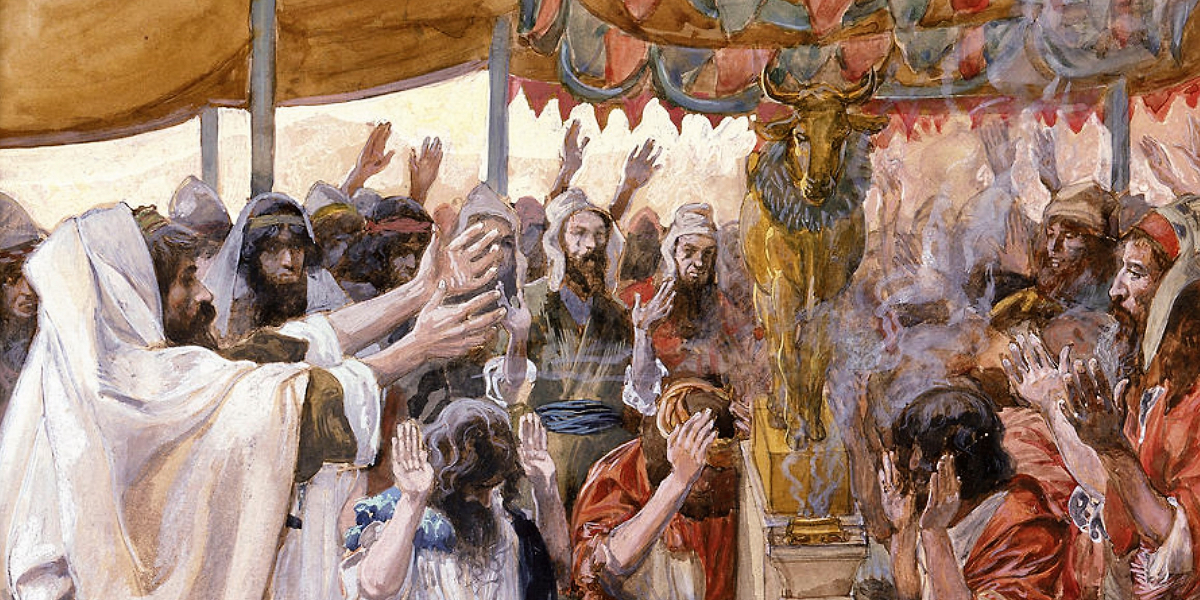
The Third Sunday in Lent – Pr. Faugstad sermon
Text: Exodus 32:1-14
In Christ Jesus, who attacked and overcame the devil, so that we whom the devil once claimed are now free to thank, praise, serve, and obey the only true God, dear fellow redeemed:
When we think about the attributes or characteristics of God, we often think of the three omnis: omnipotent, omniscient, and omnipresent. Or we think about how He is just, holy, merciful, and gracious. One of the characteristics that probably doesn’t come to mind is that God is jealous. We often think of jealousy in negative terms, describing someone who is envious or suspicious without any real reason to be so. But there is also a positive side to jealousy.
We learn about this positive side in the Catechism from the Conclusion to the Commandments, where God’s own words are quoted: “I the Lord your God am a jealous God, visiting the iniquity of the fathers upon the children to the third and fourth generations of those who hate Me, and showing mercy to thousands of those who love Me and keep My commandments.”
We use these words as the Conclusion to the Commandments, but the LORD actually spoke them after the First Commandment: “You shall have no other gods before me” (Exo. 20:3). He made it clear in this context that His people should not make any carved images of anything in heaven or on earth, and that they should not bow down to them or serve them. The people of Israel heard these words from Moses. Everything was plainly stated. And they answered with one voice, “All the words that the LORD has spoken we will do” (24:3).
Now just a short time later while Moses was meeting with God on Mount Sinai, the people grew restless. They came to Moses’ older brother Aaron, whom Moses had left in charge while he was away. “Up,” they said to Aaron, “make us gods who shall go before us. As for this Moses, the man who brought us up out of the land of Egypt, we do not know what has become of him.” It seems that Aaron felt a mixture of pressure and pride. He could see that the people were restless, and that concerned him. He also recognized he was in a position of influence.
He thought he could steer the people in a better direction; he could compromise to keep the peace. He gathered their gold jewelry and fashioned it into a golden calf, just the kind of “graven image” that God had condemned. And when the people praised the idol as the “gods… who brought [them] up out of the land of Egypt,” Aaron tried to bring the LORD back into it. He declared “a feast to the LORD” on the next day.
But the people did not have the LORD in mind. They got up early the next day, offered sacrifices to the golden calf, ate and drank, and “rose up to play.” St. Paul told the Christians in Corinth what kind of “play” the Israelites were up to. He wrote, “We must not indulge in sexual immorality as some of them did, and twenty-three thousand fell in a single day” (1Co. 10:8). Twenty-three thousand fell into sexual sin, rejecting God’s institution of marriage, an institution as old as creation itself. And many more joined them in disobeying God’s Commandments and ignoring His promises. They chose the ways of the world, the desires of their flesh, and the lordship of the devil.
How would God respond? He told Moses that the people had “corrupted themselves.” They had “turned aside quickly” from the way He commanded them. “Now therefore let Me alone,” He said, “that My wrath may burn hot against them and I may consume them.” If God did not care about His people, He wouldn’t have reacted like this. His anger was a sign of His commitment toward them. He had chosen this people. He had led them out of slavery in Egypt. He had brought them through the Red Sea and provided for them in the wilderness.
The LORD looks upon you with the same devotion and care. He gave you life through your parents; He knitted you together in your mother’s womb (Psa. 139:13). He brought you to the waters of Baptism where He adopted you as His own child and put His name on you. He delivered you from your slavery to sin, devil, and death. And He continues to provide you nourishment through His Word and Sacraments as you journey through the wilderness of this world.
If He were indifferent about how you live your life or about what happens to you, He would not have done all the things for you that He has done. Your Father in heaven certainly would not have sent His Son to suffer and die for you if He did not care for you and all sinners. But just as He was jealous for Adam and Eve when the devil brought them over to his side, and just as He was jealous for the Israelites, so He is jealous for you.
This is a proper jealousy. It’s the kind of jealousy a husband or father might feel when bad actors and bad influences are trying to break up his marriage or family. It’s a jealousy that fights for what another has no right to have. The LORD was jealous for His people. He was their God who had redeemed them. The gods the Egyptians worshiped had no power to stop Him. He alone was God. Any other gods were figments of human imagination fueled by the temptations of the devil.
Could this have been made any clearer to the Israelites, when Moses tossed their golden god in the fire, ground it to powder, scattered it on the water, and made the people drink it (32:20)? This was the god that brought them out of Egypt, the god that now made its way through their insides and was expelled?!? The same goes for the idols we set up in our lives: the pursuit of riches, possessions, and pleasures, of power, influence, and fame, of entertainment and excitement. Those might satisfy you for a while, but what good can they do when the day is far spent, when the sand in the hourglass keeps falling, when the time you have left is diminishing?
But the devil is well-experienced at trickery and deceit. He is always whispering in your ear: “Wouldn’t you like to have more? Don’t you deserve more? Why waste your life following the rules? Loosen up! Live a little! What’s so wrong with wanting to be happy? Pay attention to your feelings! Follow your heart! Only you know what’s best for yourself.” That’s what the devil did to the Israelites, and it nearly got them destroyed by the LORD.
It was only because of Moses’ intercession for the people that the LORD relented. Moses said to the LORD, “Remember Abraham, Isaac, and Israel, Your servants, to whom You swore by Your own self, and said to them, ‘I will multiply your offspring as the stars of heaven, and all this land that I have promised I will give to your offspring, and they shall inherit it forever.’” Moses pointed to God’s promise, and God’s anger was averted.
When you have behaved like the Israelites and have fallen for the devil’s temptations and committed sins against God’s holy Law, you might also wonder if you will escape God’s wrath. You took the wrong path. You followed false gods. You denied the LORD who made you, who purchased and won you, who chose you. As much as you wish you could, you can’t go back and change what you have done. Does the LORD really forgive you?
The way to answer that question is to ask a few more questions: Did God the Father send His Son to take on your flesh? Did Jesus suffer and die on the cross for the whole world’s sins? Did He rise in victory over death on the third day? If the answer to those questions is “yes,” which is exactly what the Bible teaches, then the LORD really does forgive you all your sins. Jesus made atonement for each and every one through His suffering and death.
And now since His ascension, He is “at the right hand of God,” where He “indeed is interceding for us” (Rom. 8:34). He is the Prophet like Moses, whom Moses said would come (Deu. 18:15), and Jesus intercedes for us like Moses did for the Israelites. When the Father sees us falling into sin and living contrary to His will, Jesus is constantly reminding the Father of His completed work. “I paid for that sin, and that sin, and that sin,” says Jesus. So the Father relents from the punishment we deserve. He does what Jesus’ death and resurrection require: He forgives us.
That does not mean, of course, that we are free to keep chasing after idols. God is jealous for our fear, love, and trust. “I am the LORD; that is my name” He says; “my glory I give to no other, nor my praise to carved idols” (Isa. 42:8). He deserves our love, our devotion, our worship—our entire life. Whenever and wherever we have not given these things, we must repent. We must admit that we have not been and done what He chose us and called us to do.
Then we also take comfort that our God, the only true God, is good, kind, and patient toward us. Shortly after sparing His people Israel from destruction, He described His characteristics to Moses which are still true of Him today. He said about Himself: “The LORD, the LORD, a God merciful and gracious, slow to anger, and abounding in steadfast love and faithfulness, keeping steadfast love for thousands, forgiving iniquity and transgression and sin” (Exo. 34:6-7). That is the God you have—a jealous God, jealous for your faith and salvation.
Glory be to the Father and to the Son and to the Holy Ghost; as it was in the beginning, is now, and ever shall be, forevermore. Amen.
+ + +
(picture from “The Golden Calf” by James Tissot, 1836-1902)

The Transfiguration of Our Lord – Pr. Faugstad sermon
Text: Genesis 41:37-43
In Christ Jesus, who through our light momentary afflictions is preparing for us an eternal weight of glory beyond all comparison (2Co. 4:17), dear fellow redeemed:
What happened?!? If you heard last week’s sermon about Joseph being sold as a slave in Egypt, and then you heard today’s reading about Pharaoh making Joseph his right hand man, you have to wonder how one led to the other. Here’s how it happened. When Joseph was brought to Egypt as a seventeen-year-old, he was purchased by a man named Potiphar, the captain of Pharaoh’s guard. For a while, everything went well. In fact, it went very well. The LORD blessed whatever Joseph did, and Potiphar noticed. So he made Joseph the manager of all he had and “had no concern about anything but the food he ate” (Gen. 39:6).
If we had to guess what came next, we might imagine one of Pharaoh’s people seeing the good job Joseph did for Potiphar and recommending him to Pharaoh. That could explain how Joseph made his way to Pharaoh’s house. But his path to honor and glory was not as direct as that. First, Joseph had to go to prison. He had to go to prison because Potiphar’s wife accused him of trying to rape her. The truth was that she tried to seduce Joseph. And as easy as it might have been for him to carry on a secret affair as a slave in a foreign land, he rejected her temptations. He told her, “How then can I do this great wickedness and sin against God?” (v. 9).
Seeing that Joseph would not give her what she wanted, she resolved to destroy him. She told the lie, and her husband Potiphar threw him in prison where the king’s prisoners were confined. So now Joseph was in worse shape! But the LORD blessed him there too, and in time, the keeper of the prison set Joseph over all the other prisoners. “And whatever he did, the LORD made it succeed” (v. 23).
Some time later, Pharaoh became angry with his chief cupbearer and his chief baker and sent them to the same prison as Joseph. After they had been there a while, both of these former officials had strange dreams one night. By the power of God, Joseph was able to interpret their dreams—a good outcome for the chief cupbearer who in three days was restored to his position, but a bad outcome for the chief baker who three days later was beheaded. Before the chief cupbearer left, Joseph asked him to remember him and mention him to Pharaoh.
Imagine Joseph waiting for a special representative of the court to come to the prison and let him out. His friend the chief cupbearer would not forget. A week passed. Then another week. Then a month. Then a year. Then two years. Joseph must have thought he would never get out. But God had not forgotten him.
The LORD now put two dreams in Pharaoh’s head. First Pharaoh dreamed of seven healthy cows emerging from the Nile River, but these were followed by seven ugly and thin cows that ate up the healthy cows! Then he dreamed of seven healthy ears growing on one stalk. Seven thin ears sprouted after them and swallowed up the healthy ears. Pharaoh assembled all his magicians and wise men, but none of them could interpret his dreams.
Now two years after leaving him, the cupbearer remembered Joseph and told Pharaoh about him. Pharaoh had him brought from prison, and he asked Joseph if he could interpret his dreams. Joseph replied that God would reveal the interpretation. The seven healthy cows and seven healthy ears represented seven years of plenty. The seven ugly cows and thin ears after them represented seven years of famine. Joseph advised that Pharaoh “select a discerning and wise man” (Gen. 41:33), who would store up grain from the seven good years, so there was enough for the seven bad years. And Pharaoh said, “How about you?”
No one could have guessed it. No one sees as God does. No one could imagine that Jacob’s favoritism, the brothers’ hatred, the selling of Joseph, and his trials in Egypt would lead to his position as Pharaoh’s next-in-command. And this isn’t just a rags to riches story. This was part of God’s deeper and longer plan to bring salvation to the world. Joseph had to be installed in Egypt, so he could store up grain, so there would be food for his father and brothers when the famine hit, so they would travel to Egypt and the line of Messiah would be preserved.
While the LORD was doing all these marvelous things, Jacob was back home mourning the death of his son, his other sons were afflicted by guilty consciences for their hatred, greed, and lies, and Joseph thought he would never get out of prison. This should encourage us that no matter how bad our situation seems to be or how hopeless we may feel about the future, that God is working in ways we are not aware of.
This is His promise, to work all things together for good for those who love Him (Rom. 8:28). No matter what evils came upon Joseph, God was there turning each situation into blessing and strengthening him through the trials for a much brighter future. He does the same for you. No matter what hardships you have gone through, God was there hiding His blessings. You maybe couldn’t see them at the time and not for a long time after. But now you see them. You know that He carried you through and worked so much for good.
In your times of suffering, you often can’t see the good. If you only went by your experience, you might conclude that God has abandoned you. He doesn’t care. He is opposed to you, angry with you. But that is not what He tells you in His Word. He promises His love, His care, and His help. That’s what He wants you to focus on—not your experience and how things appear to be—but on His promise and what He tells you is so. The last stanza in our hymn of the month says, “I cling to what my Savior taught / And trust it, whether felt or not” (Evangelical Lutheran Hymnary #226, v. 10).
God is most certainly for you. In fact, Joseph’s story is in part your story because the promise of a Savior that was preserved through Joseph’s efforts in Egypt is why you have a Savior today. God sent His Son to become Man through Jacob’s line, so that He would make payment for the sins of the whole world. For most of His life, Jesus hardly looked like the conquering King He was. Even His disciples who followed Him around for three years were at times unclear about His identity.
This is one reason why Jesus revealed His glory to Peter, James, and John on the mountain and was transfigured before them (Mat. 17:1-9). He wanted them to have a glimpse of His glory, so they would be assured that He was God in the flesh. A short time after this, their confidence would be tested, as Jesus went to Jerusalem and was arrested, beaten, and crucified. How could that be the mighty Son of God if He took such a beating, was crowned with thorns, and was nailed to a cross?
But this is how God operates. He hides His glory in suffering, His healing in pain, and His life in death. His crucifixion was not a defeat; it was a victory. It was not a day for His enemies, but for His friends. It was not His end; it was your beginning with Him. He was on the cross paying for your sins, and then He rose to win you new life. Through your Baptism, you were joined to Him by the power of the Holy Spirit. St. Paul writes that through that washing of regeneration and renewal you were buried and raised with Him. You walk in newness of life with Him (Ti. 3:5, Rom. 6:4).
In another place, Paul writes, “For you have died, and your life is hidden with Christ in God. When Christ who is your life appears, then you also will appear with him in glory” (Col. 3:3-4). So even in your sorrows and pains and hardships, your life is hidden with Christ. Your life is so tied up in His that He can’t help but know your troubles. You are a member of His body. How could He not care about your well-being?
You cannot see Him now, but He is present to help you. You see His presence in Joseph’s life when He made everything Joseph did successful through his thirteen years as a slave and a prisoner in Egypt. You see His presence in your life, too, when you remember how He comforted you through His Word, how He forgave your many sins, how He continued to invite you to eat His own body and drink His own blood. His power, His life, and His salvation are hidden in His Word and Sacraments.
These gifts are hidden from your physical sight, but your faith finds them there. They are not hidden from faith. By faith, you trust that Jesus is with you. No matter how deep the pit is, Jesus is there. No matter how severe the pain, Jesus knows. No matter how hopeless the situation, Jesus carries you through. Soon His presence will be revealed. Soon you will see how everything you had to endure in this life had its purpose in the larger plan of God.
Who could imagine Joseph’s glory as they looked at him in prison? Who can imagine your glory when they see you afflicted and troubled today? But the glory is coming. “When Christ who is your life appears, then you also will appear with him in glory.” On the day of His return, Christ’s glory will become your glory. On that day, He will clothe you in fine linens and put a golden crown on your head.
And then you will be exalted even higher than Joseph in Egypt, for you will join the Lord at the right hand of God where He fills all things. And no one will ask “what happened?” because all will know we are there by the grace of our Savior who loved us and gave Himself up for us (Eph. 5:2).
Glory be to the Father and to the Son and to the Holy Ghost; as it was in the beginning, is now, and ever shall be, forevermore. Amen.
+ + +
(picture from painting by Carl Bloch, c. 1865)

The Third Sunday after the Epiphany – Pr. Faugstad sermon
Text: Genesis 32:22-32
In Christ Jesus, who appeared to the faithful fathers of old to prepare them for His coming in the flesh to save the world, dear fellow redeemed:
When Jacob went to Haran to find a wife, the LORD promised him that his offspring would be “like the dust of the earth,” that He would be with him, and that He would bring him back to the land he came from (Gen. 28:14-15). Now Jacob was on his way back with his wives, children, and great possessions. He had left with nothing but a staff in his hand, and now he was a rich man. God had made good on His promise.
But Jacob was shaking with fear. He heard from a messenger that his brother Esau was coming toward him with four hundred men. Jacob knew that in the past, his brother Esau wanted to kill him for taking the family blessing. Twenty years had passed since then. Had Esau’s anger and hatred subsided over that time or had it only increased? Jacob implored God to deliver him and his family from Esau’s wrath. He prayed: “O LORD, You said, ‘I will surely do you good, and make your offspring as the sand of the sea, which cannot be numbered for multitude.’ Please protect me and deliver me as You said You would” (Gen. 32:12).
Jacob knew that Esau would reach him the next day. He sent presents ahead of him hoping to appease his brother. Then during the night, he sent his family and all that he had across the stream, while he stayed behind alone in the dark. You know how active a mind can be in the middle of the night when you are anxious about something. Can’t sleep. Wide awake. Running some problem or conflict over and over again in your head. Imagining the worst. Despairing of any good outcome. That was Jacob. All he could picture was Esau coming at him with arrow ready or knife drawn. He imagined his wives and children under attack—all that he loved, destroyed, lost.
He prayed like he never had before: “Have mercy, O LORD, have mercy!” I’m sure you can relate. Perhaps you have not faced an immediate threat to your entire family like Jacob, but you have worried about a family member who was sick or injured. Or you have been at odds with someone close to you and couldn’t see how the situation would ever improve. Or you have felt threatened by an enemy and feared what harm he or she might do to you.
You prayed at those times. But your prayers were probably also mixed with some doubts. Will my loved one be okay? Will we be able to work through this conflict? Will I be safe? And as much as you might have asked God for help, you may have felt alone like Jacob, alone and in the dark, worried and fearful about what might be coming.
In Jacob’s anguish that night, he suddenly realized he was not alone. A stranger surprised him and started fighting with him. Was it Esau or one of Esau’s men? We aren’t told what Jacob was thinking, just that “a Man wrestled with him until the breaking of the day.” Jacob poured all his worries and fears into this wrestling match. He felt that he was fighting for his very life! We don’t know how long this went on, but we do know that Jacob fought with all his might.
Jacob fought so desperately, that even when the Man dislocated his hip, he did not give up. With daylight coming on, the Man tried to get away, but Jacob said, “I will not let You go unless You bless me.” A very strange request to make of someone threatening his life! But Jacob somehow knew this was no ordinary man. He perceived that it was the LORD he was wrestling with, the very LORD he had been begging for mercy. And so it was.
But why was the LORD fighting with him? Why was He acting like Jacob’s enemy instead of his Savior? Didn’t Jacob have enough troubles without the LORD piling on? Perhaps you can relate to this too. Have you ever had one bad thing happen after another, and you couldn’t help but ask, “Why God?” Or you felt like the times you tried to do what was right, you got punished for it.
You can rule out the idea that God is unable to help or is distracted by other responsibilities. Those things could only happen if God were small and only somewhat powerful, which is not the case. You can also rule out the idea that God has changed His mind about you and has turned against you, since that would go against His promise never to leave you or forsake you (Heb. 13:5). So why might it be that God would sometimes behave like your enemy, like He did with Jacob?
Could it be that He wants you to fight like Jacob did, to fight with a desperate faith? Think about the Canaanite woman crying out to Jesus for mercy for her demon-oppressed daughter. At first, Jesus didn’t answer her. Then He told His disciples He was sent only for the Israelites. Then when the woman knelt right in front of Him, begging, Jesus said, “It is not right to take the children’s bread and throw it to the dogs.” It seems obvious that Jesus was telling her to go away, but the woman wouldn’t give up. She believed in Him. She declared that this dog would gladly accept the crumbs that fell from His table. And Jesus said, “O woman, great is your faith! Be it done for you as you desire” (Mat. 15:21-28).
This teaches us that Jesus wanted to be caught. He wanted to be conquered by faith. We see this in the Holy Gospel for today from the leprous man who conquered Jesus by faith and was healed, and from the Roman centurion who faithfully brought the needs of his servant before Jesus. The same was true in the LORD’s wrestling with Jacob. He wanted Jacob to struggle with Him and pin Him down by faith. Hadn’t He already made a promise to Jacob? Why was Jacob so afraid? Why was he so worried? The LORD tested him, so Jacob would learn not to doubt, so He would learn to fear, love, and trust in God above all things.
The LORD also wanted him to understand that the promise He made to him was bigger than blessings in his lifetime and even bigger than the multitude of people who would come from him. The promise was ultimately about the Savior who would come from his line, in whom “all the families of the earth [would] be blessed” (Gen. 28:14). Perhaps this is the blessing God repeated after wrestling with Jacob.
God operates in the same way with us. At various times in our life, He may seem to be ignoring us or even opposing us. This is because He wants to exercise our faith. He certainly isn’t trying to drive us away from Him. He wants us to recognize our weaknesses, so that we trust in His strength. He wants to teach us to let go of what we cannot control and instead cling tightly to His Word and promises.
Above all, He wants us to remember that the Savior He promised to Abraham, Isaac, and Jacob did come. The LORD kept this Promise of all promises. Jacob thought he was alone in the dark, but the LORD was right with him, holding him in His everlasting arms. Jesus, on the other hand, truly was alone as He suffered in the dark on the cross, crying out, “My God, My God, why have You forsaken Me?”
Jesus was forsaken because all your sin was piled on Him. He was getting the full wrath of God and the eternal punishment that you deserved. He was suffering for the times you worried about tomorrow, when you doubted God’s commitment to you, when you trusted your strength instead of His, when you neglected to thank Him when He saved you from your trouble. It was sins like these that brought the Son of God down to earth as a Man and got Him nailed to the cross. He paid for all your sins, every single one.
That means you can be certain that God is not punishing you for your sins by sending you hardships in your life. He lets you experience temporary suffering, not because He is angry with you, but because He loves you. Isn’t this why parents discipline their children, out of love for them, because they want them to be good, humble, and responsible people when they grow up? Hebrews 12 says, “For the Lord disciplines the one he loves, and chastises every son whom he receives.” And a few verses later, “For the moment all discipline seems painful rather than pleasant, but later it yields the peaceful fruit of righteousness to those who have been trained by it” (vv. 6, 11).
The Lord knows what you need. A life of constant success, where everything goes the way you want, would destroy your faith. Who needs faith if everything works out exactly the way they plan? When troubles and afflictions come your way, that is when faith can do what God gave it to you to do. That is when faith can rise up in every instance of hardship, pain, and sorrow and can take hold of the rock-solid promises of God. That is how faith conquers. It conquers by clinging to the One who conquered every fearful enemy for us—our Lord Jesus Christ.
He wants you to bring all your worries and fears to Him, trusting that He will take care of you. He wants you to endure and prevail in every hardship. He wants you to pin Him to His promises and not let Him go unless He blesses you. He will bless you, as He has so often done before. By His grace, He will carry you through your troubles and will strengthen your faith until you are ready to join all the faithful, the many “from east and west,” who will “recline at table with Abraham, Isaac, and Jacob in the kingdom of heaven” (Mat. 8:11).
Glory be to the Father and to the Son and to the Holy Ghost; as it was in the beginning, is now, and ever shall be, forevermore. Amen.
+ + +
(picture from 15 century French Gothic manuscript painting)

The Epiphany of Our Lord – Pr. Faugstad sermon
Text: Genesis 26:1-6
In Christ Jesus, the Light shining in the thick darkness of the earth, to whom sinners from all nations come in faith, receiving from Him life and salvation, dear fellow redeemed:
Last week, we heard about God’s command to Abraham to sacrifice his son Isaac as a burnt offering. As painful as this command was for father and son, they were willing to go through with it because they trusted God’s promise that nations would come from them, including the Savior of the world. Abraham was ready to sacrifice his son because he believed that God would bring Isaac back to life (Heb. 11:19).
The LORD stopped Abraham just as he was taking up the knife to slaughter his son, and He provided a ram for the sacrifice instead. He then repeated the promise to Abraham and Isaac that their descendants would be as many “as the stars of heaven and as the sand that is on the seashore,” and in their offspring “all the nations of the earth [would] be blessed” (Gen. 22:17,18).
It was a grand promise, so grand that it must have been difficult to imagine. This family did not have the appearance of a great dynasty. Abraham and Sarah were very old. They had one child. They lived as nomads in the land of Canaan. They didn’t own any land until Sarah died and Abraham bought a field with a cave to bury her in. Isaac was thirty-seven years old when his dear mother died, and he grieved for her.
When Isaac was forty, Abraham sent a servant to the land of his relatives to find a wife for his son. Rebekah agreed to return and marry Isaac. It was a happy marriage, except that they were unable to have children for a long time. Just as the LORD made Abraham and Sarah wait, so He made Isaac and Rebekah wait. We are told that “Isaac prayed to the LORD for his wife…. And the LORD granted his prayer” (Gen. 25:21). Twenty years after they were married, God gave Isaac and Rebekah not just one child, but twin sons!
Isaac might have thought everything was going well. As he aged, he could give thanks for a good wife, two sons including the heir of God’s promise, and sufficient means to support his household. The difficult times perhaps were behind them! But then, as today’s reading says, “there was a famine in the land….”
We can relate to this. You can think of times when things were going well for you, and you started to think you could be getting somewhere. But then something happened at work that threatened your livelihood. Or there was a family crisis or a health issue, and your plans had to be set aside, maybe never to be picked up again.
As we go through life, we learn again and again how little we can actually control. We don’t know how the economy will do, how business will go, how our health will be. We don’t know how many years or months or days we have left. Not knowing how life will play out can cause us to be anxious and worried. Those worries start in our youth and continue through the different stages of our life, worries like:
- How will I be able to make friends in a new classroom?
- How will I do on the big test?
- What will I be when I grow up?
- Will I find someone to marry?
- Will we be able to have children?
- How will we raise children if we have them?
- Will the work I do be appreciated?
- Will I have enough to live on?
- Will I have enough for retirement?
- Will I be healthy enough to enjoy what I have earned?
- Will I be able to stay in my home when I’m old?
We worry about what could happen in the future. When the future arrives, we usually recognize that we didn’t need to worry about that. Or we wonder why we were so worried about those little things when there are much bigger things to worry about now. Today’s account about Isaac and the troubles he faced is a good reminder that God keeps His promises.
Isaac could not see what the future held for him and his family. But the LORD could, and He wasn’t worried! The LORD appeared to Isaac and told him there was no need to be anxious. Even though Isaac’s situation seemed tenuous in a foreign land under a godless ruler, the LORD said, “I will be with you and will bless you, for to you and to your offspring I will give all these lands.” So his offspring would have a place. More than that, his offspring would be many, as many “as the stars of heaven.” And in his offspring “all the nations of the earth shall be blessed”—blessed because the Savior of the world would come from Isaac’s line.
Isaac could not see exactly how all this would come about. He did not know when these promises would be fulfilled. All he could see in that moment was trouble. But he believed what God said. He waited in faith for the Lord to act for his good and at the right time. Such quiet confidence is expressed by one of the characters in the Bright Valley of Love book that we are starting next week. He said, “When human thinking has come to a dead end and can see no way out of its problems… then faith is able to spread its wings. The climate has never been better—for faith” (p. 80).
Times of trouble are the perfect times for faith to “spread its wings.” Faith is for the things that are out of your control, which is most everything! Hebrews 11:1 defines faith as “the assurance of things hoped for, the conviction of things not seen.” The same chapter goes on to describe the faith of Noah who started building an ark long before the rain fell (v. 7), and the faith of Abraham who left his home country to live in the land that God promised to his descendants (vv. 8-9). They trusted God’s promises, fully knowing that some of these would not be fulfilled in their lifetime.
The times you must wait for the Lord in your trials, your suffering, your uncertainties, your pain—these are the times when God builds up faith. These are the times when He teaches you to rely on Him, to lean on Him. But when things are going well for you, when everything seems to be in place, when your plans are working out exactly as you intended, these can be dangerous times for faith. In our sinful thinking, we might imagine that it is our efforts, our abilities, our talents that have led to our success. And if that is the case, then what do you really need God for? If I am in control, if I am the master of my fate, then the Lord can just wait until possibly sometime down the road when I need Him.
In these times of little faith or no faith at all, God often sends us trials. He does not send these to destroy us or drive us from Him, but to draw us closer. In His love for us, He wants to give us opportunities to exercise our faith, to remind us of our need for His mercy, to strengthen our confidence in His grace and forgiveness.
You might remember with guilt those times in your self-assurance and pride when you took God’s gifts for granted. You became aware of how faithless you had been and how unworthy you were to be called a child of God. You maybe even had a difficult time coming to church because of your guilt. But what did you hear when God brought you back through these doors? Not words of judgment for poor sinners. Not condemnation. You heard God’s promise of forgiveness for your sins, the promise that you are reconciled with God the Father through the blood of His Son, the promise of eternal joy in His heavenly kingdom when your life here comes to an end.
These promises are as sure as God’s Son hanging on the cross and His tomb sitting empty on the third day because He had risen. He was the ultimate fulfillment of the LORD’s promise to Abraham and Isaac. It is through Jesus Christ, the Son of God incarnate, that “all the nations of the earth [are] blessed”—both the descendants of Abraham and Isaac and people from other nations like those wise men from the east. Jesus died and rose again for all, including you.
And that is true no matter what trouble God calls you to face in this life, or how often you have failed to trust in Him. You are a beloved child of God, fearfully and wonderfully made, redeemed by the blood of His Son, sanctified and kept in the true faith by the Holy Spirit. Like He did for Isaac when he was afflicted by a famine and wandering around with his family, the LORD promises to be with you and guide you and bless you. The LORD did not fail to keep His promises to Isaac, and He will not fail to keep His promises to you.
So in your suffering, in your pain, in your trouble, you say with the psalmist, “I wait for the LORD, my soul waits, And in His word I do hope” (Psa. 130:5). Those who wait for the LORD and hope in His Word shall, as the Holy Scriptures say, “renew their strength; they shall mount up with wings like eagles; they shall run and not be weary; they shall walk and not faint” (Isa. 40:31)—ever strong in the LORD.
Glory be to the Father and to the Son and to the Holy Ghost; as it was in the beginning, is now, and ever shall be, forevermore. Amen.
+ + +
(picture from “Sacrifice of Isaac” by Orazio Riminaldi, 1625)

The Fourth Sunday in Advent – Pr. Faugstad sermon
Text: Genesis 17:15-22
In Christ Jesus, who leads His people to the heavenly Zion with singing, everlasting joy upon their heads, where they shall obtain gladness and joy, and sorrow and sighing shall flee away (Isa. 35:10), dear fellow redeemed:
Abram and Sarai experienced a particular pain that many have experienced since then—they were unable to have children. This is the first detail the Bible shares about Sarai, that she “was barren; she had no child” (Gen. 11:30). Undoubtedly this caused them much sadness. As the years passed and no child was conceived, they became more and more resigned to the fact that they would have no descendants. They passed into their forties, then their fifties, then their sixties. By this time, Abram had become a very wealthy man. He had great possessions and many servants.
Then rather abruptly, the LORD told Abram to leave his country and his relatives and go to a new land. He said to Abram, “I will make of you a great nation, and I will bless you and make your name great, so that you will be a blessing. I will bless those who bless you, and him who dishonors you I will curse, and in you all the families of the earth shall be blessed” (Gen. 12:2-3). If Abram had any doubts about this, they are not recorded for us. He might have wondered how his name would become great and all the families of the earth would be blessed through him. For one thing, he had no children. For another, he was at this time seventy-five years old, and Sarai was sixty-five!
But Abram obeyed. He gathered all he had and traveled to the land of Canaan. When he got there, the LORD appeared to him and said, “To your offspring I will give this land” (v. 7). A while later, the LORD repeated the promise, “Look toward heaven, and number the stars, if you are able to number them…. So shall your offspring be” (15:5). Abram believed what God said (v. 6).
But ten years passed after the LORD told Abram and Sarai to move. Sarai was now seventy-five. If she hadn’t had a child yet, how could she now? She decided to give her servant to Abram as another wife, so that if her servant conceived a child with him, Sarai would count the child as hers. Her servant did conceive and gave birth to a son named Ishmael. But Ishmael was not the child of God’s promise.
Thirteen years later when Abram was ninety-nine years old, God appeared to him again and told him, “You shall be the father of a multitude of nations. No longer shall your name be called Abram, but your name shall be Abraham” (17:4-5). Abraham means “father of a multitude.” At the same time, the LORD changed the name Sarai to Sarah which means “princess,” and He promised Abraham that he would have a son by Sarah.
Abraham’s reaction is recorded for us. He “fell on his face and laughed and said to himself, ‘Shall a child be born to a man who is a hundred years old? Shall Sarah, who is ninety years old, bear a child?’” Now as you know, there are different kinds of laughter. Some point their fingers and laugh when they are ridiculing a person or showing their disdain for him. Some laugh when they are shocked or surprised. Martin Luther was convinced that Abraham laughed “because he was filled with great gladness and joy” (Luther’s Works, vol. 3, p. 154).
He was filled with joy because he understood that God’s promise of a son was about more than providing him an heir. It was about making a way for all the families of the earth to be blessed (12:3). The promise the LORD made to Abraham is the same promise He made to Adam and to Noah. God would send a Savior to redeem sinful mankind. Jesus pointed back to this promise when He said to the Jews, “Your father Abraham rejoiced that he would see my day. He saw it and was glad” (Joh. 8:56).
Abraham’s laugh coincided with the name of his son. God said to him, “you shall call his name Isaac,” a name which means “he laughs.” A year later, that son was born. And the new mother Sarah said, “God has made laughter for me; everyone who hears will laugh over me…. Who would have said to Abraham that Sarah would nurse children? Yet I have borne him a son in his old age” (Gen. 21:6-7). And every time they held that little baby and listened to his little grunts and coos, what else could they do but laugh?
But we can’t help but wonder: Why did God do this? Why did He make Abraham and Sarah wait until they were one hundred years old and ninety years old before they had a child? The author of the book of Hebrews writes in a very understated way that Sarah “was past the age” of being able to conceive, and in a more expressive way that Abraham was “as good as dead” (11:11,12). If this amazing birth were not recorded in the Bible, we would laugh at the possibility.
And that is the point. What we consider impossible, God makes possible. No one can say that Abraham and Sarah were the ones to keep the promise of a Savior alive. They were incapable of having children. They were very old. And God gave them laughter. He gave them Isaac. He wanted to show that this child was a gift, just as all children are. He wanted to show that His promise would neither fail nor succeed because of the work of man. God’s promises succeed because He is God.
That means we can trust His promises. What makes this difficult is our sinful tendency to trust ourselves. We act as if everything depends on ourselves instead of God. We offer weak prayers, if we offer them at all, because we are convinced that God will not give us what we pray for. Or we get impatient when we ask something of Him, and He makes us wait—maybe when we are sick or injured or in trouble. We might even attach a demand to our requests: “If You love me, You will do this by this day or this time.” What we are really doing is putting ourselves in the position of God, and by our lack of faith we are calling down His judgment instead of His mercy. When we take matters into our own hands, like Sarai did by giving her servant to Abram, we often experience unexpected and unpleasant consequences.
God’s plans are much better than ours, and His promises are rock-solid. When He makes a promise, nothing will change His mind. He fulfilled His promise to give Abraham and Sarah a son. And He fulfilled His promise to send a Savior through Abraham’s line. Some two thousand years down the road, God sent His angel to another old man, a priest named Zechariah. Zechariah and his wife Elizabeth were also old and barren like Abraham and Sarah. And the angel said, “Do not be afraid, Zechariah, for your prayer has been heard, and your wife Elizabeth will bear you a son, and you shall call his name John” (Luk. 1:13). Zechariah did not respond in faith like Abraham, and for his disbelief, God made him unable to speak until after John was born.
John was a messenger, “the voice of one crying out in the wilderness, ‘Make straight the way of the Lord’” (Joh. 1:23). He pointed to One much greater than he, “the strap of whose sandal [he was] not worthy to untie” (v. 27). That One was the Son of God incarnate, the descendant of Abraham and Isaac, the fulfillment of God’s promise to save the world. God sent His Son to take on human flesh because He loves you so deeply and so perfectly. Jesus came to be your righteousness, to live blamelessly under the Law in your place. He came to atone for your many sins by shedding His holy blood on the cross. He came to conquer your death by rising from the dead in victory.
He came to give you hope as you struggle with your doubts and fears. He came to give you peace as the guilt of your sins weighs down on you. He came to give you comfort in your pain and sadness. The hymnwriter Paul Gerhardt put it beautifully in his great Advent hymn:
Rejoice, then, ye sad-hearted, / Who sit in deepest gloom,
Who mourn o’er joys departed, / And tremble at your doom;
Despair not, He is near you, / Yea, standing at the door,
Who best can help and cheer you, / And bid you weep no more.
No care nor effort either / Is needed day or night,
How ye may draw Him hither / In your own strength and might.
He comes, He comes with gladness, / Moved by His love alone,
To calm your fear and sadness, / To Him they well are known. (ELH #94, vv. 6-7)
God promises to come to you through His Word and Sacraments. Through those means, He promises to forgive you. He promises to strengthen you. He promises to renew your faith, so that you have joy even when you are suffering, even when you are struggling. You have joy in knowing that you do not walk through this life alone, that there will be an end to the sadness of this life, and that Jesus will return on the last day to take you to His kingdom of glory.
The time of your final redemption is drawing near. The time will come when the joy you have in Christ will be perfected, when sin, death, and devil will no longer bother you, when you will forever forget the troubles you had here. Then we will sing. We will shout with gladness. And with Abraham and Sarah and all the saints, We Will Laugh.
Glory be to the Father and to the Son and to the Holy Ghost; as it was in the beginning, is now, and ever shall be, forevermore. Amen.
+ + +
(picture of Abraham viewing the stars from 1919 Bible primer book by Augustana Book Concern)

The First Sunday in Advent – Pr. Faugstad sermon
Text: Genesis 3:14-4:2
In Christ Jesus, the Offspring of the virgin, who was called Immanuel, God with us, dear fellow redeemed:
“The LORD God said to the serpent, ‘Because you have done this, cursed are you.’” What the devil had done was tempt the most special part of God’s creation—mankind—to sin. In the form of or inhabiting a serpent, the devil had approached the first woman with the express purpose of turning her against her Creator. He first tempted her to doubt the Word of God and then to deny the Word of God. She took fruit from the tree of the knowledge of good and evil—the one tree God warned Adam not to eat from—, and she ate. Then she gave some of the fruit to Adam “who was with her,” and he ate (Gen. 3:6).
They did not receive what they were looking for. They were hoping to “be like God,” as the devil had promised them. They failed to appreciate that they already were “like God,” made in His holy image (1:26-27). They did receive part of what the devil had promised, the knowledge of good and evil (3:5). They learned that they used to be good as the caretakers of God’s good creation. Now they had become evil, and they viewed God as their enemy.
This is why they went into hiding when they heard Him walking in the garden. They were afraid of Him. What was He going to do to them? Adam surely remembered what God said about that one tree, that “in the day that you eat of it you shall surely die” (2:17). They went into hiding because they did not want to be punished for their sin. They did not want to die. In fact, they already had. They were still breathing, but spiritually, they had died. They were separated from God. They were on the devil’s side now.
But the LORD would not let the devil keep them. Their punishment would not be the same as the devil’s punishment. God extended no grace and hope to the devil, but He did to Adam and Eve. The key verse in today’s reading and perhaps in all of Scripture is verse fifteen. God said this to the devil but for mankind’s benefit: “I will put enmity between you and the woman, and between your offspring and her Offspring; He shall bruise your head, and you shall bruise His heel.”
Just as the devil had manipulated a woman into disobeying God, so it would be through the Offspring of a woman that the devil’s power would be crushed. Martin Luther called this verse the “first comfort, this source of all mercy and fountainhead of all promises” (Luther’s Works, vol. 1, p. 191). He also suggested that God made the prophecy purposely vague, so that the devil would have to fear every woman going forward since any of them might bear the One to destroy him.
God’s promise terrified the devil, but it gave great hope to mankind. God had not changed His mind about death entering the world through sin. But now He delivered the hope of salvation, that One would come to set everything right again, to overcome sin, devil, and death for all humanity. If Adam and Eve thought another path was open to them, that possibility was closed when God posted “the cherubim and a flaming sword” outside the Garden of Eden to keep them away from the tree of life.
There was no other way to be saved than God’s way. Immediately after this, we are told that “Adam knew Eve his wife, and she conceived.” They trusted what God said, that salvation would come through the woman’s Offspring. They hoped their firstborn son was this Savior. They called him “Cain,” a name that means “acquired” or “gotten” because they had “gotten a man from the LORD.” But Cain was not the promised One. The devil poisoned his mind with anger and hatred, leading to the murder of his brother Abel.
God’s promise would not be fulfilled for many, many years. Child after child would be born, grow old, and die. Women had pain in childbearing like God said they would, while enduring the imperfect rule of men. Men toiled in pain by the sweat of their face to make a living, before returning to the ground from which they were made. Decade after decade, generation after generation, brief life to certain death. Still no Savior.
God’s people might have wondered if His promise would be fulfilled, except that He reminded them with clearer and clearer prophecies as the time approached. The Savior would come from the line of Abraham, Isaac, Jacob, and Judah (Gen. 49:10). He would be a descendant of King David (Psa. 110). He would be born of a virgin (Isa. 7:14). He would be born in Bethlehem (Mic. 5:2). God waited for thousands of years after making His promise, until “the fullness of time had come” (Gal. 4:4).
Then He sent His angel Gabriel to a virgin named Mary. “Behold, you will conceive in your womb and bear a son,” said Gabriel, “and you shall call his name Jesus” (Luk. 1:31). “How will this be,” asked Mary, “since I am a virgin?” And the angel answered her, “The Holy Spirit will come upon you, and the power of the Most High will overshadow you; therefore the child to be born will be called holy—the Son of God” (1:34-35). The time had finally come! The woman’s Offspring was here. God had entered His creation, taking on human flesh. The devil was about to be ruined.
And all of that, the dark day when the world was plunged into sin, the beautiful, first promise of God, the history of every joy and sadness, hope and pain, life and death, all of it was in the background and in Jesus’ mind as He rode into Jerusalem on Palm Sunday. “Hosanna to the Son of David!” shouted the people. “Blessed is he who comes in the name of the Lord! Hosanna in the highest!” (Mat. 21:9). No one understood what had to be done. No one knew the suffering that Jesus would endure. No one knew what it would take to redeem mankind from the sin that started in Eden.
The death that was brought on the world through a tree had to be undone by death on another tree. The perfection that was lost through sin had to be regained by a perfect sacrifice. The curse of sin had to be directed against One who had never sinned. He had to pay for man’s disobedience. He had to suffer eternal punishment in every person’s place. This is what Jesus, the eternal Son of God, had to do.
He was witness to all that transpired in Eden. He walked with Adam and Eve in perfection and then found them in their sin. He saw all the wickedness that was done from that point on, all the pride, deceitfulness, abuse, unfaithfulness, violence. He was witness to everyone’s sins from Eden onward. And because He is God, He could see even the sins that stretched forward in time, including the sins done in our lifetime, the sins done by us, even our sins today.
What would you think if you had witnessed all that poisonous evil, the terrible pain and destruction, brought about because of mankind’s sins? What would you do? Would you feel compassion for sinners? Or would your anger burn hot against them? Jesus rode forward humbly to His death in every sinner’s place. We hear this Palm Sunday account at the beginning of the Church Year because it teaches us how to think about sin and salvation and Jesus, and how to prepare for His coming.
If any of us is comfortable with our sinning, then we’re not really seeing what Jesus did in Jerusalem. He was not beaten up for anything He had done. He was not driven toward Calvary for His sins. He did not cry out in agony on the cross for His wrongdoing. He was there because of Adam and Eve. He was there because of Cain. He was there because of Abraham and David and Jezebel and Nebuchadnezzar and Mary and Herod and Pontius Pilate—all the sinful people of human history, both prominent and poor, outwardly good and evil. He was there because of you and me, because of our sins.
He was there for you and me. Jesus went to the cross to make satisfaction for our sins. Adam and Eve’s selfishness, shame, and fear—“Put that on Me,” He said. Our lovelessness, our lies, our pride, our pleasure-seeking, our greediness, our despising the holy Word—“I’ll take the punishment,” He said. He paid for the sins of your past, your sins of today, and all the sins that will be done in the future.
This is what God promised right after the fall. This is what He told Adam and Eve and their descendants to look for. This is what He tells us to look to. God kept that first promise from Eden to Jerusalem. We weren’t in the crowd on Palm Sunday, but we should picture ourselves there. While we’re at it, we can picture Adam and Eve standing there in their garments of animal skin with their sons Abel and Seth; Abraham, Isaac, and Jacob looking on; David and his descendants watching with joy. We see there a great “cloud of witnesses” (Heb. 12:1), all who waited for God’s promise to be fulfilled.
And we see there all believers who have lived since that time, up to our day and beyond. We stand there, eyes fixed on Jesus, His praise on our lips. We watch Him go forward, carrying the weight of the whole world. He goes to the cross for our sins. He goes to destroy the works of the devil (1Jo. 3:8). He goes there to save us from death.
Glory be to the Father and to the Son and to the Holy Ghost; as it was in the beginning, is now, and ever shall be, forevermore. Amen.
+ + +
(picture from “The Procession in the Streets of Jerusalem” by James Tissot, 1836-1902)

Good Friday – Pr. Faugstad homily
Texts: Genesis 3:14-15,20, St. Matthew 27:45-46
The very same statement can be a blessing for one and a curse for another. That’s how it was when the LORD confronted the devil in the Garden of Eden. The devil had successfully tempted the man and woman to disobey God. They were now hiding from God with him. They were on his side.
But the LORD God said, “No! You cannot have them; they are not yours. I will put enmity between you and the woman, and between your offspring and her Offspring.” The woman and her Offspring would be opposed to the devil, hostile to him. They would not remain in his clutches; they would not continue to be wound up tightly in his coils.
And then God said the thing that really troubled the devil. It was bad enough that he would be cursed more than all livestock and beasts, that he would crawl on his belly and eat dust, and that he would not have mankind fully in his control. And then God told him that the woman’s Offspring “shall bruise your head, and you shall bruise His heel.”
The serpent would get his head stomped on by one of those humans he had just overcome. And the damage inflicted on his conqueror would only be a bruise on his heel. The devil was destined to lose, and there was nothing he could do to stop it. God made a promise, and His promises cannot be broken.
The first man and woman believed this promise. We see it in the name Adam chose for his wife. He called her “Eve,” a name that means “life.” She could have been called the “bearer of death,” since she had listened to the serpent, and because her children would die just as she would. But she was called Eve, “because she was the mother of all living.” The serpent-crusher, the Savior, would come from her. He would bring life to the dying.
But Eve was not given the privilege of bearing this Child. God’s promise would wait, generation after generation, century after century, thousands of years passing by, until God sent His angel to the woman Mary of Nazareth to tell her that she was the one.
It is her Offspring, it is her Son, hanging on the cross that first Good Friday, a day which looked anything but “good.” The only perfect man who had walked the earth since the fall into sin was now pinned to a cross. This is how the world esteemed Him. This is the honor that was shown Him—nailed to a tree to die.
He was put on the cross at 9:00 in the morning. At 12:00 noon, the sky went dark, and the darkness hung over the land for the next three hours—what is typically the brightest part of the day.
Jesus was in great anguish. He was suffering the eternal fires of hell in that darkness. He was paying for the first sin of that fateful day in the Garden of Eden, and for all the sins committed from that time forward. He was suffering hell for your selfish actions, your false words, your wicked thoughts. He felt God’s wrath for every single sin, whether large or small.
Under this burning wrath, He cried out, “My God, My God, why have You forsaken Me?” We cannot imagine it. We cannot comprehend it. But we can see how the innocent Christ was suffering what we deserved. We can see what the wages of our sin added up to. Beholding Jesus in this great anguish, we see the price of our redemption.
The very same act—His crucifixion—was curse for Him and blessing for you. The Son of God willingly accepted this curse. He willingly took your place, so He could take your punishment. This is how the devil’s grip would be broken. This is how his lying mouth would be shut up. This is how his head would be crushed.
Our Lord Jesus had to die, in order to cancel the curse brought into the world by Adam and Eve, the curse that consigned us all to hell. Galatians 3 says, “Christ redeemed us from the curse of the law by becoming a curse for us—for it is written, ‘Cursed is everyone who is hanged on a tree’” (v. 13).
Christ’s crucifixion looks like defeat, but it is victory. The devil seems to win, but he utterly loses. Death appears to succeed, but it is conquered once and for all. Jesus died for you, to save you.
This is the promise God made long ago in Eden. This is why Adam named his wife Eve. This is why Mary said to the angel, “let it be to me according to your word” (Luk. 1:38). This is why Jesus prayed to His heavenly Father, “not my will, but yours, be done” (Luk. 22:42), and willingly went to the cross.
The devil knew this was coming, but he didn’t know when. He knows now. And so do you. Seeing Jesus on the cross, you see God’s Promise Kept.
+ + +
(picture from Isenheim Altarpiece by Matthias Grunewald, c. 1510)