
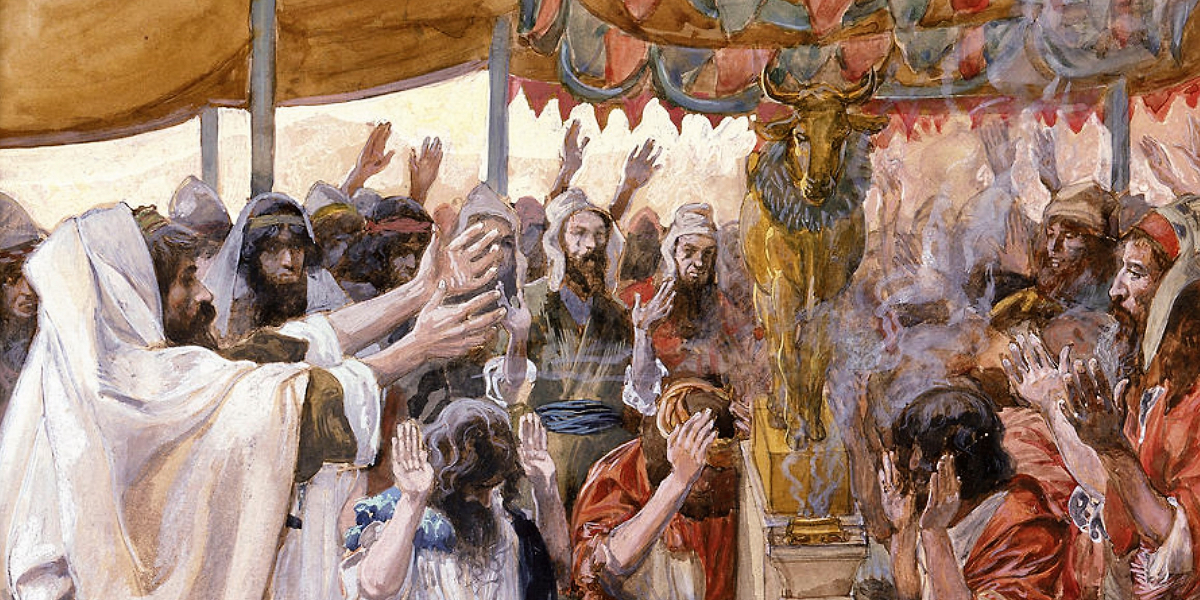
The LORD Is a Jealous God.
The Third Sunday in Lent – Pr. Faugstad sermon
Text: Exodus 32:1-14
In Christ Jesus, who attacked and overcame the devil, so that we whom the devil once claimed are now free to thank, praise, serve, and obey the only true God, dear fellow redeemed:
When we think about the attributes or characteristics of God, we often think of the three omnis: omnipotent, omniscient, and omnipresent. Or we think about how He is just, holy, merciful, and gracious. One of the characteristics that probably doesn’t come to mind is that God is jealous. We often think of jealousy in negative terms, describing someone who is envious or suspicious without any real reason to be so. But there is also a positive side to jealousy.
We learn about this positive side in the Catechism from the Conclusion to the Commandments, where God’s own words are quoted: “I the Lord your God am a jealous God, visiting the iniquity of the fathers upon the children to the third and fourth generations of those who hate Me, and showing mercy to thousands of those who love Me and keep My commandments.”
We use these words as the Conclusion to the Commandments, but the LORD actually spoke them after the First Commandment: “You shall have no other gods before me” (Exo. 20:3). He made it clear in this context that His people should not make any carved images of anything in heaven or on earth, and that they should not bow down to them or serve them. The people of Israel heard these words from Moses. Everything was plainly stated. And they answered with one voice, “All the words that the LORD has spoken we will do” (24:3).
Now just a short time later while Moses was meeting with God on Mount Sinai, the people grew restless. They came to Moses’ older brother Aaron, whom Moses had left in charge while he was away. “Up,” they said to Aaron, “make us gods who shall go before us. As for this Moses, the man who brought us up out of the land of Egypt, we do not know what has become of him.” It seems that Aaron felt a mixture of pressure and pride. He could see that the people were restless, and that concerned him. He also recognized he was in a position of influence.
He thought he could steer the people in a better direction; he could compromise to keep the peace. He gathered their gold jewelry and fashioned it into a golden calf, just the kind of “graven image” that God had condemned. And when the people praised the idol as the “gods… who brought [them] up out of the land of Egypt,” Aaron tried to bring the LORD back into it. He declared “a feast to the LORD” on the next day.
But the people did not have the LORD in mind. They got up early the next day, offered sacrifices to the golden calf, ate and drank, and “rose up to play.” St. Paul told the Christians in Corinth what kind of “play” the Israelites were up to. He wrote, “We must not indulge in sexual immorality as some of them did, and twenty-three thousand fell in a single day” (1Co. 10:8). Twenty-three thousand fell into sexual sin, rejecting God’s institution of marriage, an institution as old as creation itself. And many more joined them in disobeying God’s Commandments and ignoring His promises. They chose the ways of the world, the desires of their flesh, and the lordship of the devil.
How would God respond? He told Moses that the people had “corrupted themselves.” They had “turned aside quickly” from the way He commanded them. “Now therefore let Me alone,” He said, “that My wrath may burn hot against them and I may consume them.” If God did not care about His people, He wouldn’t have reacted like this. His anger was a sign of His commitment toward them. He had chosen this people. He had led them out of slavery in Egypt. He had brought them through the Red Sea and provided for them in the wilderness.
The LORD looks upon you with the same devotion and care. He gave you life through your parents; He knitted you together in your mother’s womb (Psa. 139:13). He brought you to the waters of Baptism where He adopted you as His own child and put His name on you. He delivered you from your slavery to sin, devil, and death. And He continues to provide you nourishment through His Word and Sacraments as you journey through the wilderness of this world.
If He were indifferent about how you live your life or about what happens to you, He would not have done all the things for you that He has done. Your Father in heaven certainly would not have sent His Son to suffer and die for you if He did not care for you and all sinners. But just as He was jealous for Adam and Eve when the devil brought them over to his side, and just as He was jealous for the Israelites, so He is jealous for you.
This is a proper jealousy. It’s the kind of jealousy a husband or father might feel when bad actors and bad influences are trying to break up his marriage or family. It’s a jealousy that fights for what another has no right to have. The LORD was jealous for His people. He was their God who had redeemed them. The gods the Egyptians worshiped had no power to stop Him. He alone was God. Any other gods were figments of human imagination fueled by the temptations of the devil.
Could this have been made any clearer to the Israelites, when Moses tossed their golden god in the fire, ground it to powder, scattered it on the water, and made the people drink it (32:20)? This was the god that brought them out of Egypt, the god that now made its way through their insides and was expelled?!? The same goes for the idols we set up in our lives: the pursuit of riches, possessions, and pleasures, of power, influence, and fame, of entertainment and excitement. Those might satisfy you for a while, but what good can they do when the day is far spent, when the sand in the hourglass keeps falling, when the time you have left is diminishing?
But the devil is well-experienced at trickery and deceit. He is always whispering in your ear: “Wouldn’t you like to have more? Don’t you deserve more? Why waste your life following the rules? Loosen up! Live a little! What’s so wrong with wanting to be happy? Pay attention to your feelings! Follow your heart! Only you know what’s best for yourself.” That’s what the devil did to the Israelites, and it nearly got them destroyed by the LORD.
It was only because of Moses’ intercession for the people that the LORD relented. Moses said to the LORD, “Remember Abraham, Isaac, and Israel, Your servants, to whom You swore by Your own self, and said to them, ‘I will multiply your offspring as the stars of heaven, and all this land that I have promised I will give to your offspring, and they shall inherit it forever.’” Moses pointed to God’s promise, and God’s anger was averted.
When you have behaved like the Israelites and have fallen for the devil’s temptations and committed sins against God’s holy Law, you might also wonder if you will escape God’s wrath. You took the wrong path. You followed false gods. You denied the LORD who made you, who purchased and won you, who chose you. As much as you wish you could, you can’t go back and change what you have done. Does the LORD really forgive you?
The way to answer that question is to ask a few more questions: Did God the Father send His Son to take on your flesh? Did Jesus suffer and die on the cross for the whole world’s sins? Did He rise in victory over death on the third day? If the answer to those questions is “yes,” which is exactly what the Bible teaches, then the LORD really does forgive you all your sins. Jesus made atonement for each and every one through His suffering and death.
And now since His ascension, He is “at the right hand of God,” where He “indeed is interceding for us” (Rom. 8:34). He is the Prophet like Moses, whom Moses said would come (Deu. 18:15), and Jesus intercedes for us like Moses did for the Israelites. When the Father sees us falling into sin and living contrary to His will, Jesus is constantly reminding the Father of His completed work. “I paid for that sin, and that sin, and that sin,” says Jesus. So the Father relents from the punishment we deserve. He does what Jesus’ death and resurrection require: He forgives us.
That does not mean, of course, that we are free to keep chasing after idols. God is jealous for our fear, love, and trust. “I am the LORD; that is my name” He says; “my glory I give to no other, nor my praise to carved idols” (Isa. 42:8). He deserves our love, our devotion, our worship—our entire life. Whenever and wherever we have not given these things, we must repent. We must admit that we have not been and done what He chose us and called us to do.
Then we also take comfort that our God, the only true God, is good, kind, and patient toward us. Shortly after sparing His people Israel from destruction, He described His characteristics to Moses which are still true of Him today. He said about Himself: “The LORD, the LORD, a God merciful and gracious, slow to anger, and abounding in steadfast love and faithfulness, keeping steadfast love for thousands, forgiving iniquity and transgression and sin” (Exo. 34:6-7). That is the God you have—a jealous God, jealous for your faith and salvation.
Glory be to the Father and to the Son and to the Holy Ghost; as it was in the beginning, is now, and ever shall be, forevermore. Amen.
+ + +
(picture from “The Golden Calf” by James Tissot, 1836-1902)