

The First Sunday in Advent – Pr. Faugstad sermon
Text: Genesis 3:14-4:2
In Christ Jesus, the Offspring of the virgin, who was called Immanuel, God with us, dear fellow redeemed:
“The LORD God said to the serpent, ‘Because you have done this, cursed are you.’” What the devil had done was tempt the most special part of God’s creation—mankind—to sin. In the form of or inhabiting a serpent, the devil had approached the first woman with the express purpose of turning her against her Creator. He first tempted her to doubt the Word of God and then to deny the Word of God. She took fruit from the tree of the knowledge of good and evil—the one tree God warned Adam not to eat from—, and she ate. Then she gave some of the fruit to Adam “who was with her,” and he ate (Gen. 3:6).
They did not receive what they were looking for. They were hoping to “be like God,” as the devil had promised them. They failed to appreciate that they already were “like God,” made in His holy image (1:26-27). They did receive part of what the devil had promised, the knowledge of good and evil (3:5). They learned that they used to be good as the caretakers of God’s good creation. Now they had become evil, and they viewed God as their enemy.
This is why they went into hiding when they heard Him walking in the garden. They were afraid of Him. What was He going to do to them? Adam surely remembered what God said about that one tree, that “in the day that you eat of it you shall surely die” (2:17). They went into hiding because they did not want to be punished for their sin. They did not want to die. In fact, they already had. They were still breathing, but spiritually, they had died. They were separated from God. They were on the devil’s side now.
But the LORD would not let the devil keep them. Their punishment would not be the same as the devil’s punishment. God extended no grace and hope to the devil, but He did to Adam and Eve. The key verse in today’s reading and perhaps in all of Scripture is verse fifteen. God said this to the devil but for mankind’s benefit: “I will put enmity between you and the woman, and between your offspring and her Offspring; He shall bruise your head, and you shall bruise His heel.”
Just as the devil had manipulated a woman into disobeying God, so it would be through the Offspring of a woman that the devil’s power would be crushed. Martin Luther called this verse the “first comfort, this source of all mercy and fountainhead of all promises” (Luther’s Works, vol. 1, p. 191). He also suggested that God made the prophecy purposely vague, so that the devil would have to fear every woman going forward since any of them might bear the One to destroy him.
God’s promise terrified the devil, but it gave great hope to mankind. God had not changed His mind about death entering the world through sin. But now He delivered the hope of salvation, that One would come to set everything right again, to overcome sin, devil, and death for all humanity. If Adam and Eve thought another path was open to them, that possibility was closed when God posted “the cherubim and a flaming sword” outside the Garden of Eden to keep them away from the tree of life.
There was no other way to be saved than God’s way. Immediately after this, we are told that “Adam knew Eve his wife, and she conceived.” They trusted what God said, that salvation would come through the woman’s Offspring. They hoped their firstborn son was this Savior. They called him “Cain,” a name that means “acquired” or “gotten” because they had “gotten a man from the LORD.” But Cain was not the promised One. The devil poisoned his mind with anger and hatred, leading to the murder of his brother Abel.
God’s promise would not be fulfilled for many, many years. Child after child would be born, grow old, and die. Women had pain in childbearing like God said they would, while enduring the imperfect rule of men. Men toiled in pain by the sweat of their face to make a living, before returning to the ground from which they were made. Decade after decade, generation after generation, brief life to certain death. Still no Savior.
God’s people might have wondered if His promise would be fulfilled, except that He reminded them with clearer and clearer prophecies as the time approached. The Savior would come from the line of Abraham, Isaac, Jacob, and Judah (Gen. 49:10). He would be a descendant of King David (Psa. 110). He would be born of a virgin (Isa. 7:14). He would be born in Bethlehem (Mic. 5:2). God waited for thousands of years after making His promise, until “the fullness of time had come” (Gal. 4:4).
Then He sent His angel Gabriel to a virgin named Mary. “Behold, you will conceive in your womb and bear a son,” said Gabriel, “and you shall call his name Jesus” (Luk. 1:31). “How will this be,” asked Mary, “since I am a virgin?” And the angel answered her, “The Holy Spirit will come upon you, and the power of the Most High will overshadow you; therefore the child to be born will be called holy—the Son of God” (1:34-35). The time had finally come! The woman’s Offspring was here. God had entered His creation, taking on human flesh. The devil was about to be ruined.
And all of that, the dark day when the world was plunged into sin, the beautiful, first promise of God, the history of every joy and sadness, hope and pain, life and death, all of it was in the background and in Jesus’ mind as He rode into Jerusalem on Palm Sunday. “Hosanna to the Son of David!” shouted the people. “Blessed is he who comes in the name of the Lord! Hosanna in the highest!” (Mat. 21:9). No one understood what had to be done. No one knew the suffering that Jesus would endure. No one knew what it would take to redeem mankind from the sin that started in Eden.
The death that was brought on the world through a tree had to be undone by death on another tree. The perfection that was lost through sin had to be regained by a perfect sacrifice. The curse of sin had to be directed against One who had never sinned. He had to pay for man’s disobedience. He had to suffer eternal punishment in every person’s place. This is what Jesus, the eternal Son of God, had to do.
He was witness to all that transpired in Eden. He walked with Adam and Eve in perfection and then found them in their sin. He saw all the wickedness that was done from that point on, all the pride, deceitfulness, abuse, unfaithfulness, violence. He was witness to everyone’s sins from Eden onward. And because He is God, He could see even the sins that stretched forward in time, including the sins done in our lifetime, the sins done by us, even our sins today.
What would you think if you had witnessed all that poisonous evil, the terrible pain and destruction, brought about because of mankind’s sins? What would you do? Would you feel compassion for sinners? Or would your anger burn hot against them? Jesus rode forward humbly to His death in every sinner’s place. We hear this Palm Sunday account at the beginning of the Church Year because it teaches us how to think about sin and salvation and Jesus, and how to prepare for His coming.
If any of us is comfortable with our sinning, then we’re not really seeing what Jesus did in Jerusalem. He was not beaten up for anything He had done. He was not driven toward Calvary for His sins. He did not cry out in agony on the cross for His wrongdoing. He was there because of Adam and Eve. He was there because of Cain. He was there because of Abraham and David and Jezebel and Nebuchadnezzar and Mary and Herod and Pontius Pilate—all the sinful people of human history, both prominent and poor, outwardly good and evil. He was there because of you and me, because of our sins.
He was there for you and me. Jesus went to the cross to make satisfaction for our sins. Adam and Eve’s selfishness, shame, and fear—“Put that on Me,” He said. Our lovelessness, our lies, our pride, our pleasure-seeking, our greediness, our despising the holy Word—“I’ll take the punishment,” He said. He paid for the sins of your past, your sins of today, and all the sins that will be done in the future.
This is what God promised right after the fall. This is what He told Adam and Eve and their descendants to look for. This is what He tells us to look to. God kept that first promise from Eden to Jerusalem. We weren’t in the crowd on Palm Sunday, but we should picture ourselves there. While we’re at it, we can picture Adam and Eve standing there in their garments of animal skin with their sons Abel and Seth; Abraham, Isaac, and Jacob looking on; David and his descendants watching with joy. We see there a great “cloud of witnesses” (Heb. 12:1), all who waited for God’s promise to be fulfilled.
And we see there all believers who have lived since that time, up to our day and beyond. We stand there, eyes fixed on Jesus, His praise on our lips. We watch Him go forward, carrying the weight of the whole world. He goes to the cross for our sins. He goes to destroy the works of the devil (1Jo. 3:8). He goes there to save us from death.
Glory be to the Father and to the Son and to the Holy Ghost; as it was in the beginning, is now, and ever shall be, forevermore. Amen.
+ + +
(picture from “The Procession in the Streets of Jerusalem” by James Tissot, 1836-1902)

Good Friday – Pr. Faugstad homily
Texts: Genesis 3:14-15,20, St. Matthew 27:45-46
The very same statement can be a blessing for one and a curse for another. That’s how it was when the LORD confronted the devil in the Garden of Eden. The devil had successfully tempted the man and woman to disobey God. They were now hiding from God with him. They were on his side.
But the LORD God said, “No! You cannot have them; they are not yours. I will put enmity between you and the woman, and between your offspring and her Offspring.” The woman and her Offspring would be opposed to the devil, hostile to him. They would not remain in his clutches; they would not continue to be wound up tightly in his coils.
And then God said the thing that really troubled the devil. It was bad enough that he would be cursed more than all livestock and beasts, that he would crawl on his belly and eat dust, and that he would not have mankind fully in his control. And then God told him that the woman’s Offspring “shall bruise your head, and you shall bruise His heel.”
The serpent would get his head stomped on by one of those humans he had just overcome. And the damage inflicted on his conqueror would only be a bruise on his heel. The devil was destined to lose, and there was nothing he could do to stop it. God made a promise, and His promises cannot be broken.
The first man and woman believed this promise. We see it in the name Adam chose for his wife. He called her “Eve,” a name that means “life.” She could have been called the “bearer of death,” since she had listened to the serpent, and because her children would die just as she would. But she was called Eve, “because she was the mother of all living.” The serpent-crusher, the Savior, would come from her. He would bring life to the dying.
But Eve was not given the privilege of bearing this Child. God’s promise would wait, generation after generation, century after century, thousands of years passing by, until God sent His angel to the woman Mary of Nazareth to tell her that she was the one.
It is her Offspring, it is her Son, hanging on the cross that first Good Friday, a day which looked anything but “good.” The only perfect man who had walked the earth since the fall into sin was now pinned to a cross. This is how the world esteemed Him. This is the honor that was shown Him—nailed to a tree to die.
He was put on the cross at 9:00 in the morning. At 12:00 noon, the sky went dark, and the darkness hung over the land for the next three hours—what is typically the brightest part of the day.
Jesus was in great anguish. He was suffering the eternal fires of hell in that darkness. He was paying for the first sin of that fateful day in the Garden of Eden, and for all the sins committed from that time forward. He was suffering hell for your selfish actions, your false words, your wicked thoughts. He felt God’s wrath for every single sin, whether large or small.
Under this burning wrath, He cried out, “My God, My God, why have You forsaken Me?” We cannot imagine it. We cannot comprehend it. But we can see how the innocent Christ was suffering what we deserved. We can see what the wages of our sin added up to. Beholding Jesus in this great anguish, we see the price of our redemption.
The very same act—His crucifixion—was curse for Him and blessing for you. The Son of God willingly accepted this curse. He willingly took your place, so He could take your punishment. This is how the devil’s grip would be broken. This is how his lying mouth would be shut up. This is how his head would be crushed.
Our Lord Jesus had to die, in order to cancel the curse brought into the world by Adam and Eve, the curse that consigned us all to hell. Galatians 3 says, “Christ redeemed us from the curse of the law by becoming a curse for us—for it is written, ‘Cursed is everyone who is hanged on a tree’” (v. 13).
Christ’s crucifixion looks like defeat, but it is victory. The devil seems to win, but he utterly loses. Death appears to succeed, but it is conquered once and for all. Jesus died for you, to save you.
This is the promise God made long ago in Eden. This is why Adam named his wife Eve. This is why Mary said to the angel, “let it be to me according to your word” (Luk. 1:38). This is why Jesus prayed to His heavenly Father, “not my will, but yours, be done” (Luk. 22:42), and willingly went to the cross.
The devil knew this was coming, but he didn’t know when. He knows now. And so do you. Seeing Jesus on the cross, you see God’s Promise Kept.
+ + +
(picture from Isenheim Altarpiece by Matthias Grunewald, c. 1510)

The Fourth Sunday in Lent – Pr. Faugstad sermon
Text: Galatians 4:21-5:1
In Christ Jesus, through whom we have “obtained access by faith into this grace in which we stand” (Rom. 5:2), dear fellow redeemed:
Both this week and next, you are going to hear a bit about Abraham, and how he relates to Jesus and to you. Abraham is one of the most prominent characters in the Old Testament. Christians, Muslims, and Jews all claim Abraham as a spiritual father. But as you would expect, they do not all claim him in the same way.
Christians claim him as a father of faith, whose heirs we are because we believe the promise of salvation as he did. Muslims celebrate Abraham’s righteous life and say that their own prophet Muhammed descended from Abraham’s son Ishmael. Jews make the most of their physical descent from the line of Abraham through his son Isaac. These distinctions are some of the very things Paul is addressing in his Epistle to the Galatians.
But first, a little background about Abraham. When he was seventy-five years old, God called him and his wife Sarai to leave his father’s household and go to the land of Canaan. When they arrived, the LORD appeared to Abram and said, “To your offspring I will give this land” (Gen. 12:7). But to this point, they had had no children. Ten years passed, and eighty-five-year-old Abram was getting anxious. The LORD brought him outside and said, “Look toward heaven, and number the stars, if you are able to number them…. So shall your offspring be” (15:5). And Abram believed the promise.
At the same time, it seems that Sarai was struggling. She was now seventy-five years old. If she hadn’t conceived a child to this point, how could she possibly have one now? She decided to give her female servant Hagar to Abram. If they conceived, she would consider the child of her servant as her own. Hagar did conceive, and she bore a son, Ishmael. Sarai wasn’t as pleased as she thought she would be. And this is not how God’s promise was fulfilled.
God promised a child through Abram and Sarai, and He was going to bring it about, contrary to every expectation, contrary to all human reason. So more years passed. Abram was now ninety-nine and Sarai was ten years behind him. The LORD appeared again to Abram and told him his name would now be Abraham, “for I have made you the father of a multitude of nations,” said the LORD. “I will make you exceedingly fruitful, and I will make you into nations, and kings shall come from you” (Gen. 17:5-6). Sarai would become Sarah, “and she shall become nations; kings of peoples shall come from her” (v. 16).
And it happened. By that time the next year, 90-year-old Sarah and 100-year-old Abraham were holding their newborn son Isaac. He was their son, but they could not take credit for him. They knew this was pure gift from the Lord God. Abraham’s child with Hagar came from human planning. Abraham’s child with Sarah came from God’s promise.
Now here comes Paul’s question to the Galatians: Did you come to the saving faith through human effort or through divine promise? Earlier in his letter, he asked the question this way, “Did you receive the Spirit by works of the law or by hearing with faith?” (Gal. 3:2). If their answer was “by hearing with faith,” then he had another question, “Having begun by the Spirit, are you now being perfected by the flesh?” (v. 3).
The problem was that the Galatians were listening to false teachers, who told them that faith in Jesus was a good start. But unless they now followed the Old Testament rules and regulations, they could not be right with God. So were they saved by faith in what Jesus accomplished for them, or by their own efforts, or by some mixture of the two? That’s a very important question.
I think a great number of Christians today believe it is a mixture of the two—Jesus had to do His part, and we have to do ours if we hope to be saved. But that is not what we teach in the Lutheran Church, and it isn’t what St. Paul taught either. As soon as we start to trust in ourselves—even a little bit—for our salvation, we lose sight of what Jesus accomplished for us. This can happen very easily.
We can look at the bad things happening around us, the sins that so many commit right out in the open. We are rightfully alarmed and offended by these things. But there is often another thought that accompanies our concern, something like: “I would never do something like that!” or “If only others were more like me.” And then we don’t sound so different than the Pharisee with his self-righteous prayer: “God, I thank you that I am not like other men” (Luk. 18:11).
There is a difficult balance here. Of course we want to do what is good. That is what God demands of us in His Law. We should avoid temptations to sin. We should do nice things for the people around us. We should constantly strive to think, say, and do things better than we have done them in the past. But if we make progress, and if we succeed, we should remember where the power comes from to do these things, and we should remember who deserves the glory.
No matter how well we do in our own view or in the estimation of others, it is not even close to what God requires to get into His kingdom. That is the big misconception among so many Christians today. They think that God’s holiness is not so out of reach, and our works are not so far from perfection. That is not what the Lord’s prophet said. He said, “all our righteous deeds are like a polluted garment” (Isa. 64:6). Or the psalmist, who wrote that the LORD looks down from heaven to see if there are any righteous. And what does He find? “They have all turned aside; together they have become corrupt; there is none who does good, not even one” (Psa. 14:3).
However bad the people around us appear to be, it is pure pride to think that we are better. We are not better. We have the same corrupt heart. The devil wants you to think that you are better. He wants you to take refuge in your own righteousness. He wants you to quietly judge everyone around you and never point the holy Law at your own heart. Jesus does the opposite. He sharpens the Law. He says that maybe you haven’t murdered, but have you held a grudge? Maybe you haven’t committed adultery, but have you looked at someone with lust? Or maybe you have treated your friends well, but what about your enemies?
Remaining in slavery is thinking that we can be right with God through our keeping of His Law. That makes us children of Mt. Sinai, the mountain where God gave His Commandments. But that was a terrifying place to be. The mountain was wrapped in a thick cloud with thunder and lightning and the sound of a very loud trumpet blast. Then the LORD descended on it in fire, and smoke went up like the smoke of a kiln, and the whole mountain shook (Exo. 19:16-18).
The people who think they can work their way to heaven will one day have to stand before the holy God in all His power. Then they will see how well the glory of their work matches up with His glory. It will be like comparing a child’s scribbles with the work of a master artist, or really much worse.
We cannot find our comfort and confidence through the Law. We can only find it by traveling to another mountain, the mountain of Jerusalem, Mount Zion. Abraham went there long before the holy city was established, and he brought along his son Isaac, the son of promise. God had told Abraham to offer Isaac on a mountain as a burnt offering (Gen. 22:2). As troubling as this was, Abraham obeyed. He carried the fire and knife, and Isaac carried the wood for the sacrifice. “[B]ut where is the lamb for a burnt offering?” asked Isaac (v. 7). “God will provide for himself the lamb for a burnt offering, my son” (v. 8).
Isaac did not die that day. God stopped Abraham just before he dropped the knife, and He provided a ram for a burnt offering instead. Some two thousand years later, Jesus the only Son of God carried His own burden of wood to the same mountaintop. There, the Lamb of God was sacrificed on the altar of the cross. There, His blood was shed to wash all the sin of all the world away.
That includes your sin, the guilt you feel for doing so little of what God’s holy Law requires, and the guilt you feel for thinking you have accomplished great things on your own. Jesus took every bit of your unrighteousness on Himself to atone for it, and in exchange He gives you every bit of His perfect righteousness. That is His promise to you by faith in Him.
You are indeed set free from your former slavery to sin, devil, and death. You don’t have to keep a record of your wrongs any more than you have to keep a record of your rights. Jesus is your righteousness. He is your life. To Him, you are no servant or slave that He might push around or give away as He pleases. He has joined Himself to you in order to give you the full inheritance of the heavenly Father.
Yes, you are no longer a child of slavery. You have been born again as a child of promise. The Lord did this for you. There is nothing you have to do to set yourself free. He won you this freedom. “Stand firm therefore,” writes St. Paul—firm in the faith, firm in Christ your Savior.
Glory be to the Father and to the Son and to the Holy Ghost; as it was in the beginning, is now, and ever shall be, forevermore. Amen.
+ + +
(picture of Abraham viewing the stars from 1919 Bible primer book by Augustana Book Concern)
Christmas Eve – Pr. Faugstad homilies
St. Luke 1:31-35,38
I. The angel Gabriel said to Mary: “And behold, you will conceive in your womb and bear a Son, and you shall call His name Jesus.”
This scene has a specific context, a context that stretched back thousands of years. The reason an angel of the almighty God appeared to a young woman named Mary is because of another woman who lived long before this, all the way back in the beginning of time. That woman had a blissful and holy existence with her husband in a beautiful garden. They had no sin. They felt no pain. They lacked nothing.
But then a tempter came to the woman. “Wouldn’t you like to have even more?” he said. The woman gave in to the temptation, and so did her husband. They ate fruit from the one tree God had forbidden. Now they had sin. Now they knew pain. Now they were left with nothing. They hid from the presence of their Creator!
But God still loved them. He had mercy on them. He told the tempter, “I will put enmity between you and the woman, and between your offspring and her offspring; he shall bruise your head, and you shall bruise his heel” (Gen. 3:15). Adam thought the LORD was referring to Eve and her firstborn son (3:20, 4:1). But He was especially referring to another woman—to Mary, lowly Mary, Mary of Nazareth, who wouldn’t be born for several thousands of years.
In this evening’s reading, we see that God keeps His promises. He sent an angel to tell Mary that she was the one. She was the one who would bear the Son who would crush the head of Satan. She was the one who would bear the Son who would pay for all the sin of Adam & Eve and all their descendants. She was the one who would bear the Son whose name revealed His purpose. He was to be called “Jesus”—the One who saves.
Hymn: #119 – “Away in a Manger”
II. “He will be great and will be called the Son of the Most High.”
When Jesus lay there “asleep on the hay,” He did not look very impressive; He did not look so “great.” He looked like an ordinary little baby who needed what all babies need—milk, sleep, and new diapers. But this particular Baby was much more than met the eye. In the mystery of all mysteries, “the Son of the Most High,” the Son of God, had taken on human flesh.
We heard how His coming was prophesied right after the fall into sin. But the plan was actually in place before God the Father made the world and everything in it. God the Holy Spirit inspired the apostle Peter to write that our Lord Jesus Christ “was foreknown before the foundation of the world but was made manifest in the last times for the sake of you” (1Pe. 1:20).
The Son of God was incarnate, the Christ was made manifest, “the Word became flesh and dwelt among us” (Joh. 1:14). This great Lord, this “Son of the Most High,” came in the most unexpected of ways. He did not come down from heaven on the clouds in all His brilliant glory. He did not enter the world in the court of a powerful king. He came to the womb of a poor woman and was born in a little town. He “made Himself of no reputation, taking the form of a bondservant, and coming in the likeness of men” (Phi. 2:7, NKJV).
But why would He do this? Why would the God of eternity come down to us in this way? The apostle Paul tells us, “For you know the grace of our Lord Jesus Christ, that though he was rich, yet for your sake he became poor, so that you by his poverty might become rich” (2Co. 8:9).
Hymn: #123.1-4,15 – “From Heaven Above to Earth I Come”
III. “And the Lord God will give to Him the throne of His father David, and He will reign over the house of Jacob forever, and of His kingdom there will be no end.”
These words describe both the divine and human natures of the Christ: “And the Lord God will give to Him the throne of His father David.” The Lord God, God the Father from eternity, sent His only-begotten Son to join a human line. It was the line of Adam and Noah, Abraham, Isaac, and Jacob, the line of Jesse and his son David who was called from keeping sheep to be Israel’s king.
God promised that after David’s death, He would raise up an Offspring of David after him and “establish the throne of his kingdom forever” (2Sa. 7:13). That promise endured one thousand years through the crumbling and captivity of Judah and its return from exile until the birth of Jesus. Although the glory had long since departed from David’s royal line, Mary could trace her lineage to him.
More importantly, Mary was tied to the Promise, the Promise first made in the Garden of Eden, a Seed of Promise passed down from generation to generation, until it was planted in Mary’s womb by the Holy Spirit. The Child in her womb was both Man and God, both David’s Son and David’s Lord.
Though the world did not know it, He was a great King. He was the greatest King who ever walked on this earth, and He still reigns. He reigns with power and grace over His people. He sits on the throne of a kingdom that has no end.
Hymn: #143.1-2,7-9 – “The Happy Christmas Comes Once More”
IV. And Mary said to the angel, “How will this be, since I am a virgin?” And the angel answered her, “The Holy Spirit will come upon you, and the power of the Most High will overshadow you; therefore the Child to be born will be called holy—the Son of God.”
“How will this be, since I am a virgin?” Do we find it strange that Mary brings this up? Why does she feel compelled to mention her virginity? If Mary were living now, she would be told, “Mary, what you do with your body is no one’s business but yours.” But in fact what I do with my body and what you do with yours isn’t just our own business. What we do with our bodies is part of something bigger.
All who are baptized into Christ become part of His holy body. He was covered with our sins, so we would be clothed in His righteousness. He died in our place, so we would live. The apostle Paul writes that Christ “died for all, that those who live might no longer live for themselves but for him who for their sake died and was raised” (2Co. 5:15).
It does matter that Mary was a virgin. It means that the child in her womb was not conceived in her by a sinful man. That would mean their child was a sinner like them. But Jesus had no sin. He was conceived in Mary’s womb by God the Holy Spirit and therefore was “called holy.” Jesus had to be holy, so that He could take the place of you and me and all people, and offer Himself as a holy sacrifice for our sins.
Hymn: #113.1-2,4 – “A Great and Mighty Wonder”
V. And Mary said, “Behold, I am the servant of the Lord; let it be to me according to your word.” (ESV)
What a beautiful faith we find in Mary! She heard the stunning words of the angel which seemed to violate all sense, and she believed. “Behold, I am the servant of the Lord; let it be to me according to your word.” Martin Luther wrote that at her faithful hearing of God’s Word, Mary conceived “through her ear.” The day the angel visited her was the day God became man, starting as a tiny embryo in her womb.
Our minds are unable to comprehend the incarnation of God. How could the God of the universe spend nine months growing in a dark womb? How could He who has no beginning and no end be born of a woman and cradled in her arms? We cannot understand it any more than Mary could.
But we can rejoice. We can give thanks that the eternal Son of God was born for us. He was born to let nails and spear pierce Him through. He was born to bear the cross for me, for you. We don’t understand it. We don’t deserve it. But God declares it to us. “It is for you,” He says. So we reply, each one of us, with a believing heart, “Behold, I am the servant of the Lord; let it be to me according to your word.”
Hymn: #145 – “What Child Is This?”
+ + +
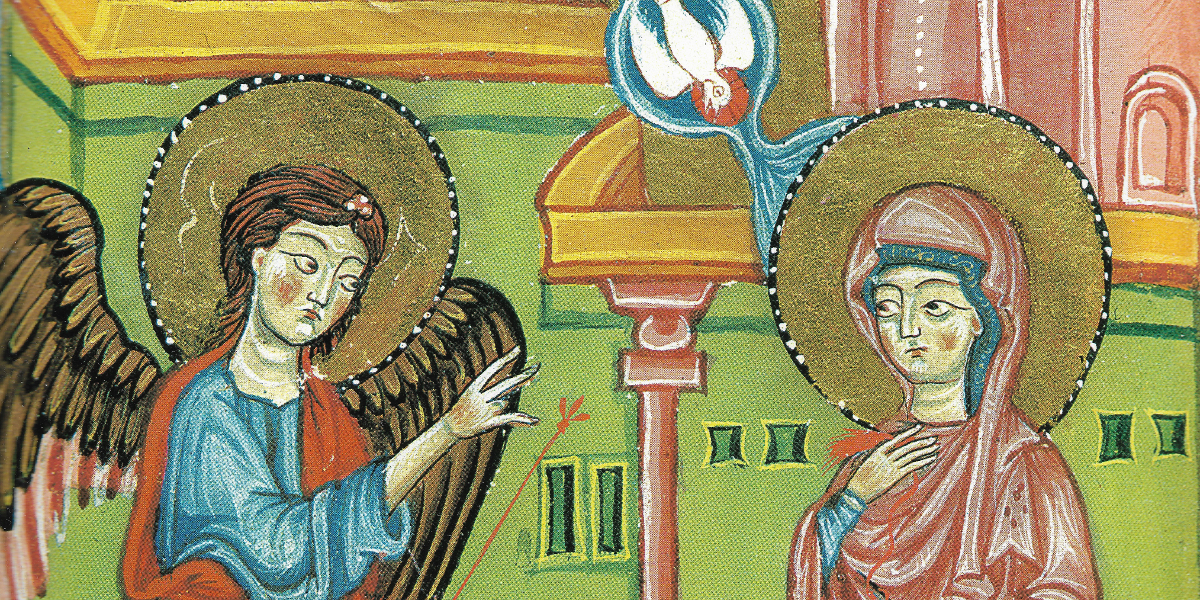
(picture from “The Annunciation” by Toros Taronetsi, 1323)

The Eighteenth Sunday after Trinity – Pr. Faugstad sermon
Text: St. Matthew 23:34-46
In Christ Jesus, who fulfilled the Old Testament and ushered in the New Testament, dear fellow redeemed:
It was the week of Passover. The city of Jerusalem was full of Jewish people who had traveled there from all directions. Everyone was buzzing about “Jesus of Nazareth” who had recently raised Lazarus from the dead. Some viewed Him as a great prophet, a miracle worker, and perhaps even the Messiah. Others regarded Him as an imposter, a blasphemer, an enemy. The religious leaders had been plotting His destruction for some time, but they didn’t want to create an uproar among the people by arresting Him in public.
So they waited for a good opportunity. While they waited, they decided to try to catch Him saying something false, something they could use against Him in a trial. First the Herodians came asking Him if it was lawful to pay taxes to Caesar or not. They went away marveling at His expert answer. Then the Sadducees came with a question about marriage in the resurrection. In His answer, Jesus quoted from the Old Testament Scriptures, showing that the Sadducees did not know what they claimed to know.
Then the Pharisees came. They fancied themselves as experts of the Law, the best of the best. If anyone could expose Jesus as false, they could. Their confidence in their own abilities is laughable. It was like pee-wee league players facing off against professionals. They didn’t know who they were dealing with. Their pride was about to be checked.
“Teacher,” one of them said, “which is the great commandment in the Law?” It’s hard to know how they were trying to trip Him up with this. Jesus’ answer came from the classic Old Testament creed in the book of Deuteronomy: “Hear, O Israel: The LORD our God, the LORD is one. You shall love the LORD your God with all your heart and with all your soul and with all your might” (6:4-5). Then Jesus added a second great commandment from the book of Leviticus: “You shall love your neighbor as yourself” (19:18). “This is the summary of God’s commands in the Scriptures,” He said. “These are the hooks on which they ‘hang.’”
All that God asks of us is found in these two commandments: love God with our whole being and love our neighbors as ourselves. But what kind of love is God talking about? People use “love” today to describe things like their favorite food, their favorite musical artist, or their favorite color. Regarding relationships, our culture likes to say that “love is love,” meaning any form of affection we might have toward another is a proper love, even if is actually harmful to ourselves or others.
The definition of love given by Jesus from the Old Testament is clearly a self-sacrificing, humble love. How should we love God? With “all our heart… all our soul… all our mind.” That means we should attune each of our desires, plans, and beliefs to the will of God. We should apply our intellect and our thoughts to His service and dedicate ourselves to studying His Word of truth above all else.
And how should we love our neighbor? Just as we love ourselves. This means that my neighbors should matter to me as much as I matter to me. Their needs should be just as important as my needs, their struggles as my struggles, their pain and sorrow as my pain and sorrow. This is not necessarily a mutual love, as in, “I love you; you love me.” This is a love that does not require or expect a return. It is love spilling over from one to another, and even to an enemy.
This is the love Jesus had for the religious leaders who wanted to destroy Him. He didn’t show them love by affirming them in their pride and self-righteousness. Love does not mean supporting people in every choice they make. If that is the way we parented our children, they would be spoiled brats and would almost certainly reject the saving truth of the Bible. Instead, we correct them, call out their bad decisions, rebuke them for the untrue or unkind things they say, challenge their selfish thinking. That is love.
And we need God to do the same to us. We need to hear these two great commands of God and ask ourselves how well we have kept them. All our heart, soul, and mind? Love for others as we love ourselves? Most of the time, we can’t rightly say that God has even half our heart, soul, and mind. So often we are focused on earthly concerns, things like our health, money, influence, future plans, pleasures. And our neighbors? The people closest to us don’t always get our best; they might more likely get the leftovers. Instead of thinking about what I can do for them, we think about what they can do for me. We need the Holy Spirit to convict us through the Law for our lack of love.
But while the Pharisees were still gathered together, Jesus shifted the focus from the Law with a question of His own. He asked them whose son the Christ, or the “Anointed One,” is. They said, “the Son of David,” meaning that the Christ would descend from the royal line of David. Jesus followed that with a quotation from one of David’s Psalms, where David recorded a conversation between “the LORD,” and “[his] Lord.” Then Jesus asked, “If then David calls Him Lord, how is He his Son?”
Where were the experts now? Didn’t they claim to know the Law like no one else? Their mouths were shut. They didn’t know what to say. The evangelist Matthew, who was a witness to all these things, said about them, “no one was able to answer Him a word, nor from that day did anyone dare to ask Him any more questions.” Jesus had exposed their ignorance. But His goal was not to win a verbal battle. His goal was to open their heart, soul, and mind to the beautiful promise of the Scriptures.
The central promise, the core message of the Old Testament is not first of all the Law of God. The Old Testament is first of all about the LORD’s promise to send a Savior for sinners. The promise came right after Adam’s fall into sin. The written Law came much later, probably thousands of years later, through God’s servant Moses. Jesus was calling the Pharisees to consider this central teaching. He wanted them to recognize that the promised Christ was both David’s Son and David’s Lord. He was both human and divine.
And what would this Christ do? The Jews were hoping for a man who would return Israel to its former glory like it had under King David. That is probably how the Pharisees understood Psalm 110, from which Jesus was quoting. And this Psalm does speak in terms of conquest. The first verse says, “The LORD says to my Lord: ‘Sit at my right hand, until I make your enemies your footstool.’” And later in the Psalm: “The Lord is at your right hand; he will shatter kings on the day of his wrath. He will execute judgment among the nations, filling them with corpses; he will shatter chiefs over the wide earth” (vv. 5-6).
It certainly sounds like the coming Christ would be a conqueror of nations. That is probably how we would have understood it too. But now we know that this Psalm is much more. Defeating the powerful leaders of the territory would be impressive. Jesus did something infinitely more impressive. He took on the enemies that have vexed and conquered humanity ever since the fall into sin. He took on the poison of sin, the power of death, and the devil that pulls the strings of all that is evil and destructive in the world.
These are the enemies that would become Jesus’ footstool. But first He had to perfectly fulfill the command to love God and neighbor by going to the cross. His Father sent Him into the world for this very purpose, and Jesus willingly offered His perfect life for the lives of all His neighbors, for all the sinners of all time. What wondrous love is this! It is perfect love.
This love was poured out for you when Jesus shed His holy blood. He went to the cross as your substitute carrying the many ways you have failed in love toward God and your neighbors. He carried your selfishness, the anger you have felt toward others, the grudges you have nursed, and your reluctance to help those who needed you. On the cross, He paid for all those transgressions as though they were His own, all those violations of God’s clear commands. His death in your place freed you from the culpability and blame of all your sin.
You do not love God with all your heart, soul, and mind or your neighbor as yourself, but Jesus did, for you. Romans 10:4 declares that “Christ is the end of the law for righteousness to everyone who believes.” Because He fulfilled the Law, you share in that fulfillment by faith in Him. His life of perfect love is credited to each one of us by His grace alone.
This is the comfort we find in the Word of God as recorded in the Old and the New Testaments. We certainly become more aware of our sin when we hear and learn the Word, but we also learn about our Savior, the promised Christ, from the beginning of Genesis all the way to the end of Revelation. As Jesus said to the religious leaders on another occasion, “You search the Scriptures because you think that in them you have eternal life; and it is they that bear witness about me” (Joh. 5:39).
With these words, Jesus is teaching us to look for Him and His saving work all through the pages of the Bible. He is The Anointed One who Fulfills the Scriptures. This Son of David and Lord of David, Jesus the Christ, did not come to make a spectacle out of us sinners. He came to save us. He came to carry out the mission His Father sent Him to do, until His enemies—and our enemies—were made a footstool under His feet. Jesus, the Son of God incarnate, reigns over sin, death, and the devil, now and forever. He won the victory for us sinners, just as the Scriptures said He would.
Glory be to the Father and to the Son and to the Holy Ghost; as it was in the beginning, is now, and ever shall be, forevermore. Amen.
+ + +
(picture from the altarpiece in Weimar by Lucas Cranach the Younger, 1555)
The Annunciation of Our Lord – Vicar Anderson sermon
Text: St. Luke 1:26-38
In Christ Jesus, where at the end of the season of Lent we get this taste of Christmas, an announcement of why your Savior was born for you, dear fellow redeemed:
There are many ways in which you can find information. Many surf social media. Some watch the news on the TV. What I have learned living in New Hampton is: You must read the newspaper. If you want to be in the know, you just read it. How else will you know what is happening with the county? Now the newspaper can be used for many different announcements. It can be used to announce weddings, funerals, anniversaries, and the like. How about using an angel? Now that would be a statement! And what kind of announcement comes from an angel? Well, it must be something special. When God wants to announce something important, He sends His messengers. Today we celebrate a special announcement. The time has come! God announces His promise for all, the promise of a Savior—true God and true Man.
This special announcement of the Christ’s coming is always celebrated on March 25th. There are a few reasons why that is. This is the day of Jesus’ conception in Mary’s womb. He was conceived at God’s command. A great miracle. Then do some simple math and add nine months to the date. Nine months from now we are celebrating the birth of our Savior. The date of Christmas came later, though, and this is not why the early Christians settled on March 25th. They were looking at the incarnation for a different reason. In Jewish tradition, it was thought that the great prophets died on the same calendar day that they had been conceived. The early Christian church identified the date of Jesus’ death as March 25th. That is one of the first things they celebrated and held as important. We see that important connection too. The reason that Jesus is born is so that He can die.
That reason was even tied up in His name. Mary is told the name she is supposed to give her son. She is to give Him the name Jesus. Jesus means God saves. The prophet Isaiah also prophesied the importance of today. “Therefore the Lord himself will give you a sign. Behold, the virgin shall conceive and bear a son, and shall call his name Immanuel” (Isaiah 7:14.) Immanuel means God with us, and today we see it so clearly. The closest God can be with us is when He comes in the flesh. Gabriel announces God’s plan, His promise to send His son down from heaven and it is happening. “But she [Mary] was greatly troubled at the saying, and tried to discern what sort of greeting this might be.”
Like Mary, we would be afraid to see the power of God. The Power of God means He sees and knows all our sins. The world depicts angels as gentle people or even tender babies. But Scripture describes them differently. When angels appear, people are often terrified. God is called the LORD of Armies. This angel is bringing a message directly from God. Would we want to hear that message? We would be troubled seeing their power as we are sinful creatures. They dwell in God’s presence.
But Gabriel told Mary not to be afraid, because she had found favor with God. Found with favor, yet she was still troubled. That is what we want to have, favor with God. The question is how do we find it? Do we look at God’s favor as something we earn, or something we are freely given? Our sinful nature likes to think that we can find favor with God by our efforts. Our pride works hard to earn His favor. Whether we are trying to move up the corporate ladder or be accepted by our friends, our ambitions might not be in the right place. As we look to serve ourselves, we forget that everything we do should be in service to God. We forget the very first commandment of what we are to do. We are to love God with all our heart, soul, and mind. Because we have failed to do this, there is no favor found here.
In our sins, it is impossible to find favor with God. We can’t have favor with the world and favor with God at the same time. We like to be of the world. We want to find favor in the world. Doing so causes us to sin in ways for us to find that favor. The world wants us to be more accepting. It wants us to accept everyone’s sins. When we give into that pressure, usually we do it because we might be engaged in those same sins. We might not realize it before it is too late. Do we give up our sins when they are brought out into the light? Do we double down to try and get our way? To find favor in the world, we find our own destruction.
When God sent Gabriel to Mary, He was announcing the keeping of His promise. This promise is THE promise made in the Garden of Eden. The promise was repeated to Abraham, Isaac and Jacob. The promise was prophesied about by the prophets. King David heard directly that, “your house and your kingdom shall be made sure forever before me. Your throne shall be established forever” (2 Samuel 7:16.) Years and years go by, building up to this important moment. It is time for God to keep His promise, which means the child that Mary had, that she conceived, His job was to grow up, suffer and die for you.
Jesus is the promised Savior. He is conceived at the speaking of God’s Word, and then He is born. This miracle shows that all things are possible with God. We never have to doubt God. This singular date brings together both holidays that the Christian church loves. We have the joy of Christmas knowing that the somberness of Good Friday is around the corner. Jesus’ birth is only one step of His humiliation. He must be born to die for you. His death on the cross cleanses you of your sins and with His rising from the grave, another miracle assures you that your sins are gone. Your favor is found in Christ death and resurrection.
Thankfully our favor with God is not up to us. There is only one person who can have perfect favor with God. That person not only is man, but He is also God. That is who Jesus is, true God and true man. He perfectly finds favor with His Heavenly Father. We hear the Father say how much favor Jesus has. He says, “This is my beloved Son, with whom I am well pleased” (Matthew 3:17.) Jesus does His Father’s will. He knew that this is why He was sent here. Only He can willingly obey the law in our place. Only He can willingly die in our place. Jesus’ death and resurrection saves everyone because when God the Father looks at us, He sees the life that Christ lived.
We now have favor with God because Jesus lived the life that we couldn’t. This announcement comes directly to you every day. As we fall flat on our faces and the world looks to convince us that we must find favor with it in order to live, this announcement comes to you with forgiveness because you hear the Son of God comes to save you.
God announces His promise for all to hear. First Mary hears it announced directly to her. That she was picked to be the bearer of the Christ child. You hold onto this announcement by faith in the Savior. Faith that is from the work of the Holy Spirit in you. This announcement comes to you through the hearing and reading of the Word. You hear the Words of God as He announces His coming Son to save all of mankind. He is born to die for the sins of the world. He is the Word made flesh. This is the joy that you have. God keeps his promises. He says nothing is impossible with Him. Since we were condemned because of our sins, God sent a Savior. Mary conceives Jesus by the Holy Spirit. Your Salvation came down from heaven.
The angel tells you what Jesus’ job is here on earth. “He will be great and will be called the Son of the Most High. And the Lord God will give to him the throne of his father David, and he will reign over the house of Jacob forever, and of his kingdom there will be no end.” He will reign forever, and you inherit His kingdom because of what He did for you. You couldn’t earn God’s favor but you have God’s favor because Christ earned it for you. God announces His promise for you.
An announcement for the ages. It wasn’t found online or in the newspaper. This announcement came from a special messenger directly from God. Mary heard the ultimate news. Her Savior was sent for her, and she would be the one to give birth to Him. We see abundantly clear that God keeps His promises. This was the ultimate promise. Eve was promised that her seed would crush Satan’s head. Jesus is the promised seed. His mission was simple. He lived a perfect life to die. Today we celebrate Jesus’ incarnation. In less than two weeks we remember His death. As one of our Christmas hymns says: “Nails, spear shall pierce Him through, The cross be borne for me, for you; Hail, hail the Word made flesh, The Babe, the Son of Mary!” (145:2 Evangelical Lutheran Hymnary). Amen.
Glory be to the Father and to the Son and to the Holy Ghost; as it was in the beginning, is now, and ever shall be, forevermore. Amen.
+ + +
(picture from “The Annunciation” by Toros Taronetsi, 1323)

The Second Sunday in Advent – Vicar Cody Anderson sermon
Text: St. Luke 21:25-36
In Christ Jesus, who says this generation will not pass away until all has taken place. Heaven and earth will pass away, but my words will not pass away, dear fellow redeemed:
We are at that point in time where my wife says, this is the most wonderful time of the year! Just me saying that and you can already hear the music in your head. We do always look forward to the holiday seasons. We are planning what we are going to make for food, what we are going to buy for gifts. It is great to look ahead for the holidays. Since we gauge things in time, there are other things on the calendar we look ahead towards. We look ahead to birthdays, anniversaries, vacation and the list goes on. With ourselves trained to look ahead for certain dates that are ahead, Scripture reminds us that there is a more important date that is coming up. It is a date that we are supposed to look forward to, we are supposed to expect it, yet we tend to forget about it. As we get excited to remember and celebrate Christ’s first coming, we should not forget about what Christ says about his second coming.
Jesus speaks very clearly about what is going to happen. Jesus says, “And there will be signs in sun and moon and stars, and on the earth distress of nations in perplexity because of the roaring of the sea and the waves, people fainting with fear and with foreboding of what is coming on the world. For the powers of the heavens will be shaken.” If that sounds very serious, then look around, these signs are happening. What Jesus says is happening. His kingdom is coming. The earth is only our temporary home. It will pass away. Now we could look at what is happening in the world and we could freak out. It seems like a lot of people are doing that already. Or we can listen to what Jesus says when it comes to the end of the world and prepare for His coming.
As the end draws near, God calls us to repent. Paul writes, that [God] desires all people to be saved and to come to the knowledge of the truth. (1 Tim. 2:4) This happens with a contrite heart. We repent of our sins. Our sins are very serious and they have eternal consequences. The world doesn’t like that at all. Who likes to be told that they have done something wrong? For the world this is very despairing, so they try to stop and ignore the signs. They will try to save the dying world’s health. They will look for a worldly peace among the nations by treaties. They will try to control the climate. They will also see these signs and instead of prepare, they will be like in the days of Noah and act like nothing is happening. That Jesus second coming should just be ignored. Why should the world care about the signs that Jesus tells us when they can find something as great as their own self-worth. Now we see the outcome of the world rejecting the teachings of Christ. Jesus is telling us the truth, repent for the kingdom of God is coming, the world will end.
Unfortunately, Satan is crafty and he has a way of getting us to fall into the traps and worries of the world. Jesus tries to warn us. He says, “But watch yourselves lest your hearts be weighed down with dissipation and drunkenness and cares of this life, and that day come upon you suddenly like a trap. For it will come upon all who dwell on the face of the whole earth.” Due to our own stubbornness, we also fall into the traps ourselves. We see the problems of this life and we see how they affect us and we begin to worry. What will happen when the famine, pestilence, and wars hit close to home? So, we put our confidence in the powerful people of the world. Or we try to find help and comfort in worldly things that cannot save us. The temptations of the world will not go away quietly, the world shows us how noisy it is. It wants us to tune out the signs and the promises that Jesus has given us. It wants to distract us from what really matters and get us to focus on what is passing away.
It is so interesting that we look forward to so many dates and special occasions yet we lose focus on what Christ tells us. Talking about the end is coming directly from our Savior yet it is the hardest even for us to hear at times. We don’t like to hear when we are wrong. We don’t want to be corrected of our sins. If we stay in our sins, then we will be condemned with the rest of the world. Our hearts can harden, and if we die in unbelief or if we are without faith when Jesus returns, then we will join the devil and his demons in hell. The world is not prepared for Christ’s return, but we need to be. When we forget about repentance, then we have succumbed to the world and we end up not being vigilant. When we are weighed down by our own cares and anxieties, then we forget about the comfort in Jesus second coming.
As we get ready to celebrate and rejoice in the first coming of Christ, we also look forward to what is to come because Christ will come again in glory to take us to our heavenly home for all eternity! This terrible evil world will come to an end and we won’t have to stay in it. Because of Christ life and death on the cross, we don’t have to suffer the pains of hell. He will call us to our eternal home.
Advent is the season for looking ahead. We see how Christ came humbly into the world, yet we “will see the Son of Man coming in a cloud with power and great glory.” We needed him to come the first time because we needed a Savior from our sins. Jesus redeemed us from our sins of worrying. He takes away our sins that have distracted us from His coming. He gives us comfort that his Word will never pass away. This is the message of the Gospel, what Christ has done for us. When we fail and get worried about our future, Jesus gives us comfort that He has not left us and that He is coming soon.
Christians also look ahead to when Christ comes to us in the Means of Grace. This is Christ giving you the assurance that He is trustworthy. He is truth. Every week we hear the Word preached, the blessing of the Gospel of Christ in his Word. There is so much comfort in the Word of God. It tells you how Jesus redeemed you. You are a sinner who could not save yourself, and the Son of God took on flesh to sacrifice Himself for you. He died in your place, so that your sin and death would be overcome forever. He gives you these blessings of His redemption in the mysteries of Holy Communion. You look forward to this sacrament because here is the true body and blood of our Savior given to you for the forgiveness of your sins. This is the assurance that you have forgiveness of sins, life and salvation because of what Christ has done for you.
Verse 27 again says, “And then they will see the Son of Man coming in a cloud with power and great glory.” This is a glory that you will not have to fear. You can rest assured that when Christ comes on the last day you will rejoice in his return. There will be no pain or suffering. All of the trials and temptations of this world will be gone. Your tears will be gone. Your bodies will be glorified where Christ is the light of the world. This is the comfort that you have in His message. Jesus is telling you that believers will not have to worry. This is your eternal reward. Jesus’ kingdom will have no end.
Looking forward to Christ’s second coming, Jesus tells you how to prepare. “But stay awake at all times, praying that you may have strength to escape all these things that are going to take place, and to stand before the Son of Man.” Here Jesus gives you the tools to be ready. You pray to him for the strength you need because you can’t stand on our own. Your strength to endure through this life comes from Christ, in what He did in his first coming. Living a perfect life, dying, rising from the dead, redeeming you.
Now our calendars can tend to be full at times and I know that everyone has been starting to fill in next year’s already. Christ keeps the real focus on him. That is where our focus needs to be. He wants us prepared for His second coming because we don’t know when it will come. When we get lost in time, we forget the date entirely. Christ keeps us sure of what is to come. Though life will get difficult, Christ is our comfort because of what he has done. Because of Jesus first coming, we can rejoice when the second coming is here. The world will try to distract us from Christ. It will try to convince us that His Words have no meaning. Jesus however says in verse 32, Truly, I say to you, this generation will not pass away until all has taken place. Heaven and earth will pass away, but my words will not pass away. Amen.
Glory be to the Father and to the Son and to the Holy Ghost; as it was in the beginning, is now, and ever shall be, forevermore. Amen.
+ + +
(picture from Jerico Lutheran Church stained glass)