

The Second Sunday after Trinity – Pr. Faugstad sermon
Text: 1 John 3:13-18
In Christ Jesus, Love incarnate, who demonstrated God’s love for the world through His sinless life and sacrificial death, and who calls His people to follow His example of love, dear fellow redeemed:
There are different ways we express the fact that we are alive: “I’m breathing.”—“I’m upright.”—“I have a pulse.”—“I’m still above ground.”—“The ol’ ticker is still working.” Our reading for today gives another proof of our being alive, but it is talking about something more than physical life. The apostle John writes, “We know that we have passed out of death into life, because we love the brothers.”
The “brothers” that John is referring to are fellow believers. Although it sounds like John is saying that it is our love for the brothers that has brought us “out of death into life,” this is not the case. John makes this clear a couple verses later when he writes, “By this we know love, that He laid down His life for us.” We “know love,” because we have seen the love of Jesus.
The love of Jesus was completely sacrificial. He came, as He said, “not to be served but to serve” (Mar. 10:45). Of all the people who could have demanded the love of others, it was Him. “For by him all things were created” (Col. 1:16), and “he upholds the universe by the word of his power” (Heb. 1:3). He is the only-begotten Son of God the Father from all eternity. We would not exist apart from Him. When He took on human flesh and revealed Himself through His gracious words and works, He should have received nothing but love, honor, and respect.
At the same time, His love was not contingent on receiving what He deserved. Whether or not His words were listened to, whether or not His works were praised, whether or not He was thanked for His miracles and blessings, He still loved, like the love we see from the master of the house who invited “the poor and crippled and blind and lame” to his banquet (Luk. 14:16-24). Jesus loved the sinners around Him all the way to the cross, where He lovingly carried all their sins to make payment for them. He came “not to be served but to serve, and to give his life as a ransom for many” (Mar. 10:45).
What He has done, that is what we are called to do. On the night He was betrayed, Jesus washed the feet of His disciples and told them, “I have given you an example, that you also should do just as I have done to you” (Joh. 13:15). Then He added that it is love that would set His disciples apart from the world. He said, “By this all people will know that you are my disciples, if you have love for one another” (v. 35).
Jesus is not referring to a love that will come from deep down in our heart, as though all we need to do is look inside to find it or try harder. He is referring to a love that comes from God Himself. As John wrote later in his epistle, “Beloved, let us love one another, for love is from God, and whoever loves has been born of God and knows God” (1Jo. 4:7). That tells us there is a difference between the love of the world and the love of God.
In fact, we learn from the Bible that those “loves”—worldly love and godly love—are opposed to each other. The world has a warped understanding of love. “Love” might be defined as “the acting out of my passions.” It is “doing the things I find fulfilling.” The “love” that the world embraces hardly ever has a sacrificial component. It is about what is good for me more than it is what is good for you.
It is no wonder, then, that the world chafes under the Bible’s definition of love. God says that nothing can be loving if it goes against His Ten Commandments. The Commandments show us the shape of love and the focus of love. They do not direct us inward toward a love of self. They direct us outward toward love for God and neighbor.
Therefore, we say, it can’t be love when we dishonor or disrespect parents or the governing authorities (4th). It can’t be love when we do harm to others or wish harm on them in our hearts (5th). It can’t be love when we act on our sexual passions and desires outside of marriage (6th). It can’t be love when we have the world’s goods and see a brother in need, yet close our heart against him, as our reading says. Anything that does not agree with God’s holy law cannot be loving, since “love is the fulfilling of the law” (Rom. 13:10).
The world, of course, disagrees, and it doesn’t disagree mildly. It says that you should indulge your sinful passions, do whatever you want to do, put yourself first. The world doesn’t take kindly to these things being questioned or challenged by we who hold to the true Word of God. The effect is as John says, “the world hates you.” He is saying nothing different than the Lord Jesus who said, “If the world hates you, know that it has hated me before it hated you. If you were of the world, the world would love you as its own; but because you are not of the world, but I chose you out of the world, therefore the world hates you” (Joh. 15:18-19).
Love for God means hatred from the world. You cannot have it both ways. Jesus says you cannot enjoy the love of the world and the love of God. The unbelievers of the world walk around dead in their sins, like the people in the Holy Gospel who thought their worldly pursuits were more important than the banquet of salvation. They do not know the love of God. They are unable to love as He loves. So it is no surprise when we are the recipients of their hatred. Hatred comes naturally to the unbelievers of the world, just as it once came naturally to us.
But now we are alive in Christ. We have been buried and raised with Him through Baptism. We have been grafted into Him, which means that life and love flow from Him to us like nourishment from a vine to its branches. Through these branches—through us—God produces fruits of love for the benefit of others. John describes what that love looks like. Just as Jesus laid down His life for us, “we ought to lay down our lives for the brothers.” If any brother has a need, we should do our best to help and supply him. Believers in Jesus should never be accused of being “all talk.” We show our love by our words and our actions.
But what if we don’t? What if we fall into the same snares and sins of the unbelievers? And of course we have. We have played the part of murderers by hating a brother or sister in Christ. Perhaps it was hatred toward a parent, a sibling, a spouse, or a member of the congregation. We wanted them to be hurt like we hurt. We wanted them to suffer like we suffered. And there have been times when we saw a fellow Christian in need, but we didn’t want to trouble ourselves to help. Or we told ourselves that surely someone else would step up who had more resources and more time.
When these behaviors have described us, then we were no better than the unbelievers of the world. Then this indictment is true for us: “Whoever does not love abides in death.” It is death—lifelessness—when we fail to love. Christians who do not love are like lungs that don’t breathe or hearts that don’t beat. We do not represent the God of all love when we are selfish or judgmental or too proud to lift a finger to help those we think are below us.
If the wheels in your brain are turning right now, remembering when you did not love, but then trying to justify those times, that is death in you. But if you recall those times of weakness and sin, and you are sorry for them, that is life in you. St. Paul writes, “For if you live according to the flesh you will die, but if by the Spirit you put to death the deeds of the body, you will live” (Rom. 8:13).
“Putting to death the deeds of the body,” means repenting of your sins and trying to avoid them in the future. Every one of us here has sins to repent of, sins of hatred and selfishness. The Holy Spirit leads us to recognize these sins and hand them over to the Father. This remorsefulness and repentance is a clear sign of life. It is a sign that you are not dying along with the loveless world. You are alive in Him who loved perfectly.
His love for you does not change, even though you have sinned, even though you have not always loved like you should. The Son of God accepted the punishment for all those sins in your place, so that they are not charged against you anymore. His love for you from cradle to cross covers the multitude of your sins. He gave Himself to save you.
The Holy Spirit gives you the faith to believe this. And He continues working through the Word and Sacraments to strengthen your faith and renew your love toward others. You come here bringing your sin and guilt, but you leave holding His grace and forgiveness, with plenty to share with everyone around you.
That is what we do. We pass on what we have received. We Living Ones Love. We do not lose anything by loving. We only gain, like honeybees transferring pollen from flower to flower, or like a flame being passed from one candle to another. Just as the love of God has come to us from others, so we share this love, not just “in word or talk but in deed and in truth.”
Glory be to the Father and to the Son and to the Holy Ghost; as it was in the beginning, is now, and ever shall be, forevermore. Amen.
+ + +
(woodcut of the poor, the blind, and the lame being invited to the banquet from the 1880 edition of The Story of the Bible from Genesis to Revelation)
(No audio recording is available for this sermon.)

The Sixth Sunday of Easter – Pr. Faugstad sermon
Text: James 1:22-29
In Christ Jesus, who did every good thing that His Father gave Him to do, so that we sinners would be covered in His righteousness, dear fellow redeemed:
The employee worked hard. He went above and beyond what was asked of him. He never took company things for his personal use. But he still got passed over for promotions in favor of co-workers who were less dedicated and less honest. Why should he work hard if no one notices?
The mother finds time in her busy schedule to put a meal together for her family, and all they can do is complain about what she made. How can they be so ungrateful?
The student tries to be friendly and helpful to her classmates, but they hardly acknowledge that she exists. Why should she be nice when no one seems to care?
We can relate to these situations or ones like them. Each of us has had the experience of doing good things for others, and then either having them not notice or having them criticize our efforts. That hurts! It makes us question whether it might have been better not to try at all. Or it makes us regret that we tried, along with the resolve not to try again in the future. In other words, “Fool me once, shame on you; fool me twice, shame on me.”
But there’s a problem with this approach: It makes our doing of good contingent on receiving something in return. Then it’s fair to ask how good our good deed is, if there is really a selfish aim behind it. But how else are we supposed to operate? Who is able to keep doing good when the opposite is thrown back at them? If our good deeds never result in being promoted or thanked or treated with kindness and respect, then why should we try? Then What’s the Point of Doing Good?
We receive an answer to that question in today’s reading. Just before our text, James writes about the salvation we receive through the Word of God. We heard these words last week: “receive with meekness the implanted word, which is able to save your souls” (v. 21). By calling it “the implanted word,” James indicates that God’s Word should grow in us, and that it should produce fruits in us and through us.
This is why he goes on to say that we should “be doers of the word, and not hearers only.” Notice that he does not say that doing is more important than hearing. In fact, one follows from the other. We are not ready to do until we have heard. Our faith and our salvation come from hearing, not from doing. This is what Romans 10 and Ephesians 2 teach, “So faith comes from hearing, and hearing through the word of Christ” (v. 7). And, “by grace you have been saved through faith. And this is not your own doing; it is the gift of God, not a result of works, so that no one may boast” (vv. 8-9).
The great error of the Roman Church that Martin Luther called out at the time of the Reformation was the idea that a sinner’s salvation comes from a mixture of his faith and his good works. That is wrong for two reasons: 1) It takes the glory away from Christ who perfectly kept the Law for us and gave up His life to redeem our souls, and 2) it leads us either to pride in our works or to despair because of our failures.
The Bible teaches that salvation was won for us 100% by Jesus and is gifted to us by the work of the Holy Spirit. That is why we can be completely confident of our salvation. It was accomplished for us by Him. It happened outside of us, not inside us—apart from us, not with our assistance. God the Father declares us forgiven, redeemed, saved because of the perfect life, death, and resurrection of His Son Jesus.
This good news, this gracious reality imparted to us—it changes us. It changes our heart, our mind, our purpose, our plans. It changes the way we look at ourselves and at one another. This change is what James describes in his epistle. If we have rightly heard, he says, and faith has been worked in our hearts, then we will certainly do. We will reflect the love we have received from God out toward the people around us.
This love will make us stand out in a world that is so filled with hatred and self-righteousness. The Christian Church throughout history has always been known for its love. Christians have started countless hospitals, orphanages, care centers, soup kitchens, and food pantries around the world to help the poor, helpless, and lonely. Christians defend and care for those whom others cast aside, such as the crippled, the sick, the elderly, and the unwanted.
This is how James describes “pure and undefiled [religion] before God,” to care for those who are most in need, such as “orphans and widows in their affliction.” Then he adds that such pure religion is also, “to keep oneself unstained from the world.” Christians are in the world, but they are not of it. They have a special purpose, a special calling from God. They are set apart for holy things and holy works, even as they live in an unholy world.
But there is a problem: Christians are not perfect either. Often we, too, think selfishly about things. We focus on what others should be doing for us, instead of what we should do for them. Or we keep our faith so well disguised around our friends and co-workers, that they would never guess we believe in Jesus as our Savior. This is hypocrisy, which is one of the sins that James identifies in today’s reading.
It is hypocrisy when we say we believe what God says, but then we act or speak in ways that are contradictory to our beliefs. We have all in our own way played this game. We have been on good behavior around fellow believers but behaved just like our unbelieving acquaintances in other settings. Or we willingly compromised the truth when it seemed advantageous to do so.
In these ways, we don’t look much like the new creation we are through our Baptism into Christ. We don’t look like those who have been transformed by the powerful working of the Holy Spirit through the Word. We don’t look like those who are bound for the kingdom of heaven with the saints and angels who stand in the holy presence of God.
When God looks at how little we have accomplished and how much we have failed, it seems fair that He should ask, “What’s the point?” “What’s the point of all that I do for them, providing for their needs every day, pouring out my blessings upon them? What’s the point of forgiving their sins, when they just sin more and more? What’s the point of doing good to them?”
But God does not ask these questions. He doesn’t ask them, because His love toward us is perfect. It never falters. It never runs out. He does not second-guess His commitment toward us. He loves, because He is love (1Jo. 4:16). He does good toward us, because He is good.
His love is what caused Him to send His only Son to save us. “For God so loved the world, that he gave his only-begotten Son, that whoever believes in him should not perish but have everlasting life” (Joh. 3:16). God did not send His Son in order to get something from us. He sent His Son in order to give grace to us, by fulfilling the law for us, dying for us, rising from the dead in victory for us.
Jesus perfectly carried out this work to save our souls. He did not make His good words and good efforts contingent on others doing good to Him. He kept doing good things, even when He was opposed, mocked, and finally crucified. Even when the nails were piercing His flesh, He prayed, “Father, forgive them, for they know not what they do” (Luk. 23:34).
Jesus’ perfect life of love is already counted as ours by faith. We have nothing to do to earn God’s favor or get ourselves to heaven. We get to work, we get to serve, we get to help, we get to pray for everyone in need as the special agents of God carrying out His mission in the world. “We love because he first loved us” (1Jo. 4:19).
Through the immeasurable love of God toward us, we learn how to love others. We learn that the hard work we put in (like the honest employee), the sacrifices we make (like the meal-making mother), and the kindness we show (like the helpful classmate), are not about what we can get or what we think we deserve. They are about what we can give in recognition of what God has given us. One of the best ways to give to others is to pray for them. This is how we bring their needs to God who promises always to answer our prayers in the way that is best.
God only does good toward us. There is no good apart from Him. We do good to others through our words and actions, because that is what He created and redeemed us for as His children. Since He never runs out of good, neither will we, because “every good gift” comes down to us “from the Father of lights” (Jam. 1:17). “Oh, give thanks unto the Lord, for He is good, for His mercy endures forever” (Psa. 106:1). Amen.
Glory be to the Father and to the Son and to the Holy Ghost; as it was in the beginning, is now, and ever shall be, forevermore. Amen.
+ + +
(picture from “Jesus and the Little Child” by James Tissot, 1836-1902)

Maundy Thursday – Vicar Lehne sermon
Text: St. John 13:1-15
In Christ Jesus, who cleansed you by his selfless love, dear fellow redeemed:
The time had finally come. Jesus knew what was about to happen. In only a few short hours, he would be betrayed by one of his own disciples and arrested by the religious authorities in the Garden of Gethsemane. Then, after being questioned, mocked, and tortured, he would be sentenced to death on a cross, one of the worst ways for a person to die, even though he had done nothing wrong. On that cross, he would bear the burden of the entire world’s sin as if it were his own and face the punishment for all of it. This would be the final Passover meal that Jesus would eat with his disciples before he would be sacrificed as the ultimate Passover Lamb.
If you knew that you were about to face the ultimate suffering, surely you would be dreading what was about to happen and, if it were possible, would be thinking of ways that you could escape it. But Jesus wasn’t thinking about himself or the pain that he was about to endure. He was instead thinking about “his own who were in the world” (verse 1), whom he loved to the end, to the fullest extent. These people were not only his disciples, but were also, as Jesus describes in John 17:20, “those who will believe in [him] through their word,” that is, the gospel that would be preached by the disciples. In his final hours, Jesus was thinking about you. His disciples, on the other hand, were thinking about something much different.
In the gospel according to St. Luke, we hear that “[a] dispute also arose among them, as to which of them was to be regarded as the greatest” (Luke 22:24). This is not the first time that the disciples had this dispute. The last time they did, Jesus called a child to him and said to them, “Truly, I say to you, unless you turn and become like children, you will never enter the kingdom of heaven. Whoever humbles himself like this child is the greatest in the kingdom of heaven” (Matthew 18:3–4). But it appears that the lesson did not sink in. So, this time, Jesus said to them, “[L]et the greatest among you become as the youngest, and the leader as one who serves. For who is the greater, one who reclines at table or one who serves? Is it not the one who reclines at table? But I am among you as the one who serves” (Luke 22:26–28).
The Jews, including the disciples, thought that the Messiah was going to be an earthly king who would free them from the Romans, but Jesus did not come down from his throne in heaven to be an earthly king. He came down to earth to be a servant. In our Epistle lesson for Palm Sunday, we heard that Jesus, “though he was in the form of God, did not count equality with God a thing to be grasped, but emptied himself, by taking the form of a servant, being born in the likeness of men” (Philippians 2:6–7). We also hear in the gospels of St. Matthew and St. Mark that “the Son of Man came not to be served but to serve, and to give his life as a ransom for many” (Matthew 20:28; Mark 10:45). Now, Jesus was not only going to show his disciples through his actions that he came to be a servant, but he was also going to give them an example for how they were expected to act. He got up from the table, took off his outer garments and laid them aside, wrapped a towel around his waist, poured water into a basin, and began to wash the disciples’ feet.
Since the Jews wore sandals when they traveled at that time, traveling on the dusty roads would cause their feet to get dirty. But washing feet was not a task that just anyone did. This was considered menial work that was reserved for the lowest of servants. Because the disciples thought so highly of themselves, none of them thought to volunteer to wash the feet of the others. But now that Jesus, the greatest among them, was willingly washing their feet without complaint, they all felt guilty that they had not been the ones to volunteer.
You might not argue that you are the greatest, like the disciples did, but there are times when you think that you are better than others or you think that a certain task is beneath you. You may not be perfect, but at least you’re better than the person who actively lives in sin, despite the warnings that are given to them by you or others, or the person who refuses to go to church, even though they are perfectly able to do so. There are also many important tasks that you are in charge of. So, why should you be expected to do even more when you’re already doing so much? Why can’t other people be found to do those tasks? It’s really easy to start thinking in these ways, but when you think in these ways, you are putting yourself, your wants and desires, before others and their needs.
This is not the example that Jesus gave us to follow. By washing the feet of his disciples, by willingly taking on the task that was reserved for the lowliest of servants, Jesus was teaching his disciples and us that we are to humble ourselves in loving service to others. But it’s clear from how often we fail to do that and only think of ourselves that it’s impossible for us to serve like Jesus served. Fortunately for us, Jesus perfectly humbled himself in loving service to others for us.
Jesus’ entire earthly ministry was spent in loving service to others. He fed people who were hungry, healed people who were sick, cast out demons from people who were possessed, and even raised people back to life who had died. Jesus was not performing these miracles because he was trying to make himself look good or because he was trying to get something out of those he was helping. He was performing these miracles because he loved the people of the world and wanted to help them. And Jesus showed how much he truly loved all sinners when he willingly laid down his own life for them.
Jesus’ willing sacrifice was the ultimate example of his loving service to others. Because of his great love for us, Jesus took all of our sins on himself and carried them all the way to the cross. He bore the burden of our sins as he hung on the cross and paid the price for every single one of them. When Jesus died on the cross, all of our sins died with him, because he bore them as though they were his own and made atonement for them.
Peter did not yet understand why Jesus was washing his feet or what Jesus was going to have to do to save him and the world. So, when Jesus came to wash his feet, Peter said to him, “You shall never wash my feet” (verse 8). But Jesus answered him, “If I do not wash you, you have no share with me” (verse 8). Jesus was not saying that Peter needed to have his feet washed if he wanted to have a share of Jesus’ eternal inheritance in heaven. He was saying that Peter, as well as all of us, need to be spiritually cleansed by him if we want to have a share in his eternal inheritance.
All of us who believe in Jesus have already been spiritually cleansed by him. But, just like a person who needs to keep washing his dirty feet, we also need to keep returning to Jesus for forgiveness since we continue to sin every day of our lives. One of the ways that we receive this forgiveness is in the Lord’s Supper.
Jesus would soon institute Holy Communion after he finished washing his disciples’ feet. In that supper, you receive Jesus’ true body and blood in the bread and the wine for the forgiveness of sins. When Jesus instituted Holy Communion, he was looking forward to the sacrifice he would soon make as the Passover Lamb on the cross, shedding his blood for you. Now that his sacrifice has been made, when you partake in the Lord’s Supper, you look back on the sacrifice that he made for you, and the forgiveness that he won by his sacrifice is brought to you in the present. As you leave the Lord’s table, you have the comfort of Jesus’ forgiveness and the assurance that you will one day feast with him in his eternal kingdom.
You may not be able to perfectly follow Jesus’ example of loving service, but through the faith that the Holy Spirit has given you through the Word and the Sacraments, he has changed your heart so that you desire to follow Jesus’ example. And when you fall short, you return to the Lord’s table to receive his forgiveness, which he freely gives to you. It is because of Jesus’ selfless love that you receive his forgiveness. It is because of Jesus’ selfless love that you are cleansed. Amen.
+ + +
(picture from painting by Giotto di Bondone, c. 1267-1337)

The Third Sunday in Advent – Pr. Faugstad sermon
Text: 1 Corinthians 4:1-5
In Christ Jesus, who continues to carry out His mission of redemption through the efforts of His faithful people, dear fellow redeemed:
His work had started so well. The thirty-something preacher came in with tremendous energy. He maybe wasn’t the greatest looking guy, and he had some strange habits, but there was a magnetism about him. People came from all over to hear him preach—young and old, churched and unchurched; even important people in their expensive clothes came to see “what this is all about.”
He didn’t let anyone off the hook. With biting words, he exposed their sin as though he could see into their hearts. He was not afraid of anyone, from peasant to prince. He preached like there was no tomorrow. “Even now the axe is laid to the root of the trees,” he cried. “Every tree therefore that does not bear good fruit is cut down and thrown into the fire” (Mat. 3:10). But it wasn’t all doom and gloom. He also told them about God’s grace toward sinners. “Repent and be baptized,” he said; “receive the forgiveness of sins.” Some even wondered if he might be the promised Messiah.
But John was not the Messiah. The real Messiah came to John while he was baptizing at the Jordan River. He urged John to baptize Him, and when he did, the heavens were opened, the Holy Spirit descended in the form of a dove, and the Father spoke from above to His “beloved Son,” with whom He was well pleased (Mat. 3:16-17). What an experience! Preacher John now pointed to Jesus and said, “Behold, the Lamb of God, who takes away the sin of the world!” (Joh. 1:29).
Just imagine what these two great men could accomplish. Imagine how many people they could reach by working together. But that isn’t exactly how it went. They did work simultaneously for a little while, and then John’s disciples started to see the crowds shrinking. They realized the crowds were leaving John and going to Jesus! But John was not upset. “I am the friend of the bridegroom,” he said. “He must increase, but I must decrease” (Joh. 3:29,30).
John did decrease, very quickly. He called out the adultery of King Herod, who had taken his brother Philip’s wife for himself. So Herod arrested John and put him in prison (Mat. 14:3-4). That is where we find him in the Holy Gospel for today—in prison (Mat. 11:2-10). What good could John do there? He longed to be back out in the Judean wilderness, preaching by the Jordan. A few faithful disciples continued to visit him through his bars. Perhaps that’s why John sent them to question Jesus; he knew his time was short. It was the Bridegroom who mattered.
Would you say that John had a successful ministry? Since He pointed out Jesus as the Messiah, the answer must be yes. But if that had happened in this church, if a fiery preacher had attracted such crowds that all the pews were filled, and it was standing room only. If that preacher helped put your church on the map where it belonged, but then the crowds started thinning and the cars stopped pulling up for Sunday service until it was back to just you. And then to top it all off, that once-popular preacher ended up in prison. Would you be glad for the high point, or would it just depress you to think about what you used to have?
It is tempting to think about success in the church by numbers. You might think back to when each row of pews had people in them, when every member’s social life and spiritual life were largely intertwined and centered in the church. For example, the Young People’s Society had enough kids to raise money for Jerico’s large stained-glass windows. There wasn’t enough room in our church basements for congregational dinners. What has changed? People have more commitments away from home, more on the schedule. Families are smaller than they used to be. Fewer people live near the churches. Church attendance is falling in all mainline denominations. These things are true.
But perhaps you also wonder if the church would do better if it changed a little more with the times. Maybe if we weren’t so strict about moral issues, or if we gave a little ground on our Communion practice or our style of worship. Or maybe it seems like the pastor could do different things to connect with the members and the community—get a stronger youth program going, offer more classes, do more to reach out.
Every pastor wants to be a good pastor, but he often has doubts. “What could I be doing better? Has my presence here really made a positive difference? Would the parish be better off if I left, and someone else stepped in?” How is a congregation supposed to measure its pastor? How is a pastor supposed to assess his own work?
The apostle Paul outlines the standard. He does not mention a trajectory of growth in membership. He does not identify the level of happiness and satisfaction that should be felt by parishioners and pastor. Paul says this about how people should think of pastors: “This is how one should regard us, as servants of Christ and stewards of the mysteries of God.”
So the important question for parishioners is not first and foremost, “Do I like my pastor?” or “Is my pastor a really good preacher or teacher?” or “Has he brought in new members?” The important question is, “Do I recognize that my pastor, even with all his weaknesses and quirks, is a ‘servant of Christ’? Do I acknowledge that God has put him here to distribute His gifts through His Holy Word and Sacraments?” That is the true measure of a pastor, that he faithfully carries out these duties the congregation has called him to do.
And a pastor should not focus on the appearance of success through things like an increase in church activity and involvement. Paul continues: “Moreover, it is required of stewards that they be found trustworthy.” To be found “trustworthy” means that pastors are faithful to the Word of God. They must be faithful to the Word before they are faithful to any member of the congregation, no matter how influential those members might be. Sometimes that faithfulness to the Word requires them to confront members with their sins and call them to repentance like John the Baptizer did. A pastor’s faithfulness to the Word might even make him some enemies both inside and outside the church.
So there can be tension at times between pastors and parishioners. Paul expresses this tension by telling the congregation in Corinth, “But with me it is a very small thing that I should be judged by you or by any human court…. It is the Lord who judges me. Therefore do not pronounce judgment.” The times when it is certainly proper for a congregation to judge its pastor and call him to account is if he is preaching false doctrine, if he is leading an openly sinful life, or if he refuses to carry out the duties he is called to do. But it is not proper to judge him for personality shortcomings, for unrealistic or unmet expectations, or for declines in offerings or church attendance.
Most pastors do a good enough job judging themselves without needing parishioners to do it too. Many would have a hard time saying with Paul, “For I am not aware of anything against myself.” Pastors are well aware of their mistakes and failures. So here we are: a sinful pastor preaching to sinful parishioners. What hope do we have for the future? What reasons do we have for optimism?
Today’s reading reminds us that we have “the mysteries of God.” God’s own mysteries have been revealed to us! These mysteries all have their source in the one central mystery of God. That central mystery is Christ, “in whom are hidden all the treasures of wisdom and knowledge” (Col. 2:3). It is the mystery of the all-powerful Son of God nestled as an infant in Mary’s arms. It is the mystery of this person maintaining perfect purity according to the holy Law throughout His life. It is the mystery of this perfect man willingly taking the place of all sinners under God’s wrath. It is the mystery of a dead man coming back to life after three days to declare His victory over sin, devil, and death.
These mysteries have been revealed to you and to me through the Word of God, along with still more mysteries: Jesus’ righteousness, grace, and life bestowed by simple water and His Word. Jesus’ forgiveness imparted through the Absolution. Jesus’ body and blood tied to the elements of bread and wine by the power of His Word. These gifts of Jesus all come to us through faith, which the Holy Spirit has worked inside us.
What a mystery that the Son of God was willing to suffer and die to save us sinners! What a mystery that He calls us His own, even though we are so often weak and cold-hearted! What a mystery that He remains patient with us, visits us with His mercy through the means of grace, and sends us out as His own stewards and representatives to do His work! What mysteries! What blessings!
Because Jesus is at work among us according to His promise, we are assured of success. It may or may not be success in attendance numbers, offering amounts, or admiration from the people in our community. To many people, it may appear that what we are doing does not matter, just as it may have appeared to the people around John that his work was all for nothing once he was put in prison. But that is not how God sees it at all.
Paul writes that when our Lord Jesus comes, He “will bring to light the things now hidden in darkness and will disclose the purposes of the heart. Then each one will receive his commendation—his praise—from God.” God sees things as they really are. He sees the humble support and encouragement that parishioners give their pastors. He sees the often unheralded but crucial work that pastors do for the people they serve. As unimpressive as all of it seems, it all flows from the love of Christ, and it all points back to Him. That makes the work we do together in Jesus’ name the picture of success.
Glory be to the Father and to the Son and to the Holy Ghost; as it was in the beginning, is now, and ever shall be, forevermore. Amen.
+ + +
(picture from “The Preaching of St. John the Baptist” by Pieter Bruegel the Elder, c. 1565)

Thanksgiving – Vicar Lehne homily
Text: Psalm 100
In Christ Jesus, who is our ultimate reason to give thanks, dear fellow redeemed:
Thanksgiving is many things to many people. To some, it’s the Thanksgiving Day Parade, in which giant parade balloons of their favorite characters float down the street. To others, it’s the Thanksgiving Day football game, complete with a halftime show that’s performed by some of their favorite celebrities. Still, to others, it’s simply getting to spend time with their friends and family. But, of course, if Thanksgiving is anything, it has to be Thanksgiving dinner: turkey; stuffing; mashed potatoes and gravy; pumpkin pie! In fact, Thanksgiving dinner is such a big part of Thanksgiving that many people go without eating all day in preparation for the massive feast.
Now, these are all perfectly fine things to do on Thanksgiving, but what many people fail to realize is that the true meaning of the holiday is right there in the name: Thanksgiving. It’s a day in which we are to give thanks, but give thanks for what? The psalmist answers this question by saying in verses 4 and 5 of our reading for today, “Give thanks to [the Lord]; bless his name! For the Lord is good; his steadfast love endures forever, and his faithfulness to all generations.” Through the love and faithfulness that he shows us, God proves that he is good and worthy of our thanks. But how does God show his love and faithfulness to us? The psalmist also answers this question by saying in verse 3 of our reading, “It is he who made us, and we are his; we are his people, and the sheep of his pasture.”
This verse paints God in two ways: as our Creator and our Good Shepherd. As our Creator, God shows his love for us by giving us life. Without him, none of us would even exist in the first place. As Psalm 139:13 says, “[Y]ou formed my inward parts; you knitted me together in my mother’s womb.” As our Good Shepherd, God shows his love for us by preserving us and protecting us. Everything that we have comes from God, and God makes sure that we have everything that we need, like a shepherd leading his sheep to green pastures and flowing water. As Psalm 145:15 says, “The eyes of all look to you, and you give them their food in due season.” But it isn’t just because God provides for us that we’re alive, it’s also because God protects us, like a shepherd who fights off the hungry wolves that are after his sheep. As Psalm 91:11 says, “He will command his angels concerning you to guard you in all your ways.”
God being our Creator and Good Shepherd in our earthly lives is enough of a reason to give thanks to him, but God is also our Creator and Good Shepherd in our spiritual lives. God wants us to be with him in heaven, where we will never want for anything. However, because of the countless sins that we committed, we were not able to stand in the presence of a perfect God and were doomed to be cast out from his presence into hell, where we would pay the price for our sins for all eternity.
There was no way that we could change our fate and enter God’s presence on our own, but God the Father didn’t want to leave us to our fate. He loved us too much to do that. So, he sent his only begotten Son, Jesus, to earn the honor of entering his presence for us. Jesus died an innocent death on the cross, taking all of our sins on himself and paying the price for them, so that our prefect, heavenly Father would no longer see our imperfections. He also applied his perfect life to our lives so that we are able to enter the presence of our perfect Father in heaven. These blessings that Jesus won for us are brought to us and made our own through the waters of baptism. In those holy waters, our old sinful self is drowned, and our new holy self is born, uniting with Christ and rising to the surface. While we were once spiritually dead, God has given us new life in Christ.
However, our faith is just like our physical bodies: it needs nourishment, or it will die. Thankfully, God does not leave us alone once he brings us to faith but continues to nourish our faith by feeding us his Word. Every time we enter his presence in this life, gather around his Word with other believers, we hear the good news of what Jesus has done to save us and of how God continues to work to preserve us and protect us.
Because of this, our faith is strengthened, but our faith needs more than just nourishment. It also needs protection, protection from our spiritual enemies (the devil, the world, and our own sinful nature) who are constantly trying to lead us astray so that we won’t get to enter God’s perfect presence. These spiritual enemies of ours try every trick in the book on us: they tell us that our sins aren’t so bad, and that everyone else is doing them anyway; they tell us that we need to reject God in order to fit in with the rest of the world and be accepted by them; they tell us that God is a liar and that he doesn’t do the things that he says he does, so we shouldn’t follow him; and they tell us that there is no way that God could ever forgive us of our sins, so we should just give up hope. Our spiritual enemies play the role of both friend and foe, whatever it takes to win against us.
But there is no need for us to fear our spiritual enemies, for God is always there to protect us from them. They cannot harm us, nor do their accusations succeed against us, for Jesus has paid the price for all our sins, and as a result, eternal life in heaven is ours. As Jesus says in John 10:28, “I give them eternal life, and they will never perish, and no one will snatch them out of my hand.”
So, we see that God is not only our Creator, Preserver, and Protector in our earthly lives, but also in our spiritual lives. For all this, we ought to give thanks to God. But there are times when we are tempted to think that there isn’t much to give thanks to God for at all, especially when we take a look around us and see the troubles that we all face every day. Prices continue to go up on everything, making it harder and harder to provide for ourselves and our families. Our loved ones continue to get sick and die. There continues to be war and violence throughout the world. And the world continues to encourage sinful behavior, seemingly wanting us to accept every kind of lifestyle, no matter how sinful it is, while, at the same time, rejecting those who are Christians, and even attacking them. Because of everything that’s going wrong in the world, it can sometimes make us wonder: is God truly in control? And if that thought starts to creep into our minds, it can tempt us to abandon God and turn to others for answers.
Thankfully, even though there are times when we aren’t faithful to God, God always remains faithful to us. Like a shepherd, he does not abandon his sheep that have wandered off, but he drops everything to find his lost sheep and lead them back to his flock. He accomplishes this through the preaching of his Word, the same Word that he uses to create and nourish our faith. When the Word is preached to us, we are made aware of the sins that we committed that caused us to go astray. But then, we receive the comfort that we have the forgiveness of sins because Jesus has paid the price for all our sins by his innocent death on the cross, that he willingly endured out of his great love for us.
Knowing all that God has done for us, and especially knowing what he has done to save us from our sins and open the gates of heaven to us, we are moved to give him thanks. But this thanksgiving is not limited to just one day of the year, nor is it limited to just when we go to church, but we show thanksgiving to God every day in all that we say and do, as the light that we now have in Christ shines before men. In fact, we can’t help but give thanks to God, because in every area of our lives, in how God made us, sent his only begotten Son to save us, and continues to provide for our needs, guard us from danger, and keep our faith alive, we know that God’s love endures forever. As the explanation to the First Article of the Creed says, “[F]or all this it is my duty to thank and praise, to serve and obey Him.”
Glory be to the Father and to the Son and to the Holy Ghost; as it was in the beginning, is now, and ever shall be, forevermore. Amen.
+ + +
(picture from stained glass window in St. John the Baptist’s Anglican Church in New South Wales)

The Second-Last Sunday of the Church Year
Text: St. Matthew 25:31-46
In Christ Jesus, who judges us not by the love we have shown others, but by the love He has shown us, dear fellow redeemed:
Are you ready for “Judgment Day”? We can’t help but feel some fear at the thought of it. On that day, Jesus will peel back the barrier between heaven and earth and reveal His glory to all mankind. He will come with a shout, with the sound of a great trumpet, accompanied by the angels. All the works of darkness will be exposed by His holy light. There will be nowhere to hide. Jesus says that “on the day of judgment people will give account for every careless word they speak” (Mat. 12:36). That is terrifying, because we have filled our life with careless words.
But the way Jesus describes the last judgment in today’s reading gives us a different perspective on the day. We are told of a King sitting on His glorious throne, but then He is described as a Shepherd. Those are very different pictures. A king gives orders; he exercises his power. A shepherd dutifully cares for the sheep. Here we see Jesus separating “people one from another as a shepherd separates the sheep from the goats.”
For the sheep, He only has sweet things to say. He calls them ones who are “blessed by My Father.” He says they will “inherit the kingdom prepared for you from the foundation of the world.” Then this Shepherd-King does something remarkable. He starts recounting all the good things the sheep have done for Him! They gave Him food when He was hungry, drink when He was thirsty, a home when He was a stranger, clothing when He was naked, encouragement when He was sick and in prison.
The sheep are dumbfounded, as sheep often are. They ask, “When did we do all these things for You, O Lord? When did we sheep do these things for You, our Shepherd, our King?” And He will reply, “Truly, I say to you, as you did it to one of the least of these My brothers, you did it to Me.” This happy exchange is probably not the first thing that comes to our minds when we think of Judgment Day. But it is how Jesus describes it, so it is good for us to dwell on His words and to find comfort in them as the last day approaches.
On the other hand, Jesus does not only speak words of comfort regarding that day. The goats at His left hear a very different message. Jesus does not say, “As long as you tried to be good and do what is right, you can enter My kingdom.” Or, “as long as you were sincere in your beliefs and followed your heart, that’s all that matters to Me.” This is the way the unbelieving world speaks. We hear many people—including professed Christians—say that all religions worship the same god, or that all religions are different paths to get to the same place. This is “Universalism,” and Jesus never teaches it.
He makes a much more exclusive claim about Christianity. He says, “I am the way, and the truth, and the life. No one comes to the Father except through me” (Joh. 14:6). Those who deny the Son of God incarnate cannot have the Father. The apostle Peter once told the Jewish religious leaders that in rejecting Jesus, they had rejected “the cornerstone.” Then he added, “And there is salvation in no one else, for there is no other name under heaven given among men by which we must be saved” (Act. 4:11,12).
This is why the goats ended up at Jesus’ left. They denied Him. They rejected the salvation He won for them. They did not want to hear His Word of truth. They wanted to go their own way. So Jesus will say to them on the last day, “Depart from Me, you cursed, into the eternal fire prepared for the devil and his angels.” He will explain that when He was hungry, they did not feed Him. When He was thirsty, they gave Him no drink, and so on.
In their desperation, the unbelievers will cry out, “Lord, when did we see You hungry or thirsty or a stranger or naked or sick or in prison, and did not minister to You?” Their thinking is that if only they had the chance, they would have helped the King. If they knew of His needs, they would have stepped up. But they miss the point. The point is not that they failed to do enough good works for God to earn their way into heaven.
Doing good works doesn’t get anyone into heaven. Ephesians 2 says, “For by grace you have been saved through faith. And this is not your own doing; it is the gift of God, not a result of works, so that no one may boast” (vv. 8-9). If we wanted to get ourselves to heaven by our own works, we would have to live a perfect life in every way. But none of us has even come close! We have broken each of God’s Commandments more times than we could count.
This is why the sheep are so surprised to hear their Shepherd-King recount all the good things they had done for Him. We know how much we have sinned and how far we have fallen short of the glory of God (Rom. 3:23). But the sheep are not those who have always excelled at doing what is right, or who have sinned less than others have. The sheep are believers. Their trust and confidence are not in themselves and what they do, but in Jesus and what He has done.
The opposite is the case for the goats, the unbelievers. They may have been really nice people, but they did not trust in Jesus as their Savior. Because they rejected Him, nothing they did was actually righteous in His sight. That is what Hebrews 11:6 emphasizes, “without faith it is impossible to please him.” No matter how much money a person gives to the hungry and the poor, no matter how many strangers they welcome or prisoners they visit, if these are not done as fruits of faith, the Shepherd-King does not count them as being done for Him. It is impossible to please God without faith.
But then it is also the case that with faith it is impossible not to please Him. Faith produces good fruit. So when you and I go about our day, serving the people around us, these are good fruits in God’s sight. Usually we aren’t even aware of the good. We go to work, pick up groceries, clean the house, and pay our bills. We have devotions with our family, and we pray. There is never enough time to get everything done, and we probably feel guilty for not doing more.
But Jesus considers all these little things that barely seem to matter to be great works. He looks at our imperfect and lowly efforts like a parent looks at the scribbled drawings of a little child. In His eyes, the scribbled efforts of our humble lives are beautiful. On the last day, He will put our good deeds on display, like a child’s drawing showcased on the kitchen fridge. He counts all the things done for “the least of these [His] brothers,” as being done for Him.
We know that He looks at us like this not because we are so good, but because He is so good. Whatever good we accomplish starts with His good. Our love for others starts with His love for us. We learn what it means to serve the least by watching the Son of God humble Himself to serve the world of sinners. The world was happy with His miracles. The sick and demon-possessed were glad to be healed. But most people walked away from Him. Some even conspired to kill Him.
Still He went forward. He lived a perfect life according to the law of God, showing perfect love to God and to His neighbors, a life free from sin. He did not “repay evil for evil or reviling for reviling” (1Pe. 3:9). He did what He teaches His followers to do. He loved His enemies. He did good to those who hated Him. He blessed those who cursed Him. He prayed for those who abused Him (Luk. 6:27-28). Then He willingly gave up His life, so that all sin would be atoned for, and sinners would have salvation.
The holy life He lived is the reason you now stand holy in God’s sight. When you were brought to faith in Him, your sins were removed from you, and His righteousness was placed over you. This is why you can get ready for Judgment Day without being afraid of what will happen to you. You will not be judged for your careless words or any of your sins, because Jesus paid for them all. And you will not be judged as failing to do enough good, because Jesus’ life of good works, His life of perfect righteousness, is credited to you.
The King who will sit on His glorious throne on Judgment Day is a “King of love.” He is your Savior. Like a Shepherd, He will gather you and all His sheep safely to His side. Then you will never again hunger, never again thirst, never be left out or go without. You will be with Him, so you will have everything you need. On the last day, you will respond to His love for you like the hymnwriter expresses it:
The King of love my Shepherd is,
Whose goodness faileth never;
I nothing lack if I am His,
And He is mine forever. (Evangelical Lutheran Hymnary 370, v. 1)
Glory be to the Father and to the Son and to the Holy Ghost; as it was in the beginning, is now, and ever shall be, forevermore. Amen.
+ + +
(picture from “The Last Judgment” by Fra Angelico, c. 1395-1455)

The Eighteenth Sunday after Trinity – Pr. Faugstad sermon
Text: St. Matthew 23:34-46
In Christ Jesus, who fulfilled the Old Testament and ushered in the New Testament, dear fellow redeemed:
It was the week of Passover. The city of Jerusalem was full of Jewish people who had traveled there from all directions. Everyone was buzzing about “Jesus of Nazareth” who had recently raised Lazarus from the dead. Some viewed Him as a great prophet, a miracle worker, and perhaps even the Messiah. Others regarded Him as an imposter, a blasphemer, an enemy. The religious leaders had been plotting His destruction for some time, but they didn’t want to create an uproar among the people by arresting Him in public.
So they waited for a good opportunity. While they waited, they decided to try to catch Him saying something false, something they could use against Him in a trial. First the Herodians came asking Him if it was lawful to pay taxes to Caesar or not. They went away marveling at His expert answer. Then the Sadducees came with a question about marriage in the resurrection. In His answer, Jesus quoted from the Old Testament Scriptures, showing that the Sadducees did not know what they claimed to know.
Then the Pharisees came. They fancied themselves as experts of the Law, the best of the best. If anyone could expose Jesus as false, they could. Their confidence in their own abilities is laughable. It was like pee-wee league players facing off against professionals. They didn’t know who they were dealing with. Their pride was about to be checked.
“Teacher,” one of them said, “which is the great commandment in the Law?” It’s hard to know how they were trying to trip Him up with this. Jesus’ answer came from the classic Old Testament creed in the book of Deuteronomy: “Hear, O Israel: The LORD our God, the LORD is one. You shall love the LORD your God with all your heart and with all your soul and with all your might” (6:4-5). Then Jesus added a second great commandment from the book of Leviticus: “You shall love your neighbor as yourself” (19:18). “This is the summary of God’s commands in the Scriptures,” He said. “These are the hooks on which they ‘hang.’”
All that God asks of us is found in these two commandments: love God with our whole being and love our neighbors as ourselves. But what kind of love is God talking about? People use “love” today to describe things like their favorite food, their favorite musical artist, or their favorite color. Regarding relationships, our culture likes to say that “love is love,” meaning any form of affection we might have toward another is a proper love, even if is actually harmful to ourselves or others.
The definition of love given by Jesus from the Old Testament is clearly a self-sacrificing, humble love. How should we love God? With “all our heart… all our soul… all our mind.” That means we should attune each of our desires, plans, and beliefs to the will of God. We should apply our intellect and our thoughts to His service and dedicate ourselves to studying His Word of truth above all else.
And how should we love our neighbor? Just as we love ourselves. This means that my neighbors should matter to me as much as I matter to me. Their needs should be just as important as my needs, their struggles as my struggles, their pain and sorrow as my pain and sorrow. This is not necessarily a mutual love, as in, “I love you; you love me.” This is a love that does not require or expect a return. It is love spilling over from one to another, and even to an enemy.
This is the love Jesus had for the religious leaders who wanted to destroy Him. He didn’t show them love by affirming them in their pride and self-righteousness. Love does not mean supporting people in every choice they make. If that is the way we parented our children, they would be spoiled brats and would almost certainly reject the saving truth of the Bible. Instead, we correct them, call out their bad decisions, rebuke them for the untrue or unkind things they say, challenge their selfish thinking. That is love.
And we need God to do the same to us. We need to hear these two great commands of God and ask ourselves how well we have kept them. All our heart, soul, and mind? Love for others as we love ourselves? Most of the time, we can’t rightly say that God has even half our heart, soul, and mind. So often we are focused on earthly concerns, things like our health, money, influence, future plans, pleasures. And our neighbors? The people closest to us don’t always get our best; they might more likely get the leftovers. Instead of thinking about what I can do for them, we think about what they can do for me. We need the Holy Spirit to convict us through the Law for our lack of love.
But while the Pharisees were still gathered together, Jesus shifted the focus from the Law with a question of His own. He asked them whose son the Christ, or the “Anointed One,” is. They said, “the Son of David,” meaning that the Christ would descend from the royal line of David. Jesus followed that with a quotation from one of David’s Psalms, where David recorded a conversation between “the LORD,” and “[his] Lord.” Then Jesus asked, “If then David calls Him Lord, how is He his Son?”
Where were the experts now? Didn’t they claim to know the Law like no one else? Their mouths were shut. They didn’t know what to say. The evangelist Matthew, who was a witness to all these things, said about them, “no one was able to answer Him a word, nor from that day did anyone dare to ask Him any more questions.” Jesus had exposed their ignorance. But His goal was not to win a verbal battle. His goal was to open their heart, soul, and mind to the beautiful promise of the Scriptures.
The central promise, the core message of the Old Testament is not first of all the Law of God. The Old Testament is first of all about the LORD’s promise to send a Savior for sinners. The promise came right after Adam’s fall into sin. The written Law came much later, probably thousands of years later, through God’s servant Moses. Jesus was calling the Pharisees to consider this central teaching. He wanted them to recognize that the promised Christ was both David’s Son and David’s Lord. He was both human and divine.
And what would this Christ do? The Jews were hoping for a man who would return Israel to its former glory like it had under King David. That is probably how the Pharisees understood Psalm 110, from which Jesus was quoting. And this Psalm does speak in terms of conquest. The first verse says, “The LORD says to my Lord: ‘Sit at my right hand, until I make your enemies your footstool.’” And later in the Psalm: “The Lord is at your right hand; he will shatter kings on the day of his wrath. He will execute judgment among the nations, filling them with corpses; he will shatter chiefs over the wide earth” (vv. 5-6).
It certainly sounds like the coming Christ would be a conqueror of nations. That is probably how we would have understood it too. But now we know that this Psalm is much more. Defeating the powerful leaders of the territory would be impressive. Jesus did something infinitely more impressive. He took on the enemies that have vexed and conquered humanity ever since the fall into sin. He took on the poison of sin, the power of death, and the devil that pulls the strings of all that is evil and destructive in the world.
These are the enemies that would become Jesus’ footstool. But first He had to perfectly fulfill the command to love God and neighbor by going to the cross. His Father sent Him into the world for this very purpose, and Jesus willingly offered His perfect life for the lives of all His neighbors, for all the sinners of all time. What wondrous love is this! It is perfect love.
This love was poured out for you when Jesus shed His holy blood. He went to the cross as your substitute carrying the many ways you have failed in love toward God and your neighbors. He carried your selfishness, the anger you have felt toward others, the grudges you have nursed, and your reluctance to help those who needed you. On the cross, He paid for all those transgressions as though they were His own, all those violations of God’s clear commands. His death in your place freed you from the culpability and blame of all your sin.
You do not love God with all your heart, soul, and mind or your neighbor as yourself, but Jesus did, for you. Romans 10:4 declares that “Christ is the end of the law for righteousness to everyone who believes.” Because He fulfilled the Law, you share in that fulfillment by faith in Him. His life of perfect love is credited to each one of us by His grace alone.
This is the comfort we find in the Word of God as recorded in the Old and the New Testaments. We certainly become more aware of our sin when we hear and learn the Word, but we also learn about our Savior, the promised Christ, from the beginning of Genesis all the way to the end of Revelation. As Jesus said to the religious leaders on another occasion, “You search the Scriptures because you think that in them you have eternal life; and it is they that bear witness about me” (Joh. 5:39).
With these words, Jesus is teaching us to look for Him and His saving work all through the pages of the Bible. He is The Anointed One who Fulfills the Scriptures. This Son of David and Lord of David, Jesus the Christ, did not come to make a spectacle out of us sinners. He came to save us. He came to carry out the mission His Father sent Him to do, until His enemies—and our enemies—were made a footstool under His feet. Jesus, the Son of God incarnate, reigns over sin, death, and the devil, now and forever. He won the victory for us sinners, just as the Scriptures said He would.
Glory be to the Father and to the Son and to the Holy Ghost; as it was in the beginning, is now, and ever shall be, forevermore. Amen.
+ + +
(picture from the altarpiece in Weimar by Lucas Cranach the Younger, 1555)

The Seventeenth Sunday after Trinity – Vicar Lehne sermon
Text: St. Luke 14:1-11
In Christ Jesus, who humbled himself so that we may be exalted, dear fellow redeemed:
The Pharisees were at it again. This wasn’t the first time they had tried something like this. In fact, just a few chapters before our text for today, at the end of Luke 11, it says that “the scribes and the Pharisees began to press [Jesus] hard and to provoke him to speak about many things, lying in wait for him, to catch him in something he might say” (Luke 11:53–54). You would think that they would eventually learn their lesson and realize that their mission was a futile one, but their reputations were on the line, so, they kept on trying to get Jesus to slip up and do or say something wrong. This time, they did so by inviting Jesus over for a Sabbath meal.
The Sabbath was meant to be a day when the Israelites would take a break from their work and worship God. There were still actions that the Israelites were allowed to do on the Sabbath, but the Pharisees had taken things too far. They had invented their own laws that forbid any amount of work on the Sabbath, taking the focus of the Sabbath off of God and putting it on their own actions. And, knowing Jesus, they would hopefully be able to catch him doing something that they didn’t permit on the Sabbath. So, they all watched him carefully.
At this Sabbath meal, there happened to be a man there who had dropsy. Dropsy was a condition that caused swelling to occur due to fluids building up in a person’s body tissue. Luke doesn’t tell us why this man was there. Since Jewish feasts, such as this one, were semipublic, it’s possible that he came to the Sabbath meal all on his own. It’s also possible that the Pharisees intentionally brought him along to their Sabbath meal in order to get Jesus to break their manmade Sabbath laws by healing him. But, regardless of the reason, Jesus decided to use this moment to teach these so called “experts in the Law,” and the lesson that he taught them was that the humble will be exalted. While this is certainly a lesson that the Pharisees needed to learn, it’s also a lesson that we all need to learn because, like the Pharisees, instead of being humble, (1) we judge others in our pride. But we have no need to fear, for (2) Jesus saved us through his humility.
Now, the manmade laws that were invented by the Pharisees were originally made with good intentions. Through Moses, God had given the Israelites the Law that he wanted them to obey. However, the Pharisees were afraid that they wouldn’t be able to obey all of God’s Law, and this fear was completely justified. After all, none of us is perfect, which means that it’s impossible for anyone to rightly fulfill any part of God’s Law. So, the Pharisees came up with a solution: they would make more laws that acted as safeguards so that they wouldn’t even come close to breaking God’s Law. However, as time passed, they eventually came to view their own manmade laws not as safeguards but as equal to God’s Law, which meant that they thought that everyone had to follow their manmade laws in order to be saved.
But it wasn’t just the Pharisees’ attitude toward their own manmade laws that had changed. They were also no longer afraid of breaking God’s Law because they thought that they obeyed it better than anyone else. Therefore, they thought that they had earned a place of honor at God’s table at the eternal feast in heaven. The Pharisees were so focused on what they were doing for their own benefits that they didn’t do anything for the benefit of their neighbors. Instead, they pridefully judged them for not being as good at keeping their own manmade laws and, by extension, God’s Law as they were.
But it isn’t just the Pharisees that invented their own manmade laws, we’ve all done that as well, possibly without even realizing it. We may think that there’s only one correct way to honor our father and mother; only one correct way to do our jobs; only one correct way to dress. So, when we see people living their lives in ways that go against how we think that they should be living their lives, we pridefully judge them, thinking to ourselves, “If they really honored their parents, they wouldn’t have to be asked to do that,” or “If they really wanted to be successful at their job, they would do their job like me,” or “I can tell by the way that they dress that they don’t live respectful and modest lives.” And these are only some examples of ways that we can judge others for not living their lives like we do.
In addition, because we do such a good job at obeying the manmade laws that we’ve invented, we think that we deserve a higher place at God’s heavenly table than others do. Sure, we may confess that we’re sinners who deserve only God’s wrath and punishment when we’re at church and when we say our private prayers to God, but, in our pride, we’re tempted to think that obeying our own manmade laws makes us better than others. Of course, that’s not the case. Obeying our own manmade laws is not the same as obeying God’s Law. Rightfully obeying God’s Law means humbly loving our neighbors as we love ourselves, something that we not only fail to do time and time again but also can never do enough of to earn a place at God’s table.
The good news is that we don’t have to do enough to earn a place at God’s table, because Jesus already did enough for us. He rightfully obeyed God’s Law, humbly loving his neighbors in all the ways that we couldn’t. One of the ways he showed that love was by healing the man with dropsy.
Jesus knew that the Pharisees were watching him to see if he would break one of their manmade Sabbath laws, so, when he saw the man who had dropsy, before doing anything else, he asked them a question: “Is it lawful to heal on the Sabbath, or not” (verse 3)? The Pharisees were silent. So, Jesus answered his own question through his actions by healing the man who had dropsy and sending him away.
This wasn’t the only time that Jesus healed on the Sabbath. Jesus healed a man with a withered hand on the Sabbath (Mark 3:1–6), Jesus healed a woman who couldn’t stand up straight for eighteen years due to a disabling spirit that she had on the Sabbath (Luke 13:10–17), and Jesus healed a man who had been sick for thirty-eight years on the Sabbath (John 5:1–17). Jesus showed through his actions, through his active obedience of God’s Law, not only that it’s lawful to heal on the Sabbath but also that rightfully obeying God’s Law means humbly loving our neighbors as we love ourselves.
But Jesus wasn’t done teaching the Pharisees yet. To drive his point home, he gave an example. He asked the Pharisees, “Which of you, having a son or an ox that has fallen into a well on a Sabbath day, will not immediately pull him out” (verse 5)? By asking this, Jesus was implying that, if the Pharisees were willing to show love to their family or animals in such a way on the Sabbath, when their manmade laws said that doing any amount of work on the Sabbath was wrong, then, they should have no problem with Jesus or anyone else showing love to his neighbors by healing on the Sabbath, which takes much less work.
Like before, the Pharisees remained silent. They knew that Jesus spoke the truth. In the same way, we too have no choice but to remain silent before Jesus. We’re like the son who has fallen into a well. But this is not a physical well. This well is the well of sin. We may pridefully think that we can come up with ways to climb out of the well of sin on our own, but no matter what we do, no matter how many ways that we try to exalt ourselves, no matter how many of our manmade laws that we keep, we remain trapped at the bottom of the well. After all of our best efforts, we’re humbled with the reality that we can’t climb out of the well of sin on our own.
Knowing this, there are times when we can fall into despair. Even though we know what Jesus has done for us to save us from our sins, we remain all too aware that, in our pride, we fail to rightfully obey God’s Law time and time again, so we don’t think that there’s any way we could have a spot at God’s table. In fact, we know that we rightfully deserve a place in hell. When we put our hope in ourselves, there is no hope for us, but, thankfully, we can put our hope in Jesus, who came down into the well of sin to pull us out.
Jesus came down by putting on our flesh and going to the cross, where he performed the most miraculous healing of all. On the cross, Jesus took all of the times that you pridefully judged others for not living their lives like you do and all of the times that you failed to rightfully obey God’s Law by humbly loving your neighbors as you love yourself—He took all of those sins, even the ones you have yet to commit, and put them on himself. By his innocent death on that cross, all of your sins were paid for, opening the gates of heaven for you. You can never earn a place at God’s table through your own actions, but because of all that Jesus did for you, he didn’t just earn you a place at God’s table; he also earned you a place of honor.
While we were trapped at the bottom of the well of sin, Jesus reached out to us through his Word and Sacraments. By doing so, he didn’t just grab a hold of us and pull us out of the well of sin; he also washed all of the filth of sin off of us through the waters of baptism, making it as though we never got trapped at the bottom of that well of sin in the first place. Because Jesus cleansed us of our sins, God the Father no longer sees us as the helpless and trapped sinners that we once were and happily welcomes us to his table at the eternal feast in heaven.
We’re already getting a foretaste of the eternal feast in heaven while we’re here on earth. We get that foretaste in the Lord’s Supper. While we’re here on earth, Jesus welcomes us to his table to give us the blessings that he won for us with his perfect life and innocent death, those blessings being the forgiveness of sins, life, and salvation. Our sins are completely forgiven, thanks to Jesus’ sacrifice on our behalf, but we have yet to enter eternal life in heaven. Therefore, when we enter the gates of heaven, we will experience the culmination of the blessings that Jesus won for us, finally entering eternal life. So, not only did Jesus earn us a spot at his table but he also already welcomes us to his table every time we receive his true body and blood for the forgiveness of sins.
Through the Sacraments, Jesus strengthens us to humbly show love to our neighbors. Thanks to him, we no longer feel the need to pridefully exalt ourselves over others, like we’re passing over them to get a higher place at the table, but we now desire to boost our neighbors up, like we’re giving them a higher place at the table by sitting at a lower seat. Because we now rightfully obey God’s Law by humbly loving our neighbors as we love ourselves, Jesus exalts us to a place of honor. And yet, we can take no pride in this, for it’s only though Jesus that we can rightfully obey God’s Law in the first place. Jesus truly has done everything for us.
We haven’t done anything to deserve a place at God’s table at the eternal feast in heaven, but, thankfully, we don’t rely on ourselves to earn a seat. We rely on Jesus, who already did everything necessary to earn us a seat. He never exalted himself, even though he’s the only one who obeyed God’s Law perfectly. Rather, he humbly loved his neighbors and showed the ultimate example of his love by miraculously healing us of all of our sins on the cross. Thanks to the perfect life that Jesus lived and the innocent death on the cross that Jesus suffered for our benefit, we not only get a seat at God’s table; we’re also exalted to a place of honor.
Glory be to the Father and to the Son and to the Holy Ghost; as it was in the beginning, is now, and ever shall be, forevermore. Amen.
+ + +
(picture of Jesus healing a man with dropsy)

The Thirteenth Sunday after Trinity – Vicar Lehne sermon
Text: St. Luke 10:23-37
In Christ Jesus, who always loves us, his neighbors, as himself, dear fellow redeemed:
The lawyer was not happy. After all, he was an expert in the Law. He knew what the Law said and what it meant. And yet, in a verse that came just before our text for today, Jesus said, “I thank you, Father, Lord of heaven and earth, that you have hidden these things from the wise and understanding and revealed them to little children; yes, Father, for such was your gracious will” (Luke 10:21). Not only did this suggest that little children knew more about the Law than the lawyer did, but this also suggested that faith, given by God, was all that was required to understand the Holy Scriptures and to be saved. The lawyer had to prove that he understood the Law better than little children, better than Jesus. So, he put Jesus to the test, saying, “Teacher, what shall I do to inherit eternal life” (verse 25)?
The Law clearly stated what a person had to do to be saved, so if Jesus’ answer showed that he did, in fact, believe that it was by faith that a person was saved, he would prove his ignorance. However, Jesus didn’t answer the lawyer’s question. Instead, Jesus turned it on him, saying, “What is written in the Law? How do you read it” (verse 26)? While not what the lawyer was expecting, he now had a chance to prove that he understood the Law. So, he summarized the Law by saying, “You shall love the Lord your God with all your heart and with all your soul and with all your strength and with all your mind, and your neighbor as yourself” (verse 27). Jesus then responded to the lawyer by saying, “You have answered correctly; do this, and you will live” (verse 28).
Wait, so Jesus didn’t think that a person was saved by faith alone? That’s what Jesus’ response sounded like to the lawyer. However, that’s not what Jesus meant. He was actually trying to get the lawyer to see that he couldn’t live up to what the Law demanded and that it was purely by God’s grace and mercy that he was saved. But the lawyer didn’t see what Jesus wanted him to see. Instead, the lawyer shifted his goal to justifying himself. Jesus had told him to “do this,” but he already thought that he had. He had loved God like he should and his neighbor as himself—as long as “neighbor” was defined in a certain way. To see if Jesus saw things the way he did, he asked Jesus, “And who is my neighbor?”
This question was intended to prove to Jesus that the lawyer was needed to legally define what a neighbor is. After all, in the lawyer’s mind, since the Law was given by Moses to the Jews at the Mount Siani, then a neighbor had to be someone within the Jewish community, and he wanted to make that belief law. However, Jesus didn’t give the lawyer the justification he was looking for. Instead, Jesus showed that everyone is our neighbor, and therefore, (1) we’re not to show our love just to those we think deserve it, but (2) we’re to show our love to everyone, just as Jesus loves all of us.
In the parable, Jesus not only put the priest and the Levite, whom the lawyer would associate himself with, in a bad light, but he also put the Samaritan in a good light. The Samaritans were certainly not people whom the Jews would consider to be their neighbors. They were a mixed race and didn’t follow the Old Testament to the letter like the Jews did. But by using the Samaritan as the good example, Jesus made his point abundantly clear, so that even the lawyer had to admit it when he said that the one who “proved to be a neighbor to the man who fell among the robbers” (verse 36) was “[t]he one who showed him mercy” (verse 37), or the good Samaritan.
When we hear accounts from the Bible like these, we can often times think to ourselves, “Yeah! You tell them Jesus!” However, we fail to realize that Jesus was not just speaking to the lawyer. He was speaking to all of us. Like the lawyer, there are those whom we don’t think deserve our love. Maybe it’s because they are murderers. Maybe it’s because they committed adultery. Maybe it’s because they didn’t keep a promise that they made. Or maybe it’s simply because they don’t belong to our group, like how the Jews viewed the Samaritans.
There are even times when we don’t think that those whom we would normally consider to be our neighbors deserve our love. In times like these, we act like the priest and the Levite, who passed by a fellow Jew in need of their help, simply because it wasn’t convenient for them. We might be willing to help someone in need, as long as it’s convenient for us or it benefits us. But, if we think that people have to deserve our love, then we also have to admit that we don’t deserve God’s love.
Since we have to keep the entire Law in order to earn God’s love, as Jesus told the lawyer, then we have to admit that we’ve failed. Sure, on the surface it may look like we’ve kept the entire Law, but Jesus shows us that it doesn’t take much to break the Law. We may think that we haven’t murdered anyone, but Jesus says that “everyone who is angry with his brother will be liable to judgment; whoever insults his brother will be liable to the council; and whoever says, ‘You fool!’ will be liable to the hell of fire” (Matthew 5:22). We may think that we haven’t committed adultery, but Jesus says that “everyone who looks at a woman with lustful intent has already committed adultery with her in his heart” (Matthew 5:28). We may think that we haven’t sworn falsely, but Jesus says, “Let what you say be simply ‘Yes’ or ‘No’; anything more than this comes from evil” (Matthew 5:37). We may think that we don’t have to show love to our enemies, like how the Jews thought they didn’t have to show love to the Samaritans, but Jesus says, “Love your enemies and pray for those who persecute you” (Matthew 5:44). And these are just some of the ways that we fail to love our neighbors as ourselves.
We’re like the man who was attacked by robbers; beaten, bloody, and clinging to life; except we’re not the victim. We’re that way because of the sins that we committed, and Jesus would have every right to pass us by on the other side of the road and leave us to the fate that we brought upon ourselves. But he didn’t. Instead, like the good Samaritan, he came to help us in our time of need.
During his life on earth, Jesus was a good Samaritan in every way that we failed to be. He had compassion on those in need, feeding those who were hungry, healing those who were sick, and casting out demons. He didn’t let the background of others stop him from helping them. In fact, he would often times associate with Samaritans and those whom the religious authorities considered sinners. He even showed love to his enemies, praying while he was on the cross, “Father, forgive them, for they know not what they do” (Luke 23:34). And he wasn’t concerned for his own wellbeing, putting the wellbeing of others before his own, with the ultimate example of this being that he willingly laid down his own life for our benefit. As the apostle Paul says, “God shows his love for us in that while we were still sinners, Christ died for us” (Romans 5:8).
On the cross, Jesus paid the price for all of the times that you didn’t show love to your neighbors. You did nothing to deserve the love that Jesus showed you, for you were completely helpless and dying on the side of the road. But Jesus washed your wounds with the waters of baptism, nursed you back to health by feeding you the medicine that is his own body and blood in the Lord’s Supper, and clothed you with his own perfect and holy garments. Because of what Jesus did for you and still does for you, you haven’t just received the forgiveness of sins that he won for you, but his perfect fulfillment of the Law has also been applied to your life. Now, the Father no longer sees the beaten and bloody sinner that you once were, but only the new man that his only begotten Son, Jesus, made you. This is the same message that Jesus was trying to get the lawyer to understand, that he had come to save sinners and open heaven to all who trust in him.
The lawyer didn’t get the answer from Jesus that he was looking for. He thought that he had a better understanding of what a neighbor is than others did, and he thought that by showing love only to those whom he thought deserved it would earn him a place in heaven. Jesus showed him that his understanding of what a neighbor is was wrong and also that he needed the grace and mercy that only God can give in order to be saved. It is a message that the lawyer needed to hear, as well as all of us. We have not loved our neighbors like we should, but Jesus has loved us. Because of his love we now live, and because of his love we love one another as he has loved us.
Glory be to the Father and to the Son and to the Holy Ghost; as it was in the beginning, is now, and ever shall be, forevermore. Amen.
+ + +
(picture from “Parable of the Good Samaritan” by Jan Wijnants, 1632-1684)
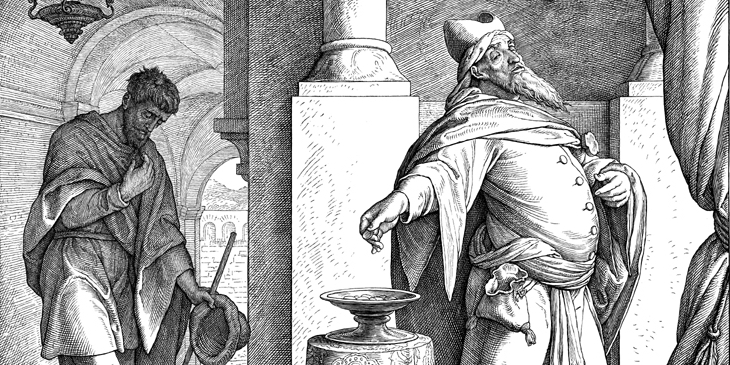
The Eleventh Sunday after Trinity – Pr. Faugstad sermon
Text: St. Luke 18:9-14
In Christ Jesus, who rewards us not because of what we have done, but because of what He has done, dear fellow redeemed:
The opening words of today’s reading state: “[Jesus] also told this parable to some who trusted in themselves that they were righteous, and treated others with contempt.” Is this parable really for you? Is it for me? Are we people who trust in our own righteousness? Do we treat others with contempt? We find the Pharisee and his praying to be offensive. We admire the humility of the tax collector. So do we really need to hear this parable today?
Let me change the characters a little, make it more personal, and see if it gives us a different angle to consider it. “Two people went up into the temple to pray, one of them was you and the other Jesus.” In that comparison, we know which one is the prideful and arrogant one, and which one is humble. We might not step out and boldly say the things the Pharisee did, but Jesus wants us to examine the pride we have in our hearts and minds.
We can hardly imagine saying the things publicly that the Pharisee said. But we certainly have thought them. We have looked around us at the extortioners, unjust, adulterers, and cheats and stood a little taller—“I’m glad I’m not like them!” On the other hand, we have counted up the good things we have done and thought we were in pretty good shape.
Our natural tendency according to our sinful flesh is to get the object of our love wrong. The Commandments direct us to love the Lord our God with all our being and to love our neighbor as ourselves. Our love should be focused outward, not inward. And yet, what motivates us is often what pleases us, what makes us feel good, what benefits us. That’s the attitude that puts us in the place of the Pharisee.
The Pharisee said the words, “God, I thank You,” but it’s obvious he was really thanking himself. His “prayer” does not read like a humble offering but as a prideful recounting of all the reasons God should be pleased with him. What do our lists look like? “God, I thank You that I’m not lazy and dishonest like my co-workers are—that I’m not mean like my classmates—that I’m so good to my family—that I do so many wonderful things for others.”
It is not the good works that are the problem, but where we think the credit belongs for those good works. Why are you a hard worker? Why are you nice? Why are you good to your family? Why have you done so many wonderful things for others? If you think it is because you are such a good person and better than most, then you are most certainly the Pharisee. But if you humbly confess that the good you do is not really from you but is a gift of God, then you are the tax collector.
Now the tax collector was undoubtedly sinful. Tax collectors had the reputation of charging more taxes than required. We get a sense of this from Zacchaeus, the chief tax collector whom Jesus spotted up in a sycamore tree. When Jesus went to Zacchaeus’ home for a meal, all the people grumbled that He had “gone in to be the guest of a man who is a sinner” (Luk. 19:7). But Zacchaeus’ heart had changed. He stood up and vowed to Jesus, “Behold, Lord, the half of my goods I give to the poor. And if I have defrauded anyone of anything, I restore it fourfold” (v. 8).
The tax collector in the temple was also troubled by his sins. He stood way off to the side. He didn’t want to draw any attention to himself. He kept his eyes downcast. It’s as though no one were there except him and God. He struck his chest and said, “God, be merciful to me, a sinner!” Notice what he did not do. He did not put on airs, as though he were too important to show any weakness. He did not point out the Pharisee’s pride or exchange words with him: “Oh yeah, well what about when you did this and this!” All he could see was his own sins and God’s faithfulness.
That is the model for humility and repentance that Jesus sets before us. But we never do this perfectly. I have mentioned before the lesson my classmates and I learned from a college professor, who asked if we thought we were more like the Pharisee or the tax collector in this parable. Of course, we identified with the tax collector. “If you think you are more like the tax collector,” he said, “you are probably the Pharisee.” Yes, we can be proud even of our humility.
Jesus says, “For everyone who exalts himself will be humbled, but the one who humbles himself will be exalted.” We are humbled not by our own doing, as though it were a good quality in us. We are humbled by the Holy Spirit working on us through the Law of God. We are humbled by being shown we are not as good as we want to think. We are humbled by having our self-focused love exposed. We need the Holy Spirit to continue to do this humbling work, because the old Adam in us always thinks he knows best. But that fruit is still rotten to the taste.
The second Adam never tasted that fruit. He never sinned. He humbled Himself completely, perfectly. The apostle Paul writes that God’s Son, Christ Jesus, “made himself nothing, taking the form of a servant, being born in the likeness of men. And being found in human form, he humbled himself by becoming obedient to the point of death, even death on a cross” (Phi. 2:7-8). Jesus humbled Himself all the way. He did not maintain any dignity or honor for Himself. He never put Himself first. He put Himself right in our place and accepted all our sins as His own. He was no sinner, but He appealed to His heavenly Father to consider Him the sinner.
And the Father did. “For our sake [God] made him to be sin who knew no sin” (2Co. 5:21). Jesus was cast outside the city, ridiculed by self-righteous men, and forsaken by God. There would be no mercy. He had to be the object of the Father’s wrath, so we sinners would not be. He had to make the payment, because we had nothing to offer. He had to atone for all sin with His holy blood.
His perfect humility, His perfect sacrifice, means that God no longer condemns us. Jesus did the work in our place that we could not do. He fulfilled God’s holy Law of love for us, and He cancelled the whole debt of our sins that we could never pay. Because of these works of Jesus, we are justified before God, pronounced righteous, declared innocent of any wrongdoing.
Comparing the results of Adam’s sin and Jesus’ righteousness, Paul declares, “Therefore, as one trespass led to condemnation for all men, so one act of righteousness leads to justification and life for all men. For as by the one man’s disobedience the many were made sinners, so by the one man’s obedience the many will be made righteous” (Rom. 5:18-19). What Adam did, Jesus undid. What Adam ruined, Jesus restored. You are just as guilty as Adam because of your sin, and you are just as righteous as Jesus because He credits His righteousness to you.
There is no need to boast in your own works like a Pharisee. Far better works are yours by faith in Jesus. Everything He obtained by His humble work, He shares with you. He even shares His glory with you. That glory is hidden now while the world seems to be king and the members of Christ’s Church seem so lowly and powerless. But that glory will be revealed when Jesus returns with a shout and the sound of a trumpet on the last day.
Then we who are justified by the grace of God will also be glorified. We who are humbled will be exalted. We walk in our Lord’s footsteps. We live the life He has laid out for us. We take up our cross and follow after Him. It may not be a life that seems very impressive. We may be looked down on as those whom no one would desire to be. Accusing fingers identifying our faults will be pointed our way.
We don’t have to play the world’s game, a game in which everyone loses. It is not for us to sling mud with the self-righteous Pharisees. We carry out our humble callings, off to the side, eyes looking down with compassion on our neighbors in need, always with a prayer for God’s mercy on our lips. He hears these prayers. He does have mercy on us. He sends us to our homes and to our work justified.
Knowing that we are right with God makes us joyful in our work and eager to serve. We don’t need to prove our worth to God, to others, or even to ourselves. Our worth is firmly established in God’s Son, who took on our flesh, suffered and died for us, so that we would have life and purpose and fulfillment in Him.
Let us pray: God, we thank You that though we are just like all others in our sin and have not lived the life of love You commanded, yet You have had mercy on us poor sinners. You have judged us righteous by faith in Your Son, who humbly gave Himself in our place and is now exalted above all things. To You alone be the glory.
Glory be to the Father and to the Son and to the Holy Ghost; as it was in the beginning, is now, and ever shall be, forevermore. Amen.
+ + +
(woodcut from “The Pharisee and the Tax Collector” by Julius Schnorr von Carolsfeld, 1794-1872)