
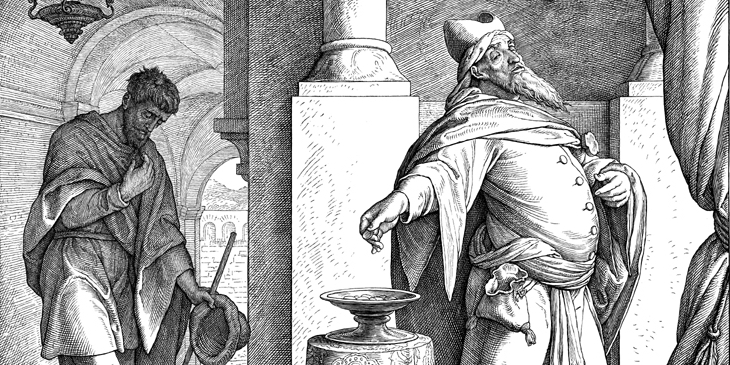
The Eleventh Sunday after Trinity – Pr. Faugstad sermon
Text: St. Luke 18:9-14
In Christ Jesus, who rewards us not because of what we have done, but because of what He has done, dear fellow redeemed:
The opening words of today’s reading state: “[Jesus] also told this parable to some who trusted in themselves that they were righteous, and treated others with contempt.” Is this parable really for you? Is it for me? Are we people who trust in our own righteousness? Do we treat others with contempt? We find the Pharisee and his praying to be offensive. We admire the humility of the tax collector. So do we really need to hear this parable today?
Let me change the characters a little, make it more personal, and see if it gives us a different angle to consider it. “Two people went up into the temple to pray, one of them was you and the other Jesus.” In that comparison, we know which one is the prideful and arrogant one, and which one is humble. We might not step out and boldly say the things the Pharisee did, but Jesus wants us to examine the pride we have in our hearts and minds.
We can hardly imagine saying the things publicly that the Pharisee said. But we certainly have thought them. We have looked around us at the extortioners, unjust, adulterers, and cheats and stood a little taller—“I’m glad I’m not like them!” On the other hand, we have counted up the good things we have done and thought we were in pretty good shape.
Our natural tendency according to our sinful flesh is to get the object of our love wrong. The Commandments direct us to love the Lord our God with all our being and to love our neighbor as ourselves. Our love should be focused outward, not inward. And yet, what motivates us is often what pleases us, what makes us feel good, what benefits us. That’s the attitude that puts us in the place of the Pharisee.
The Pharisee said the words, “God, I thank You,” but it’s obvious he was really thanking himself. His “prayer” does not read like a humble offering but as a prideful recounting of all the reasons God should be pleased with him. What do our lists look like? “God, I thank You that I’m not lazy and dishonest like my co-workers are—that I’m not mean like my classmates—that I’m so good to my family—that I do so many wonderful things for others.”
It is not the good works that are the problem, but where we think the credit belongs for those good works. Why are you a hard worker? Why are you nice? Why are you good to your family? Why have you done so many wonderful things for others? If you think it is because you are such a good person and better than most, then you are most certainly the Pharisee. But if you humbly confess that the good you do is not really from you but is a gift of God, then you are the tax collector.
Now the tax collector was undoubtedly sinful. Tax collectors had the reputation of charging more taxes than required. We get a sense of this from Zacchaeus, the chief tax collector whom Jesus spotted up in a sycamore tree. When Jesus went to Zacchaeus’ home for a meal, all the people grumbled that He had “gone in to be the guest of a man who is a sinner” (Luk. 19:7). But Zacchaeus’ heart had changed. He stood up and vowed to Jesus, “Behold, Lord, the half of my goods I give to the poor. And if I have defrauded anyone of anything, I restore it fourfold” (v. 8).
The tax collector in the temple was also troubled by his sins. He stood way off to the side. He didn’t want to draw any attention to himself. He kept his eyes downcast. It’s as though no one were there except him and God. He struck his chest and said, “God, be merciful to me, a sinner!” Notice what he did not do. He did not put on airs, as though he were too important to show any weakness. He did not point out the Pharisee’s pride or exchange words with him: “Oh yeah, well what about when you did this and this!” All he could see was his own sins and God’s faithfulness.
That is the model for humility and repentance that Jesus sets before us. But we never do this perfectly. I have mentioned before the lesson my classmates and I learned from a college professor, who asked if we thought we were more like the Pharisee or the tax collector in this parable. Of course, we identified with the tax collector. “If you think you are more like the tax collector,” he said, “you are probably the Pharisee.” Yes, we can be proud even of our humility.
Jesus says, “For everyone who exalts himself will be humbled, but the one who humbles himself will be exalted.” We are humbled not by our own doing, as though it were a good quality in us. We are humbled by the Holy Spirit working on us through the Law of God. We are humbled by being shown we are not as good as we want to think. We are humbled by having our self-focused love exposed. We need the Holy Spirit to continue to do this humbling work, because the old Adam in us always thinks he knows best. But that fruit is still rotten to the taste.
The second Adam never tasted that fruit. He never sinned. He humbled Himself completely, perfectly. The apostle Paul writes that God’s Son, Christ Jesus, “made himself nothing, taking the form of a servant, being born in the likeness of men. And being found in human form, he humbled himself by becoming obedient to the point of death, even death on a cross” (Phi. 2:7-8). Jesus humbled Himself all the way. He did not maintain any dignity or honor for Himself. He never put Himself first. He put Himself right in our place and accepted all our sins as His own. He was no sinner, but He appealed to His heavenly Father to consider Him the sinner.
And the Father did. “For our sake [God] made him to be sin who knew no sin” (2Co. 5:21). Jesus was cast outside the city, ridiculed by self-righteous men, and forsaken by God. There would be no mercy. He had to be the object of the Father’s wrath, so we sinners would not be. He had to make the payment, because we had nothing to offer. He had to atone for all sin with His holy blood.
His perfect humility, His perfect sacrifice, means that God no longer condemns us. Jesus did the work in our place that we could not do. He fulfilled God’s holy Law of love for us, and He cancelled the whole debt of our sins that we could never pay. Because of these works of Jesus, we are justified before God, pronounced righteous, declared innocent of any wrongdoing.
Comparing the results of Adam’s sin and Jesus’ righteousness, Paul declares, “Therefore, as one trespass led to condemnation for all men, so one act of righteousness leads to justification and life for all men. For as by the one man’s disobedience the many were made sinners, so by the one man’s obedience the many will be made righteous” (Rom. 5:18-19). What Adam did, Jesus undid. What Adam ruined, Jesus restored. You are just as guilty as Adam because of your sin, and you are just as righteous as Jesus because He credits His righteousness to you.
There is no need to boast in your own works like a Pharisee. Far better works are yours by faith in Jesus. Everything He obtained by His humble work, He shares with you. He even shares His glory with you. That glory is hidden now while the world seems to be king and the members of Christ’s Church seem so lowly and powerless. But that glory will be revealed when Jesus returns with a shout and the sound of a trumpet on the last day.
Then we who are justified by the grace of God will also be glorified. We who are humbled will be exalted. We walk in our Lord’s footsteps. We live the life He has laid out for us. We take up our cross and follow after Him. It may not be a life that seems very impressive. We may be looked down on as those whom no one would desire to be. Accusing fingers identifying our faults will be pointed our way.
We don’t have to play the world’s game, a game in which everyone loses. It is not for us to sling mud with the self-righteous Pharisees. We carry out our humble callings, off to the side, eyes looking down with compassion on our neighbors in need, always with a prayer for God’s mercy on our lips. He hears these prayers. He does have mercy on us. He sends us to our homes and to our work justified.
Knowing that we are right with God makes us joyful in our work and eager to serve. We don’t need to prove our worth to God, to others, or even to ourselves. Our worth is firmly established in God’s Son, who took on our flesh, suffered and died for us, so that we would have life and purpose and fulfillment in Him.
Let us pray: God, we thank You that though we are just like all others in our sin and have not lived the life of love You commanded, yet You have had mercy on us poor sinners. You have judged us righteous by faith in Your Son, who humbly gave Himself in our place and is now exalted above all things. To You alone be the glory.
Glory be to the Father and to the Son and to the Holy Ghost; as it was in the beginning, is now, and ever shall be, forevermore. Amen.
+ + +
(woodcut from “The Pharisee and the Tax Collector” by Julius Schnorr von Carolsfeld, 1794-1872)

The Sixth Sunday after Trinity – Pr. Faugstad sermon
Text: St. Matthew 5:20-26
In Christ Jesus, who came not to abolish the Law of God but to fulfill it for our righteousness, dear fellow redeemed:
The words of Jesus for today come from the early part of His “Sermon on the Mount.” In His Sermon on the Mount, Jesus describes what a righteous life before God looks like. A righteous life is a life that matches up with what God says in His Commandments. It is to be just, right with God, blameless. Two times in His sermon, Jesus tells us to desire such a life. He says, “Blessed are those who hunger and thirst for righteousness,” and “seek first the kingdom of God and his righteousness” (Mat. 5:6, 6:33).
In both of these passages, He describes a righteousness that is outside us. What we are to hunger and thirst for and seek first is God’s righteousness. That’s because our own personal righteousness is not enough. “For I tell you,” says Jesus, “unless your righteousness exceeds that of the scribes and Pharisees, you will never enter the kingdom of heaven.” The scribes and Pharisees were seen as the holiest people there were, and Jesus said their righteousness still fell short.
Then He illustrated the ways our righteousness falls short by explaining that the Commandments of God are about more than outward actions, outward conformity. You haven’t kept the Fifth Commandment simply by refraining from murder. Jesus explains that this Commandment is also broken in the mind and the heart when you hold grudges, when you have anger toward another, or when you insult someone. The Fifth Commandment, along with all of the other Commandments, is fulfilled by love. If you have anger or want revenge against others, you have no love for them.
But if you think right now about the people who have been mean to you, who have been unkind to you, who have hurt you, it is easy to justify the anger or even the hatred that you feel. You gave them the benefit of the doubt, but they abused your trust. You tried to be nice, but they only got worse. So you are going to treat them how they have treated you. You are going to give them what they deserve—and it isn’t love.
Imagine if Jesus took this approach. If Jesus took this approach, I would have no good word to share with you today, no comfort to impart. If Jesus treated us like we deserved, He would never have come down to make peace between us and God. He would never have suffered the wrath of man and of God and let Himself be nailed to the cross in our place. If Jesus treated us like we deserved, He would condemn us for our sins and send us to eternal suffering in hell.
But the Son of God did not become man to give us what we deserved. He came to show God’s mercy and grace toward the world of sinners. Look at what love and compassion He had for the sick and hurting! So many came to Him for healing, that He often went without meals and without sleep. And He did this fully knowing where this was all going, knowing the suffering and anguish that the collective sin of humanity would cause Him.
He loved perfectly. He didn’t work with an angle in mind. He didn’t serve with conditions. He constantly focused on the needs of His neighbors and how He could bless them. His life is what the righteous life that God requires looks like. It is not the way our lives look. But Jesus does not look down on us or flaunt His righteousness in front of us. He lived a life of perfect righteousness for us.
His righteous keeping of God’s Commandments counted for you. Because He is true God and true Man, whatever He did in the flesh was done on behalf of all people. This means that all who deny their own self-righteousness and trust in Him are credited with His righteousness. You will find no peace in running over and over again the wrongs done to you by others or in trying to convince yourself that you have a right to your bitterness and anger.
You will find peace in Jesus. He died for all sin—both your sin and the sin of those who have wronged you. His blood cleanses you of all of it (1Jo. 1:7). And His righteous life, His life of perfect love, covers you completely. You are a holy one by faith in Him. God is not angry with you for your many sins. He poured out His wrath against His Son, who fully atoned for all your sins. By faith in Him, your righteousness does exceed that of the scribes and Pharisees, because you have His righteousness. That means you will enter the kingdom of heaven.
Everything God required of you, He supplied you. There is nothing keeping you out of heaven. Eternal life is yours—this is most certainly true! But it is not time for heaven yet. As long as you are here, God has important work for you to do. It isn’t that He needs anything from you; after all, everything on earth is His, because He made all things. But the people around you do have needs, and God has called you to love and serve them. He calls you to share with others what you have received from Him.
This is where our identity as His “righteous ones” is tested. We are glad to hear that He forgives our sins and declares us righteous, but we find it difficult to treat other people how He treats us. We can be “good with God” but not so good with others. But look at how Jesus takes the beam of love we have toward God and trains it on our neighbors. He says, “if you are offering your gift at the altar—dedicating your prayers, thanksgivings, and offerings to God—and there remember that your brother has something against you, leave your gift there before the altar and go. First be reconciled to your brother, and then come and offer your gift.”
First things first, says Jesus. Do what you can to amend your wrong toward someone, so that you can offer your gifts to God with a cheerful heart and a clear conscience. Now there are some interpersonal issues that are difficult for us to fix. Someone might have something against us because they choose too and not because we are guilty of wronging them. These are people we show love and kindness to and pray for God to soften their hearts.
But here, Jesus is speaking about people that we have wronged by something we did to them, something we said to them, or some other way we caused offense. This applies to everyone whom we have hurt, and especially to our brothers—our fellow believers. It is always troubling and sad when there is a division within the family of faith, within the body of Christ.
But taking that first step toward reconciliation is a difficult one. As we said before, it is easy to justify the reasons we have treated others like we have. “They started it!” “What he did was worse than anything I ever did!” “I was only giving her what she gave to me!” Those responses are self-righteousness. What we are concerned about is Jesus-righteousness. We are willing to humble ourselves and serve and suffer just as He did for us.
Jesus is the prime example of how we are to interact with our neighbors. He never stopped loving, even when all He received was hatred. Think of His first words after being violently nailed to the cross, “Father, forgive them, for they know not what they do” (Luk. 23:34). But Jesus is far more than our example. He is our righteousness, our forgiveness, our power source for stepping outside what we want and stepping toward a neighbor in need.
All our neighbors have to deal with our sins, so we also want to deal out Jesus’ gifts to them. It is with Jesus’ love and sacrifice in mind that we can have courage and strength to say those three difficult words, “I am sorry.” And it is with His love and sacrifice in mind that we can respond to those who have hurt us with those other three difficult words, “I forgive you.”
“[B]e reconciled to your brother,” said Jesus, “and then come and offer your gift.” It may even happen, by the grace of God, that when you return to offer your gift, the brother with whom you had been at odds will be kneeling right beside you, offering his gift of praise and thanksgiving to God. This is what we are privileged to do each week as we receive Holy Communion. Husbands and wives who have hurt each other with unkind words come to receive Jesus’ powerful healing through His body and blood, given and shed for the remission of their sins. The same goes for parents and children who have been fighting, or for any others in the congregation whom Satan has tried to divide.
We all come forward, not trusting in our own righteousness, but humbly trusting in Jesus’ righteousness. We know how lacking our love for our neighbors has been, but we firmly believe that Jesus still forgives us and that He will strengthen us to do better. This is a beautiful pattern that repeats each week. We come weak and stained by our sin to the Divine Service, and Jesus meets us here to serve us and fill us up with His gifts.
Then He sends us back to our homes and jobs and activities with plenty of grace and forgiveness to share with others. If He never runs out of these gifts, then we won’t either, and we will continuously learn what a blessing it is to love as He has loved us.
Glory be to the Father and to the Son and to the Holy Ghost; as it was in the beginning, is now, and ever shall be, forevermore. Amen.
+ + +
(picture from “The Sermon on the Mount” by Rudolf Yelin the Older, 1912)

Maundy Thursday sermon – Vicar Cody Anderson
Text: St. John 13:1-15
In Christ Jesus, who continued to teach His disciples even hours before His death, who continues to teach and provides for you, dear fellow redeemed:
My mother has a sign in her house that says, “Dust is a country collectable.” As much as we try to keep our houses clean of that country collectable, we see that it doesn’t take much for our houses to continue to be dirty. Not only can our houses be dirty, but around here our cars can get dirty. When our houses, cars, and whatever else get dirty, then usually we must take the time to attempt to clean them. This is a chore that no one really wants to do and most of the time we wait until the last minute. In our text we see the humility of our Savior. Jesus takes time from the Passover meal to wash His disciples’ feet. This humble act shows how much He loved His disciples; it also shows how much He loves us. Jesus says, “I have washed you; you are clean!
Earlier in the week on Palm Sunday, Jesus’ rode into Jerusalem. He has done His teaching of the people in the temple. He has rested and now is with His disciples for one more gathering. Jesus instructed His disciples to have a room prepared so that they might eat the Passover meal. Now during the supper, Jesus does something that would have been out of the ordinary. He takes off His outer garment, wraps His waist with a towel, and then He begins to wash His disciple’s feet. A task that would have been done by a servant or a slave. As Jesus washes their feet, in our text He explains why He does it. This explanation is applied directly to us.
Jesus said to [Peter], “The one who has bathed does not need to wash, except for his feet, but is completely clean. Peter at first doesn’t want the Lord to wash him. He thinks that Jesus is degrading Himself. Jesus says if He doesn’t wash Peter’s feet then Peter can have no share with him. Jesus also points out that He knows and sees all. He says, “Not all of you are clean.” Judas currently has fallen into complete unbelief. He is only thinking about how he can betray Jesus. Jesus washed his feet and gave him bread. Jesus is giving him opportunities to come back but Judas does not take them. The devil then enters his heart. The Upper Room activity on this Maundy Thursday points out the actions of Peter and Judas and why we need to be washed. We need to be washed daily because of our sins. We have inherited our sin from our first parents. We must be washed clean because of our sins, but we are unable to do so on our own.
Jesus tells us that He wants to wash us clean. Like Peter, we can tell Jesus that we don’t want His washing. Most of the time the sins that we commit, we want to do it. Why would we want Jesus to wash something away that we enjoy doing? He wants to do it. He wants us clean. Most people want Jesus to only help them out on their terms.
There are many dangers when we stay persistent in our sins. Jesus warns us of this in the text. Peter said to him, “You shall never wash my feet.” Jesus answered him, “If I do not wash you, you have no share with me.” The biggest danger is that the devil comes into our heart, and we live in unbelief. The devil’s goal is to lead people astray. This unbelief happens because of our choices to give up on God. The devil wants that separation. This is not what Jesus wants but we can give up on Him.
Our text for today reveals the amount of Jesus’ love. “Now before the Feast of the Passover, when Jesus knew that his hour had come to depart out of this world to the Father, having loved his own who were in the world, he loved them to the end.” He loved His disciples to the end, and we know that He loves us until the end. As Jesus teaches the love that He has for us, we see how much love we lack at times. Jesus tells us to do for others as He has done for us. But we know how often we have failed to love as we should.
Jesus teaches and shows His disciples how they are to love each other. He washes their feet. This was the job of a servant, a slave. He washes their feet, but more importantly, He washes them completely with His blood. Jesus is bringing the gospel out with the washing of His disciple’s feet. Their sins are washed away by His power. The sins that they have committed to this point and the sins that they are going to commit. They are all washed away by Christ.
Jesus knows that He is going back to the Father. The plan is being carried out, Jesus’ great love for you. Jesus is not only washing His disciple’s feet clean, but He is also going to die for them. He told them earlier, “For even the Son of Man came not to be served but to serve, and to give his life as a ransom for many” (Mark 10:45). He loves you and He was willing to die for your sins. He knew His time on earth was up. He would have to go back to His Father. He also knew what it would take for Him to go back. Jesus knew that He would suffer and die. He did it for you. He became a servant and died for you.
Jesus’ death on the cross and resurrection saves you because He could serve you perfectly. He obeyed God the Father and He knew what kind of sacrifice was needed. Jesus doesn’t lead people astray; He is the way, the truth, and the life. He washes away the sins that are easy to quit, and the sins that are hard to shake. He cleanses you with His blood. You received these gifts from Christ through your baptism. You died and rose with Christ because of this washing. This washing stays with you. Jesus then gave the Lord’s Supper. He proclaims to you that you are forgiven by His body and blood.
Jesus invites you to often go to the Lord’s Supper. He taught it to you saying that it brings you forgiveness of sins, life, and salvation. You are clean by faith in Him, but you will continually sin. Jesus tells you to eat and drink often in remembrance of Him. This is your medicine here on earth. He brings you comfort and strength for the days ahead.
As the sacrament provides us with comfort and strength, it also is Jesus’ last will and testament. By Christians taking the sacrament, we are proclaiming Jesus’ death and resurrection until He comes again. Knowing that our sins are forgiven, it doesn’t mean that we are perfect. We will still give in to sin. It is the Holy Spirit who works faith in our hearts to receive His forgiveness and the Holy Spirit creates fruits of faith. It is through the Holy Spirit that we serve others with a good heart, having their best interests in mind.
As you keep your Savior in front of you, knowing what He has done for you, He teaches you love for one another. “If I then, your Lord and Teacher, have washed your feet, you also ought to wash one another’s feet. For I have given you an example, that you also should do just as I have done to you.” Who would have thought we could learn so much from a simple washing of feet? This is great humility that came with a price. Jesus gave His life as a ransom for many. That is the undeserved love that you receive. Jesus also gave you His medicine to remind you about this foot washing, and to give you the strength to make it through the week. His Supper is a gift that He wants you to receive often. It shows you that even those who are clean by faith continually need to be cleansed. You will give in to sin. But the Lord’s Supper gives you forgiveness. You take it for your comfort and strength. Through it you pronounce the Lord’s death and resurrection until He comes again. Amen.
Glory be to the Father and to the Son and to the Holy Ghost; as it was in the beginning, is now, and ever shall be, forevermore. Amen.
+ + +
(picture from painting by Giotto di Bondone, c. 1267-1337)