
The Seventh Sunday after Trinity – Pr. Faugstad sermon
Text: St. Mark 8:1-9
In Christ Jesus, who commands us to pray and has promised to hear us, dear fellow redeemed:
As long as someone says the right words, does it really matter how they say it? For instance, a child’s eyes are glued to the TV or smartphone. His parent asks him a question. No response. “Did you hear what I just said?” The child says, “Yes, I’m listening!” An unmotivated employee is asked if a job is finished yet. “I’ll get it done,” she says. A person gets caught in a lie, and only when the evidence against him is overwhelming does he force out the words, “I’m sorry.” They all said the right thing, but it is difficult to trust what they say.
We call these “empty words,” words that have no support or strength behind them. You don’t come to church to hear empty words. You come to hear God’s Word. His Word has authority. You know that He means what He says because He does exactly what He says. He does not just tell us what we want to hear—often He tells us the opposite but always for our own good.
It is precisely because Jesus meant what He said that crowds followed Him all over the countryside. At the very beginning of His public work, the Jews noticed this difference about Him. The evangelist Mark writes that “they were astonished at his teaching, for he taught them as one who had authority, and not as the scribes” (1:22). This was still the case toward the end of His public work, when it is recorded that “all the people were hanging on his words” (Luk. 19:48).
Because of His clear and comforting teaching, we are told in today’s reading that a great crowd followed Jesus out to a desolate place along the Sea of Galilee. They must not have planned to follow Him so long or so far. Three days passed, and they had not brought along the provisions they needed. Jesus perceived the problem: “I have compassion on the crowd, because they have been with Me now three days and have nothing to eat. And if I send them away hungry to their homes, they will faint on the way. And some of them have come from far away.”
These people are a wonderful example for us. They prioritized spiritual nourishment over physical nourishment. Filling their bellies was not the first thing on their minds. They were living as God had taught His Old Testament people to live as they journeyed toward the promised land. At that time, God made manna appear on the ground each day to feed them and to teach them “that man does not live by bread alone, but man lives by every word that comes from the mouth of the LORD” (Deu. 8:3).
Keeping the Word of God first in our lives is the definition of faithfulness toward Him. Jesus said, “seek first the kingdom of God and his righteousness, and all these things—all that you need for this body and life—will be added to you” (Mat. 6:33). But the devil and the world also exert a powerful influence over us. The world sends the message that you don’t have enough of what you need for this life, and you never really can have enough. The world wants you to worry about what could happen in the future: “You better take action now, or you’ll be sorry later.” That mentality produces nothing but anxious, selfish, greedy people.
Now certainly it is good to plan for the future. It is good to think ahead and give some thought to how we can save some of today’s money for future blessings. But if our plans only account for ourselves and maybe our immediate family members, then we are not using the gifts of God as He intended them to be used. What about the needs of our neighbors? What about supporting the preaching of the Gospel and promoting this work around the world? This is what you are praying for when you say in the Lord’s Prayer, “Thy kingdom come; Thy will be done.” Or are those just empty words?
What about when you pray, “Give us this day our daily bread”? What do these words mean? By praying these words, we are acknowledging that God gives our daily bread, which includes everything needed for this life every single day. We pray that He continues to remind us of this, so that we “receive our daily bread with thanksgiving” (Luther’s Explanation to the Fourth Petition).
It is good to say the Lord’s Prayer every day, and I assume that many of you do. But with something so familiar, we can often say it without really thinking about it. As we pray, “Give us this day our daily bread,” do we recognize that there is no daily bread—no food, drink, clothing, shoes, house, home, fields, cattle, money, goods, God-fearing spouse and children, and so on—none of those blessings apart from the grace and mercy of God?
Do we recognize this when we look at our beautiful fields and gardens? The corn is already tasseling, the beans look great, everything is green and healthy. It is God who sends the rain, God who sends the sunlight, God who sends the heat. All of it is a gift from Him. Jesus made it abundantly clear who provides food by taking a small amount of food in His hands, seven loaves of bread from the fields and a few small fish from the sea. From those goods of God’s creation, Jesus produced food in the wilderness for four thousand men and a sizeable number of women and children besides. He made so much from so little, that seven baskets full were collected after everyone had eaten.
The people had no need to worry since Jesus was with them. Neither do we. Jesus has compassion on us too and is with us. In the children’s hymn, we sing that He “Knows my need and well provides me, / Loves me ev’ry day the same, / Even calls me by my name” (Evangelical Lutheran Hymnary #177, v. 1). By the growth of plants each season, He provides food for the whole creation. He gives clean water for us to drink and ample oxygen for us to breathe. Where we live at this point in history, we don’t have to worry about where our next meal will come from since He gives so much in abundance.
The older you are, the more you can see how the Lord has provided for you. You may not have always had a lot. You may have had some anxious days and months and years. But He gave you what you needed to keep going forward. Psalm 37:25 says, “I have been young, and now am old, yet I have not seen the righteous forsaken or his children begging for bread.” So with the knowledge of His goodness toward us in the past, why do we keep worrying about tomorrow?
We worry because we don’t want to entrust ourselves, our life, and our future completely to His hands. When times get difficult, prayer in Jesus’ name is not usually the first thing we think of doing. We work harder, try a different angle, and exhaust all other options. Then if everything else fails, we fall to our knees and pray. Even then, we might pray with such doubt and weakness of faith that anyone listening could wonder if we really mean what we pray.
But our heavenly Father is still patient and loving toward us. Even when we have put our confidence and trust in ourselves instead of Him, and even when we forget His mercy in the good times or His promises in the bad times, He still looks with compassion on us. He wants to hear our prayers. We are His weak children, but we are His children. He does not grow tired of us or turn His back on us.
Out of love for us because He knows what is best for us, He might let us experience hunger or some other kind of want, pain, or illness. He might give us suffering and trial. This is not to harm us; it is to strengthen us, to purify our weak faith, so that it becomes firmer and more resilient. When the crowds of people felt hunger, Jesus was there to give them the food they needed. They recognized their own weakness and their inability to provide for themselves, which made His mercy toward them all the clearer.
All of the trials and triumphs He sends you, all of the burdens and blessings, are meant to prepare you for something more than this life. The One who saves your body by providing for you each day has also saved your soul. God the Father addressed your greatest hunger, your greatest need, by sending His Son to redeem you. Providing for the four thousand in the wilderness was one of countless miracles that showed He was God incarnate, the One promised since the fall into sin.
Jesus came because God’s promise to Adam and Eve and all sinners was not an empty word. Jesus perfectly fulfilled the will of His Father where you often exhibit doubt and unfaithfulness. He came to give Himself in your place, suffering all, even the torments of hell on the cross, so you would not be lost eternally. That’s how much He loves you, how much compassion He has toward you. Just as the people received the bread and fish in abundance, we have abundantly received the gifts of His grace, so that every sin is covered over, every sin is forgiven.
That is what it means to pray “in Jesus’ name.” It is having the Father’s ear open to us because we have been joined to His Son by faith. We are cleansed by His blood and covered in His righteousness. When we pray, He hears His beloved Son praying. When we ask, He hears His beloved Son asking. Even when we pray by ourselves, we say “Our Father” because Jesus is always praying along with us and sanctifying our prayers.
This gives us every confidence that when we pray, whether for physical or spiritual needs, the Lord hears us and will help us at the right time and in the right way. He is not moved by empty words, as if simply saying the right thing is good enough for Him. He wants you to pray in faith, trusting that He will help and save. That is what He has promised to do for you, His dear child, and He means exactly what He says.
Glory be to the Father and to the Son and to the Holy Ghost; as it was in the beginning, is now, and ever shall be, forevermore. Amen.
+ + +
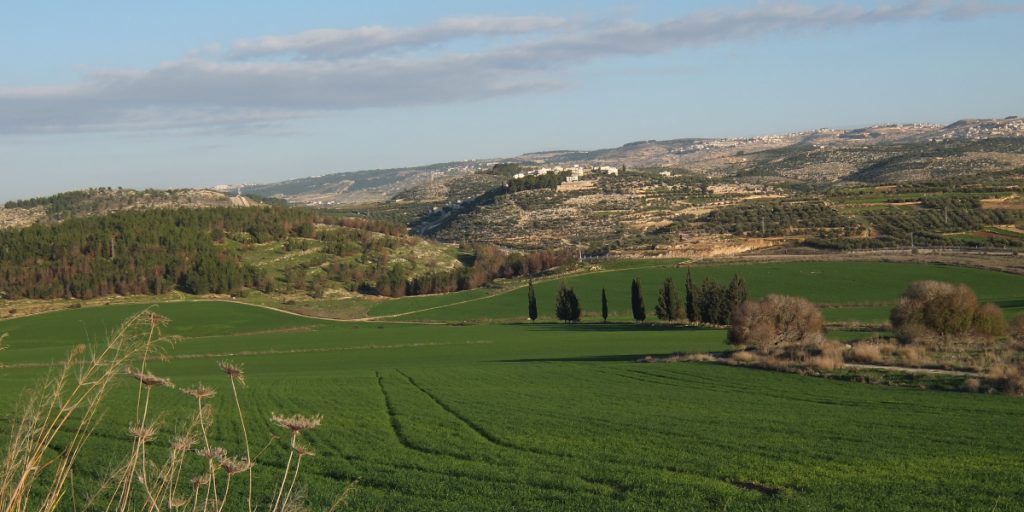
(picture of the Judean mountains in Israel)


Copyright 2020 © Saude, Jerico, & Redeemer Lutherans. All rights reserved.