
The Tenth Sunday after Trinity – Pr. Faugstad sermon
Text: St. Luke 19:41-48
In Christ Jesus, the stone that the builders rejected who has become the cornerstone of His holy Church, in which we hear and are comforted by His Word of peace, dear fellow redeemed:
The word “Jerusalem” has peace in its name. “Salem” means “peace.” The whole name is understood to mean “foundation of peace” or “city of peace.” It is a strange name for a city that in our day has often been a place of conflict and war. The same was true for it in ancient days. Jerusalem sits in the center of a corridor that runs along the Mediterranean Sea. It is built on a high hill that in Abraham’s time was known as “Mount Moriah” and in later times was called “Mount Zion.”
When Joshua led the people of Israel into the promised land of Canaan, they conquered much of the land. But they were unable to take Jerusalem (Jos. 15:63). That city did not fall until some four hundred years later when David and his soldiers overcame it (2Sa. 5:6-7). From that point on, it was known as “the city of David,” and it became the capital city of the kingdom of Israel. This was solidified when David’s son Solomon built a grand temple to the LORD in Jerusalem, where all the people of the kingdom came to worship.
But as the generations passed, the people of Israel did not remain faithful to the LORD. They instead worshipped the gods of the people around them. So God allowed enemies to invade the land to humble His people and lead them to repentance. In 586 B. C., the Babylonians broke through the city walls of Jerusalem, the grand temple of Solomon was destroyed, and most of the people who were not killed were taken into exile. They learned a hard lesson that just having the beautiful temple of the LORD and offering the prescribed sacrifices were not enough to save the city. God was not looking for outward acts of devotion; He was looking for faith in their hearts.
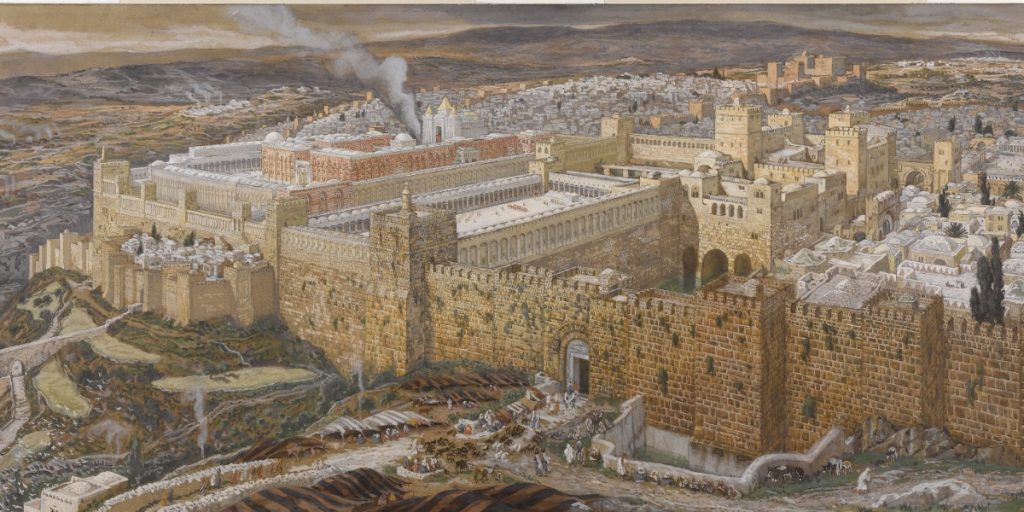
But God did not turn His back on His chosen people; He had mercy on them. He promised to bring them back to Jerusalem, and He did. A faithful remnant returned and rebuilt the temple, though not on the scale that it had been built before. This temple was enlarged and improved during the reign of Herod the Great, and this was the temple that Jesus saw in the center of the city as He looked upon Jerusalem and wept. He cried out, “Would that you, even you, had known on this day the things that make for peace!”
It was no city of peace now, since it did not even recognize the Prince of Peace. Isaiah had clearly prophesied His coming some 700 years before: “For to us a child is born, to us a son is given; and the government shall be upon his shoulder, and his name shall be called Wonderful Counselor, Mighty God, Everlasting Father, Prince of Peace” (9:6). Isaiah described His forthcoming reign in this way: “Of the increase of his government and of peace there will be no end, on the throne of David and over his kingdom, to establish it and to uphold it with justice and with righteousness from this time forth and forevermore. The zeal of the LORD of hosts will do this” (v. 7).
Didn’t the chief priests and the scribes know their Scriptures? Weren’t they looking for the promised Messiah, the Prince of Peace? No, they were blinded by their own pride and their thirst for power. Things were going okay for them. They were able to maintain an uneasy existence under Roman rule and practice their religion as they saw fit. They didn’t need Jesus coming in and messing this up for them. So they “were seeking to destroy Him.” They weren’t looking for peace at all; they wanted Jesus’ blood.
Little did they know that Jesus had every intention of giving it to them, freely. This was why He came, to pour out His holy, precious blood in payment for the sins of all. The apostle Paul writes that through Him, God in the flesh, He “reconcile[d] to himself all things, whether on earth or in heaven, making peace by the blood of his cross” (Col. 1:20).
The people in Jerusalem might have been looking for Jesus to become their earthly king when they welcomed Him with shouts of: “Blessed is the King who comes in the name of the Lord! Peace in heaven and glory in the highest!” (Luk. 19:38). They got something even better. He came to establish His rule over an everlasting kingdom, not a temporary earthly one. He came to make peace between God and mankind, so that redeemed sinners could live with Him in glory forever.
But the Jewish leaders opposing Him were not interested in His words or His work. Like the Israelites six centuries earlier, they thought their well-fortified city and their beautiful temple would never fall again. Jesus said otherwise. He warned the people that enemies would come in the future, lay siege to the city, and utterly destroy it.
It was a chilling prophecy, and it came true. The reason this Gospel reading is selected for this time of the year is because the walls of Jerusalem were breeched by Roman armies, and the temple was destroyed in August of the year A. D. 70, some forty years after Jesus’ death and resurrection. The historian Josephus recorded these events, and the suffering during the siege and the slaughter that followed are horrible to read about. The people did not know “the things that make for peace.” They did not know “the time of [their] visitation.” They did not believe in Jesus, and therefore they had no peace.
But not everyone ignored His word. When Jesus predicted the destruction of Jerusalem, His disciples took notice. Those few decades later when the Romans were on the march toward Jerusalem, the Christians living within the city got out. They ran for the hills as fast as they could. They did not believe Jerusalem was invincible. They did believe Jesus’ word.
Would we have done the same? What do we trust in today that is not the word and promise of Jesus? Is it our system of government that we place our confidence in or certain elected officials? Is it our savings and investment accounts? Is it our own strength and skills? Whatever we fear, love, and trust instead of God is an idol, an object of our worship that cannot save us.
Nothing should have priority in our lives above the word of Jesus. Nothing. There is no peace with God apart from Jesus. And there is no way to receive this peace of God apart from His Word. Notice how differently Jesus’ words were received by the chief priests, scribes, and big-whigs of the city as opposed to the crowds gathered around Jesus. Those leaders wanted to destroy Him, while “all the people were hanging on His words.”
The same tension and division are present today. Some hate Jesus and His Word and oppose the work of His Church, while others humbly and gladly hear His Word and desire to live according to it. We do not want to make peace with these enemies of the Church by compromising or watering down the teachings of the Bible. We seek peace with the enemies of Jesus by speaking to them His saving Word. His Word changes hearts. It cleanses hearts from all the sinful thoughts and plans that fill them, like Jesus clearing the ungodly buyers and sellers from the temple so it could again be a house of holy prayer.
The Prince of Peace Speaks Words of Peace into your heart, peace for all the ways you have pursued what is not peaceful or good. Have you, for example, been part of a conflict with family or at work, and your stubbornness and pride have made things worse? Jesus says, “I shed My blood to wash away that sin.” Is your heart full of anger and hatred? “I love you with an everlasting love,” says Jesus. Have you resolved to get revenge against someone who hurt you? “I suffered every injustice in your place,” says Jesus. Are you wracked with guilt for past sins and misdeeds? “I forgive you,” says Jesus, “all your sins.” Are you lonely, grieving, full of uncertainty, hanging on by your fingertips? “Come to Me,” says Jesus, “and I will give you rest.”
Jesus did exactly what He came to do. He came to bring peace to this world of sin and to our hearts of sin. He won that peace with God by His innocent life, His suffering, and death on the cross just outside the walls of Jerusalem. You don’t receive that peace by going where His death and resurrection took place and trying to feel a connection to Him there. There is no place in the world that can promise you peace.
There are many today who believe that if only we could rebuild the temple to the LORD in Jerusalem, then Jesus would return to usher in an eternal era of peace on earth. But we put no such confidence in a place. We don’t need to look for peace in Jerusalem, in Rome, in Mecca, in Salt Lake City, or anywhere else in the world.
We know where to find peace, or rather how to find peace. Peace is found wherever the Prince of Peace is graciously present. Peace is found in His holy Word. Peace is found in His holy Sacraments. Through these means, God the Holy Spirit plants and pours peace into your heart. He brings you this peace through Jesus wherever you may be—in church, in your home, at work, on the road—wherever His Words of Peace are spoken, heard, or remembered.
By His grace, you do know “the things that make for peace.” You know “the time of your visitation.” It is through the presence of the Prince of Peace today and every day. Now the peace of God, which passes all understanding, keep your hearts and minds in Christ Jesus unto everlasting life. Amen.
+ + +
(picture from “Reconstruction of Jerusalem and the Temple of Herod” by James Tissot, 1836-1902)


Copyright 2020 © Saude, Jerico, & Redeemer Lutherans. All rights reserved.