
The Eleventh Sunday after Trinity – Pr. Faugstad sermon
Text: St. Luke 18:9-14
In Christ Jesus, who came to exchange His perfect, righteous life with our lives of unholiness and sin, dear fellow redeemed:
One of the most difficult things for us humans to do is admit we are sinful. When people are confronted about something hurtful they did or said or for a mistake they made, they are quick to defend themselves. They will try to explain away the wrong and make excuses for it. If that fails, it is common for them to appeal to their general goodness: “I am not a bad person,” they say. “I’m a good person!”
What exactly does a “good person” look like, if we had to describe one? We might say that a good person is someone who does not commit any major crimes or harm other people. A good person is responsible, self-controlled, and charitable with what he has. A good person has a good reputation in the community and is looked up to by others.
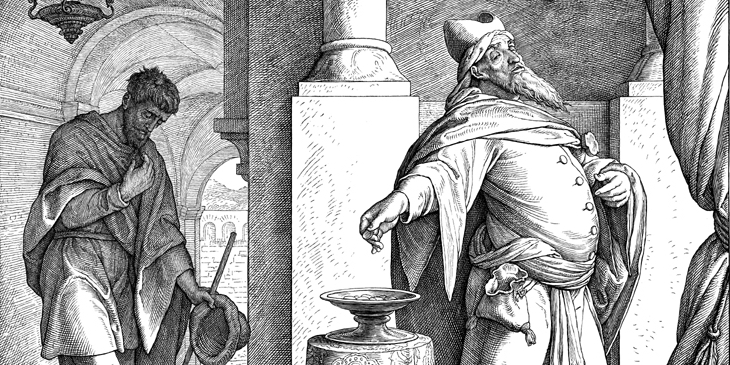
With this definition, we could say that the Pharisee in today’s parable was certainly a good person. He was a church-goer, who often went to the temple to pray. He fasted twice a week, which was far above and beyond God’s requirement that the Jews fast once a year on the Day of Atonement. He gave a tithe or a tenth of all that he received in his offerings to God. Besides that, he lived a morally upright life: he did no bodily harm to his neighbor, he was faithful to his wife, and he didn’t steal. He was the kind of guy we would like to have for a neighbor.
That is why it is surprising when Jesus says, “This man was not right before God. This man was not a good person.” The one who went home justified—righteous before God—was the tax collector. Tax collectors at that time did not have a good reputation. They had the reputation of charging the Jewish people more than they were required to, and they had the full authority of Rome behind them. If you refused to pay what the tax collector said, you could take your complaint to the Roman authorities who weren’t known for their mercy and understanding.
The Pharisee lumped the tax collector in with the extortioners, the unjust, and the adulterers. No one trusted the tax collectors. No one wanted a tax collector for a neighbor. No one would have said that a tax collector was good. Except for Jesus. But the tax collector in the parable was not good because he was a tax collector. He was counted as good only when he recognized how bad he was.
This is how it works in God’s kingdom. Everything gets turned upside down. The good are counted as bad, and the bad good. The righteous are counted as sinners, and the sinners righteous. The strong are counted as weak, and the weak strong. What impresses us does not impress God. “For the LORD sees not as man sees: man looks on the outward appearance, but the LORD looks on the heart” (1Sa. 16:7).
The problem is when we act like outward appearance is what matters most. If outward appearance is what matters most, then we can always find others who are worse than we are. It is not hard to find people who despise God, who take His name in vain, who never go to church, who lie, cheat, and steal, who commit sexual sin, who say offensive things, who pursue all sorts of wickedness. We hear reports about the lifestyle choices people make and the sins they commit, and we think to ourselves, “I would never do that. That is so wrong.”
It is certainly true that we should stay away from those sins. We should be on the lookout for temptations. We should want to honor God by what we say, think, and do. We should try to do what is good and right. But if we think those efforts are what set us apart before God and are the reason we are right with Him, then we are like the Pharisee looking down on everyone else and patting himself on the back for how good he is.
It is clearly the work of the devil to get us to think that we are not as bad as we really are. That is why everyone’s default position is: “I’m a good person.” If we are all naturally good people, then we don’t need Jesus to save us. We don’t need Him to pay for our sins because there really aren’t that many. The devil wants us to be self-reliant instead of trusting in the work of Jesus. He wants us to be self-righteous instead of trusting in the righteousness of Jesus.
The only way to break free from the devil’s grip is to see ourselves as we really are. The only way to know how we really are is to listen to what God says about us. Romans 3 says, “None is righteous, no, not one…. [N]o one does good, not even one…. For by works of the law no human being will be justified in his sight…. [F]or all have sinned and fall short of the glory of God” (vv. 10, 12, 20, 23). The devil wants us to think we are almost perfect, and everyone should be more like us. God says we are dead in our sins by nature and deserve nothing but punishment in hell for having sinned against Him.
Perhaps you have not behaved “like other men, extortioners, unjust, adulterers,” or like a greedy tax collector. But in your heart, have you wanted what they had? Perhaps you “fast twice a week,” or refrain from other pleasures in life. But do you do it as a humble offering to God or as a show of superiority over others? Perhaps you “give tithes of all that [you] get”—a good practice in stewardship. But do you do it out of devotion to God or to be seen by others?
As we examine our actions, words, and thoughts, we find that none of them are completely pure. All of them are tainted by our desire to have something different than what we have or to have more. We are never content with the good gifts of God. If He gives us what we want, we grow tired of it. If He gives us honor and success in the world, we act like we deserve it and take pride in it. If He doubles our blessings, we expect to see them doubled again.
The harsh truth of God’s Law is that no one is a good person. No one has lived the way God wanted. No one has done what He commanded. It’s not as though we are almost there; in fact, we’re not even close. The tax collector saw himself for what he really was. The Law had done its work on him. When he went up into the temple, it was not to keep up appearances. It was because he was crushed beneath the weight of his sin and guilt. The load was too heavy. He knew he could never make up for what he had done wrong.
So he found a dark, quiet corner, bowed his head, and beat his breast, saying, “God, be merciful to me, a sinner!” Why should God be merciful? Why might the tax collector ask for this or even hope for it? Was it because his repentance was sincere enough or his humility low enough? No, there was nothing the tax collector could do to make God be merciful. None of us earns God’s mercy by our repentance, our humility, or our faith.
God is merciful toward us because that’s how He is. He is “The LORD, the LORD, a God merciful and gracious, slow to anger, and abounding in steadfast love and faithfulness” (Exo. 34:6). The LORD God is full of mercy toward us. We can’t understand this because we are not like this. But it is true. The Triune God loves you and me. He wants us to believe in Him and be saved. He wants to forgive us all our sins and bring us to be with Him in heaven. He wants to declare us sinners righteous.
And because of what Jesus did for us, that is what He does. Jesus was the only truly good person who ever walked the earth. He perfectly obeyed the Commandments of God. He loved God and every single one of His neighbors without hesitation or failure. Because He lived that life while wearing our human flesh, all His perfect, holy works count for you. His generosity covers over your greed. His kindness covers over your judgmental attitude. His humility covers over your pride. His sacrifice covers over your selfishness. All that God’s holy Law required of you, Jesus fulfilled for you and supplies to you.
Besides keeping the Law for you, that holy, righteous Man also willingly accepted the punishment for all your sin. He took the blame. He took the beating. He took the eternal wrath of God and the fires of hell. He paid the price for your redemption, so that you will not have to answer for your many sins on the last day, and you will not fall short of the glory of God. You will not have to make the case for why God should let you into heaven. Jesus already made the case with His holy, precious blood and declares the work on your behalf “finished!” (Joh. 19:30).
We don’t come to church each week trying to prove why God should look favorably upon us, recounting to Him all the good things we have accomplished. We repent of the Pharisaical, self-righteous attitude that resides in each of our hearts. We come before God with these words, “I Am Sinful and Unclean. I am lost if You do not find me. I am dead if You do not breathe life into me. I am damned if You do not save me. God, be merciful to me, a sinner!”
He responds with His gracious words of forgiveness, with the blessing of His promises, with the holy food of His righteousness and life freely given to you at His holy table. And then like that tax collector, you go back to your home unburdened, cleansed, strengthened, justified—declared good and right with God because He is good to you, and His mercy toward you endures forever.
Glory be to the Father and to the Son and to the Holy Ghost; as it was in the beginning, is now, and ever shall be, forevermore. Amen.
+ + +
(picture from “The Parable of the Pharisee and the Tax Collector” by Julius Schnorr von Carolsfeld, 1794-1872)


Copyright 2020 © Saude, Jerico, & Redeemer Lutherans. All rights reserved.