

The Festival of the Resurrection of Our Lord – Pr. Faugstad exordium & sermon
Festival exordium:
Christ is risen! He is risen indeed! Alleluia! That was not the disciples’ reaction on Easter Sunday. “Christ is risen!” said the angel (Mar. 16:6). “Christ is risen!” said the women (Luk. 24:9). “Christ is risen!” said the Emmaus disciples (Mar. 16:13; Luk. 24:34). But this shocking message, this wonderful news, was met with questions and doubt. “Is Christ risen?” they wondered. “We won’t believe it until we see it with our own eyes.”
We know the truth that Jesus certainly died and certainly rose again on the third day. We know it, because the disciples did see Jesus after His resurrection, and they reported exactly what they saw and heard from Him. His resurrection is a fact. Christ is risen indeed!
But where our doubt comes in is here: “Is Christ risen for me? How can I be sure? How can I know that when I die, I will rise again? Or that my loved ones will rise again?” We can understand the disciples’ doubts—when had anyone ever risen from the dead? Our doubts seem reasonable too—when have we ever seen someone rise from the dead? But experience only goes so far.
The two disciples walking on the road to Emmaus on Easter afternoon were experiencing sadness. Jesus joined them on the road, but they didn’t know it was Him. They told Him everything they had witnessed and heard over the last few days, including the report of Jesus’ resurrection.
And Jesus said to them, “O foolish ones, and slow of heart to believe all that the prophets have spoken! Was it not necessary that the Christ should suffer these things and enter into his glory?” (Luk. 24:25-26). Then what did He do? “[B]eginning with Moses and all the Prophets, he interpreted to them in all the Scriptures the things concerning himself” (v. 27).
We may not have seen anyone rise from the dead. But we do have the Scriptures, God’s own Word. Jesus’ life and works match perfectly with all the Old Testament prophecies about the Messiah. And everything that He told His disciples would happen during Holy Week, including His resurrection on the third day, did happen exactly as He predicted.
So we do not need to doubt His promise to return on the last day to raise up the dead, or His promise that He has gone to prepare a place for all believers in heaven, or His promise to be present with us now through His Word and Sacraments to strengthen our faith. His resurrection verifies that what He promises, He does.
We rejoice in these promises by rising to sing hymn #348, “He Is Arisen! Glorious Word!”
He is arisen! Glorious Word!
Now reconciled is God, my Lord;
The gates of heaven are open.
My Jesus died triumphantly,
And Satan’s arrows broken lie,
Destroyed hell’s direst weapon.
O hear
What cheer!
Christ victorious
Riseth glorious,
Life He giveth—
He was dead, but see, He liveth!
+ + +
Sermon text: 1 Corinthians 5:6-8
In Christ Jesus, through whom you are a new creation, a new lump, filled no longer with the leaven of sin, but with the sincerity and truth that come from Him alone, dear fellow redeemed:
God sent nine terrible plagues on Egypt, but still Pharaoh would not let the enslaved people of Israel go into the wilderness to offer sacrifices to the LORD. God promised to send one more plague, after which Pharaoh would let the people go. In preparation for this plague, the LORD instructed each Israelite household to take a male lamb without blemish and kill it at twilight. Then they were to put the blood of the lamb on their doorposts and eat the flesh of the lamb roasted over fire.
They were also instructed to eat unleavened bread. All leaven had to be removed from their houses, and they would eat unleavened bread for seven days. The penalty for eating leavened bread during this time was severe. The LORD said, “if anyone eats what is leavened, from the first day until the seventh day, that person shall be cut off from Israel” (Exo. 12:15). He repeated the same warning a few verses later that anyone who disobeyed “will be cut off from the congregation of Israel” (v. 19).
In today’s Epistle lesson, the apostle Paul draws on this account of the Passover. He tells the Christian congregation in Corinth to “cleanse out the old leaven.” But he is not talking about their bread. He is talking about the congregation. The Christians there were puffed up. They were boasting, puffed up with pride, and they were not boasting about what their Savior Jesus had done for them. They were boasting about their open-mindedness and their willingness to tolerate what was clearly sinful. In this case, they were boasting about a clear violation of the Sixth Commandment—one of the members of the congregation living in open sin.
This is the kind of approach that is cheered by our culture today. The churches that are willing to compromise the Word of God, change their teachings with the times, and stop calling out sin are praised. These churches probably don’t say much about the Ten Commandments anymore, or they might explain them in such a way that no one in the congregation is really challenged or convicted by them. “Oh, the Ten Commandments are for the bad people,” they say, “and for the people who just want to judge others. But we are doing just fine.”
Paul writes, “Your boasting is not good. Do you not know that a little leaven leavens the whole lump?” Then he tells us what that leaven is, it is “the old leaven, the leaven of malice and evil.” It is the sin that characterized us before we became unleavened, before we were born again in Christ through Holy Baptism. It is the sin that Jesus died to free us from, we who were formerly enslaved to sin and death.
We are freed from this sin, because “Christ, our Passover Lamb, has been sacrificed.” Here, God’s stunning plan of salvation becomes clear, a plan that was illustrated by the Passover lamb. Right after Jesus’ public revealing as the Messiah at His Baptism, John pointed to Him and said, “Behold, the Lamb of God, who takes away the sin of the world!” (Joh. 1:29). He could take the world’s sin, because He had no sin of His own to carry. He was “a lamb without blemish or spot” (1Pe. 1:19).
The blood of this spotless Lamb was poured out for you on Good Friday just before the Passover was celebrated in Jerusalem. This holy blood cleanses you from all sin (1Jo. 1:7). We just sang a verse about this in Martin Luther’s great Easter hymn: “Here the true Paschal Lamb we see, / Whom God so freely gave us; / He died on the accursed tree— / So strong His love— to save us. / See, His blood doth mark our door [the door of our heart!]; / Faith points to it [to His blood], death passes o’er, / And Satan cannot harm us. / Alleluia!” (Evangelical Lutheran Hymnary #343, v. 5).
Jesus’ resurrection on the third day is the irrefutable proof that all sin was atoned for by His sacrifice. Now is the time to “celebrate the festival,” writes Paul. Now is the time to celebrate the Lamb’s victory. Now is the time to celebrate the forgiveness of sins. Now is the time to celebrate the eternal life that is ours because Jesus rose triumphant over death.
But how are we to “celebrate the festival”? Today’s reading says, “not with the old leaven, the leaven of malice and evil”—not by returning to the sin that Jesus has freed us from, not by confirming others in their sin and boasting about how charitable and accommodating we are of them. Remember that the Israelites were told to get rid of every trace of leaven from their homes. In the same way, we are called to get rid of every trace of sin in our own hearts and to recognize that our sins not only affect us—they affect the congregation to which we belong and the whole body of Christ. “A little leaven” in just one area of a batch of dough “leavens the whole lump.”
The way we “cleanse out the old leaven,” both individually and as a congregation is through repentance. We own up to our weaknesses. We admit our sinful actions, words, and thoughts that we have tried to justify or pass off as being “not so bad.” We even pry the lid off old sins that we have done our best to cover up but that continue to trouble our conscience.
We repent of our sins, because they have already been paid for. Jesus carried them to the cross, and when He came out of the tomb, our sins were left buried for now and forever. The payment of His death and the triumph of His resurrection are applied to us in Holy Baptism. Romans 6 tells us that just as Jesus was raised from the dead, so through Baptism “we too might walk in newness of life” (v. 4). “We know that Christ, being raised from the dead, will never die again; death no longer has dominion over him” (v. 9). Because that is true for Jesus, “So you also must consider yourselves dead to sin and alive to God in Christ Jesus” (v. 11). His victory over sin and death is your victory.
You are not dead in your sins; you are alive in Jesus. You are no longer a slave to sin; you are free from it. You are free from the “leaven of malice and evil” that used to permeate you and rule you. You are free to “celebrate the festival” of Jesus’ victory “with the unleavened bread of sincerity and truth.”
Paul explained more in his Second Epistle to the Corinthians what this “sincerity” means. He wrote, “we behaved in the world with simplicity and godly sincerity, not by earthly wisdom but by the grace of God” (2Co. 1:12). And again, “we are not like many, peddling the word of God, but as from sincerity, but as from God, we speak in Christ in the sight of God (2:17, NASB).
“[T]he unleavened bread of sincerity and truth” is the faithful confession of God’s Word, no matter what cultural winds are blowing, and no matter what pressure is applied against the church. We have nothing to be ashamed of before God, when we believe and teach the Word of God with “sincerity and truth.”
But what if you haven’t spoken His Word faithfully, but instead compromised what He says? Or what if you haven’t done such a good job of “[cleansing] out the old leaven,” so that you are often still puffed up with sin and pride, or you are full of bitterness or anger toward others? Then repent of these sins and listen to these words: “Christ, our Passover Lamb, has been sacrificed” for you. God the Father sent His Son to atone for all your sins.
And He has called me to proclaim it to you. I can stand here today and tell you with no hesitation that your sins are forgiven, because Jesus won your freedom from them through His death and resurrection. Because He lives, you will live also (Joh. 14:19). That is what He promises all people who put their trust in Him. They are no longer full of “the old leaven,” they “really are unleavened.”
“You Really Are Unleavened.” That is how you are in Jesus. You are baptized into Him. You trust in Him. You know that He will return again on the last day to raise up and glorify you and all believers. He really has risen! He has risen for you, indeed! Alleluia!
Glory be to the Father and to the Son and to the Holy Ghost; as it was in the beginning, is now, and ever shall be, forevermore. Amen.
+ + +
(picture of Easter morning sunrise taken by Redeemer member, 3/31/24)

The Eighth Sunday after Trinity – Vicar Lehne sermon
Text: St. Matthew 7:15-23
In Christ Jesus, in whom we can always put our trust, dear fellow redeemed:
The last few years of my life were spent in the classroom learning how to be a pastor. Throughout those years, there were many times when the professors would have me, along with my fellow classmates, read commentaries on the books of the Bible. Because the people who wrote these commentaries were much smarter than me, I tended to give them the benefit of the doubt and assume that what they said in their commentaries was accurate. However, when it came time for us to discuss in class what we learned from the commentaries, there were times when I felt like I was the only one who assumed that the writers were right, as my classmates seemed to be much more willing to question the writers on points that they made than I was. It was then that I realized that, going forward, I should be more critical when reading commentaries on the books of the Bible and should not assume that they are right just because they are smarter than me.
There are times when all of us can assume that someone knows more than us in a particular field because they studied in that field more than us. We trust plumbers who come to fix the pipes in our houses. We trust doctors who tell us if we are sick and what we should do to get better. We trust pastors who tell us what the Bible says and how we should apply what the Bible says to our daily lives. However, while there can certainly be consequences in this life if the plumbers and doctors we trust are wrong, our eternal life can be at risk if the pastors we trust are wrong. So, when it comes to pastors and preachers, who can you trust? (1) Trusting solely in people leads to destruction, while (2) trusting in Jesus leads to heaven.
In our text for today, Jesus warns us to not trust every preacher who comes to us. After all, just because a preacher comes to us does not mean that he was sent to us by God. Jesus called these preachers “false prophets” and says in verse 15 that they “come to you in sheep’s clothing but inwardly are ravenous wolves.” They look like true prophets on the outside, but in reality, they are false prophets who, if followed, will lead us off of the path to eternal life and down the path to eternal destruction. And it’s no mistake that they appear to be like a fellow sheep either. It’s important to false prophets that they appear to be innocent and harmless, because if they let their true nature show, then the true sheep who follow the true Shepherd would recognize that these so called “prophets” are trying to lead them astray and would turn from them.
These false prophets come in many different forms. Some false prophets rely on miraculous signs and wonders to win people over to them. They have no intention of actually preaching the gospel. They just want to make better lives for themselves by using their lying wonders.
Sometimes they don’t have any miraculous powers at all and only stage their miracles in order to fool us, kind of like a magician doing magic tricks. It may seem real, but there is actually some really clever slight of hand that very few people recognize. Sometimes they actually are using real powers. However, these powers do not come from God. In reality, they are demonic powers. The devil and his angels do have limited powers, and they use those powers to lead people astray.
In our text for today, we do not see Jesus deny that the false prophets were performing miraculous signs. When he says in verse 22 that many false prophets will say to him on the Last Day, “Lord, Lord, did we not prophesy in your name, and cast out demons in your name, and do many mighty works in your name?”, he says in verse 23 that he will respond to them by saying, “I never knew you; depart from me, you workers of lawlessness.” These false prophets may be able to fool people, but they aren’t able to fool God. God did not give them these powers, and even if they are claiming to do these miracles in his name, they actually had no intention of honoring anyone but themselves.
Another form that false prophets come in is one that distorts God’s Word, intentionally lying about what the Bible says. These false prophets will often try to win us over by using kernels of truth, such as saying that Jesus preached that we should love one another, as he told his disciples on Maundy Thursday in John 13:34–35. However, they will then preach a lie to go along with it, such as saying that, because Jesus told us to love one another, therefore we should never judge anyone for living a different way than we do, and we should support every kind of lifestyle that exists out there, even though the Bible condemns some of those lifestyles.
Some of these lies can be more convincing than others, and often times the lies are slowly introduced, so that we don’t realize that we are being lied to until it’s too late. This is why we have to be on alert and not trust everyone who claims to be from God. But if false prophets can be so convincing at times that we aren’t aware that they are lying to us, then who can we trust? While trusting solely in people leads to destruction, there is one man in whom we can put our trust: the God-man Jesus. Trusting in Jesus leads to heaven.
Unlike false prophets, who lie in order to win us over and lead us astray, Jesus never lied. Everything that he said during his time on Earth came true. When a centurion demonstrated the great faith that he had after asking Jesus to heal his servant, Jesus said, “Go, let it be done for you as you have believed” (Matthew 8:13). After Jesus said this, the verse continues by saying, “And the servant was healed at that very moment.” After Peter told Jesus that he would never fall away, even if everyone else did, Jesus said to him, “Truly I tell you, this very night, before the rooster crows twice, you will deny me three times” (Mark 14:30), which ended up happening exactly as Jesus had said. And after Jesus cleansed the temple when it was being used as a house of trade, the Jews asked him, “What sign do you show us for doing these things” (John 2:18)? And Jesus responded, “Destroy this temple, and in three days I will raise it up” (John 2:19). The Jews thought that Jesus was talking about the temple that they were currently standing in, but Jesus was actually talking about his body. So, the account continued by saying, “When therefore he was raised from the dead, his disciples remembered that he had said this, and they believed the Scripture and the word that Jesus had spoken” (John 2:22).
Therefore, when Jesus says things such as, “I am the resurrection and the life. Whoever believes in me, though he die, yet shall he live, and everyone who lives and believes in me shall never die” (John 11:25–26), and “If you abide in my word, you are truly my disciples, and you will know the truth, and the truth will set you free” (John 8:31–32), we know that we can trust that he is speaking the truth and can confess, as Peter did, “Lord, to whom shall we go? You have the words of eternal life” (John 6:68).
But while we would certainly like to think that we will always believe what Jesus says, in reality, we go through doubts all throughout our lives. We often find ourselves turning to what false prophets say, because what they say sounds better to our sinful nature than what Jesus says. There are times when we don’t think that the Bible makes sense the way that the true prophets of God explain it, so we turn to the false prophets that explain the Bible in a way that does make sense to our rational but sinful minds. There are times when we don’t like to be told that we are wrong or that we need to change, so when we hear false prophets telling us that we are perfect the way we are and that we don’t need to change, we want to listen to them.
We may not sit and listen to a false prophet each week like we listen to our pastor in church, but our sinful nature is always whispering in our ears, urging us to do the things we know are wrong and to neglect the loving things we know we should do. In a way, our sinful nature is the biggest false prophet of them all, and we follow it all the time.
While these false prophets often tell us what we want to hear, Jesus tells us what we need to hear, and what we need to hear is not only that we are poor and wretched sinners who deserve God’s wrath and punishment for turning away from him, but also that Jesus has paid the price for all of our sins so that eternal life is ours. Jesus accomplished this for us by his perfect life and innocent death. During his life, Jesus did not turn away from the Father, like the devil kept tempting him to do, but perfectly followed his Father’s will, which led him all the way to the cross to die for our sins of turning from the Father and following false prophets. And because Jesus perfectly listened to his Father in heaven, that perfect listening is credited to us as righteousness.
The salvation that Jesus won for you is a free gift. This is another way that he sets himself apart from the false prophets. You don’t have to give money in order to receive blessings from God, like some false prophets tell you to do. You don’t have to follow a program that false prophets plan out for you. Salvation is already yours, freely given to you by God through his Word and Sacraments.
Therefore, knowing that Jesus speaks to you truthfully though his Word, you can use his Word to test your pastors. Jesus says in verse 16 that “[y]ou will recognize [false prophets] by their fruits.” Your pastors are called to preach God’s Word. Therefore, follow the example of the Bereans, who “examin[ed] the Scriptures daily to see if these things [that Paul and Silas were saying in the synagogue] were so” (Acts 17:11). If your pastors are not preaching the sound doctrine that is found in God’s Word, you will know that they are false prophets, but if they are preaching the sound doctrine that is found in God’s Word, you will know that they are true prophets who have been sent by God.
While you may at times not know who you can trust, you know that you can always trust Jesus. He became flesh to live a perfect life and die an innocent death on the cross in order to save you from your sins. He never failed to keep his promises, and he still comes to you to bless you through his holy Word. He truly is the one you can trust.
Glory be to the Father and to the Son and to the Holy Ghost; as it was in the beginning, is now, and ever shall be, forevermore. Amen.
+ + +
(picture from “The Sermon on the Mount” by Carl Bloch, 1877)
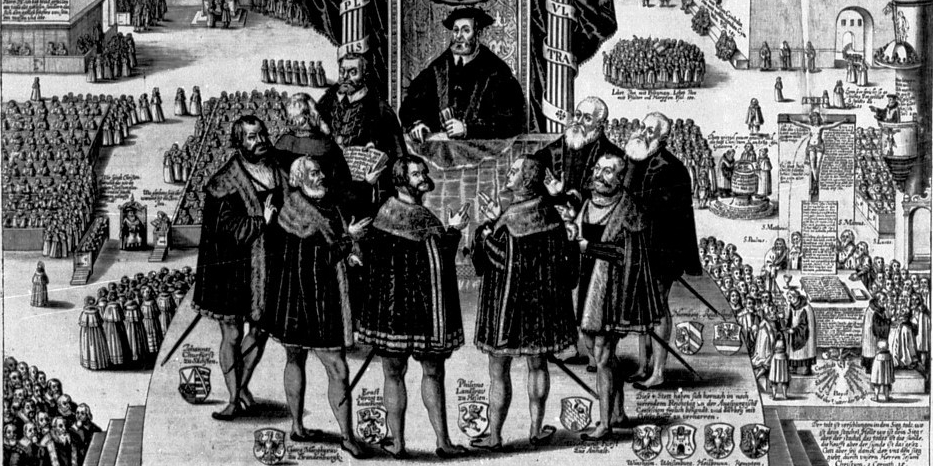
The Presentation of the Augsburg Confession – Pr. Faugstad homily
Text: Psalm 119:46
493 years ago on June 25, 1530, the Lutheran princes of Germany stood before Emperor Charles V and publicly read their confession of faith to all who were gathered there. They stated that they would rather die than compromise the truth of God’s Word.
+ + +
In Christ Jesus, who in His testimony before Pontius Pilate made the good confession (1Ti. 6:13), and who calls us to do the same when we are asked for a reason for the hope that is in us (1Pe. 3:15), dear fellow redeemed:
The men who read the words of the Augsburg Confession before Emperor Charles V were not pastors or theological professors. They were laymen. And they understood and believed every word they spoke. They were powerful men in Germany—dukes, princes, and wealthy landowners—, which meant that they had a lot to lose. They were willing to risk it all because of the Gospel message of salvation they had heard and believed.
By speaking the truth of God’s Word, you also could face the possible loss of your job, your standing in the community, or your favor with friends. Telling God’s truth is the most courageous thing you can do, and it is also the most difficult. The world does not welcome the truth. It actively opposes it and wants the clear teaching of God to be silenced.
But while the unbelieving world may succeed in intimidating us and winning some battles against us, it cannot conquer the Church of God in Christ. He assures us, “In the world you will have tribulation. But take heart; I have overcome the world” (Joh. 16:33). He also reminds us how important our confession of the truth is. Not only is it a matter of eternal life or death for us, it is also a matter of eternal life or death for those we associate with. Jesus says, “So everyone who acknowledges me before men, I also will acknowledge before my Father who is in heaven, but whoever denies me before men, I also will deny before my Father who is in heaven” (Mat. 10:32-33).
The laymen at Augsburg confessed the pure Gospel of Jesus in the presence of some of the most powerful people of their day. We still stand on this confession. We believe what they believed. We teach what they taught. By the grace of God, we have the received His treasures of forgiveness, righteousness, and peace through the preaching of His Word. We have been made members of the body of Christ through faith in Him who died for all our sins and rose from the dead in victory. There is no hope apart from Him, and every confidence in Him.
But we have not always been confident, and we have not always been hopeful. At various times in our lives, we have lost sight of this most important thing. We have listened to the promises of the world. We have sometimes chosen sin over salvation, friendships over faithfulness, peace and security in the world instead of the peace that surpasses all understanding. We think back on these things, and we feel ashamed.
Shame is always waiting for those who walk the way of the world and not the way of God’s Word. You and I find plenty to be ashamed of when we look at our own hearts and minds. But we find nothing to be ashamed of when we look to Jesus. He also stood before powerful authorities. Though they attacked Him and told lies about Him, He did not give in, and He did not retaliate. They sentenced Him unjustly to death by crucifixion, and He endured this suffering willingly.
He did all of it for you, so that His blood would cleanse you of all your sins of weakness and unfaithfulness, and so that His holy life would cover you like a royal robe. You do not face the threats of the world alone. You stand in Him, who has overcome the world, the devil, and death for you. Whether you speak His testimony before kings or before your boss or co-workers or anyone else around you, you have nothing to be ashamed of, because Jesus Christ is “the way, and the truth, and the life” (Joh. 14:6).
The Word of God has not changed and will not change. Every power and influence in this world will pass away, but the Word of our God will endure forever. The men at Augsburg spoke timeless truths, which is why we still speak them today. The Lutheran Church which confesses this truth is not a new church or even a 500-year-old church. It is the continuation of the one holy Christian and Apostolic Church from its New Testament origin to the present day.
We pray that God keeps us faithful to this saving truth, and that He gives us the courage to speak His truth to all who need to hear it.
Glory be to the Father and to the Son and to the Holy Ghost; as it was in the beginning, is now, and ever shall be, forevermore. Amen.
+ + +
(picture of Emperor Charles V receiving the Augsburg Confession)

The Festival of Our Lord’s Ascension – Vicar Anderson sermon
Text: St. Mark 16:14-20
In Christ Jesus, your ascended King and Lord, who lives and reigns over all creation, who is still with you until your ascension, dear fellow redeemed:
A role model is a person looked to by others as an example to be imitated. While baby-sitting I found out how quickly you can be put into that role. Looking back now, I see why parenting can sometimes be difficult. Children watch every single thing that parents do. They watch especially when you think that they are not watching. They point out how impressionable they are. Part of that reason is the trust that they have. Now as children put this trust in their parents and role models, tonight we see Jesus asking for that same trust. Not only is He the one who we want to imitate, and He is our guide, but He is our Savior. And as He ascended into heaven, He puts the trust that we have in Him on display. Jesus assures us with His ascension the hope that we have in Him. We will ascend and meet Him in glory!
St. Mark in this last section of his gospel is giving an overview of Jesus last forty days on earth. In our text we see Jesus rebuking the disciples. “He rebuked them for their unbelief and hardness of heart, because they had not believed those who saw him after he had risen.” Now this rebuke is warranted because of what is recorded before our text. Jesus had appeared to three witnesses after His resurrection and only two witnesses proved something happened. Jesus had appeared to three. On that evidence they should have believed that He had risen.
Like the disciples, we can need that same wake up call. The disciples were told by three witnesses. We have the Scriptures. The Old Testament reveals to us what God demands and promises that someone is going to come and follow those demands perfectly for us. The New Testament reveals to us the heart of the Gospel, Jesus is the Christ who came down from Heaven, lived a perfect life and died for us. When hardships arise in our lives sometimes the first thing we do instead of looking to the Scriptures is look for earthly answers. We forget about God’s promises, and we can question if Jesus is even real, our hearts harden. The same eyewitnesses who had unbelief, they wrote down the gospel to be our witnesses.
Are they still believable? Even the disciples questioned Jesus with His death. Tomorrow marks Ascension, He visibly left us. Why would He leave those He loves? Does He care? Shouldn’t we get special treatment because we follow Him? This would make a lot of sense if God would come and establish an earthly kingdom. We would want a part ruling in that kingdom. These distractions can move us away from the truth. When it looks like it is us against the world or we are just selfish, we don’t want or need that mindset. We have no reason to be selfish or independent. The world wants to be independent, but our independence gets us nowhere.
The command to go into the world also looks as though it is challenging. What will people think of us? We see that they don’t like the message that we have. This message points out the truth of what we have done. The truth is that we have made many mistakes. We don’t like to hear when we have made mistakes. Jesus then says to share the Gospel. This can even be harder when people are already mad because you first told them that they were doing something wrong, that if they don’t change their ways, then they will be condemned. Jesus says, “If you abide in my word, you are truly my disciples, and you will know the truth, and the truth will set you free” (John 8:31-32). We hear the truth that we have done wrong, but then the Gospel comes in and everything changes.
The disciples are brought to faith once again. Jesus immediately puts them to work. He knows that He is not going to be with them much longer. Jesus commands them that they are to spread the Gospel, baptizing all nations. We see how smart Jesus is. Since the disciples are not perfect, what is to stop them from hardening their hearts again? Jesus allows them to perform signs. These signs are not meant to be used like magical spells. They are meant to help those in need. They are special signs used to prove that the Gospel is true. How could the disciples be lying if the message that they are bringing comes with special signs to help those in need? The disciples speak the truth of Christ, and we see how they go out faithfully to do so. They go out, perform these signs, and they gave their lives to preach this saving truth. Even as their Lord had ascended before their eyes, we see that Jesus never left them. These signs were performed in His name. It was not power of the disciples, but the power was Christ. These signs prove that Christ is still carrying out His Work. His enemies can’t stand against Him.
Jesus’ time on earth has ended. Like the disciples, we can sometimes struggle to understand this, but Jesus ascended for your benefit. Jesus’ ascension means that the Holy Spirit would come to the disciples. As the disciples receive these gifts, it is through the Holy Spirit that Christ comes to you. He uses the means of the Word and sacraments. He tells you the benefit of your baptism. With baptism, you have faith that what Christ did for you is true. He died for your sins on the cross and He rose from the dead for your justification. It is through this work that God finds you not guilty. Your baptism into Christ’s death brings forgiveness of sins, life, and salvation. Your baptism washes away your sins of doubt.
The world will try to convince you that Jesus has left you all alone to live this life on earth. To deal with all these hardships. That is not what His ascension means. If Christ did not ascend, you would have to travel to see Him. He ascended visibly into Heaven so that He can be with you wherever you are. He is not just a man confined to a body; He is true God. Christ is with you wherever you go. You know His presence is here in His Word and Sacraments. You believe this through faith in Christ, faith that you only have because of the work of the Holy Spirit in you.
Through faith in Christ, you see the work of His ascension. You see His authority; Christ puts His work on display for the church. You see Him as a Prophet. He sends trained men to come and share you this gospel message. In His ascension He is also a Priest. He intercedes your prayers on your behalf. Lastly, Christ has taken His crown as King. He has crushed all His enemies. He takes care of you and He will live and reign over the church triumphant when He calls you home. Christ’s ascension reveals to you that there is a home that you will go to when you die. Your destination is not to remain here and suffer. Christ ascension, Him not being here, assures you that you do not have to stay here. Jesus has prepared a home for you, the hope of your ascension.
We have tried to look to Christ and imitate Him in our lives. Like the disciples, we have failed to do that, and we will continue to fail as long as we live. Where we are not perfect, our Savior was perfect. He not only lived His life in our place, but He gave up His life so that we would be saved. He brings us that comfort through our baptism, that we are marked children of God. But Jesus couldn’t stay with us on earth. The time came for Him to go back to His Father. This happened for us. He didn’t abandon us. He left visibly to live and reign over all creation, to be at all places, to protect, and comfort you from all trials and hardships, preparing a place in Heaven for you. We confess our hope with hymn 392, On Christ’s ascension I now built the hope of mine ascension; This hope alone has ever stilled All doubt and apprehension; For where the Head is, there full well I know His members are to dwell When Christ shall come and call them (ELH 392 v. 1). Amen.
Glory be to the Father and to the Son and to the Holy Ghost; as it was in the beginning, is now, and ever shall be, forevermore. Amen.
+ + +
(picture from painting by John Singleton Copley, 1775)

The Fifth Sunday of Easter – Pr. Faugstad sermon
Text: St. John 16:5-15
In Christ Jesus, whose Father willed your salvation from eternity, who won your salvation by His death and resurrection, and whose saving work is brought to you today by the power of the Holy Spirit, dear fellow redeemed:
When Jesus spoke the words of today’s reading, everything was so clouded for His disciples, so unclear. Even though Jesus had plainly told them what was coming, they did not understand. They were filled with sorrow, preoccupied with their own thoughts which were not God’s thoughts. But later, after Jesus died, rose again, and ascended into heaven, they did understand. They were guided into “all the truth” by “the Spirit of truth.” But how did they know the Spirit was speaking to them? How did they know what was true? And how can we be sure today that we have the truth?
We know very well that the world in which we live does not support the idea of objective truth. Many people consider truth to be relative: “You have your truth, and I have my truth, and everyone’s truth is equally valid.” That all sounds very nice until one person’s truth is totally opposed to another person’s truth. Then both truths cannot be equal. Both truths cannot be valid.
We would think that at least among Christians, we could agree about what is true. But sadly, that is not the case. Even basic questions like, “Is the Bible the Word of God?” or “Did Jesus really rise from the dead?” are not answered the same way by all Christians, and not even by all Lutherans. Some of them believe that the Holy Spirit is working not so much through the Bible, but that He is working directly in our minds and hearts and through our culture to lead us to new truths and new teachings.
What does Jesus have to say about all this? We’ll start at the end of today’s reading, where Jesus says, “All that the Father has is Mine.” That is a bold statement! The disciples of Jesus still did not grasp His eternal connection to the Father as His only Son. Earlier in the evening, Philip blurted out, “Lord, show us the Father, and it is enough for us” (Joh. 14:8). And Jesus replied, “Have I been with you so long, and you still do not know me, Philip? Whoever has seen me has seen the Father. How can you say, ‘Show us the Father’? Do you not believe that I am in the Father and the Father is in me?” (vv. 9-10).
Jesus was teaching them and us that He is one God with the Father. Everything that God the Father has, the Son has. Jesus listed some of these things as He prayed to His Father that same evening. He said that His Father had given Him “authority over all flesh” (Joh. 17:2). He had given Him His words (v. 8), His name (v. 11), His glory (v. 22), and His love (v. 26). These are the gifts that God the Father gave God the Son.
But those gifts did not remain with the Son. They were shared with sinners, including you and me. This happens by the work of the third Person of the Holy Trinity, God the Holy Spirit. But before the Holy Spirit imparts the gifts of God, He must prepare us to receive them. That work of preparation is hard on us, because the Holy Spirit reveals our need for salvation by pointing out our sins, imperfections, and misplaced priorities.
Jesus says that the Holy Spirit comes to “convict the world concerning sin and righteousness and judgment.” The Holy Spirit through the holy Law condemns the world for its rejection of Jesus, for trusting its own ideas about righteousness which are nothing but filthy rags (Isa. 64:6), and for following the desires of the devil who wants us to focus only on ourselves and only on this life.
The Holy Spirit must perform major surgery on us to break our dependence on the pleasures and promises of the world and to cut out the sin embedded deep in our hearts. Most surgery is painful, but its purpose is to bring about healing and strength. A patient can’t get better if the root problem is not addressed, if the infection is not eliminated, if the cancer is not removed.
The Holy Spirit shows us through the holy Law how deeply sin has infected us and how dire our situation is. But we don’t like to think we are really that bad off. Whatever spiritual weaknesses and problems we have, we think we can fix them. We can avoid the temptations that caused us to fall in the past. We can do better. It’s like trying to run on a broken leg.
So we fall into the same old sins, and we fall for new ones too. We are not capable of healing ourselves. If we were doing so well, God the Father would not have sent His Son to take on our flesh, keep the Law for us, and die on the cross to atone for sin. And God the Holy Spirit would not have come first of all to “convict the world concerning sin and righteousness and judgment.”
This is why we confess every week at the beginning of the divine service “that we are by nature sinful and unclean, and that we have sinned against [God] by thought, word and deed” (Rite 1, p. 41), that each one of us is “a poor, miserable sinner” (Rite 2, p. 61). That is not very flattering language! And it is completely accurate.
But the Holy Spirit’s work is not only to convict us, not only to reveal our sins. In fact, that is not even His primary work. His main work is to comfort us. Now He does not comfort us by telling us things like, “Everything’s going to work out just the way you want,” or “God loves you just the way you are.” He comforts us by planting the perfect promises of God right in our sinful hearts.
Jesus said, “He will not speak on His own authority, but whatever He hears He will speak, and He will declare to you the things that are to come.” “The things that are to come” means all that Jesus would accomplish by His death and resurrection. The disciples did not know that by morning, their great Teacher and Lord would be beaten beyond recognition and nailed to a cross. They did not know that this was necessary for the salvation of sinners. And they did not know that on the third day He would rise from the dead in victory.
His saving work is why Jesus said, “it is to your advantage that I go away.” His “going away” meant that the work was finished. His work to save you was complete. Because He gave Himself as the sacrificial Lamb on the cross, your sins are all washed away. And because He rose from the dead in triumph, death can no longer overpower you.
You know this and you believe it, because the Holy Spirit has declared it to you through the holy Word of God. Jesus said, “He will glorify Me, for He will take what is Mine and declare it to you.” Here we can see the perfect unity of the Holy Trinity. The Father has given all things to the Son, and the Son has given all things to the Holy Spirit to give to you. The Father’s authority, the Father’s words, the Father’s name, the Father’s glory, the Father’s love—all of it comes to you through the Son by the power of the Holy Spirit.
With the authority bestowed on Him at His resurrection, Jesus commissioned the apostles to go and make disciples of all nations by baptizing them and teaching them all that He had taught them (Mat. 28:18-20). That is how you became a disciple. You were baptized into God’s name by the power of His Word and were brought into His holy family. Everything Jesus did for you became yours. You were given a share of His glory and became a recipient of the divine love that the Father has for His Son, because the Holy Spirit made you a member of Jesus’ holy body.
The Holy Spirit continues to bring you the rich blessings of God. The Holy Spirit does all His work through the Word, and always through the Word. That is where He is active. If anyone claims to receive a message from the Spirit outside of the Bible, a message that contradicts the Bible, that message is not from God. You have the truth, because you have the pure Word of God.
By the Spirit’s work through the Word, you know that you deserve to be punished eternally in hell because of your sins, and you also know that your sins are all forgiven through the blood of God’s Son. You know that your best works cannot earn you any favor with God, and you know that by faith in His Son, you now stand perfectly righteous before Him. You know that you have let the devil lead the way far too often and have fallen for his lies again and again, and you know that Jesus has destroyed Satan’s evil plans and brought you into His own kingdom of light.
The Spirit of truth has taught you all these things by the Word. None of them are new, and they never go out of style. In three weeks, we will celebrate the outpouring of the Holy Spirit on Pentecost, the birthday of the Christian Church. We welcome His coming by continuing to hear the Word, read it, meditate on it, and hold it tight as the greatest treasure we have.
Glory be to the Father and to the Son and to the Holy Ghost; as it was in the beginning, is now, and ever shall be, forevermore. Amen.
+ + +
(picture from stained glass by Gian Lorenzo Bernini, c. 1660)

The Feast of the Holy Nativity of Our Lord – Pr. Faugstad exordium & sermon
Festival exordium:
“Merry Christmas!” It rolls easily off the tongue this time of year. We might not use the word “merry” in any other month, but it seems perfectly fitting in December. In this otherwise dark time of year, we want people to find joy and happiness in Christmas. The word “Christmas” was first recorded in an old English source from A. D. 1038 as “Crīstesmæsse.” It is the combination of two words: “Christ” and “mass.”
“Christ” is the special title given to the Savior of the world. It means, “anointed one.” So when we say, “Jesus Christ,” we are saying, “Jesus, the anointed one.” Jesus was officially anointed as the Savior at His baptism in the Jordan River. The heavens opened, and the Holy Spirit descended upon Him in the form of a dove while the Father spoke from above, “This is my beloved Son, with whom I am well pleased” (Mat. 3:17). The incarnate Son of God was anointed “to seek and to save the lost” (Luk. 19:10), to give Himself as the atoning sacrifice for all sin.
But what about the word “mass”? That comes from the Latin term “missa” which has long been associated with the Service of Holy Communion. “Christmas”—“Christ-mass”—means the coming of the Christ to us in His Supper. In Holy Communion, we receive more than bread and wine. We receive the life-giving body and blood of the incarnate Son of God.
The eternal God took on flesh in the virgin Mary’s womb and came to win our salvation by the sacrifice of His body and the shedding of His blood. He gives this same body and blood to us now for our forgiveness, our comfort, and our strength. Jesus’ coming to save us and His continued presence with us is the reason we can be joyful today, even as we carry various burdens and sorrows.
So I say again, “Merry Christmas!”—“Merry Christ-mass!” The Christ was born for you, and He still comes to bless you. For these wonderful gifts, let us rise and sing our festival hymn, #142 (“Rejoice, Rejoice This Happy Morn!”):
Rejoice, rejoice this happy morn!
A Savior unto us is born,
The Christ, the Lord of glory.
His lowly birth in Bethlehem
The angels from on high proclaim
And sing redemption’s story.
My soul,
Extol
God’s great favor;
Bless Him ever
For salvation.
Give Him praise and adoration!
+ + +
Sermon text: St. John 1:1-14
In Christ Jesus, who came down from His exalted throne in heaven with gifts for you and me and all people, dear fellow redeemed:
The artistic depictions of the nativity often show the baby Jesus as the source of light. The faces of Mary, Joseph, and the shepherds shine as they look down on Jesus in the manger. One of our favorite Christmas hymns puts this idea into words: “Son of God, love’s pure light / Radiant beams from Thy holy face” (ELH #140, v. 3). But in reality, Jesus did not glow with an inner light. He looked just like any other baby. What set Him apart for the witnesses of His birth was the word of the angels.
The angel Gabriel told Mary, “the child to be born will be called holy—the Son of God” (Luk. 1:35). An angel of the Lord told Joseph, “do not fear to take Mary as your wife, for that which is conceived in her is from the Holy Spirit” (Mat. 1:20). And then the angel told the shepherds the night of Jesus’ birth, “For unto you is born this day in the city of David a Saviour, which is Christ the Lord” (Luk. 2:11, KJV). They would find Him in Bethlehem not by looking for a shining baby, but for a baby wrapped in swaddling clothes and lying in a humble manger.
So as they worshiped Him that day, they worshiped Him not because of what their eyes saw, but because of what their ears heard. And that is why we worship Him today. We worship Him because of what has been revealed to us about Him in God’s holy Word. The Christian religion is not based on what we can see. It is a religion of faith—believing what we do not see.
That does not satisfy the people of the world. They demand proof of God’s existence, proof of the virgin birth, proof of Christ’s resurrection, proof that He still comes among us today. The proof that the Bible provides won’t do—it has to be proof on their terms. But if we’re talking about Santa Claus, then it’s all about faith. “Don’t ask questions; just believe!” I suppose in their minds, faith is fine when we’re talking fantasy, but it isn’t fine when we’re talking fact.
So why is it that we are so confident that Jesus is who the Bible says He is? Why do we believe in Him? We believe because God the Holy Spirit has worked faith in our hearts through the powerful Word. We didn’t decide to believe in Jesus; God decided to pull us out of the darkness of our sin and death and into the light of His grace.
But our faith is not a “blind faith” that has no evidence to go by. We have the evidence of eyewitnesses who saw what Jesus did and heard what He said. The evangelist John in today’s reading says, “the Word became flesh and dwelt among us, and we have seen His glory.” “The Word” is a special term that John uses to describe the Son of God. He writes that “the Word” was in the beginning, “the Word” was with God, and here’s the part that makes it clear who He is: “the Word was God.”
Once I was talking to a Jehovah’s Witness about who Jesus was. She would not agree with me that the Bible calls Jesus God. I asked her to look up John 1 in her Bible. There her translation (a total mistranslation) said that “the Word was a god,” in the sense of being “divine” or “holy.” But that is not what John wrote. He said, “the Word was God.” God the Son has always existed with God the Father and God the Holy Spirit. All things that were made in the beginning were made through the Son. All life and all light came through Him.
This Lord of life and light is the One the Father sent to be clothed in our flesh. He looked like a regular human being, but He was much more. The apostle Paul wrote about the Christ that “in him the whole fullness of deity dwells bodily” (Col. 2:9). That means that the Son of God was not just partially present in Jesus, but His entire person was now found in a human body.
Why not let His glory be seen by everyone around Him? Why not let His eternal light beam through His skin? It was because no sinner could have endured His bright presence. When Moses wanted to see God’s glory, the LORD said, “you cannot see my face, for man shall not see me and live” (Exo. 33:20). The Son of God incarnate kept His glory hidden for our sake. He “made himself nothing, taking the form of a servant” (Phi. 2:7). He came to humble Himself, to put Himself below us in order to save us.
And that is hard to believe. Why would God do this for us? What is in it for Him? We think there always has to be an angle. For us there often is, but not for God. God sent His Son to take on our flesh out of love for us. He sent His Son to do for us what we are incapable of doing. The Son of God did not put Himself above the Law; He put Himself beneath it, so that He could fulfill God’s commands for us. And He willingly went the way of suffering and the cross, so that full payment would be made for our sins.
If Jesus were just a man, nothing He did could count for you. But because He is God incarnate, “the Word made flesh,” everything He accomplished counts for you. His perfect keeping of the Law is for your righteousness. His innocent death on the cross is for your salvation. These gifts were intended for you long before you were born and long before Jesus was born. Right after the fall into sin, God revealed His plan to send a Savior, the woman’s Seed, the devil’s Destroyer.
That promised Savior was the infant baby Jesus lying in a manger in a little town with a bunch of poor people gathered around Him. “He was in the world, and the world was made through Him, yet the world did not know Him.” No one knew except those who had received a special invitation. They were not rich or famous or influential. They were people like us, sinful people, whose eyes of faith looked in awe upon the Promise fulfilled, Hope incarnate.
We are invited to join them in beholding this great mystery. Jesus was not born for them alone, but for all people of all time. You are hearing the good news today, because God wants you to hear it. He wants you to know that a Savior was born for you to save you from your sins—that there is a solution for the darkness in your heart and mind which has caused you to do dark things.
“The Word became flesh” not to bring God’s righteous wrath down on your head, the punishment you deserve for your sins. The Son of God came down to earth “full of grace and truth.” That’s far better than presents spilling out from under your Christmas tree or brightly-colored boxes stacked in your living room. Jesus came to reconcile you with God the Father through His death in your place. He came to bring peace on earth by the shedding of His blood.
That is why when we hear again the account of our Savior’s birth today, we see more than a baby in a manger. We see “the breadth and length and height and depth” of God’s love for us (Eph. 3:18). We see “the true Light, which enlightens everyone… coming into the world.” We see His glory, “glory as of the only Son from the Father.” It is beyond our human comprehension, but it has been granted us to know it and to understand it by faith.
By His grace, through His Word of truth, Jesus has given us “the right to become children of God, who were born, not of blood nor of the will of the flesh nor of the will of man, but of God.” Because you were baptized into Him, all of His life and light and glory and grace are now yours. You couldn’t ask for better gifts at Christmas, and these gifts last forever.
Glory be to the Father and to the Son and to the Holy Ghost; as it was in the beginning, is now, and ever shall be, forevermore. Amen.
+ + +
(picture from “Adoration of the Shepherds” by Gerard van Honthorst, 1592-1656)