

The First Sunday in Lent – Pr. Faugstad sermon
Text: St. Matthew 4:1-11
In Christ Jesus, who promises to protect you and everyone who trusts in Him from “all the flaming darts of the evil one” (Eph. 6:16), dear fellow redeemed:
The devil started with a temptation about food. He followed that up with a temptation about making God prove Himself. He concluded with a temptation to seek glory, instead of faithfulness to God’s will. This describes his temptation of Jesus in the wilderness, and it also describes his temptation of Eve in the Garden of Eden.
What was the first thing he said to Eve? “Did God actually say, ‘You shall not eat of any tree in the garden’?” (Gen. 3:1). He started with food, with the stomach. We have to admit that the stomach is a difficult thing to manage. We are often torn between what we enjoy eating, and eating what we know is good for us. We do not live in a time of lack or of rationing, when certain goods are not available to us. Sometimes the price of something skyrockets, like eggs and beef in recent months, but they are still available. If we have money to spend, we can buy whatever we like.
When something is not limited or moderated by factors outside of us, we need to exercise self-control. Part of the reason for this self-control is what St. Paul talks about: “I discipline my body and keep it under control, lest after preaching to others I myself should be disqualified” (1Co. 9:27). He did not want to let the devil tempt him through the weakness of his flesh, so he practiced self-discipline.
One way to do this is by periodic fasting. Fasting is telling the stomach that it does not have all the power over us. It shows us that there is something more important than food. Our physical hunger reminds us of our need for spiritual nourishment. Fasting is one of the old spiritual disciplines of Lent, along with prayer and almsgiving, or charitable giving. If we limit our food intake or withhold for a time certain foods that we like, we have more time for prayer, and we have extra money that we can share with others in need.
Jesus fasted for forty days and forty nights. We might think that was easy for Him since He is God. But remember that in His state of humiliation, He was not making full use of His divine powers. The Holy Gospel for today tells us plainly that “He was hungry.” As a true human being, He felt true hunger. That made it a real temptation by the devil.
But what made the devil think he could possibly overcome the Son of God in the flesh? Well, he had done it before with the perfect crown of God’s creation, man and woman. If he could defeat them in a perfect world, why couldn’t he succeed against Jesus in a sinful world? “Humankind is weak,” thought the devil. “Why should Jesus be any different?”
The devil tempted Eve to eat whatever she wanted, particularly from the tree of the knowledge of good and evil. It looked good, didn’t it? It would not harm her; it would make her even better, like God. So he said to Jesus, “If You are the Son of God, command these stones to become loaves of bread. You’re hungry, aren’t You? If You are God, why should You have to feel pain? Why suffer? You can have it. Take it!” The temptation worked on Eve, but not on Jesus. He answered the devil by quoting from Deuteronomy, “It is written, ‘Man shall not live by bread alone, but by every word that comes from the mouth of God.’”
The devil did not stop at the stomach. He continued his temptation of Eve by urging her to make God prove Himself. “Eat this fruit,” he said, “For God knows that when you eat of it your eyes will be opened” (Gen. 3:5). “God knows it, so why shouldn’t you know it? Why should you be left in the dark? Make God show you.” We feel the same temptation when we can’t see a clear way forward. Maybe we are struggling with a health issue, or we have gotten caught up in a sin that we can’t get free from. And we tell God that He needs to give us a special sign or take away our pain. If He doesn’t, then we might conclude that He does not love us, that He does not care.
With this temptation in mind, the devil took Jesus to the pinnacle of the temple and told Him to throw Himself down. “If God loves You, if He cares, won’t He send His angels to catch You? Isn’t that what the Scriptures say He will do? And just imagine the impact it will have on the people of Jerusalem, when they see how God saved You from any harm!” But Jesus said again quoting the Scriptures, “You shall not put the Lord your God to the test.”
The devil had one more. He said to Eve, “you will be like God, knowing good and evil. You can have what God has! You can experience His glory!” We are surrounded by people who promise they can make our life better. If we take this supplement, exercise in this way, invest like this, follow these five easy steps, our life will completely change. We can have what we’ve always wanted!
As we have already heard, it is good to practice discipline for our health, just as it is good to practice discipline in the stewardship of our money and possessions. But to what end? If this is for selfish reasons, to gain power and glory on earth, then we haven’t made any progress at all. Then things might get better for us in the world, but they will be getting worse with God. In Romans 12:1-2, St. Paul writes, “I appeal to you therefore, brothers, by the mercies of God, to present your bodies as a living sacrifice, holy and acceptable to God, which is your spiritual worship. Do not be conformed to this world, but be transformed by the renewal of your mind, that by testing you may discern what is the will of God, what is good and acceptable and perfect.”
The devil tempted Jesus to bypass His suffering and His death on the cross to save sinners. “You can have all the kingdoms of the world and their glory,” he said. “All You have to do is fall down and worship me.” Then Jesus, whom the devil thought was so weak, told him to take a hike. “Be gone, Satan! For it is written, ‘You shall worship the Lord your God and Him only shall you serve.’”
This is where Adam and Eve failed. Eve was the first to eat of the fruit, but she “gave some to her husband who was with her, and he ate” (Gen. 3:6). Adam had heard the command directly from God’s mouth: “You may surely eat of every tree of the garden, but of the tree of the knowledge of good and evil you shall not eat, for in the day that you eat of it you shall surely die” (2:16-17). Adam knew what God said, he heard what the devil was saying to his wife, and he did not put a stop to it. That is why the first sin is pinned on Adam.
Romans 5:12 says, “Therefore, just as sin came into the world through one man, and death through sin, and so death spread to all men because all sinned.” Adam was perfect. So was Eve. They already were “like God,” since they had been made in His image. But they threw away these tremendous gifts of God because they wanted to have more.
We have inherited their sin, all of us have. No matter what excellent gifts God gives us, we also want to have more. And that is how the devil so often succeeds at tempting us. “Don’t hold back,” he says. “Take what you deserve. Eat that fruit. You won’t be disappointed. Stop worrying about what you think God wants, and do what you want.” How many times have we given in? How often did it make our life better?
There is a reason that the Son of God took on human flesh. There is a reason He was anointed by the Spirit at His Baptism. There is a reason He was “led up by the Spirit into the wilderness to be tempted by the devil.” It was for Adam and Eve and you and me and all sinners. He came to succeed where we had all failed. He came to win the victory over sin, death, and devil by perfectly following His Father’s will all the way to His death on the cross.
Where you succumbed to the devil’s temptations by putting your stomach first, by insisting that God prove His love for you on your terms, by seeking the world’s glory instead of God’s will, Jesus did not give in. He was certainly tempted just like Adam and Eve were and like we are. “[I]n every respect [He] has been tempted as we are, yet without sin” (Heb. 4:15). That perfect life of following the Father’s will counts for you and me. God does not see your sins and failings. Jesus’ blood has washed them all away, and His righteousness covers you in a much better garment than Adam and Eve’s fig leaves.
Romans 5 states the beautiful truth: “Therefore, as one trespass led to condemnation for all men, so one act of righteousness leads to justification and life for all men. For as by the one man’s disobedience the many were made sinners, so by the one man’s obedience the many will be made righteous” (vv. 18-19). The Bible refers to Jesus as the “second man” or “second Adam” (1Co. 15:45,47). He came to undo and deliver all that the first Adam destroyed.
The devil thought Jesus was an easy mark. He thought he could do to Him what he did to the first Adam. He learned otherwise. Jesus, the second Adam, stayed strong for you. He did not eat from the forbidden tree. He did not turn stones into bread. He did not throw Himself off the temple. He did not bow down to the devil. Instead, He suffered willingly. He took up His cross. He died in your place, so that His perfect life would be accepted by the Father as the sufficient sacrifice for your sins.
Glory be to the Father and to the Son and to the Holy Ghost; as it was in the beginning, is now, and ever shall be, forevermore. Amen.
+ + +
(picture from woodcut by Julius Schnorr von Carolsfeld, 1794-1872)

In Christ Jesus, who was “despised and rejected by men; a man of sorrows, and acquainted with grief” (Isa. 53:3), dear fellow redeemed:
The cursing and swearing that came out of Peter’s mouth were not characteristic of him—at least not since Jesus called him away from his fishing nets. We don’t know how he was before, except that when Jesus provided a great catch of fish on the Sea of Galilee shortly after Peter met Him, he fell down at Jesus’ knees and said, “Depart from me, for I am a sinful man, O Lord” (Luk. 5:8). Now whatever foul language he had learned in the past came rushing back to him as he stated with an oath before God that he did not know the Man Jesus. Peter was afraid, afraid that he would be arrested and beaten up like Jesus was and maybe even killed.
It was only a few hours before this that Peter had confidently told Jesus, “Though they all fall away because of you, I will never fall away” (Mat. 26:33). Jesus told him that before the rooster crowed twice (Mar. 14:30), Peter would deny Him three times. Peter would not hear it: “Even if I must die with you, I will not deny you!” (Mat. 26:35). He was so sure of himself, so sure that he could not fall like that.
And that’s exactly the kind of self-assurance that the devil looks to exploit. History is full of Christians—good and faithful Christians—who fell into sins they thought they would never succumb to. They heard the stories about how others had fallen, and they thought to themselves, “That would never happen to me. I would never do that!” An attitude of judgment and pride are mixed into those thoughts. We are warned about this arrogance in 1 Corinthians 10: “Therefore let anyone who thinks that he stands take heed lest he fall” (v. 12).
The devil, like a roaring lion, is watching and waiting for the opportunity to attack us when we think we are standing strong. Jesus spoke these ominous words to Peter when he boasted about his faithfulness: “Simon, Simon, behold, Satan demanded to have you, that he might sift you like wheat” (Luk. 22:31). In other words, “You are not as strong as you think you are, and the devil knows it.” Then Jesus added these hopeful words, “but I have prayed for you that your faith may not fail. And when you have turned again, strengthen your brothers” (v. 32). Peter would fall, but he would not be lost forever. The Lord’s mercy and grace would cover even his horrible curses and denial.
This is a great comfort to us. We can also think of times that we cursed and swore and indicated by our words and actions that we “do not know the Man.” We did it because we wanted to fit in. We did not want to be made fun of for our faith. The devil was right there, tempting us, ready to sift us like wheat, and we gave in. Don’t you wish you could go back and unsay the terrible things you’ve said, and undo the wicked things you’ve done?
But there is no going back. There is no fixing what you broke. As much as Peter wanted to forget what he did in that Jerusalem courtyard, it happened. He did it. When faced with the reality of our sin, our natural reaction is to try to downplay it: “I was young and made some mistakes—everyone makes mistakes. It didn’t really hurt anyone. It wasn’t that big of a deal.” Or we try to assign the blame to someone else: “If I hadn’t been put in that situation by that person, I would have been fine.”
We think we can escape our sins by trying to wiggle out from under them or by keeping them buried in the past. But as much as we might want to detach ourselves from our sins, they will not detach themselves from us. We can’t try to balance out the bad by doing good. We can’t pay the debt of past sins by paying it forward in kindness. There is nothing we can do to make our sins go away and make things right with God. We sinned against Him. We did it.
Peter felt his sin to the depths of his soul. Jesus told him what would happen, told him what he would do. Peter denied his Lord’s words. And then he denied his Lord. Jesus was aware of all of it when it happened. Right after the rooster crowed the second time, the evangelist Luke records that “the Lord turned and looked at Peter” (Luk. 22:61), either as He was being led through the courtyard or from a window or doorway nearby.
Peter saw Jesus look at him, and he remembered what Jesus had said about denying Him. When the reality of what he had just done hit him, there was nothing he could do but weep, bitterly. Was he sorry for his sin? Every tear said that he was. There was no more posturing from him, no more proving his faithfulness. He was crushed by his sins, and he repented.
This is what we do with sin—we repent of it. Repentance is not about saying the right words, and you are good to go. It is not a work you do that God rewards. Repentance is acknowledging sin from the heart, without selling it short or making any excuses for it. It is admitting what you thought or said or did that God said you should not think or say or do. Repentance is painful; we don’t like to own up to our sins. But repentance prepares us to receive grace from God.
Jesus came for sinners. He suffered and died for all of them, including his dear disciple Peter who denied that he even knew Him. The first thing Jesus said when He was nailed to the cross was not, “How could they all desert Me and leave Me to suffer alone?” He said, “Father, forgive them, for they know not what they do” (Luk. 23:34). Those words are for you, too. Even though you have denied Jesus by your sin, He went to the cross willingly for you.
As the spotless sacrificial Lamb, He offered up His perfect life as the sacrifice for all sin, for your sins and mine, sins of arrogance and pride, of stubbornness, of trying to pass the blame for the wrongs you have done. He suffered “once for sins, the righteous for the unrighteous, that he might bring [you] to God” (1Pe. 3:18). You sinned against God in countless ways, and Jesus reconciled you with the Father by pouring out His holy, precious blood to wash your sins away.
His blood also paid for Peter’s sin, even that horrible denial of Jesus in His darkest time of suffering. Jesus had told him, “I have prayed for you that your faith may not fail.” This was Peter’s hope in his gut-wrenching grief. Jesus had not forsaken him—He would not forsake him—because He had promised to be faithful. Jesus made sure that Peter knew His love and forgiveness by appearing personally to Peter after His resurrection (1Co. 15:5) and then reinstating him to feed His lambs and sheep (Joh. 21:15-19).
He assures you of the same love and forgiveness each time you hear His Word of absolution and receive His body and blood for the remission of your sins. You do not come before Him with boasting, presenting all your good works to Him. You come in humble repentance, laying bare your soul to Him, begging for His mercy and grace.
That is the message that Martin Luther wrote on his deathbed. 480 years ago today (2/18/1546), He left a note ending with these words: “We are beggars, this is true.” Luther did not enter death empty-handed, but he took along nothing of his own. He knew that the Lord supplied the forgiveness and righteousness that he needed for eternal life in heaven.
The same is true for you. Jesus suffered and died for you, so that all your transgressions would be forgiven, removed from you “as far as the east is from the west” (Psa. 103:12). His ear is always open to your cry, and His Word is always ready to bring you His healing and life. So you can confidently and gratefully say along with penitent David and Peter: “A broken and a contrite heart—These, O God, You will not despise” (Psa. 51:17, NKJV).
Glory be to the Father and to the Son and to the Holy Ghost; as it was in the beginning, is now, and ever shall be, forevermore. Amen.
+ + +
(picture from “The Second Denial of Saint Peter” by James Tissot, 1836-1902)

The Second Sunday after the Epiphany – Pr. Faugstad sermon
Text: St. John 2:1-11
In Christ Jesus, who does not reject us for our sins but nourishes and cherishes us as members of His holy body (Eph. 5:29-30), dear fellow redeemed:
We expect that Jesus would perform His first public sign in the heart of Jerusalem, perhaps in the temple, so all the higher-ups would know the Messiah had come. He could have done something magnificent like the transfiguration of His appearance, flying from one place to another, or putting food on everyone’s table or money in their pockets. Or His first sign could have been in His hometown of Nazareth, so all His neighbors would realize who He really was.
But Jesus did not choose Nazareth or the Holy City. He chose Cana, a little town in Galilee about nine miles north of Nazareth. And the occasion for His first sign was a wedding. A common Jewish custom for wedding feasts at this time was a seven-day celebration. The fact that the wine ran out does not automatically mean the guests at this wedding drank more than usual. It could mean that more guests had arrived than anticipated.
Running out of wine would have certainly changed the celebratory mood of those who were present. And it would have been an embarrassing way for the bride and groom to begin their life together. The situation concerned Jesus’ mother Mary enough that she brought the problem to her Son. “They have no wine,” she told Him. Jesus’ reply is surprisingly blunt: “Woman, what does this have to do with Me? My hour has not yet come.”
We’re not sure what Mary wanted Jesus to do. But her message to the servants, “do whatever He tells you,” indicates that she thought He might do something. We can’t forget how Mary treasured up all the things she heard and saw about her special Son through the years and pondered them in her heart (Luk. 2:19,51). Now that He was a grown man, she was waiting for Him to take the next step, to reveal who He really was, who the angel Gabriel told her He was—the true Son of God (Luk. 1:35). His recent calling of Galilean men to be His disciples certainly had her thinking that something was about to happen.
But Jesus was not going to be forced to act by His mother whom He loved dearly. He told her as a twelve-year-old that the plan was not in her hands, “Did you not know that I must be in My Father’s house?” (Luk. 2:49). And He reminded her of the same thing now, “what does this have to do with Me? My hour has not yet come.” And at this point in the account, Mary, after speaking to the servants, steps aside.
Soon after this, Jesus quietly asked the servants to fill six large stone jars with water. When this was done, He asked them to “draw some out and take it to the master of the feast.” Could they tell that the water’s color had changed? Could they smell the aroma of wine? Did they comprehend what had just happened? Whether it struck them in the moment or later on, these eyewitnesses could only conclude that Jesus had powers unlike anyone else they knew or had heard of. That’s certainly the impact this sign had on the disciples. The evangelist John who was almost certainly present at the wedding reported about himself and the other disciples that they “believed in [Jesus],” that He was the Son of God incarnate.
So Jesus saved the wedding celebration. He saved the bride and groom from embarrassment. Their joy-filled union was the occasion for His first public sign through which He “manifested His glory.” Of all the places and ways He could have revealed His divinity, He chose a wedding celebration, the formation of a new home through the marital union of husband and wife.
While it might not be what we expect, a wedding was a fitting place and way for Jesus to start His public work. Marriage is the first building block of society and everything that exists within it—from home to church to state. God instituted marriage before the fall into sin, so He saw that it was “very good” even for a man and woman who lacked nothing. Marriage was a gift for them, and it was the means by which God would expand the human race.
Adam and Eve had the first and only perfect marriage. Adam rejoiced that the woman made from his rib was “bone of my bones and flesh of my flesh; she shall be called Woman, because she was taken out of Man” (Gen. 2:23). The end of Genesis 2 includes this note, “And the man and his wife were both naked and were not ashamed” (v. 24). They had a marriage without shame, without any sin. They perfectly loved one another and perfectly served one another.
But then they gave it all up because they wanted to have more. They brought sin into Paradise. Immediately after falling, they played the blame game, pointing their fingers at each other instead of themselves. But God did not destroy them for their sin or take them away from each other. He gave them a promise that would hold them together and give them hope. From the woman would come an Offspring who would crush Satan’s head (3:15).
That particular woman was not Eve but the virgin Mary, and that particular Offspring was Jesus the Christ. What Adam and Eve destroyed, Jesus came to restore. He came to rescue the human race, and with it, His beautiful institution of marriage. Marriage can never be in this life what it was before the fall into sin, but it can be more than the world considers it to be—much more.
To teach us about the greatness of marriage, Jesus likens it to His union with the Church of all believers. Ephesians 5 says that as the Church acknowledges Christ as its Head and submits to Him, “so also wives should submit in everything to their husbands” (v. 24). And as Christ loved the Church and gave Himself up for her, this is how husbands should love their wives (v. 25). When this happens by the grace of God, when neither spouse points fingers and both spouses make sacrifices for each other, then we catch a glimpse of the blessed union of Christ with His Church.
Sometimes a self-sacrificing love can be found in marriages between unbelievers. But more often the view of marriage in the world today is that it exists for my personal fulfillment, and if I am not happy, if my needs are not being met the way I want them to be, then I am going to walk. And then there is the growing number of couples who think marriage is “nothing but a piece of paper,” a formality, which is “not nearly as important as a shared expression of love for one another.” The devil attacks the best gifts of God, and that’s what he is doing to marriage today.
It isn’t just unbelievers who are affected by his lies and temptations. Satan especially works against marriages of Christians, and he has done damage among us too. He tempts us to selfishness, unkindness, jealousy, manipulation, hurtful words, and hurtful actions. He tempts us to look outside of our marriage to get what we want. He tempts us to think that happiness should be the primary concern in our marriage instead of faithfulness and sacrificial love.
But Jesus is active in our marriages too. Despite our sins against Him, He has not turned His back on us. We might get frustrated with each other, but He does not get frustrated with us. He loves us perfectly. As ugly as we know we look in our sin, He declares His bride the Church to be “without spot or wrinkle or any such thing… holy and without blemish” (Eph. 5:27). This is because He cleansed us in Holy Baptism “by the washing of water with the word” (v. 26). He joined us to Him. He paid for our sins. He covers us in His righteousness. He keeps no record of our wrongs.
This is sacrificial love. We sinned against Him, but He took the punishment in our place. We were unfaithful to Him, but He willingly carried our guilt to the cross. We deserved eternal death, but He died to win us eternal life. Your sins against your neighbor, including your spouse, are sins against Him—and He forgives you. He forgives you, which moves you to share that forgiveness with others. Ephesians 4:32 says, “Be kind to one another, tenderhearted, forgiving one another, as God in Christ forgave you.”
The first sin happened because of a breakdown of marriage. The first sign that God had taken on flesh to bring salvation to the world took place at a marriage celebration. Marriage was not perpetually cursed by Adam and Eve, so that it should be avoided at all costs. Marriage is eternally blessed by God, so we should embrace it and give thanks for it as a great gift. Whether or not you are married today, you came from a marriage. You had a father and a mother. You know what a gift a healthy marriage is. You know how important marriage is for the home, the church, and the state. It is the human foundation on which everything else rests.
And that’s why Jesus is particularly interested in the home. He gives husband and wife to care for, help, and encourage one another. He gives children through their union, so that children have stability, so they are provided for, and so they receive training in the saving Word of God. He gathers the family around His Word, so we set our hope on His promises and grow in love for God and one another. Where His Word is, Jesus is present. He says, “For where two or three are gathered in my name, there am I among them” (Mat. 18:20).
Jesus is present in holiness and power turning sorrows into joys, pain into pleasure, hardship into contentment. Whatever is brought into our homes because of sin, He transforms by His grace like the way He turned water into wine. Keeping His Word at the center of our home and our life together is how we know our family will be blessed, even if the future does not go the way we plan or expect. Jesus is with us drawing us closer to Him and to one another and giving us hope—hope in this life and hope for the eternal life to come.
Glory be to the Father and to the Son and to the Holy Ghost; as it was in the beginning, is now, and ever shall be, forevermore. Amen.
+ + +
(picture from a work by a 10th century monk)

Maundy Thursday – Pr. Faugstad sermon
Text: Numbers 9:1-14
In Christ Jesus, the perfect Passover Lamb, whose holy blood cleanses us from all sin, dear fellow redeemed:
When the LORD was about to deliver the Israelites from slavery in Egypt, He gave Moses instructions for the Passover meal—the male lamb without blemish, killed at twilight, roasted whole over the fire, with unleavened bread and bitter herbs on the side. Because they had put the blood of the lamb on the doorposts of their homes, the angel of God passed over their homes, and their firstborn sons were spared. The same was not true for the homes without blood as death came to every Egyptian home.
The Israelites quickly gathered their belongings and marched out of Egypt, no longer enslaved. The Passover was the defining event in their deliverance. It ushered in a new era for the people. The LORD told the people, “This month shall be for you the beginning of months. It shall be the first month of the year for you” (Exo. 12:2). And every year on the fourteenth day of the first month, the people were to remember the Passover and “keep it as a feast to the LORD” (v. 14). When they observed it, they were to tell and teach their children, “It is the sacrifice of the LORD’s Passover, for he passed over the houses of the people of Israel in Egypt, when he struck the Egyptians but spared our houses” (v. 27).
It had been an eventful year since the Israelites left Egypt. They had been saved from Pharaoh’s army by passing through the Red Sea. They had received God’s holy Law at Mount Sinai. The tabernacle had been constructed, where God made His presence known through a cloud. And now it was time to partake of the Passover meal again—on the fourteenth day of the first month.
But some of the men brought a problem to Moses. They told him they were unclean according to God’s Law because they had to take care of a dead body. So they were unable to observe the Passover even though they wanted to. They asked Moses what they should do. Moses asked the LORD, and the LORD gave a special provision for the Passover. He said that if any were unclean from touching a dead body, or if they were on a long journey at the time of the Passover, they could observe the Passover exactly one month later, on the fourteenth day of the second month.
But this only applied in special cases; it was not to be done for convenience’ sake or because a person preferred to wait. Such disregard for the LORD’s Passover required that the offending individual be “cut off from his people”; in other words, that he be cast out or excommunicated from the Israelite congregation. The Passover observance was not optional. It had to be done in remembrance of what the LORD had done for them.
There was also a forward-looking aspect of the Passover. Every year that the people observed it, they were reminded that the LORD had delivered them from slavery and death in Egypt by the blood of the lamb. But in the future, He would deliver them from something much greater. That lamb without blemish was a type or picture of the sinless Son of God, who would take on human flesh to deliver all people from our slavery to sin and death.
This is the week that the Lamb of God made His way toward the altar of sacrifice, toward His crucifixion on Calvary. The night of His betrayal and arrest, He reclined at table with His disciples to partake of the Passover. He said, “I have earnestly desired to eat this Passover with you before I suffer. For I tell you I will not eat it until it is fulfilled in the kingdom of God” (Luk. 22:15-16). Jesus was the Passover’s fulfillment. He was the spotless Lamb that took away the sin of the world on the cross.
Since He was its fulfillment, the observance of the Passover was no longer required. Now Jesus instituted a “new testament” to replace the old. He took unleavened bread from the Passover meal, “and when He had given thanks, He broke it and gave it to them, saying, ‘This is My body, which is given for you. Do this in remembrance of Me.’” Then He took the cup of blessing filled with wine and said, “This cup that is poured out for you is the new covenant in My blood” (vv. 19,20).
Just as the LORD directed the people of Israel to observe the Passover “in remembrance” of what He had done for them, so now Jesus tells His followers to eat His body and drink His blood “in remembrance” of Him. But is the Lord’s Supper required in the same way as the Passover was? In other words, can we as Christians choose not to partake of the Supper? And if so, how long can we go without it?
It is true that Jesus did not mandate how often to receive Holy Communion. He just said, “do this.” So perhaps we should ask what might keep a Christian from not doing this. Like the Israelite men who were unclean from working with a dead body, the death of a loved one or a personal illness or injury could keep us from attending the Divine Service for a time. Or if we were “on a long journey” like the LORD spoke of with the Passover, perhaps we would not be able to receive the Lord’s body and blood for a while.
But if we are in fair health, and we are able to attend church, or we are able to receive a pastoral visit in our home, then why would we not want to receive Jesus’ body and blood for the forgiveness of our sins? Our Catechism asks the question, “Do those who neglect the Lord’s Supper commit a sin?” The answer is “yes” with this explanation. They sin first of all against “the Lord, whom they insult by treating His gifts as unimportant,” second of all against “themselves, whom they deprive of great blessings,” and finally against “the believers, whose fellowship they neglect” (ELS Explanation, 2023 edition, p. 252). Whether or not we partake of the Lord’s Supper is no unimportant matter.
It can happen, though, that a child of God is struggling. He carries a burden of guilt because of a sin done long ago or not so long ago. Perhaps he is still stuck in the sin. He wants to stop, he is sorry for it, but he doesn’t have the strength. Or maybe someone is hurting from harm done to her by another. She knows she should forgive, but she can’t get rid of the anger. Sometimes people in these situations stay away from the Lord’s Supper because they don’t feel worthy enough to receive it.
To such as these, Jesus says, “Come to me, all who labor and are heavy laden, and I will give you rest” (Mat. 11:28). “But Jesus, I have sinned!” we say, “I’m not worthy to come to Your table!” And Jesus replies, “whoever comes to me I will never cast out” (Joh. 6:37). His Supper is for sinners. If you recognize your sin and are sorry for it, His Supper is for you. He gave His body on the cross and shed His blood in payment for your sins, and now gives you the same holy body and cleansing blood for your comfort and strength.
Partaking of the Lord’s Supper is not a time for going through the motions. The Israelites were to observe the Passover each year remembering what the LORD had done and continued to do for them. We also partake of the Sacrament remembering what Jesus has done and continues to do for us. This is no place for our unrepentance, our sinful smugness and stubbornness, our pride, our self-righteousness. This is the place for broken and contrite hearts, for humble faith, for thankfulness.
We come forward remembering who Jesus is, the true Son of God and Son of Man. We remember what He has done, given Himself and shed His blood to redeem us from our sin and death. We remember our ongoing need for His forgiveness because of our many sins. And we remember His promise to be with us always here and to return again on the last day to take us to be with Him.
Just as the Israelites observed the Passover to God’s glory, so we observe the Lord’s Supper to His glory. “For as often as [we] eat this bread and drink the cup, [we] proclaim the Lord’s death until he comes” (1Co. 11:26). Amen.
+ + +
(painting of the Last Supper by Simon Ushakov, 1685)

Palm Sunday – Pr. Faugstad sermon
Text: Numbers 21:4-9
In Christ Jesus, whose saving work was foretold by the prophets and depicted among the peoples at many times and in many ways, dear fellow redeemed:
If you had to guess what verse in the Bible is the most popular one, you would probably say John 3:16, “For God so loved the world that He gave His only begotten Son, that whoever believes in Him should not perish but have everlasting life.” It is an awesome verse. It clearly states that we are saved from our sin and death by faith in the Son of God. But did you know that the context leading up to this verse includes a reference to the bronze serpent that Moses made?
John 3:14-15 says, “And as Moses lifted up the serpent in the wilderness, so must the Son of Man be lifted up, that whoever believes in him may have eternal life.” Then the famous passage follows. By this reference to today’s account from Numbers 21, our Lord is teaching us how to read the Old Testament. We read the Old Testament not just for historical purposes and not just for lessons about what we should and should not do. We read the Old Testament as a book about God keeping His promises, including His chief promise to send a Savior for sinners.
We certainly find sinners in today’s reading. Once again, the Israelites became impatient. Once again, they grumbled and complained. They took God’s gifts for granted and wished they could go back to Egypt where they recalled being so happy and healthy. It is obvious the devil had “pulled the wool over their eyes.” The people needed to be brought out of their spiritual sleep. They needed to be reminded who the LORD was and what He was doing for them.
But being made aware of our wickedness and weakness is not a pleasant experience. It certainly wasn’t for the Israelites. The LORD sent fiery serpents among the people. We don’t know exactly what made the serpents “fiery.” Perhaps it was their appearance. Perhaps it was the type of pain people felt when they were bitten. It was a terrifying experience that claimed the lives of many people.
It also woke the people up. They came to Moses in humility and repentance, “We have sinned, for we have spoken against the LORD and against you. Pray to the LORD, that He take away the serpents from us.” They realized their sin the hard way. Instead of trusting God and obeying His will, they broke His holy Law and faced the consequences.
We can also think of many times that we learned about sin “the hard way.” We decided to do what we knew was wrong. We thought we could get away with it, or we thought it was worth the risk, but that sin came back to bite us hard. Some sins have temporary consequences, but other sins have deeper consequences that can last our entire life and negatively impact others even after we are gone.
The sin we have inherited from Adam is like the bite of a poisonous serpent. The poison works its way further and further in, and if no treatment is applied, it leads to death. The Book of James outlines the progression of sin: “But each person is tempted when he is lured and enticed by his own desire. Then desire when it has conceived gives birth to sin, and sin when it is fully grown brings forth death” (Jam. 1:14-15). This is not just about physical death which touches all people. This is about eternal death in hell which is received by all who remain in their sin and refuse to repent.
It was a gift from God that the people afflicted by the fiery serpents repented. Not everyone feels sorry for sin. Many boast how there is nothing about their life they would change. “I did it my way,” they say, as though that is something admirable. So we see that God was mercifully leading the Israelites out of their sin and unbelief and back to Him in faith. They went to God’s servant Moses, admitted their wrong, and begged him to intercede for them. Moses prayed to the LORD, and the LORD listened to his prayer. He said to Moses, “Make a fiery serpent and set it on a pole, and everyone who is bitten, when he sees it, shall live.”
Now this seems a little odd. Why would God tell Moses to put on a pole an image of the very animal that was killing them? And how could the lifeless image of a serpent save the people from the bite of actual serpents? This was a test of faith. The power to save the people was not in a piece of metal on a pole. The power to save the people was in the promise God attached to the image. He said, “and everyone who is bitten, when he sees it, shall live.” Would the people trust God’s Word now?
We are faced with a similar test when we look at God’s Sacraments. Many people—even many Christians—reject the Sacraments as external things, as empty rituals, that have no real effect on our faith. They say it is little more than getting water splashed on you, than eating bread and drinking wine. We receive no benefit if we look at the Sacraments in this way and just go through the motions because we feel like we should. But if we listen to what our Lord says about them, if we recognize that the power of the Sacraments is in His Word, and we trust the promise He attaches to these visible means, then we receive great benefit.
The Israelites may have tried to apply medicinal remedies of their own making to their family members and friends who had been bitten. Maybe they tried to chase the snakes away. But their efforts all failed. People kept dying. They could not save themselves. Only God could rescue them. He directed Moses to lift up the bronze serpent on a pole, and the people who trusted His promise were spared. “[I]f a serpent bit anyone, he would look at the bronze serpent and live.”
So when the devil with his temptations slithers toward you, when sin sinks its fangs into you, when its poison works its way through you, what can you do? You can’t save yourself. You don’t have the power to neutralize your sins or keep their poison from spreading. You can’t heal the wounds inflicted by your sin or outrun the consequences of what you have done. There is only one remedy, only one antidote for sin—“as Moses lifted up the serpent in the wilderness, so must the Son of Man be lifted up” (Joh. 3:14).
The Son of Man, Jesus Christ, had to be lifted up. It was absolutely necessary. The antidote for sin’s poison had to come from God to us. He sent healing and salvation to us by giving His Son to suffer and die in our place. That is our focus in this holiest of weeks beginning with our Lord’s humble entry into Jerusalem.
He was welcomed as a king on Palm Sunday, but the true nature of His kingdom would not be clear until He was wearing a crown of thorns on Friday. His throne was not covered in gold. It was splattered in the holy blood that oozed from His wounds. His throne was that rough, wooden cross that lifted Him up for all eyes to see. Many looked at Him in unbelief; they ridiculed and blasphemed Him.
Even for them, Jesus willingly suffered. Even for you. He carried your sins to the cross. He felt their painful bite and their burning poison. He did not grumble or complain. He did not ask His Father why He sent Him from heaven to die in the wilderness of the world. He accepted the punishing wrath of God and endured the eternal torments of hell, so you would not die but live.
Sin filled you with death, but Jesus fills you with life. He counteracts the effects of all your sins, including the ones that caused deep wounds and piercing pain in you and others. By giving up His holy life in payment for sin, He won forgiveness and salvation for you. He brings the fruits of His victory to you right now through His Word and Sacraments. Through these means, He imparts the medicine of life. You hear His promises spoken to you, you eat His body and drink His blood with faith in what He says, and His power works through you to heal, comfort, and strengthen you.
Whether you feel healthy and strong in your spiritual life or under attack and weak, you keep your eyes always on the Son of Man who was lifted up to save you. If you tried to measure your faith by how well you are doing or how much you have accomplished, you would be applying the Law as a remedy to your sinfulness. But the Law cannot save you. One of our great Lutheran hymns puts it well:
The law reveals the guilt of sin,
And makes men conscience-stricken;
The gospel then doth enter in,
The sin-sick soul to quicken.
Come to the cross, loop up and live!
The law no peace to thee doth give,
Nor can its deeds bring comfort. (Evangelical Lutheran Hymnary #227, v. 9)
You look to Jesus for comfort. His Father sent Him to fulfill the promise of the ages by suffering and dying in your place. Like the whole creation that eagerly waits for the blossoming and new life of spring, the entire Old Testament anticipates the coming of the Savior. Jesus said to the Jews, “You search the Scriptures because you think that in them you have eternal life; and it is they that bear witness about me” (Joh. 5:39).
The bronze serpent on a pole was a picture of what Jesus would do on the cross. Like the Israelites who looked up with faith in the LORD’s promise, you also by faith Come to the Cross, Look Up and Live! In Jesus, you have life for today, life for this Holy Week, and life forevermore. Thanks be to God. Amen.
+ + +
(picture from “Crucifixion, Seen from the Cross,” by James Tissot, c. 1890)

The First Sunday in Advent – Pr. Faugstad sermon
Text: Genesis 3:14-4:2
In Christ Jesus, the Offspring of the virgin, who was called Immanuel, God with us, dear fellow redeemed:
“The LORD God said to the serpent, ‘Because you have done this, cursed are you.’” What the devil had done was tempt the most special part of God’s creation—mankind—to sin. In the form of or inhabiting a serpent, the devil had approached the first woman with the express purpose of turning her against her Creator. He first tempted her to doubt the Word of God and then to deny the Word of God. She took fruit from the tree of the knowledge of good and evil—the one tree God warned Adam not to eat from—, and she ate. Then she gave some of the fruit to Adam “who was with her,” and he ate (Gen. 3:6).
They did not receive what they were looking for. They were hoping to “be like God,” as the devil had promised them. They failed to appreciate that they already were “like God,” made in His holy image (1:26-27). They did receive part of what the devil had promised, the knowledge of good and evil (3:5). They learned that they used to be good as the caretakers of God’s good creation. Now they had become evil, and they viewed God as their enemy.
This is why they went into hiding when they heard Him walking in the garden. They were afraid of Him. What was He going to do to them? Adam surely remembered what God said about that one tree, that “in the day that you eat of it you shall surely die” (2:17). They went into hiding because they did not want to be punished for their sin. They did not want to die. In fact, they already had. They were still breathing, but spiritually, they had died. They were separated from God. They were on the devil’s side now.
But the LORD would not let the devil keep them. Their punishment would not be the same as the devil’s punishment. God extended no grace and hope to the devil, but He did to Adam and Eve. The key verse in today’s reading and perhaps in all of Scripture is verse fifteen. God said this to the devil but for mankind’s benefit: “I will put enmity between you and the woman, and between your offspring and her Offspring; He shall bruise your head, and you shall bruise His heel.”
Just as the devil had manipulated a woman into disobeying God, so it would be through the Offspring of a woman that the devil’s power would be crushed. Martin Luther called this verse the “first comfort, this source of all mercy and fountainhead of all promises” (Luther’s Works, vol. 1, p. 191). He also suggested that God made the prophecy purposely vague, so that the devil would have to fear every woman going forward since any of them might bear the One to destroy him.
God’s promise terrified the devil, but it gave great hope to mankind. God had not changed His mind about death entering the world through sin. But now He delivered the hope of salvation, that One would come to set everything right again, to overcome sin, devil, and death for all humanity. If Adam and Eve thought another path was open to them, that possibility was closed when God posted “the cherubim and a flaming sword” outside the Garden of Eden to keep them away from the tree of life.
There was no other way to be saved than God’s way. Immediately after this, we are told that “Adam knew Eve his wife, and she conceived.” They trusted what God said, that salvation would come through the woman’s Offspring. They hoped their firstborn son was this Savior. They called him “Cain,” a name that means “acquired” or “gotten” because they had “gotten a man from the LORD.” But Cain was not the promised One. The devil poisoned his mind with anger and hatred, leading to the murder of his brother Abel.
God’s promise would not be fulfilled for many, many years. Child after child would be born, grow old, and die. Women had pain in childbearing like God said they would, while enduring the imperfect rule of men. Men toiled in pain by the sweat of their face to make a living, before returning to the ground from which they were made. Decade after decade, generation after generation, brief life to certain death. Still no Savior.
God’s people might have wondered if His promise would be fulfilled, except that He reminded them with clearer and clearer prophecies as the time approached. The Savior would come from the line of Abraham, Isaac, Jacob, and Judah (Gen. 49:10). He would be a descendant of King David (Psa. 110). He would be born of a virgin (Isa. 7:14). He would be born in Bethlehem (Mic. 5:2). God waited for thousands of years after making His promise, until “the fullness of time had come” (Gal. 4:4).
Then He sent His angel Gabriel to a virgin named Mary. “Behold, you will conceive in your womb and bear a son,” said Gabriel, “and you shall call his name Jesus” (Luk. 1:31). “How will this be,” asked Mary, “since I am a virgin?” And the angel answered her, “The Holy Spirit will come upon you, and the power of the Most High will overshadow you; therefore the child to be born will be called holy—the Son of God” (1:34-35). The time had finally come! The woman’s Offspring was here. God had entered His creation, taking on human flesh. The devil was about to be ruined.
And all of that, the dark day when the world was plunged into sin, the beautiful, first promise of God, the history of every joy and sadness, hope and pain, life and death, all of it was in the background and in Jesus’ mind as He rode into Jerusalem on Palm Sunday. “Hosanna to the Son of David!” shouted the people. “Blessed is he who comes in the name of the Lord! Hosanna in the highest!” (Mat. 21:9). No one understood what had to be done. No one knew the suffering that Jesus would endure. No one knew what it would take to redeem mankind from the sin that started in Eden.
The death that was brought on the world through a tree had to be undone by death on another tree. The perfection that was lost through sin had to be regained by a perfect sacrifice. The curse of sin had to be directed against One who had never sinned. He had to pay for man’s disobedience. He had to suffer eternal punishment in every person’s place. This is what Jesus, the eternal Son of God, had to do.
He was witness to all that transpired in Eden. He walked with Adam and Eve in perfection and then found them in their sin. He saw all the wickedness that was done from that point on, all the pride, deceitfulness, abuse, unfaithfulness, violence. He was witness to everyone’s sins from Eden onward. And because He is God, He could see even the sins that stretched forward in time, including the sins done in our lifetime, the sins done by us, even our sins today.
What would you think if you had witnessed all that poisonous evil, the terrible pain and destruction, brought about because of mankind’s sins? What would you do? Would you feel compassion for sinners? Or would your anger burn hot against them? Jesus rode forward humbly to His death in every sinner’s place. We hear this Palm Sunday account at the beginning of the Church Year because it teaches us how to think about sin and salvation and Jesus, and how to prepare for His coming.
If any of us is comfortable with our sinning, then we’re not really seeing what Jesus did in Jerusalem. He was not beaten up for anything He had done. He was not driven toward Calvary for His sins. He did not cry out in agony on the cross for His wrongdoing. He was there because of Adam and Eve. He was there because of Cain. He was there because of Abraham and David and Jezebel and Nebuchadnezzar and Mary and Herod and Pontius Pilate—all the sinful people of human history, both prominent and poor, outwardly good and evil. He was there because of you and me, because of our sins.
He was there for you and me. Jesus went to the cross to make satisfaction for our sins. Adam and Eve’s selfishness, shame, and fear—“Put that on Me,” He said. Our lovelessness, our lies, our pride, our pleasure-seeking, our greediness, our despising the holy Word—“I’ll take the punishment,” He said. He paid for the sins of your past, your sins of today, and all the sins that will be done in the future.
This is what God promised right after the fall. This is what He told Adam and Eve and their descendants to look for. This is what He tells us to look to. God kept that first promise from Eden to Jerusalem. We weren’t in the crowd on Palm Sunday, but we should picture ourselves there. While we’re at it, we can picture Adam and Eve standing there in their garments of animal skin with their sons Abel and Seth; Abraham, Isaac, and Jacob looking on; David and his descendants watching with joy. We see there a great “cloud of witnesses” (Heb. 12:1), all who waited for God’s promise to be fulfilled.
And we see there all believers who have lived since that time, up to our day and beyond. We stand there, eyes fixed on Jesus, His praise on our lips. We watch Him go forward, carrying the weight of the whole world. He goes to the cross for our sins. He goes to destroy the works of the devil (1Jo. 3:8). He goes there to save us from death.
Glory be to the Father and to the Son and to the Holy Ghost; as it was in the beginning, is now, and ever shall be, forevermore. Amen.
+ + +
(picture from “The Procession in the Streets of Jerusalem” by James Tissot, 1836-1902)
Thanksgiving – Pr. Faugstad homily
Text: Genesis 1:26-31
In Christ Jesus, who is “the radiance of the glory of God and the exact imprint of his nature, [who] upholds the universe by the word of his power” (Heb. 1:3), dear fellow redeemed:
The book of Genesis does not start like we might expect. It does not begin with an explanation of who God is or why He decided to make things. It just tells us in a very concise way how God created time, space, and matter. “In the beginning [time], God created the heavens [space] and the earth [matter].” Then we see how God ordered the universe and everything in it. Every detail led up to the crowning moment, the greatest part, of His creation which we hear about in today’s reading—the creation of man.
Can you see how marvelous and exalted this creation is? In the council within the Godhead—Father, Son, and Holy Spirit in perfect communion—God said, “Let Us make man in Our image, after Our likeness.” The pronouns are plural because God is triune, three Persons in one. God did not say about the water, the trees, or the planets, “Let us make them in Our image.” And He did not say it about the fish, the birds, the land animals, or even the angels. He said it about mankind, and only mankind.
Man is made in the image of God. That does not refer to physical characteristics because God is spirit. We do not look like God, though God made Himself look like us when the Son took on our flesh to save us. The image of God is the special imprint of holiness from God, true knowledge, goodness, love, wisdom, peace. Adam and Eve had these things perfectly. They had everything that is good. They lacked nothing. They enjoyed every second of their existence.
Their existence in the beginning is like nothing we can comprehend. The light was brighter, the food more delicious. They were surrounded by beauty and harmony and sound like our eyes have never seen and our ears have never heard. They had “dominion over the fish of the sea and over the birds of the heavens and over every living thing that moves on the earth.” This was not an authority to harm; it was authority to care for and keep and enjoy all the wonderful parts of God’s creation.
It was a creation full of life, and that life would only increase. “Be fruitful and multiply,” God said, “and fill the earth and subdue it.” No creature knew what death was because nothing died. All animals ate plants. God gave the produce of every plant and tree to man, including the most special tree in all creation, the tree of life. We don’t know what life tastes like, but Adam and Eve did. They smelled and saw and tasted life to the full because life is all there was.
But then they decided that they wanted more. They knew good perfectly, but what if there was somehow a higher good? “Eat this fruit,” said the serpent, and “your eyes will be opened, and you will be like God, knowing good and evil” (Gen. 3:5). They did what he said. They chose the words of the deceiver over the holy words of their Creator. This horrible, disobedient act plunged all creation into the sadness and suffering of sin.
It does us no good to be mad at them. There is no going back in this life. What they did, we inherited, which makes us just as guilty as they are. We cannot go back and undo what has been done, either by Adam and Eve or by us in our sin. The power of salvation is not in us, but it is in God. And the LORD says to us, “Come now, let us reason together… though your sins are like scarlet, they shall be as white as snow; though they are red like crimson, they shall become like wool” (Isa. 1:18).
Our sins are blotted out because the Son of God became man and shed holy blood to take them all away. We can’t go back to atone for our sins, but Jesus could. God reached back to the beginning of time and gathered up the sin of Adam and Eve, their children, and their children’s children. He swept up all the sin from the past up to the present. And then He reached forward and gathered up all sins that hadn’t even been committed yet, including our sins.
All the sins of the world, past, present, and future, God imputed to His perfect Son. He did it for our sake. “For our sake he made him to be sin who knew no sin, so that in him we might become the righteousness of God” (2Co. 5:21). What the first Adam lost, the second Adam, Jesus, restored. The wrath of God that we deserved, Jesus satisfied. The image of God that we gave up was placed on us again when the Holy Spirit brought us to faith. “Therefore,” writes St. Paul, “if anyone is in Christ, he is a new creation. The old has passed away; behold, the new has come” (2Co. 5:17).
A new creation in Christ. And that means we focus not so much on what we lost in the fall, but on the blessings that are ours right now, and the joys we will have with God in heaven. Even though everything in the world is tainted by sin, there is so much beauty to enjoy in God’s creation. We can look at one tiny piece of what He made and never understand the full scope of its wonder and complexity. So much of His majesty still shines through.
Still, mankind is the crown of God’s creation, though the image of God is not perfectly restored to us in this life. Still, we have dominion over all creation and receive blessings from it every day. Still, God gives the gift of procreation, so that we enjoy family and home. Still, God causes plants to grow, so all creation is sustained and fed. God’s creation is still “very good” because God is very good.
And He has far more in store for us than the blessings we have in this life. A place for us has been prepared in His Paradise above. There we will enjoy the image of God just as Adam and Eve had it. There we will eat from “the tree of life with its twelve kinds of fruit” (Rev. 22:2). There we will see and hear and taste and experience what cannot even be imagined here.
Why does God give you all these good things? We just confessed it in the First Article: “purely out of fatherly, divine goodness and mercy, without any merit or worthiness in me.” And how do we respond to His gifts? “For all which I am in duty bound to thank and praise, to serve and obey Him.” What a blessing and a privilege to be able “to thank and praise, to serve and obey” our mighty God, the Maker of heaven and earth, and our merciful Savior.
Glory be to the Father and to the Son and to the Holy Ghost; as it was in the beginning, is now, and ever shall be, forevermore. Amen.
+ + +
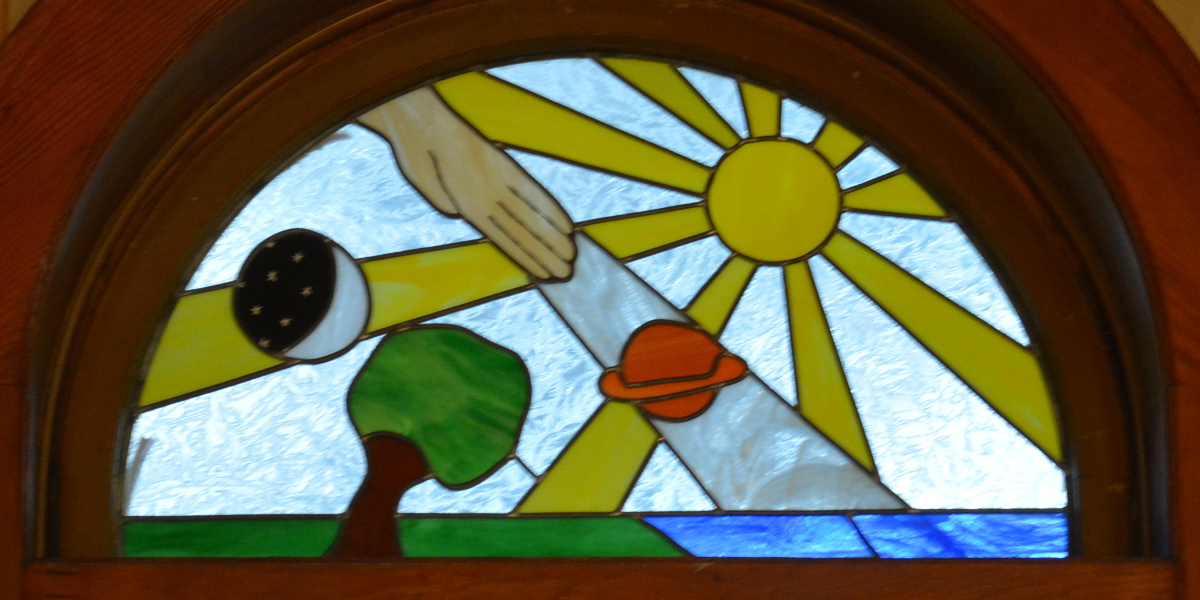
(picture from Saude Lutheran Church stained glass)
The Seventh Sunday after Trinity – Pr. Faugstad sermon
Text: Romans 6:19-23
In Christ Jesus, who not only freed us from sin, but who also freed us for a life of righteousness, dear fellow redeemed:
In one of the books that the kids and I read recently, we read about a ship exploring unmapped parts of an imaginary sea (The Voyage of the Dawn Treader by C. S. Lewis). The crew came across an island covered in darkness where a half-wild man swam toward the boat yelling for them to turn back. When he got on board, he told them it was an enchanted island “where dreams come true.” At first, the sailors thought this sounded appealing—who wouldn’t want their dreams to come true? Then it hit them that not all dreams are good dreams, and they rowed away as fast as they could.
This illustrates how something that seems to offer ultimate freedom might actually deliver the opposite. The same goes for the choices we make in our life. We might like to think that we are perfectly free to do whatever we feel like doing. But what if the choices we make result in our having less freedom? So I might think that pursuing my desires is freedom, but if those desires are sinful, then I am being drawn away from holy and noble things, and I become bound up in sin.
And the more bound up in sin I am, the more difficult it is not to sin. Those who are addicted to alcohol and drugs, to pornography, to gambling, or to certain kinds of foods know this well. The more they need their “fix,” even though it is harming them spiritually, mentally, and physically, the harder it is to stop. In fact, all of us are drawn to our particular sins, whatever they may be. We might think we can stay in control and not let our sinful desires control us. But then we fall and keep falling. One theologian put it this way: “[W]e cannot take sin or leave it [as though we are always in control]. Once we take sin, sin has taken us” (Martin Franzmann, Romans: A Commentary, p. 116).
As much as we should resist sin, and as much harm as it does us, we still find ourselves “taking” it. This is because we have a sinful nature, a part of us that is inclined to do the opposite of what God wants. In today’s reading, Paul describes our natural state as a sort of slavery. Slaves of sin pursue “impurity” and “lawlessness leading to more lawlessness.”
This is a slavery we were born into because the perfectly free and righteous Adam and Eve chose to give up this freedom. They disobeyed the command of God and chose lawlessness. We inherited their sin, but we have chosen it too. The apostle John wrote that “Everyone who makes a practice of sinning also practices lawlessness; sin is lawlessness” (1Jo. 3:4). And Jesus taught, “Truly, truly, I say to you, everyone who commits sin is a slave to sin” (Joh. 8:34).
This is very different than what we hear from the world. The world says that freedom is found in “following our heart,” and doing whatever makes us feel happy. We are told to prioritize our own choices and desires without really considering how those choices affect others. And if our plans contradict what God says in the Bible, we are urged to “stay true to ourselves.”
But a life of sin is no free life. It may deliver temporary happiness. You may have pleasure for a time or power or possessions. But all of it will slip through your fingers like a handful of sand. Paul writes, “For when you were slaves of sin, you were free in regard to righteousness. But what fruit were you getting at that time from the things of which you are now ashamed?” What do the works of sin add up to? What have we actually accomplished by going our own way? Paul states the stark reality: “For the end of those things is death.”
That is what our life of sinful choices results in: death. “For the wages of sin—what we earn by our sin—is death.” A person may think he is free apart from Christ, but he is actually enslaved, and he cannot free himself. Being a slave of sin is like being stuck without water in a boat on the ocean. You can drink the salt water, you can keep sinning, but it will only make you more and more parched until it kills you.
This view of human beings as slaves of sin rather than naturally free is completely rejected by the unbelieving world. Its response is like the Jews who said to Jesus, “[We] have never been enslaved to anyone. How is it that you say, ‘You will become free’?” (Joh. 8:33). If you don’t know you are separated from God, you won’t know how desperate your situation is. If you don’t know you are a slave of sin and death, you won’t know you need to be freed.
We have compassion for the people around us who are in this state. They don’t know what they don’t know. They need to be awakened spiritually just as we have been through the power of God’s Word. They need to hear—just as we need to keep hearing—what Jesus has done for us, how He entered the prison house of our slavery and removed our chains of sin.
He did this by letting Himself be bound. Even though He never sinned, He accepted the wages of our sin. He took our place and paid that price. He was beaten and flogged for our disobedience. “He was wounded for our transgressions” (Isa. 53:5). We can’t see how deep our sin runs and how much damage it has done. But Jesus knows, because He paid for every last sin of every single person. The price He paid for our freedom was tremendous.
This is what God the Father sent Him to do. The Son of God speaking through the prophet Isaiah said, “the LORD has anointed me to bring good news to the poor; he has sent me to bind up the brokenhearted, to proclaim liberty to the captives, and the opening of the prison to those who are bound” (Isa. 61:1). Jesus came to proclaim and win our liberty and freedom—not liberty and freedom for sin, but liberty and freedom from sin.
Paul emphasizes this point in today’s reading. He says that as you once willingly participated in sin, now through faith dedicate yourself to pursuing righteousness. In fact, he says that it can only be one or the other. Either you are a slave of sin, or you are a slave of righteousness (Rom. 6:18). Slavery to righteousness is not an oppressive slavery; it is not unpleasant. If slavery to sin is like drinking salt water that makes you thirstier, slavery to righteousness is like drinking pure, cold water on a hot day.
God did not create us and redeem us to sin; He created and redeemed us to do good. When we pursue righteousness, we are not acting against God’s purpose for us. We are doing what He called us to do and living according to His will. This is the sanctified life that He works in us through His Word. He brings us more and more in line with His will as He brings us the forgiveness and righteousness of Jesus. This is why we can produce good fruit in our life; it is because we are joined to Jesus.
So we give Him the glory for the good we do. He is the one who works blessings for others through our small efforts. He multiplies our little words and works of righteousness, so they have a great impact. Taking credit for all the good we are able to be part of would be like the disciples taking credit for the food that fed four thousand, because they provided the seven loaves and a few fish (Mar. 8:1-9). That would be obnoxious and prideful.
All that we have and all that we are able to do are gifts from God. We do not deserve the freedom we have in Him—freedom from having to answer for our sins, freedom from the eternal punishment we deserve, freedom to bear good fruit in His name and to enter heaven by His grace. We do not deserve it, but this freedom is most certainly ours. “For the wages of sin is death, but the free gift of God is eternal life in Christ Jesus our Lord.”
This is what we receive as the “slaves of God.” We receive the inheritance of sons. We receive eternal life. Slavery to God is not oppressive, except to our sinful nature. God guards and keeps us, so that we do not become lost in the darkness where even our worst dreams come true. Through His Word and Sacraments, He leads us out of the darkness of sin, He feeds us so we eat and are satisfied (Mar. 8:8), and He prepares us to inherit His kingdom in the life to come.
The slaves of sin in this world may appear to have everything, but without Christ they have nothing. The slaves of God may appear to have nothing in this life, but in Christ they have everything.
Glory be to the Father and to the Son and to the Holy Ghost; as it was in the beginning, is now, and ever shall be, forevermore. Amen.
+ + +
(picture from “Crucifixion, Seen from the Cross,” by James Tissot, c. 1890)
(No audio recording is available for this sermon.)
Midweek Lent 2 – Pr. Abraham Faugstad homily
Texts: Genesis 3:8-13, St. Luke 23:32-34
Dear Fellow Redeemed,
King Solomon wrote, “There is nothing new under the sun” (Ecclesiastes 1:9). Wise words from a wise man. Although we have had over 7,000 years, we have not improved Adam’s argument for why we sin. As soon as there was sin, there was blame and accusation. “The woman whom You gave to be with me, she gave me the fruit of the tree, and I ate.” No personal responsibility. No regret. No remorse. Just blame. Surely, “There is nothing new under the sun.”
Adam’s response is shocking. Here we see the audacity and shameful boldness sin creates, even attacking God. The woman “whom you gave” me, she caused me to sin. Adam was clearly in no position to pass the blame. The Lord had commanded him not to eat of the tree of the knowledge of good and evil. The Lord had placed him as the spiritual leader of his household including teaching and defending his wife, but he failed. While it is easy for us to see how absurd it was for Adam to blame anyone one but himself, it is often more difficult to see it in ourselves.
If you have a pulse, you understand the impulse to blame others. A spouse says in a marriage confrontation, “If you wouldn’t have done that or been more considerate, I wouldn’t have done that to hurt you.” A child says to his parent, “I wouldn’t have done that if you would have listened to me!” A neighbor complains, “I wouldn’t have done that if you would just pick up your own leaves!” A politician blames the members of the other party, the citizen blames the politician… No personal responsibility. No regret. No remorse. Adam blamed the woman whom God gave him; Eve blamed the serpent, and the blame game has continued ever since. “There is nothing new under the sun.”
When we try to show someone they are wrong, we may, even unconsciously, feel a boost in our pride. We often have secret motives. But that is not how God works. When God shows us our sins, he does it to save us. Consider the tender and fatherly way the Lord called out to Adam after they had sinned: “Where are you?” No harsh words. No attack. A simple question, giving Adam the opportunity to come forward to confess. We see this same patience from Jesus on the cross when he prays, “Father, forgive them, for they know not what they do.” He was not just praying for the soldiers or the two criminals who mocked him. Jesus was praying for all people—for those who don’t recognize their sin, who fail to see the consequences that their sin deserves. God wants us to repent.
The Lenten season is a time for repentance. By nature, we try to justify our behaviors and sin. We might blame it on someone or something else and think that it is okay. The Greek word for repentance literally means, “think differently afterwards.” God causes us to see the truth, to think differently about our sins, by using the mirror of the Law. When you look in the mirror, who do you see? Yourself. God shows us that we have sinned against God. He sees all your sins, do you? Or do you choose to only see the sins of others?
John writes, “If we say that we have no sin, we deceive ourselves, and the truth is not in us” (I John 1:8). Last week we heard the sobering words the Lord spoke to Adam after he sinned, “Dust you are, and to dust you shall return” (Genesis 3:19). With these words we are reminded and acknowledging that we are sinners and the wages of sin is death.
Yet, God doesn’t show us our sin to push us down and leave us in despair. He shows us our sin to lead us to Jesus. We learn in the Catechism that Confession, has two parts. First, we confess our sins. Then, “We receive absolution, or forgiveness, from the pastor or confessor as from God himself, and in no way doubt, but firmly believe that our sins are thereby forgiven before God in heaven.”
At the very moment God shows us the severity of our sin, he shows us his love. The fact that it took the only begotten Son of God to pay for our sins, shows us how terrible and hopeless we were on our own. Yet, when we see Jesus on the cross, we also see the love of God—that he would suffer and die for you and me. He doesn’t blame us, he prays for us, “Father, forgive them, for they know not what they do.”
Consider this—at the very worst time in history, God attested his love for us. Adam and Eve fell into sin. Sin ruined creation and brought death—Adam even blames God. But what does God do? He promises the Seed of the woman, who will crush Satan’s head. What love! Jesus, the very Son of God, is beaten, mocked, and crucified. But what does he do? He prays for us. He prays for our forgiveness, showing that is exactly what he was accomplishing with his death. What love!
There should be no doubt that our sins are forgiven. Jesus accomplished it all on the cross—it is finished. Yet, as the devil tempted Eve, he still tempts us—“Did God really say that?” Do you really think he is going to forgive you after what you’ve done? When the devil tempts us into sin, he tries to make it seem like no big deal. Yet, after we sin or are near death, he attacks us—he accuses and blames us so that we might despair and lose hope.
This is why Lent is so important. While some Christians feel uncomfortable during Lent, we all need to meditate on it. Certainly, it reminds us about the seriousness of our sin. Yet, even more importantly it points us to Jesus who has paid for our sins. The season of Lent gives us the greatest ammunition against the devil’s attacks to doubt God’s forgiveness. Jesus lived for you. He suffered for your sins. When he was on the cross, did he blame you for putting him there? No. He uses his last words to pray for us and our forgiveness. The only innocent man to ever live, pled guilty for you. You are now free. Your sins are forgiven. God the Father declares you innocent for Jesus’ sake!
Permit me to quote at length, an excerpt from Martin Luther’s commentary on Galatians. Here he gives us advice on what we should do, when the devil accuses us of our sins:
“When the devil accuses us and says, ‘You are a sinner and therefore damned,’ we should answer, ‘Because you say I am a sinner, I will be righteous and saved.’ ‘No,’ says the devil, ‘you will be damned.’ And I reply, ‘No, for I fly to Christ, who gave himself for my sins. Satan, you will not prevail against me when you try to terrify me by setting forth the greatness of my sins and try to bring me into heaviness, distrust, despair, hatred, contempt and blasphemy against God. On the contrary, when you say I am a sinner, you give me armor and weapons against yourself, so that with your own sword I may cut your throat and tread you under my feet, for Christ died for sinners. . . . As often as you object that I am a sinner, so often you remind me of the benefit of Christ my Redeemer, on whose shoulders, and not on mine, lie all my sins. So when you say I am a sinner, you do not terrify me but comfort me immeasurably.’”
You are a sinner, but you are a sinner for whom Christ died. He has taken the blame—all your guilt, your sin, every careless thought and word—to the cross. You can repent with hope. Hope of forgiveness. Hope for this life and the life to come. You are dust, but from the dust you shall arise… “And shall meet Him in the skies, death itself is transitory, I shall lift my head in glory.” Amen.
(picture from “Crucifixion, Seen from the Cross,” by James Tissot, c. 1890)

Sexagesima Sunday – Vicar Lehne sermon
Text: St. Luke 8:4-15
In Christ Jesus, who never gives up on us, dear fellow redeemed:
When we hear the parable of the sower, we can easily focus on how each type of bad ground was described and wonder, “Well, what did the sower think was going to happen?” If you throw seed onto a path, of course it isn’t going to take root, but be trampled and devoured by birds. If you throw seed onto rocks, of course it isn’t going to have a deep enough root to get the moisture it needs to grow. If you throw seed among thorns, of course the thorns will grow up with the seed and choke it. But the picture that Jesus is using in this parable actually describes things that the people at that time would be familiar with.
Before the farmers did any sowing, the field was first plowed to break up the soil. After the plowing was done, the entire field would appear to be good soil, but that was not the case. Some parts of the field only had a thin layer of soil on the top with a layer of rock beneath it. Some parts of the field ended up growing thorny weeds along with the seed, weeds that can pop up anywhere no matter how much a person tries to protect their crops from them. Plus, as a sower threw his seed out onto the field, some of the seed would undoubtedly fall on the paths of soil that were packed down from people walking on them.
Jesus uses these relatable struggles of farming to teach us that God generously sows the seed of his Word in every type of heart, not just the hearts that are the most ideal, because God “desires all people to be saved and to come to the knowledge of the truth” (1 Timothy 2:4). But not everyone who receives his Word is saved. Some people hear the Word, but their hearts are hard like the packed down soil of a path that runs through a field. So, the Word doesn’t take root in their hearts and is plucked away by the devil. Some people hear the Word, and the Word fills them with joy. They appear to be strong Christians on the surface, but in reality, their faith is shallow, like a thin layer of soil on top of a layer of rock. Their faith is unable to get the nutrients it needs to stay alive, so when they are faced with hard times, they fall away. Some people hear the Word and receive it in faith, but the cares, riches, and pleasures that surround them like thorny weeds choke their faith and kill it. And some people hear the Word and hold on to it. Their hearts are repentant and, through their trust in God, they are able to patiently endure what destroyed the faith of the others and produce a crop that shows the fruit of their faith.
Of these four types of soil, which soil are you? That seems like a silly question. Of course you’re the good soil. You know that you’re a sinner and are repentant of your sins, you put your trust in God, and you do plenty of good things throughout your life that prove that your faith has produced a plentiful crop. But this parable is not just a warning to those who have rejected the Word, fallen from faith, or are in danger of losing their faith. This parable is also a warning to all of us who think that we are secure in our faith. As the apostle Paul says, “Therefore let anyone who thinks that he stands take heed lest he fall” (1 Corinthians 10:12).
There are many dangers that could result from us thinking that we are secure in our faith. One of those dangers is thinking that we don’t need to worry about sin because God forgives us all our sins anyway. Sin is a very serious thing, and if we think that God will forgive our sins whether they bother us or not, then we could end up no longer viewing sin as the serious thing that it is. Not taking sin seriously could also lead to us living in sin without feeling the need to repent and turn to Jesus for forgiveness. And if we don’t think that we need forgiveness for our sins, then we could think that we don’t need Jesus and lose our faith. What starts off as us not taking sin seriously could end up with us having hardened hearts, and the devil will have an opportunity to pluck the Word away from us.
There are times when we all become comfortable in certain sins. But when that happens to you, God doesn’t leave you alone to see if you’ll pull through on our own. If he did that, then your hearts would become hardened for sure. Instead, he gets to work on you, plowing the field of your heart to break up its hard soil. Through his Word, he shows you the seriousness of your sin, and that you deserve eternal death in hell. Then, through that same Word, he gives you the comfort of the gospel, showing you that Jesus paid the price for even your most serious and repeated sins by his death on the cross, so that you will not die, but live forever with him in heaven. Because of the sacrifice that Jesus made for you, you are God’s own dear child, and he will make sure that the devil cannot pluck you out of his hand.
But that is not the only danger to our faith. There is also a danger for us to feel secure enough in our faith that we don’t think that we need to regularly remain in the Word. After all, we’ve heard these accounts countless times and can even recite some of them by heart. We know the basic truths of Scripture: that we are all sinners, and that Jesus died for our sins. This could cause us to think that we don’t need to keep reading the Word or coming to hear the Word, because we think that we already know everything. But, if we don’t keep coming back to the Word, then our faith won’t be able to receive the nutrients that it needs to stay alive. It will become shallow, like the thin layer of soil on top of the layer of rock. And if we have a shallow faith when we enter a time of testing, then we are in trouble.
There are many times throughout our lives when God allows us to enter a time of testing. These times of testing can be quite hard on us. There are times when work can be difficult due to people we are interacting with or due to the demands of our work that seem unattainable. There are times when we think that we are doing great at our tasks or with our relationships, and then suddenly, we mess up in a way that we don’t think we’ll be able to recover from. There are times when our loved ones fall ill and begin to suffer terribly, or their lives are taken from us in tragic ways. No matter what our difficult times are, God promises to be with us and help us through them. He gives us this comfort through his Word. But if we have not kept our faith nourished though his Word, then where are we going to get that comfort from? As a result, the burden of our troubles could appear to be too much for us, and we could end up falling away from the faith, wondering why God allowed this to happen to us.
If your faith is starting to get shallow because you are not remaining in the Word, God takes appropriate measures to help you. He breaks up the rock beneath your shallow faith and works through his Word to fill that space with more faith, so that the Word can take root in your heart and thrive. Often, he works through times of testing to accomplish this, reminding you of how much you need him and of how much he has done for you, including giving up his own life for you. By dying on the cross, Jesus dealt with your biggest problems of all: sin and death. And if God loved you enough to die for you, then surely, he also loves you enough to keep his promise to always be with you and bear your burdens in your time of need. When God turns you back to his comforting Word, the joy you feel is no longer a shallow joy that can easily be destroyed, but a joy that comes from the deepest parts of your heart.
The last danger to our faith is the distractions that the world surrounds us with. These distractions can appear to be harmless. After all, what’s wrong with earning a little extra money, or buying some items that we’ve always wanted, or going to sporting events and other fun places? There is nothing wrong with these things in and of themselves, but when those things start to become more important to us than God, then we have a problem. What starts as just wanting to earn a little extra money could turn into spending as much time working as possible, even if it means we don’t have time to gather around the Word anymore. What starts as just wanting a few items could turn into us obsessing over those items and wanting to spend all of our time making use of them rather than spending that time in the Word. What starts out as us wanting to go to a few fun events and places could turn into us going to them whenever we can, even if it means that we have to sacrifice gathering around the Word. When the distractions of this world overtake us, they can choke our faith out and kill it, like seeds growing up surrounded by thorny weeds.
When you are in danger of having your faith choked out by the distractions of this world, God comes to you to remove those distractions, like a farmer pulling weeds. He can remove these distractions in many different ways, whether it’s by helping you to realize that you need to distance yourself from them or by removing them from you by other means. It can be difficult for us to part from our distractions, but when we do, and God works in us to make our faith grow free of those distractions that were choking us, we realize just how little we actually needed them. We also realize how much we need the blessings that Jesus won for us on the cross that God brings to us through his Word: the forgiveness of sins, life, and salvation. The work that Jesus did to earn you these blessings is more important than any work you could ever do. These blessings that Jesus purchased for you on the cross are more valuable than anything you could ever purchase. The event of Jesus’ suffering and death is a more significant event than anything you could ever attend. And thanks to the work that God does on your hearts through his Word, you realize just how much greater Jesus and the blessings that he won for you are than the distractions of this world.
When a farmer plants his seed, he doesn’t leave it unattended. He keeps coming back to make sure that it’s healthy and growing, and if he needs to work the ground some more to protect his crop, he will. God doesn’t leave you unattended either. He has planted his Word in your hearts and is constantly making sure that your hearts remain fertile soil for his Word. Even when your hearts are not the ideal ground for the Word to grow in, God never gives up on you and is always working the soil of your hearts to make sure that his Word can take root in your hearts and grow. Because of God, your faith is protected and taken care of. Because of God, you know that the blessings that Jesus won for you on the cross are yours.
Glory be to the Father and to the Son and to the Holy Ghost; as it was in the beginning, is now, and ever shall be, forevermore. Amen.
+ + +
(picture from Hortus Diliciarum, a book compiled by Herrad of Landsberg in the 12th century)