

The Second Sunday in Lent – Pr. Faugstad sermon
Text: St. Matthew 15:21-28
In Christ Jesus, who promises that whoever comes to Him, He will never cast out (Joh. 6:37), dear fellow redeemed:
Jesus had not entered the Gentile district of Tyre and Sidon to interact with the locals or to gather a crowd. On the contrary, the evangelist Mark reported that “he entered a house and did not want anyone to know” (7:24). The Canaanite woman who came looking for Him would have noticed that He was not looking to be seen or talked to. So what made her pursue Him so relentlessly?
There were two reasons: her daughter was severely oppressed by a demon, and she believed that Jesus could heal her. We don’t know how long the demon had afflicted her daughter or how it affected her. But obviously no one else had been able to help. What made her think that Jesus could succeed when all others had failed?
The answer is in the way she addressed Him: “Have mercy on me, O Lord, Son of David,” she said. She was confessing that Jesus was the promised Messiah descended from David’s line. She had obviously heard about Jesus, what He had taught and the miracles He had done. On the basis of these reports, she believed that He was the true God in the flesh. That’s why she knew He could help her daughter, just as He had helped many others throughout Judea and Galilee.
When the Canaanite woman followed after Jesus crying for His mercy, at first He said nothing to her, absolutely nothing. He certainly gave the impression that He wasn’t interested in hearing her troubles. But He didn’t say “no.” The woman kept asking. She begged for His help again and again, so much so, that the disciples grew tired of her cries. Now they begged Jesus to send her away, so they could have some peace. Jesus’ reply? “I was sent only to the lost sheep of the house of Israel,” meaning the Jews and not the Gentiles. That still wasn’t a “no.”
Now she fell down on her knees right in front of Jesus and said, “Lord, help me.” She would not be ignored, and she was not going to leave until Jesus ordered her to. He did not do this. Instead, He used an analogy for what He said before, that He was sent for the Jews: “It is not right to take the children’s bread and throw it to the dogs.” The “children’s bread” is the salvation God had chosen His people Israel to taste and see. The Israelites had the Holy Scriptures. They knew the promise of a Savior. They had been waiting for its fulfillment. Why should the Gentiles have the same gift when they had rejected the true God for so long?
Jesus said it was neither good nor right to take bread from the children—the Jews—and throw it to the dogs—the Gentiles. It sounded kind of harsh, but even that wasn’t a hard “no.” Far from being put off by what Jesus said, the woman seized on His words as an invitation: “Yes, Lord, what You say is true. We Gentiles don’t deserve to have what the Jews have. I know I don’t deserve Your mercy, yet even the dogs eat the crumbs that fall from their masters’ table.” “I’m not asking to be treated like the children,” she said. “I’m just happy to have the crumbs that fall on the floor, because even the crumbs from You, O Lord, Son of David, are more than enough!”
What an expression of faith! What dogged confidence in Jesus! What kept her coming? Why didn’t she give up when Jesus acted so disinterested? Well if she walked away, her daughter would still be severely oppressed by a demon. Besides that, she knew who Jesus was, the promised Messiah. She wasn’t going to leave the only One who could help. This is what Peter said when other disciples of Jesus were leaving because His teaching offended them. Jesus asked the Twelve, “Do you want to go away as well?” (Joh. 6:67). Simon Peter replied, “Lord, to whom shall we go? You have the words of eternal life, and we have believed, and have come to know, that you are the Holy One of God” (vv. 68-69).
Those “words of eternal life” from our Lord are what strengthen our faith and give us hope in the difficult times. God also uses the trials themselves to test our faith, refine it, and exercise it, so that our focus on Him is sharpened. That’s what happened with the Canaanite woman. Her tremendous difficulties with her daughter did not crush her faith; these challenges made her faith stronger. She wouldn’t have gone looking for Jesus if everything in her life was going well. But she did when she was suffering. Then when she found Jesus, His behavior toward her might have seemed uncaring, but it caused her to be even more persistent and cling more tightly to Him.
Why does a parent take an extra step away from the wall of the pool when a little child is getting ready to jump in? It is to increase the child’s trust: “Don’t worry, I will catch you. I will keep you safe.” That’s what Jesus says to us when the distance from here to there looks too far, when we can’t imagine surviving another health setback, when giving up a particular sin requires too much sacrifice, when the consequences for saying “no” to the crowd are too painful. “Don’t worry,” says Jesus, “I will catch you. I will keep you safe.”
But is it true? Has the Lord caught you when you had to take a leap of faith? Did He bless you and keep you and give you peace in your times of greatest difficulty? Have you emerged from those trials stronger or weaker? Perhaps you’re not sure. Our perception about these things is often affected by our expectation. If our expectation is that we should never have to suffer or experience hardships, but that life should go about how we plan, then our perception will almost certainly be that God has failed us. He didn’t keep us from pain.
But if we accept what Jesus says, “In the world you will have tribulation” (Joh. 16:33), then we will not go looking for trials, but we also won’t be taken by surprise when they come. And when troubles do come, God promises to work through them for our good. That’s what Romans 8:28 says, “And we know that for those who love God all things work together for good, for those who are called according to his purpose.” He says He will turn every trial, every heartache, pain, and sorrow into blessings for us somehow. We don’t always figure out just what those blessings are, but we trust that this is true.
The woman might not have perceived a blessing in the way Jesus seemed to avoid her and put her off. But that all changed when Jesus said, “O woman, great is your faith! Be it done for you as you desire,” and she returned home to a daughter healed. This woman is a tremendous example for us. We learn from her what to do when our suffering is intense, when the Lord seems to be ignoring us or seems to be punishing us, when we feel no better than a despised dog. She kept her eyes on Jesus. No matter how He responded (or didn’t respond) to her cries, no matter what she experienced, she kept crying out for His mercy and help. Like Jacob wrestling with God, she would not let her Lord go unless He blessed her (Gen. 32:26).
Her faith in Him was not disappointed. Faith in Jesus never is. Faith ties you to Him. It connects you to Him who is Love incarnate, who took on your flesh to redeem you from sin and death, who covers you in His righteousness. The woman was right that the crumbs of His grace are more than enough. But Jesus gives you more than crumbs. He gives His grace in abundance through His holy Word and Sacraments, so that every sin of weakness and doubt is forgiven, and you are given the strength you need to go forward and endure.
So we come here like dogs who expect good things from their good Master. We keep our eyes trained on Him, we listen to what He says, and we want to please Him by what we do. Sometimes He will make us wait for something in order to teach us patience and trust. But then He opens His hand and gives us everything we need. He feeds us with His body and blood as we kneel before Him at the Communion rail. He assures us that He forgives all of our sins, and that He is well pleased with us.
Though it didn’t seem like it at first, Jesus loved that Canaanite woman. If He wanted to get rid of her, He could have. But He wanted her to keep crying out, keep pursuing, keep begging, until the time was right to grant her request. Jesus loves you in the same way. He wants you to follow Him and not get discouraged when your troubles don’t go away as quickly as you would like. He hears all your cries, and He promises that at the right time, He will grant your request, or He will continue to strengthen you in the struggle.
The faithful woman gladly embraced Jesus’ reference to the family dog waiting at the side of the table. We can do the same. Not only are we Gentiles like she was, but we know that Jesus came to save us, too, and has abundant grace to help in our times of need. We don’t have to have all the answers. We don’t have to get ourselves out of all our troubles. Like a pet that is well-cared for by its master, we know our merciful Lord will care for us.
So we keep our eyes fixed on Him. We do not give up, even when it seems like He isn’t listening. We hold Him to His promise that He will have mercy upon us. Because He does, and He will.
Glory be to the Father and to the Son and to the Holy Ghost; as it was in the beginning, is now, and ever shall be, forevermore. Amen.
+ + +
(picture from 15 century French Gothic manuscript painting)

Quinquagesima Sunday – Pr. Faugstad sermon
Text: St. Luke 18:31-43
In Christ Jesus, who is patient and kind, ever ready to show mercy in our suffering and helplessness, dear fellow redeemed:
How can you tell if you love someone, and how can you tell if they love you? Is it by how they look? This might be the reason for an initial attraction. A girl thinks a boy is handsome, or a boy thinks a girl is pretty. That could be the beginning of a crush—what is sometimes called “love at first sight”—, but that’s not exactly love. Love is much deeper than physical appearance or a feeling of attraction. And love is more than romantic or flattering words.
Today’s Epistle Lesson from 1 Corinthians 13 describes love as selfless action: “Love is patient and kind; love does not envy or boast; it is not arrogant or rude. It does not insist on its own way; it is not irritable or resentful; it does not rejoice at wrongdoing, but rejoices with the truth” (vv. 4-6). “Love at first sight” is more about what you could do for me. Love that flows from Jesus is about what I can do for you.
And what did Jesus say He would do for others? He said, “See, we are going up to Jerusalem, and everything that is written about the Son of Man by the prophets will be accomplished. For He will be delivered over to the Gentiles and will be mocked and shamefully treated and spit upon. And after flogging Him, they will kill Him, and on the third day He will rise.” The disciples did not hear this as love. They heard it as suffering and especially as loss—their loss. They had big plans for Jesus and for themselves as His closest associates. Those plans did not include Jesus’ suffering and death.
Instead of letting Jesus’ plan and promise “sink into [their] ears” (Luk. 9:44), they insisted on their own way. And if they had gotten their way, they might have enjoyed more earthly glory, but neither they nor we would have a Savior. Jesus’ love for sinners compelled Him toward suffering and the cross. Nobody forced Him to go to Jerusalem; He went willingly.
That’s another quality of godly love—it can’t be forced. When love is a “have to,” it is motivated by the Law. When love is a “get to,” it is motivated by the Gospel. The Law says, “You shall love the LORD your God with all your heart, soul, and mind… and your neighbor as yourself” (Mat. 22:37,39). But only the Gospel can move our hearts to show this love gladly and freely. Only when we have been brought to faith by the Holy Spirit, can we bear the fruit of love toward others.
Jesus was acting out of love when He explained what He would do in Jerusalem. He was going there to pay for the sins of all people of all time, even though He had never done any wrong. This was the ultimate act of love, accepting the eternal punishment that everyone else deserved. The disciples in their selfishness would have stopped Him from going to do this, but His love for them and us compelled Him forward.
As He made His way toward Jerusalem, a large crowd went with Him. It was shortly before this that Jesus had raised His friend Lazarus from the dead, and He continued to do other miracles besides. The reports of His miraculous power traveled in every direction, and they also reached the ears of a blind man who lived in or near the town of Jericho in Judea. He was begging by the road outside of town when the crowd passed by with Jesus. As soon as he learned that Jesus was near, he began to cry out, “Jesus, Son of David, have mercy on me!”
The members of the crowd had referred to Him as “Jesus of Nazareth,” but the blind man called him “Jesus, Son of David.” This tells us that from the reports he heard about Jesus, he was convinced that Jesus was the Messiah, the Savior long-promised to Israel. Though he could not see physically, the blind man “saw” Jesus by faith. He believed what He had heard about Him. He is a wonderful example of what Jesus later said to His disciple Thomas, “Blessed are those who have not seen and yet have believed” (Joh. 20:29).
This man’s faith shines the more brightly when we think about his situation. He was blind and probably had been his whole life. He had no source of income, so he was forced to beg on the side of the road. If you were in his shoes (assuming he had any), would you be more likely to complain about what God wasn’t doing for you or cling to His promises? Trust Him to provide for you or turn away from Him?
Jesus heard the blind man’s cry for mercy, just as He hears yours. Psalm 34 says, “The eyes of the LORD are on the righteous, And His ears are open to their cry” (v. 15, NKJV). Perhaps no one else knows your particular struggle, your pain, how helpless you sometimes feel. But He does. For you, He was “mocked and shamefully treated and spit upon.” He was treated like the blind beggar on the side of the road that no one wanted to look at or listen to. “He was despised and rejected by men; a man of sorrows, and acquainted with grief” (Isa. 53:3).
He endured all this trouble and suffering, so you would have hope in your trouble and suffering. Maybe you have been hurt or harmed by those who were supposed to love you. Maybe you feel like your efforts to love have been thrown back in your face. That is a lonely place to be in, like being stuck by yourself in the darkness.
Jesus does not leave you alone. He does not withhold His mercy from you. Look how personally He dealt with the blind man. “Bring him here to Me,” He said. Then He asked the blind man this grace-filled question: “What do you want Me to do for you?” This is how Jesus invites you to pray. He says, “ask, and it will be given to you; seek, and you will find; knock, and it will be opened to you” (Luk. 11:9). No problem is too big or too small for Him. No request is too hard. You don’t always know what is best for yourself, but He does, and He wants you to bring your petitions to Him.
The blind man said, “Lord, let me recover my sight.” He said this about his physical sight, but we say the same about our faith. The less we hear Jesus’ Word, the less clear His love for us is. The more we hear His Word, the clearer He is to our faith. Our sinful flesh and the temptations of the world and the devil cloud our faith. We get to thinking too much about human glory like the disciples did. We become bitter dwelling on what we should have received but didn’t. But getting exactly what we want when we want it is not the way, the truth, and the life. Jesus is.
That’s another lesson the blind man teaches us. If you had been blind your whole life and could suddenly see, what would you do? Where would you go? This is what the formerly blind man did: he “followed [Jesus], glorifying God.” Whether physically blind or seeing, what mattered most was that this man believed in Jesus. Jesus said as much, “your faith has made you well.”
When we come to church, one of the first things we do is confess our sins. We acknowledge that our spiritual vision is not as sharp as it should be. Our love is lacking. Our faith is weak. As we confess, we say with the blind man, “Lord, let me recover my sight.” “Let Your mercy be upon me. Let me see Your love. Forgive me all my sins. Show me the light of Your grace.” And Jesus says through the mouth of the pastor, “I forgive you all your sins. Recover your sight; your faith has made you well.”
The faith that you have, that the Holy Spirit worked in you through the powerful Word, is what connects you to the love of God in Christ Jesus. Faith sees Jesus “mocked and shamefully treated and spit upon,” flogged, and nailed to a cross and says, “Jesus did that to redeem me.” Faith hears Jesus cry, “It is finished!” and says, “He finished the work for me to win my salvation.” Faith sees the empty tomb on Easter Sunday morning and declares, “Jesus conquered death for me.”
Jesus did more than tell you He loves you. He showed it. And He keeps showing it by calling you back to the grace of your Baptism by which He joined you to Him, by filling you with comfort through His Word of absolution, and by strengthening you through the Supper of His holy body and blood. He is not about to pass you by, especially in your times of greatest suffering and need. Whether you are in Jerico, Iowa, or Jericho in the Middle East, He comes to you in love through His Holy Word.
We won’t fully understand the extent of His love in this life. Our sinful flesh keeps us from seeing it in all its “breadth and length and height and depth” (Eph. 3:18). But the day will come when we will see Jesus as He is. Like the blind man who had the shadows lifted from his sight, we will look upon Jesus in His glory and see perfect love embodied in Him. 1 Corinthians 13, the great love chapter, describes how this will be: “For now we see in a mirror dimly, but then face to face. Now I know in part; then I shall know fully, even as I have been fully known” (v. 12).
Glory be to the Father and to the Son and to the Holy Ghost; as it was in the beginning, is now, and ever shall be, forevermore. Amen.
+ + +
(picture from “Jesus Healing the Blind in Jericho,” Netherlands 1470s)
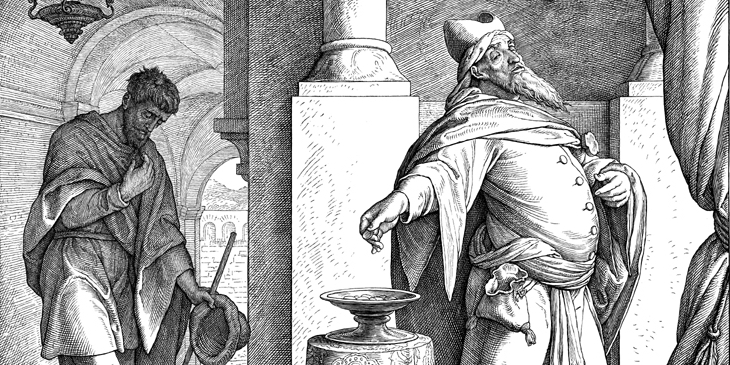
The Eleventh Sunday after Trinity – Pr. Faugstad sermon
Text: 1 Kings 19:9-18
In Christ Jesus, who knew exactly what to do when God sent Him down from His heavenly throne—save all people from their sins, dear fellow redeemed:
Two times the LORD asked Elijah, “What are you doing here?” “Here” was Mount Horeb, the same mountainous area where Moses received the holy Law from God. It was deep in the wilderness, south of the kingdom of Judah. Mount Horeb was a long way from Mount Carmel in the northern kingdom of Israel. Mount Carmel in the north is where the LORD showed His power over the prophets of Baal by consuming Elijah’s sacrifice with fire from heaven. When that happened, the people of Israel cried out, “The LORD, he is God; the LORD, he is God!” (1Ki. 18:39).
You heard about that last week. What you didn’t hear about is that Elijah commanded the Israelites to seize the prophets of Baal and kill them. The people did this; those false prophets were totally wiped out. Immediately after this, the LORD sent a great rain upon the parched land, rain that hadn’t fallen for three and a half years. Everything seemed to be changing for the better in Israel by the power of the LORD. So what was Elijah doing far away from Israel, way down south at Mount Horeb?
When Queen Jezebel learned that her prophets had been destroyed, she sent this chilling message to Elijah, “So may the gods do to me and more also, if I do not make your life as the life of one of them by this time tomorrow” (19:2). She was telling Elijah that he was as good as dead. Despite his victory at Mount Carmel by the power of the LORD, Elijah was now seized with fear. He “ran for his life” as fast and as far as he could go, away from where Jezebel was.
As the days passed and the miles stretched behind him, Elijah began to feel guilty. Why did he run from the wicked queen when she was no match for the almighty LORD? How could he be such a coward? He knew that he was not worthy to be a prophet of the LORD (19:4). But as his long journey continued, and God made it clear that Elijah’s work wasn’t finished, a self-righteous anger began to well up inside Elijah.
When the LORD asked, “What are you doing here, Elijah?” he had an answer ready, almost as though it had been rehearsed. He said, “I have been very jealous for the LORD, the God of hosts. For the people of Israel have forsaken Your covenant, thrown down Your altars, and killed Your prophets with the sword, and I, even I only, am left, and they seek my life, to take it away.”
Elijah’s complaint is understandable. The pressure on him was tremendous, and he knew of no one who shared the same devotion to the LORD. Elijah felt utterly alone. He had done what God directed him to do, but what had it accomplished? King Ahab and Queen Jezebel were still in power. The people of Israel remained in their sinful ways. And Elijah had been given a death sentence. It wasn’t fair. It was too much.
I imagine you can relate to that thought: “This isn’t fair; this is too much.” You have said that when you were stretched too thin, when more was expected of you than you could deliver. Or maybe you said it when you stayed faithful to the LORD, when you said or did what was right, and your reward for it was getting attacked or punished. You have felt alone, like the weight of the world was pressing down on you, and you couldn’t see how anything would improve.
As natural as this thinking is, it is also dangerous thinking. “This isn’t fair; this is too much,” is focusing on ourselves. It is turning over and over again in our minds the wrongs that have been done to us, the injustices we have experienced, the hardships that we don’t think we deserve. Tied up in that thinking is criticism directed at the LORD. It sounds like, “God, don’t You see what is happening? Why won’t You help? Can’t You see how faithful I have been? Don’t You care about me?” We can sympathize with lonely Elijah.
And how did the LORD respond to his reasons for running and hiding out in a cave in the wilderness? He sent a strong wind that tore at the mountains and broke the rocks in pieces. Then He sent an earthquake that made Elijah shudder in his cave. Then He sent a fire blazing across the face of the mountain. But the LORD did not appear in any of these forces of nature. After the fire had passed, Elijah heard “the sound of a low whisper.” When he heard this, “he wrapped his face in his cloak and went out and stood at the entrance of the cave.”
For the second time, Elijah heard the LORD’s question, “What are you doing here?” And for the second time, Elijah answered just as he had before. But after having experienced the wind, the earthquake, and the fire, and with his face now wrapped in a cloak, his answer had probably lost its edge. It’s kind of comical to think of Elijah talking through his cloak, “I have been very jealous for the LORD, the God of hosts,” and, “I, even I only, am left,” as He stood in the presence of the holy God. He didn’t look or sound quite as defiant or justified as he had before.
And that is as it should have been. It wasn’t Elijah’s job to tell God what He should be doing differently. It wasn’t Elijah’s job to determine what the LORD should do with his efforts. It was Elijah’s job to speak God’s Word faithfully and entrust his life to the LORD. When we insist on what is fair or on what God owes us, we sound like the Pharisee in the Holy Gospel, “I thank you that I am not like other men…. I fast twice a week; I give tithes of all that I get” (Luk. 18:11,12). He wanted everyone to hear why God should look with favor on him. He wanted his reward.
The tax collector saw things differently. The last thing he wanted was for God to reward him for what he had done. That would mean God punishing him for his sins. He knew that is what he deserved. Instead of trying to justify himself, the tax collector humbly bowed his head and quietly prayed, “God, be merciful to me, a sinner!” (v. 13).
The LORD gave him the gift of repentance, which is a gift He wants to give each of us. The way He leads us to repentance is through the clear preaching of His Law. In Catechism Class last week, the students reviewed what the Law is: “The Law is that Word of God which tells us how we are to be, and what we are to do and not to do” (ELS Catechism, p. 23). But none of us likes being told what we should and shouldn’t do. That’s what makes hearing the Law painful. It exposes the sins that we would rather keep hidden. It shows us that we are not as righteous as we want to think we are.
The Law accuses us and terrifies us like the wind, earthquake, and fire that God sent on the mountain where Elijah was. The LORD described the Law as functioning like this: “Is not my word like fire, declares the LORD, and like a hammer that breaks the rock in pieces?” (Jer. 23:29). The Law like a fire burns away our prideful and self-righteous thinking. The Law like a hammer breaks through the hardness and stubbornness of our hearts. St. Paul writes that the purpose of the Law is “so that every mouth may be stopped [like Elijah’s cloak wrapped around his face], and the whole world may be held accountable to God” (Rom. 3:19).
But once the Law has done its work, once it has humbled us like it did Elijah and the tax collector, then we hear “the sound of a low whisper,” a gentle word, from God. He promises us that all is not lost; He has a plan. He is not here to destroy us; He is here to save. We are not alone in our guilt; He is present with forgiveness and grace. This is the message of the Gospel. The Catechism students learn that “The Gospel (the Good News) is that Word of God which reveals the salvation Christ has won for all people” (ELS Catechism, p. 39).
We need this good news because all of us have sinned. All of us have played the part of the Pharisee, wanting to be seen as righteous by the good we have done. We must bow our heads like the tax collector, each and every day, and acknowledge that we are saved solely by the mercy of God. We are saved not because we deserve it, but because in His love, God the Father sent His Son to be our Substitute and our Savior.
In our weakness and impatience we complain, “This isn’t fair; this is too much.” But Jesus went forth like a Lamb uncomplaining, bearing the guilt of the whole world, taking the entire burden on Himself. He did not run from it. He didn’t argue His innocence. He didn’t make excuses for why He couldn’t do the job. Willing, all this He suffered (Evangelical Lutheran Hymnary #331, v. 1).
That means your sins of fear and despair, anger and impatience, pride and self-righteousness, are all forgiven, fully paid for, blotted from your record by His holy, precious blood. Now He cleanses your heart and mind to do His will, and He cleanses your mouth for words of truth and love. He has more work for you to do in His name, just as He had more work for Elijah to do.
He told Elijah, “You are not as alone as you think.” The LORD had preserved seven thousand in Israel who had not bowed the knee to Baal or kissed him by idolatrous worship. And He has done the same for you. He has preserved brothers and sisters in Christ in these congregations and around the world who are faithful to His Word.
His Word, both powerful and piercing in Law and calming and comforting in Gospel, will strengthen and keep you steadfast until your end, according to His gracious will.
Glory be to the Father and to the Son and to the Holy Ghost; as it was in the beginning, is now, and ever shall be, forevermore. Amen.
+ + +
(woodcut from “The Pharisee and the Tax Collector” by Julius Schnorr von Carolsfeld, 1794-1872)

The Fourth Sunday after Trinity – Pr. Faugstad sermon
Text: 2 Samuel 9
In Christ Jesus, who with the Father and the Holy Spirit is ever rich in mercy toward us sinners, dear fellow redeemed:
In ancient times, it often happened that when a king was defeated by an adversary, not only was he killed or imprisoned but so were his sons and grandsons. The new king would not risk a member of the former royal family challenging his throne. But David did not do this. He made promises to both King Saul and his son Jonathan that he would not exterminate the family when his time came to reign, but that he would show kindness to them.
Saul and three of his sons were killed in the same battle against the Philistines (1Sa. 31). When the nurse of Saul’s grandson heard the news of their deaths, she expected that Saul’s enemies would seek to kill all his family members. So she picked up the five-year-old boy and fled with him, “and as she fled in her haste, he fell and became lame. And his name was Mephibosheth” (2Sa. 4:4). When the last of Saul’s sons was later murdered, this left the crippled Mephibosheth as the only male heir of Saul.
David showed kindness to him not because he was worthy of it, but because David was merciful. He showed mercy because the LORD had been merciful to him. We, too, have opportunities each day to reflect the mercy to others that God has shown to us. God has not called us to show mercy only to those who treat us well and have earned our respect. He calls us to show mercy to all people, just as He has done.
Jesus says in today’s Holy Gospel, “Be merciful, even as your Father is merciful” (Luk. 6:36). Our mercy does not start with us; it starts with our heavenly Father. If it had to start with us, it would never happen. We learn mercy from Him. “For God so loved the world, that he gave” (Joh. 3:16). He looked upon each member of the human race as a lost sheep that must be saved and not as an enemy that must be punished. “For God did not send his Son into the world to condemn the world, but in order that the world might be saved through him” (v. 17). He sent His Son to die on the cross, so that our many sins are not counted against us but are blotted out by His blood.
God has not given us what we deserved. He is merciful—full of mercy toward us. He has redeemed us from our sin and brought us to faith in Him. By faith in Jesus, we are credited with His perfection. We are covered by His righteousness. His perfect mercifulness is attributed to us. As members of His holy body, we get to participate in His mercy work. We get to serve as His hands and feet and mouth in a world that needs His mercy.
Throughout its history, the Christian Church has shown mercy in countless ways. Christians have founded hospitals, orphanages, and care facilities around the world. They have protected those who are most vulnerable, from the unborn to the elderly. They have shown mercy to the poor, weak, sick, and handicapped. When disasters struck, they were the first to pitch in and help. They have promoted justice and fairness even for those who despised them and their beliefs. The whole world has experienced the mercy of the Christian Church.
But is the Christian Church carrying out this vital mercy work today? In many places it is, but there is a lot more to be done. Some in society have a positive view of the Church; they see the acts of kindness and love that are taking place, the ways that Christians are helping the helpless. But for many others, their view of the Church is that “Christians are just a bunch of hypocrites; they talk a good game but rarely do what they say.” Or, they say, “the Church only cares about taking our money.”
We can’t deny that there is a lot of hypocrisy, selfishness, and greed in the visible Christian Church. We don’t have the power to make these problems go away, and we don’t need some high-priced PR campaign to try to change people’s perceptions about the Church on earth. There will always be sin in the visible Christian Church. But for our part, we can focus on showing love and mercy to the people around us who need our help.
One of the things that keeps us from taking action is that we wait for others to take the lead. When we hear about the mercy work of the Church, we might think that the Church as an institution or each individual congregation has to organize this. “I’m willing to get to work,” we say, “if someone tells me where to be and what to do.” But the Church is not primarily an institution or a social service organization. The Church consists of all believers in Jesus.
You are the Church. You are the help and support that your neighbors need. You are the reflection of God’s love in your community. You don’t need to wait for someone to tell you where and when to have mercy. God presents these opportunities to you as you carry out your vocations, as you go about your regular activities, as you open your eyes and ears to the needs of the people around you.
Like David, we want to show mercy for mercy’s sake and not for personal gain. We want to humbly pursue acts of love and service toward others because we are children of the all-merciful God. That mercy starts in our own homes with our spouse, our children, our parents, our siblings. Then it branches out to our fellow congregation members, our next-door neighbors, the people we go to school with or work with, and the needy in places outside our communities. St. Paul writes by inspiration, “let us do good to everyone, and especially to those who are of the household of faith” (Gal. 6:10).
We are especially called to do good to our fellow believers in Christ. That should be obvious since we are united in our understanding and appreciation of God’s mercy and grace toward us. But it is often the case that the people we are closest to are the ones we consistently struggle to show love and mercy to. Maybe this is because we take them for granted, or because we expect more from them than we do from others whom we don’t know as well. But mercy needs to start right at home in “the household of faith.”
Part of doing good and showing mercy is not being too quick to judge and condemn, as Jesus teaches in today’s Holy Gospel (Luk. 6:36-42). It means being eager to forgive, ignoring the speck in a brother’s eye, and being honest about the log of sin in our own eye. This is challenging work. We can think of many times that we fell short of this. Instead of showing mercy, we held a grudge and hoped that others would feel the hurt that we did. Or we decided that someone wasn’t worthy of receiving our mercy; they were too far below us.
But look at what powerful King David did. He restored all the land of King Saul to his grandson Mephibosheth, even though Saul often tried to have David killed. David also honored Mephibosheth by giving him a place at his table. It was pure mercy, and Mephibosheth knew it. He said, “What is your servant, that you should show regard for a dead dog such as I?”
Our merciful Lord has done the same thing for us. Mephibosheth was in the line of a failed king, and he was lame in both feet. We were lost in the devil’s kingdom, and we were crippled by our sin. But God sought us out, brought us before His mercy seat, and announced that we would be honored members of His kingdom. He put His name on us at our Baptism and invited us to eat and drink at His holy table.
Anyone who knows us—the mistakes we’ve made, the sins we’ve committed—might wonder how the Lord could possibly look on us with such favor. They could point out the many times that we failed to show mercy, acted selfishly, judged others as lower than ourselves, pridefully refused to help. But like Mephibosheth who did nothing to merit David’s mercy, we have received everything from God by His grace. Our merciful Lord says, “I forgive you all your sins. I won’t count them against you now or ever. Come and join Me at My table.”
It is a joy to join the King at His table along with our brothers and sisters in Christ. None of us deserves to be here. None of us has earned this mercy. But we have it in full. Our Lord Is Full of Mercy Toward Us, and He has plenty of mercy to share with other helpless sinners like us. We pray that He keeps us ready for opportunities to share His mercy by our words and actions, so that others are blessed to know along with us His unchanging love. “O give thanks unto the Lord, for He is good, for His mercy endures forever” (Psa. 106:1).
Glory be to the Father and to the Son and to the Holy Ghost; as it was in the beginning, is now, and ever shall be, forevermore. Amen.
+ + +
(picture from “The Sermon on the Mount” by Carl Bloch, 1877)

The Sixth Sunday of Easter – Pr. Faugstad sermon
Text: Judges 16:18-30
In Christ Jesus, the greater and perfect Samson, who delivered us from all our enemies, dear fellow redeemed:
There is an error about prayer hanging around some of the branches of the Christian Church. The error is the idea that if you pray with enough faith, or if you have proven yourself worthy before God by your good works, then He will give you exactly what you ask for. When people who are taught this do not receive what they pray for, they have a crisis of faith. They assume that God must be punishing them for something. They picture Him looking upon them with fierce wrath instead of looking upon them with mercy.
We see a different picture in God’s dealings with Samson. But first, a little backstory is helpful. Before Samson’s mother had him, she had been unable to have children. The angel of the LORD appeared to her and said that she would “conceive and bear a son” (Jud. 13:3). He would be dedicated to the LORD, and his parents were directed to let his hair grow. As he got older, we are told that “the LORD blessed him. And the Spirit of the LORD began to stir in him” (13:24-25).
One of the ways the Holy Spirit “began to stir in him” was by giving him tremendous physical strength. On one occasion, a young lion charged at him roaring. “Then the Spirit of the LORD rushed upon him, and… he tore the lion in pieces” (14:6). The same language is used later on—“the Spirit of the LORD rushed upon him”—and he single-handedly killed thirty men among the Philistines who ruled at that time over the Israelites (v. 19). The LORD was using Samson to deliver the Israelites from their oppressors.
For his next act, he caught 300 foxes, tied them together in pairs and put a torch between them. Then he set them loose in the Philistines’ grain fields and olive orchards, and much was destroyed. The Philistines came after him, and with the jawbone of a donkey in his hand, Samson killed 1,000 of them. Another time, he tore out the gates and posts of one of their cities and carried it in one piece and set it on the top of a hill. Samson was a big problem for the Philistines.
And Philistine women were a big problem for Samson. We meet one of them in today’s reading, a woman named Delilah. The Philistine rulers promised her great riches if she would “seduce him” and find out “where his great strength lies” (16:5). Samson told her that if he were bound with seven fresh bowstrings, he would become weak. When he fell asleep, she bound him with seven fresh bowstrings, but when he woke up, he broke them easily. She kept trying. He told her that fresh ropes would do it, but he broke those too. Then he said if his hair were tied into a weaver’s loom, he would become weak. Delilah did this, but it didn’t work either.
It is obvious that Delilah could not be trusted, but she wouldn’t give up. She kept pressing and pressing until Samson finally gave in. “A razor has never come upon my head,” he said, “for I have been a Nazirite to God from my mother’s womb. If my head is shaved, then my strength will leave me, and I shall become weak and be like any other man” (16:17). You heard what happened next. The Philistines shaved his head while he slept, and when they attacked him, he figured he would defeat them like before. But “his strength left him” because “the LORD had left him.”
Samson had taken his strength for granted. He felt invincible. He thought he could not be defeated. He had forgotten where his strength came from. He had forgotten to put his trust in God and follow the LORD’s will. He was full of pride, and that led to his fall (Pro. 16:18). It was a tremendous fall. The Philistines gouged out his eyes and made him grind at the mill in their prison. Then they gathered for a great feast to their god Dagon to celebrate Samson’s defeat, and they brought Samson in to entertain them. We can imagine the abuse and mockery hurled toward him. He had killed so many of their people, but now here he was—weak, pathetic, a joke.
These hardships had given Samson time to reflect. He knew where he had gone wrong. He understood how foolish he had been. He realized how arrogant he had been and how faithless before God. We see this humility come out in his prayer to the LORD: “O Lord GOD, please remember me and please strengthen me only this once, O God, that I may be avenged on the Philistines for my two eyes.”
But why should God give back to Samson what he had so carelessly thrown away? He didn’t owe Samson anything. Samson had been given a great gift from God, and he sold it for the charms of Delilah. Samson deserved to be the Philistines’ slave. He deserved their ridicule and torment. Why should the LORD listen to his prayer?
The same question might come to our minds. None of us have had the strength of Samson, but like Samson, we have taken God’s gifts for granted. We have not used our ability to think in pure and dedicated service to the LORD. We have not always used our mouths for His glory and honor. We have not always used our physical abilities to serve Him and our neighbors. We have treated these gifts as though they originated with us and not with God. Why should the LORD listen to our prayers?
The answer is not that we have somehow earned the right to have God hear us because our faith is strong enough or we have proven ourselves worthy before Him. We know this is not the case. The reason the LORD listens to our prayers is because He is merciful—full of mercy—toward us. He is not watching us and keeping a tally of all the things we do and say and think that are wrong, to see when the scale tips or the balance shifts away from His favor. If this were the case, our fate would have been sealed long ago for our sins against Him.
But as He looked upon Samson, so He looks upon us. He knows far more clearly than we do how we have sinned against Him. He sees every misdeed, every infraction, every transgression. We deserve nothing but torment from God for these sins, endless torture in the eternal prison of hell. But the LORD has mercy upon us. He saw us in all our weakness, surrounded by our enemies, unable to free ourselves, and He sent us a Savior.
Like the angel who spoke to Samson’s mother, an angel appeared to the virgin Mary and said, “you will conceive in your womb and bear a son” (Luk. 1:31). The Spirit of the Lord was upon Him because He was the eternal Son of God. As He humbled Himself to carry out His saving work, Jesus appeared vulnerable and weak, but His enemies were not able to overcome Him. The devil, the roaring lion, rushed at Him with many temptations, the unbelieving world with all its power and resources tried to bury Him, death tried to hold Him fast in its dark chains. But all of them failed. He conquered them all.
He was our Samson, the strongest Man, who stood up to our formidable enemies. He had mercy on us in our weakness. He rescued us from the devil’s prison house. He paid the price for our transgressions. He suffered and died for our sins. This is how we know God the Father loves us—He sent His Son to redeem us by pouring out His holy blood. This is how we know God the Father is not punishing us for our wrongs—He punished His Son in our place.
Jesus’ death on the cross and His resurrection on the third day is also how we know the Father hears our prayers and wants to hear them. In today’s Holy Gospel, Jesus says, “the Father himself loves you, because you have loved me and have believed that I came from God” (Joh. 16:27). Because of what Jesus has done, the way is open to the Father. He urges us to pray to Him as He says in Psalm 50, “call upon me in the day of trouble; I will deliver you, and you shall glorify me” (v. 15).
He knows that it is often in “the day of trouble” that we remember to pray to Him. It is when we are weak, when we are unable to control or fix something, when we don’t have answers, that we remember to bring these troubles to our LORD. This is what Samson did. He was weak, he couldn’t see, he was the object of everyone’s scorn, and he prayed for the LORD to give him strength. The LORD did. Samson pushed against the pillars of the house, and the house fell on the thousands of Philistines gathered there, killing more in Samson’s death than he had in his life.
The LORD had given him strength in his weakness, and He had done it for the sake of His people Israel to save them from their enemies. The LORD also works in you as the Holy Spirit strengthens and builds you up through His Word and Sacraments. He leads you to repent of your sins, to set aside your arrogance and pride, and put your trust in Him alone. He applies the saving work of Jesus to you, so you are comforted and assured of His grace.
The Holy Spirit also guides you in your prayers. He graciously brings your needs and concerns and requests before God. Romans 8:26 says, “The Spirit helps us in our weakness. For we do not know what to pray for as we ought, but the Spirit himself intercedes for us with groanings too deep for words.” The Lord God wants to hear your prayers, and in His mercy, He promises to answer them in the way that is best for you, both for your earthly good and for your eternal salvation.
Glory be to the Father and to the Son and to the Holy Ghost; as it was in the beginning, is now, and ever shall be, forevermore. Amen.
+ + +
(picture from stained glass by Gian Lorenzo Bernini, c. 1660)

The Fifth Sunday in Lent – Pr. Faugstad sermon
Text: Exodus 34:29-35
In Christ Jesus, “who make[s] His face shine upon you and be gracious unto you” (Num. 6:25), dear fellow redeemed:
I imagine you have heard the proverb: “Bad company corrupts good character.” The apostle Paul quotes it in his First Letter to the Corinthians (15:33). The opposite is also true: “Good company promotes good character.” But good company can also be painful for us when we are doing or saying things that are not good. You may have had the experience of criticizing or making fun of someone, only to have a friend or acquaintance defend that person and speak well of him. That can make you feel pretty small as you become aware of your own pettiness and your failure to uphold the Eighth Commandment.
When this happens, there are typically two responses. You might admire your friend, react with humility, and be thankful that he or she spoke up. That would be “good company promoting good character.” But you might also get angry and accuse that person of being self-righteous. You might even put some distance between the two of you and choose the company of friends who will not question you like this. That would be “bad company corrupting good character.”
We see something like this going on in today’s account of Moses coming down the mountain with a shining face. The people knew why his face was shining; “he had been talking with God.” They also saw “the two tablets of the testimony in his hand,” just like the first set he broke when he found them worshipping the golden calf. And instead of approaching Moses with humility, they ran from his presence and kept their distance from him.
Moses’ shining face reminded them how unholy they were, how much they had fallen short of the glory of God. They weren’t even seeing God’s glory directly; this was a reflection of His glory, and it was still too much! But Moses called the leaders of the people to come near. He recognized their fear; he spoke gently with them. The scene is similar to when Joseph revealed his identity to his eleven brothers in Egypt. He had the power to harm them after they had sold him as a slave many years earlier. But instead he called them to come near and embraced them (Gen. 45:4,14-15); “he comforted them and spoke kindly to them” (50:21).
Moses had been chosen by God as an intermediary between Him and the people. No one but Moses could go up on Mount Sinai when God descended in a cloud to talk with him. We are told that the LORD spoke with Moses “as a man speaks to his friend” (Exo. 33:11). God gave His holy commands to Moses, and Moses gave them to the people. After Moses finished speaking God’s Word to them, he would put on a veil to cover his shining face. But when He returned to the LORD’s presence, he removed the veil and kept the veil off until He had conveyed to the people what God had said.
Moses had some privilege and power as the mediator. Nobody else had this close communication with God, and whatever Moses said, the people accepted as God’s truth. His constantly shining face reminded them how different his station was than theirs. But Moses was still a sinner like them. The holy Law of God applied to him as well, and it condemned him whenever he followed his own sinful will. So Moses was a mediator with flaws and limitations. He had no power to make God do anything. He had no power within himself to save the people.
A different mediator was needed for that, and today’s Epistle from the Book of Hebrews tells us about Him. But to understand what Hebrews is saying, we need to understand the ceremonial laws about worship in Old Testament times along with the responsibilities of the priests. God gave instructions to Moses how he was to construct a tabernacle or movable tent for the worship of the LORD. The tabernacle had two main sections: the Holy Place and the Most Holy Place. These areas were separated by a thick veil.
Behind the veil in the Most Holy Place, the Ark of the Covenant was set. Three things were put inside the ark: a golden urn holding some manna, Aaron’s staff that had budded, and the tablets of the Law that Moses brought down the mountain (Heb. 9:4). On the lid of the ark, God directed Moses to put a “mercy seat.”
Only once a year, the high priest could enter the Most Holy Place, and only after he had washed and put on holy garments and been consecrated for the work. He sprinkled the blood of a bull and a goat on the mercy seat to make atonement for Israel’s sin before God. This blood sprinkled on the mercy seat covered over the Law of God which was stored below it. The high priest was directed to perform this ritual every year because the people continued to break the holy Law of God (Lev. 16).
Today’s Epistle brings this practice forward to the time of Christ. It says, “But when Christ appeared as a high priest of the good things that have come, then through the greater and more perfect tent (not made with hands, that is, not of this creation) he entered once for all into the holy places, not by means of the blood of goats and calves but by means of his own blood, thus securing an eternal redemption.” As the high priest brought blood into the Most Holy Place to make atonement each year, so Jesus presented His own blood before God in heaven once and for all.
This shows us that the tabernacle that Moses built and later the temple in Jerusalem that followed the same design were patterned after heaven. And the work of the high priest each year with the sprinkling of blood pointed forward to Jesus’ atoning sacrifice and the shedding of His blood for the redemption of all sinners. This is an “eternal redemption,” sufficient for all time, because no common blood was offered before God. Jesus offered His own holy blood for our cleansing.
The author to the Hebrews writes that His blood “[purifies] our conscience from dead works to serve the living God” (9:14). “Dead works” are all the works we have done in our sin—our lack of love for others, our self-centered behavior, our giving way to bad habits and choosing bad company. They are dead works, which mean they don’t work. They destroy everything. These dead works clutter up our conscience; they weigh on us like a heavy burden.
Jesus’ holy blood washes away these sinful works; it cleans them out of us as though they were never there in the first place. His blood cancels the debt we owe to God for breaking His Law. Jesus paid for our sins. He made atonement for them. No matter what bad things you have done or said, God neither sees nor remembers them anymore. He forgives you all of them.
He has washed these sins out of you and freed your conscience, so that you can serve Him. That is the great liberating effect of Jesus’ atonement and the absolution He announces to you. His forgiveness of your sins means you get to move forward. You don’t have to continue to dwell on your transgressions in the past. You go forward in His grace, ready each day to serve Him by serving your neighbor.
You are free to serve the living God. That sounds very different than serving God because you are afraid of Him, afraid that He will destroy you in His anger if you mess up. That is the message of the old covenant, of God’s holy Law. But there is another covenant, the covenant of God’s promise. This is the promise that God the Father made to send His only Son to keep the Law for us and die for our sins. Romans 10:4 says, “Christ is the end of the law for righteousness to everyone who believes.”
If we read the old covenant apart from Christ, it is like reading it with a veil covering it, a veil like the one Moses wore over his shining face. Apart from Christ, we don’t see the Law clearly and how it applies to us. But as St. Paul writes, “when one turns to the Lord, the veil is removed” (2Co. 3:16). Then we have freedom, freedom through the knowledge of our forgiveness, freedom to approach God for mercy and grace.
This was underscored by the amazing thing that happened when Jesus took His last breath on the cross. Right at that moment, the thick veil in the temple (thick as a person’s hand!) that separated the Holy Place from the Most Holy Place tore in two, from top to bottom (Mat. 27:51, Mar. 15:38, Luk. 23:45). What was veiled, was now opened. What was formerly restricted, was now freely accessible. The hymnwriter explains what that means for us:
Jesus, in Thy cross are centered
All the marvels of Thy grace;
Thou, my Savior, once hast entered
Through Thy blood the holy place:
Thy sacrifice holy there wrought my redemption,
From Satan’s dominion I now have exemption;
The way is now free to the Father’s high throne,
Where I may approach Him, in Thy name alone.
(Evangelical Lutheran Hymnary 182, v. 8)
This is what our perfect Mediator, our holy High Priest, has done for us. He offered Himself as the atoning sacrifice for our sins, which gives us continuous access to the Father’s throne of grace. He imparts this grace to us through His holy means of grace. As we hear His Word and partake of His Sacraments, we receive His heavenly gifts. His holiness covers us, His life fills us, His light shines through us.
As awesome as it would have been to converse with God on the mountain like Moses did, we have everything that Moses had and more. He looked ahead to the fulfillment of God’s promises. We see them fulfilled. The Old Testament laws and rituals, the detailed requirements for daily life, the constant emphasis on holiness—all of these anticipated the coming of the Holy One, our Lord Jesus Christ. All those things were “a shadow of the things to come, but the substance belongs to Christ” (Col. 2:17).
Glory be to the Father and to the Son and to the Holy Ghost; as it was in the beginning, is now, and ever shall be, forevermore. Amen.
+ + +
(picture of tabernacle in wilderness by William Dickes, 1815-1892)
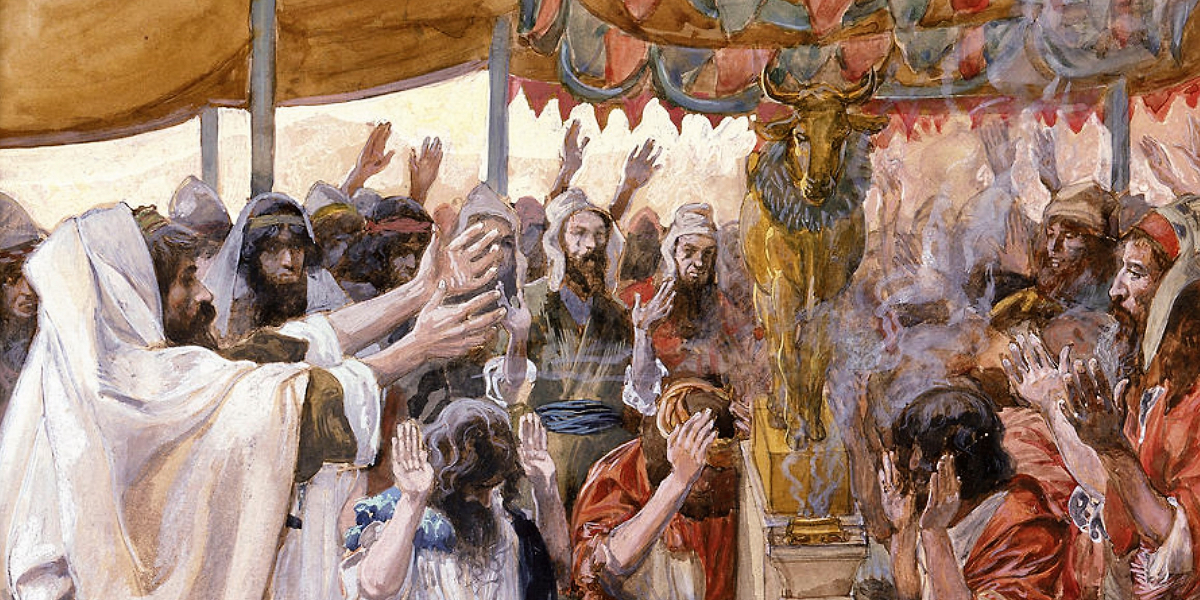
The Third Sunday in Lent – Pr. Faugstad sermon
Text: Exodus 32:1-14
In Christ Jesus, who attacked and overcame the devil, so that we whom the devil once claimed are now free to thank, praise, serve, and obey the only true God, dear fellow redeemed:
When we think about the attributes or characteristics of God, we often think of the three omnis: omnipotent, omniscient, and omnipresent. Or we think about how He is just, holy, merciful, and gracious. One of the characteristics that probably doesn’t come to mind is that God is jealous. We often think of jealousy in negative terms, describing someone who is envious or suspicious without any real reason to be so. But there is also a positive side to jealousy.
We learn about this positive side in the Catechism from the Conclusion to the Commandments, where God’s own words are quoted: “I the Lord your God am a jealous God, visiting the iniquity of the fathers upon the children to the third and fourth generations of those who hate Me, and showing mercy to thousands of those who love Me and keep My commandments.”
We use these words as the Conclusion to the Commandments, but the LORD actually spoke them after the First Commandment: “You shall have no other gods before me” (Exo. 20:3). He made it clear in this context that His people should not make any carved images of anything in heaven or on earth, and that they should not bow down to them or serve them. The people of Israel heard these words from Moses. Everything was plainly stated. And they answered with one voice, “All the words that the LORD has spoken we will do” (24:3).
Now just a short time later while Moses was meeting with God on Mount Sinai, the people grew restless. They came to Moses’ older brother Aaron, whom Moses had left in charge while he was away. “Up,” they said to Aaron, “make us gods who shall go before us. As for this Moses, the man who brought us up out of the land of Egypt, we do not know what has become of him.” It seems that Aaron felt a mixture of pressure and pride. He could see that the people were restless, and that concerned him. He also recognized he was in a position of influence.
He thought he could steer the people in a better direction; he could compromise to keep the peace. He gathered their gold jewelry and fashioned it into a golden calf, just the kind of “graven image” that God had condemned. And when the people praised the idol as the “gods… who brought [them] up out of the land of Egypt,” Aaron tried to bring the LORD back into it. He declared “a feast to the LORD” on the next day.
But the people did not have the LORD in mind. They got up early the next day, offered sacrifices to the golden calf, ate and drank, and “rose up to play.” St. Paul told the Christians in Corinth what kind of “play” the Israelites were up to. He wrote, “We must not indulge in sexual immorality as some of them did, and twenty-three thousand fell in a single day” (1Co. 10:8). Twenty-three thousand fell into sexual sin, rejecting God’s institution of marriage, an institution as old as creation itself. And many more joined them in disobeying God’s Commandments and ignoring His promises. They chose the ways of the world, the desires of their flesh, and the lordship of the devil.
How would God respond? He told Moses that the people had “corrupted themselves.” They had “turned aside quickly” from the way He commanded them. “Now therefore let Me alone,” He said, “that My wrath may burn hot against them and I may consume them.” If God did not care about His people, He wouldn’t have reacted like this. His anger was a sign of His commitment toward them. He had chosen this people. He had led them out of slavery in Egypt. He had brought them through the Red Sea and provided for them in the wilderness.
The LORD looks upon you with the same devotion and care. He gave you life through your parents; He knitted you together in your mother’s womb (Psa. 139:13). He brought you to the waters of Baptism where He adopted you as His own child and put His name on you. He delivered you from your slavery to sin, devil, and death. And He continues to provide you nourishment through His Word and Sacraments as you journey through the wilderness of this world.
If He were indifferent about how you live your life or about what happens to you, He would not have done all the things for you that He has done. Your Father in heaven certainly would not have sent His Son to suffer and die for you if He did not care for you and all sinners. But just as He was jealous for Adam and Eve when the devil brought them over to his side, and just as He was jealous for the Israelites, so He is jealous for you.
This is a proper jealousy. It’s the kind of jealousy a husband or father might feel when bad actors and bad influences are trying to break up his marriage or family. It’s a jealousy that fights for what another has no right to have. The LORD was jealous for His people. He was their God who had redeemed them. The gods the Egyptians worshiped had no power to stop Him. He alone was God. Any other gods were figments of human imagination fueled by the temptations of the devil.
Could this have been made any clearer to the Israelites, when Moses tossed their golden god in the fire, ground it to powder, scattered it on the water, and made the people drink it (32:20)? This was the god that brought them out of Egypt, the god that now made its way through their insides and was expelled?!? The same goes for the idols we set up in our lives: the pursuit of riches, possessions, and pleasures, of power, influence, and fame, of entertainment and excitement. Those might satisfy you for a while, but what good can they do when the day is far spent, when the sand in the hourglass keeps falling, when the time you have left is diminishing?
But the devil is well-experienced at trickery and deceit. He is always whispering in your ear: “Wouldn’t you like to have more? Don’t you deserve more? Why waste your life following the rules? Loosen up! Live a little! What’s so wrong with wanting to be happy? Pay attention to your feelings! Follow your heart! Only you know what’s best for yourself.” That’s what the devil did to the Israelites, and it nearly got them destroyed by the LORD.
It was only because of Moses’ intercession for the people that the LORD relented. Moses said to the LORD, “Remember Abraham, Isaac, and Israel, Your servants, to whom You swore by Your own self, and said to them, ‘I will multiply your offspring as the stars of heaven, and all this land that I have promised I will give to your offspring, and they shall inherit it forever.’” Moses pointed to God’s promise, and God’s anger was averted.
When you have behaved like the Israelites and have fallen for the devil’s temptations and committed sins against God’s holy Law, you might also wonder if you will escape God’s wrath. You took the wrong path. You followed false gods. You denied the LORD who made you, who purchased and won you, who chose you. As much as you wish you could, you can’t go back and change what you have done. Does the LORD really forgive you?
The way to answer that question is to ask a few more questions: Did God the Father send His Son to take on your flesh? Did Jesus suffer and die on the cross for the whole world’s sins? Did He rise in victory over death on the third day? If the answer to those questions is “yes,” which is exactly what the Bible teaches, then the LORD really does forgive you all your sins. Jesus made atonement for each and every one through His suffering and death.
And now since His ascension, He is “at the right hand of God,” where He “indeed is interceding for us” (Rom. 8:34). He is the Prophet like Moses, whom Moses said would come (Deu. 18:15), and Jesus intercedes for us like Moses did for the Israelites. When the Father sees us falling into sin and living contrary to His will, Jesus is constantly reminding the Father of His completed work. “I paid for that sin, and that sin, and that sin,” says Jesus. So the Father relents from the punishment we deserve. He does what Jesus’ death and resurrection require: He forgives us.
That does not mean, of course, that we are free to keep chasing after idols. God is jealous for our fear, love, and trust. “I am the LORD; that is my name” He says; “my glory I give to no other, nor my praise to carved idols” (Isa. 42:8). He deserves our love, our devotion, our worship—our entire life. Whenever and wherever we have not given these things, we must repent. We must admit that we have not been and done what He chose us and called us to do.
Then we also take comfort that our God, the only true God, is good, kind, and patient toward us. Shortly after sparing His people Israel from destruction, He described His characteristics to Moses which are still true of Him today. He said about Himself: “The LORD, the LORD, a God merciful and gracious, slow to anger, and abounding in steadfast love and faithfulness, keeping steadfast love for thousands, forgiving iniquity and transgression and sin” (Exo. 34:6-7). That is the God you have—a jealous God, jealous for your faith and salvation.
Glory be to the Father and to the Son and to the Holy Ghost; as it was in the beginning, is now, and ever shall be, forevermore. Amen.
+ + +
(picture from “The Golden Calf” by James Tissot, 1836-1902)

The Second Sunday in Lent – Pr. Faugstad sermon
Text: Exodus 17:1-16
In Christ Jesus, who refreshes us as we travel through the wilderness with the living water of His Word and the nourishment of His holy body and blood, dear fellow redeemed:
It is a common phenomenon to view the past more positively than we view the present, and to view the past more positively than we actually experienced it. Psychologists suggest the term “rosy retrospection” for this. It is looking into the past with rose-colored glasses and wishing we could go back to a time when we had so few troubles and cares. But what we are doing with this “rosy retrospection” is minimizing our struggles in the past while magnifying our struggles in the present.
We find the Israelites doing the same thing, and they were not even looking back that far. Had they forgotten how poorly they were treated as slaves? How they were forced to work harder and harder with fewer resources? How Pharaoh commanded them to drown their baby boys in the Nile River? Had they forgotten how the LORD spared their lives by the blood of the lamb on their doorposts, and how He led them out of Egypt and through the Red Sea on dry ground?
As soon as they faced trials in the wilderness, they immediately started to complain. In their hunger, they recalled how they “sat by the meat pots and ate bread to the full” in the land of Egypt (Exo. 16:3). When they were thirsty, they thought of the abundance of water at the Nile River and grumbled against Moses, “Why did you bring us up out of Egypt, to kill us and our children and our livestock with thirst?” Would they have really preferred to return as slaves in Egypt than to be with the LORD in the wilderness?
But that was the root of the problem—they were not convinced the LORD was actually with them. That is the question they kept asking one another: “Is the LORD among us or not?” It’s shocking that they would wonder this. Hadn’t they seen the LORD leading them in a pillar of cloud and fire, and the walls of water on either side of them as they passed through the Red Sea? Hadn’t they seen the entire army of Egypt dead on the seashore? How could they doubt the LORD?
They doubted Him because they assumed that if He were really with them, they wouldn’t have to go without food; they wouldn’t have to go without water. All their needs would be provided for—if He were really with them. Thoughts like these have crossed our minds too: “If You are really with me, LORD, why don’t You make my pain go away? Why don’t You heal me or my loved one? Why don’t You remove these troubles or obstacles, so I can serve You better?”
The crosses we have to carry in this life are tremendous tests of our faith. In the midst of our struggles, we wonder why the all-powerful, all-knowing, everywhere present God doesn’t remove those crosses. If He can, then why doesn’t He? We learn something about this in the Holy Gospel for today (Mat. 15:21-28).
A Canaanite woman came to Jesus begging Him to have mercy on her demon-oppressed daughter. At first, Jesus did not answer her. But she didn’t give up; she took her request to Jesus’ disciples. They became so annoyed by her persistence that they now begged Jesus to send her away. Still He did nothing. So she knelt right in front of Him—she wouldn’t be denied. Jesus said to her, “It is not right to take the children’s bread and throw it to the dogs.” And she replied, “Yes, Lord, yet even the dogs eat the crumbs that fall from their masters’ table.” Acknowledging her great faith, Jesus granted her request and instantly healed her daughter.
Why did Jesus act like this? Why did He prolong the suffering of this woman and her daughter? Why did He treat her almost like an enemy? The answer is not that “even Jesus gets annoyed or impatient sometimes.” The answer is that the trial Jesus put this woman through was for one purpose only: to strengthen her faith in Him. But how can God expect to draw us closer when we feel like He is pushing us away?
Think about how parents might play with their children. A mother might hide a piece of cookie from her toddler or keep moving it just out of his reach. The toddler protests, but he doesn’t give up. He keeps reaching and tries harder until he grabs it. Or a father might wrestle with his kids and act like their enemy, only to gather them into a big bear hug in the end. In the same way, God might make us work at something difficult or wrestle with some hardship, so that we learn to cling to Him and trust His promises.
That is what He wanted the Israelites to do. It was no mistake that the LORD led them to Rephidim where there was no water. This hardship was an opportunity for the people to prove their love for Him, to demonstrate their holy fear of Him, to show that they would trust His providence and care. They did not pass this test, but the LORD still had mercy on His people. He would provide more opportunities along the way for them to exercise their faith.
In this case, He ordered Moses to take his staff, with which he had struck the Nile and turned it to blood, and which he used to part the Red Sea. He told Moses to strike a rock, and water would come out of it. Moses did, and it did, and the people had plenty to drink. If God could do this, if He could make water flow out of a rock in the desert, what can’t He do for us in our time of need? We might not see a way out of our troubles. We might feel hopeless about a situation ever improving. But nothing is impossible for God.
Just after God provided water for the Israelites, we are told that the Amalekites came to fight against them. This was another tremendous test. The Israelites had no military training. They were not prepared for this. But the LORD fought for them. Moses went up on a hill and raised his staff. As long as his staff was held high, Israel prevailed. When his arms grew weary, Aaron and Hur stood on either side of him and held up his arms. So the Israelites with Joshua in command won the victory.
No one expected a rag-tag company of slaves to march out of Egypt and prevail in battle. No one expected water to come out of a rock, enough for perhaps hundreds of thousands of people and their livestock besides. If we have learned anything from the Bible or from human history, it is that we can expect the unexpected from God.
Nowhere is this more evident than God the Father sending His Son to take on human flesh by the power of the Holy Spirit. Did the Father send Him in anger to destroy the world? No! He sent His Son to save the world of sinners by offering up His holy life in the place of every transgressor. Jesus willingly suffered and died for your sins, including your doubts about His faithfulness to you, your impatience in suffering, and your failure to trust what He promises. Jesus shed His blood to wash all this away and to open heaven to you through the forgiveness of your sins. That was unexpected!
Today’s reading includes some comforting pictures of Jesus’ suffering and death for us. Moses’ outstretched arms that brought victory to the Israelites is a picture of Jesus’ outstretched arms on the cross by which He brought us victory over sin, death, and the devil. The staff Moses used to strike the rock causing water to gush out is a picture of the spear plunged into Jesus’ side after His death that caused blood and water to gush out.
St. Paul makes this connection to Christ even clearer. He says that the Israelites “drank from the spiritual Rock that followed them, and the Rock was Christ” (1Co. 10:4). Yes, the LORD was certainly with them in the wilderness, even the One who many years later would pay the penalty for their sins of grumbling, quarreling, doubts, and denial.
The LORD knows our sins just as plainly as theirs. He hears our “It isn’t fair!” our “I don’t deserve this!” our “Where are You? Why won’t You help?” And in response, we hear Jesus say, “Father, forgive them, for they know not what they do.” “My God, My God, why have You forsaken Me?” Then, “I thirst.” And, “It is finished.” Jesus took all your sins, your troubles, your sorrows on Himself. He accepted the eternal punishment of hell for you and felt its terrible fire, so much so that He longed for just one drop of water to cool His tongue.
He felt this thirst for you, so you would evermore drink from His grace. Jesus said, “whoever drinks of the water that I will give him will never be thirsty again. The water that I will give him will become in him a spring of water welling up to eternal life” (Joh. 4:14). This is what we have in His holy Word and Sacraments. Through these means, we have here ample food and drink for our journey through the wilderness.
So when we are tempted to ask, “Is the Lord among Us or Not?” we can remember the Lord’s mercy and grace toward us in the past, which continue to cover us in the present, and which will lead us into the future. There is no need for “rosy retrospection” with God because everything is rosy when it is cleansed by and covered in the blood of Jesus, our Rock and our Redeemer.
Glory be to the Father and to the Son and to the Holy Ghost; as it was in the beginning, is now, and ever shall be, forevermore. Amen.
+ + +
(picture from the altarpiece in Weimar by Lucas Cranach the Younger, 1555)

The Third Sunday in Advent – Pr. Faugstad sermon
Text: Genesis 8:15-22
In Christ Jesus, who “always leads us in triumphal procession, and through us spreads the fragrance of the knowledge of him everywhere” (2Co. 2:14), dear fellow redeemed:
After Noah and his family entered the ark, rain fell for forty days and forty nights. It was no gentle rain. Genesis 7 says that “all the fountains of the great deep burst forth, and the windows of the heavens were opened” (v. 11). The water kept rising and rising until the whole earth was covered. The water covered even the highest mountains by fifteen cubits, or more than twenty feet. Every living thing on earth died. If you were to look down on earth from a satellite view, you would have seen only blue. If you zoomed in, you might eventually spy something small floating on that great ocean—the ark.
God preserved Noah and his family and two of each kind of animal on this ark. They floated on the water for five months, everyone getting used to the constant rocking of the boat. Then suddenly they heard the bottom of the boat scrape something, and the rocking stopped. The ark had come to rest on the mountains of Ararat. But it was not time to disembark. Just as Noah waited for God’s command to enter the ark (7:1), so he waited for God’s command to leave it. This command finally came more than one year after they had climbed into the ark.
It was a big boat, but one year was a long time to be in it. I imagine it felt more and more crowded as each day passed. Wouldn’t man and animal be eager to get out and enjoy the land and the fresh air again? But in the back of their minds, perhaps Noah and his family wondered, “Will we be safe? We’ve seen what God can do. We are not perfect. What if He gets angry with us? Are we safer staying in the ark in case this happens again?” God soon put those potential fears to rest. He told Noah and his family to “go out from the ark” and to bring out all the living creatures, so they might “be fruitful and multiply on the earth.”
So they went out, and not in the chaotic way we might imagine. By the guidance of God, the animals “went out by families from the ark.” As the animals fanned out in every direction, the first thing Noah did was build an altar to the LORD and offer burnt offerings from the seven pairs of clean animals that he brought on the ark. This sacrifice offered in thanksgiving and praise was pleasing to God. In wording that emphasizes the closeness of God, we read that “the LORD smelled the pleasing aroma.” It wasn’t so much the smell, as the faith by which it was offered.
Before the Flood, the LORD was grieved by the wickedness of man. The stench of their sin filled His nostrils. Now He smelled the soothing aroma of faithfulness. And the LORD said in His heart, “I will never again curse the ground because of man, for the intention of man’s heart is evil from his youth. Neither will I ever again strike down every living creature as I have done.” That is good news for us, but it is a perplexing statement. God is stating that the people who left the ark were not any different by nature than the people who were destroyed. Before the Flood, God saw that “every intention of the thoughts of [man’s] heart was only evil continually” (6:5). After the Flood, He still saw that “the intention of man’s heart is evil from his youth.”
Nothing about man had changed. Ever since the fall into sin, every person is born in the image of sinful Adam. His sin is passed down generation to generation. It came down through his children and their children, through Noah and his family members, all the way down to us. The Flood cleansed the earth of wickedness, but it did not wash wickedness from the human heart. So why did the LORD say He would never again destroy the earth like He did in the Flood? It is not because we are better than the people were before the Flood. It is not because we have collectively learned our lesson or somehow deserve the LORD’s goodness.
It is because God is a merciful God. Mercy means not punishing when punishment is deserved. Mercy is not earned by the one who receives it. Mercy comes from the heart of the one who has every right to punish. So a store owner might have mercy by not pressing charges against a thief. A judge might have mercy by commuting the sentence of a criminal. You might have mercy by not treating your neighbors in the hurtful way they have treated you.
You can see how mercy is tied to love. This is how God teaches us to be, to be loving as He loves us. We can certainly see the wrath of God by the destruction of the Flood. But we see His love in sparing Noah and his family, even though they were sinners too. He spared them because He had made a promise. He promised Adam and Eve and all mankind that One would come from the woman to destroy the works of the devil. No one made God make that promise, and when He makes a promise, it cannot be undone.
He could not have destroyed all flesh on the earth and kept that promise. So Noah and his family were spared. He had mercy on them. In His love for the whole human race from Adam to Noah and to the end of time, God chose Noah to be in the line of that promise, to be a forefather of the coming Christ. Just as the days on the ark must have stretched on and on, so did the years from Noah onward. But God did not forget.
Thousands of years after the Flood, the LORD sent John to preach in the wilderness. When Jesus came to be baptized by him, the heavens were opened, and Jesus was anointed by the Holy Spirit. John now testified to any who would listen, “He who sent me to baptize with water said to me, ‘He on whom you see the Spirit descend and remain, this is he who baptizes with the Holy Spirit.’ And I have seen and have borne witness that this is the Son of God” (Joh. 1:33-34).
Jesus showed who He was by His words and works. In the Holy Gospel for today, Jesus described His work to John’s disciples, “the blind receive their sight and the lame walk, lepers are cleansed and the deaf hear, and the dead are raised up, and the poor have good news preached to them” (Mat. 11:4-5). This is mercy work. This is God’s demonstration of His love for mankind.
This love was demonstrated even more clearly when Jesus drew all sin to Himself like the animals were drawn to the ark. All sin was sealed up in Him, so sin would no longer be counted against us. Then as God once poured out His wrath on the wicked world, He now poured out His wrath on His only Son.
The LORD said after the Flood, “I will never again curse the ground because of man.” He would not destroy every living creature. But He was willing to put the curse on His Son. Galatians 3:13 says, “Christ redeemed us from the curse of the law by becoming a curse for us—for it is written, ‘Cursed is everyone who is hanged on a tree.’” Jesus was cursed because God is merciful to you. You deserved the punishment Jesus received, but He accepted it for you. “For God did not send his Son into the world to condemn the world, but in order that the world might be saved through him” (Joh. 3:17).
So you don’t need to wonder if you are safe with God. You don’t need to worry that He is angry with you because of your weaknesses and sins. He knows that “the intention of [your] heart is evil from [your] youth.” He knows who you are. He knows what you have done. And He chooses to have mercy on you. He has mercy because He is full-of-mercy—merciful. This is how He described Himself to Moses: “The LORD, the LORD, a God merciful and gracious, slow to anger, and abounding in steadfast love and faithfulness, keeping steadfast love for thousands, forgiving iniquity and transgression and sin” (Exo. 34:6-7).
This is how He looks upon you, with mercy and grace, slow to anger, abounding in steadfast love and faithfulness, forgiving each and every one of your sins. You hear this each week in the ark of the church, before the LORD sends you out again to be fruitful in your vocations. Whether at home or at your job or in the community, like Noah you offer sacrifices of thanksgiving and praise to God through your honest words, your good efforts, and your godly behavior.
These sacrifices of love rise up as a pleasing aroma to the LORD. He does remember you. You are His beloved child, washed clean of your wickedness by the blood of Jesus, covered in His righteousness through the waters of Holy Baptism. The LORD’s mercy toward you is as certain as the changing of the seasons, “seedtime and harvest, cold and heat, summer and winter, day and night.” His love for you does not change. “The steadfast love of the LORD never ceases; his mercies never come to an end; they are new every morning; great is your faithfulness” (Lam. 3:23). Amen.
Glory be to the Father and to the Son and to the Holy Ghost; as it was in the beginning, is now, and ever shall be, forevermore. Amen.
+ + +
(picture from Saude Lutheran Church stained glass)

The Festival of the Holy Trinity – Pr. Faugstad sermon
Text: Romans 11:33-36
In Christ Jesus, who has revealed the Father’s love for us by becoming one with us and who has now sent us the Holy Spirit to guide us into all truth, dear fellow redeemed:
In the spring of 1955, a pathologist performed a regular autopsy on a man who had recently died. But then he did something that crossed an ethical boundary. Though there had been no injury to the man’s brain or any cause to believe that something had gone wrong with it, the pathologist removed it from his skull! He was motivated by the fact that this wasn’t just another person on his table. This was Albert Einstein, a man regarded as one of the great thinkers of the 20th century.
His brain was dissected and put into slides for purposes of research and study. The hope was that some secrets of Einstein’s genius might be uncovered and used to increase human capacity for knowledge and mental capability. More recently, scientists have been experimenting with putting digital chips in the brain that could enhance memory retention or even be used to download information into the brain.
We would all like to be smarter and stronger, getting better and better. But even if we could, even if we made major strides forward from a human perspective, we would still be “know-nothings” compared to God. The apostle Paul speaks of “the depth of the riches and wisdom and knowledge of God! How unsearchable are His judgments,” he says, “and how inscrutable—how incomprehensible—His ways!”
The only reason we are able to know anything significant about God is because of what He has revealed to us about Himself. For example, human thinking could never figure out and cannot comprehend that God is Triune—one God in three Persons. Non-Christians such as the Muslims accuse us of having three gods. But that is not the case. We worship “one God in Trinity and Trinity in Unity,” as we just confessed in the Athanasian Creed.
The Triune God is all-powerful, all-knowing, and present everywhere, which we remember with the three omni words: omnipotent, omniscient, and omnipresent. God is eternal, holy, wise, and loving. He created all things that exist—the world and everything in it with all its beauty and complexity and the world’s place in the vast and ordered universe.
The evidence of creation alone is enough to show us the unfathomable depth of God. Specialists can spend their entire lives focusing on one tiny part of God’s creation and still learn or understand only a little fraction of it. In the whole scheme and scope of the universe, you and I are just small specks, temporary placeholders on a timeline that stretches behind us for thousands of years and will stretch beyond us for an unknown amount of time.
And yet, though we are certainly little more than fragments of dust in the history of the world, we are known and loved by our Creator God. We know this because He has told us so. This is how He described His approach to the human race, that He is “the LORD, a God merciful and gracious, slow to anger, and abounding in steadfast love and faithfulness, keeping steadfast love for thousands, forgiving iniquity and transgression and sin” (Exo. 34:6-7a).
The crown of His creation—mankind—rebelled against Him and did the one thing He commanded them not to do. But instead of pouring out His anger on them and wiping them off the face of His perfect earth, He made them a promise. He would send a Savior to free them from the grip of sin, death, and devil. That promise was kept when God the Father sent His Son to become one with mankind.
In the incarnate Son of God, we clearly see the mercy and grace of God. God could have condemned us. He could make us pay for our sins. But instead, He chose in His love to redeem us. The Son perfectly obeyed the will of His Father and suffered and died in our place for all our sins. This also is beyond our comprehension. How could sins be paid for that hadn’t even been committed yet, like our sins? And how could the Son die, but not the Father or the Holy Spirit, since these three Persons are one God?
We don’t need to make logical sense out of all this before we accept it as true. Just because something may not jive with our reason doesn’t mean it can’t be true. In fact, accepting only the things that fit our thinking makes us closed-minded, not open-minded. God wants to expand our understanding to include truths that are over and above anything the world can know. We were reminded last Sunday how He did this.
On Pentecost, God the Holy Spirit was poured out on the disciples, so that their message of Christ crucified would reach the ears and hearts of sinners “in Jerusalem and in all Judea and Samaria, and to the end of the earth” (Act. 1:8). In his First Letter to the Corinthians, Paul wrote, “Now we have received not the spirit of the world, but the Spirit who is from God, that we might understand the things freely given us by God. And we impart this in words not taught by human wisdom but taught by the Spirit” (1Co. 2:12-13a).
The Holy Spirit continues to work through the inspired Word of the Bible, so that sinners are brought to faith and grow in the wisdom and knowledge of God. But even we believers have plenty more to learn. It is easy to forget this. After all, we are baptized, and we have been confirmed. We regularly attend church, and we know way more about the Bible than most of our Christian friends. Our faith is strong! But it doesn’t take much for us to question God.
Where is He, we wonder, when we need help and are hurting? Isn’t He all-powerful and able to change our situation? Or when we were unknowingly heading toward trouble, why didn’t He redirect our steps? Isn’t He all-knowing? Or when we were worried and had doubts, why didn’t He make His presence more obviously known, so we could be certain He is in control? Isn’t He present everywhere?
Paul writes, “For who has known the mind of the Lord, or who has been His counselor?” Are we on God’s level? Can we see things like He does? When you have been around someone who acted like he or she knew everything, you know how irritating that is. It might be the brand new employee who on the first day of the job points out all the things the long-time employees should be doing better. Or the person who has hardly watched a sport, let alone played it, yet who thinks he knows more than the professionals.
Pretty annoying. Pretty laughable. It’s like us trying to tell God what He should be doing better. What do we know about upholding the universe and everything in it? We can’t even keep our own life and behavior under control most of the time! The Lord invites us to cry out to Him and even complain. But we have no right to criticize Him. He is never wrong. He is never unjust. Everything He does is good and right and true, even if we can’t perceive the good.
Another error we make is thinking God owes us something. Paul quoted this from the book of Job: “Or who has given a gift to Him that he might be repaid?” Many people think they deserve payment from God because of what they have done for Him. “I have made sacrifices for you, God. I have served you my whole life. I have always tried to do what was right.” But how good is a work that is done for a reward?
This is the way the apostle Peter was thinking when he said to Jesus, “See, we have left everything and followed you. What then will we have?” (Mat. 19:27). At another point, the mother of James and John led her sons to Jesus and said, “Say that these two sons of mine are to sit, one at your right hand and one at your left, in your kingdom” (Mat. 20:21). Jesus’ response in these cases was, “many who are first will be last, and the last first” (19:30), and “whoever would be great among you must be your servant, and whoever would be first among you must be your slave” (20:26-27).
Then He added, “even as the Son of Man came not to be served but to serve, and to give his life as a ransom for many” (v. 28). If we think God owes us anything, we should recall what He has already freely given us. He has given us our very existence, including the body we have, the air we breathe, and the food and possessions we enjoy. He has also redeemed our soul, so that we will spend eternity with Him in heaven and not with the damned in hell.
He has had mercy on us when we did not deserve it. Jesus willingly took our place and shed His holy blood to wash away our sins. He paid for our sins of pride, our thinking that we are pretty good, that we have a better plan, or that we can see more clearly than He can. Our wisdom and knowledge are so small compared to His. Paul writes, “For from Him and through Him and to Him are all things.”
“From Him” tells us that God is the Source of all things. Through Him” says that God is the Giver of all that is good. “To Him” means that God is the Goal, the blessed Focus of all that we are and have and do. We can dissect the brains of geniuses and try to enhance our thinking with microchips, but we will never come close to the understanding that the Holy Spirit imparts to us through His Word.
Through the Word, we humbly learn how God Is Merciful to the Know-Nothings like us, and how He leads us more and more, deeper and deeper, into His “riches and wisdom and knowledge.” “And the peace of God, which surpasses all understanding, will guard your hearts and your minds in Christ Jesus” (Phi. 4:7).
To Him be glory forever. Amen.
+ + +
(picture from “Jesus Traveling” by James Tissot, 1836-1902)