

The Second Sunday after Trinity – Pr. Faugstad sermon
Text: 1 John 3:13-18
In Christ Jesus, Love incarnate, who demonstrated God’s love for the world through His sinless life and sacrificial death, and who calls His people to follow His example of love, dear fellow redeemed:
There are different ways we express the fact that we are alive: “I’m breathing.”—“I’m upright.”—“I have a pulse.”—“I’m still above ground.”—“The ol’ ticker is still working.” Our reading for today gives another proof of our being alive, but it is talking about something more than physical life. The apostle John writes, “We know that we have passed out of death into life, because we love the brothers.”
The “brothers” that John is referring to are fellow believers. Although it sounds like John is saying that it is our love for the brothers that has brought us “out of death into life,” this is not the case. John makes this clear a couple verses later when he writes, “By this we know love, that He laid down His life for us.” We “know love,” because we have seen the love of Jesus.
The love of Jesus was completely sacrificial. He came, as He said, “not to be served but to serve” (Mar. 10:45). Of all the people who could have demanded the love of others, it was Him. “For by him all things were created” (Col. 1:16), and “he upholds the universe by the word of his power” (Heb. 1:3). He is the only-begotten Son of God the Father from all eternity. We would not exist apart from Him. When He took on human flesh and revealed Himself through His gracious words and works, He should have received nothing but love, honor, and respect.
At the same time, His love was not contingent on receiving what He deserved. Whether or not His words were listened to, whether or not His works were praised, whether or not He was thanked for His miracles and blessings, He still loved, like the love we see from the master of the house who invited “the poor and crippled and blind and lame” to his banquet (Luk. 14:16-24). Jesus loved the sinners around Him all the way to the cross, where He lovingly carried all their sins to make payment for them. He came “not to be served but to serve, and to give his life as a ransom for many” (Mar. 10:45).
What He has done, that is what we are called to do. On the night He was betrayed, Jesus washed the feet of His disciples and told them, “I have given you an example, that you also should do just as I have done to you” (Joh. 13:15). Then He added that it is love that would set His disciples apart from the world. He said, “By this all people will know that you are my disciples, if you have love for one another” (v. 35).
Jesus is not referring to a love that will come from deep down in our heart, as though all we need to do is look inside to find it or try harder. He is referring to a love that comes from God Himself. As John wrote later in his epistle, “Beloved, let us love one another, for love is from God, and whoever loves has been born of God and knows God” (1Jo. 4:7). That tells us there is a difference between the love of the world and the love of God.
In fact, we learn from the Bible that those “loves”—worldly love and godly love—are opposed to each other. The world has a warped understanding of love. “Love” might be defined as “the acting out of my passions.” It is “doing the things I find fulfilling.” The “love” that the world embraces hardly ever has a sacrificial component. It is about what is good for me more than it is what is good for you.
It is no wonder, then, that the world chafes under the Bible’s definition of love. God says that nothing can be loving if it goes against His Ten Commandments. The Commandments show us the shape of love and the focus of love. They do not direct us inward toward a love of self. They direct us outward toward love for God and neighbor.
Therefore, we say, it can’t be love when we dishonor or disrespect parents or the governing authorities (4th). It can’t be love when we do harm to others or wish harm on them in our hearts (5th). It can’t be love when we act on our sexual passions and desires outside of marriage (6th). It can’t be love when we have the world’s goods and see a brother in need, yet close our heart against him, as our reading says. Anything that does not agree with God’s holy law cannot be loving, since “love is the fulfilling of the law” (Rom. 13:10).
The world, of course, disagrees, and it doesn’t disagree mildly. It says that you should indulge your sinful passions, do whatever you want to do, put yourself first. The world doesn’t take kindly to these things being questioned or challenged by we who hold to the true Word of God. The effect is as John says, “the world hates you.” He is saying nothing different than the Lord Jesus who said, “If the world hates you, know that it has hated me before it hated you. If you were of the world, the world would love you as its own; but because you are not of the world, but I chose you out of the world, therefore the world hates you” (Joh. 15:18-19).
Love for God means hatred from the world. You cannot have it both ways. Jesus says you cannot enjoy the love of the world and the love of God. The unbelievers of the world walk around dead in their sins, like the people in the Holy Gospel who thought their worldly pursuits were more important than the banquet of salvation. They do not know the love of God. They are unable to love as He loves. So it is no surprise when we are the recipients of their hatred. Hatred comes naturally to the unbelievers of the world, just as it once came naturally to us.
But now we are alive in Christ. We have been buried and raised with Him through Baptism. We have been grafted into Him, which means that life and love flow from Him to us like nourishment from a vine to its branches. Through these branches—through us—God produces fruits of love for the benefit of others. John describes what that love looks like. Just as Jesus laid down His life for us, “we ought to lay down our lives for the brothers.” If any brother has a need, we should do our best to help and supply him. Believers in Jesus should never be accused of being “all talk.” We show our love by our words and our actions.
But what if we don’t? What if we fall into the same snares and sins of the unbelievers? And of course we have. We have played the part of murderers by hating a brother or sister in Christ. Perhaps it was hatred toward a parent, a sibling, a spouse, or a member of the congregation. We wanted them to be hurt like we hurt. We wanted them to suffer like we suffered. And there have been times when we saw a fellow Christian in need, but we didn’t want to trouble ourselves to help. Or we told ourselves that surely someone else would step up who had more resources and more time.
When these behaviors have described us, then we were no better than the unbelievers of the world. Then this indictment is true for us: “Whoever does not love abides in death.” It is death—lifelessness—when we fail to love. Christians who do not love are like lungs that don’t breathe or hearts that don’t beat. We do not represent the God of all love when we are selfish or judgmental or too proud to lift a finger to help those we think are below us.
If the wheels in your brain are turning right now, remembering when you did not love, but then trying to justify those times, that is death in you. But if you recall those times of weakness and sin, and you are sorry for them, that is life in you. St. Paul writes, “For if you live according to the flesh you will die, but if by the Spirit you put to death the deeds of the body, you will live” (Rom. 8:13).
“Putting to death the deeds of the body,” means repenting of your sins and trying to avoid them in the future. Every one of us here has sins to repent of, sins of hatred and selfishness. The Holy Spirit leads us to recognize these sins and hand them over to the Father. This remorsefulness and repentance is a clear sign of life. It is a sign that you are not dying along with the loveless world. You are alive in Him who loved perfectly.
His love for you does not change, even though you have sinned, even though you have not always loved like you should. The Son of God accepted the punishment for all those sins in your place, so that they are not charged against you anymore. His love for you from cradle to cross covers the multitude of your sins. He gave Himself to save you.
The Holy Spirit gives you the faith to believe this. And He continues working through the Word and Sacraments to strengthen your faith and renew your love toward others. You come here bringing your sin and guilt, but you leave holding His grace and forgiveness, with plenty to share with everyone around you.
That is what we do. We pass on what we have received. We Living Ones Love. We do not lose anything by loving. We only gain, like honeybees transferring pollen from flower to flower, or like a flame being passed from one candle to another. Just as the love of God has come to us from others, so we share this love, not just “in word or talk but in deed and in truth.”
Glory be to the Father and to the Son and to the Holy Ghost; as it was in the beginning, is now, and ever shall be, forevermore. Amen.
+ + +
(woodcut of the poor, the blind, and the lame being invited to the banquet from the 1880 edition of The Story of the Bible from Genesis to Revelation)
(No audio recording is available for this sermon.)

The Festival of All Saints (observed) – Vicar Lehne sermon
Text: St. Matthew 9:18-26
In Christ Jesus, who conquered death so that we may live, dear fellow redeemed:
Death can be a scary thing. This is especially true for those who have no hope. To them, death is the end. So, to make death seem less scary, they try to “soften it” by describing it in nice sounding terms, such as “he is playing eighteen holes on the golf course in the sky,” or, “he lived a good life, and now his legacy lives on,” or, “he will continue to be with you forever, so long as you keep thinking about him.”
The New Testament describes death as a peaceful sleep for those who die in Christ. To the world, describing death as a peaceful sleep is another one of those ways to try to “soften it” and make death seem less scary, but the world does not expect a waking up from that sleep. We can even think this way too, especially when we have just experienced the death of a loved one. However, while (1) death seems like the end to us, in reality, (2) death is only a sleep that Jesus will wake us from. Jesus gives us hope.
Our reading for today begins with a ruler kneeling before Jesus and asking him to lay his hand on his daughter so that she will live. We find out from the Gospels of Mark and Luke that this ruler was named Jairus. We also find out from these two Gospels that Jairus’ daughter wasn’t dead yet, but she was near death. This doesn’t mean that the Gospel of Matthew is giving an inaccurate report of what happened. The account was simply condensed.
Even though Jarius’ daughter wasn’t dead yet, she was so close to death that Jairus had little to no hope that she would be able to recover. The only hope he had was that Jesus could heal her. Jairus wasn’t basing his hope on nothing. Jesus had already healed many people who were sick. He healed an official’s son who was at the point of death (John 4:46–54). He healed a man who had been sick for thirty-eight years (John 5:1–17). He healed Peter’s mother-in-law, who was sick with a high fever (Luke 4:38–39). He healed a paralytic (Mark 2:1–12). And he healed many others besides these (Matthew 8:16–17; 4:23–24).
Jairus had more than enough proof that Jesus had the power to heal his daughter. And then he watched Jesus heal a sick woman who touched the fringe of his garment on the way to his house. Seeing Jesus heal someone right in front of him no doubt gave him even more hope than he already had that Jesus had could save his daughter’s life. He had no reason to fear that his daughter would die so long as Jesus made it to his daughter in time.
Then the bad news came. According to Mark and Luke, after Jesus healed and reassured the sick woman, some men arrived to tell Jairus that his daughter had died. Jesus didn’t make it to Jairus’ daughter in time after all. Hearing this news could cause anyone to lose hope, but Jesus reassured Jairus by saying, “Do not fear; only believe, and she will be well” (Luke 8:50).
What Jesus said to reassure Jairus he also says to reassure us. Jesus entered this world to save us from death by his own death and resurrection. As Jesus said to Martha when her brother Lazarus died, “I am the resurrection and the life. Whoever believes in me, though he die, yet shall he live, and everyone who lives and believes in me shall never die” (John 11:25–26).
Despite knowing this, death can still be a scary thing. We can fear the deaths of our loved ones, not wanting to experience the loneliness caused by them no longer being by our sides, or worrying how we will provide for ourselves and our families without their help. We can also fear our own deaths, worrying that it will be painful or that we will leave our families without the help that they need.
But it’s not just physical death that we can fear, but also eternal death. We know that we are by nature sinful and that we rightfully deserve eternal punishment in the fires of hell because of our many sins, a fact that can become clearer to us the closer to death that we get. As a result, we can wonder whether we lived a good enough life or whether we have a strong enough faith to get to heaven.
When any of these fears enter our minds, Jesus offers us reassurance and hope by telling us, “Do not be afraid; only believe” (Mark 5:36). Jesus gives us the faith we need through his Word and Sacraments. Because of this, we believe that Jesus experienced all our sufferings and took all our sins on himself on the cross. We believe that he paid the price for all our sins by his innocent suffering and death. We believe that he did everything necessary to save us. And we believe that he will remain with us through all our struggles, giving us the strength to persevere until the day we enter the peaceful sleep of death and enter eternal life in heaven.
Jairus believed and put his hope in Jesus, even after he received the terrible news that his daughter had died. His friends did not have the same confidence. In fact, the men who came to deliver Jairus the bad news also told him not to bother Jesus anymore since his daughter was now dead (Mark 5:35). In addition, the people who had gathered at Jairus’ house to mourn his daughter’s death laughed at Jesus when he told them that “the girl [was] not dead but sleeping” (verse 24).
Like those who didn’t believe that Jesus could raise Jairus’ daughter from the dead, we are tempted to doubt Jesus’ power over death. We know that God has revealed through his Word that we will rise again on the Last Day and that our bodies will be reunited with our souls. However, despite knowing what the Bible says, it can be difficult for us to have hope that we will rise from the dead. After all, Jesus’ power over death doesn’t change the fact that our loved ones are, for the moment, gone. We might even wonder why Jesus didn’t prevent the death of our loved ones if he has so much power.
Additionally, when our loved ones die and we are faced with the immediate reality of death, we might think that death is the end. Since we have only ever experienced life on earth, we tend not to give much thought at all to life in heaven. So, knowing that we will not see our loved ones again in this life might cause us to think that we will never see them again, despite knowing that the Bible says that we will see them again in heaven.
When we are tempted to doubt Jesus’ power over death and think that death is the end, Jesus gives us reassurance and hope. Jesus simply saying that he has power over death is one thing, but he also backed up his words with his actions. One of the ways he did this was by raising Jairus’ daughter from the dead.
Even though no one besides Jairus seemed to believe that Jesus could raise his daughter from the dead, Jesus proved them wrong. He entered Jairus’ house, took his daughter by the hand, and said to her, “Talitha cumi,” which means, “Little girl, I say to you, arise” (Mark 5:41). And she arose.
This is not the only time that Jesus raised someone from the dead. He later raised the widow of Nain’s son from the dead (Luke 7:11–17). He raised Mary and Martha’s brother, and his friend Lazarus from the dead not long before his own death (John 11:1–41). And, in the greatest raising of all, Jesus raised himself from the dead on the third day after his death.
If Jesus had not risen from the dead, we would have no hope. If death had kept its hold on Jesus and kept him in the ground, then that would mean he isn’t God. And if Jesus wasn’t God, then he would not have paid the price for our sins. But Jesus did rise from dead, and by his resurrection, he proved he is God and defeated death, giving us hope.
But it was not just physical death that Jesus saved us from. He also saved us from two other kinds of death: spiritual death and eternal death. We are all by nature sinful, meaning that we were spiritually dead from the moment we were conceived and could only sin all the time. Even our good deeds were like filthy rags (Isaiah 64:4). Because of the sins we committed, we rightfully deserved to suffer for all eternity in the fires of hell. We couldn’t escape this fate on our own, because we couldn’t choose to do good, let alone choose to believe in Jesus. However, on the cross, Jesus paid the price for all of our sins so that we will not enter eternal death in hell when we physically die, but eternal life in heaven. Additionally, he applied his perfect life to us so that God the Father no longer sees us as his enemies who deserve eternal death in hell, but as his own dear children who deserve eternal life in heaven. So that this reality can be ours, Jesus brought us to faith through his Word and Sacraments. In the waters of Holy Baptism, our sinful natures were drowned, and our new selves rose up.
Through Baptism, Jesus has already raised us from the dead, making us a part of the saints triumphant, even though we have yet to physically die. Jesus has made us members of his holy body, as he does with all believers. Therefore, our believing loved ones who are already sleeping are not so very far away from us because we are all united in Jesus. Now, whenever we pray to God, join together in praising him, or receive his body and blood at his holy table in his Supper, we are joining in praying, praising, and feasting with the saints triumphant who are already sleeping.
Since Jesus defeated death in all of its forms, the death of the body is no longer the end for those who believe in him, but a peaceful sleep. Death is no different than falling to sleep peacefully in our beds. When our bodies enter the peaceful sleep of death, our souls will be with Jesus in heaven. Then, on the Last Day, the sure hope that we have in Christ will come to pass. When Jesus returns, he will wake all those who believe in him from their peaceful sleep, which include us and our loved ones who are already sleeping, and will reunite our bodies with our souls. But our bodies will not be the imperfect bodies we died in. They will be perfected, and we will never experience the sufferings of this world ever again. Then, Jesus will take all believers in him to heaven—all the saints—to live with him for all eternity.
Those who have no hope do not believe that this could possibly be true. To them, the sure hope that we will live again is a misguided and empty attempt to make death seem less scary. However, this sure hope is a reality for those who die in Christ. Jesus has conquered death by his innocent death on the cross and his resurrection from the dead. Because Jesus has conquered death, we will not die, but live. Because Jesus has conquered death, we have hope.
Glory be to the Father and to the Son and to the Holy Ghost; as it was in the beginning, is now, and ever shall be, forevermore. Amen.
+ + +
(picture from painting by Gabriel von Max, 1878)
The Visitation of Mary & Vicar Installation – Pr. Faugstad sermon
Text: St. Luke 1:39-56
In Christ Jesus, who “made Himself nothing, taking the form of a servant, being born in the likeness of men” (Phi. 2:7), in order to redeem us by His perfect life and innocent death, dear fellow redeemed:
The mothers who have carried in their wombs the greatest people in the history of the world, did not know what their little babies would become. The Apostle Paul’s mother could not have guessed that her son would one day preach Christ crucified around the world. And Margarethe Luther would not have expected her son Martin to become a great reformer.
Elizabeth and Mary were different. They knew that the baby boys in their wombs were destined for tremendous things. Elizabeth learned it from her husband, a priest serving in the Jerusalem temple, who was visited by the angel Gabriel. The angel told Zechariah that he and Elizabeth would have a son. He would “be filled with the Holy Spirit, even from his mother’s womb,” and would “turn many of the children of Israel to the Lord their God” (Luk. 1:15, 16). His name was to be John. After Elizabeth conceived this child, she kept herself hidden for five months. Who would believe that this old woman was carrying a child after a lifetime of barrenness?
In the sixth month of Elizabeth’s pregnancy, the angel Gabriel visited her young relative Mary. As you know very well, Mary was betrothed to a man named Joseph, but they had not had relations with each other. Mary was a virgin. Gabriel shared the stunning news with Mary that she would bear the Christ Child, “the Son of the Most High” (Luk. 1:32), who would reign over an everlasting kingdom. And he had even more news to share. Her elderly relative Elizabeth was six months along in her own pregnancy. “For nothing will be impossible with God” (Luk. 1:37).
So what did Mary do next? She got up and hurried to Elizabeth’s house. Even if no one else believed her, Elizabeth would—Elizabeth whose life had also been touched by the unexpected working of God. By this time, Elizabeth’s belly had expanded to make room for the growing boy inside her. She might have felt little flutters as he moved around and hiccupped. Her baby was about twelve inches long and 1½ to 2 pounds in weight. His eyes may have just begun to peek out behind red eyelids.
Elizabeth did not know that a monumental meeting was about to take place. The Messiah was about to enter the home of His messenger. With Mary’s arrival, the two men who would turn the world upside down with their preaching and teaching, were now in the same room in the flesh. Elizabeth had not heard about Mary’s pregnancy, and yet she knew. She knew as soon as Mary greeted her, and her baby leaped in her womb. She knew, because at Mary’s greeting she was filled with the Holy Spirit.
The Holy Spirit revealed to her that Mary, a virgin and yet pregnant, was “the mother of her Lord.” She spoke three blessings to Mary: “Blessed are you among women,” “blessed is the fruit of your womb,” and “blessed is she who believed” what the Lord said. Elizabeth did not honor Mary because she had accomplished great things on her own. Elizabeth honored Mary because of her connection to the teeny, tiny baby growing in her womb.
But how could the little baby of a poor woman save the world? The world doesn’t think much of little babies or of poor women. Little babies are viewed more and more as burdens. Babies get in the way of careers and riches and personal freedom. All of us have thought that at one point or another. But Elizabeth and Mary were once babies, as were their sons John and Jesus. You and I were babies, and here we are. We are supposed to be here. God gave us life. Every Christian should be pro-baby, because God is pro-baby!
Every soul is precious in His sight, which means every soul should be precious to us. Our hearts should expand in love for all our neighbors, from the poor ones to the rich ones, from the lowly ones to the well-regarded, from the unborn to the elderly. Every life has value. Every life matters. Just look at the care with which God formed us in the womb. The psalmist David wrote, “For you formed my inward parts; you knitted me together in my mother’s womb. I praise you, for I am fearfully and wonderfully made” (Psa. 139:13-14). He goes on to describe how we were “made in secret, intricately woven,” and how even at our conception, God had a plan for all our days (vv. 15, 16).
The miraculous composition of a human being should be enough for people to acknowledge and praise the almighty God. But our sinfulness is great, and it has been with us for as long as we have existed. Adam and Eve’s fall meant that all their descendants would inherit their sin, and sin keeps us from fearing, loving, and trusting God as we should. In another of his Psalms, David wrote, “Behold, I was brought forth in iniquity, and in sin did my mother conceive me” (Psa. 51:5). That is true of every one of us. We were sinners from the moment we were conceived.
But Jesus was an exception to that unbroken line of sin. He was conceived not by a human father and mother, but by God the Holy Spirit overshadowing the womb of Mary. In this way, God the Son took on human flesh but without human sin. By His entrance into the world as an embryo, God was showing that life matters from its earliest beginnings, even before the human eye can see it. As He went through each stage of life—from His growth in the womb, to His birth, as a toddler, a child, a young adult, a grown-up—Jesus was redeeming every stage of life from the sin that pollutes us.
God does not take shortcuts. There was no simple, easy way for mankind to be saved. The Son of God had to take on flesh, and He couldn’t just appear in the flesh like you might appear in costume. He had to take human flesh into His Person. He had to start the way all humans start, with the joining of tiny cells. From the time that Gabriel visited faithful Mary, the eternal Son of God became God and Man in one Person. And He remains God and Man for all eternity.
This is the One whom John would go into the wilderness to proclaim. But that would be about thirty years later. Today was the day for Messenger John and his Master Jesus to meet. And how do we know that John was aware of Jesus’ presence? Elizabeth exclaimed to Mary, “For behold, when the sound of your greeting came to my ears, the baby in my womb leaped for joy.”
John continued to rejoice. Those thirty years later after Jesus was baptized, John cried out, “Behold, the Lamb of God, who takes away the sin of the world!” (Joh. 1:29). As Jesus’ following increased, and fewer were coming to John, John testified, “The friend of the bridegroom, who stands and hears him, rejoices greatly at the bridegroom’s voice. Therefore this joy of mine is now complete. He must increase, but I must decrease” (Joh. 3:29-30).
John had it right; his glory was in Jesus. The long-promised Savior had come. Elizabeth saw it the same way. She welcomed Mary with all humility, “And why is this granted to me that the mother of my Lord should come to me?” Mary saw it the same way. In her famous song, the Magnificat, she said that her Savior God “has looked on the humble estate of His servant,” “has done great things for me,” has “exalted those of humble estate,” and “has filled the hungry with good things.”
And so it is for you and me. The Lord has looked on our humble estate. He saw how helpless we were, how lost in our sin. And He has done great things for us. The little baby in Mary’s womb was growing there for you and me. The six months bigger baby growing in Elizabeth’s womb would go before Him to prepare His way. All of this happened more than 2,000 years ago, but God had you in mind.
God the Father sent His only Son for this express purpose—to save your soul. He gave you birth, so that He could give you rebirth. He formed you in the womb, so He could transform you by the power of the Gospel. You might wonder sometimes how much your life matters. You might wish you could go back, make different choices, and do more with your life. You can put all those thoughts to rest when you see what God did for you, when you see the womb of a virgin swelling with Child, when you see the God-Man making His way to Calvary carrying His cross—for you.
Your life matters. God loves you. He forgives all your sin. He wants you to join Him in heaven with Elizabeth, John, Mary, and all the saints. This is the message He calls sinful men to preach. We give thanks that He has sent another vicar to our parish to preach this Word to us and to continue training for the noble work of pastor. Pastors have nothing to offer you of their own, just as Mary had nothing to offer of her own. But as God chose her to bear the Christ-Child in her body, so He has chosen sinners to “rightly handle His word of truth” (2Ti. 2:15), and to distribute His means of grace through our mouths and by our hands.
The presence of Jesus in Mary’s womb brought joy to Elizabeth and John, and His presence still brings joy to us. When the sound of His forgiveness and grace reaches our ears, the Holy Spirit comes to remove our burdens and lift our hearts. Then our souls magnify the Lord, and our spirits rejoice in God our Savior.
Glory be to the Father and to the Son and to the Holy Ghost; as it was in the beginning, is now, and ever shall be, forevermore. Amen.
+ + +
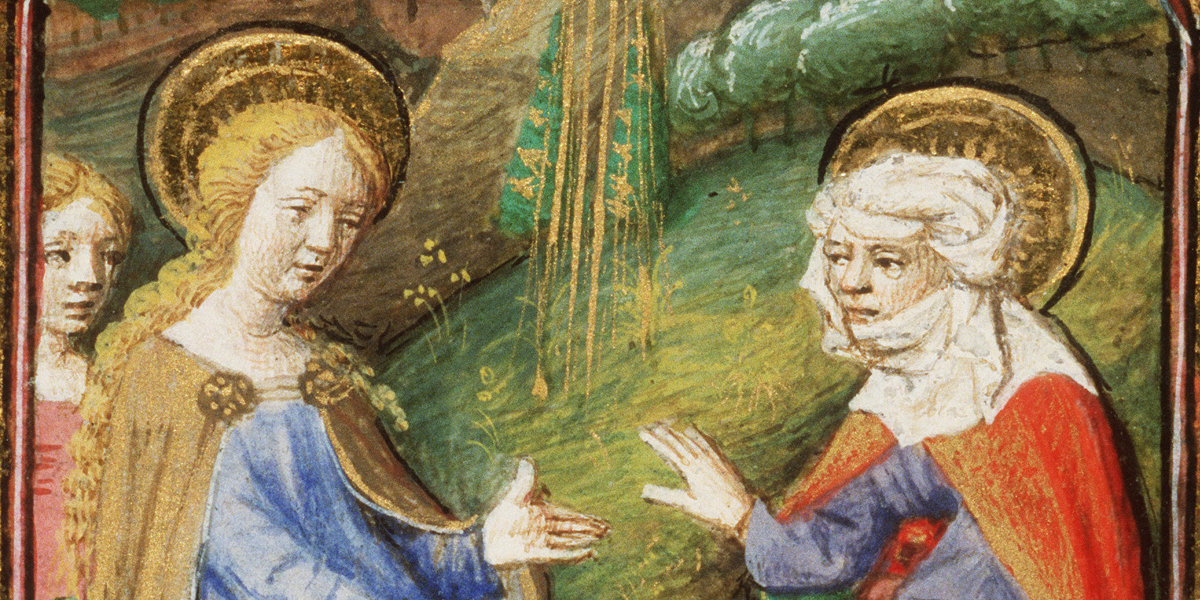
(Picture of the Visitation from the Book of Hours of Simon de Varie, 1455)
The Third Sunday of Easter – Pr. Faugstad sermon
Text: St. John 10:11-16
In Christ Jesus, who is constantly seeking after lost sheep to bring them into His holy flock of believers, dear fellow redeemed:
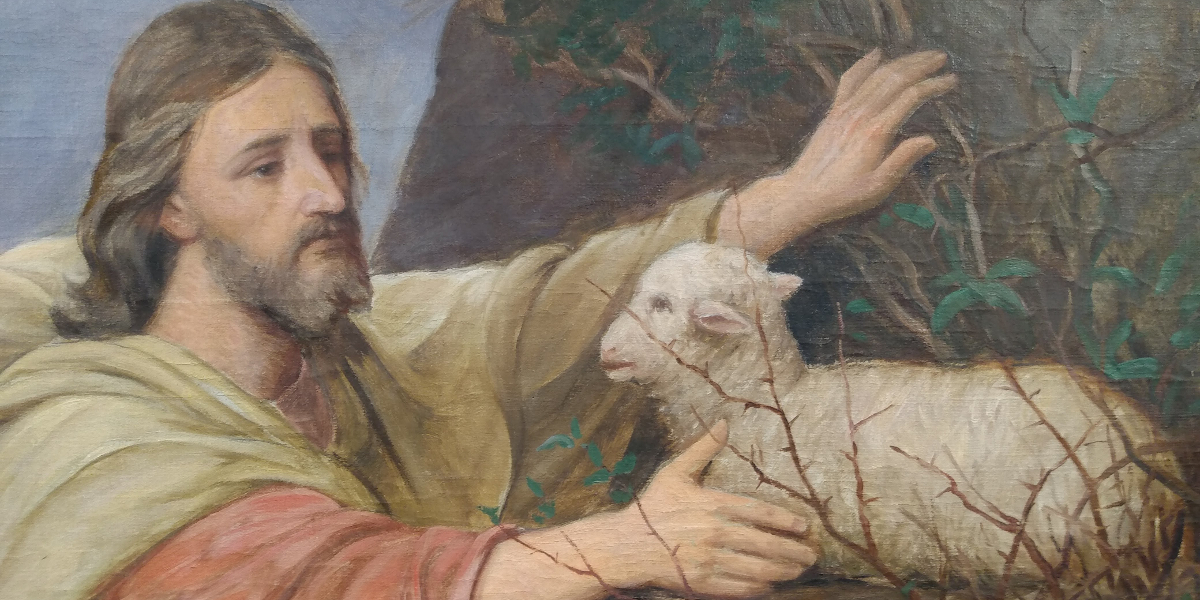
If you search online for “Good Shepherd paintings,” you will find depictions of lambs being carried on Jesus’ shoulders, held in His arms, led by Him to pasture and water, and rescued by Him. The Saude altar painting shows the Good Shepherd rescuing a lost lamb. What you never see in these paintings is the sheep taking charge, blazing their own trail, and conquering their enemies. That is not something sheep do—or if they try, they don’t do it very successfully.
Domestic sheep require constant care and protection. They are quite vulnerable to predators and are prone to wandering. But they are also very loyal and are able to discern the difference between their shepherd’s voice and the voices of strangers. In these ways, little lambs are something like little children.
Children come into the world through the union of a man and a woman, because God wants every child to have the care and protection of a mother and a father. Little children often don’t recognize the dangers around them. They try to touch things that are too hot or too sharp. They want to go exploring on their own and climb on things that are too high. So their parents (or their siblings) keep a close eye on them: “Don’t touch that!” they say. “Come back!” “Get down!”
Do children listen? Sometimes yes and sometimes no. You have probably seen the look in a child’s eyes when he hears his parents say something, but he wishes he hadn’t heard it, and he acts like he didn’t hear it. So a parent says, “Did you hear what I said? Listen to me!” That listening is important. It keeps children safe. It teaches and guides them.
Children who will not listen to their parents will bring harm on themselves and distress and sadness to those who care for them. But children who do listen to their parents learn early on the difference between what is good and bad, right and wrong, safe and unsafe. Children who listen grow in wisdom and knowledge. They bring joy to their parents.
The same goes for you and me before God. We are His children. He made us and continues to provide for us. He sent His only Son to redeem us, so that we would be adopted into His holy family. Our primary responsibility as His children is to listen to what He says. The apostle Peter wrote, “Like newborn infants, long for the pure spiritual milk—the Word of God—, that by it you may grow up into salvation” (1Pe. 2:2). And Jesus says, “My sheep hear my voice, and I know them, and they follow me” (Joh. 11:27).
The shepherd does not follow the sheep; the sheep follow the shepherd. The sheep do not tell the shepherd what to do; they listen to what he tells them. Just as it is not right for children to be disrespectful to their parents, to question everything they say, or to blame them for all their problems, so it is not right for the sheep—for you and me—to act like this toward God. We do not have the power and the authority; He does. We do not know what is best for ourselves; He does.
That is difficult for us to accept. When we are giving in to our passions, going a direction we have been taught to avoid, doing things we have been told not to do, we feel like we are in control. “I can make decisions for myself!” we think. “It’s my life! No one can stop me from doing what I want!” We learn the hard way that the path of sinful indulgence is not where we find fulfillment and happiness. It is where we find pain and heartache, and where we receive deep cuts and wounds that don’t heal easily.
The young woman who gives herself to one boyfriend after another hoping that the latest relationship will last, knows this to be true. So does the young man who has taken the bait of pornography and is now helplessly stuck on the hook. They thought they could give up part of themselves to get what they wanted. They thought they could maintain control. But their sin controls them. And now they wish they could get everything back that they gave up.
What does a little lamb do who has gotten himself or herself into a thorny situation, who doesn’t know where to turn? That little lamb does the only thing it can do. It cries out for help. It sends out a mournful, desperate cry right from the heart. That’s what we do when our conscience is troubled, when guilt gnaws inside us, when we find ourselves in a difficult situation that we can’t find our way out of. We cry for rescue and deliverance. And the Good Shepherd hears that cry. “I know My own,” He says.
A mother can hear her child’s cry from the other side of a room full of people. Jesus not only hears your cry, He knows your pain before you express it. He knows exactly how to help before you even open your mouth. That is how well He knows you. That is how much He cares for you. But you already know this about your Good Shepherd, because you know what He gave up for you. “The Good Shepherd lays down His life for the sheep.”
Even though you and I have tested God’s patience again and again by our sinful choices, even though we have wandered so far away from Him that we could no longer hear His voice, even though we can hardly imagine why He would want us, the Good Shepherd willingly gave up His life for us. In His eyes, we were worth saving. We were worth the anguish and thorns and piercing of the nails. We were worth the righteous wrath of God and the fires of hell.
Jesus stepped between us and the wolfish devil, the one who is constantly tempting us to sin and then torturing us for committing it. Jesus let all accusation come upon Him. He took the place of us sheep who love to wander and made all our transgressions His. He paid the debt that we owed God for breaking His Commandments by our actions, words, and thoughts.
The cold jaws of death fastened around Jesus instead of us. But how could the sheep survive without the Shepherd? The night of His arrest, Jesus quoted this Old Testament passage about Himself and His followers, “I will strike the shepherd, and the sheep of the flock will be scattered” (Mat. 26:31). What a terrible outcome! But then Jesus added these stunning words, “after I am raised up, I will go before you to Galilee” (v. 32).
“After I am raised up….” What an amazing prediction! Immediately following today’s Gospel reading, Jesus said the same thing, “I lay down my life that I may take it up again. No one takes it from me, but I lay it down of my own accord” (Joh. 10:17-18). The death of the Good Shepherd would not mark the end of His care for the sheep. He rose from the dead in triumph to demonstrate that nothing could stop His love for His sheep—not even death (Rom. 8:35-39).
You were brought into His care and became His little lamb when you were baptized. He took you up in His arms like He did those little children so many years ago and He blessed you. He washed away all your sins in His blood. He made you spotless like the bright wool of a lamb, clothing you in His righteousness. He rescued you from the darkness of sin and death where you had gotten utterly lost, and He brought you into His kingdom of light and life.
And what does He ask of you? Only that you listen to His voice and hear His comforting and saving words. “If you abide in my word, you are truly my disciples,” He says, “and you will know the truth, and the truth will set you free” (Joh. 8:31-32). To listen to Jesus is to have truth and life and freedom. To ignore Him is to become prey to the devil’s lies and death.
Listening is hard for us little lambs, us little children, because we like to do things that are bad for us. None of us listens perfectly. We sin all the time. But Jesus keeps calling out to us, calling us back to His care and protection. That call goes out every time you attend divine service and open your Bible or devotion book for study at home. “Come to me,” Jesus says, “and I will give you rest” (Mat. 11:28).
He calls you to the green pastures and still waters of His Word and Sacraments. He invites you to eat and drink for your fulfillment and strength. He trains you to listen better and follow Him more closely. This happens all through your life. You never get to the point where you are strong enough to set out on your own. You always need your Shepherd’s care.
To keep you in His care, your Lord has given you under-shepherds, who speak nothing more or less than what He has spoken. The way to tell the difference between a faithful pastor and a hired hand is to compare what each one says with what Jesus says. My call as your pastor, your shepherd in this place, is to pay careful attention to myself and to all the flock, in which the Holy Spirit has made me an overseer, to care for the church of God, which He obtained with His own blood (Act. 20:28).
My call is to remind you that You Are Jesus’ Little Lamb. You need His forgiveness. You need His guidance. You need His constant protection as you walk through the valley of the shadow of death. He brings all these blessings to you through His powerful Word. “My sheep hear my voice,” He says, “and I know them, and they follow me” (Joh. 11:27).
Glory be to the Father and to the Son and to the Holy Ghost; as it was in the beginning, is now, and ever shall be, forevermore. Amen.
+ + +
(picture from Saude Lutheran Church altar painting)

The Resurrection of Our Lord – Pr. Faugstad exordium & sermon
Festival exordium:
The miracle-worker died, but his followers refused to accept it. “He will rise again!” they said. So they waited. They waited one day. Then two. On the third day, nothing happened. Weeks passed, then months. Then more than a year and a half had gone by. Finally the funeral home obtained a court order and buried the man’s body.
This actually happened in South Africa. A pastor who claimed to be able to heal the sick, and who reportedly predicted his own resurrection, stayed dead. He did not have the power he thought he had or said he had.
There is only one Man who predicted His own resurrection and then did it. We are gathered here today to hear His Word and sing His praises. Even though He had done countless miracles and even raised several people from the dead, His closest disciples did not believe He would rise. The eleven disciples went into hiding after He was crucified and buried. The women made plans to return to His tomb after the Sabbath to anoint His dead body with more spices.
The only ones who seemed to take Jesus’ prediction seriously were the chief priests and Pharisees. They went to Pilate and said, “Sir, we remember how that impostor said, while he was still alive, ‘After three days I will rise.’” Therefore order the tomb to be made secure until the third day, lest his disciples go and steal him away” (Mat. 27:63-64). All this accomplished was putting witnesses at the tomb—the soldiers—who watched an angel descend from heaven and roll away the stone revealing an empty tomb. They reported what they saw to the chief priests, who, instead of hearing what they said, paid them to tell a lie (28:11-15).
But the resurrection of Jesus is no lie. It happened just as Jesus said it would, on the third day after His death. He did break the chains of death. He did emerge victorious. He did end the terrible reign of death brought into the world by Adam’s sin. He did it for the doubters, for the weak, for the faithless, for sinners—for you and me.
In thankfulness and joy, let us rise to sing hymn #348, “He Is Arisen! Glorious Word!”
He is arisen! Glorious Word!
Now reconciled is God, my Lord;
The gates of heaven are open.
My Jesus died triumphantly,
And Satan’s arrows broken lie,
Destroyed hell’s direst weapon.
O hear
What cheer!
Christ victorious
Riseth glorious,
Life He giveth—
He was dead, but see, He liveth!
+ + +
Sermon text: St. Mark 16:1-8
In Christ Jesus, who was not in the tomb on Easter morning, but who is here with us to bless us, dear fellow redeemed:
Many people claim to have seen angels. Some of them say angels appeared when they were in great distress or sorrow and brought them comfort. Others report messages spoken to them by the angels, special messages from God. The problem is, sometimes those messages do not agree with what the Bible says. So which is more reliable: a special visit from an angel or the Word of God?
If someone is given a message by a holy angel, it will not contradict the Word of God. The angels who serve God are without sin; they only tell the truth. So if an angel speaks a message that conflicts with the Word of God, it is not a holy angel. St. Paul writes that “even Satan disguises himself as an angel of light” (2Co. 11:14). Many prominent false teachers in history claim to have been visited by angels who gave them their new teachings. But these were not holy angels. They were the devil or demons coming in disguise.
So how can we know that the angel who spoke to the women at Jesus’ tomb was really sent by God? How can we be sure that it wasn’t just something they imagined in their state of emotional turmoil and sorrow? When the women went to Jesus’ tomb early Sunday morning, they went there expecting to find a dead man—if they could roll away the stone from the entrance to get to Him.
Instead, they looked up and saw that the stone had already been rolled away. That was strange. And when they cautiously peaked inside, they did not see the body of Jesus. They saw a young man wearing a long, white robe—an angel. Seeing their distress and alarm, the angel told them there was no need to fear. Why? There was no need to fear because Jesus had done everything He said He would do.
The angel didn’t tell them anything new. Jesus had told His disciples multiple times that He would go to Jerusalem to suffer, die, and on the third day rise again. And when they were in Jerusalem the night of His arrest, He told His disciples that they would all desert Him, but after He was raised up, He would go before them to Galilee (Mar. 14:27-28). Now the angel was saying the same thing: Jesus “was crucified. He is risen!… He is going before you into Galilee… as He said to you.”
That is the message the women took back to the disciples. The appearance of the angel was surprising, but the words he spoke should not have been surprising. He simply reminded them what they had already heard. That’s what the holy angels do. They proclaim the promises of God. Isn’t that what the angels did the night of Jesus’ birth? They proclaimed the fulfillment of God’s promise: “For unto you is born this day in the city of David a Savior, which is Christ the Lord” (Luk. 2:11).
You can be sure that if an angel appears to you and speaks a message that does not agree with the Bible’s teaching, it is not an angel of God. St. Paul said that there are some who “want to distort the gospel of Christ.” Then he adds, “But even if we or an angel from heaven should preach to you a gospel contrary to the one we preached to you, let him be accursed” (Gal. 1:7-8). But how can we know that the Gospel is true? Or how can we be sure we have the right Gospel?
That topic came up in a conversation I had with a Mormon man. Before I knew his religious background, he asked me a question that every Lutheran pastor loves to hear, “What is the Gospel?” But I could tell as I explained the Gospel to him that he wasn’t convinced. It was a “gotcha question.” He wanted to make the point that if all of the different denominations of Christians had different understandings of the Gospel, none of us could be certain we had the right one. That’s why we needed a modern-day prophet to give the correct interpretation—a prophet like Joseph Smith (who, incidentally, claimed to get his special revelations from an “angel”).
But we can know the Gospel from the Bible and be certain that we have the true Gospel. The angel sitting in that tomb couldn’t have said it more plainly: Jesus “was crucified. He is risen!” That is the good news. That is the Gospel. A dead man rose from the dead! But it wasn’t just any dead man. It was a dead man who claimed to be the Son of God. It was a dead man who predicted that everything would happen just as it happened. It was a dead man who said that His victory over death would be your victory, that His life would be your life.
Jesus’ resurrection verified everything He ever said. He could have said what He did, died on the cross, and never been seen or heard from again. That would have proven that He was nothing more than a big talker, or that He was delusional. But that is not what happened. He did rise from the dead. We believe it not just because an angel said it happened. We believe it because Jesus showed Himself alive to the women later that morning, to His disciples on numerous occasions, and at one time to more than five hundred of His followers (1Co. 15:6). He talked with them, ate with them, and definitively proved that He is who He said—the Son of God in the flesh.
The disciples wrote down what they saw and heard, so that everyone could learn about Jesus and what He had done. Jesus hadn’t just accomplished something for His time. He had done something for all time. His apostle John wrote near the end of His Gospel account: “these are written so that you may believe that Jesus is the Christ, the Son of God, and that by believing you may have life in his name” (Joh. 20:31).
Our faith in Jesus is not a special feeling we have about Him. It is not a decision we made when considering various faith systems. Our faith in Jesus is a confidence worked in us by God the Holy Spirit through the message of His Gospel. It is a confidence that because Jesus rose from the dead, we will rise. Because He lives forever, we will live forever. We know how ridiculous and impossible it sounds that a severely beaten and crucified man should rise from the dead a couple days later, alive and well, walking around and visiting with people all over the place.
But this was not just any man. This was God-in-the-flesh who won the victory for you. He went to the cross and crushed the devil’s head by paying for your sins. And He conquered death by coming alive on the very day He said He would. Sin, devil, and death could not stop Him. They met an Enemy who had them shaking in their boots.
This is the Lord and Savior who joined Himself to your flesh, so that He could do everything for you that you couldn’t do. And He has joined Himself to you in an even more personal way. He made you a member of His holy body through your Baptism into Him, cleansing you of your sins and covering you in His righteousness. And He feeds you and fills you with His life by giving you His immortal body and blood in His holy Supper. He graciously comes to you and me through His Word and Sacraments, so that even though outwardly we are wasting away, inwardly He renews us day by day (2Co. 4:16).
The Bible says that the angels are amazed by the gracious care God has for us. The gifts the Holy Spirit gives us through the Gospel are “things into which angels long to look” (1Pe. 1:12). So we do not need to wait for a special visit from an angel to know that God loves us. We do not need to seek comfort in our grief from strange coincidences, appearances of certain animals, or from other signs that seem to convey messages from those who are now dead.
We need the Gospel. We need to hear the message again and again that our sins are forgiven, that eternal life is ours through faith in Jesus, and that He will raise our bodies and the bodies of all our loved ones from the dead when He comes again in glory. That is the message God sent His holy angels to proclaim when His Son entered this world and when He rose in triumph out of the dark tomb.
And that is the message we still proclaim today and every day. We want our family, our friends, and even our enemies to hear the saving truth that Christ is risen! He is risen indeed! Alleluia!
Glory be to the Father and to the Son and to the Holy Ghost; as it was in the beginning, is now, and ever shall be, forevermore. Amen.
+ + +
(woodcut from “The Empty Tomb” by Julius Schnorr von Carolsfeld, 1794-1872)