
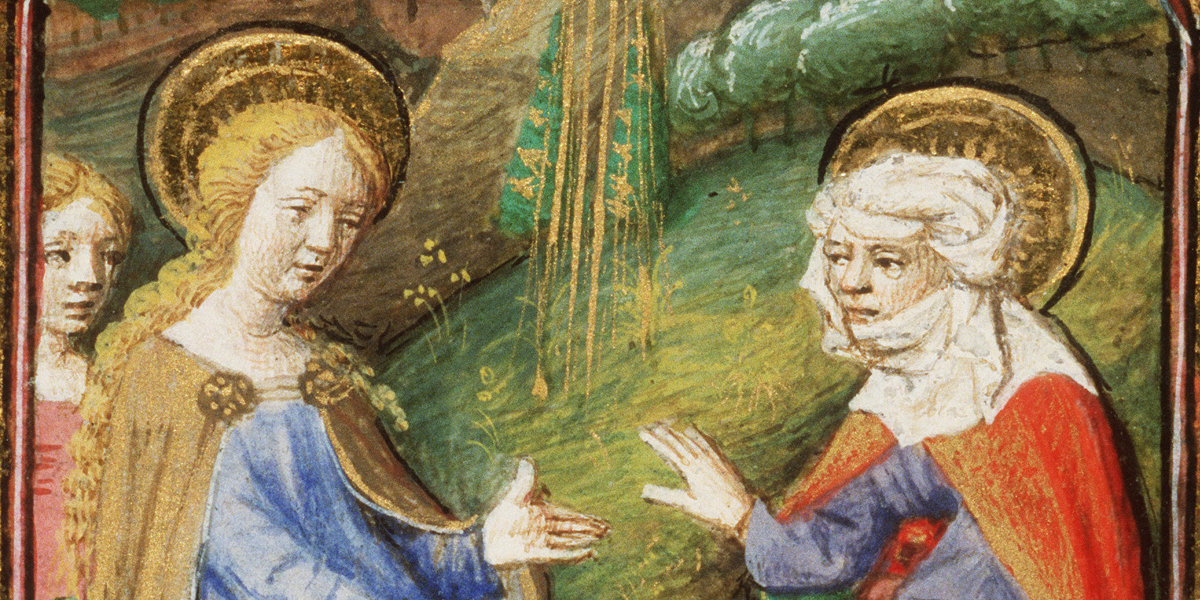
The Visitation of Mary & Vicar Installation – Pr. Faugstad sermon
Text: St. Luke 1:39-56
In Christ Jesus, who “made Himself nothing, taking the form of a servant, being born in the likeness of men” (Phi. 2:7), in order to redeem us by His perfect life and innocent death, dear fellow redeemed:
The mothers who have carried in their wombs the greatest people in the history of the world, did not know what their little babies would become. The Apostle Paul’s mother could not have guessed that her son would one day preach Christ crucified around the world. And Margarethe Luther would not have expected her son Martin to become a great reformer.
Elizabeth and Mary were different. They knew that the baby boys in their wombs were destined for tremendous things. Elizabeth learned it from her husband, a priest serving in the Jerusalem temple, who was visited by the angel Gabriel. The angel told Zechariah that he and Elizabeth would have a son. He would “be filled with the Holy Spirit, even from his mother’s womb,” and would “turn many of the children of Israel to the Lord their God” (Luk. 1:15, 16). His name was to be John. After Elizabeth conceived this child, she kept herself hidden for five months. Who would believe that this old woman was carrying a child after a lifetime of barrenness?
In the sixth month of Elizabeth’s pregnancy, the angel Gabriel visited her young relative Mary. As you know very well, Mary was betrothed to a man named Joseph, but they had not had relations with each other. Mary was a virgin. Gabriel shared the stunning news with Mary that she would bear the Christ Child, “the Son of the Most High” (Luk. 1:32), who would reign over an everlasting kingdom. And he had even more news to share. Her elderly relative Elizabeth was six months along in her own pregnancy. “For nothing will be impossible with God” (Luk. 1:37).
So what did Mary do next? She got up and hurried to Elizabeth’s house. Even if no one else believed her, Elizabeth would—Elizabeth whose life had also been touched by the unexpected working of God. By this time, Elizabeth’s belly had expanded to make room for the growing boy inside her. She might have felt little flutters as he moved around and hiccupped. Her baby was about twelve inches long and 1½ to 2 pounds in weight. His eyes may have just begun to peek out behind red eyelids.
Elizabeth did not know that a monumental meeting was about to take place. The Messiah was about to enter the home of His messenger. With Mary’s arrival, the two men who would turn the world upside down with their preaching and teaching, were now in the same room in the flesh. Elizabeth had not heard about Mary’s pregnancy, and yet she knew. She knew as soon as Mary greeted her, and her baby leaped in her womb. She knew, because at Mary’s greeting she was filled with the Holy Spirit.
The Holy Spirit revealed to her that Mary, a virgin and yet pregnant, was “the mother of her Lord.” She spoke three blessings to Mary: “Blessed are you among women,” “blessed is the fruit of your womb,” and “blessed is she who believed” what the Lord said. Elizabeth did not honor Mary because she had accomplished great things on her own. Elizabeth honored Mary because of her connection to the teeny, tiny baby growing in her womb.
But how could the little baby of a poor woman save the world? The world doesn’t think much of little babies or of poor women. Little babies are viewed more and more as burdens. Babies get in the way of careers and riches and personal freedom. All of us have thought that at one point or another. But Elizabeth and Mary were once babies, as were their sons John and Jesus. You and I were babies, and here we are. We are supposed to be here. God gave us life. Every Christian should be pro-baby, because God is pro-baby!
Every soul is precious in His sight, which means every soul should be precious to us. Our hearts should expand in love for all our neighbors, from the poor ones to the rich ones, from the lowly ones to the well-regarded, from the unborn to the elderly. Every life has value. Every life matters. Just look at the care with which God formed us in the womb. The psalmist David wrote, “For you formed my inward parts; you knitted me together in my mother’s womb. I praise you, for I am fearfully and wonderfully made” (Psa. 139:13-14). He goes on to describe how we were “made in secret, intricately woven,” and how even at our conception, God had a plan for all our days (vv. 15, 16).
The miraculous composition of a human being should be enough for people to acknowledge and praise the almighty God. But our sinfulness is great, and it has been with us for as long as we have existed. Adam and Eve’s fall meant that all their descendants would inherit their sin, and sin keeps us from fearing, loving, and trusting God as we should. In another of his Psalms, David wrote, “Behold, I was brought forth in iniquity, and in sin did my mother conceive me” (Psa. 51:5). That is true of every one of us. We were sinners from the moment we were conceived.
But Jesus was an exception to that unbroken line of sin. He was conceived not by a human father and mother, but by God the Holy Spirit overshadowing the womb of Mary. In this way, God the Son took on human flesh but without human sin. By His entrance into the world as an embryo, God was showing that life matters from its earliest beginnings, even before the human eye can see it. As He went through each stage of life—from His growth in the womb, to His birth, as a toddler, a child, a young adult, a grown-up—Jesus was redeeming every stage of life from the sin that pollutes us.
God does not take shortcuts. There was no simple, easy way for mankind to be saved. The Son of God had to take on flesh, and He couldn’t just appear in the flesh like you might appear in costume. He had to take human flesh into His Person. He had to start the way all humans start, with the joining of tiny cells. From the time that Gabriel visited faithful Mary, the eternal Son of God became God and Man in one Person. And He remains God and Man for all eternity.
This is the One whom John would go into the wilderness to proclaim. But that would be about thirty years later. Today was the day for Messenger John and his Master Jesus to meet. And how do we know that John was aware of Jesus’ presence? Elizabeth exclaimed to Mary, “For behold, when the sound of your greeting came to my ears, the baby in my womb leaped for joy.”
John continued to rejoice. Those thirty years later after Jesus was baptized, John cried out, “Behold, the Lamb of God, who takes away the sin of the world!” (Joh. 1:29). As Jesus’ following increased, and fewer were coming to John, John testified, “The friend of the bridegroom, who stands and hears him, rejoices greatly at the bridegroom’s voice. Therefore this joy of mine is now complete. He must increase, but I must decrease” (Joh. 3:29-30).
John had it right; his glory was in Jesus. The long-promised Savior had come. Elizabeth saw it the same way. She welcomed Mary with all humility, “And why is this granted to me that the mother of my Lord should come to me?” Mary saw it the same way. In her famous song, the Magnificat, she said that her Savior God “has looked on the humble estate of His servant,” “has done great things for me,” has “exalted those of humble estate,” and “has filled the hungry with good things.”
And so it is for you and me. The Lord has looked on our humble estate. He saw how helpless we were, how lost in our sin. And He has done great things for us. The little baby in Mary’s womb was growing there for you and me. The six months bigger baby growing in Elizabeth’s womb would go before Him to prepare His way. All of this happened more than 2,000 years ago, but God had you in mind.
God the Father sent His only Son for this express purpose—to save your soul. He gave you birth, so that He could give you rebirth. He formed you in the womb, so He could transform you by the power of the Gospel. You might wonder sometimes how much your life matters. You might wish you could go back, make different choices, and do more with your life. You can put all those thoughts to rest when you see what God did for you, when you see the womb of a virgin swelling with Child, when you see the God-Man making His way to Calvary carrying His cross—for you.
Your life matters. God loves you. He forgives all your sin. He wants you to join Him in heaven with Elizabeth, John, Mary, and all the saints. This is the message He calls sinful men to preach. We give thanks that He has sent another vicar to our parish to preach this Word to us and to continue training for the noble work of pastor. Pastors have nothing to offer you of their own, just as Mary had nothing to offer of her own. But as God chose her to bear the Christ-Child in her body, so He has chosen sinners to “rightly handle His word of truth” (2Ti. 2:15), and to distribute His means of grace through our mouths and by our hands.
The presence of Jesus in Mary’s womb brought joy to Elizabeth and John, and His presence still brings joy to us. When the sound of His forgiveness and grace reaches our ears, the Holy Spirit comes to remove our burdens and lift our hearts. Then our souls magnify the Lord, and our spirits rejoice in God our Savior.
Glory be to the Father and to the Son and to the Holy Ghost; as it was in the beginning, is now, and ever shall be, forevermore. Amen.
+ + +
(Picture of the Visitation from the Book of Hours of Simon de Varie, 1455)

The Festival of Our Lord’s Ascension – Vicar Anderson sermon
Text: St. Mark 16:14-20
In Christ Jesus, your ascended King and Lord, who lives and reigns over all creation, who is still with you until your ascension, dear fellow redeemed:
A role model is a person looked to by others as an example to be imitated. While baby-sitting I found out how quickly you can be put into that role. Looking back now, I see why parenting can sometimes be difficult. Children watch every single thing that parents do. They watch especially when you think that they are not watching. They point out how impressionable they are. Part of that reason is the trust that they have. Now as children put this trust in their parents and role models, tonight we see Jesus asking for that same trust. Not only is He the one who we want to imitate, and He is our guide, but He is our Savior. And as He ascended into heaven, He puts the trust that we have in Him on display. Jesus assures us with His ascension the hope that we have in Him. We will ascend and meet Him in glory!
St. Mark in this last section of his gospel is giving an overview of Jesus last forty days on earth. In our text we see Jesus rebuking the disciples. “He rebuked them for their unbelief and hardness of heart, because they had not believed those who saw him after he had risen.” Now this rebuke is warranted because of what is recorded before our text. Jesus had appeared to three witnesses after His resurrection and only two witnesses proved something happened. Jesus had appeared to three. On that evidence they should have believed that He had risen.
Like the disciples, we can need that same wake up call. The disciples were told by three witnesses. We have the Scriptures. The Old Testament reveals to us what God demands and promises that someone is going to come and follow those demands perfectly for us. The New Testament reveals to us the heart of the Gospel, Jesus is the Christ who came down from Heaven, lived a perfect life and died for us. When hardships arise in our lives sometimes the first thing we do instead of looking to the Scriptures is look for earthly answers. We forget about God’s promises, and we can question if Jesus is even real, our hearts harden. The same eyewitnesses who had unbelief, they wrote down the gospel to be our witnesses.
Are they still believable? Even the disciples questioned Jesus with His death. Tomorrow marks Ascension, He visibly left us. Why would He leave those He loves? Does He care? Shouldn’t we get special treatment because we follow Him? This would make a lot of sense if God would come and establish an earthly kingdom. We would want a part ruling in that kingdom. These distractions can move us away from the truth. When it looks like it is us against the world or we are just selfish, we don’t want or need that mindset. We have no reason to be selfish or independent. The world wants to be independent, but our independence gets us nowhere.
The command to go into the world also looks as though it is challenging. What will people think of us? We see that they don’t like the message that we have. This message points out the truth of what we have done. The truth is that we have made many mistakes. We don’t like to hear when we have made mistakes. Jesus then says to share the Gospel. This can even be harder when people are already mad because you first told them that they were doing something wrong, that if they don’t change their ways, then they will be condemned. Jesus says, “If you abide in my word, you are truly my disciples, and you will know the truth, and the truth will set you free” (John 8:31-32). We hear the truth that we have done wrong, but then the Gospel comes in and everything changes.
The disciples are brought to faith once again. Jesus immediately puts them to work. He knows that He is not going to be with them much longer. Jesus commands them that they are to spread the Gospel, baptizing all nations. We see how smart Jesus is. Since the disciples are not perfect, what is to stop them from hardening their hearts again? Jesus allows them to perform signs. These signs are not meant to be used like magical spells. They are meant to help those in need. They are special signs used to prove that the Gospel is true. How could the disciples be lying if the message that they are bringing comes with special signs to help those in need? The disciples speak the truth of Christ, and we see how they go out faithfully to do so. They go out, perform these signs, and they gave their lives to preach this saving truth. Even as their Lord had ascended before their eyes, we see that Jesus never left them. These signs were performed in His name. It was not power of the disciples, but the power was Christ. These signs prove that Christ is still carrying out His Work. His enemies can’t stand against Him.
Jesus’ time on earth has ended. Like the disciples, we can sometimes struggle to understand this, but Jesus ascended for your benefit. Jesus’ ascension means that the Holy Spirit would come to the disciples. As the disciples receive these gifts, it is through the Holy Spirit that Christ comes to you. He uses the means of the Word and sacraments. He tells you the benefit of your baptism. With baptism, you have faith that what Christ did for you is true. He died for your sins on the cross and He rose from the dead for your justification. It is through this work that God finds you not guilty. Your baptism into Christ’s death brings forgiveness of sins, life, and salvation. Your baptism washes away your sins of doubt.
The world will try to convince you that Jesus has left you all alone to live this life on earth. To deal with all these hardships. That is not what His ascension means. If Christ did not ascend, you would have to travel to see Him. He ascended visibly into Heaven so that He can be with you wherever you are. He is not just a man confined to a body; He is true God. Christ is with you wherever you go. You know His presence is here in His Word and Sacraments. You believe this through faith in Christ, faith that you only have because of the work of the Holy Spirit in you.
Through faith in Christ, you see the work of His ascension. You see His authority; Christ puts His work on display for the church. You see Him as a Prophet. He sends trained men to come and share you this gospel message. In His ascension He is also a Priest. He intercedes your prayers on your behalf. Lastly, Christ has taken His crown as King. He has crushed all His enemies. He takes care of you and He will live and reign over the church triumphant when He calls you home. Christ’s ascension reveals to you that there is a home that you will go to when you die. Your destination is not to remain here and suffer. Christ ascension, Him not being here, assures you that you do not have to stay here. Jesus has prepared a home for you, the hope of your ascension.
We have tried to look to Christ and imitate Him in our lives. Like the disciples, we have failed to do that, and we will continue to fail as long as we live. Where we are not perfect, our Savior was perfect. He not only lived His life in our place, but He gave up His life so that we would be saved. He brings us that comfort through our baptism, that we are marked children of God. But Jesus couldn’t stay with us on earth. The time came for Him to go back to His Father. This happened for us. He didn’t abandon us. He left visibly to live and reign over all creation, to be at all places, to protect, and comfort you from all trials and hardships, preparing a place in Heaven for you. We confess our hope with hymn 392, On Christ’s ascension I now built the hope of mine ascension; This hope alone has ever stilled All doubt and apprehension; For where the Head is, there full well I know His members are to dwell When Christ shall come and call them (ELH 392 v. 1). Amen.
Glory be to the Father and to the Son and to the Holy Ghost; as it was in the beginning, is now, and ever shall be, forevermore. Amen.
+ + +
(picture from painting by John Singleton Copley, 1775)

St. Joseph, Guardian of Jesus – Pr. Faugstad sermon
Text: St. Matthew 13:54-58
In Christ Jesus, whose coming was prophesied for thousands of years, but whose arrival still caught everyone by surprise, dear fellow redeemed:
Sometimes we wonder how our life would be different if we had chosen a different path. What if we had taken risks instead of playing it safe, or the other way around? What if we had followed the advice of this person instead of that person, turned right instead of left? Maybe we would have been more successful, more respected, more happy. Maybe we could have reached our full potential. Maybe we would feel today like we had really done something significant. Unsettling thoughts, and we’ve all had them at one point or another.
There is encouragement for us in the example of St. Joseph. Joseph was a descendant of the great King David, but it had been hundreds of years since a member of the family had occupied the throne. Joseph lived a ways north of the capital, up in the territory of Galilee in the town of Nazareth. We get a sense of the town when Philip told Nathanael about “Jesus of Nazareth,” and Nathanael asked, “Can anything good come out of Nazareth?” (Joh. 1:46).
Today’s reading tells us that Joseph was a carpenter of some sort, working his trade in the community, working with his hands. He was neither wealthy nor well-known—not a person expected to make an impact on history. But God had other plans for him. He brought a faithful woman into his life—Mary—and they made plans to be married. They were “betrothed” to each other, which was a legally binding arrangement that came before the public marriage ceremony. Until the public ceremony, they stayed in separate homes and did not share a bed.
Then the shocker! Mary informed Joseph that she was pregnant. He obviously was not the father, and Mary’s story about a visit from an angel, and the Holy Spirit conceiving a holy Child in her womb, was difficult to accept. The evangelist Matthew writes that “Joseph, being a just man and unwilling to put her to shame, resolved to divorce her quietly” (1:19). That tells you a lot about Joseph. Even in his heartbroken state, he did not want to make an example out of Mary or bring the Law down on her. He resolved to move on and go back to his work.
But before he took that step, an angel of the Lord appeared to him in a dream and verified Mary’s story. He referred to Joseph by his royal lineage, showing that God was laying out this path for Joseph. The angel said, “Joseph, son of David, do not fear to take Mary as your wife, for that which is conceived in her is from the Holy Spirit. She will bear a son, and you shall call his name Jesus, for he will save his people from their sins” (1:20-21). Joseph listened. He set aside his reason. He ignored any doubts. He trusted the Word of God. He married Mary, and when her Son was born, he called His name “Jesus,” which means, “the LORD is salvation” (1:25).
We hear only a little more about Joseph. He had Jesus circumcised at eight days old and then brought Him to the temple at forty days old to present Him there as the Law of God required (Luk. 2:21-22). He rushed Jesus and Mary to safety in Egypt when King Herod wanted the Child dead (Mat. 2:13-15). He moved the family back to Nazareth after some time had passed (Mat. 2:19-23). And each year after that, he brought his family to Jerusalem to celebrate the Passover (Luk. 2:41). All of these things show Joseph’s character. He was a man of faith committed both to the Word of God and to his family.
Jesus learned from him, which is surprising to think about. The evangelist Luke writes that as a youth, “Jesus increased in wisdom and in stature” (Luk. 2:52). In His state of humiliation, Jesus did not make full use of His divine power. He was able to learn and mature. And Joseph was right there to model a life of faithful adherence to the Scriptures and faithful attendance at the synagogue each week—a good model for Christian fathers today. He also taught Jesus how to build with His hands—a carpenter just like him (Mar. 6:3).
What we learn in today’s Gospel reading is that the people of Nazareth couldn’t get past the image of little Jesus working with quiet Joseph. They had heard about the miracles Jesus had done in the surrounding territory, and now they were listening to Him teach with authority in the synagogue. But instead of seeing Him in a different light and opening their ears to Him, they closed their minds. “Where did this man get this wisdom and these mighty works?” they wondered. They thought about His humble parents and their simple way of life. “What makes Jesus think He can teach us? Does He think He’s something special?”
They were wrong, of course. But we’ve been wrong like that too, judging people by our perception of them instead of by what they actually are. This is especially tempting in small communities like ours. We can judge people by the way we thought about them in elementary school or junior high. Or we can put them in certain categories and tell ourselves that they are all the same as before, and they aren’t worth our time.
But God tells us to love our neighbors, no matter how far back our history with them goes, or what we have perceived them to be. There is always a chance that we have gotten them wrong. There is always a chance that they have grown just as we’d like to think we have. Clearly the people of Nazareth got Jesus wrong. They had gotten His parents wrong too. Joseph was not just a carpenter; he was the legal guardian of the Christ-Child, whose coming had been prophesied for thousands of years. And Mary was not just a mother; she was the bearer of the Son of God, who came to destroy the work of the devil by His innocent suffering and death.
Neither Mary nor Joseph had chosen this for themselves. God chose them for these things. Who would ever feel qualified to raise the Christ-Child? They must have felt like failures, and not only when they lost track of the twelve-year-old Jesus in Jerusalem. They knew that the best they could do was not good enough. But they still carried out their calling from God. They trusted that since He had chosen this for them, He would bless their efforts—imperfect though they were.
This is your encouragement as you carry out your callings from God. Looking back on your life, you may feel that your life has been one long string of bad choices, failures, and missed opportunities. But that isn’t how God sees it at all. He sees you as His dear child, washed clean by the blood of Jesus and covered in His righteousness. He sees your light of faith shining in your home, your workplace, and your community. He sees you surrounded by neighbors who need your love and service—a life full of purpose.
It is the devil who wants to discourage you and make you discontent. He wants you to question if you married the right the person, if you can really give your children what they need, if your job is right for you, or if anyone actually cares about you. He wants you to think that maybe everything would get better if you just walked away, if you just started over. Then you could do what you were meant to do. Then you could reach your full potential.
But while giving way to selfishness may feel like a sort of freedom, it will only drive you more deeply into sin and its darkness. You are not here to serve yourself. You are here to serve the Lord by serving the people He has placed in your life. Jesus told His disciples, “I chose you and appointed you that you should go and bear fruit” (Joh. 15:16). It is the Lord who has planned the good that you would do. He is the one who has set the course for your life.
You haven’t missed out on some higher purpose, some greater thing you were supposed to do, by being where you are today. The Lord has big plans for you and important work for you to do right where you are. You are no failure to Him. God sent His Son to prove the value of your life by giving His perfect life for yours. He cleansed you of your sin and sanctified your life for His work at your Baptism. And He invites you continuously to feast on Him, the Bread of Life—to receive again and again His forgiveness and to be strengthened for your callings by His grace.
Joseph and Mary needed this too. Even while they were raising and providing for Jesus, He was living a perfect life on their behalf. He was keeping the holy commands of God for them and all people, and He would keep these commands all the way to His death on the cross to pay for sin—for His parents’ sins and for yours. His cross is where you take your selfish behavior, your discontentment about your station in life, your thoughts about leaving it all behind. You confess these sins to your merciful Lord, and He declares you forgiven, washed clean by His holy blood.
He chose you for the work you do for the neighbors around you, starting with the neighbors in your own home. Like Joseph, you will not carry out these callings perfectly. But your worth, your success, and your salvation do not depend on how perfect you are. They depend on how perfect your Savior is, and the work He perfectly completed to save you.
What He has done frees you to give with generosity and serve with gladness. Because the work the Lord has given you to do for others is His work. And if it comes from Him, then it is a gift, a gift for which He deserves all the glory.
Glory be to the Father and to the Son and to the Holy Ghost; as it was in the beginning, is now, and ever shall be, forevermore. Amen.
+ + +
(picture from “The Holy Family with a Little Bird” by Bartolomé Esteban Murillo, c. 1650)

The First Sunday in Lent – Vicar Anderson sermon
Text: St. Matthew 4:1-11
In Christ Jesus, who beat back all of the temptations that we face in this life, who fights the devil for us, dear fellow redeemed:
The battle of good versus evil is pretty much in every single script for any superhero and action movie. The only way these movies or TV shows succeed is if you have a humble yet powerful superhero who the viewers will love, take on the evil character. The movie usually has the hero finding himself throughout the story. This then leads to the climax that happens at the end. To add a little flavor, sometimes the hero will have already fought and lost to the bad guy. Here is where all these movies and TV shows find their origin. Jesus has begun his public ministry and as soon as He starts, He is going head-to-head with the prince of this world. This is the first climax and Satan is not hiding behind his punches. What Satan thinks is a cat and mouse game, it is a boxing match that Jesus intends to not lose. Our text is giving you a front row seat as the Adversary takes on your Savior and the Adversary is the one outmatched.
Jesus after being baptized by John, is led into the wilderness. Satan thinks he is ready for the showdown. He strikes when it seems that Jesus is most vulnerable. Jesus had just fasted for 40 days and 40 nights. The majority of people cannot go this long without food. Here comes Satan when Jesus is weak with hunger, and he tells Jesus to turn these stones into bread. Satan is always armed with his half-truths, hoping to get Jesus to trip up. He tempts Jesus with food that can only provide comfort for a little while. He shows Jesus’ ways in which He can give up on living this earthly life. This life is hard, why should Jesus have to make sacrifices, especially for sinners? He flaunts Jesus with the pleasures of the world to get him to give up. Satan shows his knowledge of Scripture, misinterpreting passages to use against Jesus. Jesus must trust the Father’s plan of salvation and it will not be easy.
The surgical strikes that Satan uses against Jesus are the same strikes that are used against us. These heat seeking missiles hit their mark. He tempts us with the power that we think we can use to change our outcomes. He often uses the temptations of wealth and social status. We see that with social media platforms like Tiktok, Snapchat and Instagram. To have power, we must look better than the competition. To be better than our friends, we have to know the latest gossip and have to share it. We are very quick to compare our accomplishments with others. We are quick to look on with lust over what someone else has. The devil also deliberately uses God’s Word against us the same way in which he used it against Christ. He twists the meaning of passages that apply to society saying, “Did God really say that you can’t do that?” The same temptation used in the Garden.
We test God when we throw ourselves into danger. We hear and know the ten commandments. We know what God expects from us. Yet we test God by breaking every single one. Satan waves the sin in front of us. We see that juicy fruit that is pleasing to the eye and good for the taste. Once we taste the fruit, there is no going back, and the consequences of our sins are in front of us. Like us, Jesus is also exhausted after the constant bombardment of temptations. The problem is that we give in to temptation. Repeatedly.
That is what sets us apart from Jesus. We see as clear as day that we are children of Adam and Eve. Their first sin has been passed down the family tree all the way down to us. There is no earthly cure for our sinful nature. Satan has our number. The temptations are dangled in front of us like the forbidden fruit that it is, and we take a bite almost every time. We crave the power, we test God, and we bow down to get gratification that is short lived. The sins that we commit condemn us to death. We can’t withstand the temptations of Satan on our own. That is why Jesus came to withstand Satan for us.
Jesus takes every attack that Satan has to offer and deflects them all with the Sword of the Spirit, the Word of God. Jesus points Satan to the Law demonstrating how He will keep it to perfection. He points out that we live by God. “Man shall not live by bread alone, but by every word that comes from the mouth of God.” He says, “You shall not put the Lord your God to the test.” There is no reason to doubt what God can do since He is with us. Finally, He says, “Be gone, Satan! For it is written, ‘“You shall worship the Lord your God and him only shall you serve.”’ There is no room for Satan and his lies. Jesus is victorious over Satan!
This battle gives us joy because in all the temptations that we fall into, Christ did not give in one inch because our souls were on the line. Our whole lives consist of us failing and falling into temptation. When we are close to despair, it is Jesus who not only beat the temptations perfectly His whole life, but He also took the punishment for what we have done. Jesus withstood what we cannot. The Gospel shows us that we are saved because of what Christ has done for us. Our sins have been wiped away. Satan wants us to despair. He is the accuser who tells God that since we have given into his temptation, that we should be his. Jesus tells Satan to “Be gone,” he cannot accuse what Jesus has redeemed.
Jesus fights for us through the His Word and Sacraments. His Word is where He defends us, comforts us, and He sends the devil away. We are not wielding the sword. Christ is the sword who does all the work as it is His power that causes Satan to flee. In our baptism we are clothed with Christ. Our old Adam was drowned, and the new man arises. The place that Jesus comes to us in the Word and Sacraments right here.
Jesus contends for you and fights for you each week in the Divine Service. When Satan tempts you and wins, you confess to God what you have done and that you are sorry for your sins. Then Jesus speaks His absolution to you through the mouth of the pastor or vicar. You hear these precious words spoken to you, hearing that as you admit that you have given in to the devil and his temptations, your Savior confirms to you that He has borne all your sins on the tree. They will not be remembered in the sight of God.
The sermon is Jesus’ own Word to you, where He teaches you what He has done for you, warns you about the devil’s temptations, and proclaims to you the power of the Gospel. The Gospel comes through clearly revealing that Christ came into the world, suffered everything that you suffer in this life, and He did it all perfectly and willingly in your place. Christ has beaten Satan. Then Jesus meets you in Holy Communion.
Holy Communion is the true body and blood of Christ. The precious body and blood of your Savior is placed on your tongue confirming that the sins that you have given into have been wiped away by Christ’s blood, shed for you and for many for the remission of sins. He fights the battles within you and keeps you close to him. You can’t get closer to your Savior than in His Word and Sacraments.
By the end of the service, you know that there is only One who you put all your hope and faith in, Jesus Christ your Savior. He is the same yesterday and today. He is your armor, your sword and shield against the enemy. He protects you, guides you, and brings forgiveness of sins, life, and salvation, not because you earned it. But because He has beaten the devil for you. When you are weak, He is strong. He is the Hero of all heroes, the One who cannot be overcome.
Satan thought that He could get Jesus. He thought that Jesus was weak. Satan underestimated what Jesus is capable of. Jesus is the Son of God. Satan’s temptations were no match for Jesus. He should have known this as he was told this would happen in the Garden of Eden. Satan won with tempting Adam and Eve, but God delivers to him the ultimate blow. He promised that the woman’s seed would come and crush his head. Jesus is that seed. He came into the world as a humble infant. He humbly lived a life like ours, perfectly keeping God’s Law. And then He went to the cross sacrificing Himself for us, destroying the works of the devil. Jesus is victorious over Satan and always will be. Amen.
Glory be to the Father and to the Son and to the Holy Ghost; as it was in the beginning, is now, and ever shall be, forevermore. Amen.
+ + +
(picture from “The Temptation of Christ by the Devil” by Félix Joseph Barrias, 1822-1907)

The Baptism of Our Lord – Pr. Faugstad sermon
Text: St. Matthew 3:13-17
In Christ Jesus, who “came by water and blood,” (1Jo. 5:6), who came to fulfill all righteousness and win our salvation from His baptism to His death on the cross, dear fellow redeemed:
What do you want to be when you grow up? If you are not asking that question now, you probably did at one time. Children and adolescents spend a lot of time thinking about that question. What am I supposed to do with my life? What will my future hold? Typically we start with grand ideas. We want to be just like the famous trailblazers and champions we admire. But as we get older, our plans become more realistic, even if our life doesn’t go in the direction we expect.
Tied up in our plans for the future is the question about where we fit in the world. We want to be noticed. We want to be liked. We want to be successful. We want others to think we are special. And that’s a lot of pressure. A report released last week by the CDC said that anxiety and depression are on the rise among teenagers, and it’s way up among teenage girls. Part of the reason for this increase has to do with the pressure that teenagers feel in matters of their sexuality.
Our current culture does not provide a healthy environment for children to mature and grow. It expects them to make life-changing decisions about themselves and their bodies when they aren’t ready to make those decisions. How do we help them with the burdens they carry? How do we settle our own anxious thoughts about our purpose in life and our future?
Today’s reading provides good direction for us. The events happened at a time when hardly anyone knew who Jesus was. His neighbors in Nazareth thought of Him as a kind and intelligent young man. But they didn’t exactly expect Him to be a world-changer. He was the son of Joseph and Mary, and He was probably destined for a very anonymous life (Mat. 13:55).
But that isn’t what John the Baptizer thought. When Jesus made His way to the Jordan River where John was preaching and baptizing, John said something surprising, “I need to be baptized by You, and do You come to me?” How did John know who Jesus was? We don’t know. What we know is that John was called to prepare the way for the Messiah. And he said that “for this purpose I came baptizing with water, that he might be revealed to Israel” (Joh. 1:31).
John and Jesus were also cousins, so it is possible they grew up around each other, and John could see how good and upright Jesus was. Whatever impressions John had about Jesus would now become set in stone. “Let it be so now,” said Jesus, “for thus it is fitting for us to fulfill all righteousness.” So John baptized Him.
As soon as Jesus stepped down into the river and had water poured over Him, you and I were assured of a very bright, a very beautiful future. How can that be? When Jesus stepped into the water, He didn’t go for Himself. We can see why John questioned Jesus’ intent to be baptized. John clearly proclaimed that his baptism was for sinners. But what sins did Jesus have to confess?
Jesus had no sins of His own, but He had all of yours and mine. This was no ordinary man who showed up at the river. This was the eternal Son of God clothed in our flesh. Whatever God did in the flesh should have our very close attention. He didn’t go to the Jordan to pass the time. Everything He did had purpose. His baptism was not a small detail in His life. It was the public beginning of His work of salvation. It was His anointing as the Savior of the world.
He stepped into the river “to fulfill all righteousness.” You can’t “fulfill all righteousness.” I can’t “fulfill all righteousness.” But Jesus could fulfill it for all of us. When He entered the water, He stepped in for you and me and every member of the human race. He was baptized to work a great exchange—your sin for His righteousness. He was baptized into your sin, so that you could be baptized into His righteousness.
In other words, His baptism in the Jordan is your future flashing before your eyes. And His journey from the Jordan to the cross and grave is your journey. What I mean is that you do not have to worry about the mark you will make on the world. You do not have to prove that you matter or that you are special. You do not have to create your own identity or determine your own fate. Jesus already addressed these concerns for you.
You can’t see what your future will hold, but you can see what Jesus’ future held. You see how the heavens were opened after His baptism and the Holy Spirit came down like a dove and rested on Him. You see how God the Father gave the stamp of approval to His Son by saying, “This is My beloved Son, with whom I am well pleased.”
You know how Jesus went on from there to the wilderness to be tempted, how He started teaching about the kingdom of God and healing the sick and the hurting, how His enemies made plans against Him, and eventually brought Him up on false charges before the governor Pontius Pilate. You see how Jesus willingly suffered, like a lamb that is led to the slaughter opening not His mouth. You see how He was nailed to the cross, cried out in anguish, died, and was buried.
That’s not exactly a future to aspire to. Do we really want to walk in those steps? Jesus told His disciples, “If anyone would come after me, let him deny himself and take up his cross and follow me” (Mat. 16:24). That is the exact opposite of what we want to do. The world tells us to indulge ourselves—food, drink, entertainment, pleasure—and our own flesh wants it. Why should we fight these desires? Why do we have to take up a cross? Won’t that only lead to heartache and pain?
It is true that following after Jesus brings us trouble. He says the world will hate everyone who trusts in Him, because the world hated Him (Joh. 15:18-19). “In the world you will have tribulation” (Joh. 16:33), He says. But persecution and trouble are not all that our future holds. In fact, Jesus says that these things only last “a little while.”
Jesus’ future did not end with His death and burial and neither will yours. Jesus came to life again on the third day. He undid death. He reversed the curse. Death no longer had dominion over Him (Rom. 6:9). He rose from the dead, and He lives on in glory. That is your future. He won that victory for you.
And all of it starts at baptism. Baptism changed your future and your focus like nothing else in the world possibly could. It had a bigger impact on you than having all your hopes and dreams for this life come true, even more than winning the lottery or becoming the ruler of the whole world. Because at your baptism, Jesus officially made His righteousness, His accomplishments, and His eternal victory over death yours.
Jesus had your sins poured over Him at the Jordan River, so you would have His righteousness poured over you at the font. He was punished by the Father in your place, so you would be forgiven of all you have done wrong. He died, so that you would live. When you were baptized, the Holy Spirit came to rest on you and filled your heart with faith. When you were baptized, God the Father called you His “beloved,” with whom He is “well pleased.”
St. Paul explains that “We were buried therefore with [Christ Jesus] by baptism into death, in order that, just as Christ was raised from the dead by the glory of the Father, we too might walk in newness of life” (Rom. 6:4). At your baptism, you were set on a new course. The plan for your future was locked in. Your life gained an instant and clear purpose. Because the merciful God chose you. He adopted you as His own. He named you His child and heir with Jesus as your brother.
Everything Jesus earned for you from His baptism to His grave became yours, and it is still yours. No matter how much you have messed up, God has not taken His baptism away from you. All that Jesus did for you is still done. Your future in Him is still secure.
So for the young who feel the pressure of being everything the world says they should be, who think they need to prove their worth and show how special they are, who are tempted to compromise themselves and their beliefs in order to be accepted, we can tell them that God loves them perfectly. He sees the temptations they have to face, how difficult their life is, and He promises that He will never leave them alone. He sent His Son to redeem their life with His, He brought them to the font to receive His blessings and give them new life, and He still meets them in their times of sadness and pain to help and strengthen them by His Word and Sacrament.
That is the promise and comfort that all of us need whether we are looking forward with anxiety or backward with regret. Jesus was baptized for you, to fulfill all righteousness for you. He went to the cross for you and rose again for you. Because of His work, your future is bright. You are baptized into Him. You believe in Him. And “[w]hoever believes and is baptized will be saved” (Mar. 16:16).
Glory be to the Father and to the Son and to the Holy Ghost; as it was in the beginning, is now, and ever shall be, forevermore. Amen.
+ + +
(picture from 1895 painting by José Ferraz de Almeida Júnior)

The Childhood of Jesus – Pr. Faugstad homily
Texts: St. Luke 2:22-38, St. Matthew 2:1-12, St. Matthew 2:13-23, St. Luke 2:41-52
In Christ Jesus, who entered this world of temptation and sin to win our righteousness and salvation, dear fellow redeemed:
When we review the accounts of Jesus’ childhood—especially the first three readings for today—Jesus is not depicted as doing anything on His own. When He was forty days old, His parents brought Him to Jerusalem to present Him to the LORD and to offer a sacrifice for Him as Old Testament Law required. Then Simeon took Jesus in his arms, blessing God. A number of months after this, wise men showed up at their house in Bethlehem, worshipping Jesus and giving Him gifts. Then because of Herod’s jealous wrath, an angel of the LORD told Joseph to take Jesus and Mary to Egypt for safety.
We might have expected more out of the Son of God incarnate. When He was presented at the temple, He could have impressed His parents and Simeon and Anna by opening His mouth and speaking a blessing to them. Or He could have made gifts appear for the wise men to help them on their journey home. He could have made His family vanish from Bethlehem and arrive in Egypt with no trouble. He could have stopped the terrible work of Herod’s soldiers.
But we see none of this. There was nothing in His appearance or actions that set Jesus apart from other children His age. He needed to be fed and have His diapers changed. He had to learn to walk and talk. The only difference that might have been perceived is that Jesus never threw a temper tantrum as infants and toddlers occasionally do. He never sinned even at this early age.
God had humbled Himself so completely when He entered our world as a baby, that He required the care of others. He needed the kind of help and assistance that all children need. God has given the responsibility of raising children to every adult, even those who do not have children of their own. Children need our collective care and support. They cannot provide for themselves, or when they are younger, defend themselves.
And the kind of care that God especially requires of us is spiritual care. Deuteronomy 6 says, “You shall teach [the words of God] diligently to your children, and shall talk of them when you sit in your house, and when you walk by the way, and when you lie down, and when you rise” (v. 7)—our conversations about what God has done for us should happen constantly. Proverbs 22 says, “Train up a child in the way he should go; even when he is old he will not depart from it” (v. 6).
And Jesus speaks a blessing for those who take this seriously, but He speaks a curse for those who don’t. He said, “Whoever receives one such child in my name receives me, but whoever causes one of these little ones who believe in me to sin, it would be better for him to have a great millstone fastened around his neck and to be drowned in the depth of the sea” (Mat. 18:5-6). Parents cause their children to sin by not teaching them the truth of God’s Word. But they give them eternal blessings by constantly pointing them to Jesus and reminding them of the gifts they received from Him at their Baptism.
This is serious business! And serious business can often seem too much for us to handle. But the care of our children is God’s will. And what God wills, He blesses. It is no mistake that the children in our life are in our life. God has given us to serve them, and He has given them to enrich our life. Children are a check on our selfish impulses by giving us a purpose and a focus outside of ourselves. And they are the source of tremendous joy and gladness as we watch their growth and development… and their misadventures.
As children mature, we see them become more and more independent. They still need us, but not for the same things. They start to test boundaries and not always in a sinful way. They want to explore on their own and find out what they are capable of. We see this independence in Jesus as a twelve-year-old. It is clear that His parents were comfortable with this, because they trusted that He was part of the group traveling home after the Passover. They didn’t feel the need to verify it. Jesus was a good boy!
And Jesus for His part was not doing anything sneaky by staying behind at the temple. He wasn’t trying to trouble His parents or make them worry. He was laser-focused on the important task of the moment and tuned out everything else around Him. This happens with our children too. Sometimes they don’t hear us give them some instruction because they don’t want to hear it. That is sinful. But other times, they don’t mean to be disobedient—they are just so focused on what they are doing that everything else gets tuned out. I suppose that happens with adults too!
It is clear that Jesus’ motivations were pure by His response to His mother, when she chided Him for His decision to stay in Jerusalem. Jesus was genuinely surprised at their concern. In His first recorded words in the New Testament, He asked them, “Why were you looking for Me? Did you not know that I must be in My Father’s house?” They didn’t understand this at the time, but it became clear to them later. And so we learn to be patient with our children, even when they do things that are hard to understand.
Raising children is difficult, frustrating, stressful, awesome, enriching, and fun all at the same time. We wish we were better at it. It’s easy for us to list our failures, the times we grew impatient and lost our temper, when we put ourselves first, when we did not model goodness and faithfulness through our words and actions. And we know well the failures of our childhood, when we did not respect our parents and other authorities as we should, when we did things we knew were wrong, when we behaved selfishly and unkindly.
Jesus came to right all these wrongs. We are told that He submitted to His sinful parents and showed love to all the people around Him, even when they did not treat Him like they should have. We probably do the most sinning against those who are closest to us, who are part of our household. But Jesus showed perfect love to all. He did not sin. Even as a baby when it looked like He wasn’t doing anything, Jesus Was Busy Winning Our Righteousness.
His active obedience under the Law was for you, offered to God on your behalf. God does not hold your failures against you. He doesn’t even see them, because Jesus paid for them with His blood, and He covers you with His own holy life. No matter how unqualified you may feel at times to watch over those in your care, you are where you are supposed to be, and God promises to strengthen you for this important work. Even your lowly and imperfect efforts are sanctified by His grace and used for the care and salvation of the little lambs who are His more than they are yours.
Glory be to the Father and to the Son and to the Holy Ghost; as it was in the beginning, is now, and ever shall be, forevermore. Amen.
+ + +
(picture from “Jesus Among the Doctors” by James Tissot, 1836-1902)

Circumcision and Name of Jesus – Vicar Anderson sermon
Text: St. Luke 2:21
In Christ Jesus, who when the fulness of time had come, He came down from heaven, was born of flesh and under the law for you, dear fellow redeemed:
When I was studying to go into law enforcement, I went on some ride-along’s with my local police department. On those ride-along’s, I was able to hear the question asked from an officer’s point of view, “do you know the reason why I pulled you over?” This is the question that no one wants to hear because when you hear this question, it means that you have probably done something wrong. And, usually you know you did something wrong. Depending how serious the crime is, someone could find themselves in court. They might get their time reduced, or they might hear that judge bring the gavel down and say guilty. Laws keep us safe from danger. We know that these laws keep us safe yet we usually don’t like to follow them. We also see God’s laws and find ourselves relaxed in following those too. In fact, we have broken every one of them. What will He do to us? Will the perfect judge condemn us? God shows how much he cares about us with the text for today. He knows that we can’t fulfill the Law, so the lawgiver himself has come to fulfill it!
Mary and Joseph waste no time in following the commands of God. The law states that “on the eighth day the flesh of his foreskin shall be circumcised” (Leviticus 12:3). We see the care that Mary and Joseph had for the Word of God. They were devout believers in His promises. They followed what the law said concerning their new born son. However, this law is more than a Law handed down by Moses. Circumcision started long before this in the command that God gave Abraham in Genesis 17. [God] said to Abraham, “this is my covenant, which you shall keep, between me and you and your offspring after you: Every male among you shall be circumcised. You shall be circumcised in the flesh of your foreskins, and it shall be a sign of the covenant between me and you. He who is eight days old among you shall be circumcised…Any uncircumcised male who is not circumcised in the flesh of his foreskin shall be cut off from his people; he has broken my covenant (10-12, 14.)”
What is so special about this covenant? This is God giving Abraham a promise and setting Abraham and his descendants apart from the nations around them. This promise is that God would be with him. Abraham would be the father of many nations. His name would be great! There was also the promise of the Savior that would come through him. God told him when he called him that, “in you all the families of the earth shall be blessed” (Gen 12: 3). Now the Savior had come from the line of Abraham. To keep the promise given to Abraham, Jesus is circumcised, made a member of the people of the covenant, placed under the law. Jesus has no need to obey the law for himself as He is God. The law was given to the people. God told them that they are to keep these laws. When they keep the law they are showing that they trust God. It also shows how they are separate from the heathen nations. The heathen nations did despicable things. If the people of the covenant, God’s chosen people sinned, then they had to repent.
Looking in the Old Testament, it is apparent that many of the Israelites did not follow God’s law. They simply defied them. They were God’s chosen people. Yet they were often at war with God and his laws that He had given them. They were punished for their sins and when they repented, God would come to them as a loving Father to his children. As the Jews attempted and failed often to obey God’s law, they had to bring sacrifices to God. They needed many, many animals to shed their blood. This was done to look ahead to the coming one. But often the Israelites would only go through the motions with these sacrifices and were not actually sorry for their sins. Or they thought that the sacrifice was what did the job. The Israelites deserved the punishment that was given them because of the law that they had broken.
Like the Israelites of old, we see God’s law and we fail to follow them. We work very hard at it, but it never comes to fruition even if we are trying our best. We also can find ourselves going through the motions. We might not think about the prayers that we are saying. Some of the prayers that we say we might not even mean them. If we fail to repent of our sins, then our confession is meaningless. It can be easy to do that if we believe that “God will just forgive me anyway, he knows that I’m trying. He knows that I’m not as bad as other people.” If we don’t repent of sins and are sorry for them, we can go to communion and take it to our harm. This is the danger of getting set in the motions because then why should we be at church at all. This is the danger of being stuck in our sins.
This time of year is a great example of this taking place. Now is the time that people are going to start their new year’s resolutions. We will start them with great anticipation and the hope that they will stay with it. Unfortunately, we are very quick to lose interest in something that could help us. We make the promise and then we break it. We treat our sins the same. We will promise God that we will try our best to keep his law. We make a promise and then we don’t keep it. We lose interest and we keep doing them. We need someone to fulfill the law for us.
Jesus follows the commands of God not for himself, but for sinners. This event is the first time in Jesus early life that he sheds his blood. At eight days old Jesus had already shed blood for you. We know this shedding of blood would have to be more. This is the start. Jesus following the law at eight days old makes him obligated to keep the law. From His infancy to adulthood, He fulfilled the law completely for you. He then shed his blood and gave his life for you on the cross. He didn’t have to do it. He was perfect in every way. But He wanted to do it for you. Only the lawgiver, God in the flesh, could come down and keep the law for you and take away your sins. We see that in our text today. Jesus as a baby, being put under the law.
The name He was given also described His purpose. He is given a name of utmost importance. A name whose definition is the sole reason that he came down from heaven, for our salvation. Mary and Joseph were both told that they would name this child Jesus because “He will save his people from their sins” (Matthew 1:21). Jesus fulfilled the law to redeem all people. He took on the pain, woe, and suffering for all people of all time. He did not live this life for himself, he lived it for us.
Paul’s letter to the Galatians shows us how important it is that Jesus went under the law for us. Paul writes, “But when the fullness of time had come God sent forth his Son, born of woman, born under the law, to redeem those who were under the law, so that we might receive adoptions as sons” (Galatians 4:4-5). Because of what Jesus has done, we can go to God as children go to their dear Father. God sees that the law has been completed by His son Jesus Christ. He lived out His life as an act of obedience. This act of circumcision obeyed the Old Testament law for baby boys. This was only the beginning. Jesus continued to obey the Old Testament law up to his death on the cross.
Jesus’ circumcision fulfilled the promise that was given to Abraham and his descendants. With Jesus being circumcised, being brought into the Abrahamic covenant, all families of the earth have been blessed. Now that Jesus has fulfilled the law for us, what about circumcision? Is it needed? We see the battles that Paul fought in the New Testament that this is not the case. Circumcision does not bind us to the promise, but Jesus instituted something else that does. Paul explains that we have been circumcised in another way.
“In him also you were circumcised with a circumcision made without hands, by putting off the body of the flesh, by the circumcision of Christ, having been buried with him in baptism, in which you were also raised with him through faith in the powerful working of God, who raised him from the dead” (Colossians 2:11-12). Your baptism connects you to what Christ has done. In your baptism you are buried with Christ and you now walk in newness of life. Your Savior, God in the flesh, has obeyed the law for you. He began his journey as a baby, going to the cross, completing it.
No one can imagine a lawgiver being the one who has to fulfill his own law. Now we see Jesus our Savior. He was given a name that was known from eternity. He was put under the law for us. We don’t have to despair when we fall short of God’s law. He sent his only Son to obey his law willingly for us and Jesus shed his blood willingly. He is our Savior. His name tells us so. His obedience shows us so. Our sins have been washed away. At eight days old we see how much Jesus loved us. He did this for us in our place. We can begin the new year with no worries since the law has been fulfilled! Amen.
Glory be to the Father and to the Son and to the Holy Ghost; as it was in the beginning, is now, and ever shall be, forevermore. Amen.
+ + +
(picture from “The Nativity at Night” by Geertgen tot Sint Jans, c. 1490)