
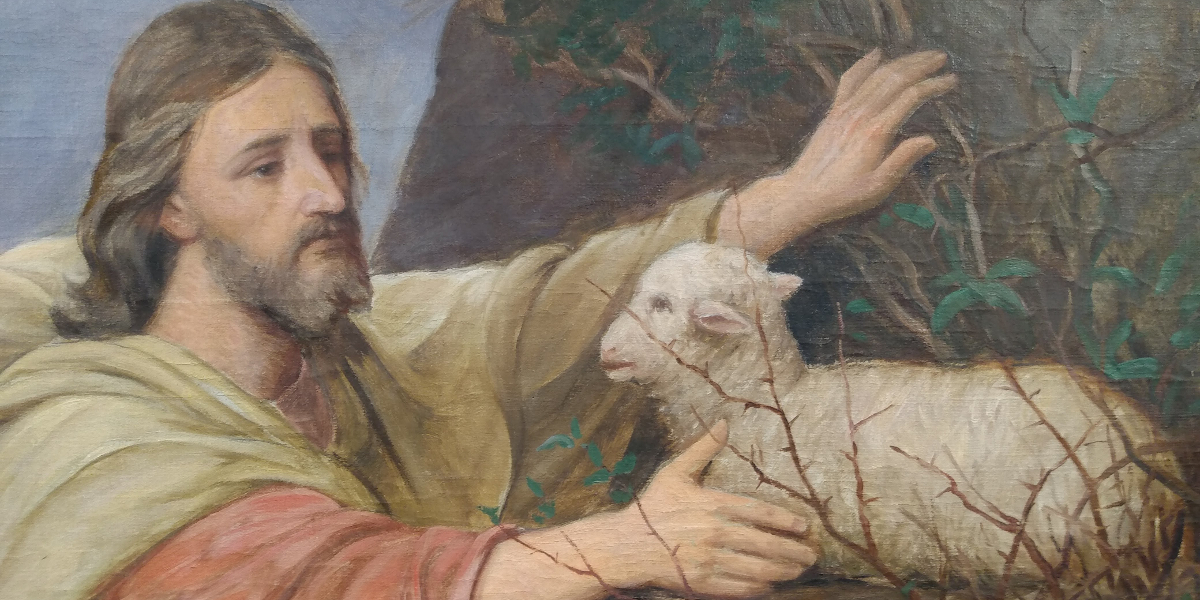
The Third Sunday of Easter – Vicar Lehne sermon
Text: St. John 10:11-16
In Christ Jesus, who laid down his life for us that he might take it up again, dear fellow redeemed:
The sheep were all jumbled together. Several shepherds had brought their sheep to the same pen for the night. The pen had only one gate that was guarded by a watchman, and it had walls that were tall enough to keep the sheep from wandering away during the night and to keep thieves and predators, such as wolves, out. But if all of the sheep were in the same pen, how would the shepherds know whose sheep were whose when they came back for them in the morning? It actually wasn’t a problem at all. Why? Because the sheep knew the voice of their shepherd. When they heard their shepherd’s voice, they followed him, while the other sheep, who did not recognize his voice, stayed behind. The shepherds led their sheep by their word.
In our reading for today, we are called “sheep,” and if we are sheep, then that means that we must have a shepherd whose voice we follow. Who is that shepherd? He is none other than Jesus, the Good Shepherd. When we call Jesus “the Good Shepherd,” we don’t mean that he is simply good at being a shepherd. We mean that he is the best shepherd that we could possibly have, and Jesus shows this in what he was willing to do for us.
You were once lost sheep, wandering every which way and being hunted by wolves. These wolves are your spiritual enemies: the devil, the world, and your sinful nature. Led by the devil, your spiritual enemies had completely surrounded you. You were doomed to be snatched by them and dragged away into the fires of hell. But even though you were already in the deadly clutches of your enemies, Jesus did not want to leave you to that fate. So, he left the green pastures of heaven and entered the wilderness of Earth to save you. When Jesus appeared, the wolves attacked him and killed him. In this moment, your spiritual enemies thought they had won, but it was by Jesus’ death, by the shedding of his blood, that the price that was necessary to save you was paid. By the shedding of Jesus’ blood, you were made his own. Jesus saved you from the clutches of your enemies by laying down his life of you. This is what sets Jesus apart from all other shepherds. “The good shepherd lays down his life for the sheep” (verse 11). Other shepherds are willing to protect their sheep, but they wouldn’t go so far as laying down their lives for their sheep. It is through this act, through willingly laying down his own life for you, that Jesus shows just how much he loves you.
But Jesus didn’t leave you without a shepherd. As he says in the verses following our reading for today, “I lay down my life that I may take it up again” (John 10:17). Death had no power over Jesus. On the third day, he rose again from the dead, declaring his victory over your spiritual enemies. Because Jesus is risen, you remain safe from the attacks of your spiritual enemies and are led to green pastures and still waters that nourish the faith that you have been given. As the psalmist says, “He makes me lie down in green pastures. He leads me beside still waters. He restores my soul” (Psalm 23:2–3). These green pastures and still waters that your Good Shepherd nourishes you with are the means of grace, the Word and Sacraments.
Just like real sheep, who are led by the word of their shepherds, you are led by the Word of your Good Shepherd. You know Jesus’ voice because he speaks to you through his Word, and the words that he speaks to you are very comforting. When there are sins that are troubling you, Jesus says to you, “I forgive you all your sins.” When you feel like you are in danger from the wolves that surround you, Jesus says to you, “They will never snatch you out of my hand.” When you feel lost, Jesus says to you, “Follow me.” And when you feel like you are all alone, with no one to turn to, Jesus says to you, “I will be with you always, even to the end of the age.” Your Good Shepherd not only leads you with these comforting words. He also nourishes you and strengthens you with them, just like he does with the Sacraments of Holy Baptism and Holy Communion.
In the Sacrament of Holy Baptism, you are marked for eternal life, which Jesus promises to give to his sheep in the verses following our reading for today (verse 28). You are marked for eternal life when the waters of baptism wash your sins away. These waters continue to wash you to this day. For every day, your new self rises up out of the waters of your baptism and your old self is drowned in them. Through baptism, you are comforted and strengthened, knowing that you have been washed clean. For since you have been washed clean, you have been marked as Jesus’ own, meaning that the eternal life that he promises to give his sheep is yours.
While you wait for the day when you will receive your promised eternal life, you receive a foretaste of it in the Sacrament of Holy Communion. During this holy supper, you feast on the true body and blood of your Good Shepherd who laid down his life for you to win you that eternal life. Jesus willingly went to the cross and shed his blood for you, and through the shedding of his blood, you receive the forgiveness of sins. When you come to his table, along with your fellow sheep, the forgiveness of sins that he won for you on the cross is brought to you when you eat and drink Jesus’ true body and blood in the bread and the wine. Then, you leave his table strengthened and nourished in the confidence that you have been forgiven. These means of grace truly are the best green pastures and still waters that your Good Shepherd can provide you with in this life.
You are blessed to have a Good Shepherd who continues to provide for your spiritual needs and protect you from your spiritual enemies. But that doesn’t mean that you can let your guard down. Your spiritual enemies are cunning, and there are lots of tricks that they have up their sleeves that they use against you to try and lure you away from your Good Shepherd. One of their most cunning tricks is to use false teachers to leave you defenseless to their attacks. Even though Jesus is your Good Shepherd, he has left you with shepherds who he has tasked with watching over his sheep. These shepherds are your pastors. But not all pastors are true shepherds who serve the Good Shepherd. Some of them look good and sound good, but in reality, all they care about is themselves. They do not feel responsible for you. All they want is to make a living off of you. So, when the wolves attack, they show their true colors and leave the flock to fend for themselves. Jesus compares these false teachers to the hired hands who watch the sheep. He says, “He who is a hired hand and not a shepherd, who does not own the sheep, sees the wolf coming and leaves the sheep and flees, and the wolf snatches them and scatters them. He flees because he is a hired hand and cares nothing for the sheep” (verses 12–13). What a blessing it is to have a pastor who truly cares about you and is always willing to be there for you.
But that is only one of the tricks that you have to look out for. Another one of your spiritual enemies’ most cunning tricks is making their voices sound like the voice of your Good Shepherd. You look to God’s Word to hear the words of Jesus, but when you read them, the devil, the father of lies, says to you, “When Jesus said this, what he really meant was that.” As the world continues to live in sin and encourages you to join in with them, you point to what Jesus has said to you in his Word. But in response, the world says to you, “Those things only applied to the people of the Bible. We don’t have to follow those things anymore.” When your sinful nature tempts you to sin, you remember the words that Jesus spoke to you. But your sinful nature responds by saying, “You still have faith in Jesus, don’t you? It doesn’t matter what you do, because faith is all you need.” These, along with all other ways that your spiritual enemies attempt to lead you astray, can sound very convincing and can trick you into thinking that their voices are the voice of your Good Shepherd. But unfortunately, there are even times when you and I know that we are not hearing Jesus’ voice, yet we decide to listen to the false voices and follow them anyway. We must be careful, because these wolves are only trying to get us into their jaws so that they can snatch us and drag us away from our Good Shepherd, away from the green pastures and still waters of the means of grace, and into the fires of hell.
Even though we are sheep that love to wander and constantly fall for the tricks that our spiritual enemies use against us, we don’t need to fear losing our place in green pastures of heaven, because we belong to Jesus. As Jesus says in the verses following our reading for today, “No one will snatch [my sheep] out of my hand” (John 10:28). When we do wander into the clutches of our spiritual enemies, Jesus will be there to rescue us from them. No matter how far we’ve wandered away from him, Jesus is willing to go to the ends of the earth to lead us back to him. Jesus knows who his sheep are, and he will never abandon them, especially not when they need him most.
The sheep know the voice of their shepherd, but this knowing isn’t one-sided. Your Good Shepherd also knows you. But this knowing is much more than simply recognizing each other. Even the devil, the leader of the wolves, recognizes who Jesus is. This knowing is a knowledge that unites you with your Savior in love. You love Jesus, your Good Shepherd, and desire to follow him. But this love does not have its origin in you. It has its origin in Jesus and what he did for you. As the apostle John says, “We love because he first loved us” (1 John 4:19). Jesus loved you so much that he was willing to lay down his own life so that you may experience eternal life in the green pastures of heaven. And Jesus still shows his love for you in that, as your risen Lord, he leads you safely though the dangers of this world until you reach those green pastures of heaven. As the psalmist says, “Even though I walk through the valley of the shadow of death, I will fear no evil, for you are with me; your rod and your staff, they comfort me” (Psalm 23:4). Jesus, your Good Shepherd is better than any other shepherd because no one has love that matches his. So, you can be confident that your Good Shepherd knows you and will lead you to the green pastures of heaven. As Jesus says, “I give [my sheep] eternal life, and they will never perish” (John 10:28).
Glory be to the Father and to the Son and to the Holy Ghost; as it was in the beginning, is now, and ever shall be, forevermore. Amen.
+ + +
(picture from Saude Lutheran Church altar painting)

Palm Sunday – Pr. Faugstad sermon
Text: Philippians 2:5-11
In Christ Jesus, who came to be crowned and clothed in our sin and shame in order to obtain eternal salvation for us, dear fellow redeemed:
We don’t know how many people witnessed Jesus’ coming to Jerusalem on Palm Sunday. The apostle John mentions “the large crowd” that had come to celebrate the Passover there (Joh. 12:12). The apostle Matthew describes “the crowds that went before [Jesus] and that followed him” (Mat. 21:9). The people made such a commotion with their scattering of cloaks and palm branches on the road and with their singing and shouting that “the whole city was stirred up, saying, ‘Who is this?’” (v. 10).
What a good question! “Who is this?” Some of His followers viewed Him as a great Teacher, one who taught the Scriptures with authority. Some viewed Him as a great worker of miracles, including many who knew He had raised Lazarus from the dead. Some, like the religious leaders, viewed Him as an imposter and blasphemer, an enemy who had to be eliminated. A great many in the crowd were convinced He was the Messiah, “the Son of David” (Mat. 21:9), “the King who comes in the name of the Lord” (Luk. 19:38), “even the King of Israel” (Joh. 12:13). But they didn’t have it quite clear what this Messiah would come to do.
Jesus’ disciples were there—Peter, James, John, and all the rest—, no doubt walking near Him as He rode forward on the donkey. Probably His good friends Lazarus, Martha, and Mary were there watching with nervous anticipation. What was going to happen next? We are not specifically told that Jesus’ mother Mary was present, but I expect that she was also in the crowd watching. What did she think?
I’m not sure that her first thought was, “Hosanna to the Son of David.” I imagine her first thought may have been, “That is my son.” Did she look upon His arrival with pride, as so many shouted His praises? Did she look on in fear, knowing that many wanted Jesus dead? Perhaps she thought back to that unexpected visit of the angel, when she was just a young woman betrothed to Joseph. “Greetings, O favored one, the Lord is with you!” said the angel (Luk. 1:28). “And behold, you will conceive in your womb and bear a son, and you shall call his name Jesus” (v. 31).
The angel told her what this special Child would do: “[T]he Lord God will give to him the throne of his father David, and he will reign over the house of Jacob forever, and of his kingdom there will be no end” (v. 33). For a long time, the Church has celebrated this Annunciation, this announcement, the day of our Lord’s incarnation, on March 25th, which falls on Monday of Holy Week this year.
Now as Jesus came to Jerusalem, the purpose of His incarnation would become clear. Mary may have wondered if this was the moment the angel had spoken about. Was Jesus about to sit on the throne in Jerusalem and rule over the people of Israel? But she couldn’t forget the words of Simeon when she and Joseph brought Jesus to Jerusalem for the first time forty days after His birth. Simeon said to her, “Behold, this child is appointed for the fall and rising of many in Israel, and for a sign that is opposed (and a sword will pierce through your own soul also)” (Luk. 2:34-35).
Before the week of that Palm Sunday had ended, Mary would feel the sword piercing her soul. The praises of the crowds would turn to jeers. The hope of Jesus’ followers would become despair. Jesus would be nailed to the cross. Life would give way to death. What a shame! What a tremendous loss! The disciples who unknowingly talked with Jesus after His resurrection told Him with sadness, “[W]e had hoped that he was the one to redeem Israel” (Luk. 24:21).
And of course that is exactly what Jesus had accomplished! Jesus had to be delivered over to the chief priests and scribes to be condemned to death. He had to be delivered over to the Gentiles to be mocked and flogged and crucified (Mat. 20:18-19). He told His disciples that these things would happen. They had to be so!
This was exactly God’s plan. This is how Satan’s head would be crushed and his works would be destroyed (Gen. 3:15, 1Jo. 3:8). This is how the wages of sin would be paid, and death overcome (Rom. 6:23). God the Father would send His Son to take “the form of a servant” and be “born in the likeness of men,” as today’s Epistle says. And His Son would willingly humble Himself “by becoming obedient to the point of death, even death on a cross.”
On Palm Sunday, it looked like a king was coming to Jerusalem, a powerful prophet, a conqueror. Jesus was those things, but you can hardly tell it five days later. You will hear about this at our services on Friday, how He was beaten, thorns driven into His skull, flogged, blood dripping from too many wounds to count, nailed to a cross with criminals on either side, crying out in anguish.
The question each of us needs to ask ourselves is: Do I really want to be associated with this person? The world of our day mocks Him, just like the Jewish religious leaders and the Roman soldiers who were gathered around His cross. The way of Christ, a life lived according to His Word, is viewed as outdated, too restrictive, even by some as hateful. “What can Jesus do for you that you can’t do for yourself?” they ask. “How can Jesus guide you through present challenges, when He lived so long ago?”
“If you want to be successful,” they say, “you won’t get there by trusting in Jesus or being like Jesus.” And the world is right about that. If you want success and praise from the world, you probably won’t get it by putting the Word of God first in your life, by taking up the cross of scorn and suffering in the world and following after Jesus. Do you really want this trouble? Do you want to be mocked and pushed aside and persecuted? Do you want to be hated like He was?
And if we are answering honestly, we will say, “Not really. I don’t want that trouble. I don’t want to be left out. I don’t want to suffer.” That’s why we have compromised when we should have confessed the truth. That’s why we have hidden when we should have stood our ground. That’s why we have remained silent when people around us by their sinful words and sinful actions mocked our Lord and His holy Word. We weren’t willing to humble ourselves like Jesus did or give our lives in service to God and our neighbors like He did.
But take a good look at Him. Watch Jesus coming down the road to Jerusalem. There He goes into the city, into the lion’s den, onward to His death. What courage He showed! What strength of purpose! What love for His Father and for you! He went forward humbly in obedience to His Father’s will. The merciful God wanted to save you. He wanted your sin to be atoned for. He wanted your eternal life to be secured.
This Jesus, who went to Jerusalem on Palm Sunday, is not ashamed of you. He is not angry that He had to pay for your sins. He is not bitter that He had to die your death. He knows all your weaknesses. He knows how poorly you have represented His name. And He forgives all your transgressions. “All we like sheep have gone astray; we have turned—every one—to his own way; and the LORD has laid on him—on Jesus Christ—the iniquity of us all” (Isa. 53:6).
The Man riding into Jerusalem was no typical teacher, prophet, miracle worker, or king. He was all those things and so much more. He is the King of kings and the Lord of lords, the Ruler over heaven and earth, the Conqueror of sin, devil, and death. The world calls Him a “has-been” (if it acknowledges that He ever was). But what does the world have to chirp about? Greed? Lies? War? Death? Every promise made by the world fails, and must fail.
The promises of Jesus never fail. He is the Lord of life. Not only did He humbly and willingly pay for your sins, but He gladly meets you here through His Word and Sacraments. With the same purpose and love that brought Him to Jerusalem, He comes here to forgive you, encourage you, strengthen you. He comes to change your heart and mind, so that you are equipped and prepared to love as He loved and to suffer as He suffered.
We welcome Him here in the same way that the crowds welcomed Him to Jerusalem: “Blessed is He who comes in the name of the Lord! Hosanna in the highest!” We know who this is. It is Jesus, the Son of God, our Savior. We know His name that God the Father has bestowed on Him, “the name that is above every name.” The name of Jesus describes what He did for us—He saved us!
We honor His name in church by bowing our heads each week in repentance and by humbly trusting in His promise of grace and forgiveness. With cleansed and thankful hearts, we “confess that Jesus Christ is Lord, to the glory of God the Father.” And outside of church, we honor His name by speaking His Word of truth and living our lives according to it.
We do want to be associated with this person. He redeemed us from our sin and death, and He lives to bless and keep us as members of His everlasting kingdom.
Thanks be to God. Amen.
+ + +
(picture from “The Procession in the Streets of Jerusalem” by James Tissot, 1836-1902)

The Third Sunday in Lent – Vicar Lehne sermon
Text: St. Luke 11:14-28
In Christ Jesus, who guards your heart from every one of Satan’s attacks, dear fellow redeemed:
The people were amazed! Jesus had just cast out a demon that was making a man mute, and now that man could speak! Jesus was not just another prophet; he was a prophet who had power, enough power to cast out demons! “Can this be the Son of David?” the people asked (Matthew 12:23). But not everyone was amazed. The scribes and the Pharisees rejected the idea that Jesus was the Son of David. So, when they heard the people asking this about him, they tried to come up with a way to discredit him. They couldn’t say that Jesus was faking it, because the miracles that he was doing were undeniable. So, they had to come up with another reason for why he could do what he did. And if they didn’t want to say that his power was coming from God, then that only left them with one other option. “He casts out demons by Beelzebul, the price of demons,” they said. In their attempt to discredit Jesus, the scribes and the Pharisees had blasphemed him.
The scribes and the Pharisees may not have seen anything wrong with their accusation when they made it, but Jesus was easily able to poke holes in it. He said, “Every kingdom divided against itself is laid waste, and a divided household falls. And if Satan also is divided against himself, how will his kingdom stand?” (verses 17–18). The demons were doing the work of Satan, work that Satan hoped would allow his kingdom to grow by adding more souls to it. If Jesus was in league with Satan, then having Jesus cast out his own demons would be self-destructive, and his kingdom would meet its end as a result.
If the coach of a sports team wanted his team to win the championship, then he would obviously want his team to win games. So, if the coach went to one of the rival teams and made a deal with them that every time their teams played each other, the rival team would win, you would think that the coach was crazy. After all, the coach could never hope to lead his team to a championship victory by losing. So, why would Satan do essentially the same thing?
The reality is that Satan is not welcoming attacks from Jesus; he is actively guarding against them. Jesus described Satan as a strong man who is trying to keep the goods in his palace safe, those goods being the hearts of every unbeliever. Satan wants every person to be a part of his kingdom. So, he guards their hearts with his full set of armor, which is every devilish trick that he has in his playbook.
You were once a part of Satan’s kingdom. From the moment that you were conceived, you were by nature sinful, which made you an enemy of God. Because of your sinful nature, you hated God and wanted to remain a part of Satan’s kingdom. And you saw being a part of the kingdom of God as foolishness. But God’s love was more powerful than your hate. He didn’t want you to remain his enemy. God wanted you to be a part of his kingdom. So, he sent his only begotten Son, Jesus, to attack Satan’s kingdom and rescue you from it. Jesus did so by leaving his kingdom, the kingdom of heaven, and coming down to Earth as a man. On Earth, Jesus challenged Satan on his own battlefield and won. Satan used every devilish trick that he had in his playbook, but none of them worked against Jesus. Satan thought that your heart was safe from Jesus because of his strength, but no matter how strong Satan was, Jesus was stronger. Jesus used his strength to “[attack] him and [overcome] him, [and to take] away his armor in which he trusted” (verse 22). And with Satan disarmed, Jesus cast Satan out of your heart.
Because Jesus has cast Satan out of your heart, you are like the people whom Jesus cast demons out of. You used to be possessed by Satan, and when you were, your heart was like a house that wasn’t taken care of: it was a big mess and was falling apart. The devil is the master of chaos. But after Jesus forced Satan out, the Holy Spirit moved in. Through the preaching of the Word and the administering of the Sacraments, the Holy Spirit changed your heart so that you no longer hated God but loved God. The Holy Spirit fixed up your heart so that it was no longer falling apart, and he cleaned it up so that it was presentable to God the Father. Now, when God the Father looks at your heart, all he sees is the new heart that Jesus won for you by his perfect life and his innocent death on the cross, a heart that now belongs to him.
But just because your heart now belongs to God does not mean that you can let your guard down. Even though Satan has lost the battle, the war is far from over, and he isn’t willing to give up on you yet. As the apostle Peter says, “Be sober-minded; be watchful. Your adversary the devil prowls around like a roaring lion, seeking someone to devour” (1 Peter 5:8). The apostle Paul also writes, “Therefore let anyone who thinks that he stands take heed lest he fall” (1 Corinthians 10:12). When you are overly confident in yourself and think that you could never fall, like the scribes and the Pharisees thought of themselves, you leave yourself vulnerable to attacks from your enemy. Satan is constantly looking for an opportunity to strike at your heart and claim it for his own once again. He doesn’t want you to love God. He wants you to hate God and become his enemy again, and one of the ways that he tries to accomplish this is by convincing you to blaspheme God, like the scribes and the Pharisees did.
But we would never actually blaspheme God, right? We love God. We pray to him; worship him. We would never blaspheme him. So, we don’t need to worry about blasphemy. Unfortunately, it’s easier to blaspheme God than we may think. According to our Catechism, blasphemy is “[d]eliberate mockery, scorn, and disrespect” (Luther’s Small Catechism and Explanation, 275). There may be times when we are surrounded by people who are mocking God. In that moment, we might be tempted to laugh along with them so as not to cause any trouble for ourselves. That is deliberately mocking God. There may be times when we are going through a difficult time and God doesn’t seem to be listening to our prayers to deliver us from our suffering. In that moment, we might be tempted to become angry with God, which could lead us to deliberately scorning him. There may be times when we use God’s name to curse someone or something. That is deliberately disrespecting God’s name. It truly is all too easy for us to blaspheme God, and if we do, we are in danger of letting Satan back into our hearts.
Even though Satan is always waiting for the perfect moment to strike at your heart, you don’t need to fear him, because he already lost. You no longer belong to him. You belong to God. And because you belong to God, God is now the one who guards your heart by giving you his full armor. As the apostle Paul writes, “Put on the whole armor of God, that you may be able to stand against the schemes of the devil. For we do not wrestle against flesh and blood, but against the rulers, against the authorities, against the cosmic powers over this present darkness, against the spiritual forces of evil in the heavenly places. Therefore take up the whole armor of God, that you may be able to withstand in the evil day, and having done all, to stand firm” (Ephesians 6:11–13). With God’s help, you remain vigilant, so that you are always ready for an attack from Satan. And when Satan does attack you, you rely on the full armor that God has given you. That full armor is put to good use when you put your confidence and trust in Jesus who fights for you by continuously coming to you through his Word and Sacraments.
In the book of Hebrews, it says that the Word of God is “sharper than any two-edged sword” (Hebrews 4:12). And you know that the Word of God works against Satan, because Jesus used it to fend off Satan’s attacks when he was tempted by him in the wilderness (Matthew 4:1–11). But the Word is not just a weapon that God uses against Satan. God also uses his Word to comfort you. Through his Word, you hear that Jesus has delivered you from your enemies: sin, death, and the devil. Jesus put your sin to death with him on the cross. He defeated death by his resurrection from the dead. And because he has brought his blessings to you through his Word and Sacraments, the devil no longer has a hold on your heart. This means that you will not face eternal punishment in hell, for you are no longer a part of Satan’s kingdom. Rather, you will get to spend all eternity in heaven, for God has made you a part of his kingdom through the Sacrament of Holy Baptism.
In the waters of baptism, the filth of sin that stained your heart and marked you as a citizen of Satan’s kingdom was washed away. Your heart has been made clean. Through baptism, you have the comfort that your sins have been forgiven and that you are a child of God, an heir of his kingdom. But baptism is not the only Sacrament that God uses to bring you comfort. He also brings you comfort through the Sacrament of Holy Communion.
In Holy Communion, Jesus gives you his true body and blood in the bread and the wine. When you come to his table and eat his body and drink his blood, you receive the forgiveness of sins that he won for you by the shedding of his blood. And when you leave his table, you depart in peace, having the comfort of his forgiveness. Through the preaching of his Word and the administering of his Sacraments, God truly does guard your heart and fight your battles, giving you the comfort that you are safe with him.
Satan may be strong, but God is stronger. No matter how devastating the attacks that Satan throws at you are, they are no match for God’s defenses. You don’t need to fear the attacks of Satan, because God guards your heart, and no one, not even Satan, “is able to snatch [you] out of the Father’s hand” (John 10:29).
Glory be to the Father and to the Son and to the Holy Ghost; as it was in the beginning, is now, and ever shall be, forevermore. Amen.
+ + +
(picture from “Exorcism” woodcut by Julius Schnorr von Carolsfeld, 1794-1872)

The First Sunday in Lent – Vicar Lehne sermon
Text: St. Matthew 4:1-11
In Christ Jesus, who resisted every temptation for our sake, dear fellow redeemed:
There are many times throughout our lives when we are given tasks that are seemingly impossible. In school, a teacher might give us a test that seems to have too much information on it to remember. Or at work, we might find ourselves having to do a task that seems too big to finish by the time it’s supposed to be. But no matter what these seemingly impossible tasks are, we are usually able to find a way to accomplish them.
Jesus had his own task that was seemingly impossible, and it was far more difficult than anything we have to face. He had to live a perfect life, which didn’t just mean keeping God’s law perfectly; it also meant resisting every temptation that the devil threw at him. This task wasn’t impossible for Jesus, because he is God, but what made it seemingly impossible was that no one can live a perfect life. But that was exactly why Jesus needed to resist every temptation in the first place, because we couldn’t. So, to accomplish this task, we hear in the beginning of our reading for today that “Jesus was led up by the Spirit into the wilderness to be tempted by the devil” (verse 1).
Jesus spent forty days and forty nights in that wilderness, and during that time, he fasted, not eating anything. It is at the end of these forty days and forty nights that we hear the first of the devil’s temptations. The devil said to Jesus, “If you are the Son of God, command these stones to become loaves of bread” (verse 3). On the surface, there doesn’t seem to be anything wrong with Jesus doing this. After all, God wants us to take care of our bodies. So, since Jesus hadn’t eaten for forty days and forty nights, what would be so wrong with miraculously turning stones into loaves of bread?
There are many temptations that the devil uses that sound perfectly innocent on the surface, but in reality, there is something sinister about them beneath the surface. In this case, the devil was trying to get Jesus to doubt God the Father. The devil was essentially saying, “God has led you out here into the wilderness and abandoned you. Since he hasn’t given you any food for the past forty days and forty nights, you clearly can’t trust him to provide for you. So, you should use your miraculous powers to provide for yourself.”
There are times when we can find ourselves wondering if God truly does provide for us. Jesus tells us in Matthew 6, “Therefore do not be anxious, saying, ‘What shall we eat?’ or ‘What shall we drink?’ or ‘What shall we wear?’ For the Gentiles seek after all these things, and your heavenly Father knows that you need them all. But seek first the kingdom of God and his righteousness, and all these things will be added to you” (Matthew 6:31–33). But it is still easy for us to worry about not having enough money to feel completely secure or about the prices for everything continuing to go up. So, what does the devil say to us? He says, “You should rely on yourself to provide for your needs.” On the surface, this sounds harmless. After all, there’s nothing wrong with relying on your talents to get things done in and of itself. But in reality, what the devil is saying to us is, “God has said that he will provide for you, but if that were true, then why don’t you have all the money and food that you need? You clearly can’t trust God to provide for you, so you should stop trusting in him and rely only on yourself.”
Unfortunately, we all too easily fall for the devil’s temptation to doubt that God provides for us. But Jesus did not fall for this temptation. He responded to the devil by quoting Deuteronomy 8:3, saying, “Man shall not live by bread alone, but by every word that comes from the mouth of God” (verse 4). Jesus trusted that his Father would provide him with everything that he needed, whether that was food or strength to carry out his mission to save you. When the devil finished tempting him and left him, God sent his angels to minister to Jesus, giving him what he needed to be sustained. And later, when Jesus prayed to his Father in the Garden of Gethsemane, “there appeared to him an angel from heaven, strengthening him” (Luke 22:43). And with that strength, Jesus endured the mocking from everyone around him; the suffering from the beatings, flogging, and crucifixion; all of the sins that you committed; and even hell itself for your sake. He endured them all so that all of the times that you put your trust in yourself instead of in God would be forgiven on the cross.
Jesus’ trust in God the Father remained unwavering. So, the devil decided to lean into that with his next temptation. He took Jesus up to the pinnacle of the temple and said to him, “If you are the Son of God, throw yourself down, for it is written, ‘He will command his angels concerning you,’ and ‘On their hands they will bear you up, lest you strike your foot against a stone’” (verse 6). This time, the devil was essentially saying, “Prove that you trust completely in God and prove that God can truly be trusted by throwing yourself down from here. After all, doesn’t God promise to protect you from all harm in his Word?”
As Christians, this is a trick by the devil that we have to be extra careful of. He loves to use the faith that we have in God against us and twist our understanding of the Word. By doing so, he makes us doubt what the Bible says, as well as God himself. If something has gone wrong in our lives, such as a loved one getting sick, the devil says to us, “Didn’t God say that he would make all things work out for your good? You should make him prove it by demanding that he heal your loved one.” So, we end up saying prayers in which we wrongfully put God to the test, such as, “God, if you really love me, you will heal my loved one of his sickness.” Then, if things don’t work out like we wanted them to and our loved one either gets worse or ends up dying, the devil says to us, “God didn’t answer your prayers. How can God’s Word be true if he let this happen to you?”
The devil can easily twist God’s Word in a way that gets us to demand things of him that he never promised he would do and doubt him when those things don’t end up happening. But the devil didn’t fool Jesus. He knew that the devil was twisting the Word. So, Jesus responded by using the Word correctly. He quoted Deuteronomy 6:16, saying, “You shall not put the Lord your God to the test” (verse 7). Jesus did not believe that the Father would do things for him that he never promised. He always believed that the Father’s will would be done. And the Father’s will was done when Jesus hung on the cross and died for your sins. As horrible as it was that Jesus had to die on the cross, God used it for your ultimate good. Through the sacrifice of his only begotten Son, the Father forgives you all your sins, including the times when you wrongly put him to the test or doubt him. And one day, you will get to enter the gates of heaven and be with God forever, which is the ultimate good that God can and will give you.
Once again, the devil had failed to lead Jesus into temptation, but he had one last trick up his sleeve. This time, “the devil took him to a very high mountain and showed him all the kingdoms of the world and their glory” (verse 8). How the devil managed to do this, we do not know. We just know that he did, after which he said to Jesus, “All these I will give you, if you will fall down and worship me” (verse 9).
This temptation doesn’t seem to be as tricky as the other two. The first one sounded harmless, but it wasn’t. The second one appeared to be using God’s Word correctly, but it wasn’t. This one, by comparison, sounds like an easy temptation to resist. After all, the devil was telling Jesus to fall down and worship him. But this temptation was still just as tricky as the others.
The devil knew that Jesus had left his throne in heaven to live as a man, a man who was not only hated by his own people, but would also have to suffer and die if he wanted to sit on his throne again. So, the devil was offering him an easy way out. He was essentially saying, “This mission that you’re on will only bring you further pain and suffering. You don’t have to go through with this mission any longer. You can have your victory in the world right now. All you have to do is fall down and worship me.”
The devil attempts to lead us into temptation in similar ways. He knows the pain and suffering that we endure here on Earth. So, he promises to offer us a way out, while at the same time promising us things that we want. The devil says to us, “What has being a Christian done for you? Is your life truly any better off than everyone else’s? The only difference between you and them is that they get to do what they want, and you don’t. So, why not give up on being a Christian so you have the things that truly make you happy?” Temptations like these may not tell us to give up on being a Christian, but may simply say that it’s okay to pursue the things of this world that we want. But whenever we want to pursue something in this world over God, we are essentially saying that we don’t want to be Christian anymore. We may think that this is a temptation that we could easily resist, but it is a temptation that is just as tricky as the others that we face, because all too often, we would prefer to have the things of this world over the spiritual blessings that God gives us.
Thankfully, even though we all too easily give up on God, Jesus did not give up on his mission. Even though he knew that his mission would end with him suffering and dying on the cross for your sins, he continued with his mission anyway out of his great love for you. He loved you so much that he was willing to set aside his glory and lay down his life for you. Because Jesus did this for you, not only did he return to his throne in heaven, but he won you heaven as well, which is better than anything you could have in this world.
Sometimes it can be hard to believe that heaven is yours. After all, the devil has tempted you in every way that he possibly could, and you’ve failed to resist his temptations more times than you can count. You have failed to live a perfect life, and as punishment for your failure, you rightfully deserve to be thrown into the fires of hell for all eternity. But you have a Savior who understands your weaknesses and has lived a perfect life in your place. As Hebrews 4:15 says, “For we do not have a high priest who is unable to sympathize with our weaknesses, but one who in every respect has been tempted as we are, yet without sin.” Jesus succeeded in every way that you failed. He resisted every temptation that the devil threw at him, not for his own sake, but for your sake. He resisted the devil’s temptations so that he could be your Savior and win your forgiveness. He won that forgiveness for you on the cross, and he brings that forgiveness to you through his Word and Sacraments. Even though it is impossible for you to live a perfect life, eternal life in heaven is yours because Jesus has accomplished the impossible for you.
Glory be to the Father and to the Son and to the Holy Ghost; as it was in the beginning, is now, and ever shall be, forevermore. Amen.
+ + +
(picture from woodcut by Julius Schnorr von Carolsfeld, 1794-1872)

The Third Sunday after the Epiphany – Vicar Lehne sermon
Text: St. Matthew 8:1-13
In Christ Jesus, who is our ultimate cure, dear fellow redeemed:
Benjamin Franklin once said, “[I]n this world, nothing is certain except death and taxes.” But I think that a third thing needs to be added to that list: sickness. You could eat nothing but healthy food, drink lots of water, get just the right amount of sleep every night, wash your hands regularly with soap and water, and clean everything that could possibly be contaminated in your house; and you would still get sick eventually.
Getting sick is a miserable and frustrating thing. Depending on the type of sickness you get and the severity of it, you could lose your voice, your head could hurt, you could become so weak that it’s difficult for you to move, or perhaps the worst thing of all, you could have to take really nasty tasting medicine. And if that’s not bad enough, you may even have to cancel plans that you’ve been looking forward to, or you may fall behind on important work that you have to get done. Getting sick really can put you in your weakest and most helpless state.
When you are in this state, you have two options: you could ignore your weakness and helplessness and try to power through on your own, which usually results in your sickness getting even worse, or you could admit your weakness and helplessness and turn to others for help. But who should you turn to? Family? Friends? A doctor? While all of these people can be a great help to us when we are helpless, there is one person who can help us more than any of them: Jesus.
In our reading for today, we hear about two men who were at their weakest and most helpless state. One of them was a leper, a man who had a disease that made him ceremonially unclean and unable to be a part of Jewish society. The other was a centurion, a Roman commander who was in charge of about a hundred men. The centurion himself was not suffering from any physical weakness, but he was still at his weakest and most helpless point. This was because he had a servant who was not just suffering terribly from paralysis, but, as we find out in Luke 7, was also near death (Luke 7:2), and there was nothing he could do about it. These two men could have ignored their weakness and helplessness and powered through on their own, but they didn’t. They realized that they needed help, and the person who they turned to for help was Jesus.
The leper and the centurion believed that Jesus had the power to give them the help that they needed. Now, if Jesus was a mere man, then believing that he had any real power at all would be foolishness. After all, no man can miraculously heal someone’s sicknesses or disabilities. But what did Jesus do? He touched the leper with his hand and said, “[B]e clean” (verse 3), and the leper was immediately cleansed of his leprosy. He said to the centurion, “[L]et it be done for you as you have believed” (verse 13), and the centurion’s servant “was healed at that very moment” (verse 13). By having mercy on these two men and healing the leper and the centurion’s servant, Jesus proved that he was not just a man. He is God.
Because Jesus is God, we can turn to him for help whenever we are suffering from physical weaknesses of any kind. Physical weaknesses are not just sicknesses or injuries. They are also everything else that we suffer from in this life, such as money problems, drama with friends or family, or when we have a seemingly impossible task before us. Whatever it is that we are suffering from, it can put us at our lowest point.
When we are struggling and feeling helpless, we have two options: we could ignore our helplessness and try to push through on our own, which would only make our suffering even worse, or we could turn to Jesus, who has the power to help us, no matter what state we’re in, because he’s God. Jesus loves us, and in his mercy, he comes to us in our time of need and lifts us out of our low points. And if we have to suffer for a little longer, he remains by our side and takes all our sufferings on himself and bears the burden of them for us. As Jesus says, “Come to me, all who labor and are heavy laden, and I will give you rest. Take my yoke upon you, and learn from me, for I am gentle and lowly in heart, and you will find rest for your souls. For my yoke is easy, and my burden is light” (Matthew 11:28–30).
Even though we don’t deserve any of this love and mercy that Jesus shows us, there are times when we don’t think he is showing us enough love and mercy. We are grateful to Jesus when he delivers us from our suffering, but if he allows us to continue suffering, and that suffering seems to have no end in sight, we can become impatient with him and wonder if he is truly doing what is best for us.
We may think that we know what’s best for us, but this is based on our imperfect human reasoning. In reality, God is the only one who knows what’s best for us. It can be difficult for us to understand how our suffering could possibly be for our good when we are in the middle of it, and sometimes we may never know the reason for it. All we can do is trust, like the leper did, that no matter how God chooses to help us, be it by delivering us from our suffering or by helping us bear it, his will for us will be done. As the apostle Paul says, “[W]e know that for those who love God all things work together for good, for those who are called according to his purpose” (Romans 8:28). And we know that God’s ultimate will for us will be done, because he has already delivered us from the deadliest disease of all, the disease of sin.
Sin is a disease that we are all born with, and it infected every part of us, not just our physical bodies, but also our thoughts, words, and actions. It is because of sin that all of our physical weaknesses exist in the first place. It is because of sin that we grow impatient with God when he doesn’t help us in the way that we want him to. And it is because of sin that we will one day die. The disease of sin really puts us in our absolute weakest and most helpless state.
The disease of sin has infected us so completely that we are unable to turn to Jesus for help. And if it were left up to us, we would not just fail to overcome our sin, we would enter into the outer darkness of hell as punishment for our sin, where, as Jesus describes it in today’s reading, “there will be weeping and gnashing of teeth” (verse 12) without end, eternal suffering.
But God the Father did not want to leave us in this state of complete and utter helplessness. He knew that we were unable to cure ourselves of the disease of sin, so he sent his only begotten Son, Jesus, to be our ultimate cure. Because Jesus is God, he was not born with sin, like all of us were, and he did not catch that deadly disease because he successfully resisted all the temptations that would have caused him to catch it, temptations that we fail to resist on a regular basis. Then, on the cross, he took the burden of our sin on himself and paid the price for all of it. Because of the suffering that Jesus endured on the cross for us, we have been cleansed of our sin.
The cure that Jesus won for you is a free gift that he gives to all of you through his Word and Sacraments. He speaks his forgiveness to you through his powerful Word, which heals you at that very moment. He reaches out his hand and gives you his healing touch through his Holy Sacraments. And now that he has given you his cure through these means of grace, you have a new life, not one that is weak and helpless, but one that is strong in Jesus.
Unfortunately, much like the physical sicknesses that you suffer through in this life, the disease of sin just doesn’t want to go away. And it doesn’t just give you physical weaknesses to suffer through, it also gives you spiritual weaknesses. It does so by trying to attack and weaken your faith, making you think that your weaknesses make you uncurable. But, thanks to the new life that God has given you through faith, trying to power through on your own is no longer your only option. In faith, you can turn to God for help, and he gives you the help you need by giving you the comfort that he has forgiven you and will always be there for you, bearing the burdens that you suffer in this life until the day that you get to enter into eternal life in heaven with him and forever be at peace.
One of the ways that Jesus gives you the forgiveness of sins when you are suffering is through Holy Communion. In that holy supper, you come to the Lord’s table, weak and helpless from the sins that you are suffering from, and you receive the Lord’s true body and blood in the bread and wine, which is the best medicine there is, the medicine of immortality. This is not a medicine that tastes really nasty, like the medicine that you may have to take to recover from your physical sicknesses. This medicine is sweet, granting you the forgiveness of sins that Jesus won for you on the cross and strengthening you to continue through your lives with Jesus at your side.
Sickness is something that can be truly miserable and frustrating, especially when it makes us so weak and helpless that we can no longer function on our own. But even though it can be miserable, it can also be beneficial by helping us to realize that we can’t do everything on our own and that we do need to rely on help from others, especially on Jesus. When we are suffering from physical or spiritual weaknesses and there is no one else to turn to, we know that we can always turn to Jesus, who has the power to help us get through any weakness, because he is God.
Even though things that cause us suffering, such as death, taxes, and sickness, are considered to be certainties in this life, they are only temporary. The only certainty that has no end is the grace and mercy that can only be found in Jesus. Jesus truly is the ultimate cure.
Glory be to the Father and to the Son and to the Holy Ghost; as it was in the beginning, is now, and ever shall be, forevermore. Amen.
+ + +
(picture from a portion of a Byzantine mosaic in Sicily)
Christmas Eve – Pr. Faugstad homilies
St. Luke 1:31-35,38
I. The angel Gabriel said to Mary: “And behold, you will conceive in your womb and bear a Son, and you shall call His name Jesus.”
This scene has a specific context, a context that stretched back thousands of years. The reason an angel of the almighty God appeared to a young woman named Mary is because of another woman who lived long before this, all the way back in the beginning of time. That woman had a blissful and holy existence with her husband in a beautiful garden. They had no sin. They felt no pain. They lacked nothing.
But then a tempter came to the woman. “Wouldn’t you like to have even more?” he said. The woman gave in to the temptation, and so did her husband. They ate fruit from the one tree God had forbidden. Now they had sin. Now they knew pain. Now they were left with nothing. They hid from the presence of their Creator!
But God still loved them. He had mercy on them. He told the tempter, “I will put enmity between you and the woman, and between your offspring and her offspring; he shall bruise your head, and you shall bruise his heel” (Gen. 3:15). Adam thought the LORD was referring to Eve and her firstborn son (3:20, 4:1). But He was especially referring to another woman—to Mary, lowly Mary, Mary of Nazareth, who wouldn’t be born for several thousands of years.
In this evening’s reading, we see that God keeps His promises. He sent an angel to tell Mary that she was the one. She was the one who would bear the Son who would crush the head of Satan. She was the one who would bear the Son who would pay for all the sin of Adam & Eve and all their descendants. She was the one who would bear the Son whose name revealed His purpose. He was to be called “Jesus”—the One who saves.
Hymn: #119 – “Away in a Manger”
II. “He will be great and will be called the Son of the Most High.”
When Jesus lay there “asleep on the hay,” He did not look very impressive; He did not look so “great.” He looked like an ordinary little baby who needed what all babies need—milk, sleep, and new diapers. But this particular Baby was much more than met the eye. In the mystery of all mysteries, “the Son of the Most High,” the Son of God, had taken on human flesh.
We heard how His coming was prophesied right after the fall into sin. But the plan was actually in place before God the Father made the world and everything in it. God the Holy Spirit inspired the apostle Peter to write that our Lord Jesus Christ “was foreknown before the foundation of the world but was made manifest in the last times for the sake of you” (1Pe. 1:20).
The Son of God was incarnate, the Christ was made manifest, “the Word became flesh and dwelt among us” (Joh. 1:14). This great Lord, this “Son of the Most High,” came in the most unexpected of ways. He did not come down from heaven on the clouds in all His brilliant glory. He did not enter the world in the court of a powerful king. He came to the womb of a poor woman and was born in a little town. He “made Himself of no reputation, taking the form of a bondservant, and coming in the likeness of men” (Phi. 2:7, NKJV).
But why would He do this? Why would the God of eternity come down to us in this way? The apostle Paul tells us, “For you know the grace of our Lord Jesus Christ, that though he was rich, yet for your sake he became poor, so that you by his poverty might become rich” (2Co. 8:9).
Hymn: #123.1-4,15 – “From Heaven Above to Earth I Come”
III. “And the Lord God will give to Him the throne of His father David, and He will reign over the house of Jacob forever, and of His kingdom there will be no end.”
These words describe both the divine and human natures of the Christ: “And the Lord God will give to Him the throne of His father David.” The Lord God, God the Father from eternity, sent His only-begotten Son to join a human line. It was the line of Adam and Noah, Abraham, Isaac, and Jacob, the line of Jesse and his son David who was called from keeping sheep to be Israel’s king.
God promised that after David’s death, He would raise up an Offspring of David after him and “establish the throne of his kingdom forever” (2Sa. 7:13). That promise endured one thousand years through the crumbling and captivity of Judah and its return from exile until the birth of Jesus. Although the glory had long since departed from David’s royal line, Mary could trace her lineage to him.
More importantly, Mary was tied to the Promise, the Promise first made in the Garden of Eden, a Seed of Promise passed down from generation to generation, until it was planted in Mary’s womb by the Holy Spirit. The Child in her womb was both Man and God, both David’s Son and David’s Lord.
Though the world did not know it, He was a great King. He was the greatest King who ever walked on this earth, and He still reigns. He reigns with power and grace over His people. He sits on the throne of a kingdom that has no end.
Hymn: #143.1-2,7-9 – “The Happy Christmas Comes Once More”
IV. And Mary said to the angel, “How will this be, since I am a virgin?” And the angel answered her, “The Holy Spirit will come upon you, and the power of the Most High will overshadow you; therefore the Child to be born will be called holy—the Son of God.”
“How will this be, since I am a virgin?” Do we find it strange that Mary brings this up? Why does she feel compelled to mention her virginity? If Mary were living now, she would be told, “Mary, what you do with your body is no one’s business but yours.” But in fact what I do with my body and what you do with yours isn’t just our own business. What we do with our bodies is part of something bigger.
All who are baptized into Christ become part of His holy body. He was covered with our sins, so we would be clothed in His righteousness. He died in our place, so we would live. The apostle Paul writes that Christ “died for all, that those who live might no longer live for themselves but for him who for their sake died and was raised” (2Co. 5:15).
It does matter that Mary was a virgin. It means that the child in her womb was not conceived in her by a sinful man. That would mean their child was a sinner like them. But Jesus had no sin. He was conceived in Mary’s womb by God the Holy Spirit and therefore was “called holy.” Jesus had to be holy, so that He could take the place of you and me and all people, and offer Himself as a holy sacrifice for our sins.
Hymn: #113.1-2,4 – “A Great and Mighty Wonder”
V. And Mary said, “Behold, I am the servant of the Lord; let it be to me according to your word.” (ESV)
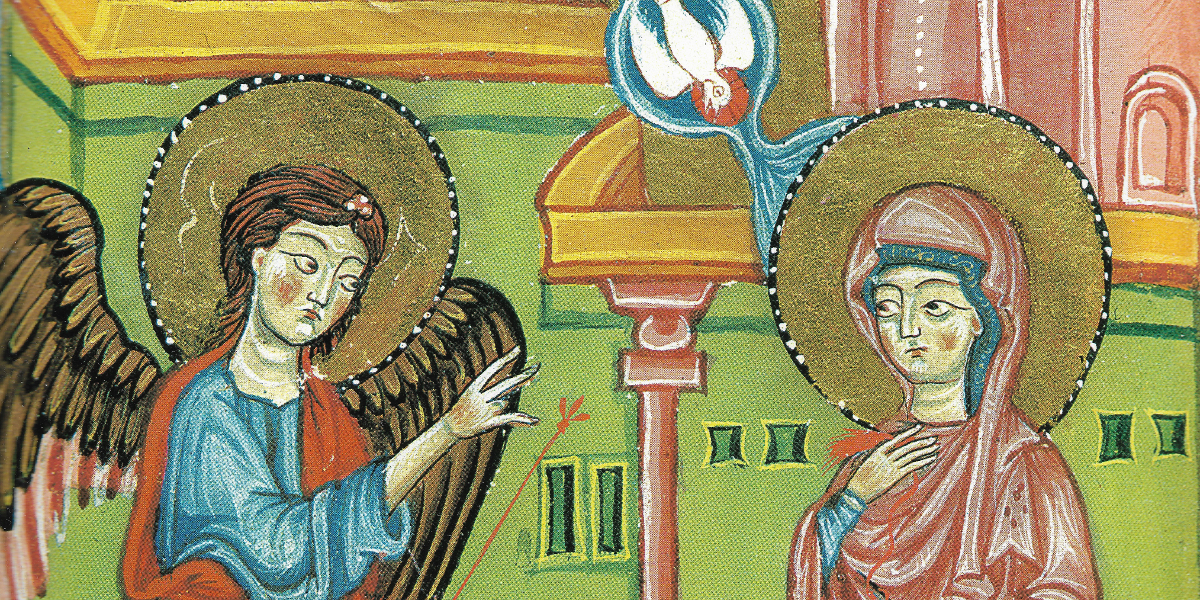
What a beautiful faith we find in Mary! She heard the stunning words of the angel which seemed to violate all sense, and she believed. “Behold, I am the servant of the Lord; let it be to me according to your word.” Martin Luther wrote that at her faithful hearing of God’s Word, Mary conceived “through her ear.” The day the angel visited her was the day God became man, starting as a tiny embryo in her womb.
Our minds are unable to comprehend the incarnation of God. How could the God of the universe spend nine months growing in a dark womb? How could He who has no beginning and no end be born of a woman and cradled in her arms? We cannot understand it any more than Mary could.
But we can rejoice. We can give thanks that the eternal Son of God was born for us. He was born to let nails and spear pierce Him through. He was born to bear the cross for me, for you. We don’t understand it. We don’t deserve it. But God declares it to us. “It is for you,” He says. So we reply, each one of us, with a believing heart, “Behold, I am the servant of the Lord; let it be to me according to your word.”
Hymn: #145 – “What Child Is This?”
+ + +
(picture from “The Annunciation” by Toros Taronetsi, 1323)

The Fourth Sunday of Advent/Christmas Vigil – Vicar Lehne sermon
Text: St. Matthew 1:18-25
In Christ Jesus, who is still with us today, dear fellow redeemed:
The people of this world pride themselves on being able to use their human reason to solve all their problems. They don’t need a God. They’re enlightened. However, no matter how “enlightened” the people of this world are, there are still times when they are faced with problems that they can’t solve on their own. So, what do they do in these moments? They lift their eyes to the heavens and say, “Give me a sign!” Yes, even the so called “enlightened” people of this world, who supposedly don’t need God, are at times faced with problems that cause them to hope that a higher power really does exist that can offer them guidance. However, the “higher power” that the people of this world turn to is usually the universe. The “signs” that the people of this world supposedly receive from the universe can be found in just about anything: a book that has been opened to a specific page; a song that is being played on the radio; how the stars in the sky are ordered and what they mean. However, if they were truly looking for signs that would help them solve their problems, they would not look to the “signs” that the universe supposedly gives them, but to the signs that God definitely gives them in his Word, for God’s signs point to salvation.
In our reading for today, we are told that Jesus being born of the Virgin Mary was a sign that God would save his people from their sins. However, the context in which this sign was promised to be given appears to be a bit strange. The prophecy that the sign would happen was given long ago, and by that time, the nation of Israel had split into two kingdoms: the Northern Kingdom of Israel and the Southern Kingdom of Judah. The current king of Judah, King Ahaz, had just found out that Israel had joined forces with Syria to wage war against Judah. And so, he was understandably afraid.
Therefore, God instructed the prophet Isaiah to comfort King Ahaz by reassuring him that the house of David would not fall but would be delivered. In addition to these words of comfort, King Ahaz was also told to ask God for a sign so that he would be able to attach his faith in God’s promise to something tangible. However, King Ahaz did not have faith in God, so he refused to ask for a sign, making it appear as though he piously did not want to put God to the test. But God was not fooled, so he responded to King Ahaz by saying through Isaiah, “Therefore the Lord himself will give you a sign. Behold, the virgin shall conceive and bear a son, and shall call his name Immanuel” (Isaiah 7:14). This was not a sign that King Ahaz would see in his lifetime, nor would anyone who lived in Judah at that time. But, to those who believed in God, the promise of this sign comforted them and gave them hope for the future, hope that they would not just be delivered from their earthly enemies but also from their sins.
But this sign was not just meant to give hope to the believers who lived in Judah at the time. It was meant to give hope to all believers of all time, including you. The prophecy shows that it was not just the deliverance of his people in the nation of Judah that God had in mind, but also the deliverance of all his people from every nation. By preserving the house of David, God was preserving the line of the Savior, who would come from the house and line of David. That Savior would be no mere man, for a regular man would not even be able to deliver himself, let alone all people. No, that Savior would be God in the flesh, which is what Immanuel means: “God with us.” And this God-man would deliver everyone from their sins, which is what Jesus means: “The LORD saves.”
Even though we were not around to see the sign that God foretold would happen through Isaiah, God has revealed in his Word that it did happen, just as he said that it would. God inspired Matthew to write in our reading for today that “the birth of Jesus Christ took place in this way. When his mother Mary had been betrothed to Joseph, before they came together she was found to be with child from the Holy Spirit” (verse 18). The Holy Spirit caused Mary to conceive, despite the fact that she was a virgin, and the baby that was conceived inside her was God in the flesh. Then, as if we needed it to be any clearer that this is how God fulfilled his prophecy to King Ahaz, Matthew goes on to say that “this took place to fulfill what the Lord had spoken by the prophet [Isaiah]” (verse 22).
When the God-man, Jesus, came in the flesh, he experienced everything that you do. He didn’t just experience the joys of life, but also the sorrows of life. He faced your temptations and overcame them. He even experienced everything that you rightfully deserved by taking all your sins on himself, suffering your punishment of hell, and dying on the cross in your place. Through all this, Jesus saved you from your sins, and now, life and salvation are yours.
Therefore, whenever you become afraid when faced with your sins and guilt, whenever you are struggling with temptation, or whenever you are going through a difficult time, Jesus assures you through his comforting Word that he has already delivered you from your sins and that he will be there with you to help you overcome your temptations and get through your difficult times. These words of comfort should be all we need to believe in him, but he has also given us tangible signs to attach his promises to, just like he did for King Ahaz. Those tangible signs are the means by which God brings his grace to us: his holy Sacraments of baptism and the Lord’s Supper.
In holy baptism, the simple means of water is applied to us as his Word is spoken. Since God attaches his Word to the tangible element of water, we know that he is truly with us to give us faith and wash away our sins through those waters. In the Lord’s Supper, the simple means of bread and wine, over which his Word was spoken during the Words of Institution, are fed to us. Since God attaches his Word to the tangible elements of bread and wine, we know that Jesus is truly with us to give us the forgiveness of sins through the bread and wine, which are his true body and blood. It is not the tangible elements themselves that we put our faith in, but they help us to remember what Jesus has truly accomplished through them and that he is still with us.
These are the tangible signs that God has given to us, and how God wants us to receive these signs is shown in Joseph. Our reading for today begins with Joseph finding out that Mary, the woman that he was betrothed to, was pregnant. Using his human reason, he assumed that Mary must have been unfaithful to him and committed adultery. We have the benefit of knowing that it was the Holy Spirit who caused Mary to conceive, but Joseph did not know this at the time. So, assuming that Mary was unfaithful to him was an understandable assumption.
Adultery was very serious in the Jewish community. According to the Old Testament law, if a woman was found guilty of committing adultery, she would be stoned to death. However, Joseph was a just and kind man. He didn’t want Mary to be exposed to public shame and be stoned, so, he decided to divorce Mary as quietly as possible instead, which was the only way to break off a marriage in those days, after which her father would look after her for the remainder of her life.
However, before Joseph could carry out his plan, an angel of the Lord appeared to him in a dream and told him that the one who was conceived in Mary was from the Holy Spirit: the promised Savior who would save his people from their sins whom Isaiah spoke of in his prophecy. Joseph now had two choices: believe what the angel of the Lord said to him and receive the sign of the virgin birth in faith or put his trust in his own human reason and divorce Mary, rejecting the sign. And Joseph, having faith, accepted the sign in faith and went through with taking Mary as his wife, as the angel of the Lord commanded him.
When we try to rely on our human reason more than God and his Word, it only causes us to doubt the words that God says and reject them. A child being born of a virgin? That’s impossible! The evangelists must have actually added this later to make Jesus and Mary seem better than they were. Baptism being a work of God through which God gives us faith and washes away our sins? That’s impossible! Baptism must actually be a human work that symbolizes the washing away of our sins and demonstrates our commitment to God. The bread and the wine in the Lord’s Supper being the true body and blood of Jesus through which we receive the forgiveness of sins? That’s impossible! The bread and the wine must actually symbolize Jesus’ body and blood to remind us of what he did to forgive our sins. And these are only some of the ways in which we can reject what God has revealed to us in his Word.
If we reject God’s signs, like King Ahaz did, then we no longer stand on God’s promises, and our faith cannot endure. Without faith, we lose all the blessings that Jesus, the God-man, won for us on the cross: the forgiveness of sins, life, and salvation. But when we receive God’s signs in the faith that God has given us, like Joseph did, we know that God has worked through his signs to bring us his blessings.
Because God works through these signs of Word and Sacrament to bring his blessings to us, we know that he is with us today. Jesus didn’t come in the past only to leave us when he ascended into heaven. He is with all of us today, including you. And because Jesus saved you from your sins by his innocent death on the cross and experienced your struggles and hardships, you know that he will continue to bring you the forgiveness of sins and help you through your struggles and hardships today, as well as throughout the rest of your lives, until the day when you enter eternal life in heaven, where you will never struggle or face hardships ever again. In all of these ways that God is with us, we know that God’s signs truly do point to salvation.
Glory be to the Father and to the Son and to the Holy Ghost; as it was in the beginning, is now, and ever shall be, forevermore. Amen.
+ + +
(picture from “Joseph’s Dream” by T’oros Roslin, 1210-1270)

The Festival of All Saints (observed) – Vicar Lehne sermon
Text: St. Matthew 9:18-26
In Christ Jesus, who conquered death so that we may live, dear fellow redeemed:
Death can be a scary thing. This is especially true for those who have no hope. To them, death is the end. So, to make death seem less scary, they try to “soften it” by describing it in nice sounding terms, such as “he is playing eighteen holes on the golf course in the sky,” or, “he lived a good life, and now his legacy lives on,” or, “he will continue to be with you forever, so long as you keep thinking about him.”
The New Testament describes death as a peaceful sleep for those who die in Christ. To the world, describing death as a peaceful sleep is another one of those ways to try to “soften it” and make death seem less scary, but the world does not expect a waking up from that sleep. We can even think this way too, especially when we have just experienced the death of a loved one. However, while (1) death seems like the end to us, in reality, (2) death is only a sleep that Jesus will wake us from. Jesus gives us hope.
Our reading for today begins with a ruler kneeling before Jesus and asking him to lay his hand on his daughter so that she will live. We find out from the Gospels of Mark and Luke that this ruler was named Jairus. We also find out from these two Gospels that Jairus’ daughter wasn’t dead yet, but she was near death. This doesn’t mean that the Gospel of Matthew is giving an inaccurate report of what happened. The account was simply condensed.
Even though Jarius’ daughter wasn’t dead yet, she was so close to death that Jairus had little to no hope that she would be able to recover. The only hope he had was that Jesus could heal her. Jairus wasn’t basing his hope on nothing. Jesus had already healed many people who were sick. He healed an official’s son who was at the point of death (John 4:46–54). He healed a man who had been sick for thirty-eight years (John 5:1–17). He healed Peter’s mother-in-law, who was sick with a high fever (Luke 4:38–39). He healed a paralytic (Mark 2:1–12). And he healed many others besides these (Matthew 8:16–17; 4:23–24).
Jairus had more than enough proof that Jesus had the power to heal his daughter. And then he watched Jesus heal a sick woman who touched the fringe of his garment on the way to his house. Seeing Jesus heal someone right in front of him no doubt gave him even more hope than he already had that Jesus had could save his daughter’s life. He had no reason to fear that his daughter would die so long as Jesus made it to his daughter in time.
Then the bad news came. According to Mark and Luke, after Jesus healed and reassured the sick woman, some men arrived to tell Jairus that his daughter had died. Jesus didn’t make it to Jairus’ daughter in time after all. Hearing this news could cause anyone to lose hope, but Jesus reassured Jairus by saying, “Do not fear; only believe, and she will be well” (Luke 8:50).
What Jesus said to reassure Jairus he also says to reassure us. Jesus entered this world to save us from death by his own death and resurrection. As Jesus said to Martha when her brother Lazarus died, “I am the resurrection and the life. Whoever believes in me, though he die, yet shall he live, and everyone who lives and believes in me shall never die” (John 11:25–26).
Despite knowing this, death can still be a scary thing. We can fear the deaths of our loved ones, not wanting to experience the loneliness caused by them no longer being by our sides, or worrying how we will provide for ourselves and our families without their help. We can also fear our own deaths, worrying that it will be painful or that we will leave our families without the help that they need.
But it’s not just physical death that we can fear, but also eternal death. We know that we are by nature sinful and that we rightfully deserve eternal punishment in the fires of hell because of our many sins, a fact that can become clearer to us the closer to death that we get. As a result, we can wonder whether we lived a good enough life or whether we have a strong enough faith to get to heaven.
When any of these fears enter our minds, Jesus offers us reassurance and hope by telling us, “Do not be afraid; only believe” (Mark 5:36). Jesus gives us the faith we need through his Word and Sacraments. Because of this, we believe that Jesus experienced all our sufferings and took all our sins on himself on the cross. We believe that he paid the price for all our sins by his innocent suffering and death. We believe that he did everything necessary to save us. And we believe that he will remain with us through all our struggles, giving us the strength to persevere until the day we enter the peaceful sleep of death and enter eternal life in heaven.
Jairus believed and put his hope in Jesus, even after he received the terrible news that his daughter had died. His friends did not have the same confidence. In fact, the men who came to deliver Jairus the bad news also told him not to bother Jesus anymore since his daughter was now dead (Mark 5:35). In addition, the people who had gathered at Jairus’ house to mourn his daughter’s death laughed at Jesus when he told them that “the girl [was] not dead but sleeping” (verse 24).
Like those who didn’t believe that Jesus could raise Jairus’ daughter from the dead, we are tempted to doubt Jesus’ power over death. We know that God has revealed through his Word that we will rise again on the Last Day and that our bodies will be reunited with our souls. However, despite knowing what the Bible says, it can be difficult for us to have hope that we will rise from the dead. After all, Jesus’ power over death doesn’t change the fact that our loved ones are, for the moment, gone. We might even wonder why Jesus didn’t prevent the death of our loved ones if he has so much power.
Additionally, when our loved ones die and we are faced with the immediate reality of death, we might think that death is the end. Since we have only ever experienced life on earth, we tend not to give much thought at all to life in heaven. So, knowing that we will not see our loved ones again in this life might cause us to think that we will never see them again, despite knowing that the Bible says that we will see them again in heaven.
When we are tempted to doubt Jesus’ power over death and think that death is the end, Jesus gives us reassurance and hope. Jesus simply saying that he has power over death is one thing, but he also backed up his words with his actions. One of the ways he did this was by raising Jairus’ daughter from the dead.
Even though no one besides Jairus seemed to believe that Jesus could raise his daughter from the dead, Jesus proved them wrong. He entered Jairus’ house, took his daughter by the hand, and said to her, “Talitha cumi,” which means, “Little girl, I say to you, arise” (Mark 5:41). And she arose.
This is not the only time that Jesus raised someone from the dead. He later raised the widow of Nain’s son from the dead (Luke 7:11–17). He raised Mary and Martha’s brother, and his friend Lazarus from the dead not long before his own death (John 11:1–41). And, in the greatest raising of all, Jesus raised himself from the dead on the third day after his death.
If Jesus had not risen from the dead, we would have no hope. If death had kept its hold on Jesus and kept him in the ground, then that would mean he isn’t God. And if Jesus wasn’t God, then he would not have paid the price for our sins. But Jesus did rise from dead, and by his resurrection, he proved he is God and defeated death, giving us hope.
But it was not just physical death that Jesus saved us from. He also saved us from two other kinds of death: spiritual death and eternal death. We are all by nature sinful, meaning that we were spiritually dead from the moment we were conceived and could only sin all the time. Even our good deeds were like filthy rags (Isaiah 64:4). Because of the sins we committed, we rightfully deserved to suffer for all eternity in the fires of hell. We couldn’t escape this fate on our own, because we couldn’t choose to do good, let alone choose to believe in Jesus. However, on the cross, Jesus paid the price for all of our sins so that we will not enter eternal death in hell when we physically die, but eternal life in heaven. Additionally, he applied his perfect life to us so that God the Father no longer sees us as his enemies who deserve eternal death in hell, but as his own dear children who deserve eternal life in heaven. So that this reality can be ours, Jesus brought us to faith through his Word and Sacraments. In the waters of Holy Baptism, our sinful natures were drowned, and our new selves rose up.
Through Baptism, Jesus has already raised us from the dead, making us a part of the saints triumphant, even though we have yet to physically die. Jesus has made us members of his holy body, as he does with all believers. Therefore, our believing loved ones who are already sleeping are not so very far away from us because we are all united in Jesus. Now, whenever we pray to God, join together in praising him, or receive his body and blood at his holy table in his Supper, we are joining in praying, praising, and feasting with the saints triumphant who are already sleeping.
Since Jesus defeated death in all of its forms, the death of the body is no longer the end for those who believe in him, but a peaceful sleep. Death is no different than falling to sleep peacefully in our beds. When our bodies enter the peaceful sleep of death, our souls will be with Jesus in heaven. Then, on the Last Day, the sure hope that we have in Christ will come to pass. When Jesus returns, he will wake all those who believe in him from their peaceful sleep, which include us and our loved ones who are already sleeping, and will reunite our bodies with our souls. But our bodies will not be the imperfect bodies we died in. They will be perfected, and we will never experience the sufferings of this world ever again. Then, Jesus will take all believers in him to heaven—all the saints—to live with him for all eternity.
Those who have no hope do not believe that this could possibly be true. To them, the sure hope that we will live again is a misguided and empty attempt to make death seem less scary. However, this sure hope is a reality for those who die in Christ. Jesus has conquered death by his innocent death on the cross and his resurrection from the dead. Because Jesus has conquered death, we will not die, but live. Because Jesus has conquered death, we have hope.
Glory be to the Father and to the Son and to the Holy Ghost; as it was in the beginning, is now, and ever shall be, forevermore. Amen.
+ + +
(picture from painting by Gabriel von Max, 1878)

The Festival of the Reformation – Pr. Faugstad exordium & sermon
Flung to the heedless winds
Or on the waters cast,
The martyrs’ ashes, watched,
Shall gathered be at last.
And from that scattered dust,
Around us and abroad,
Shall spring a plenteous seed
Of witnesses for God. (Evangelical Lutheran Hymnary #556, v. 1)
These words were inspired by Martin Luther’s first hymn, a commemoration of the deaths of two monks named Henry and John. These monks were arrested for their “evangelical” preaching, which meant they proclaimed salvation through Jesus alone and not through a person’s own efforts or works. After eight months of imprisonment and interrogation, they were put on trial.
At the trial, they were told to bow to the authority of the pope and the church fathers. They said they would as long as their writings did not contradict the Holy Scriptures. They were told that it was sinful to read Luther’s writings, since the pope had banned them. They replied that it was wrong to ban writings that faithfully teach the Word of God. When it became clear that the two men would not repent of what they were teaching, they were sentenced to death by fire.
They were led quickly to the place of their execution. A yellow tunic was put on Henry to mock him and a black gown on John to symbolize his sinfulness. They were tied to the stake. They waited for half an hour as their executioners tried to get the fire going. Then as the flames advanced, the two men said the Creed, and they sang Psalms and hymns. Their last song was an old Christian hymn, the Te Deum Laudamus, which means, “We praise You, O God.” Finally they cried out, “Lord, Jesus, Son of David, have mercy on us!” And then they were overwhelmed by the smoke and after a while were reduced to ashes.
The monks Henry and John were the first martyrs of the Lutheran Reformation. They died on July 1, 1523—five hundred years and a few months ago. They did not go to the stake because they believed in the man Martin Luther. They learned from Luther’s writings to put their trust in Jesus. They died confessing Jesus as their Savior and Lord, even when the whole world seemed opposed to them.
Their example is an encouragement to us, encouragement to resist the temptations of the devil and the appeal of going along with the crowd, and encouragement to firmly believe and clearly confess God’s truth with honest hearts. We pray that our Lord equips us as He did these two faithful men, so that we also are kept in the saving faith until our earthly end.
We join in the prayer of hymn #18, the fourth stanza, “Triune God, Be Thou Our Stay”:
Triune God, be Thou our Stay;
O let us perish never!
Cleanse us from our sins, we pray,
And grant us life forever.
Keep us from the evil one;
Uphold our faith most holy;
Grant us to trust Thee solely
With humble hearts and lowly.
Let us put God’s armor on,
With all true Christians running
Our heavenly race and shunning
The devil’s wiles and cunning.
Amen, amen! This be done;
So sing we, Alleluia! (ELH, #18, v. 4)
+ + +
Sermon text: Ephesians 6:10-17
In Christ Jesus, the great Conqueror who willingly joined Himself with us losers and single-handedly destroyed our terrible enemies, dear fellow redeemed:
If you had to go to the front lines of a battle, what would you want to have with you? What would you need in order to feel safe, or at least to feel like you had a fighting chance? Maybe it would be body armor like a bullet-proof vest and a helmet that could protect you from shrapnel and bullets. Maybe it would be a thick wall in front of you or well-trained soldiers on either side of you. Perhaps what would make you feel safest is a powerful weapon in your hands that causes your enemy to duck for cover.
The apostle Paul talks about a battle situation like this, except that the battle he refers to is a spiritual one. It happens around us and inside us, and we can’t see the enemy. But we can see the enemy’s work; we can see his “schemes.” Paul writes that our conflict is not primarily “against flesh and blood”; our greatest enemies are not other human beings. Rather our conflict is against the rulers, authorities, cosmic powers of darkness, and forces of evil in the spiritual realm.
Paul is describing a hierarchy of wickedness with the devil at the top and his fellow demons sowing destruction and chaos around him. They are the ones who tempt and incite human beings to do the bad things they do. If we do not recognize that the devil and demons are behind the evil in the world, we might think that every human problem can be solved by a human solution. But there is no human solution that can overcome the devil.
This is what the Roman Church was attempting to do at the time of the Reformation. The people were taught that they could make satisfaction for their sins by the good works they did, by the prayers and gifts they offered, or even by purchasing a piece of paper, an indulgence authorized by the pope. On October 31, 1517, Martin Luther posted his Ninety-Five Theses, which argued that a soul could be saved only through repentance and not through the purchase of indulgences.
As he continued to study the Scriptures, Luther came further in his understanding of salvation. He realized that only God could supply the righteousness that His holy law required, and that this righteousness was fulfilled by His only-begotten Son in the flesh, Jesus the Christ. A sinner could have his sins forgiven and be justified before God not because of anything he did, but because of God’s grace toward him and the faith worked in his heart by the Holy Spirit to receive these gifts.
When Paul writes about putting on “the whole armor of God,” this is what he is talking about. He is talking about putting our trust in God alone as we face the devil’s attacks. What is the armor we wear? “The belt of truth”—that doesn’t mean our own personal truth, what is true for each one of us. It is God’s truth, the truth about our sinful weakness and about His gracious plan to save us. “The breastplate of righteousness” is Jesus’ righteousness. A breastplate protects a soldier’s vital organs, and so it is Jesus’ perfect life that covers and protects us, so that we are kept alive and well in Him.
The “shoes for [our] feet” is the readiness to stand firm in the Gospel of peace, to conquer by the message of grace which has conquered our own hearts. Paul tells us what “the shield of faith” is for. It is to “extinguish all the flaming darts of the evil one.” Whenever the devil tries to accuse us for our sins, we point in faith to Jesus, who already paid the penalty for all our sins. “[T]he helmet of salvation” is what protects our minds from the devil’s schemes as he tries to work doubts in our heads or anger toward others or sinful desires for what God has not given us.
Finally, we have “the sword of the Spirit, which is the word of God.” We do not advance in this battle by physical force. We speak God’s powerful Word, and the devil and the demons have to retreat. They cannot stand against the power of God’s Word. Whenever Jesus comes through the Word, the devil’s head starts hurting, since Jesus stomped on it and crushed his power by dying in our place and rising from the dead for our victory.
But if we want to give the devil the advantage over us, we can set aside the armor of God and try to face him on our own. We do this whenever we feel pride for the great things we have accomplished, and fail to give God the glory. We do this when we embrace what God says is sinful, instead of repenting of sin and running away from it. We give the devil the upper hand when we don’t speak up when the truth is challenged, when we compare our good works with those of others, when we trust our own reason or strength, when we stop regularly hearing and learning the Word of our God.
The devil will defeat us if we are not wearing the armor of God. He has done it before. He schemed against us, and his schemes were successful. We lost ground in our faith, and perhaps at certain points, we lost our faith altogether. But even though the devil has won many battles against us, he has not won the victory. This is clear by the attention you are giving to God’s Word right now. You know that you are weak. You know that you have sinned. And you also know that Jesus saved you from your sin and death and still fights for you against “our ancient foe” (ELH #251, v. 1).
That is what Martin Luther’s hymn, “A Mighty Fortress Is Our God” is about, a hymn that is called “The Battle Hymn of the Reformation.” Based on the Forty-Sixth Psalm, it describes God as a Fortress of strength, a Shield of protection, and a Weapon of defense. We need His help because of our powerful enemy who wants to destroy us, whose strength has no equal on earth (v. 1). On our own we would lose, but One stronger than the devil fights for us, the Man of God’s choosing. This is God’s Son come from heaven to earth, the Lord of hosts, who is victorious in every field of battle (v. 2).
Even a world full of devils cannot defeat us when Jesus fights for us. They are overthrown by a Word, the Word of God (v. 3). Their arms go limp when God speaks His Word. They have to run and hide, because they know they are beaten. As long as our Lord is with us in the fight “with His good gifts and Spirit,” with His power imparted to us through His Word and Sacraments, we remain in the kingdom of God, and His kingdom remains ours (v. 4).
This is what it means to “be strong in the Lord and in the strength of His might.” This is what it means to “take up the whole armor of God” and “to stand firm.” It means repenting of our weak efforts on the battlefield that could not win the victory, and it means trusting in Jesus’ righteousness and blood for our salvation.
We are not lost. We are not forsaken. We are not destined for eternal damnation—because God the Father loves us, His Son redeemed us, and the Holy Spirit sanctifies and keeps us in the true faith. A Mighty Fortress Is Our God. We give Him thanks that the Gospel was proclaimed and bore fruit at the time of the Reformation, and that His saving Word is still proclaimed among us today, despite our unworthiness to receive it.
Glory be to the Father and to the Son and to the Holy Ghost; as it was in the beginning, is now, and ever shall be, forevermore. Amen.
+ + +
(picture from “Martin Luther at Worms” by Anton von Werner, 1877)

The Eighth Sunday after Trinity – Vicar Lehne sermon
Text: St. Matthew 7:15-23
In Christ Jesus, in whom we can always put our trust, dear fellow redeemed:
The last few years of my life were spent in the classroom learning how to be a pastor. Throughout those years, there were many times when the professors would have me, along with my fellow classmates, read commentaries on the books of the Bible. Because the people who wrote these commentaries were much smarter than me, I tended to give them the benefit of the doubt and assume that what they said in their commentaries was accurate. However, when it came time for us to discuss in class what we learned from the commentaries, there were times when I felt like I was the only one who assumed that the writers were right, as my classmates seemed to be much more willing to question the writers on points that they made than I was. It was then that I realized that, going forward, I should be more critical when reading commentaries on the books of the Bible and should not assume that they are right just because they are smarter than me.
There are times when all of us can assume that someone knows more than us in a particular field because they studied in that field more than us. We trust plumbers who come to fix the pipes in our houses. We trust doctors who tell us if we are sick and what we should do to get better. We trust pastors who tell us what the Bible says and how we should apply what the Bible says to our daily lives. However, while there can certainly be consequences in this life if the plumbers and doctors we trust are wrong, our eternal life can be at risk if the pastors we trust are wrong. So, when it comes to pastors and preachers, who can you trust? (1) Trusting solely in people leads to destruction, while (2) trusting in Jesus leads to heaven.
In our text for today, Jesus warns us to not trust every preacher who comes to us. After all, just because a preacher comes to us does not mean that he was sent to us by God. Jesus called these preachers “false prophets” and says in verse 15 that they “come to you in sheep’s clothing but inwardly are ravenous wolves.” They look like true prophets on the outside, but in reality, they are false prophets who, if followed, will lead us off of the path to eternal life and down the path to eternal destruction. And it’s no mistake that they appear to be like a fellow sheep either. It’s important to false prophets that they appear to be innocent and harmless, because if they let their true nature show, then the true sheep who follow the true Shepherd would recognize that these so called “prophets” are trying to lead them astray and would turn from them.
These false prophets come in many different forms. Some false prophets rely on miraculous signs and wonders to win people over to them. They have no intention of actually preaching the gospel. They just want to make better lives for themselves by using their lying wonders.
Sometimes they don’t have any miraculous powers at all and only stage their miracles in order to fool us, kind of like a magician doing magic tricks. It may seem real, but there is actually some really clever slight of hand that very few people recognize. Sometimes they actually are using real powers. However, these powers do not come from God. In reality, they are demonic powers. The devil and his angels do have limited powers, and they use those powers to lead people astray.
In our text for today, we do not see Jesus deny that the false prophets were performing miraculous signs. When he says in verse 22 that many false prophets will say to him on the Last Day, “Lord, Lord, did we not prophesy in your name, and cast out demons in your name, and do many mighty works in your name?”, he says in verse 23 that he will respond to them by saying, “I never knew you; depart from me, you workers of lawlessness.” These false prophets may be able to fool people, but they aren’t able to fool God. God did not give them these powers, and even if they are claiming to do these miracles in his name, they actually had no intention of honoring anyone but themselves.
Another form that false prophets come in is one that distorts God’s Word, intentionally lying about what the Bible says. These false prophets will often try to win us over by using kernels of truth, such as saying that Jesus preached that we should love one another, as he told his disciples on Maundy Thursday in John 13:34–35. However, they will then preach a lie to go along with it, such as saying that, because Jesus told us to love one another, therefore we should never judge anyone for living a different way than we do, and we should support every kind of lifestyle that exists out there, even though the Bible condemns some of those lifestyles.
Some of these lies can be more convincing than others, and often times the lies are slowly introduced, so that we don’t realize that we are being lied to until it’s too late. This is why we have to be on alert and not trust everyone who claims to be from God. But if false prophets can be so convincing at times that we aren’t aware that they are lying to us, then who can we trust? While trusting solely in people leads to destruction, there is one man in whom we can put our trust: the God-man Jesus. Trusting in Jesus leads to heaven.
Unlike false prophets, who lie in order to win us over and lead us astray, Jesus never lied. Everything that he said during his time on Earth came true. When a centurion demonstrated the great faith that he had after asking Jesus to heal his servant, Jesus said, “Go, let it be done for you as you have believed” (Matthew 8:13). After Jesus said this, the verse continues by saying, “And the servant was healed at that very moment.” After Peter told Jesus that he would never fall away, even if everyone else did, Jesus said to him, “Truly I tell you, this very night, before the rooster crows twice, you will deny me three times” (Mark 14:30), which ended up happening exactly as Jesus had said. And after Jesus cleansed the temple when it was being used as a house of trade, the Jews asked him, “What sign do you show us for doing these things” (John 2:18)? And Jesus responded, “Destroy this temple, and in three days I will raise it up” (John 2:19). The Jews thought that Jesus was talking about the temple that they were currently standing in, but Jesus was actually talking about his body. So, the account continued by saying, “When therefore he was raised from the dead, his disciples remembered that he had said this, and they believed the Scripture and the word that Jesus had spoken” (John 2:22).
Therefore, when Jesus says things such as, “I am the resurrection and the life. Whoever believes in me, though he die, yet shall he live, and everyone who lives and believes in me shall never die” (John 11:25–26), and “If you abide in my word, you are truly my disciples, and you will know the truth, and the truth will set you free” (John 8:31–32), we know that we can trust that he is speaking the truth and can confess, as Peter did, “Lord, to whom shall we go? You have the words of eternal life” (John 6:68).
But while we would certainly like to think that we will always believe what Jesus says, in reality, we go through doubts all throughout our lives. We often find ourselves turning to what false prophets say, because what they say sounds better to our sinful nature than what Jesus says. There are times when we don’t think that the Bible makes sense the way that the true prophets of God explain it, so we turn to the false prophets that explain the Bible in a way that does make sense to our rational but sinful minds. There are times when we don’t like to be told that we are wrong or that we need to change, so when we hear false prophets telling us that we are perfect the way we are and that we don’t need to change, we want to listen to them.
We may not sit and listen to a false prophet each week like we listen to our pastor in church, but our sinful nature is always whispering in our ears, urging us to do the things we know are wrong and to neglect the loving things we know we should do. In a way, our sinful nature is the biggest false prophet of them all, and we follow it all the time.
While these false prophets often tell us what we want to hear, Jesus tells us what we need to hear, and what we need to hear is not only that we are poor and wretched sinners who deserve God’s wrath and punishment for turning away from him, but also that Jesus has paid the price for all of our sins so that eternal life is ours. Jesus accomplished this for us by his perfect life and innocent death. During his life, Jesus did not turn away from the Father, like the devil kept tempting him to do, but perfectly followed his Father’s will, which led him all the way to the cross to die for our sins of turning from the Father and following false prophets. And because Jesus perfectly listened to his Father in heaven, that perfect listening is credited to us as righteousness.
The salvation that Jesus won for you is a free gift. This is another way that he sets himself apart from the false prophets. You don’t have to give money in order to receive blessings from God, like some false prophets tell you to do. You don’t have to follow a program that false prophets plan out for you. Salvation is already yours, freely given to you by God through his Word and Sacraments.
Therefore, knowing that Jesus speaks to you truthfully though his Word, you can use his Word to test your pastors. Jesus says in verse 16 that “[y]ou will recognize [false prophets] by their fruits.” Your pastors are called to preach God’s Word. Therefore, follow the example of the Bereans, who “examin[ed] the Scriptures daily to see if these things [that Paul and Silas were saying in the synagogue] were so” (Acts 17:11). If your pastors are not preaching the sound doctrine that is found in God’s Word, you will know that they are false prophets, but if they are preaching the sound doctrine that is found in God’s Word, you will know that they are true prophets who have been sent by God.
While you may at times not know who you can trust, you know that you can always trust Jesus. He became flesh to live a perfect life and die an innocent death on the cross in order to save you from your sins. He never failed to keep his promises, and he still comes to you to bless you through his holy Word. He truly is the one you can trust.
Glory be to the Father and to the Son and to the Holy Ghost; as it was in the beginning, is now, and ever shall be, forevermore. Amen.
+ + +
(picture from “The Sermon on the Mount” by Carl Bloch, 1877)