

In Christ Jesus, who was “despised and rejected by men; a man of sorrows, and acquainted with grief” (Isa. 53:3), dear fellow redeemed:
The cursing and swearing that came out of Peter’s mouth were not characteristic of him—at least not since Jesus called him away from his fishing nets. We don’t know how he was before, except that when Jesus provided a great catch of fish on the Sea of Galilee shortly after Peter met Him, he fell down at Jesus’ knees and said, “Depart from me, for I am a sinful man, O Lord” (Luk. 5:8). Now whatever foul language he had learned in the past came rushing back to him as he stated with an oath before God that he did not know the Man Jesus. Peter was afraid, afraid that he would be arrested and beaten up like Jesus was and maybe even killed.
It was only a few hours before this that Peter had confidently told Jesus, “Though they all fall away because of you, I will never fall away” (Mat. 26:33). Jesus told him that before the rooster crowed twice (Mar. 14:30), Peter would deny Him three times. Peter would not hear it: “Even if I must die with you, I will not deny you!” (Mat. 26:35). He was so sure of himself, so sure that he could not fall like that.
And that’s exactly the kind of self-assurance that the devil looks to exploit. History is full of Christians—good and faithful Christians—who fell into sins they thought they would never succumb to. They heard the stories about how others had fallen, and they thought to themselves, “That would never happen to me. I would never do that!” An attitude of judgment and pride are mixed into those thoughts. We are warned about this arrogance in 1 Corinthians 10: “Therefore let anyone who thinks that he stands take heed lest he fall” (v. 12).
The devil, like a roaring lion, is watching and waiting for the opportunity to attack us when we think we are standing strong. Jesus spoke these ominous words to Peter when he boasted about his faithfulness: “Simon, Simon, behold, Satan demanded to have you, that he might sift you like wheat” (Luk. 22:31). In other words, “You are not as strong as you think you are, and the devil knows it.” Then Jesus added these hopeful words, “but I have prayed for you that your faith may not fail. And when you have turned again, strengthen your brothers” (v. 32). Peter would fall, but he would not be lost forever. The Lord’s mercy and grace would cover even his horrible curses and denial.
This is a great comfort to us. We can also think of times that we cursed and swore and indicated by our words and actions that we “do not know the Man.” We did it because we wanted to fit in. We did not want to be made fun of for our faith. The devil was right there, tempting us, ready to sift us like wheat, and we gave in. Don’t you wish you could go back and unsay the terrible things you’ve said, and undo the wicked things you’ve done?
But there is no going back. There is no fixing what you broke. As much as Peter wanted to forget what he did in that Jerusalem courtyard, it happened. He did it. When faced with the reality of our sin, our natural reaction is to try to downplay it: “I was young and made some mistakes—everyone makes mistakes. It didn’t really hurt anyone. It wasn’t that big of a deal.” Or we try to assign the blame to someone else: “If I hadn’t been put in that situation by that person, I would have been fine.”
We think we can escape our sins by trying to wiggle out from under them or by keeping them buried in the past. But as much as we might want to detach ourselves from our sins, they will not detach themselves from us. We can’t try to balance out the bad by doing good. We can’t pay the debt of past sins by paying it forward in kindness. There is nothing we can do to make our sins go away and make things right with God. We sinned against Him. We did it.
Peter felt his sin to the depths of his soul. Jesus told him what would happen, told him what he would do. Peter denied his Lord’s words. And then he denied his Lord. Jesus was aware of all of it when it happened. Right after the rooster crowed the second time, the evangelist Luke records that “the Lord turned and looked at Peter” (Luk. 22:61), either as He was being led through the courtyard or from a window or doorway nearby.
Peter saw Jesus look at him, and he remembered what Jesus had said about denying Him. When the reality of what he had just done hit him, there was nothing he could do but weep, bitterly. Was he sorry for his sin? Every tear said that he was. There was no more posturing from him, no more proving his faithfulness. He was crushed by his sins, and he repented.
This is what we do with sin—we repent of it. Repentance is not about saying the right words, and you are good to go. It is not a work you do that God rewards. Repentance is acknowledging sin from the heart, without selling it short or making any excuses for it. It is admitting what you thought or said or did that God said you should not think or say or do. Repentance is painful; we don’t like to own up to our sins. But repentance prepares us to receive grace from God.
Jesus came for sinners. He suffered and died for all of them, including his dear disciple Peter who denied that he even knew Him. The first thing Jesus said when He was nailed to the cross was not, “How could they all desert Me and leave Me to suffer alone?” He said, “Father, forgive them, for they know not what they do” (Luk. 23:34). Those words are for you, too. Even though you have denied Jesus by your sin, He went to the cross willingly for you.
As the spotless sacrificial Lamb, He offered up His perfect life as the sacrifice for all sin, for your sins and mine, sins of arrogance and pride, of stubbornness, of trying to pass the blame for the wrongs you have done. He suffered “once for sins, the righteous for the unrighteous, that he might bring [you] to God” (1Pe. 3:18). You sinned against God in countless ways, and Jesus reconciled you with the Father by pouring out His holy, precious blood to wash your sins away.
His blood also paid for Peter’s sin, even that horrible denial of Jesus in His darkest time of suffering. Jesus had told him, “I have prayed for you that your faith may not fail.” This was Peter’s hope in his gut-wrenching grief. Jesus had not forsaken him—He would not forsake him—because He had promised to be faithful. Jesus made sure that Peter knew His love and forgiveness by appearing personally to Peter after His resurrection (1Co. 15:5) and then reinstating him to feed His lambs and sheep (Joh. 21:15-19).
He assures you of the same love and forgiveness each time you hear His Word of absolution and receive His body and blood for the remission of your sins. You do not come before Him with boasting, presenting all your good works to Him. You come in humble repentance, laying bare your soul to Him, begging for His mercy and grace.
That is the message that Martin Luther wrote on his deathbed. 480 years ago today (2/18/1546), He left a note ending with these words: “We are beggars, this is true.” Luther did not enter death empty-handed, but he took along nothing of his own. He knew that the Lord supplied the forgiveness and righteousness that he needed for eternal life in heaven.
The same is true for you. Jesus suffered and died for you, so that all your transgressions would be forgiven, removed from you “as far as the east is from the west” (Psa. 103:12). His ear is always open to your cry, and His Word is always ready to bring you His healing and life. So you can confidently and gratefully say along with penitent David and Peter: “A broken and a contrite heart—These, O God, You will not despise” (Psa. 51:17, NKJV).
Glory be to the Father and to the Son and to the Holy Ghost; as it was in the beginning, is now, and ever shall be, forevermore. Amen.
+ + +
(picture from “The Second Denial of Saint Peter” by James Tissot, 1836-1902)
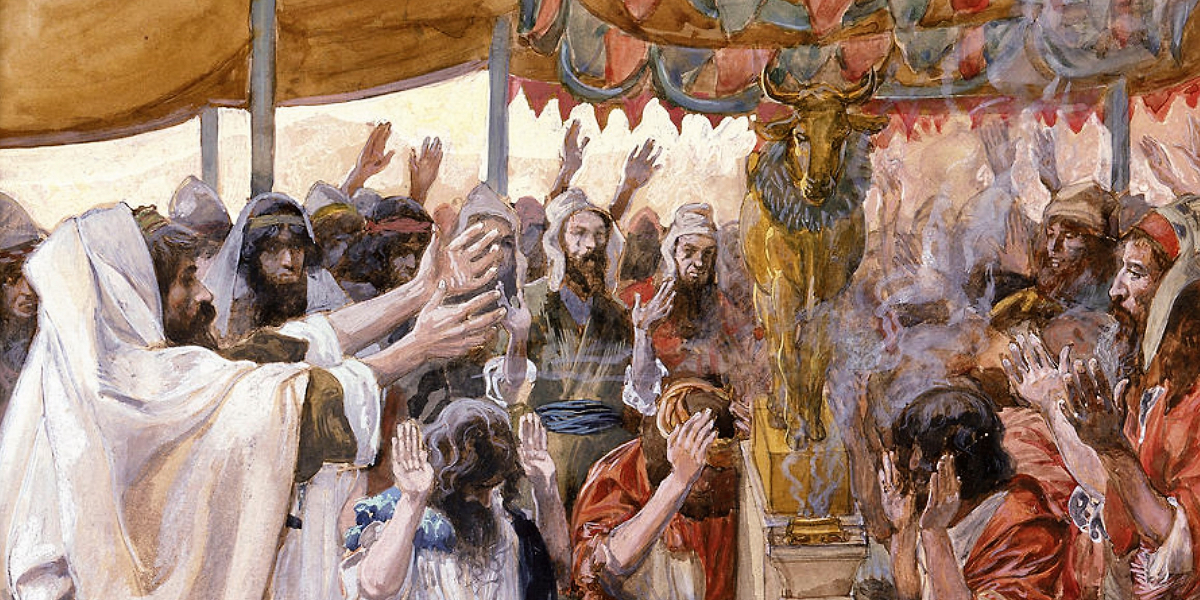
The Third Sunday in Lent – Pr. Faugstad sermon
Text: Exodus 32:1-14
In Christ Jesus, who attacked and overcame the devil, so that we whom the devil once claimed are now free to thank, praise, serve, and obey the only true God, dear fellow redeemed:
When we think about the attributes or characteristics of God, we often think of the three omnis: omnipotent, omniscient, and omnipresent. Or we think about how He is just, holy, merciful, and gracious. One of the characteristics that probably doesn’t come to mind is that God is jealous. We often think of jealousy in negative terms, describing someone who is envious or suspicious without any real reason to be so. But there is also a positive side to jealousy.
We learn about this positive side in the Catechism from the Conclusion to the Commandments, where God’s own words are quoted: “I the Lord your God am a jealous God, visiting the iniquity of the fathers upon the children to the third and fourth generations of those who hate Me, and showing mercy to thousands of those who love Me and keep My commandments.”
We use these words as the Conclusion to the Commandments, but the LORD actually spoke them after the First Commandment: “You shall have no other gods before me” (Exo. 20:3). He made it clear in this context that His people should not make any carved images of anything in heaven or on earth, and that they should not bow down to them or serve them. The people of Israel heard these words from Moses. Everything was plainly stated. And they answered with one voice, “All the words that the LORD has spoken we will do” (24:3).
Now just a short time later while Moses was meeting with God on Mount Sinai, the people grew restless. They came to Moses’ older brother Aaron, whom Moses had left in charge while he was away. “Up,” they said to Aaron, “make us gods who shall go before us. As for this Moses, the man who brought us up out of the land of Egypt, we do not know what has become of him.” It seems that Aaron felt a mixture of pressure and pride. He could see that the people were restless, and that concerned him. He also recognized he was in a position of influence.
He thought he could steer the people in a better direction; he could compromise to keep the peace. He gathered their gold jewelry and fashioned it into a golden calf, just the kind of “graven image” that God had condemned. And when the people praised the idol as the “gods… who brought [them] up out of the land of Egypt,” Aaron tried to bring the LORD back into it. He declared “a feast to the LORD” on the next day.
But the people did not have the LORD in mind. They got up early the next day, offered sacrifices to the golden calf, ate and drank, and “rose up to play.” St. Paul told the Christians in Corinth what kind of “play” the Israelites were up to. He wrote, “We must not indulge in sexual immorality as some of them did, and twenty-three thousand fell in a single day” (1Co. 10:8). Twenty-three thousand fell into sexual sin, rejecting God’s institution of marriage, an institution as old as creation itself. And many more joined them in disobeying God’s Commandments and ignoring His promises. They chose the ways of the world, the desires of their flesh, and the lordship of the devil.
How would God respond? He told Moses that the people had “corrupted themselves.” They had “turned aside quickly” from the way He commanded them. “Now therefore let Me alone,” He said, “that My wrath may burn hot against them and I may consume them.” If God did not care about His people, He wouldn’t have reacted like this. His anger was a sign of His commitment toward them. He had chosen this people. He had led them out of slavery in Egypt. He had brought them through the Red Sea and provided for them in the wilderness.
The LORD looks upon you with the same devotion and care. He gave you life through your parents; He knitted you together in your mother’s womb (Psa. 139:13). He brought you to the waters of Baptism where He adopted you as His own child and put His name on you. He delivered you from your slavery to sin, devil, and death. And He continues to provide you nourishment through His Word and Sacraments as you journey through the wilderness of this world.
If He were indifferent about how you live your life or about what happens to you, He would not have done all the things for you that He has done. Your Father in heaven certainly would not have sent His Son to suffer and die for you if He did not care for you and all sinners. But just as He was jealous for Adam and Eve when the devil brought them over to his side, and just as He was jealous for the Israelites, so He is jealous for you.
This is a proper jealousy. It’s the kind of jealousy a husband or father might feel when bad actors and bad influences are trying to break up his marriage or family. It’s a jealousy that fights for what another has no right to have. The LORD was jealous for His people. He was their God who had redeemed them. The gods the Egyptians worshiped had no power to stop Him. He alone was God. Any other gods were figments of human imagination fueled by the temptations of the devil.
Could this have been made any clearer to the Israelites, when Moses tossed their golden god in the fire, ground it to powder, scattered it on the water, and made the people drink it (32:20)? This was the god that brought them out of Egypt, the god that now made its way through their insides and was expelled?!? The same goes for the idols we set up in our lives: the pursuit of riches, possessions, and pleasures, of power, influence, and fame, of entertainment and excitement. Those might satisfy you for a while, but what good can they do when the day is far spent, when the sand in the hourglass keeps falling, when the time you have left is diminishing?
But the devil is well-experienced at trickery and deceit. He is always whispering in your ear: “Wouldn’t you like to have more? Don’t you deserve more? Why waste your life following the rules? Loosen up! Live a little! What’s so wrong with wanting to be happy? Pay attention to your feelings! Follow your heart! Only you know what’s best for yourself.” That’s what the devil did to the Israelites, and it nearly got them destroyed by the LORD.
It was only because of Moses’ intercession for the people that the LORD relented. Moses said to the LORD, “Remember Abraham, Isaac, and Israel, Your servants, to whom You swore by Your own self, and said to them, ‘I will multiply your offspring as the stars of heaven, and all this land that I have promised I will give to your offspring, and they shall inherit it forever.’” Moses pointed to God’s promise, and God’s anger was averted.
When you have behaved like the Israelites and have fallen for the devil’s temptations and committed sins against God’s holy Law, you might also wonder if you will escape God’s wrath. You took the wrong path. You followed false gods. You denied the LORD who made you, who purchased and won you, who chose you. As much as you wish you could, you can’t go back and change what you have done. Does the LORD really forgive you?
The way to answer that question is to ask a few more questions: Did God the Father send His Son to take on your flesh? Did Jesus suffer and die on the cross for the whole world’s sins? Did He rise in victory over death on the third day? If the answer to those questions is “yes,” which is exactly what the Bible teaches, then the LORD really does forgive you all your sins. Jesus made atonement for each and every one through His suffering and death.
And now since His ascension, He is “at the right hand of God,” where He “indeed is interceding for us” (Rom. 8:34). He is the Prophet like Moses, whom Moses said would come (Deu. 18:15), and Jesus intercedes for us like Moses did for the Israelites. When the Father sees us falling into sin and living contrary to His will, Jesus is constantly reminding the Father of His completed work. “I paid for that sin, and that sin, and that sin,” says Jesus. So the Father relents from the punishment we deserve. He does what Jesus’ death and resurrection require: He forgives us.
That does not mean, of course, that we are free to keep chasing after idols. God is jealous for our fear, love, and trust. “I am the LORD; that is my name” He says; “my glory I give to no other, nor my praise to carved idols” (Isa. 42:8). He deserves our love, our devotion, our worship—our entire life. Whenever and wherever we have not given these things, we must repent. We must admit that we have not been and done what He chose us and called us to do.
Then we also take comfort that our God, the only true God, is good, kind, and patient toward us. Shortly after sparing His people Israel from destruction, He described His characteristics to Moses which are still true of Him today. He said about Himself: “The LORD, the LORD, a God merciful and gracious, slow to anger, and abounding in steadfast love and faithfulness, keeping steadfast love for thousands, forgiving iniquity and transgression and sin” (Exo. 34:6-7). That is the God you have—a jealous God, jealous for your faith and salvation.
Glory be to the Father and to the Son and to the Holy Ghost; as it was in the beginning, is now, and ever shall be, forevermore. Amen.
+ + +
(picture from “The Golden Calf” by James Tissot, 1836-1902)

The First Sunday in Advent – Pr. Faugstad sermon
Text: Genesis 3:14-4:2
In Christ Jesus, the Offspring of the virgin, who was called Immanuel, God with us, dear fellow redeemed:
“The LORD God said to the serpent, ‘Because you have done this, cursed are you.’” What the devil had done was tempt the most special part of God’s creation—mankind—to sin. In the form of or inhabiting a serpent, the devil had approached the first woman with the express purpose of turning her against her Creator. He first tempted her to doubt the Word of God and then to deny the Word of God. She took fruit from the tree of the knowledge of good and evil—the one tree God warned Adam not to eat from—, and she ate. Then she gave some of the fruit to Adam “who was with her,” and he ate (Gen. 3:6).
They did not receive what they were looking for. They were hoping to “be like God,” as the devil had promised them. They failed to appreciate that they already were “like God,” made in His holy image (1:26-27). They did receive part of what the devil had promised, the knowledge of good and evil (3:5). They learned that they used to be good as the caretakers of God’s good creation. Now they had become evil, and they viewed God as their enemy.
This is why they went into hiding when they heard Him walking in the garden. They were afraid of Him. What was He going to do to them? Adam surely remembered what God said about that one tree, that “in the day that you eat of it you shall surely die” (2:17). They went into hiding because they did not want to be punished for their sin. They did not want to die. In fact, they already had. They were still breathing, but spiritually, they had died. They were separated from God. They were on the devil’s side now.
But the LORD would not let the devil keep them. Their punishment would not be the same as the devil’s punishment. God extended no grace and hope to the devil, but He did to Adam and Eve. The key verse in today’s reading and perhaps in all of Scripture is verse fifteen. God said this to the devil but for mankind’s benefit: “I will put enmity between you and the woman, and between your offspring and her Offspring; He shall bruise your head, and you shall bruise His heel.”
Just as the devil had manipulated a woman into disobeying God, so it would be through the Offspring of a woman that the devil’s power would be crushed. Martin Luther called this verse the “first comfort, this source of all mercy and fountainhead of all promises” (Luther’s Works, vol. 1, p. 191). He also suggested that God made the prophecy purposely vague, so that the devil would have to fear every woman going forward since any of them might bear the One to destroy him.
God’s promise terrified the devil, but it gave great hope to mankind. God had not changed His mind about death entering the world through sin. But now He delivered the hope of salvation, that One would come to set everything right again, to overcome sin, devil, and death for all humanity. If Adam and Eve thought another path was open to them, that possibility was closed when God posted “the cherubim and a flaming sword” outside the Garden of Eden to keep them away from the tree of life.
There was no other way to be saved than God’s way. Immediately after this, we are told that “Adam knew Eve his wife, and she conceived.” They trusted what God said, that salvation would come through the woman’s Offspring. They hoped their firstborn son was this Savior. They called him “Cain,” a name that means “acquired” or “gotten” because they had “gotten a man from the LORD.” But Cain was not the promised One. The devil poisoned his mind with anger and hatred, leading to the murder of his brother Abel.
God’s promise would not be fulfilled for many, many years. Child after child would be born, grow old, and die. Women had pain in childbearing like God said they would, while enduring the imperfect rule of men. Men toiled in pain by the sweat of their face to make a living, before returning to the ground from which they were made. Decade after decade, generation after generation, brief life to certain death. Still no Savior.
God’s people might have wondered if His promise would be fulfilled, except that He reminded them with clearer and clearer prophecies as the time approached. The Savior would come from the line of Abraham, Isaac, Jacob, and Judah (Gen. 49:10). He would be a descendant of King David (Psa. 110). He would be born of a virgin (Isa. 7:14). He would be born in Bethlehem (Mic. 5:2). God waited for thousands of years after making His promise, until “the fullness of time had come” (Gal. 4:4).
Then He sent His angel Gabriel to a virgin named Mary. “Behold, you will conceive in your womb and bear a son,” said Gabriel, “and you shall call his name Jesus” (Luk. 1:31). “How will this be,” asked Mary, “since I am a virgin?” And the angel answered her, “The Holy Spirit will come upon you, and the power of the Most High will overshadow you; therefore the child to be born will be called holy—the Son of God” (1:34-35). The time had finally come! The woman’s Offspring was here. God had entered His creation, taking on human flesh. The devil was about to be ruined.
And all of that, the dark day when the world was plunged into sin, the beautiful, first promise of God, the history of every joy and sadness, hope and pain, life and death, all of it was in the background and in Jesus’ mind as He rode into Jerusalem on Palm Sunday. “Hosanna to the Son of David!” shouted the people. “Blessed is he who comes in the name of the Lord! Hosanna in the highest!” (Mat. 21:9). No one understood what had to be done. No one knew the suffering that Jesus would endure. No one knew what it would take to redeem mankind from the sin that started in Eden.
The death that was brought on the world through a tree had to be undone by death on another tree. The perfection that was lost through sin had to be regained by a perfect sacrifice. The curse of sin had to be directed against One who had never sinned. He had to pay for man’s disobedience. He had to suffer eternal punishment in every person’s place. This is what Jesus, the eternal Son of God, had to do.
He was witness to all that transpired in Eden. He walked with Adam and Eve in perfection and then found them in their sin. He saw all the wickedness that was done from that point on, all the pride, deceitfulness, abuse, unfaithfulness, violence. He was witness to everyone’s sins from Eden onward. And because He is God, He could see even the sins that stretched forward in time, including the sins done in our lifetime, the sins done by us, even our sins today.
What would you think if you had witnessed all that poisonous evil, the terrible pain and destruction, brought about because of mankind’s sins? What would you do? Would you feel compassion for sinners? Or would your anger burn hot against them? Jesus rode forward humbly to His death in every sinner’s place. We hear this Palm Sunday account at the beginning of the Church Year because it teaches us how to think about sin and salvation and Jesus, and how to prepare for His coming.
If any of us is comfortable with our sinning, then we’re not really seeing what Jesus did in Jerusalem. He was not beaten up for anything He had done. He was not driven toward Calvary for His sins. He did not cry out in agony on the cross for His wrongdoing. He was there because of Adam and Eve. He was there because of Cain. He was there because of Abraham and David and Jezebel and Nebuchadnezzar and Mary and Herod and Pontius Pilate—all the sinful people of human history, both prominent and poor, outwardly good and evil. He was there because of you and me, because of our sins.
He was there for you and me. Jesus went to the cross to make satisfaction for our sins. Adam and Eve’s selfishness, shame, and fear—“Put that on Me,” He said. Our lovelessness, our lies, our pride, our pleasure-seeking, our greediness, our despising the holy Word—“I’ll take the punishment,” He said. He paid for the sins of your past, your sins of today, and all the sins that will be done in the future.
This is what God promised right after the fall. This is what He told Adam and Eve and their descendants to look for. This is what He tells us to look to. God kept that first promise from Eden to Jerusalem. We weren’t in the crowd on Palm Sunday, but we should picture ourselves there. While we’re at it, we can picture Adam and Eve standing there in their garments of animal skin with their sons Abel and Seth; Abraham, Isaac, and Jacob looking on; David and his descendants watching with joy. We see there a great “cloud of witnesses” (Heb. 12:1), all who waited for God’s promise to be fulfilled.
And we see there all believers who have lived since that time, up to our day and beyond. We stand there, eyes fixed on Jesus, His praise on our lips. We watch Him go forward, carrying the weight of the whole world. He goes to the cross for our sins. He goes to destroy the works of the devil (1Jo. 3:8). He goes there to save us from death.
Glory be to the Father and to the Son and to the Holy Ghost; as it was in the beginning, is now, and ever shall be, forevermore. Amen.
+ + +
(picture from “The Procession in the Streets of Jerusalem” by James Tissot, 1836-1902)

The Twenty-First Sunday after Trinity – Pr. Faugstad sermon
Text: Ephesians 6:10-17
In Christ Jesus, who rallies His soldiers around a manger, a cross, and an empty tomb and sends the terrible army of darkness scurrying away from His piercing light, dear fellow redeemed:
“It’s time to take a stand!” “Seize the moment!” “Stand up and be counted!” “Your future and your children’s future are at stake!” We have been hearing these messages a lot lately. They are attached to appeals for the citizens of this country to get active and go vote. People from both sides of the political aisle are calling this the most important presidential election in our lifetime. Each side says that if the other candidate wins, it will be the end of democracy as we know it.
It is not my job to tell you who to vote for. It is not even my job to tell you to vote. That is a right and privilege you have that you can choose to exercise or not. But it is my job to tell you not to get too caught up with the candidates you support or the candidates you oppose. God can use bad rulers as well as good rulers for His purposes. After this November 5th, our almighty Lord will still reign over all things in heaven and on earth just as He does now.
We are reminded of this in today’s reading, where our chief enemy is identified along with the battle plan for his defeat. Paul writes that we must take our stand “against the schemes of the devil.” Jesus described the devil as “a murderer from the beginning, [who] has nothing to do with the truth, because there is no truth in him…. he is a liar and the father of lies” (Joh. 8:44). The devil’s goal is that we join him in the eternal torments of hell. He is pure evil. He does not play fair. He will do whatever it takes to separate us from the forgiveness and salvation we have in Christ.
The devil is our number one opponent. We can never forget that he is on the march against us. Bad people—including bad politicians and government officials—come and go (Psa. 146:3-4). The devil has been carrying out his destructive work since the beginning (1Jo. 3:8). Our reading says, “For we do not wrestle against flesh and blood, but against the rulers, against the authorities, against the cosmic powers over this present darkness, against the spiritual forces of evil in the heavenly places.” When people pursue bad things and do bad things, we have to remember who is behind it—the great tempter and deceiver and his fellow demons.
He has his sights set on you, too, especially you. You confess Jesus to be your Savior and Lord, which puts you at odds with the devil. He hates you. He wants to destroy you. The unbelievers can go their merry way, but not you. You have to pay for your devotion to Jesus. He will attack wherever he thinks you are vulnerable, wherever he thinks he can cause the most pain and do the most damage to your faith. In Job’s case, he attacked his possessions and his family and then Job’s own health. But he did not prevail against Job, and it is not a foregone conclusion that he will prevail against you.
So how can you withstand his attacks? What is your battle strategy? If you knew someone was going to try to break into your home, you would stay awake and alert. Or if someone was going to physically attack you or take shots at you, you would wear protective body armor and carry weapons to defend yourself. But physical defenses and weapons don’t work against the devil. You need spiritual protection for this spiritual battle.
That is why Paul says, “Put on” and “take up the whole armor of God.” Only God’s armor can protect you against the devil. God knows the dark and imminent threats to your faith. He sees the dangers and pitfalls that are hidden from your eyes. He knows how to equip you, so that you “stand firm.”
The first piece of God’s armor is “the belt of truth.” This is not your truth or anyone else’s truth; this is God’s truth. His is the only truth that matters. His is the only truth that is most certainly true. We know the truth because He has delivered it to us in the Holy Scriptures. Jesus said, “If you abide in my word, you are truly my disciples, and you will know the truth, and the truth will set you free” (Joh. 8:31-32). And He said in prayer to His Father, “Sanctify them by the truth; your word is truth” (Joh. 17:17). We learn the truth by listening to and studying God’s Word, and in this way we also learn to identify the devil’s lies.
The next piece of God’s armor is “the breastplate of righteousness.” A breastplate protects your vital organs. What is it that covers your heart, so you are safe from the devil’s attacks? Some think that their heart is protected by their own good works and good intentions. Their heart is pure because they work hard to keep it pure. But this kind of self-righteousness is not a strength; it is a terrible weakness. The only righteousness that can cover and protect your heart is Jesus’ righteousness. The devil cannot pierce through the armor of His righteousness because He has perfectly kept the holy Law, and He kept it on your behalf.
The next part of God’s armor is sturdy shoes that help you to stand firm. You are ready for battle when you stand on “the Gospel of peace.” Now that doesn’t sound very strong. What about “the Gospel of power” or “the Gospel of victory”? The Gospel is those things too. But “peace” is where you stand with God. Paul wrote about this to the Christians in Rome, “since we have been justified by faith, we have peace with God through our Lord Jesus Christ” (Rom. 5:1). And, “Through him we have also obtained access by faith into this grace in which we stand” (v. 2). As long as you have peace with God and remain in His grace by faith, you have firm footing against the devil.
God also supplies you with “the shield of faith.” This part of His armor provides some insight into how active the devil is. Paul speaks about “all the flaming darts of the evil one.” Picture thousands after thousands of burning arrows flying at you through the darkness. Or if that isn’t scary enough, picture thousands upon thousands of missiles screaming your way. God provides a shield to protect you—the shield of faith. The devil’s unending accusations cannot land on you as long as your trust is in Jesus. Those flaming darts are quenched like matches flicked toward a waterfall.
By faith you wear “the helmet of salvation.” You put this on when the water was poured on your head while Jesus’ words were spoken at your Baptism. The sign of the cross was made over your forehead and heart that day, and the sign of the cross still starts at your forehead and ends over your heart. God does not let the devil hang your sins over your head or bury you under them. You are protected by the salvation Jesus secured through His death and resurrection.
So you have the belt of truth, the breastplate of righteousness, shoes standing on the Gospel of peace, the shield of faith, and the helmet of salvation. Finally you take in your hand “the sword of the Spirit, which is the Word of God.” There is no more powerful defense than the Word. The Second Letter to Timothy says, “All Scripture is breathed out by God and profitable for teaching, for reproof, for correction, and for training in righteousness, that the man of God may be competent, equipped for every good work” (3:16-17). Everything you need in your battle against the devil is supplied by the Word. You also learn through God’s Word how to pray, speaking back to God in petitions and praises for what He has promised you (Eph. 6:18).
The inspired words of today’s reading make it very clear where we should stand and where our strength is found. We stand “in the Lord and in the strength of His might.” The parts of the armor of God that we have reviewed today are all gifts from Him. None of them depend on our own strength or our own abilities. In other words, the only way to stand firm against the devil’s attacks is to recognize our own weakness. The only way to win is to admit how poor and unprepared we are by ourselves.
Our powerful Lord must fight for us. This is exactly what Martin Luther wrote in “the Battle Hymn of the Reformation”:
Stood we alone in our own might,
Our striving would be losing;
For us the one true Man doth fight,
The Man of God’s own choosing.
Who is this chosen One?
’Tis Jesus Christ, the Son,
The Lord of hosts ’tis He
Who wins the victory
In ev’ry field of battle. (Evangelical Lutheran Hymnary #251, v. 2)
Jesus fights for us in every field of battle. We stand with Him. Or better yet, He stands with us. He comes to strengthen and keep us in the faith through His Word and Sacraments. This is how He keeps us ready for the cosmic conflict against the devil. This is how He picks us up when are staggered by the devil’s blows and have fallen into sin. This is how He fortifies and tightens our armor, so there are no gaps and weak spots for the devil to exploit.
Today and every day is the Time to Take a Stand. Not on the shaky ground of a politician’s promises or an important person’s power because they will disappoint us. Not on the mushy ground of our own strength or our good intentions because they will fail us. We take our stand on the solid rock of Jesus Christ and His Word. Even the gates of hell cannot prevail against His Word (Mat. 16:18). “The word of our God will stand forever” (Isa. 40:8).
Glory be to the Father and to the Son and to the Holy Ghost; as it was in the beginning, is now, and ever shall be, forevermore. Amen.
+ + +
(picture from “The Temptation of Christ by the Devil” by Félix Joseph Barrias, 1822-1907)

The Feast of St. Michael and All Angels – Pr. Faugstad sermon
Text: Revelation 12:7-12
In Christ Jesus, who wore a crown of thorns and yet remained the King of heaven and earth, who carried His own cross and yet commands the angels, who felt the flames of hell and yet quenched the devil’s fire, who died, rose victorious, and lives forevermore, dear fellow redeemed:
The Old Testament book of Job describes Satan as being in a place we wouldn’t expect him. It says that when the holy angels presented themselves before the LORD at His heavenly throne, Satan came among them. The LORD did not immediately throw him out. He asked if Satan had considered His faithful servant Job, “who fears God and turns away from evil.” Satan replied that it is no surprise Job was so faithful since God blessed everything he did. “But stretch out your hand and touch all that he has,” said the devil, “and he will curse you to your face” (1:6-11).
God allowed Satan to destroy all that Job had. But even with this tremendous loss, Job did not curse God. So Satan came before the LORD again and said, “stretch out your hand and touch his bone and his flesh, and he will curse you to your face” (2:5). God allowed the devil to do this as well, and the devil struck Job with terrible sores. Satan would not give up. He would stop at nothing to try to turn Job against his Creator.
This account reveals that Satan had surprising access to God even after rebelling against Him. We can picture it like a courtroom. God the Father sits in the Judge’s seat. Satan is the prosecuting attorney lobbing charge after charge at the accused. Ten jurors sit over on the side listening carefully and nodding their heads. And who is on the stand? The sinner.
That sinner is you; he is me. And how does the devil try to accuse us? This is how nasty the devil is. He tempts us to commit sins, and then he points an accusing finger at us when we sin. “How could God love you? You’re just a liar, just a cheat! You have loved yourself but hardly your neighbor! All you care about is being popular, influential, and rich! How can you expect to go to heaven? You have failed in every way! You are guilty! You deserve death!”
The ten jurors are the Ten Commandments, and they agree with the accusations. We have not loved the Lord our God with all our heart and with all our soul and with all our mind. We have not loved our neighbors as ourselves (Mat. 22:37-39). We will get no help from the Law. None of our works can get us off the hook because all of our works are imperfect.
It looks like an open and shut case. We bury our face in our hands. The devil looks confident. There is a smirk on his face. “Another one goes down,” he says to himself. “I’m still on top!” But the Judge hasn’t ruled yet. There is still more to be said for the accused sinner. There is more evidence to be logged in the public record. The smirk on the devil’s face begins to fade and then goes away. What has he missed?
The door to the courtroom opens. Who should enter but a Lamb looking “as though it had been slain” (Rev. 5:6)? The gallery erupts with cries of astonishment. The devil’s eyes get big. He looks at the same time like he wants to crawl under a rock and like he wants to destroy all living things. The Lamb comes forward slowly and purposefully and says, “State the charges again.” The devil gathers himself and launches into a tirade against the accused, listing wrong after wrong after wrong.
But after each accusation, the Lamb replies, “Objection! That sin was paid for… and that one… and that one.” The Judge does not overrule Him. What the Lamb says is true. He has the marks to prove it. This Lamb is the Sacrifice, the One once dead but now living. This is “the Lamb of God, who takes away the sin of the world!” (Joh. 1:29). This Lamb—the Son of God incarnate—took away your sin. He canceled all the debt you owed to God. He made the vomit of accusations from the devil’s mouth stop cold by stomping on the devil’s ugly head.
The deflated and desperate devil had no leg to stand on, but he wasn’t about to go down quietly. This is where our sermon text picks up from the book of Revelation, chapter twelve, beginning at verse seven:
“Now war arose in heaven, Michael and his angels fighting against the dragon. And the dragon and his angels fought back, but he was defeated, and there was no longer any place for them in heaven. And the great dragon was thrown down, that ancient serpent, who is called the devil and Satan, the deceiver of the whole world—he was thrown down to the earth, and his angels were thrown down with him.
“And I heard a loud voice in heaven, saying, “Now the salvation and the power and the kingdom of our God and the authority of His Christ have come, for the accuser of our brothers has been thrown down, who accuses them day and night before our God. And they have conquered him by the blood of the Lamb and by the word of their testimony, for they loved not their lives even unto death. Therefore, rejoice, O heavens and you who dwell in them! But woe to you, O earth and sea, for the devil has come down to you in great wrath, because he knows that his time is short!”
The great dragon, the old evil foe, was thrown down, along with all the evil angels. These had rebelled against God shortly after they were created. They refused to obey His will. They refused to serve Him. And now they were cast out of heaven and away from His presence once and for all. Now the devil can no longer accuse God’s people “day and night” in the heavenly courtroom.
He was conquered “by the blood of the Lamb and by the word of their testimony.” The blood of Jesus washes away all sin. Sin does not stick to you and me anymore because God the Father put all our sin on His Son. He was judged in our place. He took our punishment and was sentenced to eternal death in hell for us. This Gospel proclamation is the cause of the devil’s continued frustration. He cannot stand against the Gospel since the Gospel “is the power of God for salvation to everyone who believes” (Rom. 1:16).
We are acquitted and righteous before God. We are justified by His grace, declared “not guilty!” But that does not mean our troubles are over. That does not mean we have tangled with the devil for the last time. He was cast out of heaven, but he landed on his feet on earth. The voice from heaven that announced the devil’s defeat also said, “woe to you, O earth and sea, for the devil has come down to you in great wrath, because he knows that his time is short!”
The devil has been defeated, but that does not mean he has given up. He knows now that he can never knock God off His throne. What drives his evil heart is trying to pull more souls with him into eternal damnation. He does this by tempting each one of us in our own unique ways. He might tempt us with bitterness or anger or lust or greed or pride or selfishness or complacency. He has innumerable tools at his disposal. Like we see in the account of Job, the devil will never give up until he has utterly ruined us.
The Lord’s apostle Peter said, “Be sober-minded; be watchful. Your adversary the devil prowls around like a roaring lion, seeking someone to devour. Resist him, firm in your faith” (1Pe. 5:8-9). The devil is a formidable opponent. We cannot stand against him alone by relying on our own power or on the strength of our own will. But we can resist him by the power of God the Holy Spirit. As we listen to and study the Word of God and faithfully receive His Sacraments, the Holy Spirit fortifies us and strengthens us. He makes us sober-minded, alert, and watchful for the devil’s attacks. He increases our faith, so that our eyes are constantly fixed on our Champion Jesus who destroyed the works of the devil by His death (1Jo. 3:8) and who still fights for us.
Our faithful Lord also dispatches His holy angels to guard us and defend us. Psalm 91 says, “he will command his angels concerning you to guard you in all your ways” (v. 11). Psalm 103 describes God’s angels as “mighty ones who do his word, obeying the voice of his word” (v. 20). Today’s Gospel reading tells us that even the littlest among us have angels watching over them, angels constantly looking upon the face of God and taking His direction (Mat. 18:10).
We are well-protected against the devil’s attacks. As formidable as Satan is and as much as he still tries to accuse us, our Lord Jesus with His holy angels defends us. The Lamb with the marks of His crucifixion stands against the great dragon, and the dragon must slither away. The blood of the Lamb poured out for all people means that you and I are cleansed of all our sins. The devil and demons know it, the holy angels know it, and God wants you to know it and never forget it.
One of the things that the voice from heaven said about the saints, about the holy followers of Jesus, is that “they loved not their lives even unto death.” They did not love their life on the earth with all its treasures and pleasures. They did not place all their hope in what they could get here. That is just what the devil wants and how he so often succeeds. But no, they loved the Lamb who died and rose again for their salvation. And they loved His holy Word which testifies to His victory.
God grant each of us such an enduring faith, a faith that holds fast to the Lord Jesus and His saving blood, a faith that leads us confidently before God’s throne of grace, a faith that makes all the holy angels rejoice with exceeding joy.
Glory be to the Father and to the Son and to the Holy Ghost; as it was in the beginning, is now, and ever shall be, forevermore. Amen.
+ + +
(woodcut by Julius Schnorr von Carolsfeld, 1794-1872)

The Third Sunday after Trinity – Pr. Faugstad sermon
Text: 1 Peter 5:6-11
In Christ Jesus, who promises to defend and keep His Holy Church, so that not even the gates of hell shall prevail against it (Mat. 16:18), dear fellow redeemed:
Some of the most popular movies are the ones about resistance efforts against powerful rulers. This is what Star Wars was about with the rebel alliance versus the evil empire, or more recently with the Hunger Games series. We enjoy rooting for the underdog. We enjoy watching them come up with plans to topple the bad guys.
Have you ever imagined yourself in a scenario like this? What if you were part of a resistance group? How would you try to undermine the work of wicked rulers? What risks would you be willing to take? What sacrifices would you make? Is there anything that could make you give in or give up?
Our reading for today says that as followers of Jesus, You Are Part of the Resistance. This means it is important that you know your enemy and his tactics, that you know who your allies are, and that you have a good plan for engaging and standing firm against those who stand against you.
So who is your chief enemy? Who wants to destroy you? The apostle Peter writes, “Your adversary the devil prowls around like a roaring lion, seeking someone to devour.” Lions are nothing to take lightly. If lions inhabited our part of the world, we would have to be ready all the time. But as powerful as they are, lions don’t just charge across an open field at their prey. They sneak up slowly and quietly, waiting for the opportunity to strike when their target is vulnerable.
That’s how the devil is with us. He waits for the right opportunity, watching for signs of weakness. He tempts us to think that we are strong, that we have nothing to be concerned about. We can make our own choices. We should do whatever feels right to us, even if it isn’t in line with what the Bible teaches. The devil wants you to believe that you can be a good Christian even if you don’t follow the Word of Christ.
But that isn’t the only weapon in his arsenal. When he is unable to coax us away from the Word, he tries to make us suffer for our faithfulness. That suffering could come when unbelievers ridicule us or even attack us for what we believe. You might get picked on at school, because you won’t go along with the crowd. You might get passed over at work, because you won’t participate in what is unethical. I recently listened to a presentation by a Christian man who was charged with various crimes, because he would not create something that went against his beliefs.
The devil wants to make life as rough on you as he possibly can. The world is his kingdom. If you will not join him, you are not welcome here. He mobilizes all his diabolical forces against you. He won’t let you pass through the world in peace. Martin Luther in his famous hymn says this about the devil: “The old evil foe / Now means deadly woe; / Deep guile and great might / Are his dread arms in fight; / On earth is not his equal” (Evangelical Lutheran Hymnary 250, v. 1).
But you don’t face the devil all by yourself. If you did, you would certainly lose; he is too powerful. God has called you to stand with others, to be part of a mighty community, “the communion of saints.” Peter makes reference to this fellowship in the body of Christ when he says, “Resist [the devil], firm in your faith, knowing that the same kinds of suffering are being experienced by your brotherhood throughout the world.”
You are not the first to suffer trials and difficulties for your faith, and you won’t be the last. Jesus said, “If anyone would come after me, let him deny himself and take up his cross and follow me” (Mat. 16:24). Every follower of Jesus must “take up his cross.” Every follower of Jesus must expect trouble in the world. Every follower of Jesus must prepare for suffering.
But like teammates who cheer each other on, or like medics who bind up the wounds of warriors, we stand shoulder to shoulder with our brothers and sisters in Christ, ready to give support and help. We “consider how to stir up one another to love and good works, not neglecting to meet together, as is the habit of some, but encouraging one another, and all the more as [we] see the Day drawing near” (Heb. 10:24-25). We “bear one another’s burdens” (Gal. 6:2). We are “kind to one another, tenderhearted, forgiving one another, as God in Christ forgave [us]” (Eph. 4:32).
We do these things for one another, because this is the way of our Lord Jesus. He did all these things perfectly for us. That was His plan for victory. It wasn’t to conquer His enemies by being more brutal, more violent, or more deceptive than they were. It was to come in humility, to love, serve, and sacrifice for the sinners who did not welcome Him or honor Him, but who despised Him and conspired to kill Him.
That hardly seems like a recipe for success, and for many Christians still it does not seem like a proper strategy for battle or a plan for victory. They don’t want to hear about humility or suffering or love. They want to meet the unbelievers of the world on their own battlefield while giving no thought to working from higher ground. For some Christians, everything depends on getting certain people elected to government positions or getting certain laws passed. “Then,” they think, “then we have a chance at victory.”
But that sort of victory will always be out of reach. Jesus said, “My kingdom is not of this world” (Joh. 18:36). Earthly rulers come and go, governments rise and fall. “The grass withers, the flower fades, but the word of our God will stand forever” (Isa. 40:8). In our resistance efforts in this world, the only weapon the Church has and the only weapon we need is the Word of God.
The powerful Word is what routes the devil and frustrates his plans. He has no answer for the Word. As Luther says again, “The world’s prince may still / Scowl fierce as he will, / He can harm us none, / He’s judged; the deed is done; / One little word can fell him” (ELH 250, v. 3). The devil is sent packing every time Jesus says to us, “I forgive you all your sins,” or when He says, “This is My body, which is given for you; this is My blood which is shed for you for the remission of sins.”
What can the devil say against you if Jesus speaks this way for you? Jesus makes it abundantly clear that He stands with you, and you stand with Him, which can only mean that the devil has to go hungry. That roaring lion can roar all he wants and “scowl fierce as he will.” He can accuse us, attack us, throw all he has at us. But he cannot overcome us, because he is overcome by Jesus.
John the apostle writes that this is “the reason the Son of God appeared.” It was “to destroy the works of the devil” (1Jo. 3:8). In the days leading up to His crucifixion, Jesus told the crowds, “Now is the judgment of this world; now will the ruler of this world be cast out. And I, when I am lifted up from the earth, will draw all people to myself” (Joh. 12:31-32). The very means by which Jesus seemed to be defeated was the means He used to destroy Satan.
His suffering and His death on the cross was the payment for all sin. And since sin has been paid for, there is nothing more for the devil to say. If the devil is in your ear, tempting you away from Jesus, and you think his temptations sound reasonable, it is because of one of two things (or both)—you have forgotten you are a sinner, or you have forgotten what Jesus did to redeem you from your sin.
This is why Peter says in his epistle, “Humble yourselves, therefore, under the mighty hand of God so that at the proper time He may exalt you.” You humble yourself by acknowledging your weakness, by repenting of your sin and trusting in God’s unchanging love for you. You “[cast] all your anxieties on Him,” knowing that “He cares for you.” You don’t carry out resistance work against the devil on your own. You don’t rely on your own abilities, your own strength, your own cunning. You rely on Jesus, your Savior and your King, the Conqueror of the devil and death.
You may often feel overmatched in this fallen world which does not honor Jesus. It may seem like the odds are hopelessly against His Church here on earth. It may seem like you and all believers are certain to lose and lose badly. But the Lord Jesus is on the march! He comes boldly and powerfully through His Word and Sacraments. He comes to “seek the lost,” “bring back the strayed,” “bind up the injured,” and “strengthen the weak” (Eze. 34:16). He is the Good Shepherd who comes looking for us wherever we have wandered and carries us home on His shoulders rejoicing (Luk. 15:5).
The devil has not won, and he cannot win. Even though you will suffer in the shadow of his dark kingdom for a little while, you have the promise that “the God of all grace, who has called you to His eternal glory in Christ, will Himself restore, confirm, strengthen, and establish you.” Because of what Jesus did for you, you are at peace with the God who rules over all things for your good. Jesus says, “In the world you will have tribulation. But take heart; I have overcome the world” (Joh. 16:33). In Jesus, you cannot lose.
To Him be the dominion forever and ever. Amen.
+ + +
(picture from “The Good Shepherd” by James Tissot, 1836-1902)

The Third Sunday of Easter – Vicar Lehne sermon
Text: St. John 10:11-16
In Christ Jesus, who laid down his life for us that he might take it up again, dear fellow redeemed:
The sheep were all jumbled together. Several shepherds had brought their sheep to the same pen for the night. The pen had only one gate that was guarded by a watchman, and it had walls that were tall enough to keep the sheep from wandering away during the night and to keep thieves and predators, such as wolves, out. But if all of the sheep were in the same pen, how would the shepherds know whose sheep were whose when they came back for them in the morning? It actually wasn’t a problem at all. Why? Because the sheep knew the voice of their shepherd. When they heard their shepherd’s voice, they followed him, while the other sheep, who did not recognize his voice, stayed behind. The shepherds led their sheep by their word.
In our reading for today, we are called “sheep,” and if we are sheep, then that means that we must have a shepherd whose voice we follow. Who is that shepherd? He is none other than Jesus, the Good Shepherd. When we call Jesus “the Good Shepherd,” we don’t mean that he is simply good at being a shepherd. We mean that he is the best shepherd that we could possibly have, and Jesus shows this in what he was willing to do for us.
You were once lost sheep, wandering every which way and being hunted by wolves. These wolves are your spiritual enemies: the devil, the world, and your sinful nature. Led by the devil, your spiritual enemies had completely surrounded you. You were doomed to be snatched by them and dragged away into the fires of hell. But even though you were already in the deadly clutches of your enemies, Jesus did not want to leave you to that fate. So, he left the green pastures of heaven and entered the wilderness of Earth to save you. When Jesus appeared, the wolves attacked him and killed him. In this moment, your spiritual enemies thought they had won, but it was by Jesus’ death, by the shedding of his blood, that the price that was necessary to save you was paid. By the shedding of Jesus’ blood, you were made his own. Jesus saved you from the clutches of your enemies by laying down his life of you. This is what sets Jesus apart from all other shepherds. “The good shepherd lays down his life for the sheep” (verse 11). Other shepherds are willing to protect their sheep, but they wouldn’t go so far as laying down their lives for their sheep. It is through this act, through willingly laying down his own life for you, that Jesus shows just how much he loves you.
But Jesus didn’t leave you without a shepherd. As he says in the verses following our reading for today, “I lay down my life that I may take it up again” (John 10:17). Death had no power over Jesus. On the third day, he rose again from the dead, declaring his victory over your spiritual enemies. Because Jesus is risen, you remain safe from the attacks of your spiritual enemies and are led to green pastures and still waters that nourish the faith that you have been given. As the psalmist says, “He makes me lie down in green pastures. He leads me beside still waters. He restores my soul” (Psalm 23:2–3). These green pastures and still waters that your Good Shepherd nourishes you with are the means of grace, the Word and Sacraments.
Just like real sheep, who are led by the word of their shepherds, you are led by the Word of your Good Shepherd. You know Jesus’ voice because he speaks to you through his Word, and the words that he speaks to you are very comforting. When there are sins that are troubling you, Jesus says to you, “I forgive you all your sins.” When you feel like you are in danger from the wolves that surround you, Jesus says to you, “They will never snatch you out of my hand.” When you feel lost, Jesus says to you, “Follow me.” And when you feel like you are all alone, with no one to turn to, Jesus says to you, “I will be with you always, even to the end of the age.” Your Good Shepherd not only leads you with these comforting words. He also nourishes you and strengthens you with them, just like he does with the Sacraments of Holy Baptism and Holy Communion.
In the Sacrament of Holy Baptism, you are marked for eternal life, which Jesus promises to give to his sheep in the verses following our reading for today (verse 28). You are marked for eternal life when the waters of baptism wash your sins away. These waters continue to wash you to this day. For every day, your new self rises up out of the waters of your baptism and your old self is drowned in them. Through baptism, you are comforted and strengthened, knowing that you have been washed clean. For since you have been washed clean, you have been marked as Jesus’ own, meaning that the eternal life that he promises to give his sheep is yours.
While you wait for the day when you will receive your promised eternal life, you receive a foretaste of it in the Sacrament of Holy Communion. During this holy supper, you feast on the true body and blood of your Good Shepherd who laid down his life for you to win you that eternal life. Jesus willingly went to the cross and shed his blood for you, and through the shedding of his blood, you receive the forgiveness of sins. When you come to his table, along with your fellow sheep, the forgiveness of sins that he won for you on the cross is brought to you when you eat and drink Jesus’ true body and blood in the bread and the wine. Then, you leave his table strengthened and nourished in the confidence that you have been forgiven. These means of grace truly are the best green pastures and still waters that your Good Shepherd can provide you with in this life.
You are blessed to have a Good Shepherd who continues to provide for your spiritual needs and protect you from your spiritual enemies. But that doesn’t mean that you can let your guard down. Your spiritual enemies are cunning, and there are lots of tricks that they have up their sleeves that they use against you to try and lure you away from your Good Shepherd. One of their most cunning tricks is to use false teachers to leave you defenseless to their attacks. Even though Jesus is your Good Shepherd, he has left you with shepherds who he has tasked with watching over his sheep. These shepherds are your pastors. But not all pastors are true shepherds who serve the Good Shepherd. Some of them look good and sound good, but in reality, all they care about is themselves. They do not feel responsible for you. All they want is to make a living off of you. So, when the wolves attack, they show their true colors and leave the flock to fend for themselves. Jesus compares these false teachers to the hired hands who watch the sheep. He says, “He who is a hired hand and not a shepherd, who does not own the sheep, sees the wolf coming and leaves the sheep and flees, and the wolf snatches them and scatters them. He flees because he is a hired hand and cares nothing for the sheep” (verses 12–13). What a blessing it is to have a pastor who truly cares about you and is always willing to be there for you.
But that is only one of the tricks that you have to look out for. Another one of your spiritual enemies’ most cunning tricks is making their voices sound like the voice of your Good Shepherd. You look to God’s Word to hear the words of Jesus, but when you read them, the devil, the father of lies, says to you, “When Jesus said this, what he really meant was that.” As the world continues to live in sin and encourages you to join in with them, you point to what Jesus has said to you in his Word. But in response, the world says to you, “Those things only applied to the people of the Bible. We don’t have to follow those things anymore.” When your sinful nature tempts you to sin, you remember the words that Jesus spoke to you. But your sinful nature responds by saying, “You still have faith in Jesus, don’t you? It doesn’t matter what you do, because faith is all you need.” These, along with all other ways that your spiritual enemies attempt to lead you astray, can sound very convincing and can trick you into thinking that their voices are the voice of your Good Shepherd. But unfortunately, there are even times when you and I know that we are not hearing Jesus’ voice, yet we decide to listen to the false voices and follow them anyway. We must be careful, because these wolves are only trying to get us into their jaws so that they can snatch us and drag us away from our Good Shepherd, away from the green pastures and still waters of the means of grace, and into the fires of hell.
Even though we are sheep that love to wander and constantly fall for the tricks that our spiritual enemies use against us, we don’t need to fear losing our place in green pastures of heaven, because we belong to Jesus. As Jesus says in the verses following our reading for today, “No one will snatch [my sheep] out of my hand” (John 10:28). When we do wander into the clutches of our spiritual enemies, Jesus will be there to rescue us from them. No matter how far we’ve wandered away from him, Jesus is willing to go to the ends of the earth to lead us back to him. Jesus knows who his sheep are, and he will never abandon them, especially not when they need him most.
The sheep know the voice of their shepherd, but this knowing isn’t one-sided. Your Good Shepherd also knows you. But this knowing is much more than simply recognizing each other. Even the devil, the leader of the wolves, recognizes who Jesus is. This knowing is a knowledge that unites you with your Savior in love. You love Jesus, your Good Shepherd, and desire to follow him. But this love does not have its origin in you. It has its origin in Jesus and what he did for you. As the apostle John says, “We love because he first loved us” (1 John 4:19). Jesus loved you so much that he was willing to lay down his own life so that you may experience eternal life in the green pastures of heaven. And Jesus still shows his love for you in that, as your risen Lord, he leads you safely though the dangers of this world until you reach those green pastures of heaven. As the psalmist says, “Even though I walk through the valley of the shadow of death, I will fear no evil, for you are with me; your rod and your staff, they comfort me” (Psalm 23:4). Jesus, your Good Shepherd is better than any other shepherd because no one has love that matches his. So, you can be confident that your Good Shepherd knows you and will lead you to the green pastures of heaven. As Jesus says, “I give [my sheep] eternal life, and they will never perish” (John 10:28).
Glory be to the Father and to the Son and to the Holy Ghost; as it was in the beginning, is now, and ever shall be, forevermore. Amen.
+ + +
(picture from Saude Lutheran Church altar painting)

Good Friday – Pr. Faugstad homily
Texts: Genesis 3:14-15,20, St. Matthew 27:45-46
The very same statement can be a blessing for one and a curse for another. That’s how it was when the LORD confronted the devil in the Garden of Eden. The devil had successfully tempted the man and woman to disobey God. They were now hiding from God with him. They were on his side.
But the LORD God said, “No! You cannot have them; they are not yours. I will put enmity between you and the woman, and between your offspring and her Offspring.” The woman and her Offspring would be opposed to the devil, hostile to him. They would not remain in his clutches; they would not continue to be wound up tightly in his coils.
And then God said the thing that really troubled the devil. It was bad enough that he would be cursed more than all livestock and beasts, that he would crawl on his belly and eat dust, and that he would not have mankind fully in his control. And then God told him that the woman’s Offspring “shall bruise your head, and you shall bruise His heel.”
The serpent would get his head stomped on by one of those humans he had just overcome. And the damage inflicted on his conqueror would only be a bruise on his heel. The devil was destined to lose, and there was nothing he could do to stop it. God made a promise, and His promises cannot be broken.
The first man and woman believed this promise. We see it in the name Adam chose for his wife. He called her “Eve,” a name that means “life.” She could have been called the “bearer of death,” since she had listened to the serpent, and because her children would die just as she would. But she was called Eve, “because she was the mother of all living.” The serpent-crusher, the Savior, would come from her. He would bring life to the dying.
But Eve was not given the privilege of bearing this Child. God’s promise would wait, generation after generation, century after century, thousands of years passing by, until God sent His angel to the woman Mary of Nazareth to tell her that she was the one.
It is her Offspring, it is her Son, hanging on the cross that first Good Friday, a day which looked anything but “good.” The only perfect man who had walked the earth since the fall into sin was now pinned to a cross. This is how the world esteemed Him. This is the honor that was shown Him—nailed to a tree to die.
He was put on the cross at 9:00 in the morning. At 12:00 noon, the sky went dark, and the darkness hung over the land for the next three hours—what is typically the brightest part of the day.
Jesus was in great anguish. He was suffering the eternal fires of hell in that darkness. He was paying for the first sin of that fateful day in the Garden of Eden, and for all the sins committed from that time forward. He was suffering hell for your selfish actions, your false words, your wicked thoughts. He felt God’s wrath for every single sin, whether large or small.
Under this burning wrath, He cried out, “My God, My God, why have You forsaken Me?” We cannot imagine it. We cannot comprehend it. But we can see how the innocent Christ was suffering what we deserved. We can see what the wages of our sin added up to. Beholding Jesus in this great anguish, we see the price of our redemption.
The very same act—His crucifixion—was curse for Him and blessing for you. The Son of God willingly accepted this curse. He willingly took your place, so He could take your punishment. This is how the devil’s grip would be broken. This is how his lying mouth would be shut up. This is how his head would be crushed.
Our Lord Jesus had to die, in order to cancel the curse brought into the world by Adam and Eve, the curse that consigned us all to hell. Galatians 3 says, “Christ redeemed us from the curse of the law by becoming a curse for us—for it is written, ‘Cursed is everyone who is hanged on a tree’” (v. 13).
Christ’s crucifixion looks like defeat, but it is victory. The devil seems to win, but he utterly loses. Death appears to succeed, but it is conquered once and for all. Jesus died for you, to save you.
This is the promise God made long ago in Eden. This is why Adam named his wife Eve. This is why Mary said to the angel, “let it be to me according to your word” (Luk. 1:38). This is why Jesus prayed to His heavenly Father, “not my will, but yours, be done” (Luk. 22:42), and willingly went to the cross.
The devil knew this was coming, but he didn’t know when. He knows now. And so do you. Seeing Jesus on the cross, you see God’s Promise Kept.
+ + +
(picture from Isenheim Altarpiece by Matthias Grunewald, c. 1510)

The First Sunday in Lent – Vicar Lehne sermon
Text: St. Matthew 4:1-11
In Christ Jesus, who resisted every temptation for our sake, dear fellow redeemed:
There are many times throughout our lives when we are given tasks that are seemingly impossible. In school, a teacher might give us a test that seems to have too much information on it to remember. Or at work, we might find ourselves having to do a task that seems too big to finish by the time it’s supposed to be. But no matter what these seemingly impossible tasks are, we are usually able to find a way to accomplish them.
Jesus had his own task that was seemingly impossible, and it was far more difficult than anything we have to face. He had to live a perfect life, which didn’t just mean keeping God’s law perfectly; it also meant resisting every temptation that the devil threw at him. This task wasn’t impossible for Jesus, because he is God, but what made it seemingly impossible was that no one can live a perfect life. But that was exactly why Jesus needed to resist every temptation in the first place, because we couldn’t. So, to accomplish this task, we hear in the beginning of our reading for today that “Jesus was led up by the Spirit into the wilderness to be tempted by the devil” (verse 1).
Jesus spent forty days and forty nights in that wilderness, and during that time, he fasted, not eating anything. It is at the end of these forty days and forty nights that we hear the first of the devil’s temptations. The devil said to Jesus, “If you are the Son of God, command these stones to become loaves of bread” (verse 3). On the surface, there doesn’t seem to be anything wrong with Jesus doing this. After all, God wants us to take care of our bodies. So, since Jesus hadn’t eaten for forty days and forty nights, what would be so wrong with miraculously turning stones into loaves of bread?
There are many temptations that the devil uses that sound perfectly innocent on the surface, but in reality, there is something sinister about them beneath the surface. In this case, the devil was trying to get Jesus to doubt God the Father. The devil was essentially saying, “God has led you out here into the wilderness and abandoned you. Since he hasn’t given you any food for the past forty days and forty nights, you clearly can’t trust him to provide for you. So, you should use your miraculous powers to provide for yourself.”
There are times when we can find ourselves wondering if God truly does provide for us. Jesus tells us in Matthew 6, “Therefore do not be anxious, saying, ‘What shall we eat?’ or ‘What shall we drink?’ or ‘What shall we wear?’ For the Gentiles seek after all these things, and your heavenly Father knows that you need them all. But seek first the kingdom of God and his righteousness, and all these things will be added to you” (Matthew 6:31–33). But it is still easy for us to worry about not having enough money to feel completely secure or about the prices for everything continuing to go up. So, what does the devil say to us? He says, “You should rely on yourself to provide for your needs.” On the surface, this sounds harmless. After all, there’s nothing wrong with relying on your talents to get things done in and of itself. But in reality, what the devil is saying to us is, “God has said that he will provide for you, but if that were true, then why don’t you have all the money and food that you need? You clearly can’t trust God to provide for you, so you should stop trusting in him and rely only on yourself.”
Unfortunately, we all too easily fall for the devil’s temptation to doubt that God provides for us. But Jesus did not fall for this temptation. He responded to the devil by quoting Deuteronomy 8:3, saying, “Man shall not live by bread alone, but by every word that comes from the mouth of God” (verse 4). Jesus trusted that his Father would provide him with everything that he needed, whether that was food or strength to carry out his mission to save you. When the devil finished tempting him and left him, God sent his angels to minister to Jesus, giving him what he needed to be sustained. And later, when Jesus prayed to his Father in the Garden of Gethsemane, “there appeared to him an angel from heaven, strengthening him” (Luke 22:43). And with that strength, Jesus endured the mocking from everyone around him; the suffering from the beatings, flogging, and crucifixion; all of the sins that you committed; and even hell itself for your sake. He endured them all so that all of the times that you put your trust in yourself instead of in God would be forgiven on the cross.
Jesus’ trust in God the Father remained unwavering. So, the devil decided to lean into that with his next temptation. He took Jesus up to the pinnacle of the temple and said to him, “If you are the Son of God, throw yourself down, for it is written, ‘He will command his angels concerning you,’ and ‘On their hands they will bear you up, lest you strike your foot against a stone’” (verse 6). This time, the devil was essentially saying, “Prove that you trust completely in God and prove that God can truly be trusted by throwing yourself down from here. After all, doesn’t God promise to protect you from all harm in his Word?”
As Christians, this is a trick by the devil that we have to be extra careful of. He loves to use the faith that we have in God against us and twist our understanding of the Word. By doing so, he makes us doubt what the Bible says, as well as God himself. If something has gone wrong in our lives, such as a loved one getting sick, the devil says to us, “Didn’t God say that he would make all things work out for your good? You should make him prove it by demanding that he heal your loved one.” So, we end up saying prayers in which we wrongfully put God to the test, such as, “God, if you really love me, you will heal my loved one of his sickness.” Then, if things don’t work out like we wanted them to and our loved one either gets worse or ends up dying, the devil says to us, “God didn’t answer your prayers. How can God’s Word be true if he let this happen to you?”
The devil can easily twist God’s Word in a way that gets us to demand things of him that he never promised he would do and doubt him when those things don’t end up happening. But the devil didn’t fool Jesus. He knew that the devil was twisting the Word. So, Jesus responded by using the Word correctly. He quoted Deuteronomy 6:16, saying, “You shall not put the Lord your God to the test” (verse 7). Jesus did not believe that the Father would do things for him that he never promised. He always believed that the Father’s will would be done. And the Father’s will was done when Jesus hung on the cross and died for your sins. As horrible as it was that Jesus had to die on the cross, God used it for your ultimate good. Through the sacrifice of his only begotten Son, the Father forgives you all your sins, including the times when you wrongly put him to the test or doubt him. And one day, you will get to enter the gates of heaven and be with God forever, which is the ultimate good that God can and will give you.
Once again, the devil had failed to lead Jesus into temptation, but he had one last trick up his sleeve. This time, “the devil took him to a very high mountain and showed him all the kingdoms of the world and their glory” (verse 8). How the devil managed to do this, we do not know. We just know that he did, after which he said to Jesus, “All these I will give you, if you will fall down and worship me” (verse 9).
This temptation doesn’t seem to be as tricky as the other two. The first one sounded harmless, but it wasn’t. The second one appeared to be using God’s Word correctly, but it wasn’t. This one, by comparison, sounds like an easy temptation to resist. After all, the devil was telling Jesus to fall down and worship him. But this temptation was still just as tricky as the others.
The devil knew that Jesus had left his throne in heaven to live as a man, a man who was not only hated by his own people, but would also have to suffer and die if he wanted to sit on his throne again. So, the devil was offering him an easy way out. He was essentially saying, “This mission that you’re on will only bring you further pain and suffering. You don’t have to go through with this mission any longer. You can have your victory in the world right now. All you have to do is fall down and worship me.”
The devil attempts to lead us into temptation in similar ways. He knows the pain and suffering that we endure here on Earth. So, he promises to offer us a way out, while at the same time promising us things that we want. The devil says to us, “What has being a Christian done for you? Is your life truly any better off than everyone else’s? The only difference between you and them is that they get to do what they want, and you don’t. So, why not give up on being a Christian so you have the things that truly make you happy?” Temptations like these may not tell us to give up on being a Christian, but may simply say that it’s okay to pursue the things of this world that we want. But whenever we want to pursue something in this world over God, we are essentially saying that we don’t want to be Christian anymore. We may think that this is a temptation that we could easily resist, but it is a temptation that is just as tricky as the others that we face, because all too often, we would prefer to have the things of this world over the spiritual blessings that God gives us.
Thankfully, even though we all too easily give up on God, Jesus did not give up on his mission. Even though he knew that his mission would end with him suffering and dying on the cross for your sins, he continued with his mission anyway out of his great love for you. He loved you so much that he was willing to set aside his glory and lay down his life for you. Because Jesus did this for you, not only did he return to his throne in heaven, but he won you heaven as well, which is better than anything you could have in this world.
Sometimes it can be hard to believe that heaven is yours. After all, the devil has tempted you in every way that he possibly could, and you’ve failed to resist his temptations more times than you can count. You have failed to live a perfect life, and as punishment for your failure, you rightfully deserve to be thrown into the fires of hell for all eternity. But you have a Savior who understands your weaknesses and has lived a perfect life in your place. As Hebrews 4:15 says, “For we do not have a high priest who is unable to sympathize with our weaknesses, but one who in every respect has been tempted as we are, yet without sin.” Jesus succeeded in every way that you failed. He resisted every temptation that the devil threw at him, not for his own sake, but for your sake. He resisted the devil’s temptations so that he could be your Savior and win your forgiveness. He won that forgiveness for you on the cross, and he brings that forgiveness to you through his Word and Sacraments. Even though it is impossible for you to live a perfect life, eternal life in heaven is yours because Jesus has accomplished the impossible for you.
Glory be to the Father and to the Son and to the Holy Ghost; as it was in the beginning, is now, and ever shall be, forevermore. Amen.
+ + +
(picture from woodcut by Julius Schnorr von Carolsfeld, 1794-1872)
Ash Wednesday, Midweek Lent 1 – Vicar Lehne homily
Texts: Genesis 3:1-6, St. Matthew 27:37-44
In Christ Jesus, who did not seek his own glory, but ours, dear fellow redeemed:
Everyone loves to receive glory for the things they do. Athletes show off in front of their fans when they make a good play. Actors and singers hope that they win awards for the work that they’ve done and even become upset if they think that they deserved to win an award but didn’t. We can even see this desire for receiving glory at the earliest stages of a person’s life. When a child does something good or impressive and those around them start to clap and cheer for them, you can see a smile spread across their face, and they may even try to replicate what they just did so that they will be cheered for again. Because of how much we love to receive glory, it’s no wonder that this desire is what the devil used to cause the first man and woman, Adam and Eve, to fall into sin.
Adam and Eve were the crown of God’s creation and were given the task to rule over his creation. There was only one thing that God told them not to do, which Eve repeated back to the devil, who was in the form of a serpent, when he first began his attempt to lead her into temptation, “You shall not eat of the fruit of the tree that is in the midst of the garden, neither shall you touch it, lest you die” (verse 3). By following this command, Adam and Eve gave glory to God. But Adam and Eve weren’t content with giving glory to God alone. They wanted glory for themselves too. So, when the devil said to Eve, “You will not surely die. For God knows that when you eat of it your eyes will be opened, and you will be like God, knowing good and evil” (verse 4–5), they fell for the devilish temptation and ate the forbidden fruit, thinking that doing so would give them the knowledge that would make them worthy of glory. But when they did, they didn’t become like God and receive glory like he had; they instead fell into sin, falling as far away from God as they could.
Because Adam and Eve disobeyed God, sin entered the world and corrupted everything in it. That means we are deserving of God’s wrath and punishment, for we have inherited the sin of our first parents and have sinned throughout our lives. God has revealed to us in his Word the commands that he wants us to follow, which are summed up with the Ten Commandments. By following these commandments and resisting the temptations to disobey them, we give glory to God. But, just like our first parents, we want glory for ourselves and are often willing to disobey God to get it. We want to receive glory for the work that we do, for the talent that we display, for the words that we speak and sing, and in our quest to receive glory for these things, we don’t give a second thought to God or to the people that we have to ignore, push aside, and even sabotage to receive that glory that we think we rightfully deserve. By giving in to the devilish temptation to chase after glory, we don’t show love to God or our neighbors, which is what the law demands. So, while we think that we deserve glory for the things that we do, the things that we do actually make us deserve eternal punishment in the fires of hell.
While anything that we do can make us deserving of hell if it is done with sinful intent, no good thing that we do, regardless of the intent, can get us out of hell, which is why God promised to send us a Savior, Jesus Christ, a promise that he first made to Adam and Eve after they ate the forbidden fruit. The Son of God would not seek glory for himself but would humble himself by coming down from his throne in heaven and becoming a man. He would give his Father glory by resisting every temptation and by carrying out his will to go all the way to the cross, where he would die an innocent death on the cross in our place. On that cross, Jesus would crush the head of the serpent, the devil (Genesis 3:15), and save us from our sins.
But the devil wasn’t going down without a fight. While Jesus was suffering what we rightfully deserved on the cross, the devil tempted Jesus to seek glory for himself by abandoning his mission and miraculously coming down from the cross. Throughout Jesus’ earthly ministry, it seemed as though everyone wanted to give him glory for the miracles that he was performing. In fact, after Jesus miraculously fed five thousand men, not counting women and children, with just five loaves of bread and two fish, the people wanted to force Jesus to become their king (John 6:15). But now, everyone seemed to be against him, wanting him to die. The chief priests, the scribes, the elders, the people who were passing by, and even the robbers who were being crucified with him were all mocking him. “You who would destroy the temple and rebuild it in three days, save yourself” (verse 40)! “He saved others; he cannot save himself” (verse 42). “If you are the Son of God, come down from the cross” (verse 40). “[L]et him come down now from the cross, and we will believe in him” (verse 42). As the crowd said these things, it was as though the devil was right there along with them and saying these things to Jesus himself.
Jesus had the power to do as they said, and doing so would undoubtedly cause the people to want to give him glory again. Receiving glory for the miracles that you can do certainly sounds a lot better than suffering and dying for the sake of others while everyone mocks you, especially when you have done nothing to deserve any of it. So, we wouldn’t blame Jesus for coming down from the cross. In fact, it would probably be satisfying for us to hear and read, since all those people who got him put to death in the first place and were now mocking him would be proven wrong and humiliated. But if Jesus gave in to this devilish temptation, then we would be doomed.
If Jesus came down from the cross, you would still be a slave to your sin, you would still seek glory for only yourself, with no desire to seek repentance, and you would one day go to hell to pay the punishment for your sins for all eternity. But Jesus didn’t give in to the devil’s temptation. He remained on the cross so that you would be freed from your sins; so that, through faith in him, you would resist the devilish temptation to seek glory only for yourself; and so that you would one day go to heaven to live with him forever. Jesus remained on the cross because he loves you, and because Jesus did as his Father willed by remaining on the cross, he undid the sin of Adam, who went against his Father’s will.
But while Jesus has crushed the head of the serpent and has saved you from your sin by putting your sin to death with him on the cross, your old Adam, your sinful nature, doesn’t want to stay dead. It still wants you to receive glory for yourself no matter what you have to do to get it, and the devil works through that sinful nature to continue to tempt you. But through the faith that the Holy Spirit has given you, God leads you to repent of these sins and trust in the forgiveness he won for you. He gives you the strength to resist these devilish temptations and give him glory by doing so.
Even though God gives you that strength, there are still times when things seem helpless. But in those times, God points you to the glory of his Son dying for you on the cross. On the surface, there doesn’t appear to be any glory in someone dying a gruesome death on a cross. But it is what Jesus accomplished by his death on the cross that is glorious. On that cross, he paid the price for all your sins. On that cross, he won you the glory of heaven. You don’t need to earn any glory for yourself, because Jesus already earned all the glory for you.
Glory be to the Father and to the Son and to the Holy Ghost; as it was in the beginning, is now, and ever shall be, forevermore. Amen.
+ + +
(picture from “The Temptation of Christ by the Devil” by Félix Joseph Barrias, 1822-1907)