

The Feast of St. Michael and All Angels – Pr. Faugstad sermon
Text: Revelation 12:7-12
In Christ Jesus, who wore a crown of thorns and yet remained the King of heaven and earth, who carried His own cross and yet commands the angels, who felt the flames of hell and yet quenched the devil’s fire, who died, rose victorious, and lives forevermore, dear fellow redeemed:
The Old Testament book of Job describes Satan as being in a place we wouldn’t expect him. It says that when the holy angels presented themselves before the LORD at His heavenly throne, Satan came among them. The LORD did not immediately throw him out. He asked if Satan had considered His faithful servant Job, “who fears God and turns away from evil.” Satan replied that it is no surprise Job was so faithful since God blessed everything he did. “But stretch out your hand and touch all that he has,” said the devil, “and he will curse you to your face” (1:6-11).
God allowed Satan to destroy all that Job had. But even with this tremendous loss, Job did not curse God. So Satan came before the LORD again and said, “stretch out your hand and touch his bone and his flesh, and he will curse you to your face” (2:5). God allowed the devil to do this as well, and the devil struck Job with terrible sores. Satan would not give up. He would stop at nothing to try to turn Job against his Creator.
This account reveals that Satan had surprising access to God even after rebelling against Him. We can picture it like a courtroom. God the Father sits in the Judge’s seat. Satan is the prosecuting attorney lobbing charge after charge at the accused. Ten jurors sit over on the side listening carefully and nodding their heads. And who is on the stand? The sinner.
That sinner is you; he is me. And how does the devil try to accuse us? This is how nasty the devil is. He tempts us to commit sins, and then he points an accusing finger at us when we sin. “How could God love you? You’re just a liar, just a cheat! You have loved yourself but hardly your neighbor! All you care about is being popular, influential, and rich! How can you expect to go to heaven? You have failed in every way! You are guilty! You deserve death!”
The ten jurors are the Ten Commandments, and they agree with the accusations. We have not loved the Lord our God with all our heart and with all our soul and with all our mind. We have not loved our neighbors as ourselves (Mat. 22:37-39). We will get no help from the Law. None of our works can get us off the hook because all of our works are imperfect.
It looks like an open and shut case. We bury our face in our hands. The devil looks confident. There is a smirk on his face. “Another one goes down,” he says to himself. “I’m still on top!” But the Judge hasn’t ruled yet. There is still more to be said for the accused sinner. There is more evidence to be logged in the public record. The smirk on the devil’s face begins to fade and then goes away. What has he missed?
The door to the courtroom opens. Who should enter but a Lamb looking “as though it had been slain” (Rev. 5:6)? The gallery erupts with cries of astonishment. The devil’s eyes get big. He looks at the same time like he wants to crawl under a rock and like he wants to destroy all living things. The Lamb comes forward slowly and purposefully and says, “State the charges again.” The devil gathers himself and launches into a tirade against the accused, listing wrong after wrong after wrong.
But after each accusation, the Lamb replies, “Objection! That sin was paid for… and that one… and that one.” The Judge does not overrule Him. What the Lamb says is true. He has the marks to prove it. This Lamb is the Sacrifice, the One once dead but now living. This is “the Lamb of God, who takes away the sin of the world!” (Joh. 1:29). This Lamb—the Son of God incarnate—took away your sin. He canceled all the debt you owed to God. He made the vomit of accusations from the devil’s mouth stop cold by stomping on the devil’s ugly head.
The deflated and desperate devil had no leg to stand on, but he wasn’t about to go down quietly. This is where our sermon text picks up from the book of Revelation, chapter twelve, beginning at verse seven:
“Now war arose in heaven, Michael and his angels fighting against the dragon. And the dragon and his angels fought back, but he was defeated, and there was no longer any place for them in heaven. And the great dragon was thrown down, that ancient serpent, who is called the devil and Satan, the deceiver of the whole world—he was thrown down to the earth, and his angels were thrown down with him.
“And I heard a loud voice in heaven, saying, “Now the salvation and the power and the kingdom of our God and the authority of His Christ have come, for the accuser of our brothers has been thrown down, who accuses them day and night before our God. And they have conquered him by the blood of the Lamb and by the word of their testimony, for they loved not their lives even unto death. Therefore, rejoice, O heavens and you who dwell in them! But woe to you, O earth and sea, for the devil has come down to you in great wrath, because he knows that his time is short!”
The great dragon, the old evil foe, was thrown down, along with all the evil angels. These had rebelled against God shortly after they were created. They refused to obey His will. They refused to serve Him. And now they were cast out of heaven and away from His presence once and for all. Now the devil can no longer accuse God’s people “day and night” in the heavenly courtroom.
He was conquered “by the blood of the Lamb and by the word of their testimony.” The blood of Jesus washes away all sin. Sin does not stick to you and me anymore because God the Father put all our sin on His Son. He was judged in our place. He took our punishment and was sentenced to eternal death in hell for us. This Gospel proclamation is the cause of the devil’s continued frustration. He cannot stand against the Gospel since the Gospel “is the power of God for salvation to everyone who believes” (Rom. 1:16).
We are acquitted and righteous before God. We are justified by His grace, declared “not guilty!” But that does not mean our troubles are over. That does not mean we have tangled with the devil for the last time. He was cast out of heaven, but he landed on his feet on earth. The voice from heaven that announced the devil’s defeat also said, “woe to you, O earth and sea, for the devil has come down to you in great wrath, because he knows that his time is short!”
The devil has been defeated, but that does not mean he has given up. He knows now that he can never knock God off His throne. What drives his evil heart is trying to pull more souls with him into eternal damnation. He does this by tempting each one of us in our own unique ways. He might tempt us with bitterness or anger or lust or greed or pride or selfishness or complacency. He has innumerable tools at his disposal. Like we see in the account of Job, the devil will never give up until he has utterly ruined us.
The Lord’s apostle Peter said, “Be sober-minded; be watchful. Your adversary the devil prowls around like a roaring lion, seeking someone to devour. Resist him, firm in your faith” (1Pe. 5:8-9). The devil is a formidable opponent. We cannot stand against him alone by relying on our own power or on the strength of our own will. But we can resist him by the power of God the Holy Spirit. As we listen to and study the Word of God and faithfully receive His Sacraments, the Holy Spirit fortifies us and strengthens us. He makes us sober-minded, alert, and watchful for the devil’s attacks. He increases our faith, so that our eyes are constantly fixed on our Champion Jesus who destroyed the works of the devil by His death (1Jo. 3:8) and who still fights for us.
Our faithful Lord also dispatches His holy angels to guard us and defend us. Psalm 91 says, “he will command his angels concerning you to guard you in all your ways” (v. 11). Psalm 103 describes God’s angels as “mighty ones who do his word, obeying the voice of his word” (v. 20). Today’s Gospel reading tells us that even the littlest among us have angels watching over them, angels constantly looking upon the face of God and taking His direction (Mat. 18:10).
We are well-protected against the devil’s attacks. As formidable as Satan is and as much as he still tries to accuse us, our Lord Jesus with His holy angels defends us. The Lamb with the marks of His crucifixion stands against the great dragon, and the dragon must slither away. The blood of the Lamb poured out for all people means that you and I are cleansed of all our sins. The devil and demons know it, the holy angels know it, and God wants you to know it and never forget it.
One of the things that the voice from heaven said about the saints, about the holy followers of Jesus, is that “they loved not their lives even unto death.” They did not love their life on the earth with all its treasures and pleasures. They did not place all their hope in what they could get here. That is just what the devil wants and how he so often succeeds. But no, they loved the Lamb who died and rose again for their salvation. And they loved His holy Word which testifies to His victory.
God grant each of us such an enduring faith, a faith that holds fast to the Lord Jesus and His saving blood, a faith that leads us confidently before God’s throne of grace, a faith that makes all the holy angels rejoice with exceeding joy.
Glory be to the Father and to the Son and to the Holy Ghost; as it was in the beginning, is now, and ever shall be, forevermore. Amen.
+ + +
(woodcut by Julius Schnorr von Carolsfeld, 1794-1872)

Mission Festival/Bethany Sunday – Prof. Mark DeGarmeaux sermon
Text: Psalm 118:15-17
“Dear Christians, one and all—Rejoice!” That hymn was written by Martin Luther 500 years ago and printed in the first Lutheran hymnbook, along with 7 others. It is based on the text of Psalm 118. Luther also wrote a little musical piece based on these verses: “I shall not die but live and declare the works of the Lord.”
The last part of that verse really tells us the purpose and mission of the church: to proclaim the wonderful works of God. The most wonderful work of God is forgiveness and salvation, purchased through the blood of Jesus, God’s Son, shed on the cross. The crowds of Pentecost heard the Apostles preaching in many languages. They said: “We hear them speaking in our own tongues the wonderful works of God.” John wrote in his Gospel: “These are written that you may believe that Jesus is the Christ, the Son of God, and that believing you may have life in His name.”
Our text is from Psalm 118. The Jewish people sang this psalm as they travelled up to Jerusalem to celebrate the Passover. Think of what that means. The first Passover happened when the people of Israel were slaves in Egypt. God was sending the Tenth Plague upon Egypt, killing every firstborn. — Imagine if we lost every firstborn animal in Iowa. It would be devastating. If we lost every firstborn human, it would be unthinkable. — Through faith, the Israelites were spared, when they sacrificed the Passover Lamb and painted its blood on the doorposts of their house.
This commemoration continued through the centuries. When Jesus was 12 years old, His family travelled to Jerusalem for this festival of Passover. Young Jesus stayed behind and discussed the Scriptures with the teachers of the synagogue. They were “astonished at His understanding and answers.” When Mary and Joseph found Him, three days later, He said: “Did you not know that I must be about My Father’s business?” Jesus’ business is the business of the Temple; it is the Word of God. Mary and Joseph taught Jesus the Word of God as He was growing up. Jesus knew these words of Scripture were about Him and His work of salvation. He is true God and has all knowledge and all authority in heaven and on earth, but as a child, He submits to His earthly parents to obey them and learn from them.
Each time they travelled to Jerusalem, they sang these words, and Jesus sang with them: “Bind the sacrifice with cords to the horns of the altar.” He knew that one day, He would be that Passover lamb slaughtered to redeem not only the firstborn of Israel, but the whole world. He would carry all our sins.
Some 20 years later, Jesus entered Jerusalem again on Palm Sunday. He heard the people singing these words from Psalm 118: “Hosanna! Blessed is He who comes in the name of the Lord! Hosanna in the highest!”
The Psalm also includes these joyful words: “The voice of rejoicing and salvation Is in the tents of the righteous; The right hand of the Lord does valiantly. The right hand of the Lord is exalted; The right hand of the Lord does valiantly.”
Dear Christians—one and all—rejoice! We come to church to rejoice in the work of God and to thank Him for His victory over sin, death, and Satan. “The right hand of the Lord does valiantly.” That’s why we can rejoice. Jesus does the work of His Father. He lives a sinless and perfect life—because we cannot. He offers Himself as the sacrifice—to pay for our sins. This is “the work of the Lord, the wondrous work of God” which we hear in this Psalm, and at Pentecost, and whenever we gather together in church.
We sing: Lord have mercy — in thanks and adoration to God who is merciful. With the angels we sing “All glory be to God on high who hath our race befriended.” We praise the newborn Christ as our Savior. We say: I believe in God the Father, in Jesus Christ His only Son our Lord, and in the Holy Spirit. This Holy Triune God is our Maker, Redeemer, and Comforter. Without Him we cannot live or move or have our being.
What wondrous works He does! He created the whole world. We teach this to our children. We continue to learn it and confess it throughout our life. God is our Maker. We marvel at His creation, at seedtime and harvest.
What wondrous works God does! He washes away our sins in Holy Baptism. Each day we can remember that we are baptized in the name of the Father and of the Son and of the Holy Spirit. Our children must learn that they too are redeemed children of God. Their sins are washed away. — But how easy for us to continue in our sin. We fail each day, every one of us. But God’s mercies are abundant and new every morning. He casts our sins into the depths of the sea so they can never come back to accuse us. He rebukes and restrains Satan so He cannot really attack and accuse us. God allows temptations, but only so far. Through these trials we are strengthened in our faith, our trust, and our reliance on God.
As we sing through Luther’s hymn, we sense with him our powerlessness: “My good works so imperfect were … To hell I fast was sinking.” The Catechism teaches us: “I cannot by my own reason or strength believe in Jesus Christ.” Faith itself is a gift from God. Salvation is by God’s free grace, “without any merit or worthiness in me.”
The hymn also directs us to the remedy of our sinfulness: “Then God beheld my wretched state, Sin brooded darkly o’er me.” “He spoke to His beloved Son: ’Tis time to have compassion … Bring to man salvation.”
It is because of these truths of Scripture that Luther chose words from this Psalm as a kind of motto for his life: “I shall not die, but live, and declare the works of the Lord.” As children we learn to pray: “Into your hands I commend myself, my body and soul and all things. Let Your holy angel be with me that the wicked foe may have no power over me.”
When we hear these wondrous works of God in Holy Scripture, God the Holy Spirit Himself comes with them to create and strengthen faith in our hearts. This happens in preaching, in Baptism, in the Lord’s Supper, in the Absolution, and whenever the powerful and saving Word of God comes to us. That Word always points us to Christ our Savior. We cannot separate Christ from the Scriptures, or the Scriptures from Christ. They are one. Jesus Himself is the Word of God, as St John tells us. “The Word became flesh and dwelt among us.”
The Word of God is taught among us in our Sunday services, Bible classes, Catechism classes, and whenever we gather for devotions at church or at home. This also happens in our Lutheran schools and Lutheran home schools, wherever they may be. It also happens at our Bethany Lutheran College. The Word of God is the foundation of Bethany. Classes are taught with the understanding that God’s Word is true, that God created the world, that God gives us His commands for living, and God redeems us from our sin. The Gospel of Jesus Christ crucified for our sins is the One Thing Needful that is the core of what Bethany Lutheran College stands for.
In science classes we learn about evolution, but we are taught the truth that God created the world in six days. In history classes we learn about many different worldviews, but we know that God is in control of the world. In theatre and music and art we learn about various styles of art, but we learn to value what is good, noble, true, and virtuous. In psychology and sociology we learn many theories of human behavior, but we know foundationally the Scriptural truth that all people are born sinful and corrupt, and also that God established traditional marriage and family as the foundation of human society. We learn to care about other people, as God cares for us. We learn forgive each other as God forgives us.
In the world, we hear so many different voices. The world declares its own works, its own ideas, its own powers. Today people think they can choose their own version of truth and reality. But in the church, it is God’s work and God’s power that is central to our faith and our salvation.
So we teach our children, and we teach each other, what the Word of God says. “I shall not die, but live, and declare the works of the Lord.” It is also what our Lord Jesus says in His words to the disciples before His Ascension: “Go therefore and teach all nations, baptizing them in the name of the Father, and of the Son, and of the Holy Ghost: Teaching them to observe all things whatsoever I have commanded you.”
We do this also in our seminary, in our mission fields, and with sister churches around the world. Some of our pastors are helping a seminary in Kenya to train pastors to serve our brothers and sisters there. We have sent missionaries and seminary graduates to Peru, Chile, Latvia, Czech Republic, Norway, Korea, and Australia. Their work is our work together: to declare the works of the Lord, to preach the Gospel of Jesus Christ.
In the Old Testament the people were instructed to teach their children the truths of God’s Word: “Hear, O Israel: The Lord our God, the Lord is one! You shall love the Lord your God with all your heart, with all your soul, and with all your strength. And these words which I command you today shall be in your heart. You shall teach them diligently to your children, and shall talk of them when you sit in your house, when you walk by the way, when you lie down, and when you rise up.”
Jesus Himself said: “Blessed are those who hear the Word of God and keep it.” The Word of God is a treasure in our life. We use the Word of God when we pray, when we have devotions and Bible reading at home, when we come to church and Bible class and Catechism class. It is a treasure because by God’s power and authority it forgives our sins. This saving Gospel of Jesus Christ who lived a holy life for us, died an innocent death for us, and rose from the dead for us—this Gospel is the power of God to salvation for everyone who believes.
This is the work and mission of the church and of all Christian schools: to declare the works of God, to proclaim forgiveness through Jesus Christ our Savior. In this we have joy, as the Psalmist says: “The voice of rejoicing and salvation is in the tents of the righteous.” And this is because “the right hand of the Lord does valiantly.” And so we say with the Psalmist and with Martin Luther: “I shall not die, but live, and declare the works of the Lord.”
Dear Christians, one and all, rejoice! Proclaim the wonders God hath done. Rejoice in God’s promise of salvation and eternal life, through Jesus Christ our Savior. Amen.
Glory be to the Father and to the Son and to the Holy Ghost; as it was in the beginning, is now, and ever shall be, forevermore. Amen.
+ + +
(picture from “Entry of Christ into Jerusalem” by Pietro Lorenzetti, 1320)
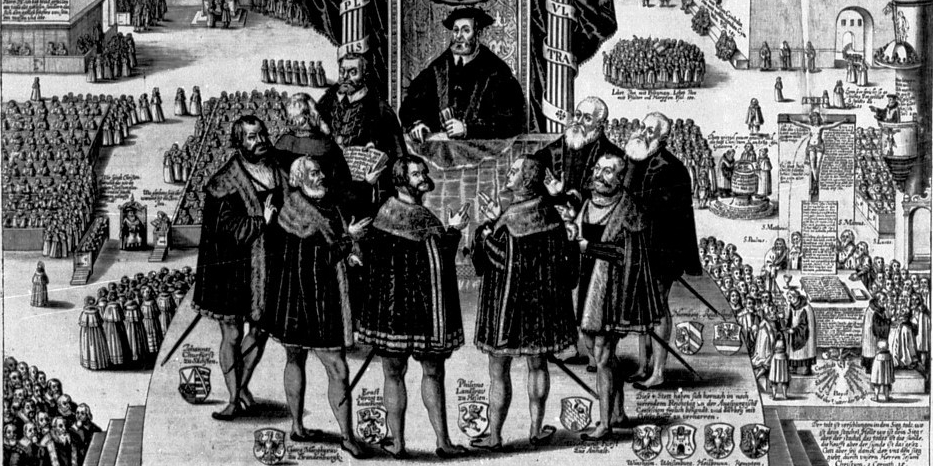
Presentation of the Augsburg Confession – Pr. Faugstad homily
On June 25, 1530, the Lutheran princes of Germany stood before Emperor Charles V in the German town of Augsburg and publicly read their confession of faith. They stated that they would rather die than compromise the truth of God’s Word.
Text: Romans 10:5-17
In Christ Jesus, whose perfect confession of the truth covers over our times of doubt, weakness, and faithlessness, dear fellow redeemed:
In the parts of the Augsburg Confession we have heard so far, there are two major themes that are brought up again and again. Those themes are righteousness and faith. In the Bible, “righteousness” is what it takes to be right with God. We don’t have to guess about the standard, because God has given us His standard for righteousness. He has given us ten statements—Commandments—which outline a life of righteousness.
Just ten commands—if you can live by them and keep them, you are right with God. But if you cannot keep them, then you cannot make yourself right with God. Already in the second article of the Augsburg Confession, the Reformers said this: We condemn those who “argue that a person can be justified before God by his own strength and reason” (ELH p. 9). In article four, they repeated the same thing, “We teach that men cannot be justified before God by their own strength, merits, or works” (ELH p. 9).
This teaching that there is nothing we can do to make ourselves right with God does not shock us, but it certainly shocked the people in Germany and beyond in 1530. Many believed that their good works, their merits, did contribute to their righteousness before God. The Roman theologians who responded to the Augsburg Confession put it like this, “All Catholics admit that our works of themselves have no merit but God’s grace makes them worthy to earn eternal life” (“The Confutation of the Augsburg Confession” in Sources and Contexts of The Book of Concord, p. 109). So is it ultimately God’s power or our power? Is it His work or our work?
St. Paul does not leave this ambiguous or unclear in today’s reading. He writes about “the righteousness that is based on the law” and “the righteousness based on faith.” The righteousness based on the law is our attempts to do what God tells us. If we kept His Commandments perfectly, He would let us into heaven because of our own good work. But if we have not kept them perfectly, we stand condemned in our sin. It’s all or nothing. Either you are perfect according to God’s standard, or you are not.
Now “the righteousness based on faith” is not a different kind of righteousness. It is still the perfect keeping of God’s Commandments, but this righteousness comes to us apart from our works. We do not earn this righteousness; we are given this righteousness. It is the righteousness of Jesus, who did perfectly keep the Commandments. He is the only human being to accomplish this. We were all conceived and born in sin, and we continued sinning. But He was conceived in the virgin Mary’s womb by the power of the Holy Spirit, and therefore He entered the world without sin.
Though in every respect He was tempted as we are, He never sinned (Heb. 4:15). He perfectly feared, loved, and trusted His heavenly Father. He perfectly loved everyone around Him. And that perfect keeping of God’s law is counted to each one of you by faith, and faith alone. Again from the Augsburg Confession, article four: “We teach that men… are freely justified for Christ’s sake through faith, when they believe that they are received into favor and that their sins are forgiven for Christ’s sake, who by His death has made satisfaction for our sins” (ELH p. 9).
For this faithful confession before one of the most powerful rulers in the world, the Reformers were risking their very necks! They were willing to die for this truth. They were fully convinced that what St. Paul wrote is true: “if you confess with your mouth that Jesus is Lord and believe in your heart that God raised Him from the dead, you will be saved.” Paul says nothing about God’s grace making us worthy to earn salvation, or about faith working through love that somehow earns us heaven. He speaks of the righteousness of Jesus becoming ours by faith in Him.
But where does faith come from? Is that a work you do? Paul writes, “So faith comes from hearing, and hearing through the word of Christ.” The power to save you and to work faith in you is in the Gospel, the good news of Jesus’ perfect life and atoning death on behalf of sinners. That is why you can be certain of your righteousness and salvation. They are gifts from God to you, received through the faith the Holy Spirit worked in you through the Word.
God has saved you. He justifies you. He caused you to believe this soul-saving truth. You Are Righteous before God by Faith. This is what the Lutheran laymen and pastors confessed 494 years ago, and by God’s enduring grace, we still confess it today to His glory alone. Amen.
+ + +
(picture of Emperor Charles V receiving the Augsburg Confession)

The Festival of Our Lord’s Ascension – Vicar Lehne exordium & sermon
Festival exordium:
“It is finished.” These are the words that Jesus spoke on the cross after he had completed everything that was necessary to save us from our sins. But just because Jesus’ work to save us was finished didn’t mean that he was done with us. There is still so much that he does for us from the position of authority that he has in heaven. He ascended to the right hand of his Father in order to be our Prophet, High Priest, and King. As our Prophet, Jesus sends out believers to spread the good news about what he has done for us and works through the good news of Scripture to bring the unbelieving world to faith. As our High Priest, Jesus intercedes for us on our behalf to the Father. And as our King, Jesus rules over not just heaven, which is his kingdom of glory, and earth, which is his kingdom of power, but also over his Holy Church, which is his kingdom of grace.
This is what Jesus ascended on high to do for you. He was seated at the right hand of the Father in glory in order to share the finished work of redemption with you. He is not done with you. He continues to give you these gifts. As your Prophet, he tells you the good news that he has finished the work to save you. As your High Priest, he reminds the Father of his sacrifice that he made on your behalf, and the Father sees your sins no more. And as your King, he rules over all things for your good so that you can be safely led by him to heaven to be with him forever. For these wonderful gifts, we praise and glorify his name by rising to sing “O Wondrous Conqueror and Great,” as it is printed in your service folders.
O wondrous Conqueror and great,
Scorned by the world You did create,
Your work is all completed!
Your toilsome course is at an end;
You to the Father do ascend,
In royal glory seated,
Lowly,
Holy,
Now victorious,
High and glorious:
Earth and heaven
To Your rule, O Christ, are given.
+ + +
Sermon text: Acts 1:1-11
In Christ Jesus, who did not leave us but continues to be with us always, dear fellow redeemed:
The disciples didn’t want Jesus to leave them. They had spent three years of their lives following Jesus and getting to know him well. During that time, they heard his words and saw his miraculous power. Because of these things that they saw and heard, they were hoping that Jesus would use his power to establish a kingdom on earth. But then, Jesus “began to show his disciples that he must go to Jerusalem and suffer many things from the elders and chief priests and scribes, and be killed, and on the third day be raised” (Matthew 16:21). This was not what the disciples wanted. Peter even “took [Jesus] aside and began to rebuke him, saying, ‘Far be it from you, Lord! This shall never happen to you’” (Matthew 16:22). But, even though it wasn’t what the disciples wanted, Jesus did suffer and die, just as he said he would, and his disciples were left alone and afraid.
Thankfully, that wasn’t the end. Jesus had also told his disciples that he would rise again on the third day, and that’s just what he did. When the disciples heard that he had risen, they didn’t believe it at first, but when Jesus appeared before them, they could no longer deny it. Jesus had risen, just as he said! He hadn’t left them after all. Now, the disciples were sure that Jesus would establish a kingdom on earth, and they would get to be with him as he ruled. But that’s not what happened. Instead, Jesus told them to “[g]o into all the world and proclaim the gospel to the whole creation” (Mark 16:15). As they did, they were to baptize all nations “in the name of the Father and of the Son and of the Holy Spirit [and teach] them to observe all that [Jesus had] commanded [them]” (Matthew 28:19–20). Then, after telling them this, Jesus was taken up into the sky before their very eyes, until he was hidden from their sight by a cloud. Jesus had just told his disciples, “I am with you always, to the end of the age” (Matthew 28:20), but now, the disciples appeared to be alone once again, this time for good.
Do we ever feel like Jesus has left us? While we would certainly love to say that we’ve never felt this way, all we have to do is look at the sinful world around us, and it becomes extremely difficult not to feel alone. Sinful lifestyles that we know are wrong are regularly practiced and encouraged by those around us. Even though the world claims to be a tolerant one, it seems to be tolerant of everything except Christianity, making it harder and harder for us to live as Christians. Like the disciples, we want Jesus to be visible and establish a kingdom on earth that is free from trouble, but we look around for him and can’t seem to find him anywhere. During times like these, it can be very easy for us to say, “Jesus, where are you? Why have you left us all alone?”
But Jesus has not left us all alone, just as he hadn’t left his disciples alone. As our gospel reading for today says, “[the disciples] went out and preached everywhere, while the Lord worked with them and confirmed the message by accompanying signs” (Mark 16:20). Jesus wasn’t visibly with his disciples, but he was still with them. He was with his disciples as they carried out the mission he had given them by preaching the Word and administering the Sacraments. In the same way, Jesus is with us as the Word is preached to us and the Sacraments are administered to us.
When Jesus’ Word is preached to you, or when you read his Word on your own, Jesus is present as he tells you everything that he did to save you from your sins. You were unable to follow God’s command to live a perfect life, but Jesus says through his Word, “I lived a perfect life for you, and that perfect life is now yours.” Your sins needed to be paid for with blood, and Jesus says through his Word, “My blood was shed on the cross for you. I have paid the price for your sins.” There are times when you may fear death, not wanting to leave your loved ones behind, but Jesus says through his Word, “I have risen from the dead, which means that you too will one day rise from the dead when I return in the same way that I was taken up into heaven.” You may wonder if the work to save you has truly been finished, but Jesus says through his Word, “My ascension into heaven is proof that everything that was necessary to save you was completed by me.”
How comforting it is to know that you can see Jesus whenever you want by simply opening up and reading your Bible. And because Jesus is present in his Word, that means that he is also present in the Sacraments, since they get their power from the Word. One of those Sacraments is baptism. When the water was applied in the name of the Father and of the Son and of the Holy Spirit at your baptism, all of your sins were washed away. At that moment, Jesus gave you the forgiveness of sins that he won for you by his death on the cross. He clothed you in the white garments of his perfect life, the perfect life that he lived for you. And he sent his Holy Spirit into your heart to create faith, a faith that trusts in him.
So, Jesus is with us in the preaching of his Word and in the waters of baptism, which are connected with his Word, even though we can’t see him, but he isn’t bodily present with us, right? After all, at his ascension, he was bodily taken up into heaven, which means that his body must be stuck in heaven. But this simply isn’t true. Jesus’s body and blood are present in the Sacrament of Holy Communion. Whenever we come to his table to receive the bread and the wine, which have been connected with his Word, we are receiving Jesus’ true body and blood. Even though we can’t see him, Jesus is with us in his meal to personally give us the forgiveness of sins that he won for us with the shedding of his blood.
You may not feel worthy of receiving the forgiveness of sins from Jesus in his supper. When you look at your sins, you are burdened with guilt. You don’t feel like Jesus is with you, and so, you think that he must have left you because your sins are too great to be forgiven. But Jesus didn’t come to save the worthy. He came to save the unworthy. He invites you to join him at his table so that he can freely offer you the forgiveness of sins. He freely forgives your sins not because you deserve it, but because he loves you. And you can leave his table knowing that the forgiveness that he just personally gave to you through his true body and blood was for you.
From his throne in heaven, our ascended Lord works through these means of grace, which he has promised to be present in, for our good, for the good of his church. This may not be how we expect Jesus to work things for our good. Like the disciples, who asked Jesus if he was going to restore the kingdom of Israel, we may want Jesus to give us a heaven on earth. But Jesus didn’t come to establish an earthly kingdom, nor does he rule over all things from his position of authority to make our lives a heaven on earth. He came to give us something far better: a perfect life of endless joy in heaven. The doors to heaven were opened to us when Jesus died on the cross, and then, he ascended into heaven after his resurrection to “prepare a place” for us (John 14:3). Until that time comes when Jesus returns “in the same way as [his disciples] saw him go into heaven” (verse 11), he comes to us in his means of grace, his Word and Sacraments, to prepare us for the day when we will leave this world and enter heaven to be with him forever. We are only strangers here. “Our citizenship is in heaven” (Philippians 3:20). And everything that our ascended Lord is doing for us here on earth is preparing us to come home to heaven.
When Jesus was taken up into heaven and hidden from the disciples, they were no longer able to see him. But that didn’t mean that Jesus had left them. He continued to be with them throughout the rest of their earthly lives, and when their time on earth was over, Jesus led them safely to his side in heaven. In the same way, even if you can’t see him or feel him, you know that Jesus is with you, because he gives you the same promise that he gave to his disciples “I am with you always, to the end of the age” (Matthew 28:20). He speaks to you through his Word. He washes you in the waters of baptism. And he personally feeds you at his supper. Your ascended Lord may not be present in the ways that you want him to be, but he is present in the ways that he promised to be and in the ways that you need him to be. Jesus hasn’t left you. He is with you always and will continue to be with you throughout your life, until he takes you up into heaven to be with him forever.
Glory be to the Father and to the Son and to the Holy Ghost; as it was in the beginning, is now, and ever shall be, forevermore. Amen.
+ + +
(picture from painting by John Singleton Copley, 1775)

Good Friday – Pr. Faugstad homily
Texts: Genesis 3:14-15,20, St. Matthew 27:45-46
The very same statement can be a blessing for one and a curse for another. That’s how it was when the LORD confronted the devil in the Garden of Eden. The devil had successfully tempted the man and woman to disobey God. They were now hiding from God with him. They were on his side.
But the LORD God said, “No! You cannot have them; they are not yours. I will put enmity between you and the woman, and between your offspring and her Offspring.” The woman and her Offspring would be opposed to the devil, hostile to him. They would not remain in his clutches; they would not continue to be wound up tightly in his coils.
And then God said the thing that really troubled the devil. It was bad enough that he would be cursed more than all livestock and beasts, that he would crawl on his belly and eat dust, and that he would not have mankind fully in his control. And then God told him that the woman’s Offspring “shall bruise your head, and you shall bruise His heel.”
The serpent would get his head stomped on by one of those humans he had just overcome. And the damage inflicted on his conqueror would only be a bruise on his heel. The devil was destined to lose, and there was nothing he could do to stop it. God made a promise, and His promises cannot be broken.
The first man and woman believed this promise. We see it in the name Adam chose for his wife. He called her “Eve,” a name that means “life.” She could have been called the “bearer of death,” since she had listened to the serpent, and because her children would die just as she would. But she was called Eve, “because she was the mother of all living.” The serpent-crusher, the Savior, would come from her. He would bring life to the dying.
But Eve was not given the privilege of bearing this Child. God’s promise would wait, generation after generation, century after century, thousands of years passing by, until God sent His angel to the woman Mary of Nazareth to tell her that she was the one.
It is her Offspring, it is her Son, hanging on the cross that first Good Friday, a day which looked anything but “good.” The only perfect man who had walked the earth since the fall into sin was now pinned to a cross. This is how the world esteemed Him. This is the honor that was shown Him—nailed to a tree to die.
He was put on the cross at 9:00 in the morning. At 12:00 noon, the sky went dark, and the darkness hung over the land for the next three hours—what is typically the brightest part of the day.
Jesus was in great anguish. He was suffering the eternal fires of hell in that darkness. He was paying for the first sin of that fateful day in the Garden of Eden, and for all the sins committed from that time forward. He was suffering hell for your selfish actions, your false words, your wicked thoughts. He felt God’s wrath for every single sin, whether large or small.
Under this burning wrath, He cried out, “My God, My God, why have You forsaken Me?” We cannot imagine it. We cannot comprehend it. But we can see how the innocent Christ was suffering what we deserved. We can see what the wages of our sin added up to. Beholding Jesus in this great anguish, we see the price of our redemption.
The very same act—His crucifixion—was curse for Him and blessing for you. The Son of God willingly accepted this curse. He willingly took your place, so He could take your punishment. This is how the devil’s grip would be broken. This is how his lying mouth would be shut up. This is how his head would be crushed.
Our Lord Jesus had to die, in order to cancel the curse brought into the world by Adam and Eve, the curse that consigned us all to hell. Galatians 3 says, “Christ redeemed us from the curse of the law by becoming a curse for us—for it is written, ‘Cursed is everyone who is hanged on a tree’” (v. 13).
Christ’s crucifixion looks like defeat, but it is victory. The devil seems to win, but he utterly loses. Death appears to succeed, but it is conquered once and for all. Jesus died for you, to save you.
This is the promise God made long ago in Eden. This is why Adam named his wife Eve. This is why Mary said to the angel, “let it be to me according to your word” (Luk. 1:38). This is why Jesus prayed to His heavenly Father, “not my will, but yours, be done” (Luk. 22:42), and willingly went to the cross.
The devil knew this was coming, but he didn’t know when. He knows now. And so do you. Seeing Jesus on the cross, you see God’s Promise Kept.
+ + +
(picture from Isenheim Altarpiece by Matthias Grunewald, c. 1510)

Maundy Thursday – Vicar Lehne sermon
Text: St. John 13:1-15
In Christ Jesus, who cleansed you by his selfless love, dear fellow redeemed:
The time had finally come. Jesus knew what was about to happen. In only a few short hours, he would be betrayed by one of his own disciples and arrested by the religious authorities in the Garden of Gethsemane. Then, after being questioned, mocked, and tortured, he would be sentenced to death on a cross, one of the worst ways for a person to die, even though he had done nothing wrong. On that cross, he would bear the burden of the entire world’s sin as if it were his own and face the punishment for all of it. This would be the final Passover meal that Jesus would eat with his disciples before he would be sacrificed as the ultimate Passover Lamb.
If you knew that you were about to face the ultimate suffering, surely you would be dreading what was about to happen and, if it were possible, would be thinking of ways that you could escape it. But Jesus wasn’t thinking about himself or the pain that he was about to endure. He was instead thinking about “his own who were in the world” (verse 1), whom he loved to the end, to the fullest extent. These people were not only his disciples, but were also, as Jesus describes in John 17:20, “those who will believe in [him] through their word,” that is, the gospel that would be preached by the disciples. In his final hours, Jesus was thinking about you. His disciples, on the other hand, were thinking about something much different.
In the gospel according to St. Luke, we hear that “[a] dispute also arose among them, as to which of them was to be regarded as the greatest” (Luke 22:24). This is not the first time that the disciples had this dispute. The last time they did, Jesus called a child to him and said to them, “Truly, I say to you, unless you turn and become like children, you will never enter the kingdom of heaven. Whoever humbles himself like this child is the greatest in the kingdom of heaven” (Matthew 18:3–4). But it appears that the lesson did not sink in. So, this time, Jesus said to them, “[L]et the greatest among you become as the youngest, and the leader as one who serves. For who is the greater, one who reclines at table or one who serves? Is it not the one who reclines at table? But I am among you as the one who serves” (Luke 22:26–28).
The Jews, including the disciples, thought that the Messiah was going to be an earthly king who would free them from the Romans, but Jesus did not come down from his throne in heaven to be an earthly king. He came down to earth to be a servant. In our Epistle lesson for Palm Sunday, we heard that Jesus, “though he was in the form of God, did not count equality with God a thing to be grasped, but emptied himself, by taking the form of a servant, being born in the likeness of men” (Philippians 2:6–7). We also hear in the gospels of St. Matthew and St. Mark that “the Son of Man came not to be served but to serve, and to give his life as a ransom for many” (Matthew 20:28; Mark 10:45). Now, Jesus was not only going to show his disciples through his actions that he came to be a servant, but he was also going to give them an example for how they were expected to act. He got up from the table, took off his outer garments and laid them aside, wrapped a towel around his waist, poured water into a basin, and began to wash the disciples’ feet.
Since the Jews wore sandals when they traveled at that time, traveling on the dusty roads would cause their feet to get dirty. But washing feet was not a task that just anyone did. This was considered menial work that was reserved for the lowest of servants. Because the disciples thought so highly of themselves, none of them thought to volunteer to wash the feet of the others. But now that Jesus, the greatest among them, was willingly washing their feet without complaint, they all felt guilty that they had not been the ones to volunteer.
You might not argue that you are the greatest, like the disciples did, but there are times when you think that you are better than others or you think that a certain task is beneath you. You may not be perfect, but at least you’re better than the person who actively lives in sin, despite the warnings that are given to them by you or others, or the person who refuses to go to church, even though they are perfectly able to do so. There are also many important tasks that you are in charge of. So, why should you be expected to do even more when you’re already doing so much? Why can’t other people be found to do those tasks? It’s really easy to start thinking in these ways, but when you think in these ways, you are putting yourself, your wants and desires, before others and their needs.
This is not the example that Jesus gave us to follow. By washing the feet of his disciples, by willingly taking on the task that was reserved for the lowliest of servants, Jesus was teaching his disciples and us that we are to humble ourselves in loving service to others. But it’s clear from how often we fail to do that and only think of ourselves that it’s impossible for us to serve like Jesus served. Fortunately for us, Jesus perfectly humbled himself in loving service to others for us.
Jesus’ entire earthly ministry was spent in loving service to others. He fed people who were hungry, healed people who were sick, cast out demons from people who were possessed, and even raised people back to life who had died. Jesus was not performing these miracles because he was trying to make himself look good or because he was trying to get something out of those he was helping. He was performing these miracles because he loved the people of the world and wanted to help them. And Jesus showed how much he truly loved all sinners when he willingly laid down his own life for them.
Jesus’ willing sacrifice was the ultimate example of his loving service to others. Because of his great love for us, Jesus took all of our sins on himself and carried them all the way to the cross. He bore the burden of our sins as he hung on the cross and paid the price for every single one of them. When Jesus died on the cross, all of our sins died with him, because he bore them as though they were his own and made atonement for them.
Peter did not yet understand why Jesus was washing his feet or what Jesus was going to have to do to save him and the world. So, when Jesus came to wash his feet, Peter said to him, “You shall never wash my feet” (verse 8). But Jesus answered him, “If I do not wash you, you have no share with me” (verse 8). Jesus was not saying that Peter needed to have his feet washed if he wanted to have a share of Jesus’ eternal inheritance in heaven. He was saying that Peter, as well as all of us, need to be spiritually cleansed by him if we want to have a share in his eternal inheritance.
All of us who believe in Jesus have already been spiritually cleansed by him. But, just like a person who needs to keep washing his dirty feet, we also need to keep returning to Jesus for forgiveness since we continue to sin every day of our lives. One of the ways that we receive this forgiveness is in the Lord’s Supper.
Jesus would soon institute Holy Communion after he finished washing his disciples’ feet. In that supper, you receive Jesus’ true body and blood in the bread and the wine for the forgiveness of sins. When Jesus instituted Holy Communion, he was looking forward to the sacrifice he would soon make as the Passover Lamb on the cross, shedding his blood for you. Now that his sacrifice has been made, when you partake in the Lord’s Supper, you look back on the sacrifice that he made for you, and the forgiveness that he won by his sacrifice is brought to you in the present. As you leave the Lord’s table, you have the comfort of Jesus’ forgiveness and the assurance that you will one day feast with him in his eternal kingdom.
You may not be able to perfectly follow Jesus’ example of loving service, but through the faith that the Holy Spirit has given you through the Word and the Sacraments, he has changed your heart so that you desire to follow Jesus’ example. And when you fall short, you return to the Lord’s table to receive his forgiveness, which he freely gives to you. It is because of Jesus’ selfless love that you receive his forgiveness. It is because of Jesus’ selfless love that you are cleansed. Amen.
+ + +
(picture from painting by Giotto di Bondone, c. 1267-1337)

Thanksgiving – Vicar Lehne homily
Text: Psalm 100
In Christ Jesus, who is our ultimate reason to give thanks, dear fellow redeemed:
Thanksgiving is many things to many people. To some, it’s the Thanksgiving Day Parade, in which giant parade balloons of their favorite characters float down the street. To others, it’s the Thanksgiving Day football game, complete with a halftime show that’s performed by some of their favorite celebrities. Still, to others, it’s simply getting to spend time with their friends and family. But, of course, if Thanksgiving is anything, it has to be Thanksgiving dinner: turkey; stuffing; mashed potatoes and gravy; pumpkin pie! In fact, Thanksgiving dinner is such a big part of Thanksgiving that many people go without eating all day in preparation for the massive feast.
Now, these are all perfectly fine things to do on Thanksgiving, but what many people fail to realize is that the true meaning of the holiday is right there in the name: Thanksgiving. It’s a day in which we are to give thanks, but give thanks for what? The psalmist answers this question by saying in verses 4 and 5 of our reading for today, “Give thanks to [the Lord]; bless his name! For the Lord is good; his steadfast love endures forever, and his faithfulness to all generations.” Through the love and faithfulness that he shows us, God proves that he is good and worthy of our thanks. But how does God show his love and faithfulness to us? The psalmist also answers this question by saying in verse 3 of our reading, “It is he who made us, and we are his; we are his people, and the sheep of his pasture.”
This verse paints God in two ways: as our Creator and our Good Shepherd. As our Creator, God shows his love for us by giving us life. Without him, none of us would even exist in the first place. As Psalm 139:13 says, “[Y]ou formed my inward parts; you knitted me together in my mother’s womb.” As our Good Shepherd, God shows his love for us by preserving us and protecting us. Everything that we have comes from God, and God makes sure that we have everything that we need, like a shepherd leading his sheep to green pastures and flowing water. As Psalm 145:15 says, “The eyes of all look to you, and you give them their food in due season.” But it isn’t just because God provides for us that we’re alive, it’s also because God protects us, like a shepherd who fights off the hungry wolves that are after his sheep. As Psalm 91:11 says, “He will command his angels concerning you to guard you in all your ways.”
God being our Creator and Good Shepherd in our earthly lives is enough of a reason to give thanks to him, but God is also our Creator and Good Shepherd in our spiritual lives. God wants us to be with him in heaven, where we will never want for anything. However, because of the countless sins that we committed, we were not able to stand in the presence of a perfect God and were doomed to be cast out from his presence into hell, where we would pay the price for our sins for all eternity.
There was no way that we could change our fate and enter God’s presence on our own, but God the Father didn’t want to leave us to our fate. He loved us too much to do that. So, he sent his only begotten Son, Jesus, to earn the honor of entering his presence for us. Jesus died an innocent death on the cross, taking all of our sins on himself and paying the price for them, so that our prefect, heavenly Father would no longer see our imperfections. He also applied his perfect life to our lives so that we are able to enter the presence of our perfect Father in heaven. These blessings that Jesus won for us are brought to us and made our own through the waters of baptism. In those holy waters, our old sinful self is drowned, and our new holy self is born, uniting with Christ and rising to the surface. While we were once spiritually dead, God has given us new life in Christ.
However, our faith is just like our physical bodies: it needs nourishment, or it will die. Thankfully, God does not leave us alone once he brings us to faith but continues to nourish our faith by feeding us his Word. Every time we enter his presence in this life, gather around his Word with other believers, we hear the good news of what Jesus has done to save us and of how God continues to work to preserve us and protect us.
Because of this, our faith is strengthened, but our faith needs more than just nourishment. It also needs protection, protection from our spiritual enemies (the devil, the world, and our own sinful nature) who are constantly trying to lead us astray so that we won’t get to enter God’s perfect presence. These spiritual enemies of ours try every trick in the book on us: they tell us that our sins aren’t so bad, and that everyone else is doing them anyway; they tell us that we need to reject God in order to fit in with the rest of the world and be accepted by them; they tell us that God is a liar and that he doesn’t do the things that he says he does, so we shouldn’t follow him; and they tell us that there is no way that God could ever forgive us of our sins, so we should just give up hope. Our spiritual enemies play the role of both friend and foe, whatever it takes to win against us.
But there is no need for us to fear our spiritual enemies, for God is always there to protect us from them. They cannot harm us, nor do their accusations succeed against us, for Jesus has paid the price for all our sins, and as a result, eternal life in heaven is ours. As Jesus says in John 10:28, “I give them eternal life, and they will never perish, and no one will snatch them out of my hand.”
So, we see that God is not only our Creator, Preserver, and Protector in our earthly lives, but also in our spiritual lives. For all this, we ought to give thanks to God. But there are times when we are tempted to think that there isn’t much to give thanks to God for at all, especially when we take a look around us and see the troubles that we all face every day. Prices continue to go up on everything, making it harder and harder to provide for ourselves and our families. Our loved ones continue to get sick and die. There continues to be war and violence throughout the world. And the world continues to encourage sinful behavior, seemingly wanting us to accept every kind of lifestyle, no matter how sinful it is, while, at the same time, rejecting those who are Christians, and even attacking them. Because of everything that’s going wrong in the world, it can sometimes make us wonder: is God truly in control? And if that thought starts to creep into our minds, it can tempt us to abandon God and turn to others for answers.
Thankfully, even though there are times when we aren’t faithful to God, God always remains faithful to us. Like a shepherd, he does not abandon his sheep that have wandered off, but he drops everything to find his lost sheep and lead them back to his flock. He accomplishes this through the preaching of his Word, the same Word that he uses to create and nourish our faith. When the Word is preached to us, we are made aware of the sins that we committed that caused us to go astray. But then, we receive the comfort that we have the forgiveness of sins because Jesus has paid the price for all our sins by his innocent death on the cross, that he willingly endured out of his great love for us.
Knowing all that God has done for us, and especially knowing what he has done to save us from our sins and open the gates of heaven to us, we are moved to give him thanks. But this thanksgiving is not limited to just one day of the year, nor is it limited to just when we go to church, but we show thanksgiving to God every day in all that we say and do, as the light that we now have in Christ shines before men. In fact, we can’t help but give thanks to God, because in every area of our lives, in how God made us, sent his only begotten Son to save us, and continues to provide for our needs, guard us from danger, and keep our faith alive, we know that God’s love endures forever. As the explanation to the First Article of the Creed says, “[F]or all this it is my duty to thank and praise, to serve and obey Him.”
Glory be to the Father and to the Son and to the Holy Ghost; as it was in the beginning, is now, and ever shall be, forevermore. Amen.
+ + +
(picture from stained glass window in St. John the Baptist’s Anglican Church in New South Wales)

The Festival of the Reformation – Pr. Faugstad exordium & sermon
Flung to the heedless winds
Or on the waters cast,
The martyrs’ ashes, watched,
Shall gathered be at last.
And from that scattered dust,
Around us and abroad,
Shall spring a plenteous seed
Of witnesses for God. (Evangelical Lutheran Hymnary #556, v. 1)
These words were inspired by Martin Luther’s first hymn, a commemoration of the deaths of two monks named Henry and John. These monks were arrested for their “evangelical” preaching, which meant they proclaimed salvation through Jesus alone and not through a person’s own efforts or works. After eight months of imprisonment and interrogation, they were put on trial.
At the trial, they were told to bow to the authority of the pope and the church fathers. They said they would as long as their writings did not contradict the Holy Scriptures. They were told that it was sinful to read Luther’s writings, since the pope had banned them. They replied that it was wrong to ban writings that faithfully teach the Word of God. When it became clear that the two men would not repent of what they were teaching, they were sentenced to death by fire.
They were led quickly to the place of their execution. A yellow tunic was put on Henry to mock him and a black gown on John to symbolize his sinfulness. They were tied to the stake. They waited for half an hour as their executioners tried to get the fire going. Then as the flames advanced, the two men said the Creed, and they sang Psalms and hymns. Their last song was an old Christian hymn, the Te Deum Laudamus, which means, “We praise You, O God.” Finally they cried out, “Lord, Jesus, Son of David, have mercy on us!” And then they were overwhelmed by the smoke and after a while were reduced to ashes.
The monks Henry and John were the first martyrs of the Lutheran Reformation. They died on July 1, 1523—five hundred years and a few months ago. They did not go to the stake because they believed in the man Martin Luther. They learned from Luther’s writings to put their trust in Jesus. They died confessing Jesus as their Savior and Lord, even when the whole world seemed opposed to them.
Their example is an encouragement to us, encouragement to resist the temptations of the devil and the appeal of going along with the crowd, and encouragement to firmly believe and clearly confess God’s truth with honest hearts. We pray that our Lord equips us as He did these two faithful men, so that we also are kept in the saving faith until our earthly end.
We join in the prayer of hymn #18, the fourth stanza, “Triune God, Be Thou Our Stay”:
Triune God, be Thou our Stay;
O let us perish never!
Cleanse us from our sins, we pray,
And grant us life forever.
Keep us from the evil one;
Uphold our faith most holy;
Grant us to trust Thee solely
With humble hearts and lowly.
Let us put God’s armor on,
With all true Christians running
Our heavenly race and shunning
The devil’s wiles and cunning.
Amen, amen! This be done;
So sing we, Alleluia! (ELH, #18, v. 4)
+ + +
Sermon text: Ephesians 6:10-17
In Christ Jesus, the great Conqueror who willingly joined Himself with us losers and single-handedly destroyed our terrible enemies, dear fellow redeemed:
If you had to go to the front lines of a battle, what would you want to have with you? What would you need in order to feel safe, or at least to feel like you had a fighting chance? Maybe it would be body armor like a bullet-proof vest and a helmet that could protect you from shrapnel and bullets. Maybe it would be a thick wall in front of you or well-trained soldiers on either side of you. Perhaps what would make you feel safest is a powerful weapon in your hands that causes your enemy to duck for cover.
The apostle Paul talks about a battle situation like this, except that the battle he refers to is a spiritual one. It happens around us and inside us, and we can’t see the enemy. But we can see the enemy’s work; we can see his “schemes.” Paul writes that our conflict is not primarily “against flesh and blood”; our greatest enemies are not other human beings. Rather our conflict is against the rulers, authorities, cosmic powers of darkness, and forces of evil in the spiritual realm.
Paul is describing a hierarchy of wickedness with the devil at the top and his fellow demons sowing destruction and chaos around him. They are the ones who tempt and incite human beings to do the bad things they do. If we do not recognize that the devil and demons are behind the evil in the world, we might think that every human problem can be solved by a human solution. But there is no human solution that can overcome the devil.
This is what the Roman Church was attempting to do at the time of the Reformation. The people were taught that they could make satisfaction for their sins by the good works they did, by the prayers and gifts they offered, or even by purchasing a piece of paper, an indulgence authorized by the pope. On October 31, 1517, Martin Luther posted his Ninety-Five Theses, which argued that a soul could be saved only through repentance and not through the purchase of indulgences.
As he continued to study the Scriptures, Luther came further in his understanding of salvation. He realized that only God could supply the righteousness that His holy law required, and that this righteousness was fulfilled by His only-begotten Son in the flesh, Jesus the Christ. A sinner could have his sins forgiven and be justified before God not because of anything he did, but because of God’s grace toward him and the faith worked in his heart by the Holy Spirit to receive these gifts.
When Paul writes about putting on “the whole armor of God,” this is what he is talking about. He is talking about putting our trust in God alone as we face the devil’s attacks. What is the armor we wear? “The belt of truth”—that doesn’t mean our own personal truth, what is true for each one of us. It is God’s truth, the truth about our sinful weakness and about His gracious plan to save us. “The breastplate of righteousness” is Jesus’ righteousness. A breastplate protects a soldier’s vital organs, and so it is Jesus’ perfect life that covers and protects us, so that we are kept alive and well in Him.
The “shoes for [our] feet” is the readiness to stand firm in the Gospel of peace, to conquer by the message of grace which has conquered our own hearts. Paul tells us what “the shield of faith” is for. It is to “extinguish all the flaming darts of the evil one.” Whenever the devil tries to accuse us for our sins, we point in faith to Jesus, who already paid the penalty for all our sins. “[T]he helmet of salvation” is what protects our minds from the devil’s schemes as he tries to work doubts in our heads or anger toward others or sinful desires for what God has not given us.
Finally, we have “the sword of the Spirit, which is the word of God.” We do not advance in this battle by physical force. We speak God’s powerful Word, and the devil and the demons have to retreat. They cannot stand against the power of God’s Word. Whenever Jesus comes through the Word, the devil’s head starts hurting, since Jesus stomped on it and crushed his power by dying in our place and rising from the dead for our victory.
But if we want to give the devil the advantage over us, we can set aside the armor of God and try to face him on our own. We do this whenever we feel pride for the great things we have accomplished, and fail to give God the glory. We do this when we embrace what God says is sinful, instead of repenting of sin and running away from it. We give the devil the upper hand when we don’t speak up when the truth is challenged, when we compare our good works with those of others, when we trust our own reason or strength, when we stop regularly hearing and learning the Word of our God.
The devil will defeat us if we are not wearing the armor of God. He has done it before. He schemed against us, and his schemes were successful. We lost ground in our faith, and perhaps at certain points, we lost our faith altogether. But even though the devil has won many battles against us, he has not won the victory. This is clear by the attention you are giving to God’s Word right now. You know that you are weak. You know that you have sinned. And you also know that Jesus saved you from your sin and death and still fights for you against “our ancient foe” (ELH #251, v. 1).
That is what Martin Luther’s hymn, “A Mighty Fortress Is Our God” is about, a hymn that is called “The Battle Hymn of the Reformation.” Based on the Forty-Sixth Psalm, it describes God as a Fortress of strength, a Shield of protection, and a Weapon of defense. We need His help because of our powerful enemy who wants to destroy us, whose strength has no equal on earth (v. 1). On our own we would lose, but One stronger than the devil fights for us, the Man of God’s choosing. This is God’s Son come from heaven to earth, the Lord of hosts, who is victorious in every field of battle (v. 2).
Even a world full of devils cannot defeat us when Jesus fights for us. They are overthrown by a Word, the Word of God (v. 3). Their arms go limp when God speaks His Word. They have to run and hide, because they know they are beaten. As long as our Lord is with us in the fight “with His good gifts and Spirit,” with His power imparted to us through His Word and Sacraments, we remain in the kingdom of God, and His kingdom remains ours (v. 4).
This is what it means to “be strong in the Lord and in the strength of His might.” This is what it means to “take up the whole armor of God” and “to stand firm.” It means repenting of our weak efforts on the battlefield that could not win the victory, and it means trusting in Jesus’ righteousness and blood for our salvation.
We are not lost. We are not forsaken. We are not destined for eternal damnation—because God the Father loves us, His Son redeemed us, and the Holy Spirit sanctifies and keeps us in the true faith. A Mighty Fortress Is Our God. We give Him thanks that the Gospel was proclaimed and bore fruit at the time of the Reformation, and that His saving Word is still proclaimed among us today, despite our unworthiness to receive it.
Glory be to the Father and to the Son and to the Holy Ghost; as it was in the beginning, is now, and ever shall be, forevermore. Amen.
+ + +
(picture from “Martin Luther at Worms” by Anton von Werner, 1877)
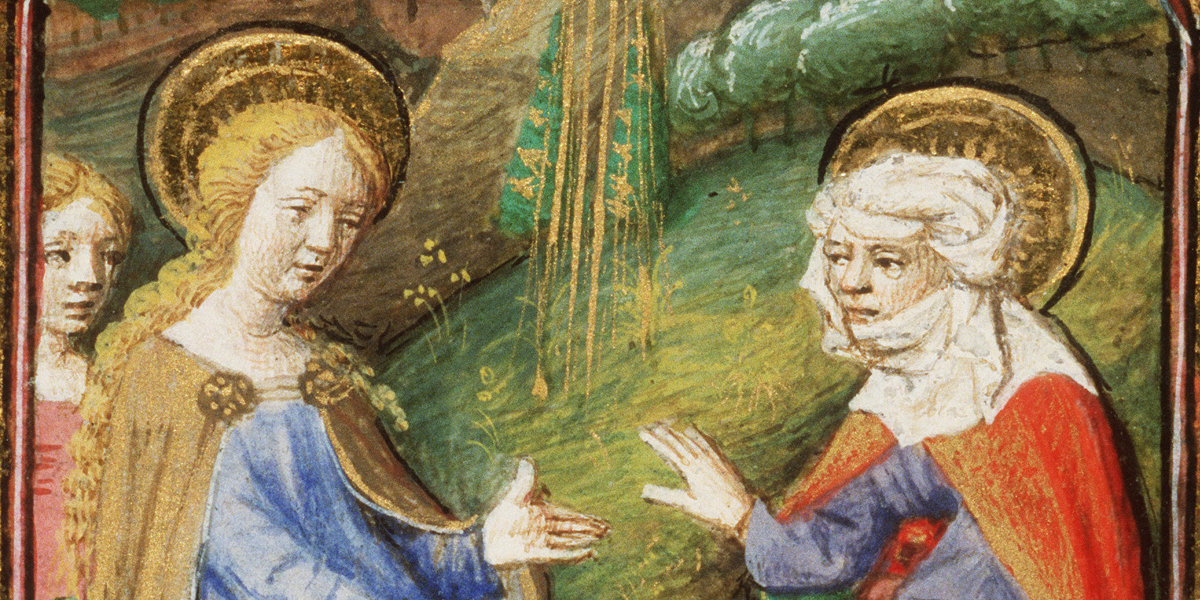
The Visitation of Mary & Vicar Installation – Pr. Faugstad sermon
Text: St. Luke 1:39-56
In Christ Jesus, who “made Himself nothing, taking the form of a servant, being born in the likeness of men” (Phi. 2:7), in order to redeem us by His perfect life and innocent death, dear fellow redeemed:
The mothers who have carried in their wombs the greatest people in the history of the world, did not know what their little babies would become. The Apostle Paul’s mother could not have guessed that her son would one day preach Christ crucified around the world. And Margarethe Luther would not have expected her son Martin to become a great reformer.
Elizabeth and Mary were different. They knew that the baby boys in their wombs were destined for tremendous things. Elizabeth learned it from her husband, a priest serving in the Jerusalem temple, who was visited by the angel Gabriel. The angel told Zechariah that he and Elizabeth would have a son. He would “be filled with the Holy Spirit, even from his mother’s womb,” and would “turn many of the children of Israel to the Lord their God” (Luk. 1:15, 16). His name was to be John. After Elizabeth conceived this child, she kept herself hidden for five months. Who would believe that this old woman was carrying a child after a lifetime of barrenness?
In the sixth month of Elizabeth’s pregnancy, the angel Gabriel visited her young relative Mary. As you know very well, Mary was betrothed to a man named Joseph, but they had not had relations with each other. Mary was a virgin. Gabriel shared the stunning news with Mary that she would bear the Christ Child, “the Son of the Most High” (Luk. 1:32), who would reign over an everlasting kingdom. And he had even more news to share. Her elderly relative Elizabeth was six months along in her own pregnancy. “For nothing will be impossible with God” (Luk. 1:37).
So what did Mary do next? She got up and hurried to Elizabeth’s house. Even if no one else believed her, Elizabeth would—Elizabeth whose life had also been touched by the unexpected working of God. By this time, Elizabeth’s belly had expanded to make room for the growing boy inside her. She might have felt little flutters as he moved around and hiccupped. Her baby was about twelve inches long and 1½ to 2 pounds in weight. His eyes may have just begun to peek out behind red eyelids.
Elizabeth did not know that a monumental meeting was about to take place. The Messiah was about to enter the home of His messenger. With Mary’s arrival, the two men who would turn the world upside down with their preaching and teaching, were now in the same room in the flesh. Elizabeth had not heard about Mary’s pregnancy, and yet she knew. She knew as soon as Mary greeted her, and her baby leaped in her womb. She knew, because at Mary’s greeting she was filled with the Holy Spirit.
The Holy Spirit revealed to her that Mary, a virgin and yet pregnant, was “the mother of her Lord.” She spoke three blessings to Mary: “Blessed are you among women,” “blessed is the fruit of your womb,” and “blessed is she who believed” what the Lord said. Elizabeth did not honor Mary because she had accomplished great things on her own. Elizabeth honored Mary because of her connection to the teeny, tiny baby growing in her womb.
But how could the little baby of a poor woman save the world? The world doesn’t think much of little babies or of poor women. Little babies are viewed more and more as burdens. Babies get in the way of careers and riches and personal freedom. All of us have thought that at one point or another. But Elizabeth and Mary were once babies, as were their sons John and Jesus. You and I were babies, and here we are. We are supposed to be here. God gave us life. Every Christian should be pro-baby, because God is pro-baby!
Every soul is precious in His sight, which means every soul should be precious to us. Our hearts should expand in love for all our neighbors, from the poor ones to the rich ones, from the lowly ones to the well-regarded, from the unborn to the elderly. Every life has value. Every life matters. Just look at the care with which God formed us in the womb. The psalmist David wrote, “For you formed my inward parts; you knitted me together in my mother’s womb. I praise you, for I am fearfully and wonderfully made” (Psa. 139:13-14). He goes on to describe how we were “made in secret, intricately woven,” and how even at our conception, God had a plan for all our days (vv. 15, 16).
The miraculous composition of a human being should be enough for people to acknowledge and praise the almighty God. But our sinfulness is great, and it has been with us for as long as we have existed. Adam and Eve’s fall meant that all their descendants would inherit their sin, and sin keeps us from fearing, loving, and trusting God as we should. In another of his Psalms, David wrote, “Behold, I was brought forth in iniquity, and in sin did my mother conceive me” (Psa. 51:5). That is true of every one of us. We were sinners from the moment we were conceived.
But Jesus was an exception to that unbroken line of sin. He was conceived not by a human father and mother, but by God the Holy Spirit overshadowing the womb of Mary. In this way, God the Son took on human flesh but without human sin. By His entrance into the world as an embryo, God was showing that life matters from its earliest beginnings, even before the human eye can see it. As He went through each stage of life—from His growth in the womb, to His birth, as a toddler, a child, a young adult, a grown-up—Jesus was redeeming every stage of life from the sin that pollutes us.
God does not take shortcuts. There was no simple, easy way for mankind to be saved. The Son of God had to take on flesh, and He couldn’t just appear in the flesh like you might appear in costume. He had to take human flesh into His Person. He had to start the way all humans start, with the joining of tiny cells. From the time that Gabriel visited faithful Mary, the eternal Son of God became God and Man in one Person. And He remains God and Man for all eternity.
This is the One whom John would go into the wilderness to proclaim. But that would be about thirty years later. Today was the day for Messenger John and his Master Jesus to meet. And how do we know that John was aware of Jesus’ presence? Elizabeth exclaimed to Mary, “For behold, when the sound of your greeting came to my ears, the baby in my womb leaped for joy.”
John continued to rejoice. Those thirty years later after Jesus was baptized, John cried out, “Behold, the Lamb of God, who takes away the sin of the world!” (Joh. 1:29). As Jesus’ following increased, and fewer were coming to John, John testified, “The friend of the bridegroom, who stands and hears him, rejoices greatly at the bridegroom’s voice. Therefore this joy of mine is now complete. He must increase, but I must decrease” (Joh. 3:29-30).
John had it right; his glory was in Jesus. The long-promised Savior had come. Elizabeth saw it the same way. She welcomed Mary with all humility, “And why is this granted to me that the mother of my Lord should come to me?” Mary saw it the same way. In her famous song, the Magnificat, she said that her Savior God “has looked on the humble estate of His servant,” “has done great things for me,” has “exalted those of humble estate,” and “has filled the hungry with good things.”
And so it is for you and me. The Lord has looked on our humble estate. He saw how helpless we were, how lost in our sin. And He has done great things for us. The little baby in Mary’s womb was growing there for you and me. The six months bigger baby growing in Elizabeth’s womb would go before Him to prepare His way. All of this happened more than 2,000 years ago, but God had you in mind.
God the Father sent His only Son for this express purpose—to save your soul. He gave you birth, so that He could give you rebirth. He formed you in the womb, so He could transform you by the power of the Gospel. You might wonder sometimes how much your life matters. You might wish you could go back, make different choices, and do more with your life. You can put all those thoughts to rest when you see what God did for you, when you see the womb of a virgin swelling with Child, when you see the God-Man making His way to Calvary carrying His cross—for you.
Your life matters. God loves you. He forgives all your sin. He wants you to join Him in heaven with Elizabeth, John, Mary, and all the saints. This is the message He calls sinful men to preach. We give thanks that He has sent another vicar to our parish to preach this Word to us and to continue training for the noble work of pastor. Pastors have nothing to offer you of their own, just as Mary had nothing to offer of her own. But as God chose her to bear the Christ-Child in her body, so He has chosen sinners to “rightly handle His word of truth” (2Ti. 2:15), and to distribute His means of grace through our mouths and by our hands.
The presence of Jesus in Mary’s womb brought joy to Elizabeth and John, and His presence still brings joy to us. When the sound of His forgiveness and grace reaches our ears, the Holy Spirit comes to remove our burdens and lift our hearts. Then our souls magnify the Lord, and our spirits rejoice in God our Savior.
Glory be to the Father and to the Son and to the Holy Ghost; as it was in the beginning, is now, and ever shall be, forevermore. Amen.
+ + +
(Picture of the Visitation from the Book of Hours of Simon de Varie, 1455)
The Presentation of the Augsburg Confession – Pr. Faugstad homily
Text: Psalm 119:46
493 years ago on June 25, 1530, the Lutheran princes of Germany stood before Emperor Charles V and publicly read their confession of faith to all who were gathered there. They stated that they would rather die than compromise the truth of God’s Word.
+ + +
In Christ Jesus, who in His testimony before Pontius Pilate made the good confession (1Ti. 6:13), and who calls us to do the same when we are asked for a reason for the hope that is in us (1Pe. 3:15), dear fellow redeemed:
The men who read the words of the Augsburg Confession before Emperor Charles V were not pastors or theological professors. They were laymen. And they understood and believed every word they spoke. They were powerful men in Germany—dukes, princes, and wealthy landowners—, which meant that they had a lot to lose. They were willing to risk it all because of the Gospel message of salvation they had heard and believed.
By speaking the truth of God’s Word, you also could face the possible loss of your job, your standing in the community, or your favor with friends. Telling God’s truth is the most courageous thing you can do, and it is also the most difficult. The world does not welcome the truth. It actively opposes it and wants the clear teaching of God to be silenced.
But while the unbelieving world may succeed in intimidating us and winning some battles against us, it cannot conquer the Church of God in Christ. He assures us, “In the world you will have tribulation. But take heart; I have overcome the world” (Joh. 16:33). He also reminds us how important our confession of the truth is. Not only is it a matter of eternal life or death for us, it is also a matter of eternal life or death for those we associate with. Jesus says, “So everyone who acknowledges me before men, I also will acknowledge before my Father who is in heaven, but whoever denies me before men, I also will deny before my Father who is in heaven” (Mat. 10:32-33).
The laymen at Augsburg confessed the pure Gospel of Jesus in the presence of some of the most powerful people of their day. We still stand on this confession. We believe what they believed. We teach what they taught. By the grace of God, we have the received His treasures of forgiveness, righteousness, and peace through the preaching of His Word. We have been made members of the body of Christ through faith in Him who died for all our sins and rose from the dead in victory. There is no hope apart from Him, and every confidence in Him.
But we have not always been confident, and we have not always been hopeful. At various times in our lives, we have lost sight of this most important thing. We have listened to the promises of the world. We have sometimes chosen sin over salvation, friendships over faithfulness, peace and security in the world instead of the peace that surpasses all understanding. We think back on these things, and we feel ashamed.
Shame is always waiting for those who walk the way of the world and not the way of God’s Word. You and I find plenty to be ashamed of when we look at our own hearts and minds. But we find nothing to be ashamed of when we look to Jesus. He also stood before powerful authorities. Though they attacked Him and told lies about Him, He did not give in, and He did not retaliate. They sentenced Him unjustly to death by crucifixion, and He endured this suffering willingly.
He did all of it for you, so that His blood would cleanse you of all your sins of weakness and unfaithfulness, and so that His holy life would cover you like a royal robe. You do not face the threats of the world alone. You stand in Him, who has overcome the world, the devil, and death for you. Whether you speak His testimony before kings or before your boss or co-workers or anyone else around you, you have nothing to be ashamed of, because Jesus Christ is “the way, and the truth, and the life” (Joh. 14:6).
The Word of God has not changed and will not change. Every power and influence in this world will pass away, but the Word of our God will endure forever. The men at Augsburg spoke timeless truths, which is why we still speak them today. The Lutheran Church which confesses this truth is not a new church or even a 500-year-old church. It is the continuation of the one holy Christian and Apostolic Church from its New Testament origin to the present day.
We pray that God keeps us faithful to this saving truth, and that He gives us the courage to speak His truth to all who need to hear it.
Glory be to the Father and to the Son and to the Holy Ghost; as it was in the beginning, is now, and ever shall be, forevermore. Amen.
+ + +
(picture of Emperor Charles V receiving the Augsburg Confession)