

The Festival of Our Lord’s Ascension – Pr. Faugstad exordium & sermon
Festival exordium:
Beginning forty days before Easter, we recall the intense suffering our Lord Jesus endured for our salvation. Forty days after Easter, we celebrate His glorious ascension. This was His enthronement at the right hand of God the Father, not only as the Son of God but also as the Son of Man. He was welcomed by all the host of heaven as the victorious King, the Conqueror of sin, death, and devil, the Savior of the world.
Jesus ascended visibly into heaven, but He also continues to be with us and bless us here on earth. Just before His ascension, He said to His disciples, “All authority has been given to Me in heaven and on earth. Go therefore and make disciples of all the nations, baptizing them in the name of the Father and of the Son and of the Holy Spirit, teaching them to observe all things that I have commanded you” (Mat. 28:18-20, NKJV). He commissioned the Church to take His powerful Word and Sacraments to every nation, land, and people.
Then He added words that give us great comfort and courage, “And lo, I am with you always, even to the end of the age” (v. 20, NKJV). Jesus did not abandon us when He ascended into heaven. He has not left us to fend for ourselves. “I am with you always,” He says. As true God, He is present everywhere. And He is specially present when His message of salvation is proclaimed, when the Baptism He instituted is administered, and when His body and blood are distributed in His Holy Supper.
You know just where to find Jesus. He is seated at the right hand of God the Father Almighty right here and right now. God’s right hand touches this pulpit, this font, this altar. His right hand touches our homes, “where two or three are gathered in [Jesus’] name” (Mat. 18:20), hearing and learning His Word. Jesus, the victorious Son of God, is present and active here, just as He has promised He would be.
And on the last day, He will return visibly in glory to judge both the living and the dead. Then you and all trust in Him will also ascend. You will join Him in His heavenly kingdom. You will be gathered with all the host of heaven around the throne of God, where rejoicing and gladness never come to an end.
We now stand to sing our festival hymn printed in the service folder, “O Wondrous Conqueror and Great”:
O wondrous Conqueror and great,
Scorned by the world You did create,
Your work is all completed!
Your toilsome course is at an end;
You to the Father do ascend,
In royal glory seated.
Lowly,
Holy,
Now victorious,
High and glorious:
Earth and heaven
To Your rule, O Christ, are given.
+ + +
Sermon text: 1 Samuel 8:1-22
In Christ Jesus, whose kingdom of power, grace, and glory will never end, dear fellow redeemed:
Over the last couple of weeks, we heard how God sent judges to deliver the Israelites from their enemies, judges like Gideon and Samson. After Samson’s death, the LORD raised up one of the great leaders of the Israelites, a prophet named Samuel. He judged Israel all the days of his life and faithfully called the wayward Israelites back to the worship of the true God. But Samuel’s sons were not like him. He wanted them to continue after him and serve the LORD like he had. They were more interested in using their positions for personal gain.
So the elders of Israel came to Samuel and made a fateful request: “We want to have a king like all the other nations.” It was not wrong for them to want a strong leader. It was wrong for them to speak as though they had no king. The LORD God was their king. He had led them out of Egypt to the Promised Land and had given them victory over their enemies. Samuel was troubled by their request. But the LORD told him, “Obey the voice of the people in all that they say to you, for they have not rejected you, but they have rejected Me from being king over them.”
God would give the people what they asked for, but He warned them that having a king was not as great as they imagined. The people would not listen. They could only see the positives: our king will “judge us,” they said, “and go out before us and fight our battles.” It’s the sort of thinking that touches every generation. We are always looking for the next great leader who will fix all the problems in our society—and perhaps even the world—and make us more prosperous and happy than ever before. But as soon as we think we’ve found people like that, they inevitably disappoint us. They aren’t as perfect as we thought they were.
The people of Israel were dreaming about what their new king would give them. Samuel informed them about what their king would take from them: he would take their sons to fight for him, farm for him, and build for him; he would take their daughters to be perfumers, cooks, and bakers; he would take their fields, vineyards, and olive orchards; he would take their servants, their grain, and their livestock. They would be his slaves.
That does not sound like a good deal. Why would the Israelites want this? Samuel revealed later that they made this request because they were afraid of their enemies (1Sa. 12:12). They did not trust the LORD to protect them. For the next number of weeks, we will learn about the kings of Israel. Some of them served well for a time. But what God warned the people about through Samuel did come true. It wasn’t long before the kings required more than they delivered; they took more than they gave. Having a king wasn’t as great as the people expected.
We in the United States have no king of our country. The crown was offered to George Washington after the American colonies won the Revolutionary War, but in humility, Washington rejected it. He served as president for two terms and then peacefully stepped aside. We have no king of our country, but we do have a King in the church. This is not the pope. He may be the head of the Roman Church, but he has no divine authority in the holy Christian Church.
The King of our church is no mortal man whose reign is temporary. The King of our church is the crucified and risen Christ, who reigns over all things at the right hand of His Father in heaven. He left the glories of heaven to take on our human flesh and humbly suffer and die in our place. He hardly looked like a king, except to those who looked upon Him with faith. The thief hanging next to Jesus on the cross was one of these. When He looked at the anguished, bleeding Christ with a crown of thorns on His head, He saw a King who even had power over death. He said, “Jesus, remember me when you come into your kingdom” (Luk. 23:42).
Now, beginning with His victory march through hell and His resurrection from the dead, Jesus is exalted. Now He always and fully uses His divine power as God and Man. As our King, Jesus rules over a three-fold kingdom. He rules with power over the whole universe. He rules with grace in His holy Church. And He rules with glory in heaven. Ephesians 1 tells us that God the Father “raised [Christ] from the dead and seated him at his right hand in the heavenly places…. And he put all things under his feet and gave him as head over all things to the church, which is his body, the fullness of him who fills all in all” (vv. 20,22-23).
This passage describes our connection to Christ in the closest terms: He is our Head, and we are members of His body. We live in Him, move in Him, and have our being in Him (Act. 17:28). There is no life apart from Him. He gives us our spiritual health and strength. He makes us fruitful members that desire to do good to the glory of God. He also prepares us to follow Him to heaven, to go where He has gone. One of today’s hymns says, “For where the Head is, there full well / I know His members are to dwell / When Christ shall come and call them” (Evangelical Lutheran Hymnary #392, v. 1).
Our King does not use His power and authority to boss us around or take things from us. He was not like the Israelite kings that Samuel warned the people about. Jesus does the opposite. He uses His power and authority to bless us by His grace. Ephesians 4 says, “But grace was given to each one of us according to the measure of Christ’s gift. Therefore it says, ‘When he ascended on high he led a host of captives, and he gave gifts to men’” (vv. 7-8).
The “host of captives” includes you and me. We were captive to sin and death by nature. The devil, the prince of demons and darkness, ruled over us. But Jesus broke us out of this prison. The devil, the unbelieving world, and death tried to stop Him, but there was nothing they could do. Our King was too powerful for them. His victory was complete.
He shares this victory with all who trust in Him. “When he ascended on high he led a host of captives, and he gave gifts to men.” The gifts He gives to us are the gifts of eternal salvation. He forgives our sins; He covers us in His righteousness; He has prepared a place for us in His kingdom. We couldn’t have it better than we have it with our King.
But like the Israelites who wanted to be like the nations around them, we often look for more than what Jesus gives us. We want to have power and success and prosperity now. We want to enjoy the good things of here. These things seem real to us, unlike the invisible gifts from an invisible King, who promises us a place in a heavenly kingdom we have never seen. And yet we never get as much from the world as we hope we might. We find that despite its promises and seeming advantages, the world takes more from us than it gives.
Only the grace of God prevails. Only the grace of God gives us what cannot be taken away. Jesus’ ascension into heaven was the crowning moment of His saving work. It was the ultimate recognition that He had accomplished everything His Father sent Him to do. No sin was left unpaid for. No accusation of the devil left unaddressed. No chain of death left unbroken. Everything for salvation was carried out, completed, finished—for you and every sinner.
Our King now sits at the right hand of God the Father dispensing these gifts of His grace. Every day, He hands them out to you, to me, and to all His people all over the world. He never runs out. In fact, He always has grace for more, more who will join Him in His kingdom. This grace comes through the means or channels He has established for giving His gifts. He calls pastors to speak His Word, baptize, and administer His Supper. The pastor is not the King; he is just the courier or the messenger. He only passes on what Jesus has given to His Church.
The Church receives these gifts with joy. We know who our King is, we know what He has done for us, and we know He is preparing us for even greater things when He returns in glory.
Glory be to the Father and to the Son and to the Holy Ghost; as it was in the beginning, is now, and ever shall be, forevermore. Amen.
+ + +
(picture from painting by John Singleton Copley, 1775)

The Sixth Sunday of Easter – Pr. Faugstad sermon
Text: Judges 16:18-30
In Christ Jesus, the greater and perfect Samson, who delivered us from all our enemies, dear fellow redeemed:
There is an error about prayer hanging around some of the branches of the Christian Church. The error is the idea that if you pray with enough faith, or if you have proven yourself worthy before God by your good works, then He will give you exactly what you ask for. When people who are taught this do not receive what they pray for, they have a crisis of faith. They assume that God must be punishing them for something. They picture Him looking upon them with fierce wrath instead of looking upon them with mercy.
We see a different picture in God’s dealings with Samson. But first, a little backstory is helpful. Before Samson’s mother had him, she had been unable to have children. The angel of the LORD appeared to her and said that she would “conceive and bear a son” (Jud. 13:3). He would be dedicated to the LORD, and his parents were directed to let his hair grow. As he got older, we are told that “the LORD blessed him. And the Spirit of the LORD began to stir in him” (13:24-25).
One of the ways the Holy Spirit “began to stir in him” was by giving him tremendous physical strength. On one occasion, a young lion charged at him roaring. “Then the Spirit of the LORD rushed upon him, and… he tore the lion in pieces” (14:6). The same language is used later on—“the Spirit of the LORD rushed upon him”—and he single-handedly killed thirty men among the Philistines who ruled at that time over the Israelites (v. 19). The LORD was using Samson to deliver the Israelites from their oppressors.
For his next act, he caught 300 foxes, tied them together in pairs and put a torch between them. Then he set them loose in the Philistines’ grain fields and olive orchards, and much was destroyed. The Philistines came after him, and with the jawbone of a donkey in his hand, Samson killed 1,000 of them. Another time, he tore out the gates and posts of one of their cities and carried it in one piece and set it on the top of a hill. Samson was a big problem for the Philistines.
And Philistine women were a big problem for Samson. We meet one of them in today’s reading, a woman named Delilah. The Philistine rulers promised her great riches if she would “seduce him” and find out “where his great strength lies” (16:5). Samson told her that if he were bound with seven fresh bowstrings, he would become weak. When he fell asleep, she bound him with seven fresh bowstrings, but when he woke up, he broke them easily. She kept trying. He told her that fresh ropes would do it, but he broke those too. Then he said if his hair were tied into a weaver’s loom, he would become weak. Delilah did this, but it didn’t work either.
It is obvious that Delilah could not be trusted, but she wouldn’t give up. She kept pressing and pressing until Samson finally gave in. “A razor has never come upon my head,” he said, “for I have been a Nazirite to God from my mother’s womb. If my head is shaved, then my strength will leave me, and I shall become weak and be like any other man” (16:17). You heard what happened next. The Philistines shaved his head while he slept, and when they attacked him, he figured he would defeat them like before. But “his strength left him” because “the LORD had left him.”
Samson had taken his strength for granted. He felt invincible. He thought he could not be defeated. He had forgotten where his strength came from. He had forgotten to put his trust in God and follow the LORD’s will. He was full of pride, and that led to his fall (Pro. 16:18). It was a tremendous fall. The Philistines gouged out his eyes and made him grind at the mill in their prison. Then they gathered for a great feast to their god Dagon to celebrate Samson’s defeat, and they brought Samson in to entertain them. We can imagine the abuse and mockery hurled toward him. He had killed so many of their people, but now here he was—weak, pathetic, a joke.
These hardships had given Samson time to reflect. He knew where he had gone wrong. He understood how foolish he had been. He realized how arrogant he had been and how faithless before God. We see this humility come out in his prayer to the LORD: “O Lord GOD, please remember me and please strengthen me only this once, O God, that I may be avenged on the Philistines for my two eyes.”
But why should God give back to Samson what he had so carelessly thrown away? He didn’t owe Samson anything. Samson had been given a great gift from God, and he sold it for the charms of Delilah. Samson deserved to be the Philistines’ slave. He deserved their ridicule and torment. Why should the LORD listen to his prayer?
The same question might come to our minds. None of us have had the strength of Samson, but like Samson, we have taken God’s gifts for granted. We have not used our ability to think in pure and dedicated service to the LORD. We have not always used our mouths for His glory and honor. We have not always used our physical abilities to serve Him and our neighbors. We have treated these gifts as though they originated with us and not with God. Why should the LORD listen to our prayers?
The answer is not that we have somehow earned the right to have God hear us because our faith is strong enough or we have proven ourselves worthy before Him. We know this is not the case. The reason the LORD listens to our prayers is because He is merciful—full of mercy—toward us. He is not watching us and keeping a tally of all the things we do and say and think that are wrong, to see when the scale tips or the balance shifts away from His favor. If this were the case, our fate would have been sealed long ago for our sins against Him.
But as He looked upon Samson, so He looks upon us. He knows far more clearly than we do how we have sinned against Him. He sees every misdeed, every infraction, every transgression. We deserve nothing but torment from God for these sins, endless torture in the eternal prison of hell. But the LORD has mercy upon us. He saw us in all our weakness, surrounded by our enemies, unable to free ourselves, and He sent us a Savior.
Like the angel who spoke to Samson’s mother, an angel appeared to the virgin Mary and said, “you will conceive in your womb and bear a son” (Luk. 1:31). The Spirit of the Lord was upon Him because He was the eternal Son of God. As He humbled Himself to carry out His saving work, Jesus appeared vulnerable and weak, but His enemies were not able to overcome Him. The devil, the roaring lion, rushed at Him with many temptations, the unbelieving world with all its power and resources tried to bury Him, death tried to hold Him fast in its dark chains. But all of them failed. He conquered them all.
He was our Samson, the strongest Man, who stood up to our formidable enemies. He had mercy on us in our weakness. He rescued us from the devil’s prison house. He paid the price for our transgressions. He suffered and died for our sins. This is how we know God the Father loves us—He sent His Son to redeem us by pouring out His holy blood. This is how we know God the Father is not punishing us for our wrongs—He punished His Son in our place.
Jesus’ death on the cross and His resurrection on the third day is also how we know the Father hears our prayers and wants to hear them. In today’s Holy Gospel, Jesus says, “the Father himself loves you, because you have loved me and have believed that I came from God” (Joh. 16:27). Because of what Jesus has done, the way is open to the Father. He urges us to pray to Him as He says in Psalm 50, “call upon me in the day of trouble; I will deliver you, and you shall glorify me” (v. 15).
He knows that it is often in “the day of trouble” that we remember to pray to Him. It is when we are weak, when we are unable to control or fix something, when we don’t have answers, that we remember to bring these troubles to our LORD. This is what Samson did. He was weak, he couldn’t see, he was the object of everyone’s scorn, and he prayed for the LORD to give him strength. The LORD did. Samson pushed against the pillars of the house, and the house fell on the thousands of Philistines gathered there, killing more in Samson’s death than he had in his life.
The LORD had given him strength in his weakness, and He had done it for the sake of His people Israel to save them from their enemies. The LORD also works in you as the Holy Spirit strengthens and builds you up through His Word and Sacraments. He leads you to repent of your sins, to set aside your arrogance and pride, and put your trust in Him alone. He applies the saving work of Jesus to you, so you are comforted and assured of His grace.
The Holy Spirit also guides you in your prayers. He graciously brings your needs and concerns and requests before God. Romans 8:26 says, “The Spirit helps us in our weakness. For we do not know what to pray for as we ought, but the Spirit himself intercedes for us with groanings too deep for words.” The Lord God wants to hear your prayers, and in His mercy, He promises to answer them in the way that is best for you, both for your earthly good and for your eternal salvation.
Glory be to the Father and to the Son and to the Holy Ghost; as it was in the beginning, is now, and ever shall be, forevermore. Amen.
+ + +
(picture from stained glass by Gian Lorenzo Bernini, c. 1660)

The Fifth Sunday of Easter & Saude Confirmation – Pr. Faugstad sermon
Text: Judges 7:1-7, 16-21
In Christ Jesus, whose grace is sufficient for you, whose power is made perfect in weakness (2Co. 12:9), dear fellow redeemed:
The Israelites had become everyone’s doormat. They should hardly have been surprised. They lived on prime real estate in the land of Canaan—land that was the envy of all the nations around them. The only reason they had this land and the only reason they ever had peace is because the LORD God gave it to them. But as the generations passed, the Israelites did not give thanks to God or honor Him for these gifts. Instead they gave up the worship of the true God for the false gods of the nations around them. So God gave them up to their enemies.
That’s how we find Israel in today’s reading. They were currently under the thumb of the Midianites. Every time the Israelites’ crops matured, the Midianites and others “would come like locusts in number” and take whatever they wanted; “they laid waste to the land” (Jud. 6:5). The Israelites were completely impoverished. They had no way to defend themselves. And only now at rock bottom did they remember the LORD. They cried out for His mercy.
The LORD chose an unlikely savior for them. He visited a man named Gideon and told him he would deliver Israel. Gideon replied, “Please, Lord, how can I save Israel? Behold, my clan is the weakest in Manasseh, and I am the least in my father’s house” (Jud. 6:15). The first task the LORD gave him was to destroy his father’s altar to the god Baal and the monument next to it to the goddess Asherah. Gideon was so afraid to do this that he waited until the middle of night, so he wouldn’t have to face any opposition for his actions. Not exactly hero material.
It was harvest time again, so the Midianites were on the march. But this year wouldn’t be like the ones before it. The Midianites would not be taking whatever they wanted. The LORD prepared timid Gideon to stop them by giving him strength and courage. We are told that “the Spirit of the LORD clothed Gideon, and he sounded the trumpet, and [his countrymen] were called out to follow him” (6:34). Altogether 32,000 men showed up for battle. That sounds like a lot, but the camp of Midian had 135,000 men—more than four times as many! Just looking at the numbers, Israel wouldn’t stand a chance.
But that’s not how God saw it. He said to Gideon, “The people with you are too many for Me to give the Midianites into their hand, lest Israel boast over Me, saying, ‘My own hand has saved me.’” He told Gideon to send anyone home who was afraid. 22,000 left, leaving just 10,000 fighting men. “The people are still too many,” said the LORD. He devised a test to whittle down the number by how the men drank water. Of the 10,000, all but 300 knelt down to drink. The LORD chose the 300.
So it was 300 Israelites against 135,000 Midianites. No one would take those odds. Israel did not have superior armor or equipment. They had no weapon of mass destruction. But the Israelites did have one thing the Midianites did not—they had the LORD on their side. Would Gideon and his 300 trust the LORD to give them the victory?
God’s faithful people have often faced long odds. The prophet Elijah thought he was the only believer left in his day, but God had preserved 7,000 who had not bowed the knee to Baal (1Ki. 19:18). Shortly after Jesus’ resurrection, only a handful believed in Him. When persecution began against the Christians after Pentecost, their number was only at 5,000. Martin Luther had many more opponents than allies when he articulated the Bible’s teaching of salvation. And still today, our congregations are on the smaller side in our communities, and our church body hardly registers on anyone’s radar.
When we look at all that threatens us, all around us who would like to see the Church go under and go away, it is easy for us to wonder if our days are numbered. How can we as Christians stand in a society and culture that is moving further away from God’s Word and will? We are tempted to stop speaking the truth because we don’t want to face the consequences for it. We might stay silent because we don’t want to become targets of people’s criticism or ridicule or risk our good standing in the community. Like the Israelites who were “fearful and trembling” at the thought of facing the powerful Midianites in battle, we are afraid to face the world’s opposition to our faith. Do we even stand a chance?
But we must not forget who is on our side. In God’s holy Church, where something appears to be weak, that is often where He shows His strength. And where something has the appearance of strength, that is often where you find weakness. The first chapter of First Corinthians lays this out clearly: “God chose what is foolish in the world to shame the wise; God chose what is weak in the world to shame the strong; God chose what is low and despised in the world, even things that are not, to bring to nothing things that are, so that no human being might boast in the presence of God” (1Co. 1:27-29).
Think of how God adds members to His holy Church. He does it through simple water and Word in the Sacrament of Baptism, and typically the ones brought to the font are little infants! How can helpless babies endure against the spiritual enemies arrayed against them? When our youth are confirmed, they renounce the devil and all his works and all his ways, and they promise to remain faithful to the pure teaching of the Bible until death. But how can they be so sure they will? They don’t know what life will throw at them and what challenges they will face in the future.
The devil, the unbelieving world, and our sinful flesh look disdainfully at us weak Christians and say, “They don’t stand a chance.” But they are forgetting something. Look at Gideon with his 300 facing an army of 135,000. The Israelites did have a plan for confusing the Midianites by dividing into three companies and then blowing their trumpets, breaking their jars, and holding their torches high in the dark of night. But that alone does not account for so few defeating so many.
Right after today’s reading it says, “When they blew the 300 trumpets, the LORD set every man’s sword against his comrade and against all the army” (7:22). It was the LORD who did this, the LORD who defeated the great Midianite army, the LORD who gave victory to Gideon and his fellow Israelites. The task seemed impossible, but not for God. He delights in making the seemingly impossible, the humanly impossible—possible. “For nothing will be impossible with God” (Luk. 1:37).
The angel Gabriel said those words to the virgin Mary the day the Christ was conceived in her womb. As He grew up, almost no one would have picked Jesus to be a Savior, just as they would not have picked Gideon to lead so many years before. And if the odds were stacked against Gideon, they were stacked even more against Jesus. Gideon had 300 men for his mission. Jesus had 12, and they deserted Him right when He was at His lowest point. The Jewish religious leaders carried out their scheme, the Roman soldiers flexed their muscles, and Jesus was nailed to a cross. Everyone who passed by agreed: He didn’t stand a chance.
But why did Jesus on the cross talk like He wasn’t losing? “Father, forgive them,” He said. “Today, you will be with Me in Paradise.” “Father, into Your hands I commend My spirit.” His enemies must have been perplexed. He talked like someone who was in control, who was not suffering against His will. This is because Jesus was no regular man hanging on the cross. He was the Son of God in the flesh! He predicted very clearly leading up to His crucifixion, “I lay down my life that I may take it up again” (Joh. 10:17). He did lay down His life on the cross, and He did take it up again on the third day when He left His tomb empty. No one could stop Him. No one could keep Him from doing what He came to do.
This is why you have great courage, even as your enemies surround you and you seem hopelessly overmatched and outnumbered. The crucified and risen Lord is on your side. He paid for each of your sins and rose again for your justification, for the declaration of your righteousness and innocence before God. Jesus won it all for you. And He gives His victory over sin and death to you right now. He gives it to you by the power of the Holy Spirit. In the Holy Gospel for today, Jesus said that the Holy Spirit “will guide you into all the truth… for He will take what is Mine and declare it to you” (Joh. 16:13,14).
This is how you are able to stand against your many and formidable enemies. On your own, relying on your own strength, you would be crushed. But with Jesus contending for you, you cannot lose. At your Baptism, you “put on Christ” (Gal. 3:27); you were joined to Him. In Holy Communion, He gives you His own body and blood to eat and drink for your forgiveness and life. He is the one who fortifies you and fights for you.
With your confidence and trust in Him and not in yourself, you can look disdainfully at all your spiritual enemies—your sinful flesh that would betray you, the devil who would destroy you, death which would swallow you up—you can look at them in the courage of the Holy Spirit and say, “They Don’t Stand a Chance.”
As true as God’s own Word is true,
Not earth or hell with all their crew
Against us shall prevail.
A jest and byword are they grown;
God is with us, we are His own;
Our vict’ry cannot fail. (Evangelical Lutheran Hymnary #375, v. 3)
Glory be to the Father and to the Son and to the Holy Ghost; as it was in the beginning, is now, and ever shall be, forevermore. Amen.
+ + +
(picture from stained glass window at Saude Lutheran Church)
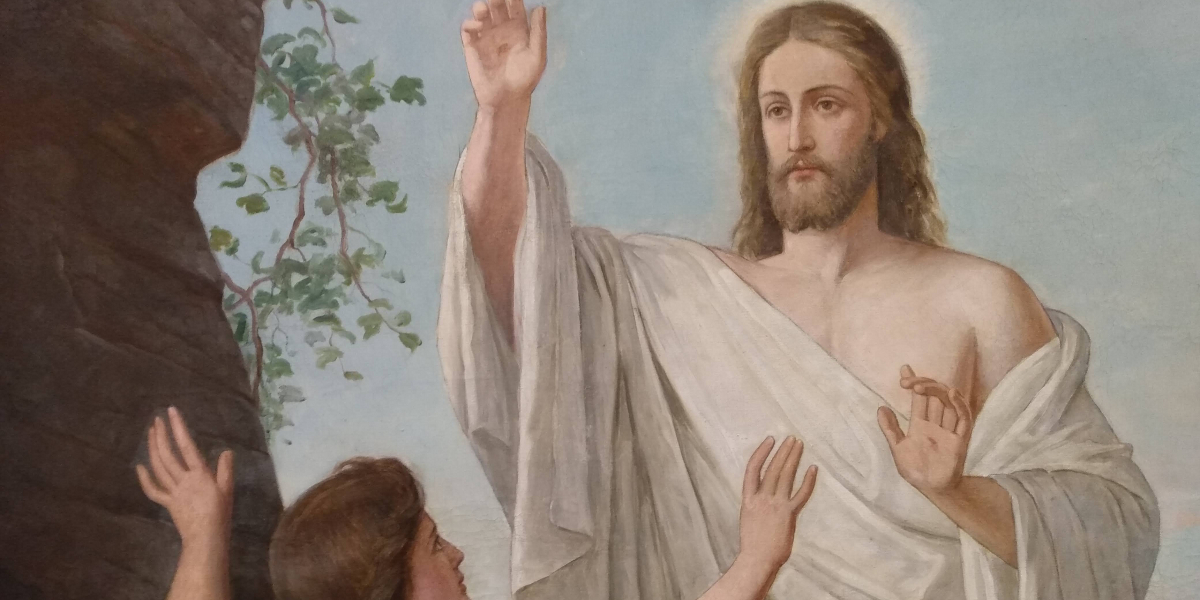
The Fourth Sunday of Easter – Pr. Faugstad sermon
Text: Judges 2:10-23
In Christ Jesus, whom God the Father sent to save us from all the enemies who tempted and afflicted us, dear fellow redeemed:
I have had the experience multiple times that I am talking with strangers, and they find out I am a pastor, or I ask them if they ever go to church. And they respond with something like, “Fire would probably drop out of the sky on me if I tried to walk into a church.” Or, “If they knew the things I have done, no one would want me there.” Or, “It’s too late for me.” Their underlying assumption is that they have been too bad or sinned too much to be forgiven.
This is a good opportunity to assure them that “the blood of Jesus [God’s] Son cleanses us from all sin (1Jo. 1:7), even the sins we think are unforgiveable. The very fact that a Christian is having a conversation like this with a non-Christian shows that God is a gracious God who wants all sinners to come to repentance and faith. But we Christians who know this also wonder sometimes if we have sinned too much to be forgiven. We ask ourselves, “If I were in God’s place, would I still be patient with me? Would I still love me?” We wonder how it will go for us when we finally do “meet our Maker.”
Today’s reading gives us a good picture of who that Maker is and how He operates. What we have in Judges 2 is a summary of what the rest of the book is about. It gives the pattern of the Israelites being tempted toward the gods of the Canaanites and worshipping these false gods. Then the LORD allowed their enemies to oppress them. Then the people cried out for deliverance. Then the LORD in His mercy sent judges to save them. This happened again and again.
What was so appealing about the gods of the Canaanites? Our reading states that the Israelites “abandoned the LORD and served the Baals and the Ashtaroth.” The Canaanites believed that the god Baal brought the rain that caused all life to spring forth. Asherah was a female goddess associated with fertility. The pagan people worshipped Baal and Asherah by engaging in sexual intercourse on hills and other high places, so these make-believe gods would be pleased and would bring fruitfulness to the land.
The Israelites looked at their own religion of strict moral law and of restraining their sinful inclinations, and it didn’t seem nearly as exciting and fulfilling as the religion of the Canaanites. So as today’s reading says, “they whored after other gods.” They rejected the true God, the God who loved them. The same thing happens today. We teach the holy Commandments of God which were given for our protection and blessing and also as a check on our sinful nature. But many reject His Commandments because they want to live their own way, walk their own path, answer to no one but themselves.
That approach to life does sound appealing. But what has this self-centered attitude done to our culture and our communities? It has caused many to walk away from marriage and having children. When there are children, many of them grow up in broken homes. People are lonely, even as there are supposedly more and more ways to “stay connected.” Many wonder what the purpose of life is, and they try to fill the emptiness with possessions, entertainment, and pleasure.
When this happens among the baptized, those whom God in His mercy has brought out of darkness into His marvelous light, whom He has claimed as His own and covered in His righteousness—when this happens to us His people, He may try to wake us up like He did the Israelites. Our reading says, “He gave them over to plunderers, who plundered them. And He sold them into the hand of their surrounding enemies…. [T]he hand of the LORD was against them for harm, as the LORD had warned…. And they were in terrible distress.”
A wake up call is not always pleasant. I imagine you have had a number of these as I have. You had to learn the hard way that you were neglecting your spouse, neglecting your family, neglecting your health. Your priorities were out of whack. Your Bible and devotion books were collecting dust. You felt stuck and unsettled. And somehow the Lord exposed your selfishness, or your pride, or your dishonesty, or your stubbornness.
Maybe it was through a sermon or through a conversation with a friend. Maybe it was because someone called you out, or you came to the realization by your own reflection. It hurts to go through this. It hurts to admit you were wrong, that you haven’t made good decisions, that you are not as right as you want to think. But that very recognition of your own weakness and failure, that is a gift from God. It shows He has not left you or rejected you. Once He has broken down your sinful works, He can build something better in you and with you.
This is why He sends crosses and trials; He does it to refine and strengthen our faith. It is too easy to take our prosperity and success for granted like the Israelites did, and to ignore the Word of God like they did. So God uses the troubles we experience to lead us to repentance, to an honest assessment of ourselves. And He uses our troubles to draw us closer to Him. He is not a “three strikes and you’re out” God, a God whose anger against our sin just keeps building and building until His wrath explodes against us.
Certainly His anger is kindled by continuous sinning, like it was toward the Israelites. But the afflictions He sent their way were done out of love. He did not want to lose them forever. He was ready to have mercy on them and eager to forgive them. Today’s reading says, “For the LORD was moved to pity by their groaning because of those who afflicted and oppressed them.” He wanted to save them. He wanted them to have relief from their troubles and to know that He, the only true God, was their God.
The Lord was patient with them. None of us would have been as patient with the Israelites as He was toward them. He had brought them out of slavery in Egypt, led them to the Promised Land, given them victory over their enemies, and handed them a beautiful place to live. They repaid Him by worshipping the false gods of the peoples they had defeated. Still, the LORD called them back. Still, He rescued them. Still, He blessed them.
The Lord Is just as Patient with You. He brought you out of the slavery of sin at your Baptism, taught you His unchanging truth throughout your years, absolved you of your sins week after week, and regularly called you to His holy Supper where He gives His own body and blood for your spiritual and eternal good. How have you thanked Him for these gifts? How have your words and actions in your day-to-day life shown your appreciation for what He has done?
When we reflect on this, we see that we are no more deserving of His grace than the Israelites were, but He gives it to us just as He gave it to them. When all we had done was sin, God the Father sent His holy Son to take our place. He sent His Son to be born of Mary, who descended from the same wayward Israelites we are hearing about today. Despite their tremendous sins against Him, God kept His promise to send a Savior and carried it out through them. Though they were faithless, He remained faithful; He could not deny Himself (2Ti. 2:13).
He is also faithful toward you. 2 Peter 3:9 says, “The Lord is not slow to fulfill his promise as some count slowness, but is patient toward you, not wishing that any should perish, but that all should reach repentance.” He wants you every day to repent of your sin and trust His promises. He wants you to rely on Him in times of trouble and triumph, sadness and joy, in good days and bad. The love He has for you is not some weak connection that could easily break and separate you from Him. He loves you with a strong love, a love so strong that He sacrificed His only Son for your salvation.
His Son had the same love for you. He willingly accepted your hurtful words and selfish actions. He paid the penalty for your dishonesty and pride. He suffered for your sinful stubbornness. He died for you, so that you would not be overcome by your spiritual enemies but would rest securely in His grace. His death on the cross for all sin means you have not sinned too much to be forgiven. The fact that you are sitting here today listening to His Word shows that He is merciful to you and wants you to know His love for you.
In His love, He promises to turn your times of suffering and trial into good. It is always tempting to dwell on the suffering, but it is better to cling to our Lord’s promise, the promise He spoke to His disciples in the Holy Gospel. Jesus said to them and us, “So also you have sorrow now, but I will see you again, and your hearts will rejoice, and no one will take your joy from you.” (Joh. 16:22).
The Lord, who died and rose again in victory, is with you each step of the way, ever-patient, always gracious, bearing your griefs and carrying your sorrows. He brings you comfort and joy as He meets you in His powerful Word and Sacraments. And He prepares you to greet Him when He returns on the last day to give you eternal salvation. On that day, you will praise Him for His patience with you, and your heart will be filled with a heavenly joy that no sadness or trouble will ever take away.
Glory be to the Father and to the Son and to the Holy Ghost; as it was in the beginning, is now, and ever shall be, forevermore. Amen.
+ + +
(picture from Jerico Lutheran Church altar painting)

The Third Sunday of Easter – Pr. Faugstad sermon
Text: Joshua 21:41-45
In Christ Jesus, who promises rest to His sheep who “labor and are heavy laden” with their sins and with the troubles of the world (Mat. 11:28), dear fellow redeemed:
Have you ever been perfectly happy? Have you been so relaxed, that you felt like you had no care in the world? Has it seemed like everything in life was going your way? Often these thoughts come to mind when you are looking back and remembering, when you say, “I didn’t know how good I had it.” Or perhaps you are constantly hoping for that experience, for that time in the future when you can say, “I finally made it; I reached my goal; now I can be happy.”
A wise pastor said that we almost always miss the experience or feeling we are aiming for. So if we aim for happiness, we never seem to have it. If we aim for contentment or success or fulfillment, they always seem just out of reach. But if we aim for service and love toward others, for hard work, or for any other noble pursuit, we often find happiness, contentment, success.
So it was for the people of Israel. It wasn’t sufficient to aim for happiness and prosperity in the Promised Land. They thought they could achieve that through their strength, their plan, their work. They should have focused on the promises of God and trusted His Word, and they would have received the happiness and prosperity they wanted. But most of the Israelites whom the LORD brought out of Egypt did not enter the Promised Land. They did not trust the LORD. Because of their unbelief, they had to wander in the wilderness for forty years, and they died in the wilderness.
They never reached the Promised Land, but their children did. Their children trusted the promises of God. We heard on Easter how they entered the land of Canaan through the Jordan River, when God stopped the water from flowing so they could cross on dry ground. Last week, we heard how He delivered the stronghold of Jericho into their hands by making its walls come tumbling down. After Jericho fell, the book of Joshua details victory after victory over their enemies until we get to the point of today’s reading.
Now the people had rest from their wandering and their fighting, “rest on every side.” Now each tribe of the sons of Israel received cities and lands in Canaan. The descendants of Levi received very little land because the LORD wanted them to live in the territories of the other tribes. The Levites provided instruction from the Scriptures and spiritual care, and their needs were supported by the people they served—much like it works with pastors today. Throughout the land of Canaan, the Levites were provided forty-eight cities with pasturelands to keep animals for sacrifice.
Many times before the Israelites reached Canaan, they heard it described as “a land flowing with milk and honey.” It was a beautiful land. It had everything the Israelites needed. They were able to settle so quickly because God gave them victory over all their enemies. The Israelites took over the cities, homes, vineyards, and fields. It was all theirs! “And the LORD gave them rest on every side just as He had sworn to their fathers…. Not one word of all the good promises that the LORD had made to the house of Israel had failed; all came to pass.”
That sounds like the last words of a happy book or the last scene of a feel-good movie. The Israelites had to go through a lot of trials and suffering, but here they were. Everything had worked out well in the end. It would be nice if we could visit this land today and find it just as it is described in Joshua 21, to find “a land flowing with milk and honey,” to find everyone living in prosperity and peace—a people dedicated to the LORD.
But you already know that isn’t how the story played out. Shortly before he died at age 110, Joshua urged the people, “be very strong to keep and to do all that is written in the Book of the Law of Moses, turning aside from it neither to the right hand nor to the left, that you may not mix with these nations remaining among you or make mention of the names of their gods or swear by them or serve them or bow down to them, but you shall cling to the LORD your God just as you have done to this day” (Jos. 23:6-8).
The generation after Joshua’s remained faithful; they knew what God had done for them. But the next generation took this all for granted. They only knew the prosperity and peace, and it spoiled them. They imagined they would always have it. The days of slavery were in the distant past, they thought. Now they were a force to be reckoned with. They forgot the source of their peace, the reason they had “rest on every side.” And they lost it all.
This is very instructive for us who also enjoy many good things. The standard of living that we have is higher than most places in the world. We have plenty to eat and places to live. We enjoy relative safety with no imminent threats to our daily existence. Our country could be described as “a land flowing with milk and honey.” But do the people of our land give glory to God for these tremendous gifts? Do we give glory to God for these tremendous gifts?
The Israelites didn’t seem to recognize that as they had received the homes of others by the grace of God, so He could turn their homes over to others as He saw fit. Their beautiful land was only theirs because God handed it to them. Our reading states it very clearly: “[T]he LORD gave to Israel all the land…. [T]he LORD gave them rest on every side…. [T]he LORD had given all their enemies into their hands.” The LORD had done it all, and He had done it all for them.
When the Israelites forgot about this or ignored it, then He had to remind them what was most important. It wasn’t their homes, their vineyards, or their success against their enemies. For their own good, He took these things away from them, so they would remember, so they would seek His mercy, so they would trust His Word. Nothing was more important than calling His sheep back to the green pastures and still waters of His promises.
Our Lord also calls us back to His holy Word when we have drifted toward the ways of the world. He can see when our eyes are drawn to what appear to be greener pastures, but are actually dangerous places that are not safe for us. Joshua warned the Israelites about mixing with the unbelieving nations around them, people who would tempt them to serve their gods.
We are tempted in the same way to adopt the thinking and practices of unbelievers around us, to think the way the world thinks about relationships and money and priorities, so that God’s Word no longer has a place in our lives. But when the worldly things we have come to trust slip through our fingers or are taken from us, what will we have left?
If we aim at the appealing things of the world, we will find neither peace nor rest. Just ask anyone who has won big in the lottery if their life has improved since winning. Their possessions increased exponentially but so did their problems. But if we aim at God’s holy promises, at His unchanging Word, we find both peace and rest—and not just for this life but for the life to come.
Hebrews 4 is all about this heavenly rest of God. This rest comes to those who believe His promises. It is our Sabbath rest, a rest that results from God’s work and not man’s work. We have to do just as much work to obtain salvation and eternal life as God the Father did on day seven of Creation week, or that Jesus did in the tomb on the day after His atoning death. The Sabbath rest we enter by faith is a gift from Him.
It is a rest from our sin because God the Father took our sins off us and placed them on His Son who suffered and died for them all. It is a rest from our sorrows and troubles because our Lord promises to carry us through the difficulties of this life and strengthen us to endure. It is a rest from the devil’s afflictions since his head was crushed by our Savior. It is a rest from the fear of death since we know that death is our entrance to the green pasturelands of heaven.
This Sabbath rest of God fills your ears and mind and heart every time you listen to His Word and partake of His Sacraments. Here our Good Shepherd comes to tend His sheep. He knows His sheep. He recognizes our weaknesses, He sees our invisible burdens, He knows our deepest cares. He tends personally to each of His little lambs as only the perfect Good Shepherd can do. Everything you need, even if you were not aware you needed it before hearing His Word, is richly supplied by Him.
Through His Word, God gives you His kingdom. It is a glorious kingdom, flowing with spiritual milk and honey—with forgiveness, righteousness, and life. Your worldly wanderings in the past are forgiven and forgotten by Him. The Lord invites you to remain with Him where you have Rest on Every Side, where your enemies cannot harm you, where you shall want for no good thing, where He restores your soul. And when He takes you to the Promised Land above, you will join all His sheep in praising Him and saying, “Not one word of all the good promises that the LORD made to us has failed; all came to pass.”
Glory be to the Father and to the Son and to the Holy Ghost; as it was in the beginning, is now, and ever shall be, forevermore. Amen.
+ + +
(picture of the Judean mountains in Israel)

The Second Sunday of Easter – Pr. Faugstad sermon
Text: Joshua 5:13-6:6
In Christ Jesus, who waits for just the right time to give just the right blessings, dear fellow redeemed:
The Lord’s apostle Thomas had a tough week. Mary Magdalene and the other women said, “We have seen the Lord!” The two Emmaus disciples said, “We have seen the Lord!” His fellow chosen disciples said, “We have seen the Lord!” Why did Thomas seem to be the only one who hadn’t seen the Lord that Easter Sunday? Why would Jesus leave him out? He couldn’t bear the thought; they must be mistaken.
So all week long, no matter who talked to him, and no matter what evidence they offered of Jesus’ resurrection, Thomas defiantly replied, “Unless I see in his hands the mark of the nails, and place my finger into the mark of the nails, and place my hand into his side, I will never believe” (Joh. 20:25). But did he also have some doubts about his firm position? As each day passed without the Lord appearing, did he wonder, “O Lord, what are You waiting for?” Or did the passing of each day without the Lord’s appearance make him more firm in his denials?
He asked for proof, real tangible evidence. He wanted to see it, or he said he would never believe it. This showed a misunderstanding of what it means to “believe.” It is not a decision that a person makes when the evidence is convincing enough. It is not a scientific process of gathering facts until there is no possible conclusion but one. To “believe” is to trust that something is so, or that something will be, even when there is no tangible evidence or logical basis to support it.
The Israelites were operating by faith as they marched around the walls of Jericho. They trusted that the LORD would give them the victory He promised. But we could understand if their faith wavered a bit. Like Thomas who had to wait a week before Jesus revealed Himself to him, the Israelites had to wait a week before the LORD delivered Jericho into their hands.
Each day for six days, they were directed to march one time all the way around the city. The only sound to be made was seven priests blowing seven rams’ horns. The men of war were to march in silence. As each day passed with nothing happening, did those Israelites wonder within themselves, “What are You waiting for?” What if nothing happened at all? They would be the laughing-stock of all the land of Canaan if they marched around a city for a week and nothing happened. Possibly while they marched they could hear the inhabitants of Jericho yelling down at them, taunting them, ridiculing them.
But as strange as it seemed to do what God said, they held onto His promise. They followed the LORD’s instructions. For six days, they marched around once, and on the seventh day, they marched around the city seven times in the same manner as before. Then the seven priests blew their trumpets. On their cue, the men of war sent up a great shout, and the walls of Jericho dropped straight down just like a skyscraper that is imploded.
The Israelites’ seven-day wait was rewarded with a complete victory over the city and its inhabitants. Their faith in the LORD’s promise was confirmed. The wait was definitely worth it. Because the LORD made them wait and made the walls of Jericho fall without anything touching them, the Israelites saw more clearly that the victory was the LORD’s.
The “sevens” in the account emphasize this. The number seven in the Bible is closely tied to God, so it represents His holiness or perfection. He directed seven priests to march for seven days carrying seven horns, with seven trips around the city on the seventh day. This was the work of the holy LORD; this was His doing out of love for His people.
The same holy LORD still works on your behalf, to give you blessings. But when you have to do something you don’t want to do, or when relief is taking longer than you want, it is easy to ask Him, “What are You waiting for?” You may have asked that when you were sick and didn’t seem to be getting better. You may have asked that when you were being mistreated by a classmate or co-worker or member of the community. You may have asked that when a close relationship was strained, when great troubles loomed in your future, when the questions kept piling up but no answers—“What Are You Waiting For?”
It is natural to ask this. We even have examples of wording like this in the Psalms of lament. But the psalmists don’t stop with that question. They go on to express their confidence that the LORD will act, that He will deliver them at the right time. We need to remember who is calling the shots, who has the Master plan. This is brought home to us by the first part of today’s reading, when Joshua comes face to face with a mysterious Man of war. Joshua asked Him, “Are You for us, or for our adversaries?” It’s a simple choice. We think the answer will be “I am for you.” But instead the Man replied, “No; but I am the commander of the army of the LORD. Now I have come.”
God is not interested in taking the side of sinners, as though He is just another weapon in our arsenal. He wants us to take His side, to put our trust in Him. This is instructive for when we wonder if we should pray for our favorite sports team, as though God is a fan like we are, or that our team is more righteous than another. God is above all this. He doesn’t want us to be so focused on sides in this life. He wants us to stay focused on His Word.
This is the crucial step when we ask Him, “What are You waiting for?” Instead of just staring up in the sky and waiting for something to happen, the LORD wants us to hear His holy Word. He wants us to review His promises, take them to heart, understand anew His love for us. He wants us to believe that He sent His only-begotten Son to take on flesh for us. He wants us to believe that Jesus satisfied the requirements of God’s holy Law in our place and died to make satisfaction for all our sin. He wants us to believe that Jesus rose on the third day in victory over death just as He said He would.
This was Thomas’ failing. He might have thought that His friends were playing a cruel trick on him, but he should not have rejected Jesus’ clear word. Before His death, Jesus told all twelve of the disciples, “See, we are going up to Jerusalem. And the Son of Man will be delivered over to the chief priests and scribes, and they will condemn him to death and deliver him over to the Gentiles to be mocked and flogged and crucified, and he will be raised on the third day” (Mat. 20:18-19). Thomas heard those words, but like his fellow disciples, he did not believe them.
They did not believe until they saw Jesus, until they had tangible proof. And Jesus said to them, “Blessed are those who have not seen and yet have believed” (Joh. 20:29). Sometimes Christians will ask God for some special sign of His love, some evidence that will show them He is really present, that He really cares. And the LORD says to us, “Blessed are those who have not seen and yet have believed.”
He calls you to trust His love even when it seems like He is angry with you, to rely on Him even when there appears to be no end to your troubles, to follow His Word even when you can’t see a “light at the end of the tunnel.” Because He is only waiting for the right time. He will not forget about you. Everything He does is for your good.
Day seven was the right time for the walls of Jericho to come crashing down just as the LORD promised they would. Seven days was the right time to hide Himself from Thomas, so Thomas would learn to trust Jesus’ Word and not his own reason. And however long you must wait for relief or help or deliverance is the right amount of time. Whatever you go through, Jesus is with you. Did you notice how He repeated Thomas’ words showing that He had seen all and heard all? Thomas didn’t know it, but Jesus was with Him the whole time.
And so He is with you always, even to the end of your life, even to the end of the age (Mat. 28:20). He is with you “where two or three are gathered in [His] name” (Mat. 18:20). He is with you when He brings forgiveness right to your heart in the absolution. He is with you when you come forward to His holy table. These are the means of His grace by which He makes the walls of your sin and doubt come crashing down. This is where He gives you strength for today and for tomorrow. This is where He turns your desire for proof of His love into the assurance that He loves you with a perfect love.
This is where He changes your impatient, “What are You waiting for?” into a faithful and eager waiting for His grace. We join the psalmist in this faithful waiting and say, “I wait for the LORD, my soul waits, And in His word I do hope. My soul waits for the Lord More than those who watch for the morning—Yes, more than those who watch for the morning. O Israel, hope in the LORD; For with the LORD there is mercy, And with Him is abundant redemption” (Psa. 130:5-7, NKJV).
Glory be to the Father and to the Son and to the Holy Ghost; as it was in the beginning, is now, and ever shall be, forevermore. Amen.
+ + +
(woodcut from “Doubting Thomas” by Julius Schnorr von Carolsfeld, 1794-1872)

The Festival of the Resurrection of Our Lord – Pr. Faugstad exordium & sermon
Festival exordium:
It feels like Easter. Green grass is popping up everywhere, trees are budding, the temperature is going up, and April showers are in the forecast. But perhaps the most recognizable sign that Easter is here is the lilies. They are often the first flowers to show up in the spring. Even after the lifeless brown of fall and the biting cold of winter, new life has sprouted again.
That is why lilies are a symbol for Jesus’ resurrection. Adam and Eve brought sin and death to God’s perfect creation. Now the ground produced thorns and thistles. Now there was pain and suffering. But God planted hope in their hearts. He would send a Savior to redeem them. He would bring life to the world of death.
Everything looked so dark on Friday. Jesus struggled to breathe on the cross while His enemies mocked Him. Then He gave one last cry, and He was gone. They laid His body in a tomb and sealed it shut. His disciples despaired. They went into hiding.
But then on Sunday morning new life sprang forth. An angel rolled the stone away from the tomb and declared, “He is not here, for he has risen, as he said” (Mat. 28:6). Then Jesus began to show Himself: to the women, to two disciples on the road to Emmaus, to Peter, to ten of the disciples gathered together. He was not dead, and He was no ghost. He had risen indeed!
St. Paul called Him “the firstfruits of those who have fallen asleep” (1Co. 15:20). He was the first to rise bodily from the dead, the first flower of a New Spring. This is why we plant flowers on graves. Just as the flowers come forth and flourish, so will the bodies of all the faithful when Jesus returns on the last day with a shout and “with the sound of the trumpet of God” (1Th. 4:16).
The trumpet-shaped lilies anticipate His coming. Our cemeteries might look lifeless and bleak now, but they will fill with new life when our Lord Jesus comes in His glory. The winter is past. Death is dead. Spring breaks forth. And together with all who live in Him, we join our voices in saying: “Christ is risen! He is risen indeed! Alleluia!”
Let us sing our festival hymn #348, “He Is Arisen! Glorious Word!”
He is arisen! Glorious Word!
Now reconciled is God, my Lord;
The gates of heaven are open.
My Jesus died triumphantly,
And Satan’s arrows broken lie,
Destroyed hell’s direst weapon.
O hear
What cheer!
Christ victorious
Riseth glorious,
Life He giveth—
He was dead, but see, He liveth!
+ + +
Sermon text: Joshua 3:5-17
In Christ Jesus, who is the Way, the Truth, and the Life (Joh. 14:6), dear fellow redeemed:
There aren’t many people who end up doing what they think they will as children. After all, there are only so many spots open for professional athletes, famous singers, or the President of the United States. Typically a person’s path through life is less definite than they think it will be as a child. We learn as we go that dreams often do not become reality. The person we thought was perfect for us turns out not to be. We move from job to job. Plans change. So the way our life plays out is not so much a “point A to point B,” but a zig-zagging, forward and backward, wandering around sort of path that leads to a different point than we ever imagined.
When the Israelite people left Egypt, they expected to journey to the land of Canaan which the LORD had promised to give them. But they didn’t march straight east and then north right into the land. God led them into the wilderness, through the Red Sea, and to Mount Sinai to receive His Law. Finally He brought them to the Promised Land, where spies were sent to survey the land. But the spies brought back a bad report. “[T]he cities are fortified and very large,” they said. “The people are too strong. They are like giants, and we seemed like grasshoppers in comparison. We could never defeat them” (Num. 13:28,31-32).
Because they did not trust the LORD, He told them they would wander for forty years in the wilderness, and everyone above the age of twenty with the exception of Joshua and Caleb would die in the wilderness (Num. 32:11-12). If you were five or ten years old when the LORD delivered this judgment, the next forty years would have seemed a long time. As you traveled around from one wilderness place to another, you couldn’t help but wonder, “Are we ever going to get somewhere?”
That question was answered in today’s account. The time had come for the people to cross over the Jordan River and enter the land of Canaan. But how would they get across? The Jordan River was estimated to be one hundred feet wide and up to ten feet deep. Besides that, it was springtime when snowmelt from a nearby mountain and new rainfall caused the river to overflow its banks. There was no way the great multitude of Israelites would be able to wade across.
Just before today’s reading, we are told that the Israelites camped near the Jordan for three days (Jos. 3:1-2). For three days, they looked at the churning waters in front of them. Perhaps they scouted up and down the river looking for a suitable place to cross. There was none. Their eyes were also drawn past the waters to the lush, green landscape of Canaan. How good it would be to get there! That’s where they wanted to go! But when? How?
They had no answers. They could not accomplish it. They had to wait for the LORD to make a way. He brought them this far; He would have to bring them across. Through Joshua, the LORD told the people to consecrate themselves, to prepare in repentance for what He would do for them. Joshua told the priests to carry the ark of the covenant toward the river, and when their feet touched the water’s edge, the water from the north stopped flowing. It stood up in a heap like the waters of the Red Sea had done, so that all the people could cross over on dry ground. The impossible was made possible by the mighty LORD.
We have gathered to celebrate another impossible event today, the resurrection of Jesus from the dead. None of His disciples expected it to happen. As they waited those three days, they wept together and hid themselves in fear of what might happen to them. All they could see before them and behind them were dark, churning waters of trouble which threatened to engulf them at any moment. Where could they go? What would they do?
Then reports started to trickle in: “The stone was rolled away… the tomb was empty… angels spoke to us… we saw Jesus… He told us what we should do….” The impossible was made possible. Jesus rose from the dead, which means He was not just a man. He is true God who completed the work He came to do—redeem the whole world from sin and death by His death and resurrection. By the Sunday after Easter, He had shown Himself to His chosen disciples, and soon afterward, He appeared to more than five hundred of His followers at once (1Co. 15:6).
Then on the fortieth day after His resurrection, His disciples watched Him ascend into heaven, and angels appeared and said, “This Jesus… will come in the same way as you saw him go into heaven” (Act. 1:11). So there is a direct line between the resurrection of Jesus from the dead and His return on the last day to judge the living and the dead. Because He predicted His resurrection on the third day and then rose, it is just as certain that He will return visibly on the last day as He said He would. So if His resurrection is “point A,” and His return in glory is “point B,” then every day is another day down the line closer to His return.
But just as the Israelites wondered if they would ever get to the Promised Land as they wandered through the wilderness, so we wonder if we will ever reach the Promised Land of heaven. We haven’t seen heaven. All we know is the wilderness of this world. And often it seems to us that the sinful plans and pleasures of the moment are better than the promise of future blessings. Is the Promised Land really waiting at the end of the line? Is it really all it is made out to be?
So like the Israelites who had doubts about God’s care for them and His promises to them, we have doubts. Like the Israelites who grumbled and complained when they faced hardships, we grumble and complain. Like the Israelites who wanted to stop aiming for the Promised Land and instead return to Egypt, we are tempted to turn away from God’s promise, go along with the world, and pursue what is wrong.
But there is no life in going back to where we started or choosing a different path than God’s. Those paths are all dead ends. They all lead away from God and back into the slavery of sin. Only through Jesus can we see our way forward to blessings in this life and beyond. But how can we know we are walking on His path? How can we be certain that the way we are going is the way we are supposed to go?
Actually that responsibility does not rest with us, which is a good thing because we have a terrible sense of direction! If our reaching the Promised Land depended on our figuring out the way and on our strength to get there, we would never come close. The only way to get on that straight line stretching from Jesus’ resurrection to His return, is if He puts us on the line and keeps us on it.
It starts with Baptism. At your Baptism, Jesus joined Himself to you. He tied you to His burial and His resurrection, so that your sin was buried with Him and you now walk with Him “in newness of life” (Rom. 6:4). Baptism is the beginning of your journey to the Promised Land of heaven, just as the Israelites’ passing through the water of the Red Sea was the beginning of their journey to the Promised Land of Canaan.
Baptism gives you a clear future. It means that where Jesus is going, you are going—point A to point B. In your sin, you might deviate from that path—and sometimes significantly. But Jesus by His grace is constantly calling you back, constantly forgiving your sins, and guiding you in the right direction through His Word and Sacraments. He says, “If you abide in my word, you are truly my disciples, and you will know the truth, and the truth will set you free” (Joh. 8:31-32). And, “My sheep hear my voice, and I know them, and they follow me. I give them eternal life” (Joh. 10:27-28a).
By His holy Word, Jesus leads you through this life toward eternal life with Him. When you die, your immortal soul will leave your body and be carried to the Lord. Your body will be buried for a time. Then on the day of His return, the heaven you have strained to see over the dark, churning waters of this life, will finally become clear. Jesus, your Joshua, will call you from the grave, clothe you in His glory, and lead you to a blessed place, a bright new beginning. He will bring you safely across the Jordan To the Promised Land.
Glory be to the Father and to the Son and to the Holy Ghost; as it was in the beginning, is now, and ever shall be, forevermore. Amen.
+ + +
(woodcut from “The Empty Tomb” by Julius Schnorr von Carolsfeld, 1794-1872)

The Festival of Our Lord’s Ascension – Vicar Lehne exordium & sermon
Festival exordium:
“It is finished.” These are the words that Jesus spoke on the cross after he had completed everything that was necessary to save us from our sins. But just because Jesus’ work to save us was finished didn’t mean that he was done with us. There is still so much that he does for us from the position of authority that he has in heaven. He ascended to the right hand of his Father in order to be our Prophet, High Priest, and King. As our Prophet, Jesus sends out believers to spread the good news about what he has done for us and works through the good news of Scripture to bring the unbelieving world to faith. As our High Priest, Jesus intercedes for us on our behalf to the Father. And as our King, Jesus rules over not just heaven, which is his kingdom of glory, and earth, which is his kingdom of power, but also over his Holy Church, which is his kingdom of grace.
This is what Jesus ascended on high to do for you. He was seated at the right hand of the Father in glory in order to share the finished work of redemption with you. He is not done with you. He continues to give you these gifts. As your Prophet, he tells you the good news that he has finished the work to save you. As your High Priest, he reminds the Father of his sacrifice that he made on your behalf, and the Father sees your sins no more. And as your King, he rules over all things for your good so that you can be safely led by him to heaven to be with him forever. For these wonderful gifts, we praise and glorify his name by rising to sing “O Wondrous Conqueror and Great,” as it is printed in your service folders.
O wondrous Conqueror and great,
Scorned by the world You did create,
Your work is all completed!
Your toilsome course is at an end;
You to the Father do ascend,
In royal glory seated,
Lowly,
Holy,
Now victorious,
High and glorious:
Earth and heaven
To Your rule, O Christ, are given.
+ + +
Sermon text: Acts 1:1-11
In Christ Jesus, who did not leave us but continues to be with us always, dear fellow redeemed:
The disciples didn’t want Jesus to leave them. They had spent three years of their lives following Jesus and getting to know him well. During that time, they heard his words and saw his miraculous power. Because of these things that they saw and heard, they were hoping that Jesus would use his power to establish a kingdom on earth. But then, Jesus “began to show his disciples that he must go to Jerusalem and suffer many things from the elders and chief priests and scribes, and be killed, and on the third day be raised” (Matthew 16:21). This was not what the disciples wanted. Peter even “took [Jesus] aside and began to rebuke him, saying, ‘Far be it from you, Lord! This shall never happen to you’” (Matthew 16:22). But, even though it wasn’t what the disciples wanted, Jesus did suffer and die, just as he said he would, and his disciples were left alone and afraid.
Thankfully, that wasn’t the end. Jesus had also told his disciples that he would rise again on the third day, and that’s just what he did. When the disciples heard that he had risen, they didn’t believe it at first, but when Jesus appeared before them, they could no longer deny it. Jesus had risen, just as he said! He hadn’t left them after all. Now, the disciples were sure that Jesus would establish a kingdom on earth, and they would get to be with him as he ruled. But that’s not what happened. Instead, Jesus told them to “[g]o into all the world and proclaim the gospel to the whole creation” (Mark 16:15). As they did, they were to baptize all nations “in the name of the Father and of the Son and of the Holy Spirit [and teach] them to observe all that [Jesus had] commanded [them]” (Matthew 28:19–20). Then, after telling them this, Jesus was taken up into the sky before their very eyes, until he was hidden from their sight by a cloud. Jesus had just told his disciples, “I am with you always, to the end of the age” (Matthew 28:20), but now, the disciples appeared to be alone once again, this time for good.
Do we ever feel like Jesus has left us? While we would certainly love to say that we’ve never felt this way, all we have to do is look at the sinful world around us, and it becomes extremely difficult not to feel alone. Sinful lifestyles that we know are wrong are regularly practiced and encouraged by those around us. Even though the world claims to be a tolerant one, it seems to be tolerant of everything except Christianity, making it harder and harder for us to live as Christians. Like the disciples, we want Jesus to be visible and establish a kingdom on earth that is free from trouble, but we look around for him and can’t seem to find him anywhere. During times like these, it can be very easy for us to say, “Jesus, where are you? Why have you left us all alone?”
But Jesus has not left us all alone, just as he hadn’t left his disciples alone. As our gospel reading for today says, “[the disciples] went out and preached everywhere, while the Lord worked with them and confirmed the message by accompanying signs” (Mark 16:20). Jesus wasn’t visibly with his disciples, but he was still with them. He was with his disciples as they carried out the mission he had given them by preaching the Word and administering the Sacraments. In the same way, Jesus is with us as the Word is preached to us and the Sacraments are administered to us.
When Jesus’ Word is preached to you, or when you read his Word on your own, Jesus is present as he tells you everything that he did to save you from your sins. You were unable to follow God’s command to live a perfect life, but Jesus says through his Word, “I lived a perfect life for you, and that perfect life is now yours.” Your sins needed to be paid for with blood, and Jesus says through his Word, “My blood was shed on the cross for you. I have paid the price for your sins.” There are times when you may fear death, not wanting to leave your loved ones behind, but Jesus says through his Word, “I have risen from the dead, which means that you too will one day rise from the dead when I return in the same way that I was taken up into heaven.” You may wonder if the work to save you has truly been finished, but Jesus says through his Word, “My ascension into heaven is proof that everything that was necessary to save you was completed by me.”
How comforting it is to know that you can see Jesus whenever you want by simply opening up and reading your Bible. And because Jesus is present in his Word, that means that he is also present in the Sacraments, since they get their power from the Word. One of those Sacraments is baptism. When the water was applied in the name of the Father and of the Son and of the Holy Spirit at your baptism, all of your sins were washed away. At that moment, Jesus gave you the forgiveness of sins that he won for you by his death on the cross. He clothed you in the white garments of his perfect life, the perfect life that he lived for you. And he sent his Holy Spirit into your heart to create faith, a faith that trusts in him.
So, Jesus is with us in the preaching of his Word and in the waters of baptism, which are connected with his Word, even though we can’t see him, but he isn’t bodily present with us, right? After all, at his ascension, he was bodily taken up into heaven, which means that his body must be stuck in heaven. But this simply isn’t true. Jesus’s body and blood are present in the Sacrament of Holy Communion. Whenever we come to his table to receive the bread and the wine, which have been connected with his Word, we are receiving Jesus’ true body and blood. Even though we can’t see him, Jesus is with us in his meal to personally give us the forgiveness of sins that he won for us with the shedding of his blood.
You may not feel worthy of receiving the forgiveness of sins from Jesus in his supper. When you look at your sins, you are burdened with guilt. You don’t feel like Jesus is with you, and so, you think that he must have left you because your sins are too great to be forgiven. But Jesus didn’t come to save the worthy. He came to save the unworthy. He invites you to join him at his table so that he can freely offer you the forgiveness of sins. He freely forgives your sins not because you deserve it, but because he loves you. And you can leave his table knowing that the forgiveness that he just personally gave to you through his true body and blood was for you.
From his throne in heaven, our ascended Lord works through these means of grace, which he has promised to be present in, for our good, for the good of his church. This may not be how we expect Jesus to work things for our good. Like the disciples, who asked Jesus if he was going to restore the kingdom of Israel, we may want Jesus to give us a heaven on earth. But Jesus didn’t come to establish an earthly kingdom, nor does he rule over all things from his position of authority to make our lives a heaven on earth. He came to give us something far better: a perfect life of endless joy in heaven. The doors to heaven were opened to us when Jesus died on the cross, and then, he ascended into heaven after his resurrection to “prepare a place” for us (John 14:3). Until that time comes when Jesus returns “in the same way as [his disciples] saw him go into heaven” (verse 11), he comes to us in his means of grace, his Word and Sacraments, to prepare us for the day when we will leave this world and enter heaven to be with him forever. We are only strangers here. “Our citizenship is in heaven” (Philippians 3:20). And everything that our ascended Lord is doing for us here on earth is preparing us to come home to heaven.
When Jesus was taken up into heaven and hidden from the disciples, they were no longer able to see him. But that didn’t mean that Jesus had left them. He continued to be with them throughout the rest of their earthly lives, and when their time on earth was over, Jesus led them safely to his side in heaven. In the same way, even if you can’t see him or feel him, you know that Jesus is with you, because he gives you the same promise that he gave to his disciples “I am with you always, to the end of the age” (Matthew 28:20). He speaks to you through his Word. He washes you in the waters of baptism. And he personally feeds you at his supper. Your ascended Lord may not be present in the ways that you want him to be, but he is present in the ways that he promised to be and in the ways that you need him to be. Jesus hasn’t left you. He is with you always and will continue to be with you throughout your life, until he takes you up into heaven to be with him forever.
Glory be to the Father and to the Son and to the Holy Ghost; as it was in the beginning, is now, and ever shall be, forevermore. Amen.
+ + +
(picture from painting by John Singleton Copley, 1775)

The Sixth Sunday of Easter – Pr. Faugstad sermon
Text: James 1:22-29
In Christ Jesus, who did every good thing that His Father gave Him to do, so that we sinners would be covered in His righteousness, dear fellow redeemed:
The employee worked hard. He went above and beyond what was asked of him. He never took company things for his personal use. But he still got passed over for promotions in favor of co-workers who were less dedicated and less honest. Why should he work hard if no one notices?
The mother finds time in her busy schedule to put a meal together for her family, and all they can do is complain about what she made. How can they be so ungrateful?
The student tries to be friendly and helpful to her classmates, but they hardly acknowledge that she exists. Why should she be nice when no one seems to care?
We can relate to these situations or ones like them. Each of us has had the experience of doing good things for others, and then either having them not notice or having them criticize our efforts. That hurts! It makes us question whether it might have been better not to try at all. Or it makes us regret that we tried, along with the resolve not to try again in the future. In other words, “Fool me once, shame on you; fool me twice, shame on me.”
But there’s a problem with this approach: It makes our doing of good contingent on receiving something in return. Then it’s fair to ask how good our good deed is, if there is really a selfish aim behind it. But how else are we supposed to operate? Who is able to keep doing good when the opposite is thrown back at them? If our good deeds never result in being promoted or thanked or treated with kindness and respect, then why should we try? Then What’s the Point of Doing Good?
We receive an answer to that question in today’s reading. Just before our text, James writes about the salvation we receive through the Word of God. We heard these words last week: “receive with meekness the implanted word, which is able to save your souls” (v. 21). By calling it “the implanted word,” James indicates that God’s Word should grow in us, and that it should produce fruits in us and through us.
This is why he goes on to say that we should “be doers of the word, and not hearers only.” Notice that he does not say that doing is more important than hearing. In fact, one follows from the other. We are not ready to do until we have heard. Our faith and our salvation come from hearing, not from doing. This is what Romans 10 and Ephesians 2 teach, “So faith comes from hearing, and hearing through the word of Christ” (v. 7). And, “by grace you have been saved through faith. And this is not your own doing; it is the gift of God, not a result of works, so that no one may boast” (vv. 8-9).
The great error of the Roman Church that Martin Luther called out at the time of the Reformation was the idea that a sinner’s salvation comes from a mixture of his faith and his good works. That is wrong for two reasons: 1) It takes the glory away from Christ who perfectly kept the Law for us and gave up His life to redeem our souls, and 2) it leads us either to pride in our works or to despair because of our failures.
The Bible teaches that salvation was won for us 100% by Jesus and is gifted to us by the work of the Holy Spirit. That is why we can be completely confident of our salvation. It was accomplished for us by Him. It happened outside of us, not inside us—apart from us, not with our assistance. God the Father declares us forgiven, redeemed, saved because of the perfect life, death, and resurrection of His Son Jesus.
This good news, this gracious reality imparted to us—it changes us. It changes our heart, our mind, our purpose, our plans. It changes the way we look at ourselves and at one another. This change is what James describes in his epistle. If we have rightly heard, he says, and faith has been worked in our hearts, then we will certainly do. We will reflect the love we have received from God out toward the people around us.
This love will make us stand out in a world that is so filled with hatred and self-righteousness. The Christian Church throughout history has always been known for its love. Christians have started countless hospitals, orphanages, care centers, soup kitchens, and food pantries around the world to help the poor, helpless, and lonely. Christians defend and care for those whom others cast aside, such as the crippled, the sick, the elderly, and the unwanted.
This is how James describes “pure and undefiled [religion] before God,” to care for those who are most in need, such as “orphans and widows in their affliction.” Then he adds that such pure religion is also, “to keep oneself unstained from the world.” Christians are in the world, but they are not of it. They have a special purpose, a special calling from God. They are set apart for holy things and holy works, even as they live in an unholy world.
But there is a problem: Christians are not perfect either. Often we, too, think selfishly about things. We focus on what others should be doing for us, instead of what we should do for them. Or we keep our faith so well disguised around our friends and co-workers, that they would never guess we believe in Jesus as our Savior. This is hypocrisy, which is one of the sins that James identifies in today’s reading.
It is hypocrisy when we say we believe what God says, but then we act or speak in ways that are contradictory to our beliefs. We have all in our own way played this game. We have been on good behavior around fellow believers but behaved just like our unbelieving acquaintances in other settings. Or we willingly compromised the truth when it seemed advantageous to do so.
In these ways, we don’t look much like the new creation we are through our Baptism into Christ. We don’t look like those who have been transformed by the powerful working of the Holy Spirit through the Word. We don’t look like those who are bound for the kingdom of heaven with the saints and angels who stand in the holy presence of God.
When God looks at how little we have accomplished and how much we have failed, it seems fair that He should ask, “What’s the point?” “What’s the point of all that I do for them, providing for their needs every day, pouring out my blessings upon them? What’s the point of forgiving their sins, when they just sin more and more? What’s the point of doing good to them?”
But God does not ask these questions. He doesn’t ask them, because His love toward us is perfect. It never falters. It never runs out. He does not second-guess His commitment toward us. He loves, because He is love (1Jo. 4:16). He does good toward us, because He is good.
His love is what caused Him to send His only Son to save us. “For God so loved the world, that he gave his only-begotten Son, that whoever believes in him should not perish but have everlasting life” (Joh. 3:16). God did not send His Son in order to get something from us. He sent His Son in order to give grace to us, by fulfilling the law for us, dying for us, rising from the dead in victory for us.
Jesus perfectly carried out this work to save our souls. He did not make His good words and good efforts contingent on others doing good to Him. He kept doing good things, even when He was opposed, mocked, and finally crucified. Even when the nails were piercing His flesh, He prayed, “Father, forgive them, for they know not what they do” (Luk. 23:34).
Jesus’ perfect life of love is already counted as ours by faith. We have nothing to do to earn God’s favor or get ourselves to heaven. We get to work, we get to serve, we get to help, we get to pray for everyone in need as the special agents of God carrying out His mission in the world. “We love because he first loved us” (1Jo. 4:19).
Through the immeasurable love of God toward us, we learn how to love others. We learn that the hard work we put in (like the honest employee), the sacrifices we make (like the meal-making mother), and the kindness we show (like the helpful classmate), are not about what we can get or what we think we deserve. They are about what we can give in recognition of what God has given us. One of the best ways to give to others is to pray for them. This is how we bring their needs to God who promises always to answer our prayers in the way that is best.
God only does good toward us. There is no good apart from Him. We do good to others through our words and actions, because that is what He created and redeemed us for as His children. Since He never runs out of good, neither will we, because “every good gift” comes down to us “from the Father of lights” (Jam. 1:17). “Oh, give thanks unto the Lord, for He is good, for His mercy endures forever” (Psa. 106:1). Amen.
Glory be to the Father and to the Son and to the Holy Ghost; as it was in the beginning, is now, and ever shall be, forevermore. Amen.
+ + +
(picture from “Jesus and the Little Child” by James Tissot, 1836-1902)
The Fifth Sunday of Easter (Cantate) – Pr. Faugstad
A Study of the Parts of the Divine Service
The commentary below was given throughout the service. The attached recording is of the homily only.
The Divine Service is primarily God’s service to us. He imparts His holy gifts to us through His Word and Sacraments. These are the sacramental parts of the service—from God to us.
In thankfulness for these gifts, we also respond in service to Him through our faithful confession of His truth, our prayers, and our singing. These are the sacrificial parts of the service—from us to God.
The way to tell these apart is to watch which way the pastor is facing. If I am facing you, those are generally the sacramental parts of the service—from God to you. If I am facing the altar, those are generally the sacrificial parts of the service—from us to God.
I. The Service of Preparation
The Service of Preparation beginning on p. 41 is the part of the service that prepares us to hear God’s Word and receive Holy Communion.
We begin the service by returning in faith to our Baptism. We drown the old Adam in us with all its sins and evil desires as we humbly acknowledge our sins and confess them. Then we take hold again of the forgiveness and righteousness that is ours through faith in Jesus. We confess our sins to our heavenly Father, knowing that “he is faithful and just to forgive us our sins and to cleanse us from all unrighteousness” (1 John 1:9).
Then we sing the Kyrie Eleison, the “Lord, have mercy.” Traditionally this was not directly tied to the Confession of Sin, but was a general prayer for God’s grace and help for every part of our life.
Having confessed our sin, we now hear the absolution. This is not a wish for your forgiveness, and it does not come from any special power I have as your pastor. The power of absolution comes from Jesus, who breathed on His disciples and said to them, “Receive the Holy Spirit. If you forgive the sins of any, they are forgiven them; and if you retain the sins of any, they are retained” (John 20:22-23).
With our sins forgiven, we join the angels in their Christmas song, “Glory be to God in the highest,” praising God for the sending of His Son to save us.
Now we are almost ready to hear the lessons from God’s holy Word. But before we do, pastor and congregation remind each other in the Salutation of their callings in the Christian congregation.
Then on behalf of the congregation, the pastor “collects” their requests for the day in prayer to God.
Let us bow before the Lord and confess our sins….
II. The Service of the Word
Now we are prepared to hear the holy Word of God. The lessons build from the Old Testament prophecies about Jesus, to the apostles’ application of Jesus’ work in their epistles, to an account from the life of Jesus in one of the Holy Gospels. We rise for the reading of the Gospel in humble recognition of God sending His Son to save us sinners.
In the first half of the church year, we also sing a Psalm responsively in the service. The Book of Psalms is God’s own hymnbook. These Psalms have been sung for thousands of years. Since these Psalms are about the Triune God, the Christian Church concludes each Psalm by singing “Glory be to the Father and to the Son and to the Holy Ghost….”
After the lessons have been read, we confess our holy faith in the words of one of the three ecumenical creeds—the Apostles’ Creed when there is no Communion, the Nicene Creed when there is Communion, and the Athanasian Creed on special occasions. We speak back to God what He has taught us about Himself through His Word.
Then we sing the chief hymn. This hymn matches the theme of the day and is typically based on the Gospel reading. In today’s hymn by Martin Luther, you will hear a summary of the work of God’s Son to save us. We will sing the first half of the hymn before the sermon and the second half after the sermon. In the second half, you will see how Luther directly based his hymn verses on the Gospel reading for today.
The Old Testament Lesson for the Fifth Sunday of Easter…
Homily on James 1:16-21:
In Christ Jesus, the good and perfect Gift whom God the Father sent down from heaven to save our souls, dear fellow redeemed:
In our study of the Divine Service today, you can see that there is an order to the way the parts are put together. You also see how the Divine Service is saturated with God’s Word. That is just as it should be, since it is through the Word that God serves us with the forgiveness, righteousness, and life of Jesus.
In the sermon, we hear a specific passage of the Bible explained and applied by the pastor. This is an important moment in the Divine Service and an essential exercise of our faith. The sermon is the time when you, the parishioners, are the least active. You get to sit and listen, to receive what God wants to give you.
Our epistle lesson for today emphasizes the importance of listening: “let every person be quick to hear, slow to speak, slow to anger; for the anger of man does not produce the righteousness of God.” God wants us to be patient with one another and to care for each other. But we don’t do that perfectly.
We come to church with various burdens due to the sins we have committed. We come with various hurts inflicted on us by others. We come with heavy hearts of sorrow. God is not disappointed to see us come. He does not give His gifts to the people who have it all together, as though His gifts were a prize for our self-sufficiency or our self-righteousness.
We are not righteous before God by anything we do. He gives His gifts to us through the Word, because He loves to give us these gifts. James writes by inspiration, “Every good gift and every perfect gift is from above, coming down from the Father of lights.” That is what happens every Lord’s Day as we gather together. God the Father, “the Father of lights,” sends down His good and perfect gifts to us sinners.
These gifts are brought to us by the Holy Spirit. Jesus taught about the Spirit in today’s Gospel reading. Jesus said, “He will glorify Me, for He will take what is Mine and declare it to you. All that the Father has is Mine; therefore I said that He will take what is Mine and declare it to you” (Joh. 16:14-15). What Jesus has is righteousness, forgiveness, and life, which He obtained through His obedience to the Father. These are the gifts the Holy Spirit brings you right here, right now.
The Triune God is present here with us. How do you welcome His presence? Just as you got cleaned up on the outside to come to church, so you must also be cleaned on the inside. The epistle lesson says, “Therefore put away all filthiness and rampant wickedness.” This is not about empty actions. This is not about empty words. You can’t fool God. Putting away “all filthiness and rampant wickedness” means repenting of your sin from the heart and having the intent to change your sinful ways.
But you know that you do not have the power inside yourself to make these changes. This is why our reading continues, “and receive with meekness the implanted word, which is able to save your souls.” We are not saved by any strength or goodness that is naturally inside us. We are saved by Jesus’ work outside us, accomplished 2,000 years ago. That saving work is applied to us today by the external means of Word and Sacrament.
The Holy Spirit comes from outside us to inside us through these means—from the pages of the Bible to your eyes, from my mouth to your ears and into your heart. That is where God plants His Word; He plants it in the very center of you, in your heart, your mind, your soul. There His Word grows in you; it comforts you; it gives you strength.
The entire Divine Service is saturated with His Word, which means that you leave here with your faith well-watered and well-fed. You leave here with your sins forgiven, with Jesus’ righteousness covering you, and with His holy light shining in you for the benefit of others.
Glory be to the Father and to the Son and to the Holy Ghost; as it was in the beginning, is now, and ever shall be, forevermore. Amen.
+ + +
Our Lord urges us “that supplications, prayers, intercessions, and thanksgivings be made for all people, for kings and all who are in high positions, that we may lead a peaceful and quiet life, godly and dignified in every way” (1 Tim. 2:1-2). This is why we pray the Prayer of the Church on p. 48 for the needs of all people. We also add extra petitions to this prayer, special requests for our fellow believers.
III. The Service of Holy Communion
Having received God’s blessings through His Word, we now receive further blessings from Him through His Holy Supper. We don’t rush forward. We want to be properly prepared.
We sing back and forth in the Preface using words that can be traced to the Passover celebration. In the General Preface, we join with “angels and archangels and all the company of heaven” in honoring and praising our gracious God.
We sing the Sanctus with the angels of heaven, their never-ending song of praise to the Triune God, “Holy, holy, holy is the Lord of hosts; the whole earth is full of his glory!” (Isa. 6:3). This song in our liturgy is combined with the Benedictus, the “Blessed is He who comes in the name of the Lord. Hosanna in the highest!” This is the victory Psalm that the people of Israel sang to welcome Jesus on Palm Sunday, and it becomes our song as we welcome Jesus here in His Supper.
The Exhortation to the communicants is a more recent addition to our liturgy. It teaches us about what we receive in the Sacrament and prepares us to receive it with blessing.
Then we pray the prayer our Lord has taught us, a prayer with seven petitions. These requests are answered by the blessings Jesus imparts to us through His Supper.
Now our Lord’s own words are sung over the bread and wine. Through these Words of Institution, His body and blood are joined to the bread and wine for us Christians to eat and to drink for the remission of our sins.
We welcome Jesus’ presence with the words of John the Baptizer, “O Christ, the Lamb of God, You take away the sin of the world, have mercy on us” (Joh. 1:29). We sing this three times, ending the final line with “grant us Your peace.” That is exactly what Jesus is here to do, bring us the peace of His forgiveness and grace toward us.
After humbly receiving His body and blood with faith in His Word, we give thanks to Him with a hymn and a prayer.
Now we are well-fed with every good gift of God’s grace. The pastor speaks a final blessing, a Benediction that God told Aaron and the priests to speak. This three-fold blessing places God’s promise on you as you prepare to return to your homes and carry out your callings to the glory of His name.
We continue with the Service of Holy Communion, beginning on p. 50….
+ + +
(picture from stained glass by Gian Lorenzo Bernini, c. 1660)