

The Festival of the Resurrection of Our Lord – Pr. Faugstad exordium & sermon
Festival exordium:
Christ is risen! He is risen indeed! Alleluia! That was not the disciples’ reaction on Easter Sunday. “Christ is risen!” said the angel (Mar. 16:6). “Christ is risen!” said the women (Luk. 24:9). “Christ is risen!” said the Emmaus disciples (Mar. 16:13; Luk. 24:34). But this shocking message, this wonderful news, was met with questions and doubt. “Is Christ risen?” they wondered. “We won’t believe it until we see it with our own eyes.”
We know the truth that Jesus certainly died and certainly rose again on the third day. We know it, because the disciples did see Jesus after His resurrection, and they reported exactly what they saw and heard from Him. His resurrection is a fact. Christ is risen indeed!
But where our doubt comes in is here: “Is Christ risen for me? How can I be sure? How can I know that when I die, I will rise again? Or that my loved ones will rise again?” We can understand the disciples’ doubts—when had anyone ever risen from the dead? Our doubts seem reasonable too—when have we ever seen someone rise from the dead? But experience only goes so far.
The two disciples walking on the road to Emmaus on Easter afternoon were experiencing sadness. Jesus joined them on the road, but they didn’t know it was Him. They told Him everything they had witnessed and heard over the last few days, including the report of Jesus’ resurrection.
And Jesus said to them, “O foolish ones, and slow of heart to believe all that the prophets have spoken! Was it not necessary that the Christ should suffer these things and enter into his glory?” (Luk. 24:25-26). Then what did He do? “[B]eginning with Moses and all the Prophets, he interpreted to them in all the Scriptures the things concerning himself” (v. 27).
We may not have seen anyone rise from the dead. But we do have the Scriptures, God’s own Word. Jesus’ life and works match perfectly with all the Old Testament prophecies about the Messiah. And everything that He told His disciples would happen during Holy Week, including His resurrection on the third day, did happen exactly as He predicted.
So we do not need to doubt His promise to return on the last day to raise up the dead, or His promise that He has gone to prepare a place for all believers in heaven, or His promise to be present with us now through His Word and Sacraments to strengthen our faith. His resurrection verifies that what He promises, He does.
We rejoice in these promises by rising to sing hymn #348, “He Is Arisen! Glorious Word!”
He is arisen! Glorious Word!
Now reconciled is God, my Lord;
The gates of heaven are open.
My Jesus died triumphantly,
And Satan’s arrows broken lie,
Destroyed hell’s direst weapon.
O hear
What cheer!
Christ victorious
Riseth glorious,
Life He giveth—
He was dead, but see, He liveth!
+ + +
Sermon text: 1 Corinthians 5:6-8
In Christ Jesus, through whom you are a new creation, a new lump, filled no longer with the leaven of sin, but with the sincerity and truth that come from Him alone, dear fellow redeemed:
God sent nine terrible plagues on Egypt, but still Pharaoh would not let the enslaved people of Israel go into the wilderness to offer sacrifices to the LORD. God promised to send one more plague, after which Pharaoh would let the people go. In preparation for this plague, the LORD instructed each Israelite household to take a male lamb without blemish and kill it at twilight. Then they were to put the blood of the lamb on their doorposts and eat the flesh of the lamb roasted over fire.
They were also instructed to eat unleavened bread. All leaven had to be removed from their houses, and they would eat unleavened bread for seven days. The penalty for eating leavened bread during this time was severe. The LORD said, “if anyone eats what is leavened, from the first day until the seventh day, that person shall be cut off from Israel” (Exo. 12:15). He repeated the same warning a few verses later that anyone who disobeyed “will be cut off from the congregation of Israel” (v. 19).
In today’s Epistle lesson, the apostle Paul draws on this account of the Passover. He tells the Christian congregation in Corinth to “cleanse out the old leaven.” But he is not talking about their bread. He is talking about the congregation. The Christians there were puffed up. They were boasting, puffed up with pride, and they were not boasting about what their Savior Jesus had done for them. They were boasting about their open-mindedness and their willingness to tolerate what was clearly sinful. In this case, they were boasting about a clear violation of the Sixth Commandment—one of the members of the congregation living in open sin.
This is the kind of approach that is cheered by our culture today. The churches that are willing to compromise the Word of God, change their teachings with the times, and stop calling out sin are praised. These churches probably don’t say much about the Ten Commandments anymore, or they might explain them in such a way that no one in the congregation is really challenged or convicted by them. “Oh, the Ten Commandments are for the bad people,” they say, “and for the people who just want to judge others. But we are doing just fine.”
Paul writes, “Your boasting is not good. Do you not know that a little leaven leavens the whole lump?” Then he tells us what that leaven is, it is “the old leaven, the leaven of malice and evil.” It is the sin that characterized us before we became unleavened, before we were born again in Christ through Holy Baptism. It is the sin that Jesus died to free us from, we who were formerly enslaved to sin and death.
We are freed from this sin, because “Christ, our Passover Lamb, has been sacrificed.” Here, God’s stunning plan of salvation becomes clear, a plan that was illustrated by the Passover lamb. Right after Jesus’ public revealing as the Messiah at His Baptism, John pointed to Him and said, “Behold, the Lamb of God, who takes away the sin of the world!” (Joh. 1:29). He could take the world’s sin, because He had no sin of His own to carry. He was “a lamb without blemish or spot” (1Pe. 1:19).
The blood of this spotless Lamb was poured out for you on Good Friday just before the Passover was celebrated in Jerusalem. This holy blood cleanses you from all sin (1Jo. 1:7). We just sang a verse about this in Martin Luther’s great Easter hymn: “Here the true Paschal Lamb we see, / Whom God so freely gave us; / He died on the accursed tree— / So strong His love— to save us. / See, His blood doth mark our door [the door of our heart!]; / Faith points to it [to His blood], death passes o’er, / And Satan cannot harm us. / Alleluia!” (Evangelical Lutheran Hymnary #343, v. 5).
Jesus’ resurrection on the third day is the irrefutable proof that all sin was atoned for by His sacrifice. Now is the time to “celebrate the festival,” writes Paul. Now is the time to celebrate the Lamb’s victory. Now is the time to celebrate the forgiveness of sins. Now is the time to celebrate the eternal life that is ours because Jesus rose triumphant over death.
But how are we to “celebrate the festival”? Today’s reading says, “not with the old leaven, the leaven of malice and evil”—not by returning to the sin that Jesus has freed us from, not by confirming others in their sin and boasting about how charitable and accommodating we are of them. Remember that the Israelites were told to get rid of every trace of leaven from their homes. In the same way, we are called to get rid of every trace of sin in our own hearts and to recognize that our sins not only affect us—they affect the congregation to which we belong and the whole body of Christ. “A little leaven” in just one area of a batch of dough “leavens the whole lump.”
The way we “cleanse out the old leaven,” both individually and as a congregation is through repentance. We own up to our weaknesses. We admit our sinful actions, words, and thoughts that we have tried to justify or pass off as being “not so bad.” We even pry the lid off old sins that we have done our best to cover up but that continue to trouble our conscience.
We repent of our sins, because they have already been paid for. Jesus carried them to the cross, and when He came out of the tomb, our sins were left buried for now and forever. The payment of His death and the triumph of His resurrection are applied to us in Holy Baptism. Romans 6 tells us that just as Jesus was raised from the dead, so through Baptism “we too might walk in newness of life” (v. 4). “We know that Christ, being raised from the dead, will never die again; death no longer has dominion over him” (v. 9). Because that is true for Jesus, “So you also must consider yourselves dead to sin and alive to God in Christ Jesus” (v. 11). His victory over sin and death is your victory.
You are not dead in your sins; you are alive in Jesus. You are no longer a slave to sin; you are free from it. You are free from the “leaven of malice and evil” that used to permeate you and rule you. You are free to “celebrate the festival” of Jesus’ victory “with the unleavened bread of sincerity and truth.”
Paul explained more in his Second Epistle to the Corinthians what this “sincerity” means. He wrote, “we behaved in the world with simplicity and godly sincerity, not by earthly wisdom but by the grace of God” (2Co. 1:12). And again, “we are not like many, peddling the word of God, but as from sincerity, but as from God, we speak in Christ in the sight of God (2:17, NASB).
“[T]he unleavened bread of sincerity and truth” is the faithful confession of God’s Word, no matter what cultural winds are blowing, and no matter what pressure is applied against the church. We have nothing to be ashamed of before God, when we believe and teach the Word of God with “sincerity and truth.”
But what if you haven’t spoken His Word faithfully, but instead compromised what He says? Or what if you haven’t done such a good job of “[cleansing] out the old leaven,” so that you are often still puffed up with sin and pride, or you are full of bitterness or anger toward others? Then repent of these sins and listen to these words: “Christ, our Passover Lamb, has been sacrificed” for you. God the Father sent His Son to atone for all your sins.
And He has called me to proclaim it to you. I can stand here today and tell you with no hesitation that your sins are forgiven, because Jesus won your freedom from them through His death and resurrection. Because He lives, you will live also (Joh. 14:19). That is what He promises all people who put their trust in Him. They are no longer full of “the old leaven,” they “really are unleavened.”
“You Really Are Unleavened.” That is how you are in Jesus. You are baptized into Him. You trust in Him. You know that He will return again on the last day to raise up and glorify you and all believers. He really has risen! He has risen for you, indeed! Alleluia!
Glory be to the Father and to the Son and to the Holy Ghost; as it was in the beginning, is now, and ever shall be, forevermore. Amen.
+ + +
(picture of Easter morning sunrise taken by Redeemer member, 3/31/24)

The Sunday after the Ascension & Saude Confirmation – Pr. Faugstad sermon
Text: St. John 15:26-16:4
In Christ Jesus, who is constantly interceding for us at the right hand of God and pouring out His blessings on the Church, dear fellow redeemed:
This past Thursday marks the day of our Lord’s ascension, forty days after He rose from the dead on Easter Sunday. St. Paul writes in Ephesians 4 that “When he ascended on high he led a host of captives, and he gave gifts to men” (v. 8). Everybody likes to receive gifts, so what gifts come to us from Jesus’ ascension?
Some people teach that the gifts we receive from Jesus are all about our life in this world. “If you give your life to Jesus,” they say, “you will receive great blessings. You will be more successful at your job and become more secure financially. Your family life will improve. You will have a more positive outlook, and your life will be happier.” Those are all wonderful things, but Jesus never promised to give them. Many people have been misled and frustrated by these false promises.
The gifts that Jesus did promise to give are tied directly to the work of God the Holy Spirit. Just before He ascended, Jesus said to His disciples, “you will receive power when the Holy Spirit has come upon you” (Act. 1:8). And what would they do with this power? Jesus told them, “you will be my witnesses in Jerusalem and in all Judea and Samaria, and to the end of the earth” (v. 8). The Holy Spirit would be poured out on them, and they would boldly proclaim the truth about what Jesus had done for all sinners.
In today’s reading, Jesus called the Holy Spirit the “Paraclete,” which is often translated as “Helper” or “Comforter.” The Holy Spirit would come to guide them along the way and give them strength to do what they never could on their own. He would teach them the truth which He received from God the Son and God the Father. He would bear witness about who Jesus was and what He had accomplished. It is obvious that the disciples of Jesus received these gifts, because they went from huddling together in locked rooms to openly preaching about Jesus in Jerusalem from the day of Pentecost onward. Their attitude changed from fear and doubt to confidently and eagerly speaking the truth.
And what reward did they receive for their faithful work? They were put out of the synagogues—excommunicated from the church. They were often beaten for preaching the truth. And of the apostles who were sent out to preach the Gospel after Jesus’ ascension, church tradition indicates that all but one of them were martyred for what they taught.
That seems like a questionable bargain. If I were to start a club, and I told people that membership in the club would not benefit them in any obvious external way, how many would want to be part of it? It would not bring them more respect in the community. It would not make them more likely to be chosen for important positions. It would not make them more popular, and in fact, it would probably bring them trouble and hardship. That wouldn’t be a very popular club. But this is something like membership in the Christian Church.
Now you could find a church that would not compromise your standing in society at all, because many churches have changed their teachings to fit the trends in society. The biblical and historic teaching of the Church, for example, is that no one should receive Holy Communion unless he has been properly examined, but many churches open Communion to everyone regardless of what they understand and believe. The biblical and historic teaching of the Church is that only qualified men should be pastors, but many churches allow unqualified men and women to preach and administer the Sacraments. The biblical and historic teaching of the Church is that all sex outside of traditional marriage is sinful, but many churches say that God supports whatever personal choices anyone makes about when and with whom to have sex.
If you do hold to the biblical and historic teaching of the Church, you will find that society and a significant part of the church in the world is not very friendly toward you. You may have heard disparaging comments from people in the community or even from your own friends about how the church you attend is too judgmental, too strict, or too old-fashioned. “That’s why your church is so small,” they say. “Why don’t you just attend one of the larger churches around?”
It all comes back to what we are expecting to receive from the ascended Lord Jesus. We can’t expect to receive approval both from Him and from the world, because Jesus said that the world hated Him and persecuted Him (Joh. 15:18,20). Ultimately Jesus was nailed to a cross, even though He had committed no crime and had healed and helped many who were sick and hurting. The people who crucified Him thought they were doing it in service to God, and Jesus said this same belief would also motivate those who would persecute and kill His followers.
So why would any of us want to follow Jesus if we know it will cause us pain and trouble in the world? We follow Jesus, because He has the words of eternal life (Joh. 6:68). The world cannot give eternal life. All the world can offer is temporary wealth, temporary fame, temporary pleasure, temporary peace. But as soon as we die, everything we built up, everything we enjoyed in this life, goes away. It would be one thing if we just ceased to exist when we die. If that were the case, then why not live it up now? But God says that all who die in unbelief, rejecting the salvation Jesus won for them, are consigned to eternal punishment in hell.
That is not the case for believers. You and I will not be punished eternally, because we are justified in Christ. To be justified does not mean that all the things we have done and said are reasonable and right—far from it. We have sinned just as greatly as everyone else in the world and deserve damnation just like they do. But by faith in Jesus, we are declared right with God, innocent of any wrongdoing. That’s what justification means. It means that through Jesus’ atoning death and victorious resurrection, we are counted righteous before God, forgiven of all our sins, heirs of eternal life.
Because Jesus gave Himself for you, you can expect to receive tremendous spiritual gifts through the means He has established. Through Holy Baptism, you were washed clean of all your sins and made a child of God. Your life and your future were tied to Jesus, who “is seated at the right hand of God the Father Almighty.” Because He lives, you live. Because He reigns, you reign. And He promises to come back again in glory to take you and all believers with Him to His heavenly kingdom.
Jesus has also promised to bring you His gifts through the preaching of His Word and the administration of His Holy Supper. Even though He visibly departed from this world, He is very much present in all His power and glory. After Jesus ascended, the evangelist Mark wrote that the apostles “went out and preached everywhere, while the Lord worked with them and confirmed the message by accompanying signs” (16:20). Jesus is still at work among us. He imparts His righteousness, forgiveness, and life as we listen to His Word, and as we eat His body and drink His blood with the bread and wine of Holy Communion.
Here we are, so often weak, faithless, stubborn, and lacking in love toward one another, and Jesus comes to us with mercy and grace. “Peace be with you,” He says. “I forgive you all your sins. I am not angry with you. All that is Mine is still yours.” And the Holy Spirit works through these powerful promises to comfort us and strengthen our faith.
The Holy Spirit convinces us that what Jesus has won for us and what He has stored up for us are greater treasures than we could find anywhere else. No one else has atoned for sin. No one else has conquered death. We proclaim what Jesus has done, not to cause trouble in the world, but to save the world. Our merciful God wants “all people to be saved and to come to the knowledge of the truth” (1Ti. 2:4), and so do we. That won’t happen if we water down God’s truth and compromise our teachings with the times.
But we know that boldly speaking the truth will cause friction, just as Jesus and His disciples met opposition and persecution. We can expect to have trouble in the world, because we are not of the world. Jesus chose us out of the world (Joh. 15:19). He wanted to give us so much more than the world ever could.
As we follow Jesus by faith, we know exactly what to expect. He has told us clearly about the gifts that are coming our way. He gave the gift of the Holy Spirit to guide us into all truth and to comfort us through His saving work. He also warned us to expect hostility and trials in the world. These things do not come to us as punishment from God, but as signs of His faithfulness.
We are not meant to stay in this world any more than Jesus was. After completing His work to save us, He ascended to the throne of His Father, where He rules over all things and continuously blesses His Church. With Him as our Lord and King, we cannot lose, even if everything we have in this life is taken from us. With the psalmist we say, “The LORD is on my side; I will not fear. What can man do to me?” (Psa. 118:6). Soon the sufferings of this present time will come to an end, and we will join our Savior in the glories of heaven.
Glory be to the Father and to the Son and to the Holy Ghost; as it was in the beginning, is now, and ever shall be, forevermore. Amen.
+ + +
(picture from painting by John Singleton Copley, 1775)

The Sixth Sunday of Easter – Vicar Anderson sermon
Text: St. John 16:23-30
In Christ Jesus, who teaches you the value, meaning, and the command of prayer, giving the Lord’s prayer as your model and guide, assuring you that He hears you, dear fellow redeemed:
Pastor and I have started another round of Christianity 101. Like the class in the fall, a statement is made to try and put people at ease. That statement is, “There is no such thing as a dumb question.” Now we might chuckle and think to ourselves questions that fit that category, we can also use this idea with our worship lives. Is there such a thing as a dumb prayer? Now I know when children hear the text say, “Truly, truly, I say to you, whatever you ask of the Father in my name, he will give it to you,” they can wonder if God will really give us anything. “Can God really give me my own semi-truck?” “Can He get me my very own race car?” As a child I may have had these questions, and even if they were childish then, our text today is very clear. Jesus is teaching about the power that prayer has. This power is not from us, but we see Christ’s work on display. It is through Him that the Heavenly Father hears His children’s prayers.
Our text starts with Jesus telling the disciples that their joy will be full when they ask in His name. He is pointing out that this joy is coming to them from God. God is with them, and He will not leave them or forsake them. Jesus is pointing this out because they can still have joy, even when there is great tribulation. The disciples forget about the joy they have from their heavenly Father as the night continues. Their joy that they have being with Jesus soon shatters as Jesus is arrested and taken away from them. Instead of joy, they run away in fear.
The disciples are trying to figure out what Jesus is talking about. Jesus admits to them that some of the things that He tells them, He is using figures of speech. Jesus is not saying these things to trick His disciples. There is important information that Jesus tells them plainly. The important information is that He will die and rise from the dead. The disciples do not want to believe this saying.
Jesus also tells the disciples where He came from. “In that day you will ask in my name, and I do not say to you that I will ask the Father on your behalf; for the Father himself loves you, because you have loved me and have believed that I came from God. I came from the Father and have come into the world, and now I am leaving the world and going to the Father.” He points out that the disciples do believe this. That Jesus is the Son of God. They can pray to God the Father because they believe in the Son. Hours from now they will be asked to pray. Jesus would pray continually in the garden, but instead of praying, the disciples would fall asleep. They would not ask for strength and they would run away in fear.
We all have fears that the devil will try to use to paralyze us. Our fears can consume us. I don’t need to say, “think about being in the disciple’s shoes.” Each one of us has had a fear that has caused us to cower and many times, it can be from our sins. We can be struck with the fear that our sins could be brought into the light. This fear has been passed to us from our first parents. Adam and Eve tried to hide their sins from God. They sewed fig leaves to make clothes and when they heard God walking in the Garden, they hid among the trees. God knows their hiding place.
He also knows our hiding place. God sees all that we do, nothing is hidden from Him. Like Adam, Eve, and the disciples, how do we go to God when we have sinned against Him. He is a righteous judge. Yet we get in trouble because we do not go to Him when we have problems. We think that since God is upset with us, maybe we can just get ourselves out of the problem. God is right there to give us medicine, but we look the other way. How can the Father love us and answer us when we have failed to keep His commands?
Jesus is teaching His disciples about God’s command of prayer. God hears our prayers and commands us to do it. Now what is the problem with that? Well, we usually do two things. We can find ourselves in a group who don’t pray or pray very little. We think that we are controlling our lives. The devil enjoys when we are not going to God. He knows that when we are not praying, it means we are focused on ourselves. Then we go to God in prayer as a last resort when we find ourselves in a bad situation. There is another group who looks at prayer as something we are doing for God. That God needs our prayers to function. These prayers, like the last-minute ones, focus on me. Not on what God has done, but what I can do for God or what I demand from Him. As you might be wondering to yourselves, “how do I pray to God”, Jesus keeps you calm with the first thing He says in this text.
God the Father does hear His children. Jesus teaches the disciples that they can have comfort and joy because they know the truth. Jesus tells them that “you have loved me and have believed that I came from God.” They understand that Jesus is true God. God the Father loves them because they loved and trusted His Son. They can go to God the Father as children because Jesus has taken away their sins and made them right with God. Even when they were going to still mess up. Jesus would soon leave them, but He would come back to them, rising from the dead!
Jesus’ glory shines forth and we see that He is not just a man. This is God in the flesh. No one can talk like this unless they came from God. The world needed someone to be able to answer God directly. We cannot do that because we are not perfect. Jesus however can talk to God directly because He has done all that His Father asked of Him. Jesus assures us just as He assured His disciples that the Father does hear us. He listens to our every word and Jesus explains why.
“Truly, truly, I say to you, whatever you ask of the Father in my name, he will give it to you.” Jesus knows that you can’t go to God the Father on your own. He is a righteous judge. Jesus tells you that it isn’t because of anything that you can do to talk to God the Father. You needed a go-between. “For there is one God, and there is one mediator between God and men, the man Christ Jesus” (1 Timothy 2:5). You can ask for anything in Jesus’ name because He is your go-between. He stepped in front of God’s vision with His sacrifice on the cross for your sins. Your communication is restored with your heavenly Father because He comes to you through the work of Christ.
Christ’s redemptive work is the reason that you are children of God. You never need to think that God doesn’t hear your prayers. He is always listening. When life looks as though it will continue to push back on you, when it drives you into the lowest parts, it can feel and seem easy to not pray to God. It is in these hard moments where you look to the cross, see what Christ has done for you and know that God hears every prayer. He can even translate prayers when you are so hurt that it looks as though nothing will come out of your mouth.
As God translates even your silent prayers of pain, He has given you other prayers to pray. The psalms are rich prayers that still fit today. They remind you of where your prayers are supposed to come from. “O LORD, you hear the desire of the afflicted; you will strengthen their heart” (Psalm 10:17). Your prayers do not come from elaborate thoughts, they come from the heart. The psalms assure you that because of what Christ has done for you, you are heard here on earth.
Your Savior has also taught you a prayer that sometimes you take for granted. There is a reason that Jesus taught the Lord’s prayer. Think about the petitions, how many are focused on the things of this world? The fourth petition is the only petition that you pray that God would give you daily bread. Your daily bread is anything you need to take care of your body and life. All the rest of the petitions are about your spiritual needs. These are needs that you can sometimes forget about, and these are the most important. You are reminded that God is the One who takes care of you, not the other way around. And when you forget this, it is your Savior who has redeemed you that you can go to God as children go to their Fathers.
We do not need to be in fear or think that we don’t deserve this Fatherly love. We receive it not based on our own works. The Father loves us because of His Son. Christ died in our place and rose from the dead taking away our sins. It is because of what Christ has done for us that we don’t need to worry about our prayers. They are being answered by God himself. He is all around us, providing us with strength for our trials. Our prayers are not dumb in God’s eyes. He hears every word, even the words that won’t come out of our mouths. Nothing is too big or too small for God to handle. He will do everything according to His good and gracious will. Jesus teaches us that whatever we ask in His name God will hear. Our joy will be full because we know that we speak to God because of Christ. And because of Christ’s resurrection, we will speak to Him face-to-face when He calls us home. Amen.
Glory be to the Father and to the Son and to the Holy Ghost; as it was in the beginning, is now, and ever shall be, forevermore. Amen.
+ + +
(portion of “Crucifixion, Seen from the Cross,” by James Tissot, c. 1890)

The Fifth Sunday of Easter – Pr. Faugstad sermon
Text: St. John 16:5-15
In Christ Jesus, whose Father willed your salvation from eternity, who won your salvation by His death and resurrection, and whose saving work is brought to you today by the power of the Holy Spirit, dear fellow redeemed:
When Jesus spoke the words of today’s reading, everything was so clouded for His disciples, so unclear. Even though Jesus had plainly told them what was coming, they did not understand. They were filled with sorrow, preoccupied with their own thoughts which were not God’s thoughts. But later, after Jesus died, rose again, and ascended into heaven, they did understand. They were guided into “all the truth” by “the Spirit of truth.” But how did they know the Spirit was speaking to them? How did they know what was true? And how can we be sure today that we have the truth?
We know very well that the world in which we live does not support the idea of objective truth. Many people consider truth to be relative: “You have your truth, and I have my truth, and everyone’s truth is equally valid.” That all sounds very nice until one person’s truth is totally opposed to another person’s truth. Then both truths cannot be equal. Both truths cannot be valid.
We would think that at least among Christians, we could agree about what is true. But sadly, that is not the case. Even basic questions like, “Is the Bible the Word of God?” or “Did Jesus really rise from the dead?” are not answered the same way by all Christians, and not even by all Lutherans. Some of them believe that the Holy Spirit is working not so much through the Bible, but that He is working directly in our minds and hearts and through our culture to lead us to new truths and new teachings.
What does Jesus have to say about all this? We’ll start at the end of today’s reading, where Jesus says, “All that the Father has is Mine.” That is a bold statement! The disciples of Jesus still did not grasp His eternal connection to the Father as His only Son. Earlier in the evening, Philip blurted out, “Lord, show us the Father, and it is enough for us” (Joh. 14:8). And Jesus replied, “Have I been with you so long, and you still do not know me, Philip? Whoever has seen me has seen the Father. How can you say, ‘Show us the Father’? Do you not believe that I am in the Father and the Father is in me?” (vv. 9-10).
Jesus was teaching them and us that He is one God with the Father. Everything that God the Father has, the Son has. Jesus listed some of these things as He prayed to His Father that same evening. He said that His Father had given Him “authority over all flesh” (Joh. 17:2). He had given Him His words (v. 8), His name (v. 11), His glory (v. 22), and His love (v. 26). These are the gifts that God the Father gave God the Son.
But those gifts did not remain with the Son. They were shared with sinners, including you and me. This happens by the work of the third Person of the Holy Trinity, God the Holy Spirit. But before the Holy Spirit imparts the gifts of God, He must prepare us to receive them. That work of preparation is hard on us, because the Holy Spirit reveals our need for salvation by pointing out our sins, imperfections, and misplaced priorities.
Jesus says that the Holy Spirit comes to “convict the world concerning sin and righteousness and judgment.” The Holy Spirit through the holy Law condemns the world for its rejection of Jesus, for trusting its own ideas about righteousness which are nothing but filthy rags (Isa. 64:6), and for following the desires of the devil who wants us to focus only on ourselves and only on this life.
The Holy Spirit must perform major surgery on us to break our dependence on the pleasures and promises of the world and to cut out the sin embedded deep in our hearts. Most surgery is painful, but its purpose is to bring about healing and strength. A patient can’t get better if the root problem is not addressed, if the infection is not eliminated, if the cancer is not removed.
The Holy Spirit shows us through the holy Law how deeply sin has infected us and how dire our situation is. But we don’t like to think we are really that bad off. Whatever spiritual weaknesses and problems we have, we think we can fix them. We can avoid the temptations that caused us to fall in the past. We can do better. It’s like trying to run on a broken leg.
So we fall into the same old sins, and we fall for new ones too. We are not capable of healing ourselves. If we were doing so well, God the Father would not have sent His Son to take on our flesh, keep the Law for us, and die on the cross to atone for sin. And God the Holy Spirit would not have come first of all to “convict the world concerning sin and righteousness and judgment.”
This is why we confess every week at the beginning of the divine service “that we are by nature sinful and unclean, and that we have sinned against [God] by thought, word and deed” (Rite 1, p. 41), that each one of us is “a poor, miserable sinner” (Rite 2, p. 61). That is not very flattering language! And it is completely accurate.
But the Holy Spirit’s work is not only to convict us, not only to reveal our sins. In fact, that is not even His primary work. His main work is to comfort us. Now He does not comfort us by telling us things like, “Everything’s going to work out just the way you want,” or “God loves you just the way you are.” He comforts us by planting the perfect promises of God right in our sinful hearts.
Jesus said, “He will not speak on His own authority, but whatever He hears He will speak, and He will declare to you the things that are to come.” “The things that are to come” means all that Jesus would accomplish by His death and resurrection. The disciples did not know that by morning, their great Teacher and Lord would be beaten beyond recognition and nailed to a cross. They did not know that this was necessary for the salvation of sinners. And they did not know that on the third day He would rise from the dead in victory.
His saving work is why Jesus said, “it is to your advantage that I go away.” His “going away” meant that the work was finished. His work to save you was complete. Because He gave Himself as the sacrificial Lamb on the cross, your sins are all washed away. And because He rose from the dead in triumph, death can no longer overpower you.
You know this and you believe it, because the Holy Spirit has declared it to you through the holy Word of God. Jesus said, “He will glorify Me, for He will take what is Mine and declare it to you.” Here we can see the perfect unity of the Holy Trinity. The Father has given all things to the Son, and the Son has given all things to the Holy Spirit to give to you. The Father’s authority, the Father’s words, the Father’s name, the Father’s glory, the Father’s love—all of it comes to you through the Son by the power of the Holy Spirit.
With the authority bestowed on Him at His resurrection, Jesus commissioned the apostles to go and make disciples of all nations by baptizing them and teaching them all that He had taught them (Mat. 28:18-20). That is how you became a disciple. You were baptized into God’s name by the power of His Word and were brought into His holy family. Everything Jesus did for you became yours. You were given a share of His glory and became a recipient of the divine love that the Father has for His Son, because the Holy Spirit made you a member of Jesus’ holy body.
The Holy Spirit continues to bring you the rich blessings of God. The Holy Spirit does all His work through the Word, and always through the Word. That is where He is active. If anyone claims to receive a message from the Spirit outside of the Bible, a message that contradicts the Bible, that message is not from God. You have the truth, because you have the pure Word of God.
By the Spirit’s work through the Word, you know that you deserve to be punished eternally in hell because of your sins, and you also know that your sins are all forgiven through the blood of God’s Son. You know that your best works cannot earn you any favor with God, and you know that by faith in His Son, you now stand perfectly righteous before Him. You know that you have let the devil lead the way far too often and have fallen for his lies again and again, and you know that Jesus has destroyed Satan’s evil plans and brought you into His own kingdom of light.
The Spirit of truth has taught you all these things by the Word. None of them are new, and they never go out of style. In three weeks, we will celebrate the outpouring of the Holy Spirit on Pentecost, the birthday of the Christian Church. We welcome His coming by continuing to hear the Word, read it, meditate on it, and hold it tight as the greatest treasure we have.
Glory be to the Father and to the Son and to the Holy Ghost; as it was in the beginning, is now, and ever shall be, forevermore. Amen.
+ + +
(picture from stained glass by Gian Lorenzo Bernini, c. 1660)
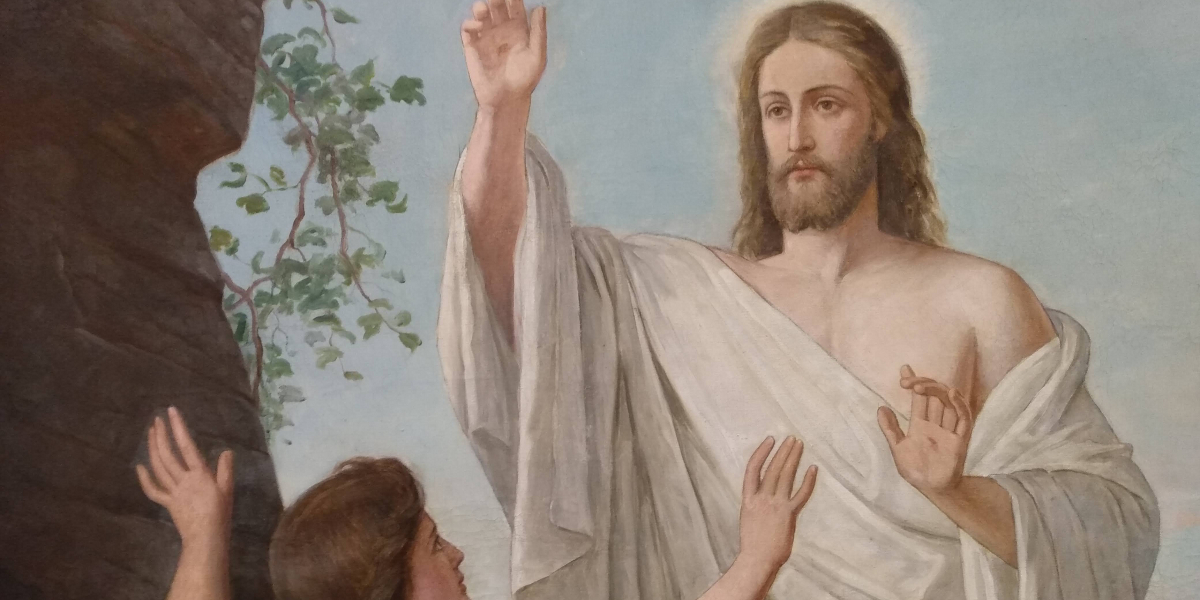
The Fourth Sunday of Easter – Vicar Anderson sermon
Text: St. John 16:16-23
In Christ Jesus, even though we live in a world with sorrows, trials, and tribulations, we are able to rejoice in our risen Lord, who promises no one will take away your joy, dear fellow redeemed:
Change is in the air. We have watched all the snow melt away. The flowers are starting to bloom. I have noticed the green starting to appear in the grey trees as the new leaves begin to grow. I think it is safe to say that most people enjoy spring. It is a season of growth and warmth. We are transitioning from a season that is kind of dark and dreary. Those winter months can be long. We have also finished a few holiday seasons, and as we acknowledge those seasons, for some maybe those seasons aren’t as joyous as we think. During those dreary months, it is a time where people tend to pass away. The holidays that we love so much can sometimes become a time of mourning and sorrow. As the spring brings us out of those dreary months into warmth and sunshine, Jesus is telling His disciples that He will bring them joy. It won’t start out like that. He says they will first weep and lament. Jesus’ comfort for His disciples comes to you as well, your sorrow will be turned into joy!
Jesus in His discourse is telling the disciples this great message. He has told them on more than one occasion that He is going to be arrested and He will die and will rise again. Jesus tells His disciples that what He is saying, they are not going to like it or want to bear it. It will look like their lives are going to be extremely hard. Jesus assures them that they will have clarity and He will explain more to them. The Holy Spirit will guide them. Everything that Jesus is telling His disciples is so that they can be strengthened. When Jesus ends with saying that He is going to leave them, the disciples hold onto that sentence. They are having a hard time understanding what is happening. The disciples will still have their doubts, or they will not believe it.
Even after our text for today and Jesus continues to tell the disciples what is about to happen. The disciples respond, “now we know that you know all things and do not need anyone to question you; this is why we believe that you came from God” (John 16:30). The disciples think that they understand what is happening and they put their trust in their own belief. Jesus tells them what will happen. “Do you now believe? Behold, the hour is coming, indeed it has come, when you will be scattered, each to his own home, and will leave me alone” (John 16:31-32).
Jesus wants the disciples to realize they are going to have sorrow and will lament because Jesus is going to be arrested, tried, and executed. He is telling them this so that they are aware of what is happening and so that they will be strengthened. The disciples see what is happening and they fall into despair. Like the disciples, we can have a lack of understanding with what God tells us. His commands are clear to us. Most of the time, we like to pick and choose which commands that we want to follow. The world will question the truths that we believe, and they will put us on the spot. The world wants us to cave to its demands. The devil helps the world out by getting us to question what God says. And when we cave and question God’s authority, we can fall into despair.
When battles happen on these different fronts, we can look to our own strength. We can think that our belief is our own. We forget that it is by the work of the Holy Spirit that we believe. When we tell the Holy Spirit “I got it from here,” this is usually the time that our lives start to fall apart. The disciples soon found their lives falling apart at the seams.
There are two time periods that Jesus is referring to when He says, “a little while.” Our “little while” here on this earth does come with suffering and trials and our lives can start to fall apart. We are plagued with sicknesses. We live and watch as those whom we love pass away. We watch as many, maybe someone close to us fall from faith. The world rejoices and ridicules us. Like the author of Lamentations, we can sometimes say, “My endurance has perished; so has my hope from the LORD” (Lamentations 3:18). The world tells us to “just toughen up”. However, there are some trials where there might not be a toughening up to bear it. As the pain and suffering can continues to weigh us down, we can forget about the cross that won us salvation and instead fixate on our own cross.
The third commandment can bring us strength. We come to church to receive comfort. Many think that church is only filled with those who have everything going well in their lives. The world doesn’t realize that we are coming here to receive help and medicine from the loving doctor. When we neglect coming to worship. Instead of putting off our burdens on Jesus who says, “I will carry them”, we can continue to carry them ourselves and they will drag us down.
Jesus was not lying when He said that the disciple’s sorrows would turn to joy. They saw their risen Savior. He was not a ghost, but He was God in the flesh. They were comforted when they saw their teachers’ hands and his feet. They saw the spear mark in His side. The disciples witnessed Jesus fulfilling what He said He would do. The Son of man would suffer and die on the cross for the sins of the world. Like the turning from dreary winter to beautiful spring, three days later Jesus rose from the dead.
Jesus illustrates this sorrow and joy. A woman ready to give birth has pain as her child is coming into the world. Once her baby is born, the mother is filled with joy as her child has arrived. She forgets all about the pain. The sorrow of Jesus being dead doesn’t compare to the glorious joy of Him risen from the grave! The disciples would watch their Savior leave again. Like the disciples after Jesus’ ascension, we are living in a “little while.” There is sorrow now, but there will be great joy when Christ returns for the Resurrection of the Dead!
As you wait for that glorious day, Jesus does see all your struggles and hardships. He hears your cries. There are many accounts where you see the compassion that your Savior has for people. St. Matthew records, “he had compassion for them, because they were harassed and helpless, like sheep without a shepherd” (Matthew 9:36). He had compassion for those who lived while He was visibly on earth, and He has compassion for you right now. He carried your burdens and sins on His shoulders and took them to the cross. As He turns the disciples’ lament into joy on that Easter day, that same day He turns your sorrows into joy!
Your comfort and joy are not in the things of this world, but in Jesus’ death and resurrection. The things of this world will pass away. Your laments turn to joy because even though there are struggles and trials in this life, you have been saved from eternal suffering. Jesus glorious resurrection assures you that God accepts Jesus’ sacrifice for your redemption. You are redeemed children of God and you will leave this world of sorrow and strife to your blessed inheritance of Heaven.
Every day we get closer to the hour that this life will pass away. We also see every day how people attempt to cope on their own with all the world’s pains. Many feel that there is no way out of this. That there is no comfort. As many despair, we hear Jesus’ Words to proclaim the Gospel. It is the power of the Gospel that turns sorrow into joy. We can share with others the comfort that we have in Christ. He is our strength. He is the One who carries us through this life because we don’t have the strength on our own. And when we need that reminder ourselves, we come to worship, repent of our sins, and again receive the comfort and strength that comes to us through the Word and sacraments. We then continue waiting and confessing, “The steadfast love of the LORD never ceases; his mercies never come to an end” (Lamentations 3:22).
As we rejoice in all the blessings that God has given us in this life, we can also rejoice that God keeps track of time way different than we do. We find the joys in spring, but we know that those dreary months will come back. Our lives will continue to have hardships and trials. But Jesus says, “A little while, and you will see me no longer, and again a little while, and you will see me.” Our time here on earth is only a little while. Every day is a blessing, but we know that soon our rooms will be prepared. Christ will call us to our heavenly home where our sorrows will cease. We will have constant joy because we have not been forgotten. Jesus has risen from the dead, and in a little while, we will see Him. Amen.
Glory be to the Father and to the Son and to the Holy Ghost; as it was in the beginning, is now, and ever shall be, forevermore. Amen.
+ + +
(picture from Jerico Lutheran Church altar painting)
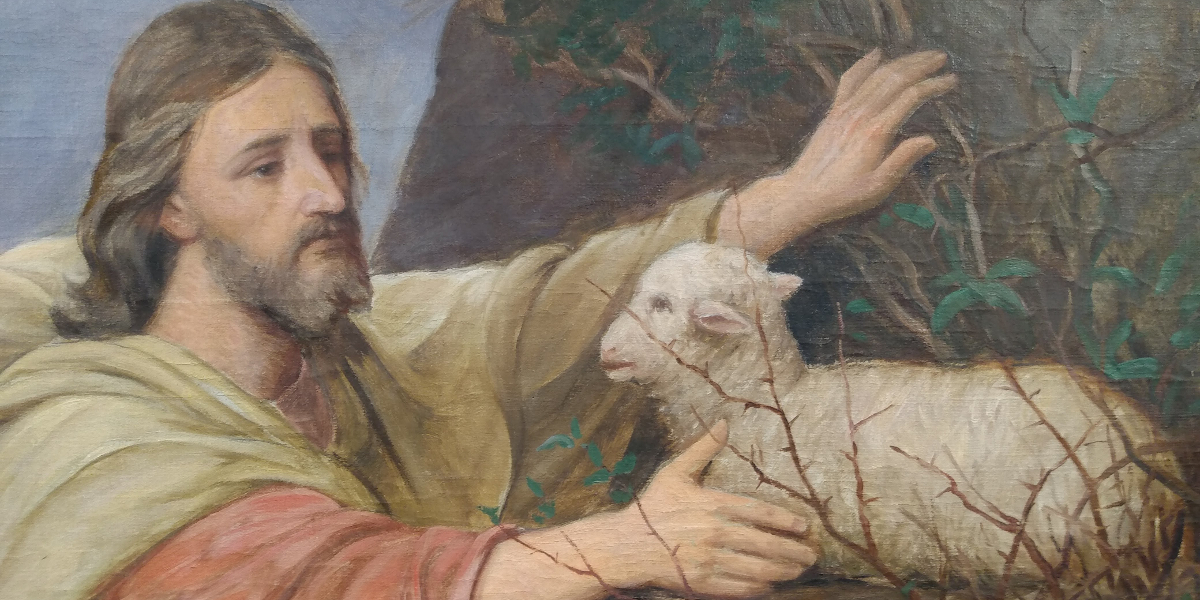
The Third Sunday of Easter – Pr. Faugstad sermon
Text: St. John 10:11-16
In Christ Jesus, who is constantly seeking after lost sheep to bring them into His holy flock of believers, dear fellow redeemed:
If you search online for “Good Shepherd paintings,” you will find depictions of lambs being carried on Jesus’ shoulders, held in His arms, led by Him to pasture and water, and rescued by Him. The Saude altar painting shows the Good Shepherd rescuing a lost lamb. What you never see in these paintings is the sheep taking charge, blazing their own trail, and conquering their enemies. That is not something sheep do—or if they try, they don’t do it very successfully.
Domestic sheep require constant care and protection. They are quite vulnerable to predators and are prone to wandering. But they are also very loyal and are able to discern the difference between their shepherd’s voice and the voices of strangers. In these ways, little lambs are something like little children.
Children come into the world through the union of a man and a woman, because God wants every child to have the care and protection of a mother and a father. Little children often don’t recognize the dangers around them. They try to touch things that are too hot or too sharp. They want to go exploring on their own and climb on things that are too high. So their parents (or their siblings) keep a close eye on them: “Don’t touch that!” they say. “Come back!” “Get down!”
Do children listen? Sometimes yes and sometimes no. You have probably seen the look in a child’s eyes when he hears his parents say something, but he wishes he hadn’t heard it, and he acts like he didn’t hear it. So a parent says, “Did you hear what I said? Listen to me!” That listening is important. It keeps children safe. It teaches and guides them.
Children who will not listen to their parents will bring harm on themselves and distress and sadness to those who care for them. But children who do listen to their parents learn early on the difference between what is good and bad, right and wrong, safe and unsafe. Children who listen grow in wisdom and knowledge. They bring joy to their parents.
The same goes for you and me before God. We are His children. He made us and continues to provide for us. He sent His only Son to redeem us, so that we would be adopted into His holy family. Our primary responsibility as His children is to listen to what He says. The apostle Peter wrote, “Like newborn infants, long for the pure spiritual milk—the Word of God—, that by it you may grow up into salvation” (1Pe. 2:2). And Jesus says, “My sheep hear my voice, and I know them, and they follow me” (Joh. 11:27).
The shepherd does not follow the sheep; the sheep follow the shepherd. The sheep do not tell the shepherd what to do; they listen to what he tells them. Just as it is not right for children to be disrespectful to their parents, to question everything they say, or to blame them for all their problems, so it is not right for the sheep—for you and me—to act like this toward God. We do not have the power and the authority; He does. We do not know what is best for ourselves; He does.
That is difficult for us to accept. When we are giving in to our passions, going a direction we have been taught to avoid, doing things we have been told not to do, we feel like we are in control. “I can make decisions for myself!” we think. “It’s my life! No one can stop me from doing what I want!” We learn the hard way that the path of sinful indulgence is not where we find fulfillment and happiness. It is where we find pain and heartache, and where we receive deep cuts and wounds that don’t heal easily.
The young woman who gives herself to one boyfriend after another hoping that the latest relationship will last, knows this to be true. So does the young man who has taken the bait of pornography and is now helplessly stuck on the hook. They thought they could give up part of themselves to get what they wanted. They thought they could maintain control. But their sin controls them. And now they wish they could get everything back that they gave up.
What does a little lamb do who has gotten himself or herself into a thorny situation, who doesn’t know where to turn? That little lamb does the only thing it can do. It cries out for help. It sends out a mournful, desperate cry right from the heart. That’s what we do when our conscience is troubled, when guilt gnaws inside us, when we find ourselves in a difficult situation that we can’t find our way out of. We cry for rescue and deliverance. And the Good Shepherd hears that cry. “I know My own,” He says.
A mother can hear her child’s cry from the other side of a room full of people. Jesus not only hears your cry, He knows your pain before you express it. He knows exactly how to help before you even open your mouth. That is how well He knows you. That is how much He cares for you. But you already know this about your Good Shepherd, because you know what He gave up for you. “The Good Shepherd lays down His life for the sheep.”
Even though you and I have tested God’s patience again and again by our sinful choices, even though we have wandered so far away from Him that we could no longer hear His voice, even though we can hardly imagine why He would want us, the Good Shepherd willingly gave up His life for us. In His eyes, we were worth saving. We were worth the anguish and thorns and piercing of the nails. We were worth the righteous wrath of God and the fires of hell.
Jesus stepped between us and the wolfish devil, the one who is constantly tempting us to sin and then torturing us for committing it. Jesus let all accusation come upon Him. He took the place of us sheep who love to wander and made all our transgressions His. He paid the debt that we owed God for breaking His Commandments by our actions, words, and thoughts.
The cold jaws of death fastened around Jesus instead of us. But how could the sheep survive without the Shepherd? The night of His arrest, Jesus quoted this Old Testament passage about Himself and His followers, “I will strike the shepherd, and the sheep of the flock will be scattered” (Mat. 26:31). What a terrible outcome! But then Jesus added these stunning words, “after I am raised up, I will go before you to Galilee” (v. 32).
“After I am raised up….” What an amazing prediction! Immediately following today’s Gospel reading, Jesus said the same thing, “I lay down my life that I may take it up again. No one takes it from me, but I lay it down of my own accord” (Joh. 10:17-18). The death of the Good Shepherd would not mark the end of His care for the sheep. He rose from the dead in triumph to demonstrate that nothing could stop His love for His sheep—not even death (Rom. 8:35-39).
You were brought into His care and became His little lamb when you were baptized. He took you up in His arms like He did those little children so many years ago and He blessed you. He washed away all your sins in His blood. He made you spotless like the bright wool of a lamb, clothing you in His righteousness. He rescued you from the darkness of sin and death where you had gotten utterly lost, and He brought you into His kingdom of light and life.
And what does He ask of you? Only that you listen to His voice and hear His comforting and saving words. “If you abide in my word, you are truly my disciples,” He says, “and you will know the truth, and the truth will set you free” (Joh. 8:31-32). To listen to Jesus is to have truth and life and freedom. To ignore Him is to become prey to the devil’s lies and death.
Listening is hard for us little lambs, us little children, because we like to do things that are bad for us. None of us listens perfectly. We sin all the time. But Jesus keeps calling out to us, calling us back to His care and protection. That call goes out every time you attend divine service and open your Bible or devotion book for study at home. “Come to me,” Jesus says, “and I will give you rest” (Mat. 11:28).
He calls you to the green pastures and still waters of His Word and Sacraments. He invites you to eat and drink for your fulfillment and strength. He trains you to listen better and follow Him more closely. This happens all through your life. You never get to the point where you are strong enough to set out on your own. You always need your Shepherd’s care.
To keep you in His care, your Lord has given you under-shepherds, who speak nothing more or less than what He has spoken. The way to tell the difference between a faithful pastor and a hired hand is to compare what each one says with what Jesus says. My call as your pastor, your shepherd in this place, is to pay careful attention to myself and to all the flock, in which the Holy Spirit has made me an overseer, to care for the church of God, which He obtained with His own blood (Act. 20:28).
My call is to remind you that You Are Jesus’ Little Lamb. You need His forgiveness. You need His guidance. You need His constant protection as you walk through the valley of the shadow of death. He brings all these blessings to you through His powerful Word. “My sheep hear my voice,” He says, “and I know them, and they follow me” (Joh. 11:27).
Glory be to the Father and to the Son and to the Holy Ghost; as it was in the beginning, is now, and ever shall be, forevermore. Amen.
+ + +
(picture from Saude Lutheran Church altar painting)

The Second Sunday of Easter – Vicar Anderson sermon
Text: St. John 20:19-31
In Christ Jesus, who walks with you by faith, who you don’t see visibly, but He is right here with you, dear fellow redeemed:
Whose shoes do you want to be in? The city of Jerusalem on the first day of the week is quite busy. Soldiers are minding their own business, probably wondering why they are guarding someone’s grave. Women are wondering who is going to move the large stone away. To their surprise angels move away the stone and proclaim the wonderful news, Christ is risen! The fear of the religious leaders has become a reality, the tomb is empty. The women not only hear this glorious news, but then they see Jesus! They tell the disciples, the ones who loved Jesus so much, and they doubted what the women told them. Thomas is nowhere to be found. So again, whose shoes do you want to be in? I think we can all feel for those disciples. We know some of the thoughts that they probably had. Their teacher was gone! He was dead! We weren’t there, we did not witness what took place, but Scripture has revealed to us what happened that Easter day. Our Savior has risen! Christ tells us directly that seeing is not believing.
Jesus’ disciples needed to see Him. Our text shows that on the evening of Easter, they are locked in a room. This is a place that they feel safe. After seeing what happened, they knew that the authorities were probably coming for them next. Remember these are disciples who said “Lord, I am ready to go with you both to prison and to death” (Luke 22:33). Some news arrives that the tomb is empty. Yet they still do not believe what they have heard.
We see in the Passion account that the disciples needed help to get to this point. They had forgotten Jesus’ teachings. Jesus had spoken plainly to them about how everything was going to be fulfilled. “The Son of Man is going to be delivered into the hands of men, and they will kill him. And when he is killed, after three days he will rise” (Mark 9:31). Their little faith now has them locked in a room in fear of the leaders who put Jesus to death.
The other gospels have more details about that day. After the women had reported to the disciples what they discovered, Peter and John also raced to the tomb. They saw His folded up burial clothes. Jesus body was raised, yet they did not understand what was happening. They were stuck in despair. Thomas was not even in the room on that first day of the week. He did not get to rejoice in seeing His Lord. He wanted hard proof that Jesus was alive otherwise he would not believe it.
Scripture speaks very plainly to us just like Jesus spoke to His disciples. We will often ignore what Jesus says to stay in our sins. We try to appease the world, and the world will still throw us into despair. We can get to the point that our lack of faith can have us locked behind closed doors in fear too. This is what the devil wants. He wants us at that point of no return where we doubt God and we despair that we have been left alone. He points out all of the things that are going wrong in our lives. We hear the lie “If your God is a good God, why is He letting all of these bad things happen to you, surely you won’t have more than what you can bear?”
Like the disciples, we often doubt what God says. God tells us that He keeps His promises. The moment something happens in our lives that causes our world to turn upside down, we immediately doubt what God tells us. We try to find our own way of fixing the situation. The first thing we should be doing is praying to God. Our way of communicating with Him. And we should go to His Word where He shows us and tells us that He works things out for the good. We tend to not look much farther than the disaster in front of us because that doesn’t look like God’s promises.
God’s promise is that He will abide with us, provide for us, and help us. When we forget His first commandment to fear, love, and trust in Him above all things, we ignore His promises. When we forget about fear, love, and trust, well now why should we believe in Him? The world tells us to look around and see that there is no God. We must take care of ourselves. Unfortunately, we will continue into the pit of despair because we throw away our only source of comfort in this life.
The disciples looked like they were going to continue to stay in that pit of despair. Maybe they would have come around at some point from hearing what the women had told them. Jesus however has a different plan. Finally, as the day ends, they get to see Him with their own eyes. “Jesus came and stood among them and said to them, “Peace be with you.” When he had said this, he showed them his hands and his side. Then the disciples were glad when they saw the Lord.” Their Lord was there and was alive! Their faith was restored! They get to see in person that their Savior has risen from the dead! They see that He is no longer in the tomb. Death was destroyed. Jesus has done all that He says He would do!
Now remember Thomas was not there that first night. The grief of the events must have been overwhelming. Thomas also said he needs that physical proof. One week later and the first thing that Jesus does after saying “Peace be with you,” is that He heads right over to Thomas. This is not only Jesus walking over to Thomas, but this is Jesus walking over to speak directly to you.
Where you lack trust, that is all Jesus had. He trusted in God that this was the plan of Salvation. Like Isaac trusting his father when Abraham was about to sacrifice him, Jesus also put His trust in God the Father. He did it perfectly and instead of being spared, He took on all your sins and died for every one of them. Without Jesus death on the cross and resurrection, the world would be right, and you would have nothing or no one to trust in. There would be no reason to believe in God keeping His promises. There would be no reason to go to church to hear and learn from Him. You would just sit at home and wait for your untimely demise. These sins of doubt and failing to trust in God, they are forgiven. When the hard events of life get you, your faith might waver, but what you see in that room where Jesus met His disciples is the truth. Your faith in Jesus Christ is not in vain. He is risen indeed! And as He speaks to Thomas, He has a message for you.
That message comes to you right here and now. You are in the year 2023 and you did not get to witness the crucifixion. The men and women who were there saw and heard what happened, yet they doubted. You were not there, but you believe it. You have a new life in Christ because He is speaking directly to you. Jesus said to him, “Have you believed because you have seen me? Blessed are those who have not seen and yet have believed.” You have faith because even though it has been 2,000 years since Jesus was visibly on this earth, He still comes directly to you in the Means of Grace providing you with strength every day. Jesus is still here! This is why you come to church, to hear His Word and to receive His Sacraments. This is where Jesus is present, coming to you. He has marked you as His own, He speaks His Words of comfort that you are blessed, and He personally provides you with forgiveness of sins, life, and salvation at the altar. He breathes the Holy Spirit on you so that you hear this message and believe it.
We walk by a clear and confident faith because God has kept His promises. Our Savior has risen from the dead. Jesus then tells us directly that we do not have to worry or doubt. We were not present, but we are blessed because we believe. This is why Scripture is recorded. Everyone can hear the message of their salvation. Jesus came and died for all. St. John tells us that it is recorded for our hearing so that we may believe. We receive comfort that Christ has not left us. He is with us now in this life and He will reign over us forever. It is 2023 and we know that the tomb of Jesus was empty. Like Job we can confess, I know that my Redeemer lives; what comfort this sweet sentence gives! He lives, He lives, who once was dead; He lives, my ever-living head (ELH 351). Amen.
Glory be to the Father and to the Son and to the Holy Ghost; as it was in the beginning, is now, and ever shall be, forevermore. Amen.
+ + +
(woodcut from “Doubting Thomas” by Julius Schnorr von Carolsfeld, 1794-1872)

The Resurrection of Our Lord – Pr. Faugstad exordium & sermon
Festival exordium:
The miracle-worker died, but his followers refused to accept it. “He will rise again!” they said. So they waited. They waited one day. Then two. On the third day, nothing happened. Weeks passed, then months. Then more than a year and a half had gone by. Finally the funeral home obtained a court order and buried the man’s body.
This actually happened in South Africa. A pastor who claimed to be able to heal the sick, and who reportedly predicted his own resurrection, stayed dead. He did not have the power he thought he had or said he had.
There is only one Man who predicted His own resurrection and then did it. We are gathered here today to hear His Word and sing His praises. Even though He had done countless miracles and even raised several people from the dead, His closest disciples did not believe He would rise. The eleven disciples went into hiding after He was crucified and buried. The women made plans to return to His tomb after the Sabbath to anoint His dead body with more spices.
The only ones who seemed to take Jesus’ prediction seriously were the chief priests and Pharisees. They went to Pilate and said, “Sir, we remember how that impostor said, while he was still alive, ‘After three days I will rise.’” Therefore order the tomb to be made secure until the third day, lest his disciples go and steal him away” (Mat. 27:63-64). All this accomplished was putting witnesses at the tomb—the soldiers—who watched an angel descend from heaven and roll away the stone revealing an empty tomb. They reported what they saw to the chief priests, who, instead of hearing what they said, paid them to tell a lie (28:11-15).
But the resurrection of Jesus is no lie. It happened just as Jesus said it would, on the third day after His death. He did break the chains of death. He did emerge victorious. He did end the terrible reign of death brought into the world by Adam’s sin. He did it for the doubters, for the weak, for the faithless, for sinners—for you and me.
In thankfulness and joy, let us rise to sing hymn #348, “He Is Arisen! Glorious Word!”
He is arisen! Glorious Word!
Now reconciled is God, my Lord;
The gates of heaven are open.
My Jesus died triumphantly,
And Satan’s arrows broken lie,
Destroyed hell’s direst weapon.
O hear
What cheer!
Christ victorious
Riseth glorious,
Life He giveth—
He was dead, but see, He liveth!
+ + +
Sermon text: St. Mark 16:1-8
In Christ Jesus, who was not in the tomb on Easter morning, but who is here with us to bless us, dear fellow redeemed:
Many people claim to have seen angels. Some of them say angels appeared when they were in great distress or sorrow and brought them comfort. Others report messages spoken to them by the angels, special messages from God. The problem is, sometimes those messages do not agree with what the Bible says. So which is more reliable: a special visit from an angel or the Word of God?
If someone is given a message by a holy angel, it will not contradict the Word of God. The angels who serve God are without sin; they only tell the truth. So if an angel speaks a message that conflicts with the Word of God, it is not a holy angel. St. Paul writes that “even Satan disguises himself as an angel of light” (2Co. 11:14). Many prominent false teachers in history claim to have been visited by angels who gave them their new teachings. But these were not holy angels. They were the devil or demons coming in disguise.
So how can we know that the angel who spoke to the women at Jesus’ tomb was really sent by God? How can we be sure that it wasn’t just something they imagined in their state of emotional turmoil and sorrow? When the women went to Jesus’ tomb early Sunday morning, they went there expecting to find a dead man—if they could roll away the stone from the entrance to get to Him.
Instead, they looked up and saw that the stone had already been rolled away. That was strange. And when they cautiously peaked inside, they did not see the body of Jesus. They saw a young man wearing a long, white robe—an angel. Seeing their distress and alarm, the angel told them there was no need to fear. Why? There was no need to fear because Jesus had done everything He said He would do.
The angel didn’t tell them anything new. Jesus had told His disciples multiple times that He would go to Jerusalem to suffer, die, and on the third day rise again. And when they were in Jerusalem the night of His arrest, He told His disciples that they would all desert Him, but after He was raised up, He would go before them to Galilee (Mar. 14:27-28). Now the angel was saying the same thing: Jesus “was crucified. He is risen!… He is going before you into Galilee… as He said to you.”
That is the message the women took back to the disciples. The appearance of the angel was surprising, but the words he spoke should not have been surprising. He simply reminded them what they had already heard. That’s what the holy angels do. They proclaim the promises of God. Isn’t that what the angels did the night of Jesus’ birth? They proclaimed the fulfillment of God’s promise: “For unto you is born this day in the city of David a Savior, which is Christ the Lord” (Luk. 2:11).
You can be sure that if an angel appears to you and speaks a message that does not agree with the Bible’s teaching, it is not an angel of God. St. Paul said that there are some who “want to distort the gospel of Christ.” Then he adds, “But even if we or an angel from heaven should preach to you a gospel contrary to the one we preached to you, let him be accursed” (Gal. 1:7-8). But how can we know that the Gospel is true? Or how can we be sure we have the right Gospel?
That topic came up in a conversation I had with a Mormon man. Before I knew his religious background, he asked me a question that every Lutheran pastor loves to hear, “What is the Gospel?” But I could tell as I explained the Gospel to him that he wasn’t convinced. It was a “gotcha question.” He wanted to make the point that if all of the different denominations of Christians had different understandings of the Gospel, none of us could be certain we had the right one. That’s why we needed a modern-day prophet to give the correct interpretation—a prophet like Joseph Smith (who, incidentally, claimed to get his special revelations from an “angel”).
But we can know the Gospel from the Bible and be certain that we have the true Gospel. The angel sitting in that tomb couldn’t have said it more plainly: Jesus “was crucified. He is risen!” That is the good news. That is the Gospel. A dead man rose from the dead! But it wasn’t just any dead man. It was a dead man who claimed to be the Son of God. It was a dead man who predicted that everything would happen just as it happened. It was a dead man who said that His victory over death would be your victory, that His life would be your life.
Jesus’ resurrection verified everything He ever said. He could have said what He did, died on the cross, and never been seen or heard from again. That would have proven that He was nothing more than a big talker, or that He was delusional. But that is not what happened. He did rise from the dead. We believe it not just because an angel said it happened. We believe it because Jesus showed Himself alive to the women later that morning, to His disciples on numerous occasions, and at one time to more than five hundred of His followers (1Co. 15:6). He talked with them, ate with them, and definitively proved that He is who He said—the Son of God in the flesh.
The disciples wrote down what they saw and heard, so that everyone could learn about Jesus and what He had done. Jesus hadn’t just accomplished something for His time. He had done something for all time. His apostle John wrote near the end of His Gospel account: “these are written so that you may believe that Jesus is the Christ, the Son of God, and that by believing you may have life in his name” (Joh. 20:31).
Our faith in Jesus is not a special feeling we have about Him. It is not a decision we made when considering various faith systems. Our faith in Jesus is a confidence worked in us by God the Holy Spirit through the message of His Gospel. It is a confidence that because Jesus rose from the dead, we will rise. Because He lives forever, we will live forever. We know how ridiculous and impossible it sounds that a severely beaten and crucified man should rise from the dead a couple days later, alive and well, walking around and visiting with people all over the place.
But this was not just any man. This was God-in-the-flesh who won the victory for you. He went to the cross and crushed the devil’s head by paying for your sins. And He conquered death by coming alive on the very day He said He would. Sin, devil, and death could not stop Him. They met an Enemy who had them shaking in their boots.
This is the Lord and Savior who joined Himself to your flesh, so that He could do everything for you that you couldn’t do. And He has joined Himself to you in an even more personal way. He made you a member of His holy body through your Baptism into Him, cleansing you of your sins and covering you in His righteousness. And He feeds you and fills you with His life by giving you His immortal body and blood in His holy Supper. He graciously comes to you and me through His Word and Sacraments, so that even though outwardly we are wasting away, inwardly He renews us day by day (2Co. 4:16).
The Bible says that the angels are amazed by the gracious care God has for us. The gifts the Holy Spirit gives us through the Gospel are “things into which angels long to look” (1Pe. 1:12). So we do not need to wait for a special visit from an angel to know that God loves us. We do not need to seek comfort in our grief from strange coincidences, appearances of certain animals, or from other signs that seem to convey messages from those who are now dead.
We need the Gospel. We need to hear the message again and again that our sins are forgiven, that eternal life is ours through faith in Jesus, and that He will raise our bodies and the bodies of all our loved ones from the dead when He comes again in glory. That is the message God sent His holy angels to proclaim when His Son entered this world and when He rose in triumph out of the dark tomb.
And that is the message we still proclaim today and every day. We want our family, our friends, and even our enemies to hear the saving truth that Christ is risen! He is risen indeed! Alleluia!
Glory be to the Father and to the Son and to the Holy Ghost; as it was in the beginning, is now, and ever shall be, forevermore. Amen.
+ + +
(woodcut from “The Empty Tomb” by Julius Schnorr von Carolsfeld, 1794-1872)