
The Festival of the Reformation – Pr. Faugstad sermon
Text: 1 Peter 1:23-25
In Christ Jesus, who still is with us in the fight with His good gifts and Spirit (ELH 251, v. 4), dear fellow redeemed:
The beans are pretty much all harvested, and the corn is well on its way. The Lord has blessed us in northeast Iowa with a good crop. Our farmers work hard to plant and tend and harvest, but the glory still belongs to God. He created seed-producing plants in the beginning. He gives the sunlight, heat, and rain to make plants grow. And He gives us the ability to do our work.
So much is produced by so little. Just one kernel of corn can grow a stalk that produces an ear with anywhere from 500-1000 kernels of corn on it. That is an amazing return! If you go back aways, I suppose you could trace all the corn in Chickasaw and Howard counties to one kernel. This is good to remember in many areas of life. One small action, one kind deed, one encouraging word, can bear fruit in significant ways that may not be seen for a very long time.
Today we celebrate the beginning of the Lutheran Reformation. Like a solitary seed planted in the ground, the first actions that started the Reformation may not have seemed so significant at the time. The Roman Church was looking to raise funds to build St. Peter’s Basilica in Rome. The pope issued a special indulgence that people could buy to free family members and friends from purgatory or to keep for their own security and salvation.
Martin Luther was an Augustinian monk who was teaching at the newly founded University of Wittenberg. He heard the promises the indulgence salesmen made, and he was appalled. How could money buy a soul’s salvation? At this time, he still believed that people had to make satisfaction for their sins by confessing them and doing good works. People couldn’t buy salvation, but they could possibly work for it.
He wrote Ninety-Five Theses or statements about the sale of indulgences and other topics. He wrote them in Latin for scholarly debate and nailed them to the door of the city church on the Eve of All Saints, or All Hallows’ Eve, on October 31, 1517. The first thesis stated: “When our Lord and Master Jesus Christ said, ‘Repent,’ He willed the entire life of believers to be one of repentance.”
Luther had no intention of starting a global movement with these theses. He was just planting a seed for the purpose of correcting bad teaching and practice. But that little seed grew into something much bigger. It was watered by an intellectual movement called Humanism. It was fertilized by the translation of the theses into German and the mass production of them by the relatively recent invention of the printing press.
Luther did not set out to become famous, but that’s what happened. Almost overnight, he began to gain powerful friends and equally powerful enemies. He kept wrestling with the Scriptures. He kept studying, writing, and speaking. Before long, he realized that he had been understanding the “righteousness of God” incorrectly. He had been reading it as the righteousness that God requires of us. But then it struck him that the righteousness of God is what believers receive from God as a gift. Romans 1:17 was key to his understanding where it is written: “The righteous shall live by faith.”
Faith is formed by the Gospel. Just before Romans 1:17, the apostle Paul described the Gospel as “the power of God for salvation” (v. 16). St. Peter says the same thing in today’s reading: “[Y]ou have been born again, not of perishable seed but of imperishable, through the living and abiding word of God.” A seed typically has to die in order to grow a new plant, but the Word of God does not fade or die. It brings life to what is dead, and that includes you and me.
By nature, we are dead in our sins and destined for both an earthly and an eternal death. No matter how strong a person might become, no matter how famous, no matter how rich, eventually everyone must die. Quoting from the prophet Isaiah, St. Peter writes that “All flesh is like grass and all its glory like the flower of grass. The grass withers, and the flower falls.” We are just like grass. Or perhaps a better illustration right now is that we are just like a stalk of corn. It grows straight and green and healthy for a time, but then it dies and turns brown and weak. That’s what our life is like. We flourish for a while, but then we fade and die.
If life were only about this life, it would be an empty life. The Preacher in Ecclesiastes writes, “[V]anity of vanities! All is vanity. What does man gain by all the toil at which he toils under the sun? A generation goes, and a generation comes, but the earth remains forever” (1:2b-4). I could buy more and more land and get richer and richer, but eventually, my body will be planted in that ground, lifeless and cold.
The Holy Spirit puts a stop to the endless cycle of death among us. He is the power in “the living and abiding word of God.” He plants the imperishable seed of the Word in the hard, rocky, parched ground of our hearts. Unlike a natural seed, the seed of the Word has the power through the Holy Spirit to change the ground where it is planted. It breaks through our stubbornness and pride. It sends roots of hope into the hidden places of our sorrow, despair, and guilt. It brings cleansing, forgiveness, and healing.
The Holy Spirit plants this seed through the Gospel, “the good news that [is] preached to you.” The good news is that God is not going to punish you for your sins, not for the wrong things you have done or for the good things you have failed to do. He is not waiting for you to make up for your sins by your prayers, by your good works, or by demonstrating regular improvement in right living. God is not waiting for you to save yourself or even help toward your salvation. It is impossible for you to do this.
The good news is that He does it for you. God the Father showed His love for you and the whole world by sending His perfect Son to suffer and die in your place. Only a perfect sacrifice would do, and only God is perfect. The blood of the Son of God was needed to atone for your and my many sins. Just before today’s reading, St. Peter expresses this good news: “[Y]ou were ransomed from the futile ways inherited from your forefathers, not with perishable things such as silver or gold, but with the precious blood of Christ, like that of a lamb without blemish or spot” (vv. 18-19).
You were ransomed—bought back—from sin, death, and damnation by the precious blood of Christ shed on the cross. He is “the Lamb of God, who takes away the sin of the world!” (Joh. 1:29). If He has taken away the sin of the world, then He has taken away your sin because you are in the world. “For God so loved the world” (Joh. 3:16)—that means He loves you!
This Gospel message was not being preached when Luther started pointing out errors in the Roman Church. Souls were despairing. Consciences were crushed by guilt. And that included Luther’s. But by the grace of God, the seed of the Gospel was planted in his heart and was then planted through his writings in person after person.
This imperishable seed caused our forefathers in other lands to be born again, and then their descendants brought the same “living and abiding word of God” with them here to America. You and I have also been born again through this Word. It happened at our Baptism when the Holy Spirit planted faith in our hearts and covered us in the righteousness of Jesus. Everything we need to get to heaven, we received through water and the Word when most of us were infants. This faith has been strengthened and nourished since then through the same living Word, the same good news.
This Word has not changed or faded. As our reading says, “The word of the Lord [endures] forever.” That’s what the letters VDMA stand for on the front of your bulletin. It is an acronym for the Latin words: Verbum Domini Manet in Aeternum—“The Word of the Lord Endures Forever.” As early as 1522, five years after Luther nailed his Ninety-Five Theses to the church door, the ruler of that region began to have VDMA stitched into the clothing of the court officials and servants. It was emblazoned on flags, banners, and the uniforms of soldiers. It was etched in stone, printed on coins, and pounded into metal—“The Word of the Lord Endures Forever.”
This is the legacy of the Lutheran Reformation. We do not look for strength or salvation in ourselves. We do not trust in powerful people, political movements, or the abundance of our possessions. We do not seek new revelations or the feeling or sensation that the Spirit is at work in us. Instead, we gladly hear and learn the Word of God. This Word is not just information that we can discard as soon as we’ve heard it. It is “living and active” (Heb. 4:12), “imperishable… living and abiding.” It “endures forever.”
The Word of God—heard, read, meditated upon—gives you right here, right now, every day, the gifts that Jesus won for you: the forgiveness of all your sins, the perfect righteousness you need to stand before God, and the certainty of eternal life in His holy presence. Everything you need comes from Him through the seed of His Word. You won’t find what you need inside yourself. This is why St. James writes: “[P]ut away all filthiness and rampant wickedness—repent of your sins—and receive with meekness the implanted word, which is able to save your souls” (1:21).
Humbly receiving the implanted Word seems like a small thing. But The Seed of the Word Produces Tremendous Fruit. We see what God did through Luther that brought changes he could have never imagined, things that still deeply impact us today. And we see what change God’s Word has produced in our own lives, filling us with faith, hope, and love in this life, and preparing us to enter His heavenly kingdom forever.
Glory be to the Father and to the Son and to the Holy Ghost; as it was in the beginning, is now, and ever shall be, forevermore. Amen.
+ + +
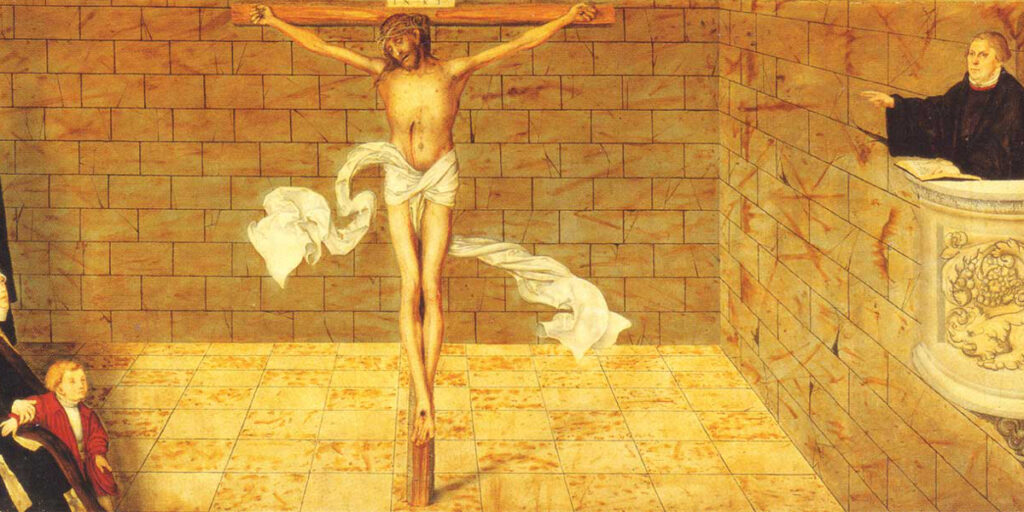
(picture from the altarpiece in St. Mary’s Church in Wittenberg, by Lucas Cranach the elder and younger, completed 1547)


Copyright 2020 © Saude, Jerico, & Redeemer Lutherans. All rights reserved.