
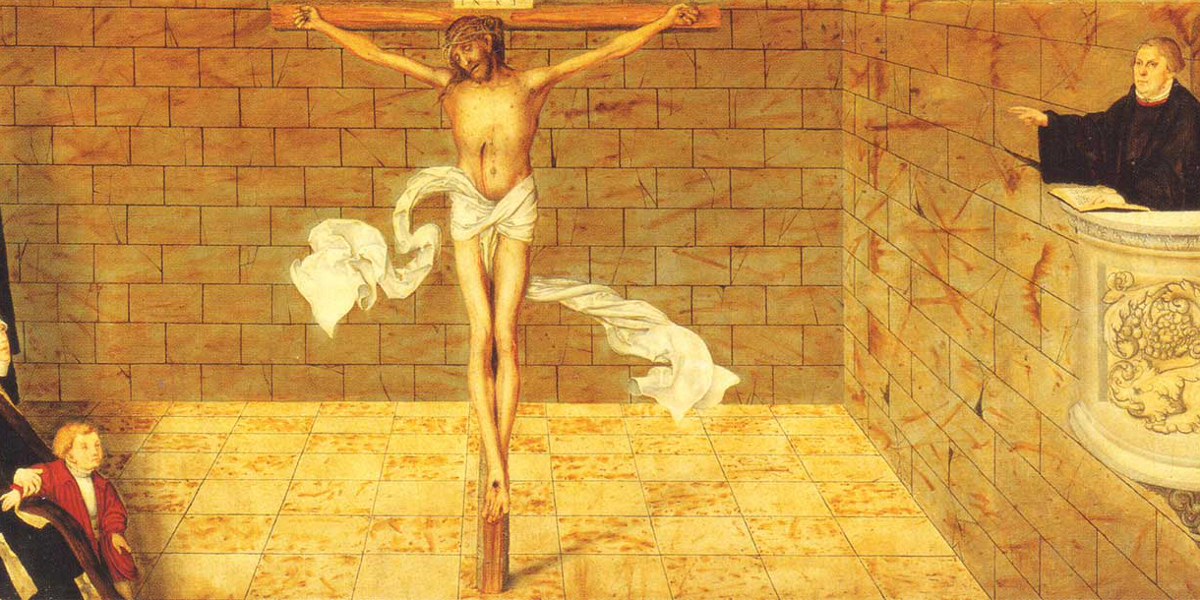
Christ Cleanses the Church by His Pure Word.
The Festival of the Reformation – Pr. Faugstad sermon
Text: 2 Chronicles 29:12-19
In Christ Jesus, who cleanses and consecrates His holy Church of all believers, so we are ready to carry out His work in His name to His glory, dear fellow redeemed:
Imagine if a church building was taken over by Satanists and defiled in every way, or it was turned into an establishment that catered to every vice that people were willing to pay for. What would need to be done to turn the building back into a Christian church? Every godless image and item would be need to thrown out. The interior would need to be scrubbed from top to bottom. None of the uncleanness that was there before could be left—not even a hint of it—if it was to serve as the place of God’s holy presence once again.
This is the task the Levites and priests faced when King Hezekiah opened up the temple doors that his wicked father had shut up. Hezekiah’s father had followed the pagan practices of the nations around Judah. He had built altars to false gods all over Jerusalem and in the high places surrounding it. He had sacrificed some of his sons as burnt offerings. He took the holy vessels from the temple of God and cut them in pieces. He put a stop to the daily sacrifices in the temple which God had commanded (2Chr. 28).
The first thing Hezekiah did when he began to reign was to call the priests and Levites together to cleanse the temple of the filth that had been brought into it. They started by consecrating themselves—preparing themselves for holy work—as the Law of God required. This is how every effort in the Church should begin, by a recognition of our own sinfulness. The priests and Levites acknowledged their past unfaithfulness, and they committed to doing what God had commanded.
Piece by piece, item by item, inch by inch, they cleansed the house of the LORD. They started with the innermost parts of the temple. The seven Levitical families worked seven days plus one until they reached the vestibule or porch of the temple. Then they worked another seven days plus one to finish the work of consecration.
The number seven is in view because that is the number for perfection or completeness. The use of seven indicates that the temple of the LORD was completely cleansed by the priests and Levites and prepared for His service. This is also why seven bulls, seven rams, seven lambs, and seven male goats were brought for a sin offering when the temple was ready. This was an offering for all the sins of all the Israelites (2Chr. 29:24).
But how could the people turn so quickly from their wicked ways? How could they so eagerly follow a bad king one day and a good king the next? The change was not exactly so immediate and all-inclusive. Some whose consciences had troubled them under the previous king were now ready to do what was right under King Hezekiah. Others might have preferred the former practices and pleasures that the worship of false gods offered.
But Hezekiah and the priests and Levites did not do their work arbitrarily. The religious system they sought to re-establish and follow was not a spirituality of their own making. They were doing what God had told His people to do in His Word, in the Holy Scriptures recorded by the prophets. This is what they would follow because this was the very voice of God which He had spoken and given for their life and salvation.
Martin Luther and the other reformers in the sixteenth century similarly had to deal with defilement in the house of God, in His holy Church. Over time, the Roman Catholic Church had adopted unbiblical teachings and practices that were leading the people away from the truth. The Roman Church taught that indulgences could be purchased to free souls from purgatory, that the human will is able to produce good works which make satisfaction for sin, that Mary and the saints could be invoked for spiritual help, and many other things that are not taught in the Bible.
Just as the priests and Levites threw some things out of the temple, but consecrated and kept others, so the Reformers did not throw out everything that “looked Catholic.” They kept everything that was faithful to the Word of God, such as the Baptism of infants, the real presence of Jesus in the Supper, the order of the historic liturgy, vestments, altars, pulpits, crucifixes, candles. This is why Roman Catholics often find that our buildings and services seem familiar, because we have retained these historic and beneficial Christian things.
The focus of the priests and Levites, just like the focus of the Lutheran Reformers, was to hold fast to the pure Word of God. Every teaching, every practice, every effort in the Church had to be examined in the light of God’s Word and to be cast out if it did not agree with God’s Word. They would humbly listen to His teaching, follow His guidance, and proclaim His truth.
This is still our focus today. We have been talking over the last couple weeks about how different we are than other Lutherans who do not believe the Bible is the inspired Word of God. Recently in the news we are hearing about a division in the Anglican Church between those who deny the clear Word of God and those who want to follow it. In fact, every major Christian church body has fractured over those who want to stand on the Scriptures as written and those who want to make accommodations for our culture and society.
The Christian Church on earth will always be tempted to water down its teachings in order to fit better with the world. We are personally tempted when we think to ourselves how many more people we could reach if we just loosened up on this teaching or that practice, such as the clear meaning of the Ten Commandments, the roles of men and women, and who can receive Holy Communion. But if we step off the foundation of the Bible, from what our Lord has taught us in His Word, we will find there is no firm ground to stand on.
Faithfulness here (in the church) has to start with faithfulness here (in the heart). If each of us individually cannot articulate and defend the faith we have, how can we make sure that the teachings of our church will stay pure? Like the priests and Levites working their way through the polluted temple starting with its inner parts, we need to closely examine our hearts to identify what is unclean and needs to be cast out.
So we could examine ourselves with questions like these: What lies have I been telling myself or others that need to be acknowledged? What sins have I committed with my eyes, my ears, or my mouth that need to be stopped? What anger, hatred, and bitterness have I let grow in my heart toward another person? What jealousy, judgment, or unkindness do I find when I think about certain people? What sins have I tried to bury or ignore that are eating me up? How have I failed to honor God in my daily pursuits and efforts?
The Levites carried the unclean items from the temple out to the brook Kidron. We bring all our sins to the waters of Holy Baptism. It was at Baptism that we were first cleansed of our sins and made members of Christ’s holy Church. We return to that Baptism and receive cleansing again when we confess our sins and receive forgiveness through Christ’s Word of absolution, like we do at the beginning of the divine service.
Every time you hear your Savior’s comforting words of forgiveness, He is telling you that He is not angry with you for your sins. He joined you to Him in Baptism, so that you would be covered in His righteousness and consecrated, or set apart, to do His holy work. No matter how the temple of your body has been defiled in the past from your sins, He prepares it for fruitful work now.
After listing all sorts of serious sins that the Christians in Corinth had committed, St. Paul wrote, “But you were washed, you were sanctified, you were justified in the name of the Lord Jesus Christ and by the Spirit of our God” (1Co. 6:11). He wrote to them again in his second letter, “Therefore, if anyone is in Christ, he is a new creation. The old has passed away; behold, the new has come” (2Co. 5:17).
You are washed in the waters of Holy Baptism—cleansed of your sins. In Christ, you are a new creation, which means your sinful past is history. But then why do we find it so challenging to do what is right? It is because the old Adam clings to us and wants to re-conquer our hearts. Our sin is the reason that the Church on earth is always struggling—in Hezekiah’s time, in Luther’s time, and in our time. We can’t take for granted that we will always be faithful, because we are no less sinful and weak than anyone else.
But you know where Christ’s power and strength for faithfulness is found. It is found in His pure Word and Sacraments. The preaching and studying of His Word and the administration of His Sacraments may seem like weak fortifications for the attacks of the devil, the world, and your own flesh. But nothing could be more effective against these attacks. Jesus says: “It is the Spirit who gives life; the flesh is no help at all. The words that I have spoken to you are spirit and life,” and, “If you abide in my word, you are truly my disciples, and you will know the truth, and the truth will set you free” (Joh. 6:33, 8:31-32).
Christ Cleanses the Church by His Pure Word. Through His Word, He reveals the uncleanness in our hearts and the errors of our ways. Through His Word, He declares the forgiveness and righteousness we have by faith in Him. Through His Word, He changes us, prepares us, and equips us for the good work He has given us to do as members of His holy Church. So we joyfully confess and sing the words of Luther’s hymn:
Stood we alone in our own might,
Our striving would be losing;
For us the one true Man doth fight,
The Man of God’s own choosing.
Who is this chosen One?
’Tis Jesus Christ, the Son,
The Lord of hosts, ’tis He
Who wins the victory
In ev’ry field of battle. (ELH #251, v. 2)
Glory be to the Father and to the Son and to the Holy Ghost; as it was in the beginning, is now, and ever shall be, forevermore. Amen.
+ + +
(picture from Wittenberg altarpiece painting by Lucas Cranach the Elder and Younger, 1547)