
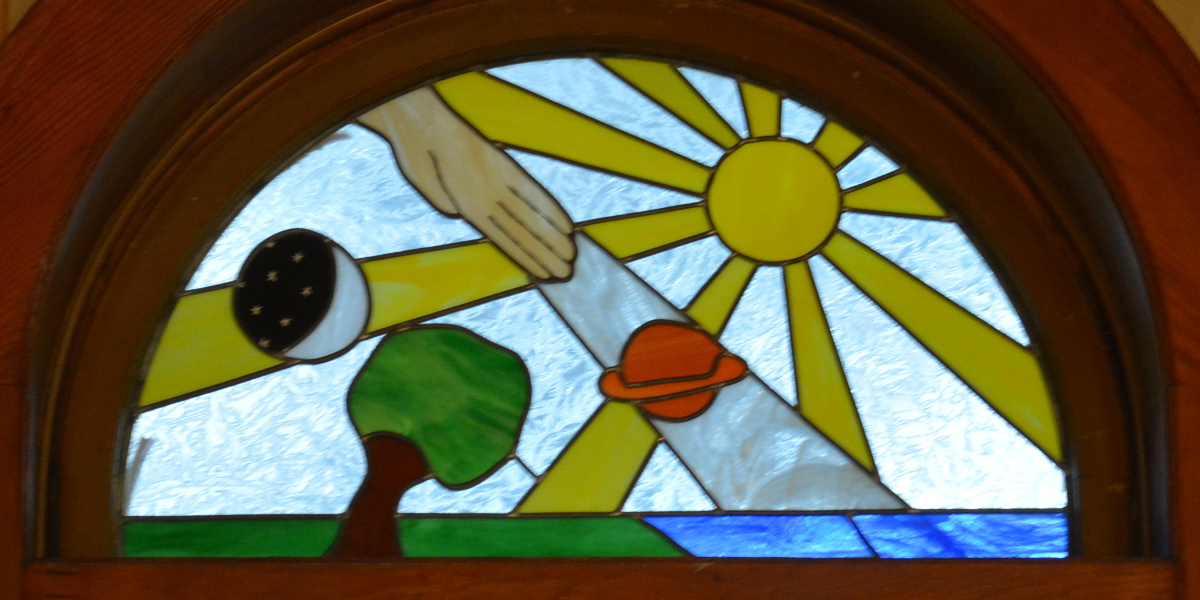
God Gives All Good Things to You.
Thanksgiving – Pr. Faugstad homily
Text: Genesis 1:26-31
In Christ Jesus, who is “the radiance of the glory of God and the exact imprint of his nature, [who] upholds the universe by the word of his power” (Heb. 1:3), dear fellow redeemed:
The book of Genesis does not start like we might expect. It does not begin with an explanation of who God is or why He decided to make things. It just tells us in a very concise way how God created time, space, and matter. “In the beginning [time], God created the heavens [space] and the earth [matter].” Then we see how God ordered the universe and everything in it. Every detail led up to the crowning moment, the greatest part, of His creation which we hear about in today’s reading—the creation of man.
Can you see how marvelous and exalted this creation is? In the council within the Godhead—Father, Son, and Holy Spirit in perfect communion—God said, “Let Us make man in Our image, after Our likeness.” The pronouns are plural because God is triune, three Persons in one. God did not say about the water, the trees, or the planets, “Let us make them in Our image.” And He did not say it about the fish, the birds, the land animals, or even the angels. He said it about mankind, and only mankind.
Man is made in the image of God. That does not refer to physical characteristics because God is spirit. We do not look like God, though God made Himself look like us when the Son took on our flesh to save us. The image of God is the special imprint of holiness from God, true knowledge, goodness, love, wisdom, peace. Adam and Eve had these things perfectly. They had everything that is good. They lacked nothing. They enjoyed every second of their existence.
Their existence in the beginning is like nothing we can comprehend. The light was brighter, the food more delicious. They were surrounded by beauty and harmony and sound like our eyes have never seen and our ears have never heard. They had “dominion over the fish of the sea and over the birds of the heavens and over every living thing that moves on the earth.” This was not an authority to harm; it was authority to care for and keep and enjoy all the wonderful parts of God’s creation.
It was a creation full of life, and that life would only increase. “Be fruitful and multiply,” God said, “and fill the earth and subdue it.” No creature knew what death was because nothing died. All animals ate plants. God gave the produce of every plant and tree to man, including the most special tree in all creation, the tree of life. We don’t know what life tastes like, but Adam and Eve did. They smelled and saw and tasted life to the full because life is all there was.
But then they decided that they wanted more. They knew good perfectly, but what if there was somehow a higher good? “Eat this fruit,” said the serpent, and “your eyes will be opened, and you will be like God, knowing good and evil” (Gen. 3:5). They did what he said. They chose the words of the deceiver over the holy words of their Creator. This horrible, disobedient act plunged all creation into the sadness and suffering of sin.
It does us no good to be mad at them. There is no going back in this life. What they did, we inherited, which makes us just as guilty as they are. We cannot go back and undo what has been done, either by Adam and Eve or by us in our sin. The power of salvation is not in us, but it is in God. And the LORD says to us, “Come now, let us reason together… though your sins are like scarlet, they shall be as white as snow; though they are red like crimson, they shall become like wool” (Isa. 1:18).
Our sins are blotted out because the Son of God became man and shed holy blood to take them all away. We can’t go back to atone for our sins, but Jesus could. God reached back to the beginning of time and gathered up the sin of Adam and Eve, their children, and their children’s children. He swept up all the sin from the past up to the present. And then He reached forward and gathered up all sins that hadn’t even been committed yet, including our sins.
All the sins of the world, past, present, and future, God imputed to His perfect Son. He did it for our sake. “For our sake he made him to be sin who knew no sin, so that in him we might become the righteousness of God” (2Co. 5:21). What the first Adam lost, the second Adam, Jesus, restored. The wrath of God that we deserved, Jesus satisfied. The image of God that we gave up was placed on us again when the Holy Spirit brought us to faith. “Therefore,” writes St. Paul, “if anyone is in Christ, he is a new creation. The old has passed away; behold, the new has come” (2Co. 5:17).
A new creation in Christ. And that means we focus not so much on what we lost in the fall, but on the blessings that are ours right now, and the joys we will have with God in heaven. Even though everything in the world is tainted by sin, there is so much beauty to enjoy in God’s creation. We can look at one tiny piece of what He made and never understand the full scope of its wonder and complexity. So much of His majesty still shines through.
Still, mankind is the crown of God’s creation, though the image of God is not perfectly restored to us in this life. Still, we have dominion over all creation and receive blessings from it every day. Still, God gives the gift of procreation, so that we enjoy family and home. Still, God causes plants to grow, so all creation is sustained and fed. God’s creation is still “very good” because God is very good.
And He has far more in store for us than the blessings we have in this life. A place for us has been prepared in His Paradise above. There we will enjoy the image of God just as Adam and Eve had it. There we will eat from “the tree of life with its twelve kinds of fruit” (Rev. 22:2). There we will see and hear and taste and experience what cannot even be imagined here.
Why does God give you all these good things? We just confessed it in the First Article: “purely out of fatherly, divine goodness and mercy, without any merit or worthiness in me.” And how do we respond to His gifts? “For all which I am in duty bound to thank and praise, to serve and obey Him.” What a blessing and a privilege to be able “to thank and praise, to serve and obey” our mighty God, the Maker of heaven and earth, and our merciful Savior.
Glory be to the Father and to the Son and to the Holy Ghost; as it was in the beginning, is now, and ever shall be, forevermore. Amen.
+ + +
(picture from Saude Lutheran Church stained glass)