
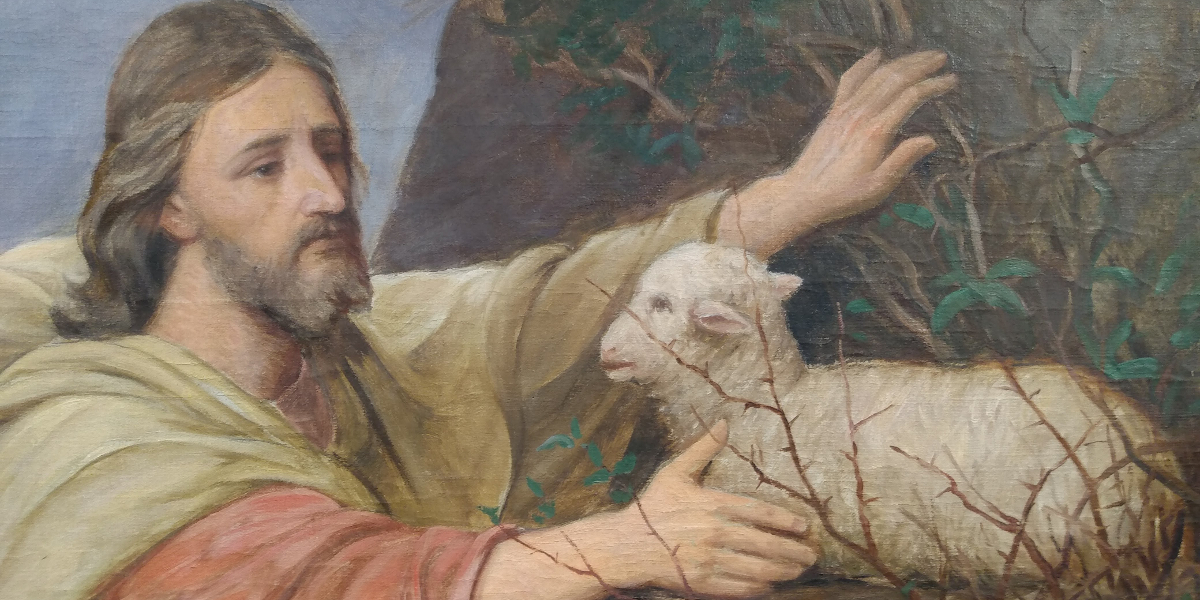
You Are Jesus’ Little Lamb.
The Third Sunday of Easter – Pr. Faugstad sermon
Text: St. John 10:11-16
In Christ Jesus, who is constantly seeking after lost sheep to bring them into His holy flock of believers, dear fellow redeemed:
If you search online for “Good Shepherd paintings,” you will find depictions of lambs being carried on Jesus’ shoulders, held in His arms, led by Him to pasture and water, and rescued by Him. The Saude altar painting shows the Good Shepherd rescuing a lost lamb. What you never see in these paintings is the sheep taking charge, blazing their own trail, and conquering their enemies. That is not something sheep do—or if they try, they don’t do it very successfully.
Domestic sheep require constant care and protection. They are quite vulnerable to predators and are prone to wandering. But they are also very loyal and are able to discern the difference between their shepherd’s voice and the voices of strangers. In these ways, little lambs are something like little children.
Children come into the world through the union of a man and a woman, because God wants every child to have the care and protection of a mother and a father. Little children often don’t recognize the dangers around them. They try to touch things that are too hot or too sharp. They want to go exploring on their own and climb on things that are too high. So their parents (or their siblings) keep a close eye on them: “Don’t touch that!” they say. “Come back!” “Get down!”
Do children listen? Sometimes yes and sometimes no. You have probably seen the look in a child’s eyes when he hears his parents say something, but he wishes he hadn’t heard it, and he acts like he didn’t hear it. So a parent says, “Did you hear what I said? Listen to me!” That listening is important. It keeps children safe. It teaches and guides them.
Children who will not listen to their parents will bring harm on themselves and distress and sadness to those who care for them. But children who do listen to their parents learn early on the difference between what is good and bad, right and wrong, safe and unsafe. Children who listen grow in wisdom and knowledge. They bring joy to their parents.
The same goes for you and me before God. We are His children. He made us and continues to provide for us. He sent His only Son to redeem us, so that we would be adopted into His holy family. Our primary responsibility as His children is to listen to what He says. The apostle Peter wrote, “Like newborn infants, long for the pure spiritual milk—the Word of God—, that by it you may grow up into salvation” (1Pe. 2:2). And Jesus says, “My sheep hear my voice, and I know them, and they follow me” (Joh. 11:27).
The shepherd does not follow the sheep; the sheep follow the shepherd. The sheep do not tell the shepherd what to do; they listen to what he tells them. Just as it is not right for children to be disrespectful to their parents, to question everything they say, or to blame them for all their problems, so it is not right for the sheep—for you and me—to act like this toward God. We do not have the power and the authority; He does. We do not know what is best for ourselves; He does.
That is difficult for us to accept. When we are giving in to our passions, going a direction we have been taught to avoid, doing things we have been told not to do, we feel like we are in control. “I can make decisions for myself!” we think. “It’s my life! No one can stop me from doing what I want!” We learn the hard way that the path of sinful indulgence is not where we find fulfillment and happiness. It is where we find pain and heartache, and where we receive deep cuts and wounds that don’t heal easily.
The young woman who gives herself to one boyfriend after another hoping that the latest relationship will last, knows this to be true. So does the young man who has taken the bait of pornography and is now helplessly stuck on the hook. They thought they could give up part of themselves to get what they wanted. They thought they could maintain control. But their sin controls them. And now they wish they could get everything back that they gave up.
What does a little lamb do who has gotten himself or herself into a thorny situation, who doesn’t know where to turn? That little lamb does the only thing it can do. It cries out for help. It sends out a mournful, desperate cry right from the heart. That’s what we do when our conscience is troubled, when guilt gnaws inside us, when we find ourselves in a difficult situation that we can’t find our way out of. We cry for rescue and deliverance. And the Good Shepherd hears that cry. “I know My own,” He says.
A mother can hear her child’s cry from the other side of a room full of people. Jesus not only hears your cry, He knows your pain before you express it. He knows exactly how to help before you even open your mouth. That is how well He knows you. That is how much He cares for you. But you already know this about your Good Shepherd, because you know what He gave up for you. “The Good Shepherd lays down His life for the sheep.”
Even though you and I have tested God’s patience again and again by our sinful choices, even though we have wandered so far away from Him that we could no longer hear His voice, even though we can hardly imagine why He would want us, the Good Shepherd willingly gave up His life for us. In His eyes, we were worth saving. We were worth the anguish and thorns and piercing of the nails. We were worth the righteous wrath of God and the fires of hell.
Jesus stepped between us and the wolfish devil, the one who is constantly tempting us to sin and then torturing us for committing it. Jesus let all accusation come upon Him. He took the place of us sheep who love to wander and made all our transgressions His. He paid the debt that we owed God for breaking His Commandments by our actions, words, and thoughts.
The cold jaws of death fastened around Jesus instead of us. But how could the sheep survive without the Shepherd? The night of His arrest, Jesus quoted this Old Testament passage about Himself and His followers, “I will strike the shepherd, and the sheep of the flock will be scattered” (Mat. 26:31). What a terrible outcome! But then Jesus added these stunning words, “after I am raised up, I will go before you to Galilee” (v. 32).
“After I am raised up….” What an amazing prediction! Immediately following today’s Gospel reading, Jesus said the same thing, “I lay down my life that I may take it up again. No one takes it from me, but I lay it down of my own accord” (Joh. 10:17-18). The death of the Good Shepherd would not mark the end of His care for the sheep. He rose from the dead in triumph to demonstrate that nothing could stop His love for His sheep—not even death (Rom. 8:35-39).
You were brought into His care and became His little lamb when you were baptized. He took you up in His arms like He did those little children so many years ago and He blessed you. He washed away all your sins in His blood. He made you spotless like the bright wool of a lamb, clothing you in His righteousness. He rescued you from the darkness of sin and death where you had gotten utterly lost, and He brought you into His kingdom of light and life.
And what does He ask of you? Only that you listen to His voice and hear His comforting and saving words. “If you abide in my word, you are truly my disciples,” He says, “and you will know the truth, and the truth will set you free” (Joh. 8:31-32). To listen to Jesus is to have truth and life and freedom. To ignore Him is to become prey to the devil’s lies and death.
Listening is hard for us little lambs, us little children, because we like to do things that are bad for us. None of us listens perfectly. We sin all the time. But Jesus keeps calling out to us, calling us back to His care and protection. That call goes out every time you attend divine service and open your Bible or devotion book for study at home. “Come to me,” Jesus says, “and I will give you rest” (Mat. 11:28).
He calls you to the green pastures and still waters of His Word and Sacraments. He invites you to eat and drink for your fulfillment and strength. He trains you to listen better and follow Him more closely. This happens all through your life. You never get to the point where you are strong enough to set out on your own. You always need your Shepherd’s care.
To keep you in His care, your Lord has given you under-shepherds, who speak nothing more or less than what He has spoken. The way to tell the difference between a faithful pastor and a hired hand is to compare what each one says with what Jesus says. My call as your pastor, your shepherd in this place, is to pay careful attention to myself and to all the flock, in which the Holy Spirit has made me an overseer, to care for the church of God, which He obtained with His own blood (Act. 20:28).
My call is to remind you that You Are Jesus’ Little Lamb. You need His forgiveness. You need His guidance. You need His constant protection as you walk through the valley of the shadow of death. He brings all these blessings to you through His powerful Word. “My sheep hear my voice,” He says, “and I know them, and they follow me” (Joh. 11:27).
Glory be to the Father and to the Son and to the Holy Ghost; as it was in the beginning, is now, and ever shall be, forevermore. Amen.
+ + +
(picture from Saude Lutheran Church altar painting)