

The Baptism of Our Lord – Pr. Faugstad sermon
Text: St. Matthew 3:13-17
In Christ Jesus, who put His forgiveness and righteousness in the Sacrament of Holy Baptism, so that the Father is well pleased with us His children, dear fellow redeemed:
One of the most remarkable things about the life of Jesus up to the point of His Baptism is how little we know about it. We learn about His birth, His circumcision, and His presentation in the temple as a little baby. We hear about the visit of the wise men and how He had to flee with His family to Egypt when He was under two years old. We hear about His journey to Jerusalem and sitting among the teachers in the temple when He was twelve years old. And that’s it. We know nothing more about His teenage years or twenties beyond the summary recorded by the evangelist Luke: “And Jesus increased in wisdom and in stature and in favor with God and man” (2:52).
That tells us that Jesus was respected by the people around Him. We know He never got in trouble, at least due to a wrong of His own, because He was without sin. He spent His days serving His mother Mary and guardian Joseph and helping His neighbors in need. It is shocking how mundane this seems. We are so used to Jesus active in teaching and miracles, that we have a hard time picturing Him in Nazareth as a regular citizen of the town. But there is a comfort here, too, that in all the time Jesus was living this mostly anonymous life, He was redeeming our lives by His perfect keeping of God’s Law.
And now the time had come for His true nature to be revealed. He traveled from Galilee to where John was baptizing at the Jordan River and stepped down into the water. When John saw Him, he said, “I need to be baptized by You, and do You come to me?” That is a strange statement. At another place in the Gospels, John made it clear that he did not know who the Messiah was until His Baptism: “I myself did not know him,” said John, “but for this purpose I came baptizing with water, that he might be revealed to Israel” (Joh. 1:31).
We know that Jesus and John had met before. John leaped in his mother Elizabeth’s womb when her relative Mary, pregnant with the Christ-Child, greeted her (Luk. 1:41). We assume that more visits between the two families followed through the years. This may be why John had a positive view of Jesus and considered Him to be superior to himself. But having great respect for Jesus was different than recognizing Him as the Messiah.
John saw Jesus in a completely different light after Jesus was baptized. When Jesus came out of the water, the heavens were opened, the Spirit of God descended in the form of a dove and came to rest on Him, and the voice of God the Father said, “This is My beloved Son, with whom I am well pleased.” If the townspeople of Nazareth were present that day, they would have stood there wide-eyed. They would have said then what they said later: “Is not this Joseph’s son?” (Luk. 4:22). How could Jesus be the beloved Son of God?
But He was! All four evangelists record this event which shows its significance. Nowhere else in the Bible do we see the distinctiveness of the Persons of God depicted so clearly. There stood the Son, upon Him came the Holy Spirit, and from heaven spoke the Father. And yet, these three Persons were still one God. One God from eternity. One God in power and glory. One God over all—always Triune, one God in three Persons.
Once he saw the Holy Spirit come down from heaven upon Jesus, John knew this was the Christ, this was the Savior. He told everyone who would listen: “Behold, the Lamb of God, who takes away the sin of the world!… I have seen and have borne witness that this is the Son of God” (Joh. 1:29,34).
The event of Jesus’ Baptism and John’s eyewitness testimony were recorded so you would know who Jesus is. He is more than a man; He is not just the Son of Mary. He is the Son of God. His Baptism was the beginning of His public work, His anointing by the Holy Spirit to His three-fold office as Prophet, High Priest, and King. The Father also left no question about Jesus’ Person. He said, “This is My beloved Son, with whom I am well pleased”—His holy, perfect, eternal Son.
So His Baptism reveals Jesus’ Person, but what about His Purpose? We are baptized, and we bring our children to be baptized, because of our sin. We go to the font for “the washing of regeneration and renewing of the Holy Spirit” (Ti. 3:5). We go to be cleansed “by the washing of water with the word” (Eph. 5:26). We go to be buried and raised with Christ, so we might “walk in newness of life” (Rom. 6:4).
But Jesus needed no regeneration and renewal. He needed no cleansing. He had no need of a new spiritual life because He was perfect. What prompted Him to go to the Jordan River to be baptized? Even John questioned why He should need to do this. And Jesus replied, “Let it be so now, for thus it is fitting for us to fulfill all righteousness.” He was baptized not to have sins of His own taken away but to impart His righteousness.
Many theologians have described Jesus’ Baptism as a great exchange. He stood there in the water at the beginning of His public work to have our sins poured over Him. And He went forward as a spotless Lamb to the cross, so that His righteousness would be poured over us. Our sins for His righteousness—that’s the great exchange. Everything Jesus did in obedience to His Father from His Incarnation to His Baptism to the Cross was “to fulfill all righteousness.”
He came to redeem every bit of your sinful life from the moment you were conceived in your mother’s womb and inherited original sin (Psa. 51:5), to the moment you take your last breath. Jesus left nothing undone. He fulfilled every tiny detail in God’s holy Law. He missed nothing. He said, “Do not think that I have come to abolish the Law or the Prophets; I have not come to abolish them but to fulfill them. For truly, I say to you, until heaven and earth pass away, not an iota, not a dot, will pass from the Law until all is accomplished” (Mat. 5:17-18).
He verified that He did everything He set out to do when He said from the cross, “It is finished” (Joh. 19:30). The fulfillment of God’s Law was complete, and so was the payment for all sin. By becoming a Man, the Son of God put Himself under the Law to keep it in every sinner’s place. And He had a body and soul that could suffer the wrath of God against sin on our behalf. This was God the Father’s plan, and Jesus willingly and perfectly carried it out. “For our sake [God] made him to be sin who knew no sin, so that in him we might become the righteousness of God” (2Co. 5:21).
This righteousness was poured over you and credited to you at your Baptism. Some Christians who misunderstand Baptism regard it as little more than a ritual, a ceremony or tradition of the church that has no power in it. “It is just something external,” they say, “but what really matters is the decision you make in your heart for Christ.” But Jesus does not give us empty rituals. He gives us powerful Sacraments for dispensing His eternal gifts.
After His resurrection, He commanded His Church to “Go therefore and make disciples of all nations” by baptizing them and teaching them (Mat. 28:18-19). His apostles did this; they baptized sinners of all ages from all kinds of backgrounds. And the Church has continued to do this until the present day. Baptism is the primary means by which sinners are brought into the holy Christian Church and made members of the body of Christ.
Everything you needed to get to heaven was given to you at your Baptism. Galatians 3:27 says, “For as many of you as were baptized into Christ have put on Christ.” If you have “put on Christ,” what do you lack? What more is there to add? If you have been buried and raised with Him, receiving the benefits of His death and resurrection (Rom. 6:4), what else could you need? All of this came to you as a gift from God.
But it is possible to lose this gift. This would happen if you no longer believed that the Jesus who stepped down into the Jordan River and was nailed to the cross on Calvary is the true Son of God. Or if you no longer believed that He did everything necessary to win your salvation, and therefore did not “fulfill all righteousness” for you.
If you do not believe in Him, then you are on your own. Then you have to answer for every bad thing you have done and for every righteous thing you have left undone. If your sins were not put on Jesus, then they are still on you. If His righteousness was not imparted to you, then you have no righteousness that counts before God.
It is vitally important to have a clear understanding about the gifts God gave you in Baptism, how He made you His own through those waters and changed the course of your life from destruction to deliverance. Jesus’ Nazareth neighbors had a hard time seeing Him as anything more than a man, but His Baptism revealed Him as the true Son of God on a mission to redeem the world. Your neighbors may look at you in the same way, as no different than anyone else.
But through Baptism, you became a true son of God and an heir of His eternal kingdom. You became a member of Jesus’ holy body, which means you are going where He your Head has gone. You are no longer stuck in your sin and destined for eternal death. You have been raised with Christ, you walk in newness of life even now, and you look forward to the eternal joys waiting for you in the Lord’s holy presence. For this we say…
Glory be to the Father and to the Son and to the Holy Ghost; as it was in the beginning, is now, and ever shall be, forevermore. Amen.
+ + +
(picture from 1895 painting by José Ferraz de Almeida Júnior)

The First Sunday after Christmas – Pr. Faugstad sermon
Text: Galatians 4:1-7
In Christ Jesus, who paid the price of our redemption, so we might be set free from sin and death, dear fellow redeemed:
On September 22, 1862, Abraham Lincoln issued the Emancipation Proclamation, declaring that all slaves in the southern states were freed from slavery effective January 1 of the following year. But the Confederate army did not surrender until April 9, 1865, more than two years later. Even then, slavery persisted in several outlying areas in the south, especially in the state of Texas where the Union army did not have a strong presence.
The order of emancipation was not read and enforced in Texas until June 19, 1865. So even though the freedom of the slaves had been declared two and a half years earlier, the slaves did not gain their freedom until word was brought right to them. To mark the day of their freedom, some former slaves celebrated a “jubilee day” the following year on June 19, a day that is now known as “Juneteenth” and observed as a national holiday.
Long before all these events took place, St. Paul spoke about slavery on a much broader scale. In fact, he referred to all people as slaves. In today’s reading, he said that “when we were children, [we] were enslaved to the elementary principles of the world.” These “elementary principles” were the things that agreed with human thinking. For the Jews, this included their extra demands placed on top of God’s Law which were not about words and actions of love but about maintaining outward obedience. For the Gentiles, these “elementary principles” were their methods of operating in the world which often violated the moral Law of God.
Many of the people who heard Paul preach and teach probably laughed when he called them slaves. Many people still laugh at this idea. Unbelieving people in our community and around the world think that freedom consists in establishing their own set of rules, living by their own thoughts and plans, doing whatever they feel like doing. And sometimes believers are tricked by this. Believers may think of themselves as restricted, tied down, by the rules and regulations of “the church,” and they long to experience what it is like to live totally free—to live “totally for me.”
That, writes St. Paul, that is slavery. Because if you decide to follow your heart wherever it leads you—away from responsibility, away from family, away from the needs of your neighbor, away from the Word of God—you will not find the freedom you seek. You may find pleasure for a while like the prodigal son did. But people’s sin and guilt always have a way of catching up with them. So does their mortality. Do you think the rich and famous care much about the wild life they lived when the cold eyes of death are staring them right in the face?
True freedom, the emancipation of ourselves, cannot be found by “doing it my way.” Whatever we try to do, whether trying to live a strict life of discipline or living a reckless life of indulgence, cannot free us from our sin and death and the holy Law of God that condemns us. And since we cannot secure our own freedom, we either have no hope of freedom at all, or another has to secure it for us.
St. Paul has sweet words for us, something we might call “God’s Emancipation Proclamation”: “But when the fullness of time had come, God sent forth His Son, born of woman, born under the law, to redeem those who were under the law, so that we might receive adoption as sons.” Of course there is more to the Proclamation than this, more details that this passage doesn’t cover. But those details are at least summarized by the one word “redeem.”
To “redeem” means to “buy back,” and the one doing the redeeming is the eternal Son of God, whom the Father sent to be “born of woman, born under the law.” He had to be born under the law like we are, so He could redeem us by His perfect life and His innocent suffering and death. It is difficult to imagine a free person willingly taking the place of a slave subject to terrible abuse at the hands of his master. But that is exactly what Jesus did for us.
“[T]hough he was rich, yet for your sake he became poor, so that you by his poverty might become rich” (2Co. 8:9). He became poor by “taking the form of a servant, being born in the likeness of men. And being found in human form, he humbled himself by becoming obedient to the point of death, even death on a cross” (Phi. 2:7-8). He let Himself be attacked again and again by “the father of lies” (Joh. 8:44), who tried to tempt Him to give up His mission of salvation. He let Himself be falsely accused, repeatedly struck, spit on, whipped, and crowned with thorns by the hands of both the Jews and the Gentiles.
Then nails were pounded through Jesus’ hands and feet, and He was put on display on the cross for all to mock and laugh at Him. This is what the Father sent His Son to do. This is what the Son faithfully did to redeem you. As Paul wrote earlier in Galatians, “Christ redeemed us from the curse of the law by becoming a curse for us—for it is written, ‘Cursed is everyone who is hanged on a tree.’” Jesus redeemed you—He bought you back—from your sin and death, by shedding His precious blood for you and dying in your place (1Pe. 1:18-19).
That is how your freedom was gained. He won it for you. He entered your slavery, so you would have His freedom. He became poor, so you would be rich. This is true of every single person who is a slave to sin and death. Jesus did not suffer and die only for some. He did it for everyone. John the Baptizer stated it clearly at the beginning of Jesus’ public work: “Behold, the Lamb of God, who takes away the sin of the world!” (Joh. 1:29).
But what if you don’t feel like your sin is taken away? What if you continue to be plagued by the guilt of sinful things you have done? Or what if you are terrified of death, or you carry a heavy burden of sorrow because someone you dearly loved has died, and it feels like you will never see them again?
The slaves in Texas were legally free for a long time, but they didn’t know it. And when word finally reached them of their emancipation, I’m sure there were many who doubted it could be true. All they had known was slavery. They were slaves, as their fathers were before them, and as their fathers were before them.
The same is true in our case. We were born into Adam’s slavery of sin and death, and it seems too good to be true that we could actually be free of it. We keep on sinning, and each day is a day closer to our death. So many wonderful, faithful people have died. Are we really free? How can we be sure? Today’s reading says that the Son of God redeemed us, “so that we might receive adoption as sons.” He purchased us from our slavery, so that we “might be His own” and “live under Him in His kingdom” (Luther’s Explanation to the Second Article).
That purchase agreement was sealed with your name on it when the Holy Spirit worked faith in your heart at your Baptism. Your Baptism is when God officially adopted you as His own. He washed you clean of your sin by water and the Word and transferred you from a state of death to His inheritance of life. When He brought you to faith through the Word, He put you in the position of His Son, because all who believe in Jesus are members of His holy body.
Since you are adopted as God’s son, you stand to inherit everything Jesus obtained in perfect obedience to His Father’s will. God the Father put His stamp of approval on everything Jesus did “by raising him from the dead” (Act. 17:31). That means the holy life Jesus lived perfectly fulfilled God’s Law and cancels out your sinful life. And the payment He made by His death on the cross satisfies the debt you have with God.
So even though you may not feel like you are forgiven and you struggle with guilt, by faith in Jesus you are no longer a slave to sin. He set you free by the price of His blood. And even though you may fear death or grieve the death of a loved one, Jesus assures you, “I am the resurrection and the life…. Because I live, you also will live” (Joh. 11:25, 14:19).
These are promises that we need to hear again and again, just as I’m sure the slaves in Texas wanted to hear the Juneteenth proclamation over and over again. The Word and Sacraments are God’s proclamation of grace toward us sinners. They are the means by which He calms our consciences, comforts our hearts, and strengthens our faith. Through these means, God sends “the Spirit of His Son into our hearts, crying, ‘Abba! Father!’”
The Spirit’s powerful work in us through the Word is the reason we came to church all through this past year, and the reason we will keep coming in the year ahead. It is no surprise that the Simeon and Anna in today’s Gospel account were led by the Holy Spirit to Jesus in the temple—in church (Luk. 2:25-38).
Here, the Holy Spirit brings us Jesus with all His saving gifts. Here, the Holy Spirit prepares us to share the sweet message of freedom with others who have been freed from their slavery but haven’t heard the good news yet. Here, the Holy Spirit says to each one of us personally, no matter how difficult or stained our past might be: “You Are No Longer a Slave, but a Son.” And since you are a son of God, all that is His is yours.
Glory be to the Father and to the Son and to the Holy Ghost; as it was in the beginning, is now, and ever shall be, forevermore. Amen.
+ + +
(picture from “Presentation of Jesus in the Temple” by Rembrandt, 1631)

The Festival of the Holy Trinity – Vicar Anderson farewell sermon
Text: St. John 3:1-15
In Christ Jesus, who with God the Father and the Holy Spirit are one God, one Lord, who in the confession of the only true God, we worship the Trinity in person and the Unity in substance, of majesty co-equal, dear fellow redeemed:
In the last ten years, I have mostly moved once a year. First it was to college. After nine months, I packed everything up and brought it home. Then I moved for Seminary, then to Iowa, and later this month, to my first call to serve as pastor in Klamath Falls, Oregon. Packing and unpacking, packing, and unpacking. My wife and I are working to make sure everything is secured in boxes. Our text for today is teaching how some have tried to pack up God. The world and maybe we have wondered, how can we have a triune God who is also one true God? Is that even possible? Should packing God into a box even be done? The answer is that we do not want to try and pack God into a box. It is not possible. Yet how do we reason with God being triune? Our God is holy, perfect, and righteous. Jesus in our text explains how God is triune. The trinity is active in your life for your good. Jesus teaches you and Nicodemus how this is possible.
Nicodemus points out how they believe that Jesus was sent from God. “Rabbi, we know that you are a teacher come from God, for no one can do these signs that you do unless God is with him.” The Pharisees reveal that there is a God. They understand that God does exist. As they believe that God exists, they refuse to believe that Jesus came down from heaven to die for them. They don’t believe that Jesus is God in the flesh. They pack God into a box with their lack of understanding of the Scriptures.
As Nicodemus reveals that Jesus is a prophet, he doesn’t understand what Jesus is telling him. ‘Nicodemus said to him, “How can a man be born when he is old? Can he enter a second time into his mother’s womb and be born?” Jesus answered, “Truly, truly, I say to you, unless one is born of water and the Spirit, he cannot enter the kingdom of God.’ It is easy to understand why after hearing this, Nicodemus needs clarification. Jesus gives Nicodemus an explanation that His teaching is about heavenly things, but Nicodemus should know this as He is the teacher of Israel.
The reason that Nicodemus is having a hard time with this is because He has the wrong understanding about God’s Law. The Pharisees believed they were saved by their works. They had created their own laws, so it looked as though they were following God’s Law. This belief skewed their judgement, causing them to be upset about Jesus and His work as the Son of Man.
This concept of the Trinity, a Son of Man, how do we understand it? How do we explain that God is one God in three persons? By us believing that God is God the Father, God the Son, and God the Holy Spirit, we have alienated ourselves from the rest of the world and their beliefs. We are told that if we just believe in “a god”, we will easily fit in with everyone else. Why can’t we just have “a god”? If we have “a god”, or we try to remove the Trinity from the one true God then this is what we have, “for he comes to judge the earth. He will judge the world in righteousness, and the peoples in his faithfulness” (Psalm 96:13). This is God boxed up into our glorious, most holy judge. He will come and judge the world in righteousness and faithfulness.
Our righteousness and faithfulness do not compare to what God wants. Jesus tells us, “You therefore must be perfect, as your heavenly Father is perfect” (Matthew 5:48). We cannot appease God and be perfect for Him. And since we can’t be perfect, we deserve His holy wrath and punishment. Like the Pharisees and the world, we can strive as much as we can and change God’s laws to be born again on our own, but it never works out. Jesus then tells Nicodemus that the prophets have been ignored.
“Truly, truly, I say to you, we speak of what we know, and bear witness to what we have seen, but you do not receive our testimony. If I have told you earthly things and you do not believe, how can you believe if I tell you heavenly things?” Here Jesus is telling Nicodemus that what Jesus and the prophets have spoken in Scripture will happen even if the world won’t receive it. He has tried to explain it in an earthly way, but Nicodemus still lacked understanding. As this cuts us to the heart, Jesus tells Nicodemus, He tells us what their testimony is all about.
The prophets prophesied that a Savior would come. That Savior cannot be just anyone. “No one has ascended into heaven except he who descended from heaven, the Son of Man.” Jesus confirms to Nicodemus that what the Pharisees think is true. Jesus has come from God. He is true God and the Son of Man. Our text ends with Jesus saying, “And as Moses lifted up the serpent in the wilderness, so must the Son of Man be lifted up, that whoever believes in him may have eternal life.”
Jesus teaches that this can only happen with the work of the triune God, and this is how He is active. God the Father has mercy on all of mankind. He sends the Son of Man to suffer and die for all people. How is Nicodemus born again? It is not based on his works. He is born again by the work of the Holy Spirit who brings the work of the Son of Man to him as “The wind blows where it wishes, and you hear its sound, but you do not know where it comes from or where it goes. So, it is with everyone who is born of the Spirit.” It’s not Nicodemus work, it’s not our work. It is the Trinity active in your life.
God is righteous and merciful. He is so merciful that He did the unthinkable for you. Like Nicodemus, we can’t fathom that God would be so merciful that He would send His one and only Son. Jesus points out that the Father is looking out for you. He blesses you beyond all measure. He provides for your earthly needs, and He does the unthinkable by providing for your spiritual needs. He sent His Son to earth and born of flesh and blood. The Son of Man, felt your pains, sufferings, and temptations. He suffered this earthly life perfectly for you. He loved you so much, that He put your sins on His back that the Father’s perfect righteousness and holy judgement came down on Him that He was judged guilty of death even though He was innocent.
Jesus like that serpent, was raised up on the cross, becoming a curse for you. So that He would not have to judge you guilty of what you deserved. Jesus died and rose from the dead for your future. Your eternal future is eternal life in heaven not because of anything that you could do, but because of the death of your Savior.
To have eternal life, God can’t be packed into a box as just “a god”. We wouldn’t be able to be in His presence. Our triune God, not only rules over you, but He takes care of and comes directly to you in the Word and Sacraments. He comes to you in the Word as the Word is Christ. He speaks directly to you, He knows that you have sinned and because of your repentance, He forgives your sins. In baptism, you were baptized with the name of the triune God into the death of Christ. You were marked with the sign of the cross the mark of your Savior. The water and the Word washes away sins and drowned your old Adam. In Holy Communion Christ commands, you to come often to receive His holy body and blood for the forgiveness of your sins. Physical comfort of your Savior with you. These gifts that the Father has mercifully given you because of the life of His perfect Son come to you through these means by the work of the Holy Spirit.
Your baptism, going to communion, and hearing the Word of God preached to you strengthens your faith. You can be certain of your new life in Christ because this is not you’re doing. The work of the Holy Spirit brings you faith in Christ. Every good work that you do is because of the Holy Spirit. This is your new life, and the Trinity is constantly at work for your good. And when the problems of this life get you to again question like Nicodemus, “How can these things be?” The Holy Spirit works faith, you confess your sins, and He once again brings you comfort and assurance that you have been forgiven by Christ, giving you the blessing of eternal life.
This text is not quite the same as packing up belongings and moving them across the country. We see the opposite, that God cannot be contained. If God was contained into a supreme being, there would be no benefit for us. We would see how we cannot achieve what He wants from us. The Holy Trinity is active in our lives. God the Father blesses us, God the Son redeems us, and we receive all of this through the work of God the Holy Spirit. Three distinct persons, one true God. We will never be able to unpack this information because like Nicodemus, we are sinners. But as we confess our sins, the Holy Spirit works faith in our hearts giving us new life, and like Nicodemus we hear forgiveness in the Son of Man being raised up like that serpent on a pole. The next verse brings us comfort until the end of time. “For God so loved the world, that he gave his only Son, that whoever believes in him should not perish but have eternal life” (John 3:16). Amen.
Glory be to the Father and to the Son and to the Holy Ghost; as it was in the beginning, is now, and ever shall be, forevermore. Amen.
+ + +
(picture from “Christ and Nicodemus” by Fritz von Uhde, c. 1886)

The Fifth Sunday of Easter – Pr. Faugstad sermon
Text: St. John 16:5-15
In Christ Jesus, whose Father willed your salvation from eternity, who won your salvation by His death and resurrection, and whose saving work is brought to you today by the power of the Holy Spirit, dear fellow redeemed:
When Jesus spoke the words of today’s reading, everything was so clouded for His disciples, so unclear. Even though Jesus had plainly told them what was coming, they did not understand. They were filled with sorrow, preoccupied with their own thoughts which were not God’s thoughts. But later, after Jesus died, rose again, and ascended into heaven, they did understand. They were guided into “all the truth” by “the Spirit of truth.” But how did they know the Spirit was speaking to them? How did they know what was true? And how can we be sure today that we have the truth?
We know very well that the world in which we live does not support the idea of objective truth. Many people consider truth to be relative: “You have your truth, and I have my truth, and everyone’s truth is equally valid.” That all sounds very nice until one person’s truth is totally opposed to another person’s truth. Then both truths cannot be equal. Both truths cannot be valid.
We would think that at least among Christians, we could agree about what is true. But sadly, that is not the case. Even basic questions like, “Is the Bible the Word of God?” or “Did Jesus really rise from the dead?” are not answered the same way by all Christians, and not even by all Lutherans. Some of them believe that the Holy Spirit is working not so much through the Bible, but that He is working directly in our minds and hearts and through our culture to lead us to new truths and new teachings.
What does Jesus have to say about all this? We’ll start at the end of today’s reading, where Jesus says, “All that the Father has is Mine.” That is a bold statement! The disciples of Jesus still did not grasp His eternal connection to the Father as His only Son. Earlier in the evening, Philip blurted out, “Lord, show us the Father, and it is enough for us” (Joh. 14:8). And Jesus replied, “Have I been with you so long, and you still do not know me, Philip? Whoever has seen me has seen the Father. How can you say, ‘Show us the Father’? Do you not believe that I am in the Father and the Father is in me?” (vv. 9-10).
Jesus was teaching them and us that He is one God with the Father. Everything that God the Father has, the Son has. Jesus listed some of these things as He prayed to His Father that same evening. He said that His Father had given Him “authority over all flesh” (Joh. 17:2). He had given Him His words (v. 8), His name (v. 11), His glory (v. 22), and His love (v. 26). These are the gifts that God the Father gave God the Son.
But those gifts did not remain with the Son. They were shared with sinners, including you and me. This happens by the work of the third Person of the Holy Trinity, God the Holy Spirit. But before the Holy Spirit imparts the gifts of God, He must prepare us to receive them. That work of preparation is hard on us, because the Holy Spirit reveals our need for salvation by pointing out our sins, imperfections, and misplaced priorities.
Jesus says that the Holy Spirit comes to “convict the world concerning sin and righteousness and judgment.” The Holy Spirit through the holy Law condemns the world for its rejection of Jesus, for trusting its own ideas about righteousness which are nothing but filthy rags (Isa. 64:6), and for following the desires of the devil who wants us to focus only on ourselves and only on this life.
The Holy Spirit must perform major surgery on us to break our dependence on the pleasures and promises of the world and to cut out the sin embedded deep in our hearts. Most surgery is painful, but its purpose is to bring about healing and strength. A patient can’t get better if the root problem is not addressed, if the infection is not eliminated, if the cancer is not removed.
The Holy Spirit shows us through the holy Law how deeply sin has infected us and how dire our situation is. But we don’t like to think we are really that bad off. Whatever spiritual weaknesses and problems we have, we think we can fix them. We can avoid the temptations that caused us to fall in the past. We can do better. It’s like trying to run on a broken leg.
So we fall into the same old sins, and we fall for new ones too. We are not capable of healing ourselves. If we were doing so well, God the Father would not have sent His Son to take on our flesh, keep the Law for us, and die on the cross to atone for sin. And God the Holy Spirit would not have come first of all to “convict the world concerning sin and righteousness and judgment.”
This is why we confess every week at the beginning of the divine service “that we are by nature sinful and unclean, and that we have sinned against [God] by thought, word and deed” (Rite 1, p. 41), that each one of us is “a poor, miserable sinner” (Rite 2, p. 61). That is not very flattering language! And it is completely accurate.
But the Holy Spirit’s work is not only to convict us, not only to reveal our sins. In fact, that is not even His primary work. His main work is to comfort us. Now He does not comfort us by telling us things like, “Everything’s going to work out just the way you want,” or “God loves you just the way you are.” He comforts us by planting the perfect promises of God right in our sinful hearts.
Jesus said, “He will not speak on His own authority, but whatever He hears He will speak, and He will declare to you the things that are to come.” “The things that are to come” means all that Jesus would accomplish by His death and resurrection. The disciples did not know that by morning, their great Teacher and Lord would be beaten beyond recognition and nailed to a cross. They did not know that this was necessary for the salvation of sinners. And they did not know that on the third day He would rise from the dead in victory.
His saving work is why Jesus said, “it is to your advantage that I go away.” His “going away” meant that the work was finished. His work to save you was complete. Because He gave Himself as the sacrificial Lamb on the cross, your sins are all washed away. And because He rose from the dead in triumph, death can no longer overpower you.
You know this and you believe it, because the Holy Spirit has declared it to you through the holy Word of God. Jesus said, “He will glorify Me, for He will take what is Mine and declare it to you.” Here we can see the perfect unity of the Holy Trinity. The Father has given all things to the Son, and the Son has given all things to the Holy Spirit to give to you. The Father’s authority, the Father’s words, the Father’s name, the Father’s glory, the Father’s love—all of it comes to you through the Son by the power of the Holy Spirit.
With the authority bestowed on Him at His resurrection, Jesus commissioned the apostles to go and make disciples of all nations by baptizing them and teaching them all that He had taught them (Mat. 28:18-20). That is how you became a disciple. You were baptized into God’s name by the power of His Word and were brought into His holy family. Everything Jesus did for you became yours. You were given a share of His glory and became a recipient of the divine love that the Father has for His Son, because the Holy Spirit made you a member of Jesus’ holy body.
The Holy Spirit continues to bring you the rich blessings of God. The Holy Spirit does all His work through the Word, and always through the Word. That is where He is active. If anyone claims to receive a message from the Spirit outside of the Bible, a message that contradicts the Bible, that message is not from God. You have the truth, because you have the pure Word of God.
By the Spirit’s work through the Word, you know that you deserve to be punished eternally in hell because of your sins, and you also know that your sins are all forgiven through the blood of God’s Son. You know that your best works cannot earn you any favor with God, and you know that by faith in His Son, you now stand perfectly righteous before Him. You know that you have let the devil lead the way far too often and have fallen for his lies again and again, and you know that Jesus has destroyed Satan’s evil plans and brought you into His own kingdom of light.
The Spirit of truth has taught you all these things by the Word. None of them are new, and they never go out of style. In three weeks, we will celebrate the outpouring of the Holy Spirit on Pentecost, the birthday of the Christian Church. We welcome His coming by continuing to hear the Word, read it, meditate on it, and hold it tight as the greatest treasure we have.
Glory be to the Father and to the Son and to the Holy Ghost; as it was in the beginning, is now, and ever shall be, forevermore. Amen.
+ + +
(picture from stained glass by Gian Lorenzo Bernini, c. 1660)
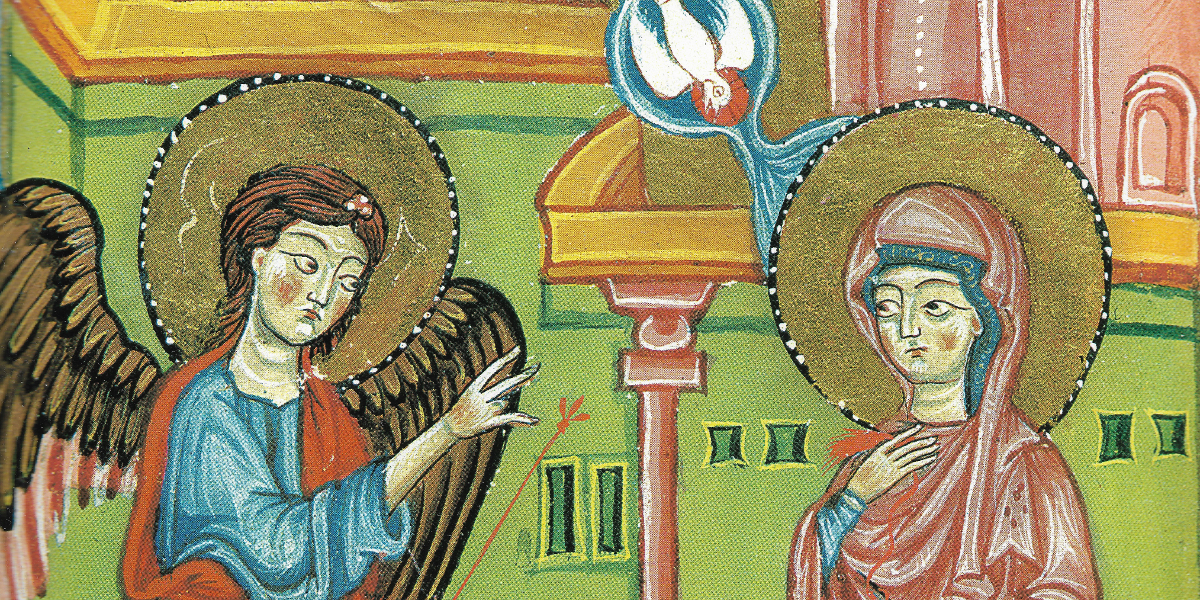
The Annunciation of Our Lord – Vicar Anderson sermon
Text: St. Luke 1:26-38
In Christ Jesus, where at the end of the season of Lent we get this taste of Christmas, an announcement of why your Savior was born for you, dear fellow redeemed:
There are many ways in which you can find information. Many surf social media. Some watch the news on the TV. What I have learned living in New Hampton is: You must read the newspaper. If you want to be in the know, you just read it. How else will you know what is happening with the county? Now the newspaper can be used for many different announcements. It can be used to announce weddings, funerals, anniversaries, and the like. How about using an angel? Now that would be a statement! And what kind of announcement comes from an angel? Well, it must be something special. When God wants to announce something important, He sends His messengers. Today we celebrate a special announcement. The time has come! God announces His promise for all, the promise of a Savior—true God and true Man.
This special announcement of the Christ’s coming is always celebrated on March 25th. There are a few reasons why that is. This is the day of Jesus’ conception in Mary’s womb. He was conceived at God’s command. A great miracle. Then do some simple math and add nine months to the date. Nine months from now we are celebrating the birth of our Savior. The date of Christmas came later, though, and this is not why the early Christians settled on March 25th. They were looking at the incarnation for a different reason. In Jewish tradition, it was thought that the great prophets died on the same calendar day that they had been conceived. The early Christian church identified the date of Jesus’ death as March 25th. That is one of the first things they celebrated and held as important. We see that important connection too. The reason that Jesus is born is so that He can die.
That reason was even tied up in His name. Mary is told the name she is supposed to give her son. She is to give Him the name Jesus. Jesus means God saves. The prophet Isaiah also prophesied the importance of today. “Therefore the Lord himself will give you a sign. Behold, the virgin shall conceive and bear a son, and shall call his name Immanuel” (Isaiah 7:14.) Immanuel means God with us, and today we see it so clearly. The closest God can be with us is when He comes in the flesh. Gabriel announces God’s plan, His promise to send His son down from heaven and it is happening. “But she [Mary] was greatly troubled at the saying, and tried to discern what sort of greeting this might be.”
Like Mary, we would be afraid to see the power of God. The Power of God means He sees and knows all our sins. The world depicts angels as gentle people or even tender babies. But Scripture describes them differently. When angels appear, people are often terrified. God is called the LORD of Armies. This angel is bringing a message directly from God. Would we want to hear that message? We would be troubled seeing their power as we are sinful creatures. They dwell in God’s presence.
But Gabriel told Mary not to be afraid, because she had found favor with God. Found with favor, yet she was still troubled. That is what we want to have, favor with God. The question is how do we find it? Do we look at God’s favor as something we earn, or something we are freely given? Our sinful nature likes to think that we can find favor with God by our efforts. Our pride works hard to earn His favor. Whether we are trying to move up the corporate ladder or be accepted by our friends, our ambitions might not be in the right place. As we look to serve ourselves, we forget that everything we do should be in service to God. We forget the very first commandment of what we are to do. We are to love God with all our heart, soul, and mind. Because we have failed to do this, there is no favor found here.
In our sins, it is impossible to find favor with God. We can’t have favor with the world and favor with God at the same time. We like to be of the world. We want to find favor in the world. Doing so causes us to sin in ways for us to find that favor. The world wants us to be more accepting. It wants us to accept everyone’s sins. When we give into that pressure, usually we do it because we might be engaged in those same sins. We might not realize it before it is too late. Do we give up our sins when they are brought out into the light? Do we double down to try and get our way? To find favor in the world, we find our own destruction.
When God sent Gabriel to Mary, He was announcing the keeping of His promise. This promise is THE promise made in the Garden of Eden. The promise was repeated to Abraham, Isaac and Jacob. The promise was prophesied about by the prophets. King David heard directly that, “your house and your kingdom shall be made sure forever before me. Your throne shall be established forever” (2 Samuel 7:16.) Years and years go by, building up to this important moment. It is time for God to keep His promise, which means the child that Mary had, that she conceived, His job was to grow up, suffer and die for you.
Jesus is the promised Savior. He is conceived at the speaking of God’s Word, and then He is born. This miracle shows that all things are possible with God. We never have to doubt God. This singular date brings together both holidays that the Christian church loves. We have the joy of Christmas knowing that the somberness of Good Friday is around the corner. Jesus’ birth is only one step of His humiliation. He must be born to die for you. His death on the cross cleanses you of your sins and with His rising from the grave, another miracle assures you that your sins are gone. Your favor is found in Christ death and resurrection.
Thankfully our favor with God is not up to us. There is only one person who can have perfect favor with God. That person not only is man, but He is also God. That is who Jesus is, true God and true man. He perfectly finds favor with His Heavenly Father. We hear the Father say how much favor Jesus has. He says, “This is my beloved Son, with whom I am well pleased” (Matthew 3:17.) Jesus does His Father’s will. He knew that this is why He was sent here. Only He can willingly obey the law in our place. Only He can willingly die in our place. Jesus’ death and resurrection saves everyone because when God the Father looks at us, He sees the life that Christ lived.
We now have favor with God because Jesus lived the life that we couldn’t. This announcement comes directly to you every day. As we fall flat on our faces and the world looks to convince us that we must find favor with it in order to live, this announcement comes to you with forgiveness because you hear the Son of God comes to save you.
God announces His promise for all to hear. First Mary hears it announced directly to her. That she was picked to be the bearer of the Christ child. You hold onto this announcement by faith in the Savior. Faith that is from the work of the Holy Spirit in you. This announcement comes to you through the hearing and reading of the Word. You hear the Words of God as He announces His coming Son to save all of mankind. He is born to die for the sins of the world. He is the Word made flesh. This is the joy that you have. God keeps his promises. He says nothing is impossible with Him. Since we were condemned because of our sins, God sent a Savior. Mary conceives Jesus by the Holy Spirit. Your Salvation came down from heaven.
The angel tells you what Jesus’ job is here on earth. “He will be great and will be called the Son of the Most High. And the Lord God will give to him the throne of his father David, and he will reign over the house of Jacob forever, and of his kingdom there will be no end.” He will reign forever, and you inherit His kingdom because of what He did for you. You couldn’t earn God’s favor but you have God’s favor because Christ earned it for you. God announces His promise for you.
An announcement for the ages. It wasn’t found online or in the newspaper. This announcement came from a special messenger directly from God. Mary heard the ultimate news. Her Savior was sent for her, and she would be the one to give birth to Him. We see abundantly clear that God keeps His promises. This was the ultimate promise. Eve was promised that her seed would crush Satan’s head. Jesus is the promised seed. His mission was simple. He lived a perfect life to die. Today we celebrate Jesus’ incarnation. In less than two weeks we remember His death. As one of our Christmas hymns says: “Nails, spear shall pierce Him through, The cross be borne for me, for you; Hail, hail the Word made flesh, The Babe, the Son of Mary!” (145:2 Evangelical Lutheran Hymnary). Amen.
Glory be to the Father and to the Son and to the Holy Ghost; as it was in the beginning, is now, and ever shall be, forevermore. Amen.
+ + +
(picture from “The Annunciation” by Toros Taronetsi, 1323)

Christmas Eve – Pr. Faugstad homilies
Text: Galatians 4:4-5
I. But when the fullness of time had come,
Adam and Eve knew this time would come. Their son Seth and his son Enosh knew. Abraham, Isaac, and Jacob knew. David knew. And the lowly virgin Mary knew. They knew that God would send a Savior for them, One who would crush the head of Satan and undo the curse of sin (Gen. 3:15). But when would the Savior come? Thousands of years had passed since God first promised a Savior. When would the promise be fulfilled?
The apostle Paul answers: it was “when the fullness of time had come.” Just as we cannot predict when our Lord will return again in glory, we could not have predicted when He would come in the flesh. The people of Israel were to expect the fulfillment of God’s promise at any time, just as we are to expect His promised return at any time.
God always knows the best time. There is nothing hidden from Him. He sees everything in the past and in the future as though it were happening in the present. He knew when the time was right to carry out His promised plan. All the prophecies of the Old Testament, inspired by the Holy Spirit, pointed to this time.
Now was the time for a prophet like Moses to rise up (Deu. 18:15). Now was the time for the virgin to conceive and bear a Son who would be called “Immanuel” (Isa. 7:14). Now was the time for a Shoot to grow from the stump of Jesse (Isa. 11:1), a righteous Branch from the royal line of David (Jer. 23:5). Now little Bethlehem would be back on the map (Mic. 5:2). Now was the time for shepherds to see the night sky light up with the glory of the Lord and hear the history-altering words of those herald angels.
Hymn: #125.1-2 – “Hark! The Herald Angels Sing”
II. God sent forth His Son,
“God sent forth His Son.” They are simple words, but who can truly appreciate their meaning? We might expect the righteous God to send His eternal Son to condemn this broken, sinful world. Isn’t that what we would do? If you handed the keys to a brand new car to a friend and said, “I trust that you will take good care of it.” And your friend drives around recklessly damaging everything in his path and then crashes your car and destroys it, you would be very angry. You would want justice and repayment.
And what if your friend tried to put the blame on you? “Well, it’s not like it was a very nice car. You could have done a lot better. If you had made a better plan, none of this would have happened!” That’s what Adam and Eve did; they tried to put the blame on God and each other. And we keep on doing the same thing. Each one of us has broken God’s Law more than we know, and yet we still find it easy to blame God and one another for our troubles.
How should God respond to such wickedness? He responded not with anger but with grace. “For God so loved the world, that he gave his only Son, that whoever believes in him should not perish but have eternal life. For God did not send his Son into the world to condemn the world, but in order that the world might be saved through him” (Joh. 3:16-17). That is good news—glad tidings of great joy.
Hymn: #123.1-4, 13 – “From Heaven Above to Earth I Come”
III. born of woman,
Human beings have done some great and mighty things. People have climbed the highest mountains and explored the oceans’ depths. They have built impressive structures and developed life-changing technologies. But no one with their accomplishments or inventions—no matter how great—can hold a candle to what Mary did.
Mary of Nazareth would have never been described as someone who was “going places.” She did not strive for or expect to be a “somebody.” She wanted to marry a poor craftsman, set up a warm home, and hopefully be blessed with children. All that changed when the angel Gabriel suddenly appeared saying, “Greetings, O favored one, the Lord is with you!” (Luk. 1:28). The angel explained that Mary had found favor with God, which tells us that she believed the promises of God’s Word.
The angel told her that she would conceive and bear a Son, whom she was to name Jesus. He would ascend the throne of His ancestor David and reign over an everlasting kingdom (vv. 31-33). “But how could a virgin bear a child?” Mary wondered. The angel said, “The Holy Spirit will come upon you, and the power of the Most High will overshadow you; therefore the child to be born will be called holy—the Son of God” (v. 35). That’s what made Mary so great—she was chosen by God to carry and care for the incarnate Son of God, the holy Christ-Child, who came to bring peace on earth to men.
Hymn: #113.1-2 – “A Great and Mighty Wonder”
IV. born under the law, to redeem those who were under the law,
For us, the birth of Jesus in Bethlehem has a warmth to it. We put nativity scenes in our homes that make it seem like Jesus couldn’t have been born under more favorable conditions. But we must remember why this sweet baby was here. The eternal Son of God had taken on flesh, so that He might do everything for us that we had failed to do.
He was “born under the law, to redeem those who were under the law.” By becoming a man, He made Himself obligated to His own holy Law. He had to live up to every rule and regulation of God, not only in His actions and words but also in His thoughts. And that is what He did. At every stage of His life—infant, toddler, child, teenager, adult—He perfectly adhered to the Law of God. He did not have anything to gain from it personally, since He was already perfect from eternity. But you and I had everything to gain by it.
No human being had ever kept the Law of God. All of us had fallen far short of God’s requirements. So the perfect, unreachable standard of God’s Law cursed us and condemned us. It told us that we had sinned against the holy God and must face His wrath. Except that God Himself intervened. He couldn’t undo the Law—His Law is perfect, and He is neither capable of nor interested in imperfection. But He could send His Son to take our place and fulfill the Law for us.
That is why God’s holy Son was here. He was here to redeem our sinful lives by His perfect life. He was here to pour out His holy blood on the cross to satisfy the righteous wrath of God. He came down from His exalted throne for no other reason than to save our fallen race.
Hymn: #127.1-2, 5-6 – “I Am So Glad When Christmas Comes”
V. so that we might receive adoption as sons.
A child who is adopted does not do anything to get adopted. He is chosen by others to be their child, live in their home, and receive their care. That is how it is with us and God. We did not choose Him; He chose us. We do not go to Him; He comes to us.
Like an orphan, you may feel as though you hardly matter to anyone. You might wonder if anyone really cares about you. You might think to yourself that everyone would be better off if you were gone. But that is not what God thinks. He created you and formed you in your mother’s womb with a care that would make even the most skilled craftsmen bow their heads in awe.
Not only that, but God sent His only Son for you, to suffer and die for you, so that you would have eternal life. He brought you to the waters of Baptism, so that you could learn how much He cares for you. He claimed you through those waters. He adopted you as His own child and put His name on you. He said to you that day, and He says it every day since then, “All that I have is yours. My holiness is yours. My life is yours. My kingdom is yours.”
Everything Jesus obtained for you by His perfect life, His innocent death, and His victorious resurrection has been given to you by your merciful Father in heaven. Jesus became your Brother in the flesh, so you would inherit everything that is His. He became a lowly Servant, so you would become an honored lord.
Hymn: #148.1, 6-8 – “Praise God the Lord, Ye Sons of Men”
+ + +
(picture from “Shepherds Visit” by Julius Schnorr von Carolsfeld, 1794-1872)