

Sexagesima Sunday – Pr. Faugstad sermon
Text: St. Luke 8:4-15
In Christ Jesus, who promises all who abide in His Word that they are His disciples, set free from sin, death, and every lie of the devil (Joh. 8:31-32), dear fellow redeemed:
If we studied Jesus’ parable by itself without the interpretation He gave, we would miss the point of the whole thing. We might first of all question the method of the farmer who sowed the seed. Couldn’t he be a little more precise about where the seed was broadcast? Three quarters of the seed fell where it was unable the survive and thrive—the hard path, the rocky ground, and the patch of thorns. Only one quarter fell into the good soul, grew up, and yielded fruit. We might conclude that it was the farmer’s fault that the seed did not do better.
Or perhaps we would blame the difficult conditions for growing seed. With all the birds flying around, with all the rocks, and with all the thorns, what chance could the seed have? It seems that the seed was destined to fail. Or possibly some would also criticize the seed. If the seed were better engineered to handle the challenging conditions, a crop could grow even there.
But Jesus does not interpret the parable in this way. His focus is not on the one who scattered the seed, the challenging conditions, or the seed itself. His focus is on the people who hear His words. As He spoke the words of the parable, He called out to everyone around Him, “He who has ears to hear, let him hear.” That should have told the people that Jesus wanted them to learn something from His words, something that applied to their faith and salvation. But what were they supposed to learn? Were they the farmers? Were they the seed? Were they the birds, the bad ground, or the good ground?
Jesus’ disciples were not sure themselves, but they knew this was important. They asked Him what the parable meant. We learn to ask the same question from our study of the Catechism. We recite something from the Bible like the Ten Commandments, and we ask after each one: “What does this mean?” We don’t just want to know the words, we want to understand them. We want to know how they apply to our lives. We want to meditate on what God is saying and receive the rich blessings He wants to give.
But many don’t take the time to dig into the Word like this. They have a basic understanding of who God is and what Jesus has done, but they don’t go any further. They think they know as much as they need. They don’t have any strong desire to learn more.
This is something like people who have never watched a football game before. They turn it on and figure out that the players with light stretchy pants are going against the players with dark stretchy pants. They both want to play with the same ball. Sometimes they throw it, sometimes they kick it, and sometimes they steal it. They seem to want to punish one another. That kind of watching might entertain to some extent. But the game means a lot more when you know the strengths and weaknesses of each player, and how the offense and defense are looking for leverage against each other.
The more understanding you have, the more appreciation you have. Isn’t that how love develops between a young man and a young woman? They want to spend time with each other, learn about one another’s likes and dislikes, talk about their difficulties and their dreams. You and I won’t have a love for God’s Word unless we spend time with God’s Word, learning what He has done for us and how He wants us to live, sharing our problems with Him through prayer and hearing about the plans He has for us.
So we don’t read the Bible like an ancient history book, as though it’s only about things long past. We don’t read it like an instruction book that we can set aside as soon as we know the rules. We don’t read it like a children’s book either, looking only for a cute story or a simple message. We take the Bible in our hands and soak it in line by line like the love letter that it is. We pour over it as we would the smallest details on a treasure map. We read a passage and then read it again and again, absorbing the words, chewing on them.
I heard about one Christian who writes a new Bible passage on a small piece of paper every day and pulls it out of his pocket throughout the day to keep it in his head. Others read a portion from their Bible each day. They have maybe read the Bible multiple times and are constantly surprised by what they didn’t notice before. There is no right or wrong way to meditate on the Word of God, as long as we are letting His Word speak for itself. We don’t come up with our own unique interpretations of His Word. We read a passage in its context; we compare one passage with another, this part with that part, and the interpretation becomes clear.
In today’s reading, Jesus provides the interpretation for His own parable. After His disciples asked, “What does this mean?” Jesus explained how to understand and apply each part. He did not identify the farmer who sowed the seed, so that is not a detail we need to explore. The seed is the Word of God. And all the types of ground—the hard path, the rocky ground, the patch of thorns—are those who hear the Word.
The seed was the same wherever it fell; all hear the same powerful Word of God’s grace. This shows how God “desires all people to be saved and to come to the knowledge of the truth” (1Ti. 2:4). He generously broadcasts His Word, so that it is heard by people who might not seem to be good soil for the Word. But sometimes they are! Since we do not know in whom the Lord will work faith, our mission as members of His Church is to “proclaim the gospel to the whole creation” (Mar. 16:15), to “Go… and make disciples of all nations” (Mat. 28:18).
Since we are all born with the same original sin, none of us is a naturally “good” candidate to hear His Word and believe. Even we who believe need encouragement to “hold fast” His Word because we are always tempted to loosen our grip, to let other things become more important. When Jesus describes the reasons people lose faith, He is not providing a list of excuses. He is not telling us why some are justified in rejecting what they have heard.
The devil snatches the Word from some hearts because the people who hear pursue temptation instead of faithfulness. The seed in the rocky soil does not take root because some turn away from God in times of testing and difficulty instead of turning toward Him. The seed choked by thorns is when priority is given to “the cares and riches and pleasures of life,” when faith is taken for granted instead of being fortified and strengthened.
These things can happen to any of us, and at various points in our life, they probably have. But our Lord is merciful. When He sows His Word, He does not snatch it away from us. He does not withhold the moisture of His “living water” so that our faith cannot sink down roots. He does not send thorny trials to choke our faith. It’s just the opposite: “a bruised reed he will not break, and a faintly burning wick he will not quench” (Isa. 42:3).
He wants you to hear His holy, soul-saving Word. He wants you to hear the message again and again that He loves you—even weak, unworthy you. He wants His sweet words of absolution to sink into your ears and heart, that He forgives every single one of your sins. He wants you to be confident that “though your sins are like scarlet, they shall be as white as snow; though they are red like crimson, they shall become like wool” (Isa. 1:18). He wants to assure you that a place is prepared for you in His kingdom, and that He will come back in glory to take you there.
When you receive these words in faith, trusting His gracious promises, gaining the comfort He wants you to have, this is the “good soil” in which His Word does powerful work. The more we hear the Word, the better and more fruitful becomes the soil of our hearts. You have seen this in your own life, that difficulties you could not have managed on your own, God gave you the strength for. People you could not have forgiven on your own, God moved you to forgive.
The Word of God is “living and active” (Heb. 4:12). It does not return to Him empty but accomplishes what He wills (Isa. 55:11). His Word creates the faith and strengthens the faith that bears fruit toward the people around us—the good fruit of love, kindness, faithfulness, patience (Gal. 5:22-23)—in our homes, our church, and our community.
Today’s parable is Jesus’ word to us. His message rings out even to the other side of the world and thousands of years after He originally spoke it: “He who has ears to hear, let him hear.” And when we listen, when we treasure up all these things and ponder them in our hearts (Luk. 2:19), Jesus leans toward us and says, “To you it has been given to know the secrets of the kingdom of God.” To you! To know the secrets of the kingdom of God!
The secrets are that you are not meant for this world; you are meant for something much greater. You are not destined to die and remain dead; you are destined to live. “For God did not send his Son into the world to condemn the world, but in order that the world might be saved through him” (Joh. 3:17). Jesus came to save you, and He wants you to know it.
Blessed Jesus, at Thy Word
We are gathered all to hear Thee;
Let our hearts and souls be stirred
Now to seek and love and fear Thee,
By Thy teachings, sweet and holy,
Drawn from earth to love Thee solely. (Evangelical Lutheran Hymnary #1, v. 1)
Glory be to the Father and to the Son and to the Holy Ghost; as it was in the beginning, is now, and ever shall be, forevermore. Amen.
+ + +
(picture from Hortus Diliciarum, a book compiled by Herrad of Landsberg in the 12th century)
Sexagesima Sunday – Vicar Lehne sermon
Text: St. Luke 8:4-15
In Christ Jesus, who never gives up on us, dear fellow redeemed:
When we hear the parable of the sower, we can easily focus on how each type of bad ground was described and wonder, “Well, what did the sower think was going to happen?” If you throw seed onto a path, of course it isn’t going to take root, but be trampled and devoured by birds. If you throw seed onto rocks, of course it isn’t going to have a deep enough root to get the moisture it needs to grow. If you throw seed among thorns, of course the thorns will grow up with the seed and choke it. But the picture that Jesus is using in this parable actually describes things that the people at that time would be familiar with.
Before the farmers did any sowing, the field was first plowed to break up the soil. After the plowing was done, the entire field would appear to be good soil, but that was not the case. Some parts of the field only had a thin layer of soil on the top with a layer of rock beneath it. Some parts of the field ended up growing thorny weeds along with the seed, weeds that can pop up anywhere no matter how much a person tries to protect their crops from them. Plus, as a sower threw his seed out onto the field, some of the seed would undoubtedly fall on the paths of soil that were packed down from people walking on them.
Jesus uses these relatable struggles of farming to teach us that God generously sows the seed of his Word in every type of heart, not just the hearts that are the most ideal, because God “desires all people to be saved and to come to the knowledge of the truth” (1 Timothy 2:4). But not everyone who receives his Word is saved. Some people hear the Word, but their hearts are hard like the packed down soil of a path that runs through a field. So, the Word doesn’t take root in their hearts and is plucked away by the devil. Some people hear the Word, and the Word fills them with joy. They appear to be strong Christians on the surface, but in reality, their faith is shallow, like a thin layer of soil on top of a layer of rock. Their faith is unable to get the nutrients it needs to stay alive, so when they are faced with hard times, they fall away. Some people hear the Word and receive it in faith, but the cares, riches, and pleasures that surround them like thorny weeds choke their faith and kill it. And some people hear the Word and hold on to it. Their hearts are repentant and, through their trust in God, they are able to patiently endure what destroyed the faith of the others and produce a crop that shows the fruit of their faith.
Of these four types of soil, which soil are you? That seems like a silly question. Of course you’re the good soil. You know that you’re a sinner and are repentant of your sins, you put your trust in God, and you do plenty of good things throughout your life that prove that your faith has produced a plentiful crop. But this parable is not just a warning to those who have rejected the Word, fallen from faith, or are in danger of losing their faith. This parable is also a warning to all of us who think that we are secure in our faith. As the apostle Paul says, “Therefore let anyone who thinks that he stands take heed lest he fall” (1 Corinthians 10:12).
There are many dangers that could result from us thinking that we are secure in our faith. One of those dangers is thinking that we don’t need to worry about sin because God forgives us all our sins anyway. Sin is a very serious thing, and if we think that God will forgive our sins whether they bother us or not, then we could end up no longer viewing sin as the serious thing that it is. Not taking sin seriously could also lead to us living in sin without feeling the need to repent and turn to Jesus for forgiveness. And if we don’t think that we need forgiveness for our sins, then we could think that we don’t need Jesus and lose our faith. What starts off as us not taking sin seriously could end up with us having hardened hearts, and the devil will have an opportunity to pluck the Word away from us.
There are times when we all become comfortable in certain sins. But when that happens to you, God doesn’t leave you alone to see if you’ll pull through on our own. If he did that, then your hearts would become hardened for sure. Instead, he gets to work on you, plowing the field of your heart to break up its hard soil. Through his Word, he shows you the seriousness of your sin, and that you deserve eternal death in hell. Then, through that same Word, he gives you the comfort of the gospel, showing you that Jesus paid the price for even your most serious and repeated sins by his death on the cross, so that you will not die, but live forever with him in heaven. Because of the sacrifice that Jesus made for you, you are God’s own dear child, and he will make sure that the devil cannot pluck you out of his hand.
But that is not the only danger to our faith. There is also a danger for us to feel secure enough in our faith that we don’t think that we need to regularly remain in the Word. After all, we’ve heard these accounts countless times and can even recite some of them by heart. We know the basic truths of Scripture: that we are all sinners, and that Jesus died for our sins. This could cause us to think that we don’t need to keep reading the Word or coming to hear the Word, because we think that we already know everything. But, if we don’t keep coming back to the Word, then our faith won’t be able to receive the nutrients that it needs to stay alive. It will become shallow, like the thin layer of soil on top of the layer of rock. And if we have a shallow faith when we enter a time of testing, then we are in trouble.
There are many times throughout our lives when God allows us to enter a time of testing. These times of testing can be quite hard on us. There are times when work can be difficult due to people we are interacting with or due to the demands of our work that seem unattainable. There are times when we think that we are doing great at our tasks or with our relationships, and then suddenly, we mess up in a way that we don’t think we’ll be able to recover from. There are times when our loved ones fall ill and begin to suffer terribly, or their lives are taken from us in tragic ways. No matter what our difficult times are, God promises to be with us and help us through them. He gives us this comfort through his Word. But if we have not kept our faith nourished though his Word, then where are we going to get that comfort from? As a result, the burden of our troubles could appear to be too much for us, and we could end up falling away from the faith, wondering why God allowed this to happen to us.
If your faith is starting to get shallow because you are not remaining in the Word, God takes appropriate measures to help you. He breaks up the rock beneath your shallow faith and works through his Word to fill that space with more faith, so that the Word can take root in your heart and thrive. Often, he works through times of testing to accomplish this, reminding you of how much you need him and of how much he has done for you, including giving up his own life for you. By dying on the cross, Jesus dealt with your biggest problems of all: sin and death. And if God loved you enough to die for you, then surely, he also loves you enough to keep his promise to always be with you and bear your burdens in your time of need. When God turns you back to his comforting Word, the joy you feel is no longer a shallow joy that can easily be destroyed, but a joy that comes from the deepest parts of your heart.
The last danger to our faith is the distractions that the world surrounds us with. These distractions can appear to be harmless. After all, what’s wrong with earning a little extra money, or buying some items that we’ve always wanted, or going to sporting events and other fun places? There is nothing wrong with these things in and of themselves, but when those things start to become more important to us than God, then we have a problem. What starts as just wanting to earn a little extra money could turn into spending as much time working as possible, even if it means we don’t have time to gather around the Word anymore. What starts as just wanting a few items could turn into us obsessing over those items and wanting to spend all of our time making use of them rather than spending that time in the Word. What starts out as us wanting to go to a few fun events and places could turn into us going to them whenever we can, even if it means that we have to sacrifice gathering around the Word. When the distractions of this world overtake us, they can choke our faith out and kill it, like seeds growing up surrounded by thorny weeds.
When you are in danger of having your faith choked out by the distractions of this world, God comes to you to remove those distractions, like a farmer pulling weeds. He can remove these distractions in many different ways, whether it’s by helping you to realize that you need to distance yourself from them or by removing them from you by other means. It can be difficult for us to part from our distractions, but when we do, and God works in us to make our faith grow free of those distractions that were choking us, we realize just how little we actually needed them. We also realize how much we need the blessings that Jesus won for us on the cross that God brings to us through his Word: the forgiveness of sins, life, and salvation. The work that Jesus did to earn you these blessings is more important than any work you could ever do. These blessings that Jesus purchased for you on the cross are more valuable than anything you could ever purchase. The event of Jesus’ suffering and death is a more significant event than anything you could ever attend. And thanks to the work that God does on your hearts through his Word, you realize just how much greater Jesus and the blessings that he won for you are than the distractions of this world.
When a farmer plants his seed, he doesn’t leave it unattended. He keeps coming back to make sure that it’s healthy and growing, and if he needs to work the ground some more to protect his crop, he will. God doesn’t leave you unattended either. He has planted his Word in your hearts and is constantly making sure that your hearts remain fertile soil for his Word. Even when your hearts are not the ideal ground for the Word to grow in, God never gives up on you and is always working the soil of your hearts to make sure that his Word can take root in your hearts and grow. Because of God, your faith is protected and taken care of. Because of God, you know that the blessings that Jesus won for you on the cross are yours.
Glory be to the Father and to the Son and to the Holy Ghost; as it was in the beginning, is now, and ever shall be, forevermore. Amen.
+ + +
(picture from Hortus Diliciarum, a book compiled by Herrad of Landsberg in the 12th century)
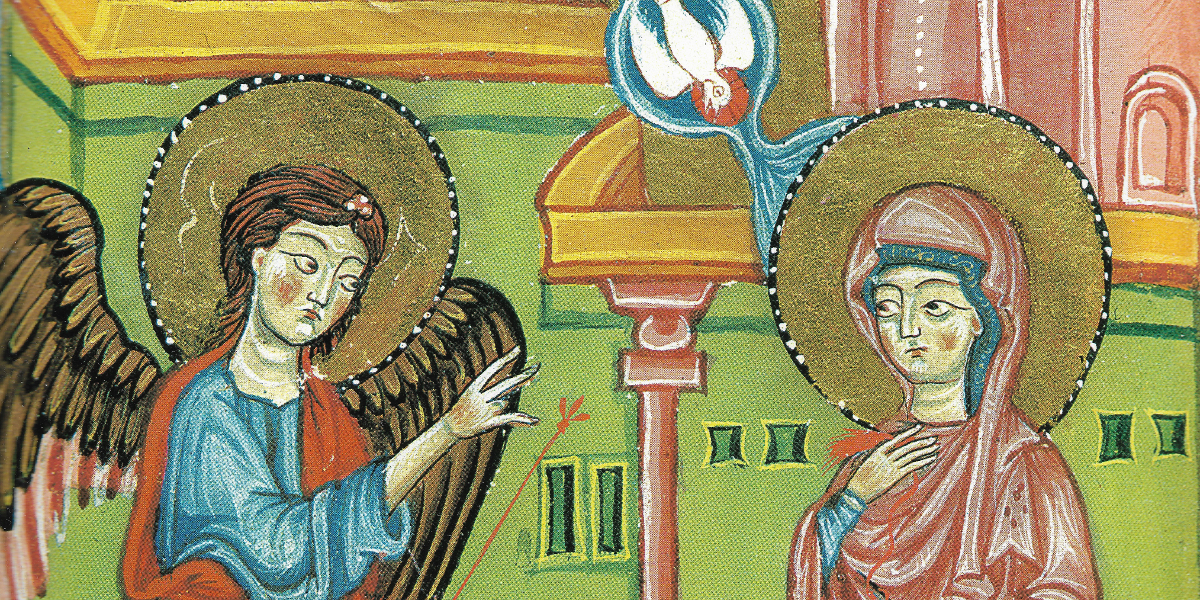
Christmas Eve – Pr. Faugstad homilies
St. Luke 1:31-35,38
I. The angel Gabriel said to Mary: “And behold, you will conceive in your womb and bear a Son, and you shall call His name Jesus.”
This scene has a specific context, a context that stretched back thousands of years. The reason an angel of the almighty God appeared to a young woman named Mary is because of another woman who lived long before this, all the way back in the beginning of time. That woman had a blissful and holy existence with her husband in a beautiful garden. They had no sin. They felt no pain. They lacked nothing.
But then a tempter came to the woman. “Wouldn’t you like to have even more?” he said. The woman gave in to the temptation, and so did her husband. They ate fruit from the one tree God had forbidden. Now they had sin. Now they knew pain. Now they were left with nothing. They hid from the presence of their Creator!
But God still loved them. He had mercy on them. He told the tempter, “I will put enmity between you and the woman, and between your offspring and her offspring; he shall bruise your head, and you shall bruise his heel” (Gen. 3:15). Adam thought the LORD was referring to Eve and her firstborn son (3:20, 4:1). But He was especially referring to another woman—to Mary, lowly Mary, Mary of Nazareth, who wouldn’t be born for several thousands of years.
In this evening’s reading, we see that God keeps His promises. He sent an angel to tell Mary that she was the one. She was the one who would bear the Son who would crush the head of Satan. She was the one who would bear the Son who would pay for all the sin of Adam & Eve and all their descendants. She was the one who would bear the Son whose name revealed His purpose. He was to be called “Jesus”—the One who saves.
Hymn: #119 – “Away in a Manger”
II. “He will be great and will be called the Son of the Most High.”
When Jesus lay there “asleep on the hay,” He did not look very impressive; He did not look so “great.” He looked like an ordinary little baby who needed what all babies need—milk, sleep, and new diapers. But this particular Baby was much more than met the eye. In the mystery of all mysteries, “the Son of the Most High,” the Son of God, had taken on human flesh.
We heard how His coming was prophesied right after the fall into sin. But the plan was actually in place before God the Father made the world and everything in it. God the Holy Spirit inspired the apostle Peter to write that our Lord Jesus Christ “was foreknown before the foundation of the world but was made manifest in the last times for the sake of you” (1Pe. 1:20).
The Son of God was incarnate, the Christ was made manifest, “the Word became flesh and dwelt among us” (Joh. 1:14). This great Lord, this “Son of the Most High,” came in the most unexpected of ways. He did not come down from heaven on the clouds in all His brilliant glory. He did not enter the world in the court of a powerful king. He came to the womb of a poor woman and was born in a little town. He “made Himself of no reputation, taking the form of a bondservant, and coming in the likeness of men” (Phi. 2:7, NKJV).
But why would He do this? Why would the God of eternity come down to us in this way? The apostle Paul tells us, “For you know the grace of our Lord Jesus Christ, that though he was rich, yet for your sake he became poor, so that you by his poverty might become rich” (2Co. 8:9).
Hymn: #123.1-4,15 – “From Heaven Above to Earth I Come”
III. “And the Lord God will give to Him the throne of His father David, and He will reign over the house of Jacob forever, and of His kingdom there will be no end.”
These words describe both the divine and human natures of the Christ: “And the Lord God will give to Him the throne of His father David.” The Lord God, God the Father from eternity, sent His only-begotten Son to join a human line. It was the line of Adam and Noah, Abraham, Isaac, and Jacob, the line of Jesse and his son David who was called from keeping sheep to be Israel’s king.
God promised that after David’s death, He would raise up an Offspring of David after him and “establish the throne of his kingdom forever” (2Sa. 7:13). That promise endured one thousand years through the crumbling and captivity of Judah and its return from exile until the birth of Jesus. Although the glory had long since departed from David’s royal line, Mary could trace her lineage to him.
More importantly, Mary was tied to the Promise, the Promise first made in the Garden of Eden, a Seed of Promise passed down from generation to generation, until it was planted in Mary’s womb by the Holy Spirit. The Child in her womb was both Man and God, both David’s Son and David’s Lord.
Though the world did not know it, He was a great King. He was the greatest King who ever walked on this earth, and He still reigns. He reigns with power and grace over His people. He sits on the throne of a kingdom that has no end.
Hymn: #143.1-2,7-9 – “The Happy Christmas Comes Once More”
IV. And Mary said to the angel, “How will this be, since I am a virgin?” And the angel answered her, “The Holy Spirit will come upon you, and the power of the Most High will overshadow you; therefore the Child to be born will be called holy—the Son of God.”
“How will this be, since I am a virgin?” Do we find it strange that Mary brings this up? Why does she feel compelled to mention her virginity? If Mary were living now, she would be told, “Mary, what you do with your body is no one’s business but yours.” But in fact what I do with my body and what you do with yours isn’t just our own business. What we do with our bodies is part of something bigger.
All who are baptized into Christ become part of His holy body. He was covered with our sins, so we would be clothed in His righteousness. He died in our place, so we would live. The apostle Paul writes that Christ “died for all, that those who live might no longer live for themselves but for him who for their sake died and was raised” (2Co. 5:15).
It does matter that Mary was a virgin. It means that the child in her womb was not conceived in her by a sinful man. That would mean their child was a sinner like them. But Jesus had no sin. He was conceived in Mary’s womb by God the Holy Spirit and therefore was “called holy.” Jesus had to be holy, so that He could take the place of you and me and all people, and offer Himself as a holy sacrifice for our sins.
Hymn: #113.1-2,4 – “A Great and Mighty Wonder”
V. And Mary said, “Behold, I am the servant of the Lord; let it be to me according to your word.” (ESV)
What a beautiful faith we find in Mary! She heard the stunning words of the angel which seemed to violate all sense, and she believed. “Behold, I am the servant of the Lord; let it be to me according to your word.” Martin Luther wrote that at her faithful hearing of God’s Word, Mary conceived “through her ear.” The day the angel visited her was the day God became man, starting as a tiny embryo in her womb.
Our minds are unable to comprehend the incarnation of God. How could the God of the universe spend nine months growing in a dark womb? How could He who has no beginning and no end be born of a woman and cradled in her arms? We cannot understand it any more than Mary could.
But we can rejoice. We can give thanks that the eternal Son of God was born for us. He was born to let nails and spear pierce Him through. He was born to bear the cross for me, for you. We don’t understand it. We don’t deserve it. But God declares it to us. “It is for you,” He says. So we reply, each one of us, with a believing heart, “Behold, I am the servant of the Lord; let it be to me according to your word.”
Hymn: #145 – “What Child Is This?”
+ + +
(picture from “The Annunciation” by Toros Taronetsi, 1323)
Sexagesima Sunday – Vicar Anderson sermon
Text: St. Luke 8:4-15
In Christ Jesus, who sows the Seed of the Word of God for all to hear, sowing forgiveness and grace in you, dear fellow redeemed:
Living in Iowa, there is one part of the scenery that I have gotten used too. The land is flat, and since it is flat, there will be corn. Miles and miles of corn. Jesus’ parable is very straight forward and knowing these congregations, you should hear Christ speaking directly to you. This message is very fitting. You know what it takes to get that corn to grow. The field has to be tilled. The rocks have to be picked out of the field and thrown to the side. The field has to be treated so that the weeds don’t attack and kill the baby corn stalk. Lastly, you pray to God for rain and look expectantly for it to grow. Jesus has designed this parable for you. Now as you are the sowers of your fields, in our text we see Jesus, the sower of the Word. Jesus warns us how the Word is under threat. He teaches that this is not just a parable of categories and where you fit in. Jesus is teaching us the truth that we can’t grow His Word on our own. We have to rely on him.
Jesus uses imagery that easily sticks in our minds. The parallels are very easy to spot. Pesky birds fly down and eat the seeds on the road. The Devil is a hunting lion stalking his prey and ready to strike. He is constantly working to make those who hear the Word reject it. The seed is eaten with almost no chance for it to ever come back. The seed can be planted multiple times and a person can reject it every time. Where the field’s edge sits, the rocks are thrown. The Word is believed and quickly forgotten. Many people love how the Word can be refreshing and comforting. But when the troubles and absolute hard times put us on our knees, those refreshing words can be tossed aside because what can they do to help me now?
Where weed killer isn’t used, the thorns grow. When God’s Word isn’t active, then faith is choked out. Jesus shows the crowd how easily the pleasures and riches of world can be those temptations that make faith wither. They saw the life He was living, yet they looked at all of their possessions and they did not want to give them up. The good fruit that comes from the Word is twisted into fruit selfishly used for oneself.
Did you hear yourself in any of those categories? A misconception of this text is to think that this text only applies to the world and not to those who believe. Most of the time if not all of the time we will consider ourselves in that field, holding onto the Word and yielding a hundredfold. A key verse to think about is when Jesus called out, “He who has ears to hear, let him hear.” How often do we let the Word of God go in one ear and out the other ear? We hear; honor your parents, honor authority, don’t covet, don’t look at someone with lust, whoever hates his brother is a murderer. When we sin, we are rejecting God’s Word and Satan lies in wait.
Jesus tells his disciples that, “To you it has been given to know the secrets of the kingdom of God, but for others they are in parables, so that ‘seeing they may not see, and hearing they may not understand.’ Jesus has given us the understanding of this parable. But like the unbelievers, who can harden their hearts again and again, we also can harden our hearts. We cave to the pressures of the world and fail to live our Christian lives. We sin often which puts us under intense scrutiny. The more that we behave like the unbelievers do, the more we let God’s Word drift away.
When we are not listening to God’s Word, our faith will not grow. And if we set aside the Word long enough, our faith will die out. God says to rely on him, yet the pleasure of this life, the pleasures of our sins make us feel so good. It might not even be the pleasures of life either. We might ignore the comfort that Word brings in the hardest times in our lives. The budget might be tight, we begin to worry that God is not providing for us. Just because we have ears, doesn’t mean that we actually hear and learn. As we get caught up in our sins and problems, Jesus’ parable does point to a solution. The question to be answered is, why is Jesus so concerned that we listen to what He says? Why should we listen?
The reason that Jesus is so concerned about us listening to Him is because He is the one who is sowing the seed. “God desires all people to be saved and to come to the knowledge of the truth” (1 Timothy 2:4). The truth is taught to us in the Word of God. The Word of God is a Means of Grace. It brings forgiveness of sins, life and salvation. The Word shows us that Christ is the one who saves us. It teaches how He died on the cross, taking away our sins, and rising from the dead. Why should we listen? This is how Christ comes to us. He comes to us directly in His Word. He doesn’t hide himself. This is where we find understanding. It’s not in what the world has to offer. We find it in the Word.
With your ears you hear that the Word of God is powerful and effective because it is how Jesus comes to you. Your sins are many and there are many times that you have failed to listen to God’s Word. You can’t grow the seed, but when you acknowledge that you have sinned against God, it is Jesus’ Words that you hear when the pastor says to you “I forgive you all your sins.” That word of absolution works powerfully within you. Jesus sows His forgiveness and grace in you. He takes and not only plants the seed, He waters it and He makes it grow. The Word brings you assurance. Your sins are not attached to you.
As you grow in the Word, it provides you with strength and comfort when the temptations come and the thorns grow. This is how you know that you are in the good soil. Jesus says, “as for that in the good soil, they are those who, hearing the word, hold it fast in an honest and good heart, and bear fruit with patience.” Jesus planted His Word in you and made your heart into good soil.
Holding fast to the Word of God, the honest and good heart is revealed. It is nurtured by Christ. We know that by nature our hearts are sinful. The heart is against God all the time and knows can’t rely on itself. But Christ comes to our hearts through the Word and dwells in us. With growing and patience in God’s Word, Jesus produces fruit in us, fruit that is shared with those around us.
Jesus teaches with this parable that the Word is not going out only to believers. After hearing God’s Word, and hearing how plainly the truth is taught, some people will still reject it. This is a sad truth and an all too familiar one. But knowing that the truth is rejected does not stop us from sharing it. We want people to hear how their salvation has been won. The Gospel has the power to change hearts. The Law reveals that we are fallen people. We needed to be redeemed. The Gospel proclaims the truth, that we are saved by faith alone. The Word brings us comfort and joy as we continue to grow in it.
As the Word works, we see how powerful it is. The Word is powerful through the working of the Holy Spirit. This is what we confess in the third article of the Apostle’s Creed. We can’t increase our faith on our own. It is the Holy Spirit who calls us by the Gospel. He opens our ears so that we hear the saving message. He is the reason we keep our faith. Not only does He keep us in the true faith through the preaching of the Word but He keeps the whole Christian Church on earth with Jesus Christ in the one true faith. The Word is working throughout our entire life.
The spring and fall are the two seasons that are looked on with great anticipation. It is the time for seeds to be planted and for them to rise up for harvest. Thankfully the Word of God does not work in seasons. The Word continues to work when we are in it, exploring, and hearing all that God has done for us. As we learn and hear His Word, Jesus comes to us. The world wants a personal Christ. He doesn’t get more personal than in His Word. We hear the comfort that He brings us which helps us through our trials and temptations. The Word of God tells us what Christ has done. The Word keeps us strong in our faith. The Word grows our fruit, fruit that is meant for the world. A testimony of Christ’s constant love to the world that comes from hearing the Word of the Gospel. “He who has ears to hear, let him hear.” Amen.
Glory be to the Father and to the Son and to the Holy Ghost; as it was in the beginning, is now, and ever shall be, forevermore. Amen.
+ + +
(picture from Hortus Diliciarum, a book compiled by Herrad of Landsberg in the 12th century)