

The Epiphany of Our Lord – Pr. Faugstad sermon
Text: St. Matthew 2:1-12
In Christ Jesus, at whose name “every knee should bow, in heaven and on earth and under the earth, and every tongue confess that Jesus Christ is Lord, to the glory of God the Father” (Phi. 2:10-11), dear fellow redeemed:
When strange men from the east arrived in Jerusalem, they could not have asked a more provocative question: “Where is He who has been born King of the Jews?” Very quickly their question reached the ears of King Herod. These men from the east, described in our reading as magi or wise men, did not know that Herod was one of the most wicked kings in the history of Israel. He was a very jealous king who even had some of his own sons killed in order to preserve his power.
And now these men were asking about a newborn “King of the Jews.” Far from wondering about this, even when he heard the Old Testament prophecies about the Christ, Herod immediately made plans to destroy this little rival to his throne. But he didn’t let the wise men see his rage. They could make his job easier. If they found this so-called “Christ,” they could tell Herod where He was, and then Herod could kill Him.
Herod must have been a convincing liar. The wise men did not suspect a thing. Herod acted like a fellow believer. He wanted to know everything they could tell him about the star and the promise attached to it. He may have indicated that there were some bad characters who would oppose this Baby in Bethlehem, but that he, Herod, would see to it that the Child was protected. Herod was so certain that he had the wise men tricked, that he did not feel the need to send them to Bethlehem with his own officials or soldiers. He had set the trap, and these Gentiles from the east were walking right into it.
The contrast between the two kings in today’s reading could not be more pronounced. King Herod was exceedingly active. When he heard the news about some other king of the Jews, he turned the whole city upside down to get to the bottom of this problem. When he called the religious leaders to come, they came. He pulled the strings on all the people around him, including the innocent wise men. No one dared challenge him or cross him. King Herod had power, and he used it.
The other King we hear about was under two years old at this time. This King counted on his humble mother Mary and his guardian Joseph for everything—food, clothing, a place to live. He had no other attendants (at least visible ones). He pulled no strings, ordered no one around, threatened no one. He had no obvious power. He may have been called a “king” by the men from the east, but He hardly seemed it.
And yet, this was the King the wise men had come to worship. That was their stated reason for making the long trip: “We have come to worship this newborn King.” And that’s what they did when the special star from God led them to Jesus’ house in Bethlehem. When they entered the house and saw this Child with Mary His mother, “they fell down and worshiped Him.” What an absurd sight! Grown men falling on their faces and worshiping before a toddler! What could He do for them, this little diapered Child?
Their actions are a beautiful example of faith. If they were looking for a king with obvious power and influence, they would have stuck with Herod. But they were looking for a King of promise, One who could rise above all political intrigues and petty jealousies. They hadn’t just seen a new star appear in the sky and decided to follow it because they had nothing better to do. Somehow, some way, they knew this star was tied to God’s promise to send a Savior.
This Savior was born of the Jews, but He was not just for the Jews. He was for all people, including these Gentile men from the east. If they did not believe this, they would not have worshiped Jesus and brought Him gifts. That is why the Epiphany of our Lord, celebrated on January 6 just after the twelve days of Christmas, is often called “Christmas for the Gentiles.” It was the first time that non-Jewish people laid eyes on the Christ-Child.
We are Gentiles like them. Most if not all of us have descended from the Gentile peoples who did not have the Old Testament Scriptures, who did not know the Promise. But after His resurrection, Jesus made it clear that His message of salvation was to be broadcast to “all nations” (Mat. 28:19). Disciples were to be made for Him from people of all ages, nationalities, and languages by baptizing them in His name and teaching them His Word.
You have become one of these disciples. As great as the gifts of gold, frankincense, and myrrh given by the wise men were, you have received greater ones. You have received the forgiveness of all your sins, the righteousness of Jesus’ perfect life credited to you, and the assurance of eternal life in His kingdom. You received these gifts when you were a little child like Jesus, when you seemingly had nothing to offer Him or the Church. At your Baptism, your Lord was not seeking to get something from you; He was present there to give you the gifts of His grace.
But He did not come with visible displays of power. The heavens did not visibly open and bright rays did not shine down on you when you were baptized. The same goes for your hearing of the Word and receiving the body and blood of Jesus in His Supper today. These do not come with impressive signs like glowing light, the sound of a rushing wind, or a tingly feeling that God is near. You trust that God is active through His Word and in your life because He promises that He is.
Faith clings to His promise. When the wise men saw the star over Bethlehem, “they rejoiced exceedingly with great joy.” They rejoiced because of the promise attached to the star, that the King of the Jews had been born for the salvation of the world. The Bible, the true Word of God, is that same guiding star for us. We sang about it in our opening hymn: “As a star, God’s holy Word / Leads us to our King and Lord” (Evangelical Lutheran Hymnary #120, v. 6).
We rejoice exceedingly with great joy because “the King of the Jews” worshiped by the wise men is our King too. He is the King of creation. He is the King over sin, death, and devil. He is the King who reigns at the right hand of the Father, and who shall come again with glory to judge both the living and the dead (Nicene Creed). He is the “King of kings” and “Lord of lords,” as the Bible describes Him (1Ti. 6:15, Rev. 17:14, 19:16).
But it does not always appear so in this life. The Church of all believers, the body of Christ, does not look very powerful. We often feel threatened or afraid about what might happen to us. We are tricked and betrayed by the false promises of those who seem to have power and influence, like the wise men were by King Herod. We wish that God propelled His kingdom forward by outward displays of majesty and might. We know we are on the winning side, but we would like to see this and experience it.
The wise men are good examples and teachers for us. They followed the promise of God with steadfast and joyful hearts. No matter what wicked plots and intrigues were happening all around them, they went forward in faith and hope. And when they found the Christ-Child, who displayed no visible power and authority, they humbly fell before Him and offered Him their gifts. We do the same when we hold to the promise of God revealed in His Word, no matter what temptations or trials come our way. We hear His Word and receive His gifts in the Divine Service, though they come with no visible show of God’s power. And we respond with our own humble gifts of praise, thanksgiving, and a godly life.
To outsiders, unbelievers, this all seems utterly ridiculous and foolish. They may look at believers in Christ as Herod viewed the wise men—as simpletons, easily manipulated, inferior people who hold to an empty faith. They want the Christian Church to crumble and fade into history. But we have a secret weapon: we have the Lamb.
Revelation 17 describes the kings of this world who receive their power from the devil. Verse 14 says, “They will make war on the Lamb.” This should be an easy victory. What could be more vulnerable or weaker than a lamb? But that isn’t what happens. We read that “They will make war on the Lamb, and the Lamb will conquer them, for he is Lord of lords and King of kings.” This Lamb is the eternal Son of God who became a Baby born of the virgin Mary. He is the One who offered up His spotless life to take away the sin of the world, including your sin and mine.
He may have looked like nothing but a little Child when the wise men came calling, but they saw Him differently by the grace of God, and so do you. This Christ-Child, the Lamb, the suffering Servant crowned with thorns and hanging on a cross is no King the world wants. But He is the only King who matters. He is the only King who saves. We Worship the King of Kings. You know where to look for Him. You find Him where He promises to be found. And that is right here, through His Word, for your eternal good.
Glory be to the Father and to the Son and to the Holy Ghost; as it was in the beginning, is now, and ever shall be, forevermore. Amen.
+ + +
(picture from “Adoration of the Magi,” a late 1800s mural in Conception, Missouri basilica)
Christmas Eve – Pr. Faugstad homilies
Text: St. Luke 2:8-14
I. And there were in the same country shepherds abiding in the field, keeping watch over their flock by night.
It was a normal night as far as the shepherds were concerned. They were used to working under the stars. Their job was to keep the sheep safe from predators and thieves. They were totally unaware that something had just happened in the nearby town of Bethlehem that would change not just their lives but the whole course of human history. They were unaware of these workings of God, but He was not unaware of them.
Even more closely than they kept watch over their sheep, the LORD kept watch over these shepherds. He knew each one. He loved them. He had chosen them to be unwitting witnesses of the fulfillment of His greatest promise—the sending of His Son in human flesh to save the world of sinners. Whatever concerns occupied their minds—workplace tensions, money problems, relationship issues, personal struggles—these concerns were about to melt away like snow in springtime.
The LORD looks upon you with the same love and care as those Bethlehem shepherds. He knows the troubles you face in your life, the burdens that weigh you down. He knows you personally, and He loves you. For you, just as much as for the shepherds, God the Father sent His only-begotten Son. He sent His Son to bear your sin and conquer your death. In the fields outside the little town of Bethlehem, the shepherds’ entire outlook changed on the night of Jesus’ birth, just as it has for you. Life is no longer dullness and despair. It is hope and peace and joy through the incarnate Son of God.
Hymn #137.1-3 – “O Little Town of Bethlehem”
II. And, lo, the angel of the Lord came upon them, and the glory of the Lord shone round about them: and they were sore afraid.
Standing in the holy presence of the LORD made their un-holiness all the more obvious. They felt exposed. They wanted to hide. That was the condition of Adam and Eve after they disobeyed the command of God and fell into sin. When they heard the sound of the Lord walking in the Garden of Eden, “they hid themselves from the presence of the Lord God” (Gen. 3:8).
But they couldn’t really hide, not from God. Hebrews 4 says that “no creature is hidden from his sight, but all are naked and exposed to the eyes of him to whom we must give account” (v. 13). This is why the shepherds were “sore afraid,” literally, why “they were afraid with a great fear.” They could not see God, but they were surrounded by His glory, and that was enough to get their knees shaking. They knew in that moment what St. Paul later wrote about all mankind, “all have sinned and fall short of the glory of God” (Rom. 3:23).
We have all inherited Adam’s sin, and we have heaped up piles and piles of our own sins. If the glory of the Lord surrounded us right now, we would cower in fear too. But the fear that the shepherds felt was soon removed by the comforting words of the angel. The glory of the Lord shone around them because God had come to earth not to destroy sinners but to save them.
Hymn #126.1-3 – “God Rest You Merry”
III. And the angel said unto them, “Fear not: for, behold, I bring you good tidings of great joy, which shall be to all people. For unto you is born this day in the city of David a Saviour, which is Christ the Lord.”
The angel did not tell the shepherds, “Fear not, for you are good men. God is pleased with your righteous lives.” He did not say, “Fear not, for God has seen your humble efforts to do what is good and kind, as opposed to the proud and the powerful who harm others.” If the angel had said that, I imagine the shepherds would have continued to be afraid because they knew their own sinful hearts.
The angel said “fear not” because he had good news to share with them, “good tidings of great joy.” And it wasn’t just good news for them; it was good news for all people: “For unto you—for you—is born this day in the city of David a Saviour, which is Christ the Lord.” The cowering shepherds were comforted by the message that God had kept His promise, the promise first delivered to Adam and Eve. The promise was that the Seed of the woman would crush Satan’s head and free all people from his kingdom of darkness and death.
The details shared by the angel were mind boggling. This Savior was the Christ, the anointed One prophesied throughout the Old Testament. He was the Lord—the true God—and yet the angel said He had been born! How could this be? How could the Lord be born a Baby? How could God take on flesh? The shepherds were about to find out because this amazing birth had taken place “in the city of David,” in Bethlehem, within sight of where they were. So now their fear turned to wonder as they—and we with them—ponder these “glad tidings of great joy.”
Hymn #123.1-5 – “From Heaven Above to Earth I Come”
IV. “And this shall be a sign unto you; Ye shall find the Babe wrapped in swaddling clothes, lying in a manger.”
The sign for the shepherds to find the Christ-Child was not to look for a Baby glowing with heavenly light or to look for a Child surrounded by the rich and famous. The sign was a Baby wrapped in swaddling clothes—not so uncommon for a newborn—and lying in a manger—now that was unique! They would not have to enter any gated communities or knock on any palace doors this night. They were sent to look for a little stable with a humble manger that held the greatest treasure the world had ever seen.
The Son of God entered the world as a lowly Baby instead of a powerful King, so He could redeem the entire human race from the moment of conception throughout childhood and into adulthood. He lived a perfect life at every stage to fulfill God’s Commandments for us. Then He was laid upon another rough piece of wood, so that His hands and feet could be nailed to the cross for His atoning death in our place.
Hebrews 2 explains why all this had to be: “Since therefore the children share in flesh and blood, he himself likewise partook of the same things, that through death he might destroy the one who has the power of death, that is, the devil, and deliver all those who through fear of death were subject to lifelong slavery” (vv. 14-15). In that Baby “wrapped in swaddling clothes, lying in a manger,” we find our salvation and our life.
Hymn #119 – “Away in a Manger”
V. And suddenly there was with the angel a multitude of the heavenly host praising God, and saying, “Glory to God in the highest, and on earth peace, good will toward men!”
The angel had delivered the message. He had shared the good news about God entering His creation to redeem mankind. Why would God show such compassion for these weak beings who sinned against Him? What made them worth it? These thoughts did not even cross the minds of the holy angels. They know that everything God does is good and right. They perfectly obey the will of the holy God and gladly serve Him.
And now, a great multitude of angels filled the night sky outside Bethlehem singing the praises of God and glorifying His name. “Glory to God in the highest,” they sang, “and on earth peace, good will toward men!” That summed it all up. In His mercy, God the Father did not want to destroy sinners; He wanted to save them. He sent His Son to make peace, to atone for all sin by shedding His holy blood.
We still sing this song of the angels. Each Sunday in the Divine Service, we sing these words after hearing the absolution announced by the pastor: “By the authority of God and of my holy office I forgive you all your sins, in the name of the Father and of the Son and of the Holy Spirit.” That is what Jesus came to do for us—forgive our sins and win for us eternal life. So hearing what God has accomplished for you and me, we join the angels in giving “Glory to God in the highest” for His gifts of goodness and peace.
Hymn #125.1-3 – “Hark! The Herald Angels Sing”
+ + +
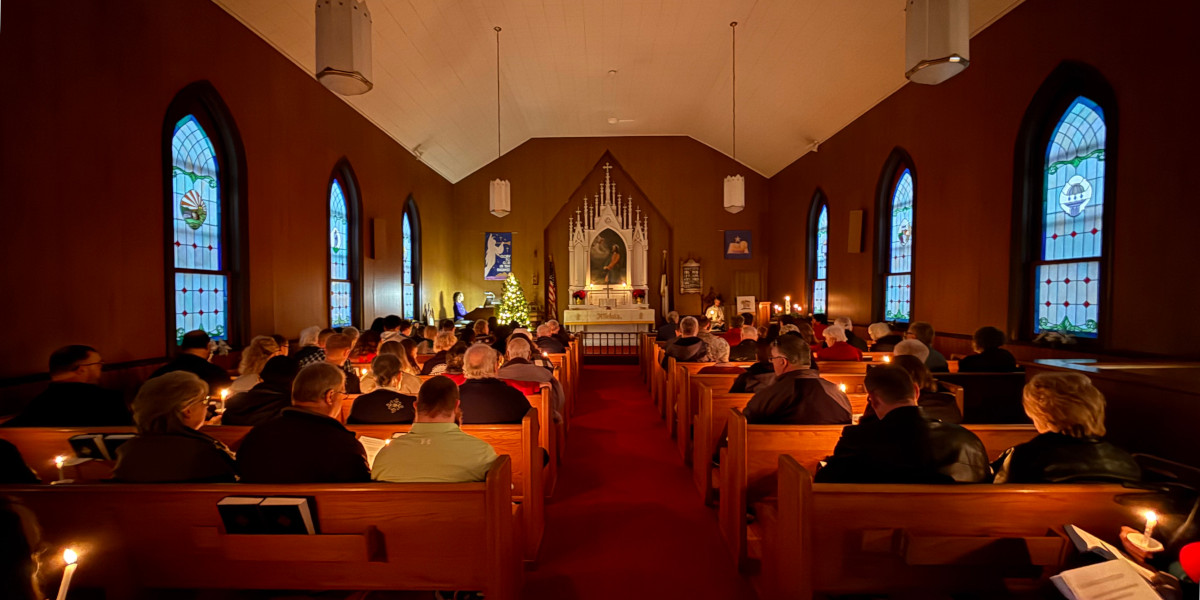
(picture from the Candlelight Service at Redeemer Lutheran Church)

The Third Sunday after the Epiphany – Pr. Faugstad sermon
Text: Genesis 32:22-32
In Christ Jesus, who appeared to the faithful fathers of old to prepare them for His coming in the flesh to save the world, dear fellow redeemed:
When Jacob went to Haran to find a wife, the LORD promised him that his offspring would be “like the dust of the earth,” that He would be with him, and that He would bring him back to the land he came from (Gen. 28:14-15). Now Jacob was on his way back with his wives, children, and great possessions. He had left with nothing but a staff in his hand, and now he was a rich man. God had made good on His promise.
But Jacob was shaking with fear. He heard from a messenger that his brother Esau was coming toward him with four hundred men. Jacob knew that in the past, his brother Esau wanted to kill him for taking the family blessing. Twenty years had passed since then. Had Esau’s anger and hatred subsided over that time or had it only increased? Jacob implored God to deliver him and his family from Esau’s wrath. He prayed: “O LORD, You said, ‘I will surely do you good, and make your offspring as the sand of the sea, which cannot be numbered for multitude.’ Please protect me and deliver me as You said You would” (Gen. 32:12).
Jacob knew that Esau would reach him the next day. He sent presents ahead of him hoping to appease his brother. Then during the night, he sent his family and all that he had across the stream, while he stayed behind alone in the dark. You know how active a mind can be in the middle of the night when you are anxious about something. Can’t sleep. Wide awake. Running some problem or conflict over and over again in your head. Imagining the worst. Despairing of any good outcome. That was Jacob. All he could picture was Esau coming at him with arrow ready or knife drawn. He imagined his wives and children under attack—all that he loved, destroyed, lost.
He prayed like he never had before: “Have mercy, O LORD, have mercy!” I’m sure you can relate. Perhaps you have not faced an immediate threat to your entire family like Jacob, but you have worried about a family member who was sick or injured. Or you have been at odds with someone close to you and couldn’t see how the situation would ever improve. Or you have felt threatened by an enemy and feared what harm he or she might do to you.
You prayed at those times. But your prayers were probably also mixed with some doubts. Will my loved one be okay? Will we be able to work through this conflict? Will I be safe? And as much as you might have asked God for help, you may have felt alone like Jacob, alone and in the dark, worried and fearful about what might be coming.
In Jacob’s anguish that night, he suddenly realized he was not alone. A stranger surprised him and started fighting with him. Was it Esau or one of Esau’s men? We aren’t told what Jacob was thinking, just that “a Man wrestled with him until the breaking of the day.” Jacob poured all his worries and fears into this wrestling match. He felt that he was fighting for his very life! We don’t know how long this went on, but we do know that Jacob fought with all his might.
Jacob fought so desperately, that even when the Man dislocated his hip, he did not give up. With daylight coming on, the Man tried to get away, but Jacob said, “I will not let You go unless You bless me.” A very strange request to make of someone threatening his life! But Jacob somehow knew this was no ordinary man. He perceived that it was the LORD he was wrestling with, the very LORD he had been begging for mercy. And so it was.
But why was the LORD fighting with him? Why was He acting like Jacob’s enemy instead of his Savior? Didn’t Jacob have enough troubles without the LORD piling on? Perhaps you can relate to this too. Have you ever had one bad thing happen after another, and you couldn’t help but ask, “Why God?” Or you felt like the times you tried to do what was right, you got punished for it.
You can rule out the idea that God is unable to help or is distracted by other responsibilities. Those things could only happen if God were small and only somewhat powerful, which is not the case. You can also rule out the idea that God has changed His mind about you and has turned against you, since that would go against His promise never to leave you or forsake you (Heb. 13:5). So why might it be that God would sometimes behave like your enemy, like He did with Jacob?
Could it be that He wants you to fight like Jacob did, to fight with a desperate faith? Think about the Canaanite woman crying out to Jesus for mercy for her demon-oppressed daughter. At first, Jesus didn’t answer her. Then He told His disciples He was sent only for the Israelites. Then when the woman knelt right in front of Him, begging, Jesus said, “It is not right to take the children’s bread and throw it to the dogs.” It seems obvious that Jesus was telling her to go away, but the woman wouldn’t give up. She believed in Him. She declared that this dog would gladly accept the crumbs that fell from His table. And Jesus said, “O woman, great is your faith! Be it done for you as you desire” (Mat. 15:21-28).
This teaches us that Jesus wanted to be caught. He wanted to be conquered by faith. We see this in the Holy Gospel for today from the leprous man who conquered Jesus by faith and was healed, and from the Roman centurion who faithfully brought the needs of his servant before Jesus. The same was true in the LORD’s wrestling with Jacob. He wanted Jacob to struggle with Him and pin Him down by faith. Hadn’t He already made a promise to Jacob? Why was Jacob so afraid? Why was he so worried? The LORD tested him, so Jacob would learn not to doubt, so He would learn to fear, love, and trust in God above all things.
The LORD also wanted him to understand that the promise He made to him was bigger than blessings in his lifetime and even bigger than the multitude of people who would come from him. The promise was ultimately about the Savior who would come from his line, in whom “all the families of the earth [would] be blessed” (Gen. 28:14). Perhaps this is the blessing God repeated after wrestling with Jacob.
God operates in the same way with us. At various times in our life, He may seem to be ignoring us or even opposing us. This is because He wants to exercise our faith. He certainly isn’t trying to drive us away from Him. He wants us to recognize our weaknesses, so that we trust in His strength. He wants to teach us to let go of what we cannot control and instead cling tightly to His Word and promises.
Above all, He wants us to remember that the Savior He promised to Abraham, Isaac, and Jacob did come. The LORD kept this Promise of all promises. Jacob thought he was alone in the dark, but the LORD was right with him, holding him in His everlasting arms. Jesus, on the other hand, truly was alone as He suffered in the dark on the cross, crying out, “My God, My God, why have You forsaken Me?”
Jesus was forsaken because all your sin was piled on Him. He was getting the full wrath of God and the eternal punishment that you deserved. He was suffering for the times you worried about tomorrow, when you doubted God’s commitment to you, when you trusted your strength instead of His, when you neglected to thank Him when He saved you from your trouble. It was sins like these that brought the Son of God down to earth as a Man and got Him nailed to the cross. He paid for all your sins, every single one.
That means you can be certain that God is not punishing you for your sins by sending you hardships in your life. He lets you experience temporary suffering, not because He is angry with you, but because He loves you. Isn’t this why parents discipline their children, out of love for them, because they want them to be good, humble, and responsible people when they grow up? Hebrews 12 says, “For the Lord disciplines the one he loves, and chastises every son whom he receives.” And a few verses later, “For the moment all discipline seems painful rather than pleasant, but later it yields the peaceful fruit of righteousness to those who have been trained by it” (vv. 6, 11).
The Lord knows what you need. A life of constant success, where everything goes the way you want, would destroy your faith. Who needs faith if everything works out exactly the way they plan? When troubles and afflictions come your way, that is when faith can do what God gave it to you to do. That is when faith can rise up in every instance of hardship, pain, and sorrow and can take hold of the rock-solid promises of God. That is how faith conquers. It conquers by clinging to the One who conquered every fearful enemy for us—our Lord Jesus Christ.
He wants you to bring all your worries and fears to Him, trusting that He will take care of you. He wants you to endure and prevail in every hardship. He wants you to pin Him to His promises and not let Him go unless He blesses you. He will bless you, as He has so often done before. By His grace, He will carry you through your troubles and will strengthen your faith until you are ready to join all the faithful, the many “from east and west,” who will “recline at table with Abraham, Isaac, and Jacob in the kingdom of heaven” (Mat. 8:11).
Glory be to the Father and to the Son and to the Holy Ghost; as it was in the beginning, is now, and ever shall be, forevermore. Amen.
+ + +
(picture from 15 century French Gothic manuscript painting)

The Second Sunday after the Epiphany – Pr. Faugstad sermon
Text: Genesis 29:13-30
In Christ Jesus, who walked a lonely road and suffered for our griefs, sorrows, and sins, so we would be assured of His help in our trials, dear fellow redeemed:
Jacob didn’t know—he couldn’t have known—that when he traveled to Haran, he was walking right into a great web, a terrible sticky web. He would soon find himself wrapped up in such cares and troubles that he wondered if he would ever be free again. When he first made contact with his mother’s relatives, he was filled with joy. He was blissfully unaware that a spider watched his every move, a spider watching, waiting, scheming. That spider was Laban, his mother’s brother, his own uncle.
Jacob went there because his mother wanted to save him from the wrath of his brother Esau after Jacob received the family blessing instead of Esau. Jacob’s parents sent him to find a wife among his relatives. As he set off on his journey toward Haran, he stopped for the night at a place called Luz. This was in the same area where the LORD appeared to Abram when he first arrived in the land of Canaan. As Jacob slept, he dreamed about a ladder reaching to heaven, with angels ascending and descending on it.
And the LORD spoke to him, promising that his offspring would be “like the dust of the earth,” and that “all the families of the earth [would] be blessed” through him (Gen. 28:14). “Behold, I am with you,” said the LORD, “and will keep you wherever you go, and will bring you back to this land” (v. 15). They were wonderful promises, but at the present Jacob had nothing. He had no wife, no home, and no great possessions. When he got to Haran, he was just poor Jacob trying to find a wife.
As we heard in today’s lesson, his uncle Laban received him warmly. He “embraced him and kissed him and brought him to his house.” Jacob couldn’t have been happier, and he gladly helped his uncle however he could. Laban recognized his good work ethic and thought it would be useful to keep Jacob around for a while. “Tell me, what shall your wages be?” asked Laban. Jacob had come to his uncle’s place for a very specific purpose, and of Laban’s two daughters, one of them caught his eye. He said, “I will serve you seven years for your younger daughter Rachel.”
Now do you suppose Rachel was flattered and excited about this, or somewhat offended? In our culture, marriages are not arranged by the parents. We expect marriages to be by the free and mutual consent of a man and a woman—with no business strings attached. The culture in Haran was different. There it seems that the father had the authority to give a daughter in marriage to whomever he wanted, and his daughter did not question that decision.
This did not automatically mean the marriage would be unhappy. Many cultures around the world still have arranged marriages. Studies have shown that these marriages may even last longer than marriages for love. While we would hardly adopt this approach in our families, it is very important for Christian parents to approve of the spouses their children decide to marry. When this does not happen, there are bumpy roads ahead!
As far as we can tell, Rachel was okay with the arrangement to marry Jacob. He certainly loved her. In a line too mushy for middle school boys, we are told that the seven years Jacob served for Rachel “seemed to him but a few days because of the love he had for her.” The time couldn’t go fast enough for Jacob, but it went too fast for Laban.
You see, Laban saw what kind of worker he had in Jacob. And that old spider thought to himself, “If I spin a little deception, what can Jacob do about it? He came here with nothing. He has no one to stand up for him. I know how I can keep him under my thumb for a while longer….” So he put his older daughter Leah in the marriage bed instead of Rachel and arranged things so that Jacob would not know until after they had come together. “You can have Rachel, too,” said Laban, “IF you serve me for seven more years.”
That’s how we arrive at a godly man with two wives, sisters, with the younger one favored over the older one and making sure big sister knew it. And a deceitful father-in-law who treated his son-in-law like a slave. And Jacob not knowing who he could trust and wondering how and when he would ever get back home.
There is much unhappiness in this saga. This isn’t the way Jacob imagined it when he saw the angels of God going up and down the ladder from heaven and heard the LORD’s promises. This isn’t the way he imagined it when his uncle first welcomed him to Haran. This isn’t the way he imagined it when he prepared to marry the woman he loved. Nothing had gone the way he planned.
For these reasons, Jacob is a helpful example for us—because each of us here has also had to go through troubles and trials that we did not anticipate, had to adjust our plans because life did not go like we imagined. Maybe like Jacob, you fell deeply in love with someone and could only see happiness ahead, but then something happened to change the relationship, and the future you saw so clearly faded. Maybe you thought marriage would be easy, but it tested you to your very limits. Maybe you found yourself under your boss’s thumb and didn’t know how to get away or didn’t think you could afford to.
When we have been hurt, sometimes we draw inside ourselves and put up a hard shell to try to protect ourselves from the pain. Sometimes we lash out at the person who hurt us or at innocent bystanders who caught us at just the wrong time. Sometimes we let our anger build up inside and maybe even plot our revenge, hoping that the person who hurt us, someday, somehow, will learn how it feels.
This bitterness can happen in a marriage. It can happen between siblings. It can happen between a parent and a child. It can happen with friends and co-workers and neighbors. The devil wants this to happen. He wants to break up marriages and families and friendships. He wants us to think selfishly, to dwell on our hurts, to never forget a wrong, and to quickly give up on something that God intended for our good.
God gives marriage, family, and friendship for our good. The reason these things go haywire is not because He fails us but because we are sinners. Each one of us brings sin into our marriages, our families, and our friendships. The neighbors who should concern us the most, the ones who are closest to us—even in our own home—these are the ones who have often gotten the worst of our sinning. They have been on the receiving end of our prideful behavior, our hurtful words, our selfish actions. They have seen us behave less like faithful Jacob and more like deceitful Laban.
Where do we take the pain that others have caused us, the deep hurts from broken promises, failed expectations, shattered dreams? Where do we take the guilt for our own mistakes and failures, the recognition that we have not been for others what we should have been? We take all this guilt and shame and pain to the One who came to bear our griefs and carry our sorrows (Isa. 53:4).
Jacob looked to this One also, which is how he was sustained in his troubles. Jacob believed that a Savior was coming, even from his own line. And in a strange twist that only God could see, this Savior did not come as Jacob expected from his union with Rachel. The Savior came from his union with Leah! God knows how to work blessings even out of times of trial. We have another example of this in the Holy Gospel for today, where for His first public sign Jesus turned water into wine to bring joy to a marriage celebration (Joh. 2:1-11).
He still does that now. No matter what you have gone through in your marriage, your family, and your friendships—or what you are still going through—Jesus brings you His blessings. He is present here today to forgive you the sins you have committed against those He called you to care for. He is here to take the burdens of your guilt about the past, your struggles in the present, and your worries about the future. He picks you up and covers you in His mercy and grace as you listen to His promises and prepare to receive His body and blood given and shed for you. “Come to me, all who labor and are heavy laden,” He says, “and I will give you rest” (Mat. 11:28).
Your Savior Sees Your Troubles. Even before you were born, He saw you and what you would go through in your life. It was for you that He endured every sort of trouble on earth and for you that He went to the cross. No trial that you have to face is stronger than His love for you. There are more blessings ahead for you because He is with you.
Glory be to the Father and to the Son and to the Holy Ghost; as it was in the beginning, is now, and ever shall be, forevermore. Amen.
+ + +
(picture from a work by a 10th century monk)

The Feast of the Holy Nativity of Our Lord – Pr. Faugstad exordium & sermon
Festival exordium:
What would your life be like without the church? Let’s say you woke up tomorrow believing everything you believe now, but the church building is gone and the congregation you were a part of no longer exists. No pastor. No worshiping together. No services on Christmas Eve or Christmas Day. No Saturday evening or Sunday morning opportunities to hear the Word, receive the Lord’s Supper, and enjoy fellowship together.
Because we have congregations and church buildings, we don’t have to think about these things. We expect they will be here for us, just as they were for our parents, our grandparents, and others before them. I pray that our congregations will continue for a long time. But we are also witnessing a decline in church attendance throughout our country, as people shift their time and attention to other pursuits, other priorities.
We can learn something from the Bethlehem shepherds today. As impressive as it was to see the heavenly hosts fill the sky and the Baby lying in a manger, they were more impressed by what they heard. After visiting the Christ-Child, “they made known abroad the saying which was told them concerning this child.” They told everyone what the angel told them: “Behold, I bring you good tidings of great joy, which shall be to all people. For unto you is born this day in the city of David a Saviour, which is Christ the Lord.”
“A Savior is born for you!” they shouted in the streets of Bethlehem. That message is as important today as it was 2,000 years ago. You and I need a Savior, our neighbors need a Savior, people all around the world need a Savior. If our churches suddenly disappeared, this message of salvation would bring us together. Once you hear the good news, you can’t un-hear it. Once you know what Jesus came to do for you, you can’t keep that news to yourself.
This is why we keep coming together. We come here to wonder at the glad tidings of salvation we have heard from God. We come to ponder and learn what Jesus has done. And we come to be strengthened and renewed through His Word and Sacraments, so we are ready to glorify and praise God in every station of our life, wherever we are and in everything we do.
A Savior is born—born for you—Christ the Lord! Let us rise and sing our festival hymn, #142:
Rejoice, rejoice this happy morn!
A Savior unto us is born,
The Christ, the Lord of glory.
His lowly birth in Bethlehem
The angels from on high proclaim
And sing redemption’s story.
My soul,
Extol
God’s great favor;
Bless Him ever
For salvation.
Give Him praise and adoration!
+ + +
Sermon text: St. Luke 2:8-14
In Christ Jesus, who hides His glory in humble means, so you can receive His forgiveness, His righteousness, and His life, dear fellow redeemed:
Just another day on the job, or rather another night. The shepherds were in the fields around Bethlehem protecting their sheep from predators that might be lurking about. It was an important job, but perhaps not one that everyone wanted to have. The night shift is a long one. It is difficult to stay awake and alert when the body wants to rest. But for the shepherds on this night, that weary feeling was about to go away.
Out of nowhere, an angel of the Lord appeared to them. I suppose they had never seen an angel before, but since he was accompanied by the glory of the Lord shining all around, they were able to put it together. This was an angel from heaven, a messenger from God! We get a sense of what “the glory of the Lord” was like that night from a few references in the Old Testament. When Moses went up Mount Sinai to receive the Law from God, the LORD’s glory was there in a thick cloud. To the people of Israel watching from a distance, “the appearance of the glory of the LORD was like a devouring fire on the top of the mountain” (Exo. 24:17).
Some time after this when Moses finished building the tabernacle, “the cloud covered the tent of meeting, and the glory of the LORD filled [it]” (Exo. 40:34). The same thing happened many years later when King Solomon built the temple in Jerusalem (1Ki. 8:11). On these two occasions fire came from the LORD’s presence to consume the sacrifices offered (Lev. 9:24, 2Ch. 7:1). So “the glory of the Lord” was hidden in a cloud and accompanied by fire. Anyone who witnessed these things trembled at the power of God and fell down before Him.
This is how the shepherds reacted—“they were sore afraid.” They were filled with a great fear as the glory of the Lord surrounded them. But there were still more surprises coming. The angel announced that he was bringing “good tidings of great joy,” a wonderful message intended not just for the shepherds but for all people of all time. “For unto you—FOR YOU—is born this day in the city of David a Saviour, which is Christ the Lord.”
“Christ” means “anointed one,” the same title in the Greek language as “Messiah” in the Hebrew language. The child born in Bethlehem was the anointed One, the One chosen by God to redeem the world of sinners. Here was the Offspring of the woman first promised to Adam and Eve (Gen. 3:15). Here was the son of Abraham, the son of David, the son of Mary. Here was the eternal Son of God wrapped in human flesh. Just a little baby, and yet the Lord of heaven and earth. Just a lowly manger and yet the King enthroned on high.
The angels could not contain their excitement. God parted the veil separating heaven from earth to let the shepherds hear their heavenly praises. The night sky filled with the angels of God’s army, as “a multitude of the heavenly host” appeared. They sang about what the coming of this Savior meant. It meant “Glory to God in the highest,” and it meant “on earth peace, good will toward men.” Jesus was born to give glory to God the Father by following His holy will throughout His earthly life, and to bring peace between God and man through the shedding of His blood.
So the shepherds had seen the glory of the Lord all around them, an angel had spoken to them, and then an entire host of angels appeared to sing God’s praises. But there was something still more amazing, still more wonderful, for them to see this night. They immediately set off to find “the babe wrapped in swaddling clothes, lying in a manger.” And they did find Him just as the angel said, with Mary and Joseph by His side.
It is a strange contrast—the glory of the Lord filling the night sky with the dimly lit stable, the angels arrayed in heavenly garments with a baby swaddled in strips of cloth, the heavenly host singing for joy with the quiet breathing of a baby asleep. The shepherds had never seen anything like it. No one had. For all the poverty of the surroundings, this little baby was more than met the eye. When the shepherds looked at Jesus’ face, they were looking at the face of God. When they heard His little cooing noises, they were hearing the voice of God.
Human reason says, “This can’t be! How can God be a baby? How can He require the care of a human mother and the protection of a mortal man? How can this poor, helpless baby do anything for us?” The shepherds might have thought the same thing if the angel hadn’t said, “[This] is Christ the Lord.” God calls us today to look through their eyes, to see what they saw. This was no ordinary baby lying in a manger; this was God incarnate.
He took on flesh for you. He was born for you. He humbled Himself to be Your servant, to take your place under God’s holy Law, to accept the punishment for your sin, to die your death. He came so that one day you could see the glory of the Lord with your own eyes and hear the angels singing the praises of God in heaven. He came to save you from this world of darkness, to shine the light of His grace into your heart and your home.
But it is natural to wonder if these things are really so. How can we be sure? How can we know that everything in the Bible happened just as we are told it did? If the angels appeared to the shepherds to bring them good news, why don’t they do the same for us? Why doesn’t God give us a glimpse of His glory? These things would go a long way, we think, toward addressing our doubts, calming our fears and anxieties, and giving us strength.
But what was the sign the shepherds were told to look for? Not a royal procession of the saints and angels marching before their King, and not the Son of God descending from heaven in a blaze of glory. The sign was this: “Ye shall find the babe wrapped in swaddling clothes, lying in a manger.” They found the Christ-child, with His glory hidden in baby skin, swaddling clothes, and straw.
And so it is true for us today. Jesus is not found in a great mansion or palace hanging out with the rich and famous, or even where religious institutions appear to be most impressive and successful. Jesus is found where He tells us He is, wrapped up in His Word, in Water, in Bread and Wine. He is present for us in His holy means of grace, the Gospel message in His Word and Sacraments.
Our sinful reason says that this cannot be! How can eternal life come to us through the preaching of a weak pastor? How can Jesus’ righteousness be placed on us at the baptismal font? How can the forgiveness of sins come to us by eating and drinking bread and wine? Here is the key: the means Jesus instituted to give us His grace offer no benefit to us if we just go through the motions, if we view them as nothing more than empty rituals or silly traditions.
My preaching does no good, the application of water has no benefit, eating and drinking at the Communion rail gives no blessing—without faith in the Word of Jesus, without believing that what He promises, He gives you. And that faith is not a choice you make or a work you do. Saving faith is a gift worked through the Word by God the Holy Spirit, who moves you to repent of your sins and to believe that these sins are forgiven by the One who took on flesh to save you.
The angel’s message was not just for the shepherds. It was for you and for every sinner. God wants you to know that you have a Savior. Christ was born for you. He came to atone for your sins. He came to rescue you from this world of darkness. He came to bring you to His kingdom of light, where His glory will surround you, and you will not be afraid forever and ever.
Glory be to the Father and to the Son and to the Holy Ghost; as it was in the beginning, is now, and ever shall be, forevermore. Amen.
+ + +
(picture from “Adoration of the Shepherds” by Gerard van Honthorst, 1592-1656)

Midweek Lent 4 – Matthew Lehne homily
Texts: Genesis 3:17-18, St. John 19:1-6
In Christ Jesus, who was crowned with sin so that we may be crowned with glory, dear fellow redeemed:
Working the ground is not an easy task. Whether you are growing crops or flowers, there are seemingly countless things that can go wrong, chief among them being thorns and thistles growing up with them. No matter how hard you try to prevent them from growing, they somehow always do, and if you don’t catch them in time, they could end up killing your crops or your flowers. This, like all other hardships you experience in life, is a consequence of sin.
Adam’s sin affected all creation. God said that because Adam disobeyed his command, the ground was cursed. Now Adam would labor in pain, and the ground would bring forth thorns and thistles. But even this, God used for Adam’s good. The thorns and thistles were a reminder to Adam of his sin and of his need for a Savior.
We can see examples of this being true today. When people feel safe and secure, they don’t see a need to go to church and hear the comforting words of our Lord. As a result, church attendance is low. But when there are times of hardship and people no longer feel the safety and security that they once felt, church attendance suddenly goes up. It is through the thorns and thistles of hardship that we realize our need for a Savior and turn to him in repentance. This is why God placed a curse on the ground, saying to Adam, “Because you have listened to the voice of your wife and have eaten of the tree of which I commanded you, ‘You shall not eat of it,’ cursed is the ground because of you; in pain you shall eat of it all the days of your life; thorns and thistles it shall bring forth for you; and you shall eat the plants of the field” (Genesis 3:17–18). It was for mankind’s benefit that the ground was cursed, just as it was for mankind’s benefit that God sent a Savior to deliver us from the curse of sin.
The thorns and thistles would be a reminder to Adam and his descendants of their sin that corrupted the world. We see this corruption in the thorns and thistles that we experience in our daily lives. We feel the pain of fear when those around us cause us to question our safety. We feel the pain of betrayal when those who we thought we could trust reveal our secrets or abandon us for their own personal gain. We feel the pain of weakness when we get sick. We feel the pain of loss when our loved ones are taken from us. We feel the pain of our own sins when our consciences prick at us. All of this pain is too much for us to bear on our own, but there is one man who took all of our pain and bore it by himself: Jesus Christ, our Savior.
Jesus already knew what it was like to feel pain. He felt the pain of hunger when he fasted for forty days and forty nights in the wilderness. He felt the pain of loss when his friends John the Baptizer and Lazarus died. He felt the pain of betrayal when Judas handed him over to the religious authorities, when his disciples abandoned him after his arrest, and when Peter denied him three times in the courtyard. And now he was experiencing the pain of mocking and beating at the hands of the soldiers and would soon be experiencing the pain of death and hell on the cross. Jesus, your Savior, felt all that pain for you and endured it all for your salvation.
As the soldiers were mocking and beating Jesus, they happened to find some thorns, the divine reminder of our need for a Savior, and twisted them into a crown and put them on the head of the Savior. On some coins, emperors were represented with a laurel wreath encircling their heads. So, since they heard it said that Jesus was the King of the Jews, the soldiers thought that this would be a fitting way to mock him even more. This man who was their so-called King was now made to look absolutely ridiculous.
As the soldiers continued to beat him, the crown of thorns was pressed into Jesus’ head, causing him even more pain. That pain that Jesus experienced was your pain. The pain that pressed into Jesus’ head was the pain that you experience from those around you and from the guilt of your own sins. He wore all your thorns and thistles on his head and carried them all the way to the cross. There, all of the thorns and thistles of life, along with the pain that they cause you, were put to death with him. On that cross, Jesus put an end to the curse of sin.
Before going all the way to that cross, Pontius Pilate first paraded Jesus out in front of the crowd, having been thoroughly tortured and humiliated, and said, “Behold the man” (John 19:5)! Pilate did not realize the full implication of what he was saying. There stood not just any man, but the man, the man who was your divine substitute, your atoning sacrifice. Jesus stood there and took all of the pain and the suffering, all of the mocking and beating, that you rightfully deserve for your sins. He took all of it so that you would not have to take it.
The Apostle Paul writes in his letter to the Romans, “For if many died through one man’s trespass [that is, Adam’s trespass], much more have the grace of God and the free gift by the grace of that one man Jesus Christ abounded for many. . . . For as by the one man’s disobedience the many were made sinners, so by the one man’s obedience the many will be made righteous” (Romans 5:15, 19). It was because of one man, Adam, that sin entered the world. Adam disobeyed God, and because of that disobedience, we all disobey God as well, for we all inherited Adam’s sin. But one man undid all that. Jesus obeyed his Father in every way and stood in our place to bear the curse of sin and to receive the punishment for sin that we rightfully deserve. It is because of that one man’s atoning sacrifice that our sins have been forgiven; it is because of that one man that God’s grace is freely given to us; and it is because of that one man that the gates of heaven have been opened to us.
When we enter heaven, we will get to experience the same ease of work that Adam and Eve briefly got to experience in the Garden of Eden. In heaven, there will be no thorns or thistles that cause us pain, neither in the ground nor in our lives. All of the pain that we experience in this life, all the fear, all the betrayal, all the weakness, all the loss, all the sin, will never be experienced again because the curse of sin that caused that pain has been put to death with our Savior. We eagerly await that day when we get to experience the joys of heaven, but until that day comes, we wait, just as all creation waits for Jesus’ return. As Romans 8:20–21 says, “For the creation was subjected to futility, not willingly, but because of him [that is God] who subjected it, in hope that the creation itself will be set free from its bondage to corruption and obtain the freedom of the glory of the children of God.” On the Last Day, the ground will return to its former glory, when God creates a new heaven and a new earth. At that time, our bodies will be glorified as well. Our glorified bodies will never again experience the thorns and thistles of sin, which our divine substitute wore on his own head as a crown and put to death with him on the cross for us. Because Jesus wore our crown of thorns on his head, a crown of glory is now ours, a crown of glory that will never fade away.
Glory be to the Father and to the Son and to the Holy Ghost; as it was in the beginning, is now, and ever shall be, forevermore. Amen.
+ + +
(picture from “Ecce Homo” by Antonio Ciseri, 1871)
The Visitation of Mary & Vicar Installation – Pr. Faugstad sermon
Text: St. Luke 1:39-56
In Christ Jesus, who “made Himself nothing, taking the form of a servant, being born in the likeness of men” (Phi. 2:7), in order to redeem us by His perfect life and innocent death, dear fellow redeemed:
The mothers who have carried in their wombs the greatest people in the history of the world, did not know what their little babies would become. The Apostle Paul’s mother could not have guessed that her son would one day preach Christ crucified around the world. And Margarethe Luther would not have expected her son Martin to become a great reformer.
Elizabeth and Mary were different. They knew that the baby boys in their wombs were destined for tremendous things. Elizabeth learned it from her husband, a priest serving in the Jerusalem temple, who was visited by the angel Gabriel. The angel told Zechariah that he and Elizabeth would have a son. He would “be filled with the Holy Spirit, even from his mother’s womb,” and would “turn many of the children of Israel to the Lord their God” (Luk. 1:15, 16). His name was to be John. After Elizabeth conceived this child, she kept herself hidden for five months. Who would believe that this old woman was carrying a child after a lifetime of barrenness?
In the sixth month of Elizabeth’s pregnancy, the angel Gabriel visited her young relative Mary. As you know very well, Mary was betrothed to a man named Joseph, but they had not had relations with each other. Mary was a virgin. Gabriel shared the stunning news with Mary that she would bear the Christ Child, “the Son of the Most High” (Luk. 1:32), who would reign over an everlasting kingdom. And he had even more news to share. Her elderly relative Elizabeth was six months along in her own pregnancy. “For nothing will be impossible with God” (Luk. 1:37).
So what did Mary do next? She got up and hurried to Elizabeth’s house. Even if no one else believed her, Elizabeth would—Elizabeth whose life had also been touched by the unexpected working of God. By this time, Elizabeth’s belly had expanded to make room for the growing boy inside her. She might have felt little flutters as he moved around and hiccupped. Her baby was about twelve inches long and 1½ to 2 pounds in weight. His eyes may have just begun to peek out behind red eyelids.
Elizabeth did not know that a monumental meeting was about to take place. The Messiah was about to enter the home of His messenger. With Mary’s arrival, the two men who would turn the world upside down with their preaching and teaching, were now in the same room in the flesh. Elizabeth had not heard about Mary’s pregnancy, and yet she knew. She knew as soon as Mary greeted her, and her baby leaped in her womb. She knew, because at Mary’s greeting she was filled with the Holy Spirit.
The Holy Spirit revealed to her that Mary, a virgin and yet pregnant, was “the mother of her Lord.” She spoke three blessings to Mary: “Blessed are you among women,” “blessed is the fruit of your womb,” and “blessed is she who believed” what the Lord said. Elizabeth did not honor Mary because she had accomplished great things on her own. Elizabeth honored Mary because of her connection to the teeny, tiny baby growing in her womb.
But how could the little baby of a poor woman save the world? The world doesn’t think much of little babies or of poor women. Little babies are viewed more and more as burdens. Babies get in the way of careers and riches and personal freedom. All of us have thought that at one point or another. But Elizabeth and Mary were once babies, as were their sons John and Jesus. You and I were babies, and here we are. We are supposed to be here. God gave us life. Every Christian should be pro-baby, because God is pro-baby!
Every soul is precious in His sight, which means every soul should be precious to us. Our hearts should expand in love for all our neighbors, from the poor ones to the rich ones, from the lowly ones to the well-regarded, from the unborn to the elderly. Every life has value. Every life matters. Just look at the care with which God formed us in the womb. The psalmist David wrote, “For you formed my inward parts; you knitted me together in my mother’s womb. I praise you, for I am fearfully and wonderfully made” (Psa. 139:13-14). He goes on to describe how we were “made in secret, intricately woven,” and how even at our conception, God had a plan for all our days (vv. 15, 16).
The miraculous composition of a human being should be enough for people to acknowledge and praise the almighty God. But our sinfulness is great, and it has been with us for as long as we have existed. Adam and Eve’s fall meant that all their descendants would inherit their sin, and sin keeps us from fearing, loving, and trusting God as we should. In another of his Psalms, David wrote, “Behold, I was brought forth in iniquity, and in sin did my mother conceive me” (Psa. 51:5). That is true of every one of us. We were sinners from the moment we were conceived.
But Jesus was an exception to that unbroken line of sin. He was conceived not by a human father and mother, but by God the Holy Spirit overshadowing the womb of Mary. In this way, God the Son took on human flesh but without human sin. By His entrance into the world as an embryo, God was showing that life matters from its earliest beginnings, even before the human eye can see it. As He went through each stage of life—from His growth in the womb, to His birth, as a toddler, a child, a young adult, a grown-up—Jesus was redeeming every stage of life from the sin that pollutes us.
God does not take shortcuts. There was no simple, easy way for mankind to be saved. The Son of God had to take on flesh, and He couldn’t just appear in the flesh like you might appear in costume. He had to take human flesh into His Person. He had to start the way all humans start, with the joining of tiny cells. From the time that Gabriel visited faithful Mary, the eternal Son of God became God and Man in one Person. And He remains God and Man for all eternity.
This is the One whom John would go into the wilderness to proclaim. But that would be about thirty years later. Today was the day for Messenger John and his Master Jesus to meet. And how do we know that John was aware of Jesus’ presence? Elizabeth exclaimed to Mary, “For behold, when the sound of your greeting came to my ears, the baby in my womb leaped for joy.”
John continued to rejoice. Those thirty years later after Jesus was baptized, John cried out, “Behold, the Lamb of God, who takes away the sin of the world!” (Joh. 1:29). As Jesus’ following increased, and fewer were coming to John, John testified, “The friend of the bridegroom, who stands and hears him, rejoices greatly at the bridegroom’s voice. Therefore this joy of mine is now complete. He must increase, but I must decrease” (Joh. 3:29-30).
John had it right; his glory was in Jesus. The long-promised Savior had come. Elizabeth saw it the same way. She welcomed Mary with all humility, “And why is this granted to me that the mother of my Lord should come to me?” Mary saw it the same way. In her famous song, the Magnificat, she said that her Savior God “has looked on the humble estate of His servant,” “has done great things for me,” has “exalted those of humble estate,” and “has filled the hungry with good things.”
And so it is for you and me. The Lord has looked on our humble estate. He saw how helpless we were, how lost in our sin. And He has done great things for us. The little baby in Mary’s womb was growing there for you and me. The six months bigger baby growing in Elizabeth’s womb would go before Him to prepare His way. All of this happened more than 2,000 years ago, but God had you in mind.
God the Father sent His only Son for this express purpose—to save your soul. He gave you birth, so that He could give you rebirth. He formed you in the womb, so He could transform you by the power of the Gospel. You might wonder sometimes how much your life matters. You might wish you could go back, make different choices, and do more with your life. You can put all those thoughts to rest when you see what God did for you, when you see the womb of a virgin swelling with Child, when you see the God-Man making His way to Calvary carrying His cross—for you.
Your life matters. God loves you. He forgives all your sin. He wants you to join Him in heaven with Elizabeth, John, Mary, and all the saints. This is the message He calls sinful men to preach. We give thanks that He has sent another vicar to our parish to preach this Word to us and to continue training for the noble work of pastor. Pastors have nothing to offer you of their own, just as Mary had nothing to offer of her own. But as God chose her to bear the Christ-Child in her body, so He has chosen sinners to “rightly handle His word of truth” (2Ti. 2:15), and to distribute His means of grace through our mouths and by our hands.
The presence of Jesus in Mary’s womb brought joy to Elizabeth and John, and His presence still brings joy to us. When the sound of His forgiveness and grace reaches our ears, the Holy Spirit comes to remove our burdens and lift our hearts. Then our souls magnify the Lord, and our spirits rejoice in God our Savior.
Glory be to the Father and to the Son and to the Holy Ghost; as it was in the beginning, is now, and ever shall be, forevermore. Amen.
+ + +
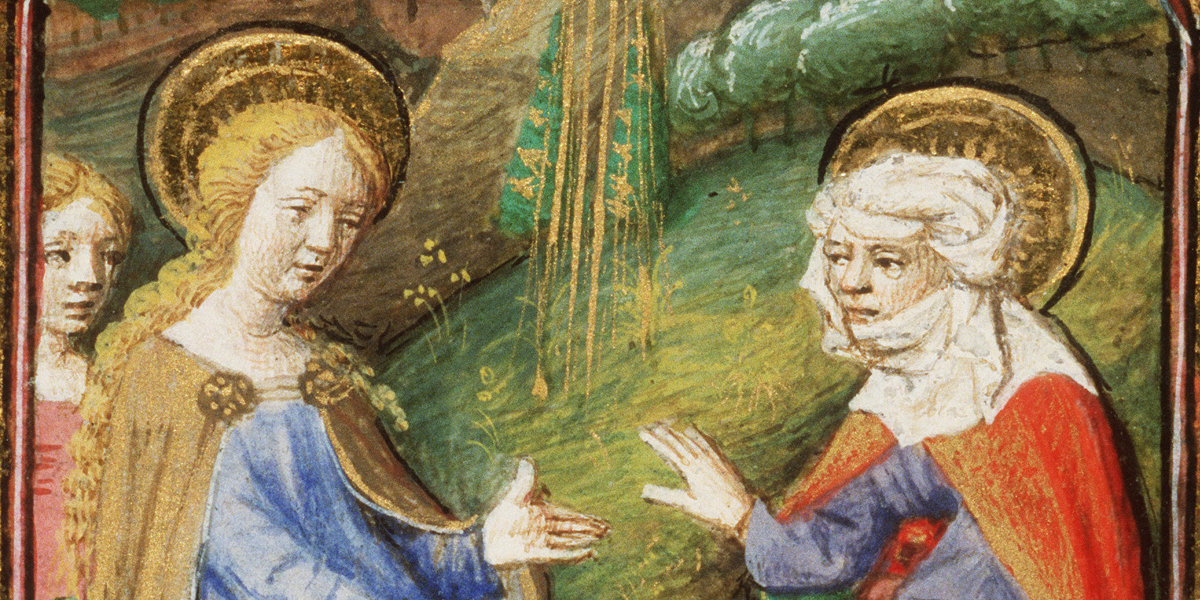
(Picture of the Visitation from the Book of Hours of Simon de Varie, 1455)

Midweek Lent – Pr. Faugstad homily
Text: St. Mark 15:16-20
In Christ Jesus, who in great humility hid His power and glory, so that He might suffer and die in our place, dear fellow redeemed:
What the soldiers said was perfectly correct: “Hail, King of the Jews!” “Hail” was a positive and proper greeting. And Jesus was “King of the Jews,” at least in a certain respect. He was a descendant from the line of the great King David, and His reign had been prophesied all through the Old Testament. Earlier that Holy Week, Jesus had told the religious leaders that He was both David’s Son and David’s Lord (Mat. 22:41-45). He was David’s Son according to His human nature, and He was David’s Lord according to His divine nature.
But Jesus was more than the King of the Jews. The book of Revelation refers to Him as “King of kings and Lord of lords” (19:16; 17:14). He is King over all. He spoke everything into existence in the beginning, and “he upholds the universe by the word of his power” (Heb. 1:3). In Psalm 2, God the Father Almighty declares, “I have set my King on Zion, my holy hill” (v. 6). Then He says to this King, His eternal Son, “Ask of me, and I will make the nations your heritage, and the ends of the earth your possession. You shall break them with a rod of iron and dash them in pieces like a potter’s vessel” (vv. 7-8). In Psalm 110, the Father says to Him, “Sit at my right hand, until I make your enemies your footstool” (v. 1).
That is powerful language about a powerful king. But Jesus hardly looked the part on this day, the day of His arrest and His trial before Pontius Pilate. Pilate was showing his own weakness as he presided over a trial he wanted nothing to do with. He had no special compassion toward Jesus. Jesus was a Jew, and the Romans disliked the Jews. This Roman governor and the battalion of Roman soldiers would have much rather been about anywhere else, not watching over this annoying, unruly people. Now things were even worse, since the city of Jerusalem had filled with Jews who had traveled from all directions to celebrate the Passover.
In Jesus, the Roman soldiers found an outlet for their disgust of this people. Supposedly He was an important Jew from what they were hearing, perhaps some sort of a king. Some of the soldiers had already scourged Him leaving deep cuts all over His back and sides. But neither these wounds nor the bruising and swelling on His face would keep them from inflicting more pain on Him. He had just been sentenced to die, so why shouldn’t the soldiers have some fun at His expense?
The soldiers who had charge of Him called together the whole battalion. A battalion was about 600 soldiers. This church could hardly fit a group of people that large. These men acted without restraint. It was mob rule, where anything goes. They dressed Jesus in a purple cloak. They made a crown out of thorns and pressed it into His skull. Then the soldiers took turns saluting Him, striking Him on the head, spitting on Him, and kneeling before Him in mock worship.
I can imagine six against one. I can’t imagine six hundred against one, each taking his turn. But in a certain sense, the number was actually higher, much, much higher—thousands against one, millions against one, billions against one. We must remember why Jesus was in this horrible situation. It was because of sin—not just the sins of the Jewish leaders who turned Him over to Pilate, not just the sins of the godless Romans, but because of your sins, my sins.
When we see the terrible actions of these Roman soldiers, it should not make us feel self-righteous. “Oh, I would never do something like that! I would not treat someone like that!” Instead we should picture ourselves among those violent soldiers, striking Jesus, spitting on Him, mocking Him. Our sin put Jesus in this situation. Our sin caused His suffering. Our sin sent Him to the cross.
The sins we have committed against God are every bit as serious and just as bad as what those soldiers did. We cannot wash our hands of Jesus’ suffering. We cannot say, “the Jews did that,” or “the Romans did that,” without also realizing, “I did that.” If you and I don’t understand our part in it, then we will not see Jesus for who He is or understand what He did for us. He was not simply a tragic figure who was dealt a bad hand. He was not a victim of unfortunate circumstances, caught in the middle of a race war against His will.
He was a Lamb that “goes uncomplaining forth, / The guilt of all men bearing; / And laden with the sins of earth, / None else the burden sharing! / Goes patient on, grows weak and faint, / To slaughter led without complaint, / That spotless life to offer; / Bears shame and stripes, and wounds and death, / Anguish and mockery, and saith, / ‘Willing all this I suffer’” (ELH #331, v. 1).
He, this totally innocent Man, this descendant of David’s royal line, this mighty King of kings—He suffered willingly. For the salvation of sinners—for your salvation—He let the thorns be driven into His head. He let the punches land. He let the spit run down His face. He let the mocking words enter His ears and sting His soul. He did all of it in perfect obedience to His Father’s will.
The prophet Isaiah recorded these words of the Son’s humble submission to His Father: “The Lord GOD has opened my ear, and I was not rebellious; I turned not backward. I gave my back to those who strike, and my cheeks to those who pull out the beard; I hid not my face from disgrace and spitting. But the Lord GOD helps me; therefore I have not been disgraced; therefore I have set my face like a flint, and I know that I shall not be put to shame. He who vindicates me is near” (Isa. 50:5-8).
Jesus did not fight back. He did not say a word. The apostle Peter wrote, “When he was reviled, he did not revile in return; when he suffered, he did not threaten, but continued entrusting himself to him who judges justly” (1Pe. 2:23). Perhaps this is why the soldiers grew tired of their game. Maybe they were beginning to feel guilt for their terrible actions. For all the abuse they had carried out on Jesus, He hadn’t spoken one word in anger or hurled one curse their way. He just took it.
He took it for their sake and for yours. He took it in order to spare you from the eternal suffering of hell, a suffering we all deserve. He received this punishment, so you would receive God’s grace and forgiveness.
We know that Jesus’ humble suffering made an impression on some of the soldiers. They saw how intensely He suffered, and how He bore it patiently. Then when nails were driven mercilessly into His hands and feet, they heard Him say, “Father, forgive them, for they know not what they do” (Luk. 23:34). So when the ground shook immediately after His death, a centurion and those who were with him cried out, “Truly this was the Son of God!” (Mat. 27:54)—“Certainly this man was innocent!” (Luk. 23:47).
Perhaps they also added the same words as before, but now with a holy awe: “Hail, King of the Jews!” We join them in praising this suffering Servant, this righteous King, the Savior of our souls.
Thanks be to God. Amen.
+ + +
(picture from “Ecce Homo” by Mateo Cerezo, 1650)