
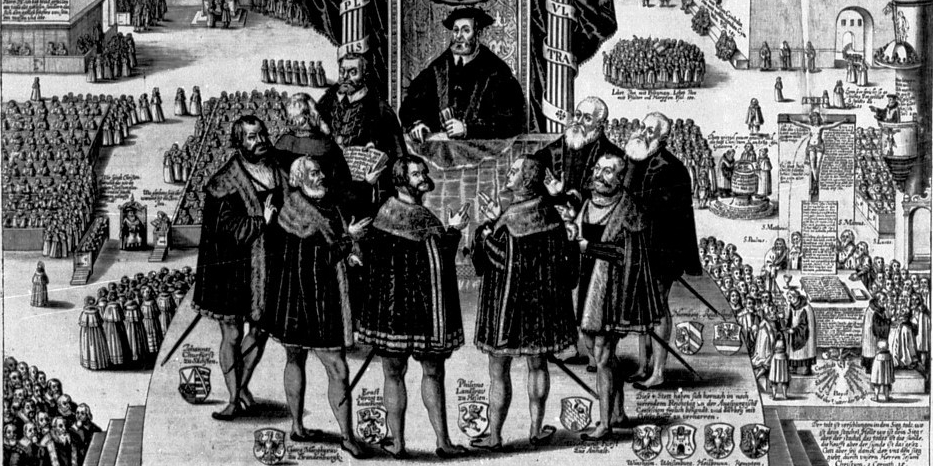
Presentation of the Augsburg Confession – Pr. Faugstad homily
On June 25, 1530, the Lutheran princes of Germany stood before Emperor Charles V in the German town of Augsburg and publicly read their confession of faith. They stated that they would rather die than compromise the truth of God’s Word.
Text: Romans 10:5-17
In Christ Jesus, whose perfect confession of the truth covers over our times of doubt, weakness, and faithlessness, dear fellow redeemed:
In the parts of the Augsburg Confession we have heard so far, there are two major themes that are brought up again and again. Those themes are righteousness and faith. In the Bible, “righteousness” is what it takes to be right with God. We don’t have to guess about the standard, because God has given us His standard for righteousness. He has given us ten statements—Commandments—which outline a life of righteousness.
Just ten commands—if you can live by them and keep them, you are right with God. But if you cannot keep them, then you cannot make yourself right with God. Already in the second article of the Augsburg Confession, the Reformers said this: We condemn those who “argue that a person can be justified before God by his own strength and reason” (ELH p. 9). In article four, they repeated the same thing, “We teach that men cannot be justified before God by their own strength, merits, or works” (ELH p. 9).
This teaching that there is nothing we can do to make ourselves right with God does not shock us, but it certainly shocked the people in Germany and beyond in 1530. Many believed that their good works, their merits, did contribute to their righteousness before God. The Roman theologians who responded to the Augsburg Confession put it like this, “All Catholics admit that our works of themselves have no merit but God’s grace makes them worthy to earn eternal life” (“The Confutation of the Augsburg Confession” in Sources and Contexts of The Book of Concord, p. 109). So is it ultimately God’s power or our power? Is it His work or our work?
St. Paul does not leave this ambiguous or unclear in today’s reading. He writes about “the righteousness that is based on the law” and “the righteousness based on faith.” The righteousness based on the law is our attempts to do what God tells us. If we kept His Commandments perfectly, He would let us into heaven because of our own good work. But if we have not kept them perfectly, we stand condemned in our sin. It’s all or nothing. Either you are perfect according to God’s standard, or you are not.
Now “the righteousness based on faith” is not a different kind of righteousness. It is still the perfect keeping of God’s Commandments, but this righteousness comes to us apart from our works. We do not earn this righteousness; we are given this righteousness. It is the righteousness of Jesus, who did perfectly keep the Commandments. He is the only human being to accomplish this. We were all conceived and born in sin, and we continued sinning. But He was conceived in the virgin Mary’s womb by the power of the Holy Spirit, and therefore He entered the world without sin.
Though in every respect He was tempted as we are, He never sinned (Heb. 4:15). He perfectly feared, loved, and trusted His heavenly Father. He perfectly loved everyone around Him. And that perfect keeping of God’s law is counted to each one of you by faith, and faith alone. Again from the Augsburg Confession, article four: “We teach that men… are freely justified for Christ’s sake through faith, when they believe that they are received into favor and that their sins are forgiven for Christ’s sake, who by His death has made satisfaction for our sins” (ELH p. 9).
For this faithful confession before one of the most powerful rulers in the world, the Reformers were risking their very necks! They were willing to die for this truth. They were fully convinced that what St. Paul wrote is true: “if you confess with your mouth that Jesus is Lord and believe in your heart that God raised Him from the dead, you will be saved.” Paul says nothing about God’s grace making us worthy to earn salvation, or about faith working through love that somehow earns us heaven. He speaks of the righteousness of Jesus becoming ours by faith in Him.
But where does faith come from? Is that a work you do? Paul writes, “So faith comes from hearing, and hearing through the word of Christ.” The power to save you and to work faith in you is in the Gospel, the good news of Jesus’ perfect life and atoning death on behalf of sinners. That is why you can be certain of your righteousness and salvation. They are gifts from God to you, received through the faith the Holy Spirit worked in you through the Word.
God has saved you. He justifies you. He caused you to believe this soul-saving truth. You Are Righteous before God by Faith. This is what the Lutheran laymen and pastors confessed 494 years ago, and by God’s enduring grace, we still confess it today to His glory alone. Amen.
+ + +
(picture of Emperor Charles V receiving the Augsburg Confession)

Midweek Lent 5 – Pr. Abraham Faugstad homily
Texts: Genesis 3:7,21, St. John 19:23-24
In Christ, who for our sakes was stripped in shame that we might be clothed with the garments of salvation, dear fellow redeemed.
Why do we wear clothes? While we might be inclined to attribute clothing to modest Norwegian sensibilities, we know that isn’t quite true. People all around the world wear clothes. Clothing does not just have to do with the climate either. In both hot and cold climates people wear clothes. It’s rather interesting that humans are the only creatures in the world that wear clothes. So why do we wear clothes?
To understand why we wear clothes we have to go all the way back to the garden of Eden. The serpent tempted Eve by saying that by eating of the tree of the knowledge of good and evil they would become like God. Adam and Eve saw that the forbidden fruit was pleasant to the eyes, and they ate. They thought that they knew what was better for them than God did. As a result, they brought sin, death, and destruction to the entire human race. As soon as they sinned, Scripture tells us that their eyes were opened, “and they knew that they were naked” (Genesis 3:7).
Immediately, they felt their shame and nakedness. They were now afraid of God. They knew they had no right to stand in the presence of a holy and just God. They tried to hide themselves among the trees of the Garden and they made themselves loincloths of leaves to cover their sinfulness. Humanity made the first clothes to try to cover their sin. Every suit of clothes, every clothing store, and every clothing display is a witness of the fall into sin.
Adam and Eve clothed themselves with leaves to cover their shame. Yet, we know what happens when leaves are plucked. They dry up and break into pieces rather quickly. How silly it must have looked for our first parents to attempt to cover themselves up with something that clearly would not last.
But isn’t this what we all try to do? We don’t want others to see our sin, so we try to cover it up. Some try to cover and clothe themselves by blaming others. It’s as old as Adam who blamed Eve and she who in turn blamed the serpent. We see this in our own lives. It’s easy for us to blame our problems or actions on someone else rather than taking personal responsibility.
Yet, perhaps the main way people try to cover up their sin today is through human work righteousness. Our consciences accuse us for what we have done wrong, so people try to make up for it by doing good things. People think God is keeping records of our rights and wrongs, and as long as our rights outweigh the wrongs, we are alright. Ask the average person how he expects to have peace with God in the afterlife and the usual answers you will get is, “I’ve tried to live a good life so I think God will accept me and take me into heaven.”
No matter how we try to cover ourselves and our sin, they are all feeble and foolish attempts. All the leaves of our own righteousness dry up as Adam and Eve’s did before God’s demand, “Be perfect as I the Lord your God am perfect” (Matthew 5:48). God isn’t impressed by our best efforts or good intentions—he demands perfect holiness. When we look at our own lives, we see that we have never perfectly kept God’s Law—our heart is filled with hatred, lust, jealousy, and greed. Scripture tells us that even our righteous works are like filthy rags in the sight of God, which cannot save us (Isaiah 64:6).
God knew that Adam and Eve’s leaf clothing would never work. The leaves would crumble and dry up. Therefore, the Lord made for Adam and Eve tunics of animal skin and clothed them. We could never stand before God with our own man-made clothing; only God can provide the proper clothing for man.
“And the LORD God made for Adam and for his wife garments of skins and clothed them.” By the shedding of blood and death, the Lord covered Adam and Eve. From this we see two important things—first, God must cover us. God provides the proper clothing. We can’t cover our sins and shame. Second, it required sacrifice and death so that God could cover our sins. The covering of sins is pictured in all the Old Testament sacrifices which pointed to the once and for all sacrifice and covering on the cross.
The clothing of Adam and Eve reminded them of the danger of sinning, to repent continually, and to put their hope of forgiveness and life in the promised Seed of the woman. They looked with hope to the one who would crush Satan’s head and free us by the bondage of sin and provide the covering needed to stand before God. The One born of the virgin called Emmanuel, God with us.
Our Lord Jesus provided a garment for us, which alone is pleasing to God, by offering up his life in our place. The Son of God became man, leaving his glory and majesty on high to come to our rescue. Jesus was the only righteous person to ever live, but he humbled himself, by taking on our shame. Ever since God first clothed Adam and Eve, it has been shameful to be disrobed in public. Our dear Lord Jesus was stripped in shame so that we would never have to be.
When we see Jesus mocked, beaten, and stripped in shame, we can feel a sense of anger and sadness over his mistreatment. Yet, we must realize that Jesus was not just there because of Pontius Pilate or the soldiers who mocked and stripped him. Jesus was there because of you. We deserve to be punished, publicly shamed, and abandoned by God. But here Jesus stood in the place of sinners—of Adam and Eve, Abraham and Isaac, and you and me.
“He was wounded for our transgressions, He was bruised for our iniquities; The chastisement for our peace was upon Him, And by His stripes we are healed… the Lord has laid on Him the iniquity of us all” (Isaiah 53:5–6). God kept his promise. Jesus fulfilled what the Scriptures foretold, even to the most minute detail of the soldiers dividing his garments and casting lots for his tunic, all to assure you that your sin and shame have been covered by his blood. Jesus offered himself up so that we might be holy and righteous before God. “For as by one man’s disobedience many were made sinners, so also by one Man’s obedience many will be made righteous” (Romans 5:19).
Scripture writes, “For He has clothed me with the garments of salvation, He has covered me with the robe of righteousness” (Isaiah 61:10). Your robe has been made white through the blood of the Lamb. The righteousness of Jesus, God’s own Son, is the only covering that can clothe the nakedness of the sinner. Because of Jesus, God no longer sees your sins—his holiness is counted as your own.
Paul explains how God has clothed you with the beautiful garment of Christ personally, “For you are all sons of God through faith in Christ Jesus. For as many of you as were baptized into Christ have put on Christ” (Galatians 3:26–27). By faith in Jesus, worked in us and promised to us in the waters of holy Baptism, we are clothed with the garment of Christ. Clothes fit for heaven itself!
Our sinful flesh will always try to cover our sin with man-made coverings, but these cannot save us and will leave us in shame on judgement day. Why do we wear clothes? They remind us of the fall into sin and serve as a reminder of our own sinfulness and need to be covered before God. At the same time your clothes are an assurance of your salvation. You have been covered by God with the garment of forgiveness obtained by Jesus’ blood shed on the cross. Your sins are forgiven. There will be no shame for those who are clothed with Christ’s righteousness, but eternal joy and peace. God grant us faith to hold dear to this priceless clothing freely given to us,
Jesus, Thy blood and righteousness,
My beauty are, my glorious dress;
’Midst flaming worlds, in these arrayed,
With joy shall I lift up my head. Amen.
ELH 432:1
(picture from “Cristo Crucificado” by Diego Velázquez, 1632)

The Fourth Sunday in Lent – Pr. Faugstad sermon
Text: Galatians 4:21-5:1
In Christ Jesus, through whom we have “obtained access by faith into this grace in which we stand” (Rom. 5:2), dear fellow redeemed:
Both this week and next, you are going to hear a bit about Abraham, and how he relates to Jesus and to you. Abraham is one of the most prominent characters in the Old Testament. Christians, Muslims, and Jews all claim Abraham as a spiritual father. But as you would expect, they do not all claim him in the same way.
Christians claim him as a father of faith, whose heirs we are because we believe the promise of salvation as he did. Muslims celebrate Abraham’s righteous life and say that their own prophet Muhammed descended from Abraham’s son Ishmael. Jews make the most of their physical descent from the line of Abraham through his son Isaac. These distinctions are some of the very things Paul is addressing in his Epistle to the Galatians.
But first, a little background about Abraham. When he was seventy-five years old, God called him and his wife Sarai to leave his father’s household and go to the land of Canaan. When they arrived, the LORD appeared to Abram and said, “To your offspring I will give this land” (Gen. 12:7). But to this point, they had had no children. Ten years passed, and eighty-five-year-old Abram was getting anxious. The LORD brought him outside and said, “Look toward heaven, and number the stars, if you are able to number them…. So shall your offspring be” (15:5). And Abram believed the promise.
At the same time, it seems that Sarai was struggling. She was now seventy-five years old. If she hadn’t conceived a child to this point, how could she possibly have one now? She decided to give her female servant Hagar to Abram. If they conceived, she would consider the child of her servant as her own. Hagar did conceive, and she bore a son, Ishmael. Sarai wasn’t as pleased as she thought she would be. And this is not how God’s promise was fulfilled.
God promised a child through Abram and Sarai, and He was going to bring it about, contrary to every expectation, contrary to all human reason. So more years passed. Abram was now ninety-nine and Sarai was ten years behind him. The LORD appeared again to Abram and told him his name would now be Abraham, “for I have made you the father of a multitude of nations,” said the LORD. “I will make you exceedingly fruitful, and I will make you into nations, and kings shall come from you” (Gen. 17:5-6). Sarai would become Sarah, “and she shall become nations; kings of peoples shall come from her” (v. 16).
And it happened. By that time the next year, 90-year-old Sarah and 100-year-old Abraham were holding their newborn son Isaac. He was their son, but they could not take credit for him. They knew this was pure gift from the Lord God. Abraham’s child with Hagar came from human planning. Abraham’s child with Sarah came from God’s promise.
Now here comes Paul’s question to the Galatians: Did you come to the saving faith through human effort or through divine promise? Earlier in his letter, he asked the question this way, “Did you receive the Spirit by works of the law or by hearing with faith?” (Gal. 3:2). If their answer was “by hearing with faith,” then he had another question, “Having begun by the Spirit, are you now being perfected by the flesh?” (v. 3).
The problem was that the Galatians were listening to false teachers, who told them that faith in Jesus was a good start. But unless they now followed the Old Testament rules and regulations, they could not be right with God. So were they saved by faith in what Jesus accomplished for them, or by their own efforts, or by some mixture of the two? That’s a very important question.
I think a great number of Christians today believe it is a mixture of the two—Jesus had to do His part, and we have to do ours if we hope to be saved. But that is not what we teach in the Lutheran Church, and it isn’t what St. Paul taught either. As soon as we start to trust in ourselves—even a little bit—for our salvation, we lose sight of what Jesus accomplished for us. This can happen very easily.
We can look at the bad things happening around us, the sins that so many commit right out in the open. We are rightfully alarmed and offended by these things. But there is often another thought that accompanies our concern, something like: “I would never do something like that!” or “If only others were more like me.” And then we don’t sound so different than the Pharisee with his self-righteous prayer: “God, I thank you that I am not like other men” (Luk. 18:11).
There is a difficult balance here. Of course we want to do what is good. That is what God demands of us in His Law. We should avoid temptations to sin. We should do nice things for the people around us. We should constantly strive to think, say, and do things better than we have done them in the past. But if we make progress, and if we succeed, we should remember where the power comes from to do these things, and we should remember who deserves the glory.
No matter how well we do in our own view or in the estimation of others, it is not even close to what God requires to get into His kingdom. That is the big misconception among so many Christians today. They think that God’s holiness is not so out of reach, and our works are not so far from perfection. That is not what the Lord’s prophet said. He said, “all our righteous deeds are like a polluted garment” (Isa. 64:6). Or the psalmist, who wrote that the LORD looks down from heaven to see if there are any righteous. And what does He find? “They have all turned aside; together they have become corrupt; there is none who does good, not even one” (Psa. 14:3).
However bad the people around us appear to be, it is pure pride to think that we are better. We are not better. We have the same corrupt heart. The devil wants you to think that you are better. He wants you to take refuge in your own righteousness. He wants you to quietly judge everyone around you and never point the holy Law at your own heart. Jesus does the opposite. He sharpens the Law. He says that maybe you haven’t murdered, but have you held a grudge? Maybe you haven’t committed adultery, but have you looked at someone with lust? Or maybe you have treated your friends well, but what about your enemies?
Remaining in slavery is thinking that we can be right with God through our keeping of His Law. That makes us children of Mt. Sinai, the mountain where God gave His Commandments. But that was a terrifying place to be. The mountain was wrapped in a thick cloud with thunder and lightning and the sound of a very loud trumpet blast. Then the LORD descended on it in fire, and smoke went up like the smoke of a kiln, and the whole mountain shook (Exo. 19:16-18).
The people who think they can work their way to heaven will one day have to stand before the holy God in all His power. Then they will see how well the glory of their work matches up with His glory. It will be like comparing a child’s scribbles with the work of a master artist, or really much worse.
We cannot find our comfort and confidence through the Law. We can only find it by traveling to another mountain, the mountain of Jerusalem, Mount Zion. Abraham went there long before the holy city was established, and he brought along his son Isaac, the son of promise. God had told Abraham to offer Isaac on a mountain as a burnt offering (Gen. 22:2). As troubling as this was, Abraham obeyed. He carried the fire and knife, and Isaac carried the wood for the sacrifice. “[B]ut where is the lamb for a burnt offering?” asked Isaac (v. 7). “God will provide for himself the lamb for a burnt offering, my son” (v. 8).
Isaac did not die that day. God stopped Abraham just before he dropped the knife, and He provided a ram for a burnt offering instead. Some two thousand years later, Jesus the only Son of God carried His own burden of wood to the same mountaintop. There, the Lamb of God was sacrificed on the altar of the cross. There, His blood was shed to wash all the sin of all the world away.
That includes your sin, the guilt you feel for doing so little of what God’s holy Law requires, and the guilt you feel for thinking you have accomplished great things on your own. Jesus took every bit of your unrighteousness on Himself to atone for it, and in exchange He gives you every bit of His perfect righteousness. That is His promise to you by faith in Him.
You are indeed set free from your former slavery to sin, devil, and death. You don’t have to keep a record of your wrongs any more than you have to keep a record of your rights. Jesus is your righteousness. He is your life. To Him, you are no servant or slave that He might push around or give away as He pleases. He has joined Himself to you in order to give you the full inheritance of the heavenly Father.
Yes, you are no longer a child of slavery. You have been born again as a child of promise. The Lord did this for you. There is nothing you have to do to set yourself free. He won you this freedom. “Stand firm therefore,” writes St. Paul—firm in the faith, firm in Christ your Savior.
Glory be to the Father and to the Son and to the Holy Ghost; as it was in the beginning, is now, and ever shall be, forevermore. Amen.
+ + +
(picture of Abraham viewing the stars from 1919 Bible primer book by Augustana Book Concern)

The Fifteenth Sunday after Trinity – Pr. Faugstad sermon
Text: St. Matthew 6:24-34
In Christ Jesus, whose promise to provide for us is far more powerful than our worries and troubles, dear fellow redeemed:
He says it five times!
- “Do not be anxious about your life.”
- “Which of you by being anxious can add a single hour to his span of life?”
- “Why are you anxious about clothing?”
- “Do not be anxious, saying, ‘What shall we eat?’ or ‘What shall we drink?’ or ‘What shall we wear?’”
- “Do not be anxious about tomorrow.”
Jesus thinks we have an anxiousness problem, a worry problem, and Jesus is never wrong. He also identifies another problem: our little faith. Both of those go together—worry and a lack of faith. We worry because we do not believe God will do what He says, or at least we have doubts that He will provide for us in just the way and at just the time that we need it.
But what is it that causes our worry? What is our worry based on? Our worry is not based on anything we find in God’s Word. We don’t read about an arbitrary or a fickle God who sometimes chooses to bless His children and sometimes chooses to harm them. At times He does chasten and discipline us, because He wants to lead us to repentance and a stronger faith. But this is done out of love. He is always faithful. He does not change. So worry is not based on uncertainty about God’s will and work which are clearly revealed to us in His Word.
Worry is based on our own experience and the evidence we see around us in the world. We can think of times when we had more expenses than income, more responsibilities than we had the ability to meet. Maybe we were worried about paying our bills, and then more bills came. We didn’t know where the money would come from to cover even the essentials like food and utilities. Or one of our family members was sick, and we didn’t know if we could afford the medicine needed for healing.
We also look around us and see many people who go hungry, who can’t afford clothing, who have no place to go home to. If God feeds the birds and clothes the lilies, why doesn’t He feed and clothe all people in need? And if doesn’t do this for the people who really need it, how can we be sure He will do this for us? So we worry. We give more weight to our experiences and doubts than to God’s promises.
When we allow worry to come in, we are taking matters that God wants to handle and holding those matters in our own hands. We keep the burden on ourselves of providing for our needs and fixing our own problems. Or we look for another provider, another god, whose promises seem more reliable.
This is how many people view the government. They trust the government to take care of all their needs. But as necessary as government is—and God has certainly ordained it for good order and for our protection—yet government is made up of sinners, who are often ready to take as much or more than they promise to give.
Our worries really come down to 1) having enough and 2) keeping what we have. A person just out of high school or a married couple with little children might especially worry about having enough. They do without new clothes, new cars, and a nice house. Retirement is a long way off—there’s lots of work to do! But older individuals whose work has been blessed and who are able to afford the finer things, now worry about having enough to retire on and having the good health and energy to enjoy it.
When we worry about the future like this, we behave like “the Gentiles.” Jesus says, “Therefore do not be anxious, saying, ‘What shall we eat?’ or ‘What shall we drink?’ or ‘What shall we wear?’ For the Gentiles seek after all these things, and your heavenly Father knows that you need them all.” Now many of us are Gentiles in the sense of not having Jewish background. But Jesus is referring to the unbelieving Gentiles, the ones who did not have the Scriptures. That isn’t us, but we act like the unbelievers when we worry about having what we need.
Instead of worry, Jesus teaches us to do this: “seek first the kingdom of God and His righteousness, and all these things will be added to you.” He says that when we put our faith in God and His Word—little though our faith may be—, all the things we need for this earthly life will be provided to us. That’s quite a promise! It’s a promise that we have difficulty accepting.
We think that if we are going to prosper in this life, we have to make it happen. We have to outwork our co-workers, we have to come up with new solutions to get ourselves noticed by the “higher-ups.” We have to be in the right place at the right time. Then we will have a shot at our dreams. Then we can have a chance at the life we always wanted.
This is not a criticism of hard work. God wants every one of us to do our work to the best of our ability, whether we are in the classroom, in the workplace, in our homes, or at church. God never endorses laziness. In teaching us not to worry, Jesus is certainly not teaching us to sit back and wait for everything to drop in our lap. The apostle Paul couldn’t have said it more clearly than this: “If anyone is not willing to work, let him not eat” (2Th. 3:10).
The difference is working for selfish gain or working for godly gain. We work for godly gain when we recognize that God is the one who gives each of us our unique abilities and strengths to employ in His service. We trust that He will bless our efforts as He sees fit. He might give more to some of His children and less to others, but all of it is a gift from His gracious hand. So it is not helpful to compare what we have with what others have, since God is the Giver, and “He is good, for His mercy endures forever” (Psa. 136:1).
And how do we know this is true beyond any doubt, that God really is so good and merciful? We know this because the Father who created and provides for all things also gave the greatest gift of all—His only-begotten Son to save us. When Jesus says, “seek first the kingdom of God and His righteousness,” He is referring to His own holy work.
God the Father sent Him to do for us what we could not accomplish, no matter how much we worried after it or worked for it. Jesus the Christ was born under the Law, so that He might redeem us, buy us back, by His own holy life. While we are anxious and doubtful about God’s care for us, He perfectly entrusted Himself to the Father’s will. He did not worry about tomorrow; He focused on God’s Word today.
Wherever we have failed in our work through our worry, our selfishness, and our laziness, Jesus fulfilled the holy Law through His faith, His love, and His perfect commitment to the work of saving us sinners. “His righteousness” is the righteousness we must seek if we will stand before God in heaven. And this is the righteousness we already have by faith in Jesus.
Yes, our faith is “little” and never as strong as it should be. But even a little faith has salvation in Christ. Our eternal future does not depend on how strong our faith is, but on how strong our Savior and Lord is. And He is strong! He is stronger than hunger and want, stronger than worry and fear, stronger than sin, death, and the devil.
He suffered when He went to the cross, but He was not worried. Just before He took His last breath, He cried out, “Father, into your hands I commit my spirit!” (Luk. 23:46). Then He was taken off the cross and closed up in the tomb, but He was not worried. Death was no match for Him, and He rose from the dead on the third day to prove it.
It is this Conqueror of sin and death who tells you: “Do not be anxious; do not worry.” If your needs and concerns are like ten enemies threatening you with pocket knives and pitchforks, God’s care is like an entire army right behind you outfitted with the best weapons and equipment. Worldly cares are scattered by the powerful promise of God’s care.
He will provide for you. If He needs to say it again and again, even every day, He will: “Do not be anxious. I have not forgotten about your needs. I know how to turn trials into blessings. I will come and help you. Have no fear!” In His care for you, God the Father already sent His Son to rescue you from eternal death. That must mean He will not forsake you in your times of need (Rom. 8:32).
And you know this to be true. You know that your cares and worries have never done anything for you. You know that God’s care for you has never failed. Even when you were anxious, even when you complained, He kept on loving you. And if He didn’t give you everything you wanted at the time, He gave you everything you needed.
God knows your needs even better than you do. He gives you His kingdom and His righteousness for your eternal life, and He gives all that you need for this body and life besides.
Glory be to the Father and to the Son and to the Holy Ghost; as it was in the beginning, is now, and ever shall be, forevermore. Amen.
+ + +
(picture of Jesus and the lilies from stained glass at Jerico Lutheran Church)

The Twelfth Sunday after Trinity – Pr. Faugstad sermon
Text: St. Mark 7:31-37
In Christ Jesus, who came to bring healing not just for bodies but also for souls, not just for this life but for the life to come, dear fellow redeemed:
If you could change one thing about your body, one thing that would make you happier and more content, what would it be? For some of us (maybe many of us), it would be our weight—“I wish I could trim off a few pounds.” Others of us might say, “I wish I were a little bit taller.” “I wish I were stronger.” “I wish I were prettier.” Most of these wishes have to do with how other people see us. We want them to think we look good, because that helps us feel better about ourselves.
Or maybe what you would like to change is not so much your appearance, but your health. “I wish this pain in my joints or my back would go away.” “I wish I could get back the energy and mobility I used to have.” “I wish my heart were more reliable.” “I wish this cancer were gone.” And there is no question that being healed of these things would be a great relief. But how far would it take you? Would you actually be happier and more content if you received exactly what you wanted?
Today we hear about a man who was deaf and had a speech impediment. Those two things often go together. If you grow up being unable to hear, or unable to hear correctly, you won’t know how to control the sounds that you make with your mouth. Communication for this man was certainly difficult, but he had gotten along so far. He did not have a life-threatening illness or demon-possession like other people Jesus had healed. But the people figured that if Jesus could help with those things, He could “lay His hand on” this man and heal him too.
While the people had confidence in Jesus, it isn’t exactly the case that they believed in Him. They believed that He had special powers, and they were really hoping to see Him use them. But they did not believe He was the promised Savior of the world. What they were hoping for was a miracle of physical healing and not much more.
Jesus of course knew this about them. We see how He took the deaf man away from the crowd, because He wasn’t interested in making a spectacle of it. He sighed deeply—even groaned—as He looked toward heaven, saddened by the whole situation. And then after the miracle had been performed, He charged the people not to tell anyone what He had done—an order which they totally ignored.
But why would Jesus order them not to tell? Well what kind of message do you think they shared? Would you guess that they talked more about who He was, or about what He was able to do? “He has done all things well!” they cried. “He even makes the deaf hear and the mute speak!” The message was that Jesus mattered because of the physical healing He could perform.
This message could have led some to wonder, “Who is Jesus anyway? How is He able to do the things He does?” Those are the questions all the people should have been asking. But many just looked at Him as a means to get what they wanted. “If Jesus could take away this problem, or this problem, I would be so free. Then I could do whatever I wanted again.”
You can see how getting healed by Jesus did not guarantee that people would follow Him. We see the same thing today. Our merciful Lord regularly blesses the medical treatment people receive, so that their life is extended. Or He preserves people from greater harm when they could have easily died. Many who have been through these things will even express that they have “a new lease on life.” But their attitude toward God doesn’t change. They don’t give thanks to the One who gives them their daily bread, who gives them everything they have and everything they need for this life.
And the same often goes for us. We might fervently pray for one thing, one physical gift, whether it be healing from an infection or disease, or for improved health. We say that we will dedicate our whole life to God if only He will fix this one thing. But how much changes for us if that healing comes? It usually doesn’t take long before we forget what God has done for us. And then we take up a new petition, a new concern, that would make our lives so much better if only God would help.
There is always another problem. This makes me think of the animated movie Aladdin by Disney. When dirt-poor Aladdin learned he had three wishes to ask for whatever he wanted, he figured he really only needed one and said he would happily use one of the wishes to free the genie. But that first wish didn’t accomplish everything Aladdin wanted. More issues and needs kept coming up. That’s how life is in this sinful world. We cannot have a perfect existence here.
Instead of looking for happiness and contentment through the relief of our physical problems, Jesus wants us to look to Him. That was the message for Paul, who pleaded for the Lord to remove his “thorn in the flesh.” Surely God would grant this request to His loyal servant, who endured tremendous affliction for preaching the Gospel! Paul prayed specifically for this three times, and this was the Lord’s answer, “My grace is sufficient for you, for my power is made perfect in weakness” (2Co. 12:9).
The question is not whether God has the power to heal us. Of course He does. The question is whether that healing is the best thing for us. God’s response to Paul was that his thorn in the flesh would be a reminder to Paul of His grace toward him. Paul would have to rely on the Lord’s strength instead of his own, which is what he realized and confessed. Paul said, “Therefore I will boast all the more gladly of my weaknesses, so that the power of Christ may rest upon me…. For when I am weak, then I am strong” (vv. 9, 10).
What Jesus does for us—that is what matters. Today’s Epistle lesson is about the change brought by our Savior’s coming. It contrasts the ministry of condemnation and death with the ministry of righteousness and life (2Co. 3:4-11). The ministry of condemnation is the work of God’s Law on our hearts which convicts us of our sin, sins like worry and impatience in our suffering, and sins like forgetting the mercy of God toward us. The ministry of righteousness is the Holy Spirit applying the gracious work of Jesus to us sinners.
God sent His Son to infuse life into this world of death. We see this so vividly in Jesus’ healing touch. The man’s ears and tongue which were “broken” because of sin in this world, Jesus touched with His holy hands. Then He spoke His powerful Word. The man didn’t have the physical ability to hear this Word, but Jesus’ Word made its way through the damaged parts of his outer ear, middle ear, or inner ear and into his brain and set all those mechanisms right again.
That’s what Jesus’ Word does, it sets everything right. His Word sets our hearts right and our minds right. His Word sets our homes right and the teaching of our churches right. His Word sets our priorities and our plans and our hopes right. When the man’s tongue was released, we are told that he was now able to speak rightly (Greek: orthos).
The people said, “He even makes the deaf hear and the mute speak,” as though that were the most he could do or the height of what He could do. But He came to do something much bigger and much better than physical healing. Putting His fingers into the man’s ears was just a small sign of who He is and what He came to do. The Son of God put His whole divine self into our human flesh. “For in [Christ] the whole fullness of deity dwells bodily” (Col. 2:9).
He came to be the Minister of Righteousness, to serve us in His righteousness and to distribute His righteous acts to us. All the good He accomplished according to the holy Law, fulfilling its demands in full, He gives to us. He credits us with His perfect listening which covers over all the times we used our hearing to listen to what is false and wrong. He credits us with His perfect speaking which covers over all the times we used our mouths to speak what is untrue and unkind. The life we have lived in our sin has been wrong in so many ways, and Jesus set us right again with the Father by His perfect life. And the debt we owed to God for breaking all His commands, Jesus paid it by shedding His holy blood on the cross.
So whether or not everything is all right for you or for me in our bodies and in the world, we are right with God through our Lord Jesus Christ. This is our confidence and this is our comfort when we suffer. Our suffering might not quickly go away, and it may be God’s will that it does not go away as long as we live here. But He promises to keep touching us with His mercy and grace in both the good days and the bad ones.
He does not tire of coming to minister to us and serve us with His healing presence in the means of grace. He does not tire of encouraging us in our weakness. He does not tire of speaking His promises to us again and again, opening our ears and filling us with His righteousness and with His enduring peace. The people were right that Jesus “has done all things well,” but they didn’t fully appreciate what “all things” meant.
Jesus “has done all things well,” all things right, because He is Righteousness. He is the Righteousness of God sent down from heaven to free us from our bondage to sin and death, and free us to hear His Word rightly and confess His truth clearly. In Him, we can be happy and content, even if not everything is right with our bodies on the outside or the inside. Jesus, the Minister of Righteousness is the one blessing we truly need.
Glory be to the Father and to the Son and to the Holy Ghost; as it was in the beginning, is now, and ever shall be, forevermore. Amen.
+ + +
(picture from the morning of the annual outdoor service)

The Sixth Sunday after Trinity – Pr. Faugstad sermon
Text: St. Matthew 5:20-26
In Christ Jesus, who came not to abolish the Law of God but to fulfill it for our righteousness, dear fellow redeemed:
The words of Jesus for today come from the early part of His “Sermon on the Mount.” In His Sermon on the Mount, Jesus describes what a righteous life before God looks like. A righteous life is a life that matches up with what God says in His Commandments. It is to be just, right with God, blameless. Two times in His sermon, Jesus tells us to desire such a life. He says, “Blessed are those who hunger and thirst for righteousness,” and “seek first the kingdom of God and his righteousness” (Mat. 5:6, 6:33).
In both of these passages, He describes a righteousness that is outside us. What we are to hunger and thirst for and seek first is God’s righteousness. That’s because our own personal righteousness is not enough. “For I tell you,” says Jesus, “unless your righteousness exceeds that of the scribes and Pharisees, you will never enter the kingdom of heaven.” The scribes and Pharisees were seen as the holiest people there were, and Jesus said their righteousness still fell short.
Then He illustrated the ways our righteousness falls short by explaining that the Commandments of God are about more than outward actions, outward conformity. You haven’t kept the Fifth Commandment simply by refraining from murder. Jesus explains that this Commandment is also broken in the mind and the heart when you hold grudges, when you have anger toward another, or when you insult someone. The Fifth Commandment, along with all of the other Commandments, is fulfilled by love. If you have anger or want revenge against others, you have no love for them.
But if you think right now about the people who have been mean to you, who have been unkind to you, who have hurt you, it is easy to justify the anger or even the hatred that you feel. You gave them the benefit of the doubt, but they abused your trust. You tried to be nice, but they only got worse. So you are going to treat them how they have treated you. You are going to give them what they deserve—and it isn’t love.
Imagine if Jesus took this approach. If Jesus took this approach, I would have no good word to share with you today, no comfort to impart. If Jesus treated us like we deserved, He would never have come down to make peace between us and God. He would never have suffered the wrath of man and of God and let Himself be nailed to the cross in our place. If Jesus treated us like we deserved, He would condemn us for our sins and send us to eternal suffering in hell.
But the Son of God did not become man to give us what we deserved. He came to show God’s mercy and grace toward the world of sinners. Look at what love and compassion He had for the sick and hurting! So many came to Him for healing, that He often went without meals and without sleep. And He did this fully knowing where this was all going, knowing the suffering and anguish that the collective sin of humanity would cause Him.
He loved perfectly. He didn’t work with an angle in mind. He didn’t serve with conditions. He constantly focused on the needs of His neighbors and how He could bless them. His life is what the righteous life that God requires looks like. It is not the way our lives look. But Jesus does not look down on us or flaunt His righteousness in front of us. He lived a life of perfect righteousness for us.
His righteous keeping of God’s Commandments counted for you. Because He is true God and true Man, whatever He did in the flesh was done on behalf of all people. This means that all who deny their own self-righteousness and trust in Him are credited with His righteousness. You will find no peace in running over and over again the wrongs done to you by others or in trying to convince yourself that you have a right to your bitterness and anger.
You will find peace in Jesus. He died for all sin—both your sin and the sin of those who have wronged you. His blood cleanses you of all of it (1Jo. 1:7). And His righteous life, His life of perfect love, covers you completely. You are a holy one by faith in Him. God is not angry with you for your many sins. He poured out His wrath against His Son, who fully atoned for all your sins. By faith in Him, your righteousness does exceed that of the scribes and Pharisees, because you have His righteousness. That means you will enter the kingdom of heaven.
Everything God required of you, He supplied you. There is nothing keeping you out of heaven. Eternal life is yours—this is most certainly true! But it is not time for heaven yet. As long as you are here, God has important work for you to do. It isn’t that He needs anything from you; after all, everything on earth is His, because He made all things. But the people around you do have needs, and God has called you to love and serve them. He calls you to share with others what you have received from Him.
This is where our identity as His “righteous ones” is tested. We are glad to hear that He forgives our sins and declares us righteous, but we find it difficult to treat other people how He treats us. We can be “good with God” but not so good with others. But look at how Jesus takes the beam of love we have toward God and trains it on our neighbors. He says, “if you are offering your gift at the altar—dedicating your prayers, thanksgivings, and offerings to God—and there remember that your brother has something against you, leave your gift there before the altar and go. First be reconciled to your brother, and then come and offer your gift.”
First things first, says Jesus. Do what you can to amend your wrong toward someone, so that you can offer your gifts to God with a cheerful heart and a clear conscience. Now there are some interpersonal issues that are difficult for us to fix. Someone might have something against us because they choose too and not because we are guilty of wronging them. These are people we show love and kindness to and pray for God to soften their hearts.
But here, Jesus is speaking about people that we have wronged by something we did to them, something we said to them, or some other way we caused offense. This applies to everyone whom we have hurt, and especially to our brothers—our fellow believers. It is always troubling and sad when there is a division within the family of faith, within the body of Christ.
But taking that first step toward reconciliation is a difficult one. As we said before, it is easy to justify the reasons we have treated others like we have. “They started it!” “What he did was worse than anything I ever did!” “I was only giving her what she gave to me!” Those responses are self-righteousness. What we are concerned about is Jesus-righteousness. We are willing to humble ourselves and serve and suffer just as He did for us.
Jesus is the prime example of how we are to interact with our neighbors. He never stopped loving, even when all He received was hatred. Think of His first words after being violently nailed to the cross, “Father, forgive them, for they know not what they do” (Luk. 23:34). But Jesus is far more than our example. He is our righteousness, our forgiveness, our power source for stepping outside what we want and stepping toward a neighbor in need.
All our neighbors have to deal with our sins, so we also want to deal out Jesus’ gifts to them. It is with Jesus’ love and sacrifice in mind that we can have courage and strength to say those three difficult words, “I am sorry.” And it is with His love and sacrifice in mind that we can respond to those who have hurt us with those other three difficult words, “I forgive you.”
“[B]e reconciled to your brother,” said Jesus, “and then come and offer your gift.” It may even happen, by the grace of God, that when you return to offer your gift, the brother with whom you had been at odds will be kneeling right beside you, offering his gift of praise and thanksgiving to God. This is what we are privileged to do each week as we receive Holy Communion. Husbands and wives who have hurt each other with unkind words come to receive Jesus’ powerful healing through His body and blood, given and shed for the remission of their sins. The same goes for parents and children who have been fighting, or for any others in the congregation whom Satan has tried to divide.
We all come forward, not trusting in our own righteousness, but humbly trusting in Jesus’ righteousness. We know how lacking our love for our neighbors has been, but we firmly believe that Jesus still forgives us and that He will strengthen us to do better. This is a beautiful pattern that repeats each week. We come weak and stained by our sin to the Divine Service, and Jesus meets us here to serve us and fill us up with His gifts.
Then He sends us back to our homes and jobs and activities with plenty of grace and forgiveness to share with others. If He never runs out of these gifts, then we won’t either, and we will continuously learn what a blessing it is to love as He has loved us.
Glory be to the Father and to the Son and to the Holy Ghost; as it was in the beginning, is now, and ever shall be, forevermore. Amen.
+ + +
(picture from “The Sermon on the Mount” by Rudolf Yelin the Older, 1912)

The Fifth Sunday after Trinity – Pr. Faugstad sermon
Text: St. Luke 5:1-11
In Christ Jesus, who did the work we had hardly even begun and were not about to finish, dear fellow redeemed:
What would it take for you to feel like you have really “made it”? When would you consider your life a success? Would it be rising to a prominent position in a company? Being recognized and awarded for your accomplishments? Making a certain amount of money and achieving the standard of living you always dreamed of? We look up to actors, athletes, and singers, because it seems like they have everything they want, the perfect life.
King Solomon had more than all of them. He looked back on a lifetime of hard work, of success and fame, and concluded that “all was vanity and a striving after wind” (Ecc. 2:11). He said that “there is more gain in wisdom than in folly,” but in the end, “the wise dies just like the fool!” (vv. 13, 16). He also recognized that everything he had worked for would one day be turned over to another to keep and manage, “and who knows whether he will be wise or a fool?” (v. 19).
So our satisfaction will not be found in climbing higher and higher and getting more and more. There is a better focus for our work, and we learn it today from the example of Jesus’ disciples.
When Jesus visited the fishermen by the lake of Gennesaret, they were not in good spirits. These men fished for their livelihood, not for leisure, which made a night’s work with no return especially frustrating. We might have expected Simon Peter’s response to be a bit saltier than it was when Jesus directed him to row to the deep part of the lake and let down his nets. For one thing, it was not the right time of day for fishing. And the deeper parts of the lake were probably not the best places to find fish. But Simon replied respectfully, “Master, we toiled all night and took nothing! But at Your word I will let down the nets.”
It wasn’t long before the fishermen saw the nets start to drag along as though they were filling up. In a short time their nets were so full, that two fishing boats could not handle the load. So much for all their fishing wisdom! This Jesus came along and prompted the greatest catch of fish they had ever seen! Now they were keenly aware of a power in their presence that was much greater than their own. They did not doubt that they had just witnessed a miracle, which meant Jesus was either a prophet of God or God Himself. Simon fell to his knees and said, “Depart from me, for I am a sinful man, O Lord.”
What Simon had forgotten at that moment is something that we lose sight of too. We forget that we are always in the presence of God, and that we cannot prosper in work without His blessing. So often we experience some success at work and are praised for what we accomplish, and we think of this as well-earned recognition. We worked hard for this and did what others could not do.
It is not wrong to take pride in a job well done. But it is wrong to take full credit for it. If you are a farmer, who is it that sends the sun and rain for your crops? If you work for an employer, who gave you the mental and physical abilities you have? If your kids grow up to be reasonably responsible citizens, who granted you the patience and care you needed to raise them?
To act as though God has nothing to do with our successes—which is what every unbeliever thinks—is to greatly dishonor Him. Unbelievers see their success as entirely dependent on themselves and even flaunt their riches in God’s face, as though He had nothing to do with it. But unless He opens His merciful hand and gives His blessings, no creature could live. He satisfies the desire of every living thing, as the Psalm says (145:16).
But we do not always feel satisfied with His gifts. Sometimes, like the disciples, we work hard and come up with nothing. Why is that? Why do we wear ourselves out and lose ground while the unrighteous appear to prosper? Has God forgotten our need? It is easy to question God when we are struggling, but it is just as easy to forget Him when we prosper. This may be why God sometimes gives us more and sometimes less—to remind us to trust in Him.
No matter how hard you work, if your work is not done to the glory of God, it is empty. No amount of money and goods will satisfy you without Jesus in view. Peter, James, and John recognized this. Even after the greatest catch of fish they had ever seen, they left it all behind. “[T]hey left everything and followed [Jesus].” They followed Jesus because He called them to a different kind of fishing. Now they would be “catching men” for God.
But they were not prepared to help fill God’s net until they were caught themselves. When Simon saw the great catch of fish, He begged Jesus to leave him, because he was a sinner. What sin do you suppose was on his mind? Was it that he doubted any fish would be caught when he “put out into the deep”? Or was it just a general awareness of his sinfulness as He stood before his Lord? The prophet Isaiah reacted in much the same way in the presence of God in heaven, “Woe is me! For I am lost” he said; “for I am a man of unclean lips” (Is. 6:5). But the last thing Simon Peter needed is what he requested. When he said, “Depart from me,” he should have said, “Save me, for I am a sinful man, O Lord!”
Being in the presence of God and hearing His Word forces us to reckon with our sins. We hear the standard that God sets and realize how far we fall short of meeting it. But instead of crying out to Jesus, “Save me!” we try to make things better on our own. We know that the sin we have fallen into is condemned by God, and we want to stop doing it. But instead of trusting in Him, we put our trust in ourselves. “I am strong enough to overcome this,” we think. “I know I am better than this, and I will prove it!” And what happens? We fall again and again. And eventually, we lose the will to fight anymore. Sometimes we continue in the sin despite the conflict we feel in our conscience, or we begin to justify the sin in an attempt to rewire our conscience.
Our flailing attempts to get free of God’s accusing law are like a bird caught in a fishing net. The harder it tries to get away, the more tangled up it becomes. This is how it was with Martin Luther. Luther had tried to get right with God by his works. He even gave up a promising career in law in order to become a monk, so that he could dedicate his life to righteous living full-time.
But the harder he worked, the more his net of righteousness came up empty. He expressed this painful realization in a hymn verse: “Fast bound in Satan’s chains I lay; / Death brooded darkly o’er me. / Sin was my torment night and day; / In sin my mother bore me. / Yea, deep and deeper still I fell; / Life had become a living hell, / So firmly sin possessed me” (ELH 378, v. 2).
It wasn’t that Luther was more sinful than the common man. But he was more honest about his sinful condition than many are. No matter how hard you and I try, we are still sinners who deserve death. St. Paul lays it out clearly, “the wages of sin is death.” But then he speaks the good news for us sinners, “the free gift of God is eternal life in Christ Jesus our Lord” (Rom. 6:23).
By God’s grace, we learn that the righteousness God requires of sinners is supplied by Jesus. To try to get to heaven without Him is to come up empty. But to place one’s entire life and being in His hands through repentant faith is to obtain everything. By faith in Jesus, your net is filled with forgiveness for your many sins, with eternal life instead of death, and with salvation from your enemies. Faith receives such abundant blessings from God that you sink beneath their glorious weight. God’s grace surrounds you and covers you, so that your flimsy attempts at righteousness can no more be seen. All that is now in view is the righteousness of Jesus and His cleansing blood.
That is why we follow Him. He gives us what we could never get on our own. Our Constant Toiling Nets Nothing without Jesus. Romans 4:5 declares, “And to the one who does not work but believes in him who justifies the ungodly, his faith is counted as righteousness.” It is not your work that justifies you before God, but faith in Jesus who did all the work that was necessary to save you.
He worked hard to save you, and He isn’t about to let that hard work on your behalf go to waste. He comes to you still and continues to work in you through His Word and Sacraments. Through these means, He supplies forgiveness whenever your God-given work falls short, and He grants the strength that you need to carry out your work to His glory alone.
Glory be to the Father and to the Son and to the Holy Ghost; as it was in the beginning, is now, and ever shall be, forevermore. Amen.
+ + +
(picture of the miraculous catch of fish by Raphael, 1515)

The Baptism of Our Lord – Pr. Faugstad sermon
Text: St. Matthew 3:13-17
In Christ Jesus, who “came by water and blood,” (1Jo. 5:6), who came to fulfill all righteousness and win our salvation from His baptism to His death on the cross, dear fellow redeemed:
What do you want to be when you grow up? If you are not asking that question now, you probably did at one time. Children and adolescents spend a lot of time thinking about that question. What am I supposed to do with my life? What will my future hold? Typically we start with grand ideas. We want to be just like the famous trailblazers and champions we admire. But as we get older, our plans become more realistic, even if our life doesn’t go in the direction we expect.
Tied up in our plans for the future is the question about where we fit in the world. We want to be noticed. We want to be liked. We want to be successful. We want others to think we are special. And that’s a lot of pressure. A report released last week by the CDC said that anxiety and depression are on the rise among teenagers, and it’s way up among teenage girls. Part of the reason for this increase has to do with the pressure that teenagers feel in matters of their sexuality.
Our current culture does not provide a healthy environment for children to mature and grow. It expects them to make life-changing decisions about themselves and their bodies when they aren’t ready to make those decisions. How do we help them with the burdens they carry? How do we settle our own anxious thoughts about our purpose in life and our future?
Today’s reading provides good direction for us. The events happened at a time when hardly anyone knew who Jesus was. His neighbors in Nazareth thought of Him as a kind and intelligent young man. But they didn’t exactly expect Him to be a world-changer. He was the son of Joseph and Mary, and He was probably destined for a very anonymous life (Mat. 13:55).
But that isn’t what John the Baptizer thought. When Jesus made His way to the Jordan River where John was preaching and baptizing, John said something surprising, “I need to be baptized by You, and do You come to me?” How did John know who Jesus was? We don’t know. What we know is that John was called to prepare the way for the Messiah. And he said that “for this purpose I came baptizing with water, that he might be revealed to Israel” (Joh. 1:31).
John and Jesus were also cousins, so it is possible they grew up around each other, and John could see how good and upright Jesus was. Whatever impressions John had about Jesus would now become set in stone. “Let it be so now,” said Jesus, “for thus it is fitting for us to fulfill all righteousness.” So John baptized Him.
As soon as Jesus stepped down into the river and had water poured over Him, you and I were assured of a very bright, a very beautiful future. How can that be? When Jesus stepped into the water, He didn’t go for Himself. We can see why John questioned Jesus’ intent to be baptized. John clearly proclaimed that his baptism was for sinners. But what sins did Jesus have to confess?
Jesus had no sins of His own, but He had all of yours and mine. This was no ordinary man who showed up at the river. This was the eternal Son of God clothed in our flesh. Whatever God did in the flesh should have our very close attention. He didn’t go to the Jordan to pass the time. Everything He did had purpose. His baptism was not a small detail in His life. It was the public beginning of His work of salvation. It was His anointing as the Savior of the world.
He stepped into the river “to fulfill all righteousness.” You can’t “fulfill all righteousness.” I can’t “fulfill all righteousness.” But Jesus could fulfill it for all of us. When He entered the water, He stepped in for you and me and every member of the human race. He was baptized to work a great exchange—your sin for His righteousness. He was baptized into your sin, so that you could be baptized into His righteousness.
In other words, His baptism in the Jordan is your future flashing before your eyes. And His journey from the Jordan to the cross and grave is your journey. What I mean is that you do not have to worry about the mark you will make on the world. You do not have to prove that you matter or that you are special. You do not have to create your own identity or determine your own fate. Jesus already addressed these concerns for you.
You can’t see what your future will hold, but you can see what Jesus’ future held. You see how the heavens were opened after His baptism and the Holy Spirit came down like a dove and rested on Him. You see how God the Father gave the stamp of approval to His Son by saying, “This is My beloved Son, with whom I am well pleased.”
You know how Jesus went on from there to the wilderness to be tempted, how He started teaching about the kingdom of God and healing the sick and the hurting, how His enemies made plans against Him, and eventually brought Him up on false charges before the governor Pontius Pilate. You see how Jesus willingly suffered, like a lamb that is led to the slaughter opening not His mouth. You see how He was nailed to the cross, cried out in anguish, died, and was buried.
That’s not exactly a future to aspire to. Do we really want to walk in those steps? Jesus told His disciples, “If anyone would come after me, let him deny himself and take up his cross and follow me” (Mat. 16:24). That is the exact opposite of what we want to do. The world tells us to indulge ourselves—food, drink, entertainment, pleasure—and our own flesh wants it. Why should we fight these desires? Why do we have to take up a cross? Won’t that only lead to heartache and pain?
It is true that following after Jesus brings us trouble. He says the world will hate everyone who trusts in Him, because the world hated Him (Joh. 15:18-19). “In the world you will have tribulation” (Joh. 16:33), He says. But persecution and trouble are not all that our future holds. In fact, Jesus says that these things only last “a little while.”
Jesus’ future did not end with His death and burial and neither will yours. Jesus came to life again on the third day. He undid death. He reversed the curse. Death no longer had dominion over Him (Rom. 6:9). He rose from the dead, and He lives on in glory. That is your future. He won that victory for you.
And all of it starts at baptism. Baptism changed your future and your focus like nothing else in the world possibly could. It had a bigger impact on you than having all your hopes and dreams for this life come true, even more than winning the lottery or becoming the ruler of the whole world. Because at your baptism, Jesus officially made His righteousness, His accomplishments, and His eternal victory over death yours.
Jesus had your sins poured over Him at the Jordan River, so you would have His righteousness poured over you at the font. He was punished by the Father in your place, so you would be forgiven of all you have done wrong. He died, so that you would live. When you were baptized, the Holy Spirit came to rest on you and filled your heart with faith. When you were baptized, God the Father called you His “beloved,” with whom He is “well pleased.”
St. Paul explains that “We were buried therefore with [Christ Jesus] by baptism into death, in order that, just as Christ was raised from the dead by the glory of the Father, we too might walk in newness of life” (Rom. 6:4). At your baptism, you were set on a new course. The plan for your future was locked in. Your life gained an instant and clear purpose. Because the merciful God chose you. He adopted you as His own. He named you His child and heir with Jesus as your brother.
Everything Jesus earned for you from His baptism to His grave became yours, and it is still yours. No matter how much you have messed up, God has not taken His baptism away from you. All that Jesus did for you is still done. Your future in Him is still secure.
So for the young who feel the pressure of being everything the world says they should be, who think they need to prove their worth and show how special they are, who are tempted to compromise themselves and their beliefs in order to be accepted, we can tell them that God loves them perfectly. He sees the temptations they have to face, how difficult their life is, and He promises that He will never leave them alone. He sent His Son to redeem their life with His, He brought them to the font to receive His blessings and give them new life, and He still meets them in their times of sadness and pain to help and strengthen them by His Word and Sacrament.
That is the promise and comfort that all of us need whether we are looking forward with anxiety or backward with regret. Jesus was baptized for you, to fulfill all righteousness for you. He went to the cross for you and rose again for you. Because of His work, your future is bright. You are baptized into Him. You believe in Him. And “[w]hoever believes and is baptized will be saved” (Mar. 16:16).
Glory be to the Father and to the Son and to the Holy Ghost; as it was in the beginning, is now, and ever shall be, forevermore. Amen.
+ + +
(picture from 1895 painting by José Ferraz de Almeida Júnior)

The Childhood of Jesus – Pr. Faugstad homily
Texts: St. Luke 2:22-38, St. Matthew 2:1-12, St. Matthew 2:13-23, St. Luke 2:41-52
In Christ Jesus, who entered this world of temptation and sin to win our righteousness and salvation, dear fellow redeemed:
When we review the accounts of Jesus’ childhood—especially the first three readings for today—Jesus is not depicted as doing anything on His own. When He was forty days old, His parents brought Him to Jerusalem to present Him to the LORD and to offer a sacrifice for Him as Old Testament Law required. Then Simeon took Jesus in his arms, blessing God. A number of months after this, wise men showed up at their house in Bethlehem, worshipping Jesus and giving Him gifts. Then because of Herod’s jealous wrath, an angel of the LORD told Joseph to take Jesus and Mary to Egypt for safety.
We might have expected more out of the Son of God incarnate. When He was presented at the temple, He could have impressed His parents and Simeon and Anna by opening His mouth and speaking a blessing to them. Or He could have made gifts appear for the wise men to help them on their journey home. He could have made His family vanish from Bethlehem and arrive in Egypt with no trouble. He could have stopped the terrible work of Herod’s soldiers.
But we see none of this. There was nothing in His appearance or actions that set Jesus apart from other children His age. He needed to be fed and have His diapers changed. He had to learn to walk and talk. The only difference that might have been perceived is that Jesus never threw a temper tantrum as infants and toddlers occasionally do. He never sinned even at this early age.
God had humbled Himself so completely when He entered our world as a baby, that He required the care of others. He needed the kind of help and assistance that all children need. God has given the responsibility of raising children to every adult, even those who do not have children of their own. Children need our collective care and support. They cannot provide for themselves, or when they are younger, defend themselves.
And the kind of care that God especially requires of us is spiritual care. Deuteronomy 6 says, “You shall teach [the words of God] diligently to your children, and shall talk of them when you sit in your house, and when you walk by the way, and when you lie down, and when you rise” (v. 7)—our conversations about what God has done for us should happen constantly. Proverbs 22 says, “Train up a child in the way he should go; even when he is old he will not depart from it” (v. 6).
And Jesus speaks a blessing for those who take this seriously, but He speaks a curse for those who don’t. He said, “Whoever receives one such child in my name receives me, but whoever causes one of these little ones who believe in me to sin, it would be better for him to have a great millstone fastened around his neck and to be drowned in the depth of the sea” (Mat. 18:5-6). Parents cause their children to sin by not teaching them the truth of God’s Word. But they give them eternal blessings by constantly pointing them to Jesus and reminding them of the gifts they received from Him at their Baptism.
This is serious business! And serious business can often seem too much for us to handle. But the care of our children is God’s will. And what God wills, He blesses. It is no mistake that the children in our life are in our life. God has given us to serve them, and He has given them to enrich our life. Children are a check on our selfish impulses by giving us a purpose and a focus outside of ourselves. And they are the source of tremendous joy and gladness as we watch their growth and development… and their misadventures.
As children mature, we see them become more and more independent. They still need us, but not for the same things. They start to test boundaries and not always in a sinful way. They want to explore on their own and find out what they are capable of. We see this independence in Jesus as a twelve-year-old. It is clear that His parents were comfortable with this, because they trusted that He was part of the group traveling home after the Passover. They didn’t feel the need to verify it. Jesus was a good boy!
And Jesus for His part was not doing anything sneaky by staying behind at the temple. He wasn’t trying to trouble His parents or make them worry. He was laser-focused on the important task of the moment and tuned out everything else around Him. This happens with our children too. Sometimes they don’t hear us give them some instruction because they don’t want to hear it. That is sinful. But other times, they don’t mean to be disobedient—they are just so focused on what they are doing that everything else gets tuned out. I suppose that happens with adults too!
It is clear that Jesus’ motivations were pure by His response to His mother, when she chided Him for His decision to stay in Jerusalem. Jesus was genuinely surprised at their concern. In His first recorded words in the New Testament, He asked them, “Why were you looking for Me? Did you not know that I must be in My Father’s house?” They didn’t understand this at the time, but it became clear to them later. And so we learn to be patient with our children, even when they do things that are hard to understand.
Raising children is difficult, frustrating, stressful, awesome, enriching, and fun all at the same time. We wish we were better at it. It’s easy for us to list our failures, the times we grew impatient and lost our temper, when we put ourselves first, when we did not model goodness and faithfulness through our words and actions. And we know well the failures of our childhood, when we did not respect our parents and other authorities as we should, when we did things we knew were wrong, when we behaved selfishly and unkindly.
Jesus came to right all these wrongs. We are told that He submitted to His sinful parents and showed love to all the people around Him, even when they did not treat Him like they should have. We probably do the most sinning against those who are closest to us, who are part of our household. But Jesus showed perfect love to all. He did not sin. Even as a baby when it looked like He wasn’t doing anything, Jesus Was Busy Winning Our Righteousness.
His active obedience under the Law was for you, offered to God on your behalf. God does not hold your failures against you. He doesn’t even see them, because Jesus paid for them with His blood, and He covers you with His own holy life. No matter how unqualified you may feel at times to watch over those in your care, you are where you are supposed to be, and God promises to strengthen you for this important work. Even your lowly and imperfect efforts are sanctified by His grace and used for the care and salvation of the little lambs who are His more than they are yours.
Glory be to the Father and to the Son and to the Holy Ghost; as it was in the beginning, is now, and ever shall be, forevermore. Amen.
+ + +
(picture from “Jesus Among the Doctors” by James Tissot, 1836-1902)