

The Feast of the Holy Nativity of Our Lord – Pr. Faugstad exordium & sermon
Festival exordium:
If you set two Christmas presents next to each other, all wrapped up, and one of them is really big while the other is quite small, which one would a child choose? Which one would any of us choose? The possibilities seem so much greater in something big.
The emphasis at Christmas is often on the big things—a house covered with lights on the outside and filled with decorations on the inside, gifts piled up around the tree, great feasts shared with family and friends, grand gestures of charity. All of these are wonderful things, and all of them are tied to Christmas. But none of these big Christmas things is the main thing.
The main thing appears much smaller, hardly significant, easily missed. To find Christmas, you have to look past the lights and decorations and presents and food, and even past friends and family. You have to look back to a humble place in a little town where a poor man and woman welcomed a tiny Baby into the world.
That Baby, wrapped up in swaddling clothes, surrounded with straw like gift bag tissue paper, and placed in the box of a manger, is the greatest gift that has ever been given. That Baby was a gift from the God who made all things on earth and in heaven. That Baby was a gift for you.
But what could this Baby do for you? If He were just a regular baby, He could do nothing for you. If He were just a regular baby, we certainly wouldn’t be gathered here today. But He was no regular baby.
He appeared so small, and yet He was exceedingly great. He appeared so weak, and yet His power was immeasurable. He appeared so helpless, and yet He was the One who would conquer death itself.
That Baby who looked like nothing special was the Son of God incarnate, the Son of God in the flesh—your flesh. He came to be your Brother, to exchange His perfect life for your sinful one, to exchange His joy for your sorrow, to exchange His life for your death.
He is the greatest gift ever given, and He was given for you. Let us rise and sing our festival hymn, #142:
Rejoice, rejoice this happy morn!
A Savior unto us is born,
The Christ, the Lord of glory.
His lowly birth in Bethlehem
The angels from on high proclaim
And sing redemption’s story.
My soul,
Extol
God’s great favor;
Bless Him ever
For salvation.
Give Him praise and adoration!
+ + +
Sermon text: St. Luke 2:1-7
In Christ Jesus, “the founder and perfecter of our faith” (Heb. 12:2), “the Alpha and the Omega, the first and the last, the beginning and the end” (Rev. 22:13), dear fellow redeemed:
We hear stories from time to time about people who rose up from difficult circumstances to become very successful. They started with nothing and now have great wealth and power. But that doesn’t change the fact that who they are in their genetic make-up had nothing to do with them. We came from our parents, who came from their parents, who came from their parents, and so on.
In that way, we are all inheritors; we inherit both what is good and what is bad from those who came before us. For the good things we inherit, we see the great privilege and the great responsibility that is handed to us. If a good name has been handed down to us, we want to live up to the name. If wealth has been handed to us, we want to use our inheritance wisely.
At the time of Jesus’ birth, it was especially the firstborn son who felt this privilege and responsibility. He received the greatest portion of the family inheritance. The honor and influence that his ancestors had gained were passed on to him. The firstborn son had a lot to live up to and a lot to lose!
The Holy Gospel for today identifies Jesus as the “firstborn son” of Mary. The original Greek states it even more emphatically, “And she gave birth to her son, the firstborn.” This is a way of emphasizing that Mary had no children prior to Jesus. In fact it was impossible for her to have children before Jesus, because she was a virgin (Isa. 7:14; Luk. 1:34).
As the “firstborn son” of Mary, Jesus was descended from the line of King David, who in turn had descended from the great patriarchs Jacob, Isaac, and Abraham who could draw their line back through Noah to the first man Adam. So Jesus had a tremendous inheritance of family, faithfulness, and history funneling down to Him. But there was one thing—one very important thing—He did not inherit. He did not inherit His forefathers’ sin.
All the rest of us do. We were all conceived in the natural way, which means the sin of Adam has come down through the generations all the way to us. The apostle Paul writes, “Therefore, just as sin came into the world through one man, and death through sin, and so death spread to all men because all sinned” (Rom. 5:12). And, “For as by the one man’s disobedience the many were made sinners” (v. 19). Adam’s sin is ours, as though we were right with him reaching out and taking a bite from the fruit in disobedience to God.
But Adam’s sin did not reach Jesus, because He was conceived in Mary’s womb by the Holy Spirit. The angel Gabriel told Mary, “The Holy Spirit will come upon you, and the power of the Most High will overshadow you; therefore the child to be born will be called holy—the Son of God” (Luk. 1:35). So Jesus was the firstborn son of Mary, but He was also the first child to be born without sin. He represented the human line He came from, but His birth was also the start of something new, something the world of men had never seen before.
Jesus was not just the firstborn Son of Mary; He is the only-begotten Son of God. There was never a time when the Son of God was not. He is begotten of God the Father from eternity. And “when the fullness of time had come, God sent forth his Son” (Gal. 4:4). He sent Him to take on flesh in Mary’s womb by the power of God the Holy Spirit, so He could be the Redeemer of all sinners.
Once this happened, once God entered our world and took on our flesh, our future became very clear and very bright. What we see Him doing was all done for us. His perfect love for God and neighbor was to fulfill God’s holy Law for us. His innocent suffering and death was to atone for our sins. And His resurrection on the third day was to conquer and cancel our death.
The Bible wraps up all His work for us in the term “firstborn.” St. Paul describes the Christ as “the firstborn of all creation… all things were created through him and for him. And he is before all things, and in him all things hold together. And he is the head of the body, the church” (Col. 1:15,16-17). This tells us that we have nothing apart from Him, and we are nothing apart from Him. “[A]ll things were created through him and for him… in him all things hold together”—and especially His holy Church of all believers.
The Son of God came down to earth and clothed Himself in our flesh, so He could clothe us in His righteousness and take us with Him to heaven. The way that He causes us to be spiritually reborn and connected to Him is through His Sacrament of Baptism. He joins us to His holy body and therefore makes us inheritors, heirs, of all that He has fulfilled and done according to the will of His Father.
By the faith given to us at our Baptism, we inherit what is His. Galatians 3:26-27 says, “for in Christ Jesus you are all sons of God, through faith. For as many of you as were baptized into Christ have put on Christ.” Whatever the only-begotten Son of God and firstborn Son of Mary has, we have. This was God’s intention all along, even before the beginning of time. Romans 8:29 tells us that we whom God the Father has elected to salvation are “conformed to the image of his Son, in order that he might be the firstborn among many brothers” (Rom. 8:29).
So we keep a close eye on the events of Jesus’ life, because in His life, we see our future unfolding. How can I hope to escape God’s wrath and enter into heaven? Because Jesus lived a perfect life of love for me and paid for all my sins through His death on the cross. How can I hope to live when death will one day take me as it has taken so many others? Because Jesus rose from the dead in triumph over death, so that all who trust in Him share in this victory.
In fact, this is another way that Jesus is referred to as “firstborn.” The same Colossians passage that calls Him “the firstborn of all creation,” later says, “He is the beginning, the firstborn from the dead, that in everything he might be preeminent” (Col. 1:15,18). He was the first to be born in holiness, so that we could enter that holiness through our Baptism into Him. He was the first to rise from the dead, so that we could be assured of our resurrection on the last day.
Apart from Jesus, there is no clear way forward, no real hope for the future. Apart from Jesus, all we have to look forward to is getting older and dying. But because “the firstborn of all creation,” entered our world and destroyed sin and death, rising as “the firstborn from the dead,” we know what our future holds. It is a future in Him, covered in His righteousness, filled with His life, going on where He has gone. Jesus First—We Follow.
“Therefore, if anyone is in Christ, he is a new creation. The old has passed away; behold, the new has come” (2Co. 5:17). We have nothing to add to His redemptive work. All of it is done for us. This is why the Christ came. This is what we celebrate at Christmas. With the angels, we worship this holy Firstborn, our Savior, and glorify His name (Heb. 1:6).
Glory be to the Father and to the Son and to the Holy Ghost; as it was in the beginning, is now, and ever shall be, forevermore. Amen.
+ + +
(picture from “Adoration of the Shepherds” by Gerard van Honthorst, 1592-1656)

The Festival of All Saints (observed) – Vicar Lehne sermon
Text: St. Matthew 9:18-26
In Christ Jesus, who conquered death so that we may live, dear fellow redeemed:
Death can be a scary thing. This is especially true for those who have no hope. To them, death is the end. So, to make death seem less scary, they try to “soften it” by describing it in nice sounding terms, such as “he is playing eighteen holes on the golf course in the sky,” or, “he lived a good life, and now his legacy lives on,” or, “he will continue to be with you forever, so long as you keep thinking about him.”
The New Testament describes death as a peaceful sleep for those who die in Christ. To the world, describing death as a peaceful sleep is another one of those ways to try to “soften it” and make death seem less scary, but the world does not expect a waking up from that sleep. We can even think this way too, especially when we have just experienced the death of a loved one. However, while (1) death seems like the end to us, in reality, (2) death is only a sleep that Jesus will wake us from. Jesus gives us hope.
Our reading for today begins with a ruler kneeling before Jesus and asking him to lay his hand on his daughter so that she will live. We find out from the Gospels of Mark and Luke that this ruler was named Jairus. We also find out from these two Gospels that Jairus’ daughter wasn’t dead yet, but she was near death. This doesn’t mean that the Gospel of Matthew is giving an inaccurate report of what happened. The account was simply condensed.
Even though Jarius’ daughter wasn’t dead yet, she was so close to death that Jairus had little to no hope that she would be able to recover. The only hope he had was that Jesus could heal her. Jairus wasn’t basing his hope on nothing. Jesus had already healed many people who were sick. He healed an official’s son who was at the point of death (John 4:46–54). He healed a man who had been sick for thirty-eight years (John 5:1–17). He healed Peter’s mother-in-law, who was sick with a high fever (Luke 4:38–39). He healed a paralytic (Mark 2:1–12). And he healed many others besides these (Matthew 8:16–17; 4:23–24).
Jairus had more than enough proof that Jesus had the power to heal his daughter. And then he watched Jesus heal a sick woman who touched the fringe of his garment on the way to his house. Seeing Jesus heal someone right in front of him no doubt gave him even more hope than he already had that Jesus had could save his daughter’s life. He had no reason to fear that his daughter would die so long as Jesus made it to his daughter in time.
Then the bad news came. According to Mark and Luke, after Jesus healed and reassured the sick woman, some men arrived to tell Jairus that his daughter had died. Jesus didn’t make it to Jairus’ daughter in time after all. Hearing this news could cause anyone to lose hope, but Jesus reassured Jairus by saying, “Do not fear; only believe, and she will be well” (Luke 8:50).
What Jesus said to reassure Jairus he also says to reassure us. Jesus entered this world to save us from death by his own death and resurrection. As Jesus said to Martha when her brother Lazarus died, “I am the resurrection and the life. Whoever believes in me, though he die, yet shall he live, and everyone who lives and believes in me shall never die” (John 11:25–26).
Despite knowing this, death can still be a scary thing. We can fear the deaths of our loved ones, not wanting to experience the loneliness caused by them no longer being by our sides, or worrying how we will provide for ourselves and our families without their help. We can also fear our own deaths, worrying that it will be painful or that we will leave our families without the help that they need.
But it’s not just physical death that we can fear, but also eternal death. We know that we are by nature sinful and that we rightfully deserve eternal punishment in the fires of hell because of our many sins, a fact that can become clearer to us the closer to death that we get. As a result, we can wonder whether we lived a good enough life or whether we have a strong enough faith to get to heaven.
When any of these fears enter our minds, Jesus offers us reassurance and hope by telling us, “Do not be afraid; only believe” (Mark 5:36). Jesus gives us the faith we need through his Word and Sacraments. Because of this, we believe that Jesus experienced all our sufferings and took all our sins on himself on the cross. We believe that he paid the price for all our sins by his innocent suffering and death. We believe that he did everything necessary to save us. And we believe that he will remain with us through all our struggles, giving us the strength to persevere until the day we enter the peaceful sleep of death and enter eternal life in heaven.
Jairus believed and put his hope in Jesus, even after he received the terrible news that his daughter had died. His friends did not have the same confidence. In fact, the men who came to deliver Jairus the bad news also told him not to bother Jesus anymore since his daughter was now dead (Mark 5:35). In addition, the people who had gathered at Jairus’ house to mourn his daughter’s death laughed at Jesus when he told them that “the girl [was] not dead but sleeping” (verse 24).
Like those who didn’t believe that Jesus could raise Jairus’ daughter from the dead, we are tempted to doubt Jesus’ power over death. We know that God has revealed through his Word that we will rise again on the Last Day and that our bodies will be reunited with our souls. However, despite knowing what the Bible says, it can be difficult for us to have hope that we will rise from the dead. After all, Jesus’ power over death doesn’t change the fact that our loved ones are, for the moment, gone. We might even wonder why Jesus didn’t prevent the death of our loved ones if he has so much power.
Additionally, when our loved ones die and we are faced with the immediate reality of death, we might think that death is the end. Since we have only ever experienced life on earth, we tend not to give much thought at all to life in heaven. So, knowing that we will not see our loved ones again in this life might cause us to think that we will never see them again, despite knowing that the Bible says that we will see them again in heaven.
When we are tempted to doubt Jesus’ power over death and think that death is the end, Jesus gives us reassurance and hope. Jesus simply saying that he has power over death is one thing, but he also backed up his words with his actions. One of the ways he did this was by raising Jairus’ daughter from the dead.
Even though no one besides Jairus seemed to believe that Jesus could raise his daughter from the dead, Jesus proved them wrong. He entered Jairus’ house, took his daughter by the hand, and said to her, “Talitha cumi,” which means, “Little girl, I say to you, arise” (Mark 5:41). And she arose.
This is not the only time that Jesus raised someone from the dead. He later raised the widow of Nain’s son from the dead (Luke 7:11–17). He raised Mary and Martha’s brother, and his friend Lazarus from the dead not long before his own death (John 11:1–41). And, in the greatest raising of all, Jesus raised himself from the dead on the third day after his death.
If Jesus had not risen from the dead, we would have no hope. If death had kept its hold on Jesus and kept him in the ground, then that would mean he isn’t God. And if Jesus wasn’t God, then he would not have paid the price for our sins. But Jesus did rise from dead, and by his resurrection, he proved he is God and defeated death, giving us hope.
But it was not just physical death that Jesus saved us from. He also saved us from two other kinds of death: spiritual death and eternal death. We are all by nature sinful, meaning that we were spiritually dead from the moment we were conceived and could only sin all the time. Even our good deeds were like filthy rags (Isaiah 64:4). Because of the sins we committed, we rightfully deserved to suffer for all eternity in the fires of hell. We couldn’t escape this fate on our own, because we couldn’t choose to do good, let alone choose to believe in Jesus. However, on the cross, Jesus paid the price for all of our sins so that we will not enter eternal death in hell when we physically die, but eternal life in heaven. Additionally, he applied his perfect life to us so that God the Father no longer sees us as his enemies who deserve eternal death in hell, but as his own dear children who deserve eternal life in heaven. So that this reality can be ours, Jesus brought us to faith through his Word and Sacraments. In the waters of Holy Baptism, our sinful natures were drowned, and our new selves rose up.
Through Baptism, Jesus has already raised us from the dead, making us a part of the saints triumphant, even though we have yet to physically die. Jesus has made us members of his holy body, as he does with all believers. Therefore, our believing loved ones who are already sleeping are not so very far away from us because we are all united in Jesus. Now, whenever we pray to God, join together in praising him, or receive his body and blood at his holy table in his Supper, we are joining in praying, praising, and feasting with the saints triumphant who are already sleeping.
Since Jesus defeated death in all of its forms, the death of the body is no longer the end for those who believe in him, but a peaceful sleep. Death is no different than falling to sleep peacefully in our beds. When our bodies enter the peaceful sleep of death, our souls will be with Jesus in heaven. Then, on the Last Day, the sure hope that we have in Christ will come to pass. When Jesus returns, he will wake all those who believe in him from their peaceful sleep, which include us and our loved ones who are already sleeping, and will reunite our bodies with our souls. But our bodies will not be the imperfect bodies we died in. They will be perfected, and we will never experience the sufferings of this world ever again. Then, Jesus will take all believers in him to heaven—all the saints—to live with him for all eternity.
Those who have no hope do not believe that this could possibly be true. To them, the sure hope that we will live again is a misguided and empty attempt to make death seem less scary. However, this sure hope is a reality for those who die in Christ. Jesus has conquered death by his innocent death on the cross and his resurrection from the dead. Because Jesus has conquered death, we will not die, but live. Because Jesus has conquered death, we have hope.
Glory be to the Father and to the Son and to the Holy Ghost; as it was in the beginning, is now, and ever shall be, forevermore. Amen.
+ + +
(picture from painting by Gabriel von Max, 1878)
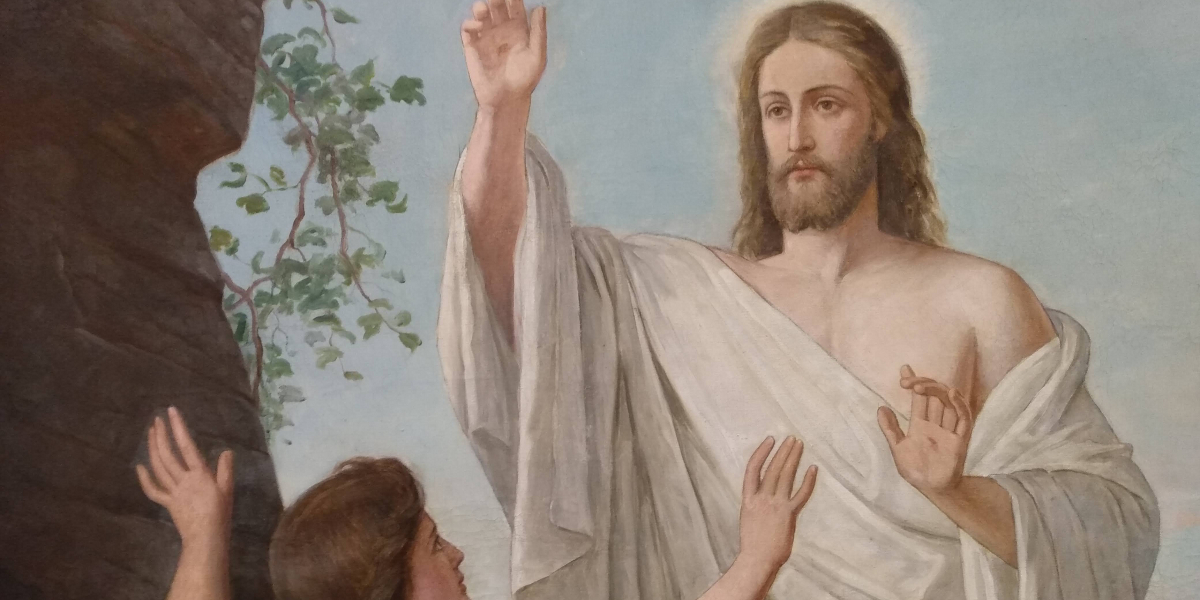
The Fourth Sunday of Easter – Vicar Anderson sermon
Text: St. John 16:16-23
In Christ Jesus, even though we live in a world with sorrows, trials, and tribulations, we are able to rejoice in our risen Lord, who promises no one will take away your joy, dear fellow redeemed:
Change is in the air. We have watched all the snow melt away. The flowers are starting to bloom. I have noticed the green starting to appear in the grey trees as the new leaves begin to grow. I think it is safe to say that most people enjoy spring. It is a season of growth and warmth. We are transitioning from a season that is kind of dark and dreary. Those winter months can be long. We have also finished a few holiday seasons, and as we acknowledge those seasons, for some maybe those seasons aren’t as joyous as we think. During those dreary months, it is a time where people tend to pass away. The holidays that we love so much can sometimes become a time of mourning and sorrow. As the spring brings us out of those dreary months into warmth and sunshine, Jesus is telling His disciples that He will bring them joy. It won’t start out like that. He says they will first weep and lament. Jesus’ comfort for His disciples comes to you as well, your sorrow will be turned into joy!
Jesus in His discourse is telling the disciples this great message. He has told them on more than one occasion that He is going to be arrested and He will die and will rise again. Jesus tells His disciples that what He is saying, they are not going to like it or want to bear it. It will look like their lives are going to be extremely hard. Jesus assures them that they will have clarity and He will explain more to them. The Holy Spirit will guide them. Everything that Jesus is telling His disciples is so that they can be strengthened. When Jesus ends with saying that He is going to leave them, the disciples hold onto that sentence. They are having a hard time understanding what is happening. The disciples will still have their doubts, or they will not believe it.
Even after our text for today and Jesus continues to tell the disciples what is about to happen. The disciples respond, “now we know that you know all things and do not need anyone to question you; this is why we believe that you came from God” (John 16:30). The disciples think that they understand what is happening and they put their trust in their own belief. Jesus tells them what will happen. “Do you now believe? Behold, the hour is coming, indeed it has come, when you will be scattered, each to his own home, and will leave me alone” (John 16:31-32).
Jesus wants the disciples to realize they are going to have sorrow and will lament because Jesus is going to be arrested, tried, and executed. He is telling them this so that they are aware of what is happening and so that they will be strengthened. The disciples see what is happening and they fall into despair. Like the disciples, we can have a lack of understanding with what God tells us. His commands are clear to us. Most of the time, we like to pick and choose which commands that we want to follow. The world will question the truths that we believe, and they will put us on the spot. The world wants us to cave to its demands. The devil helps the world out by getting us to question what God says. And when we cave and question God’s authority, we can fall into despair.
When battles happen on these different fronts, we can look to our own strength. We can think that our belief is our own. We forget that it is by the work of the Holy Spirit that we believe. When we tell the Holy Spirit “I got it from here,” this is usually the time that our lives start to fall apart. The disciples soon found their lives falling apart at the seams.
There are two time periods that Jesus is referring to when He says, “a little while.” Our “little while” here on this earth does come with suffering and trials and our lives can start to fall apart. We are plagued with sicknesses. We live and watch as those whom we love pass away. We watch as many, maybe someone close to us fall from faith. The world rejoices and ridicules us. Like the author of Lamentations, we can sometimes say, “My endurance has perished; so has my hope from the LORD” (Lamentations 3:18). The world tells us to “just toughen up”. However, there are some trials where there might not be a toughening up to bear it. As the pain and suffering can continues to weigh us down, we can forget about the cross that won us salvation and instead fixate on our own cross.
The third commandment can bring us strength. We come to church to receive comfort. Many think that church is only filled with those who have everything going well in their lives. The world doesn’t realize that we are coming here to receive help and medicine from the loving doctor. When we neglect coming to worship. Instead of putting off our burdens on Jesus who says, “I will carry them”, we can continue to carry them ourselves and they will drag us down.
Jesus was not lying when He said that the disciple’s sorrows would turn to joy. They saw their risen Savior. He was not a ghost, but He was God in the flesh. They were comforted when they saw their teachers’ hands and his feet. They saw the spear mark in His side. The disciples witnessed Jesus fulfilling what He said He would do. The Son of man would suffer and die on the cross for the sins of the world. Like the turning from dreary winter to beautiful spring, three days later Jesus rose from the dead.
Jesus illustrates this sorrow and joy. A woman ready to give birth has pain as her child is coming into the world. Once her baby is born, the mother is filled with joy as her child has arrived. She forgets all about the pain. The sorrow of Jesus being dead doesn’t compare to the glorious joy of Him risen from the grave! The disciples would watch their Savior leave again. Like the disciples after Jesus’ ascension, we are living in a “little while.” There is sorrow now, but there will be great joy when Christ returns for the Resurrection of the Dead!
As you wait for that glorious day, Jesus does see all your struggles and hardships. He hears your cries. There are many accounts where you see the compassion that your Savior has for people. St. Matthew records, “he had compassion for them, because they were harassed and helpless, like sheep without a shepherd” (Matthew 9:36). He had compassion for those who lived while He was visibly on earth, and He has compassion for you right now. He carried your burdens and sins on His shoulders and took them to the cross. As He turns the disciples’ lament into joy on that Easter day, that same day He turns your sorrows into joy!
Your comfort and joy are not in the things of this world, but in Jesus’ death and resurrection. The things of this world will pass away. Your laments turn to joy because even though there are struggles and trials in this life, you have been saved from eternal suffering. Jesus glorious resurrection assures you that God accepts Jesus’ sacrifice for your redemption. You are redeemed children of God and you will leave this world of sorrow and strife to your blessed inheritance of Heaven.
Every day we get closer to the hour that this life will pass away. We also see every day how people attempt to cope on their own with all the world’s pains. Many feel that there is no way out of this. That there is no comfort. As many despair, we hear Jesus’ Words to proclaim the Gospel. It is the power of the Gospel that turns sorrow into joy. We can share with others the comfort that we have in Christ. He is our strength. He is the One who carries us through this life because we don’t have the strength on our own. And when we need that reminder ourselves, we come to worship, repent of our sins, and again receive the comfort and strength that comes to us through the Word and sacraments. We then continue waiting and confessing, “The steadfast love of the LORD never ceases; his mercies never come to an end” (Lamentations 3:22).
As we rejoice in all the blessings that God has given us in this life, we can also rejoice that God keeps track of time way different than we do. We find the joys in spring, but we know that those dreary months will come back. Our lives will continue to have hardships and trials. But Jesus says, “A little while, and you will see me no longer, and again a little while, and you will see me.” Our time here on earth is only a little while. Every day is a blessing, but we know that soon our rooms will be prepared. Christ will call us to our heavenly home where our sorrows will cease. We will have constant joy because we have not been forgotten. Jesus has risen from the dead, and in a little while, we will see Him. Amen.
Glory be to the Father and to the Son and to the Holy Ghost; as it was in the beginning, is now, and ever shall be, forevermore. Amen.
+ + +
(picture from Jerico Lutheran Church altar painting)

The Second Sunday of Easter – Vicar Anderson sermon
Text: St. John 20:19-31
In Christ Jesus, who walks with you by faith, who you don’t see visibly, but He is right here with you, dear fellow redeemed:
Whose shoes do you want to be in? The city of Jerusalem on the first day of the week is quite busy. Soldiers are minding their own business, probably wondering why they are guarding someone’s grave. Women are wondering who is going to move the large stone away. To their surprise angels move away the stone and proclaim the wonderful news, Christ is risen! The fear of the religious leaders has become a reality, the tomb is empty. The women not only hear this glorious news, but then they see Jesus! They tell the disciples, the ones who loved Jesus so much, and they doubted what the women told them. Thomas is nowhere to be found. So again, whose shoes do you want to be in? I think we can all feel for those disciples. We know some of the thoughts that they probably had. Their teacher was gone! He was dead! We weren’t there, we did not witness what took place, but Scripture has revealed to us what happened that Easter day. Our Savior has risen! Christ tells us directly that seeing is not believing.
Jesus’ disciples needed to see Him. Our text shows that on the evening of Easter, they are locked in a room. This is a place that they feel safe. After seeing what happened, they knew that the authorities were probably coming for them next. Remember these are disciples who said “Lord, I am ready to go with you both to prison and to death” (Luke 22:33). Some news arrives that the tomb is empty. Yet they still do not believe what they have heard.
We see in the Passion account that the disciples needed help to get to this point. They had forgotten Jesus’ teachings. Jesus had spoken plainly to them about how everything was going to be fulfilled. “The Son of Man is going to be delivered into the hands of men, and they will kill him. And when he is killed, after three days he will rise” (Mark 9:31). Their little faith now has them locked in a room in fear of the leaders who put Jesus to death.
The other gospels have more details about that day. After the women had reported to the disciples what they discovered, Peter and John also raced to the tomb. They saw His folded up burial clothes. Jesus body was raised, yet they did not understand what was happening. They were stuck in despair. Thomas was not even in the room on that first day of the week. He did not get to rejoice in seeing His Lord. He wanted hard proof that Jesus was alive otherwise he would not believe it.
Scripture speaks very plainly to us just like Jesus spoke to His disciples. We will often ignore what Jesus says to stay in our sins. We try to appease the world, and the world will still throw us into despair. We can get to the point that our lack of faith can have us locked behind closed doors in fear too. This is what the devil wants. He wants us at that point of no return where we doubt God and we despair that we have been left alone. He points out all of the things that are going wrong in our lives. We hear the lie “If your God is a good God, why is He letting all of these bad things happen to you, surely you won’t have more than what you can bear?”
Like the disciples, we often doubt what God says. God tells us that He keeps His promises. The moment something happens in our lives that causes our world to turn upside down, we immediately doubt what God tells us. We try to find our own way of fixing the situation. The first thing we should be doing is praying to God. Our way of communicating with Him. And we should go to His Word where He shows us and tells us that He works things out for the good. We tend to not look much farther than the disaster in front of us because that doesn’t look like God’s promises.
God’s promise is that He will abide with us, provide for us, and help us. When we forget His first commandment to fear, love, and trust in Him above all things, we ignore His promises. When we forget about fear, love, and trust, well now why should we believe in Him? The world tells us to look around and see that there is no God. We must take care of ourselves. Unfortunately, we will continue into the pit of despair because we throw away our only source of comfort in this life.
The disciples looked like they were going to continue to stay in that pit of despair. Maybe they would have come around at some point from hearing what the women had told them. Jesus however has a different plan. Finally, as the day ends, they get to see Him with their own eyes. “Jesus came and stood among them and said to them, “Peace be with you.” When he had said this, he showed them his hands and his side. Then the disciples were glad when they saw the Lord.” Their Lord was there and was alive! Their faith was restored! They get to see in person that their Savior has risen from the dead! They see that He is no longer in the tomb. Death was destroyed. Jesus has done all that He says He would do!
Now remember Thomas was not there that first night. The grief of the events must have been overwhelming. Thomas also said he needs that physical proof. One week later and the first thing that Jesus does after saying “Peace be with you,” is that He heads right over to Thomas. This is not only Jesus walking over to Thomas, but this is Jesus walking over to speak directly to you.
Where you lack trust, that is all Jesus had. He trusted in God that this was the plan of Salvation. Like Isaac trusting his father when Abraham was about to sacrifice him, Jesus also put His trust in God the Father. He did it perfectly and instead of being spared, He took on all your sins and died for every one of them. Without Jesus death on the cross and resurrection, the world would be right, and you would have nothing or no one to trust in. There would be no reason to believe in God keeping His promises. There would be no reason to go to church to hear and learn from Him. You would just sit at home and wait for your untimely demise. These sins of doubt and failing to trust in God, they are forgiven. When the hard events of life get you, your faith might waver, but what you see in that room where Jesus met His disciples is the truth. Your faith in Jesus Christ is not in vain. He is risen indeed! And as He speaks to Thomas, He has a message for you.
That message comes to you right here and now. You are in the year 2023 and you did not get to witness the crucifixion. The men and women who were there saw and heard what happened, yet they doubted. You were not there, but you believe it. You have a new life in Christ because He is speaking directly to you. Jesus said to him, “Have you believed because you have seen me? Blessed are those who have not seen and yet have believed.” You have faith because even though it has been 2,000 years since Jesus was visibly on this earth, He still comes directly to you in the Means of Grace providing you with strength every day. Jesus is still here! This is why you come to church, to hear His Word and to receive His Sacraments. This is where Jesus is present, coming to you. He has marked you as His own, He speaks His Words of comfort that you are blessed, and He personally provides you with forgiveness of sins, life, and salvation at the altar. He breathes the Holy Spirit on you so that you hear this message and believe it.
We walk by a clear and confident faith because God has kept His promises. Our Savior has risen from the dead. Jesus then tells us directly that we do not have to worry or doubt. We were not present, but we are blessed because we believe. This is why Scripture is recorded. Everyone can hear the message of their salvation. Jesus came and died for all. St. John tells us that it is recorded for our hearing so that we may believe. We receive comfort that Christ has not left us. He is with us now in this life and He will reign over us forever. It is 2023 and we know that the tomb of Jesus was empty. Like Job we can confess, I know that my Redeemer lives; what comfort this sweet sentence gives! He lives, He lives, who once was dead; He lives, my ever-living head (ELH 351). Amen.
Glory be to the Father and to the Son and to the Holy Ghost; as it was in the beginning, is now, and ever shall be, forevermore. Amen.
+ + +
(woodcut from “Doubting Thomas” by Julius Schnorr von Carolsfeld, 1794-1872)

The Resurrection of Our Lord – Pr. Faugstad exordium & sermon
Festival exordium:
The miracle-worker died, but his followers refused to accept it. “He will rise again!” they said. So they waited. They waited one day. Then two. On the third day, nothing happened. Weeks passed, then months. Then more than a year and a half had gone by. Finally the funeral home obtained a court order and buried the man’s body.
This actually happened in South Africa. A pastor who claimed to be able to heal the sick, and who reportedly predicted his own resurrection, stayed dead. He did not have the power he thought he had or said he had.
There is only one Man who predicted His own resurrection and then did it. We are gathered here today to hear His Word and sing His praises. Even though He had done countless miracles and even raised several people from the dead, His closest disciples did not believe He would rise. The eleven disciples went into hiding after He was crucified and buried. The women made plans to return to His tomb after the Sabbath to anoint His dead body with more spices.
The only ones who seemed to take Jesus’ prediction seriously were the chief priests and Pharisees. They went to Pilate and said, “Sir, we remember how that impostor said, while he was still alive, ‘After three days I will rise.’” Therefore order the tomb to be made secure until the third day, lest his disciples go and steal him away” (Mat. 27:63-64). All this accomplished was putting witnesses at the tomb—the soldiers—who watched an angel descend from heaven and roll away the stone revealing an empty tomb. They reported what they saw to the chief priests, who, instead of hearing what they said, paid them to tell a lie (28:11-15).
But the resurrection of Jesus is no lie. It happened just as Jesus said it would, on the third day after His death. He did break the chains of death. He did emerge victorious. He did end the terrible reign of death brought into the world by Adam’s sin. He did it for the doubters, for the weak, for the faithless, for sinners—for you and me.
In thankfulness and joy, let us rise to sing hymn #348, “He Is Arisen! Glorious Word!”
He is arisen! Glorious Word!
Now reconciled is God, my Lord;
The gates of heaven are open.
My Jesus died triumphantly,
And Satan’s arrows broken lie,
Destroyed hell’s direst weapon.
O hear
What cheer!
Christ victorious
Riseth glorious,
Life He giveth—
He was dead, but see, He liveth!
+ + +
Sermon text: St. Mark 16:1-8
In Christ Jesus, who was not in the tomb on Easter morning, but who is here with us to bless us, dear fellow redeemed:
Many people claim to have seen angels. Some of them say angels appeared when they were in great distress or sorrow and brought them comfort. Others report messages spoken to them by the angels, special messages from God. The problem is, sometimes those messages do not agree with what the Bible says. So which is more reliable: a special visit from an angel or the Word of God?
If someone is given a message by a holy angel, it will not contradict the Word of God. The angels who serve God are without sin; they only tell the truth. So if an angel speaks a message that conflicts with the Word of God, it is not a holy angel. St. Paul writes that “even Satan disguises himself as an angel of light” (2Co. 11:14). Many prominent false teachers in history claim to have been visited by angels who gave them their new teachings. But these were not holy angels. They were the devil or demons coming in disguise.
So how can we know that the angel who spoke to the women at Jesus’ tomb was really sent by God? How can we be sure that it wasn’t just something they imagined in their state of emotional turmoil and sorrow? When the women went to Jesus’ tomb early Sunday morning, they went there expecting to find a dead man—if they could roll away the stone from the entrance to get to Him.
Instead, they looked up and saw that the stone had already been rolled away. That was strange. And when they cautiously peaked inside, they did not see the body of Jesus. They saw a young man wearing a long, white robe—an angel. Seeing their distress and alarm, the angel told them there was no need to fear. Why? There was no need to fear because Jesus had done everything He said He would do.
The angel didn’t tell them anything new. Jesus had told His disciples multiple times that He would go to Jerusalem to suffer, die, and on the third day rise again. And when they were in Jerusalem the night of His arrest, He told His disciples that they would all desert Him, but after He was raised up, He would go before them to Galilee (Mar. 14:27-28). Now the angel was saying the same thing: Jesus “was crucified. He is risen!… He is going before you into Galilee… as He said to you.”
That is the message the women took back to the disciples. The appearance of the angel was surprising, but the words he spoke should not have been surprising. He simply reminded them what they had already heard. That’s what the holy angels do. They proclaim the promises of God. Isn’t that what the angels did the night of Jesus’ birth? They proclaimed the fulfillment of God’s promise: “For unto you is born this day in the city of David a Savior, which is Christ the Lord” (Luk. 2:11).
You can be sure that if an angel appears to you and speaks a message that does not agree with the Bible’s teaching, it is not an angel of God. St. Paul said that there are some who “want to distort the gospel of Christ.” Then he adds, “But even if we or an angel from heaven should preach to you a gospel contrary to the one we preached to you, let him be accursed” (Gal. 1:7-8). But how can we know that the Gospel is true? Or how can we be sure we have the right Gospel?
That topic came up in a conversation I had with a Mormon man. Before I knew his religious background, he asked me a question that every Lutheran pastor loves to hear, “What is the Gospel?” But I could tell as I explained the Gospel to him that he wasn’t convinced. It was a “gotcha question.” He wanted to make the point that if all of the different denominations of Christians had different understandings of the Gospel, none of us could be certain we had the right one. That’s why we needed a modern-day prophet to give the correct interpretation—a prophet like Joseph Smith (who, incidentally, claimed to get his special revelations from an “angel”).
But we can know the Gospel from the Bible and be certain that we have the true Gospel. The angel sitting in that tomb couldn’t have said it more plainly: Jesus “was crucified. He is risen!” That is the good news. That is the Gospel. A dead man rose from the dead! But it wasn’t just any dead man. It was a dead man who claimed to be the Son of God. It was a dead man who predicted that everything would happen just as it happened. It was a dead man who said that His victory over death would be your victory, that His life would be your life.
Jesus’ resurrection verified everything He ever said. He could have said what He did, died on the cross, and never been seen or heard from again. That would have proven that He was nothing more than a big talker, or that He was delusional. But that is not what happened. He did rise from the dead. We believe it not just because an angel said it happened. We believe it because Jesus showed Himself alive to the women later that morning, to His disciples on numerous occasions, and at one time to more than five hundred of His followers (1Co. 15:6). He talked with them, ate with them, and definitively proved that He is who He said—the Son of God in the flesh.
The disciples wrote down what they saw and heard, so that everyone could learn about Jesus and what He had done. Jesus hadn’t just accomplished something for His time. He had done something for all time. His apostle John wrote near the end of His Gospel account: “these are written so that you may believe that Jesus is the Christ, the Son of God, and that by believing you may have life in his name” (Joh. 20:31).
Our faith in Jesus is not a special feeling we have about Him. It is not a decision we made when considering various faith systems. Our faith in Jesus is a confidence worked in us by God the Holy Spirit through the message of His Gospel. It is a confidence that because Jesus rose from the dead, we will rise. Because He lives forever, we will live forever. We know how ridiculous and impossible it sounds that a severely beaten and crucified man should rise from the dead a couple days later, alive and well, walking around and visiting with people all over the place.
But this was not just any man. This was God-in-the-flesh who won the victory for you. He went to the cross and crushed the devil’s head by paying for your sins. And He conquered death by coming alive on the very day He said He would. Sin, devil, and death could not stop Him. They met an Enemy who had them shaking in their boots.
This is the Lord and Savior who joined Himself to your flesh, so that He could do everything for you that you couldn’t do. And He has joined Himself to you in an even more personal way. He made you a member of His holy body through your Baptism into Him, cleansing you of your sins and covering you in His righteousness. And He feeds you and fills you with His life by giving you His immortal body and blood in His holy Supper. He graciously comes to you and me through His Word and Sacraments, so that even though outwardly we are wasting away, inwardly He renews us day by day (2Co. 4:16).
The Bible says that the angels are amazed by the gracious care God has for us. The gifts the Holy Spirit gives us through the Gospel are “things into which angels long to look” (1Pe. 1:12). So we do not need to wait for a special visit from an angel to know that God loves us. We do not need to seek comfort in our grief from strange coincidences, appearances of certain animals, or from other signs that seem to convey messages from those who are now dead.
We need the Gospel. We need to hear the message again and again that our sins are forgiven, that eternal life is ours through faith in Jesus, and that He will raise our bodies and the bodies of all our loved ones from the dead when He comes again in glory. That is the message God sent His holy angels to proclaim when His Son entered this world and when He rose in triumph out of the dark tomb.
And that is the message we still proclaim today and every day. We want our family, our friends, and even our enemies to hear the saving truth that Christ is risen! He is risen indeed! Alleluia!
Glory be to the Father and to the Son and to the Holy Ghost; as it was in the beginning, is now, and ever shall be, forevermore. Amen.
+ + +
(woodcut from “The Empty Tomb” by Julius Schnorr von Carolsfeld, 1794-1872)

The Baptism of Our Lord – Pr. Faugstad sermon
Text: St. Matthew 3:13-17
In Christ Jesus, who “came by water and blood,” (1Jo. 5:6), who came to fulfill all righteousness and win our salvation from His baptism to His death on the cross, dear fellow redeemed:
What do you want to be when you grow up? If you are not asking that question now, you probably did at one time. Children and adolescents spend a lot of time thinking about that question. What am I supposed to do with my life? What will my future hold? Typically we start with grand ideas. We want to be just like the famous trailblazers and champions we admire. But as we get older, our plans become more realistic, even if our life doesn’t go in the direction we expect.
Tied up in our plans for the future is the question about where we fit in the world. We want to be noticed. We want to be liked. We want to be successful. We want others to think we are special. And that’s a lot of pressure. A report released last week by the CDC said that anxiety and depression are on the rise among teenagers, and it’s way up among teenage girls. Part of the reason for this increase has to do with the pressure that teenagers feel in matters of their sexuality.
Our current culture does not provide a healthy environment for children to mature and grow. It expects them to make life-changing decisions about themselves and their bodies when they aren’t ready to make those decisions. How do we help them with the burdens they carry? How do we settle our own anxious thoughts about our purpose in life and our future?
Today’s reading provides good direction for us. The events happened at a time when hardly anyone knew who Jesus was. His neighbors in Nazareth thought of Him as a kind and intelligent young man. But they didn’t exactly expect Him to be a world-changer. He was the son of Joseph and Mary, and He was probably destined for a very anonymous life (Mat. 13:55).
But that isn’t what John the Baptizer thought. When Jesus made His way to the Jordan River where John was preaching and baptizing, John said something surprising, “I need to be baptized by You, and do You come to me?” How did John know who Jesus was? We don’t know. What we know is that John was called to prepare the way for the Messiah. And he said that “for this purpose I came baptizing with water, that he might be revealed to Israel” (Joh. 1:31).
John and Jesus were also cousins, so it is possible they grew up around each other, and John could see how good and upright Jesus was. Whatever impressions John had about Jesus would now become set in stone. “Let it be so now,” said Jesus, “for thus it is fitting for us to fulfill all righteousness.” So John baptized Him.
As soon as Jesus stepped down into the river and had water poured over Him, you and I were assured of a very bright, a very beautiful future. How can that be? When Jesus stepped into the water, He didn’t go for Himself. We can see why John questioned Jesus’ intent to be baptized. John clearly proclaimed that his baptism was for sinners. But what sins did Jesus have to confess?
Jesus had no sins of His own, but He had all of yours and mine. This was no ordinary man who showed up at the river. This was the eternal Son of God clothed in our flesh. Whatever God did in the flesh should have our very close attention. He didn’t go to the Jordan to pass the time. Everything He did had purpose. His baptism was not a small detail in His life. It was the public beginning of His work of salvation. It was His anointing as the Savior of the world.
He stepped into the river “to fulfill all righteousness.” You can’t “fulfill all righteousness.” I can’t “fulfill all righteousness.” But Jesus could fulfill it for all of us. When He entered the water, He stepped in for you and me and every member of the human race. He was baptized to work a great exchange—your sin for His righteousness. He was baptized into your sin, so that you could be baptized into His righteousness.
In other words, His baptism in the Jordan is your future flashing before your eyes. And His journey from the Jordan to the cross and grave is your journey. What I mean is that you do not have to worry about the mark you will make on the world. You do not have to prove that you matter or that you are special. You do not have to create your own identity or determine your own fate. Jesus already addressed these concerns for you.
You can’t see what your future will hold, but you can see what Jesus’ future held. You see how the heavens were opened after His baptism and the Holy Spirit came down like a dove and rested on Him. You see how God the Father gave the stamp of approval to His Son by saying, “This is My beloved Son, with whom I am well pleased.”
You know how Jesus went on from there to the wilderness to be tempted, how He started teaching about the kingdom of God and healing the sick and the hurting, how His enemies made plans against Him, and eventually brought Him up on false charges before the governor Pontius Pilate. You see how Jesus willingly suffered, like a lamb that is led to the slaughter opening not His mouth. You see how He was nailed to the cross, cried out in anguish, died, and was buried.
That’s not exactly a future to aspire to. Do we really want to walk in those steps? Jesus told His disciples, “If anyone would come after me, let him deny himself and take up his cross and follow me” (Mat. 16:24). That is the exact opposite of what we want to do. The world tells us to indulge ourselves—food, drink, entertainment, pleasure—and our own flesh wants it. Why should we fight these desires? Why do we have to take up a cross? Won’t that only lead to heartache and pain?
It is true that following after Jesus brings us trouble. He says the world will hate everyone who trusts in Him, because the world hated Him (Joh. 15:18-19). “In the world you will have tribulation” (Joh. 16:33), He says. But persecution and trouble are not all that our future holds. In fact, Jesus says that these things only last “a little while.”
Jesus’ future did not end with His death and burial and neither will yours. Jesus came to life again on the third day. He undid death. He reversed the curse. Death no longer had dominion over Him (Rom. 6:9). He rose from the dead, and He lives on in glory. That is your future. He won that victory for you.
And all of it starts at baptism. Baptism changed your future and your focus like nothing else in the world possibly could. It had a bigger impact on you than having all your hopes and dreams for this life come true, even more than winning the lottery or becoming the ruler of the whole world. Because at your baptism, Jesus officially made His righteousness, His accomplishments, and His eternal victory over death yours.
Jesus had your sins poured over Him at the Jordan River, so you would have His righteousness poured over you at the font. He was punished by the Father in your place, so you would be forgiven of all you have done wrong. He died, so that you would live. When you were baptized, the Holy Spirit came to rest on you and filled your heart with faith. When you were baptized, God the Father called you His “beloved,” with whom He is “well pleased.”
St. Paul explains that “We were buried therefore with [Christ Jesus] by baptism into death, in order that, just as Christ was raised from the dead by the glory of the Father, we too might walk in newness of life” (Rom. 6:4). At your baptism, you were set on a new course. The plan for your future was locked in. Your life gained an instant and clear purpose. Because the merciful God chose you. He adopted you as His own. He named you His child and heir with Jesus as your brother.
Everything Jesus earned for you from His baptism to His grave became yours, and it is still yours. No matter how much you have messed up, God has not taken His baptism away from you. All that Jesus did for you is still done. Your future in Him is still secure.
So for the young who feel the pressure of being everything the world says they should be, who think they need to prove their worth and show how special they are, who are tempted to compromise themselves and their beliefs in order to be accepted, we can tell them that God loves them perfectly. He sees the temptations they have to face, how difficult their life is, and He promises that He will never leave them alone. He sent His Son to redeem their life with His, He brought them to the font to receive His blessings and give them new life, and He still meets them in their times of sadness and pain to help and strengthen them by His Word and Sacrament.
That is the promise and comfort that all of us need whether we are looking forward with anxiety or backward with regret. Jesus was baptized for you, to fulfill all righteousness for you. He went to the cross for you and rose again for you. Because of His work, your future is bright. You are baptized into Him. You believe in Him. And “[w]hoever believes and is baptized will be saved” (Mar. 16:16).
Glory be to the Father and to the Son and to the Holy Ghost; as it was in the beginning, is now, and ever shall be, forevermore. Amen.
+ + +
(picture from 1895 painting by José Ferraz de Almeida Júnior)