
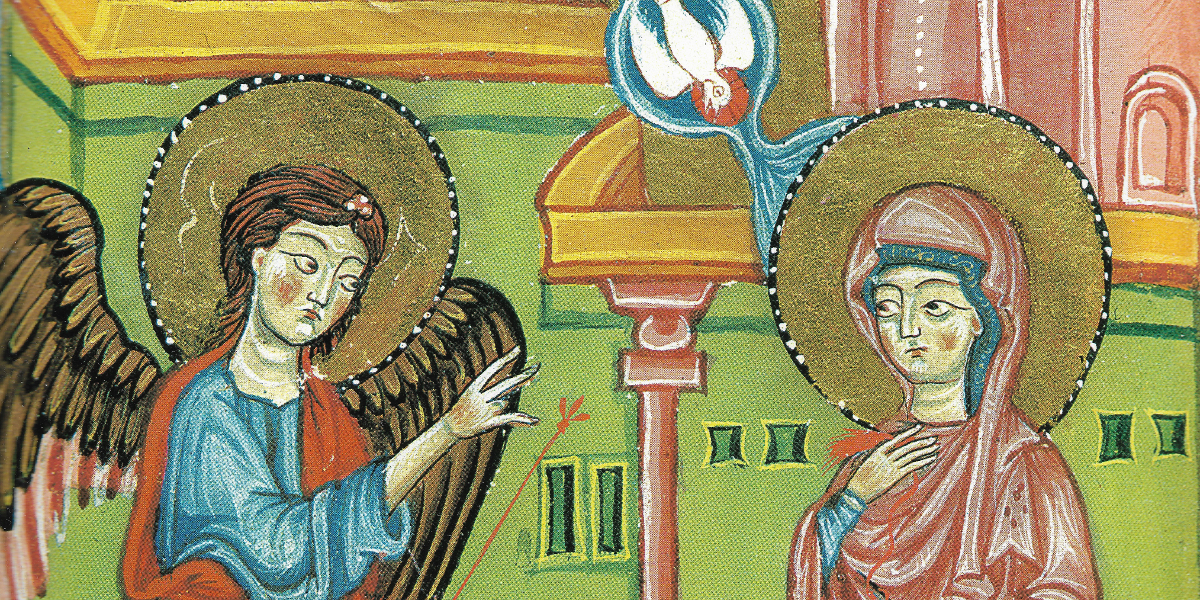
The Annunciation of Our Lord – Pr. Faugstad homily
Text: St. Luke 1:26-38
In Christ Jesus, who is true God, begotten of the Father from eternity, and also true Man, born of the Virgin Mary—our Savior and our Lord, dear fellow redeemed:
Like all faithful Jews, Mary looked forward to the coming of the Messiah promised so long before by the LORD God. She may have even wondered what sort of woman it would be who would bear that Seed, the One who would crush Satan’s head (Gen. 3:15). But she would never have imagined it would be her. Who was she? Nothing but a poor woman betrothed to a poor man from a poor town.
But God does not see as man sees. 1 Corinthians 1 says, “God chose what is low and despised in the world, even things that are not, to bring to nothing things that are, so that no human being might boast in the presence of God” (vv. 28-29). He sent His holy angel Gabriel with a history-altering message for lowly Mary. She was chosen to be the mother of the Christ-Child.
The angel’s appearance and greeting frightened and troubled Mary. He told her that she was highly favored, and that the Lord was with her. As she tried to process the angel’s words, he addressed her personally: “Do not be afraid, Mary, for you have found favor with God.” Not only did the angel speak words of blessing, but he even knew her name! There was nothing about Mary that God did not know.
In His plan to send His Son to redeem the world, He had chosen Mary to give birth to the Christ. Just as He prepared John the Baptizer to be the forerunner of Jesus, He chose Mary to be Jesus’ mother. He did not choose Mary because she was perfect. Some say that Mary was conceived without sin—an “immaculate conception”—that she lived a life without sin, and that is how her Son Jesus was without sin. But the angel clearly stated how her Child would be holy: “The Holy Spirit will come upon you, and the power of the Most High will overshadow you; therefore the Child to be born will be called holy—the Son of God.”
Mary was not chosen because she was better than everyone else. She was chosen because God is gracious. She agreed. In her song, called the Magnificat, she sang, “For He has regarded the lowly state of His maidservant; For behold, henceforth all generations will call me blessed. For He who is mighty has done great things for me, And holy is His name” (Luk. 1:48-49, NKJV).
Mary must have felt unqualified for the task God had given her, but she trusted that if He chose her to do it, then He would give her the strength for it: “Behold, I am the servant of the Lord,” she said to the angel; “let it be to me according to your word.” This is the very day that the Christ was conceived in Mary’s womb. The Holy Spirit worked through the message of the angel both to give Mary the faith she needed and to conceive the Child within her.
Traditionally the date of the angel’s announcement to Mary and the incarnation of Jesus is March 25. This day was selected in the early church because the early Christians thought it coincided with the date of Jesus’ death. Back in 2016 just after I got here, Good Friday fell on this day—March 25—so we heard at that time about both His incarnation and His death.
It is fitting that the incarnation date for Jesus falls during the season of Lent. This is the season that shows us why God took on flesh, why the Christ was born of Mary. He came to offer up His holy life in payment for all our sin. That Child of Mary lived a perfectly holy life from womb to tomb by fully keeping and never deviating from the righteous commands of God. And He freely poured out His precious blood to cleanse us from every sin.
The name given to this Child indicated what He would do. The angel said, “you shall call His name Jesus.” The angel who appeared to Joseph said the same thing: “you shall call his name Jesus, for he will save his people from their sins” (Mat. 1:21). That’s what the name Jesus means: “the Lord is salvation,” or “the Lord saves.” God sent His only-begotten Son to save.
All of this is difficult to comprehend. There are many questions we might ask: Why this point in history? Why did the Savior have to be born; why couldn’t He just appear? Why Mary? What if Mary had said “no”? Perhaps the last question has never crossed your mind. Why wouldn’t Mary want the honor of bearing the Christ-Child? For one thing, maybe she wouldn’t want the awesome responsibility of being the mother of the world’s Savior. Or maybe she would hesitate because this didn’t fit her plan. This is not how she pictured her future.
There are probably a good number of things in your life that have not gone according to your plan. Perhaps you are not living the dream you had in your younger years about what you would do and where you would go. Does this cause you disappointment, frustration, regret? Maybe you remember wonderful opportunities that passed you by, and you can’t help but imagine how much better or more successful your life would be today.
A longing for the past or dreaming about the life you might have had are tools that the devil uses to distract you from the responsibilities and blessings of today. Mary might have dreamed about a quiet home in Nazareth with several kids and a simple life. Instead, God called her to do what neither she nor anyone else could be qualified for, but that He gave her the grace and strength to do. She didn’t always understand why Jesus had to do what He did, and she suffered terribly as she watched Him dying on the cross. But in the end, she learned what it was all for—her salvation and the salvation of the world.
God has in the same way called you to the good work you are currently doing: loving and serving those closest to you, working diligently and honestly, stewarding the gifts He has given you to manage. You can’t see the big picture of what lives are being impacted by your life, but you can trust that God’s will is being done as He works through you. Mary’s statement is a wonderful expression of faith that you can adopt as your own: “Behold, I am the servant of the Lord; let it be to me according to your word.”
God knows how to bless you. That’s what He was doing by sending His Son to be born of a virgin. The fact that He was conceived by the Holy Spirit and had no biological father meant that He could be your Savior. As true Man, He was required to keep God’s holy Law and was able to suffer pain and death. As true God, His perfect keeping of the Law and His sacrificial death counted for all sinners of all time. He now declares you right with Him because of what He did for you, no matter how much or how often you have failed in your responsibilities. All of those failures are forgiven, blotted out by His precious blood.
The day the angel visited Mary changed not just her and Joseph’s life, but all of our lives. That day was the day that light entered the darkness, heaven came to earth, and God became Man. On that day—this day—, God’s promise was fulfilled, His promise to send a Savior to redeem you and me and all sinners.
Joy to the world, the Lord is come!
Let earth receive her King;
Let ev’ry heart prepare Him room
And heav’n and nature sing. (Evangelical Lutheran Hymnary #138, v. 1)
Glory be to the Father and to the Son and to the Holy Ghost; as it was in the beginning, is now, and ever shall be, forevermore. Amen.
+ + +
(picture of The Annunciation by Toros Taronetsi, 1323)

Midweek Lent 3 – Pr. Faugstad homily
Text: St. Matthew 26:6-13
In Christ Jesus, who was anointed to be our Substitute, our Savior, dear fellow redeemed:
Today’s reading introduces us to a woman at a house in Bethany, where Jesus was the honored guest at a meal. She is not named in Matthew’s Gospel or in the parallel account from the Gospel of Mark (14:3-9). But she is named in the Gospel of John (12:1-8). This woman was Mary, the sister of Martha and Lazarus. The three siblings lived in Bethany, and they were in a festive mood. Jesus had recently come to see them four days too late after Lazarus had died. But Jesus promptly called Lazarus out of his tomb alive and well. This formerly dead man was now reclining at the same table as Jesus.
Mary approached Jesus carrying “an alabaster flask of very expensive ointment.” The ointment was made of scented oil from a spikenard plant, and it was of the highest quality. In the parallel accounts, we hear the disciples’ estimate that the flask of oil was worth three hundred denarii which was about one year’s wages. It’s difficult to imagine spending one year’s wages on a bottle of perfume or cologne or any kind of oil. Could it be that Mary had purchased it for the burial of her brother, but never had the opportunity to use it?
Now she brought it to Jesus, the Savior of her brother and of the world, and she poured it over His head. St. John tells us she poured some on His feet also and wiped His feet with her hair (12:3). As the fragrance of the ointment filled the house, the disciples “caught wind” of what was going on. They recognized how costly the product was, and they criticized Mary with Judas Iscariot leading the charge: “Why this waste? For this could have been sold for a large sum and given to the poor.”
They seemed to have a good argument. After all, Mary could have just used some of the ointment. And besides, Jesus hadn’t asked her for this. Perhaps He was even annoyed by it. Those thoughts were put to rest when Jesus stepped up boldly in her defense. He gave several reasons why they should not trouble Mary. First, she had done a beautiful thing to Him, an act of love and devotion from the heart. Second, they always had the poor with them, but they would not always have Jesus. Third, she had done this to prepare Jesus’ body for burial.
It’s hard to say if Mary thought she was preparing Jesus for burial. I expect that the last thing she wanted was for her Lord to die and be buried. But Jesus gave this as the rationale for her faithful act. He was going to die. He had told this to His disciples multiple times. The fact that Jesus brought it up at this time was a sign that His death was quickly approaching.
Matthew records the anointing of Jesus just before his account of Jesus eating the Passover meal with His disciples and instituting His Supper on the Thursday of Holy Week. But it is clear that the placement of this account is topical instead of chronological. Just before he writes about the anointing of Jesus, he mentions the chief priests and the elders plotting to arrest Jesus and kill Him. Then he tells of Mary anointing Jesus and being criticized for it, especially by Judas. Then Matthew reports that Judas went to the chief priests and asked what they would give him if he betrayed Jesus to them. Matthew makes it clear that Mary’s so-called “wasteful” anointing of Jesus was a catalyst for greedy Judas to plan how to betray Jesus.
The anointing of Jesus actually happened the day before Palm Sunday (Joh. 12:1) as a preview of what was coming that week. Jesus was anointed for His burial and then made His way from Bethany to Jerusalem where He would be crucified. How long did the fragrance of the ointment linger on Jesus? Almost certainly through the next day when He rode into Jerusalem on a donkey. Then likely into Monday when He cleared the temple of the buyers and sellers. Perhaps all through the week, this scent could have been detected in Jesus’ hair.
Could the fragrance have gotten stronger again when Jesus sweat drops of blood in the Garden of Gethsemane, or when the crown of thorns brought out blood from multiple wounds in His head? Could Joseph and Nicodemus smell the fragrance when they brought His lifeless body down from the cross? Yes, this ointment was applied in advance for His burial. Jesus had to die. There was no other way. He had to go to the cross to save you. He had to be laid in a dark tomb with the entrance sealed.
The unbelieving world operates as though Jesus is still dead. Millions upon millions go through their day and conduct their business with no thought about Jesus’ sacrifice for them and no expectation of His return. To the unbelieving world, any devotion to Jesus in time, treasures, and talents is wasteful.
“You’re wasting your money if you give it to the church!” they say. “Don’t you know how often church funds have been misused for personal gain? Much better to give it to the people who actually need it, like the poor.” “You’re wasting your time by listening to the words of a God you have never seen. And if Christians are supposed to have a better life, there are an awful lot of hypocritical and miserable Christians.” “Why spend the best years of your life denying what you really want to do because some old book says you should? Why limit yourself? You only live once.”
These criticisms have an effect on us. I’m guessing that most if not all of you have had the experience of people looking at you funny when you tell them you go to church—if not outright ridiculing you for doing so—and with the pressure on, you acted like church was not really so important to you. Possibly you have thought that your life would be easier or more enjoyable if you weren’t a Christian. Maybe you have wondered if you have gotten as much out of Christianity as you have put into it, and the question came to mind, “Is this all just a waste?”
If anyone had reason to ask that, it was Jesus as He felt the whip tear at His back, the thorns cut into His skull, and the nails pierce His hands and feet. But His suffering was much worse than that. He carried the weight of the whole world’s sin on Himself. He suffered the eternal punishments of hell for wrongs He never committed. He felt forsaken by the very Father who sent Him to do this work.
But Jesus did not consider this a waste. He did not consider pouring out His holy blood for your sins a waste. He willingly, purposely, wholeheartedly did this for you. He did not waver. He did not turn back. He did not shrink from this terrible task that only He could do, and that He had to do alone.
He doesn’t hold His suffering and death against you. In fact, He is constantly making note of the beautiful things you do for Him. What things are these? Whatever you do in faith out of love for those around you, He counts as having been done for Him (Mat. 25:40). He regards it in the same way as the great gift Mary gave Him for His burial.
“Truly, I say to you, wherever this gospel is proclaimed in the whole world, what she has done will also be told in memory of her.” And so it is. Jesus’ prophecy is fulfilled today and every time we hear this Gospel. We are still hearing about Mary’s beautiful act of devotion. Her faithful gift and Jesus’ response to it points us to His saving work, that He was crucified, died, and was buried to win for us eternal life. Thanks be to God! Amen.
+ + +
(picture from stained glass at Bethany Lutheran College of Mary, Jesus, and Martha)

Palm Sunday – Pr. Faugstad sermon
Text: Philippians 2:5-11
In Christ Jesus, who came to be crowned and clothed in our sin and shame in order to obtain eternal salvation for us, dear fellow redeemed:
We don’t know how many people witnessed Jesus’ coming to Jerusalem on Palm Sunday. The apostle John mentions “the large crowd” that had come to celebrate the Passover there (Joh. 12:12). The apostle Matthew describes “the crowds that went before [Jesus] and that followed him” (Mat. 21:9). The people made such a commotion with their scattering of cloaks and palm branches on the road and with their singing and shouting that “the whole city was stirred up, saying, ‘Who is this?’” (v. 10).
What a good question! “Who is this?” Some of His followers viewed Him as a great Teacher, one who taught the Scriptures with authority. Some viewed Him as a great worker of miracles, including many who knew He had raised Lazarus from the dead. Some, like the religious leaders, viewed Him as an imposter and blasphemer, an enemy who had to be eliminated. A great many in the crowd were convinced He was the Messiah, “the Son of David” (Mat. 21:9), “the King who comes in the name of the Lord” (Luk. 19:38), “even the King of Israel” (Joh. 12:13). But they didn’t have it quite clear what this Messiah would come to do.
Jesus’ disciples were there—Peter, James, John, and all the rest—, no doubt walking near Him as He rode forward on the donkey. Probably His good friends Lazarus, Martha, and Mary were there watching with nervous anticipation. What was going to happen next? We are not specifically told that Jesus’ mother Mary was present, but I expect that she was also in the crowd watching. What did she think?
I’m not sure that her first thought was, “Hosanna to the Son of David.” I imagine her first thought may have been, “That is my son.” Did she look upon His arrival with pride, as so many shouted His praises? Did she look on in fear, knowing that many wanted Jesus dead? Perhaps she thought back to that unexpected visit of the angel, when she was just a young woman betrothed to Joseph. “Greetings, O favored one, the Lord is with you!” said the angel (Luk. 1:28). “And behold, you will conceive in your womb and bear a son, and you shall call his name Jesus” (v. 31).
The angel told her what this special Child would do: “[T]he Lord God will give to him the throne of his father David, and he will reign over the house of Jacob forever, and of his kingdom there will be no end” (v. 33). For a long time, the Church has celebrated this Annunciation, this announcement, the day of our Lord’s incarnation, on March 25th, which falls on Monday of Holy Week this year.
Now as Jesus came to Jerusalem, the purpose of His incarnation would become clear. Mary may have wondered if this was the moment the angel had spoken about. Was Jesus about to sit on the throne in Jerusalem and rule over the people of Israel? But she couldn’t forget the words of Simeon when she and Joseph brought Jesus to Jerusalem for the first time forty days after His birth. Simeon said to her, “Behold, this child is appointed for the fall and rising of many in Israel, and for a sign that is opposed (and a sword will pierce through your own soul also)” (Luk. 2:34-35).
Before the week of that Palm Sunday had ended, Mary would feel the sword piercing her soul. The praises of the crowds would turn to jeers. The hope of Jesus’ followers would become despair. Jesus would be nailed to the cross. Life would give way to death. What a shame! What a tremendous loss! The disciples who unknowingly talked with Jesus after His resurrection told Him with sadness, “[W]e had hoped that he was the one to redeem Israel” (Luk. 24:21).
And of course that is exactly what Jesus had accomplished! Jesus had to be delivered over to the chief priests and scribes to be condemned to death. He had to be delivered over to the Gentiles to be mocked and flogged and crucified (Mat. 20:18-19). He told His disciples that these things would happen. They had to be so!
This was exactly God’s plan. This is how Satan’s head would be crushed and his works would be destroyed (Gen. 3:15, 1Jo. 3:8). This is how the wages of sin would be paid, and death overcome (Rom. 6:23). God the Father would send His Son to take “the form of a servant” and be “born in the likeness of men,” as today’s Epistle says. And His Son would willingly humble Himself “by becoming obedient to the point of death, even death on a cross.”
On Palm Sunday, it looked like a king was coming to Jerusalem, a powerful prophet, a conqueror. Jesus was those things, but you can hardly tell it five days later. You will hear about this at our services on Friday, how He was beaten, thorns driven into His skull, flogged, blood dripping from too many wounds to count, nailed to a cross with criminals on either side, crying out in anguish.
The question each of us needs to ask ourselves is: Do I really want to be associated with this person? The world of our day mocks Him, just like the Jewish religious leaders and the Roman soldiers who were gathered around His cross. The way of Christ, a life lived according to His Word, is viewed as outdated, too restrictive, even by some as hateful. “What can Jesus do for you that you can’t do for yourself?” they ask. “How can Jesus guide you through present challenges, when He lived so long ago?”
“If you want to be successful,” they say, “you won’t get there by trusting in Jesus or being like Jesus.” And the world is right about that. If you want success and praise from the world, you probably won’t get it by putting the Word of God first in your life, by taking up the cross of scorn and suffering in the world and following after Jesus. Do you really want this trouble? Do you want to be mocked and pushed aside and persecuted? Do you want to be hated like He was?
And if we are answering honestly, we will say, “Not really. I don’t want that trouble. I don’t want to be left out. I don’t want to suffer.” That’s why we have compromised when we should have confessed the truth. That’s why we have hidden when we should have stood our ground. That’s why we have remained silent when people around us by their sinful words and sinful actions mocked our Lord and His holy Word. We weren’t willing to humble ourselves like Jesus did or give our lives in service to God and our neighbors like He did.
But take a good look at Him. Watch Jesus coming down the road to Jerusalem. There He goes into the city, into the lion’s den, onward to His death. What courage He showed! What strength of purpose! What love for His Father and for you! He went forward humbly in obedience to His Father’s will. The merciful God wanted to save you. He wanted your sin to be atoned for. He wanted your eternal life to be secured.
This Jesus, who went to Jerusalem on Palm Sunday, is not ashamed of you. He is not angry that He had to pay for your sins. He is not bitter that He had to die your death. He knows all your weaknesses. He knows how poorly you have represented His name. And He forgives all your transgressions. “All we like sheep have gone astray; we have turned—every one—to his own way; and the LORD has laid on him—on Jesus Christ—the iniquity of us all” (Isa. 53:6).
The Man riding into Jerusalem was no typical teacher, prophet, miracle worker, or king. He was all those things and so much more. He is the King of kings and the Lord of lords, the Ruler over heaven and earth, the Conqueror of sin, devil, and death. The world calls Him a “has-been” (if it acknowledges that He ever was). But what does the world have to chirp about? Greed? Lies? War? Death? Every promise made by the world fails, and must fail.
The promises of Jesus never fail. He is the Lord of life. Not only did He humbly and willingly pay for your sins, but He gladly meets you here through His Word and Sacraments. With the same purpose and love that brought Him to Jerusalem, He comes here to forgive you, encourage you, strengthen you. He comes to change your heart and mind, so that you are equipped and prepared to love as He loved and to suffer as He suffered.
We welcome Him here in the same way that the crowds welcomed Him to Jerusalem: “Blessed is He who comes in the name of the Lord! Hosanna in the highest!” We know who this is. It is Jesus, the Son of God, our Savior. We know His name that God the Father has bestowed on Him, “the name that is above every name.” The name of Jesus describes what He did for us—He saved us!
We honor His name in church by bowing our heads each week in repentance and by humbly trusting in His promise of grace and forgiveness. With cleansed and thankful hearts, we “confess that Jesus Christ is Lord, to the glory of God the Father.” And outside of church, we honor His name by speaking His Word of truth and living our lives according to it.
We do want to be associated with this person. He redeemed us from our sin and death, and He lives to bless and keep us as members of His everlasting kingdom.
Thanks be to God. Amen.
+ + +
(picture from “The Procession in the Streets of Jerusalem” by James Tissot, 1836-1902)
Christmas Eve – Pr. Faugstad homilies
St. Luke 1:31-35,38
I. The angel Gabriel said to Mary: “And behold, you will conceive in your womb and bear a Son, and you shall call His name Jesus.”
This scene has a specific context, a context that stretched back thousands of years. The reason an angel of the almighty God appeared to a young woman named Mary is because of another woman who lived long before this, all the way back in the beginning of time. That woman had a blissful and holy existence with her husband in a beautiful garden. They had no sin. They felt no pain. They lacked nothing.
But then a tempter came to the woman. “Wouldn’t you like to have even more?” he said. The woman gave in to the temptation, and so did her husband. They ate fruit from the one tree God had forbidden. Now they had sin. Now they knew pain. Now they were left with nothing. They hid from the presence of their Creator!
But God still loved them. He had mercy on them. He told the tempter, “I will put enmity between you and the woman, and between your offspring and her offspring; he shall bruise your head, and you shall bruise his heel” (Gen. 3:15). Adam thought the LORD was referring to Eve and her firstborn son (3:20, 4:1). But He was especially referring to another woman—to Mary, lowly Mary, Mary of Nazareth, who wouldn’t be born for several thousands of years.
In this evening’s reading, we see that God keeps His promises. He sent an angel to tell Mary that she was the one. She was the one who would bear the Son who would crush the head of Satan. She was the one who would bear the Son who would pay for all the sin of Adam & Eve and all their descendants. She was the one who would bear the Son whose name revealed His purpose. He was to be called “Jesus”—the One who saves.
Hymn: #119 – “Away in a Manger”
II. “He will be great and will be called the Son of the Most High.”
When Jesus lay there “asleep on the hay,” He did not look very impressive; He did not look so “great.” He looked like an ordinary little baby who needed what all babies need—milk, sleep, and new diapers. But this particular Baby was much more than met the eye. In the mystery of all mysteries, “the Son of the Most High,” the Son of God, had taken on human flesh.
We heard how His coming was prophesied right after the fall into sin. But the plan was actually in place before God the Father made the world and everything in it. God the Holy Spirit inspired the apostle Peter to write that our Lord Jesus Christ “was foreknown before the foundation of the world but was made manifest in the last times for the sake of you” (1Pe. 1:20).
The Son of God was incarnate, the Christ was made manifest, “the Word became flesh and dwelt among us” (Joh. 1:14). This great Lord, this “Son of the Most High,” came in the most unexpected of ways. He did not come down from heaven on the clouds in all His brilliant glory. He did not enter the world in the court of a powerful king. He came to the womb of a poor woman and was born in a little town. He “made Himself of no reputation, taking the form of a bondservant, and coming in the likeness of men” (Phi. 2:7, NKJV).
But why would He do this? Why would the God of eternity come down to us in this way? The apostle Paul tells us, “For you know the grace of our Lord Jesus Christ, that though he was rich, yet for your sake he became poor, so that you by his poverty might become rich” (2Co. 8:9).
Hymn: #123.1-4,15 – “From Heaven Above to Earth I Come”
III. “And the Lord God will give to Him the throne of His father David, and He will reign over the house of Jacob forever, and of His kingdom there will be no end.”
These words describe both the divine and human natures of the Christ: “And the Lord God will give to Him the throne of His father David.” The Lord God, God the Father from eternity, sent His only-begotten Son to join a human line. It was the line of Adam and Noah, Abraham, Isaac, and Jacob, the line of Jesse and his son David who was called from keeping sheep to be Israel’s king.
God promised that after David’s death, He would raise up an Offspring of David after him and “establish the throne of his kingdom forever” (2Sa. 7:13). That promise endured one thousand years through the crumbling and captivity of Judah and its return from exile until the birth of Jesus. Although the glory had long since departed from David’s royal line, Mary could trace her lineage to him.
More importantly, Mary was tied to the Promise, the Promise first made in the Garden of Eden, a Seed of Promise passed down from generation to generation, until it was planted in Mary’s womb by the Holy Spirit. The Child in her womb was both Man and God, both David’s Son and David’s Lord.
Though the world did not know it, He was a great King. He was the greatest King who ever walked on this earth, and He still reigns. He reigns with power and grace over His people. He sits on the throne of a kingdom that has no end.
Hymn: #143.1-2,7-9 – “The Happy Christmas Comes Once More”
IV. And Mary said to the angel, “How will this be, since I am a virgin?” And the angel answered her, “The Holy Spirit will come upon you, and the power of the Most High will overshadow you; therefore the Child to be born will be called holy—the Son of God.”
“How will this be, since I am a virgin?” Do we find it strange that Mary brings this up? Why does she feel compelled to mention her virginity? If Mary were living now, she would be told, “Mary, what you do with your body is no one’s business but yours.” But in fact what I do with my body and what you do with yours isn’t just our own business. What we do with our bodies is part of something bigger.
All who are baptized into Christ become part of His holy body. He was covered with our sins, so we would be clothed in His righteousness. He died in our place, so we would live. The apostle Paul writes that Christ “died for all, that those who live might no longer live for themselves but for him who for their sake died and was raised” (2Co. 5:15).
It does matter that Mary was a virgin. It means that the child in her womb was not conceived in her by a sinful man. That would mean their child was a sinner like them. But Jesus had no sin. He was conceived in Mary’s womb by God the Holy Spirit and therefore was “called holy.” Jesus had to be holy, so that He could take the place of you and me and all people, and offer Himself as a holy sacrifice for our sins.
Hymn: #113.1-2,4 – “A Great and Mighty Wonder”
V. And Mary said, “Behold, I am the servant of the Lord; let it be to me according to your word.” (ESV)
What a beautiful faith we find in Mary! She heard the stunning words of the angel which seemed to violate all sense, and she believed. “Behold, I am the servant of the Lord; let it be to me according to your word.” Martin Luther wrote that at her faithful hearing of God’s Word, Mary conceived “through her ear.” The day the angel visited her was the day God became man, starting as a tiny embryo in her womb.
Our minds are unable to comprehend the incarnation of God. How could the God of the universe spend nine months growing in a dark womb? How could He who has no beginning and no end be born of a woman and cradled in her arms? We cannot understand it any more than Mary could.
But we can rejoice. We can give thanks that the eternal Son of God was born for us. He was born to let nails and spear pierce Him through. He was born to bear the cross for me, for you. We don’t understand it. We don’t deserve it. But God declares it to us. “It is for you,” He says. So we reply, each one of us, with a believing heart, “Behold, I am the servant of the Lord; let it be to me according to your word.”
Hymn: #145 – “What Child Is This?”
+ + +
(picture from “The Annunciation” by Toros Taronetsi, 1323)
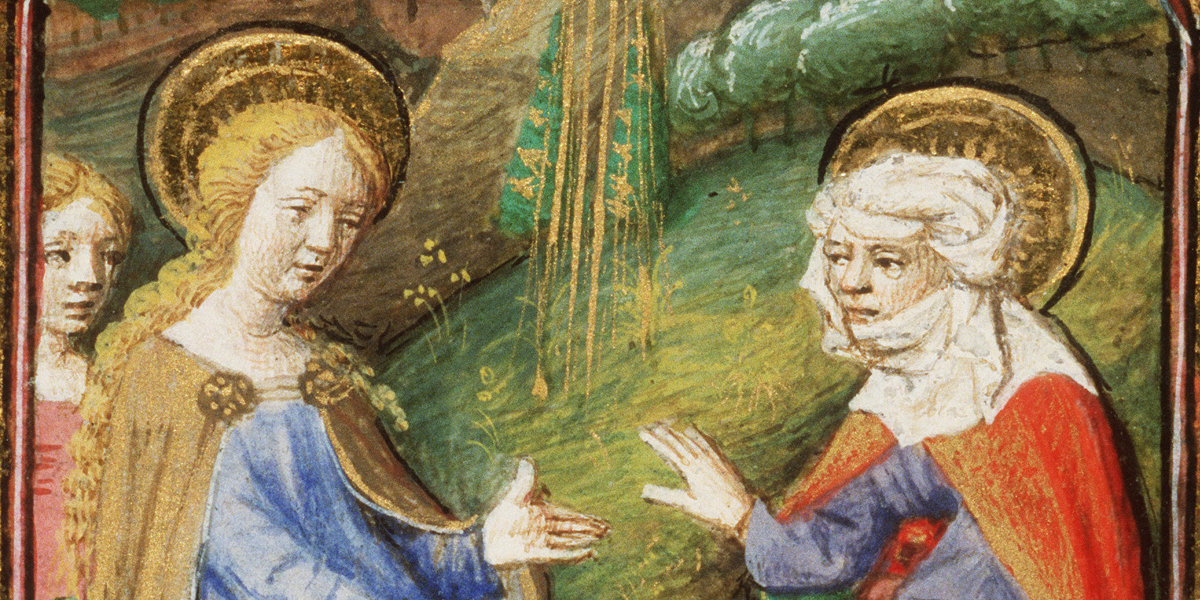
The Visitation of Mary & Vicar Installation – Pr. Faugstad sermon
Text: St. Luke 1:39-56
In Christ Jesus, who “made Himself nothing, taking the form of a servant, being born in the likeness of men” (Phi. 2:7), in order to redeem us by His perfect life and innocent death, dear fellow redeemed:
The mothers who have carried in their wombs the greatest people in the history of the world, did not know what their little babies would become. The Apostle Paul’s mother could not have guessed that her son would one day preach Christ crucified around the world. And Margarethe Luther would not have expected her son Martin to become a great reformer.
Elizabeth and Mary were different. They knew that the baby boys in their wombs were destined for tremendous things. Elizabeth learned it from her husband, a priest serving in the Jerusalem temple, who was visited by the angel Gabriel. The angel told Zechariah that he and Elizabeth would have a son. He would “be filled with the Holy Spirit, even from his mother’s womb,” and would “turn many of the children of Israel to the Lord their God” (Luk. 1:15, 16). His name was to be John. After Elizabeth conceived this child, she kept herself hidden for five months. Who would believe that this old woman was carrying a child after a lifetime of barrenness?
In the sixth month of Elizabeth’s pregnancy, the angel Gabriel visited her young relative Mary. As you know very well, Mary was betrothed to a man named Joseph, but they had not had relations with each other. Mary was a virgin. Gabriel shared the stunning news with Mary that she would bear the Christ Child, “the Son of the Most High” (Luk. 1:32), who would reign over an everlasting kingdom. And he had even more news to share. Her elderly relative Elizabeth was six months along in her own pregnancy. “For nothing will be impossible with God” (Luk. 1:37).
So what did Mary do next? She got up and hurried to Elizabeth’s house. Even if no one else believed her, Elizabeth would—Elizabeth whose life had also been touched by the unexpected working of God. By this time, Elizabeth’s belly had expanded to make room for the growing boy inside her. She might have felt little flutters as he moved around and hiccupped. Her baby was about twelve inches long and 1½ to 2 pounds in weight. His eyes may have just begun to peek out behind red eyelids.
Elizabeth did not know that a monumental meeting was about to take place. The Messiah was about to enter the home of His messenger. With Mary’s arrival, the two men who would turn the world upside down with their preaching and teaching, were now in the same room in the flesh. Elizabeth had not heard about Mary’s pregnancy, and yet she knew. She knew as soon as Mary greeted her, and her baby leaped in her womb. She knew, because at Mary’s greeting she was filled with the Holy Spirit.
The Holy Spirit revealed to her that Mary, a virgin and yet pregnant, was “the mother of her Lord.” She spoke three blessings to Mary: “Blessed are you among women,” “blessed is the fruit of your womb,” and “blessed is she who believed” what the Lord said. Elizabeth did not honor Mary because she had accomplished great things on her own. Elizabeth honored Mary because of her connection to the teeny, tiny baby growing in her womb.
But how could the little baby of a poor woman save the world? The world doesn’t think much of little babies or of poor women. Little babies are viewed more and more as burdens. Babies get in the way of careers and riches and personal freedom. All of us have thought that at one point or another. But Elizabeth and Mary were once babies, as were their sons John and Jesus. You and I were babies, and here we are. We are supposed to be here. God gave us life. Every Christian should be pro-baby, because God is pro-baby!
Every soul is precious in His sight, which means every soul should be precious to us. Our hearts should expand in love for all our neighbors, from the poor ones to the rich ones, from the lowly ones to the well-regarded, from the unborn to the elderly. Every life has value. Every life matters. Just look at the care with which God formed us in the womb. The psalmist David wrote, “For you formed my inward parts; you knitted me together in my mother’s womb. I praise you, for I am fearfully and wonderfully made” (Psa. 139:13-14). He goes on to describe how we were “made in secret, intricately woven,” and how even at our conception, God had a plan for all our days (vv. 15, 16).
The miraculous composition of a human being should be enough for people to acknowledge and praise the almighty God. But our sinfulness is great, and it has been with us for as long as we have existed. Adam and Eve’s fall meant that all their descendants would inherit their sin, and sin keeps us from fearing, loving, and trusting God as we should. In another of his Psalms, David wrote, “Behold, I was brought forth in iniquity, and in sin did my mother conceive me” (Psa. 51:5). That is true of every one of us. We were sinners from the moment we were conceived.
But Jesus was an exception to that unbroken line of sin. He was conceived not by a human father and mother, but by God the Holy Spirit overshadowing the womb of Mary. In this way, God the Son took on human flesh but without human sin. By His entrance into the world as an embryo, God was showing that life matters from its earliest beginnings, even before the human eye can see it. As He went through each stage of life—from His growth in the womb, to His birth, as a toddler, a child, a young adult, a grown-up—Jesus was redeeming every stage of life from the sin that pollutes us.
God does not take shortcuts. There was no simple, easy way for mankind to be saved. The Son of God had to take on flesh, and He couldn’t just appear in the flesh like you might appear in costume. He had to take human flesh into His Person. He had to start the way all humans start, with the joining of tiny cells. From the time that Gabriel visited faithful Mary, the eternal Son of God became God and Man in one Person. And He remains God and Man for all eternity.
This is the One whom John would go into the wilderness to proclaim. But that would be about thirty years later. Today was the day for Messenger John and his Master Jesus to meet. And how do we know that John was aware of Jesus’ presence? Elizabeth exclaimed to Mary, “For behold, when the sound of your greeting came to my ears, the baby in my womb leaped for joy.”
John continued to rejoice. Those thirty years later after Jesus was baptized, John cried out, “Behold, the Lamb of God, who takes away the sin of the world!” (Joh. 1:29). As Jesus’ following increased, and fewer were coming to John, John testified, “The friend of the bridegroom, who stands and hears him, rejoices greatly at the bridegroom’s voice. Therefore this joy of mine is now complete. He must increase, but I must decrease” (Joh. 3:29-30).
John had it right; his glory was in Jesus. The long-promised Savior had come. Elizabeth saw it the same way. She welcomed Mary with all humility, “And why is this granted to me that the mother of my Lord should come to me?” Mary saw it the same way. In her famous song, the Magnificat, she said that her Savior God “has looked on the humble estate of His servant,” “has done great things for me,” has “exalted those of humble estate,” and “has filled the hungry with good things.”
And so it is for you and me. The Lord has looked on our humble estate. He saw how helpless we were, how lost in our sin. And He has done great things for us. The little baby in Mary’s womb was growing there for you and me. The six months bigger baby growing in Elizabeth’s womb would go before Him to prepare His way. All of this happened more than 2,000 years ago, but God had you in mind.
God the Father sent His only Son for this express purpose—to save your soul. He gave you birth, so that He could give you rebirth. He formed you in the womb, so He could transform you by the power of the Gospel. You might wonder sometimes how much your life matters. You might wish you could go back, make different choices, and do more with your life. You can put all those thoughts to rest when you see what God did for you, when you see the womb of a virgin swelling with Child, when you see the God-Man making His way to Calvary carrying His cross—for you.
Your life matters. God loves you. He forgives all your sin. He wants you to join Him in heaven with Elizabeth, John, Mary, and all the saints. This is the message He calls sinful men to preach. We give thanks that He has sent another vicar to our parish to preach this Word to us and to continue training for the noble work of pastor. Pastors have nothing to offer you of their own, just as Mary had nothing to offer of her own. But as God chose her to bear the Christ-Child in her body, so He has chosen sinners to “rightly handle His word of truth” (2Ti. 2:15), and to distribute His means of grace through our mouths and by our hands.
The presence of Jesus in Mary’s womb brought joy to Elizabeth and John, and His presence still brings joy to us. When the sound of His forgiveness and grace reaches our ears, the Holy Spirit comes to remove our burdens and lift our hearts. Then our souls magnify the Lord, and our spirits rejoice in God our Savior.
Glory be to the Father and to the Son and to the Holy Ghost; as it was in the beginning, is now, and ever shall be, forevermore. Amen.
+ + +
(Picture of the Visitation from the Book of Hours of Simon de Varie, 1455)
The Annunciation of Our Lord – Vicar Anderson sermon
Text: St. Luke 1:26-38
In Christ Jesus, where at the end of the season of Lent we get this taste of Christmas, an announcement of why your Savior was born for you, dear fellow redeemed:
There are many ways in which you can find information. Many surf social media. Some watch the news on the TV. What I have learned living in New Hampton is: You must read the newspaper. If you want to be in the know, you just read it. How else will you know what is happening with the county? Now the newspaper can be used for many different announcements. It can be used to announce weddings, funerals, anniversaries, and the like. How about using an angel? Now that would be a statement! And what kind of announcement comes from an angel? Well, it must be something special. When God wants to announce something important, He sends His messengers. Today we celebrate a special announcement. The time has come! God announces His promise for all, the promise of a Savior—true God and true Man.
This special announcement of the Christ’s coming is always celebrated on March 25th. There are a few reasons why that is. This is the day of Jesus’ conception in Mary’s womb. He was conceived at God’s command. A great miracle. Then do some simple math and add nine months to the date. Nine months from now we are celebrating the birth of our Savior. The date of Christmas came later, though, and this is not why the early Christians settled on March 25th. They were looking at the incarnation for a different reason. In Jewish tradition, it was thought that the great prophets died on the same calendar day that they had been conceived. The early Christian church identified the date of Jesus’ death as March 25th. That is one of the first things they celebrated and held as important. We see that important connection too. The reason that Jesus is born is so that He can die.
That reason was even tied up in His name. Mary is told the name she is supposed to give her son. She is to give Him the name Jesus. Jesus means God saves. The prophet Isaiah also prophesied the importance of today. “Therefore the Lord himself will give you a sign. Behold, the virgin shall conceive and bear a son, and shall call his name Immanuel” (Isaiah 7:14.) Immanuel means God with us, and today we see it so clearly. The closest God can be with us is when He comes in the flesh. Gabriel announces God’s plan, His promise to send His son down from heaven and it is happening. “But she [Mary] was greatly troubled at the saying, and tried to discern what sort of greeting this might be.”
Like Mary, we would be afraid to see the power of God. The Power of God means He sees and knows all our sins. The world depicts angels as gentle people or even tender babies. But Scripture describes them differently. When angels appear, people are often terrified. God is called the LORD of Armies. This angel is bringing a message directly from God. Would we want to hear that message? We would be troubled seeing their power as we are sinful creatures. They dwell in God’s presence.
But Gabriel told Mary not to be afraid, because she had found favor with God. Found with favor, yet she was still troubled. That is what we want to have, favor with God. The question is how do we find it? Do we look at God’s favor as something we earn, or something we are freely given? Our sinful nature likes to think that we can find favor with God by our efforts. Our pride works hard to earn His favor. Whether we are trying to move up the corporate ladder or be accepted by our friends, our ambitions might not be in the right place. As we look to serve ourselves, we forget that everything we do should be in service to God. We forget the very first commandment of what we are to do. We are to love God with all our heart, soul, and mind. Because we have failed to do this, there is no favor found here.
In our sins, it is impossible to find favor with God. We can’t have favor with the world and favor with God at the same time. We like to be of the world. We want to find favor in the world. Doing so causes us to sin in ways for us to find that favor. The world wants us to be more accepting. It wants us to accept everyone’s sins. When we give into that pressure, usually we do it because we might be engaged in those same sins. We might not realize it before it is too late. Do we give up our sins when they are brought out into the light? Do we double down to try and get our way? To find favor in the world, we find our own destruction.
When God sent Gabriel to Mary, He was announcing the keeping of His promise. This promise is THE promise made in the Garden of Eden. The promise was repeated to Abraham, Isaac and Jacob. The promise was prophesied about by the prophets. King David heard directly that, “your house and your kingdom shall be made sure forever before me. Your throne shall be established forever” (2 Samuel 7:16.) Years and years go by, building up to this important moment. It is time for God to keep His promise, which means the child that Mary had, that she conceived, His job was to grow up, suffer and die for you.
Jesus is the promised Savior. He is conceived at the speaking of God’s Word, and then He is born. This miracle shows that all things are possible with God. We never have to doubt God. This singular date brings together both holidays that the Christian church loves. We have the joy of Christmas knowing that the somberness of Good Friday is around the corner. Jesus’ birth is only one step of His humiliation. He must be born to die for you. His death on the cross cleanses you of your sins and with His rising from the grave, another miracle assures you that your sins are gone. Your favor is found in Christ death and resurrection.
Thankfully our favor with God is not up to us. There is only one person who can have perfect favor with God. That person not only is man, but He is also God. That is who Jesus is, true God and true man. He perfectly finds favor with His Heavenly Father. We hear the Father say how much favor Jesus has. He says, “This is my beloved Son, with whom I am well pleased” (Matthew 3:17.) Jesus does His Father’s will. He knew that this is why He was sent here. Only He can willingly obey the law in our place. Only He can willingly die in our place. Jesus’ death and resurrection saves everyone because when God the Father looks at us, He sees the life that Christ lived.
We now have favor with God because Jesus lived the life that we couldn’t. This announcement comes directly to you every day. As we fall flat on our faces and the world looks to convince us that we must find favor with it in order to live, this announcement comes to you with forgiveness because you hear the Son of God comes to save you.
God announces His promise for all to hear. First Mary hears it announced directly to her. That she was picked to be the bearer of the Christ child. You hold onto this announcement by faith in the Savior. Faith that is from the work of the Holy Spirit in you. This announcement comes to you through the hearing and reading of the Word. You hear the Words of God as He announces His coming Son to save all of mankind. He is born to die for the sins of the world. He is the Word made flesh. This is the joy that you have. God keeps his promises. He says nothing is impossible with Him. Since we were condemned because of our sins, God sent a Savior. Mary conceives Jesus by the Holy Spirit. Your Salvation came down from heaven.
The angel tells you what Jesus’ job is here on earth. “He will be great and will be called the Son of the Most High. And the Lord God will give to him the throne of his father David, and he will reign over the house of Jacob forever, and of his kingdom there will be no end.” He will reign forever, and you inherit His kingdom because of what He did for you. You couldn’t earn God’s favor but you have God’s favor because Christ earned it for you. God announces His promise for you.
An announcement for the ages. It wasn’t found online or in the newspaper. This announcement came from a special messenger directly from God. Mary heard the ultimate news. Her Savior was sent for her, and she would be the one to give birth to Him. We see abundantly clear that God keeps His promises. This was the ultimate promise. Eve was promised that her seed would crush Satan’s head. Jesus is the promised seed. His mission was simple. He lived a perfect life to die. Today we celebrate Jesus’ incarnation. In less than two weeks we remember His death. As one of our Christmas hymns says: “Nails, spear shall pierce Him through, The cross be borne for me, for you; Hail, hail the Word made flesh, The Babe, the Son of Mary!” (145:2 Evangelical Lutheran Hymnary). Amen.
Glory be to the Father and to the Son and to the Holy Ghost; as it was in the beginning, is now, and ever shall be, forevermore. Amen.
+ + +
(picture from “The Annunciation” by Toros Taronetsi, 1323)

St. Joseph, Guardian of Jesus – Pr. Faugstad sermon
Text: St. Matthew 13:54-58
In Christ Jesus, whose coming was prophesied for thousands of years, but whose arrival still caught everyone by surprise, dear fellow redeemed:
Sometimes we wonder how our life would be different if we had chosen a different path. What if we had taken risks instead of playing it safe, or the other way around? What if we had followed the advice of this person instead of that person, turned right instead of left? Maybe we would have been more successful, more respected, more happy. Maybe we could have reached our full potential. Maybe we would feel today like we had really done something significant. Unsettling thoughts, and we’ve all had them at one point or another.
There is encouragement for us in the example of St. Joseph. Joseph was a descendant of the great King David, but it had been hundreds of years since a member of the family had occupied the throne. Joseph lived a ways north of the capital, up in the territory of Galilee in the town of Nazareth. We get a sense of the town when Philip told Nathanael about “Jesus of Nazareth,” and Nathanael asked, “Can anything good come out of Nazareth?” (Joh. 1:46).
Today’s reading tells us that Joseph was a carpenter of some sort, working his trade in the community, working with his hands. He was neither wealthy nor well-known—not a person expected to make an impact on history. But God had other plans for him. He brought a faithful woman into his life—Mary—and they made plans to be married. They were “betrothed” to each other, which was a legally binding arrangement that came before the public marriage ceremony. Until the public ceremony, they stayed in separate homes and did not share a bed.
Then the shocker! Mary informed Joseph that she was pregnant. He obviously was not the father, and Mary’s story about a visit from an angel, and the Holy Spirit conceiving a holy Child in her womb, was difficult to accept. The evangelist Matthew writes that “Joseph, being a just man and unwilling to put her to shame, resolved to divorce her quietly” (1:19). That tells you a lot about Joseph. Even in his heartbroken state, he did not want to make an example out of Mary or bring the Law down on her. He resolved to move on and go back to his work.
But before he took that step, an angel of the Lord appeared to him in a dream and verified Mary’s story. He referred to Joseph by his royal lineage, showing that God was laying out this path for Joseph. The angel said, “Joseph, son of David, do not fear to take Mary as your wife, for that which is conceived in her is from the Holy Spirit. She will bear a son, and you shall call his name Jesus, for he will save his people from their sins” (1:20-21). Joseph listened. He set aside his reason. He ignored any doubts. He trusted the Word of God. He married Mary, and when her Son was born, he called His name “Jesus,” which means, “the LORD is salvation” (1:25).
We hear only a little more about Joseph. He had Jesus circumcised at eight days old and then brought Him to the temple at forty days old to present Him there as the Law of God required (Luk. 2:21-22). He rushed Jesus and Mary to safety in Egypt when King Herod wanted the Child dead (Mat. 2:13-15). He moved the family back to Nazareth after some time had passed (Mat. 2:19-23). And each year after that, he brought his family to Jerusalem to celebrate the Passover (Luk. 2:41). All of these things show Joseph’s character. He was a man of faith committed both to the Word of God and to his family.
Jesus learned from him, which is surprising to think about. The evangelist Luke writes that as a youth, “Jesus increased in wisdom and in stature” (Luk. 2:52). In His state of humiliation, Jesus did not make full use of His divine power. He was able to learn and mature. And Joseph was right there to model a life of faithful adherence to the Scriptures and faithful attendance at the synagogue each week—a good model for Christian fathers today. He also taught Jesus how to build with His hands—a carpenter just like him (Mar. 6:3).
What we learn in today’s Gospel reading is that the people of Nazareth couldn’t get past the image of little Jesus working with quiet Joseph. They had heard about the miracles Jesus had done in the surrounding territory, and now they were listening to Him teach with authority in the synagogue. But instead of seeing Him in a different light and opening their ears to Him, they closed their minds. “Where did this man get this wisdom and these mighty works?” they wondered. They thought about His humble parents and their simple way of life. “What makes Jesus think He can teach us? Does He think He’s something special?”
They were wrong, of course. But we’ve been wrong like that too, judging people by our perception of them instead of by what they actually are. This is especially tempting in small communities like ours. We can judge people by the way we thought about them in elementary school or junior high. Or we can put them in certain categories and tell ourselves that they are all the same as before, and they aren’t worth our time.
But God tells us to love our neighbors, no matter how far back our history with them goes, or what we have perceived them to be. There is always a chance that we have gotten them wrong. There is always a chance that they have grown just as we’d like to think we have. Clearly the people of Nazareth got Jesus wrong. They had gotten His parents wrong too. Joseph was not just a carpenter; he was the legal guardian of the Christ-Child, whose coming had been prophesied for thousands of years. And Mary was not just a mother; she was the bearer of the Son of God, who came to destroy the work of the devil by His innocent suffering and death.
Neither Mary nor Joseph had chosen this for themselves. God chose them for these things. Who would ever feel qualified to raise the Christ-Child? They must have felt like failures, and not only when they lost track of the twelve-year-old Jesus in Jerusalem. They knew that the best they could do was not good enough. But they still carried out their calling from God. They trusted that since He had chosen this for them, He would bless their efforts—imperfect though they were.
This is your encouragement as you carry out your callings from God. Looking back on your life, you may feel that your life has been one long string of bad choices, failures, and missed opportunities. But that isn’t how God sees it at all. He sees you as His dear child, washed clean by the blood of Jesus and covered in His righteousness. He sees your light of faith shining in your home, your workplace, and your community. He sees you surrounded by neighbors who need your love and service—a life full of purpose.
It is the devil who wants to discourage you and make you discontent. He wants you to question if you married the right the person, if you can really give your children what they need, if your job is right for you, or if anyone actually cares about you. He wants you to think that maybe everything would get better if you just walked away, if you just started over. Then you could do what you were meant to do. Then you could reach your full potential.
But while giving way to selfishness may feel like a sort of freedom, it will only drive you more deeply into sin and its darkness. You are not here to serve yourself. You are here to serve the Lord by serving the people He has placed in your life. Jesus told His disciples, “I chose you and appointed you that you should go and bear fruit” (Joh. 15:16). It is the Lord who has planned the good that you would do. He is the one who has set the course for your life.
You haven’t missed out on some higher purpose, some greater thing you were supposed to do, by being where you are today. The Lord has big plans for you and important work for you to do right where you are. You are no failure to Him. God sent His Son to prove the value of your life by giving His perfect life for yours. He cleansed you of your sin and sanctified your life for His work at your Baptism. And He invites you continuously to feast on Him, the Bread of Life—to receive again and again His forgiveness and to be strengthened for your callings by His grace.
Joseph and Mary needed this too. Even while they were raising and providing for Jesus, He was living a perfect life on their behalf. He was keeping the holy commands of God for them and all people, and He would keep these commands all the way to His death on the cross to pay for sin—for His parents’ sins and for yours. His cross is where you take your selfish behavior, your discontentment about your station in life, your thoughts about leaving it all behind. You confess these sins to your merciful Lord, and He declares you forgiven, washed clean by His holy blood.
He chose you for the work you do for the neighbors around you, starting with the neighbors in your own home. Like Joseph, you will not carry out these callings perfectly. But your worth, your success, and your salvation do not depend on how perfect you are. They depend on how perfect your Savior is, and the work He perfectly completed to save you.
What He has done frees you to give with generosity and serve with gladness. Because the work the Lord has given you to do for others is His work. And if it comes from Him, then it is a gift, a gift for which He deserves all the glory.
Glory be to the Father and to the Son and to the Holy Ghost; as it was in the beginning, is now, and ever shall be, forevermore. Amen.
+ + +
(picture from “The Holy Family with a Little Bird” by Bartolomé Esteban Murillo, c. 1650)