

The Epiphany of Our Lord – Pr. Faugstad sermon
Text: St. Matthew 2:1-12
In Christ Jesus, at whose name “every knee should bow, in heaven and on earth and under the earth, and every tongue confess that Jesus Christ is Lord, to the glory of God the Father” (Phi. 2:10-11), dear fellow redeemed:
When strange men from the east arrived in Jerusalem, they could not have asked a more provocative question: “Where is He who has been born King of the Jews?” Very quickly their question reached the ears of King Herod. These men from the east, described in our reading as magi or wise men, did not know that Herod was one of the most wicked kings in the history of Israel. He was a very jealous king who even had some of his own sons killed in order to preserve his power.
And now these men were asking about a newborn “King of the Jews.” Far from wondering about this, even when he heard the Old Testament prophecies about the Christ, Herod immediately made plans to destroy this little rival to his throne. But he didn’t let the wise men see his rage. They could make his job easier. If they found this so-called “Christ,” they could tell Herod where He was, and then Herod could kill Him.
Herod must have been a convincing liar. The wise men did not suspect a thing. Herod acted like a fellow believer. He wanted to know everything they could tell him about the star and the promise attached to it. He may have indicated that there were some bad characters who would oppose this Baby in Bethlehem, but that he, Herod, would see to it that the Child was protected. Herod was so certain that he had the wise men tricked, that he did not feel the need to send them to Bethlehem with his own officials or soldiers. He had set the trap, and these Gentiles from the east were walking right into it.
The contrast between the two kings in today’s reading could not be more pronounced. King Herod was exceedingly active. When he heard the news about some other king of the Jews, he turned the whole city upside down to get to the bottom of this problem. When he called the religious leaders to come, they came. He pulled the strings on all the people around him, including the innocent wise men. No one dared challenge him or cross him. King Herod had power, and he used it.
The other King we hear about was under two years old at this time. This King counted on his humble mother Mary and his guardian Joseph for everything—food, clothing, a place to live. He had no other attendants (at least visible ones). He pulled no strings, ordered no one around, threatened no one. He had no obvious power. He may have been called a “king” by the men from the east, but He hardly seemed it.
And yet, this was the King the wise men had come to worship. That was their stated reason for making the long trip: “We have come to worship this newborn King.” And that’s what they did when the special star from God led them to Jesus’ house in Bethlehem. When they entered the house and saw this Child with Mary His mother, “they fell down and worshiped Him.” What an absurd sight! Grown men falling on their faces and worshiping before a toddler! What could He do for them, this little diapered Child?
Their actions are a beautiful example of faith. If they were looking for a king with obvious power and influence, they would have stuck with Herod. But they were looking for a King of promise, One who could rise above all political intrigues and petty jealousies. They hadn’t just seen a new star appear in the sky and decided to follow it because they had nothing better to do. Somehow, some way, they knew this star was tied to God’s promise to send a Savior.
This Savior was born of the Jews, but He was not just for the Jews. He was for all people, including these Gentile men from the east. If they did not believe this, they would not have worshiped Jesus and brought Him gifts. That is why the Epiphany of our Lord, celebrated on January 6 just after the twelve days of Christmas, is often called “Christmas for the Gentiles.” It was the first time that non-Jewish people laid eyes on the Christ-Child.
We are Gentiles like them. Most if not all of us have descended from the Gentile peoples who did not have the Old Testament Scriptures, who did not know the Promise. But after His resurrection, Jesus made it clear that His message of salvation was to be broadcast to “all nations” (Mat. 28:19). Disciples were to be made for Him from people of all ages, nationalities, and languages by baptizing them in His name and teaching them His Word.
You have become one of these disciples. As great as the gifts of gold, frankincense, and myrrh given by the wise men were, you have received greater ones. You have received the forgiveness of all your sins, the righteousness of Jesus’ perfect life credited to you, and the assurance of eternal life in His kingdom. You received these gifts when you were a little child like Jesus, when you seemingly had nothing to offer Him or the Church. At your Baptism, your Lord was not seeking to get something from you; He was present there to give you the gifts of His grace.
But He did not come with visible displays of power. The heavens did not visibly open and bright rays did not shine down on you when you were baptized. The same goes for your hearing of the Word and receiving the body and blood of Jesus in His Supper today. These do not come with impressive signs like glowing light, the sound of a rushing wind, or a tingly feeling that God is near. You trust that God is active through His Word and in your life because He promises that He is.
Faith clings to His promise. When the wise men saw the star over Bethlehem, “they rejoiced exceedingly with great joy.” They rejoiced because of the promise attached to the star, that the King of the Jews had been born for the salvation of the world. The Bible, the true Word of God, is that same guiding star for us. We sang about it in our opening hymn: “As a star, God’s holy Word / Leads us to our King and Lord” (Evangelical Lutheran Hymnary #120, v. 6).
We rejoice exceedingly with great joy because “the King of the Jews” worshiped by the wise men is our King too. He is the King of creation. He is the King over sin, death, and devil. He is the King who reigns at the right hand of the Father, and who shall come again with glory to judge both the living and the dead (Nicene Creed). He is the “King of kings” and “Lord of lords,” as the Bible describes Him (1Ti. 6:15, Rev. 17:14, 19:16).
But it does not always appear so in this life. The Church of all believers, the body of Christ, does not look very powerful. We often feel threatened or afraid about what might happen to us. We are tricked and betrayed by the false promises of those who seem to have power and influence, like the wise men were by King Herod. We wish that God propelled His kingdom forward by outward displays of majesty and might. We know we are on the winning side, but we would like to see this and experience it.
The wise men are good examples and teachers for us. They followed the promise of God with steadfast and joyful hearts. No matter what wicked plots and intrigues were happening all around them, they went forward in faith and hope. And when they found the Christ-Child, who displayed no visible power and authority, they humbly fell before Him and offered Him their gifts. We do the same when we hold to the promise of God revealed in His Word, no matter what temptations or trials come our way. We hear His Word and receive His gifts in the Divine Service, though they come with no visible show of God’s power. And we respond with our own humble gifts of praise, thanksgiving, and a godly life.
To outsiders, unbelievers, this all seems utterly ridiculous and foolish. They may look at believers in Christ as Herod viewed the wise men—as simpletons, easily manipulated, inferior people who hold to an empty faith. They want the Christian Church to crumble and fade into history. But we have a secret weapon: we have the Lamb.
Revelation 17 describes the kings of this world who receive their power from the devil. Verse 14 says, “They will make war on the Lamb.” This should be an easy victory. What could be more vulnerable or weaker than a lamb? But that isn’t what happens. We read that “They will make war on the Lamb, and the Lamb will conquer them, for he is Lord of lords and King of kings.” This Lamb is the eternal Son of God who became a Baby born of the virgin Mary. He is the One who offered up His spotless life to take away the sin of the world, including your sin and mine.
He may have looked like nothing but a little Child when the wise men came calling, but they saw Him differently by the grace of God, and so do you. This Christ-Child, the Lamb, the suffering Servant crowned with thorns and hanging on a cross is no King the world wants. But He is the only King who matters. He is the only King who saves. We Worship the King of Kings. You know where to look for Him. You find Him where He promises to be found. And that is right here, through His Word, for your eternal good.
Glory be to the Father and to the Son and to the Holy Ghost; as it was in the beginning, is now, and ever shall be, forevermore. Amen.
+ + +
(picture from “Adoration of the Magi,” a late 1800s mural in Conception, Missouri basilica)

Maundy Thursday – Pr. Faugstad sermon
Text: Numbers 9:1-14
In Christ Jesus, the perfect Passover Lamb, whose holy blood cleanses us from all sin, dear fellow redeemed:
When the LORD was about to deliver the Israelites from slavery in Egypt, He gave Moses instructions for the Passover meal—the male lamb without blemish, killed at twilight, roasted whole over the fire, with unleavened bread and bitter herbs on the side. Because they had put the blood of the lamb on the doorposts of their homes, the angel of God passed over their homes, and their firstborn sons were spared. The same was not true for the homes without blood as death came to every Egyptian home.
The Israelites quickly gathered their belongings and marched out of Egypt, no longer enslaved. The Passover was the defining event in their deliverance. It ushered in a new era for the people. The LORD told the people, “This month shall be for you the beginning of months. It shall be the first month of the year for you” (Exo. 12:2). And every year on the fourteenth day of the first month, the people were to remember the Passover and “keep it as a feast to the LORD” (v. 14). When they observed it, they were to tell and teach their children, “It is the sacrifice of the LORD’s Passover, for he passed over the houses of the people of Israel in Egypt, when he struck the Egyptians but spared our houses” (v. 27).
It had been an eventful year since the Israelites left Egypt. They had been saved from Pharaoh’s army by passing through the Red Sea. They had received God’s holy Law at Mount Sinai. The tabernacle had been constructed, where God made His presence known through a cloud. And now it was time to partake of the Passover meal again—on the fourteenth day of the first month.
But some of the men brought a problem to Moses. They told him they were unclean according to God’s Law because they had to take care of a dead body. So they were unable to observe the Passover even though they wanted to. They asked Moses what they should do. Moses asked the LORD, and the LORD gave a special provision for the Passover. He said that if any were unclean from touching a dead body, or if they were on a long journey at the time of the Passover, they could observe the Passover exactly one month later, on the fourteenth day of the second month.
But this only applied in special cases; it was not to be done for convenience’ sake or because a person preferred to wait. Such disregard for the LORD’s Passover required that the offending individual be “cut off from his people”; in other words, that he be cast out or excommunicated from the Israelite congregation. The Passover observance was not optional. It had to be done in remembrance of what the LORD had done for them.
There was also a forward-looking aspect of the Passover. Every year that the people observed it, they were reminded that the LORD had delivered them from slavery and death in Egypt by the blood of the lamb. But in the future, He would deliver them from something much greater. That lamb without blemish was a type or picture of the sinless Son of God, who would take on human flesh to deliver all people from our slavery to sin and death.
This is the week that the Lamb of God made His way toward the altar of sacrifice, toward His crucifixion on Calvary. The night of His betrayal and arrest, He reclined at table with His disciples to partake of the Passover. He said, “I have earnestly desired to eat this Passover with you before I suffer. For I tell you I will not eat it until it is fulfilled in the kingdom of God” (Luk. 22:15-16). Jesus was the Passover’s fulfillment. He was the spotless Lamb that took away the sin of the world on the cross.
Since He was its fulfillment, the observance of the Passover was no longer required. Now Jesus instituted a “new testament” to replace the old. He took unleavened bread from the Passover meal, “and when He had given thanks, He broke it and gave it to them, saying, ‘This is My body, which is given for you. Do this in remembrance of Me.’” Then He took the cup of blessing filled with wine and said, “This cup that is poured out for you is the new covenant in My blood” (vv. 19,20).
Just as the LORD directed the people of Israel to observe the Passover “in remembrance” of what He had done for them, so now Jesus tells His followers to eat His body and drink His blood “in remembrance” of Him. But is the Lord’s Supper required in the same way as the Passover was? In other words, can we as Christians choose not to partake of the Supper? And if so, how long can we go without it?
It is true that Jesus did not mandate how often to receive Holy Communion. He just said, “do this.” So perhaps we should ask what might keep a Christian from not doing this. Like the Israelite men who were unclean from working with a dead body, the death of a loved one or a personal illness or injury could keep us from attending the Divine Service for a time. Or if we were “on a long journey” like the LORD spoke of with the Passover, perhaps we would not be able to receive the Lord’s body and blood for a while.
But if we are in fair health, and we are able to attend church, or we are able to receive a pastoral visit in our home, then why would we not want to receive Jesus’ body and blood for the forgiveness of our sins? Our Catechism asks the question, “Do those who neglect the Lord’s Supper commit a sin?” The answer is “yes” with this explanation. They sin first of all against “the Lord, whom they insult by treating His gifts as unimportant,” second of all against “themselves, whom they deprive of great blessings,” and finally against “the believers, whose fellowship they neglect” (ELS Explanation, 2023 edition, p. 252). Whether or not we partake of the Lord’s Supper is no unimportant matter.
It can happen, though, that a child of God is struggling. He carries a burden of guilt because of a sin done long ago or not so long ago. Perhaps he is still stuck in the sin. He wants to stop, he is sorry for it, but he doesn’t have the strength. Or maybe someone is hurting from harm done to her by another. She knows she should forgive, but she can’t get rid of the anger. Sometimes people in these situations stay away from the Lord’s Supper because they don’t feel worthy enough to receive it.
To such as these, Jesus says, “Come to me, all who labor and are heavy laden, and I will give you rest” (Mat. 11:28). “But Jesus, I have sinned!” we say, “I’m not worthy to come to Your table!” And Jesus replies, “whoever comes to me I will never cast out” (Joh. 6:37). His Supper is for sinners. If you recognize your sin and are sorry for it, His Supper is for you. He gave His body on the cross and shed His blood in payment for your sins, and now gives you the same holy body and cleansing blood for your comfort and strength.
Partaking of the Lord’s Supper is not a time for going through the motions. The Israelites were to observe the Passover each year remembering what the LORD had done and continued to do for them. We also partake of the Sacrament remembering what Jesus has done and continues to do for us. This is no place for our unrepentance, our sinful smugness and stubbornness, our pride, our self-righteousness. This is the place for broken and contrite hearts, for humble faith, for thankfulness.
We come forward remembering who Jesus is, the true Son of God and Son of Man. We remember what He has done, given Himself and shed His blood to redeem us from our sin and death. We remember our ongoing need for His forgiveness because of our many sins. And we remember His promise to be with us always here and to return again on the last day to take us to be with Him.
Just as the Israelites observed the Passover to God’s glory, so we observe the Lord’s Supper to His glory. “For as often as [we] eat this bread and drink the cup, [we] proclaim the Lord’s death until he comes” (1Co. 11:26). Amen.
+ + +
(painting of the Last Supper by Simon Ushakov, 1685)

The Baptism of Our Lord – Pr. Faugstad sermon
Text: Exodus 11:1, 12:21-30
In Christ Jesus, whose blood cleansed us from all our sins and reconciled us to God, so that we would be saved from destruction, dear fellow redeemed:
God turned all of Egypt’s water to blood, but Pharaoh wouldn’t let the people of Israel go. Then God sent frogs and gnats and flies, but Pharaoh wouldn’t budge. Then He sent a disease on Egypt’s livestock, boils on Egypt’s people, and destructive hail throughout the land. Still, Pharaoh said no. God sent locusts that devoured every green plant, and then caused a deep darkness to fall on the land for three days. Through each of these nine plagues, the book of Exodus says first that Pharaoh hardened his heart, and then that God hardened Pharaoh’s heart. He did this to show Egypt and all other nations that He was the LORD (Exo. 10:2). He would free His people, the Israelites, from slavery.
They weren’t always slaves. You remember that Joseph brought his father and brothers to Egypt during a time of famine. When they came with their families, there were seventy of them. But over a period of several hundred years, the people had multiplied greatly, and the Pharaohs in power no longer knew about Joseph. They saw the Israelite people as a threat, so they enslaved them. When the people continued to expand, the Pharaoh ordered all Israelite baby boys to be killed. It was a horrible time for God’s people.
But the LORD heard their groaning. He saw their suffering. He hadn’t forgotten them (Exo. 2:24-25). He raised up an unlikely deliverer, eighty-year-old Moses, to lead them out of Egypt to the Promised Land. Moses and his brother Aaron delivered the message to Pharaoh that he was to let the Israelites go to worship the LORD in the wilderness. When Pharaoh refused, the plagues commenced and continued.
That brings us to the final and decisive plague which today’s reading describes. Before He sent the plague, God gave instructions for how His people were to be protected. He didn’t give them armor or put a force field around them. He didn’t give them supernatural powers to defend themselves. He told them that their salvation would come through a lamb.
Each household was to select a lamb “without blemish, a male a year old” (Exo. 12:5). They were to wait four days and then kill the lamb at twilight. They were directed to put some of the lamb’s blood on the lintels and doorposts of their homes, eat the meat roasted over a fire with unleavened bread on the side, and prepare to march into the wilderness. The Israelites did this. They killed the lambs, painted the blood outside their doors, ate the meat, and waited with belts fastened, sandals on, and staffs in hand.
At midnight, the LORD did what He said. He struck down all the firstborn sons in Egypt in all the homes that had no blood on the doorposts. The LORD had told His people, “The blood shall be a sign for you, on the houses where you are. And when I see the blood, I will pass over you, and no plague will befall you to destroy you, when I strike the land of Egypt” (Exo. 12:13). This is where the term “Passover” comes from—the LORD passed over the homes marked by the blood of the lamb. In this way, the people of Israel were saved and set apart from all other nations. They were purchased by God from their slavery in Egypt with blood.
This purchasing with the blood of the lamb was a “type” or a shadow of what God promised to do for all sinners through His Son. 1 Peter 1 says, “you were ransomed from the futile ways inherited from your forefathers, not with perishable things such as silver or gold, but with the precious blood of Christ, like that of a lamb without blemish or spot” (vv. 18-19). This is why John, after seeing the Holy Spirit descend on Him and hearing the words of the Father about Him, pointed to Jesus and said, “Behold, the Lamb of God, who takes away the sin of the world!” (Joh. 1:29).
Jesus’ Baptism marked Him as the Christ, the anointed Son of God. It was the beginning of His public work. No more quiet service to His parents in Nazareth, where probably no one pegged Him as the next great rabbi or a great prophet. Now He began to teach, preach, and heal. He gathered His disciples. He traveled from place to place. And finally He set His face to go to Jerusalem, where this spotless Lamb would be bound, nailed to a cross, and die before the setting of the sun on that Passover day.
Just as the blood of the Passover lamb saved the people of Israel from death and delivered them from slavery, so the blood of Jesus has done the same for you. His blood set you free from the grip of the devil; he can no longer accuse and torment you for your sins because your sins were all atoned for by Jesus. You are not a slave to sin because you have been purchased and won by Jesus’ blood. Eternal punishment and death in hell must pass over you because Jesus saved you.
But how can you be sure about this? Doubts always creep in. What if the sins you have committed, either for their frequency or for their repulsiveness, disqualify you from receiving God’s grace? What if your faith is not true enough? What if your heart is not pure enough? The Israelites could point to the blood on their doorposts: “That made the difference! That’s why we are saved!” What can you point to?
Some people try to point to their good works, but those cannot save them. Some point to their good intentions – “My life may not look great, but God knows I tried”—that won’t save anyone either. If you point to anything you do, you will always have doubts. Your thoughts, words, and actions have never been perfectly pure, and as long as you live in this fallen world, they never will be.
And that is why you take comfort, not in what you have done, but in what God has done for you. God the Father sent His Son to be your Passover Lamb, to wash you clean of all your sin by shedding His precious blood. Jesus willingly went to the cross for you. He suffered and died there for you. And to make sure you know that He did this for you, He has given you a visible sign, the holy Sacrament of water and the Word.
Your Baptism is like the Israelites’ blood on the doorposts. The blood marked them as God’s own children. Baptism marks you as a child of God. When you were baptized “in the name of the Father and of the Son and of the Holy Spirit,” God put His name on you and claimed you as His own. He made you holy and set you apart from the world. He made you His heir, joining you to the eternal inheritance won for you by your Savior.
No matter what the devil and the world plot against you, no matter what harm they might do to you, you belong to the LORD. He loves you perfectly. He knows your struggles and suffering. He gives you His strength and courage through His Word and Sacraments. And He promises ultimate deliverance—safe passage to the Promised Land. In his great Easter hymn, Martin Luther puts these thoughts together:
Here the true Paschal Lamb we see, / Whom God so freely gave us;
He died on the accursed tree— / So strong His love—to save us.
See, His blood doth mark our door; / Faith points to it, death passes o’er,
And Satan cannot harm us. / Alleluia! (ELH 343, v. 5)
Your Baptism was the beginning of your new life in Christ. It set you on a different path than you were on before. Baptism lets you put behind you the desires and sins that enslaved you. It points you forward in hope to a better place, a better day, a better home. That’s exactly what the Passover was for the people of Israel. In fact, God made their deliverance from slavery in Egypt the beginning of a new calendar (Exo. 12:2). They were to celebrate the Passover at the beginning of this new year every year, in order to remember and rejoice in the grace of God they continued to receive.
This is why it is good for you to remember the date of your Baptism and give thanks for it each year—and not just annually, but even daily. The Catechism teaches that you return to your Baptism by daily contrition and repentance, and that a new man daily comes forth and arises to live before God in righteousness and purity (“The Meaning of Baptism”). You are baptized into Christ. It is your enduring identity before God. It is the eternal mark He put on you that He can see just as clearly as He saw the blood on the doorposts.
The Israelites could not see what the future held after they had made their Passover preparations. We also at Baptism cannot see all the burdens and blessings that will come along the way in our journey. But we know who is with us—the LORD who made heaven and earth and everything in them, the LORD who delivered His people Israel from slavery, the LORD who conquered sin, devil, and death for every sinner!
As we go forward, He speaks His comforting promises to us. He reminds us who we are in Him, who He made us to be through Holy Baptism. And in the new Supper instituted with the unleavened bread and wine of the Passover meal, He feeds us with His holy body and blood. The Lamb of God takes away the sin of the world, including your sin and mine. We are saved by His blood.
Glory be to the Father and to the Son and to the Holy Ghost; as it was in the beginning, is now, and ever shall be, forevermore. Amen.
+ + +
(picture from “The Sacrificial Lamb” by Josefa de Ayala, 1630-1684)
The First Sunday after Christmas – Pr. Faugstad sermon
Text: Genesis 22:1-14
In Christ Jesus, through whose sacrifice we are redeemed from all sin and adopted as God’s beloved sons, dear fellow redeemed:
Occasionally the newspaper has a story about an old building or an old town where now there is nothing but a parking lot or grass. It may have been a thriving place at one time, but except for a newspaper article, it is all but forgotten. It works the opposite, too, that a place with little activity is now well-known and busy. This church is one example. For most of history, my guess is that this particular location, this exact place, has never had such a gathering of people as in modern times since the church was built. Before the congregation chose this spot, it was a meadow for livestock or wild game, or for ancient peoples traveling through.
Another location like this is the land of Moriah mentioned in today’s reading. It doesn’t go by that name anymore, but you know the place. It is where Jerusalem now sits on Mount Zion. It is here that God told Abraham to bring his son Isaac and offer him as a burnt offering. Setting aside this shocking command for a moment, let us remember how Abraham and his wife Sarah were given this son.
God promised offspring to Abraham when he was seventy-five years old. God did not fulfill this promise until Abraham was one hundred and his wife Sarah was ninety! It was a miraculous birth. But even more than that, God made it clear that through them, “all the families of the earth shall be blessed” (Gen. 12:3). All would be blessed because the Messiah, the world’s Savior, would come through them and their son Isaac. About Isaac, the LORD specifically promised, “I will establish my covenant with him as an everlasting covenant for his offspring after him” (Gen. 17:19).
And now God commanded Abraham to kill Isaac and burn him as an offering. The thought of this is horrific. We shudder when we read about the corrupt kings of Judah who offered their sons as burnt offerings to try to appease false gods (2Ki. 16:3, 21:6). We are sickened by the thought of the tens of millions of aborted babies in our own land who have been offered to the idols of selfishness, greed, and sexual “freedom.”
Why would the LORD tell Abraham to sacrifice his son? I’m sure Abraham wondered the same thing. Was this a punishment of some sort? Was God angry with him? What would Sarah think? What would Isaac think? The thought of taking up a knife to kill his beloved son was unbearable. And what would this mean for God’s promise of salvation? Had God changed His mind? No, that couldn’t be! Abraham hardly slept that night, troubled as he was by these questions and the task God had given him.
He got up early in the morning and made preparations for the journey. We are given details about the preparation that seem unimportant, but each one was accompanied by Abraham’s tremendous suffering. He saddled the donkey. He summoned two of his servants. He called his son. He cut wood for the burnt offering. They set off for the mountain God had designated. On the third day of their travels, Abraham saw the place in the distance, and he and Isaac continued on without the servants.
We are not told how old Isaac was at this time, but he must have at least been in his teens or perhaps his early twenties. He was strong enough to carry the wood for the burnt offering as they climbed the mountain. Abraham brought the knife and the fire. But something was missing. “My father,” said Isaac, “Where is the lamb?” Abraham replied, “God will provide for Himself the lamb for a burnt offering, my son.” They reached the place, and Abraham built the altar and laid the wood on top. Then we are told matter-of-factly that Abraham “bound Isaac his son and laid him on the altar, on top of the wood.”
How could Abraham have carried this out without Isaac trying to escape him or fight against the ropes? Since it seems obvious that Isaac could have done these things, there must be another explanation. Though we are not given the details, it seems very likely that Abraham had a straightforward conversation with his son, along the lines of: “This is what God commanded me to do. We dare not disobey His command. He has promised salvation through our line. That must mean, my dear son, that He will make a way to raise you back to life after you have turned to ashes.” That certainly seems to have been Abraham’s confidence when he said to his two servants, “I and the boy will go over there and worship and come again to you.”
The New Testament book of Hebrews explains exactly this. It says that Abraham “considered that God was able even to raise [Isaac] from the dead” (11:19). This is a tremendous account of Abraham’s faith. He could not imagine that God had taken back the promise of salvation through Isaac. God is no liar. So Abraham would do what God said and offer up his son, and leave it to God to carry out what He promised. The fact that Isaac was willing to be tied up and placed on the altar also shows his confidence in God’s promise.
Wouldn’t it be awesome to have a faith like this that clings to God’s promises even when the opposite seems to be happening! But when we wish for a stronger faith, what we often want is for God to fill us up with faith like we might fill a car with gasoline—just so quickly and easily. But Abraham’s faith did not grow out of ease and comfort. He bore the cross of a move away from his family and homeland to a strange place, the cross of waiting twenty-five years in his old age for the fulfillment of God’s promise of a son, the cross of then having to sacrifice his son Isaac. The devil tried to use these trials to drive faith out of Abraham. God used these trials to drive faith deeper in Abraham’s heart.
Times of suffering are when people either hold tightly to God’s promises or when they loosen the grip of faith. Some people think their suffering is a sign of God’s punishment or a sign that He doesn’t really care for or love them. The devil wants us to think this too. But we learn from God’s testing of Abraham that He works all suffering for our good. This is what the Bible consistently teaches. Romans 8:28 says: “[W]e know that for those who love God all things work together for good, for those who are called according to his purpose.”
And God did work Abraham’s and Isaac’s trial for good. He reinforced for them that His Word and promise was stronger than any love they had for each other. He trained their focus forward in time when His great promise of salvation would be carried out. “I will surely bless you,” the LORD said to Abraham, “and I will surely multiply your offspring as the stars of heaven and as the sand that is on the seashore. And your offspring shall possess the gate of his enemies, and in your offspring shall all the nations of the earth be blessed, because you have obeyed my voice” (Gen. 22:17-18).
This account has a happy ending. Abraham and Isaac returned home rejoicing. Will your faith be rewarded as theirs was? It already has been. Through all the trials and troubles of your life—the death of loved ones, the harm done to you by others, the stresses of your own weaknesses and failures—through all of it, the LORD has neither left you nor forsaken you. He has brought you back here to receive the forgiveness of your sins, peace in your heart, and rest from your weariness. Here through His Word and Sacraments, He does strengthen your faith, so that you are prepared for whatever crosses the Lord sends for your good.
He has these wonderful gifts to give you because God Provided the Lamb for the Offering, a Lamb to be sacrificed in your place. This Lamb, Jesus Christ, was born—where else?—in a stable. He was wrapped in cloths and laid in a manger. Forty days after His birth, Joseph and Mary brought Jesus to the temple in Jerusalem to present Him to the LORD as the Law of God commanded. It was the first time the Son of God entered the city of Jerusalem in the flesh.
The mountain on which Jerusalem was built is where Abraham and Isaac once went up to build an altar to the LORD. Just as Isaac carried the wood of the burnt offering up the mountain, Jesus would carry the wood of His cross toward Calvary. Just as Isaac let himself be bound and placed on the altar, Jesus would let Himself be bound and nailed to the altar of the cross. This was God the Father’s only Son, His beloved Son, with whom He was well pleased (Mat. 3:17).
No angel stopped this sacrifice. God the Father poured out His fiery wrath on His Son, and Jesus willingly took it, so that you would be saved. He suffered and died for you, so that your doubting of God’s commands, your unwillingness to do what He says, and your impatience in suffering would not be counted against you. Jesus suffered and died for you, so that all your sins would be blotted out, taken away, eternally forgiven.
And just as the mountain on the third day of Abraham’s and Isaac’s travels changed from a place of death to a place of rejoicing and life, so it was on the third day after Jesus’ death. In His garden tomb outside Jerusalem, an angel rolled away the stone and declared, “He is not here, for he has risen, as he said” (Mat. 28:6).
This is what we have gathered today to celebrate. We celebrate the birth of Jesus because we know why He came. “God sent forth His Son, born of woman, born under the law, to redeem those who were under the law”—Abraham and Isaac and you and me and all sinners—, “so that we might receive adoption as sons” (Gal. 4:4-5).
Glory be to the Father and to the Son and to the Holy Ghost; as it was in the beginning, is now, and ever shall be, forevermore. Amen.
+ + +
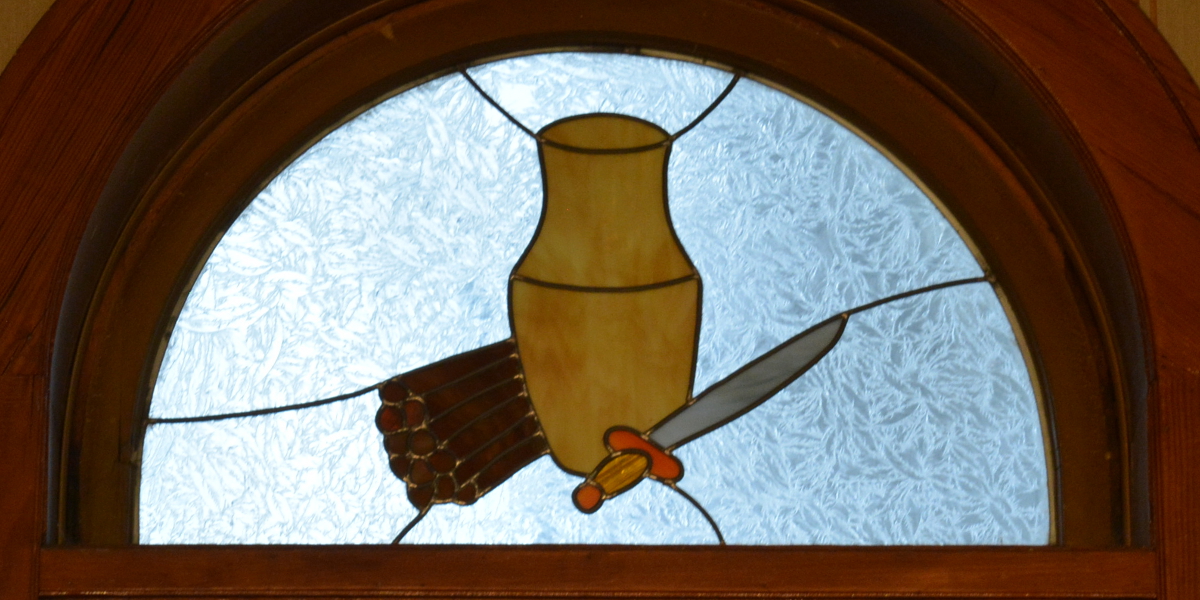
(picture from Saude stained glass depicting the wood, knife, and jar with fire for the sacrifice of Isaac)

The Feast of St. Michael and All Angels – Pr. Faugstad sermon
Text: Revelation 12:7-12
In Christ Jesus, who wore a crown of thorns and yet remained the King of heaven and earth, who carried His own cross and yet commands the angels, who felt the flames of hell and yet quenched the devil’s fire, who died, rose victorious, and lives forevermore, dear fellow redeemed:
The Old Testament book of Job describes Satan as being in a place we wouldn’t expect him. It says that when the holy angels presented themselves before the LORD at His heavenly throne, Satan came among them. The LORD did not immediately throw him out. He asked if Satan had considered His faithful servant Job, “who fears God and turns away from evil.” Satan replied that it is no surprise Job was so faithful since God blessed everything he did. “But stretch out your hand and touch all that he has,” said the devil, “and he will curse you to your face” (1:6-11).
God allowed Satan to destroy all that Job had. But even with this tremendous loss, Job did not curse God. So Satan came before the LORD again and said, “stretch out your hand and touch his bone and his flesh, and he will curse you to your face” (2:5). God allowed the devil to do this as well, and the devil struck Job with terrible sores. Satan would not give up. He would stop at nothing to try to turn Job against his Creator.
This account reveals that Satan had surprising access to God even after rebelling against Him. We can picture it like a courtroom. God the Father sits in the Judge’s seat. Satan is the prosecuting attorney lobbing charge after charge at the accused. Ten jurors sit over on the side listening carefully and nodding their heads. And who is on the stand? The sinner.
That sinner is you; he is me. And how does the devil try to accuse us? This is how nasty the devil is. He tempts us to commit sins, and then he points an accusing finger at us when we sin. “How could God love you? You’re just a liar, just a cheat! You have loved yourself but hardly your neighbor! All you care about is being popular, influential, and rich! How can you expect to go to heaven? You have failed in every way! You are guilty! You deserve death!”
The ten jurors are the Ten Commandments, and they agree with the accusations. We have not loved the Lord our God with all our heart and with all our soul and with all our mind. We have not loved our neighbors as ourselves (Mat. 22:37-39). We will get no help from the Law. None of our works can get us off the hook because all of our works are imperfect.
It looks like an open and shut case. We bury our face in our hands. The devil looks confident. There is a smirk on his face. “Another one goes down,” he says to himself. “I’m still on top!” But the Judge hasn’t ruled yet. There is still more to be said for the accused sinner. There is more evidence to be logged in the public record. The smirk on the devil’s face begins to fade and then goes away. What has he missed?
The door to the courtroom opens. Who should enter but a Lamb looking “as though it had been slain” (Rev. 5:6)? The gallery erupts with cries of astonishment. The devil’s eyes get big. He looks at the same time like he wants to crawl under a rock and like he wants to destroy all living things. The Lamb comes forward slowly and purposefully and says, “State the charges again.” The devil gathers himself and launches into a tirade against the accused, listing wrong after wrong after wrong.
But after each accusation, the Lamb replies, “Objection! That sin was paid for… and that one… and that one.” The Judge does not overrule Him. What the Lamb says is true. He has the marks to prove it. This Lamb is the Sacrifice, the One once dead but now living. This is “the Lamb of God, who takes away the sin of the world!” (Joh. 1:29). This Lamb—the Son of God incarnate—took away your sin. He canceled all the debt you owed to God. He made the vomit of accusations from the devil’s mouth stop cold by stomping on the devil’s ugly head.
The deflated and desperate devil had no leg to stand on, but he wasn’t about to go down quietly. This is where our sermon text picks up from the book of Revelation, chapter twelve, beginning at verse seven:
“Now war arose in heaven, Michael and his angels fighting against the dragon. And the dragon and his angels fought back, but he was defeated, and there was no longer any place for them in heaven. And the great dragon was thrown down, that ancient serpent, who is called the devil and Satan, the deceiver of the whole world—he was thrown down to the earth, and his angels were thrown down with him.
“And I heard a loud voice in heaven, saying, “Now the salvation and the power and the kingdom of our God and the authority of His Christ have come, for the accuser of our brothers has been thrown down, who accuses them day and night before our God. And they have conquered him by the blood of the Lamb and by the word of their testimony, for they loved not their lives even unto death. Therefore, rejoice, O heavens and you who dwell in them! But woe to you, O earth and sea, for the devil has come down to you in great wrath, because he knows that his time is short!”
The great dragon, the old evil foe, was thrown down, along with all the evil angels. These had rebelled against God shortly after they were created. They refused to obey His will. They refused to serve Him. And now they were cast out of heaven and away from His presence once and for all. Now the devil can no longer accuse God’s people “day and night” in the heavenly courtroom.
He was conquered “by the blood of the Lamb and by the word of their testimony.” The blood of Jesus washes away all sin. Sin does not stick to you and me anymore because God the Father put all our sin on His Son. He was judged in our place. He took our punishment and was sentenced to eternal death in hell for us. This Gospel proclamation is the cause of the devil’s continued frustration. He cannot stand against the Gospel since the Gospel “is the power of God for salvation to everyone who believes” (Rom. 1:16).
We are acquitted and righteous before God. We are justified by His grace, declared “not guilty!” But that does not mean our troubles are over. That does not mean we have tangled with the devil for the last time. He was cast out of heaven, but he landed on his feet on earth. The voice from heaven that announced the devil’s defeat also said, “woe to you, O earth and sea, for the devil has come down to you in great wrath, because he knows that his time is short!”
The devil has been defeated, but that does not mean he has given up. He knows now that he can never knock God off His throne. What drives his evil heart is trying to pull more souls with him into eternal damnation. He does this by tempting each one of us in our own unique ways. He might tempt us with bitterness or anger or lust or greed or pride or selfishness or complacency. He has innumerable tools at his disposal. Like we see in the account of Job, the devil will never give up until he has utterly ruined us.
The Lord’s apostle Peter said, “Be sober-minded; be watchful. Your adversary the devil prowls around like a roaring lion, seeking someone to devour. Resist him, firm in your faith” (1Pe. 5:8-9). The devil is a formidable opponent. We cannot stand against him alone by relying on our own power or on the strength of our own will. But we can resist him by the power of God the Holy Spirit. As we listen to and study the Word of God and faithfully receive His Sacraments, the Holy Spirit fortifies us and strengthens us. He makes us sober-minded, alert, and watchful for the devil’s attacks. He increases our faith, so that our eyes are constantly fixed on our Champion Jesus who destroyed the works of the devil by His death (1Jo. 3:8) and who still fights for us.
Our faithful Lord also dispatches His holy angels to guard us and defend us. Psalm 91 says, “he will command his angels concerning you to guard you in all your ways” (v. 11). Psalm 103 describes God’s angels as “mighty ones who do his word, obeying the voice of his word” (v. 20). Today’s Gospel reading tells us that even the littlest among us have angels watching over them, angels constantly looking upon the face of God and taking His direction (Mat. 18:10).
We are well-protected against the devil’s attacks. As formidable as Satan is and as much as he still tries to accuse us, our Lord Jesus with His holy angels defends us. The Lamb with the marks of His crucifixion stands against the great dragon, and the dragon must slither away. The blood of the Lamb poured out for all people means that you and I are cleansed of all our sins. The devil and demons know it, the holy angels know it, and God wants you to know it and never forget it.
One of the things that the voice from heaven said about the saints, about the holy followers of Jesus, is that “they loved not their lives even unto death.” They did not love their life on the earth with all its treasures and pleasures. They did not place all their hope in what they could get here. That is just what the devil wants and how he so often succeeds. But no, they loved the Lamb who died and rose again for their salvation. And they loved His holy Word which testifies to His victory.
God grant each of us such an enduring faith, a faith that holds fast to the Lord Jesus and His saving blood, a faith that leads us confidently before God’s throne of grace, a faith that makes all the holy angels rejoice with exceeding joy.
Glory be to the Father and to the Son and to the Holy Ghost; as it was in the beginning, is now, and ever shall be, forevermore. Amen.
+ + +
(woodcut by Julius Schnorr von Carolsfeld, 1794-1872)

The Festival of the Resurrection of Our Lord – Pr. Faugstad exordium & sermon
Festival exordium:
Christ is risen! He is risen indeed! Alleluia! That was not the disciples’ reaction on Easter Sunday. “Christ is risen!” said the angel (Mar. 16:6). “Christ is risen!” said the women (Luk. 24:9). “Christ is risen!” said the Emmaus disciples (Mar. 16:13; Luk. 24:34). But this shocking message, this wonderful news, was met with questions and doubt. “Is Christ risen?” they wondered. “We won’t believe it until we see it with our own eyes.”
We know the truth that Jesus certainly died and certainly rose again on the third day. We know it, because the disciples did see Jesus after His resurrection, and they reported exactly what they saw and heard from Him. His resurrection is a fact. Christ is risen indeed!
But where our doubt comes in is here: “Is Christ risen for me? How can I be sure? How can I know that when I die, I will rise again? Or that my loved ones will rise again?” We can understand the disciples’ doubts—when had anyone ever risen from the dead? Our doubts seem reasonable too—when have we ever seen someone rise from the dead? But experience only goes so far.
The two disciples walking on the road to Emmaus on Easter afternoon were experiencing sadness. Jesus joined them on the road, but they didn’t know it was Him. They told Him everything they had witnessed and heard over the last few days, including the report of Jesus’ resurrection.
And Jesus said to them, “O foolish ones, and slow of heart to believe all that the prophets have spoken! Was it not necessary that the Christ should suffer these things and enter into his glory?” (Luk. 24:25-26). Then what did He do? “[B]eginning with Moses and all the Prophets, he interpreted to them in all the Scriptures the things concerning himself” (v. 27).
We may not have seen anyone rise from the dead. But we do have the Scriptures, God’s own Word. Jesus’ life and works match perfectly with all the Old Testament prophecies about the Messiah. And everything that He told His disciples would happen during Holy Week, including His resurrection on the third day, did happen exactly as He predicted.
So we do not need to doubt His promise to return on the last day to raise up the dead, or His promise that He has gone to prepare a place for all believers in heaven, or His promise to be present with us now through His Word and Sacraments to strengthen our faith. His resurrection verifies that what He promises, He does.
We rejoice in these promises by rising to sing hymn #348, “He Is Arisen! Glorious Word!”
He is arisen! Glorious Word!
Now reconciled is God, my Lord;
The gates of heaven are open.
My Jesus died triumphantly,
And Satan’s arrows broken lie,
Destroyed hell’s direst weapon.
O hear
What cheer!
Christ victorious
Riseth glorious,
Life He giveth—
He was dead, but see, He liveth!
+ + +
Sermon text: 1 Corinthians 5:6-8
In Christ Jesus, through whom you are a new creation, a new lump, filled no longer with the leaven of sin, but with the sincerity and truth that come from Him alone, dear fellow redeemed:
God sent nine terrible plagues on Egypt, but still Pharaoh would not let the enslaved people of Israel go into the wilderness to offer sacrifices to the LORD. God promised to send one more plague, after which Pharaoh would let the people go. In preparation for this plague, the LORD instructed each Israelite household to take a male lamb without blemish and kill it at twilight. Then they were to put the blood of the lamb on their doorposts and eat the flesh of the lamb roasted over fire.
They were also instructed to eat unleavened bread. All leaven had to be removed from their houses, and they would eat unleavened bread for seven days. The penalty for eating leavened bread during this time was severe. The LORD said, “if anyone eats what is leavened, from the first day until the seventh day, that person shall be cut off from Israel” (Exo. 12:15). He repeated the same warning a few verses later that anyone who disobeyed “will be cut off from the congregation of Israel” (v. 19).
In today’s Epistle lesson, the apostle Paul draws on this account of the Passover. He tells the Christian congregation in Corinth to “cleanse out the old leaven.” But he is not talking about their bread. He is talking about the congregation. The Christians there were puffed up. They were boasting, puffed up with pride, and they were not boasting about what their Savior Jesus had done for them. They were boasting about their open-mindedness and their willingness to tolerate what was clearly sinful. In this case, they were boasting about a clear violation of the Sixth Commandment—one of the members of the congregation living in open sin.
This is the kind of approach that is cheered by our culture today. The churches that are willing to compromise the Word of God, change their teachings with the times, and stop calling out sin are praised. These churches probably don’t say much about the Ten Commandments anymore, or they might explain them in such a way that no one in the congregation is really challenged or convicted by them. “Oh, the Ten Commandments are for the bad people,” they say, “and for the people who just want to judge others. But we are doing just fine.”
Paul writes, “Your boasting is not good. Do you not know that a little leaven leavens the whole lump?” Then he tells us what that leaven is, it is “the old leaven, the leaven of malice and evil.” It is the sin that characterized us before we became unleavened, before we were born again in Christ through Holy Baptism. It is the sin that Jesus died to free us from, we who were formerly enslaved to sin and death.
We are freed from this sin, because “Christ, our Passover Lamb, has been sacrificed.” Here, God’s stunning plan of salvation becomes clear, a plan that was illustrated by the Passover lamb. Right after Jesus’ public revealing as the Messiah at His Baptism, John pointed to Him and said, “Behold, the Lamb of God, who takes away the sin of the world!” (Joh. 1:29). He could take the world’s sin, because He had no sin of His own to carry. He was “a lamb without blemish or spot” (1Pe. 1:19).
The blood of this spotless Lamb was poured out for you on Good Friday just before the Passover was celebrated in Jerusalem. This holy blood cleanses you from all sin (1Jo. 1:7). We just sang a verse about this in Martin Luther’s great Easter hymn: “Here the true Paschal Lamb we see, / Whom God so freely gave us; / He died on the accursed tree— / So strong His love— to save us. / See, His blood doth mark our door [the door of our heart!]; / Faith points to it [to His blood], death passes o’er, / And Satan cannot harm us. / Alleluia!” (Evangelical Lutheran Hymnary #343, v. 5).
Jesus’ resurrection on the third day is the irrefutable proof that all sin was atoned for by His sacrifice. Now is the time to “celebrate the festival,” writes Paul. Now is the time to celebrate the Lamb’s victory. Now is the time to celebrate the forgiveness of sins. Now is the time to celebrate the eternal life that is ours because Jesus rose triumphant over death.
But how are we to “celebrate the festival”? Today’s reading says, “not with the old leaven, the leaven of malice and evil”—not by returning to the sin that Jesus has freed us from, not by confirming others in their sin and boasting about how charitable and accommodating we are of them. Remember that the Israelites were told to get rid of every trace of leaven from their homes. In the same way, we are called to get rid of every trace of sin in our own hearts and to recognize that our sins not only affect us—they affect the congregation to which we belong and the whole body of Christ. “A little leaven” in just one area of a batch of dough “leavens the whole lump.”
The way we “cleanse out the old leaven,” both individually and as a congregation is through repentance. We own up to our weaknesses. We admit our sinful actions, words, and thoughts that we have tried to justify or pass off as being “not so bad.” We even pry the lid off old sins that we have done our best to cover up but that continue to trouble our conscience.
We repent of our sins, because they have already been paid for. Jesus carried them to the cross, and when He came out of the tomb, our sins were left buried for now and forever. The payment of His death and the triumph of His resurrection are applied to us in Holy Baptism. Romans 6 tells us that just as Jesus was raised from the dead, so through Baptism “we too might walk in newness of life” (v. 4). “We know that Christ, being raised from the dead, will never die again; death no longer has dominion over him” (v. 9). Because that is true for Jesus, “So you also must consider yourselves dead to sin and alive to God in Christ Jesus” (v. 11). His victory over sin and death is your victory.
You are not dead in your sins; you are alive in Jesus. You are no longer a slave to sin; you are free from it. You are free from the “leaven of malice and evil” that used to permeate you and rule you. You are free to “celebrate the festival” of Jesus’ victory “with the unleavened bread of sincerity and truth.”
Paul explained more in his Second Epistle to the Corinthians what this “sincerity” means. He wrote, “we behaved in the world with simplicity and godly sincerity, not by earthly wisdom but by the grace of God” (2Co. 1:12). And again, “we are not like many, peddling the word of God, but as from sincerity, but as from God, we speak in Christ in the sight of God (2:17, NASB).
“[T]he unleavened bread of sincerity and truth” is the faithful confession of God’s Word, no matter what cultural winds are blowing, and no matter what pressure is applied against the church. We have nothing to be ashamed of before God, when we believe and teach the Word of God with “sincerity and truth.”
But what if you haven’t spoken His Word faithfully, but instead compromised what He says? Or what if you haven’t done such a good job of “[cleansing] out the old leaven,” so that you are often still puffed up with sin and pride, or you are full of bitterness or anger toward others? Then repent of these sins and listen to these words: “Christ, our Passover Lamb, has been sacrificed” for you. God the Father sent His Son to atone for all your sins.
And He has called me to proclaim it to you. I can stand here today and tell you with no hesitation that your sins are forgiven, because Jesus won your freedom from them through His death and resurrection. Because He lives, you will live also (Joh. 14:19). That is what He promises all people who put their trust in Him. They are no longer full of “the old leaven,” they “really are unleavened.”
“You Really Are Unleavened.” That is how you are in Jesus. You are baptized into Him. You trust in Him. You know that He will return again on the last day to raise up and glorify you and all believers. He really has risen! He has risen for you, indeed! Alleluia!
Glory be to the Father and to the Son and to the Holy Ghost; as it was in the beginning, is now, and ever shall be, forevermore. Amen.
+ + +
(picture of Easter morning sunrise taken by Redeemer member, 3/31/24)
The Third Sunday of Easter – Pr. Faugstad sermon
Text: St. John 10:11-16
In Christ Jesus, who is constantly seeking after lost sheep to bring them into His holy flock of believers, dear fellow redeemed:
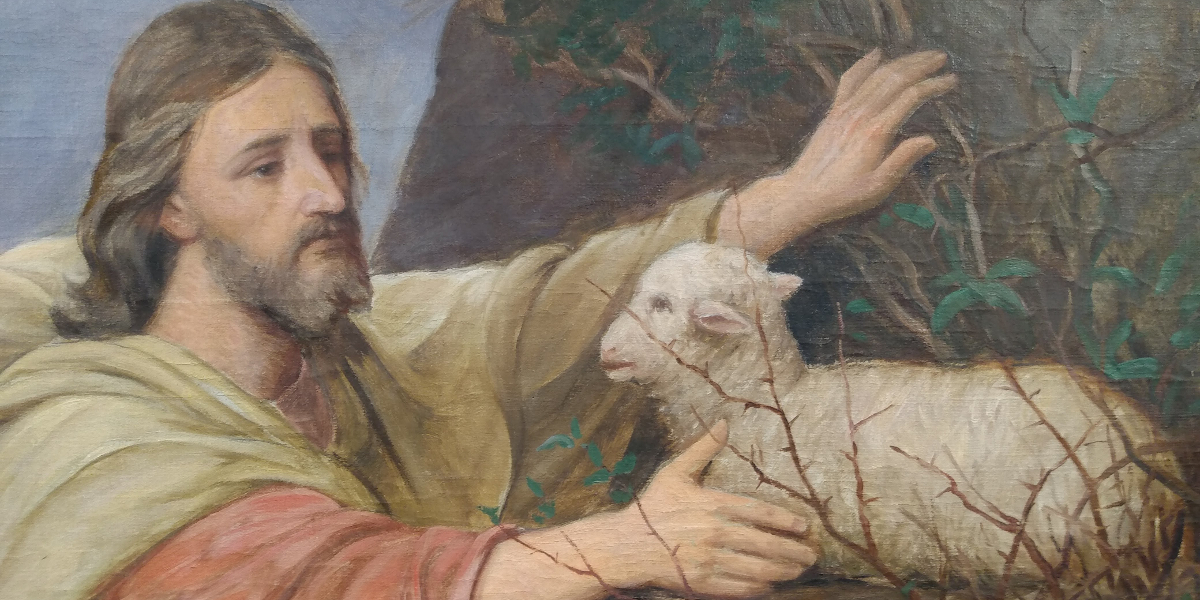
If you search online for “Good Shepherd paintings,” you will find depictions of lambs being carried on Jesus’ shoulders, held in His arms, led by Him to pasture and water, and rescued by Him. The Saude altar painting shows the Good Shepherd rescuing a lost lamb. What you never see in these paintings is the sheep taking charge, blazing their own trail, and conquering their enemies. That is not something sheep do—or if they try, they don’t do it very successfully.
Domestic sheep require constant care and protection. They are quite vulnerable to predators and are prone to wandering. But they are also very loyal and are able to discern the difference between their shepherd’s voice and the voices of strangers. In these ways, little lambs are something like little children.
Children come into the world through the union of a man and a woman, because God wants every child to have the care and protection of a mother and a father. Little children often don’t recognize the dangers around them. They try to touch things that are too hot or too sharp. They want to go exploring on their own and climb on things that are too high. So their parents (or their siblings) keep a close eye on them: “Don’t touch that!” they say. “Come back!” “Get down!”
Do children listen? Sometimes yes and sometimes no. You have probably seen the look in a child’s eyes when he hears his parents say something, but he wishes he hadn’t heard it, and he acts like he didn’t hear it. So a parent says, “Did you hear what I said? Listen to me!” That listening is important. It keeps children safe. It teaches and guides them.
Children who will not listen to their parents will bring harm on themselves and distress and sadness to those who care for them. But children who do listen to their parents learn early on the difference between what is good and bad, right and wrong, safe and unsafe. Children who listen grow in wisdom and knowledge. They bring joy to their parents.
The same goes for you and me before God. We are His children. He made us and continues to provide for us. He sent His only Son to redeem us, so that we would be adopted into His holy family. Our primary responsibility as His children is to listen to what He says. The apostle Peter wrote, “Like newborn infants, long for the pure spiritual milk—the Word of God—, that by it you may grow up into salvation” (1Pe. 2:2). And Jesus says, “My sheep hear my voice, and I know them, and they follow me” (Joh. 11:27).
The shepherd does not follow the sheep; the sheep follow the shepherd. The sheep do not tell the shepherd what to do; they listen to what he tells them. Just as it is not right for children to be disrespectful to their parents, to question everything they say, or to blame them for all their problems, so it is not right for the sheep—for you and me—to act like this toward God. We do not have the power and the authority; He does. We do not know what is best for ourselves; He does.
That is difficult for us to accept. When we are giving in to our passions, going a direction we have been taught to avoid, doing things we have been told not to do, we feel like we are in control. “I can make decisions for myself!” we think. “It’s my life! No one can stop me from doing what I want!” We learn the hard way that the path of sinful indulgence is not where we find fulfillment and happiness. It is where we find pain and heartache, and where we receive deep cuts and wounds that don’t heal easily.
The young woman who gives herself to one boyfriend after another hoping that the latest relationship will last, knows this to be true. So does the young man who has taken the bait of pornography and is now helplessly stuck on the hook. They thought they could give up part of themselves to get what they wanted. They thought they could maintain control. But their sin controls them. And now they wish they could get everything back that they gave up.
What does a little lamb do who has gotten himself or herself into a thorny situation, who doesn’t know where to turn? That little lamb does the only thing it can do. It cries out for help. It sends out a mournful, desperate cry right from the heart. That’s what we do when our conscience is troubled, when guilt gnaws inside us, when we find ourselves in a difficult situation that we can’t find our way out of. We cry for rescue and deliverance. And the Good Shepherd hears that cry. “I know My own,” He says.
A mother can hear her child’s cry from the other side of a room full of people. Jesus not only hears your cry, He knows your pain before you express it. He knows exactly how to help before you even open your mouth. That is how well He knows you. That is how much He cares for you. But you already know this about your Good Shepherd, because you know what He gave up for you. “The Good Shepherd lays down His life for the sheep.”
Even though you and I have tested God’s patience again and again by our sinful choices, even though we have wandered so far away from Him that we could no longer hear His voice, even though we can hardly imagine why He would want us, the Good Shepherd willingly gave up His life for us. In His eyes, we were worth saving. We were worth the anguish and thorns and piercing of the nails. We were worth the righteous wrath of God and the fires of hell.
Jesus stepped between us and the wolfish devil, the one who is constantly tempting us to sin and then torturing us for committing it. Jesus let all accusation come upon Him. He took the place of us sheep who love to wander and made all our transgressions His. He paid the debt that we owed God for breaking His Commandments by our actions, words, and thoughts.
The cold jaws of death fastened around Jesus instead of us. But how could the sheep survive without the Shepherd? The night of His arrest, Jesus quoted this Old Testament passage about Himself and His followers, “I will strike the shepherd, and the sheep of the flock will be scattered” (Mat. 26:31). What a terrible outcome! But then Jesus added these stunning words, “after I am raised up, I will go before you to Galilee” (v. 32).
“After I am raised up….” What an amazing prediction! Immediately following today’s Gospel reading, Jesus said the same thing, “I lay down my life that I may take it up again. No one takes it from me, but I lay it down of my own accord” (Joh. 10:17-18). The death of the Good Shepherd would not mark the end of His care for the sheep. He rose from the dead in triumph to demonstrate that nothing could stop His love for His sheep—not even death (Rom. 8:35-39).
You were brought into His care and became His little lamb when you were baptized. He took you up in His arms like He did those little children so many years ago and He blessed you. He washed away all your sins in His blood. He made you spotless like the bright wool of a lamb, clothing you in His righteousness. He rescued you from the darkness of sin and death where you had gotten utterly lost, and He brought you into His kingdom of light and life.
And what does He ask of you? Only that you listen to His voice and hear His comforting and saving words. “If you abide in my word, you are truly my disciples,” He says, “and you will know the truth, and the truth will set you free” (Joh. 8:31-32). To listen to Jesus is to have truth and life and freedom. To ignore Him is to become prey to the devil’s lies and death.
Listening is hard for us little lambs, us little children, because we like to do things that are bad for us. None of us listens perfectly. We sin all the time. But Jesus keeps calling out to us, calling us back to His care and protection. That call goes out every time you attend divine service and open your Bible or devotion book for study at home. “Come to me,” Jesus says, “and I will give you rest” (Mat. 11:28).
He calls you to the green pastures and still waters of His Word and Sacraments. He invites you to eat and drink for your fulfillment and strength. He trains you to listen better and follow Him more closely. This happens all through your life. You never get to the point where you are strong enough to set out on your own. You always need your Shepherd’s care.
To keep you in His care, your Lord has given you under-shepherds, who speak nothing more or less than what He has spoken. The way to tell the difference between a faithful pastor and a hired hand is to compare what each one says with what Jesus says. My call as your pastor, your shepherd in this place, is to pay careful attention to myself and to all the flock, in which the Holy Spirit has made me an overseer, to care for the church of God, which He obtained with His own blood (Act. 20:28).
My call is to remind you that You Are Jesus’ Little Lamb. You need His forgiveness. You need His guidance. You need His constant protection as you walk through the valley of the shadow of death. He brings all these blessings to you through His powerful Word. “My sheep hear my voice,” He says, “and I know them, and they follow me” (Joh. 11:27).
Glory be to the Father and to the Son and to the Holy Ghost; as it was in the beginning, is now, and ever shall be, forevermore. Amen.
+ + +
(picture from Saude Lutheran Church altar painting)
Midweek Lent – Pr. Abraham Faugstad homily
Text: St. Matthew 27:24-26
Dear Fellow Redeemed,
In our lesson, we see Pontius Pilate standing before the crowd washing his hands in an attempt to free himself from the guilt of Jesus’ innocent blood. In the verses preceding this, we learn of Pilate’s intense internal struggle regarding Jesus. The chief priests and the elders hurled accusation after accusation against Jesus. While the accusations were false, Jesus remained silent. Pilate marveled at this. What kind of defendant doesn’t defend himself? Especially, someone who is so clearly innocent. Jesus remained silent, fulfilling the words of the Prophet Isaiah, “He was led as a lamb to the slaughter, and as a sheep before its shearers is silent, so He opened not His mouth.” The few words Jesus spoke were in reply to Pilate’s question, “Are You the King of the Jews,” to which Jesus simply answered, “It is as you say.”
Pilate looked for the opportunity to release Jesus. While Pilate was sitting in the judgement seat, his wife sent word to him, “Have nothing to do with that just Man, for I have suffered many things today in a dream because of Him” (Matthew 27:19). At the Passover feast the governor was accustomed to releasing one prisoner to the multitude. Pilate knew of Jesus’ popularity among the people and so he saw this as an opportunity to go around the religious leaders. What he didn’t know was that the people in the crowds had largely been brought in by Jesus’ enemies. And so, when he gave the options between releasing Jesus or Barabbas—a known criminal, the crowds yelled, “Barabbas!” But to Jesus they yelled, “Let him be crucified!” Pilate even asks, “Why, what evil has He done?” But they only cried out louder, “Crucify Him!” Pilate knew the Jews could bring down on him Caesar’s harsh disfavor. When he finally saw that he could not prevail, he gave in to the crowds. He would defend this just man no more.
I. The Curse
Pilate now stands before the crowd washing his hands and says to the crowd, “You see to it.” He put the guilt on them. And the crowd in their frenzied and mad state gladly accepted it: “His blood be on us and on our children.” As if saying, “If we are guilty, then let God punish us and our children.” But just as Pilate did not have the power to remove his guilt by his words and actions, neither did the crowds have power to accept or reject their guilt. However, they did echo Jesus’ own words against their wicked generation who rejected him. A punishment they would face within one generation, when Jerusalem was attacked by the Romans and the Temple destroyed, leaving thousands dead and enslaved.
A wicked and unjust sentence was given to Jesus. The account of our Lord’s Passion is sobering. We can become angry with the people and think, “I wouldn’t have crucified Jesus if I was there! I would have defended him!” But it’s not just those who were there that day that are guilty of Jesus’ innocent blood. No, we weren’t there when they mocked Jesus. No, we weren’t present in Pilate’s courtyard. And no, we didn’t scream for Jesus’ blood, but our sin led him there. Our lack of love towards God and toward one another make us just as guilty and accused as the words the crowds shouted.
Jesus was mocked, spit on, beaten, scourged, condemned, and crucified for the guilt of our sin. He carried the sins of our first parents, Adam and Eve, and all their descendants who have broken God’s Law. No one can claim innocence from his blood. Isaiah says, “All we like sheep have gone astray; We have turned, every one, to his own way; and the Lord has laid on Him the iniquity of us all” (53:6). We weren’t there like those who shouted in the crowd, but we are certainly not exempt from his blood. Your sin sent Jesus to the cross.
We should never consider our sin a small thing. The hymnist puts it well, “Ye who think of sin but lightly nor suppose the evil great, here you see its nature rightly, here its guilt may estimate. Mark the sacrifice appointed, see who bears the awful load; ’tis the Word, the Lord’s anointed, Son of Man and Son of God.” While our Lord’s suffering reminds us of the greatness of our sin, it more importantly points us to the mercy and compassion of our Savior who died for our sin. By God’s grace, we do not bear the responsibility of the crowd’s words, but the blessing.
II. The Blessing
With their words the crowds meant evil towards Jesus, but what they meant for evil, God meant for our good (Genesis 50:20). In fact, their words serve as a beautiful sermon and prayer. For it was by our Savior’s innocent blood shed on the cross that he paid for the sins of the world. By his blood our guilt is washed away. John writes, “the blood of Jesus Christ [God’s] Son cleanses us from all sin” (I John 1:7). No matter how great our sin, how terrible our guilt, nor how often we have sinned—his blood is greater.
Jesus didn’t have to suffer. He didn’t have to face the false accusations, the taunts, the scourges, the nails, or the cross. But he did. The nails did not keep Jesus on the cross. It was his love for you. Our Lord knew that the only way that he could save us from the guilt of our sin was to be punished in our place. All the Old Testament sacrifices could not pay for sin, but they pointed to the Messiah, the Savior, the Lamb of God, who would take away the sins of the world.
God’s Law required payment for sin. It was necessary for sin to be atoned for. If God would have simply let sin go by without payment, he would be an unrighteous judge. But he didn’t. Instead, “God loved the world that He gave His only begotten Son that whoever believes in Him should not perish, but have everlasting life.” And for this reason, believers can have certainty of their redemption because “you were not redeemed with corruptible things, like silver or gold, from your aimless conduct received by tradition from your fathers, but with the precious blood of Christ, as of a lamb without blemish and without spot” (I Peter 1:18–19).
There are countless people who agonize over their guilt. They attempt to ease their guilt through acts of devotion, charity, or other sacrifices. But we cannot satisfy our guilt. All our attempts to pay for our guilt are like a hamster running on a wheel. We will get nowhere. These acts are simply washing our hands, like Pilate. Maybe, you have found yourself struggling with guilt. Guilt over your sins against God, your friends and neighbors, spouse, or children. Perhaps, there are sins from your past that you cannot forget or sins you continue to fall for again and again.
We can’t wash our guilt away by what we do, but Jesus can, and he has! When the Apostle John gives his description of his vision of heaven in Revelation 7, where he sees great multitudes standing before the throne of the Lamb robed in white—there is only one reason that is mentioned for why they are there. They were those who had “washed their robes and made them white in the blood of the Lamb” (Revelation 7:14). Whoever believes in Jesus has had their sins washed away by the blood of the Lamb. There is no doubt about it! As Paul writes, “In him we have redemption through his blood, the forgiveness of our trespasses, according to the riches of his grace” (Ephesians 1:7). And so, we can rightly pray, “His blood be on us!”
No one is beyond our Lord’s saving help—no sin is too great. The blood of Jesus Christ cleanses us from all sin! Even those who crucified Jesus were later urged by Peter to repent that their “sins may be blotted out” (Acts 3:19). Jesus says, “the one who comes to Me I will by no means cast out” (John 6:37).
Our sin surely sent Jesus to the cross, but he went willingly for you. It pleased God to do this because he loves you. Jesus was condemned that you might go free. Our dear Lord Jesus wants you to be so certain of his love for you, that he instituted Baptism, where he washes away your sins through the water and the Word. He instituted the Lord’s Supper, where you receive his shed body and blood for the remission of all your sins. You are covered by Jesus’ blood and that’s a good thing! Because that is your clothing for heaven.
By God’s grace, we can pray, “His blood be on us!” Amen!
(picture from “The Sacrificial Lamb” by Josefa de Ayala, 1630-1684)