

Palm Sunday – Pr. Faugstad sermon
Text: St. Matthew 21:1-9
In Christ Jesus, who went to Jerusalem knowing that suffering, cross, and death were waiting for Him, but who went forward willingly in obedience to His Father and out of love for you, dear fellow redeemed:
If you had the ability to look into the future, and you could see that something tragic was going to happen to someone you love, you would almost certainly try to keep it from happening. This is a common theme in time travel movies. But the characters in these movies discover that even small changes in one time and place have unintended consequences and immense effects on what comes afterward. They find that when humans try to “play God,” the results are catastrophic.
Now imagine that you were part of the crowd on that Palm Sunday. Leading up to this day, everyone was talking about whether Jesus would come to Jerusalem for the Passover. You hoped to see Him. You had heard about the miracles He had done in Judea and Galilee over the past three years. You also heard how He recently raised Lazarus from the dead after he had been in the tomb four days. “Could this be the Messiah?” you wondered. “Who else could do what He does?”
If He was the Messiah, the Chosen of God, the Son of David, who better to take the throne of Jerusalem and lead God’s people Israel? Then word started to spread that Jesus was on His way. You left the city to see for yourself and followed the crowd to the Mount of Olives. You heard the singing and shouting before you saw Him, and then He came into view. There He was, your King, “humble, and mounted on a donkey.” The future of Israel looked bright!
But let’s say that in that moment of excitement and joy, God gave you a vision of the next six days. You saw the conflict and clashes that would take place between Jesus and the Jewish religious leaders. You saw them plotting by candlelight how they could have Jesus arrested and eliminated. You saw Judas making a deal to betray Him for thirty pieces of silver. You saw His arrest in the garden, His mistreatment and abuse from His captors, His flogging, the crown of thorns, and finally the crucifixion. You saw Him taken down from the cross after His death and placed in a tomb before a stone was rolled over the entrance.
If you saw all that in a vision on Palm Sunday, what would you do? Perhaps you would try to get the attention of Jesus’ disciples to let them know what terrible things were coming. Or you might try to reach Jesus Himself to warn Him. Maybe you would try somehow to stop the enemies of Jesus from harming Him. You could get word out to the Israelites gathered in Jerusalem to stay on the lookout and not let the authorities take Jesus. Whatever you could do, whatever it took, you would keep Jesus from being arrested and killed.
This is exactly what Peter and the other disciples tried to do. Remember how Jesus predicted His suffering and death in Jerusalem and His resurrection on the third day? Peter took Him aside and began to rebuke Him, saying, “Far be it from you, Lord! This shall never happen to you” (Mat. 16:22). Then on the night of Jesus’ betrayal, Peter declared, “If I must die with you, I will not deny you” (Mar. 14:31), and all the other disciples said the same. When a band of soldiers later met Jesus in the Garden of Gethsemane to arrest Him, Peter drew his sword and got ready to fight to the death (Joh. 18:10).
But Jesus put a stop to all these attempts. He did not need someone to fight for Him. He was not looking for anyone to stop Him from doing what He came to do. The account of Christ’s passion recorded in the four Gospels does not read like a tragedy, as though Jesus got caught up in something that He didn’t see coming. He was no unfortunate fly getting stuck in a big spider web. Everything He did had purpose.
Look at today’s reading. As He made His way to Jerusalem, He gave two of His disciples specific instructions about a donkey and a colt in a nearby village. He told them where to find them and what to say if someone questioned them as they led the animals away. Everything happened just like He said, and it fulfilled a prophecy recorded by the prophet Zechariah more than 500 years earlier (Zec. 9:9).
We find these references throughout the Gospels, that Jesus did what He did “that the Scripture might be fulfilled.” Bible scholars point to hundreds of prophecies like this. The life of Jesus does not just occasionally connect to what the Old Testament says. His life perfectly matches all the prophecies of the coming Messiah. Jesus Himself called attention to this. He said, “Do not think that I have come to abolish the Law or the Prophets; I have not come to abolish them but to fulfill them” (Mat. 5:17). And again, “You search the Scriptures because you think that in them you have eternal life; and it is they that bear witness about me” (Joh. 5:39).
Jesus had a plan. Everything was laid out for Him by the Father. It was no miscalculation that led Jesus to Jerusalem. It was no mistake that He was handed over to the Jews and then to the Roman officials. No one made Him go to the cross. Some time before this, Jesus said, “No one takes [my life] from me, but I lay it down of my own accord. I have authority to lay it down, and I have authority to take it up again. This charge I have received from my Father” (Joh. 10:18). He perfectly did what His Father sent Him to do as today’s Epistle lesson says, “he humbled himself by becoming obedient to the point of death, even death on a cross” (Phi. 2:8).
But what was the point of it all? Why go through that torment and agony? Why go to Jerusalem in order to get arrested and crucified? The answer is that it was for you. Do you find that hard to believe? Do you find it hard to believe that you would be part of God’s plan that led Jesus to the cross? You might feel like you are not important enough for that. You might think that God has bigger things to think about than you. He disagrees.
God the Father had you in mind when He promised to send a Savior. He had you in mind when He sent the angel Gabriel to the virgin Mary to announce that she would bear the Christ-Child. Jesus had you in mind when He perfectly kept the Law of God in your place, when He made His way to Jerusalem to suffer, and when He endured the wrath of God on the cross. What makes me so sure that it was all for you? Because He says so, John 3:16: “For God so loved the world that He gave His only begotten Son, that whoever believes in Him should not perish but have everlasting life.”
You are part of the world. That means God loves you. That means He sent His Son to live for you, die for you, and rise again for you. He has shown that love for you in your lifetime by bringing you to the cleansing waters of Baptism and calling you by the Gospel to be His own. He speaks His gracious Word of absolution from my sinful mouth into your sinful ears. He gives the holy body and blood of Jesus for you to eat and drink. There is no doubt about it, what God sent His Son to do in Jerusalem was for you, for your salvation and mine.
That has a profound effect on how we think about our life. If you were part of God’s plan that sent His perfect Son to suffer and die, then He must have a plan for you today. You must not be an afterthought to Him. You must not have to make your own way in this world. He must have many blessings in store for you until He finally brings you into His kingdom.
This is a comforting thought and very liberating. If God has the plan for me, then I don’t have to try to control everything. If He has the plan for me, then I can accept hardships and health challenges and heartaches as trials that He will use to strengthen my faith in Him.
On our own, we might have an idea about how we want our life to go, but the path forward is unclear. We look back at some of the choices we made, thinking we had a good plan, and we see how far off we were. We didn’t have the faithfulness and the focus that we should have had, and it caused troubles that affect us still today. We learned the hard way that our heart is not a trustworthy compass. We can’t trust our own sense of direction to lead us into the future because our sense is misguided by sin.
The author of Hebrews tells us how to stay on course: “let us also lay aside every weight, and sin which clings so closely, and let us run with endurance the race that is set before us, looking to Jesus, the founder and perfecter of our faith, who for the joy that was set before him endured the cross, despising the shame, and is seated at the right hand of the throne of God” (12:1-2). At the right hand of the throne of God, Jesus dispenses His gifts of grace through the holy means He has given to His Church.
He does not leave you to fend for yourself in this life, to stumble blindly through the clouds and darkness, to search for answers or meaning that never appear. “Behold, your King is coming to you.” He comes through the preaching of His Word. He comes through the cleansing waters of Baptism. He comes in His Holy Supper, which is why we sing that Palm Sunday song in our Communion liturgy: “Blessed is He who comes in the name of the Lord.” He comes to bring you His forgiveness, His holiness, His strength for your daily struggles and needs.
We keep our eyes on Him, following Him through His triumphal entry at Jerusalem, the institution of His Holy Supper on Maundy Thursday, His suffering and death on Good Friday, His glorious resurrection on the third day, and His victorious ascension into heaven. Everything He accomplished is for you. Everything happened according to God’s will for your salvation, your life, your future—Everything According to His Plan.
Thanks be to God. Amen.
+ + +
(picture from “The Procession in the Streets of Jerusalem” by James Tissot, 1836-1902)

Midweek Lent 2 – Pr. Faugstad homily
Text: St. John 18:33-38
In Christ Jesus, the King of kings and Lord of lords, dear fellow redeemed:
As the Roman governor of Judea, Pontius Pilate had authority to administer justice on behalf of the Roman Caesar, or king. He typically did not live in Jerusalem, but he went there at the time of the Passover when many more people would be in the city than usual. Now early on Friday morning, the Jewish leaders brought him a so-called criminal, someone named “Jesus of Nazareth.” They would have preferred to execute Jesus on their own, but this was something the Roman officials did not allow. Any cases involving the death penalty had to come before the governor.
Pilate asked them a reasonable opening question: “What accusation do you bring against this man?” (Joh. 18:29). That was a difficult question because Jesus had done nothing deserving of death. The religious leaders initially refused to give Pilate a straight answer. But then they made their case: “We found this man misleading our nation and forbidding us to give tribute to Caesar, and saying that he himself is Christ, a king” (Luk. 23:2).
The first part of their accusation was false. Jesus did not mislead the nation in any way, as if He were trying to overthrow the Roman authorities. That very week He had underscored their responsibility toward both God and government officials when He said, “render to Caesar the things that are Caesar’s, and to God the things that are God’s” (Luk. 20:25). The second part of their accusation was true. Jesus was the Christ, the King over all. But they wanted Pilate to think that Jesus was setting Himself up as an earthly king who would cause problems for both Governor Pilate and Caesar. Better, they said, to have Him eliminated.
Pilate must have heard something about Jesus before this. He was the governor in Judea the entire time that Jesus carried out His three-year public ministry. Jesus traveled all over the region teaching and performing miracles, even raising some people from the dead. King Herod was certainly aware of His activities, and “he sought to see him” (Luk. 9:9). Pilate must have known something about His work, too, though he made no reference to it when he questioned Jesus.
He cut right to the chase: “Are You the King of the Jews?” Pilate’s main interest was to find out if Jesus was someone who was a threat to Roman rule and the peace of the region. He hardly regarded Jesus as a king. Jesus hardly looked like one. What Pilate did not realize is that he was in the presence of the King of the universe from whom all earthly authority came. It was something like “Undercover Boss,” when a store manager has no idea he is talking to the one who has all the power.
Jesus said, “My kingdom is not of this world. If My kingdom were of this world, My servants would have been fighting, that I might not be delivered over to the Jews. But My kingdom is not from the world.” So yes, He was a King, but not the kind that the Jews accused Him of being. Pilate agreed. “For he perceived that it was out of envy that the chief priests had delivered him up” (Mar. 15:10).
Then Jesus stated His purpose for coming into the world, that He came “to bear witness to the truth.” He said, “Everyone who is of the truth listens to My voice.” Pilate must have felt uncomfortable at these words of Jesus. The whole conversation had not gone as Pilate expected. We imagine how Jesus looked at him, like He could see right through him (because He could). Pilate may have thought to himself: “Does this Jesus think that I, Pilate, would want to listen to Him, to care what He had to say?” Pilate brushed it all aside: “What is truth?” he said.
But there is one thing about Jesus that Pilate was convinced was true. He was convinced that Jesus was innocent of any crime that would justify the death penalty. So he told the Jews, “I find no guilt in Him.” He had seen and heard enough to know that Jesus was not what the Jews made Him out to be. What Pilate did not know was that he was an unwitting part of God’s plan for the salvation of the world. Jesus had to die, and it had to be on a tree, a cross, cursed for the whole world’s sins (Gal. 3:13).
God had used a decree of Caesar Augustus to get Joseph and Mary to Bethlehem where the Christ had to be born. And now God utilized the authority of a pagan governor to have His Son, the Lamb of God, sacrificed for all people. This reminds us who is really in control. It is not the ruler-of-the-moment in local, state, or national government, no matter how powerful or influential they may seem. Everyone in these positions must answer to a power much higher than their own.
Jesus said as much to Pilate when Pilate wasn’t getting the answers from Jesus that he wanted. Pilate said, “Do you not know that I have authority to release you and authority to crucify you?” (Joh. 19:10). Jesus replied, “You would have no authority over me at all unless it had been given you from above” (v. 11). That applies not only to the authority of government, but also to authority in society, church, and home.
Whatever authority God gives you in any sphere of life, He wants it to be used in service to your neighbor. Husbands and fathers are to use their authority in the home not to manipulate or harm, but to give and guide. Ephesians 6:4 says, “Fathers, do not provoke your children to anger [by misusing your authority], but bring them up in the discipline and instruction of the Lord.” Regarding earthly masters, like employers and managers, God says that they should not mistreat those under them, knowing that they have a Master in heaven, and “there is no partiality with him” (Eph. 6:9).
God could have used His authority as the Creator of the world to punish Adam and Eve and we their descendants for all our sins. Instead, the Father used His authority to send His only-begotten Son to suffer and die for everyone. Jesus willingly and perfectly obeyed His Father’s will, never deviating from the path that led Him to the agony and torment of God’s eternal punishment.
As Jesus stood before Pilate, remaining silent while accusations and lies were hurled at Him, neither the Gentile Pilate nor the religious leaders of the Jews understood that Jesus was suffering for them, out of love for them. He was suffering for you, too, for your failure to acknowledge the authorities He has placed over you, and for the times that you used your authority to harm instead of help. His holy blood, the blood of the King of kings and Lord of lords, cleanses you from all those sins. This is most certainly true.
What punishment so strange is suffered yonder!
The Shepherd dies for sheep that loved to wander;
The Master pays the debt His servants owe Him,
Who would not know Him.
The sinless Son of God must die in sadness;
The sinful child of man may live in gladness;
Man forfeited his life and is acquitted—
God is committed. (Evangelical Lutheran Hymnary #292, vv. 4-5)
Glory be to the Father and to the Son and to the Holy Ghost; as it was in the beginning, is now, and ever shall be, forevermore. Amen.
+ + +
(picture from “Christ before Pilate” by Mihály Munkácsy, 1881)

The Epiphany of Our Lord – Pr. Faugstad sermon
Text: St. Matthew 2:1-12
In Christ Jesus, at whose name “every knee should bow, in heaven and on earth and under the earth, and every tongue confess that Jesus Christ is Lord, to the glory of God the Father” (Phi. 2:10-11), dear fellow redeemed:
When strange men from the east arrived in Jerusalem, they could not have asked a more provocative question: “Where is He who has been born King of the Jews?” Very quickly their question reached the ears of King Herod. These men from the east, described in our reading as magi or wise men, did not know that Herod was one of the most wicked kings in the history of Israel. He was a very jealous king who even had some of his own sons killed in order to preserve his power.
And now these men were asking about a newborn “King of the Jews.” Far from wondering about this, even when he heard the Old Testament prophecies about the Christ, Herod immediately made plans to destroy this little rival to his throne. But he didn’t let the wise men see his rage. They could make his job easier. If they found this so-called “Christ,” they could tell Herod where He was, and then Herod could kill Him.
Herod must have been a convincing liar. The wise men did not suspect a thing. Herod acted like a fellow believer. He wanted to know everything they could tell him about the star and the promise attached to it. He may have indicated that there were some bad characters who would oppose this Baby in Bethlehem, but that he, Herod, would see to it that the Child was protected. Herod was so certain that he had the wise men tricked, that he did not feel the need to send them to Bethlehem with his own officials or soldiers. He had set the trap, and these Gentiles from the east were walking right into it.
The contrast between the two kings in today’s reading could not be more pronounced. King Herod was exceedingly active. When he heard the news about some other king of the Jews, he turned the whole city upside down to get to the bottom of this problem. When he called the religious leaders to come, they came. He pulled the strings on all the people around him, including the innocent wise men. No one dared challenge him or cross him. King Herod had power, and he used it.
The other King we hear about was under two years old at this time. This King counted on his humble mother Mary and his guardian Joseph for everything—food, clothing, a place to live. He had no other attendants (at least visible ones). He pulled no strings, ordered no one around, threatened no one. He had no obvious power. He may have been called a “king” by the men from the east, but He hardly seemed it.
And yet, this was the King the wise men had come to worship. That was their stated reason for making the long trip: “We have come to worship this newborn King.” And that’s what they did when the special star from God led them to Jesus’ house in Bethlehem. When they entered the house and saw this Child with Mary His mother, “they fell down and worshiped Him.” What an absurd sight! Grown men falling on their faces and worshiping before a toddler! What could He do for them, this little diapered Child?
Their actions are a beautiful example of faith. If they were looking for a king with obvious power and influence, they would have stuck with Herod. But they were looking for a King of promise, One who could rise above all political intrigues and petty jealousies. They hadn’t just seen a new star appear in the sky and decided to follow it because they had nothing better to do. Somehow, some way, they knew this star was tied to God’s promise to send a Savior.
This Savior was born of the Jews, but He was not just for the Jews. He was for all people, including these Gentile men from the east. If they did not believe this, they would not have worshiped Jesus and brought Him gifts. That is why the Epiphany of our Lord, celebrated on January 6 just after the twelve days of Christmas, is often called “Christmas for the Gentiles.” It was the first time that non-Jewish people laid eyes on the Christ-Child.
We are Gentiles like them. Most if not all of us have descended from the Gentile peoples who did not have the Old Testament Scriptures, who did not know the Promise. But after His resurrection, Jesus made it clear that His message of salvation was to be broadcast to “all nations” (Mat. 28:19). Disciples were to be made for Him from people of all ages, nationalities, and languages by baptizing them in His name and teaching them His Word.
You have become one of these disciples. As great as the gifts of gold, frankincense, and myrrh given by the wise men were, you have received greater ones. You have received the forgiveness of all your sins, the righteousness of Jesus’ perfect life credited to you, and the assurance of eternal life in His kingdom. You received these gifts when you were a little child like Jesus, when you seemingly had nothing to offer Him or the Church. At your Baptism, your Lord was not seeking to get something from you; He was present there to give you the gifts of His grace.
But He did not come with visible displays of power. The heavens did not visibly open and bright rays did not shine down on you when you were baptized. The same goes for your hearing of the Word and receiving the body and blood of Jesus in His Supper today. These do not come with impressive signs like glowing light, the sound of a rushing wind, or a tingly feeling that God is near. You trust that God is active through His Word and in your life because He promises that He is.
Faith clings to His promise. When the wise men saw the star over Bethlehem, “they rejoiced exceedingly with great joy.” They rejoiced because of the promise attached to the star, that the King of the Jews had been born for the salvation of the world. The Bible, the true Word of God, is that same guiding star for us. We sang about it in our opening hymn: “As a star, God’s holy Word / Leads us to our King and Lord” (Evangelical Lutheran Hymnary #120, v. 6).
We rejoice exceedingly with great joy because “the King of the Jews” worshiped by the wise men is our King too. He is the King of creation. He is the King over sin, death, and devil. He is the King who reigns at the right hand of the Father, and who shall come again with glory to judge both the living and the dead (Nicene Creed). He is the “King of kings” and “Lord of lords,” as the Bible describes Him (1Ti. 6:15, Rev. 17:14, 19:16).
But it does not always appear so in this life. The Church of all believers, the body of Christ, does not look very powerful. We often feel threatened or afraid about what might happen to us. We are tricked and betrayed by the false promises of those who seem to have power and influence, like the wise men were by King Herod. We wish that God propelled His kingdom forward by outward displays of majesty and might. We know we are on the winning side, but we would like to see this and experience it.
The wise men are good examples and teachers for us. They followed the promise of God with steadfast and joyful hearts. No matter what wicked plots and intrigues were happening all around them, they went forward in faith and hope. And when they found the Christ-Child, who displayed no visible power and authority, they humbly fell before Him and offered Him their gifts. We do the same when we hold to the promise of God revealed in His Word, no matter what temptations or trials come our way. We hear His Word and receive His gifts in the Divine Service, though they come with no visible show of God’s power. And we respond with our own humble gifts of praise, thanksgiving, and a godly life.
To outsiders, unbelievers, this all seems utterly ridiculous and foolish. They may look at believers in Christ as Herod viewed the wise men—as simpletons, easily manipulated, inferior people who hold to an empty faith. They want the Christian Church to crumble and fade into history. But we have a secret weapon: we have the Lamb.
Revelation 17 describes the kings of this world who receive their power from the devil. Verse 14 says, “They will make war on the Lamb.” This should be an easy victory. What could be more vulnerable or weaker than a lamb? But that isn’t what happens. We read that “They will make war on the Lamb, and the Lamb will conquer them, for he is Lord of lords and King of kings.” This Lamb is the eternal Son of God who became a Baby born of the virgin Mary. He is the One who offered up His spotless life to take away the sin of the world, including your sin and mine.
He may have looked like nothing but a little Child when the wise men came calling, but they saw Him differently by the grace of God, and so do you. This Christ-Child, the Lamb, the suffering Servant crowned with thorns and hanging on a cross is no King the world wants. But He is the only King who matters. He is the only King who saves. We Worship the King of Kings. You know where to look for Him. You find Him where He promises to be found. And that is right here, through His Word, for your eternal good.
Glory be to the Father and to the Son and to the Holy Ghost; as it was in the beginning, is now, and ever shall be, forevermore. Amen.
+ + +
(picture from “Adoration of the Magi,” a late 1800s mural in Conception, Missouri basilica)

The First Sunday in Advent/St. Andrew, Apostle – Pr. Faugstad sermon
Text: St. Matthew 4:18-22
In Christ Jesus, our King who sits on His throne dispensing the gifts of His grace, dear fellow redeemed:
If someone placed an ad in the paper before local elections, and all that the ad contained was their name, their picture, and the message, “Vote for me!” it would be fair to ask the question “Why?” “Why should I vote for you? What are your qualifications? What are your goals? How will you represent me and work for me? What makes you a better candidate than the others?” Without this information, it’s hard to imagine saying, “Yes, I will vote for you. I will follow your lead.”
The same question can be asked of Jesus: “Why should I follow Him? Why should I trust Him?” The unbelievers of the world don’t see enough in Jesus to want to follow Him. Some of them believe He was a good person who unfortunately met an untimely end, which makes Him no different than any other significant figure in history. Some say He is just a legend, made up by people who wanted to gain influence. Others say that if Jesus is who He said He was, the Son of God, then why didn’t He do more to address injustice and suffering in the world?
They would be surprised to read the account before us today of Jesus calling Peter, Andrew, James, and John away from their fishing nets to follow Him. And immediately, without hesitation, they left their nets and boats—and in James and John’s case, their father—and followed Him. What convinced them that Jesus was worth following?
Well this wasn’t the first time that Peter and Andrew, James and John, had seen or heard of Jesus. John tells us in his Holy Gospel that Andrew was a disciple of John the Baptizer. He had been attracted to John the Baptizer’s preaching of repentance and must have been baptized by him. He believed John’s message, that the Savior was coming and was even now present. So when Andrew saw the Baptizer point to Jesus and say, “Behold, the Lamb of God!” (Joh. 1:36), he and another disciple followed Jesus and spent the day with Him. Then Andrew went and got his brother Peter, telling him, “We have found the Messiah!” (v. 41).
So the brothers Andrew and Peter had met Jesus and listened to Him before He walked along the sea and called them away from their nets to follow Him. They believed that He was the great Prophet, Priest, and King foretold in the Old Testament Scriptures. They believed that He was God in the flesh, the promised Savior from sin, death, and the devil. Or did they? Sometimes they were unsure. Jesus did not say and do what they expected. They expected Him to set up an earthly kingdom. They could not imagine how His death could accomplish anything good.
An earthly kingdom with earthly glory is probably what was on their minds when Jesus rode into Jerusalem on Palm Sunday. He was surrounded by adoring crowds who shouted, “Hosanna to the Son of David! Blessed is He who comes in the name of the Lord! Hosanna in the highest!” (Mat. 21:9). The people welcomed Him as their King. He would heal all their sicknesses! He would feed them! He could even keep them from dying or at least raise them from the dead—Lazarus from Bethany was proof of that! Who could stand against Jesus? His time to reign had come!
They were seeing what they wanted to see. But they were not looking at Jesus in the right way. Really they were thinking too small. He wanted them to see the big picture. Their most pressing problem was not sickness, food, or the rule of the Romans. Their most pressing problem was sin, death, and the rule of the devil. Jesus came to rescue them from these big things—and not just them, but the whole world, all people of all time.
You are not looking for Jesus to free you from the Romans. That kingdom collapsed long ago. But you might be looking for Him to work things so that the right leaders get elected who can fix all or most of the problems that trouble our society. You might be looking for Him to make your life more prosperous, your relationships more fulfilling, and your body more healthy. It is not wrong to want these things, but it is wrong to view these things as the most important things.
Jesus did not come especially to make your life better on earth. He does not promise that you will have a happy or carefree life, that everything you pray for will become yours, or that you will die with more wealth and honor than you were born with. Think of His closest disciples. After His resurrection, the chosen Twelve told the truth about what Jesus had done and said, that they themselves had witnessed. They took this message all over the known world. And for their hard labors, their preaching of salvation by grace, they suffered, were persecuted, and if tradition is accurate, they died violent, painful deaths, including Andrew who is said to have been crucified on an X-shaped cross.
Christ’s kingdom is not of this world (Joh. 18:36). We should not expect it to be established here. His kingdom is greater than this world. You are a member of it, a citizen in it, but you cannot see it yet. Now you “walk by faith, not by sight” (2Co. 5:7). “Walking by faith” means trusting that Jesus is who He says He is, and that He has done what He said He would. “Walking by faith” is what Andrew, Peter, James, and John did when they left behind the family business on the Sea of Galilee and followed Jesus.
When Jesus said, “Follow Me,” the word translated “follow” is literally, “Come! Come after Me!” He used the same word to call His disciples to rest with Him after He sent them out to preach His powerful Word. He said, “Come away by yourselves to a desolate place and rest a while” (Mar. 6:31). He called them to rest with Him again by the seashore following His resurrection, “Come and have breakfast” (Joh. 21:12).
He calls us to the same rest with Him using the same word, “Come to me, all who labor and are heavy laden, and I will give you rest” (Mat. 11:28). “Come away from your fruitless labor to get ahead in this world. Come away from the burden of trying to be the best, of trying to prove your worth, of always having to win. Come away from the sin and guilt that weigh you down. Come away from the devil and the darkness of this world. Come to Me and have rest.”
You come to Him when you open your ears to hear His Word, when you gladly hear and learn what He tells you. You come to Him when you repent of your sins and humbly listen to the absolution He speaks, “I forgive you all your sins.” You come to Him when you kneel at His table and receive His holy body and blood given and shed for you for the remission of your sins. You come to Him when you trust in Him, confidently pray to Him, and confess His saving name.
This is not so much an act of your will as it is an action of His grace. Yes, the disciples followed Him, but it was His Word that drew them away from their nets, “Come after Me!” So it is His call that brings you to Him. He takes the initiative. He says, “My sheep hear my voice, and I know them, and they follow me” (Joh. 10:27). And again, “You did not choose me, but I chose you and appointed you that you should go and bear fruit” (15:16).
His Word comforts us and compels us. His Word opens our eyes, so that we see Him. We see who He is, the eternal Son of God who took on flesh to save us. We see why He came, to keep God’s holy law for us and to suffer and die to save our souls. We see that He finished the work He set out to do in perfect obedience to the will of His Father. We see that He rose in victory over our sin, our death, and the devil.
Jesus asked His disciples, “Who do people say that the Son of Man is?” (Mat. 16:13). He is not, as the unbelievers say, just a good person who lived and died and stayed dead. He is not some made up legend concocted from people’s imagination to gain worldly influence. He is not some flawed deity who failed to do anything significant for the world. Andrew’s brother, Simon Peter, had learned the right answer, “You are the Christ, the Son of the living God” (v. 16).
That is who Jesus is, for the whole world and for you. He is the Christ, God in the flesh. He came to save you. He came to shed His blood to cleanse you from your sins. He came to share His heavenly inheritance with you. That is what He rode into Jerusalem to do, as the prophet had foretold, “Behold, your king is coming to you, humble, and mounted on a donkey” (Mat. 21:5).
This King, your King, still comes through His Word and Sacraments calling you to lay aside the sins that ensnare you and weigh you down, calling you to come and follow Him, calling you to find rest in Him. He never stops calling you to be and remain in His kingdom of grace.
And when He returns in glory on the last day, He will speak that word again, “Come.” He will say to you and all believers in Him, “Come, you who are blessed by my Father, inherit the kingdom prepared for you from the foundation of the world” (Mat. 25:34). Then like Andrew and Peter leaving their nets, immediately you will leave your labors and burdens here and will joyfully follow Him, singing with all the saints: “Hosanna to the Son of David! Blessed is he who comes in the name of the Lord! Hosanna in the highest!”
Glory be to the Father and to the Son and to the Holy Ghost; as it was in the beginning, is now, and ever shall be, forevermore. Amen.
+ + +
(picture from “Entry of Christ into Jerusalem” by Pietro Lorenzetti, 1320)

The Fifth Sunday after Trinity – Pr. Faugstad sermon
Text: 1 Samuel 15:1-15
In Christ Jesus, no counterfeit ruler, no charlatan who deceives for personal gain, but a King who gave up His life for your salvation, dear fellow redeemed:
Everyone liked Absalom. For one thing, he was very good looking. The Scriptures say that “From the sole of his foot to the crown of his head there was no blemish in him” (2Sa. 14:25). Once a year, he cut his hair because it got so heavy, and what he cut off weighed about five pounds. There was no one like him.
The other reason Absalom was so well-liked was because he was very good at telling people what they wanted to hear. He was a master of flattery. He would sit each day at the city gate in Jerusalem, and he would warmly receive everyone who arrived there. He would pretend to care about their business, and he would act like his father, King David, had no real interest in their concerns. He would say, “Oh that I were judge in the land! Then every man with a dispute or cause might come to me, and I would give him justice.” And when anyone would honor him, he would return the honor in a show of humility. In this way, we are told, “Absalom stole the hearts of the men of Israel.”
Absalom behaved in this manner for four years. What I haven’t mentioned yet, is that Absalom was a murderer. He took revenge against his brother Amnon and had Amnon killed. After doing this Absalom fled, and King David did not allow him to return to Jerusalem for three years. When Absalom did return, David refused to see him. Two years after this, Absalom manipulated one of David’s servants and gained access again to his father. And David forgave his son.
That interaction comes immediately before what we learn about today with Absalom actively working against his father. So all Israel was being drawn to the king’s son, a murderer, who had no respect for his father or his office as king. The main Commandment in view in today’s reading is the Fourth Commandment, “Honor your father and your mother, that it may be well with you, and that you may live long on the earth.”
You might recall the way David referred to King Saul while King Saul in his jealousy was trying to have David killed. David referred to him as “the Lord’s anointed” and as “my Lord” (1Sa. 24, 26). Even though Saul was not respectable, David showed respect for the office. In the same way, we are to show respect for the authorities starting in our own homes. Colossians 3:20 says, “Children, obey your parents in everything, for this pleases the Lord.”
Children are to honor, respect, and obey their parents at all times. If their parents tell them to clean their room, help around the house, or whatever they tell them to do, their children are to obey them as though the Lord Himself told them to do this. The only exception to this Commandment is if parents tell their children to do something that God says is wrong; for example, to do harm to someone or to take someone’s possessions.
This respect also applies to authority outside the home. We are to have respect for teachers, employers, pastors, and government officials, among others. We respect these individuals not because they are always respectable, and not because we like everything they do, but because God has established these authorities. If there were no authority, there would be no law and order. There would be chaos. God has given authority for our good, even if it doesn’t always seem good.
The people of Israel knew the Fourth Commandment. They knew they were to honor the king. They knew Absalom was honoring neither the king nor his father. That should have been a tremendous red flag. That should have told them that perhaps Absalom was not king material. But they let themselves be duped by him. He was an important person—a prince. He was good looking. He made them feel special.
He also told them what they wanted to hear. He told them that all their claims, their ideas, and their concerns, were good and right. That is a danger for us, too, in both civil and spiritual matters. We can be all too eager to listen to the politician who makes promises that he probably can’t keep, but that we love to hear. We like to be told that all our claims, our ideas, and our concerns, are good and right. And in being greedy to get what we want, it is only too easy to ignore the needs and concerns of our neighbors.
In spiritual matters, if we are only looking for a preacher or teacher who tells us what we want to hear, then we will be less and less willing to be corrected and challenged and taught by the Word of God. St. Paul says that in the last days people will have “itching ears.” “They will accumulate for themselves teachers to suit their own passions, and will turn away from listening to the truth and wander off into myths” (2Ti. 4:3-4). We don’t need an echo chamber. We need the Holy Spirit through the powerful Word to change us and shape us and mold us into what God has called us to be.
This is what Jesus did for Peter and the other disciples. He gave them a tremendous catch of fish, when previously they had been unable to catch anything. When he saw this, Peter fell down before Jesus and said, “Depart from me, for I am a sinful man, O Lord” (Luk. 5:8). Now Jesus going away is the last thing that Peter needed, but he clearly saw that he was not worthy to be in the Lord’s presence which was certainly true. Instead of going away, Jesus said, “Do not be afraid; from now on you will be catching men” (v. 10).
Jesus authorized Peter and the other disciples to preach the powerful Word. They would not be selfishly trying to draw people away from Jesus; they would be pointing people to Jesus. Jesus was not going to steal the throne of any earthly king. He already was the King of all heaven and earth. So what was He doing down here in human flesh? What was His purpose? What was His plan?
Absalom commissioned fifty men to run in front of him, while he rode on a chariot to take his position at the city gate. He wanted everyone to think he was important. Then he told whatever lie he had to to please them. Jesus did the opposite of all this. The Son of God entered the world through a lowly woman named Mary, a descendant of King David, and His coming was heralded by none but the shepherds. Jesus gained followers for Himself not through flattery and deceit but through teaching the truth.
He did not sit at the city gate coaxing people away from the authorities. He did not come to put on a show of His greatness or to manipulate people to do what He wanted. He came in all humility as a servant to redeem the world of sinners. He went from place to place telling people the good news of the kingdom. He healed the sick and the hurting. He fed the hungry and spared the demon-possessed. He did not look out for His own interests but for the interests of others.
As a leader, He was nothing like Absalom. There were no red flags with Jesus. Everything He said was good and right. He upheld the Commandments perfectly, including God’s command to honor father and mother and every authority. He didn’t just talk the talk; He walked the walk.
And that is why you are presented righteous before God today. However you have disrespected and dishonored your parents, your teachers, your employers, law enforcement officials, or anyone else in governing positions, God forgives these sins. They were counted against Jesus who paid for every sin on the cross. By faith in Him, His righteousness is now credited to you, so that God sees you as having no sin, as having no blemish on your record that stands between you and the perfection of heaven.
This is what He tells you in His holy Word. This is what He continues to commission men to preach and teach to you. Like Simon Peter, your pastors are imperfect men, and they know it. But they point you to the perfect Savior. This Gospel message is how sinners are “caught” for the kingdom of God. It is not a message to work against the ruling authorities or destroy the institutions of government. It is a message of peace between God and man because Jesus the God-Man stepped in as our Substitute.
We want to fix our hope on this message. Popular, influential people like Absalom will keep coming along with their plots and plans. They will appeal to us with their smooth talk and flattering words. They will promise us great personal gain and prosperity. But almost as soon as they gain power, they are gone again. Psalm 146 says, “Put not your trust in princes, in a son of man, in whom there is no salvation. When his breath departs, he returns to the earth; on that very day his plans perish” (vv. 3-4).
We put our trust not in princes, but in the King of kings and Lord of lords. An earthly son of man cannot save us, but the Son of God and Son of Man can. He is “the way, and the truth, and the life” (Joh. 14:6). His Word does not mislead us. His Word “is a lamp to [our] feet and a light to [our] path” (Psa. 119:105). He calls us to follow His Word in good times and in bad, in times of prosperity and times of trouble.
No matter how strange, outdated, or ineffective people think God’s Word is today, it remains powerful just as He is powerful. His Word is the source of our faith and the means by which He grants us eternal life. His strong Word will endure as rulers come and go and as kingdoms rise and fall. Everything in this world eventually fails and falls apart, but “the word of our God will stand forever” (Isa. 40:8).
Glory be to the Father and to the Son and to the Holy Ghost; as it was in the beginning, is now, and ever shall be, forevermore. Amen.
+ + +
(picture of the miraculous catch of fish by Raphael, 1515)

The Festival of Our Lord’s Ascension – Pr. Faugstad exordium & sermon
Festival exordium:
Beginning forty days before Easter, we recall the intense suffering our Lord Jesus endured for our salvation. Forty days after Easter, we celebrate His glorious ascension. This was His enthronement at the right hand of God the Father, not only as the Son of God but also as the Son of Man. He was welcomed by all the host of heaven as the victorious King, the Conqueror of sin, death, and devil, the Savior of the world.
Jesus ascended visibly into heaven, but He also continues to be with us and bless us here on earth. Just before His ascension, He said to His disciples, “All authority has been given to Me in heaven and on earth. Go therefore and make disciples of all the nations, baptizing them in the name of the Father and of the Son and of the Holy Spirit, teaching them to observe all things that I have commanded you” (Mat. 28:18-20, NKJV). He commissioned the Church to take His powerful Word and Sacraments to every nation, land, and people.
Then He added words that give us great comfort and courage, “And lo, I am with you always, even to the end of the age” (v. 20, NKJV). Jesus did not abandon us when He ascended into heaven. He has not left us to fend for ourselves. “I am with you always,” He says. As true God, He is present everywhere. And He is specially present when His message of salvation is proclaimed, when the Baptism He instituted is administered, and when His body and blood are distributed in His Holy Supper.
You know just where to find Jesus. He is seated at the right hand of God the Father Almighty right here and right now. God’s right hand touches this pulpit, this font, this altar. His right hand touches our homes, “where two or three are gathered in [Jesus’] name” (Mat. 18:20), hearing and learning His Word. Jesus, the victorious Son of God, is present and active here, just as He has promised He would be.
And on the last day, He will return visibly in glory to judge both the living and the dead. Then you and all trust in Him will also ascend. You will join Him in His heavenly kingdom. You will be gathered with all the host of heaven around the throne of God, where rejoicing and gladness never come to an end.
We now stand to sing our festival hymn printed in the service folder, “O Wondrous Conqueror and Great”:
O wondrous Conqueror and great,
Scorned by the world You did create,
Your work is all completed!
Your toilsome course is at an end;
You to the Father do ascend,
In royal glory seated.
Lowly,
Holy,
Now victorious,
High and glorious:
Earth and heaven
To Your rule, O Christ, are given.
+ + +
Sermon text: 1 Samuel 8:1-22
In Christ Jesus, whose kingdom of power, grace, and glory will never end, dear fellow redeemed:
Over the last couple of weeks, we heard how God sent judges to deliver the Israelites from their enemies, judges like Gideon and Samson. After Samson’s death, the LORD raised up one of the great leaders of the Israelites, a prophet named Samuel. He judged Israel all the days of his life and faithfully called the wayward Israelites back to the worship of the true God. But Samuel’s sons were not like him. He wanted them to continue after him and serve the LORD like he had. They were more interested in using their positions for personal gain.
So the elders of Israel came to Samuel and made a fateful request: “We want to have a king like all the other nations.” It was not wrong for them to want a strong leader. It was wrong for them to speak as though they had no king. The LORD God was their king. He had led them out of Egypt to the Promised Land and had given them victory over their enemies. Samuel was troubled by their request. But the LORD told him, “Obey the voice of the people in all that they say to you, for they have not rejected you, but they have rejected Me from being king over them.”
God would give the people what they asked for, but He warned them that having a king was not as great as they imagined. The people would not listen. They could only see the positives: our king will “judge us,” they said, “and go out before us and fight our battles.” It’s the sort of thinking that touches every generation. We are always looking for the next great leader who will fix all the problems in our society—and perhaps even the world—and make us more prosperous and happy than ever before. But as soon as we think we’ve found people like that, they inevitably disappoint us. They aren’t as perfect as we thought they were.
The people of Israel were dreaming about what their new king would give them. Samuel informed them about what their king would take from them: he would take their sons to fight for him, farm for him, and build for him; he would take their daughters to be perfumers, cooks, and bakers; he would take their fields, vineyards, and olive orchards; he would take their servants, their grain, and their livestock. They would be his slaves.
That does not sound like a good deal. Why would the Israelites want this? Samuel revealed later that they made this request because they were afraid of their enemies (1Sa. 12:12). They did not trust the LORD to protect them. For the next number of weeks, we will learn about the kings of Israel. Some of them served well for a time. But what God warned the people about through Samuel did come true. It wasn’t long before the kings required more than they delivered; they took more than they gave. Having a king wasn’t as great as the people expected.
We in the United States have no king of our country. The crown was offered to George Washington after the American colonies won the Revolutionary War, but in humility, Washington rejected it. He served as president for two terms and then peacefully stepped aside. We have no king of our country, but we do have a King in the church. This is not the pope. He may be the head of the Roman Church, but he has no divine authority in the holy Christian Church.
The King of our church is no mortal man whose reign is temporary. The King of our church is the crucified and risen Christ, who reigns over all things at the right hand of His Father in heaven. He left the glories of heaven to take on our human flesh and humbly suffer and die in our place. He hardly looked like a king, except to those who looked upon Him with faith. The thief hanging next to Jesus on the cross was one of these. When He looked at the anguished, bleeding Christ with a crown of thorns on His head, He saw a King who even had power over death. He said, “Jesus, remember me when you come into your kingdom” (Luk. 23:42).
Now, beginning with His victory march through hell and His resurrection from the dead, Jesus is exalted. Now He always and fully uses His divine power as God and Man. As our King, Jesus rules over a three-fold kingdom. He rules with power over the whole universe. He rules with grace in His holy Church. And He rules with glory in heaven. Ephesians 1 tells us that God the Father “raised [Christ] from the dead and seated him at his right hand in the heavenly places…. And he put all things under his feet and gave him as head over all things to the church, which is his body, the fullness of him who fills all in all” (vv. 20,22-23).
This passage describes our connection to Christ in the closest terms: He is our Head, and we are members of His body. We live in Him, move in Him, and have our being in Him (Act. 17:28). There is no life apart from Him. He gives us our spiritual health and strength. He makes us fruitful members that desire to do good to the glory of God. He also prepares us to follow Him to heaven, to go where He has gone. One of today’s hymns says, “For where the Head is, there full well / I know His members are to dwell / When Christ shall come and call them” (Evangelical Lutheran Hymnary #392, v. 1).
Our King does not use His power and authority to boss us around or take things from us. He was not like the Israelite kings that Samuel warned the people about. Jesus does the opposite. He uses His power and authority to bless us by His grace. Ephesians 4 says, “But grace was given to each one of us according to the measure of Christ’s gift. Therefore it says, ‘When he ascended on high he led a host of captives, and he gave gifts to men’” (vv. 7-8).
The “host of captives” includes you and me. We were captive to sin and death by nature. The devil, the prince of demons and darkness, ruled over us. But Jesus broke us out of this prison. The devil, the unbelieving world, and death tried to stop Him, but there was nothing they could do. Our King was too powerful for them. His victory was complete.
He shares this victory with all who trust in Him. “When he ascended on high he led a host of captives, and he gave gifts to men.” The gifts He gives to us are the gifts of eternal salvation. He forgives our sins; He covers us in His righteousness; He has prepared a place for us in His kingdom. We couldn’t have it better than we have it with our King.
But like the Israelites who wanted to be like the nations around them, we often look for more than what Jesus gives us. We want to have power and success and prosperity now. We want to enjoy the good things of here. These things seem real to us, unlike the invisible gifts from an invisible King, who promises us a place in a heavenly kingdom we have never seen. And yet we never get as much from the world as we hope we might. We find that despite its promises and seeming advantages, the world takes more from us than it gives.
Only the grace of God prevails. Only the grace of God gives us what cannot be taken away. Jesus’ ascension into heaven was the crowning moment of His saving work. It was the ultimate recognition that He had accomplished everything His Father sent Him to do. No sin was left unpaid for. No accusation of the devil left unaddressed. No chain of death left unbroken. Everything for salvation was carried out, completed, finished—for you and every sinner.
Our King now sits at the right hand of God the Father dispensing these gifts of His grace. Every day, He hands them out to you, to me, and to all His people all over the world. He never runs out. In fact, He always has grace for more, more who will join Him in His kingdom. This grace comes through the means or channels He has established for giving His gifts. He calls pastors to speak His Word, baptize, and administer His Supper. The pastor is not the King; he is just the courier or the messenger. He only passes on what Jesus has given to His Church.
The Church receives these gifts with joy. We know who our King is, we know what He has done for us, and we know He is preparing us for even greater things when He returns in glory.
Glory be to the Father and to the Son and to the Holy Ghost; as it was in the beginning, is now, and ever shall be, forevermore. Amen.
+ + +
(picture from painting by John Singleton Copley, 1775)

The Festival of Our Lord’s Ascension – Vicar Lehne exordium & sermon
Festival exordium:
“It is finished.” These are the words that Jesus spoke on the cross after he had completed everything that was necessary to save us from our sins. But just because Jesus’ work to save us was finished didn’t mean that he was done with us. There is still so much that he does for us from the position of authority that he has in heaven. He ascended to the right hand of his Father in order to be our Prophet, High Priest, and King. As our Prophet, Jesus sends out believers to spread the good news about what he has done for us and works through the good news of Scripture to bring the unbelieving world to faith. As our High Priest, Jesus intercedes for us on our behalf to the Father. And as our King, Jesus rules over not just heaven, which is his kingdom of glory, and earth, which is his kingdom of power, but also over his Holy Church, which is his kingdom of grace.
This is what Jesus ascended on high to do for you. He was seated at the right hand of the Father in glory in order to share the finished work of redemption with you. He is not done with you. He continues to give you these gifts. As your Prophet, he tells you the good news that he has finished the work to save you. As your High Priest, he reminds the Father of his sacrifice that he made on your behalf, and the Father sees your sins no more. And as your King, he rules over all things for your good so that you can be safely led by him to heaven to be with him forever. For these wonderful gifts, we praise and glorify his name by rising to sing “O Wondrous Conqueror and Great,” as it is printed in your service folders.
O wondrous Conqueror and great,
Scorned by the world You did create,
Your work is all completed!
Your toilsome course is at an end;
You to the Father do ascend,
In royal glory seated,
Lowly,
Holy,
Now victorious,
High and glorious:
Earth and heaven
To Your rule, O Christ, are given.
+ + +
Sermon text: Acts 1:1-11
In Christ Jesus, who did not leave us but continues to be with us always, dear fellow redeemed:
The disciples didn’t want Jesus to leave them. They had spent three years of their lives following Jesus and getting to know him well. During that time, they heard his words and saw his miraculous power. Because of these things that they saw and heard, they were hoping that Jesus would use his power to establish a kingdom on earth. But then, Jesus “began to show his disciples that he must go to Jerusalem and suffer many things from the elders and chief priests and scribes, and be killed, and on the third day be raised” (Matthew 16:21). This was not what the disciples wanted. Peter even “took [Jesus] aside and began to rebuke him, saying, ‘Far be it from you, Lord! This shall never happen to you’” (Matthew 16:22). But, even though it wasn’t what the disciples wanted, Jesus did suffer and die, just as he said he would, and his disciples were left alone and afraid.
Thankfully, that wasn’t the end. Jesus had also told his disciples that he would rise again on the third day, and that’s just what he did. When the disciples heard that he had risen, they didn’t believe it at first, but when Jesus appeared before them, they could no longer deny it. Jesus had risen, just as he said! He hadn’t left them after all. Now, the disciples were sure that Jesus would establish a kingdom on earth, and they would get to be with him as he ruled. But that’s not what happened. Instead, Jesus told them to “[g]o into all the world and proclaim the gospel to the whole creation” (Mark 16:15). As they did, they were to baptize all nations “in the name of the Father and of the Son and of the Holy Spirit [and teach] them to observe all that [Jesus had] commanded [them]” (Matthew 28:19–20). Then, after telling them this, Jesus was taken up into the sky before their very eyes, until he was hidden from their sight by a cloud. Jesus had just told his disciples, “I am with you always, to the end of the age” (Matthew 28:20), but now, the disciples appeared to be alone once again, this time for good.
Do we ever feel like Jesus has left us? While we would certainly love to say that we’ve never felt this way, all we have to do is look at the sinful world around us, and it becomes extremely difficult not to feel alone. Sinful lifestyles that we know are wrong are regularly practiced and encouraged by those around us. Even though the world claims to be a tolerant one, it seems to be tolerant of everything except Christianity, making it harder and harder for us to live as Christians. Like the disciples, we want Jesus to be visible and establish a kingdom on earth that is free from trouble, but we look around for him and can’t seem to find him anywhere. During times like these, it can be very easy for us to say, “Jesus, where are you? Why have you left us all alone?”
But Jesus has not left us all alone, just as he hadn’t left his disciples alone. As our gospel reading for today says, “[the disciples] went out and preached everywhere, while the Lord worked with them and confirmed the message by accompanying signs” (Mark 16:20). Jesus wasn’t visibly with his disciples, but he was still with them. He was with his disciples as they carried out the mission he had given them by preaching the Word and administering the Sacraments. In the same way, Jesus is with us as the Word is preached to us and the Sacraments are administered to us.
When Jesus’ Word is preached to you, or when you read his Word on your own, Jesus is present as he tells you everything that he did to save you from your sins. You were unable to follow God’s command to live a perfect life, but Jesus says through his Word, “I lived a perfect life for you, and that perfect life is now yours.” Your sins needed to be paid for with blood, and Jesus says through his Word, “My blood was shed on the cross for you. I have paid the price for your sins.” There are times when you may fear death, not wanting to leave your loved ones behind, but Jesus says through his Word, “I have risen from the dead, which means that you too will one day rise from the dead when I return in the same way that I was taken up into heaven.” You may wonder if the work to save you has truly been finished, but Jesus says through his Word, “My ascension into heaven is proof that everything that was necessary to save you was completed by me.”
How comforting it is to know that you can see Jesus whenever you want by simply opening up and reading your Bible. And because Jesus is present in his Word, that means that he is also present in the Sacraments, since they get their power from the Word. One of those Sacraments is baptism. When the water was applied in the name of the Father and of the Son and of the Holy Spirit at your baptism, all of your sins were washed away. At that moment, Jesus gave you the forgiveness of sins that he won for you by his death on the cross. He clothed you in the white garments of his perfect life, the perfect life that he lived for you. And he sent his Holy Spirit into your heart to create faith, a faith that trusts in him.
So, Jesus is with us in the preaching of his Word and in the waters of baptism, which are connected with his Word, even though we can’t see him, but he isn’t bodily present with us, right? After all, at his ascension, he was bodily taken up into heaven, which means that his body must be stuck in heaven. But this simply isn’t true. Jesus’s body and blood are present in the Sacrament of Holy Communion. Whenever we come to his table to receive the bread and the wine, which have been connected with his Word, we are receiving Jesus’ true body and blood. Even though we can’t see him, Jesus is with us in his meal to personally give us the forgiveness of sins that he won for us with the shedding of his blood.
You may not feel worthy of receiving the forgiveness of sins from Jesus in his supper. When you look at your sins, you are burdened with guilt. You don’t feel like Jesus is with you, and so, you think that he must have left you because your sins are too great to be forgiven. But Jesus didn’t come to save the worthy. He came to save the unworthy. He invites you to join him at his table so that he can freely offer you the forgiveness of sins. He freely forgives your sins not because you deserve it, but because he loves you. And you can leave his table knowing that the forgiveness that he just personally gave to you through his true body and blood was for you.
From his throne in heaven, our ascended Lord works through these means of grace, which he has promised to be present in, for our good, for the good of his church. This may not be how we expect Jesus to work things for our good. Like the disciples, who asked Jesus if he was going to restore the kingdom of Israel, we may want Jesus to give us a heaven on earth. But Jesus didn’t come to establish an earthly kingdom, nor does he rule over all things from his position of authority to make our lives a heaven on earth. He came to give us something far better: a perfect life of endless joy in heaven. The doors to heaven were opened to us when Jesus died on the cross, and then, he ascended into heaven after his resurrection to “prepare a place” for us (John 14:3). Until that time comes when Jesus returns “in the same way as [his disciples] saw him go into heaven” (verse 11), he comes to us in his means of grace, his Word and Sacraments, to prepare us for the day when we will leave this world and enter heaven to be with him forever. We are only strangers here. “Our citizenship is in heaven” (Philippians 3:20). And everything that our ascended Lord is doing for us here on earth is preparing us to come home to heaven.
When Jesus was taken up into heaven and hidden from the disciples, they were no longer able to see him. But that didn’t mean that Jesus had left them. He continued to be with them throughout the rest of their earthly lives, and when their time on earth was over, Jesus led them safely to his side in heaven. In the same way, even if you can’t see him or feel him, you know that Jesus is with you, because he gives you the same promise that he gave to his disciples “I am with you always, to the end of the age” (Matthew 28:20). He speaks to you through his Word. He washes you in the waters of baptism. And he personally feeds you at his supper. Your ascended Lord may not be present in the ways that you want him to be, but he is present in the ways that he promised to be and in the ways that you need him to be. Jesus hasn’t left you. He is with you always and will continue to be with you throughout your life, until he takes you up into heaven to be with him forever.
Glory be to the Father and to the Son and to the Holy Ghost; as it was in the beginning, is now, and ever shall be, forevermore. Amen.
+ + +
(picture from painting by John Singleton Copley, 1775)
Palm Sunday – Pr. Faugstad sermon
Text: Philippians 2:5-11
In Christ Jesus, who came to be crowned and clothed in our sin and shame in order to obtain eternal salvation for us, dear fellow redeemed:
We don’t know how many people witnessed Jesus’ coming to Jerusalem on Palm Sunday. The apostle John mentions “the large crowd” that had come to celebrate the Passover there (Joh. 12:12). The apostle Matthew describes “the crowds that went before [Jesus] and that followed him” (Mat. 21:9). The people made such a commotion with their scattering of cloaks and palm branches on the road and with their singing and shouting that “the whole city was stirred up, saying, ‘Who is this?’” (v. 10).
What a good question! “Who is this?” Some of His followers viewed Him as a great Teacher, one who taught the Scriptures with authority. Some viewed Him as a great worker of miracles, including many who knew He had raised Lazarus from the dead. Some, like the religious leaders, viewed Him as an imposter and blasphemer, an enemy who had to be eliminated. A great many in the crowd were convinced He was the Messiah, “the Son of David” (Mat. 21:9), “the King who comes in the name of the Lord” (Luk. 19:38), “even the King of Israel” (Joh. 12:13). But they didn’t have it quite clear what this Messiah would come to do.
Jesus’ disciples were there—Peter, James, John, and all the rest—, no doubt walking near Him as He rode forward on the donkey. Probably His good friends Lazarus, Martha, and Mary were there watching with nervous anticipation. What was going to happen next? We are not specifically told that Jesus’ mother Mary was present, but I expect that she was also in the crowd watching. What did she think?
I’m not sure that her first thought was, “Hosanna to the Son of David.” I imagine her first thought may have been, “That is my son.” Did she look upon His arrival with pride, as so many shouted His praises? Did she look on in fear, knowing that many wanted Jesus dead? Perhaps she thought back to that unexpected visit of the angel, when she was just a young woman betrothed to Joseph. “Greetings, O favored one, the Lord is with you!” said the angel (Luk. 1:28). “And behold, you will conceive in your womb and bear a son, and you shall call his name Jesus” (v. 31).
The angel told her what this special Child would do: “[T]he Lord God will give to him the throne of his father David, and he will reign over the house of Jacob forever, and of his kingdom there will be no end” (v. 33). For a long time, the Church has celebrated this Annunciation, this announcement, the day of our Lord’s incarnation, on March 25th, which falls on Monday of Holy Week this year.
Now as Jesus came to Jerusalem, the purpose of His incarnation would become clear. Mary may have wondered if this was the moment the angel had spoken about. Was Jesus about to sit on the throne in Jerusalem and rule over the people of Israel? But she couldn’t forget the words of Simeon when she and Joseph brought Jesus to Jerusalem for the first time forty days after His birth. Simeon said to her, “Behold, this child is appointed for the fall and rising of many in Israel, and for a sign that is opposed (and a sword will pierce through your own soul also)” (Luk. 2:34-35).
Before the week of that Palm Sunday had ended, Mary would feel the sword piercing her soul. The praises of the crowds would turn to jeers. The hope of Jesus’ followers would become despair. Jesus would be nailed to the cross. Life would give way to death. What a shame! What a tremendous loss! The disciples who unknowingly talked with Jesus after His resurrection told Him with sadness, “[W]e had hoped that he was the one to redeem Israel” (Luk. 24:21).
And of course that is exactly what Jesus had accomplished! Jesus had to be delivered over to the chief priests and scribes to be condemned to death. He had to be delivered over to the Gentiles to be mocked and flogged and crucified (Mat. 20:18-19). He told His disciples that these things would happen. They had to be so!
This was exactly God’s plan. This is how Satan’s head would be crushed and his works would be destroyed (Gen. 3:15, 1Jo. 3:8). This is how the wages of sin would be paid, and death overcome (Rom. 6:23). God the Father would send His Son to take “the form of a servant” and be “born in the likeness of men,” as today’s Epistle says. And His Son would willingly humble Himself “by becoming obedient to the point of death, even death on a cross.”
On Palm Sunday, it looked like a king was coming to Jerusalem, a powerful prophet, a conqueror. Jesus was those things, but you can hardly tell it five days later. You will hear about this at our services on Friday, how He was beaten, thorns driven into His skull, flogged, blood dripping from too many wounds to count, nailed to a cross with criminals on either side, crying out in anguish.
The question each of us needs to ask ourselves is: Do I really want to be associated with this person? The world of our day mocks Him, just like the Jewish religious leaders and the Roman soldiers who were gathered around His cross. The way of Christ, a life lived according to His Word, is viewed as outdated, too restrictive, even by some as hateful. “What can Jesus do for you that you can’t do for yourself?” they ask. “How can Jesus guide you through present challenges, when He lived so long ago?”
“If you want to be successful,” they say, “you won’t get there by trusting in Jesus or being like Jesus.” And the world is right about that. If you want success and praise from the world, you probably won’t get it by putting the Word of God first in your life, by taking up the cross of scorn and suffering in the world and following after Jesus. Do you really want this trouble? Do you want to be mocked and pushed aside and persecuted? Do you want to be hated like He was?
And if we are answering honestly, we will say, “Not really. I don’t want that trouble. I don’t want to be left out. I don’t want to suffer.” That’s why we have compromised when we should have confessed the truth. That’s why we have hidden when we should have stood our ground. That’s why we have remained silent when people around us by their sinful words and sinful actions mocked our Lord and His holy Word. We weren’t willing to humble ourselves like Jesus did or give our lives in service to God and our neighbors like He did.
But take a good look at Him. Watch Jesus coming down the road to Jerusalem. There He goes into the city, into the lion’s den, onward to His death. What courage He showed! What strength of purpose! What love for His Father and for you! He went forward humbly in obedience to His Father’s will. The merciful God wanted to save you. He wanted your sin to be atoned for. He wanted your eternal life to be secured.
This Jesus, who went to Jerusalem on Palm Sunday, is not ashamed of you. He is not angry that He had to pay for your sins. He is not bitter that He had to die your death. He knows all your weaknesses. He knows how poorly you have represented His name. And He forgives all your transgressions. “All we like sheep have gone astray; we have turned—every one—to his own way; and the LORD has laid on him—on Jesus Christ—the iniquity of us all” (Isa. 53:6).
The Man riding into Jerusalem was no typical teacher, prophet, miracle worker, or king. He was all those things and so much more. He is the King of kings and the Lord of lords, the Ruler over heaven and earth, the Conqueror of sin, devil, and death. The world calls Him a “has-been” (if it acknowledges that He ever was). But what does the world have to chirp about? Greed? Lies? War? Death? Every promise made by the world fails, and must fail.
The promises of Jesus never fail. He is the Lord of life. Not only did He humbly and willingly pay for your sins, but He gladly meets you here through His Word and Sacraments. With the same purpose and love that brought Him to Jerusalem, He comes here to forgive you, encourage you, strengthen you. He comes to change your heart and mind, so that you are equipped and prepared to love as He loved and to suffer as He suffered.
We welcome Him here in the same way that the crowds welcomed Him to Jerusalem: “Blessed is He who comes in the name of the Lord! Hosanna in the highest!” We know who this is. It is Jesus, the Son of God, our Savior. We know His name that God the Father has bestowed on Him, “the name that is above every name.” The name of Jesus describes what He did for us—He saved us!
We honor His name in church by bowing our heads each week in repentance and by humbly trusting in His promise of grace and forgiveness. With cleansed and thankful hearts, we “confess that Jesus Christ is Lord, to the glory of God the Father.” And outside of church, we honor His name by speaking His Word of truth and living our lives according to it.
We do want to be associated with this person. He redeemed us from our sin and death, and He lives to bless and keep us as members of His everlasting kingdom.
Thanks be to God. Amen.
+ + +
(picture from “The Procession in the Streets of Jerusalem” by James Tissot, 1836-1902)

Midweek Lent 4 – Matthew Lehne homily
Texts: Genesis 3:17-18, St. John 19:1-6
In Christ Jesus, who was crowned with sin so that we may be crowned with glory, dear fellow redeemed:
Working the ground is not an easy task. Whether you are growing crops or flowers, there are seemingly countless things that can go wrong, chief among them being thorns and thistles growing up with them. No matter how hard you try to prevent them from growing, they somehow always do, and if you don’t catch them in time, they could end up killing your crops or your flowers. This, like all other hardships you experience in life, is a consequence of sin.
Adam’s sin affected all creation. God said that because Adam disobeyed his command, the ground was cursed. Now Adam would labor in pain, and the ground would bring forth thorns and thistles. But even this, God used for Adam’s good. The thorns and thistles were a reminder to Adam of his sin and of his need for a Savior.
We can see examples of this being true today. When people feel safe and secure, they don’t see a need to go to church and hear the comforting words of our Lord. As a result, church attendance is low. But when there are times of hardship and people no longer feel the safety and security that they once felt, church attendance suddenly goes up. It is through the thorns and thistles of hardship that we realize our need for a Savior and turn to him in repentance. This is why God placed a curse on the ground, saying to Adam, “Because you have listened to the voice of your wife and have eaten of the tree of which I commanded you, ‘You shall not eat of it,’ cursed is the ground because of you; in pain you shall eat of it all the days of your life; thorns and thistles it shall bring forth for you; and you shall eat the plants of the field” (Genesis 3:17–18). It was for mankind’s benefit that the ground was cursed, just as it was for mankind’s benefit that God sent a Savior to deliver us from the curse of sin.
The thorns and thistles would be a reminder to Adam and his descendants of their sin that corrupted the world. We see this corruption in the thorns and thistles that we experience in our daily lives. We feel the pain of fear when those around us cause us to question our safety. We feel the pain of betrayal when those who we thought we could trust reveal our secrets or abandon us for their own personal gain. We feel the pain of weakness when we get sick. We feel the pain of loss when our loved ones are taken from us. We feel the pain of our own sins when our consciences prick at us. All of this pain is too much for us to bear on our own, but there is one man who took all of our pain and bore it by himself: Jesus Christ, our Savior.
Jesus already knew what it was like to feel pain. He felt the pain of hunger when he fasted for forty days and forty nights in the wilderness. He felt the pain of loss when his friends John the Baptizer and Lazarus died. He felt the pain of betrayal when Judas handed him over to the religious authorities, when his disciples abandoned him after his arrest, and when Peter denied him three times in the courtyard. And now he was experiencing the pain of mocking and beating at the hands of the soldiers and would soon be experiencing the pain of death and hell on the cross. Jesus, your Savior, felt all that pain for you and endured it all for your salvation.
As the soldiers were mocking and beating Jesus, they happened to find some thorns, the divine reminder of our need for a Savior, and twisted them into a crown and put them on the head of the Savior. On some coins, emperors were represented with a laurel wreath encircling their heads. So, since they heard it said that Jesus was the King of the Jews, the soldiers thought that this would be a fitting way to mock him even more. This man who was their so-called King was now made to look absolutely ridiculous.
As the soldiers continued to beat him, the crown of thorns was pressed into Jesus’ head, causing him even more pain. That pain that Jesus experienced was your pain. The pain that pressed into Jesus’ head was the pain that you experience from those around you and from the guilt of your own sins. He wore all your thorns and thistles on his head and carried them all the way to the cross. There, all of the thorns and thistles of life, along with the pain that they cause you, were put to death with him. On that cross, Jesus put an end to the curse of sin.
Before going all the way to that cross, Pontius Pilate first paraded Jesus out in front of the crowd, having been thoroughly tortured and humiliated, and said, “Behold the man” (John 19:5)! Pilate did not realize the full implication of what he was saying. There stood not just any man, but the man, the man who was your divine substitute, your atoning sacrifice. Jesus stood there and took all of the pain and the suffering, all of the mocking and beating, that you rightfully deserve for your sins. He took all of it so that you would not have to take it.
The Apostle Paul writes in his letter to the Romans, “For if many died through one man’s trespass [that is, Adam’s trespass], much more have the grace of God and the free gift by the grace of that one man Jesus Christ abounded for many. . . . For as by the one man’s disobedience the many were made sinners, so by the one man’s obedience the many will be made righteous” (Romans 5:15, 19). It was because of one man, Adam, that sin entered the world. Adam disobeyed God, and because of that disobedience, we all disobey God as well, for we all inherited Adam’s sin. But one man undid all that. Jesus obeyed his Father in every way and stood in our place to bear the curse of sin and to receive the punishment for sin that we rightfully deserve. It is because of that one man’s atoning sacrifice that our sins have been forgiven; it is because of that one man that God’s grace is freely given to us; and it is because of that one man that the gates of heaven have been opened to us.
When we enter heaven, we will get to experience the same ease of work that Adam and Eve briefly got to experience in the Garden of Eden. In heaven, there will be no thorns or thistles that cause us pain, neither in the ground nor in our lives. All of the pain that we experience in this life, all the fear, all the betrayal, all the weakness, all the loss, all the sin, will never be experienced again because the curse of sin that caused that pain has been put to death with our Savior. We eagerly await that day when we get to experience the joys of heaven, but until that day comes, we wait, just as all creation waits for Jesus’ return. As Romans 8:20–21 says, “For the creation was subjected to futility, not willingly, but because of him [that is God] who subjected it, in hope that the creation itself will be set free from its bondage to corruption and obtain the freedom of the glory of the children of God.” On the Last Day, the ground will return to its former glory, when God creates a new heaven and a new earth. At that time, our bodies will be glorified as well. Our glorified bodies will never again experience the thorns and thistles of sin, which our divine substitute wore on his own head as a crown and put to death with him on the cross for us. Because Jesus wore our crown of thorns on his head, a crown of glory is now ours, a crown of glory that will never fade away.
Glory be to the Father and to the Son and to the Holy Ghost; as it was in the beginning, is now, and ever shall be, forevermore. Amen.
+ + +
(picture from “Ecce Homo” by Antonio Ciseri, 1871)
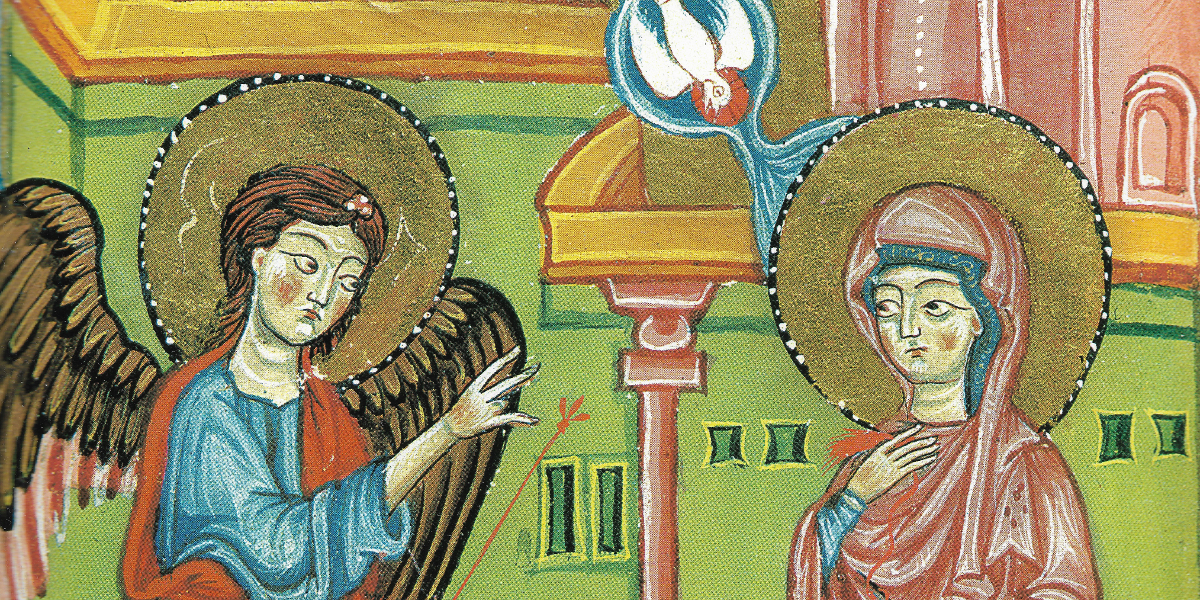
Christmas Eve – Pr. Faugstad homilies
St. Luke 1:31-35,38
I. The angel Gabriel said to Mary: “And behold, you will conceive in your womb and bear a Son, and you shall call His name Jesus.”
This scene has a specific context, a context that stretched back thousands of years. The reason an angel of the almighty God appeared to a young woman named Mary is because of another woman who lived long before this, all the way back in the beginning of time. That woman had a blissful and holy existence with her husband in a beautiful garden. They had no sin. They felt no pain. They lacked nothing.
But then a tempter came to the woman. “Wouldn’t you like to have even more?” he said. The woman gave in to the temptation, and so did her husband. They ate fruit from the one tree God had forbidden. Now they had sin. Now they knew pain. Now they were left with nothing. They hid from the presence of their Creator!
But God still loved them. He had mercy on them. He told the tempter, “I will put enmity between you and the woman, and between your offspring and her offspring; he shall bruise your head, and you shall bruise his heel” (Gen. 3:15). Adam thought the LORD was referring to Eve and her firstborn son (3:20, 4:1). But He was especially referring to another woman—to Mary, lowly Mary, Mary of Nazareth, who wouldn’t be born for several thousands of years.
In this evening’s reading, we see that God keeps His promises. He sent an angel to tell Mary that she was the one. She was the one who would bear the Son who would crush the head of Satan. She was the one who would bear the Son who would pay for all the sin of Adam & Eve and all their descendants. She was the one who would bear the Son whose name revealed His purpose. He was to be called “Jesus”—the One who saves.
Hymn: #119 – “Away in a Manger”
II. “He will be great and will be called the Son of the Most High.”
When Jesus lay there “asleep on the hay,” He did not look very impressive; He did not look so “great.” He looked like an ordinary little baby who needed what all babies need—milk, sleep, and new diapers. But this particular Baby was much more than met the eye. In the mystery of all mysteries, “the Son of the Most High,” the Son of God, had taken on human flesh.
We heard how His coming was prophesied right after the fall into sin. But the plan was actually in place before God the Father made the world and everything in it. God the Holy Spirit inspired the apostle Peter to write that our Lord Jesus Christ “was foreknown before the foundation of the world but was made manifest in the last times for the sake of you” (1Pe. 1:20).
The Son of God was incarnate, the Christ was made manifest, “the Word became flesh and dwelt among us” (Joh. 1:14). This great Lord, this “Son of the Most High,” came in the most unexpected of ways. He did not come down from heaven on the clouds in all His brilliant glory. He did not enter the world in the court of a powerful king. He came to the womb of a poor woman and was born in a little town. He “made Himself of no reputation, taking the form of a bondservant, and coming in the likeness of men” (Phi. 2:7, NKJV).
But why would He do this? Why would the God of eternity come down to us in this way? The apostle Paul tells us, “For you know the grace of our Lord Jesus Christ, that though he was rich, yet for your sake he became poor, so that you by his poverty might become rich” (2Co. 8:9).
Hymn: #123.1-4,15 – “From Heaven Above to Earth I Come”
III. “And the Lord God will give to Him the throne of His father David, and He will reign over the house of Jacob forever, and of His kingdom there will be no end.”
These words describe both the divine and human natures of the Christ: “And the Lord God will give to Him the throne of His father David.” The Lord God, God the Father from eternity, sent His only-begotten Son to join a human line. It was the line of Adam and Noah, Abraham, Isaac, and Jacob, the line of Jesse and his son David who was called from keeping sheep to be Israel’s king.
God promised that after David’s death, He would raise up an Offspring of David after him and “establish the throne of his kingdom forever” (2Sa. 7:13). That promise endured one thousand years through the crumbling and captivity of Judah and its return from exile until the birth of Jesus. Although the glory had long since departed from David’s royal line, Mary could trace her lineage to him.
More importantly, Mary was tied to the Promise, the Promise first made in the Garden of Eden, a Seed of Promise passed down from generation to generation, until it was planted in Mary’s womb by the Holy Spirit. The Child in her womb was both Man and God, both David’s Son and David’s Lord.
Though the world did not know it, He was a great King. He was the greatest King who ever walked on this earth, and He still reigns. He reigns with power and grace over His people. He sits on the throne of a kingdom that has no end.
Hymn: #143.1-2,7-9 – “The Happy Christmas Comes Once More”
IV. And Mary said to the angel, “How will this be, since I am a virgin?” And the angel answered her, “The Holy Spirit will come upon you, and the power of the Most High will overshadow you; therefore the Child to be born will be called holy—the Son of God.”
“How will this be, since I am a virgin?” Do we find it strange that Mary brings this up? Why does she feel compelled to mention her virginity? If Mary were living now, she would be told, “Mary, what you do with your body is no one’s business but yours.” But in fact what I do with my body and what you do with yours isn’t just our own business. What we do with our bodies is part of something bigger.
All who are baptized into Christ become part of His holy body. He was covered with our sins, so we would be clothed in His righteousness. He died in our place, so we would live. The apostle Paul writes that Christ “died for all, that those who live might no longer live for themselves but for him who for their sake died and was raised” (2Co. 5:15).
It does matter that Mary was a virgin. It means that the child in her womb was not conceived in her by a sinful man. That would mean their child was a sinner like them. But Jesus had no sin. He was conceived in Mary’s womb by God the Holy Spirit and therefore was “called holy.” Jesus had to be holy, so that He could take the place of you and me and all people, and offer Himself as a holy sacrifice for our sins.
Hymn: #113.1-2,4 – “A Great and Mighty Wonder”
V. And Mary said, “Behold, I am the servant of the Lord; let it be to me according to your word.” (ESV)
What a beautiful faith we find in Mary! She heard the stunning words of the angel which seemed to violate all sense, and she believed. “Behold, I am the servant of the Lord; let it be to me according to your word.” Martin Luther wrote that at her faithful hearing of God’s Word, Mary conceived “through her ear.” The day the angel visited her was the day God became man, starting as a tiny embryo in her womb.
Our minds are unable to comprehend the incarnation of God. How could the God of the universe spend nine months growing in a dark womb? How could He who has no beginning and no end be born of a woman and cradled in her arms? We cannot understand it any more than Mary could.
But we can rejoice. We can give thanks that the eternal Son of God was born for us. He was born to let nails and spear pierce Him through. He was born to bear the cross for me, for you. We don’t understand it. We don’t deserve it. But God declares it to us. “It is for you,” He says. So we reply, each one of us, with a believing heart, “Behold, I am the servant of the Lord; let it be to me according to your word.”
Hymn: #145 – “What Child Is This?”
+ + +
(picture from “The Annunciation” by Toros Taronetsi, 1323)