

Septuagesima Sunday – Pr. Faugstad sermon
Text: St. Matthew 20:1-16
In Christ Jesus, who made Himself last, suffering the punishment for all our sins, so we would be justified before God, receiving the great riches of His grace, dear fellow redeemed:
In a prosperous country like ours which does not require that everyone has the same amount of money or possessions, it is natural for us to compare what we have with what others have. We might drive through town and admire some large and beautiful homes, or we might think of the high-paying jobs some of our neighbors have, and we might wonder: “Why don’t I have more than I do?” Or, “Why have they received so much?”
These questions have crossed each of our minds. We might feel like we have worked hard, been honest and reliable; we’ve put in our time. Then we look at others who have not worked as hard, who have been willing to compromise morally and ethically, who in our estimation have not deserved the promotions or raises they have gotten. And we wonder why this has happened to us. Should we have looked out for ourselves more and sacrificed less? Or did we just pick the wrong job and put in our time at the wrong place?
It is thoughts like these that lurk in the background of today’s Holy Gospel. A landowner hires laborers for his vineyard throughout the day. The ones hired early in the morning agreed to work for a denarius. They were not being manipulated or cheated. It was a fair wage for the work they were asked to do. The workers hired at various points after that were not told what they would receive. They were promised by the owner, “whatever is right I will give you.” And they went to work, happy to be employed.
The problem came at the end of the day when it was time for the workers to receive their wages. The ones hired last who only worked one hour were sent through the line first, and they received a denarius. They couldn’t believe it! What a gift! When the ones hired first came through the line, they received the same pay—one denarius. They couldn’t believe it! How unfair! They immediately grumbled against the landowner: “Those workers don’t deserve what you gave them! We deserve to have more!”
The sins behind these statements are jealousy and a judgmental attitude. Jealousy or envy are when you see what someone else has, and you want it for yourself. It could be someone else’s property. It could be someone else’s possessions. It could be someone else’s popularity. It could be someone else’s spouse or family. There is nothing wrong with admiration; we can be impressed by what others have. But jealousy is the step forward into sin. It is what the Ninth and Tenth Commandments are about: “You shall not covet your neighbor’s house.” And, “You shall not covet your neighbor’s wife, workers, animals, or anything that is his.”
This sinful desire happens when we are discontent with what we have. That discontentment makes just about everything else around us look better. So if you are discontent about your job, just about every other job looks better. If you are discontent with your spouse or your family, just about every other spouse and family looks better. Giving way to these jealous thoughts opens the door to more sin. Sinful thoughts turn into sinful actions.
Closely related to jealousy is a judgmental attitude. When we sinfully desire what others have, we also think of reasons why they don’t deserve to have it. We say, “They haven’t worked as hard as I have.” Or, “He is so stupid and doesn’t have any real talent. What does the boss see in him?” Or, “She only got this job because of who she knows.” Or, “They don’t appreciate what they have like I would.” The more we can lower or cut down the people that we see as our opponents or enemies, the more we raise ourselves up.
The men who worked all day made this sort of judgment: “These last worked only one hour—hardly at all!—, and you have made them equal to us who have borne the burden of the day and the scorching heat. They don’t deserve what they received; we deserve way more!” The landowner replied with these points: 1) He gave the workers exactly what they agreed to work for, and 2) he has the right to pay the other workers the wages he chose to give. Then he called out the sin of the grumblers with the question: “Or do you begrudge my generosity?”—literally, “Is your eye evil (or envious) because I am good?”
The same question is set before us: Do we begrudge the Lord’s generosity to our neighbors? Do we think we haven’t gotten our “fair shake”? But how do we come to these conclusions? Who’s to say what we really do deserve? Who’s to say that we should receive something more or something different than what God has given us? In his First Letter to Timothy, St. Paul wrote, “But godliness with contentment is great gain, for we brought nothing into the world, and we cannot take anything out of the world. But if we have food and clothing, with these we will be content” (6:6-8).
Contentment is elusive. It always seems just out of reach. Others seem to have it, but not us. Except that contentment can’t be found in earthly things, in earthly success, or in earthly happiness. This is one of the devil’s tricks. The all-day workers in the vineyard wouldn’t have been any better off if they received twice as much money as the one-hour workers. The point of the parable is that contentment is not found in what we do—the energy we expend, the hours we put in, the amount we earn. Contentment is found in what God has done for us.
What we have done is so small, so insignificant, in the grand scheme of God’s kingdom. We think of ourselves as the ones who have worked so hard, “who have borne the burden of the day and the scorching heat.” But we should think of ourselves as those who often stood idle in the marketplace, who did not do the work we were called to do until the opportunity had almost passed us by.
By viewing our work in this way, we can only conclude that the wages we have received from God are not so much earned wages as they are gift. The laborers who worked one hour knew they did not deserve a full day’s wage. The knew this was a gift of the landowner’s generosity and grace. Far from his being indebted to them (like the other workers were trying to argue), they knew they were indebted to him.
This is how it is with our salvation. To earn our own salvation, we would have to be perfect children of God, perfect workers in His vineyard, perfect neighbors to those around us. This is what His Law requires. Since we have not met this standard, we have failed, and God owes us nothing. Romans 3:23 states the matter plainly: “for all have sinned and fall short of the glory of God.”
The very next verse tells us that since we cannot save ourselves from these sins, God does the saving. It says that just as “all have sinned,” so all “are justified by his grace as a gift, through the redemption that is in Christ Jesus.” We have often been jealous and judgmental toward others. This verse tells us that we are “justified” by God. To be justified means that God declares us righteous, “not guilty,” because Jesus kept the Law of God for us and suffered the punishment for all of our sin.
The justification of God requires nothing of you and gives everything to you. Romans 4:5 says, “And to the one who does not work—who does not trust in his own works for salvation—but believes in him who justifies the ungodly, his faith is counted as righteousness.” Whom does God justify, pronounce righteous? The inspired Word of God tells us that He “justifies the ungodly.” He justifies the ungodly, so that they become godly. He justifies the unrighteous, so that they are declared righteous.
What you could not do for yourself, Jesus has done for you. You could not keep God’s holy Law, so Jesus kept His Law for you. You could not pay for your sins, so Jesus paid the debt for you. You could not earn your way to heaven, so Jesus earned heaven for you. It is He who bore “the burden of the day and the scorching heat.” He took the burden of God’s wrath for your sins and endured the scorching heat of hell, so that you would be saved.
You Are Justified by God’s Grace as a Gift. Not only has He declared you right with Him because of what Jesus has done, but by the power of the Holy Spirit, He has given you the faith to believe this. Ephesians 2:8-9 says: “For by grace you have been saved through faith. And this is not your own doing; it is the gift of God, not a result of works, so that no one may boast.”
When you keep your eyes on Jesus, you see that you have everything you need. You might not have great riches or renown in this life. You might feel like many wonderful things have passed you by. But you have Jesus. You have the priceless Treasure that makes every worldly thing look so small and insignificant. You have the joy of knowing that He chose you to work in His vineyard. He chose you to receive His gracious gifts. He chose you who should be last to be first.
So we set aside our grumbling, we repent of our discontentment, and we receive His gifts with thankful hearts, faithful diligence, and a joyful hope in what He promises. The great hymnwriter put it so well:
The world may hold
Her wealth and gold;
But thou, my heart, keep Christ as thy true Treasure.
To Him hold fast
Until at last
A crown be thine and honor in full measure. (Evangelical Lutheran Hymnary #161, v. 6)
Glory be to the Father and to the Son and to the Holy Ghost; as it was in the beginning, is now, and ever shall be, forevermore. Amen.
+ + +
(picture from 11th century Byzantine manuscript of laborers working in the vineyard [lower portion] and receiving their denarius [upper portion])
The Eleventh Sunday after Trinity – Pr. Faugstad sermon
Text: St. Luke 18:9-14
In Christ Jesus, who rewards us not because of what we have done, but because of what He has done, dear fellow redeemed:
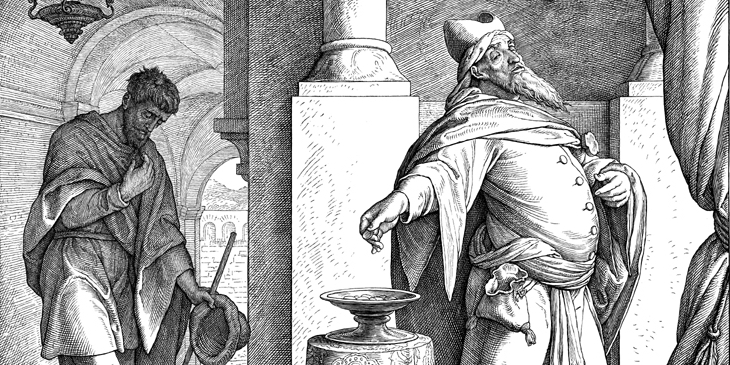
The opening words of today’s reading state: “[Jesus] also told this parable to some who trusted in themselves that they were righteous, and treated others with contempt.” Is this parable really for you? Is it for me? Are we people who trust in our own righteousness? Do we treat others with contempt? We find the Pharisee and his praying to be offensive. We admire the humility of the tax collector. So do we really need to hear this parable today?
Let me change the characters a little, make it more personal, and see if it gives us a different angle to consider it. “Two people went up into the temple to pray, one of them was you and the other Jesus.” In that comparison, we know which one is the prideful and arrogant one, and which one is humble. We might not step out and boldly say the things the Pharisee did, but Jesus wants us to examine the pride we have in our hearts and minds.
We can hardly imagine saying the things publicly that the Pharisee said. But we certainly have thought them. We have looked around us at the extortioners, unjust, adulterers, and cheats and stood a little taller—“I’m glad I’m not like them!” On the other hand, we have counted up the good things we have done and thought we were in pretty good shape.
Our natural tendency according to our sinful flesh is to get the object of our love wrong. The Commandments direct us to love the Lord our God with all our being and to love our neighbor as ourselves. Our love should be focused outward, not inward. And yet, what motivates us is often what pleases us, what makes us feel good, what benefits us. That’s the attitude that puts us in the place of the Pharisee.
The Pharisee said the words, “God, I thank You,” but it’s obvious he was really thanking himself. His “prayer” does not read like a humble offering but as a prideful recounting of all the reasons God should be pleased with him. What do our lists look like? “God, I thank You that I’m not lazy and dishonest like my co-workers are—that I’m not mean like my classmates—that I’m so good to my family—that I do so many wonderful things for others.”
It is not the good works that are the problem, but where we think the credit belongs for those good works. Why are you a hard worker? Why are you nice? Why are you good to your family? Why have you done so many wonderful things for others? If you think it is because you are such a good person and better than most, then you are most certainly the Pharisee. But if you humbly confess that the good you do is not really from you but is a gift of God, then you are the tax collector.
Now the tax collector was undoubtedly sinful. Tax collectors had the reputation of charging more taxes than required. We get a sense of this from Zacchaeus, the chief tax collector whom Jesus spotted up in a sycamore tree. When Jesus went to Zacchaeus’ home for a meal, all the people grumbled that He had “gone in to be the guest of a man who is a sinner” (Luk. 19:7). But Zacchaeus’ heart had changed. He stood up and vowed to Jesus, “Behold, Lord, the half of my goods I give to the poor. And if I have defrauded anyone of anything, I restore it fourfold” (v. 8).
The tax collector in the temple was also troubled by his sins. He stood way off to the side. He didn’t want to draw any attention to himself. He kept his eyes downcast. It’s as though no one were there except him and God. He struck his chest and said, “God, be merciful to me, a sinner!” Notice what he did not do. He did not put on airs, as though he were too important to show any weakness. He did not point out the Pharisee’s pride or exchange words with him: “Oh yeah, well what about when you did this and this!” All he could see was his own sins and God’s faithfulness.
That is the model for humility and repentance that Jesus sets before us. But we never do this perfectly. I have mentioned before the lesson my classmates and I learned from a college professor, who asked if we thought we were more like the Pharisee or the tax collector in this parable. Of course, we identified with the tax collector. “If you think you are more like the tax collector,” he said, “you are probably the Pharisee.” Yes, we can be proud even of our humility.
Jesus says, “For everyone who exalts himself will be humbled, but the one who humbles himself will be exalted.” We are humbled not by our own doing, as though it were a good quality in us. We are humbled by the Holy Spirit working on us through the Law of God. We are humbled by being shown we are not as good as we want to think. We are humbled by having our self-focused love exposed. We need the Holy Spirit to continue to do this humbling work, because the old Adam in us always thinks he knows best. But that fruit is still rotten to the taste.
The second Adam never tasted that fruit. He never sinned. He humbled Himself completely, perfectly. The apostle Paul writes that God’s Son, Christ Jesus, “made himself nothing, taking the form of a servant, being born in the likeness of men. And being found in human form, he humbled himself by becoming obedient to the point of death, even death on a cross” (Phi. 2:7-8). Jesus humbled Himself all the way. He did not maintain any dignity or honor for Himself. He never put Himself first. He put Himself right in our place and accepted all our sins as His own. He was no sinner, but He appealed to His heavenly Father to consider Him the sinner.
And the Father did. “For our sake [God] made him to be sin who knew no sin” (2Co. 5:21). Jesus was cast outside the city, ridiculed by self-righteous men, and forsaken by God. There would be no mercy. He had to be the object of the Father’s wrath, so we sinners would not be. He had to make the payment, because we had nothing to offer. He had to atone for all sin with His holy blood.
His perfect humility, His perfect sacrifice, means that God no longer condemns us. Jesus did the work in our place that we could not do. He fulfilled God’s holy Law of love for us, and He cancelled the whole debt of our sins that we could never pay. Because of these works of Jesus, we are justified before God, pronounced righteous, declared innocent of any wrongdoing.
Comparing the results of Adam’s sin and Jesus’ righteousness, Paul declares, “Therefore, as one trespass led to condemnation for all men, so one act of righteousness leads to justification and life for all men. For as by the one man’s disobedience the many were made sinners, so by the one man’s obedience the many will be made righteous” (Rom. 5:18-19). What Adam did, Jesus undid. What Adam ruined, Jesus restored. You are just as guilty as Adam because of your sin, and you are just as righteous as Jesus because He credits His righteousness to you.
There is no need to boast in your own works like a Pharisee. Far better works are yours by faith in Jesus. Everything He obtained by His humble work, He shares with you. He even shares His glory with you. That glory is hidden now while the world seems to be king and the members of Christ’s Church seem so lowly and powerless. But that glory will be revealed when Jesus returns with a shout and the sound of a trumpet on the last day.
Then we who are justified by the grace of God will also be glorified. We who are humbled will be exalted. We walk in our Lord’s footsteps. We live the life He has laid out for us. We take up our cross and follow after Him. It may not be a life that seems very impressive. We may be looked down on as those whom no one would desire to be. Accusing fingers identifying our faults will be pointed our way.
We don’t have to play the world’s game, a game in which everyone loses. It is not for us to sling mud with the self-righteous Pharisees. We carry out our humble callings, off to the side, eyes looking down with compassion on our neighbors in need, always with a prayer for God’s mercy on our lips. He hears these prayers. He does have mercy on us. He sends us to our homes and to our work justified.
Knowing that we are right with God makes us joyful in our work and eager to serve. We don’t need to prove our worth to God, to others, or even to ourselves. Our worth is firmly established in God’s Son, who took on our flesh, suffered and died for us, so that we would have life and purpose and fulfillment in Him.
Let us pray: God, we thank You that though we are just like all others in our sin and have not lived the life of love You commanded, yet You have had mercy on us poor sinners. You have judged us righteous by faith in Your Son, who humbly gave Himself in our place and is now exalted above all things. To You alone be the glory.
Glory be to the Father and to the Son and to the Holy Ghost; as it was in the beginning, is now, and ever shall be, forevermore. Amen.
+ + +
(woodcut from “The Pharisee and the Tax Collector” by Julius Schnorr von Carolsfeld, 1794-1872)