

The Feast of the Resurrection of Our Lord – Pr. Faugstad exordium & sermon
Festival exordium:
“If Christ has not been raised, your faith is futile and you are still in your sins” (1Co. 15:17).
If Christ has not been raised, all His promises were lies.
If Christ has not been raised, the Christian Church is a worldly organization created by men.
If Christ has not been raised, your Baptism did you no good.
If Christ has not been raised, you eat bread and drink wine in Communion and nothing more.
If Christ has not been raised, there is no place prepared for you in heaven.
If Christ has not been raised, the dead who are buried in our cemeteries will stay dead.
If Christ has not been raised, you got up early this morning for no good reason.
“If Christ has not been raised, then our preaching is in vain” (1Co. 15:14), and you might as well ignore it.
If Christ has not been raised, you are of all people most to be pitied (1Co. 15:19).
If Christ has not been raised, all these things are true.
But Christ HAS been raised.
Since Christ has been raised, your faith is NOT futile, and you are NOT in your sins.
Since Christ has been raised, all His promises are verified.
Since Christ has been raised, the Christian Church shall prevail against the gates of hell.
Since Christ has been raised, you were raised with Him in the waters of Baptism.
Since Christ has been raised, you receive His living body and blood in Holy Communion for the forgiveness of your sins.
Since Christ has been raised, a place is prepared for you in heaven.
Since Christ has been raised, the dead who now sleep will also rise.
Since Christ has been raised, you have not wasted your morning.
Since Christ has been raised, our preaching is not in vain, and God’s powerful words of life enter your ears and heart.
Since Christ has been raised, you are counted among those who will inherit eternal life.
Yes, Christ has been raised. That is why we joyfully share the Easter greeting as the faithful have shared it for thousands of years:
Christ is risen! He is risen indeed! Alleluia!
We sing our festival hymn #348, “He Is Arisen! Glorious Word!”
He is arisen! Glorious Word!
Now reconciled is God, my Lord;
The gates of heaven are open.
My Jesus died triumphantly,
And Satan’s arrows broken lie,
Destroyed hell’s direst weapon.
O hear
What cheer!
Christ victorious
Riseth glorious,
Life He giveth—
He was dead, but see, He liveth!
+ + +
Sermon text: St. Mark 16:1-8
In Christ Jesus, who did not do what people expected, but who did do what He said He would, dear fellow redeemed:
“Jesus is dead. He is gone.” That thought haunted their minds ever since Friday afternoon when they saw Him breathe His last. They saw Joseph of Arimathea and Nicodemus take His lifeless body down from the cross, wrap it in a linen shroud with spices, and bury it in a tomb nearby. They saw the men roll a stone across the entrance and depart. Then they went home, too, to observe the Sabbath rest.
These women had traveled with Jesus from Galilee and provided for His needs. They saw the miracles He performed. They watched Him cast demons out of people and raise the dead. They heard His powerful teaching. They believed that He was the promised Messiah. But now He was dead. What were they to do?
Overwhelmed with sorrow, they determined to serve Jesus one last time—they would give Him a more proper burial. They purchased and prepared spices and made their way early Sunday morning to the tomb. They shuddered thinking about the terrible wounds they would once again see on their Lord: the bruises on His face, the gouges from the crown of thorns, the holes in His hands and feet from the large nails, the gash in His side from the soldier’s spear. They had no doubts about what they would find at the tomb: the dead body of Jesus.
They were in for a surprise, or really a series of surprises. They found the large stone rolled away from the entrance. Looking inside, they saw an angel waiting for them. He told them not to be alarmed. They wouldn’t find what they were looking for because Jesus had been raised up. And He was on the move! They were to tell the Lord’s disciples that He was going before them to Galilee, where they would see Him, just as He had said.
The women took off from the tomb, full of trembling, amazement, and fear. But why did they react like this? Why was this such a surprise? If your parents told you they were taking you to the zoo for your birthday, and that you would see monkeys, lions, and giraffes, would you be surprised to go there and see those animals? They might not look exactly as you imagined, but you wouldn’t really be surprised. You saw what they said you would.
So why didn’t the followers of Jesus believe Him when He said He would suffer and die in Jerusalem and then rise on the third day? The evangelist Luke records a longer message from the angel reminding the women about this: “Why do you seek the living among the dead? He is not here, but has risen. Remember how he told you, while he was still in Galilee, that the Son of Man must be delivered into the hands of sinful men and be crucified and on the third day rise” (Luk. 24:5-7). Jesus clearly told His disciples what would happen. There should have been no surprise. But they did not believe.
They did not believe because they failed to see the big picture. They could not understand what benefit the death of Jesus could have. They wanted to keep things the way they were. Jesus was doing wonderful work. If Palm Sunday was any indication, He was gaining momentum and followers. If He died, all that work would come to a screeching halt. His death was the last thing the Jews and the whole world needed.
Because they couldn’t understand the purpose of His death, which was to redeem the world of sinners, they missed the significance of His resurrection. Something similar happens today. We are generally clear about the purpose of Jesus’ death—He died on the cross to pay for our sins. But we are not always so clear about the significance of His resurrection.
Jesus’ resurrection proves that He is the Son of God, and that everything He said is true. If He could predict His own resurrection and then come back to life, who can doubt the accuracy of anything He said?
Jesus’ resurrection also shows that His Father accepted His sacrifice for sin. Romans 4:25 says that He “was delivered up for our trespasses and raised for our justification.” Both things were necessary, His death and resurrection. If He had died and stayed dead, that would prove He was not God and that His sacrifice was not sufficient. His resurrection declares to the whole world that sin is paid for, death is defeated, and we are accounted as innocent before God.
Jesus’ resurrection is also a preview of our resurrection. Because He lives, we who trust in Him will live, even though we die (Joh. 11:25, 14:19). This resurrection victory was handed to us at our Baptism. The apostle Peter writes that Baptism is not about getting clean on the outside. It is deeply spiritual, “an appeal to God for a good conscience, through the resurrection of Jesus Christ” (1Pe. 3:21). The water-and-Word of Baptism is full of the forgiveness of sins and the righteousness of Jesus precisely because He has risen. St. Paul writes that through Baptism, “just as Christ was raised from the dead by the glory of the Father, we too might walk in newness of life” (Rom. 6:4).
In Baptism, we received Jesus’ resurrection victory. We received the full inheritance of His righteousness and life. We are destined for heaven with Him! But that is easy to forget while we are still here on earth. We often fail to see the big picture. We struggle with sin and the guilt it produces in us. We have doubts and sometimes even crises of faith, when we wonder if God really loves us. We don’t feel much like we’re “walking in newness of life.” Our death is getting closer and closer, and we’re not sure we’re ready for it.
Without the death and resurrection of Jesus, no one can be ready for death. Death is batting nearly .1000, with the exception of people like Enoch and Elijah whom God took directly to heaven. The rest of humankind from Adam to the present has had to die. “For the wages of sin is death” (Rom. 6:23). We are sinners, so we will die, everyone in this room, unless Jesus returns first.
But we believers don’t look at death like the women looked at Jesus’ death, as though it were final. We don’t cling to the remains of the dead like the women wanted to cling to Jesus. Instead, we cling to Jesus’ Word, His promise. He promised His disciples that He would rise from the dead on the third day, and He did. He promises us that He will come again on the last day to raise us from the dead, so He will.
On the last day, it shouldn’t surprise us when we “see the Son of Man coming in a cloud with power and great glory” (Luk. 21:27). It shouldn’t surprise us when we see the holy angels with Him, the same angels who shared the good news with the women at Jesus’ tomb. It shouldn’t surprise us when we see all the graves in our cemeteries opened up. It shouldn’t surprise us when we find no one in the caskets. But we won’t even have time for that investigation, since we will be caught up “in the clouds to meet the Lord in the air” (1Th. 4:17).
This is what sets us apart from the world. This is why we do not “not grieve as others do who have no hope” (1Th. 4:13). We know that death is not final. Jesus put a stop to death’s terrible reign. He let death devour Him, so He could tear open its insides and free everyone stuck in its dark belly. On the last day, His clear voice will wake us from our temporary sleep. We will blink our eyes and take in the light coming from the One who is Light and Life.
His same voice that will wake us from death is the powerful Word you are hearing today. He tells you today that your sins are forgiven. He paid for them on the cross and left them buried forever when He rose from the dead. He tells you at the altar, “This is My body; this is My blood for the remission of your sins.” He gave you this Holy Meal for your strength and comfort until He comes again.
The angel said to the women, “You seek Jesus of Nazareth, who was crucified. He is risen! He is not here.” But the angel would tell you something different about the presence of Jesus in His Word and Sacraments. He would say, “You seek Jesus of Nazareth, who was crucified. He is risen! And He is here!” He is here to distribute the riches of His grace to you and prepare you for His visible return.
He has done everything you need for your salvation. He tells you everything you need to know. So when He comes again in glory and leaves your grave empty by calling you to His side, it will be no unexpected surprise, just exceeding, everlasting joy.
Glory be to the Father and to the Son and to the Holy Ghost; as it was in the beginning, is now, and ever shall be, forevermore. Amen.
+ + +
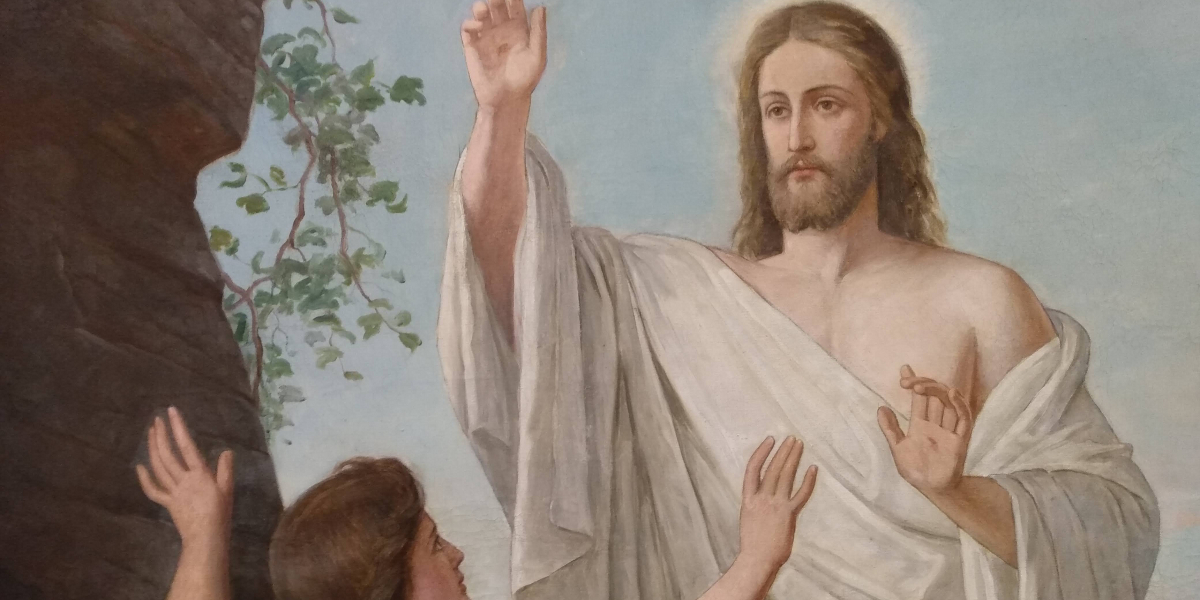
(woodcut from “The Empty Tomb” by Julius Schnorr von Carolsfeld, 1794-1872)
The Fourth Sunday of Easter – Pr. Faugstad sermon
Text: Judges 2:10-23
In Christ Jesus, whom God the Father sent to save us from all the enemies who tempted and afflicted us, dear fellow redeemed:
I have had the experience multiple times that I am talking with strangers, and they find out I am a pastor, or I ask them if they ever go to church. And they respond with something like, “Fire would probably drop out of the sky on me if I tried to walk into a church.” Or, “If they knew the things I have done, no one would want me there.” Or, “It’s too late for me.” Their underlying assumption is that they have been too bad or sinned too much to be forgiven.
This is a good opportunity to assure them that “the blood of Jesus [God’s] Son cleanses us from all sin (1Jo. 1:7), even the sins we think are unforgiveable. The very fact that a Christian is having a conversation like this with a non-Christian shows that God is a gracious God who wants all sinners to come to repentance and faith. But we Christians who know this also wonder sometimes if we have sinned too much to be forgiven. We ask ourselves, “If I were in God’s place, would I still be patient with me? Would I still love me?” We wonder how it will go for us when we finally do “meet our Maker.”
Today’s reading gives us a good picture of who that Maker is and how He operates. What we have in Judges 2 is a summary of what the rest of the book is about. It gives the pattern of the Israelites being tempted toward the gods of the Canaanites and worshipping these false gods. Then the LORD allowed their enemies to oppress them. Then the people cried out for deliverance. Then the LORD in His mercy sent judges to save them. This happened again and again.
What was so appealing about the gods of the Canaanites? Our reading states that the Israelites “abandoned the LORD and served the Baals and the Ashtaroth.” The Canaanites believed that the god Baal brought the rain that caused all life to spring forth. Asherah was a female goddess associated with fertility. The pagan people worshipped Baal and Asherah by engaging in sexual intercourse on hills and other high places, so these make-believe gods would be pleased and would bring fruitfulness to the land.
The Israelites looked at their own religion of strict moral law and of restraining their sinful inclinations, and it didn’t seem nearly as exciting and fulfilling as the religion of the Canaanites. So as today’s reading says, “they whored after other gods.” They rejected the true God, the God who loved them. The same thing happens today. We teach the holy Commandments of God which were given for our protection and blessing and also as a check on our sinful nature. But many reject His Commandments because they want to live their own way, walk their own path, answer to no one but themselves.
That approach to life does sound appealing. But what has this self-centered attitude done to our culture and our communities? It has caused many to walk away from marriage and having children. When there are children, many of them grow up in broken homes. People are lonely, even as there are supposedly more and more ways to “stay connected.” Many wonder what the purpose of life is, and they try to fill the emptiness with possessions, entertainment, and pleasure.
When this happens among the baptized, those whom God in His mercy has brought out of darkness into His marvelous light, whom He has claimed as His own and covered in His righteousness—when this happens to us His people, He may try to wake us up like He did the Israelites. Our reading says, “He gave them over to plunderers, who plundered them. And He sold them into the hand of their surrounding enemies…. [T]he hand of the LORD was against them for harm, as the LORD had warned…. And they were in terrible distress.”
A wake up call is not always pleasant. I imagine you have had a number of these as I have. You had to learn the hard way that you were neglecting your spouse, neglecting your family, neglecting your health. Your priorities were out of whack. Your Bible and devotion books were collecting dust. You felt stuck and unsettled. And somehow the Lord exposed your selfishness, or your pride, or your dishonesty, or your stubbornness.
Maybe it was through a sermon or through a conversation with a friend. Maybe it was because someone called you out, or you came to the realization by your own reflection. It hurts to go through this. It hurts to admit you were wrong, that you haven’t made good decisions, that you are not as right as you want to think. But that very recognition of your own weakness and failure, that is a gift from God. It shows He has not left you or rejected you. Once He has broken down your sinful works, He can build something better in you and with you.
This is why He sends crosses and trials; He does it to refine and strengthen our faith. It is too easy to take our prosperity and success for granted like the Israelites did, and to ignore the Word of God like they did. So God uses the troubles we experience to lead us to repentance, to an honest assessment of ourselves. And He uses our troubles to draw us closer to Him. He is not a “three strikes and you’re out” God, a God whose anger against our sin just keeps building and building until His wrath explodes against us.
Certainly His anger is kindled by continuous sinning, like it was toward the Israelites. But the afflictions He sent their way were done out of love. He did not want to lose them forever. He was ready to have mercy on them and eager to forgive them. Today’s reading says, “For the LORD was moved to pity by their groaning because of those who afflicted and oppressed them.” He wanted to save them. He wanted them to have relief from their troubles and to know that He, the only true God, was their God.
The Lord was patient with them. None of us would have been as patient with the Israelites as He was toward them. He had brought them out of slavery in Egypt, led them to the Promised Land, given them victory over their enemies, and handed them a beautiful place to live. They repaid Him by worshipping the false gods of the peoples they had defeated. Still, the LORD called them back. Still, He rescued them. Still, He blessed them.
The Lord Is just as Patient with You. He brought you out of the slavery of sin at your Baptism, taught you His unchanging truth throughout your years, absolved you of your sins week after week, and regularly called you to His holy Supper where He gives His own body and blood for your spiritual and eternal good. How have you thanked Him for these gifts? How have your words and actions in your day-to-day life shown your appreciation for what He has done?
When we reflect on this, we see that we are no more deserving of His grace than the Israelites were, but He gives it to us just as He gave it to them. When all we had done was sin, God the Father sent His holy Son to take our place. He sent His Son to be born of Mary, who descended from the same wayward Israelites we are hearing about today. Despite their tremendous sins against Him, God kept His promise to send a Savior and carried it out through them. Though they were faithless, He remained faithful; He could not deny Himself (2Ti. 2:13).
He is also faithful toward you. 2 Peter 3:9 says, “The Lord is not slow to fulfill his promise as some count slowness, but is patient toward you, not wishing that any should perish, but that all should reach repentance.” He wants you every day to repent of your sin and trust His promises. He wants you to rely on Him in times of trouble and triumph, sadness and joy, in good days and bad. The love He has for you is not some weak connection that could easily break and separate you from Him. He loves you with a strong love, a love so strong that He sacrificed His only Son for your salvation.
His Son had the same love for you. He willingly accepted your hurtful words and selfish actions. He paid the penalty for your dishonesty and pride. He suffered for your sinful stubbornness. He died for you, so that you would not be overcome by your spiritual enemies but would rest securely in His grace. His death on the cross for all sin means you have not sinned too much to be forgiven. The fact that you are sitting here today listening to His Word shows that He is merciful to you and wants you to know His love for you.
In His love, He promises to turn your times of suffering and trial into good. It is always tempting to dwell on the suffering, but it is better to cling to our Lord’s promise, the promise He spoke to His disciples in the Holy Gospel. Jesus said to them and us, “So also you have sorrow now, but I will see you again, and your hearts will rejoice, and no one will take your joy from you.” (Joh. 16:22).
The Lord, who died and rose again in victory, is with you each step of the way, ever-patient, always gracious, bearing your griefs and carrying your sorrows. He brings you comfort and joy as He meets you in His powerful Word and Sacraments. And He prepares you to greet Him when He returns on the last day to give you eternal salvation. On that day, you will praise Him for His patience with you, and your heart will be filled with a heavenly joy that no sadness or trouble will ever take away.
Glory be to the Father and to the Son and to the Holy Ghost; as it was in the beginning, is now, and ever shall be, forevermore. Amen.
+ + +
(picture from Jerico Lutheran Church altar painting)

Midweek Lent 2 – Pr. Abraham Faugstad homily
Text: St. Matthew 26:31-35
Dear Fellow Redeemed,
Jesus had made prophecies about his suffering and death. He had explained to his disciples what he would endure and the evil that would be brought against him. After Jesus had instituted the Supper of his body and blood he was with his disciples on the Mount of Olives and he now foretold what would happen to them, which would fulfill the words of the prophet Zechariah, “I will strike the shepherd, and the sheep of the flock will be scattered” (Zechariah 13:7). Judas would betray Jesus into the hands of the religious leaders and be struck. In fear for their own lives, Jesus’ disciples, his own flock, would scatter and desert their Lord and Shepherd.
This was just too much for Peter to believe. He wouldn’t and couldn’t listen to Jesus’ words. Peter turns and looks Jesus in the eyes and says, “You’re wrong, Jesus. You don’t have to worry about me. I won’t leave you. Even if everyone else leaves you, I will stand by your side. I will never fall away.” Peter contradicts Jesus and makes his own prediction. Yet, Jesus tells Peter that not only would he leave Jesus, but he would deny him three times that very night before the rooster crows. Then Peter makes his bold confession, “Even if I must die with you, I will not deny you!”
There is no doubt Peter meant what he said, but Jesus knew, that instead of dying, Peter would lie and deny to save his own life. Contrary to his grand words, Peter would completely disown his Lord and Master, not by silence, but by three loud and forceful declarations.
This account is important for all of us to ponder. We learn here how dangerous it is to presume and to rely on our own strength. Peter was so confident in himself that he believed he could never fall. “I will never fall away… I will never deny you!” Yet, instead of making promises that he could not keep, Peter should have been praying to God to be with him and not let him sink. But he relied on his own strength. And so, he fell.
Like someone who has eyes bigger than their stomachs, we often think we are stronger than we really are. Even as we hear about Peter’s fall we are tempted to think, “I can’t believe he did that” or “I would never do that.” When we hear that after being accused of being one of Jesus’ disciples a third time, Peter began to curse and swear that he did not know Jesus, we are shocked to learn that the Lord witnessed this denial. Scripture records, “And immediately, while he was still speaking, the rooster crowed. And the Lord turned and looked at Peter. And Peter remembered the saying of the Lord, how he had said to him, “Before the rooster crows today, you will deny me three times” (Luke 22:60–61). Right as Peter was frantically denying knowing Jesus, Jesus happened to be led through the courtyard. It’s hard to imagine the remorse and shame that Peter must have felt after he denied Jesus. We are told, “And he went out and wept bitterly” (Luke 22:62).
It would be a terrible thing to deny Jesus like Peter did. Yet, wouldn’t it be even worse, if Peter showed no regret or sorrow? Wouldn’t it have been even more shameful for Peter to act as if it really was not a big deal? Wouldn’t it have been more alarming if Peter acted as if he hadn’t done anything “that bad” when he saw the resurrected Christ?
Every sin that we commit is a denial of Christ. And our sin is never hidden from God—he sees everything. He knows the sinful thoughts that run through our minds and hears every careless word we speak. He sees us when we damage or take something that doesn’t belong to us. He sees us when speak poorly of our neighbor. He sees us when we fail to stand up for what is right and confess the truth. He sees us when we join in with the crowds and seek comfort by the fires of this sinful world. But how often do we act like our sins are not sins and a denial of Christ?
Perhaps the only greater sin than denying Christ is when we deny that we sin against him and deny how serious our sin is. There is no such thing as a small sin. The hymn verse reminds us (ELH 297:3),
Ye who think of sin but lightly
Nor suppose the evil great
Here may view its nature rightly,
Here its guilt may estimate.
Mark the Sacrifice appointed,
See who bears the awful load;
’Tis the Word, the Lord’s anointed,
Son of Man and Son of God.
We can’t save ourselves from our sin nor do we have the strength to keep ourselves in the faith. Our lesson shows this with the example of Peter. Yet, this lesson isn’t as much about Peter as it is about what Christ suffered for our sakes. As Peter denied Jesus, Jesus was redeeming Peter and all people. He was abandoned so that we wouldn’t have to be. Jesus suffered what we truly deserve so that we wouldn’t have to. He is the innocent Lamb of God who came to take away the sins of the world.
Jesus knew that his disciples would abandon him. He knew all that he would endure. Yet, none of the suffering that would come his way deterred him from his mission to save our souls. In fact, this is why Scripture exhorts us to look to Jesus, “The author and finisher of our faith, who for the joy that was set before Him endured the cross, despising the shame” (Hebrews 12:2). Jesus went forward with “joy,” because he was setting out to accomplish our salvation—the salvation of even those who have denied and sinned against him.
After Peter denied Jesus and saw him, he went out and wept bitterly. He realized the magnitude of what he had done. He knew Jesus’ warning that anyone who denies him, he would also deny before his Father in heaven. Nevertheless, Peter did not despair because he also remembered the words which the Lord had often spoke—that he had come into this world to call poor sinners to repentance. Christ would go before Peter in Galilee and restore him to himself. Peter had this promise. Later, Peter would confess Christ three times, just as he had denied him three times (John 21). Jesus forgave Peter and would even use him to boldly proclaim this forgiveness to others!
Paul writes, “For whatever things were written before were written for our learning, that we through the patience and comfort of the Scriptures might have hope” (Romans 15:4). The account of Peter gives us hope. There is no sin beyond forgiveness. There is nothing that you have done or failed to do, that cannot be forgiven and healed. Our sins may be great, but Jesus is greater than our sins. When the Holy Spirit shows you your sin through the Law, don’t run from God but to him. When you see what Jesus suffered, you should realize that there is no sin that he did not pay for. You don’t have to die for him, because he died for you. Your sins are forgiven. You have been reconciled with God. None of us are part of God’s family because we have earned it. We are all members by God’s grace. Jesus is a friend and Savior of sinners. He welcomes those who confess their sins and believe in him.
When Peter trusted in his own strength, he fell. Yet, through this experience he learned to put his confidence in God alone. As he later wrote, “You are kept by the power of God through faith unto salvation” (I Peter 1:5). Just as Peter was kept in the faith through Christ’s prayer and help, so too are we kept in the faith through Christ’s help. This is why we gather as Christians around the means of grace, God’s word and sacraments, because these are the means through which Christ forgives us, strengthens us, and keeps us in the one true faith. Jesus promises, “My sheep hear my voice, and I know them, and they follow me. I give them eternal life, and they will never perish, and no one will snatch them out of my hand” (John 10:27–28). Amen.
(picture from “The Second Denial of Saint Peter” by James Tissot, 1836-1902)

The Fourth Sunday in Advent – Pr. Faugstad sermon
Text: Genesis 17:15-22
In Christ Jesus, who leads His people to the heavenly Zion with singing, everlasting joy upon their heads, where they shall obtain gladness and joy, and sorrow and sighing shall flee away (Isa. 35:10), dear fellow redeemed:
Abram and Sarai experienced a particular pain that many have experienced since then—they were unable to have children. This is the first detail the Bible shares about Sarai, that she “was barren; she had no child” (Gen. 11:30). Undoubtedly this caused them much sadness. As the years passed and no child was conceived, they became more and more resigned to the fact that they would have no descendants. They passed into their forties, then their fifties, then their sixties. By this time, Abram had become a very wealthy man. He had great possessions and many servants.
Then rather abruptly, the LORD told Abram to leave his country and his relatives and go to a new land. He said to Abram, “I will make of you a great nation, and I will bless you and make your name great, so that you will be a blessing. I will bless those who bless you, and him who dishonors you I will curse, and in you all the families of the earth shall be blessed” (Gen. 12:2-3). If Abram had any doubts about this, they are not recorded for us. He might have wondered how his name would become great and all the families of the earth would be blessed through him. For one thing, he had no children. For another, he was at this time seventy-five years old, and Sarai was sixty-five!
But Abram obeyed. He gathered all he had and traveled to the land of Canaan. When he got there, the LORD appeared to him and said, “To your offspring I will give this land” (v. 7). A while later, the LORD repeated the promise, “Look toward heaven, and number the stars, if you are able to number them…. So shall your offspring be” (15:5). Abram believed what God said (v. 6).
But ten years passed after the LORD told Abram and Sarai to move. Sarai was now seventy-five. If she hadn’t had a child yet, how could she now? She decided to give her servant to Abram as another wife, so that if her servant conceived a child with him, Sarai would count the child as hers. Her servant did conceive and gave birth to a son named Ishmael. But Ishmael was not the child of God’s promise.
Thirteen years later when Abram was ninety-nine years old, God appeared to him again and told him, “You shall be the father of a multitude of nations. No longer shall your name be called Abram, but your name shall be Abraham” (17:4-5). Abraham means “father of a multitude.” At the same time, the LORD changed the name Sarai to Sarah which means “princess,” and He promised Abraham that he would have a son by Sarah.
Abraham’s reaction is recorded for us. He “fell on his face and laughed and said to himself, ‘Shall a child be born to a man who is a hundred years old? Shall Sarah, who is ninety years old, bear a child?’” Now as you know, there are different kinds of laughter. Some point their fingers and laugh when they are ridiculing a person or showing their disdain for him. Some laugh when they are shocked or surprised. Martin Luther was convinced that Abraham laughed “because he was filled with great gladness and joy” (Luther’s Works, vol. 3, p. 154).
He was filled with joy because he understood that God’s promise of a son was about more than providing him an heir. It was about making a way for all the families of the earth to be blessed (12:3). The promise the LORD made to Abraham is the same promise He made to Adam and to Noah. God would send a Savior to redeem sinful mankind. Jesus pointed back to this promise when He said to the Jews, “Your father Abraham rejoiced that he would see my day. He saw it and was glad” (Joh. 8:56).
Abraham’s laugh coincided with the name of his son. God said to him, “you shall call his name Isaac,” a name which means “he laughs.” A year later, that son was born. And the new mother Sarah said, “God has made laughter for me; everyone who hears will laugh over me…. Who would have said to Abraham that Sarah would nurse children? Yet I have borne him a son in his old age” (Gen. 21:6-7). And every time they held that little baby and listened to his little grunts and coos, what else could they do but laugh?
But we can’t help but wonder: Why did God do this? Why did He make Abraham and Sarah wait until they were one hundred years old and ninety years old before they had a child? The author of the book of Hebrews writes in a very understated way that Sarah “was past the age” of being able to conceive, and in a more expressive way that Abraham was “as good as dead” (11:11,12). If this amazing birth were not recorded in the Bible, we would laugh at the possibility.
And that is the point. What we consider impossible, God makes possible. No one can say that Abraham and Sarah were the ones to keep the promise of a Savior alive. They were incapable of having children. They were very old. And God gave them laughter. He gave them Isaac. He wanted to show that this child was a gift, just as all children are. He wanted to show that His promise would neither fail nor succeed because of the work of man. God’s promises succeed because He is God.
That means we can trust His promises. What makes this difficult is our sinful tendency to trust ourselves. We act as if everything depends on ourselves instead of God. We offer weak prayers, if we offer them at all, because we are convinced that God will not give us what we pray for. Or we get impatient when we ask something of Him, and He makes us wait—maybe when we are sick or injured or in trouble. We might even attach a demand to our requests: “If You love me, You will do this by this day or this time.” What we are really doing is putting ourselves in the position of God, and by our lack of faith we are calling down His judgment instead of His mercy. When we take matters into our own hands, like Sarai did by giving her servant to Abram, we often experience unexpected and unpleasant consequences.
God’s plans are much better than ours, and His promises are rock-solid. When He makes a promise, nothing will change His mind. He fulfilled His promise to give Abraham and Sarah a son. And He fulfilled His promise to send a Savior through Abraham’s line. Some two thousand years down the road, God sent His angel to another old man, a priest named Zechariah. Zechariah and his wife Elizabeth were also old and barren like Abraham and Sarah. And the angel said, “Do not be afraid, Zechariah, for your prayer has been heard, and your wife Elizabeth will bear you a son, and you shall call his name John” (Luk. 1:13). Zechariah did not respond in faith like Abraham, and for his disbelief, God made him unable to speak until after John was born.
John was a messenger, “the voice of one crying out in the wilderness, ‘Make straight the way of the Lord’” (Joh. 1:23). He pointed to One much greater than he, “the strap of whose sandal [he was] not worthy to untie” (v. 27). That One was the Son of God incarnate, the descendant of Abraham and Isaac, the fulfillment of God’s promise to save the world. God sent His Son to take on human flesh because He loves you so deeply and so perfectly. Jesus came to be your righteousness, to live blamelessly under the Law in your place. He came to atone for your many sins by shedding His holy blood on the cross. He came to conquer your death by rising from the dead in victory.
He came to give you hope as you struggle with your doubts and fears. He came to give you peace as the guilt of your sins weighs down on you. He came to give you comfort in your pain and sadness. The hymnwriter Paul Gerhardt put it beautifully in his great Advent hymn:
Rejoice, then, ye sad-hearted, / Who sit in deepest gloom,
Who mourn o’er joys departed, / And tremble at your doom;
Despair not, He is near you, / Yea, standing at the door,
Who best can help and cheer you, / And bid you weep no more.
No care nor effort either / Is needed day or night,
How ye may draw Him hither / In your own strength and might.
He comes, He comes with gladness, / Moved by His love alone,
To calm your fear and sadness, / To Him they well are known. (ELH #94, vv. 6-7)
God promises to come to you through His Word and Sacraments. Through those means, He promises to forgive you. He promises to strengthen you. He promises to renew your faith, so that you have joy even when you are suffering, even when you are struggling. You have joy in knowing that you do not walk through this life alone, that there will be an end to the sadness of this life, and that Jesus will return on the last day to take you to His kingdom of glory.
The time of your final redemption is drawing near. The time will come when the joy you have in Christ will be perfected, when sin, death, and devil will no longer bother you, when you will forever forget the troubles you had here. Then we will sing. We will shout with gladness. And with Abraham and Sarah and all the saints, We Will Laugh.
Glory be to the Father and to the Son and to the Holy Ghost; as it was in the beginning, is now, and ever shall be, forevermore. Amen.
+ + +
(picture of Abraham viewing the stars from 1919 Bible primer book by Augustana Book Concern)
The Visitation of Mary & Vicar Installation – Pr. Faugstad sermon
Text: St. Luke 1:39-56
In Christ Jesus, who “made Himself nothing, taking the form of a servant, being born in the likeness of men” (Phi. 2:7), in order to redeem us by His perfect life and innocent death, dear fellow redeemed:
The mothers who have carried in their wombs the greatest people in the history of the world, did not know what their little babies would become. The Apostle Paul’s mother could not have guessed that her son would one day preach Christ crucified around the world. And Margarethe Luther would not have expected her son Martin to become a great reformer.
Elizabeth and Mary were different. They knew that the baby boys in their wombs were destined for tremendous things. Elizabeth learned it from her husband, a priest serving in the Jerusalem temple, who was visited by the angel Gabriel. The angel told Zechariah that he and Elizabeth would have a son. He would “be filled with the Holy Spirit, even from his mother’s womb,” and would “turn many of the children of Israel to the Lord their God” (Luk. 1:15, 16). His name was to be John. After Elizabeth conceived this child, she kept herself hidden for five months. Who would believe that this old woman was carrying a child after a lifetime of barrenness?
In the sixth month of Elizabeth’s pregnancy, the angel Gabriel visited her young relative Mary. As you know very well, Mary was betrothed to a man named Joseph, but they had not had relations with each other. Mary was a virgin. Gabriel shared the stunning news with Mary that she would bear the Christ Child, “the Son of the Most High” (Luk. 1:32), who would reign over an everlasting kingdom. And he had even more news to share. Her elderly relative Elizabeth was six months along in her own pregnancy. “For nothing will be impossible with God” (Luk. 1:37).
So what did Mary do next? She got up and hurried to Elizabeth’s house. Even if no one else believed her, Elizabeth would—Elizabeth whose life had also been touched by the unexpected working of God. By this time, Elizabeth’s belly had expanded to make room for the growing boy inside her. She might have felt little flutters as he moved around and hiccupped. Her baby was about twelve inches long and 1½ to 2 pounds in weight. His eyes may have just begun to peek out behind red eyelids.
Elizabeth did not know that a monumental meeting was about to take place. The Messiah was about to enter the home of His messenger. With Mary’s arrival, the two men who would turn the world upside down with their preaching and teaching, were now in the same room in the flesh. Elizabeth had not heard about Mary’s pregnancy, and yet she knew. She knew as soon as Mary greeted her, and her baby leaped in her womb. She knew, because at Mary’s greeting she was filled with the Holy Spirit.
The Holy Spirit revealed to her that Mary, a virgin and yet pregnant, was “the mother of her Lord.” She spoke three blessings to Mary: “Blessed are you among women,” “blessed is the fruit of your womb,” and “blessed is she who believed” what the Lord said. Elizabeth did not honor Mary because she had accomplished great things on her own. Elizabeth honored Mary because of her connection to the teeny, tiny baby growing in her womb.
But how could the little baby of a poor woman save the world? The world doesn’t think much of little babies or of poor women. Little babies are viewed more and more as burdens. Babies get in the way of careers and riches and personal freedom. All of us have thought that at one point or another. But Elizabeth and Mary were once babies, as were their sons John and Jesus. You and I were babies, and here we are. We are supposed to be here. God gave us life. Every Christian should be pro-baby, because God is pro-baby!
Every soul is precious in His sight, which means every soul should be precious to us. Our hearts should expand in love for all our neighbors, from the poor ones to the rich ones, from the lowly ones to the well-regarded, from the unborn to the elderly. Every life has value. Every life matters. Just look at the care with which God formed us in the womb. The psalmist David wrote, “For you formed my inward parts; you knitted me together in my mother’s womb. I praise you, for I am fearfully and wonderfully made” (Psa. 139:13-14). He goes on to describe how we were “made in secret, intricately woven,” and how even at our conception, God had a plan for all our days (vv. 15, 16).
The miraculous composition of a human being should be enough for people to acknowledge and praise the almighty God. But our sinfulness is great, and it has been with us for as long as we have existed. Adam and Eve’s fall meant that all their descendants would inherit their sin, and sin keeps us from fearing, loving, and trusting God as we should. In another of his Psalms, David wrote, “Behold, I was brought forth in iniquity, and in sin did my mother conceive me” (Psa. 51:5). That is true of every one of us. We were sinners from the moment we were conceived.
But Jesus was an exception to that unbroken line of sin. He was conceived not by a human father and mother, but by God the Holy Spirit overshadowing the womb of Mary. In this way, God the Son took on human flesh but without human sin. By His entrance into the world as an embryo, God was showing that life matters from its earliest beginnings, even before the human eye can see it. As He went through each stage of life—from His growth in the womb, to His birth, as a toddler, a child, a young adult, a grown-up—Jesus was redeeming every stage of life from the sin that pollutes us.
God does not take shortcuts. There was no simple, easy way for mankind to be saved. The Son of God had to take on flesh, and He couldn’t just appear in the flesh like you might appear in costume. He had to take human flesh into His Person. He had to start the way all humans start, with the joining of tiny cells. From the time that Gabriel visited faithful Mary, the eternal Son of God became God and Man in one Person. And He remains God and Man for all eternity.
This is the One whom John would go into the wilderness to proclaim. But that would be about thirty years later. Today was the day for Messenger John and his Master Jesus to meet. And how do we know that John was aware of Jesus’ presence? Elizabeth exclaimed to Mary, “For behold, when the sound of your greeting came to my ears, the baby in my womb leaped for joy.”
John continued to rejoice. Those thirty years later after Jesus was baptized, John cried out, “Behold, the Lamb of God, who takes away the sin of the world!” (Joh. 1:29). As Jesus’ following increased, and fewer were coming to John, John testified, “The friend of the bridegroom, who stands and hears him, rejoices greatly at the bridegroom’s voice. Therefore this joy of mine is now complete. He must increase, but I must decrease” (Joh. 3:29-30).
John had it right; his glory was in Jesus. The long-promised Savior had come. Elizabeth saw it the same way. She welcomed Mary with all humility, “And why is this granted to me that the mother of my Lord should come to me?” Mary saw it the same way. In her famous song, the Magnificat, she said that her Savior God “has looked on the humble estate of His servant,” “has done great things for me,” has “exalted those of humble estate,” and “has filled the hungry with good things.”
And so it is for you and me. The Lord has looked on our humble estate. He saw how helpless we were, how lost in our sin. And He has done great things for us. The little baby in Mary’s womb was growing there for you and me. The six months bigger baby growing in Elizabeth’s womb would go before Him to prepare His way. All of this happened more than 2,000 years ago, but God had you in mind.
God the Father sent His only Son for this express purpose—to save your soul. He gave you birth, so that He could give you rebirth. He formed you in the womb, so He could transform you by the power of the Gospel. You might wonder sometimes how much your life matters. You might wish you could go back, make different choices, and do more with your life. You can put all those thoughts to rest when you see what God did for you, when you see the womb of a virgin swelling with Child, when you see the God-Man making His way to Calvary carrying His cross—for you.
Your life matters. God loves you. He forgives all your sin. He wants you to join Him in heaven with Elizabeth, John, Mary, and all the saints. This is the message He calls sinful men to preach. We give thanks that He has sent another vicar to our parish to preach this Word to us and to continue training for the noble work of pastor. Pastors have nothing to offer you of their own, just as Mary had nothing to offer of her own. But as God chose her to bear the Christ-Child in her body, so He has chosen sinners to “rightly handle His word of truth” (2Ti. 2:15), and to distribute His means of grace through our mouths and by our hands.
The presence of Jesus in Mary’s womb brought joy to Elizabeth and John, and His presence still brings joy to us. When the sound of His forgiveness and grace reaches our ears, the Holy Spirit comes to remove our burdens and lift our hearts. Then our souls magnify the Lord, and our spirits rejoice in God our Savior.
Glory be to the Father and to the Son and to the Holy Ghost; as it was in the beginning, is now, and ever shall be, forevermore. Amen.
+ + +
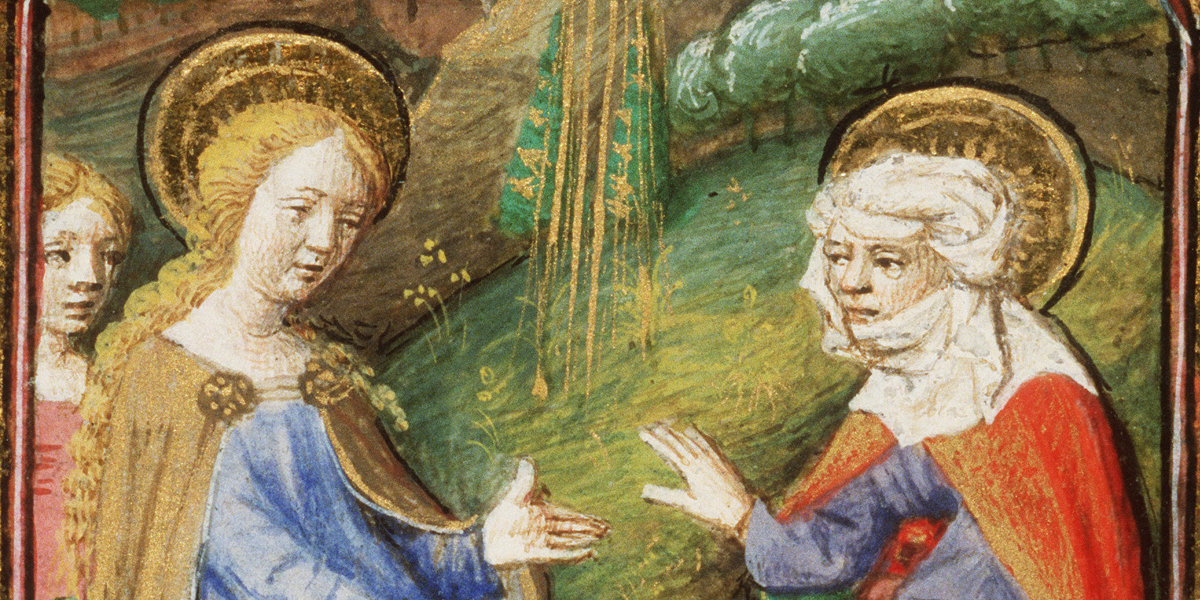
(Picture of the Visitation from the Book of Hours of Simon de Varie, 1455)

The Sixth Sunday of Easter – Vicar Anderson sermon
Text: St. John 16:23-30
In Christ Jesus, who teaches you the value, meaning, and the command of prayer, giving the Lord’s prayer as your model and guide, assuring you that He hears you, dear fellow redeemed:
Pastor and I have started another round of Christianity 101. Like the class in the fall, a statement is made to try and put people at ease. That statement is, “There is no such thing as a dumb question.” Now we might chuckle and think to ourselves questions that fit that category, we can also use this idea with our worship lives. Is there such a thing as a dumb prayer? Now I know when children hear the text say, “Truly, truly, I say to you, whatever you ask of the Father in my name, he will give it to you,” they can wonder if God will really give us anything. “Can God really give me my own semi-truck?” “Can He get me my very own race car?” As a child I may have had these questions, and even if they were childish then, our text today is very clear. Jesus is teaching about the power that prayer has. This power is not from us, but we see Christ’s work on display. It is through Him that the Heavenly Father hears His children’s prayers.
Our text starts with Jesus telling the disciples that their joy will be full when they ask in His name. He is pointing out that this joy is coming to them from God. God is with them, and He will not leave them or forsake them. Jesus is pointing this out because they can still have joy, even when there is great tribulation. The disciples forget about the joy they have from their heavenly Father as the night continues. Their joy that they have being with Jesus soon shatters as Jesus is arrested and taken away from them. Instead of joy, they run away in fear.
The disciples are trying to figure out what Jesus is talking about. Jesus admits to them that some of the things that He tells them, He is using figures of speech. Jesus is not saying these things to trick His disciples. There is important information that Jesus tells them plainly. The important information is that He will die and rise from the dead. The disciples do not want to believe this saying.
Jesus also tells the disciples where He came from. “In that day you will ask in my name, and I do not say to you that I will ask the Father on your behalf; for the Father himself loves you, because you have loved me and have believed that I came from God. I came from the Father and have come into the world, and now I am leaving the world and going to the Father.” He points out that the disciples do believe this. That Jesus is the Son of God. They can pray to God the Father because they believe in the Son. Hours from now they will be asked to pray. Jesus would pray continually in the garden, but instead of praying, the disciples would fall asleep. They would not ask for strength and they would run away in fear.
We all have fears that the devil will try to use to paralyze us. Our fears can consume us. I don’t need to say, “think about being in the disciple’s shoes.” Each one of us has had a fear that has caused us to cower and many times, it can be from our sins. We can be struck with the fear that our sins could be brought into the light. This fear has been passed to us from our first parents. Adam and Eve tried to hide their sins from God. They sewed fig leaves to make clothes and when they heard God walking in the Garden, they hid among the trees. God knows their hiding place.
He also knows our hiding place. God sees all that we do, nothing is hidden from Him. Like Adam, Eve, and the disciples, how do we go to God when we have sinned against Him. He is a righteous judge. Yet we get in trouble because we do not go to Him when we have problems. We think that since God is upset with us, maybe we can just get ourselves out of the problem. God is right there to give us medicine, but we look the other way. How can the Father love us and answer us when we have failed to keep His commands?
Jesus is teaching His disciples about God’s command of prayer. God hears our prayers and commands us to do it. Now what is the problem with that? Well, we usually do two things. We can find ourselves in a group who don’t pray or pray very little. We think that we are controlling our lives. The devil enjoys when we are not going to God. He knows that when we are not praying, it means we are focused on ourselves. Then we go to God in prayer as a last resort when we find ourselves in a bad situation. There is another group who looks at prayer as something we are doing for God. That God needs our prayers to function. These prayers, like the last-minute ones, focus on me. Not on what God has done, but what I can do for God or what I demand from Him. As you might be wondering to yourselves, “how do I pray to God”, Jesus keeps you calm with the first thing He says in this text.
God the Father does hear His children. Jesus teaches the disciples that they can have comfort and joy because they know the truth. Jesus tells them that “you have loved me and have believed that I came from God.” They understand that Jesus is true God. God the Father loves them because they loved and trusted His Son. They can go to God the Father as children because Jesus has taken away their sins and made them right with God. Even when they were going to still mess up. Jesus would soon leave them, but He would come back to them, rising from the dead!
Jesus’ glory shines forth and we see that He is not just a man. This is God in the flesh. No one can talk like this unless they came from God. The world needed someone to be able to answer God directly. We cannot do that because we are not perfect. Jesus however can talk to God directly because He has done all that His Father asked of Him. Jesus assures us just as He assured His disciples that the Father does hear us. He listens to our every word and Jesus explains why.
“Truly, truly, I say to you, whatever you ask of the Father in my name, he will give it to you.” Jesus knows that you can’t go to God the Father on your own. He is a righteous judge. Jesus tells you that it isn’t because of anything that you can do to talk to God the Father. You needed a go-between. “For there is one God, and there is one mediator between God and men, the man Christ Jesus” (1 Timothy 2:5). You can ask for anything in Jesus’ name because He is your go-between. He stepped in front of God’s vision with His sacrifice on the cross for your sins. Your communication is restored with your heavenly Father because He comes to you through the work of Christ.
Christ’s redemptive work is the reason that you are children of God. You never need to think that God doesn’t hear your prayers. He is always listening. When life looks as though it will continue to push back on you, when it drives you into the lowest parts, it can feel and seem easy to not pray to God. It is in these hard moments where you look to the cross, see what Christ has done for you and know that God hears every prayer. He can even translate prayers when you are so hurt that it looks as though nothing will come out of your mouth.
As God translates even your silent prayers of pain, He has given you other prayers to pray. The psalms are rich prayers that still fit today. They remind you of where your prayers are supposed to come from. “O LORD, you hear the desire of the afflicted; you will strengthen their heart” (Psalm 10:17). Your prayers do not come from elaborate thoughts, they come from the heart. The psalms assure you that because of what Christ has done for you, you are heard here on earth.
Your Savior has also taught you a prayer that sometimes you take for granted. There is a reason that Jesus taught the Lord’s prayer. Think about the petitions, how many are focused on the things of this world? The fourth petition is the only petition that you pray that God would give you daily bread. Your daily bread is anything you need to take care of your body and life. All the rest of the petitions are about your spiritual needs. These are needs that you can sometimes forget about, and these are the most important. You are reminded that God is the One who takes care of you, not the other way around. And when you forget this, it is your Savior who has redeemed you that you can go to God as children go to their Fathers.
We do not need to be in fear or think that we don’t deserve this Fatherly love. We receive it not based on our own works. The Father loves us because of His Son. Christ died in our place and rose from the dead taking away our sins. It is because of what Christ has done for us that we don’t need to worry about our prayers. They are being answered by God himself. He is all around us, providing us with strength for our trials. Our prayers are not dumb in God’s eyes. He hears every word, even the words that won’t come out of our mouths. Nothing is too big or too small for God to handle. He will do everything according to His good and gracious will. Jesus teaches us that whatever we ask in His name God will hear. Our joy will be full because we know that we speak to God because of Christ. And because of Christ’s resurrection, we will speak to Him face-to-face when He calls us home. Amen.
Glory be to the Father and to the Son and to the Holy Ghost; as it was in the beginning, is now, and ever shall be, forevermore. Amen.
+ + +
(portion of “Crucifixion, Seen from the Cross,” by James Tissot, c. 1890)
The Fourth Sunday of Easter – Vicar Anderson sermon
Text: St. John 16:16-23
In Christ Jesus, even though we live in a world with sorrows, trials, and tribulations, we are able to rejoice in our risen Lord, who promises no one will take away your joy, dear fellow redeemed:
Change is in the air. We have watched all the snow melt away. The flowers are starting to bloom. I have noticed the green starting to appear in the grey trees as the new leaves begin to grow. I think it is safe to say that most people enjoy spring. It is a season of growth and warmth. We are transitioning from a season that is kind of dark and dreary. Those winter months can be long. We have also finished a few holiday seasons, and as we acknowledge those seasons, for some maybe those seasons aren’t as joyous as we think. During those dreary months, it is a time where people tend to pass away. The holidays that we love so much can sometimes become a time of mourning and sorrow. As the spring brings us out of those dreary months into warmth and sunshine, Jesus is telling His disciples that He will bring them joy. It won’t start out like that. He says they will first weep and lament. Jesus’ comfort for His disciples comes to you as well, your sorrow will be turned into joy!
Jesus in His discourse is telling the disciples this great message. He has told them on more than one occasion that He is going to be arrested and He will die and will rise again. Jesus tells His disciples that what He is saying, they are not going to like it or want to bear it. It will look like their lives are going to be extremely hard. Jesus assures them that they will have clarity and He will explain more to them. The Holy Spirit will guide them. Everything that Jesus is telling His disciples is so that they can be strengthened. When Jesus ends with saying that He is going to leave them, the disciples hold onto that sentence. They are having a hard time understanding what is happening. The disciples will still have their doubts, or they will not believe it.
Even after our text for today and Jesus continues to tell the disciples what is about to happen. The disciples respond, “now we know that you know all things and do not need anyone to question you; this is why we believe that you came from God” (John 16:30). The disciples think that they understand what is happening and they put their trust in their own belief. Jesus tells them what will happen. “Do you now believe? Behold, the hour is coming, indeed it has come, when you will be scattered, each to his own home, and will leave me alone” (John 16:31-32).
Jesus wants the disciples to realize they are going to have sorrow and will lament because Jesus is going to be arrested, tried, and executed. He is telling them this so that they are aware of what is happening and so that they will be strengthened. The disciples see what is happening and they fall into despair. Like the disciples, we can have a lack of understanding with what God tells us. His commands are clear to us. Most of the time, we like to pick and choose which commands that we want to follow. The world will question the truths that we believe, and they will put us on the spot. The world wants us to cave to its demands. The devil helps the world out by getting us to question what God says. And when we cave and question God’s authority, we can fall into despair.
When battles happen on these different fronts, we can look to our own strength. We can think that our belief is our own. We forget that it is by the work of the Holy Spirit that we believe. When we tell the Holy Spirit “I got it from here,” this is usually the time that our lives start to fall apart. The disciples soon found their lives falling apart at the seams.
There are two time periods that Jesus is referring to when He says, “a little while.” Our “little while” here on this earth does come with suffering and trials and our lives can start to fall apart. We are plagued with sicknesses. We live and watch as those whom we love pass away. We watch as many, maybe someone close to us fall from faith. The world rejoices and ridicules us. Like the author of Lamentations, we can sometimes say, “My endurance has perished; so has my hope from the LORD” (Lamentations 3:18). The world tells us to “just toughen up”. However, there are some trials where there might not be a toughening up to bear it. As the pain and suffering can continues to weigh us down, we can forget about the cross that won us salvation and instead fixate on our own cross.
The third commandment can bring us strength. We come to church to receive comfort. Many think that church is only filled with those who have everything going well in their lives. The world doesn’t realize that we are coming here to receive help and medicine from the loving doctor. When we neglect coming to worship. Instead of putting off our burdens on Jesus who says, “I will carry them”, we can continue to carry them ourselves and they will drag us down.
Jesus was not lying when He said that the disciple’s sorrows would turn to joy. They saw their risen Savior. He was not a ghost, but He was God in the flesh. They were comforted when they saw their teachers’ hands and his feet. They saw the spear mark in His side. The disciples witnessed Jesus fulfilling what He said He would do. The Son of man would suffer and die on the cross for the sins of the world. Like the turning from dreary winter to beautiful spring, three days later Jesus rose from the dead.
Jesus illustrates this sorrow and joy. A woman ready to give birth has pain as her child is coming into the world. Once her baby is born, the mother is filled with joy as her child has arrived. She forgets all about the pain. The sorrow of Jesus being dead doesn’t compare to the glorious joy of Him risen from the grave! The disciples would watch their Savior leave again. Like the disciples after Jesus’ ascension, we are living in a “little while.” There is sorrow now, but there will be great joy when Christ returns for the Resurrection of the Dead!
As you wait for that glorious day, Jesus does see all your struggles and hardships. He hears your cries. There are many accounts where you see the compassion that your Savior has for people. St. Matthew records, “he had compassion for them, because they were harassed and helpless, like sheep without a shepherd” (Matthew 9:36). He had compassion for those who lived while He was visibly on earth, and He has compassion for you right now. He carried your burdens and sins on His shoulders and took them to the cross. As He turns the disciples’ lament into joy on that Easter day, that same day He turns your sorrows into joy!
Your comfort and joy are not in the things of this world, but in Jesus’ death and resurrection. The things of this world will pass away. Your laments turn to joy because even though there are struggles and trials in this life, you have been saved from eternal suffering. Jesus glorious resurrection assures you that God accepts Jesus’ sacrifice for your redemption. You are redeemed children of God and you will leave this world of sorrow and strife to your blessed inheritance of Heaven.
Every day we get closer to the hour that this life will pass away. We also see every day how people attempt to cope on their own with all the world’s pains. Many feel that there is no way out of this. That there is no comfort. As many despair, we hear Jesus’ Words to proclaim the Gospel. It is the power of the Gospel that turns sorrow into joy. We can share with others the comfort that we have in Christ. He is our strength. He is the One who carries us through this life because we don’t have the strength on our own. And when we need that reminder ourselves, we come to worship, repent of our sins, and again receive the comfort and strength that comes to us through the Word and sacraments. We then continue waiting and confessing, “The steadfast love of the LORD never ceases; his mercies never come to an end” (Lamentations 3:22).
As we rejoice in all the blessings that God has given us in this life, we can also rejoice that God keeps track of time way different than we do. We find the joys in spring, but we know that those dreary months will come back. Our lives will continue to have hardships and trials. But Jesus says, “A little while, and you will see me no longer, and again a little while, and you will see me.” Our time here on earth is only a little while. Every day is a blessing, but we know that soon our rooms will be prepared. Christ will call us to our heavenly home where our sorrows will cease. We will have constant joy because we have not been forgotten. Jesus has risen from the dead, and in a little while, we will see Him. Amen.
Glory be to the Father and to the Son and to the Holy Ghost; as it was in the beginning, is now, and ever shall be, forevermore. Amen.
+ + +
(picture from Jerico Lutheran Church altar painting)