

Midweek Lent 5 – Pr. Abraham Faugstad homily
Text: St. John 19:25-27
In Christ Jesus, who perfectly kept God’s law in your place, so that you could be regarded as saints, dear fellow redeemed!
Jesus summarizes the Ten Commandments when he says, “’You shall love the Lord your God with all your heart, with all your soul, and with all your mind.’ (and) ‘You shall love your neighbor as yourself’” (Matthew 22:37, 39). Love God; love your neighbor. Oftentimes, we think of keeping God’s commandments as simply not doing things we shouldn’t—you shall have no other gods, you shall not misuse the name of the your God, you shall not murder or hate your neighbor, you shall not steal, and so on. But to keep God’s commands is more than just not doing something—it also means to fulfill his commands. Not only are you not to murder or hate your neighbor, you need to help and befriend him in every need. To keep the seventh commandment doesn’t mean just not to steal from your neighbor but also help him to improve and protect his goods and means of making a living. To keep the eighth commandment doesn’t just mean not lying or slandering your neighbor, but excusing him, speaking well of him, and interpreting everything in the best possible way. For every “you shall not,” there is a “you shall.”
As we think about our life it’s easy for the many good things we have left undone to weigh on our conscience. As we look back upon our life and our day, it’s easy to find times where we could have been a better spouse or parent, child or friend. I should have said or done that! It’s easy for us to feel remorse and guilt for failing to fulfill God’s command to love him and our neighbor. Because it’s true. Not only have we broken God’s law and sinned, but we have also many times not done what we could have or should have done. We let opportunities that God place in front us go to waste.
That’s why tonight, as we focus on Jesus’ great love and mercy from the cross, taking care of his own mother, I want us to focus on the great comfort of Jesus’ active obedience for us.
When we speak about the saving work of Christ and his obedience, we distinguish between his active and passive obedience. By his innocent sufferings and death, Jesus suffered, in our stead and for our benefit, the punishment which we deserved according to the law of God. We call this his passive obedience. Though he was completely innocent, he suffered for the sins of the world so that we could be forgiven. He took our sentence of death so that we could go free. “Chief of sinners though I be, Jesus shed his blood for me.” The other part of Christ’s obedience was his active obedience. By his holy life, Jesus has perfectly fulfilled the law in our stead and for our benefit. Jesus loved God above all things and his neighbor as himself. He did this throughout his life, so that we who were unable to obey God’s law perfectly, might be credited a righteous life on his account. And we have a wonderful example of how Christ perfectly fulfilled the Lord’s command to love in our lesson tonight.
These were the last few hours of Jesus’ life. As the only innocent man to ever live, he was scourged and beaten, lied about and betrayed, and sentenced to crucifixion. The Roman’s didn’t invent crucifixion, but they did perfect it—ensuring it to be the most painful form of death at the time. Jesus now hung from the cross. We know from Scripture that a few women and a disciple watched this all take place from a distance, but now we are told they stood by the cross. Mary the mother of Jesus, his aunt, Mary Magdalene, and John, the disciple whom Jesus loved. They would have seen first-hand Jesus’ aching body, the sweat, the wounds, the blood, and the tears. They had come to grieve and mourn and offer what support they could to Jesus who was not only in extreme physical pain, but in spiritual affliction as he bore the weight of the world’s sins.
Yet instead of them offering him what little comfort they could, Jesus offered it to them, specifically, to his mother. He knew he would no longer be able to fulfill his obligation as a son. But as her Lord and Savior, he ensures that his mother, likely a widow, was cared for by his beloved disciple. John would later write of Jesus, “having loved His own who were in the world, He loved them to the end” (John 13:1). He loved them to the end. Surely, the Psalmist is right when he writes that God is “A father of the fatherless, a defender of widows” (Psalm 68:5). God does not forget his people. Jesus shows us this.
When we are in pain, it is normal for us not to think about anyone else. It’s natural for us to be selfish and want others to care for us. A couple weeks ago I was rinsing out a tin can and sliced my finger as I was washing it. I stomped my foot in pain. But it made me think, “how would I have responded if my wife in that moment would have asked for me to change our daughter’s diaper?” I am not too optimistic about how I would have responded. Of course, she didn’t ask for help but offered to help me.
Here hangs Jesus, at a time when anyone would understand not thinking about others—but still he loves. He perfectly cares for his neighbor, fulfilling the law of God for us. We are told that John took Mary to his home that hour, he made her part of his family. John took care of Mary until the end of her life.
John, perhaps better than anyone else, understood what it means to love our neighbor. Here, Jesus laid before John his own opportunity to show love—by caring for Mary as his own mother. To help her in her grief and support her in old age. We often call the apostles saints. Like St. Paul, St. Peter, and St. John. Why do we do that? Is it because they lived a holier life than most? Or performed certain miracles? While they lived fine Christian lives and did amazing things through God, that is not why we call them saints. They are regarded saints because they believed in Jesus. As Scripture says, “Abraham believed God, and it was credited to him as righteousness” (Romans 4:3).
Even John as he cared for Mary couldn’t have done it perfectly. John himself writes by inspiration, “If we say that we have no sin, we deceive ourselves, and the truth is not in us.” But John believed in Christ. He confessed his sins and trusted in Jesus. And he says, “If we confess our sins, He is faithful and just to forgive us our sins and to cleanse us from all unrighteousness” (I John 1:8,9).
You and I have sinned. We have broken God’s law. What’s more, we have often failed to live up to the life that God demands of us. Yet we know that Jesus has not only paid for all our sins and failures on the cross, but that he also lived the life that God demands in our place. Jesus left no good deed undone. Our Savior did all things well for you.
Maybe you’re feeling guilty for your failure to love your children, your spouse, your parents, or your coworker the way you could or should have. Maybe you missed opportunities to show love. Don’t let the devil cause you to despair. Look to Jesus. See how in his agony he still loved. He perfectly fulfilled God’s law. And he did it for you and for your benefit—so that his perfect life could be credited to you.
In willing and loving obedience to his Father, Jesus laid down his life and freely offered himself as the spotless Lamb of God for you. “For as by one man’s disobedience many were made sinners, so also by one Man’s obedience many will be made righteous” (Romans 5:19). By his willing obedience, active as well as passive, Jesus has fully atoned for our sins, reconciled us to the Father, and made us children of God and heirs of eternal glory.
Could anyone accuse Jesus of failing to live up to God’s command to love? No. Here’s the amazing thing: through faith in Jesus, neither can anyone accuse you. Because his life is your life, his death is your death, and his victory over death is your future. Yes, you are a sinner, but by God’s grace through faith, you are a saint fit for heaven. God has declared it. Behold your Savior! Amen.
(picture from “Crucifixion, Seen from the Cross,” by James Tissot, c. 1890)

The Baptism of Our Lord – Pr. Faugstad sermon
Text: St. Matthew 3:13-17
In Christ Jesus, who put His forgiveness and righteousness in the Sacrament of Holy Baptism, so that the Father is well pleased with us His children, dear fellow redeemed:
One of the most remarkable things about the life of Jesus up to the point of His Baptism is how little we know about it. We learn about His birth, His circumcision, and His presentation in the temple as a little baby. We hear about the visit of the wise men and how He had to flee with His family to Egypt when He was under two years old. We hear about His journey to Jerusalem and sitting among the teachers in the temple when He was twelve years old. And that’s it. We know nothing more about His teenage years or twenties beyond the summary recorded by the evangelist Luke: “And Jesus increased in wisdom and in stature and in favor with God and man” (2:52).
That tells us that Jesus was respected by the people around Him. We know He never got in trouble, at least due to a wrong of His own, because He was without sin. He spent His days serving His mother Mary and guardian Joseph and helping His neighbors in need. It is shocking how mundane this seems. We are so used to Jesus active in teaching and miracles, that we have a hard time picturing Him in Nazareth as a regular citizen of the town. But there is a comfort here, too, that in all the time Jesus was living this mostly anonymous life, He was redeeming our lives by His perfect keeping of God’s Law.
And now the time had come for His true nature to be revealed. He traveled from Galilee to where John was baptizing at the Jordan River and stepped down into the water. When John saw Him, he said, “I need to be baptized by You, and do You come to me?” That is a strange statement. At another place in the Gospels, John made it clear that he did not know who the Messiah was until His Baptism: “I myself did not know him,” said John, “but for this purpose I came baptizing with water, that he might be revealed to Israel” (Joh. 1:31).
We know that Jesus and John had met before. John leaped in his mother Elizabeth’s womb when her relative Mary, pregnant with the Christ-Child, greeted her (Luk. 1:41). We assume that more visits between the two families followed through the years. This may be why John had a positive view of Jesus and considered Him to be superior to himself. But having great respect for Jesus was different than recognizing Him as the Messiah.
John saw Jesus in a completely different light after Jesus was baptized. When Jesus came out of the water, the heavens were opened, the Spirit of God descended in the form of a dove and came to rest on Him, and the voice of God the Father said, “This is My beloved Son, with whom I am well pleased.” If the townspeople of Nazareth were present that day, they would have stood there wide-eyed. They would have said then what they said later: “Is not this Joseph’s son?” (Luk. 4:22). How could Jesus be the beloved Son of God?
But He was! All four evangelists record this event which shows its significance. Nowhere else in the Bible do we see the distinctiveness of the Persons of God depicted so clearly. There stood the Son, upon Him came the Holy Spirit, and from heaven spoke the Father. And yet, these three Persons were still one God. One God from eternity. One God in power and glory. One God over all—always Triune, one God in three Persons.
Once he saw the Holy Spirit come down from heaven upon Jesus, John knew this was the Christ, this was the Savior. He told everyone who would listen: “Behold, the Lamb of God, who takes away the sin of the world!… I have seen and have borne witness that this is the Son of God” (Joh. 1:29,34).
The event of Jesus’ Baptism and John’s eyewitness testimony were recorded so you would know who Jesus is. He is more than a man; He is not just the Son of Mary. He is the Son of God. His Baptism was the beginning of His public work, His anointing by the Holy Spirit to His three-fold office as Prophet, High Priest, and King. The Father also left no question about Jesus’ Person. He said, “This is My beloved Son, with whom I am well pleased”—His holy, perfect, eternal Son.
So His Baptism reveals Jesus’ Person, but what about His Purpose? We are baptized, and we bring our children to be baptized, because of our sin. We go to the font for “the washing of regeneration and renewing of the Holy Spirit” (Ti. 3:5). We go to be cleansed “by the washing of water with the word” (Eph. 5:26). We go to be buried and raised with Christ, so we might “walk in newness of life” (Rom. 6:4).
But Jesus needed no regeneration and renewal. He needed no cleansing. He had no need of a new spiritual life because He was perfect. What prompted Him to go to the Jordan River to be baptized? Even John questioned why He should need to do this. And Jesus replied, “Let it be so now, for thus it is fitting for us to fulfill all righteousness.” He was baptized not to have sins of His own taken away but to impart His righteousness.
Many theologians have described Jesus’ Baptism as a great exchange. He stood there in the water at the beginning of His public work to have our sins poured over Him. And He went forward as a spotless Lamb to the cross, so that His righteousness would be poured over us. Our sins for His righteousness—that’s the great exchange. Everything Jesus did in obedience to His Father from His Incarnation to His Baptism to the Cross was “to fulfill all righteousness.”
He came to redeem every bit of your sinful life from the moment you were conceived in your mother’s womb and inherited original sin (Psa. 51:5), to the moment you take your last breath. Jesus left nothing undone. He fulfilled every tiny detail in God’s holy Law. He missed nothing. He said, “Do not think that I have come to abolish the Law or the Prophets; I have not come to abolish them but to fulfill them. For truly, I say to you, until heaven and earth pass away, not an iota, not a dot, will pass from the Law until all is accomplished” (Mat. 5:17-18).
He verified that He did everything He set out to do when He said from the cross, “It is finished” (Joh. 19:30). The fulfillment of God’s Law was complete, and so was the payment for all sin. By becoming a Man, the Son of God put Himself under the Law to keep it in every sinner’s place. And He had a body and soul that could suffer the wrath of God against sin on our behalf. This was God the Father’s plan, and Jesus willingly and perfectly carried it out. “For our sake [God] made him to be sin who knew no sin, so that in him we might become the righteousness of God” (2Co. 5:21).
This righteousness was poured over you and credited to you at your Baptism. Some Christians who misunderstand Baptism regard it as little more than a ritual, a ceremony or tradition of the church that has no power in it. “It is just something external,” they say, “but what really matters is the decision you make in your heart for Christ.” But Jesus does not give us empty rituals. He gives us powerful Sacraments for dispensing His eternal gifts.
After His resurrection, He commanded His Church to “Go therefore and make disciples of all nations” by baptizing them and teaching them (Mat. 28:18-19). His apostles did this; they baptized sinners of all ages from all kinds of backgrounds. And the Church has continued to do this until the present day. Baptism is the primary means by which sinners are brought into the holy Christian Church and made members of the body of Christ.
Everything you needed to get to heaven was given to you at your Baptism. Galatians 3:27 says, “For as many of you as were baptized into Christ have put on Christ.” If you have “put on Christ,” what do you lack? What more is there to add? If you have been buried and raised with Him, receiving the benefits of His death and resurrection (Rom. 6:4), what else could you need? All of this came to you as a gift from God.
But it is possible to lose this gift. This would happen if you no longer believed that the Jesus who stepped down into the Jordan River and was nailed to the cross on Calvary is the true Son of God. Or if you no longer believed that He did everything necessary to win your salvation, and therefore did not “fulfill all righteousness” for you.
If you do not believe in Him, then you are on your own. Then you have to answer for every bad thing you have done and for every righteous thing you have left undone. If your sins were not put on Jesus, then they are still on you. If His righteousness was not imparted to you, then you have no righteousness that counts before God.
It is vitally important to have a clear understanding about the gifts God gave you in Baptism, how He made you His own through those waters and changed the course of your life from destruction to deliverance. Jesus’ Nazareth neighbors had a hard time seeing Him as anything more than a man, but His Baptism revealed Him as the true Son of God on a mission to redeem the world. Your neighbors may look at you in the same way, as no different than anyone else.
But through Baptism, you became a true son of God and an heir of His eternal kingdom. You became a member of Jesus’ holy body, which means you are going where He your Head has gone. You are no longer stuck in your sin and destined for eternal death. You have been raised with Christ, you walk in newness of life even now, and you look forward to the eternal joys waiting for you in the Lord’s holy presence. For this we say…
Glory be to the Father and to the Son and to the Holy Ghost; as it was in the beginning, is now, and ever shall be, forevermore. Amen.
+ + +
(picture from 1895 painting by José Ferraz de Almeida Júnior)

The Third Sunday in Advent – Pr. Faugstad sermon
Text: St. Matthew 11:2-10
In Christ Jesus, who was anointed to bring good news to the poor, to bind up the brokenhearted, to proclaim liberty to the captives, and the opening of the prison to those who are bound (Isa. 61:1), and who did that for you and me, dear fellow redeemed:
What did the crowds go out into the wilderness to see? They heard about a man, a preacher, a strange man. He didn’t dress like everybody else; he wore camel’s hair clothing with a leather belt around his waist. He didn’t eat what everyone else did; he was content with locusts and wild honey. He didn’t talk like the other religious leaders of the day. He spoke with authority, and he called out their hypocrisy: “You brood of vipers! Who warned you to flee from the wrath to come? Bear fruit in keeping with repentance” (Mat. 3:7-8).
His name was John, the son of the old priest Zechariah. Perhaps some recalled how Zechariah had lost the ability to speak while he was burning incense in the temple. He doubted the angel’s announcement that he would have a son. His speech did not return until John was born. “These things were talked about through all the hill country of Judea,” and at the time many wondered what this child would be (Luk. 1:65-66). They could see that he was different even at an early age. “The hand of the Lord was with him,” and he “became strong in spirit” (vv. 66, 80).
Then as an adult, John received his call. We are told that “the word of God came to [him] in the wilderness. And he went into all the region around the Jordan, proclaiming a baptism of repentance for the forgiveness of sins” (Luk. 3:2-3). All sorts of people from every station in society came to hear him teach and be baptized by him. They knew that something big was happening, but they didn’t know exactly what it was.
As they imagined what this could mean, they noted how John resembled the prophet Elijah, who had also worn garments of hair with a leather belt around his waist (2Ki. 1:8). Elijah had stood alone against all the authorities just as John was doing. There was also a prophecy in the last chapter of the last book in their Scriptures, the book of Malachi, where the LORD said, “Behold, I will send you Elijah the prophet before the great and awesome day of the Lord comes” (4:5). Was this man standing before them Elijah himself sent back from heaven to earth? Or could he actually be the Messiah?
John made it clear who he was and wasn’t. He said he was not the Christ or Elijah or the Prophet foretold by Moses (Joh. 1:19-21). Then who was he? He said, “I am the voice of one crying out in the wilderness, ‘Make straight the way of the Lord,’ as the prophet Isaiah said” (v. 23). He was “the voice,” God’s voice, a messenger preparing the people for something more. He was not there to tell them what they wanted to hear like a reed shaking in the wind, or to teach them how to chase the finer things in life like a self-absorbed member of the king’s court.
He was preaching to them in the wilderness far away from common comforts and cultural snares because One much greater than him was coming. The people must get ready; they must be prepared. Unlike John with his water Baptism, this One would come baptizing “with the Holy Spirit and fire” (Luk. 3:16). He would read people’s hearts. He would know who was with Him and who was not. John said He would “gather the wheat into his barn, but the chaff he will burn with unquenchable fire” (v. 17).
This One was revealed to John when Jesus came to be baptized by him in the Jordan River. When He was baptized, the Holy Spirit descended like a dove and rested on Him, and the Father spoke from heaven, “This is my beloved Son, with whom I am well pleased” (Mat. 3:17). John now pointed to Jesus and said, “Behold, the Lamb of God, who takes away the sin of the world!” (Joh. 1:29).
John had done his job; he had fulfilled his calling. He had done what God sent him to do. He could have looked for personal glory, for higher status in the religious community. He could have jealously guarded his disciples and shielded them from the influence of others. But John knew his place. He was just the messenger. As more and more people began to follow Jesus instead of John, John said, “He must increase, but I must decrease” (Joh. 3:30).
It wasn’t long after this that John was locked up in prison. He had condemned the adulterous actions of the king, so the king had him arrested. In a short amount of time, John went from a popular preacher surrounded by crowds–including the rich, influential, and powerful, sitting at his feet, listening to his every word–to a man alone, in chains, with just a few disciples stopping by to visit. Was it worth it?
What would you think if you were in his shoes? If you were in prison away from your family, away from your friends, locked up because you told the truth, because you did the Lord’s work, would you be content with that? None of us so far has had to face prison for believing in Jesus and speaking His Word. But we have faced smaller tests to our faith. Would we risk being pushed aside by the popular group because we wouldn’t go along with their sin? Or risk our jobs because we wouldn’t go along with unethical practices? Or risk conflict with family members because we wouldn’t support their bad decisions?
Our faith has been tested in various ways, unique to each of us. Often we stood at a crossroads: Do I take this path which requires me to compromise my beliefs and morals, but which offers prominence or pleasure? Or do I take the harder path, the path God wants, but which requires struggle and suffering? We rarely regret taking the right path when we are looking backwards at it, but it is tougher when we are looking at the options in front of us. We prefer to have it easy. We prefer to fit in. We would rather go along with the world than against it.
But what does that gain us? Temporary happiness, short-lived success, fleeting joy. Jesus asks the important question: “For what will it profit a man if he gains the whole world and forfeits his soul? Or what shall a man give in return for his soul?” (Mat. 16:26). John would not sell his soul for worldly success. “He must increase,” said John, “but I must decrease” (Joh. 3:30).
But was prison starting to get to John? Is that why he sent his disciples to ask Jesus, “Are You the One who is to come, or shall we look for another?” Was John discontent with the pace of Christ’s work? Did he expect more action? More fire and brimstone? More mighty works? Or did he send his disciples, so they would follow Jesus instead of him? Based on what we know of John, that seems more likely. And Jesus replied to those disciples, “Go and tell John what you hear and see: the blind receive their sight and the lame walk, lepers are cleansed and the deaf hear, and the dead are raised up, and the poor have good news preached to them. And blessed is the one who is not offended by Me.”
John was not offended by Jesus. He trusted in Jesus, and that trust was not misplaced. John soon gave up his life for the Gospel, and his soul entered the heavenly bliss of God. Our Lord promises the same care for you, even if life does not go the way you would like, even if it seems that troubles meet you at every turn, even if your earthly end comes sooner than you expect. Your trust in Him is not misplaced either.
Jesus is the One who gives sight to the blind, healing to the lame and the lepers, hearing to the deaf, and life to the dead. He gives forgiveness to sinners, righteousness to the ungodly, and eternal life to we who were spiritually dead. He is no weak master, no reed shaken by the wind, no effeminate royal. He is not overcome by the world; He overcomes the world (Joh. 16:33). He is not captured by the devil’s snares; He crushes Satan’s head and dispels his accusations against us.
You don’t follow Jesus because He promises glory in the world. You follow Him because He promises an end to all your trouble and suffering here and promises everlasting glory in heaven. He is the Coming One, the One sent by God the Father to redeem all sinners. He went to the cross with perfect devotion and purpose to cancel the debt of your sin. He suffered eternal damnation for your weaknesses, for your taking the wrong path, for your failures to follow Him. You can’t go back and fix what you have done wrong, and you don’t have to. Jesus forgives you all these sins and covers you with His grace.
So you go forward, your eyes on Him. You follow Him through times of trial and triumph, hardship and happiness. Like John, you set aside whatever plans you might have had for this life, and you point to Him. Your faithfulness to Him and your efforts for Him are not wasted. A life lived in His name, receiving the gifts of His grace, is a blessed life. He does not forsake His people. He does not leave you to suffer alone. He comes to you. He saves you. He leads you on till you reach your eternal rest, and so we pray in words of the hymn:
Jesus, still lead on / Till our rest be won;
And although the way be cheerless,
We will follow, calm and fearless;
Guide us by Your hand / To our promised land. (ELH #587, v. 1)
Glory be to the Father and to the Son and to the Holy Ghost; as it was in the beginning, is now, and ever shall be, forevermore. Amen.
+ + +
(picture from “The Preaching of St. John the Baptist” by Pieter Bruegel the Elder, c. 1565)
The Visitation of Mary & Vicar Installation – Pr. Faugstad sermon
Text: St. Luke 1:39-56
In Christ Jesus, who “made Himself nothing, taking the form of a servant, being born in the likeness of men” (Phi. 2:7), in order to redeem us by His perfect life and innocent death, dear fellow redeemed:
The mothers who have carried in their wombs the greatest people in the history of the world, did not know what their little babies would become. The Apostle Paul’s mother could not have guessed that her son would one day preach Christ crucified around the world. And Margarethe Luther would not have expected her son Martin to become a great reformer.
Elizabeth and Mary were different. They knew that the baby boys in their wombs were destined for tremendous things. Elizabeth learned it from her husband, a priest serving in the Jerusalem temple, who was visited by the angel Gabriel. The angel told Zechariah that he and Elizabeth would have a son. He would “be filled with the Holy Spirit, even from his mother’s womb,” and would “turn many of the children of Israel to the Lord their God” (Luk. 1:15, 16). His name was to be John. After Elizabeth conceived this child, she kept herself hidden for five months. Who would believe that this old woman was carrying a child after a lifetime of barrenness?
In the sixth month of Elizabeth’s pregnancy, the angel Gabriel visited her young relative Mary. As you know very well, Mary was betrothed to a man named Joseph, but they had not had relations with each other. Mary was a virgin. Gabriel shared the stunning news with Mary that she would bear the Christ Child, “the Son of the Most High” (Luk. 1:32), who would reign over an everlasting kingdom. And he had even more news to share. Her elderly relative Elizabeth was six months along in her own pregnancy. “For nothing will be impossible with God” (Luk. 1:37).
So what did Mary do next? She got up and hurried to Elizabeth’s house. Even if no one else believed her, Elizabeth would—Elizabeth whose life had also been touched by the unexpected working of God. By this time, Elizabeth’s belly had expanded to make room for the growing boy inside her. She might have felt little flutters as he moved around and hiccupped. Her baby was about twelve inches long and 1½ to 2 pounds in weight. His eyes may have just begun to peek out behind red eyelids.
Elizabeth did not know that a monumental meeting was about to take place. The Messiah was about to enter the home of His messenger. With Mary’s arrival, the two men who would turn the world upside down with their preaching and teaching, were now in the same room in the flesh. Elizabeth had not heard about Mary’s pregnancy, and yet she knew. She knew as soon as Mary greeted her, and her baby leaped in her womb. She knew, because at Mary’s greeting she was filled with the Holy Spirit.
The Holy Spirit revealed to her that Mary, a virgin and yet pregnant, was “the mother of her Lord.” She spoke three blessings to Mary: “Blessed are you among women,” “blessed is the fruit of your womb,” and “blessed is she who believed” what the Lord said. Elizabeth did not honor Mary because she had accomplished great things on her own. Elizabeth honored Mary because of her connection to the teeny, tiny baby growing in her womb.
But how could the little baby of a poor woman save the world? The world doesn’t think much of little babies or of poor women. Little babies are viewed more and more as burdens. Babies get in the way of careers and riches and personal freedom. All of us have thought that at one point or another. But Elizabeth and Mary were once babies, as were their sons John and Jesus. You and I were babies, and here we are. We are supposed to be here. God gave us life. Every Christian should be pro-baby, because God is pro-baby!
Every soul is precious in His sight, which means every soul should be precious to us. Our hearts should expand in love for all our neighbors, from the poor ones to the rich ones, from the lowly ones to the well-regarded, from the unborn to the elderly. Every life has value. Every life matters. Just look at the care with which God formed us in the womb. The psalmist David wrote, “For you formed my inward parts; you knitted me together in my mother’s womb. I praise you, for I am fearfully and wonderfully made” (Psa. 139:13-14). He goes on to describe how we were “made in secret, intricately woven,” and how even at our conception, God had a plan for all our days (vv. 15, 16).
The miraculous composition of a human being should be enough for people to acknowledge and praise the almighty God. But our sinfulness is great, and it has been with us for as long as we have existed. Adam and Eve’s fall meant that all their descendants would inherit their sin, and sin keeps us from fearing, loving, and trusting God as we should. In another of his Psalms, David wrote, “Behold, I was brought forth in iniquity, and in sin did my mother conceive me” (Psa. 51:5). That is true of every one of us. We were sinners from the moment we were conceived.
But Jesus was an exception to that unbroken line of sin. He was conceived not by a human father and mother, but by God the Holy Spirit overshadowing the womb of Mary. In this way, God the Son took on human flesh but without human sin. By His entrance into the world as an embryo, God was showing that life matters from its earliest beginnings, even before the human eye can see it. As He went through each stage of life—from His growth in the womb, to His birth, as a toddler, a child, a young adult, a grown-up—Jesus was redeeming every stage of life from the sin that pollutes us.
God does not take shortcuts. There was no simple, easy way for mankind to be saved. The Son of God had to take on flesh, and He couldn’t just appear in the flesh like you might appear in costume. He had to take human flesh into His Person. He had to start the way all humans start, with the joining of tiny cells. From the time that Gabriel visited faithful Mary, the eternal Son of God became God and Man in one Person. And He remains God and Man for all eternity.
This is the One whom John would go into the wilderness to proclaim. But that would be about thirty years later. Today was the day for Messenger John and his Master Jesus to meet. And how do we know that John was aware of Jesus’ presence? Elizabeth exclaimed to Mary, “For behold, when the sound of your greeting came to my ears, the baby in my womb leaped for joy.”
John continued to rejoice. Those thirty years later after Jesus was baptized, John cried out, “Behold, the Lamb of God, who takes away the sin of the world!” (Joh. 1:29). As Jesus’ following increased, and fewer were coming to John, John testified, “The friend of the bridegroom, who stands and hears him, rejoices greatly at the bridegroom’s voice. Therefore this joy of mine is now complete. He must increase, but I must decrease” (Joh. 3:29-30).
John had it right; his glory was in Jesus. The long-promised Savior had come. Elizabeth saw it the same way. She welcomed Mary with all humility, “And why is this granted to me that the mother of my Lord should come to me?” Mary saw it the same way. In her famous song, the Magnificat, she said that her Savior God “has looked on the humble estate of His servant,” “has done great things for me,” has “exalted those of humble estate,” and “has filled the hungry with good things.”
And so it is for you and me. The Lord has looked on our humble estate. He saw how helpless we were, how lost in our sin. And He has done great things for us. The little baby in Mary’s womb was growing there for you and me. The six months bigger baby growing in Elizabeth’s womb would go before Him to prepare His way. All of this happened more than 2,000 years ago, but God had you in mind.
God the Father sent His only Son for this express purpose—to save your soul. He gave you birth, so that He could give you rebirth. He formed you in the womb, so He could transform you by the power of the Gospel. You might wonder sometimes how much your life matters. You might wish you could go back, make different choices, and do more with your life. You can put all those thoughts to rest when you see what God did for you, when you see the womb of a virgin swelling with Child, when you see the God-Man making His way to Calvary carrying His cross—for you.
Your life matters. God loves you. He forgives all your sin. He wants you to join Him in heaven with Elizabeth, John, Mary, and all the saints. This is the message He calls sinful men to preach. We give thanks that He has sent another vicar to our parish to preach this Word to us and to continue training for the noble work of pastor. Pastors have nothing to offer you of their own, just as Mary had nothing to offer of her own. But as God chose her to bear the Christ-Child in her body, so He has chosen sinners to “rightly handle His word of truth” (2Ti. 2:15), and to distribute His means of grace through our mouths and by our hands.
The presence of Jesus in Mary’s womb brought joy to Elizabeth and John, and His presence still brings joy to us. When the sound of His forgiveness and grace reaches our ears, the Holy Spirit comes to remove our burdens and lift our hearts. Then our souls magnify the Lord, and our spirits rejoice in God our Savior.
Glory be to the Father and to the Son and to the Holy Ghost; as it was in the beginning, is now, and ever shall be, forevermore. Amen.
+ + +
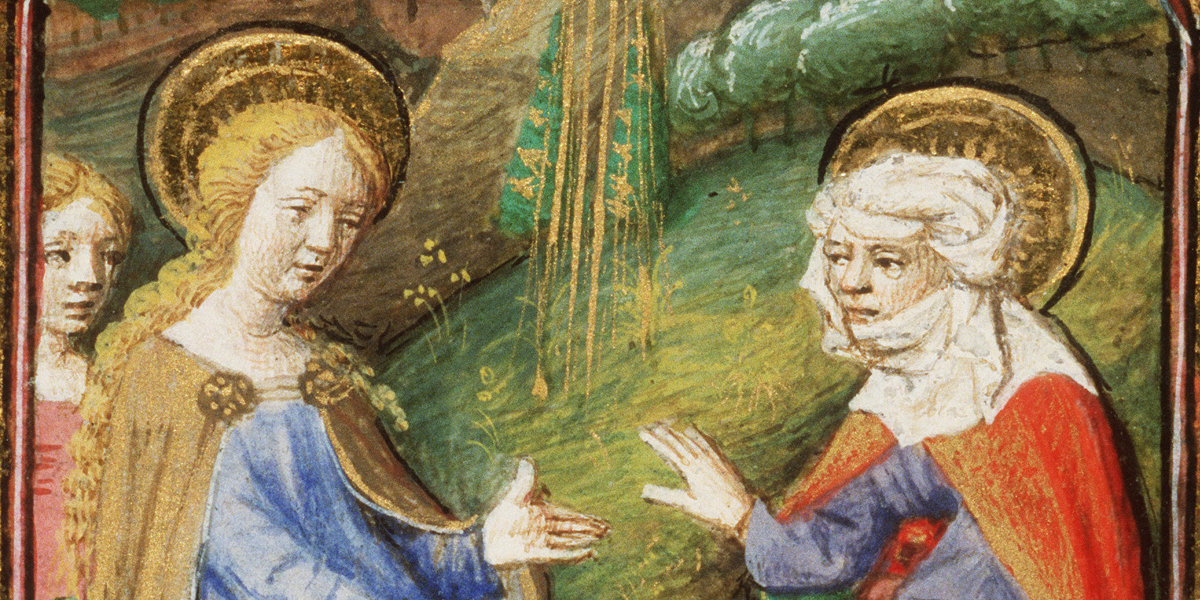
(Picture of the Visitation from the Book of Hours of Simon de Varie, 1455)
The Baptism of Our Lord – Pr. Faugstad sermon
Text: St. Matthew 3:13-17
In Christ Jesus, who “came by water and blood,” (1Jo. 5:6), who came to fulfill all righteousness and win our salvation from His baptism to His death on the cross, dear fellow redeemed:
What do you want to be when you grow up? If you are not asking that question now, you probably did at one time. Children and adolescents spend a lot of time thinking about that question. What am I supposed to do with my life? What will my future hold? Typically we start with grand ideas. We want to be just like the famous trailblazers and champions we admire. But as we get older, our plans become more realistic, even if our life doesn’t go in the direction we expect.
Tied up in our plans for the future is the question about where we fit in the world. We want to be noticed. We want to be liked. We want to be successful. We want others to think we are special. And that’s a lot of pressure. A report released last week by the CDC said that anxiety and depression are on the rise among teenagers, and it’s way up among teenage girls. Part of the reason for this increase has to do with the pressure that teenagers feel in matters of their sexuality.
Our current culture does not provide a healthy environment for children to mature and grow. It expects them to make life-changing decisions about themselves and their bodies when they aren’t ready to make those decisions. How do we help them with the burdens they carry? How do we settle our own anxious thoughts about our purpose in life and our future?
Today’s reading provides good direction for us. The events happened at a time when hardly anyone knew who Jesus was. His neighbors in Nazareth thought of Him as a kind and intelligent young man. But they didn’t exactly expect Him to be a world-changer. He was the son of Joseph and Mary, and He was probably destined for a very anonymous life (Mat. 13:55).
But that isn’t what John the Baptizer thought. When Jesus made His way to the Jordan River where John was preaching and baptizing, John said something surprising, “I need to be baptized by You, and do You come to me?” How did John know who Jesus was? We don’t know. What we know is that John was called to prepare the way for the Messiah. And he said that “for this purpose I came baptizing with water, that he might be revealed to Israel” (Joh. 1:31).
John and Jesus were also cousins, so it is possible they grew up around each other, and John could see how good and upright Jesus was. Whatever impressions John had about Jesus would now become set in stone. “Let it be so now,” said Jesus, “for thus it is fitting for us to fulfill all righteousness.” So John baptized Him.
As soon as Jesus stepped down into the river and had water poured over Him, you and I were assured of a very bright, a very beautiful future. How can that be? When Jesus stepped into the water, He didn’t go for Himself. We can see why John questioned Jesus’ intent to be baptized. John clearly proclaimed that his baptism was for sinners. But what sins did Jesus have to confess?
Jesus had no sins of His own, but He had all of yours and mine. This was no ordinary man who showed up at the river. This was the eternal Son of God clothed in our flesh. Whatever God did in the flesh should have our very close attention. He didn’t go to the Jordan to pass the time. Everything He did had purpose. His baptism was not a small detail in His life. It was the public beginning of His work of salvation. It was His anointing as the Savior of the world.
He stepped into the river “to fulfill all righteousness.” You can’t “fulfill all righteousness.” I can’t “fulfill all righteousness.” But Jesus could fulfill it for all of us. When He entered the water, He stepped in for you and me and every member of the human race. He was baptized to work a great exchange—your sin for His righteousness. He was baptized into your sin, so that you could be baptized into His righteousness.
In other words, His baptism in the Jordan is your future flashing before your eyes. And His journey from the Jordan to the cross and grave is your journey. What I mean is that you do not have to worry about the mark you will make on the world. You do not have to prove that you matter or that you are special. You do not have to create your own identity or determine your own fate. Jesus already addressed these concerns for you.
You can’t see what your future will hold, but you can see what Jesus’ future held. You see how the heavens were opened after His baptism and the Holy Spirit came down like a dove and rested on Him. You see how God the Father gave the stamp of approval to His Son by saying, “This is My beloved Son, with whom I am well pleased.”
You know how Jesus went on from there to the wilderness to be tempted, how He started teaching about the kingdom of God and healing the sick and the hurting, how His enemies made plans against Him, and eventually brought Him up on false charges before the governor Pontius Pilate. You see how Jesus willingly suffered, like a lamb that is led to the slaughter opening not His mouth. You see how He was nailed to the cross, cried out in anguish, died, and was buried.
That’s not exactly a future to aspire to. Do we really want to walk in those steps? Jesus told His disciples, “If anyone would come after me, let him deny himself and take up his cross and follow me” (Mat. 16:24). That is the exact opposite of what we want to do. The world tells us to indulge ourselves—food, drink, entertainment, pleasure—and our own flesh wants it. Why should we fight these desires? Why do we have to take up a cross? Won’t that only lead to heartache and pain?
It is true that following after Jesus brings us trouble. He says the world will hate everyone who trusts in Him, because the world hated Him (Joh. 15:18-19). “In the world you will have tribulation” (Joh. 16:33), He says. But persecution and trouble are not all that our future holds. In fact, Jesus says that these things only last “a little while.”
Jesus’ future did not end with His death and burial and neither will yours. Jesus came to life again on the third day. He undid death. He reversed the curse. Death no longer had dominion over Him (Rom. 6:9). He rose from the dead, and He lives on in glory. That is your future. He won that victory for you.
And all of it starts at baptism. Baptism changed your future and your focus like nothing else in the world possibly could. It had a bigger impact on you than having all your hopes and dreams for this life come true, even more than winning the lottery or becoming the ruler of the whole world. Because at your baptism, Jesus officially made His righteousness, His accomplishments, and His eternal victory over death yours.
Jesus had your sins poured over Him at the Jordan River, so you would have His righteousness poured over you at the font. He was punished by the Father in your place, so you would be forgiven of all you have done wrong. He died, so that you would live. When you were baptized, the Holy Spirit came to rest on you and filled your heart with faith. When you were baptized, God the Father called you His “beloved,” with whom He is “well pleased.”
St. Paul explains that “We were buried therefore with [Christ Jesus] by baptism into death, in order that, just as Christ was raised from the dead by the glory of the Father, we too might walk in newness of life” (Rom. 6:4). At your baptism, you were set on a new course. The plan for your future was locked in. Your life gained an instant and clear purpose. Because the merciful God chose you. He adopted you as His own. He named you His child and heir with Jesus as your brother.
Everything Jesus earned for you from His baptism to His grave became yours, and it is still yours. No matter how much you have messed up, God has not taken His baptism away from you. All that Jesus did for you is still done. Your future in Him is still secure.
So for the young who feel the pressure of being everything the world says they should be, who think they need to prove their worth and show how special they are, who are tempted to compromise themselves and their beliefs in order to be accepted, we can tell them that God loves them perfectly. He sees the temptations they have to face, how difficult their life is, and He promises that He will never leave them alone. He sent His Son to redeem their life with His, He brought them to the font to receive His blessings and give them new life, and He still meets them in their times of sadness and pain to help and strengthen them by His Word and Sacrament.
That is the promise and comfort that all of us need whether we are looking forward with anxiety or backward with regret. Jesus was baptized for you, to fulfill all righteousness for you. He went to the cross for you and rose again for you. Because of His work, your future is bright. You are baptized into Him. You believe in Him. And “[w]hoever believes and is baptized will be saved” (Mar. 16:16).
Glory be to the Father and to the Son and to the Holy Ghost; as it was in the beginning, is now, and ever shall be, forevermore. Amen.
+ + +
(picture from 1895 painting by José Ferraz de Almeida Júnior)
The Fourth Sunday in Advent – Pr. Faugstad sermon
Text: St. John 1:19-28
In Christ Jesus, who “comes to judge the nations, a terror to His foes,” but “a Light of consolations and blessed hope to those who love the Lord’s appearing” (ELH 94, v. 10), dear fellow redeemed:
I imagine you have a busy week ahead. There will be gifts to wrap and food to make. Maybe there is more decorating to do and cards or letters to send. This is a time of preparation, a time to get everything ready for the big day: Christmas. Perhaps you hope to recapture the feeling of the season from when you were a child, or you want your children or grandchildren to have that feeling now. This is a special time. You want everything to be just right.
Advent is a time of preparation, but the focus is not especially on external things, what is happening around us. The focus is internal, what is happening inside us. The problem with internal things is that they are more difficult to control. I can spend hours wrapping gifts and make them just the way I want them. I can clean my house from top to bottom. I can put everything in its place around me and make it look like I have every detail covered. I can do all these things while being torn up inside by sadness, by pain, by guilt.
That might be where you are right now. That is why Jesus comes to you today. He comes to meet you in your struggle and lift your burdens from you. He comes to bring you forgiveness and hope, comfort and strength. He comes to assure you that you have a merciful Father who loves you and cares for you, and that in His Father’s house are many mansions where He has prepared a place for you (Joh. 14:2).
These are the things that Jesus, the Son of God incarnate, came down to earth to do. John was sent to prepare the people for His coming. He was the “voice” prophesied more than 700 years earlier by Isaiah, the voice who would cry out, “In the wilderness prepare the way of the LORD; make straight in the desert a highway for our God. Every valley shall be lifted up, and every mountain and hill be made low; the uneven ground shall become level, and the rough places a plain” (Isa. 40:3-4). How exactly was that highway making—that raising of valleys and lowering of mountains—supposed to come about?
The evangelist Luke writes that John “went into all the region around the Jordan, proclaiming a baptism of repentance for the forgiveness of sins” (3:3). And John didn’t hold back in his Law preaching. “You brood of vipers!” he said to the crowd. “Who warned you to flee from the wrath to come? Bear fruits in keeping with repentance” (3:7-8). Repentance was the way the people were to prepare for Christ’s coming. It was the way for their hearts and minds to become open to His gracious teaching.
And that is still the way we prepare for Christ’s coming: we repent of our sins. We repent of our valleys of doubt and despair, and we repent of our mountains of pride. But we wouldn’t know this was even necessary if God did not give us His Law. His Law is both written on our hearts and recorded for us in the Bible. There is no question what God’s will is for our lives. There is also no question that we have failed to live up to His Law—failed completely.
But the error we often fall into is measuring our holiness not against God’s Commandments, but against the lives of other sinners. And we can always find others who appear to be more sinful than we are. This is a trick of the devil to get us to think that we are not that bad, that our lives are pretty well in order. But if that were true, then why did Jesus come? Did He come to hang out with the righteous people, or to save sinners? Jesus said, “Those who are well have no need of a physician, but those who are sick. I have not come to call the righteous but sinners to repentance” (Luk. 5:31-32).
The holy Law of God shows us how sick we are. It shows us how bumpy our road was in the past when we disobeyed God’s commands and how bumpy it will be in the future if we give in to our sinful desires. And through the Law, the Holy Spirit works repentance in our hearts today. He moves us to contrition, to remorsefulness and sorrow, for the wrongs we have done—for the sins we have tried to hide and the sins we have committed right out in the open.
But repentance is not just about admitting sin. It is about avoiding the same temptations going forward. It is about not giving the devil an inch, because he will take a mile and usually a lot more. What good is repentance if you have no desire to stop sinning and do better? John said to the crowd, “Bear fruits in keeping with repentance.” Show in your life how sorry you are for your sin and how you want to live for the God who made you and provides for you.
The people must have trembled when they heard John preach. He was great and powerful in their eyes. They trembled even more when he told them One was coming after him, “the strap of whose sandal I am not worthy to untie.” “I baptize you with water,” said John. “He will baptize you with the Holy Spirit and with fire. His winnowing fork is in his hand, to clear his threshing floor and to gather the wheat into his barn, but the chaff he will burn with unquenchable fire” (Luk. 3:16,17). In other words, “Don’t ignore my warning. Don’t let this fall on deaf ears. A far more powerful One than me is coming.”
John was a serious preacher, but it was not all gloom and doom. The baptism he administered was given for spiritual comfort. God’s Law was doing its work. The people were sorry for their sins. Now they stepped forward to the Jordan River desiring to receive God’s forgiveness. They believed what John said. They did not want to be caught unprepared when the Christ came. They sincerely wanted to “make straight the way of the Lord.”
But would the way be straight enough for Him? Would He be pleased with what He saw in them? Would they be worthy enough, welcoming enough? Those would have been natural questions to ask, but they were the wrong ones. We get sidetracked in the same way. We want to live our lives for the Lord, but then we focus more on our living than on the Lord. We focus more on our work than on His work.
But it is His work that saves. No matter how well or how much you prepare for Jesus’ coming to you now, it is not enough. You have fallen short of the glory of God. That is why God sent His only-begotten Son. Jesus came to perfectly do for you what you could not do. He had no need to repent, because He was sinless. He could measure His holiness against the Law of God, and it did not condemn Him. Those valleys of doubt and despair, those mountains of pride, could not be found in Jesus. He kept God’s holy Law for you down to the smallest detail.
And He put all your Law-breaking, all your sin, on His shoulders and invited God’s wrath on Himself to spare you from eternal punishment in hell. That is where the Lord’s greatness is most clearly seen—in His suffering on the cross. That is where His glory is found, hidden beneath a crown of thorns and behind all that anguish and shame.
You have a Savior who knows sadness. Isaiah described Him as “a man of sorrows, and acquainted with grief” (Isa. 53:5). You have a Savior who knows pain, who knows guilt, because He took all of yours on Himself. Isaiah says again, “[H]e was wounded for our transgressions; he was crushed for our iniquities; upon him was the chastisement that brought us peace” (v. 5). This is the peace the incarnate Son of God came to bring, the “peace on earth” that the multitude of angels sang about the night of His birth.
It is the peace He wants you to have in this busy season no matter what troubles you, grieves you, or weighs you down right now. Jesus came for your sake. He came to save you. He came to redeem your soul by shedding His holy blood and remove your transgressions from you as far as the east is from the west (Psa. 103:12).
His forgiveness of our sins is why we don’t view repentance as a chore. Repentance is a gift worked in us by the Holy Spirit which prepares us to receive God’s greater gifts—the gifts of His righteousness, peace, and life. He gives these blessings to us now and assures us that we will have them forever in heaven.
So by the power of the Holy Spirit, we “Make Straight the Way of the Lord” today. We push away all doubt. We set aside all pride. We hand over to God everything that has caused anguish and pain to ourselves and to others. And our merciful Lord says, “I forgive you all your sins. I made payment for them long ago by My precious blood. All that I won for you, all that I have, I poured over you at your Baptism. There, I made you My own.”
Your Baptism into Christ means that even though you may feel empty at times, you are not empty. And even though you may feel alone, you are not alone. The Christ, your Savior, has come, and He still comes with gracious tidings of comfort and joy for you.
Glory be to the Father and to the Son and to the Holy Ghost; as it was in the beginning, is now, and ever shall be, forevermore. Amen.
+ + +
(picture from “The Preaching of St. John the Baptist” by Pieter Bruegel the Elder, c. 1565)
