
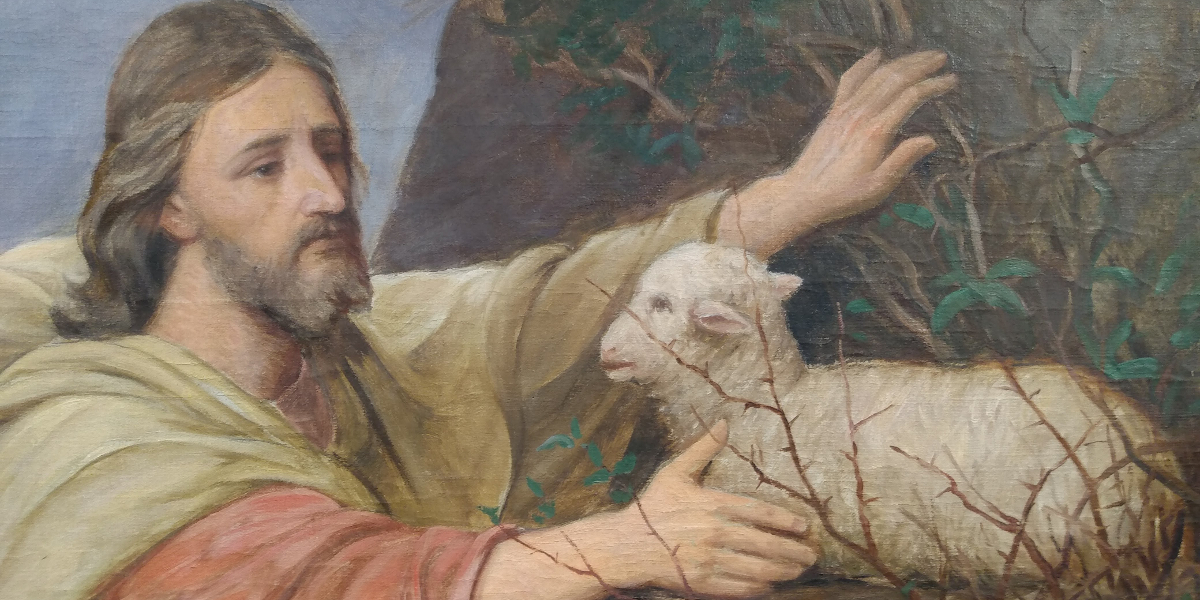
The Third Sunday of Easter – Pr. Faugstad sermon
Text: St. John 10:11-16
In Christ Jesus, who came that we “may have life and have it abundantly” (Joh. 10:10), dear fellow redeemed:
The most well-known and best-loved Psalm in the Bible is Psalm 23. We love the picture of a shepherd guiding his sheep to green pastures and still waters, leading them safely through the valley of the shadow of death, providing everything they need, and bringing them everlasting peace. This Psalm is comforting because it emphasizes the work of the shepherd, how he cares for the sheep.
If it were a Psalm about what the sheep do, the picture would be much darker. The sheep wander this way and that and become separated from each other. They don’t know where to find food and water. They walk through the valley of the shadow of death with no one to defend them. Evil surrounds them, and they are very afraid. Enemies get ready to attack, and the sheep cannot defend themselves. They are helpless; they have no hope.
This is the spiritual reality for us apart from Jesus. We don’t know the right way to go. We are constantly exposed to the devil’s attacks, and he sends us deeper and deeper into sin and guilt. Death is coming, and there is nothing we can do to avoid it. We are hopelessly lost, and we cannot find our way to safety.
But as helpless and hopeless as we are, the LORD our Shepherd still cares for us. He does not want to leave us to our own sinful devices. He does not want the wolves to slink in and pick us off. He does not want to hand us over to death. We see this in the way He snatched Adam and Eve back from the jaws of the devil and death when they fell into sin. He promised that He would “put enmity between” the devil and the woman’s offspring, and that He would send One to crush Satan’s head (Gen. 3:15).
This One is Jesus, true God and true Man. He is “the Good Shepherd,” who “lays down His life for the sheep.” That sounds like good news for the sheep, except that if their Shepherd lays down His life for them, who will be left to defend them? If the Shepherd dies for His sheep, there is no hired man who will stand with the sheep. He will see the wolf coming and leave the sheep and flee. So what good could the Shepherd’s death actually do?
We need to understand that the Shepherd laying down His life for His sheep is not some desperate fight to the end, and that as soon as it’s over for the Shepherd, it’s over for the sheep. What is taking place by His sacrifice is a great Divine Bargain. The Shepherd agrees to lay down His life on behalf of, or in the place of, His sheep. God the Father sent His Son for this very purpose. The way Satan’s head would be crushed, the way his power would be taken away from him, is by the Shepherd offering Himself as the atoning sacrifice for all sin.
Only a perfect sacrifice would do. The Shepherd, who never failed at His duties, who never lost track of the sheep, who never took the wrong path, stepped in to suffer and die for the sins of every person. He suffered as though He had wandered away from God like we have, acted foolishly and selfishly like we do, followed His own sinful desires like we have, and ignored God’s law. Whatever you and I have done to break God’s Commandments, endanger our faith, and put ourselves in the devil’s grip, Jesus took the punishment for it. The prophet Isaiah described it like this: “All we like sheep have gone astray; we have turned—every one—to his own way; and the LORD has laid on him the iniquity of us all” (53:6).
Jesus offered His perfect, righteous life in place of ours. He shed His holy blood to wash away every sin. This was the price for our redemption. This was the Divine Bargain: He would suffer and die for our sins, so we would receive His righteousness and eternal life. Jesus did what He told His disciples He came to do: “I lay down My life for the sheep.” But immediately after that statement, He indicated that He had gracious work to do beyond His sacrifice: “I have other sheep that are not of this fold. I must bring them also, and they will listen to My voice.”
How this would be possible was made clear in the very next verses after today’s reading, where Jesus says, “I lay down my life that I may take it up again. No one takes it from me, but I lay it down of my own accord. I have authority to lay it down, and I have authority to take it up again. This charge I have received from my Father” (Joh. 10:17-18). The Good Shepherd laid down His life for the sheep fully trusting His Father’s plan that He would be raised again. The sheep would not be left to fend for themselves, not the disciples in Jesus’ day and not us. Jesus died to redeem us, and He lives to save us.
We mentioned how much people appreciate Psalm 23. What might be lost on them is how well this Psalm connects with the one before it. Psalm 22 starts like this, “My God, My God, why have You forsaken Me? Why are You so far from helping Me, And from the words of My groaning?” Later in the Psalm we hear, “They pierced My hands and My feet; I can count all My bones. They look and stare at Me. They divide My garments among them, And for My clothing they cast lots” (vv. 1,16-18, NKJV). Psalm 22 is one of the clearest depictions in the Bible of Jesus’ suffering and death on the cross. But what could this Psalm of agony have to do with the peaceful Psalm that follows it?
Psalm 23 describes the fruit of His victory over death and the ongoing work He continues to do among us. Our risen Lord supplies us with everything we need for our salvation. He leads us to the green pastures and still waters of His Word and Sacraments. That’s where He feeds us, restores our soul, strengthens our faith. He leads us in the paths of righteousness. Those are the paths of God, His paths. We walk along them by His grace, “for His name’s sake,” because of what He has done for us.
We walk through the valley of the shadow of death in this life; we face temptations, hardships, sorrows, persecution; every day is a day closer to our death. But we fear no evil. Why? Because the Lord Jesus, the Good Shepherd, our crucified and risen Savior is with us. Because He is with us, we rejoice with Him and feast with Him even in the presence of our enemies. St. Paul writes, “If God is for us, who can be against us? He who did not spare his own Son but gave him up for us all, how will he not also with him graciously give us all things?” (Rom. 8:31-32).
On our own, we—the weak and vulnerable sheep—don’t have a chance. But in Him, we have every confidence. If He was willing to die in our place, for our sins, He is not going to abandon us now. If He was willing to seek after us and bring us back when we wandered and became lost in our sin, He will keep watch over us and protect us today. We Gentiles used to be outside the fold. There was a time when our forefathers did not listen to His voice. They followed gods and superstitions of their own making. That would still be true of us today if not for God’s grace toward us.
The fact that the saving faith has come to us is a fulfillment of Jesus’ promise in today’s reading: “I have other sheep that are not of this fold. I must bring them also, and they will listen to My voice. So there will be one Flock, one Shepherd.” We are believing Gentiles whom God has called along with believing Jews into the “one holy Christian and Apostolic Church” (Nicene Creed). We are sheep by faith, not by nationality. The members of His holy Church have passed through the same cleansing waters of Baptism. We have received the same body and blood of our Lord. We are gathered into His body with Him as our Head. He nourishes and cherishes us, just as a Shepherd nourishes and cherishes His sheep.
The Shepherd grows His holy Flock of believers in no other way than through His Word. He speaks, and the sheep hear His voice. We cannot see the future. We do not know what the way forward will look like. We don’t know what trials and temptations we will face. Will there be days of gladness or seasons of sadness (ELH #377, v. 3)? How dark will the shadow of death hang over us? Will the days to come be many or few?
We fear no evil because the Shepherd speaks. We know His voice. There is no other voice like His. Other voices make grand promises: “You can have more!” “You can be happier!” “You can leave all your troubles behind!” These voices would pull us in every direction away from Christ. But only He has the words of eternal life (Joh. 6:68). Jesus says, “My sheep hear my voice, and I know them, and they follow me. I give them eternal life, and they will never perish, and no one will snatch them out of my hand” (Joh. 10:27-28).
The world can make no such promises. The world cannot give you eternal life. Only He who laid down His life and took it up again can do that. He did that for you. You are not “just another sheep” to Him. He knows you, knows everything about you—your sins, your struggles, your weaknesses. He chose to suffer for you, die for you, and rise again for you, so that you would live with Him. “Surely goodness and mercy shall follow [you] All the days of [your] life; And [you] will dwell in the house of the LORD Forever” (Psa. 23:6).
Glory be to the Father and to the Son and to the Holy Ghost; as it was in the beginning, is now, and ever shall be, forevermore. Amen.
+ + +
(picture from Saude Lutheran Church altar painting)

The Third Sunday after the Epiphany – Vicar Lehne sermon
Text: St. Matthew 8:1-13
In Christ Jesus, who is our ultimate cure, dear fellow redeemed:
Benjamin Franklin once said, “[I]n this world, nothing is certain except death and taxes.” But I think that a third thing needs to be added to that list: sickness. You could eat nothing but healthy food, drink lots of water, get just the right amount of sleep every night, wash your hands regularly with soap and water, and clean everything that could possibly be contaminated in your house; and you would still get sick eventually.
Getting sick is a miserable and frustrating thing. Depending on the type of sickness you get and the severity of it, you could lose your voice, your head could hurt, you could become so weak that it’s difficult for you to move, or perhaps the worst thing of all, you could have to take really nasty tasting medicine. And if that’s not bad enough, you may even have to cancel plans that you’ve been looking forward to, or you may fall behind on important work that you have to get done. Getting sick really can put you in your weakest and most helpless state.
When you are in this state, you have two options: you could ignore your weakness and helplessness and try to power through on your own, which usually results in your sickness getting even worse, or you could admit your weakness and helplessness and turn to others for help. But who should you turn to? Family? Friends? A doctor? While all of these people can be a great help to us when we are helpless, there is one person who can help us more than any of them: Jesus.
In our reading for today, we hear about two men who were at their weakest and most helpless state. One of them was a leper, a man who had a disease that made him ceremonially unclean and unable to be a part of Jewish society. The other was a centurion, a Roman commander who was in charge of about a hundred men. The centurion himself was not suffering from any physical weakness, but he was still at his weakest and most helpless point. This was because he had a servant who was not just suffering terribly from paralysis, but, as we find out in Luke 7, was also near death (Luke 7:2), and there was nothing he could do about it. These two men could have ignored their weakness and helplessness and powered through on their own, but they didn’t. They realized that they needed help, and the person who they turned to for help was Jesus.
The leper and the centurion believed that Jesus had the power to give them the help that they needed. Now, if Jesus was a mere man, then believing that he had any real power at all would be foolishness. After all, no man can miraculously heal someone’s sicknesses or disabilities. But what did Jesus do? He touched the leper with his hand and said, “[B]e clean” (verse 3), and the leper was immediately cleansed of his leprosy. He said to the centurion, “[L]et it be done for you as you have believed” (verse 13), and the centurion’s servant “was healed at that very moment” (verse 13). By having mercy on these two men and healing the leper and the centurion’s servant, Jesus proved that he was not just a man. He is God.
Because Jesus is God, we can turn to him for help whenever we are suffering from physical weaknesses of any kind. Physical weaknesses are not just sicknesses or injuries. They are also everything else that we suffer from in this life, such as money problems, drama with friends or family, or when we have a seemingly impossible task before us. Whatever it is that we are suffering from, it can put us at our lowest point.
When we are struggling and feeling helpless, we have two options: we could ignore our helplessness and try to push through on our own, which would only make our suffering even worse, or we could turn to Jesus, who has the power to help us, no matter what state we’re in, because he’s God. Jesus loves us, and in his mercy, he comes to us in our time of need and lifts us out of our low points. And if we have to suffer for a little longer, he remains by our side and takes all our sufferings on himself and bears the burden of them for us. As Jesus says, “Come to me, all who labor and are heavy laden, and I will give you rest. Take my yoke upon you, and learn from me, for I am gentle and lowly in heart, and you will find rest for your souls. For my yoke is easy, and my burden is light” (Matthew 11:28–30).
Even though we don’t deserve any of this love and mercy that Jesus shows us, there are times when we don’t think he is showing us enough love and mercy. We are grateful to Jesus when he delivers us from our suffering, but if he allows us to continue suffering, and that suffering seems to have no end in sight, we can become impatient with him and wonder if he is truly doing what is best for us.
We may think that we know what’s best for us, but this is based on our imperfect human reasoning. In reality, God is the only one who knows what’s best for us. It can be difficult for us to understand how our suffering could possibly be for our good when we are in the middle of it, and sometimes we may never know the reason for it. All we can do is trust, like the leper did, that no matter how God chooses to help us, be it by delivering us from our suffering or by helping us bear it, his will for us will be done. As the apostle Paul says, “[W]e know that for those who love God all things work together for good, for those who are called according to his purpose” (Romans 8:28). And we know that God’s ultimate will for us will be done, because he has already delivered us from the deadliest disease of all, the disease of sin.
Sin is a disease that we are all born with, and it infected every part of us, not just our physical bodies, but also our thoughts, words, and actions. It is because of sin that all of our physical weaknesses exist in the first place. It is because of sin that we grow impatient with God when he doesn’t help us in the way that we want him to. And it is because of sin that we will one day die. The disease of sin really puts us in our absolute weakest and most helpless state.
The disease of sin has infected us so completely that we are unable to turn to Jesus for help. And if it were left up to us, we would not just fail to overcome our sin, we would enter into the outer darkness of hell as punishment for our sin, where, as Jesus describes it in today’s reading, “there will be weeping and gnashing of teeth” (verse 12) without end, eternal suffering.
But God the Father did not want to leave us in this state of complete and utter helplessness. He knew that we were unable to cure ourselves of the disease of sin, so he sent his only begotten Son, Jesus, to be our ultimate cure. Because Jesus is God, he was not born with sin, like all of us were, and he did not catch that deadly disease because he successfully resisted all the temptations that would have caused him to catch it, temptations that we fail to resist on a regular basis. Then, on the cross, he took the burden of our sin on himself and paid the price for all of it. Because of the suffering that Jesus endured on the cross for us, we have been cleansed of our sin.
The cure that Jesus won for you is a free gift that he gives to all of you through his Word and Sacraments. He speaks his forgiveness to you through his powerful Word, which heals you at that very moment. He reaches out his hand and gives you his healing touch through his Holy Sacraments. And now that he has given you his cure through these means of grace, you have a new life, not one that is weak and helpless, but one that is strong in Jesus.
Unfortunately, much like the physical sicknesses that you suffer through in this life, the disease of sin just doesn’t want to go away. And it doesn’t just give you physical weaknesses to suffer through, it also gives you spiritual weaknesses. It does so by trying to attack and weaken your faith, making you think that your weaknesses make you uncurable. But, thanks to the new life that God has given you through faith, trying to power through on your own is no longer your only option. In faith, you can turn to God for help, and he gives you the help you need by giving you the comfort that he has forgiven you and will always be there for you, bearing the burdens that you suffer in this life until the day that you get to enter into eternal life in heaven with him and forever be at peace.
One of the ways that Jesus gives you the forgiveness of sins when you are suffering is through Holy Communion. In that holy supper, you come to the Lord’s table, weak and helpless from the sins that you are suffering from, and you receive the Lord’s true body and blood in the bread and wine, which is the best medicine there is, the medicine of immortality. This is not a medicine that tastes really nasty, like the medicine that you may have to take to recover from your physical sicknesses. This medicine is sweet, granting you the forgiveness of sins that Jesus won for you on the cross and strengthening you to continue through your lives with Jesus at your side.
Sickness is something that can be truly miserable and frustrating, especially when it makes us so weak and helpless that we can no longer function on our own. But even though it can be miserable, it can also be beneficial by helping us to realize that we can’t do everything on our own and that we do need to rely on help from others, especially on Jesus. When we are suffering from physical or spiritual weaknesses and there is no one else to turn to, we know that we can always turn to Jesus, who has the power to help us get through any weakness, because he is God.
Even though things that cause us suffering, such as death, taxes, and sickness, are considered to be certainties in this life, they are only temporary. The only certainty that has no end is the grace and mercy that can only be found in Jesus. Jesus truly is the ultimate cure.
Glory be to the Father and to the Son and to the Holy Ghost; as it was in the beginning, is now, and ever shall be, forevermore. Amen.
+ + +
(picture from a portion of a Byzantine mosaic in Sicily)