
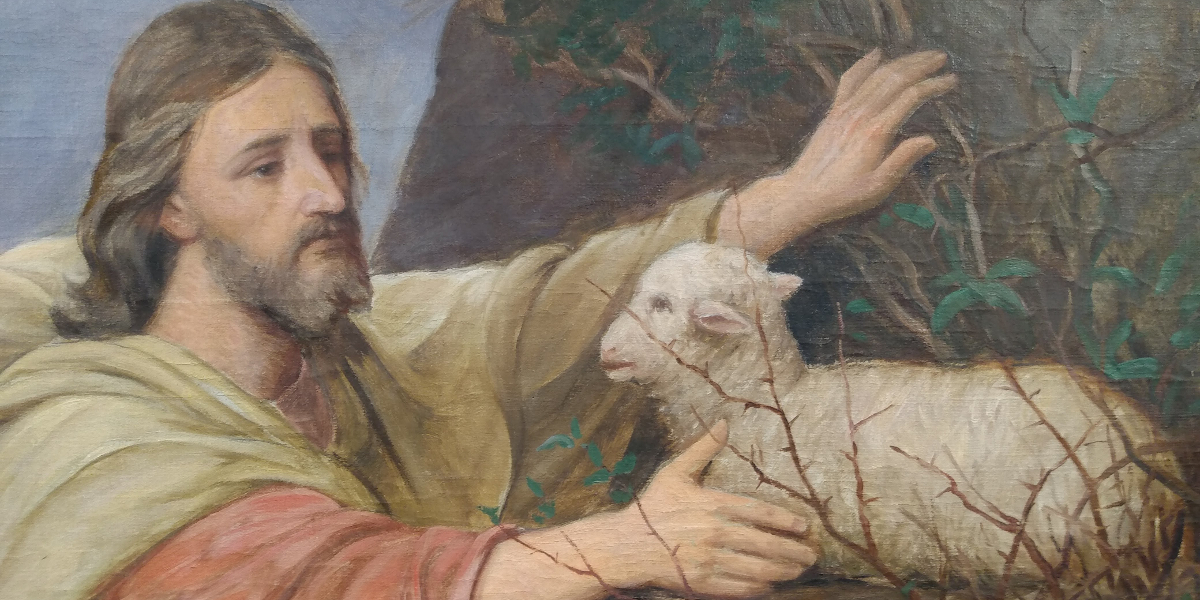
The Third Sunday of Easter – Pr. Faugstad sermon
Text: St. John 10:11-16
In Christ Jesus, who came that we “may have life and have it abundantly” (Joh. 10:10), dear fellow redeemed:
The most well-known and best-loved Psalm in the Bible is Psalm 23. We love the picture of a shepherd guiding his sheep to green pastures and still waters, leading them safely through the valley of the shadow of death, providing everything they need, and bringing them everlasting peace. This Psalm is comforting because it emphasizes the work of the shepherd, how he cares for the sheep.
If it were a Psalm about what the sheep do, the picture would be much darker. The sheep wander this way and that and become separated from each other. They don’t know where to find food and water. They walk through the valley of the shadow of death with no one to defend them. Evil surrounds them, and they are very afraid. Enemies get ready to attack, and the sheep cannot defend themselves. They are helpless; they have no hope.
This is the spiritual reality for us apart from Jesus. We don’t know the right way to go. We are constantly exposed to the devil’s attacks, and he sends us deeper and deeper into sin and guilt. Death is coming, and there is nothing we can do to avoid it. We are hopelessly lost, and we cannot find our way to safety.
But as helpless and hopeless as we are, the LORD our Shepherd still cares for us. He does not want to leave us to our own sinful devices. He does not want the wolves to slink in and pick us off. He does not want to hand us over to death. We see this in the way He snatched Adam and Eve back from the jaws of the devil and death when they fell into sin. He promised that He would “put enmity between” the devil and the woman’s offspring, and that He would send One to crush Satan’s head (Gen. 3:15).
This One is Jesus, true God and true Man. He is “the Good Shepherd,” who “lays down His life for the sheep.” That sounds like good news for the sheep, except that if their Shepherd lays down His life for them, who will be left to defend them? If the Shepherd dies for His sheep, there is no hired man who will stand with the sheep. He will see the wolf coming and leave the sheep and flee. So what good could the Shepherd’s death actually do?
We need to understand that the Shepherd laying down His life for His sheep is not some desperate fight to the end, and that as soon as it’s over for the Shepherd, it’s over for the sheep. What is taking place by His sacrifice is a great Divine Bargain. The Shepherd agrees to lay down His life on behalf of, or in the place of, His sheep. God the Father sent His Son for this very purpose. The way Satan’s head would be crushed, the way his power would be taken away from him, is by the Shepherd offering Himself as the atoning sacrifice for all sin.
Only a perfect sacrifice would do. The Shepherd, who never failed at His duties, who never lost track of the sheep, who never took the wrong path, stepped in to suffer and die for the sins of every person. He suffered as though He had wandered away from God like we have, acted foolishly and selfishly like we do, followed His own sinful desires like we have, and ignored God’s law. Whatever you and I have done to break God’s Commandments, endanger our faith, and put ourselves in the devil’s grip, Jesus took the punishment for it. The prophet Isaiah described it like this: “All we like sheep have gone astray; we have turned—every one—to his own way; and the LORD has laid on him the iniquity of us all” (53:6).
Jesus offered His perfect, righteous life in place of ours. He shed His holy blood to wash away every sin. This was the price for our redemption. This was the Divine Bargain: He would suffer and die for our sins, so we would receive His righteousness and eternal life. Jesus did what He told His disciples He came to do: “I lay down My life for the sheep.” But immediately after that statement, He indicated that He had gracious work to do beyond His sacrifice: “I have other sheep that are not of this fold. I must bring them also, and they will listen to My voice.”
How this would be possible was made clear in the very next verses after today’s reading, where Jesus says, “I lay down my life that I may take it up again. No one takes it from me, but I lay it down of my own accord. I have authority to lay it down, and I have authority to take it up again. This charge I have received from my Father” (Joh. 10:17-18). The Good Shepherd laid down His life for the sheep fully trusting His Father’s plan that He would be raised again. The sheep would not be left to fend for themselves, not the disciples in Jesus’ day and not us. Jesus died to redeem us, and He lives to save us.
We mentioned how much people appreciate Psalm 23. What might be lost on them is how well this Psalm connects with the one before it. Psalm 22 starts like this, “My God, My God, why have You forsaken Me? Why are You so far from helping Me, And from the words of My groaning?” Later in the Psalm we hear, “They pierced My hands and My feet; I can count all My bones. They look and stare at Me. They divide My garments among them, And for My clothing they cast lots” (vv. 1,16-18, NKJV). Psalm 22 is one of the clearest depictions in the Bible of Jesus’ suffering and death on the cross. But what could this Psalm of agony have to do with the peaceful Psalm that follows it?
Psalm 23 describes the fruit of His victory over death and the ongoing work He continues to do among us. Our risen Lord supplies us with everything we need for our salvation. He leads us to the green pastures and still waters of His Word and Sacraments. That’s where He feeds us, restores our soul, strengthens our faith. He leads us in the paths of righteousness. Those are the paths of God, His paths. We walk along them by His grace, “for His name’s sake,” because of what He has done for us.
We walk through the valley of the shadow of death in this life; we face temptations, hardships, sorrows, persecution; every day is a day closer to our death. But we fear no evil. Why? Because the Lord Jesus, the Good Shepherd, our crucified and risen Savior is with us. Because He is with us, we rejoice with Him and feast with Him even in the presence of our enemies. St. Paul writes, “If God is for us, who can be against us? He who did not spare his own Son but gave him up for us all, how will he not also with him graciously give us all things?” (Rom. 8:31-32).
On our own, we—the weak and vulnerable sheep—don’t have a chance. But in Him, we have every confidence. If He was willing to die in our place, for our sins, He is not going to abandon us now. If He was willing to seek after us and bring us back when we wandered and became lost in our sin, He will keep watch over us and protect us today. We Gentiles used to be outside the fold. There was a time when our forefathers did not listen to His voice. They followed gods and superstitions of their own making. That would still be true of us today if not for God’s grace toward us.
The fact that the saving faith has come to us is a fulfillment of Jesus’ promise in today’s reading: “I have other sheep that are not of this fold. I must bring them also, and they will listen to My voice. So there will be one Flock, one Shepherd.” We are believing Gentiles whom God has called along with believing Jews into the “one holy Christian and Apostolic Church” (Nicene Creed). We are sheep by faith, not by nationality. The members of His holy Church have passed through the same cleansing waters of Baptism. We have received the same body and blood of our Lord. We are gathered into His body with Him as our Head. He nourishes and cherishes us, just as a Shepherd nourishes and cherishes His sheep.
The Shepherd grows His holy Flock of believers in no other way than through His Word. He speaks, and the sheep hear His voice. We cannot see the future. We do not know what the way forward will look like. We don’t know what trials and temptations we will face. Will there be days of gladness or seasons of sadness (ELH #377, v. 3)? How dark will the shadow of death hang over us? Will the days to come be many or few?
We fear no evil because the Shepherd speaks. We know His voice. There is no other voice like His. Other voices make grand promises: “You can have more!” “You can be happier!” “You can leave all your troubles behind!” These voices would pull us in every direction away from Christ. But only He has the words of eternal life (Joh. 6:68). Jesus says, “My sheep hear my voice, and I know them, and they follow me. I give them eternal life, and they will never perish, and no one will snatch them out of my hand” (Joh. 10:27-28).
The world can make no such promises. The world cannot give you eternal life. Only He who laid down His life and took it up again can do that. He did that for you. You are not “just another sheep” to Him. He knows you, knows everything about you—your sins, your struggles, your weaknesses. He chose to suffer for you, die for you, and rise again for you, so that you would live with Him. “Surely goodness and mercy shall follow [you] All the days of [your] life; And [you] will dwell in the house of the LORD Forever” (Psa. 23:6).
Glory be to the Father and to the Son and to the Holy Ghost; as it was in the beginning, is now, and ever shall be, forevermore. Amen.
+ + +
(picture from Saude Lutheran Church altar painting)
The Third Sunday of Easter – Vicar Lehne sermon
Text: St. John 10:11-16
In Christ Jesus, who laid down his life for us that he might take it up again, dear fellow redeemed:
The sheep were all jumbled together. Several shepherds had brought their sheep to the same pen for the night. The pen had only one gate that was guarded by a watchman, and it had walls that were tall enough to keep the sheep from wandering away during the night and to keep thieves and predators, such as wolves, out. But if all of the sheep were in the same pen, how would the shepherds know whose sheep were whose when they came back for them in the morning? It actually wasn’t a problem at all. Why? Because the sheep knew the voice of their shepherd. When they heard their shepherd’s voice, they followed him, while the other sheep, who did not recognize his voice, stayed behind. The shepherds led their sheep by their word.
In our reading for today, we are called “sheep,” and if we are sheep, then that means that we must have a shepherd whose voice we follow. Who is that shepherd? He is none other than Jesus, the Good Shepherd. When we call Jesus “the Good Shepherd,” we don’t mean that he is simply good at being a shepherd. We mean that he is the best shepherd that we could possibly have, and Jesus shows this in what he was willing to do for us.
You were once lost sheep, wandering every which way and being hunted by wolves. These wolves are your spiritual enemies: the devil, the world, and your sinful nature. Led by the devil, your spiritual enemies had completely surrounded you. You were doomed to be snatched by them and dragged away into the fires of hell. But even though you were already in the deadly clutches of your enemies, Jesus did not want to leave you to that fate. So, he left the green pastures of heaven and entered the wilderness of Earth to save you. When Jesus appeared, the wolves attacked him and killed him. In this moment, your spiritual enemies thought they had won, but it was by Jesus’ death, by the shedding of his blood, that the price that was necessary to save you was paid. By the shedding of Jesus’ blood, you were made his own. Jesus saved you from the clutches of your enemies by laying down his life of you. This is what sets Jesus apart from all other shepherds. “The good shepherd lays down his life for the sheep” (verse 11). Other shepherds are willing to protect their sheep, but they wouldn’t go so far as laying down their lives for their sheep. It is through this act, through willingly laying down his own life for you, that Jesus shows just how much he loves you.
But Jesus didn’t leave you without a shepherd. As he says in the verses following our reading for today, “I lay down my life that I may take it up again” (John 10:17). Death had no power over Jesus. On the third day, he rose again from the dead, declaring his victory over your spiritual enemies. Because Jesus is risen, you remain safe from the attacks of your spiritual enemies and are led to green pastures and still waters that nourish the faith that you have been given. As the psalmist says, “He makes me lie down in green pastures. He leads me beside still waters. He restores my soul” (Psalm 23:2–3). These green pastures and still waters that your Good Shepherd nourishes you with are the means of grace, the Word and Sacraments.
Just like real sheep, who are led by the word of their shepherds, you are led by the Word of your Good Shepherd. You know Jesus’ voice because he speaks to you through his Word, and the words that he speaks to you are very comforting. When there are sins that are troubling you, Jesus says to you, “I forgive you all your sins.” When you feel like you are in danger from the wolves that surround you, Jesus says to you, “They will never snatch you out of my hand.” When you feel lost, Jesus says to you, “Follow me.” And when you feel like you are all alone, with no one to turn to, Jesus says to you, “I will be with you always, even to the end of the age.” Your Good Shepherd not only leads you with these comforting words. He also nourishes you and strengthens you with them, just like he does with the Sacraments of Holy Baptism and Holy Communion.
In the Sacrament of Holy Baptism, you are marked for eternal life, which Jesus promises to give to his sheep in the verses following our reading for today (verse 28). You are marked for eternal life when the waters of baptism wash your sins away. These waters continue to wash you to this day. For every day, your new self rises up out of the waters of your baptism and your old self is drowned in them. Through baptism, you are comforted and strengthened, knowing that you have been washed clean. For since you have been washed clean, you have been marked as Jesus’ own, meaning that the eternal life that he promises to give his sheep is yours.
While you wait for the day when you will receive your promised eternal life, you receive a foretaste of it in the Sacrament of Holy Communion. During this holy supper, you feast on the true body and blood of your Good Shepherd who laid down his life for you to win you that eternal life. Jesus willingly went to the cross and shed his blood for you, and through the shedding of his blood, you receive the forgiveness of sins. When you come to his table, along with your fellow sheep, the forgiveness of sins that he won for you on the cross is brought to you when you eat and drink Jesus’ true body and blood in the bread and the wine. Then, you leave his table strengthened and nourished in the confidence that you have been forgiven. These means of grace truly are the best green pastures and still waters that your Good Shepherd can provide you with in this life.
You are blessed to have a Good Shepherd who continues to provide for your spiritual needs and protect you from your spiritual enemies. But that doesn’t mean that you can let your guard down. Your spiritual enemies are cunning, and there are lots of tricks that they have up their sleeves that they use against you to try and lure you away from your Good Shepherd. One of their most cunning tricks is to use false teachers to leave you defenseless to their attacks. Even though Jesus is your Good Shepherd, he has left you with shepherds who he has tasked with watching over his sheep. These shepherds are your pastors. But not all pastors are true shepherds who serve the Good Shepherd. Some of them look good and sound good, but in reality, all they care about is themselves. They do not feel responsible for you. All they want is to make a living off of you. So, when the wolves attack, they show their true colors and leave the flock to fend for themselves. Jesus compares these false teachers to the hired hands who watch the sheep. He says, “He who is a hired hand and not a shepherd, who does not own the sheep, sees the wolf coming and leaves the sheep and flees, and the wolf snatches them and scatters them. He flees because he is a hired hand and cares nothing for the sheep” (verses 12–13). What a blessing it is to have a pastor who truly cares about you and is always willing to be there for you.
But that is only one of the tricks that you have to look out for. Another one of your spiritual enemies’ most cunning tricks is making their voices sound like the voice of your Good Shepherd. You look to God’s Word to hear the words of Jesus, but when you read them, the devil, the father of lies, says to you, “When Jesus said this, what he really meant was that.” As the world continues to live in sin and encourages you to join in with them, you point to what Jesus has said to you in his Word. But in response, the world says to you, “Those things only applied to the people of the Bible. We don’t have to follow those things anymore.” When your sinful nature tempts you to sin, you remember the words that Jesus spoke to you. But your sinful nature responds by saying, “You still have faith in Jesus, don’t you? It doesn’t matter what you do, because faith is all you need.” These, along with all other ways that your spiritual enemies attempt to lead you astray, can sound very convincing and can trick you into thinking that their voices are the voice of your Good Shepherd. But unfortunately, there are even times when you and I know that we are not hearing Jesus’ voice, yet we decide to listen to the false voices and follow them anyway. We must be careful, because these wolves are only trying to get us into their jaws so that they can snatch us and drag us away from our Good Shepherd, away from the green pastures and still waters of the means of grace, and into the fires of hell.
Even though we are sheep that love to wander and constantly fall for the tricks that our spiritual enemies use against us, we don’t need to fear losing our place in green pastures of heaven, because we belong to Jesus. As Jesus says in the verses following our reading for today, “No one will snatch [my sheep] out of my hand” (John 10:28). When we do wander into the clutches of our spiritual enemies, Jesus will be there to rescue us from them. No matter how far we’ve wandered away from him, Jesus is willing to go to the ends of the earth to lead us back to him. Jesus knows who his sheep are, and he will never abandon them, especially not when they need him most.
The sheep know the voice of their shepherd, but this knowing isn’t one-sided. Your Good Shepherd also knows you. But this knowing is much more than simply recognizing each other. Even the devil, the leader of the wolves, recognizes who Jesus is. This knowing is a knowledge that unites you with your Savior in love. You love Jesus, your Good Shepherd, and desire to follow him. But this love does not have its origin in you. It has its origin in Jesus and what he did for you. As the apostle John says, “We love because he first loved us” (1 John 4:19). Jesus loved you so much that he was willing to lay down his own life so that you may experience eternal life in the green pastures of heaven. And Jesus still shows his love for you in that, as your risen Lord, he leads you safely though the dangers of this world until you reach those green pastures of heaven. As the psalmist says, “Even though I walk through the valley of the shadow of death, I will fear no evil, for you are with me; your rod and your staff, they comfort me” (Psalm 23:4). Jesus, your Good Shepherd is better than any other shepherd because no one has love that matches his. So, you can be confident that your Good Shepherd knows you and will lead you to the green pastures of heaven. As Jesus says, “I give [my sheep] eternal life, and they will never perish” (John 10:28).
Glory be to the Father and to the Son and to the Holy Ghost; as it was in the beginning, is now, and ever shall be, forevermore. Amen.
+ + +
(picture from Saude Lutheran Church altar painting)
The Third Sunday of Easter – Pr. Faugstad sermon
Text: St. John 10:11-16
In Christ Jesus, who is constantly seeking after lost sheep to bring them into His holy flock of believers, dear fellow redeemed:
If you search online for “Good Shepherd paintings,” you will find depictions of lambs being carried on Jesus’ shoulders, held in His arms, led by Him to pasture and water, and rescued by Him. The Saude altar painting shows the Good Shepherd rescuing a lost lamb. What you never see in these paintings is the sheep taking charge, blazing their own trail, and conquering their enemies. That is not something sheep do—or if they try, they don’t do it very successfully.
Domestic sheep require constant care and protection. They are quite vulnerable to predators and are prone to wandering. But they are also very loyal and are able to discern the difference between their shepherd’s voice and the voices of strangers. In these ways, little lambs are something like little children.
Children come into the world through the union of a man and a woman, because God wants every child to have the care and protection of a mother and a father. Little children often don’t recognize the dangers around them. They try to touch things that are too hot or too sharp. They want to go exploring on their own and climb on things that are too high. So their parents (or their siblings) keep a close eye on them: “Don’t touch that!” they say. “Come back!” “Get down!”
Do children listen? Sometimes yes and sometimes no. You have probably seen the look in a child’s eyes when he hears his parents say something, but he wishes he hadn’t heard it, and he acts like he didn’t hear it. So a parent says, “Did you hear what I said? Listen to me!” That listening is important. It keeps children safe. It teaches and guides them.
Children who will not listen to their parents will bring harm on themselves and distress and sadness to those who care for them. But children who do listen to their parents learn early on the difference between what is good and bad, right and wrong, safe and unsafe. Children who listen grow in wisdom and knowledge. They bring joy to their parents.
The same goes for you and me before God. We are His children. He made us and continues to provide for us. He sent His only Son to redeem us, so that we would be adopted into His holy family. Our primary responsibility as His children is to listen to what He says. The apostle Peter wrote, “Like newborn infants, long for the pure spiritual milk—the Word of God—, that by it you may grow up into salvation” (1Pe. 2:2). And Jesus says, “My sheep hear my voice, and I know them, and they follow me” (Joh. 11:27).
The shepherd does not follow the sheep; the sheep follow the shepherd. The sheep do not tell the shepherd what to do; they listen to what he tells them. Just as it is not right for children to be disrespectful to their parents, to question everything they say, or to blame them for all their problems, so it is not right for the sheep—for you and me—to act like this toward God. We do not have the power and the authority; He does. We do not know what is best for ourselves; He does.
That is difficult for us to accept. When we are giving in to our passions, going a direction we have been taught to avoid, doing things we have been told not to do, we feel like we are in control. “I can make decisions for myself!” we think. “It’s my life! No one can stop me from doing what I want!” We learn the hard way that the path of sinful indulgence is not where we find fulfillment and happiness. It is where we find pain and heartache, and where we receive deep cuts and wounds that don’t heal easily.
The young woman who gives herself to one boyfriend after another hoping that the latest relationship will last, knows this to be true. So does the young man who has taken the bait of pornography and is now helplessly stuck on the hook. They thought they could give up part of themselves to get what they wanted. They thought they could maintain control. But their sin controls them. And now they wish they could get everything back that they gave up.
What does a little lamb do who has gotten himself or herself into a thorny situation, who doesn’t know where to turn? That little lamb does the only thing it can do. It cries out for help. It sends out a mournful, desperate cry right from the heart. That’s what we do when our conscience is troubled, when guilt gnaws inside us, when we find ourselves in a difficult situation that we can’t find our way out of. We cry for rescue and deliverance. And the Good Shepherd hears that cry. “I know My own,” He says.
A mother can hear her child’s cry from the other side of a room full of people. Jesus not only hears your cry, He knows your pain before you express it. He knows exactly how to help before you even open your mouth. That is how well He knows you. That is how much He cares for you. But you already know this about your Good Shepherd, because you know what He gave up for you. “The Good Shepherd lays down His life for the sheep.”
Even though you and I have tested God’s patience again and again by our sinful choices, even though we have wandered so far away from Him that we could no longer hear His voice, even though we can hardly imagine why He would want us, the Good Shepherd willingly gave up His life for us. In His eyes, we were worth saving. We were worth the anguish and thorns and piercing of the nails. We were worth the righteous wrath of God and the fires of hell.
Jesus stepped between us and the wolfish devil, the one who is constantly tempting us to sin and then torturing us for committing it. Jesus let all accusation come upon Him. He took the place of us sheep who love to wander and made all our transgressions His. He paid the debt that we owed God for breaking His Commandments by our actions, words, and thoughts.
The cold jaws of death fastened around Jesus instead of us. But how could the sheep survive without the Shepherd? The night of His arrest, Jesus quoted this Old Testament passage about Himself and His followers, “I will strike the shepherd, and the sheep of the flock will be scattered” (Mat. 26:31). What a terrible outcome! But then Jesus added these stunning words, “after I am raised up, I will go before you to Galilee” (v. 32).
“After I am raised up….” What an amazing prediction! Immediately following today’s Gospel reading, Jesus said the same thing, “I lay down my life that I may take it up again. No one takes it from me, but I lay it down of my own accord” (Joh. 10:17-18). The death of the Good Shepherd would not mark the end of His care for the sheep. He rose from the dead in triumph to demonstrate that nothing could stop His love for His sheep—not even death (Rom. 8:35-39).
You were brought into His care and became His little lamb when you were baptized. He took you up in His arms like He did those little children so many years ago and He blessed you. He washed away all your sins in His blood. He made you spotless like the bright wool of a lamb, clothing you in His righteousness. He rescued you from the darkness of sin and death where you had gotten utterly lost, and He brought you into His kingdom of light and life.
And what does He ask of you? Only that you listen to His voice and hear His comforting and saving words. “If you abide in my word, you are truly my disciples,” He says, “and you will know the truth, and the truth will set you free” (Joh. 8:31-32). To listen to Jesus is to have truth and life and freedom. To ignore Him is to become prey to the devil’s lies and death.
Listening is hard for us little lambs, us little children, because we like to do things that are bad for us. None of us listens perfectly. We sin all the time. But Jesus keeps calling out to us, calling us back to His care and protection. That call goes out every time you attend divine service and open your Bible or devotion book for study at home. “Come to me,” Jesus says, “and I will give you rest” (Mat. 11:28).
He calls you to the green pastures and still waters of His Word and Sacraments. He invites you to eat and drink for your fulfillment and strength. He trains you to listen better and follow Him more closely. This happens all through your life. You never get to the point where you are strong enough to set out on your own. You always need your Shepherd’s care.
To keep you in His care, your Lord has given you under-shepherds, who speak nothing more or less than what He has spoken. The way to tell the difference between a faithful pastor and a hired hand is to compare what each one says with what Jesus says. My call as your pastor, your shepherd in this place, is to pay careful attention to myself and to all the flock, in which the Holy Spirit has made me an overseer, to care for the church of God, which He obtained with His own blood (Act. 20:28).
My call is to remind you that You Are Jesus’ Little Lamb. You need His forgiveness. You need His guidance. You need His constant protection as you walk through the valley of the shadow of death. He brings all these blessings to you through His powerful Word. “My sheep hear my voice,” He says, “and I know them, and they follow me” (Joh. 11:27).
Glory be to the Father and to the Son and to the Holy Ghost; as it was in the beginning, is now, and ever shall be, forevermore. Amen.
+ + +
(picture from Saude Lutheran Church altar painting)