

The Fourth Sunday in Lent – Pr. Faugstad sermon
Text: Galatians 4:21-5:1
In Christ Jesus, through whom we have “obtained access by faith into this grace in which we stand” (Rom. 5:2), dear fellow redeemed:
Both this week and next, you are going to hear a bit about Abraham, and how he relates to Jesus and to you. Abraham is one of the most prominent characters in the Old Testament. Christians, Muslims, and Jews all claim Abraham as a spiritual father. But as you would expect, they do not all claim him in the same way.
Christians claim him as a father of faith, whose heirs we are because we believe the promise of salvation as he did. Muslims celebrate Abraham’s righteous life and say that their own prophet Muhammed descended from Abraham’s son Ishmael. Jews make the most of their physical descent from the line of Abraham through his son Isaac. These distinctions are some of the very things Paul is addressing in his Epistle to the Galatians.
But first, a little background about Abraham. When he was seventy-five years old, God called him and his wife Sarai to leave his father’s household and go to the land of Canaan. When they arrived, the LORD appeared to Abram and said, “To your offspring I will give this land” (Gen. 12:7). But to this point, they had had no children. Ten years passed, and eighty-five-year-old Abram was getting anxious. The LORD brought him outside and said, “Look toward heaven, and number the stars, if you are able to number them…. So shall your offspring be” (15:5). And Abram believed the promise.
At the same time, it seems that Sarai was struggling. She was now seventy-five years old. If she hadn’t conceived a child to this point, how could she possibly have one now? She decided to give her female servant Hagar to Abram. If they conceived, she would consider the child of her servant as her own. Hagar did conceive, and she bore a son, Ishmael. Sarai wasn’t as pleased as she thought she would be. And this is not how God’s promise was fulfilled.
God promised a child through Abram and Sarai, and He was going to bring it about, contrary to every expectation, contrary to all human reason. So more years passed. Abram was now ninety-nine and Sarai was ten years behind him. The LORD appeared again to Abram and told him his name would now be Abraham, “for I have made you the father of a multitude of nations,” said the LORD. “I will make you exceedingly fruitful, and I will make you into nations, and kings shall come from you” (Gen. 17:5-6). Sarai would become Sarah, “and she shall become nations; kings of peoples shall come from her” (v. 16).
And it happened. By that time the next year, 90-year-old Sarah and 100-year-old Abraham were holding their newborn son Isaac. He was their son, but they could not take credit for him. They knew this was pure gift from the Lord God. Abraham’s child with Hagar came from human planning. Abraham’s child with Sarah came from God’s promise.
Now here comes Paul’s question to the Galatians: Did you come to the saving faith through human effort or through divine promise? Earlier in his letter, he asked the question this way, “Did you receive the Spirit by works of the law or by hearing with faith?” (Gal. 3:2). If their answer was “by hearing with faith,” then he had another question, “Having begun by the Spirit, are you now being perfected by the flesh?” (v. 3).
The problem was that the Galatians were listening to false teachers, who told them that faith in Jesus was a good start. But unless they now followed the Old Testament rules and regulations, they could not be right with God. So were they saved by faith in what Jesus accomplished for them, or by their own efforts, or by some mixture of the two? That’s a very important question.
I think a great number of Christians today believe it is a mixture of the two—Jesus had to do His part, and we have to do ours if we hope to be saved. But that is not what we teach in the Lutheran Church, and it isn’t what St. Paul taught either. As soon as we start to trust in ourselves—even a little bit—for our salvation, we lose sight of what Jesus accomplished for us. This can happen very easily.
We can look at the bad things happening around us, the sins that so many commit right out in the open. We are rightfully alarmed and offended by these things. But there is often another thought that accompanies our concern, something like: “I would never do something like that!” or “If only others were more like me.” And then we don’t sound so different than the Pharisee with his self-righteous prayer: “God, I thank you that I am not like other men” (Luk. 18:11).
There is a difficult balance here. Of course we want to do what is good. That is what God demands of us in His Law. We should avoid temptations to sin. We should do nice things for the people around us. We should constantly strive to think, say, and do things better than we have done them in the past. But if we make progress, and if we succeed, we should remember where the power comes from to do these things, and we should remember who deserves the glory.
No matter how well we do in our own view or in the estimation of others, it is not even close to what God requires to get into His kingdom. That is the big misconception among so many Christians today. They think that God’s holiness is not so out of reach, and our works are not so far from perfection. That is not what the Lord’s prophet said. He said, “all our righteous deeds are like a polluted garment” (Isa. 64:6). Or the psalmist, who wrote that the LORD looks down from heaven to see if there are any righteous. And what does He find? “They have all turned aside; together they have become corrupt; there is none who does good, not even one” (Psa. 14:3).
However bad the people around us appear to be, it is pure pride to think that we are better. We are not better. We have the same corrupt heart. The devil wants you to think that you are better. He wants you to take refuge in your own righteousness. He wants you to quietly judge everyone around you and never point the holy Law at your own heart. Jesus does the opposite. He sharpens the Law. He says that maybe you haven’t murdered, but have you held a grudge? Maybe you haven’t committed adultery, but have you looked at someone with lust? Or maybe you have treated your friends well, but what about your enemies?
Remaining in slavery is thinking that we can be right with God through our keeping of His Law. That makes us children of Mt. Sinai, the mountain where God gave His Commandments. But that was a terrifying place to be. The mountain was wrapped in a thick cloud with thunder and lightning and the sound of a very loud trumpet blast. Then the LORD descended on it in fire, and smoke went up like the smoke of a kiln, and the whole mountain shook (Exo. 19:16-18).
The people who think they can work their way to heaven will one day have to stand before the holy God in all His power. Then they will see how well the glory of their work matches up with His glory. It will be like comparing a child’s scribbles with the work of a master artist, or really much worse.
We cannot find our comfort and confidence through the Law. We can only find it by traveling to another mountain, the mountain of Jerusalem, Mount Zion. Abraham went there long before the holy city was established, and he brought along his son Isaac, the son of promise. God had told Abraham to offer Isaac on a mountain as a burnt offering (Gen. 22:2). As troubling as this was, Abraham obeyed. He carried the fire and knife, and Isaac carried the wood for the sacrifice. “[B]ut where is the lamb for a burnt offering?” asked Isaac (v. 7). “God will provide for himself the lamb for a burnt offering, my son” (v. 8).
Isaac did not die that day. God stopped Abraham just before he dropped the knife, and He provided a ram for a burnt offering instead. Some two thousand years later, Jesus the only Son of God carried His own burden of wood to the same mountaintop. There, the Lamb of God was sacrificed on the altar of the cross. There, His blood was shed to wash all the sin of all the world away.
That includes your sin, the guilt you feel for doing so little of what God’s holy Law requires, and the guilt you feel for thinking you have accomplished great things on your own. Jesus took every bit of your unrighteousness on Himself to atone for it, and in exchange He gives you every bit of His perfect righteousness. That is His promise to you by faith in Him.
You are indeed set free from your former slavery to sin, devil, and death. You don’t have to keep a record of your wrongs any more than you have to keep a record of your rights. Jesus is your righteousness. He is your life. To Him, you are no servant or slave that He might push around or give away as He pleases. He has joined Himself to you in order to give you the full inheritance of the heavenly Father.
Yes, you are no longer a child of slavery. You have been born again as a child of promise. The Lord did this for you. There is nothing you have to do to set yourself free. He won you this freedom. “Stand firm therefore,” writes St. Paul—firm in the faith, firm in Christ your Savior.
Glory be to the Father and to the Son and to the Holy Ghost; as it was in the beginning, is now, and ever shall be, forevermore. Amen.
+ + +
(picture of Abraham viewing the stars from 1919 Bible primer book by Augustana Book Concern)

Sexagesima Sunday – Vicar Lehne sermon
Text: St. Luke 8:4-15
In Christ Jesus, who never gives up on us, dear fellow redeemed:
When we hear the parable of the sower, we can easily focus on how each type of bad ground was described and wonder, “Well, what did the sower think was going to happen?” If you throw seed onto a path, of course it isn’t going to take root, but be trampled and devoured by birds. If you throw seed onto rocks, of course it isn’t going to have a deep enough root to get the moisture it needs to grow. If you throw seed among thorns, of course the thorns will grow up with the seed and choke it. But the picture that Jesus is using in this parable actually describes things that the people at that time would be familiar with.
Before the farmers did any sowing, the field was first plowed to break up the soil. After the plowing was done, the entire field would appear to be good soil, but that was not the case. Some parts of the field only had a thin layer of soil on the top with a layer of rock beneath it. Some parts of the field ended up growing thorny weeds along with the seed, weeds that can pop up anywhere no matter how much a person tries to protect their crops from them. Plus, as a sower threw his seed out onto the field, some of the seed would undoubtedly fall on the paths of soil that were packed down from people walking on them.
Jesus uses these relatable struggles of farming to teach us that God generously sows the seed of his Word in every type of heart, not just the hearts that are the most ideal, because God “desires all people to be saved and to come to the knowledge of the truth” (1 Timothy 2:4). But not everyone who receives his Word is saved. Some people hear the Word, but their hearts are hard like the packed down soil of a path that runs through a field. So, the Word doesn’t take root in their hearts and is plucked away by the devil. Some people hear the Word, and the Word fills them with joy. They appear to be strong Christians on the surface, but in reality, their faith is shallow, like a thin layer of soil on top of a layer of rock. Their faith is unable to get the nutrients it needs to stay alive, so when they are faced with hard times, they fall away. Some people hear the Word and receive it in faith, but the cares, riches, and pleasures that surround them like thorny weeds choke their faith and kill it. And some people hear the Word and hold on to it. Their hearts are repentant and, through their trust in God, they are able to patiently endure what destroyed the faith of the others and produce a crop that shows the fruit of their faith.
Of these four types of soil, which soil are you? That seems like a silly question. Of course you’re the good soil. You know that you’re a sinner and are repentant of your sins, you put your trust in God, and you do plenty of good things throughout your life that prove that your faith has produced a plentiful crop. But this parable is not just a warning to those who have rejected the Word, fallen from faith, or are in danger of losing their faith. This parable is also a warning to all of us who think that we are secure in our faith. As the apostle Paul says, “Therefore let anyone who thinks that he stands take heed lest he fall” (1 Corinthians 10:12).
There are many dangers that could result from us thinking that we are secure in our faith. One of those dangers is thinking that we don’t need to worry about sin because God forgives us all our sins anyway. Sin is a very serious thing, and if we think that God will forgive our sins whether they bother us or not, then we could end up no longer viewing sin as the serious thing that it is. Not taking sin seriously could also lead to us living in sin without feeling the need to repent and turn to Jesus for forgiveness. And if we don’t think that we need forgiveness for our sins, then we could think that we don’t need Jesus and lose our faith. What starts off as us not taking sin seriously could end up with us having hardened hearts, and the devil will have an opportunity to pluck the Word away from us.
There are times when we all become comfortable in certain sins. But when that happens to you, God doesn’t leave you alone to see if you’ll pull through on our own. If he did that, then your hearts would become hardened for sure. Instead, he gets to work on you, plowing the field of your heart to break up its hard soil. Through his Word, he shows you the seriousness of your sin, and that you deserve eternal death in hell. Then, through that same Word, he gives you the comfort of the gospel, showing you that Jesus paid the price for even your most serious and repeated sins by his death on the cross, so that you will not die, but live forever with him in heaven. Because of the sacrifice that Jesus made for you, you are God’s own dear child, and he will make sure that the devil cannot pluck you out of his hand.
But that is not the only danger to our faith. There is also a danger for us to feel secure enough in our faith that we don’t think that we need to regularly remain in the Word. After all, we’ve heard these accounts countless times and can even recite some of them by heart. We know the basic truths of Scripture: that we are all sinners, and that Jesus died for our sins. This could cause us to think that we don’t need to keep reading the Word or coming to hear the Word, because we think that we already know everything. But, if we don’t keep coming back to the Word, then our faith won’t be able to receive the nutrients that it needs to stay alive. It will become shallow, like the thin layer of soil on top of the layer of rock. And if we have a shallow faith when we enter a time of testing, then we are in trouble.
There are many times throughout our lives when God allows us to enter a time of testing. These times of testing can be quite hard on us. There are times when work can be difficult due to people we are interacting with or due to the demands of our work that seem unattainable. There are times when we think that we are doing great at our tasks or with our relationships, and then suddenly, we mess up in a way that we don’t think we’ll be able to recover from. There are times when our loved ones fall ill and begin to suffer terribly, or their lives are taken from us in tragic ways. No matter what our difficult times are, God promises to be with us and help us through them. He gives us this comfort through his Word. But if we have not kept our faith nourished though his Word, then where are we going to get that comfort from? As a result, the burden of our troubles could appear to be too much for us, and we could end up falling away from the faith, wondering why God allowed this to happen to us.
If your faith is starting to get shallow because you are not remaining in the Word, God takes appropriate measures to help you. He breaks up the rock beneath your shallow faith and works through his Word to fill that space with more faith, so that the Word can take root in your heart and thrive. Often, he works through times of testing to accomplish this, reminding you of how much you need him and of how much he has done for you, including giving up his own life for you. By dying on the cross, Jesus dealt with your biggest problems of all: sin and death. And if God loved you enough to die for you, then surely, he also loves you enough to keep his promise to always be with you and bear your burdens in your time of need. When God turns you back to his comforting Word, the joy you feel is no longer a shallow joy that can easily be destroyed, but a joy that comes from the deepest parts of your heart.
The last danger to our faith is the distractions that the world surrounds us with. These distractions can appear to be harmless. After all, what’s wrong with earning a little extra money, or buying some items that we’ve always wanted, or going to sporting events and other fun places? There is nothing wrong with these things in and of themselves, but when those things start to become more important to us than God, then we have a problem. What starts as just wanting to earn a little extra money could turn into spending as much time working as possible, even if it means we don’t have time to gather around the Word anymore. What starts as just wanting a few items could turn into us obsessing over those items and wanting to spend all of our time making use of them rather than spending that time in the Word. What starts out as us wanting to go to a few fun events and places could turn into us going to them whenever we can, even if it means that we have to sacrifice gathering around the Word. When the distractions of this world overtake us, they can choke our faith out and kill it, like seeds growing up surrounded by thorny weeds.
When you are in danger of having your faith choked out by the distractions of this world, God comes to you to remove those distractions, like a farmer pulling weeds. He can remove these distractions in many different ways, whether it’s by helping you to realize that you need to distance yourself from them or by removing them from you by other means. It can be difficult for us to part from our distractions, but when we do, and God works in us to make our faith grow free of those distractions that were choking us, we realize just how little we actually needed them. We also realize how much we need the blessings that Jesus won for us on the cross that God brings to us through his Word: the forgiveness of sins, life, and salvation. The work that Jesus did to earn you these blessings is more important than any work you could ever do. These blessings that Jesus purchased for you on the cross are more valuable than anything you could ever purchase. The event of Jesus’ suffering and death is a more significant event than anything you could ever attend. And thanks to the work that God does on your hearts through his Word, you realize just how much greater Jesus and the blessings that he won for you are than the distractions of this world.
When a farmer plants his seed, he doesn’t leave it unattended. He keeps coming back to make sure that it’s healthy and growing, and if he needs to work the ground some more to protect his crop, he will. God doesn’t leave you unattended either. He has planted his Word in your hearts and is constantly making sure that your hearts remain fertile soil for his Word. Even when your hearts are not the ideal ground for the Word to grow in, God never gives up on you and is always working the soil of your hearts to make sure that his Word can take root in your hearts and grow. Because of God, your faith is protected and taken care of. Because of God, you know that the blessings that Jesus won for you on the cross are yours.
Glory be to the Father and to the Son and to the Holy Ghost; as it was in the beginning, is now, and ever shall be, forevermore. Amen.
+ + +
(picture from Hortus Diliciarum, a book compiled by Herrad of Landsberg in the 12th century)
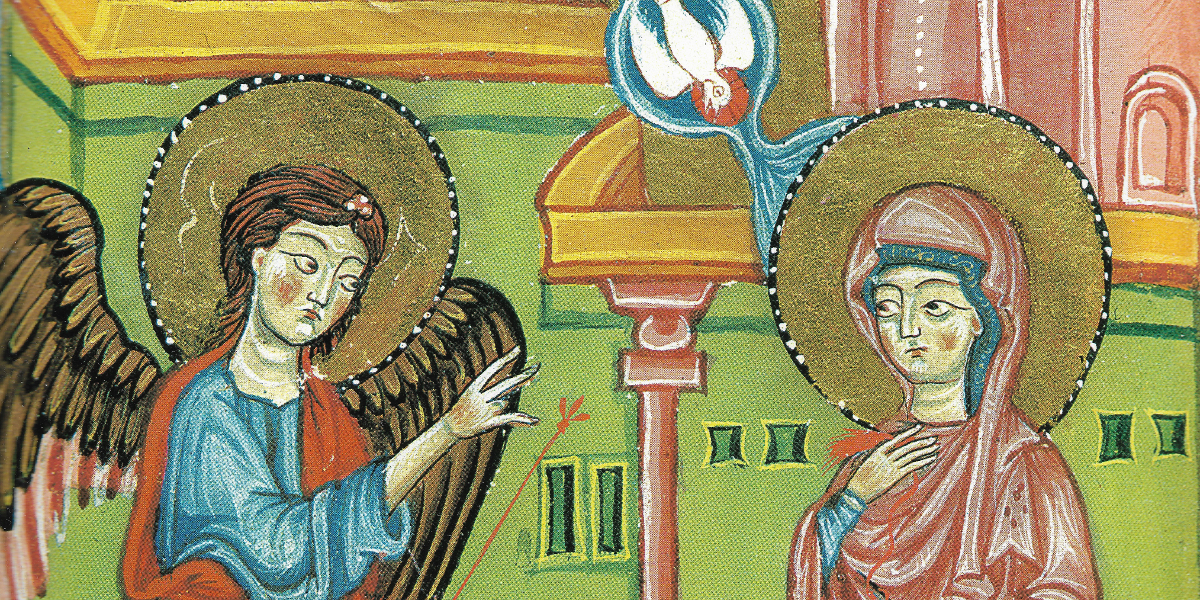
Christmas Eve – Pr. Faugstad homilies
St. Luke 1:31-35,38
I. The angel Gabriel said to Mary: “And behold, you will conceive in your womb and bear a Son, and you shall call His name Jesus.”
This scene has a specific context, a context that stretched back thousands of years. The reason an angel of the almighty God appeared to a young woman named Mary is because of another woman who lived long before this, all the way back in the beginning of time. That woman had a blissful and holy existence with her husband in a beautiful garden. They had no sin. They felt no pain. They lacked nothing.
But then a tempter came to the woman. “Wouldn’t you like to have even more?” he said. The woman gave in to the temptation, and so did her husband. They ate fruit from the one tree God had forbidden. Now they had sin. Now they knew pain. Now they were left with nothing. They hid from the presence of their Creator!
But God still loved them. He had mercy on them. He told the tempter, “I will put enmity between you and the woman, and between your offspring and her offspring; he shall bruise your head, and you shall bruise his heel” (Gen. 3:15). Adam thought the LORD was referring to Eve and her firstborn son (3:20, 4:1). But He was especially referring to another woman—to Mary, lowly Mary, Mary of Nazareth, who wouldn’t be born for several thousands of years.
In this evening’s reading, we see that God keeps His promises. He sent an angel to tell Mary that she was the one. She was the one who would bear the Son who would crush the head of Satan. She was the one who would bear the Son who would pay for all the sin of Adam & Eve and all their descendants. She was the one who would bear the Son whose name revealed His purpose. He was to be called “Jesus”—the One who saves.
Hymn: #119 – “Away in a Manger”
II. “He will be great and will be called the Son of the Most High.”
When Jesus lay there “asleep on the hay,” He did not look very impressive; He did not look so “great.” He looked like an ordinary little baby who needed what all babies need—milk, sleep, and new diapers. But this particular Baby was much more than met the eye. In the mystery of all mysteries, “the Son of the Most High,” the Son of God, had taken on human flesh.
We heard how His coming was prophesied right after the fall into sin. But the plan was actually in place before God the Father made the world and everything in it. God the Holy Spirit inspired the apostle Peter to write that our Lord Jesus Christ “was foreknown before the foundation of the world but was made manifest in the last times for the sake of you” (1Pe. 1:20).
The Son of God was incarnate, the Christ was made manifest, “the Word became flesh and dwelt among us” (Joh. 1:14). This great Lord, this “Son of the Most High,” came in the most unexpected of ways. He did not come down from heaven on the clouds in all His brilliant glory. He did not enter the world in the court of a powerful king. He came to the womb of a poor woman and was born in a little town. He “made Himself of no reputation, taking the form of a bondservant, and coming in the likeness of men” (Phi. 2:7, NKJV).
But why would He do this? Why would the God of eternity come down to us in this way? The apostle Paul tells us, “For you know the grace of our Lord Jesus Christ, that though he was rich, yet for your sake he became poor, so that you by his poverty might become rich” (2Co. 8:9).
Hymn: #123.1-4,15 – “From Heaven Above to Earth I Come”
III. “And the Lord God will give to Him the throne of His father David, and He will reign over the house of Jacob forever, and of His kingdom there will be no end.”
These words describe both the divine and human natures of the Christ: “And the Lord God will give to Him the throne of His father David.” The Lord God, God the Father from eternity, sent His only-begotten Son to join a human line. It was the line of Adam and Noah, Abraham, Isaac, and Jacob, the line of Jesse and his son David who was called from keeping sheep to be Israel’s king.
God promised that after David’s death, He would raise up an Offspring of David after him and “establish the throne of his kingdom forever” (2Sa. 7:13). That promise endured one thousand years through the crumbling and captivity of Judah and its return from exile until the birth of Jesus. Although the glory had long since departed from David’s royal line, Mary could trace her lineage to him.
More importantly, Mary was tied to the Promise, the Promise first made in the Garden of Eden, a Seed of Promise passed down from generation to generation, until it was planted in Mary’s womb by the Holy Spirit. The Child in her womb was both Man and God, both David’s Son and David’s Lord.
Though the world did not know it, He was a great King. He was the greatest King who ever walked on this earth, and He still reigns. He reigns with power and grace over His people. He sits on the throne of a kingdom that has no end.
Hymn: #143.1-2,7-9 – “The Happy Christmas Comes Once More”
IV. And Mary said to the angel, “How will this be, since I am a virgin?” And the angel answered her, “The Holy Spirit will come upon you, and the power of the Most High will overshadow you; therefore the Child to be born will be called holy—the Son of God.”
“How will this be, since I am a virgin?” Do we find it strange that Mary brings this up? Why does she feel compelled to mention her virginity? If Mary were living now, she would be told, “Mary, what you do with your body is no one’s business but yours.” But in fact what I do with my body and what you do with yours isn’t just our own business. What we do with our bodies is part of something bigger.
All who are baptized into Christ become part of His holy body. He was covered with our sins, so we would be clothed in His righteousness. He died in our place, so we would live. The apostle Paul writes that Christ “died for all, that those who live might no longer live for themselves but for him who for their sake died and was raised” (2Co. 5:15).
It does matter that Mary was a virgin. It means that the child in her womb was not conceived in her by a sinful man. That would mean their child was a sinner like them. But Jesus had no sin. He was conceived in Mary’s womb by God the Holy Spirit and therefore was “called holy.” Jesus had to be holy, so that He could take the place of you and me and all people, and offer Himself as a holy sacrifice for our sins.
Hymn: #113.1-2,4 – “A Great and Mighty Wonder”
V. And Mary said, “Behold, I am the servant of the Lord; let it be to me according to your word.” (ESV)
What a beautiful faith we find in Mary! She heard the stunning words of the angel which seemed to violate all sense, and she believed. “Behold, I am the servant of the Lord; let it be to me according to your word.” Martin Luther wrote that at her faithful hearing of God’s Word, Mary conceived “through her ear.” The day the angel visited her was the day God became man, starting as a tiny embryo in her womb.
Our minds are unable to comprehend the incarnation of God. How could the God of the universe spend nine months growing in a dark womb? How could He who has no beginning and no end be born of a woman and cradled in her arms? We cannot understand it any more than Mary could.
But we can rejoice. We can give thanks that the eternal Son of God was born for us. He was born to let nails and spear pierce Him through. He was born to bear the cross for me, for you. We don’t understand it. We don’t deserve it. But God declares it to us. “It is for you,” He says. So we reply, each one of us, with a believing heart, “Behold, I am the servant of the Lord; let it be to me according to your word.”
Hymn: #145 – “What Child Is This?”
+ + +
(picture from “The Annunciation” by Toros Taronetsi, 1323)

The Last Sunday of the Church Year – Pr. Faugstad sermon
Text: St. Matthew 25:1-13
In Christ Jesus, who has not delayed His return due to disinterest or other distractions but out of patience and love for you and all sinners, so there is time for us to repent (2Pe. 3:9), dear fellow redeemed:
One of the most exciting moments in sports across the board, is the moment just before the action begins. At that moment, anything is possible. The kicker starts his approach to the ball, the referee throws the basketball into the air at center court, the pitcher on the mound begins his windup. But where this moment is most intense is on a racetrack.
The runners are called to the starting line: “On your mark!” They jump up and down a few times and shake their arms. They crouch down and dig their feet into the blocks. They carefully plant their fingers behind the line. Then silence. The anticipation builds. Hearts beat faster. You can hear a pin drop. “Set!” Backs raise, legs straighten, muscle power pushes down to the toes to provide the catapult forward. The runners have to be especially careful right now. This is the time when many get disqualified. They can’t wait. The pop of the gun seems to take forever.
If you remember being in races as a kid, this was the toughest part. “On your mark! Get set!” Sometimes your parent or your coach would hold off on the “Go!” longer than usual. They wanted to teach you discipline. You have to be patient. If a sibling or friend started the race slow like this, they just wanted to see you suffer. You can picture it now: kids anticipating the call and leaning forward, then flailing their arms and falling in a heap on the ground. It’s so hard to wait for that “Go!” while staying ready to explode off the blocks.
That sort of waiting is what we find in today’s reading. Jesus shared this parable with His disciples to teach them and us how to prepare for His return. He speaks about ten virgins who went out to meet the bridegroom in order to join him at the wedding feast. Their description as “virgins” indicates that they were pure in faith, holy by virtue of their connection with the bridegroom.
It is a picture of the righteousness you have because you are united with Jesus. It is a strange reversal. A virgin who joins bodily with another is no longer a virgin. But we whose bodies are joined through Baptism with Jesus’ holy body, change from ones who are sinful and guilty to those who are clean and pure. Paul described this change in his letter to the Corinthian Christians. He wrote, “I betrothed you to one husband to present you as a pure virgin to Christ” (2Co. 11:2).
That is stunning language! Paul was writing at a time that was much like ours, with a culture just as much focused on personal pleasure and sexual permissiveness as ours is. Many of the people who had joined those congregations organized by Paul were ashamed of the things they had done in their past. They wished they could go back and undo what they had done, but they couldn’t.
Paul directed them to the work of Jesus to save them. After listing sins that keep people out of the kingdom of God, sins like sex outside of marriage, homosexuality, greed, and drunkenness, Paul acknowledged the reality, “And such were some of you.” Christians are not those who are unstained by sin. Some have sinned so much, that they might think it is impossible for their many sins to be forgiven. Then Paul continued with this comfort: “And such were some of you. But you were washed, you were sanctified, you were justified in the name of the Lord Jesus Christ and by the Spirit of our God” (1Co. 6:11).
You know the sins of your past. You wish you could go back and change a lot of things. But even if you did that, you would still be a sinner. You could change your actions in certain situations, you might be able to avoid some things, but other temptations would have come up. You weren’t just a bad choice or two away from perfection, you were far from it.
But in Jesus, you are holy. You were baptized into His victory over sin. Although you were impure, you have become pure. Although you were guilty, you have been absolved. Although you were dead in your sins, you have become alive in Christ Jesus by the power of the Holy Spirit. He cleansed you and all the members of His church, as Ephesians says, “by the washing of water with the word, so that he might present the church to himself in splendor, without spot or wrinkle or any such thing, that she might be holy and without blemish” (Eph. 5:26-27). That is a description of you, a virgin holding a lamp of faith, called out of the darkness to meet your Bridegroom.
So you are ready, but are you set? All ten virgins were ready at first, but only half of them were actually set. I’ll tell you what being set does not mean. It does not mean being able to say that you were baptized and confirmed in the church, or that you have been a member here your whole life. It does not even mean that you regularly go to church and contribute to the church’s work. Those things do not ensure that you are set.
The important thing is that the flame of your faith is being fueled. Going through the motions or keeping your name on a membership list does not fuel your faith. But humbly repenting of your sin, eagerly hearing the pure Word of God, and receiving the Sacraments—that does fuel your faith.
All Christians must take this seriously. Just because you once had faith, does not mean you will always have faith. The five foolish virgins took their faith for granted, and when the Bridegroom was delayed, they became weary. They did not prioritize fuel for their faith, and when they realized their error, it was too late. The door to the wedding banquet was shut, and they weren’t allowed in.
This is a powerful warning for us. You couldn’t tell the difference between the wise and foolish virgins by looking at them. But there certainly was a difference. At one point, they all had their eye on the finish line; they were all ready to go. But not all of them were set. They relaxed too much. They took their eye off the prize. They became disqualified. They did not finish the race.
And notice that in fact all the virgins—all ten of them—relaxed too much. “They all became drowsy and slept.” The gun did not go off fast enough for them. And here we are, still waiting. The Bridegroom called us out of the darkness into His marvelous light (1Pe. 2:9). The midnight cry has gone out, “Here is the bridegroom! Come out to meet him.” But He has yet to return.
So what are we supposed to do? Jesus says, “Watch therefore, for you know neither the day nor the hour.” But how do we watch? We watch by keeping our eyes on the Leader of the race, the Man standing ahead at the finish line. He has been in our shoes. He knows the difficulties and challenges we face. But He never slowed down. He never changed course. He never took His eyes off the prize, not even when the whole world stood against Him, not even when they nailed Him to a cross to suffer and die.
The author of Hebrews writes, “[F]or the joy that was set before him [Jesus] endured the cross, despising the shame, and is seated at the right hand of the throne of God” (Heb. 12:2). He endured that for you. He kept going, moving forward, for you. The Bridegroom knew what He was competing for; it was for you, His bride, His Church. The course He took was hard, harder than we can imagine, but He finished in victory. He won the victory over sin, devil, and death for you.
You stay ready and set by keeping your eyes on Him, your Savior. You watch for His return by listening to His promises. He speaks them to you today. He is not far away from you. He is present through His Word and His Sacraments to give you His encouragement and strength. He speaks His forgiveness as oil for your faith to keep it burning strong. He gives you His grace when you grow weary and drowsy along the way. He blesses you with His unseen presence now, so that you are prepared to rise up and go when He comes in glory.
That time is approaching and coming soon. The midnight cry was no false alarm. Now is the time to be ready for the Bridegroom’s return. We don’t know if His return will be sooner or later, so we stay set, alert, watchful, by continuing to fuel our faith through the powerful means that God has given us. We wait with patience for that day when a sharp sound will pierce the air, like a bullet from a gun.
Jesus will come “with a cry of command, with the voice of an archangel, and with the sound of the trumpet of God” (1Th. 4:16). And if we are no longer living here on earth, if we are sleeping the sleep of death, that sharp sound will awaken us. Then we will surge with power out of the tomb, up into the sky, and directly to our Lord.
That’s the day that we will “Go!” Until then, we stay Ready, we get Set, and with the help that God provides, we Wait.
Glory be to the Father and to the Son and to the Holy Ghost; as it was in the beginning, is now, and ever shall be, forevermore. Amen.
+ + +
(picture from 11th century painting from the Rossano Gospel)

The Second-Last Sunday of the Church Year
Text: St. Matthew 25:31-46
In Christ Jesus, who judges us not by the love we have shown others, but by the love He has shown us, dear fellow redeemed:
Are you ready for “Judgment Day”? We can’t help but feel some fear at the thought of it. On that day, Jesus will peel back the barrier between heaven and earth and reveal His glory to all mankind. He will come with a shout, with the sound of a great trumpet, accompanied by the angels. All the works of darkness will be exposed by His holy light. There will be nowhere to hide. Jesus says that “on the day of judgment people will give account for every careless word they speak” (Mat. 12:36). That is terrifying, because we have filled our life with careless words.
But the way Jesus describes the last judgment in today’s reading gives us a different perspective on the day. We are told of a King sitting on His glorious throne, but then He is described as a Shepherd. Those are very different pictures. A king gives orders; he exercises his power. A shepherd dutifully cares for the sheep. Here we see Jesus separating “people one from another as a shepherd separates the sheep from the goats.”
For the sheep, He only has sweet things to say. He calls them ones who are “blessed by My Father.” He says they will “inherit the kingdom prepared for you from the foundation of the world.” Then this Shepherd-King does something remarkable. He starts recounting all the good things the sheep have done for Him! They gave Him food when He was hungry, drink when He was thirsty, a home when He was a stranger, clothing when He was naked, encouragement when He was sick and in prison.
The sheep are dumbfounded, as sheep often are. They ask, “When did we do all these things for You, O Lord? When did we sheep do these things for You, our Shepherd, our King?” And He will reply, “Truly, I say to you, as you did it to one of the least of these My brothers, you did it to Me.” This happy exchange is probably not the first thing that comes to our minds when we think of Judgment Day. But it is how Jesus describes it, so it is good for us to dwell on His words and to find comfort in them as the last day approaches.
On the other hand, Jesus does not only speak words of comfort regarding that day. The goats at His left hear a very different message. Jesus does not say, “As long as you tried to be good and do what is right, you can enter My kingdom.” Or, “as long as you were sincere in your beliefs and followed your heart, that’s all that matters to Me.” This is the way the unbelieving world speaks. We hear many people—including professed Christians—say that all religions worship the same god, or that all religions are different paths to get to the same place. This is “Universalism,” and Jesus never teaches it.
He makes a much more exclusive claim about Christianity. He says, “I am the way, and the truth, and the life. No one comes to the Father except through me” (Joh. 14:6). Those who deny the Son of God incarnate cannot have the Father. The apostle Peter once told the Jewish religious leaders that in rejecting Jesus, they had rejected “the cornerstone.” Then he added, “And there is salvation in no one else, for there is no other name under heaven given among men by which we must be saved” (Act. 4:11,12).
This is why the goats ended up at Jesus’ left. They denied Him. They rejected the salvation He won for them. They did not want to hear His Word of truth. They wanted to go their own way. So Jesus will say to them on the last day, “Depart from Me, you cursed, into the eternal fire prepared for the devil and his angels.” He will explain that when He was hungry, they did not feed Him. When He was thirsty, they gave Him no drink, and so on.
In their desperation, the unbelievers will cry out, “Lord, when did we see You hungry or thirsty or a stranger or naked or sick or in prison, and did not minister to You?” Their thinking is that if only they had the chance, they would have helped the King. If they knew of His needs, they would have stepped up. But they miss the point. The point is not that they failed to do enough good works for God to earn their way into heaven.
Doing good works doesn’t get anyone into heaven. Ephesians 2 says, “For by grace you have been saved through faith. And this is not your own doing; it is the gift of God, not a result of works, so that no one may boast” (vv. 8-9). If we wanted to get ourselves to heaven by our own works, we would have to live a perfect life in every way. But none of us has even come close! We have broken each of God’s Commandments more times than we could count.
This is why the sheep are so surprised to hear their Shepherd-King recount all the good things they had done for Him. We know how much we have sinned and how far we have fallen short of the glory of God (Rom. 3:23). But the sheep are not those who have always excelled at doing what is right, or who have sinned less than others have. The sheep are believers. Their trust and confidence are not in themselves and what they do, but in Jesus and what He has done.
The opposite is the case for the goats, the unbelievers. They may have been really nice people, but they did not trust in Jesus as their Savior. Because they rejected Him, nothing they did was actually righteous in His sight. That is what Hebrews 11:6 emphasizes, “without faith it is impossible to please him.” No matter how much money a person gives to the hungry and the poor, no matter how many strangers they welcome or prisoners they visit, if these are not done as fruits of faith, the Shepherd-King does not count them as being done for Him. It is impossible to please God without faith.
But then it is also the case that with faith it is impossible not to please Him. Faith produces good fruit. So when you and I go about our day, serving the people around us, these are good fruits in God’s sight. Usually we aren’t even aware of the good. We go to work, pick up groceries, clean the house, and pay our bills. We have devotions with our family, and we pray. There is never enough time to get everything done, and we probably feel guilty for not doing more.
But Jesus considers all these little things that barely seem to matter to be great works. He looks at our imperfect and lowly efforts like a parent looks at the scribbled drawings of a little child. In His eyes, the scribbled efforts of our humble lives are beautiful. On the last day, He will put our good deeds on display, like a child’s drawing showcased on the kitchen fridge. He counts all the things done for “the least of these [His] brothers,” as being done for Him.
We know that He looks at us like this not because we are so good, but because He is so good. Whatever good we accomplish starts with His good. Our love for others starts with His love for us. We learn what it means to serve the least by watching the Son of God humble Himself to serve the world of sinners. The world was happy with His miracles. The sick and demon-possessed were glad to be healed. But most people walked away from Him. Some even conspired to kill Him.
Still He went forward. He lived a perfect life according to the law of God, showing perfect love to God and to His neighbors, a life free from sin. He did not “repay evil for evil or reviling for reviling” (1Pe. 3:9). He did what He teaches His followers to do. He loved His enemies. He did good to those who hated Him. He blessed those who cursed Him. He prayed for those who abused Him (Luk. 6:27-28). Then He willingly gave up His life, so that all sin would be atoned for, and sinners would have salvation.
The holy life He lived is the reason you now stand holy in God’s sight. When you were brought to faith in Him, your sins were removed from you, and His righteousness was placed over you. This is why you can get ready for Judgment Day without being afraid of what will happen to you. You will not be judged for your careless words or any of your sins, because Jesus paid for them all. And you will not be judged as failing to do enough good, because Jesus’ life of good works, His life of perfect righteousness, is credited to you.
The King who will sit on His glorious throne on Judgment Day is a “King of love.” He is your Savior. Like a Shepherd, He will gather you and all His sheep safely to His side. Then you will never again hunger, never again thirst, never be left out or go without. You will be with Him, so you will have everything you need. On the last day, you will respond to His love for you like the hymnwriter expresses it:
The King of love my Shepherd is,
Whose goodness faileth never;
I nothing lack if I am His,
And He is mine forever. (Evangelical Lutheran Hymnary 370, v. 1)
Glory be to the Father and to the Son and to the Holy Ghost; as it was in the beginning, is now, and ever shall be, forevermore. Amen.
+ + +
(picture from “The Last Judgment” by Fra Angelico, c. 1395-1455)

The Festival of All Saints (observed) – Vicar Lehne sermon
Text: St. Matthew 9:18-26
In Christ Jesus, who conquered death so that we may live, dear fellow redeemed:
Death can be a scary thing. This is especially true for those who have no hope. To them, death is the end. So, to make death seem less scary, they try to “soften it” by describing it in nice sounding terms, such as “he is playing eighteen holes on the golf course in the sky,” or, “he lived a good life, and now his legacy lives on,” or, “he will continue to be with you forever, so long as you keep thinking about him.”
The New Testament describes death as a peaceful sleep for those who die in Christ. To the world, describing death as a peaceful sleep is another one of those ways to try to “soften it” and make death seem less scary, but the world does not expect a waking up from that sleep. We can even think this way too, especially when we have just experienced the death of a loved one. However, while (1) death seems like the end to us, in reality, (2) death is only a sleep that Jesus will wake us from. Jesus gives us hope.
Our reading for today begins with a ruler kneeling before Jesus and asking him to lay his hand on his daughter so that she will live. We find out from the Gospels of Mark and Luke that this ruler was named Jairus. We also find out from these two Gospels that Jairus’ daughter wasn’t dead yet, but she was near death. This doesn’t mean that the Gospel of Matthew is giving an inaccurate report of what happened. The account was simply condensed.
Even though Jarius’ daughter wasn’t dead yet, she was so close to death that Jairus had little to no hope that she would be able to recover. The only hope he had was that Jesus could heal her. Jairus wasn’t basing his hope on nothing. Jesus had already healed many people who were sick. He healed an official’s son who was at the point of death (John 4:46–54). He healed a man who had been sick for thirty-eight years (John 5:1–17). He healed Peter’s mother-in-law, who was sick with a high fever (Luke 4:38–39). He healed a paralytic (Mark 2:1–12). And he healed many others besides these (Matthew 8:16–17; 4:23–24).
Jairus had more than enough proof that Jesus had the power to heal his daughter. And then he watched Jesus heal a sick woman who touched the fringe of his garment on the way to his house. Seeing Jesus heal someone right in front of him no doubt gave him even more hope than he already had that Jesus had could save his daughter’s life. He had no reason to fear that his daughter would die so long as Jesus made it to his daughter in time.
Then the bad news came. According to Mark and Luke, after Jesus healed and reassured the sick woman, some men arrived to tell Jairus that his daughter had died. Jesus didn’t make it to Jairus’ daughter in time after all. Hearing this news could cause anyone to lose hope, but Jesus reassured Jairus by saying, “Do not fear; only believe, and she will be well” (Luke 8:50).
What Jesus said to reassure Jairus he also says to reassure us. Jesus entered this world to save us from death by his own death and resurrection. As Jesus said to Martha when her brother Lazarus died, “I am the resurrection and the life. Whoever believes in me, though he die, yet shall he live, and everyone who lives and believes in me shall never die” (John 11:25–26).
Despite knowing this, death can still be a scary thing. We can fear the deaths of our loved ones, not wanting to experience the loneliness caused by them no longer being by our sides, or worrying how we will provide for ourselves and our families without their help. We can also fear our own deaths, worrying that it will be painful or that we will leave our families without the help that they need.
But it’s not just physical death that we can fear, but also eternal death. We know that we are by nature sinful and that we rightfully deserve eternal punishment in the fires of hell because of our many sins, a fact that can become clearer to us the closer to death that we get. As a result, we can wonder whether we lived a good enough life or whether we have a strong enough faith to get to heaven.
When any of these fears enter our minds, Jesus offers us reassurance and hope by telling us, “Do not be afraid; only believe” (Mark 5:36). Jesus gives us the faith we need through his Word and Sacraments. Because of this, we believe that Jesus experienced all our sufferings and took all our sins on himself on the cross. We believe that he paid the price for all our sins by his innocent suffering and death. We believe that he did everything necessary to save us. And we believe that he will remain with us through all our struggles, giving us the strength to persevere until the day we enter the peaceful sleep of death and enter eternal life in heaven.
Jairus believed and put his hope in Jesus, even after he received the terrible news that his daughter had died. His friends did not have the same confidence. In fact, the men who came to deliver Jairus the bad news also told him not to bother Jesus anymore since his daughter was now dead (Mark 5:35). In addition, the people who had gathered at Jairus’ house to mourn his daughter’s death laughed at Jesus when he told them that “the girl [was] not dead but sleeping” (verse 24).
Like those who didn’t believe that Jesus could raise Jairus’ daughter from the dead, we are tempted to doubt Jesus’ power over death. We know that God has revealed through his Word that we will rise again on the Last Day and that our bodies will be reunited with our souls. However, despite knowing what the Bible says, it can be difficult for us to have hope that we will rise from the dead. After all, Jesus’ power over death doesn’t change the fact that our loved ones are, for the moment, gone. We might even wonder why Jesus didn’t prevent the death of our loved ones if he has so much power.
Additionally, when our loved ones die and we are faced with the immediate reality of death, we might think that death is the end. Since we have only ever experienced life on earth, we tend not to give much thought at all to life in heaven. So, knowing that we will not see our loved ones again in this life might cause us to think that we will never see them again, despite knowing that the Bible says that we will see them again in heaven.
When we are tempted to doubt Jesus’ power over death and think that death is the end, Jesus gives us reassurance and hope. Jesus simply saying that he has power over death is one thing, but he also backed up his words with his actions. One of the ways he did this was by raising Jairus’ daughter from the dead.
Even though no one besides Jairus seemed to believe that Jesus could raise his daughter from the dead, Jesus proved them wrong. He entered Jairus’ house, took his daughter by the hand, and said to her, “Talitha cumi,” which means, “Little girl, I say to you, arise” (Mark 5:41). And she arose.
This is not the only time that Jesus raised someone from the dead. He later raised the widow of Nain’s son from the dead (Luke 7:11–17). He raised Mary and Martha’s brother, and his friend Lazarus from the dead not long before his own death (John 11:1–41). And, in the greatest raising of all, Jesus raised himself from the dead on the third day after his death.
If Jesus had not risen from the dead, we would have no hope. If death had kept its hold on Jesus and kept him in the ground, then that would mean he isn’t God. And if Jesus wasn’t God, then he would not have paid the price for our sins. But Jesus did rise from dead, and by his resurrection, he proved he is God and defeated death, giving us hope.
But it was not just physical death that Jesus saved us from. He also saved us from two other kinds of death: spiritual death and eternal death. We are all by nature sinful, meaning that we were spiritually dead from the moment we were conceived and could only sin all the time. Even our good deeds were like filthy rags (Isaiah 64:4). Because of the sins we committed, we rightfully deserved to suffer for all eternity in the fires of hell. We couldn’t escape this fate on our own, because we couldn’t choose to do good, let alone choose to believe in Jesus. However, on the cross, Jesus paid the price for all of our sins so that we will not enter eternal death in hell when we physically die, but eternal life in heaven. Additionally, he applied his perfect life to us so that God the Father no longer sees us as his enemies who deserve eternal death in hell, but as his own dear children who deserve eternal life in heaven. So that this reality can be ours, Jesus brought us to faith through his Word and Sacraments. In the waters of Holy Baptism, our sinful natures were drowned, and our new selves rose up.
Through Baptism, Jesus has already raised us from the dead, making us a part of the saints triumphant, even though we have yet to physically die. Jesus has made us members of his holy body, as he does with all believers. Therefore, our believing loved ones who are already sleeping are not so very far away from us because we are all united in Jesus. Now, whenever we pray to God, join together in praising him, or receive his body and blood at his holy table in his Supper, we are joining in praying, praising, and feasting with the saints triumphant who are already sleeping.
Since Jesus defeated death in all of its forms, the death of the body is no longer the end for those who believe in him, but a peaceful sleep. Death is no different than falling to sleep peacefully in our beds. When our bodies enter the peaceful sleep of death, our souls will be with Jesus in heaven. Then, on the Last Day, the sure hope that we have in Christ will come to pass. When Jesus returns, he will wake all those who believe in him from their peaceful sleep, which include us and our loved ones who are already sleeping, and will reunite our bodies with our souls. But our bodies will not be the imperfect bodies we died in. They will be perfected, and we will never experience the sufferings of this world ever again. Then, Jesus will take all believers in him to heaven—all the saints—to live with him for all eternity.
Those who have no hope do not believe that this could possibly be true. To them, the sure hope that we will live again is a misguided and empty attempt to make death seem less scary. However, this sure hope is a reality for those who die in Christ. Jesus has conquered death by his innocent death on the cross and his resurrection from the dead. Because Jesus has conquered death, we will not die, but live. Because Jesus has conquered death, we have hope.
Glory be to the Father and to the Son and to the Holy Ghost; as it was in the beginning, is now, and ever shall be, forevermore. Amen.
+ + +
(picture from painting by Gabriel von Max, 1878)

The Festival of the Reformation – Pr. Faugstad exordium & sermon
Flung to the heedless winds
Or on the waters cast,
The martyrs’ ashes, watched,
Shall gathered be at last.
And from that scattered dust,
Around us and abroad,
Shall spring a plenteous seed
Of witnesses for God. (Evangelical Lutheran Hymnary #556, v. 1)
These words were inspired by Martin Luther’s first hymn, a commemoration of the deaths of two monks named Henry and John. These monks were arrested for their “evangelical” preaching, which meant they proclaimed salvation through Jesus alone and not through a person’s own efforts or works. After eight months of imprisonment and interrogation, they were put on trial.
At the trial, they were told to bow to the authority of the pope and the church fathers. They said they would as long as their writings did not contradict the Holy Scriptures. They were told that it was sinful to read Luther’s writings, since the pope had banned them. They replied that it was wrong to ban writings that faithfully teach the Word of God. When it became clear that the two men would not repent of what they were teaching, they were sentenced to death by fire.
They were led quickly to the place of their execution. A yellow tunic was put on Henry to mock him and a black gown on John to symbolize his sinfulness. They were tied to the stake. They waited for half an hour as their executioners tried to get the fire going. Then as the flames advanced, the two men said the Creed, and they sang Psalms and hymns. Their last song was an old Christian hymn, the Te Deum Laudamus, which means, “We praise You, O God.” Finally they cried out, “Lord, Jesus, Son of David, have mercy on us!” And then they were overwhelmed by the smoke and after a while were reduced to ashes.
The monks Henry and John were the first martyrs of the Lutheran Reformation. They died on July 1, 1523—five hundred years and a few months ago. They did not go to the stake because they believed in the man Martin Luther. They learned from Luther’s writings to put their trust in Jesus. They died confessing Jesus as their Savior and Lord, even when the whole world seemed opposed to them.
Their example is an encouragement to us, encouragement to resist the temptations of the devil and the appeal of going along with the crowd, and encouragement to firmly believe and clearly confess God’s truth with honest hearts. We pray that our Lord equips us as He did these two faithful men, so that we also are kept in the saving faith until our earthly end.
We join in the prayer of hymn #18, the fourth stanza, “Triune God, Be Thou Our Stay”:
Triune God, be Thou our Stay;
O let us perish never!
Cleanse us from our sins, we pray,
And grant us life forever.
Keep us from the evil one;
Uphold our faith most holy;
Grant us to trust Thee solely
With humble hearts and lowly.
Let us put God’s armor on,
With all true Christians running
Our heavenly race and shunning
The devil’s wiles and cunning.
Amen, amen! This be done;
So sing we, Alleluia! (ELH, #18, v. 4)
+ + +
Sermon text: Ephesians 6:10-17
In Christ Jesus, the great Conqueror who willingly joined Himself with us losers and single-handedly destroyed our terrible enemies, dear fellow redeemed:
If you had to go to the front lines of a battle, what would you want to have with you? What would you need in order to feel safe, or at least to feel like you had a fighting chance? Maybe it would be body armor like a bullet-proof vest and a helmet that could protect you from shrapnel and bullets. Maybe it would be a thick wall in front of you or well-trained soldiers on either side of you. Perhaps what would make you feel safest is a powerful weapon in your hands that causes your enemy to duck for cover.
The apostle Paul talks about a battle situation like this, except that the battle he refers to is a spiritual one. It happens around us and inside us, and we can’t see the enemy. But we can see the enemy’s work; we can see his “schemes.” Paul writes that our conflict is not primarily “against flesh and blood”; our greatest enemies are not other human beings. Rather our conflict is against the rulers, authorities, cosmic powers of darkness, and forces of evil in the spiritual realm.
Paul is describing a hierarchy of wickedness with the devil at the top and his fellow demons sowing destruction and chaos around him. They are the ones who tempt and incite human beings to do the bad things they do. If we do not recognize that the devil and demons are behind the evil in the world, we might think that every human problem can be solved by a human solution. But there is no human solution that can overcome the devil.
This is what the Roman Church was attempting to do at the time of the Reformation. The people were taught that they could make satisfaction for their sins by the good works they did, by the prayers and gifts they offered, or even by purchasing a piece of paper, an indulgence authorized by the pope. On October 31, 1517, Martin Luther posted his Ninety-Five Theses, which argued that a soul could be saved only through repentance and not through the purchase of indulgences.
As he continued to study the Scriptures, Luther came further in his understanding of salvation. He realized that only God could supply the righteousness that His holy law required, and that this righteousness was fulfilled by His only-begotten Son in the flesh, Jesus the Christ. A sinner could have his sins forgiven and be justified before God not because of anything he did, but because of God’s grace toward him and the faith worked in his heart by the Holy Spirit to receive these gifts.
When Paul writes about putting on “the whole armor of God,” this is what he is talking about. He is talking about putting our trust in God alone as we face the devil’s attacks. What is the armor we wear? “The belt of truth”—that doesn’t mean our own personal truth, what is true for each one of us. It is God’s truth, the truth about our sinful weakness and about His gracious plan to save us. “The breastplate of righteousness” is Jesus’ righteousness. A breastplate protects a soldier’s vital organs, and so it is Jesus’ perfect life that covers and protects us, so that we are kept alive and well in Him.
The “shoes for [our] feet” is the readiness to stand firm in the Gospel of peace, to conquer by the message of grace which has conquered our own hearts. Paul tells us what “the shield of faith” is for. It is to “extinguish all the flaming darts of the evil one.” Whenever the devil tries to accuse us for our sins, we point in faith to Jesus, who already paid the penalty for all our sins. “[T]he helmet of salvation” is what protects our minds from the devil’s schemes as he tries to work doubts in our heads or anger toward others or sinful desires for what God has not given us.
Finally, we have “the sword of the Spirit, which is the word of God.” We do not advance in this battle by physical force. We speak God’s powerful Word, and the devil and the demons have to retreat. They cannot stand against the power of God’s Word. Whenever Jesus comes through the Word, the devil’s head starts hurting, since Jesus stomped on it and crushed his power by dying in our place and rising from the dead for our victory.
But if we want to give the devil the advantage over us, we can set aside the armor of God and try to face him on our own. We do this whenever we feel pride for the great things we have accomplished, and fail to give God the glory. We do this when we embrace what God says is sinful, instead of repenting of sin and running away from it. We give the devil the upper hand when we don’t speak up when the truth is challenged, when we compare our good works with those of others, when we trust our own reason or strength, when we stop regularly hearing and learning the Word of our God.
The devil will defeat us if we are not wearing the armor of God. He has done it before. He schemed against us, and his schemes were successful. We lost ground in our faith, and perhaps at certain points, we lost our faith altogether. But even though the devil has won many battles against us, he has not won the victory. This is clear by the attention you are giving to God’s Word right now. You know that you are weak. You know that you have sinned. And you also know that Jesus saved you from your sin and death and still fights for you against “our ancient foe” (ELH #251, v. 1).
That is what Martin Luther’s hymn, “A Mighty Fortress Is Our God” is about, a hymn that is called “The Battle Hymn of the Reformation.” Based on the Forty-Sixth Psalm, it describes God as a Fortress of strength, a Shield of protection, and a Weapon of defense. We need His help because of our powerful enemy who wants to destroy us, whose strength has no equal on earth (v. 1). On our own we would lose, but One stronger than the devil fights for us, the Man of God’s choosing. This is God’s Son come from heaven to earth, the Lord of hosts, who is victorious in every field of battle (v. 2).
Even a world full of devils cannot defeat us when Jesus fights for us. They are overthrown by a Word, the Word of God (v. 3). Their arms go limp when God speaks His Word. They have to run and hide, because they know they are beaten. As long as our Lord is with us in the fight “with His good gifts and Spirit,” with His power imparted to us through His Word and Sacraments, we remain in the kingdom of God, and His kingdom remains ours (v. 4).
This is what it means to “be strong in the Lord and in the strength of His might.” This is what it means to “take up the whole armor of God” and “to stand firm.” It means repenting of our weak efforts on the battlefield that could not win the victory, and it means trusting in Jesus’ righteousness and blood for our salvation.
We are not lost. We are not forsaken. We are not destined for eternal damnation—because God the Father loves us, His Son redeemed us, and the Holy Spirit sanctifies and keeps us in the true faith. A Mighty Fortress Is Our God. We give Him thanks that the Gospel was proclaimed and bore fruit at the time of the Reformation, and that His saving Word is still proclaimed among us today, despite our unworthiness to receive it.
Glory be to the Father and to the Son and to the Holy Ghost; as it was in the beginning, is now, and ever shall be, forevermore. Amen.
+ + +
(picture from “Martin Luther at Worms” by Anton von Werner, 1877)

The Fifteenth Sunday after Trinity – Pr. Faugstad sermon
Text: St. Matthew 6:24-34
In Christ Jesus, whose promise to provide for us is far more powerful than our worries and troubles, dear fellow redeemed:
He says it five times!
- “Do not be anxious about your life.”
- “Which of you by being anxious can add a single hour to his span of life?”
- “Why are you anxious about clothing?”
- “Do not be anxious, saying, ‘What shall we eat?’ or ‘What shall we drink?’ or ‘What shall we wear?’”
- “Do not be anxious about tomorrow.”
Jesus thinks we have an anxiousness problem, a worry problem, and Jesus is never wrong. He also identifies another problem: our little faith. Both of those go together—worry and a lack of faith. We worry because we do not believe God will do what He says, or at least we have doubts that He will provide for us in just the way and at just the time that we need it.
But what is it that causes our worry? What is our worry based on? Our worry is not based on anything we find in God’s Word. We don’t read about an arbitrary or a fickle God who sometimes chooses to bless His children and sometimes chooses to harm them. At times He does chasten and discipline us, because He wants to lead us to repentance and a stronger faith. But this is done out of love. He is always faithful. He does not change. So worry is not based on uncertainty about God’s will and work which are clearly revealed to us in His Word.
Worry is based on our own experience and the evidence we see around us in the world. We can think of times when we had more expenses than income, more responsibilities than we had the ability to meet. Maybe we were worried about paying our bills, and then more bills came. We didn’t know where the money would come from to cover even the essentials like food and utilities. Or one of our family members was sick, and we didn’t know if we could afford the medicine needed for healing.
We also look around us and see many people who go hungry, who can’t afford clothing, who have no place to go home to. If God feeds the birds and clothes the lilies, why doesn’t He feed and clothe all people in need? And if doesn’t do this for the people who really need it, how can we be sure He will do this for us? So we worry. We give more weight to our experiences and doubts than to God’s promises.
When we allow worry to come in, we are taking matters that God wants to handle and holding those matters in our own hands. We keep the burden on ourselves of providing for our needs and fixing our own problems. Or we look for another provider, another god, whose promises seem more reliable.
This is how many people view the government. They trust the government to take care of all their needs. But as necessary as government is—and God has certainly ordained it for good order and for our protection—yet government is made up of sinners, who are often ready to take as much or more than they promise to give.
Our worries really come down to 1) having enough and 2) keeping what we have. A person just out of high school or a married couple with little children might especially worry about having enough. They do without new clothes, new cars, and a nice house. Retirement is a long way off—there’s lots of work to do! But older individuals whose work has been blessed and who are able to afford the finer things, now worry about having enough to retire on and having the good health and energy to enjoy it.
When we worry about the future like this, we behave like “the Gentiles.” Jesus says, “Therefore do not be anxious, saying, ‘What shall we eat?’ or ‘What shall we drink?’ or ‘What shall we wear?’ For the Gentiles seek after all these things, and your heavenly Father knows that you need them all.” Now many of us are Gentiles in the sense of not having Jewish background. But Jesus is referring to the unbelieving Gentiles, the ones who did not have the Scriptures. That isn’t us, but we act like the unbelievers when we worry about having what we need.
Instead of worry, Jesus teaches us to do this: “seek first the kingdom of God and His righteousness, and all these things will be added to you.” He says that when we put our faith in God and His Word—little though our faith may be—, all the things we need for this earthly life will be provided to us. That’s quite a promise! It’s a promise that we have difficulty accepting.
We think that if we are going to prosper in this life, we have to make it happen. We have to outwork our co-workers, we have to come up with new solutions to get ourselves noticed by the “higher-ups.” We have to be in the right place at the right time. Then we will have a shot at our dreams. Then we can have a chance at the life we always wanted.
This is not a criticism of hard work. God wants every one of us to do our work to the best of our ability, whether we are in the classroom, in the workplace, in our homes, or at church. God never endorses laziness. In teaching us not to worry, Jesus is certainly not teaching us to sit back and wait for everything to drop in our lap. The apostle Paul couldn’t have said it more clearly than this: “If anyone is not willing to work, let him not eat” (2Th. 3:10).
The difference is working for selfish gain or working for godly gain. We work for godly gain when we recognize that God is the one who gives each of us our unique abilities and strengths to employ in His service. We trust that He will bless our efforts as He sees fit. He might give more to some of His children and less to others, but all of it is a gift from His gracious hand. So it is not helpful to compare what we have with what others have, since God is the Giver, and “He is good, for His mercy endures forever” (Psa. 136:1).
And how do we know this is true beyond any doubt, that God really is so good and merciful? We know this because the Father who created and provides for all things also gave the greatest gift of all—His only-begotten Son to save us. When Jesus says, “seek first the kingdom of God and His righteousness,” He is referring to His own holy work.
God the Father sent Him to do for us what we could not accomplish, no matter how much we worried after it or worked for it. Jesus the Christ was born under the Law, so that He might redeem us, buy us back, by His own holy life. While we are anxious and doubtful about God’s care for us, He perfectly entrusted Himself to the Father’s will. He did not worry about tomorrow; He focused on God’s Word today.
Wherever we have failed in our work through our worry, our selfishness, and our laziness, Jesus fulfilled the holy Law through His faith, His love, and His perfect commitment to the work of saving us sinners. “His righteousness” is the righteousness we must seek if we will stand before God in heaven. And this is the righteousness we already have by faith in Jesus.
Yes, our faith is “little” and never as strong as it should be. But even a little faith has salvation in Christ. Our eternal future does not depend on how strong our faith is, but on how strong our Savior and Lord is. And He is strong! He is stronger than hunger and want, stronger than worry and fear, stronger than sin, death, and the devil.
He suffered when He went to the cross, but He was not worried. Just before He took His last breath, He cried out, “Father, into your hands I commit my spirit!” (Luk. 23:46). Then He was taken off the cross and closed up in the tomb, but He was not worried. Death was no match for Him, and He rose from the dead on the third day to prove it.
It is this Conqueror of sin and death who tells you: “Do not be anxious; do not worry.” If your needs and concerns are like ten enemies threatening you with pocket knives and pitchforks, God’s care is like an entire army right behind you outfitted with the best weapons and equipment. Worldly cares are scattered by the powerful promise of God’s care.
He will provide for you. If He needs to say it again and again, even every day, He will: “Do not be anxious. I have not forgotten about your needs. I know how to turn trials into blessings. I will come and help you. Have no fear!” In His care for you, God the Father already sent His Son to rescue you from eternal death. That must mean He will not forsake you in your times of need (Rom. 8:32).
And you know this to be true. You know that your cares and worries have never done anything for you. You know that God’s care for you has never failed. Even when you were anxious, even when you complained, He kept on loving you. And if He didn’t give you everything you wanted at the time, He gave you everything you needed.
God knows your needs even better than you do. He gives you His kingdom and His righteousness for your eternal life, and He gives all that you need for this body and life besides.
Glory be to the Father and to the Son and to the Holy Ghost; as it was in the beginning, is now, and ever shall be, forevermore. Amen.
+ + +
(picture of Jesus and the lilies from stained glass at Jerico Lutheran Church)

The Fourteenth Sunday after Trinity – Pr. Faugstad sermon
Text: St. Luke 17:11-19
In Christ Jesus, who heals the sick and rescues the dying, so they might be His own and live under Him in His kingdom, dear fellow redeemed:
It started with little sores that stuck around, reddish spots, and some skin numbness. He wished it would go away, he wanted to ignore it, but he couldn’t. He went to the priest to have it examined, and the priest confirmed his greatest fear—it was leprosy. He had to leave his job, leave his home, leave his family. The Book of Leviticus describes the protocol for lepers: “The leprous person who has the disease shall wear torn clothes and let the hair of his head hang loose, and he shall cover his upper lip and cry out, ‘Unclean, unclean.’ He shall remain unclean as long as he has the disease. He is unclean. He shall live alone. His dwelling shall be outside the camp” (13:45-46).
It was a hard reality, but there was no known cure. A person with leprosy had to stay away for the good of others. But he wasn’t completely alone. Lepers often formed their own communities. We see that in today’s reading, when ten lepers called to Jesus outside a village between Samaria and Galilee. We learn something else about this group of men. It was a mixture of both Jews and Samaritans. That probably wouldn’t have happened if this terrible disease hadn’t drawn them together.
In general, the Jews and the Samaritans interacted with each other as little as possible. They had long lists of reasons why the other group was inferior and not worth their time and attention. But “misery loves company,” and these men were miserable. They set aside the animosity they may have felt toward one another and stuck together. But they were still of course on the outside. They were not where they wanted to be. They were part of a community of death, a community of the dying.
And that’s exactly what the world is apart from Christ. It is full of people afflicted by the disease of sin, surrounded by death and facing death themselves. Leprosy is a helpful picture for thinking about how sin works in us. In the Large Catechism, Martin Luther quotes Romans 7:18, “I know that nothing good lives in me, that is, in my flesh.” Then he says, “If St. Paul may speak this way about his flesh, we cannot assume to be better or more holy than him. But the fact that we do not feel our weakness just makes things worse. It is a sign that there is a leprous flesh in us that can’t feel anything. And yet, the leprosy rages and keeps spreading” (Part V, paras. 76-77).
Because of nerve damage, a leprous person does not always notice when he cuts himself or gets burned or injured. And we do not always notice when we are getting injured or burned by sin. The more we participate in what is unclean, the less we perceive the damage that is being done to us. We think that we can stay in control of the sin. We won’t let it overcome us. But when we can’t stop consuming what is destroying us, can’t stop doing what we should not do, we are not in control of sin; sin is in control of us.
If one of the lepers in today’s reading denied that he had leprosy, it wouldn’t have changed the fact. And “If we say we have no sin, we deceive ourselves, and the truth is not in us” (1Jo. 1:8). It is important that we see ourselves among those lepers. By nature, we are sinful and unclean (ELH, pp. 41, 61). We are the outsiders. We are the ones standing at a distance, away from all that is good. We cannot change our situation; we cannot save ourselves.
But One has drawn near to our community of death, even coming to live among us, One who has the power to heal us of our sin and save us from death. This One is very different; His reputation precedes Him. He has not been overcome by sin, and when death tried to take Him down, He took down death! “Jesus, Master, have mercy on us!” we cry.
And why should He have mercy? He isn’t the reason for our troubles. He is not responsible for the state we are in, for the messes we have made in our sin. But He does have mercy. He had mercy upon Naaman, an Old Testament Gentile who was afflicted by leprosy, by having him wash seven times in the waters of the Jordan River until he was clean (2Ki. 5). And our Lord had mercy upon us by bringing us to the cleansing waters of Baptism, where He applied the healing medicine of His holy blood to each one of us.
St. Paul explains this beautifully in Ephesians 2. He writes, “Therefore remember that at one time you Gentiles in the flesh… remember that you were at that time separated from Christ, alienated from the commonwealth of Israel and strangers to the covenants of promise, having no hope and without God in the world” (vv. 11,12). We were on the outside, and we couldn’t get in. We were stuck in our sin and death. Paul continues, “But now in Christ Jesus you who once were far off have been brought near by the blood of Christ” (v. 13). We were far off from salvation, but Jesus has brought us close to Him.
He accomplished this by perfectly keeping the Law of God, not just for the Israelite people but for all people. And then He went to the cross carrying the whole world’s sin and shed His holy blood to wash it all away. He poured His perfect righteousness and His cleansing blood over you through the waters of Baptism. That is how He transferred you from the community of death in the world to His holy Christian Church, the Communion of Saints. That is how He healed and cleansed you from the disease of sin that was killing you.
But many of the people He has done this for, whom He has joined to Himself in the waters of Baptism, continue on their way and forget what He has done. Like the nine lepers who were healed, they get caught up in “the cares and riches and pleasures of life” (Luk. 8:14). They don’t continue to listen to His healing Word. They don’t remember to give Him thanks. So even though Jesus freed them from the community of death, they have returned to it again. They might feel like they are alive. They might think they are doing important things. But none of it can save them, and none of it will last apart from Christ.
This is what the devil tempts all of us to do. He wants us to walk away from the life we have in Jesus, to give all of that up so we can fit in with the world. We might even feel ashamed sometimes of our membership in the Christian Church. We don’t tell anyone about it. We carefully keep it hidden, so we can fit in with the people who seem to matter. We don’t want them to think we are strange. We don’t want to be left on the outside. We don’t want to be singled out and left all by ourselves.
These are natural thoughts to have. It is difficult to be a follower of Jesus in a hostile world. But even though you may feel like you have to face these difficulties alone, you are not alone. The Samaritan went against the majority and turned back to give thanks to Jesus. He didn’t have the company of his former friends anymore, but He wasn’t alone. Jesus was with him, and Jesus blessed him. “Rise and go your way,” He said; “your faith has made you well.” Or as the Greek word literally reads, “your faith has saved you.”
You are saved by faith in Jesus who conquered your sin and death, and shares with you His life. And you are not the only one who has received this life. Going back to Ephesians 2: “So then you are no longer strangers and aliens, but you are fellow citizens with the saints and members of the household of God, built on the foundation of the apostles and prophets, Christ Jesus himself being the cornerstone, in whom the whole structure, being joined together, grows into a holy temple in the Lord” (vv. 19-21).
Look at how large your community is! You are a fellow citizen with all the saints, all the believers who have gone before you. You are a member of the household of God. You stand on the foundation built by the apostles and prophets. Christ Jesus Himself is the cornerstone. You are part of an immense structure, a beautiful building, a holy temple in the Lord. You are most certainly not alone.
You are a member of the body of Christ. It is with Him that you belong. You will always find friendship, acceptance, and purpose in Him. He will not leave you by yourself. He visits you with His mercy in good times and bad, whether you are happy or sad, restful or anxious. He comes right to you through His Word and His Sacraments to cleanse you again with His holy blood and bless you with His promises.
Each time you receive these blessings, you praise Him and give thanks to Him, bowing down at His feet. And He looks upon you with love, and He says, “Rise and go your way; your faith has saved you.”
Glory be to the Father and to the Son and to the Holy Ghost; as it was in the beginning, is now, and ever shall be, forevermore. Amen.
+ + +
(picture from “The Healing of Ten Lepers” by James Tissot, 1836-1902)

The Fifth Sunday after Trinity – Pr. Faugstad sermon
Text: St. Luke 5:1-11
In Christ Jesus, who did the work we had hardly even begun and were not about to finish, dear fellow redeemed:
What would it take for you to feel like you have really “made it”? When would you consider your life a success? Would it be rising to a prominent position in a company? Being recognized and awarded for your accomplishments? Making a certain amount of money and achieving the standard of living you always dreamed of? We look up to actors, athletes, and singers, because it seems like they have everything they want, the perfect life.
King Solomon had more than all of them. He looked back on a lifetime of hard work, of success and fame, and concluded that “all was vanity and a striving after wind” (Ecc. 2:11). He said that “there is more gain in wisdom than in folly,” but in the end, “the wise dies just like the fool!” (vv. 13, 16). He also recognized that everything he had worked for would one day be turned over to another to keep and manage, “and who knows whether he will be wise or a fool?” (v. 19).
So our satisfaction will not be found in climbing higher and higher and getting more and more. There is a better focus for our work, and we learn it today from the example of Jesus’ disciples.
When Jesus visited the fishermen by the lake of Gennesaret, they were not in good spirits. These men fished for their livelihood, not for leisure, which made a night’s work with no return especially frustrating. We might have expected Simon Peter’s response to be a bit saltier than it was when Jesus directed him to row to the deep part of the lake and let down his nets. For one thing, it was not the right time of day for fishing. And the deeper parts of the lake were probably not the best places to find fish. But Simon replied respectfully, “Master, we toiled all night and took nothing! But at Your word I will let down the nets.”
It wasn’t long before the fishermen saw the nets start to drag along as though they were filling up. In a short time their nets were so full, that two fishing boats could not handle the load. So much for all their fishing wisdom! This Jesus came along and prompted the greatest catch of fish they had ever seen! Now they were keenly aware of a power in their presence that was much greater than their own. They did not doubt that they had just witnessed a miracle, which meant Jesus was either a prophet of God or God Himself. Simon fell to his knees and said, “Depart from me, for I am a sinful man, O Lord.”
What Simon had forgotten at that moment is something that we lose sight of too. We forget that we are always in the presence of God, and that we cannot prosper in work without His blessing. So often we experience some success at work and are praised for what we accomplish, and we think of this as well-earned recognition. We worked hard for this and did what others could not do.
It is not wrong to take pride in a job well done. But it is wrong to take full credit for it. If you are a farmer, who is it that sends the sun and rain for your crops? If you work for an employer, who gave you the mental and physical abilities you have? If your kids grow up to be reasonably responsible citizens, who granted you the patience and care you needed to raise them?
To act as though God has nothing to do with our successes—which is what every unbeliever thinks—is to greatly dishonor Him. Unbelievers see their success as entirely dependent on themselves and even flaunt their riches in God’s face, as though He had nothing to do with it. But unless He opens His merciful hand and gives His blessings, no creature could live. He satisfies the desire of every living thing, as the Psalm says (145:16).
But we do not always feel satisfied with His gifts. Sometimes, like the disciples, we work hard and come up with nothing. Why is that? Why do we wear ourselves out and lose ground while the unrighteous appear to prosper? Has God forgotten our need? It is easy to question God when we are struggling, but it is just as easy to forget Him when we prosper. This may be why God sometimes gives us more and sometimes less—to remind us to trust in Him.
No matter how hard you work, if your work is not done to the glory of God, it is empty. No amount of money and goods will satisfy you without Jesus in view. Peter, James, and John recognized this. Even after the greatest catch of fish they had ever seen, they left it all behind. “[T]hey left everything and followed [Jesus].” They followed Jesus because He called them to a different kind of fishing. Now they would be “catching men” for God.
But they were not prepared to help fill God’s net until they were caught themselves. When Simon saw the great catch of fish, He begged Jesus to leave him, because he was a sinner. What sin do you suppose was on his mind? Was it that he doubted any fish would be caught when he “put out into the deep”? Or was it just a general awareness of his sinfulness as He stood before his Lord? The prophet Isaiah reacted in much the same way in the presence of God in heaven, “Woe is me! For I am lost” he said; “for I am a man of unclean lips” (Is. 6:5). But the last thing Simon Peter needed is what he requested. When he said, “Depart from me,” he should have said, “Save me, for I am a sinful man, O Lord!”
Being in the presence of God and hearing His Word forces us to reckon with our sins. We hear the standard that God sets and realize how far we fall short of meeting it. But instead of crying out to Jesus, “Save me!” we try to make things better on our own. We know that the sin we have fallen into is condemned by God, and we want to stop doing it. But instead of trusting in Him, we put our trust in ourselves. “I am strong enough to overcome this,” we think. “I know I am better than this, and I will prove it!” And what happens? We fall again and again. And eventually, we lose the will to fight anymore. Sometimes we continue in the sin despite the conflict we feel in our conscience, or we begin to justify the sin in an attempt to rewire our conscience.
Our flailing attempts to get free of God’s accusing law are like a bird caught in a fishing net. The harder it tries to get away, the more tangled up it becomes. This is how it was with Martin Luther. Luther had tried to get right with God by his works. He even gave up a promising career in law in order to become a monk, so that he could dedicate his life to righteous living full-time.
But the harder he worked, the more his net of righteousness came up empty. He expressed this painful realization in a hymn verse: “Fast bound in Satan’s chains I lay; / Death brooded darkly o’er me. / Sin was my torment night and day; / In sin my mother bore me. / Yea, deep and deeper still I fell; / Life had become a living hell, / So firmly sin possessed me” (ELH 378, v. 2).
It wasn’t that Luther was more sinful than the common man. But he was more honest about his sinful condition than many are. No matter how hard you and I try, we are still sinners who deserve death. St. Paul lays it out clearly, “the wages of sin is death.” But then he speaks the good news for us sinners, “the free gift of God is eternal life in Christ Jesus our Lord” (Rom. 6:23).
By God’s grace, we learn that the righteousness God requires of sinners is supplied by Jesus. To try to get to heaven without Him is to come up empty. But to place one’s entire life and being in His hands through repentant faith is to obtain everything. By faith in Jesus, your net is filled with forgiveness for your many sins, with eternal life instead of death, and with salvation from your enemies. Faith receives such abundant blessings from God that you sink beneath their glorious weight. God’s grace surrounds you and covers you, so that your flimsy attempts at righteousness can no more be seen. All that is now in view is the righteousness of Jesus and His cleansing blood.
That is why we follow Him. He gives us what we could never get on our own. Our Constant Toiling Nets Nothing without Jesus. Romans 4:5 declares, “And to the one who does not work but believes in him who justifies the ungodly, his faith is counted as righteousness.” It is not your work that justifies you before God, but faith in Jesus who did all the work that was necessary to save you.
He worked hard to save you, and He isn’t about to let that hard work on your behalf go to waste. He comes to you still and continues to work in you through His Word and Sacraments. Through these means, He supplies forgiveness whenever your God-given work falls short, and He grants the strength that you need to carry out your work to His glory alone.
Glory be to the Father and to the Son and to the Holy Ghost; as it was in the beginning, is now, and ever shall be, forevermore. Amen.
+ + +
(picture of the miraculous catch of fish by Raphael, 1515)