
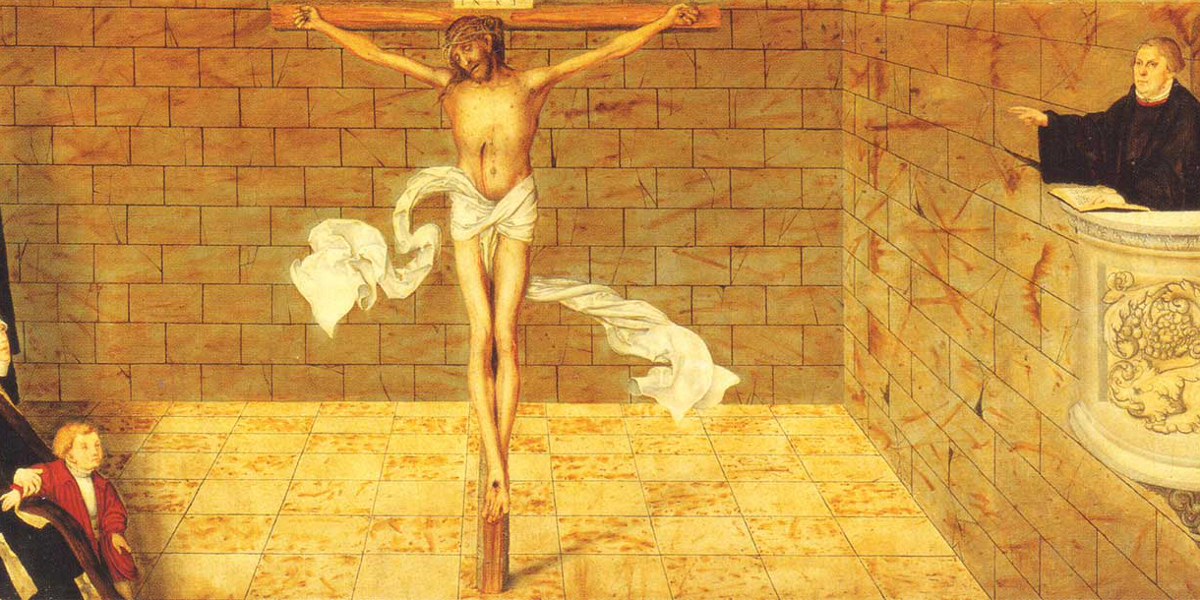
The Festival of the Reformation – Pr. Faugstad sermon
Text: Romans 3:19-28
In Christ Jesus, who promises that everyone who acknowledges Him before men, He also will acknowledge before His Father in heaven (Mat. 10:32), dear fellow redeemed:
We have all had the experience of trying to get ourselves out of trouble, but the more we say, the worse it gets. Maybe you broke something in the house, but instead of apologizing to your parents, you tried to pin the blame on a sibling. Or maybe you got pulled over, and your excuses for why you were speeding just made the situation worse. We are not always good at knowing when to speak and when to keep our mouths shut.
The same can be true in our spiritual life. We sometimes speak when we should be silent, and we are sometimes silent when we should speak. Today’s reading addresses both of these things. Just before our reading, St. Paul quoted from the Book of Psalms where it says, “None is righteous, no, not one; no one understands; no one seeks for God…. Their throat is an open grave; they use their tongues to deceive…. Their mouth is full of curses and bitterness” (3:10-11,13,14). Paul is citing God’s Law which applies to all sinners, to every single one of us.
When we hear God’s Law, we have nothing to say in response because we have failed to do what God commands us. But that doesn’t stop us from trying to sidestep responsibility for our sins. One of the hardest things for us to do is acknowledge that we have done wrong. We always want to make an excuse for why we did what we did or said what we said, excuses like:
- “He started it!”
- “If she had done what she said she would, this wouldn’t have happened!”
- “I didn’t mean to cause any harm—they’re just too sensitive!”
- “This is just how I am; I can’t help it!”
These are all statements of self-righteousness. Instead of admitting our sin and asking for forgiveness, we argue and try to pass the blame. But God’s Law does not budge. No matter how much we try to justify our actions or words, sin is sin. James 4 says, “So whoever knows the right thing to do and fails to do it, for him it is sin” (v. 17). God’s Law does not change with the times. Misusing God’s name was a sin from the beginning, and it is still a sin. Sexual immorality is still a sin. Lying is still a sin.
We can’t talk ourselves out of the judgment of the Law. One of our hymns says it like this: “What God doth in His law demand / No man to Him could render. / Before this Judge all guilty stand; / His law speaks curse in thunder. / The law demands a perfect heart; / We were defiled in ev’ry part, / And lost was our condition” (Evangelical Lutheran Hymnary #227, v. 2). This is what today’s reading teaches us. Paul writes, “Now we know that whatever the law says it speaks to those who are under the law, so that every mouth may be stopped, and the whole world may be held accountable to God.”
He says that before the Law, every mouth is stopped. We must go silent—“zip the lip!” We have no argument to make for our righteousness. God commanded us to be perfect, and we have sinned again and again, falling far short of the glory of God. There is nothing we can do to earn our way or work our way back into God’s favor. “For by works of the law no human being will be justified in His sight.” The verdict is clear. No matter how hard we try, we have failed. We cannot save ourselves.
Then why is it that so many Christians today think that salvation depends somehow on what they do? Though most Christians admit they are sinful, Lutherans stand mostly alone in our teaching that there is nothing we can do to make ourselves right with God or get ourselves connected to Him. This has been the consistent teaching of the Lutheran Church since the time of the Reformation, and we believe it to be the historic teaching of Christ’s Church from the time of the apostles as today’s reading shows.
Martin Luther took criticism from all sides for his teaching that we are saved not by our works but only by God’s grace in Christ who perfectly kept the law for us and died to pay for our sins. The Roman Catholic theologians said that if our works are not part of salvation, then what’s to stop Christians from embracing sin if they are saved by grace alone? It must be that our works contribute in some way toward our salvation. Luther replied that good works are fruits of faith that every Christian does and should do, but it is faith in Jesus alone that saves.
The Reformed theologians told Luther that he wasn’t going far enough. He had to get rid of the empty, outward trappings of the Roman Church, such as the Sacraments. What matters, they said, is that we dedicate ourselves to God from the heart and strive to live for Him. Luther replied that if we remove the means that God has given for the formation and strengthening of our faith, we will become self-righteous Pharisees, or we will despair because we are unable to do what we have promised.
Luther’s opponents wanted him to say that we are responsible—at least in some way—for our salvation. It sounded very reasonable. Many in previous generations had taught exactly this. Luther was in a difficult spot. He could have opened his mouth and worked up some kind of compromise to try to keep everyone together. He could have aimed for personal glory and a prominent position in the church.
But he would not go against God’s Word. Standing before one of the most powerful rulers of his time, Luther refused to take back what he had written and taught. “My conscience is captive to the Word of God,” he said. “Here I stand. I cannot do otherwise. God help me.” Luther knew when to be silent. He had to answer to God. He would not compromise the Word of God for the sake of peace in the Church.
This is what we celebrate on Reformation Day—not so much the man since Luther was a sinner like we are. But we celebrate his faithful confession of the truth and his faithful teaching of salvation by grace alone. On the back of your bulletin, I have included a picture from the altarpiece in Wittenberg, Germany, where Luther lived. This altar painting was dedicated in 1547, one year after Luther died. It shows him preaching to the parishioners of Wittenberg. But if the picture were bigger, you could see that Luther’s mouth is closed. He is preaching by pointing.
This painting emphasizes that Luther’s work was not about him or any unique message he came up with. He preached Christ crucified like Paul and the other apostles did. It’s all about Jesus. We do not open our mouths to boast about our own good works. We do these good things quietly, for the benefit of our neighbor and for the glory of God. When we are tempted to boast or when people encourage us to be prideful, we do what the tax collector in the temple did. We humbly bow our heads and pray, “God, be merciful to me, a sinner” (Luk. 18:13). That kind of silence about our own good works speaks volumes.
We have nothing to boast about in ourselves. But we do boast about Jesus. We boast about the salvation He won for us, not because we deserve it but because He is merciful and gracious. We deserve eternal punishment in hell. The Law condemns us. We have sinned. But God sent His Son to save us. He put Him forward “as a propitiation by His blood,” as the atoning sacrifice for our sins. The holy blood that Jesus shed washes all our sin away. It washes away the sins that make us feel guilty and the imperfect works that make us feel prideful. His blood cleanses us from the many ways we have broken the perfect Law of God.
His blood was the price He paid to redeem us, to purchase us so that we might be His own. His Father accepted this payment which is why we are justified before God, declared innocent, “not guilty.” We are “justified by His grace as a gift.” The righteousness we need to stand before God does not come from us. It comes to us as a gift from God, a gift received by faith. Even our faith is a gift, worked inside us by the Holy Spirit through the Word and Sacraments.
This is why it is right for Paul to say in the same place that we are “justified by His grace” and “justified by faith.” It all points to Jesus. We are saved by what He did, what He accomplished, what He set out to do and finished. We will be silent about our own works which could never save us. But we will not be silent about His works which He offered as a perfect sacrifice to the Father for our redemption.
This is what Paul taught in his inspired Epistles. This is what Luther taught at the time of the Reformation. This is what we still teach by the grace of God and what we pray will be taught to generations to come. Where God calls us through His Word to be silent, we will be silent, and where He calls us to speak, we will speak—all to His glory alone.
Glory be to the Father and to the Son and to the Holy Ghost; as it was in the beginning, is now, and ever shall be, forevermore. Amen.
+ + +
(picture from Wittenberg altarpiece painting by Lucas Cranach the Elder and Younger, 1547)

The Twenty-First Sunday after Trinity – Pr. Faugstad sermon
Text: Ephesians 6:10-17
In Christ Jesus, who rallies His soldiers around a manger, a cross, and an empty tomb and sends the terrible army of darkness scurrying away from His piercing light, dear fellow redeemed:
“It’s time to take a stand!” “Seize the moment!” “Stand up and be counted!” “Your future and your children’s future are at stake!” We have been hearing these messages a lot lately. They are attached to appeals for the citizens of this country to get active and go vote. People from both sides of the political aisle are calling this the most important presidential election in our lifetime. Each side says that if the other candidate wins, it will be the end of democracy as we know it.
It is not my job to tell you who to vote for. It is not even my job to tell you to vote. That is a right and privilege you have that you can choose to exercise or not. But it is my job to tell you not to get too caught up with the candidates you support or the candidates you oppose. God can use bad rulers as well as good rulers for His purposes. After this November 5th, our almighty Lord will still reign over all things in heaven and on earth just as He does now.
We are reminded of this in today’s reading, where our chief enemy is identified along with the battle plan for his defeat. Paul writes that we must take our stand “against the schemes of the devil.” Jesus described the devil as “a murderer from the beginning, [who] has nothing to do with the truth, because there is no truth in him…. he is a liar and the father of lies” (Joh. 8:44). The devil’s goal is that we join him in the eternal torments of hell. He is pure evil. He does not play fair. He will do whatever it takes to separate us from the forgiveness and salvation we have in Christ.
The devil is our number one opponent. We can never forget that he is on the march against us. Bad people—including bad politicians and government officials—come and go (Psa. 146:3-4). The devil has been carrying out his destructive work since the beginning (1Jo. 3:8). Our reading says, “For we do not wrestle against flesh and blood, but against the rulers, against the authorities, against the cosmic powers over this present darkness, against the spiritual forces of evil in the heavenly places.” When people pursue bad things and do bad things, we have to remember who is behind it—the great tempter and deceiver and his fellow demons.
He has his sights set on you, too, especially you. You confess Jesus to be your Savior and Lord, which puts you at odds with the devil. He hates you. He wants to destroy you. The unbelievers can go their merry way, but not you. You have to pay for your devotion to Jesus. He will attack wherever he thinks you are vulnerable, wherever he thinks he can cause the most pain and do the most damage to your faith. In Job’s case, he attacked his possessions and his family and then Job’s own health. But he did not prevail against Job, and it is not a foregone conclusion that he will prevail against you.
So how can you withstand his attacks? What is your battle strategy? If you knew someone was going to try to break into your home, you would stay awake and alert. Or if someone was going to physically attack you or take shots at you, you would wear protective body armor and carry weapons to defend yourself. But physical defenses and weapons don’t work against the devil. You need spiritual protection for this spiritual battle.
That is why Paul says, “Put on” and “take up the whole armor of God.” Only God’s armor can protect you against the devil. God knows the dark and imminent threats to your faith. He sees the dangers and pitfalls that are hidden from your eyes. He knows how to equip you, so that you “stand firm.”
The first piece of God’s armor is “the belt of truth.” This is not your truth or anyone else’s truth; this is God’s truth. His is the only truth that matters. His is the only truth that is most certainly true. We know the truth because He has delivered it to us in the Holy Scriptures. Jesus said, “If you abide in my word, you are truly my disciples, and you will know the truth, and the truth will set you free” (Joh. 8:31-32). And He said in prayer to His Father, “Sanctify them by the truth; your word is truth” (Joh. 17:17). We learn the truth by listening to and studying God’s Word, and in this way we also learn to identify the devil’s lies.
The next piece of God’s armor is “the breastplate of righteousness.” A breastplate protects your vital organs. What is it that covers your heart, so you are safe from the devil’s attacks? Some think that their heart is protected by their own good works and good intentions. Their heart is pure because they work hard to keep it pure. But this kind of self-righteousness is not a strength; it is a terrible weakness. The only righteousness that can cover and protect your heart is Jesus’ righteousness. The devil cannot pierce through the armor of His righteousness because He has perfectly kept the holy Law, and He kept it on your behalf.
The next part of God’s armor is sturdy shoes that help you to stand firm. You are ready for battle when you stand on “the Gospel of peace.” Now that doesn’t sound very strong. What about “the Gospel of power” or “the Gospel of victory”? The Gospel is those things too. But “peace” is where you stand with God. Paul wrote about this to the Christians in Rome, “since we have been justified by faith, we have peace with God through our Lord Jesus Christ” (Rom. 5:1). And, “Through him we have also obtained access by faith into this grace in which we stand” (v. 2). As long as you have peace with God and remain in His grace by faith, you have firm footing against the devil.
God also supplies you with “the shield of faith.” This part of His armor provides some insight into how active the devil is. Paul speaks about “all the flaming darts of the evil one.” Picture thousands after thousands of burning arrows flying at you through the darkness. Or if that isn’t scary enough, picture thousands upon thousands of missiles screaming your way. God provides a shield to protect you—the shield of faith. The devil’s unending accusations cannot land on you as long as your trust is in Jesus. Those flaming darts are quenched like matches flicked toward a waterfall.
By faith you wear “the helmet of salvation.” You put this on when the water was poured on your head while Jesus’ words were spoken at your Baptism. The sign of the cross was made over your forehead and heart that day, and the sign of the cross still starts at your forehead and ends over your heart. God does not let the devil hang your sins over your head or bury you under them. You are protected by the salvation Jesus secured through His death and resurrection.
So you have the belt of truth, the breastplate of righteousness, shoes standing on the Gospel of peace, the shield of faith, and the helmet of salvation. Finally you take in your hand “the sword of the Spirit, which is the Word of God.” There is no more powerful defense than the Word. The Second Letter to Timothy says, “All Scripture is breathed out by God and profitable for teaching, for reproof, for correction, and for training in righteousness, that the man of God may be competent, equipped for every good work” (3:16-17). Everything you need in your battle against the devil is supplied by the Word. You also learn through God’s Word how to pray, speaking back to God in petitions and praises for what He has promised you (Eph. 6:18).
The inspired words of today’s reading make it very clear where we should stand and where our strength is found. We stand “in the Lord and in the strength of His might.” The parts of the armor of God that we have reviewed today are all gifts from Him. None of them depend on our own strength or our own abilities. In other words, the only way to stand firm against the devil’s attacks is to recognize our own weakness. The only way to win is to admit how poor and unprepared we are by ourselves.
Our powerful Lord must fight for us. This is exactly what Martin Luther wrote in “the Battle Hymn of the Reformation”:
Stood we alone in our own might,
Our striving would be losing;
For us the one true Man doth fight,
The Man of God’s own choosing.
Who is this chosen One?
’Tis Jesus Christ, the Son,
The Lord of hosts ’tis He
Who wins the victory
In ev’ry field of battle. (Evangelical Lutheran Hymnary #251, v. 2)
Jesus fights for us in every field of battle. We stand with Him. Or better yet, He stands with us. He comes to strengthen and keep us in the faith through His Word and Sacraments. This is how He keeps us ready for the cosmic conflict against the devil. This is how He picks us up when are staggered by the devil’s blows and have fallen into sin. This is how He fortifies and tightens our armor, so there are no gaps and weak spots for the devil to exploit.
Today and every day is the Time to Take a Stand. Not on the shaky ground of a politician’s promises or an important person’s power because they will disappoint us. Not on the mushy ground of our own strength or our good intentions because they will fail us. We take our stand on the solid rock of Jesus Christ and His Word. Even the gates of hell cannot prevail against His Word (Mat. 16:18). “The word of our God will stand forever” (Isa. 40:8).
Glory be to the Father and to the Son and to the Holy Ghost; as it was in the beginning, is now, and ever shall be, forevermore. Amen.
+ + +
(picture from “The Temptation of Christ by the Devil” by Félix Joseph Barrias, 1822-1907)

The Nineteenth Sunday after Trinity – Pr. Faugstad sermon
Text: Ephesians 4:22-28
In Christ Jesus, who gives us a purpose bigger than ourselves, who has a plan and a glorious future for us that stretches from this life to eternity, dear fellow redeemed:
“Stick to this diet plan and watch the pounds melt away!”
“Use this face cream, and your wrinkles will disappear!”
“Do these exercises and get the body you always wanted!”
“Follow these easy steps, and you will be rich!”
The promises made by advertisements like these are often exaggerations. But we don’t really care. We want to believe there are solutions out there to make us healthier, stronger, and better than we are right now. But even if these products delivered on their promises, how much would we have actually changed? Would the changes be significant and impactful long-term, or would they be surface-level changes, only temporary, only skin-deep?
Looking around us, we can’t help but see that many people are discontent. They complain about how they look, their aches and pains, their lack of time and money, their inability to maintain a good diet and a good exercise regimen. They see the people who seem so beautiful and handsome, so strong and fit, so rich and famous, and they envy them. “If only we could look like they look and have what they have,” they say, “then we would be happy.”
Others are working on ways to further integrate technology with humanity, so that they can figure out how to mitigate or even reverse the effects of aging. They are asking questions like these: “How can we live longer? Suffer less? Function better? Have a higher quality of life?” For some called “transhumanists,” the answer is somehow to plug a computer-enhanced brain into a technological environment, so that our consciousness and cognitive ability are not limited by our weak bodies.
But as much as we would like to have better health, more agility and strength, better cognitive function, and more wealth—and as good as these things can be—there is an important question we should be asking. That question is: Who is this for? Who is my physical health, my mental ability, and my individual talents for? The answer that our society typically gives to this question is: “These things are for me.” Is it any wonder that people are so discontent? As long as their personal improvement is only for themselves, they will find that they will never get as far or have as much as they want.
Today’s reading from St. Paul’s letter to the Ephesians helps us aim higher. The focus of this reading is not first of all on our physical health or on our earthly success. It is primarily about our spiritual health and how that affects the people around us. Just as physical health is about avoiding what is bad while also pursuing what is good, the same is true for our spiritual health. Paul writes that we were taught in Christ both to put off our old self and to put on our new self.
Our old self is our sinful nature, the nature we inherited from Adam. His sinful likeness, his image, is imprinted on us (Gen. 5:3). It is clear that we have come from him because we are sinners like he was. Sin is the common family trait that we can see in every human being that has ever lived (except for One). This corruption inside us is what causes us to do and say things that are harmful to ourselves and others.
These are the things that we are to put off or lay aside. Paul gives a few examples. He writes that we should “put away falsehood.” We should “not let the sun go down on [our] anger.” We should “no longer steal.” These are things that come from the old self. These are things that invite the devil in to attack our faith. If we want to be spiritually healthy, we will avoid these things. And if we have fallen into these sins, we must be ready to repent of them.
While avoiding what is harmful to our faith, we also want to pursue what is good. If we must “put away falsehood,” we should also “speak the truth” with one another. If we must “not let the sun go down on [our] anger,” we should seek to be kind, tenderhearted, and forgiving toward others (Eph. 4:32). If we must “no longer steal,” we should be ready to do “honest work with [our] own hands, so that [we] may have something to share with anyone in need.”
But like the paralyzed man in today’s Gospel account (Mat. 9:1-8), we don’t have the power to get up and do this on our own. That power must come from God. We see this power in Jesus’ words to the paralytic, “Take heart, My son; your sins are forgiven.” It didn’t initially look like these words had done anything. The paralytic kept on lying there on his bed. What good were those words if he couldn’t walk?
But we have no indication that the man was disappointed. What if he had been blaming himself for his paralysis? What if he thought God was punishing him for past wrongs? What if he was terrified of dying apart from God’s grace? Then he heard those sweet words from Jesus, “Take heart, My son; your sins are forgiven.” If that was the gift the man wanted most, then being able to walk again was just icing on the cake.
In the same way, no one can see the power of God at work in Baptism. When water is applied while Jesus’ words are spoken, nothing seems to happen. A sleeping baby might keep on sleeping. A crying baby might keep on crying, or even cry harder! But God’s power is at work in Baptism because He promises it is. Baptism is where your old Adam was drowned and where your new life of faith began.
At your Baptism, the Triune God claimed you as His own. He cleansed your heart of its old corruption and renewed your mind for better pursuits, for a higher purpose. He created you after His likeness and applied His “true righteousness and holiness” to you. This is your new self, your life of faith in the living God. There is no room here for pride or selfishness or discontent or despair. With the new self, there is only love, only good, only opportunities to serve God and neighbor.
But bad habits are hard to break. We know that with our lack of exercise, our preference for unhealthy foods, and our pursuit of unhealthy behaviors. Our sinful flesh wants to be indulged. It wants to be fed more and more. It wants us to pursue what feels right in the moment. It wants us to fill up on anything our eyes can see, our ears can hear, or our hands can take hold of. We don’t know what has prevailed more often—our old self or new self—but we do know we are not where we want to be.
This is why our struggle against our sinful flesh is and must be a daily struggle. We know what the devil, the unbelieving world, and our sinful flesh want. They want our faith to be snuffed out. They want us to forget what Jesus has done for us. They want us to choose and pursue and do whatever seems best for ourselves.
And what does Jesus want for us? He wants us to know that He has not rejected us for our past indiscretions, for our failures toward others, for our lies, our anger, our dishonesty, or our greed. He wants us to know that each and every one of our sins is forgiven, that our guilty conscience has been washed clean in His precious blood. He still has important work for us to do.
No matter how much you fell short yesterday, God has given you the gift of today. Your works of yesterday, both bad and good, are cleansed and sanctified in Christ. Today is a fresh start, a day for truth, for kindness, and for charity. The same will be true for tomorrow. You might only see your weaknesses. You might feel incapable of doing anything that really matters. You might feel like a failure.
God sees His own beloved child. He sees a light shining in this world of darkness. He sees a saint bathed in His righteousness and holiness. He sees someone capable of great things, great things like a gentle word that turns away wrath, like a hand ready to help a person in need, like a patient ear that listens to the anguish and pain of another. God sees those great things in you because that is what He made you for.
He created you and cleansed you and called you for His holy service. He rescued you from the futility of life in this world and the unbelief that leads to hell. He calls you to be more and do more, and He gives you the power to do it. The faith you have is His gift planted in your heart. The love you show and give flows from Him to you. He is the One who moves you to keep putting off your old self in repentance and to keep putting on the new self in faith.
You are one of the blessed ones whom Jesus has called to be His disciple. As His disciple, you follow Him and continuously learn from Him. You get to carry out the work He has prepared for you to do each day, for the benefit of others and for His glory alone. “This is the day the LORD has made; We will rejoice and be glad in it” (Psa. 118:24).
Glory be to the Father and to the Son and to the Holy Ghost; as it was in the beginning, is now, and ever shall be, forevermore. Amen.
+ + +
(picture from woodcut by Julius Schnorr von Carolsfeld, 1794-1872)

The Feast of St. Michael and All Angels – Pr. Faugstad sermon
Text: Revelation 12:7-12
In Christ Jesus, who wore a crown of thorns and yet remained the King of heaven and earth, who carried His own cross and yet commands the angels, who felt the flames of hell and yet quenched the devil’s fire, who died, rose victorious, and lives forevermore, dear fellow redeemed:
The Old Testament book of Job describes Satan as being in a place we wouldn’t expect him. It says that when the holy angels presented themselves before the LORD at His heavenly throne, Satan came among them. The LORD did not immediately throw him out. He asked if Satan had considered His faithful servant Job, “who fears God and turns away from evil.” Satan replied that it is no surprise Job was so faithful since God blessed everything he did. “But stretch out your hand and touch all that he has,” said the devil, “and he will curse you to your face” (1:6-11).
God allowed Satan to destroy all that Job had. But even with this tremendous loss, Job did not curse God. So Satan came before the LORD again and said, “stretch out your hand and touch his bone and his flesh, and he will curse you to your face” (2:5). God allowed the devil to do this as well, and the devil struck Job with terrible sores. Satan would not give up. He would stop at nothing to try to turn Job against his Creator.
This account reveals that Satan had surprising access to God even after rebelling against Him. We can picture it like a courtroom. God the Father sits in the Judge’s seat. Satan is the prosecuting attorney lobbing charge after charge at the accused. Ten jurors sit over on the side listening carefully and nodding their heads. And who is on the stand? The sinner.
That sinner is you; he is me. And how does the devil try to accuse us? This is how nasty the devil is. He tempts us to commit sins, and then he points an accusing finger at us when we sin. “How could God love you? You’re just a liar, just a cheat! You have loved yourself but hardly your neighbor! All you care about is being popular, influential, and rich! How can you expect to go to heaven? You have failed in every way! You are guilty! You deserve death!”
The ten jurors are the Ten Commandments, and they agree with the accusations. We have not loved the Lord our God with all our heart and with all our soul and with all our mind. We have not loved our neighbors as ourselves (Mat. 22:37-39). We will get no help from the Law. None of our works can get us off the hook because all of our works are imperfect.
It looks like an open and shut case. We bury our face in our hands. The devil looks confident. There is a smirk on his face. “Another one goes down,” he says to himself. “I’m still on top!” But the Judge hasn’t ruled yet. There is still more to be said for the accused sinner. There is more evidence to be logged in the public record. The smirk on the devil’s face begins to fade and then goes away. What has he missed?
The door to the courtroom opens. Who should enter but a Lamb looking “as though it had been slain” (Rev. 5:6)? The gallery erupts with cries of astonishment. The devil’s eyes get big. He looks at the same time like he wants to crawl under a rock and like he wants to destroy all living things. The Lamb comes forward slowly and purposefully and says, “State the charges again.” The devil gathers himself and launches into a tirade against the accused, listing wrong after wrong after wrong.
But after each accusation, the Lamb replies, “Objection! That sin was paid for… and that one… and that one.” The Judge does not overrule Him. What the Lamb says is true. He has the marks to prove it. This Lamb is the Sacrifice, the One once dead but now living. This is “the Lamb of God, who takes away the sin of the world!” (Joh. 1:29). This Lamb—the Son of God incarnate—took away your sin. He canceled all the debt you owed to God. He made the vomit of accusations from the devil’s mouth stop cold by stomping on the devil’s ugly head.
The deflated and desperate devil had no leg to stand on, but he wasn’t about to go down quietly. This is where our sermon text picks up from the book of Revelation, chapter twelve, beginning at verse seven:
“Now war arose in heaven, Michael and his angels fighting against the dragon. And the dragon and his angels fought back, but he was defeated, and there was no longer any place for them in heaven. And the great dragon was thrown down, that ancient serpent, who is called the devil and Satan, the deceiver of the whole world—he was thrown down to the earth, and his angels were thrown down with him.
“And I heard a loud voice in heaven, saying, “Now the salvation and the power and the kingdom of our God and the authority of His Christ have come, for the accuser of our brothers has been thrown down, who accuses them day and night before our God. And they have conquered him by the blood of the Lamb and by the word of their testimony, for they loved not their lives even unto death. Therefore, rejoice, O heavens and you who dwell in them! But woe to you, O earth and sea, for the devil has come down to you in great wrath, because he knows that his time is short!”
The great dragon, the old evil foe, was thrown down, along with all the evil angels. These had rebelled against God shortly after they were created. They refused to obey His will. They refused to serve Him. And now they were cast out of heaven and away from His presence once and for all. Now the devil can no longer accuse God’s people “day and night” in the heavenly courtroom.
He was conquered “by the blood of the Lamb and by the word of their testimony.” The blood of Jesus washes away all sin. Sin does not stick to you and me anymore because God the Father put all our sin on His Son. He was judged in our place. He took our punishment and was sentenced to eternal death in hell for us. This Gospel proclamation is the cause of the devil’s continued frustration. He cannot stand against the Gospel since the Gospel “is the power of God for salvation to everyone who believes” (Rom. 1:16).
We are acquitted and righteous before God. We are justified by His grace, declared “not guilty!” But that does not mean our troubles are over. That does not mean we have tangled with the devil for the last time. He was cast out of heaven, but he landed on his feet on earth. The voice from heaven that announced the devil’s defeat also said, “woe to you, O earth and sea, for the devil has come down to you in great wrath, because he knows that his time is short!”
The devil has been defeated, but that does not mean he has given up. He knows now that he can never knock God off His throne. What drives his evil heart is trying to pull more souls with him into eternal damnation. He does this by tempting each one of us in our own unique ways. He might tempt us with bitterness or anger or lust or greed or pride or selfishness or complacency. He has innumerable tools at his disposal. Like we see in the account of Job, the devil will never give up until he has utterly ruined us.
The Lord’s apostle Peter said, “Be sober-minded; be watchful. Your adversary the devil prowls around like a roaring lion, seeking someone to devour. Resist him, firm in your faith” (1Pe. 5:8-9). The devil is a formidable opponent. We cannot stand against him alone by relying on our own power or on the strength of our own will. But we can resist him by the power of God the Holy Spirit. As we listen to and study the Word of God and faithfully receive His Sacraments, the Holy Spirit fortifies us and strengthens us. He makes us sober-minded, alert, and watchful for the devil’s attacks. He increases our faith, so that our eyes are constantly fixed on our Champion Jesus who destroyed the works of the devil by His death (1Jo. 3:8) and who still fights for us.
Our faithful Lord also dispatches His holy angels to guard us and defend us. Psalm 91 says, “he will command his angels concerning you to guard you in all your ways” (v. 11). Psalm 103 describes God’s angels as “mighty ones who do his word, obeying the voice of his word” (v. 20). Today’s Gospel reading tells us that even the littlest among us have angels watching over them, angels constantly looking upon the face of God and taking His direction (Mat. 18:10).
We are well-protected against the devil’s attacks. As formidable as Satan is and as much as he still tries to accuse us, our Lord Jesus with His holy angels defends us. The Lamb with the marks of His crucifixion stands against the great dragon, and the dragon must slither away. The blood of the Lamb poured out for all people means that you and I are cleansed of all our sins. The devil and demons know it, the holy angels know it, and God wants you to know it and never forget it.
One of the things that the voice from heaven said about the saints, about the holy followers of Jesus, is that “they loved not their lives even unto death.” They did not love their life on the earth with all its treasures and pleasures. They did not place all their hope in what they could get here. That is just what the devil wants and how he so often succeeds. But no, they loved the Lamb who died and rose again for their salvation. And they loved His holy Word which testifies to His victory.
God grant each of us such an enduring faith, a faith that holds fast to the Lord Jesus and His saving blood, a faith that leads us confidently before God’s throne of grace, a faith that makes all the holy angels rejoice with exceeding joy.
Glory be to the Father and to the Son and to the Holy Ghost; as it was in the beginning, is now, and ever shall be, forevermore. Amen.
+ + +
(woodcut by Julius Schnorr von Carolsfeld, 1794-1872)

The Fifteenth Sunday after Trinity – Pr. Faugstad sermon
Text: Galatians 5:25-6:10
In Christ Jesus, who did good to everyone, even to those who could not see the good and did not give thanks for it, dear fellow redeemed:
“Good” is a word kind of like “love”—it can be used in many different ways and have a variety of definitions. Just as it is difficult in our society today to agree on what is loving, so it is difficult to agree on what is good. Is something “good” if it makes me feel good? An illegal substance might make me feel good in the moment, but it is very damaging and bad for me. Is something good if more people are happy with a certain outcome than are unhappy? What if the majority is wrong?
The politicians are out in full force right now promising to accomplish good things for us. “I will give you more freedom!” “I will give you more rights!” “I will make everything more equitable—level the playing field for you!” “I will get you more money!” “Wouldn’t that be good?” What is good for one isn’t always what is good for another. And what we think is good for ourselves might not actually be what is good for us.
It might be helpful for defining and recognizing what is good to hear what God says is “not good.” Here are some examples from the book of Proverbs:
- “To impose a fine on a righteous man is not good, nor to strike the noble for their uprightness” (17:26).
- “It is not good to be partial to the wicked or to deprive the righteous of justice” (18:5).
- “Desire without knowledge is not good” (19:2).
- “Unequal weights are an abomination to the LORD, and false scales are not good” (20:23).
- “It is not good to eat much honey, nor is it glorious to seek one’s own glory” (25:27).
These proverbs tell us that unjust punishment is not good, injustice and unfairness are not good, unbridled desire is not good, cheating or taking advantage is not good, overindulging in food and an appetite for glory are not good. So it won’t do to define “good” as getting or having exactly what I want because that may not be good for me or for anyone else.
Today’s reading charts out a very different course for us as Christians. This epistle (or letter) from St. Paul was first of all “to the churches of Galatia.” These churches had been troubled by false teachers, false teachers who were telling these new converts that they needed to follow Old Testament rules and regulations such as circumcision and certain days of obligation in order to be good Christians. This focus on human works caused pride, in-fighting, and envy among the people. No doubt it also caused the false teachers to be puffed up since so many were now following them and forsaking Paul’s teaching.
“You are forgetting something fundamental,” said Paul, “something essential to the Christian faith. You are forgetting love—both God’s love for you and your love for one another.” Paul summed up this idea with the phrase, “law of Christ.” He said, “Bear one another’s burdens, and so fulfill the law of Christ.”
That phrase sounds a little strange to us. We think of Christ as Savior, not as Lawgiver. In fact, we push back against people who say Jesus was just a good teacher or that He intended to replace Old Testament law with a new standard of morality. That’s how some describe His Sermon on the Mount, as presenting a different kind of law than the Ten Commandments.
The “law of Christ” is not a new system of morality, but it did have a different reference point. Its reference point was not Mt. Sinai with all its thunder, lightning, and fire where God gave the holy law to Moses. Its reference point is another mount, Mt. Calvary, where Jesus gave up His life as a sacrifice for us sinners.
The evening before His death, Jesus said to His disciples, “A new commandment I give to you, that you love one another: just as I have loved you, you also are to love one another. By this all people will know that you are my disciples, if you have love for one another” (Joh. 13:34-35). Jesus’ disciples were to love others just as He had loved them. His love was the starting point.
He showed love for the people around Him by speaking God’s truth, both the law and the promises. He showed love by healing the sick and injured, comforting the hurting, feeding the hungry. Then He showed love by letting Himself be led like a lamb to the slaughter (Isa. 53:7)—“the Lamb of God, who takes away the sin of the world!” (Joh. 1:29). He had committed no sin, but He paid for our sin. He owed us nothing, and He gave us everything. He came “not to be served but to serve, and to give his life as a ransom for many” (Mat. 20:28).
That is love! And that is what Paul means by the “law of Christ.” It is a sacrificial love; it is outward-focused. “Just as I have loved you,” said Jesus, “you also are to love one another.” Just as Jesus gently restored transgressors who were sorry for their sins, so we are gentle and understanding toward our fellow Christians who fall because of weakness. Just as Jesus bore “our griefs and carried our sorrows” (Isa. 53:4), so we bear one another’s burdens of sorrow, pain, worry, and doubt. Just as Jesus sowed the good seed of righteousness through His gracious words and works, so we speak and serve one another graciously in His name. We learn from Jesus how we are to love. We learn from Jesus what is truly good.
But just because we know what is good, does not mean we always do it. Like the Galatian Christians, we need to be reminded about our sinful ways that work against God’s ways. “Let us not become conceited,” wrote Paul, “provoking one another, envying one another.” These things happen when we determine what is good by the wrong standard. We are tempted to measure how good we are by how much better we think we are than the people around us, or even by how good other people tell us we are.
We might think that we would never fall into the sins that others fall into, but Paul warns us not to be so proud: “Keep watch on yourself, lest you too be tempted.” In another place he wrote, “No temptation has overtaken you that is not common to man” (1Co. 10:13). It does not take some unique, powerful temptation to get us to sin. The common temptations are effective enough for our weak flesh, temptations like conceit because we think are better, or pointless arguments that cause division, or envy because we want what someone else has.
“For if anyone thinks he is something, when he is nothing,” writes Paul, “he deceives himself.” This is why each one of us must “test his own work,” not by comparing ourselves with others but by the standard of God’s holy law. This is how we each “bear [our] own load.” We take responsibility for our own words and actions. We acknowledge our own sins. In humility, we bring this heavy load to our Lord in repentance, asking for His mercy.
And how does He respond? “Come to me, all who labor and are heavy laden, and I will give you rest” (Mat. 11:28). You see, Jesus is the Chief Burden-Bearer. He took the massive burden of our sin and death on Himself and exchanged them with the free gifts of His forgiveness and eternal life. It is His bearing of our burdens that makes possible our bearing of one another’s burdens. It is His strength we draw on. It is His love that inspires our love. We have nothing to give that He did not first give to us. Everything comes from Him.
It first came to us when He joined Himself to us in Holy Baptism. It was then that we became members of His holy body. This is why Paul said to the Galatians earlier in his epistle, “I have been crucified with Christ. It is no longer I who live, but Christ who lives in me. And the life I now live in the flesh I live by faith in the Son of God, who loved me and gave himself for me” (2:20).
Christ lives in you by faith, and He works His good through you. When, as our reading says, you “bear one another’s burdens,” when you humbly serve one another, when you faithfully support your pastor, when you do good without growing weary, that is Christ working through you. That is Christ blessing the people around you through your humble service.
You don’t have to guess at what is “good.” You see it clearly in what Jesus has done for you and for every sinner. His goodness, His love, His mercy never run out—there is more than enough for all. And it is our feet, our hands, our mouths that He graciously employs to dispense these gifts.
“So then, as we have opportunity,” writes Paul, “let us do good to everyone”—spouse, children, parents, siblings, teachers, classmates, bosses, employees, friends, strangers, enemies—“let us do good to everyone, and especially to those who are of the household of faith”—especially to our brothers and sisters in Christ, all to the glory of His holy name.
Glory be to the Father and to the Son and to the Holy Ghost; as it was in the beginning, is now, and ever shall be, forevermore. Amen.
+ + +
(picture from “Healing the Blind Near Jericho” by a Netherlands artist in the 1470s)

The Tenth Sunday after Trinity – Pr. Faugstad sermon
Text: 1 Corinthians 12:1-11
In Christ Jesus, whom we confess as Lord by the power of the Holy Spirit, dear fellow redeemed:
If you had to decide between losing an arm or losing a leg, which would you choose? How about between your sight or your hearing? How about the ability to talk or the ability to walk? Those are difficult questions. We wouldn’t consider any of our body parts expendable, though we might give up an appendix or our tonsils if we had to (and maybe you have).
Just after today’s reading, St. Paul writes about how absurd and destructive it would be for the body to rebel against itself, so for example, for the eye to rebel against the hand or for the head to reject the feet (12:21). This would not help the body in any way. It would hurt the whole. Paul continues that “God has so composed the body, giving greater honor to the part that lacked it, that there may be no division in the body, but that the members may have the same care for one another” (vv. 24-25).
What he is talking about is the Church of all believers, which he calls “the body of Christ” (v. 27). Each believer is a member of the body of Christ. So it should be the concern of every one of us that we do not conduct ourselves in such a way that we do harm to the body. We are not just to look out for ourselves. We are not to elevate ourselves, as though we are more important members of the body of Christ while others are less important.
After all, we did not attach ourselves to Christ’s body by our own power or ability. We were joined to His body through Holy Baptism by the power of the Holy Spirit. Paul writes, “For in one Spirit we were all baptized into one body [the body of Christ]… and all were made to drink of one Spirit” (v. 13). “[B]y the washing of regeneration and renewal of the Holy Spirit” (Ti. 3:5), we were brought into the body of Christ, and by the ongoing work of the Holy Spirit through the Word, we remain active members of the body of Christ.
In today’s reading, Paul speaks about the work that is done in the Church by the power of the Spirit. It is tempting to think of success in the church according to the abilities of the members. As in, “that church is doing so well because of the programs it offers,” or “that church is growing because the pastor is such a good preacher,” or “that church is successful because of the services it provides to the community.” Whatever good may be seen to happen in the church on earth, the glory must go to God alone.
Again and again, Paul connects spiritual gifts among Christians to the Holy Spirit. Whether it is the gift of wisdom or knowledge or healing or miracles or prophecy, it is “through the Spirit,” “according to the same Spirit,” “by the same Spirit,” and “by the one Spirit.” “All these are empowered by one and the same Spirit,” he writes, “who apportions to each one individually as He wills.”
As we think about the gifts of the Spirit, we need to recognize that there is no limit to what the Holy Spirit is able to do on earth if He wills it. If He wanted, He could make us a hundred times healthier or a thousand times smarter. If He wanted, He could give us the ability to jump over great distances or even to fly. He could make it so that we never feel pain or sorrow or fear and would go about our work with perfect courage and strength.
But while there is no limit to what He could do, the Holy Spirit limits His activity to what will build up the Church, what will strengthen the body of Christ. He does not act as a rogue Person of God. He operates within the Godhead in perfect conformity with God the Father and God the Son. Jesus said, “When the Spirit of truth comes, he will guide you into all the truth, for he will not speak on his own authority, but whatever he hears he will speak, and he will declare to you the things that are to come” (Joh. 16:13). Then He added, “He will glorify me, for he will take what is mine and declare it to you” (v. 14).
The Holy Spirit employs His power to glorify Christ and the Father who sent Him, and to take the gifts obtained by Jesus and distribute them to us. Those gifts are not mentioned in today’s reading, but they are the forgiveness of sin through Jesus’ death on the cross, the bestowal of His righteousness through His perfect life, the victory over death and eternal life through His resurrection. These are the things Jesus had in mind when He looked upon the city of Jerusalem with tears in His eyes and said, “Would that you, even you, had known on this day the things that make for peace!” (Luk. 19:42).
You do know “the things that make for peace,” because the Holy Spirit has given you faith in Jesus’ saving work. You recognize that every good thing you have from God—most importantly your salvation—comes to you by grace. You deserve punishment and eternal damnation in hell, but you receive the opposite—forgiveness and eternal life in heaven. It didn’t cost you an arm or a leg, but it cost Jesus His life which He willingly gave up for you. You believe and confess that “Jesus is Lord,” because the Holy Spirit has planted this comforting truth in your sinful heart.
But the sin in your heart does not want to give up its place so easily. The old Adam in you, your sinful nature, wants you to follow after and cling to lies. It might be the lie that the church could not survive without you—the lie that if not for your talents, if not for your efforts and offerings and gifts, all would be lost—the lie that you are a more important member in the body of Christ than all the other members. Pastors are tempted in the same way too, with the thought that the good things that happen in the congregation are because of their hard work and their abilities.
“The god of what I do” or “the god of what you do” are some of those “mute idols” that formerly led the Corinthian Christians astray. The things we sinfully put our trust in will not speak for us before the throne of God on the last day. Our bank accounts will not speak for us, no matter how full they are. Our possessions will not speak for us. Our positions of power and influence will not speak for us. Our popularity in the world will not speak for us. If we gathered all these things around us to validate that we had lived a good life and accomplished good things, they would not and could not say a word on our behalf. Their mouths would stay shut no matter how much we begged for their support.
It is no good to appeal for salvation to anything we have done. If we have done any good, it is only because the Holy Spirit has worked it in us as a gift of His grace, as a fruit of faith. These are the gifts He gives for the building up of the Church. The gifts that each of us has, whatever they may be, are not meant for our own benefit or our own glory. They are for the good of the whole body, for the Christian brothers and sisters around us and even around the world.
The work of the Holy Spirit among us may not look the same as it did in the days of the apostles when the Church was first being established. “Gifts of healing,” “working of miracles,” and the speaking of “various kinds of tongues” are not common in the Church like they used to be. They seem to have faded when the New Testament books were written by the apostles and disseminated. As exciting as those spiritual gifts may be, we have all we need today for the building up of the Church. We have God’s Word and Sacraments, the holy means of grace, for our growth in wisdom, faith, and strength.
St. Paul wrote to the Church in Ephesus that God’s Word is the foundation we are built on as “members of the household of God” (Eph. 2:19). Christ Jesus is the cornerstone in whom the whole structure is joined together, a holy temple, “a dwelling place for God by the Spirit” (vv. 20-22). The Holy Spirit is just as powerfully active today as He was in the early Church. He still comes among us and works through us “for the common good.”
This is just what we pray for in the Lord’s Prayer when we say, “Thy kingdom come.” As we learn in the Catechism, “The kingdom of God comes when our heavenly Father gives us His Holy Spirit, so that by His grace we believe His holy Word and live godly lives here in time and hereafter in eternity.” That is the purpose of the Spirit’s work among us, to increase our faith in Jesus and to help us live godly lives—lives of service and love toward God and neighbor.
This is how The Holy Spirit Builds Up the Church. This is how He blesses us here on earth, and how He prepares us for our heavenly home where we will perfectly receive, utilize, and praise Him for His holy gifts.
Glory be to the Father and to the Son and to the Holy Ghost; as it was in the beginning, is now, and ever shall be, forevermore. Amen.
+ + +
(picture from “The Outpouring of the Holy Ghost” by Julius Schnorr von Carolsfeld, 1794-1872)
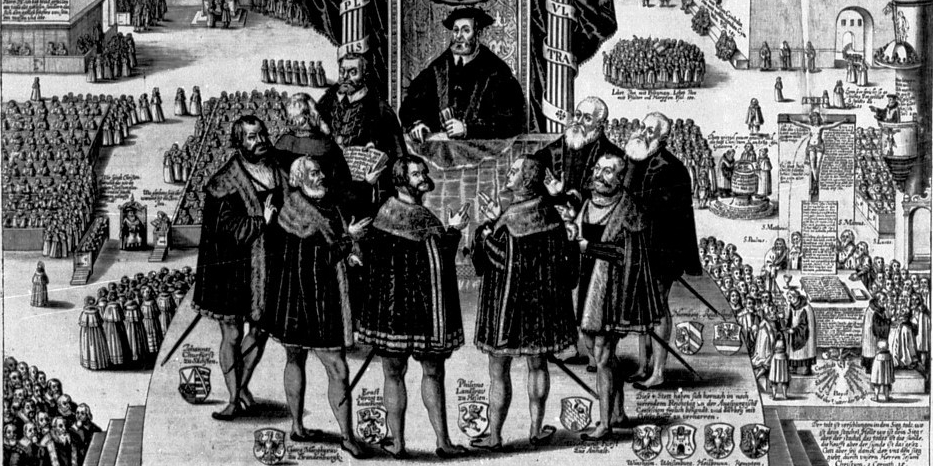
Presentation of the Augsburg Confession – Pr. Faugstad homily
On June 25, 1530, the Lutheran princes of Germany stood before Emperor Charles V in the German town of Augsburg and publicly read their confession of faith. They stated that they would rather die than compromise the truth of God’s Word.
Text: Romans 10:5-17
In Christ Jesus, whose perfect confession of the truth covers over our times of doubt, weakness, and faithlessness, dear fellow redeemed:
In the parts of the Augsburg Confession we have heard so far, there are two major themes that are brought up again and again. Those themes are righteousness and faith. In the Bible, “righteousness” is what it takes to be right with God. We don’t have to guess about the standard, because God has given us His standard for righteousness. He has given us ten statements—Commandments—which outline a life of righteousness.
Just ten commands—if you can live by them and keep them, you are right with God. But if you cannot keep them, then you cannot make yourself right with God. Already in the second article of the Augsburg Confession, the Reformers said this: We condemn those who “argue that a person can be justified before God by his own strength and reason” (ELH p. 9). In article four, they repeated the same thing, “We teach that men cannot be justified before God by their own strength, merits, or works” (ELH p. 9).
This teaching that there is nothing we can do to make ourselves right with God does not shock us, but it certainly shocked the people in Germany and beyond in 1530. Many believed that their good works, their merits, did contribute to their righteousness before God. The Roman theologians who responded to the Augsburg Confession put it like this, “All Catholics admit that our works of themselves have no merit but God’s grace makes them worthy to earn eternal life” (“The Confutation of the Augsburg Confession” in Sources and Contexts of The Book of Concord, p. 109). So is it ultimately God’s power or our power? Is it His work or our work?
St. Paul does not leave this ambiguous or unclear in today’s reading. He writes about “the righteousness that is based on the law” and “the righteousness based on faith.” The righteousness based on the law is our attempts to do what God tells us. If we kept His Commandments perfectly, He would let us into heaven because of our own good work. But if we have not kept them perfectly, we stand condemned in our sin. It’s all or nothing. Either you are perfect according to God’s standard, or you are not.
Now “the righteousness based on faith” is not a different kind of righteousness. It is still the perfect keeping of God’s Commandments, but this righteousness comes to us apart from our works. We do not earn this righteousness; we are given this righteousness. It is the righteousness of Jesus, who did perfectly keep the Commandments. He is the only human being to accomplish this. We were all conceived and born in sin, and we continued sinning. But He was conceived in the virgin Mary’s womb by the power of the Holy Spirit, and therefore He entered the world without sin.
Though in every respect He was tempted as we are, He never sinned (Heb. 4:15). He perfectly feared, loved, and trusted His heavenly Father. He perfectly loved everyone around Him. And that perfect keeping of God’s law is counted to each one of you by faith, and faith alone. Again from the Augsburg Confession, article four: “We teach that men… are freely justified for Christ’s sake through faith, when they believe that they are received into favor and that their sins are forgiven for Christ’s sake, who by His death has made satisfaction for our sins” (ELH p. 9).
For this faithful confession before one of the most powerful rulers in the world, the Reformers were risking their very necks! They were willing to die for this truth. They were fully convinced that what St. Paul wrote is true: “if you confess with your mouth that Jesus is Lord and believe in your heart that God raised Him from the dead, you will be saved.” Paul says nothing about God’s grace making us worthy to earn salvation, or about faith working through love that somehow earns us heaven. He speaks of the righteousness of Jesus becoming ours by faith in Him.
But where does faith come from? Is that a work you do? Paul writes, “So faith comes from hearing, and hearing through the word of Christ.” The power to save you and to work faith in you is in the Gospel, the good news of Jesus’ perfect life and atoning death on behalf of sinners. That is why you can be certain of your righteousness and salvation. They are gifts from God to you, received through the faith the Holy Spirit worked in you through the Word.
God has saved you. He justifies you. He caused you to believe this soul-saving truth. You Are Righteous before God by Faith. This is what the Lutheran laymen and pastors confessed 494 years ago, and by God’s enduring grace, we still confess it today to His glory alone. Amen.
+ + +
(picture of Emperor Charles V receiving the Augsburg Confession)

The First Sunday after Trinity – Vicar Lehne farewell sermon
Text: St. Luke 16:19-31
In Christ Jesus, who is our priceless treasure, dear fellow redeemed:
The rich man seemed to have everything. In his lifetime, he received good things, living in comfort, which he showed off in how he dressed and how he ate. He was clothed in purple, which was a color that was associated with royalty, and in fine linen, which was the most expensive cloth at that time. And he didn’t just have magnificent feasts some of the time, but every day, which showed that he was actively pursuing a good life on earth that was filled with worldly riches. On the other hand, there’s Lazarus. Unlike the rich man, who seemed to have everything, Lazarus seemed to have nothing. In his lifetime, he received bad things, living in anguish. He never got to feast like the rich man did. Instead, he laid at the rich man’s gate every day, hoping that he might get fed with the crumbs that fell from the rich man’s table. And the only ones who attended to him were dogs who came to lick the sores on his body.
The lives of the rich man and Lazarus couldn’t have been more different. This was not only true of their lives on earth, but also of their lives after they both died. There was just one difference. Now, their situations had completely flipped. While the rich man had feasted sumptuously on earth, now it was Lazarus who was feasting sumptuously at Abraham’s side, the father of all believers, in heaven. While Lazarus was begging for the crumbs that fell from the rich man’s table to satisfy his hunger even just a little bit on earth, now it was the rich man who was begging for a drop of water to cool his tongue even just a little bit in hell. While Lazarus lived in anguish on earth, he was now living in eternal comfort in heaven. And while the rich man lived in comfort on earth, he was now living in eternal anguish in hell.
What had caused the rich man and Lazarus to end up where they did when their lives on earth were over? It’s really easy for us to focus on their outward circumstances and think that had something to do with where they ended up, especially since that’s all we were told of their lives on earth, but this was not the case. It was not being rich that sent the rich man to hell. Everything that a person has is a blessing from God, and if we look through the Bible, we see that there were many people whom God blessed with earthly riches. We are told that God blessed Abraham in all things, including earthly riches. When God told Solomon to ask for whatever he wanted, and Solomon asked for wisdom instead of something like earthly riches, God not only gave him wisdom, but he also gave Solomon what he did not ask for, both riches and honor. The entire book of Job starts with the devil telling God that the only reason Job loves him so much is because he has blessed Job with so much. Then, at the end of the book, when Job has remained faithful to God despite losing everything, God blesses Job with even more riches than he had started with. Just as it wasn’t being rich that sent the rich man to hell, it also wasn’t being poor that sent Lazarus to heaven. It is just as easy for someone who is poor to sin as it is for someone who is rich. As Proverbs 30:8–9 says, “[G]ive me neither poverty nor riches; feed me with the food that is needful for me, lest I be full and deny you and say, ‘Who is the Lord?’ or lest I be poor and steal and profane the name of my God.”
So, if it wasn’t what was on the outside that caused the rich man and Lazarus to end up where they did when they died, then it must have been what was on the inside. While the rich man seemed to have everything during his life on earth, there was one thing that he did not have: faith. Even though the rich man had access to Moses and the Prophets, he did not see value in them or in the message that they contained. He only saw value in his earthly possessions. So, he rejected God and used his earthly possessions to give him the best life possible on earth. On the other hand, while Lazarus seemed to have nothing during his life on earth, he did have faith, the one thing that the rich man didn’t have. Through Moses and the Prophets, the Holy Spirit created faith in Lazarus’ heart, and with that faith, he saw the value in the promised Savior that Moses and the Prophets spoke about, for it was only through this promised Savior that he could be saved from his sins and given eternal comfort in heaven. This is what caused the rich man and Lazarus to end up where they did, not whether they were rich or poor, but whether or not they believed in the coming Savior, who is the most priceless treasure of all.
Of the rich man and Lazarus, who are we more like? While we would all love to say that we are like Lazarus, who held on to his faith even though he suffered in anguish every day, there are times when we are more like the rich man than we realize or care to admit. Like the rich man, who showed off his wealth in the clothes that he wore, there are times when we like to show off our own wealth to our friends and family. Getting our hands on the newest and greatest items becomes the most important thing in our lives, so much so that, instead of giving our first fruits to God, we give him our leftovers, if we give him anything at all. And like the rich man, who ate sumptuously every day, actively pursuing a good life on earth, there are times when we actively pursue a good life on earth above all else. We want to enjoy ourselves at fun and exciting events, and we want to satisfy our hunger by eating good food in nice restaurants, even if it means that we have to skip church to do it.
Now, there’s nothing wrong with owning possessions or spending our money in ways that we enjoy. After all, everything that we have is a gift from God. But if we are not careful, then we will make those things the most important things in our lives and put ourselves in danger of losing our faith and becoming even more like the rich man, who only saw value in his earthly treasures. If our earthly treasures replace our faith in Jesus as our Savior, then we will no longer see the value in God becoming a man; in the God-man, Jesus, living a perfect life; in Jesus suffering and dying on the cross. And as a result, we will no longer experience the comfort of heaven when our time on this earth is over, but we will instead experience eternal anguish in the fires of hell, like the rich man did.
Thankfully, the great treasure that is God’s Word is freely available to us, no matter how far away from God we have strayed. We don’t need to spend vast amounts of money to get it; it is freely given to us by God so that the riches that Jesus won for us may become ours. Through the faith that the Holy Spirit has created in our hearts through the preaching of the Word, we know just how valuable what Jesus has done for us truly is. The value of Jesus becoming a man is that he loved us so much that he was willing to leave his throne in heaven and humble himself to save us. The value of Jesus living a perfect life is that he fulfilled God’s law for us when we were unable to do so, and he applies his perfect life to us so that the Father only sees the holy life that his only-begotten Son lived when he looks at us. And the value of Jesus’ suffering and death on the cross is that all of our sins have been paid for; we don’t need to do anything to make up for our sins and get out of hell, because Jesus has already done everything that is necessary to win us a place in heaven. The treasures of this world that God blesses us with are nice, but they are only temporary. As the prophet Isaiah says, “The grass withers, the flower fades, but the word of our God will stand forever” (Isaiah 40:8). There truly is no greater or more priceless treasure than Jesus.
Like Lazarus, we have faith in our Savior. But there are times when we can be like Lazarus in another way. Like Lazarus, there are times when our lives are filled with anguish. Even though we may not be begging for crumbs from people’s tables, there are times when we can worry about how we are going to provide for ourselves and our families. We want to provide for our loved ones by giving them food or by paying for doctors to heal them when they get sick. But we see how expensive everything is getting, and our pay doesn’t seem to always go up along with the rising costs, meaning that we can’t buy what we used to be able to or what we currently need to. And even though we may not experience moments when no one is attending to us except for stray animals, like the case was with Lazarus, there are times when it can feel like no one cares about us or is there to help us when we need it. In moments like those, we can feel unloved and abandoned.
When we go through hardships in our lives and feel the anguish of those hardships, it can be hard for us to hold on to our faith. After all, if Jesus truly did love us, why would he be allowing us to go through such torment? But even when it feels like we’re all alone or that we have nothing, Jesus is always there for us to help us get through our anguish and give us comfort. Jesus, our priceless treasure, is all we need. He didn’t abandon us while we were still sinners. Instead, he laid down his own life to give us eternal life. As the apostle Paul says, “God shows his love for us in that while we were still sinners, Christ died for us” (Romans 5:8). And if Jesus didn’t abandon us then, he won’t abandon us now. He will remain by our side no matter what and help us endure whatever anguish and torment we have to go through until the day that he calls us home to the heaven that he won for us.
When you do enter the gates of heaven, you will never have to experience the anguish and torments of this world ever again. Never again will you hunger. Instead, you will feast sumptuously every day. Never again will you be alone or unloved. Instead, you will be surrounded by not just fellow believers who will show you love without end, but you will also be in the presence of God, who loved you so much that he sent his only-begotten Son to die for you. Any other possible anguish that you could possibly endure here on earth will be gone forever. Instead, you will only experience eternal comfort.
Through God’s Word, the Holy Spirit gives you the faith to receive all of these blessings. The rich man was unable to see the value in God’s Word. Even when he was in anguish in the fires of hell, he still couldn’t see the value in God’s Word. Instead, he thought that something else was needed, something that seemed to be more spectacular. But like Lazarus, you know the truth. You know the value of the message that God’s Word contains. You know the value of what Jesus accomplished for you. While the treasures of this world that God blesses you with are nice, they don’t hold a candle to Jesus and what he did for you. Jesus truly is your priceless treasure.
Glory be to the Father and to the Son and to the Holy Ghost; as it was in the beginning, is now, and ever shall be, forevermore. Amen.
+ + +
(picture from painting of the beggar Lazarus by Fyodor Bronnikov, 1886)

The Second Sunday of Easter – Vicar Lehne sermon
Text: St. John 20:19-31
In Christ Jesus, who dispels our every doubt, dear fellow redeemed:
How could Thomas be so stubborn? The other disciples saw Jesus with their own eyes. They saw the mark of the nails on his hands and the hole in his side from the spear. Why did Thomas refuse to believe his fellow disciples “[u]nless [he saw] in [Jesus’] hands the mark of the nails, and [placed his] finger into the mark of the nails, and [placed his] hand into [Jesus’] side” (verse 25)? What reason did he have to not believe the men whom he had traveled with for so long and gotten to know so well? But even though Thomas was wrong to doubt that Jesus had risen from the dead, the other disciples were no better.
The first people to hear the good news that Jesus had risen from the dead were the women who went to anoint Jesus’ body early in the morning after the Sabbath had ended. When they arrived at the tomb, they discovered that the stone, which blocked the entrance to the tomb, had been rolled away. Inside the tomb, Jesus’ body was gone, which perplexed the women. Then, two angels appeared to them and said, “Why do you seek the living among the dead? He is not here, but has risen. Remember how he told you, while he was still in Galilee, that the Son of Man must be delivered into the hands of sinful men and be crucified and on the third day rise” (Luke 24:5–7). Then the women remembered Jesus’ words and went to tell the disciples what they had seen and heard. The women were told to tell them these things not only by the angels, but also by Jesus himself, who appeared to them as they returned from the tomb.
What good news the women gave the disciples! Jesus, who had been betrayed by one of their own and arrested, who had died on the cross, as witnessed by John, and who had been placed in a tomb, the entrance to which was blocked by a large stone, was not dead, but alive! He had accomplished the work that he had come to do. He had paid the price for the world’s sins on the cross and declared his victory over sin, death, and the devil by his rising from the dead. The disciples should have been rejoicing when they heard the report of the women. But, when the women told these things to the disciples, “these words seemed to them an idle tale, and they did not believe them” (Luke 24:11).
The disciples had no reason to think that the women were just telling them an idle tale and that Jesus hadn’t actually risen from the dead. He had told them many times what was going to happen to him. We hear in the gospel according to St. Matthew that, after Peter confessed that Jesus is the Christ, “[f]rom that time Jesus began to show his disciples that he must go to Jerusalem and suffer many things from the elders and chief priests and scribes, and be killed, and on the third day be raised” (Matthew 16:21). He predicted his death and resurrection to his disciples two more times after that. Then, shortly before he was to be handed over to the religious authorities and arrested, he said to his disciples, “You know that after two days the Passover is coming, and the Son of Man will be delivered up to be crucified” (Matthew 26:2). And finally, on the night that he was to be arrested and sentenced to death, Jesus said to his disciples, “[A]fter I am raised up, I will go before you to Galilee” (Matthew 26:32).
When the disciples heard the report of the women, they should have remembered Jesus’ words and believed that he had risen from the dead, just like the women did. But instead, they doubted. It took Jesus appearing before the disciples and showing them the mark of the nails on his hands and the hole in his side from the spear for them to believe. The words that Jesus spoke to Thomas in our text for today may as well have been spoken to all of the disciples: “Have you believed because you have seen me? Blessed are those who have not seen and yet have believed” (verse 29).
You are “those who have not seen and yet have believed.” It was two thousand years ago that Jesus walked the earth. There’s no way that any of you could have seen him. All you have are the words that the Holy Spirit inspired the disciples and the other writers of the Bible to write down. Those words tell you that you are by nature sinful and that you deserve only God’s wrath and punishment. They tell you that there is no way for you to escape God’s wrath and punishment or to earn your way into heaven. But those words also tell you that God the Father loved you so much that he didn’t want to leave you to that dreadful fate. So, he sent his only begotten Son, Jesus Christ, to take all of your sin on himself and experience all of the wrath and punishment from God that you rightfully deserved. The mark of the nails on his hands and the hole in his side from the spear is proof of Jesus’ love for you. Jesus was nailed to the cross for you. His side was pierced for you. His death on the cross was so that you would not have to experience that death.
But what God tells us through his Word doesn’t end with Jesus’ death, because if Jesus had remained dead, then you would have no hope. As the apostle Paul writes in his first letter to the Corinthians, “[I]f Christ has not been raised, your faith is futile and you are still in your sins” (1 Corinthians 15:17). If Jesus had not been raised, then that would mean that his sacrifice was not sufficient enough to pay for your sins. The good news is that Jesus has been raised from the dead, which means that his sacrifice was sufficient and that your sins have been paid for and forgiven. You have heard the same words that the disciples heard. The disciples were not willing to believe this good news without seeing evidence that Jesus truly had risen. Even though you have not seen any evidence that Jesus has risen, it is through the work of the Holy Spirit that you believe that it’s true.
Does that make you better or more faithful than the disciples? Even though we don’t doubt that Jesus has died on the cross and risen from the dead, there are other things that God has revealed to us through his Word that we do doubt. God tells us that he will be with us in times of trouble, but how do we know for sure that he is with us during those times? After all, it is often during our times of trouble that we feel the most alone. God also tells us that he loves us and will always do what is best for us, but how do we know that this is true? After all, so many others seem to have it better than we do, and not just other Christians, but unbelievers. If unbelievers seem to have it better than we do, how do we know for sure that he loves us and is doing what is best for us? And even though we believe that Jesus truly did die on the cross for the sins of the world, how do we know for sure that Jesus died for our sins? After all, the sins that we have done are so horrible, and they continue to weigh us down. If Jesus really did die for our sins, why do we continue to feel so guilty? What if that means that our sins haven’t actually been forgiven because they are just too great? In all of these instances, as well as many others, our doubts can lead us to not trust in the words that God has spoken to us through Scripture alone. Our doubts can lead us to seek evidence from God that what he has told us is true. In moments like these, we are no better than the disciples, who needed to see the risen Jesus to believe that he had truly risen from the dead.
Whenever we have doubts about what God has revealed to us in his Word and shut the doors of our hearts to him, Jesus passes through the shut doors of our hearts and says to us, “Peace be with you” (verses 19, 26). Jesus brings his peace to us through the means of grace, his Word and Sacraments, and through Holy Absolution. Whenever we doubt that God loves us or that he is with us in times of trouble, Jesus dispels our doubts by pointing us to the promises that he made to us in his Word and saying, “I do love you and will always be with you.” Whenever we doubt that we have been forgiven, Jesus comforts and strengthens us by pointing us to our baptisms and saying, “I have washed away your sins.” Whenever we are burdened with guilt, Jesus leads us to his table to give us his true body and blood in the bread and the wine and says to us, “I forgive you all your sins.” And in Holy Absolution, he uses his called servants of the Word to announce to all of us, “By the authority of Christ, I forgive you all your sins in the name of the Father and of the Son and of the Holy Spirit.” It is not through evidence that our hearts are put at peace. It is Jesus, working through the Word, Sacraments, and Absolution, that puts our hearts at peace.
While it would certainly be amazing to have evidence from God presented to us that what he was revealed to us through his Word is true, we don’t need it, because we already have the eyewitness accounts from the apostles about what Jesus did. Even though those apostles thought that they needed to see proof of Jesus’ resurrection before they could believe, they now tell us to believe without getting any further proof. As the apostle John writes in our text for today, “[T]hese have been written in order that you may believe that Jesus is the Christ, the Son of God, and in order that by believing, you may have life in his name” (verse 31). God’s Word is enough. It is through God’s Word that we know why we need a Savior. It is through God’s Word that we know what our Savior has done to save us. It is through God’s Word that we know that the victory has been won for us by our Savior. Whenever we have doubts, we don’t demand that God give us new evidence that what he says is true. We turn to his Word and hear of his great love for us, love that led our Savior, Jesus, to lay down his own life for us, and to hear of the comfort and hope that Jesus used to dispel our doubts, comfort and hope that we have through Jesus’ resurrection from the dead.
Glory be to the Father and to the Son and to the Holy Ghost; as it was in the beginning, is now, and ever shall be, forevermore. Amen.
+ + +
(woodcut from “Doubting Thomas” by Julius Schnorr von Carolsfeld, 1794-1872)

The Fifth Sunday in Lent – Vicar Lehne sermon
Text: St. John 8:46-59
In Christ Jesus, the Son of God, who made you the children of God, dear fellow redeemed:
Looking up who your ancestors are can be really fun and interesting. You can find out that you are descended from a certain nationality, such as Germans, Norwegians, or Irish. You can even find out that you are the descendant of someone famous, such as a king or a well-known general. If you find out things like these, you can end up priding yourself on your ancestry. But how would you react to finding out that you were the descendant of someone infamous? In our reading for today, we find out how the Jews reacted to that news.
The Jews prided themselves on their ancestry. Not only could they all trace their family trees back to Abraham, but their bloodlines remained pure. None of them had married people from foreign nations, like the Samaritans had. Surely, because of this, they had a favorable status in the eyes of God the Father, making them not just children of Abraham but also children of God. But, while it was true that they were the physical descendants of Abraham, this did not actually mean anything to God. God does not look at our physical ancestry but at our spiritual ancestry, and spiritually, the Jews were not children of God, but children of the devil.
Jesus revealed this harsh truth to the Jews in the verses prior to our reading for today, and he revealed it to them very clearly. He said, “You are of your father the devil” (John 8:44). How could Jesus make a such a bold claim like that? Jesus explains, “Whoever is of God hears the words of God. The reason why you do not hear them is that you are not of God” (verse 47).
Jesus spoke the words of God, and the words of God were the clear truth. In the verses prior to our reading, Jesus said, “If you abide in my word, you are truly my disciples, and you will know the truth, and the truth will set you free” (John 8:31–32). Why would anyone need to be set free? Because everyone is by nature sinful, which makes everyone a slave to sin and a child of the devil. As a result, the only thing we could do was continue to sin, and “the wages of sin is death” (Romans 6:23). But God the Father did not want to leave us enslaved to sin and the devil and doomed to face eternal death. He wanted us to be his own dear children and live forever with him in heaven. So, he sent his only begotten Son, Jesus, into the world to break our chains and set us free from sin, death, and the devil. And by believing in him, that freedom becomes ours.
The Jews heard these words of God, but they did not believe them. In fact, they were upset and offended by them. Who was Jesus to say that they were slaves? Even though they were currently living under Roman rule, they claimed that they had never truly been slaves to anyone. Why? Because they could trace their ancestry back to a free man, Abraham, which meant that they were free in the eyes of God. So, the Jews decided to respond to Jesus by attacking his ancestry. They said to him, “Are we not right in saying that you are a Samaritan and have a demon” (verse 48)? Jesus was claiming that they were children of the devil? Well, two could play at that game! But the Jews weren’t just claiming that Jesus was actually the one who was a child of the devil. They were also claiming that he was not a pure descendent of Abraham, like they were. He was a mixed race, like the Samaritans were, and therefore, he did not deserve a place in the kingdom of God.
Like the Jews, we don’t like it when our sins are pointed out to us. Because of how much the truth of God’s Word can hurt us, there are times when we are tempted not to believe it. In those moments, we can react like the Jews, and refuse to accept that our sin could be controlling us. After all, we’re free people. We can make our own decisions, decisions that aren’t causing harm to anyone else, and we can choose to stop whenever we want. Besides, Jesus has already forgiven us all our sins. So, what’s the harm in committing a few more sins? This way of thinking might make sense to us in those moments. But in reality, we are just lying to ourselves, like the Jews were, so that we can convince ourselves that it’s okay to continue living in the sin that we love so much. And if we continue to lie to ourselves and refuse to listen to God’s Word, then we are attacking Jesus, like the Jews were. We may not be attacking Jesus’ ancestry, but in those moments, we are claiming that he has not spoken the truth. We are claiming that God is a liar, and what a dark claim to make that is.
Our sinful nature clouds us in darkness, and there’s no way for us to get out of that darkness on our own. Thankfully, Jesus provides us with the solution. He says, “I am the light of the world. Whoever follows me will not walk in darkness, but will have the light of life” (John 8:12). We once wandered in the darkness, and if we stayed in that darkness, we would end up in the eternal darkness of hell. But unlike us, who refused to listen to God’s Word and keep it, Jesus kept his Father’s word perfectly. He was a light that cut through the darkness, a light that seemed to be put out when he was put to death on the cross. But death was not the end for Jesus. Early in the morning on the third day, he rose again from the dead. Jesus defeated death with his atoning death, and now, his light leads us out of the darkness that leads to eternal death in hell and into the light of eternal life in heaven.
The Jews stubbornly refused to believe the words that Jesus spoke. He revealed to the Jews that he would save the world from eternal death by saying, “Truly, truly, I say to you, if anyone keeps my word, he will never see death” (verse 51). Jesus had already made a lot of bold claims, but with this claim, it sounded as though he was claiming to be better than Abraham, the ancestor whom the Jews prided their connection to. After all, even Abraham died eventually. How could Jesus claim that everyone who believed in him would never experience death when the greatest man of all, Abraham, could not escape death?
In their unbelief, the Jews thought that Jesus was only speaking these words to bring himself honor and glory. But in reality, it was really the Jews who were doing that. They were seeking honor and glory through their pure ancestral connection to Abraham, which they thought would earn them a place in heaven. But they were completely missing the point. They did not need to be physically related to Abraham. They needed to have a faith like Abraham, a faith that allowed him to see the day of Jesus, which he rejoiced in. As Genesis 15:6 and Romans 4:3 say, “Abraham believed God, and it was counted to him as righteousness.” The Jews may have been physical descendants of Abraham, but they were not living as descendants of Abraham, nor were they living as children of God. They were living as children of the devil.
We may not think that we’ve earned a place in God’s kingdom by being the descendants of someone famous, such as Abraham. But we can be tempted to rely on something else: our membership in our church. We’ve taken instruction classes. We’ve been confirmed as members. We’ve been baptized into the church. Surely all of that is enough to guarantee that we have a place in heaven, isn’t it? But what do we do as members of the church? Do we mean what we say when we repent of our sin in church, and do we recognize how much we need God’s grace, or are we just going to church because we think we are supposed to? Do we continue to stay in the Word outside of church, or do we only hear the Word when we go to church? We may say that we are Christians, but do we live like Christians, or do we continue to sin in our thoughts, words, and actions, despite knowing that what we are doing is wrong? If we do not make time to remain in the Word, and if we don’t repent of our sins, it won’t matter how many instruction classes we’ve taken, if we’ve been confirmed as a member of the church, or if we’ve been baptized into the church. What God looks at is the heart.
Thankfully, despite what the Jews thought, Jesus did not seek honor and glory for himself. He sought honor and glory for you. He followed God’s law to the letter, he only spoke the truth, and he never once dishonored God the Father. He carried out his Father’s will perfectly, even allowing himself to be mocked, tortured, and put to death on a cross. But, unlike when you try to glorify yourself, Jesus’ perfect obedience actually amounted to something. By living a perfect life, Jesus was the innocent sacrifice that was needed to pay the price for your sins. On the cross, he took your sins on himself, and in exchange, he gave you his perfect life, so that you appear perfect before God, your heavenly Father. Jesus was able to accomplish all of this because he is the eternal Son of God. As he confessed to the Jews, “Truly, truly, I say to you, before Abraham was, I am” (verse 58).
When the Jews heard Jesus confess that he is God, they were furious. Because they did not believe in him, they thought that Jesus was blaspheming. But through the faith that the Holy Spirit has given you, you know that Jesus spoke the truth. Knowing that Jesus is God is a great comfort for you. Because Jesus is God, you know that he was able to perfectly obey the words of his Father, in every place that you failed. Because Jesus is God, you know that his sacrifice was not for himself but for you. And because Jesus is God, you know that he is with you today and that he continues to give you the blessings that he won for you on the cross through the Word and Sacraments.
Who is your father? You could answer this question by naming your physical father, but when it comes to your soul, the only thing that matters is who your spiritual father is. Because you are by nature sinful, you once would have had to say that your father was the devil. But through the faith that the Holy Spirit has given you through the preaching of the Word and the administering of the Sacraments, faith that is like that of Abraham’s, you know that you are no longer a child of the devil. Because of the saving work of the eternal Son of God, because of the perfect life that he lived and the innocent death that he died on the cross, you know that you are a child of God.
Glory be to the Father and to the Son and to the Holy Ghost; as it was in the beginning, is now, and ever shall be, forevermore. Amen.
+ + +
(picture from the altarpiece in Weimar by Lucas Cranach the Younger, 1555)