
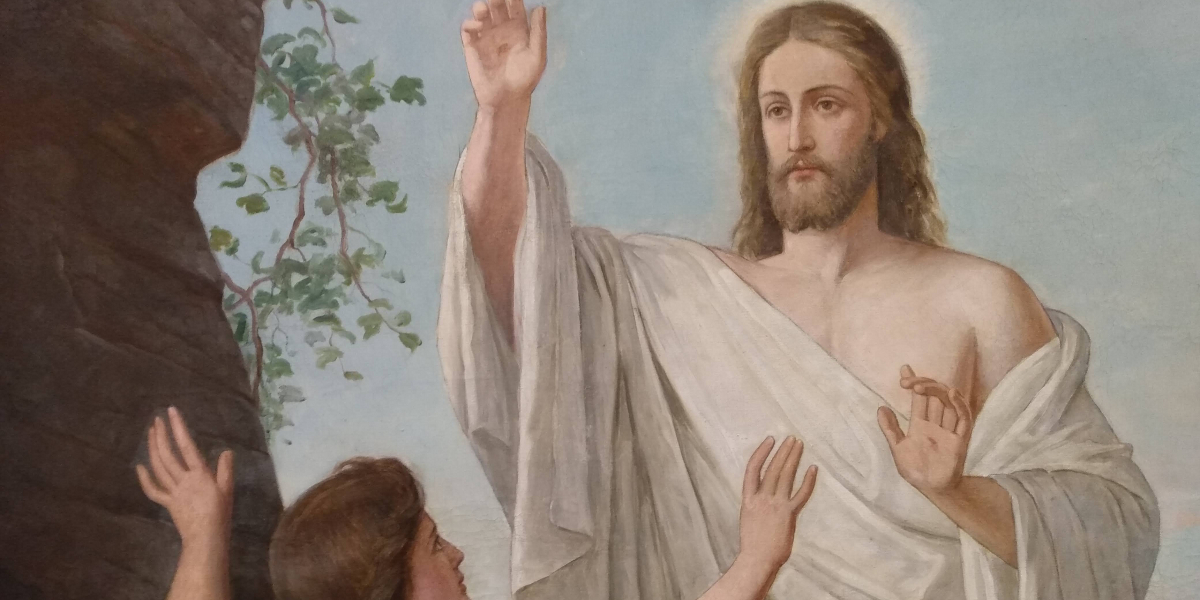
The Fourth Sunday of Easter – Pr. Faugstad sermon
Text: Judges 2:10-23
In Christ Jesus, whom God the Father sent to save us from all the enemies who tempted and afflicted us, dear fellow redeemed:
I have had the experience multiple times that I am talking with strangers, and they find out I am a pastor, or I ask them if they ever go to church. And they respond with something like, “Fire would probably drop out of the sky on me if I tried to walk into a church.” Or, “If they knew the things I have done, no one would want me there.” Or, “It’s too late for me.” Their underlying assumption is that they have been too bad or sinned too much to be forgiven.
This is a good opportunity to assure them that “the blood of Jesus [God’s] Son cleanses us from all sin (1Jo. 1:7), even the sins we think are unforgiveable. The very fact that a Christian is having a conversation like this with a non-Christian shows that God is a gracious God who wants all sinners to come to repentance and faith. But we Christians who know this also wonder sometimes if we have sinned too much to be forgiven. We ask ourselves, “If I were in God’s place, would I still be patient with me? Would I still love me?” We wonder how it will go for us when we finally do “meet our Maker.”
Today’s reading gives us a good picture of who that Maker is and how He operates. What we have in Judges 2 is a summary of what the rest of the book is about. It gives the pattern of the Israelites being tempted toward the gods of the Canaanites and worshipping these false gods. Then the LORD allowed their enemies to oppress them. Then the people cried out for deliverance. Then the LORD in His mercy sent judges to save them. This happened again and again.
What was so appealing about the gods of the Canaanites? Our reading states that the Israelites “abandoned the LORD and served the Baals and the Ashtaroth.” The Canaanites believed that the god Baal brought the rain that caused all life to spring forth. Asherah was a female goddess associated with fertility. The pagan people worshipped Baal and Asherah by engaging in sexual intercourse on hills and other high places, so these make-believe gods would be pleased and would bring fruitfulness to the land.
The Israelites looked at their own religion of strict moral law and of restraining their sinful inclinations, and it didn’t seem nearly as exciting and fulfilling as the religion of the Canaanites. So as today’s reading says, “they whored after other gods.” They rejected the true God, the God who loved them. The same thing happens today. We teach the holy Commandments of God which were given for our protection and blessing and also as a check on our sinful nature. But many reject His Commandments because they want to live their own way, walk their own path, answer to no one but themselves.
That approach to life does sound appealing. But what has this self-centered attitude done to our culture and our communities? It has caused many to walk away from marriage and having children. When there are children, many of them grow up in broken homes. People are lonely, even as there are supposedly more and more ways to “stay connected.” Many wonder what the purpose of life is, and they try to fill the emptiness with possessions, entertainment, and pleasure.
When this happens among the baptized, those whom God in His mercy has brought out of darkness into His marvelous light, whom He has claimed as His own and covered in His righteousness—when this happens to us His people, He may try to wake us up like He did the Israelites. Our reading says, “He gave them over to plunderers, who plundered them. And He sold them into the hand of their surrounding enemies…. [T]he hand of the LORD was against them for harm, as the LORD had warned…. And they were in terrible distress.”
A wake up call is not always pleasant. I imagine you have had a number of these as I have. You had to learn the hard way that you were neglecting your spouse, neglecting your family, neglecting your health. Your priorities were out of whack. Your Bible and devotion books were collecting dust. You felt stuck and unsettled. And somehow the Lord exposed your selfishness, or your pride, or your dishonesty, or your stubbornness.
Maybe it was through a sermon or through a conversation with a friend. Maybe it was because someone called you out, or you came to the realization by your own reflection. It hurts to go through this. It hurts to admit you were wrong, that you haven’t made good decisions, that you are not as right as you want to think. But that very recognition of your own weakness and failure, that is a gift from God. It shows He has not left you or rejected you. Once He has broken down your sinful works, He can build something better in you and with you.
This is why He sends crosses and trials; He does it to refine and strengthen our faith. It is too easy to take our prosperity and success for granted like the Israelites did, and to ignore the Word of God like they did. So God uses the troubles we experience to lead us to repentance, to an honest assessment of ourselves. And He uses our troubles to draw us closer to Him. He is not a “three strikes and you’re out” God, a God whose anger against our sin just keeps building and building until His wrath explodes against us.
Certainly His anger is kindled by continuous sinning, like it was toward the Israelites. But the afflictions He sent their way were done out of love. He did not want to lose them forever. He was ready to have mercy on them and eager to forgive them. Today’s reading says, “For the LORD was moved to pity by their groaning because of those who afflicted and oppressed them.” He wanted to save them. He wanted them to have relief from their troubles and to know that He, the only true God, was their God.
The Lord was patient with them. None of us would have been as patient with the Israelites as He was toward them. He had brought them out of slavery in Egypt, led them to the Promised Land, given them victory over their enemies, and handed them a beautiful place to live. They repaid Him by worshipping the false gods of the peoples they had defeated. Still, the LORD called them back. Still, He rescued them. Still, He blessed them.
The Lord Is just as Patient with You. He brought you out of the slavery of sin at your Baptism, taught you His unchanging truth throughout your years, absolved you of your sins week after week, and regularly called you to His holy Supper where He gives His own body and blood for your spiritual and eternal good. How have you thanked Him for these gifts? How have your words and actions in your day-to-day life shown your appreciation for what He has done?
When we reflect on this, we see that we are no more deserving of His grace than the Israelites were, but He gives it to us just as He gave it to them. When all we had done was sin, God the Father sent His holy Son to take our place. He sent His Son to be born of Mary, who descended from the same wayward Israelites we are hearing about today. Despite their tremendous sins against Him, God kept His promise to send a Savior and carried it out through them. Though they were faithless, He remained faithful; He could not deny Himself (2Ti. 2:13).
He is also faithful toward you. 2 Peter 3:9 says, “The Lord is not slow to fulfill his promise as some count slowness, but is patient toward you, not wishing that any should perish, but that all should reach repentance.” He wants you every day to repent of your sin and trust His promises. He wants you to rely on Him in times of trouble and triumph, sadness and joy, in good days and bad. The love He has for you is not some weak connection that could easily break and separate you from Him. He loves you with a strong love, a love so strong that He sacrificed His only Son for your salvation.
His Son had the same love for you. He willingly accepted your hurtful words and selfish actions. He paid the penalty for your dishonesty and pride. He suffered for your sinful stubbornness. He died for you, so that you would not be overcome by your spiritual enemies but would rest securely in His grace. His death on the cross for all sin means you have not sinned too much to be forgiven. The fact that you are sitting here today listening to His Word shows that He is merciful to you and wants you to know His love for you.
In His love, He promises to turn your times of suffering and trial into good. It is always tempting to dwell on the suffering, but it is better to cling to our Lord’s promise, the promise He spoke to His disciples in the Holy Gospel. Jesus said to them and us, “So also you have sorrow now, but I will see you again, and your hearts will rejoice, and no one will take your joy from you.” (Joh. 16:22).
The Lord, who died and rose again in victory, is with you each step of the way, ever-patient, always gracious, bearing your griefs and carrying your sorrows. He brings you comfort and joy as He meets you in His powerful Word and Sacraments. And He prepares you to greet Him when He returns on the last day to give you eternal salvation. On that day, you will praise Him for His patience with you, and your heart will be filled with a heavenly joy that no sadness or trouble will ever take away.
Glory be to the Father and to the Son and to the Holy Ghost; as it was in the beginning, is now, and ever shall be, forevermore. Amen.
+ + +
(picture from Jerico Lutheran Church altar painting)

The Second Sunday of Easter – Pr. Faugstad sermon
Text: Joshua 5:13-6:6
In Christ Jesus, who waits for just the right time to give just the right blessings, dear fellow redeemed:
The Lord’s apostle Thomas had a tough week. Mary Magdalene and the other women said, “We have seen the Lord!” The two Emmaus disciples said, “We have seen the Lord!” His fellow chosen disciples said, “We have seen the Lord!” Why did Thomas seem to be the only one who hadn’t seen the Lord that Easter Sunday? Why would Jesus leave him out? He couldn’t bear the thought; they must be mistaken.
So all week long, no matter who talked to him, and no matter what evidence they offered of Jesus’ resurrection, Thomas defiantly replied, “Unless I see in his hands the mark of the nails, and place my finger into the mark of the nails, and place my hand into his side, I will never believe” (Joh. 20:25). But did he also have some doubts about his firm position? As each day passed without the Lord appearing, did he wonder, “O Lord, what are You waiting for?” Or did the passing of each day without the Lord’s appearance make him more firm in his denials?
He asked for proof, real tangible evidence. He wanted to see it, or he said he would never believe it. This showed a misunderstanding of what it means to “believe.” It is not a decision that a person makes when the evidence is convincing enough. It is not a scientific process of gathering facts until there is no possible conclusion but one. To “believe” is to trust that something is so, or that something will be, even when there is no tangible evidence or logical basis to support it.
The Israelites were operating by faith as they marched around the walls of Jericho. They trusted that the LORD would give them the victory He promised. But we could understand if their faith wavered a bit. Like Thomas who had to wait a week before Jesus revealed Himself to him, the Israelites had to wait a week before the LORD delivered Jericho into their hands.
Each day for six days, they were directed to march one time all the way around the city. The only sound to be made was seven priests blowing seven rams’ horns. The men of war were to march in silence. As each day passed with nothing happening, did those Israelites wonder within themselves, “What are You waiting for?” What if nothing happened at all? They would be the laughing-stock of all the land of Canaan if they marched around a city for a week and nothing happened. Possibly while they marched they could hear the inhabitants of Jericho yelling down at them, taunting them, ridiculing them.
But as strange as it seemed to do what God said, they held onto His promise. They followed the LORD’s instructions. For six days, they marched around once, and on the seventh day, they marched around the city seven times in the same manner as before. Then the seven priests blew their trumpets. On their cue, the men of war sent up a great shout, and the walls of Jericho dropped straight down just like a skyscraper that is imploded.
The Israelites’ seven-day wait was rewarded with a complete victory over the city and its inhabitants. Their faith in the LORD’s promise was confirmed. The wait was definitely worth it. Because the LORD made them wait and made the walls of Jericho fall without anything touching them, the Israelites saw more clearly that the victory was the LORD’s.
The “sevens” in the account emphasize this. The number seven in the Bible is closely tied to God, so it represents His holiness or perfection. He directed seven priests to march for seven days carrying seven horns, with seven trips around the city on the seventh day. This was the work of the holy LORD; this was His doing out of love for His people.
The same holy LORD still works on your behalf, to give you blessings. But when you have to do something you don’t want to do, or when relief is taking longer than you want, it is easy to ask Him, “What are You waiting for?” You may have asked that when you were sick and didn’t seem to be getting better. You may have asked that when you were being mistreated by a classmate or co-worker or member of the community. You may have asked that when a close relationship was strained, when great troubles loomed in your future, when the questions kept piling up but no answers—“What Are You Waiting For?”
It is natural to ask this. We even have examples of wording like this in the Psalms of lament. But the psalmists don’t stop with that question. They go on to express their confidence that the LORD will act, that He will deliver them at the right time. We need to remember who is calling the shots, who has the Master plan. This is brought home to us by the first part of today’s reading, when Joshua comes face to face with a mysterious Man of war. Joshua asked Him, “Are You for us, or for our adversaries?” It’s a simple choice. We think the answer will be “I am for you.” But instead the Man replied, “No; but I am the commander of the army of the LORD. Now I have come.”
God is not interested in taking the side of sinners, as though He is just another weapon in our arsenal. He wants us to take His side, to put our trust in Him. This is instructive for when we wonder if we should pray for our favorite sports team, as though God is a fan like we are, or that our team is more righteous than another. God is above all this. He doesn’t want us to be so focused on sides in this life. He wants us to stay focused on His Word.
This is the crucial step when we ask Him, “What are You waiting for?” Instead of just staring up in the sky and waiting for something to happen, the LORD wants us to hear His holy Word. He wants us to review His promises, take them to heart, understand anew His love for us. He wants us to believe that He sent His only-begotten Son to take on flesh for us. He wants us to believe that Jesus satisfied the requirements of God’s holy Law in our place and died to make satisfaction for all our sin. He wants us to believe that Jesus rose on the third day in victory over death just as He said He would.
This was Thomas’ failing. He might have thought that His friends were playing a cruel trick on him, but he should not have rejected Jesus’ clear word. Before His death, Jesus told all twelve of the disciples, “See, we are going up to Jerusalem. And the Son of Man will be delivered over to the chief priests and scribes, and they will condemn him to death and deliver him over to the Gentiles to be mocked and flogged and crucified, and he will be raised on the third day” (Mat. 20:18-19). Thomas heard those words, but like his fellow disciples, he did not believe them.
They did not believe until they saw Jesus, until they had tangible proof. And Jesus said to them, “Blessed are those who have not seen and yet have believed” (Joh. 20:29). Sometimes Christians will ask God for some special sign of His love, some evidence that will show them He is really present, that He really cares. And the LORD says to us, “Blessed are those who have not seen and yet have believed.”
He calls you to trust His love even when it seems like He is angry with you, to rely on Him even when there appears to be no end to your troubles, to follow His Word even when you can’t see a “light at the end of the tunnel.” Because He is only waiting for the right time. He will not forget about you. Everything He does is for your good.
Day seven was the right time for the walls of Jericho to come crashing down just as the LORD promised they would. Seven days was the right time to hide Himself from Thomas, so Thomas would learn to trust Jesus’ Word and not his own reason. And however long you must wait for relief or help or deliverance is the right amount of time. Whatever you go through, Jesus is with you. Did you notice how He repeated Thomas’ words showing that He had seen all and heard all? Thomas didn’t know it, but Jesus was with Him the whole time.
And so He is with you always, even to the end of your life, even to the end of the age (Mat. 28:20). He is with you “where two or three are gathered in [His] name” (Mat. 18:20). He is with you when He brings forgiveness right to your heart in the absolution. He is with you when you come forward to His holy table. These are the means of His grace by which He makes the walls of your sin and doubt come crashing down. This is where He gives you strength for today and for tomorrow. This is where He turns your desire for proof of His love into the assurance that He loves you with a perfect love.
This is where He changes your impatient, “What are You waiting for?” into a faithful and eager waiting for His grace. We join the psalmist in this faithful waiting and say, “I wait for the LORD, my soul waits, And in His word I do hope. My soul waits for the Lord More than those who watch for the morning—Yes, more than those who watch for the morning. O Israel, hope in the LORD; For with the LORD there is mercy, And with Him is abundant redemption” (Psa. 130:5-7, NKJV).
Glory be to the Father and to the Son and to the Holy Ghost; as it was in the beginning, is now, and ever shall be, forevermore. Amen.
+ + +
(woodcut from “Doubting Thomas” by Julius Schnorr von Carolsfeld, 1794-1872)

Palm Sunday – Pr. Faugstad sermon
Text: Numbers 21:4-9
In Christ Jesus, whose saving work was foretold by the prophets and depicted among the peoples at many times and in many ways, dear fellow redeemed:
If you had to guess what verse in the Bible is the most popular one, you would probably say John 3:16, “For God so loved the world that He gave His only begotten Son, that whoever believes in Him should not perish but have everlasting life.” It is an awesome verse. It clearly states that we are saved from our sin and death by faith in the Son of God. But did you know that the context leading up to this verse includes a reference to the bronze serpent that Moses made?
John 3:14-15 says, “And as Moses lifted up the serpent in the wilderness, so must the Son of Man be lifted up, that whoever believes in him may have eternal life.” Then the famous passage follows. By this reference to today’s account from Numbers 21, our Lord is teaching us how to read the Old Testament. We read the Old Testament not just for historical purposes and not just for lessons about what we should and should not do. We read the Old Testament as a book about God keeping His promises, including His chief promise to send a Savior for sinners.
We certainly find sinners in today’s reading. Once again, the Israelites became impatient. Once again, they grumbled and complained. They took God’s gifts for granted and wished they could go back to Egypt where they recalled being so happy and healthy. It is obvious the devil had “pulled the wool over their eyes.” The people needed to be brought out of their spiritual sleep. They needed to be reminded who the LORD was and what He was doing for them.
But being made aware of our wickedness and weakness is not a pleasant experience. It certainly wasn’t for the Israelites. The LORD sent fiery serpents among the people. We don’t know exactly what made the serpents “fiery.” Perhaps it was their appearance. Perhaps it was the type of pain people felt when they were bitten. It was a terrifying experience that claimed the lives of many people.
It also woke the people up. They came to Moses in humility and repentance, “We have sinned, for we have spoken against the LORD and against you. Pray to the LORD, that He take away the serpents from us.” They realized their sin the hard way. Instead of trusting God and obeying His will, they broke His holy Law and faced the consequences.
We can also think of many times that we learned about sin “the hard way.” We decided to do what we knew was wrong. We thought we could get away with it, or we thought it was worth the risk, but that sin came back to bite us hard. Some sins have temporary consequences, but other sins have deeper consequences that can last our entire life and negatively impact others even after we are gone.
The sin we have inherited from Adam is like the bite of a poisonous serpent. The poison works its way further and further in, and if no treatment is applied, it leads to death. The Book of James outlines the progression of sin: “But each person is tempted when he is lured and enticed by his own desire. Then desire when it has conceived gives birth to sin, and sin when it is fully grown brings forth death” (Jam. 1:14-15). This is not just about physical death which touches all people. This is about eternal death in hell which is received by all who remain in their sin and refuse to repent.
It was a gift from God that the people afflicted by the fiery serpents repented. Not everyone feels sorry for sin. Many boast how there is nothing about their life they would change. “I did it my way,” they say, as though that is something admirable. So we see that God was mercifully leading the Israelites out of their sin and unbelief and back to Him in faith. They went to God’s servant Moses, admitted their wrong, and begged him to intercede for them. Moses prayed to the LORD, and the LORD listened to his prayer. He said to Moses, “Make a fiery serpent and set it on a pole, and everyone who is bitten, when he sees it, shall live.”
Now this seems a little odd. Why would God tell Moses to put on a pole an image of the very animal that was killing them? And how could the lifeless image of a serpent save the people from the bite of actual serpents? This was a test of faith. The power to save the people was not in a piece of metal on a pole. The power to save the people was in the promise God attached to the image. He said, “and everyone who is bitten, when he sees it, shall live.” Would the people trust God’s Word now?
We are faced with a similar test when we look at God’s Sacraments. Many people—even many Christians—reject the Sacraments as external things, as empty rituals, that have no real effect on our faith. They say it is little more than getting water splashed on you, than eating bread and drinking wine. We receive no benefit if we look at the Sacraments in this way and just go through the motions because we feel like we should. But if we listen to what our Lord says about them, if we recognize that the power of the Sacraments is in His Word, and we trust the promise He attaches to these visible means, then we receive great benefit.
The Israelites may have tried to apply medicinal remedies of their own making to their family members and friends who had been bitten. Maybe they tried to chase the snakes away. But their efforts all failed. People kept dying. They could not save themselves. Only God could rescue them. He directed Moses to lift up the bronze serpent on a pole, and the people who trusted His promise were spared. “[I]f a serpent bit anyone, he would look at the bronze serpent and live.”
So when the devil with his temptations slithers toward you, when sin sinks its fangs into you, when its poison works its way through you, what can you do? You can’t save yourself. You don’t have the power to neutralize your sins or keep their poison from spreading. You can’t heal the wounds inflicted by your sin or outrun the consequences of what you have done. There is only one remedy, only one antidote for sin—“as Moses lifted up the serpent in the wilderness, so must the Son of Man be lifted up” (Joh. 3:14).
The Son of Man, Jesus Christ, had to be lifted up. It was absolutely necessary. The antidote for sin’s poison had to come from God to us. He sent healing and salvation to us by giving His Son to suffer and die in our place. That is our focus in this holiest of weeks beginning with our Lord’s humble entry into Jerusalem.
He was welcomed as a king on Palm Sunday, but the true nature of His kingdom would not be clear until He was wearing a crown of thorns on Friday. His throne was not covered in gold. It was splattered in the holy blood that oozed from His wounds. His throne was that rough, wooden cross that lifted Him up for all eyes to see. Many looked at Him in unbelief; they ridiculed and blasphemed Him.
Even for them, Jesus willingly suffered. Even for you. He carried your sins to the cross. He felt their painful bite and their burning poison. He did not grumble or complain. He did not ask His Father why He sent Him from heaven to die in the wilderness of the world. He accepted the punishing wrath of God and endured the eternal torments of hell, so you would not die but live.
Sin filled you with death, but Jesus fills you with life. He counteracts the effects of all your sins, including the ones that caused deep wounds and piercing pain in you and others. By giving up His holy life in payment for sin, He won forgiveness and salvation for you. He brings the fruits of His victory to you right now through His Word and Sacraments. Through these means, He imparts the medicine of life. You hear His promises spoken to you, you eat His body and drink His blood with faith in what He says, and His power works through you to heal, comfort, and strengthen you.
Whether you feel healthy and strong in your spiritual life or under attack and weak, you keep your eyes always on the Son of Man who was lifted up to save you. If you tried to measure your faith by how well you are doing or how much you have accomplished, you would be applying the Law as a remedy to your sinfulness. But the Law cannot save you. One of our great Lutheran hymns puts it well:
The law reveals the guilt of sin,
And makes men conscience-stricken;
The gospel then doth enter in,
The sin-sick soul to quicken.
Come to the cross, loop up and live!
The law no peace to thee doth give,
Nor can its deeds bring comfort. (Evangelical Lutheran Hymnary #227, v. 9)
You look to Jesus for comfort. His Father sent Him to fulfill the promise of the ages by suffering and dying in your place. Like the whole creation that eagerly waits for the blossoming and new life of spring, the entire Old Testament anticipates the coming of the Savior. Jesus said to the Jews, “You search the Scriptures because you think that in them you have eternal life; and it is they that bear witness about me” (Joh. 5:39).
The bronze serpent on a pole was a picture of what Jesus would do on the cross. Like the Israelites who looked up with faith in the LORD’s promise, you also by faith Come to the Cross, Look Up and Live! In Jesus, you have life for today, life for this Holy Week, and life forevermore. Thanks be to God. Amen.
+ + +
(picture from “Crucifixion, Seen from the Cross,” by James Tissot, c. 1890)

The Second Sunday in Lent – Pr. Faugstad sermon
Text: Exodus 17:1-16
In Christ Jesus, who refreshes us as we travel through the wilderness with the living water of His Word and the nourishment of His holy body and blood, dear fellow redeemed:
It is a common phenomenon to view the past more positively than we view the present, and to view the past more positively than we actually experienced it. Psychologists suggest the term “rosy retrospection” for this. It is looking into the past with rose-colored glasses and wishing we could go back to a time when we had so few troubles and cares. But what we are doing with this “rosy retrospection” is minimizing our struggles in the past while magnifying our struggles in the present.
We find the Israelites doing the same thing, and they were not even looking back that far. Had they forgotten how poorly they were treated as slaves? How they were forced to work harder and harder with fewer resources? How Pharaoh commanded them to drown their baby boys in the Nile River? Had they forgotten how the LORD spared their lives by the blood of the lamb on their doorposts, and how He led them out of Egypt and through the Red Sea on dry ground?
As soon as they faced trials in the wilderness, they immediately started to complain. In their hunger, they recalled how they “sat by the meat pots and ate bread to the full” in the land of Egypt (Exo. 16:3). When they were thirsty, they thought of the abundance of water at the Nile River and grumbled against Moses, “Why did you bring us up out of Egypt, to kill us and our children and our livestock with thirst?” Would they have really preferred to return as slaves in Egypt than to be with the LORD in the wilderness?
But that was the root of the problem—they were not convinced the LORD was actually with them. That is the question they kept asking one another: “Is the LORD among us or not?” It’s shocking that they would wonder this. Hadn’t they seen the LORD leading them in a pillar of cloud and fire, and the walls of water on either side of them as they passed through the Red Sea? Hadn’t they seen the entire army of Egypt dead on the seashore? How could they doubt the LORD?
They doubted Him because they assumed that if He were really with them, they wouldn’t have to go without food; they wouldn’t have to go without water. All their needs would be provided for—if He were really with them. Thoughts like these have crossed our minds too: “If You are really with me, LORD, why don’t You make my pain go away? Why don’t You heal me or my loved one? Why don’t You remove these troubles or obstacles, so I can serve You better?”
The crosses we have to carry in this life are tremendous tests of our faith. In the midst of our struggles, we wonder why the all-powerful, all-knowing, everywhere present God doesn’t remove those crosses. If He can, then why doesn’t He? We learn something about this in the Holy Gospel for today (Mat. 15:21-28).
A Canaanite woman came to Jesus begging Him to have mercy on her demon-oppressed daughter. At first, Jesus did not answer her. But she didn’t give up; she took her request to Jesus’ disciples. They became so annoyed by her persistence that they now begged Jesus to send her away. Still He did nothing. So she knelt right in front of Him—she wouldn’t be denied. Jesus said to her, “It is not right to take the children’s bread and throw it to the dogs.” And she replied, “Yes, Lord, yet even the dogs eat the crumbs that fall from their masters’ table.” Acknowledging her great faith, Jesus granted her request and instantly healed her daughter.
Why did Jesus act like this? Why did He prolong the suffering of this woman and her daughter? Why did He treat her almost like an enemy? The answer is not that “even Jesus gets annoyed or impatient sometimes.” The answer is that the trial Jesus put this woman through was for one purpose only: to strengthen her faith in Him. But how can God expect to draw us closer when we feel like He is pushing us away?
Think about how parents might play with their children. A mother might hide a piece of cookie from her toddler or keep moving it just out of his reach. The toddler protests, but he doesn’t give up. He keeps reaching and tries harder until he grabs it. Or a father might wrestle with his kids and act like their enemy, only to gather them into a big bear hug in the end. In the same way, God might make us work at something difficult or wrestle with some hardship, so that we learn to cling to Him and trust His promises.
That is what He wanted the Israelites to do. It was no mistake that the LORD led them to Rephidim where there was no water. This hardship was an opportunity for the people to prove their love for Him, to demonstrate their holy fear of Him, to show that they would trust His providence and care. They did not pass this test, but the LORD still had mercy on His people. He would provide more opportunities along the way for them to exercise their faith.
In this case, He ordered Moses to take his staff, with which he had struck the Nile and turned it to blood, and which he used to part the Red Sea. He told Moses to strike a rock, and water would come out of it. Moses did, and it did, and the people had plenty to drink. If God could do this, if He could make water flow out of a rock in the desert, what can’t He do for us in our time of need? We might not see a way out of our troubles. We might feel hopeless about a situation ever improving. But nothing is impossible for God.
Just after God provided water for the Israelites, we are told that the Amalekites came to fight against them. This was another tremendous test. The Israelites had no military training. They were not prepared for this. But the LORD fought for them. Moses went up on a hill and raised his staff. As long as his staff was held high, Israel prevailed. When his arms grew weary, Aaron and Hur stood on either side of him and held up his arms. So the Israelites with Joshua in command won the victory.
No one expected a rag-tag company of slaves to march out of Egypt and prevail in battle. No one expected water to come out of a rock, enough for perhaps hundreds of thousands of people and their livestock besides. If we have learned anything from the Bible or from human history, it is that we can expect the unexpected from God.
Nowhere is this more evident than God the Father sending His Son to take on human flesh by the power of the Holy Spirit. Did the Father send Him in anger to destroy the world? No! He sent His Son to save the world of sinners by offering up His holy life in the place of every transgressor. Jesus willingly suffered and died for your sins, including your doubts about His faithfulness to you, your impatience in suffering, and your failure to trust what He promises. Jesus shed His blood to wash all this away and to open heaven to you through the forgiveness of your sins. That was unexpected!
Today’s reading includes some comforting pictures of Jesus’ suffering and death for us. Moses’ outstretched arms that brought victory to the Israelites is a picture of Jesus’ outstretched arms on the cross by which He brought us victory over sin, death, and the devil. The staff Moses used to strike the rock causing water to gush out is a picture of the spear plunged into Jesus’ side after His death that caused blood and water to gush out.
St. Paul makes this connection to Christ even clearer. He says that the Israelites “drank from the spiritual Rock that followed them, and the Rock was Christ” (1Co. 10:4). Yes, the LORD was certainly with them in the wilderness, even the One who many years later would pay the penalty for their sins of grumbling, quarreling, doubts, and denial.
The LORD knows our sins just as plainly as theirs. He hears our “It isn’t fair!” our “I don’t deserve this!” our “Where are You? Why won’t You help?” And in response, we hear Jesus say, “Father, forgive them, for they know not what they do.” “My God, My God, why have You forsaken Me?” Then, “I thirst.” And, “It is finished.” Jesus took all your sins, your troubles, your sorrows on Himself. He accepted the eternal punishment of hell for you and felt its terrible fire, so much so that He longed for just one drop of water to cool His tongue.
He felt this thirst for you, so you would evermore drink from His grace. Jesus said, “whoever drinks of the water that I will give him will never be thirsty again. The water that I will give him will become in him a spring of water welling up to eternal life” (Joh. 4:14). This is what we have in His holy Word and Sacraments. Through these means, we have here ample food and drink for our journey through the wilderness.
So when we are tempted to ask, “Is the Lord among Us or Not?” we can remember the Lord’s mercy and grace toward us in the past, which continue to cover us in the present, and which will lead us into the future. There is no need for “rosy retrospection” with God because everything is rosy when it is cleansed by and covered in the blood of Jesus, our Rock and our Redeemer.
Glory be to the Father and to the Son and to the Holy Ghost; as it was in the beginning, is now, and ever shall be, forevermore. Amen.
+ + +
(picture from the altarpiece in Weimar by Lucas Cranach the Younger, 1555)

Midweek Lent 1 – Pr. Faugstad homily
Text: St. Matthew 24:1-2
In Christ Jesus, the stone rejected by the builders, which has become the cornerstone of God’s holy house, dear fellow redeemed:
If someone told you that all the buildings in Cresco or New Hampton were going to be dismantled down to their foundations, you would have a hard time believing it. Even if you had no reason to doubt the source of the information, it would be hard to imagine what chain of events would bring about this complete destruction.
The disciples of Jesus were likewise shocked when Jesus told them that the magnificent temple in Jerusalem would be destroyed. Some estimate that the stones of the temple were as large as 37 feet long, 18 feet wide, and 12 feet high (The Lutheran Study Bible, CPH, note for Mark 13:1). The stones were decorated with gold which dazzled in the sunlight. “What wonderful stones and what wonderful buildings!” said the disciples (Mar. 13:1).
The original and most beautiful temple in Jerusalem was completed by King Solomon in the mid-900s B. C. This stood until around 587 when the Babylonians destroyed it and took the people of Judah into captivity. About seventy years later, a less ornate temple was built again after the Jews were allowed to return and rebuild Jerusalem. This temple remained until King Herod enhanced and expanded it shortly before the birth of Christ.
This temple was a source of great national pride. It gave the Jews the assurance that God must be pleased with them. After all, they made the daily sacrifices that God commanded. They prayed in the temple. They kept the festivals and feasts. But just before today’s reading, Jesus stood up in the temple and said, “O Jerusalem, Jerusalem, the city that kills the prophets and stones those who are sent to it! How often would I have gathered your children together as a hen gathers her brood under her wings, and you would not! See, your house is left to you desolate” (Mat. 23:37-38).
He followed this up by telling His disciples privately, “You see all these [buildings], do you not? Truly, I say to you, there will not be left here one stone upon another that will not be thrown down.” The temple would be utterly destroyed, and not just the temple, but the entire city of Jerusalem. This happened about forty years later in the year A. D. 70, when the Romans breached the walls of Jerusalem after an extended siege and laid waste to the city.
The well-fortified city walls did not save the people. The shining temple in the center of the city did not save them. God wanted to save them, but they rejected the salvation He sent. On His way to Jerusalem at the beginning of Holy Week, Jesus wept over the city, saying, “Would that you, even you, had known on this day the things that make for peace! But now they are hidden from your eyes” (Luk. 19:42). At that time also, He had predicted the destruction of the city, that one stone would not be left upon another. Why would this happen? “Because,” said Jesus, “you did not know the time of your visitation” (v. 44). So many of the people had rejected their Lord of life.
The destruction of Jerusalem and its temple serve as a warning for us that the things which may seem most solid and immovable on this earth also have an expiration date. The powerful countries, officials, and businesses will pass away. The great cities will fall. Our possessions, no matter how valuable; our bank accounts, no matter how full; our homes, no matter how well-built, will one day fall apart, be emptied, and come crashing down.
But there is a deeper lesson here. The people in Jerusalem were trusting in their work for God instead of His work for them. This can happen to us as well. We can quietly compare ourselves with others and feel prideful, saying with the boastful Pharisee, “God, I thank you that I am not like other men” (Luk. 18:11). Or we can think that our attendance at church and our regular offerings are pleasing to Him, even if our heart is not really in it.
But God does not want empty actions. He wants repentance and faith. David put it this way in his penitential psalm: “For you will not delight in sacrifice, or I would give it; you will not be pleased with a burnt offering. The sacrifices of God are a broken spirit; a broken and contrite heart, O God, you will not despise” (Psa. 51:16-17). That is why Jesus wept over the city—He saw very little repentance and faith among His people who had the Holy Scriptures. They had the truth of God and rejected it.
None of the impressive and beautiful things created by our hands can measure up to the glory of God. None of our works, none of our achievements, none of our abilities can secure for us the favor of our Lord. Only Jesus could do this. Only He could lay the foundation and set the cornerstone for a holy temple that would never fall. Only He could establish a spiritual house for the offering of “spiritual sacrifices acceptable to God through Jesus Christ” (1Pe. 2:5).
Our “spiritual sacrifices,” our prayers, our good works, our acts of Christian love, are “acceptable to God through Jesus Christ.” They are acceptable to God because we do them in faith. We know we cannot earn His favor by what we do. We know that we already have favor with Him because of what Jesus did for us. Jesus is “the stone that the builders rejected [which] has become the cornerstone” (Psa. 118:22). He is the Rock on which the Church is built. We stand firmly on Him.
Jesus could not be thrown down. He could not be destroyed. He is the Son of God, through whom all things were created. He is the Lord of life. After the first time that Jesus cleared the temple of all who bought and sold in it, the Jewish leaders asked Him, “What sign do you show us for doing these things?” Jesus replied, “Destroy this temple, and in three days I will raise it up.” They thought He was talking about the temple building itself and ridiculed Him. But Jesus was speaking about His body (Joh. 2:18-21). He would soon die on the cross for all sin, and then He would rise again on the third day. That temple could not be destroyed.
The temple building in Jerusalem was impressive, but it was nothing but an empty structure, a desolate house, without the Lord’s gracious presence. The same is true for our churches. If we no longer focus on Jesus, if we no longer receive His gifts through the Word and Sacraments with repentance and faith, then we have rendered these beautiful structures meaningless. If our confidence as Christians is in a building, then we are no different than the Jews in Jesus’ day who trusted a building more than the Son of God incarnate.
We know that everything we see on earth will one day be gone. Even our bodies will fail and return to dust. But as St. Paul writes, “we know that if the tent that is our earthly home is destroyed, we have a building from God, a house not made with hands, eternal in the heavens” (2Co. 5:1). We have a home with God above, a temple that will never be destroyed. By His grace, we will enter His holy household, where we will live in perfect peace and joy for all eternity. Thanks be to God! Amen.
+ + +
(picture from “Siege and Destruction of Jerusalem” by David Roberts, 1850)

The Transfiguration of Our Lord – Pr. Faugstad sermon
Text: Genesis 41:37-43
In Christ Jesus, who through our light momentary afflictions is preparing for us an eternal weight of glory beyond all comparison (2Co. 4:17), dear fellow redeemed:
What happened?!? If you heard last week’s sermon about Joseph being sold as a slave in Egypt, and then you heard today’s reading about Pharaoh making Joseph his right hand man, you have to wonder how one led to the other. Here’s how it happened. When Joseph was brought to Egypt as a seventeen-year-old, he was purchased by a man named Potiphar, the captain of Pharaoh’s guard. For a while, everything went well. In fact, it went very well. The LORD blessed whatever Joseph did, and Potiphar noticed. So he made Joseph the manager of all he had and “had no concern about anything but the food he ate” (Gen. 39:6).
If we had to guess what came next, we might imagine one of Pharaoh’s people seeing the good job Joseph did for Potiphar and recommending him to Pharaoh. That could explain how Joseph made his way to Pharaoh’s house. But his path to honor and glory was not as direct as that. First, Joseph had to go to prison. He had to go to prison because Potiphar’s wife accused him of trying to rape her. The truth was that she tried to seduce Joseph. And as easy as it might have been for him to carry on a secret affair as a slave in a foreign land, he rejected her temptations. He told her, “How then can I do this great wickedness and sin against God?” (v. 9).
Seeing that Joseph would not give her what she wanted, she resolved to destroy him. She told the lie, and her husband Potiphar threw him in prison where the king’s prisoners were confined. So now Joseph was in worse shape! But the LORD blessed him there too, and in time, the keeper of the prison set Joseph over all the other prisoners. “And whatever he did, the LORD made it succeed” (v. 23).
Some time later, Pharaoh became angry with his chief cupbearer and his chief baker and sent them to the same prison as Joseph. After they had been there a while, both of these former officials had strange dreams one night. By the power of God, Joseph was able to interpret their dreams—a good outcome for the chief cupbearer who in three days was restored to his position, but a bad outcome for the chief baker who three days later was beheaded. Before the chief cupbearer left, Joseph asked him to remember him and mention him to Pharaoh.
Imagine Joseph waiting for a special representative of the court to come to the prison and let him out. His friend the chief cupbearer would not forget. A week passed. Then another week. Then a month. Then a year. Then two years. Joseph must have thought he would never get out. But God had not forgotten him.
The LORD now put two dreams in Pharaoh’s head. First Pharaoh dreamed of seven healthy cows emerging from the Nile River, but these were followed by seven ugly and thin cows that ate up the healthy cows! Then he dreamed of seven healthy ears growing on one stalk. Seven thin ears sprouted after them and swallowed up the healthy ears. Pharaoh assembled all his magicians and wise men, but none of them could interpret his dreams.
Now two years after leaving him, the cupbearer remembered Joseph and told Pharaoh about him. Pharaoh had him brought from prison, and he asked Joseph if he could interpret his dreams. Joseph replied that God would reveal the interpretation. The seven healthy cows and seven healthy ears represented seven years of plenty. The seven ugly cows and thin ears after them represented seven years of famine. Joseph advised that Pharaoh “select a discerning and wise man” (Gen. 41:33), who would store up grain from the seven good years, so there was enough for the seven bad years. And Pharaoh said, “How about you?”
No one could have guessed it. No one sees as God does. No one could imagine that Jacob’s favoritism, the brothers’ hatred, the selling of Joseph, and his trials in Egypt would lead to his position as Pharaoh’s next-in-command. And this isn’t just a rags to riches story. This was part of God’s deeper and longer plan to bring salvation to the world. Joseph had to be installed in Egypt, so he could store up grain, so there would be food for his father and brothers when the famine hit, so they would travel to Egypt and the line of Messiah would be preserved.
While the LORD was doing all these marvelous things, Jacob was back home mourning the death of his son, his other sons were afflicted by guilty consciences for their hatred, greed, and lies, and Joseph thought he would never get out of prison. This should encourage us that no matter how bad our situation seems to be or how hopeless we may feel about the future, that God is working in ways we are not aware of.
This is His promise, to work all things together for good for those who love Him (Rom. 8:28). No matter what evils came upon Joseph, God was there turning each situation into blessing and strengthening him through the trials for a much brighter future. He does the same for you. No matter what hardships you have gone through, God was there hiding His blessings. You maybe couldn’t see them at the time and not for a long time after. But now you see them. You know that He carried you through and worked so much for good.
In your times of suffering, you often can’t see the good. If you only went by your experience, you might conclude that God has abandoned you. He doesn’t care. He is opposed to you, angry with you. But that is not what He tells you in His Word. He promises His love, His care, and His help. That’s what He wants you to focus on—not your experience and how things appear to be—but on His promise and what He tells you is so. The last stanza in our hymn of the month says, “I cling to what my Savior taught / And trust it, whether felt or not” (Evangelical Lutheran Hymnary #226, v. 10).
God is most certainly for you. In fact, Joseph’s story is in part your story because the promise of a Savior that was preserved through Joseph’s efforts in Egypt is why you have a Savior today. God sent His Son to become Man through Jacob’s line, so that He would make payment for the sins of the whole world. For most of His life, Jesus hardly looked like the conquering King He was. Even His disciples who followed Him around for three years were at times unclear about His identity.
This is one reason why Jesus revealed His glory to Peter, James, and John on the mountain and was transfigured before them (Mat. 17:1-9). He wanted them to have a glimpse of His glory, so they would be assured that He was God in the flesh. A short time after this, their confidence would be tested, as Jesus went to Jerusalem and was arrested, beaten, and crucified. How could that be the mighty Son of God if He took such a beating, was crowned with thorns, and was nailed to a cross?
But this is how God operates. He hides His glory in suffering, His healing in pain, and His life in death. His crucifixion was not a defeat; it was a victory. It was not a day for His enemies, but for His friends. It was not His end; it was your beginning with Him. He was on the cross paying for your sins, and then He rose to win you new life. Through your Baptism, you were joined to Him by the power of the Holy Spirit. St. Paul writes that through that washing of regeneration and renewal you were buried and raised with Him. You walk in newness of life with Him (Ti. 3:5, Rom. 6:4).
In another place, Paul writes, “For you have died, and your life is hidden with Christ in God. When Christ who is your life appears, then you also will appear with him in glory” (Col. 3:3-4). So even in your sorrows and pains and hardships, your life is hidden with Christ. Your life is so tied up in His that He can’t help but know your troubles. You are a member of His body. How could He not care about your well-being?
You cannot see Him now, but He is present to help you. You see His presence in Joseph’s life when He made everything Joseph did successful through his thirteen years as a slave and a prisoner in Egypt. You see His presence in your life, too, when you remember how He comforted you through His Word, how He forgave your many sins, how He continued to invite you to eat His own body and drink His own blood. His power, His life, and His salvation are hidden in His Word and Sacraments.
These gifts are hidden from your physical sight, but your faith finds them there. They are not hidden from faith. By faith, you trust that Jesus is with you. No matter how deep the pit is, Jesus is there. No matter how severe the pain, Jesus knows. No matter how hopeless the situation, Jesus carries you through. Soon His presence will be revealed. Soon you will see how everything you had to endure in this life had its purpose in the larger plan of God.
Who could imagine Joseph’s glory as they looked at him in prison? Who can imagine your glory when they see you afflicted and troubled today? But the glory is coming. “When Christ who is your life appears, then you also will appear with him in glory.” On the day of His return, Christ’s glory will become your glory. On that day, He will clothe you in fine linens and put a golden crown on your head.
And then you will be exalted even higher than Joseph in Egypt, for you will join the Lord at the right hand of God where He fills all things. And no one will ask “what happened?” because all will know we are there by the grace of our Savior who loved us and gave Himself up for us (Eph. 5:2).
Glory be to the Father and to the Son and to the Holy Ghost; as it was in the beginning, is now, and ever shall be, forevermore. Amen.
+ + +
(picture from painting by Carl Bloch, c. 1865)

The Third Sunday after the Epiphany – Pr. Faugstad sermon
Text: Genesis 32:22-32
In Christ Jesus, who appeared to the faithful fathers of old to prepare them for His coming in the flesh to save the world, dear fellow redeemed:
When Jacob went to Haran to find a wife, the LORD promised him that his offspring would be “like the dust of the earth,” that He would be with him, and that He would bring him back to the land he came from (Gen. 28:14-15). Now Jacob was on his way back with his wives, children, and great possessions. He had left with nothing but a staff in his hand, and now he was a rich man. God had made good on His promise.
But Jacob was shaking with fear. He heard from a messenger that his brother Esau was coming toward him with four hundred men. Jacob knew that in the past, his brother Esau wanted to kill him for taking the family blessing. Twenty years had passed since then. Had Esau’s anger and hatred subsided over that time or had it only increased? Jacob implored God to deliver him and his family from Esau’s wrath. He prayed: “O LORD, You said, ‘I will surely do you good, and make your offspring as the sand of the sea, which cannot be numbered for multitude.’ Please protect me and deliver me as You said You would” (Gen. 32:12).
Jacob knew that Esau would reach him the next day. He sent presents ahead of him hoping to appease his brother. Then during the night, he sent his family and all that he had across the stream, while he stayed behind alone in the dark. You know how active a mind can be in the middle of the night when you are anxious about something. Can’t sleep. Wide awake. Running some problem or conflict over and over again in your head. Imagining the worst. Despairing of any good outcome. That was Jacob. All he could picture was Esau coming at him with arrow ready or knife drawn. He imagined his wives and children under attack—all that he loved, destroyed, lost.
He prayed like he never had before: “Have mercy, O LORD, have mercy!” I’m sure you can relate. Perhaps you have not faced an immediate threat to your entire family like Jacob, but you have worried about a family member who was sick or injured. Or you have been at odds with someone close to you and couldn’t see how the situation would ever improve. Or you have felt threatened by an enemy and feared what harm he or she might do to you.
You prayed at those times. But your prayers were probably also mixed with some doubts. Will my loved one be okay? Will we be able to work through this conflict? Will I be safe? And as much as you might have asked God for help, you may have felt alone like Jacob, alone and in the dark, worried and fearful about what might be coming.
In Jacob’s anguish that night, he suddenly realized he was not alone. A stranger surprised him and started fighting with him. Was it Esau or one of Esau’s men? We aren’t told what Jacob was thinking, just that “a Man wrestled with him until the breaking of the day.” Jacob poured all his worries and fears into this wrestling match. He felt that he was fighting for his very life! We don’t know how long this went on, but we do know that Jacob fought with all his might.
Jacob fought so desperately, that even when the Man dislocated his hip, he did not give up. With daylight coming on, the Man tried to get away, but Jacob said, “I will not let You go unless You bless me.” A very strange request to make of someone threatening his life! But Jacob somehow knew this was no ordinary man. He perceived that it was the LORD he was wrestling with, the very LORD he had been begging for mercy. And so it was.
But why was the LORD fighting with him? Why was He acting like Jacob’s enemy instead of his Savior? Didn’t Jacob have enough troubles without the LORD piling on? Perhaps you can relate to this too. Have you ever had one bad thing happen after another, and you couldn’t help but ask, “Why God?” Or you felt like the times you tried to do what was right, you got punished for it.
You can rule out the idea that God is unable to help or is distracted by other responsibilities. Those things could only happen if God were small and only somewhat powerful, which is not the case. You can also rule out the idea that God has changed His mind about you and has turned against you, since that would go against His promise never to leave you or forsake you (Heb. 13:5). So why might it be that God would sometimes behave like your enemy, like He did with Jacob?
Could it be that He wants you to fight like Jacob did, to fight with a desperate faith? Think about the Canaanite woman crying out to Jesus for mercy for her demon-oppressed daughter. At first, Jesus didn’t answer her. Then He told His disciples He was sent only for the Israelites. Then when the woman knelt right in front of Him, begging, Jesus said, “It is not right to take the children’s bread and throw it to the dogs.” It seems obvious that Jesus was telling her to go away, but the woman wouldn’t give up. She believed in Him. She declared that this dog would gladly accept the crumbs that fell from His table. And Jesus said, “O woman, great is your faith! Be it done for you as you desire” (Mat. 15:21-28).
This teaches us that Jesus wanted to be caught. He wanted to be conquered by faith. We see this in the Holy Gospel for today from the leprous man who conquered Jesus by faith and was healed, and from the Roman centurion who faithfully brought the needs of his servant before Jesus. The same was true in the LORD’s wrestling with Jacob. He wanted Jacob to struggle with Him and pin Him down by faith. Hadn’t He already made a promise to Jacob? Why was Jacob so afraid? Why was he so worried? The LORD tested him, so Jacob would learn not to doubt, so He would learn to fear, love, and trust in God above all things.
The LORD also wanted him to understand that the promise He made to him was bigger than blessings in his lifetime and even bigger than the multitude of people who would come from him. The promise was ultimately about the Savior who would come from his line, in whom “all the families of the earth [would] be blessed” (Gen. 28:14). Perhaps this is the blessing God repeated after wrestling with Jacob.
God operates in the same way with us. At various times in our life, He may seem to be ignoring us or even opposing us. This is because He wants to exercise our faith. He certainly isn’t trying to drive us away from Him. He wants us to recognize our weaknesses, so that we trust in His strength. He wants to teach us to let go of what we cannot control and instead cling tightly to His Word and promises.
Above all, He wants us to remember that the Savior He promised to Abraham, Isaac, and Jacob did come. The LORD kept this Promise of all promises. Jacob thought he was alone in the dark, but the LORD was right with him, holding him in His everlasting arms. Jesus, on the other hand, truly was alone as He suffered in the dark on the cross, crying out, “My God, My God, why have You forsaken Me?”
Jesus was forsaken because all your sin was piled on Him. He was getting the full wrath of God and the eternal punishment that you deserved. He was suffering for the times you worried about tomorrow, when you doubted God’s commitment to you, when you trusted your strength instead of His, when you neglected to thank Him when He saved you from your trouble. It was sins like these that brought the Son of God down to earth as a Man and got Him nailed to the cross. He paid for all your sins, every single one.
That means you can be certain that God is not punishing you for your sins by sending you hardships in your life. He lets you experience temporary suffering, not because He is angry with you, but because He loves you. Isn’t this why parents discipline their children, out of love for them, because they want them to be good, humble, and responsible people when they grow up? Hebrews 12 says, “For the Lord disciplines the one he loves, and chastises every son whom he receives.” And a few verses later, “For the moment all discipline seems painful rather than pleasant, but later it yields the peaceful fruit of righteousness to those who have been trained by it” (vv. 6, 11).
The Lord knows what you need. A life of constant success, where everything goes the way you want, would destroy your faith. Who needs faith if everything works out exactly the way they plan? When troubles and afflictions come your way, that is when faith can do what God gave it to you to do. That is when faith can rise up in every instance of hardship, pain, and sorrow and can take hold of the rock-solid promises of God. That is how faith conquers. It conquers by clinging to the One who conquered every fearful enemy for us—our Lord Jesus Christ.
He wants you to bring all your worries and fears to Him, trusting that He will take care of you. He wants you to endure and prevail in every hardship. He wants you to pin Him to His promises and not let Him go unless He blesses you. He will bless you, as He has so often done before. By His grace, He will carry you through your troubles and will strengthen your faith until you are ready to join all the faithful, the many “from east and west,” who will “recline at table with Abraham, Isaac, and Jacob in the kingdom of heaven” (Mat. 8:11).
Glory be to the Father and to the Son and to the Holy Ghost; as it was in the beginning, is now, and ever shall be, forevermore. Amen.
+ + +
(picture from 15 century French Gothic manuscript painting)

The Epiphany of Our Lord – Pr. Faugstad sermon
Text: Genesis 26:1-6
In Christ Jesus, the Light shining in the thick darkness of the earth, to whom sinners from all nations come in faith, receiving from Him life and salvation, dear fellow redeemed:
Last week, we heard about God’s command to Abraham to sacrifice his son Isaac as a burnt offering. As painful as this command was for father and son, they were willing to go through with it because they trusted God’s promise that nations would come from them, including the Savior of the world. Abraham was ready to sacrifice his son because he believed that God would bring Isaac back to life (Heb. 11:19).
The LORD stopped Abraham just as he was taking up the knife to slaughter his son, and He provided a ram for the sacrifice instead. He then repeated the promise to Abraham and Isaac that their descendants would be as many “as the stars of heaven and as the sand that is on the seashore,” and in their offspring “all the nations of the earth [would] be blessed” (Gen. 22:17,18).
It was a grand promise, so grand that it must have been difficult to imagine. This family did not have the appearance of a great dynasty. Abraham and Sarah were very old. They had one child. They lived as nomads in the land of Canaan. They didn’t own any land until Sarah died and Abraham bought a field with a cave to bury her in. Isaac was thirty-seven years old when his dear mother died, and he grieved for her.
When Isaac was forty, Abraham sent a servant to the land of his relatives to find a wife for his son. Rebekah agreed to return and marry Isaac. It was a happy marriage, except that they were unable to have children for a long time. Just as the LORD made Abraham and Sarah wait, so He made Isaac and Rebekah wait. We are told that “Isaac prayed to the LORD for his wife…. And the LORD granted his prayer” (Gen. 25:21). Twenty years after they were married, God gave Isaac and Rebekah not just one child, but twin sons!
Isaac might have thought everything was going well. As he aged, he could give thanks for a good wife, two sons including the heir of God’s promise, and sufficient means to support his household. The difficult times perhaps were behind them! But then, as today’s reading says, “there was a famine in the land….”
We can relate to this. You can think of times when things were going well for you, and you started to think you could be getting somewhere. But then something happened at work that threatened your livelihood. Or there was a family crisis or a health issue, and your plans had to be set aside, maybe never to be picked up again.
As we go through life, we learn again and again how little we can actually control. We don’t know how the economy will do, how business will go, how our health will be. We don’t know how many years or months or days we have left. Not knowing how life will play out can cause us to be anxious and worried. Those worries start in our youth and continue through the different stages of our life, worries like:
- How will I be able to make friends in a new classroom?
- How will I do on the big test?
- What will I be when I grow up?
- Will I find someone to marry?
- Will we be able to have children?
- How will we raise children if we have them?
- Will the work I do be appreciated?
- Will I have enough to live on?
- Will I have enough for retirement?
- Will I be healthy enough to enjoy what I have earned?
- Will I be able to stay in my home when I’m old?
We worry about what could happen in the future. When the future arrives, we usually recognize that we didn’t need to worry about that. Or we wonder why we were so worried about those little things when there are much bigger things to worry about now. Today’s account about Isaac and the troubles he faced is a good reminder that God keeps His promises.
Isaac could not see what the future held for him and his family. But the LORD could, and He wasn’t worried! The LORD appeared to Isaac and told him there was no need to be anxious. Even though Isaac’s situation seemed tenuous in a foreign land under a godless ruler, the LORD said, “I will be with you and will bless you, for to you and to your offspring I will give all these lands.” So his offspring would have a place. More than that, his offspring would be many, as many “as the stars of heaven.” And in his offspring “all the nations of the earth shall be blessed”—blessed because the Savior of the world would come from Isaac’s line.
Isaac could not see exactly how all this would come about. He did not know when these promises would be fulfilled. All he could see in that moment was trouble. But he believed what God said. He waited in faith for the Lord to act for his good and at the right time. Such quiet confidence is expressed by one of the characters in the Bright Valley of Love book that we are starting next week. He said, “When human thinking has come to a dead end and can see no way out of its problems… then faith is able to spread its wings. The climate has never been better—for faith” (p. 80).
Times of trouble are the perfect times for faith to “spread its wings.” Faith is for the things that are out of your control, which is most everything! Hebrews 11:1 defines faith as “the assurance of things hoped for, the conviction of things not seen.” The same chapter goes on to describe the faith of Noah who started building an ark long before the rain fell (v. 7), and the faith of Abraham who left his home country to live in the land that God promised to his descendants (vv. 8-9). They trusted God’s promises, fully knowing that some of these would not be fulfilled in their lifetime.
The times you must wait for the Lord in your trials, your suffering, your uncertainties, your pain—these are the times when God builds up faith. These are the times when He teaches you to rely on Him, to lean on Him. But when things are going well for you, when everything seems to be in place, when your plans are working out exactly as you intended, these can be dangerous times for faith. In our sinful thinking, we might imagine that it is our efforts, our abilities, our talents that have led to our success. And if that is the case, then what do you really need God for? If I am in control, if I am the master of my fate, then the Lord can just wait until possibly sometime down the road when I need Him.
In these times of little faith or no faith at all, God often sends us trials. He does not send these to destroy us or drive us from Him, but to draw us closer. In His love for us, He wants to give us opportunities to exercise our faith, to remind us of our need for His mercy, to strengthen our confidence in His grace and forgiveness.
You might remember with guilt those times in your self-assurance and pride when you took God’s gifts for granted. You became aware of how faithless you had been and how unworthy you were to be called a child of God. You maybe even had a difficult time coming to church because of your guilt. But what did you hear when God brought you back through these doors? Not words of judgment for poor sinners. Not condemnation. You heard God’s promise of forgiveness for your sins, the promise that you are reconciled with God the Father through the blood of His Son, the promise of eternal joy in His heavenly kingdom when your life here comes to an end.
These promises are as sure as God’s Son hanging on the cross and His tomb sitting empty on the third day because He had risen. He was the ultimate fulfillment of the LORD’s promise to Abraham and Isaac. It is through Jesus Christ, the Son of God incarnate, that “all the nations of the earth [are] blessed”—both the descendants of Abraham and Isaac and people from other nations like those wise men from the east. Jesus died and rose again for all, including you.
And that is true no matter what trouble God calls you to face in this life, or how often you have failed to trust in Him. You are a beloved child of God, fearfully and wonderfully made, redeemed by the blood of His Son, sanctified and kept in the true faith by the Holy Spirit. Like He did for Isaac when he was afflicted by a famine and wandering around with his family, the LORD promises to be with you and guide you and bless you. The LORD did not fail to keep His promises to Isaac, and He will not fail to keep His promises to you.
So in your suffering, in your pain, in your trouble, you say with the psalmist, “I wait for the LORD, my soul waits, And in His word I do hope” (Psa. 130:5). Those who wait for the LORD and hope in His Word shall, as the Holy Scriptures say, “renew their strength; they shall mount up with wings like eagles; they shall run and not be weary; they shall walk and not faint” (Isa. 40:31)—ever strong in the LORD.
Glory be to the Father and to the Son and to the Holy Ghost; as it was in the beginning, is now, and ever shall be, forevermore. Amen.
+ + +
(picture from “Sacrifice of Isaac” by Orazio Riminaldi, 1625)

The Feast of the Holy Nativity of Our Lord – Pr. Faugstad exordium & sermon
Festival exordium:
What would your life be like without the church? Let’s say you woke up tomorrow believing everything you believe now, but the church building is gone and the congregation you were a part of no longer exists. No pastor. No worshiping together. No services on Christmas Eve or Christmas Day. No Saturday evening or Sunday morning opportunities to hear the Word, receive the Lord’s Supper, and enjoy fellowship together.
Because we have congregations and church buildings, we don’t have to think about these things. We expect they will be here for us, just as they were for our parents, our grandparents, and others before them. I pray that our congregations will continue for a long time. But we are also witnessing a decline in church attendance throughout our country, as people shift their time and attention to other pursuits, other priorities.
We can learn something from the Bethlehem shepherds today. As impressive as it was to see the heavenly hosts fill the sky and the Baby lying in a manger, they were more impressed by what they heard. After visiting the Christ-Child, “they made known abroad the saying which was told them concerning this child.” They told everyone what the angel told them: “Behold, I bring you good tidings of great joy, which shall be to all people. For unto you is born this day in the city of David a Saviour, which is Christ the Lord.”
“A Savior is born for you!” they shouted in the streets of Bethlehem. That message is as important today as it was 2,000 years ago. You and I need a Savior, our neighbors need a Savior, people all around the world need a Savior. If our churches suddenly disappeared, this message of salvation would bring us together. Once you hear the good news, you can’t un-hear it. Once you know what Jesus came to do for you, you can’t keep that news to yourself.
This is why we keep coming together. We come here to wonder at the glad tidings of salvation we have heard from God. We come to ponder and learn what Jesus has done. And we come to be strengthened and renewed through His Word and Sacraments, so we are ready to glorify and praise God in every station of our life, wherever we are and in everything we do.
A Savior is born—born for you—Christ the Lord! Let us rise and sing our festival hymn, #142:
Rejoice, rejoice this happy morn!
A Savior unto us is born,
The Christ, the Lord of glory.
His lowly birth in Bethlehem
The angels from on high proclaim
And sing redemption’s story.
My soul,
Extol
God’s great favor;
Bless Him ever
For salvation.
Give Him praise and adoration!
+ + +
Sermon text: St. Luke 2:8-14
In Christ Jesus, who hides His glory in humble means, so you can receive His forgiveness, His righteousness, and His life, dear fellow redeemed:
Just another day on the job, or rather another night. The shepherds were in the fields around Bethlehem protecting their sheep from predators that might be lurking about. It was an important job, but perhaps not one that everyone wanted to have. The night shift is a long one. It is difficult to stay awake and alert when the body wants to rest. But for the shepherds on this night, that weary feeling was about to go away.
Out of nowhere, an angel of the Lord appeared to them. I suppose they had never seen an angel before, but since he was accompanied by the glory of the Lord shining all around, they were able to put it together. This was an angel from heaven, a messenger from God! We get a sense of what “the glory of the Lord” was like that night from a few references in the Old Testament. When Moses went up Mount Sinai to receive the Law from God, the LORD’s glory was there in a thick cloud. To the people of Israel watching from a distance, “the appearance of the glory of the LORD was like a devouring fire on the top of the mountain” (Exo. 24:17).
Some time after this when Moses finished building the tabernacle, “the cloud covered the tent of meeting, and the glory of the LORD filled [it]” (Exo. 40:34). The same thing happened many years later when King Solomon built the temple in Jerusalem (1Ki. 8:11). On these two occasions fire came from the LORD’s presence to consume the sacrifices offered (Lev. 9:24, 2Ch. 7:1). So “the glory of the Lord” was hidden in a cloud and accompanied by fire. Anyone who witnessed these things trembled at the power of God and fell down before Him.
This is how the shepherds reacted—“they were sore afraid.” They were filled with a great fear as the glory of the Lord surrounded them. But there were still more surprises coming. The angel announced that he was bringing “good tidings of great joy,” a wonderful message intended not just for the shepherds but for all people of all time. “For unto you—FOR YOU—is born this day in the city of David a Saviour, which is Christ the Lord.”
“Christ” means “anointed one,” the same title in the Greek language as “Messiah” in the Hebrew language. The child born in Bethlehem was the anointed One, the One chosen by God to redeem the world of sinners. Here was the Offspring of the woman first promised to Adam and Eve (Gen. 3:15). Here was the son of Abraham, the son of David, the son of Mary. Here was the eternal Son of God wrapped in human flesh. Just a little baby, and yet the Lord of heaven and earth. Just a lowly manger and yet the King enthroned on high.
The angels could not contain their excitement. God parted the veil separating heaven from earth to let the shepherds hear their heavenly praises. The night sky filled with the angels of God’s army, as “a multitude of the heavenly host” appeared. They sang about what the coming of this Savior meant. It meant “Glory to God in the highest,” and it meant “on earth peace, good will toward men.” Jesus was born to give glory to God the Father by following His holy will throughout His earthly life, and to bring peace between God and man through the shedding of His blood.
So the shepherds had seen the glory of the Lord all around them, an angel had spoken to them, and then an entire host of angels appeared to sing God’s praises. But there was something still more amazing, still more wonderful, for them to see this night. They immediately set off to find “the babe wrapped in swaddling clothes, lying in a manger.” And they did find Him just as the angel said, with Mary and Joseph by His side.
It is a strange contrast—the glory of the Lord filling the night sky with the dimly lit stable, the angels arrayed in heavenly garments with a baby swaddled in strips of cloth, the heavenly host singing for joy with the quiet breathing of a baby asleep. The shepherds had never seen anything like it. No one had. For all the poverty of the surroundings, this little baby was more than met the eye. When the shepherds looked at Jesus’ face, they were looking at the face of God. When they heard His little cooing noises, they were hearing the voice of God.
Human reason says, “This can’t be! How can God be a baby? How can He require the care of a human mother and the protection of a mortal man? How can this poor, helpless baby do anything for us?” The shepherds might have thought the same thing if the angel hadn’t said, “[This] is Christ the Lord.” God calls us today to look through their eyes, to see what they saw. This was no ordinary baby lying in a manger; this was God incarnate.
He took on flesh for you. He was born for you. He humbled Himself to be Your servant, to take your place under God’s holy Law, to accept the punishment for your sin, to die your death. He came so that one day you could see the glory of the Lord with your own eyes and hear the angels singing the praises of God in heaven. He came to save you from this world of darkness, to shine the light of His grace into your heart and your home.
But it is natural to wonder if these things are really so. How can we be sure? How can we know that everything in the Bible happened just as we are told it did? If the angels appeared to the shepherds to bring them good news, why don’t they do the same for us? Why doesn’t God give us a glimpse of His glory? These things would go a long way, we think, toward addressing our doubts, calming our fears and anxieties, and giving us strength.
But what was the sign the shepherds were told to look for? Not a royal procession of the saints and angels marching before their King, and not the Son of God descending from heaven in a blaze of glory. The sign was this: “Ye shall find the babe wrapped in swaddling clothes, lying in a manger.” They found the Christ-child, with His glory hidden in baby skin, swaddling clothes, and straw.
And so it is true for us today. Jesus is not found in a great mansion or palace hanging out with the rich and famous, or even where religious institutions appear to be most impressive and successful. Jesus is found where He tells us He is, wrapped up in His Word, in Water, in Bread and Wine. He is present for us in His holy means of grace, the Gospel message in His Word and Sacraments.
Our sinful reason says that this cannot be! How can eternal life come to us through the preaching of a weak pastor? How can Jesus’ righteousness be placed on us at the baptismal font? How can the forgiveness of sins come to us by eating and drinking bread and wine? Here is the key: the means Jesus instituted to give us His grace offer no benefit to us if we just go through the motions, if we view them as nothing more than empty rituals or silly traditions.
My preaching does no good, the application of water has no benefit, eating and drinking at the Communion rail gives no blessing—without faith in the Word of Jesus, without believing that what He promises, He gives you. And that faith is not a choice you make or a work you do. Saving faith is a gift worked through the Word by God the Holy Spirit, who moves you to repent of your sins and to believe that these sins are forgiven by the One who took on flesh to save you.
The angel’s message was not just for the shepherds. It was for you and for every sinner. God wants you to know that you have a Savior. Christ was born for you. He came to atone for your sins. He came to rescue you from this world of darkness. He came to bring you to His kingdom of light, where His glory will surround you, and you will not be afraid forever and ever.
Glory be to the Father and to the Son and to the Holy Ghost; as it was in the beginning, is now, and ever shall be, forevermore. Amen.
+ + +
(picture from “Adoration of the Shepherds” by Gerard van Honthorst, 1592-1656)

The Fourth Sunday in Advent – Pr. Faugstad sermon
Text: Genesis 17:15-22
In Christ Jesus, who leads His people to the heavenly Zion with singing, everlasting joy upon their heads, where they shall obtain gladness and joy, and sorrow and sighing shall flee away (Isa. 35:10), dear fellow redeemed:
Abram and Sarai experienced a particular pain that many have experienced since then—they were unable to have children. This is the first detail the Bible shares about Sarai, that she “was barren; she had no child” (Gen. 11:30). Undoubtedly this caused them much sadness. As the years passed and no child was conceived, they became more and more resigned to the fact that they would have no descendants. They passed into their forties, then their fifties, then their sixties. By this time, Abram had become a very wealthy man. He had great possessions and many servants.
Then rather abruptly, the LORD told Abram to leave his country and his relatives and go to a new land. He said to Abram, “I will make of you a great nation, and I will bless you and make your name great, so that you will be a blessing. I will bless those who bless you, and him who dishonors you I will curse, and in you all the families of the earth shall be blessed” (Gen. 12:2-3). If Abram had any doubts about this, they are not recorded for us. He might have wondered how his name would become great and all the families of the earth would be blessed through him. For one thing, he had no children. For another, he was at this time seventy-five years old, and Sarai was sixty-five!
But Abram obeyed. He gathered all he had and traveled to the land of Canaan. When he got there, the LORD appeared to him and said, “To your offspring I will give this land” (v. 7). A while later, the LORD repeated the promise, “Look toward heaven, and number the stars, if you are able to number them…. So shall your offspring be” (15:5). Abram believed what God said (v. 6).
But ten years passed after the LORD told Abram and Sarai to move. Sarai was now seventy-five. If she hadn’t had a child yet, how could she now? She decided to give her servant to Abram as another wife, so that if her servant conceived a child with him, Sarai would count the child as hers. Her servant did conceive and gave birth to a son named Ishmael. But Ishmael was not the child of God’s promise.
Thirteen years later when Abram was ninety-nine years old, God appeared to him again and told him, “You shall be the father of a multitude of nations. No longer shall your name be called Abram, but your name shall be Abraham” (17:4-5). Abraham means “father of a multitude.” At the same time, the LORD changed the name Sarai to Sarah which means “princess,” and He promised Abraham that he would have a son by Sarah.
Abraham’s reaction is recorded for us. He “fell on his face and laughed and said to himself, ‘Shall a child be born to a man who is a hundred years old? Shall Sarah, who is ninety years old, bear a child?’” Now as you know, there are different kinds of laughter. Some point their fingers and laugh when they are ridiculing a person or showing their disdain for him. Some laugh when they are shocked or surprised. Martin Luther was convinced that Abraham laughed “because he was filled with great gladness and joy” (Luther’s Works, vol. 3, p. 154).
He was filled with joy because he understood that God’s promise of a son was about more than providing him an heir. It was about making a way for all the families of the earth to be blessed (12:3). The promise the LORD made to Abraham is the same promise He made to Adam and to Noah. God would send a Savior to redeem sinful mankind. Jesus pointed back to this promise when He said to the Jews, “Your father Abraham rejoiced that he would see my day. He saw it and was glad” (Joh. 8:56).
Abraham’s laugh coincided with the name of his son. God said to him, “you shall call his name Isaac,” a name which means “he laughs.” A year later, that son was born. And the new mother Sarah said, “God has made laughter for me; everyone who hears will laugh over me…. Who would have said to Abraham that Sarah would nurse children? Yet I have borne him a son in his old age” (Gen. 21:6-7). And every time they held that little baby and listened to his little grunts and coos, what else could they do but laugh?
But we can’t help but wonder: Why did God do this? Why did He make Abraham and Sarah wait until they were one hundred years old and ninety years old before they had a child? The author of the book of Hebrews writes in a very understated way that Sarah “was past the age” of being able to conceive, and in a more expressive way that Abraham was “as good as dead” (11:11,12). If this amazing birth were not recorded in the Bible, we would laugh at the possibility.
And that is the point. What we consider impossible, God makes possible. No one can say that Abraham and Sarah were the ones to keep the promise of a Savior alive. They were incapable of having children. They were very old. And God gave them laughter. He gave them Isaac. He wanted to show that this child was a gift, just as all children are. He wanted to show that His promise would neither fail nor succeed because of the work of man. God’s promises succeed because He is God.
That means we can trust His promises. What makes this difficult is our sinful tendency to trust ourselves. We act as if everything depends on ourselves instead of God. We offer weak prayers, if we offer them at all, because we are convinced that God will not give us what we pray for. Or we get impatient when we ask something of Him, and He makes us wait—maybe when we are sick or injured or in trouble. We might even attach a demand to our requests: “If You love me, You will do this by this day or this time.” What we are really doing is putting ourselves in the position of God, and by our lack of faith we are calling down His judgment instead of His mercy. When we take matters into our own hands, like Sarai did by giving her servant to Abram, we often experience unexpected and unpleasant consequences.
God’s plans are much better than ours, and His promises are rock-solid. When He makes a promise, nothing will change His mind. He fulfilled His promise to give Abraham and Sarah a son. And He fulfilled His promise to send a Savior through Abraham’s line. Some two thousand years down the road, God sent His angel to another old man, a priest named Zechariah. Zechariah and his wife Elizabeth were also old and barren like Abraham and Sarah. And the angel said, “Do not be afraid, Zechariah, for your prayer has been heard, and your wife Elizabeth will bear you a son, and you shall call his name John” (Luk. 1:13). Zechariah did not respond in faith like Abraham, and for his disbelief, God made him unable to speak until after John was born.
John was a messenger, “the voice of one crying out in the wilderness, ‘Make straight the way of the Lord’” (Joh. 1:23). He pointed to One much greater than he, “the strap of whose sandal [he was] not worthy to untie” (v. 27). That One was the Son of God incarnate, the descendant of Abraham and Isaac, the fulfillment of God’s promise to save the world. God sent His Son to take on human flesh because He loves you so deeply and so perfectly. Jesus came to be your righteousness, to live blamelessly under the Law in your place. He came to atone for your many sins by shedding His holy blood on the cross. He came to conquer your death by rising from the dead in victory.
He came to give you hope as you struggle with your doubts and fears. He came to give you peace as the guilt of your sins weighs down on you. He came to give you comfort in your pain and sadness. The hymnwriter Paul Gerhardt put it beautifully in his great Advent hymn:
Rejoice, then, ye sad-hearted, / Who sit in deepest gloom,
Who mourn o’er joys departed, / And tremble at your doom;
Despair not, He is near you, / Yea, standing at the door,
Who best can help and cheer you, / And bid you weep no more.
No care nor effort either / Is needed day or night,
How ye may draw Him hither / In your own strength and might.
He comes, He comes with gladness, / Moved by His love alone,
To calm your fear and sadness, / To Him they well are known. (ELH #94, vv. 6-7)
God promises to come to you through His Word and Sacraments. Through those means, He promises to forgive you. He promises to strengthen you. He promises to renew your faith, so that you have joy even when you are suffering, even when you are struggling. You have joy in knowing that you do not walk through this life alone, that there will be an end to the sadness of this life, and that Jesus will return on the last day to take you to His kingdom of glory.
The time of your final redemption is drawing near. The time will come when the joy you have in Christ will be perfected, when sin, death, and devil will no longer bother you, when you will forever forget the troubles you had here. Then we will sing. We will shout with gladness. And with Abraham and Sarah and all the saints, We Will Laugh.
Glory be to the Father and to the Son and to the Holy Ghost; as it was in the beginning, is now, and ever shall be, forevermore. Amen.
+ + +
(picture of Abraham viewing the stars from 1919 Bible primer book by Augustana Book Concern)