

The Fifth Sunday in Lent – Pr. Faugstad sermon
Text: St. John 8:46-59
In Christ Jesus, the sinless Man, the Truth-teller, the Son of God, who was despised and rejected by the world of sinners, but who still went forward through suffering and death out of love for us to redeem our souls, dear fellow redeemed:
Do you ever think about what it would be like to be related to someone famous? Imagine if you were the child of someone whose name everyone knew. Is that something you would want or not want? On the one hand, it would mean you grew up having whatever you dreamed of, having doors open to you that most people don’t even know exist. On the other hand, you would constantly be in the shadow of that famous father or mother, and you might find it difficult to make your own way in life.
One thing we would all agree on is that it is annoying when someone plays a “name card.” This happens even in our small communities: “You should pay attention to me because I am connected to so-and-so. I deserve to have certain privileges because I am this person’s child or grandchild.” As much of a blessing as it is to be related to someone successful, this can become a crutch which keeps that person from taking responsibility for his own life and future.
The same principle applies in spiritual matters. We give thanks to God if we are part of a long line of faithful Christians who have been active in the Christian Church. Our cemeteries are full of faithful people and good names that still stand as an example for us all. But we are not right with God and destined for heaven simply because we belong to the right family or have our membership in the right church.
In Jesus’ exchange with the Jews in today’s Gospel account, He made it clear that lineage alone does not make anyone right with God. The conflict intensified when Jesus said this: “If you abide in my word, you are truly my disciples, and you will know the truth, and the truth will set you free” (Joh. 8:31-32). How could that be controversial? We find these words to be very comforting! But the Jews responded, “We are offspring of Abraham and have never been enslaved to anyone. How is it that you say, ‘You will become free’?” (v. 33).
Never mind the fact that the Israelites were slaves in Egypt for the better part of four hundred years, that they spent seventy years as captives in Babylon, and that they were now ruled by the Romans. They said they had never really been slaves because they were descendants of Abraham. No one could take away their glory, they thought, since they were connected by blood to that famous man. As long as they could trace their lineage to Abraham and lived according to God’s law, then God must be pleased with them.
But what made Abraham so great in the first place? He was not great because of what he did but because of what God did through him. Abraham did not build up a nation of people as many as the stars in the heavens by his own will and determination. God waited until he was ninety-nine years old and his wife Sarah was ninety before He gave them the son of promise. Abraham knew where His glory and success came from—it was all from the LORD. Genesis 15 says that “he believed the LORD, and [the LORD] counted it to him as righteousness” (v. 6).
That is Abraham’s legacy—not what He did for himself or for God, but what God did for him. By the grace of God, Abraham believed the promise God made. Anyone who claimed a connection to Abraham should be focused on the same thing, but that was not the case with those contending against Jesus. He said to them, “If you were Abraham’s children, you would be doing the works Abraham did” (Joh. 8:39), that is, the works of faith built upon the promise. He told them, “Your father Abraham rejoiced that he would see My day. He saw it and was glad.” Abraham looked in faith to the fulfillment of God’s promise to send a Savior through his line. Jesus was that Savior.
But many of the Jews, descendants of Abraham, rejected Jesus. This showed that while they may have been physical descendants of Abraham, they were not his spiritual heirs. A rich inheritance had been handed down to them, but they were squandering it. They thought they still had it, but all they had was fool’s gold.
I recently heard that the vast wealth of a rich person is often gone by the third generation, wasted by their grandkids if it even makes it that far. We do not want the same to be said for the great treasure of faith that we have received. Our desire and aim as Christians is faithfully to pass along the holy teaching that has been handed down to us. Just as the management of wealth requires diligence and wisdom, so it is with the riches of God’s grace.
We cannot assume that the faith given at our Baptism will always be ours no matter what. We can lose this gift by intentional sinning and a proud attitude that minimizes repentance and the humble receiving of Christ’s Word and Sacrament. We can also send the message to our children and grandchildren that other things can take priority over the Word of God, that God and the Church will be there if they need them.
We must “count the cost” of what it means to follow Jesus. Following Jesus does not mean “family first” or “finances first” or “fun first.” He does not set the bar low. He says that nothing should come before Him and His Word. That’s His requirement. He says: “any one of you who does not renounce all that he has cannot be my disciple” (Luk. 14:33). He is certainly asking a lot! But He does not ask from us anything He is not prepared to give us.
Think of Abraham: God told him to move away from his family to a strange land and promised to make him into a great nation. But after Abraham moved to Canaan, God made him wait—five, ten, fifteen, twenty, twenty-five years—until finally He gave him the son of promise. He did not make Abraham wait to torment him. He made Abraham wait to strengthen his faith. That is His plan for you too. He does not promise that trusting His Word will make everything easy for you. He does promise that His Word will not return to Him empty (Isa. 55:11), and that it will bring blessings that continue into eternity.
His Word knocks off the rough edges of your sin that harm yourself and others, it softens your heart to hear the truth, and it guides you from suffering to endurance to character to hope (Rom. 5:3-4). His Word works contrition and repentance in you over your sin, and it increases your desire to do better. His Word comforts you, encourages you, strengthens you. His Word brings you the gifts Jesus won for you—His forgiveness, righteousness, and life. As Jesus told the Jews, His Word of truth sets you free.
He said the same thing in today’s reading: “Truly, truly, I say to you, if anyone keeps My word, he will never see death.” By doubling the word “truly,” He wants you to know that what He says is absolutely certain, beyond any doubt. Those who keep His Word—pay attention to it, hold onto it, treasure it above else—will never see death. But how can you know if you have “kept” it well enough? How can you know if your faith and devotion are pure enough?
The key is not to look at yourself or trust what you have done. The key is to trust what Jesus did in your place. He asked the Jews: “Which one of you convicts Me of sin?” No one could rightly accuse Him because He never sinned. He never disobeyed the will of His Father. He never used His status before God for selfish reasons. He never took His eye off the goal, which was the salvation of every soul by His atoning death and resurrection.
He came to do for you what you could not do. The Jews in our reading rejected Him because they thought they could do what God required. They thought they were good enough for God. They thought He was pleased with them because of who they were. By glorifying themselves, they failed to give honor and glory to the One sent by God to save them.
Abraham, whom they were so proud to be connected to, could not have saved them if God sent him back to earth. The same is true of our faithful forefathers. Only the eternal Son of God could save us. God the Father sent His Son to take on the flesh of man, so that He could redeem the world of sinners. He was a blood descendant of Abraham according to His human nature, but He was also infinitely before Abraham as the eternally-begotten Son of the Father. This is why He could declare without any hesitation or exaggeration: “Truly, truly, I say to you, before Abraham was, I AM.”
Jesus is the great “I AM,” the Lord of all creation, the Conqueror of sin, death, and devil. It was His plan from eternity to offer Himself for you, to save your soul. In the waters of Holy Baptism, He joined Himself to you and attached His name to you, so that you became an heir of His eternal riches. You are a dear child of God, not because you have the right human connections or belong to the right family tree. You are His dear child because Jesus died for you and rose again for you, and the Holy Spirit worked faith in you to believe in Him.
This faith comes through His powerful Word. Jesus says, “Whoever is of God hears the words of God.” Hearing and believing the promises of God is what makes you a spiritual descendant of Abraham. St. Paul writes, “Know then that it is those of faith who are the sons of Abraham… [they] are blessed along with Abraham, the man of faith” (Gal. 3:7,9). You might not ever be connected by blood to someone famous or enjoy earthly wealth in this lifetime, but you already have something far better. You are connected to Jesus by faith, and Jesus Gives the Inheritance That Lasts Eternally.
Thanks be to God. Amen.
+ + +
(picture from “The Tribute Money” by James Tissot, 1836-1902)

Midweek Lent 5 – Pr. Abraham Faugstad homily
Text: St. John 19:25-27
In Christ Jesus, who perfectly kept God’s law in your place, so that you could be regarded as saints, dear fellow redeemed!
Jesus summarizes the Ten Commandments when he says, “’You shall love the Lord your God with all your heart, with all your soul, and with all your mind.’ (and) ‘You shall love your neighbor as yourself’” (Matthew 22:37, 39). Love God; love your neighbor. Oftentimes, we think of keeping God’s commandments as simply not doing things we shouldn’t—you shall have no other gods, you shall not misuse the name of the your God, you shall not murder or hate your neighbor, you shall not steal, and so on. But to keep God’s commands is more than just not doing something—it also means to fulfill his commands. Not only are you not to murder or hate your neighbor, you need to help and befriend him in every need. To keep the seventh commandment doesn’t mean just not to steal from your neighbor but also help him to improve and protect his goods and means of making a living. To keep the eighth commandment doesn’t just mean not lying or slandering your neighbor, but excusing him, speaking well of him, and interpreting everything in the best possible way. For every “you shall not,” there is a “you shall.”
As we think about our life it’s easy for the many good things we have left undone to weigh on our conscience. As we look back upon our life and our day, it’s easy to find times where we could have been a better spouse or parent, child or friend. I should have said or done that! It’s easy for us to feel remorse and guilt for failing to fulfill God’s command to love him and our neighbor. Because it’s true. Not only have we broken God’s law and sinned, but we have also many times not done what we could have or should have done. We let opportunities that God place in front us go to waste.
That’s why tonight, as we focus on Jesus’ great love and mercy from the cross, taking care of his own mother, I want us to focus on the great comfort of Jesus’ active obedience for us.
When we speak about the saving work of Christ and his obedience, we distinguish between his active and passive obedience. By his innocent sufferings and death, Jesus suffered, in our stead and for our benefit, the punishment which we deserved according to the law of God. We call this his passive obedience. Though he was completely innocent, he suffered for the sins of the world so that we could be forgiven. He took our sentence of death so that we could go free. “Chief of sinners though I be, Jesus shed his blood for me.” The other part of Christ’s obedience was his active obedience. By his holy life, Jesus has perfectly fulfilled the law in our stead and for our benefit. Jesus loved God above all things and his neighbor as himself. He did this throughout his life, so that we who were unable to obey God’s law perfectly, might be credited a righteous life on his account. And we have a wonderful example of how Christ perfectly fulfilled the Lord’s command to love in our lesson tonight.
These were the last few hours of Jesus’ life. As the only innocent man to ever live, he was scourged and beaten, lied about and betrayed, and sentenced to crucifixion. The Roman’s didn’t invent crucifixion, but they did perfect it—ensuring it to be the most painful form of death at the time. Jesus now hung from the cross. We know from Scripture that a few women and a disciple watched this all take place from a distance, but now we are told they stood by the cross. Mary the mother of Jesus, his aunt, Mary Magdalene, and John, the disciple whom Jesus loved. They would have seen first-hand Jesus’ aching body, the sweat, the wounds, the blood, and the tears. They had come to grieve and mourn and offer what support they could to Jesus who was not only in extreme physical pain, but in spiritual affliction as he bore the weight of the world’s sins.
Yet instead of them offering him what little comfort they could, Jesus offered it to them, specifically, to his mother. He knew he would no longer be able to fulfill his obligation as a son. But as her Lord and Savior, he ensures that his mother, likely a widow, was cared for by his beloved disciple. John would later write of Jesus, “having loved His own who were in the world, He loved them to the end” (John 13:1). He loved them to the end. Surely, the Psalmist is right when he writes that God is “A father of the fatherless, a defender of widows” (Psalm 68:5). God does not forget his people. Jesus shows us this.
When we are in pain, it is normal for us not to think about anyone else. It’s natural for us to be selfish and want others to care for us. A couple weeks ago I was rinsing out a tin can and sliced my finger as I was washing it. I stomped my foot in pain. But it made me think, “how would I have responded if my wife in that moment would have asked for me to change our daughter’s diaper?” I am not too optimistic about how I would have responded. Of course, she didn’t ask for help but offered to help me.
Here hangs Jesus, at a time when anyone would understand not thinking about others—but still he loves. He perfectly cares for his neighbor, fulfilling the law of God for us. We are told that John took Mary to his home that hour, he made her part of his family. John took care of Mary until the end of her life.
John, perhaps better than anyone else, understood what it means to love our neighbor. Here, Jesus laid before John his own opportunity to show love—by caring for Mary as his own mother. To help her in her grief and support her in old age. We often call the apostles saints. Like St. Paul, St. Peter, and St. John. Why do we do that? Is it because they lived a holier life than most? Or performed certain miracles? While they lived fine Christian lives and did amazing things through God, that is not why we call them saints. They are regarded saints because they believed in Jesus. As Scripture says, “Abraham believed God, and it was credited to him as righteousness” (Romans 4:3).
Even John as he cared for Mary couldn’t have done it perfectly. John himself writes by inspiration, “If we say that we have no sin, we deceive ourselves, and the truth is not in us.” But John believed in Christ. He confessed his sins and trusted in Jesus. And he says, “If we confess our sins, He is faithful and just to forgive us our sins and to cleanse us from all unrighteousness” (I John 1:8,9).
You and I have sinned. We have broken God’s law. What’s more, we have often failed to live up to the life that God demands of us. Yet we know that Jesus has not only paid for all our sins and failures on the cross, but that he also lived the life that God demands in our place. Jesus left no good deed undone. Our Savior did all things well for you.
Maybe you’re feeling guilty for your failure to love your children, your spouse, your parents, or your coworker the way you could or should have. Maybe you missed opportunities to show love. Don’t let the devil cause you to despair. Look to Jesus. See how in his agony he still loved. He perfectly fulfilled God’s law. And he did it for you and for your benefit—so that his perfect life could be credited to you.
In willing and loving obedience to his Father, Jesus laid down his life and freely offered himself as the spotless Lamb of God for you. “For as by one man’s disobedience many were made sinners, so also by one Man’s obedience many will be made righteous” (Romans 5:19). By his willing obedience, active as well as passive, Jesus has fully atoned for our sins, reconciled us to the Father, and made us children of God and heirs of eternal glory.
Could anyone accuse Jesus of failing to live up to God’s command to love? No. Here’s the amazing thing: through faith in Jesus, neither can anyone accuse you. Because his life is your life, his death is your death, and his victory over death is your future. Yes, you are a sinner, but by God’s grace through faith, you are a saint fit for heaven. God has declared it. Behold your Savior! Amen.
(picture from “Crucifixion, Seen from the Cross,” by James Tissot, c. 1890)

The Fourth Sunday in Lent – Pr. Faugstad sermon
Text: St. John 6:1-15
In Christ Jesus, who came to give life to the world through His flesh and blood, dear fellow redeemed:
They had been free for one month. No longer were they under the harsh rule of the Egyptians. The LORD had led them out of Egypt by His servant Moses. He even opened up a path for them to walk through the Red Sea. But the people of Israel were dissatisfied. Their bellies growled with hunger, and they began to wish they were back in Egypt where at least they had something to eat. The LORD heard their cry; He had not forgotten His people. He said to Moses, “Behold, I am about to rain bread from heaven for you, and the people shall go out and gather a day’s portion every day, that I may test them, whether they will walk in my law or not” (Exo. 16:4).
Every morning, there was dew around the camp. “And when the dew had gone up, there was on the face of the wilderness a fine, flake-like thing, fine as frost on the ground” (v. 14). The people were encouraged to gather as much of this as they could eat, but they were not to keep any until the next day. The exception to this was on Friday when they must gather twice as much, so that no collecting would be needed on the Sabbath day, the day of rest.
Whoever did not listen to the LORD and kept bread overnight any day but Friday, found that in the morning it had worms and stunk. This was to teach the people to rely on the LORD for food day after day. The people called the bread “manna,” which means, “what is it?” because they had never seen anything like it before. God gave them this bread for forty years until they came into the Promised Land of Canaan.
Nearly 1500 years later, the people of Israel followed Jesus into the wilderness by the Sea of Galilee. No one had ever done the signs He was doing; He healed the sick. No one had ever taught like He had; His teaching cut to the heart, but it also comforted. They were so focused on the things Jesus was doing that they had brought no provisions with them.
As the shadows lengthened, the twelve disciples came to Jesus and said, “This is a desolate place, and the day is now over; send the crowds away to go into the villages and buy food for themselves” (Mat. 14:15). Jesus had another solution. A boy shared with Him five barley loaves and two fish. He gave thanks for this gift and proceeded to distribute bread and fish to all who were gathered there—five thousand men with women and children besides.
They had never seen a miracle like this! And then the wheels started turning. This abundant food in the wilderness reminded them of something. They thought of Moses’ words: “The LORD your God will raise up for you a prophet like me from among you, from your brothers—it is to him you shall listen” (Deu. 18:15). The people said, “This is indeed the Prophet who is to come into the world!” They wanted to make Him their king, but Jesus quietly left them and went up the mountain by Himself to pray.
The next day, the resolve of the people had not changed. Full of anticipation, they located Jesus. But their conversation with Him did not go as they had hoped. Jesus said to them, “Truly, truly, I say to you, you are seeking me, not because you saw signs, but because you ate your fill of the loaves. Do not labor for the food that perishes, but for the food that endures to eternal life, which the Son of Man will give to you” (Joh. 6:26-27).
Jesus exposed the plans of the people that they were looking not for a Savior from sin but for a savior from hunger. If they wanted a Savior from sin, they should expect to find this in the One who performed all these wonderful miracles. But the people just wanted their physical needs satisfied, and following Jesus seemed like the way to accomplish this. They focused on the gift when they should have been focusing on the Giver.
This was true of the Old Testament Israelites also, but forty years of continuous manna from heaven taught them something. Before they entered the land of Canaan, Moses recounted the people’s journey through the wilderness. He said: “And [the LORD] humbled you and let you hunger and fed you with manna, which you did not know, nor did your fathers know, that he might make you know that man does not live by bread alone, but man lives by every word that comes from the mouth of the LORD” (Deu. 8:3).
Our bodies certainly need food. That is how the LORD designed them even before the fall into sin. But we are not to live “by bread alone.” This means that our days and our lives should be occupied with more than the pursuit of daily bread. We learn in the Catechism that “daily bread includes everything needed for this life.” We also learn that it is God who gives daily bread, and we know by experience this is true. Each of us can say that God has given us earthly blessings far beyond our basic needs, just like the large amount of leftovers gathered up after Jesus fed the multitude.
But these earthly gifts can only do so much for us. They only go so far. Their usefulness is limited to our short life on earth. Jesus pointed out to the people that “Your fathers ate the manna in the wilderness, and they died” (Joh. 6:49). It was bread from heaven, but it did not bring with it the promise of eternal life. In the same way, Jesus could continue to produce for the people vast amounts of food from very little or even out of nothing, but what good would this do for their souls?
Jesus said to them, “I am the bread of life; whoever comes to me shall not hunger, and whoever believes in me shall never thirst…. I am the living bread that came down from heaven. If anyone eats of this bread, he will live forever. And the bread that I will give for the life of the world is my flesh” (vv. 35,51). And how did the people react to this? They “disputed among themselves, saying, ‘How can this man give us his flesh to eat?’” (v. 52).
Well, how could He? He had already told them: “For this is the will of my Father, that everyone who looks on the Son and believes in him should have eternal life” (v. 40). Jesus, the Bread of Life, is consumed by all who believe the Gospel message. God’s gracious Word is the platter that serves up Jesus. His flesh and blood are the main course which satisfies the hungry soul.
But does your soul feel hunger pangs for Jesus? Are you more concerned about “the food that perishes,” or “the food that endures to eternal life”? This is a real struggle. You know very well when your stomach is empty. And you can see when your earthly goods need to be fixed or replaced. But it is not as obvious when faith is running near empty, or when your understanding about God and your perspective on life in the world needs to be fixed or replaced. If you go without food for twenty-four hours, your body lets you know; there is discomfort and pain. But you can go twenty-four or forty-eight hours, or seven days, a few weeks, or even a number of months without realizing that your faith is starving.
Faith is not some goal to reach, that once you have gotten there and know the facts—once you have faith—you don’t need to be concerned about keeping it. Faith needs to keep being fed. It hungers for the Bread of Life, for Jesus. If faith does not hear Jesus and receive Jesus and get filled up with Jesus, then it cannot last. But if faith is given a steady diet of Jesus through home devotions and the dispensing of the Word and Sacraments at church, the Lord promises that it will not expire. Your faith will be rejuvenated and strengthened just as your body is whenever you eat.
There is no better food for your soul than the food of Jesus. Your soul hungers for forgiveness and life because by nature you have sin and death. This sin is what tricks you into thinking that you have no pressing spiritual need, and that your pursuit of earthly riches is more important than anything else. But the world’s goods go the same way as the manna the Israelites sinfully tried to stockpile overnight. The world’s goods leave a bad taste in the mouth, and in the end they are worthless. The food, clothing, and home that you have are gifts from God. But they must never take the place of Jesus and His Word.
When Jesus comes to you through the Gospel, He counteracts the sin and death in you. He chokes the old Adam which is trying to choke you. He starves the death that wants to devour you. He has the power to do that because sin already did its worst against Him, and death already swallowed Him up in the grave. Neither was able to destroy Him, and He emerged victorious over sin, death, and hell. Whenever you consume Jesus by faith, whether by hearing His Word or by eating and drinking His body and blood in the Lord’s Supper, you are partaking of His victory and filling yourself with His life.
For all who hunger and thirst for righteousness believing in His name, Jesus Gives the Food That Endures to Eternal Life. He gives you the food of Himself which never grows old, never spoils, and never runs out. This Bread of Life is the rich nourishment your soul needs—a holy food offered to you for this life and for the life to come.
Glory be to the Father and to the Son and to the Holy Ghost; as it was in the beginning, is now, and ever shall be, forevermore. Amen.
+ + +
(picture from “The Last Supper” by Juan de Juanes, 1503-1579)

Quinquagesima Sunday – Pr. Faugstad sermon
Text: St. Luke 18:31-43
In Christ Jesus, who is patient and kind, ever ready to show mercy in our suffering and helplessness, dear fellow redeemed:
How can you tell if you love someone, and how can you tell if they love you? Is it by how they look? This might be the reason for an initial attraction. A girl thinks a boy is handsome, or a boy thinks a girl is pretty. That could be the beginning of a crush—what is sometimes called “love at first sight”—, but that’s not exactly love. Love is much deeper than physical appearance or a feeling of attraction. And love is more than romantic or flattering words.
Today’s Epistle Lesson from 1 Corinthians 13 describes love as selfless action: “Love is patient and kind; love does not envy or boast; it is not arrogant or rude. It does not insist on its own way; it is not irritable or resentful; it does not rejoice at wrongdoing, but rejoices with the truth” (vv. 4-6). “Love at first sight” is more about what you could do for me. Love that flows from Jesus is about what I can do for you.
And what did Jesus say He would do for others? He said, “See, we are going up to Jerusalem, and everything that is written about the Son of Man by the prophets will be accomplished. For He will be delivered over to the Gentiles and will be mocked and shamefully treated and spit upon. And after flogging Him, they will kill Him, and on the third day He will rise.” The disciples did not hear this as love. They heard it as suffering and especially as loss—their loss. They had big plans for Jesus and for themselves as His closest associates. Those plans did not include Jesus’ suffering and death.
Instead of letting Jesus’ plan and promise “sink into [their] ears” (Luk. 9:44), they insisted on their own way. And if they had gotten their way, they might have enjoyed more earthly glory, but neither they nor we would have a Savior. Jesus’ love for sinners compelled Him toward suffering and the cross. Nobody forced Him to go to Jerusalem; He went willingly.
That’s another quality of godly love—it can’t be forced. When love is a “have to,” it is motivated by the Law. When love is a “get to,” it is motivated by the Gospel. The Law says, “You shall love the LORD your God with all your heart, soul, and mind… and your neighbor as yourself” (Mat. 22:37,39). But only the Gospel can move our hearts to show this love gladly and freely. Only when we have been brought to faith by the Holy Spirit, can we bear the fruit of love toward others.
Jesus was acting out of love when He explained what He would do in Jerusalem. He was going there to pay for the sins of all people of all time, even though He had never done any wrong. This was the ultimate act of love, accepting the eternal punishment that everyone else deserved. The disciples in their selfishness would have stopped Him from going to do this, but His love for them and us compelled Him forward.
As He made His way toward Jerusalem, a large crowd went with Him. It was shortly before this that Jesus had raised His friend Lazarus from the dead, and He continued to do other miracles besides. The reports of His miraculous power traveled in every direction, and they also reached the ears of a blind man who lived in or near the town of Jericho in Judea. He was begging by the road outside of town when the crowd passed by with Jesus. As soon as he learned that Jesus was near, he began to cry out, “Jesus, Son of David, have mercy on me!”
The members of the crowd had referred to Him as “Jesus of Nazareth,” but the blind man called him “Jesus, Son of David.” This tells us that from the reports he heard about Jesus, he was convinced that Jesus was the Messiah, the Savior long-promised to Israel. Though he could not see physically, the blind man “saw” Jesus by faith. He believed what He had heard about Him. He is a wonderful example of what Jesus later said to His disciple Thomas, “Blessed are those who have not seen and yet have believed” (Joh. 20:29).
This man’s faith shines the more brightly when we think about his situation. He was blind and probably had been his whole life. He had no source of income, so he was forced to beg on the side of the road. If you were in his shoes (assuming he had any), would you be more likely to complain about what God wasn’t doing for you or cling to His promises? Trust Him to provide for you or turn away from Him?
Jesus heard the blind man’s cry for mercy, just as He hears yours. Psalm 34 says, “The eyes of the LORD are on the righteous, And His ears are open to their cry” (v. 15, NKJV). Perhaps no one else knows your particular struggle, your pain, how helpless you sometimes feel. But He does. For you, He was “mocked and shamefully treated and spit upon.” He was treated like the blind beggar on the side of the road that no one wanted to look at or listen to. “He was despised and rejected by men; a man of sorrows, and acquainted with grief” (Isa. 53:3).
He endured all this trouble and suffering, so you would have hope in your trouble and suffering. Maybe you have been hurt or harmed by those who were supposed to love you. Maybe you feel like your efforts to love have been thrown back in your face. That is a lonely place to be in, like being stuck by yourself in the darkness.
Jesus does not leave you alone. He does not withhold His mercy from you. Look how personally He dealt with the blind man. “Bring him here to Me,” He said. Then He asked the blind man this grace-filled question: “What do you want Me to do for you?” This is how Jesus invites you to pray. He says, “ask, and it will be given to you; seek, and you will find; knock, and it will be opened to you” (Luk. 11:9). No problem is too big or too small for Him. No request is too hard. You don’t always know what is best for yourself, but He does, and He wants you to bring your petitions to Him.
The blind man said, “Lord, let me recover my sight.” He said this about his physical sight, but we say the same about our faith. The less we hear Jesus’ Word, the less clear His love for us is. The more we hear His Word, the clearer He is to our faith. Our sinful flesh and the temptations of the world and the devil cloud our faith. We get to thinking too much about human glory like the disciples did. We become bitter dwelling on what we should have received but didn’t. But getting exactly what we want when we want it is not the way, the truth, and the life. Jesus is.
That’s another lesson the blind man teaches us. If you had been blind your whole life and could suddenly see, what would you do? Where would you go? This is what the formerly blind man did: he “followed [Jesus], glorifying God.” Whether physically blind or seeing, what mattered most was that this man believed in Jesus. Jesus said as much, “your faith has made you well.”
When we come to church, one of the first things we do is confess our sins. We acknowledge that our spiritual vision is not as sharp as it should be. Our love is lacking. Our faith is weak. As we confess, we say with the blind man, “Lord, let me recover my sight.” “Let Your mercy be upon me. Let me see Your love. Forgive me all my sins. Show me the light of Your grace.” And Jesus says through the mouth of the pastor, “I forgive you all your sins. Recover your sight; your faith has made you well.”
The faith that you have, that the Holy Spirit worked in you through the powerful Word, is what connects you to the love of God in Christ Jesus. Faith sees Jesus “mocked and shamefully treated and spit upon,” flogged, and nailed to a cross and says, “Jesus did that to redeem me.” Faith hears Jesus cry, “It is finished!” and says, “He finished the work for me to win my salvation.” Faith sees the empty tomb on Easter Sunday morning and declares, “Jesus conquered death for me.”
Jesus did more than tell you He loves you. He showed it. And He keeps showing it by calling you back to the grace of your Baptism by which He joined you to Him, by filling you with comfort through His Word of absolution, and by strengthening you through the Supper of His holy body and blood. He is not about to pass you by, especially in your times of greatest suffering and need. Whether you are in Jerico, Iowa, or Jericho in the Middle East, He comes to you in love through His Holy Word.
We won’t fully understand the extent of His love in this life. Our sinful flesh keeps us from seeing it in all its “breadth and length and height and depth” (Eph. 3:18). But the day will come when we will see Jesus as He is. Like the blind man who had the shadows lifted from his sight, we will look upon Jesus in His glory and see perfect love embodied in Him. 1 Corinthians 13, the great love chapter, describes how this will be: “For now we see in a mirror dimly, but then face to face. Now I know in part; then I shall know fully, even as I have been fully known” (v. 12).
Glory be to the Father and to the Son and to the Holy Ghost; as it was in the beginning, is now, and ever shall be, forevermore. Amen.
+ + +
(picture from “Jesus Healing the Blind in Jericho,” Netherlands 1470s)

Septuagesima Sunday – Pr. Faugstad sermon
Text: St. Matthew 20:1-16
In Christ Jesus, who made Himself last, suffering the punishment for all our sins, so we would be justified before God, receiving the great riches of His grace, dear fellow redeemed:
In a prosperous country like ours which does not require that everyone has the same amount of money or possessions, it is natural for us to compare what we have with what others have. We might drive through town and admire some large and beautiful homes, or we might think of the high-paying jobs some of our neighbors have, and we might wonder: “Why don’t I have more than I do?” Or, “Why have they received so much?”
These questions have crossed each of our minds. We might feel like we have worked hard, been honest and reliable; we’ve put in our time. Then we look at others who have not worked as hard, who have been willing to compromise morally and ethically, who in our estimation have not deserved the promotions or raises they have gotten. And we wonder why this has happened to us. Should we have looked out for ourselves more and sacrificed less? Or did we just pick the wrong job and put in our time at the wrong place?
It is thoughts like these that lurk in the background of today’s Holy Gospel. A landowner hires laborers for his vineyard throughout the day. The ones hired early in the morning agreed to work for a denarius. They were not being manipulated or cheated. It was a fair wage for the work they were asked to do. The workers hired at various points after that were not told what they would receive. They were promised by the owner, “whatever is right I will give you.” And they went to work, happy to be employed.
The problem came at the end of the day when it was time for the workers to receive their wages. The ones hired last who only worked one hour were sent through the line first, and they received a denarius. They couldn’t believe it! What a gift! When the ones hired first came through the line, they received the same pay—one denarius. They couldn’t believe it! How unfair! They immediately grumbled against the landowner: “Those workers don’t deserve what you gave them! We deserve to have more!”
The sins behind these statements are jealousy and a judgmental attitude. Jealousy or envy are when you see what someone else has, and you want it for yourself. It could be someone else’s property. It could be someone else’s possessions. It could be someone else’s popularity. It could be someone else’s spouse or family. There is nothing wrong with admiration; we can be impressed by what others have. But jealousy is the step forward into sin. It is what the Ninth and Tenth Commandments are about: “You shall not covet your neighbor’s house.” And, “You shall not covet your neighbor’s wife, workers, animals, or anything that is his.”
This sinful desire happens when we are discontent with what we have. That discontentment makes just about everything else around us look better. So if you are discontent about your job, just about every other job looks better. If you are discontent with your spouse or your family, just about every other spouse and family looks better. Giving way to these jealous thoughts opens the door to more sin. Sinful thoughts turn into sinful actions.
Closely related to jealousy is a judgmental attitude. When we sinfully desire what others have, we also think of reasons why they don’t deserve to have it. We say, “They haven’t worked as hard as I have.” Or, “He is so stupid and doesn’t have any real talent. What does the boss see in him?” Or, “She only got this job because of who she knows.” Or, “They don’t appreciate what they have like I would.” The more we can lower or cut down the people that we see as our opponents or enemies, the more we raise ourselves up.
The men who worked all day made this sort of judgment: “These last worked only one hour—hardly at all!—, and you have made them equal to us who have borne the burden of the day and the scorching heat. They don’t deserve what they received; we deserve way more!” The landowner replied with these points: 1) He gave the workers exactly what they agreed to work for, and 2) he has the right to pay the other workers the wages he chose to give. Then he called out the sin of the grumblers with the question: “Or do you begrudge my generosity?”—literally, “Is your eye evil (or envious) because I am good?”
The same question is set before us: Do we begrudge the Lord’s generosity to our neighbors? Do we think we haven’t gotten our “fair shake”? But how do we come to these conclusions? Who’s to say what we really do deserve? Who’s to say that we should receive something more or something different than what God has given us? In his First Letter to Timothy, St. Paul wrote, “But godliness with contentment is great gain, for we brought nothing into the world, and we cannot take anything out of the world. But if we have food and clothing, with these we will be content” (6:6-8).
Contentment is elusive. It always seems just out of reach. Others seem to have it, but not us. Except that contentment can’t be found in earthly things, in earthly success, or in earthly happiness. This is one of the devil’s tricks. The all-day workers in the vineyard wouldn’t have been any better off if they received twice as much money as the one-hour workers. The point of the parable is that contentment is not found in what we do—the energy we expend, the hours we put in, the amount we earn. Contentment is found in what God has done for us.
What we have done is so small, so insignificant, in the grand scheme of God’s kingdom. We think of ourselves as the ones who have worked so hard, “who have borne the burden of the day and the scorching heat.” But we should think of ourselves as those who often stood idle in the marketplace, who did not do the work we were called to do until the opportunity had almost passed us by.
By viewing our work in this way, we can only conclude that the wages we have received from God are not so much earned wages as they are gift. The laborers who worked one hour knew they did not deserve a full day’s wage. The knew this was a gift of the landowner’s generosity and grace. Far from his being indebted to them (like the other workers were trying to argue), they knew they were indebted to him.
This is how it is with our salvation. To earn our own salvation, we would have to be perfect children of God, perfect workers in His vineyard, perfect neighbors to those around us. This is what His Law requires. Since we have not met this standard, we have failed, and God owes us nothing. Romans 3:23 states the matter plainly: “for all have sinned and fall short of the glory of God.”
The very next verse tells us that since we cannot save ourselves from these sins, God does the saving. It says that just as “all have sinned,” so all “are justified by his grace as a gift, through the redemption that is in Christ Jesus.” We have often been jealous and judgmental toward others. This verse tells us that we are “justified” by God. To be justified means that God declares us righteous, “not guilty,” because Jesus kept the Law of God for us and suffered the punishment for all of our sin.
The justification of God requires nothing of you and gives everything to you. Romans 4:5 says, “And to the one who does not work—who does not trust in his own works for salvation—but believes in him who justifies the ungodly, his faith is counted as righteousness.” Whom does God justify, pronounce righteous? The inspired Word of God tells us that He “justifies the ungodly.” He justifies the ungodly, so that they become godly. He justifies the unrighteous, so that they are declared righteous.
What you could not do for yourself, Jesus has done for you. You could not keep God’s holy Law, so Jesus kept His Law for you. You could not pay for your sins, so Jesus paid the debt for you. You could not earn your way to heaven, so Jesus earned heaven for you. It is He who bore “the burden of the day and the scorching heat.” He took the burden of God’s wrath for your sins and endured the scorching heat of hell, so that you would be saved.
You Are Justified by God’s Grace as a Gift. Not only has He declared you right with Him because of what Jesus has done, but by the power of the Holy Spirit, He has given you the faith to believe this. Ephesians 2:8-9 says: “For by grace you have been saved through faith. And this is not your own doing; it is the gift of God, not a result of works, so that no one may boast.”
When you keep your eyes on Jesus, you see that you have everything you need. You might not have great riches or renown in this life. You might feel like many wonderful things have passed you by. But you have Jesus. You have the priceless Treasure that makes every worldly thing look so small and insignificant. You have the joy of knowing that He chose you to work in His vineyard. He chose you to receive His gracious gifts. He chose you who should be last to be first.
So we set aside our grumbling, we repent of our discontentment, and we receive His gifts with thankful hearts, faithful diligence, and a joyful hope in what He promises. The great hymnwriter put it so well:
The world may hold
Her wealth and gold;
But thou, my heart, keep Christ as thy true Treasure.
To Him hold fast
Until at last
A crown be thine and honor in full measure. (Evangelical Lutheran Hymnary #161, v. 6)
Glory be to the Father and to the Son and to the Holy Ghost; as it was in the beginning, is now, and ever shall be, forevermore. Amen.
+ + +
(picture from 11th century Byzantine manuscript of laborers working in the vineyard [lower portion] and receiving their denarius [upper portion])

The Epiphany of Our Lord – Pr. Faugstad sermon
Text: St. Matthew 2:1-12
In Christ Jesus, at whose name “every knee should bow, in heaven and on earth and under the earth, and every tongue confess that Jesus Christ is Lord, to the glory of God the Father” (Phi. 2:10-11), dear fellow redeemed:
When strange men from the east arrived in Jerusalem, they could not have asked a more provocative question: “Where is He who has been born King of the Jews?” Very quickly their question reached the ears of King Herod. These men from the east, described in our reading as magi or wise men, did not know that Herod was one of the most wicked kings in the history of Israel. He was a very jealous king who even had some of his own sons killed in order to preserve his power.
And now these men were asking about a newborn “King of the Jews.” Far from wondering about this, even when he heard the Old Testament prophecies about the Christ, Herod immediately made plans to destroy this little rival to his throne. But he didn’t let the wise men see his rage. They could make his job easier. If they found this so-called “Christ,” they could tell Herod where He was, and then Herod could kill Him.
Herod must have been a convincing liar. The wise men did not suspect a thing. Herod acted like a fellow believer. He wanted to know everything they could tell him about the star and the promise attached to it. He may have indicated that there were some bad characters who would oppose this Baby in Bethlehem, but that he, Herod, would see to it that the Child was protected. Herod was so certain that he had the wise men tricked, that he did not feel the need to send them to Bethlehem with his own officials or soldiers. He had set the trap, and these Gentiles from the east were walking right into it.
The contrast between the two kings in today’s reading could not be more pronounced. King Herod was exceedingly active. When he heard the news about some other king of the Jews, he turned the whole city upside down to get to the bottom of this problem. When he called the religious leaders to come, they came. He pulled the strings on all the people around him, including the innocent wise men. No one dared challenge him or cross him. King Herod had power, and he used it.
The other King we hear about was under two years old at this time. This King counted on his humble mother Mary and his guardian Joseph for everything—food, clothing, a place to live. He had no other attendants (at least visible ones). He pulled no strings, ordered no one around, threatened no one. He had no obvious power. He may have been called a “king” by the men from the east, but He hardly seemed it.
And yet, this was the King the wise men had come to worship. That was their stated reason for making the long trip: “We have come to worship this newborn King.” And that’s what they did when the special star from God led them to Jesus’ house in Bethlehem. When they entered the house and saw this Child with Mary His mother, “they fell down and worshiped Him.” What an absurd sight! Grown men falling on their faces and worshiping before a toddler! What could He do for them, this little diapered Child?
Their actions are a beautiful example of faith. If they were looking for a king with obvious power and influence, they would have stuck with Herod. But they were looking for a King of promise, One who could rise above all political intrigues and petty jealousies. They hadn’t just seen a new star appear in the sky and decided to follow it because they had nothing better to do. Somehow, some way, they knew this star was tied to God’s promise to send a Savior.
This Savior was born of the Jews, but He was not just for the Jews. He was for all people, including these Gentile men from the east. If they did not believe this, they would not have worshiped Jesus and brought Him gifts. That is why the Epiphany of our Lord, celebrated on January 6 just after the twelve days of Christmas, is often called “Christmas for the Gentiles.” It was the first time that non-Jewish people laid eyes on the Christ-Child.
We are Gentiles like them. Most if not all of us have descended from the Gentile peoples who did not have the Old Testament Scriptures, who did not know the Promise. But after His resurrection, Jesus made it clear that His message of salvation was to be broadcast to “all nations” (Mat. 28:19). Disciples were to be made for Him from people of all ages, nationalities, and languages by baptizing them in His name and teaching them His Word.
You have become one of these disciples. As great as the gifts of gold, frankincense, and myrrh given by the wise men were, you have received greater ones. You have received the forgiveness of all your sins, the righteousness of Jesus’ perfect life credited to you, and the assurance of eternal life in His kingdom. You received these gifts when you were a little child like Jesus, when you seemingly had nothing to offer Him or the Church. At your Baptism, your Lord was not seeking to get something from you; He was present there to give you the gifts of His grace.
But He did not come with visible displays of power. The heavens did not visibly open and bright rays did not shine down on you when you were baptized. The same goes for your hearing of the Word and receiving the body and blood of Jesus in His Supper today. These do not come with impressive signs like glowing light, the sound of a rushing wind, or a tingly feeling that God is near. You trust that God is active through His Word and in your life because He promises that He is.
Faith clings to His promise. When the wise men saw the star over Bethlehem, “they rejoiced exceedingly with great joy.” They rejoiced because of the promise attached to the star, that the King of the Jews had been born for the salvation of the world. The Bible, the true Word of God, is that same guiding star for us. We sang about it in our opening hymn: “As a star, God’s holy Word / Leads us to our King and Lord” (Evangelical Lutheran Hymnary #120, v. 6).
We rejoice exceedingly with great joy because “the King of the Jews” worshiped by the wise men is our King too. He is the King of creation. He is the King over sin, death, and devil. He is the King who reigns at the right hand of the Father, and who shall come again with glory to judge both the living and the dead (Nicene Creed). He is the “King of kings” and “Lord of lords,” as the Bible describes Him (1Ti. 6:15, Rev. 17:14, 19:16).
But it does not always appear so in this life. The Church of all believers, the body of Christ, does not look very powerful. We often feel threatened or afraid about what might happen to us. We are tricked and betrayed by the false promises of those who seem to have power and influence, like the wise men were by King Herod. We wish that God propelled His kingdom forward by outward displays of majesty and might. We know we are on the winning side, but we would like to see this and experience it.
The wise men are good examples and teachers for us. They followed the promise of God with steadfast and joyful hearts. No matter what wicked plots and intrigues were happening all around them, they went forward in faith and hope. And when they found the Christ-Child, who displayed no visible power and authority, they humbly fell before Him and offered Him their gifts. We do the same when we hold to the promise of God revealed in His Word, no matter what temptations or trials come our way. We hear His Word and receive His gifts in the Divine Service, though they come with no visible show of God’s power. And we respond with our own humble gifts of praise, thanksgiving, and a godly life.
To outsiders, unbelievers, this all seems utterly ridiculous and foolish. They may look at believers in Christ as Herod viewed the wise men—as simpletons, easily manipulated, inferior people who hold to an empty faith. They want the Christian Church to crumble and fade into history. But we have a secret weapon: we have the Lamb.
Revelation 17 describes the kings of this world who receive their power from the devil. Verse 14 says, “They will make war on the Lamb.” This should be an easy victory. What could be more vulnerable or weaker than a lamb? But that isn’t what happens. We read that “They will make war on the Lamb, and the Lamb will conquer them, for he is Lord of lords and King of kings.” This Lamb is the eternal Son of God who became a Baby born of the virgin Mary. He is the One who offered up His spotless life to take away the sin of the world, including your sin and mine.
He may have looked like nothing but a little Child when the wise men came calling, but they saw Him differently by the grace of God, and so do you. This Christ-Child, the Lamb, the suffering Servant crowned with thorns and hanging on a cross is no King the world wants. But He is the only King who matters. He is the only King who saves. We Worship the King of Kings. You know where to look for Him. You find Him where He promises to be found. And that is right here, through His Word, for your eternal good.
Glory be to the Father and to the Son and to the Holy Ghost; as it was in the beginning, is now, and ever shall be, forevermore. Amen.
+ + +
(picture from “Adoration of the Magi,” a late 1800s mural in Conception, Missouri basilica)

The Fourth Sunday in Advent/St. Thomas, Apostle – Pr. Faugstad sermon
Text: St. John 20:24-29
In Christ Jesus, the Son of God, who contrary to all reason was born in a Bethlehem stable, and who gave up His life on the cross in payment for sin before rising from the dead on the third day, dear fellow redeemed:
“Every football team is the same–whether in Iowa or Minnesota or Wisconsin or Illinois–so any one is just as good as another.” “It doesn’t matter which politician you vote for, as long as you vote for someone.” “Whether you work hard to buy what you have, or whether you beg, borrow, or steal to get it, we’re all just trying to get to the same place.” I don’t think you would accept any of these statements as true. In fact, they are ridiculous. Of course not all football teams are the same. Not all politicians will get our vote. And it certainly does matter how we acquire our money.
But as ridiculous as these statements are, they are the way that people commonly talk about religion. “Every religion is the same; they all lead to the same god–one is just as good as another.” “It doesn’t matter what church you go to, as long as you go to church.” “No matter what you believe, we are all trying to get to the same place. What’s important is that you just believe in something.”
Let’s apply this thinking to today’s reading. Jesus appeared alive to the disciples while Thomas was away on the third day after His death. He showed them the marks in His hands and side. He asked them to give Him something to eat. He breathed on them and blessed them. There was no doubt about it–Jesus had risen bodily from the dead just as He promised He would. Then Thomas came along. What did the disciples say? “Thomas, Jesus appeared to us in the flesh. But it doesn’t really matter if you believe it or not, as long as you hold Him in your heart. We’re not here to force our beliefs on you; you can decide for yourself, and that’s all right with God.”
Not quite. No matter how much Thomas denied what they were saying, either from pride or from hurt feelings, they did not stop proclaiming the resurrection. Jesus’ resurrection was a fact, even if Thomas or anyone else rejected it. Whether it agreed with their natural sensibilities or not, Jesus had risen. This proved that He was no regular man. He was the Son of God in the flesh, which means He is our Savior and the Savior of the whole world.
It matters what we believe about Jesus. One belief about Him is not just as good as another. The ten disciples believed that Jesus had risen; Thomas did not. That meant that Thomas actually followed a different Jesus. He followed a Jesus who taught many things and performed many miracles, but who unfortunately met an untimely death and was buried. That was Jesus for Thomas–no Jesus who could actually save.
But then Jesus appeared again to the disciples and called Thomas back from his unbelief. Jesus proved He had heard every word that Thomas had spoken by presenting His hands and side for Thomas to see and touch. He then spoke some pointed words to Thomas: “Do not disbelieve, but believe.” Thomas had a wrong idea about faith. He thought that faith depended on his demands being met by God, on his being personally convinced by his own standards. Jesus showed him that faith means trusting what God says, whether or not there is any physical or tangible proof.
It is common to hear people say, “Seeing is believing.” But Jesus says the opposite. He says, “Blessed are those who have not seen and yet have believed.” If you can see something, you don’t need to “take it on faith.” It is when you cannot see something, when you have not witnessed or experienced it for yourself, that faith is required. This is how Hebrews 11 defines faith: “Now faith is the assurance of things hoped for, the conviction of things not seen” (v. 1).
This does not mean that faith has nothing to go by. Faith stands on the inspired, powerful Word of God. We trust what He tells us. We trust what He tells us about ourselves, and what He tells us about Himself. He tells us that He created us to be perfect masters of His creation, but that Adam and Eve gave up their perfection by doing what He commanded them not to do. This plunged the whole world into sin, sin that is passed down from generation to generation. If God did not tell us how far we had fallen short of His glory, we would think we were not far from Him. He tells us that apart from Him, we are dead in our sins.
But He also tells us that He loves us and desires our salvation. God the Father sent His only-begotten Son to take on our flesh and redeem us from our sins. God could not just overlook sin. Sin required payment, and Jesus offered up His holy life on our behalf as that payment. On the third day, He rose from the dead to prove that His work to redeem sinners was complete. He tells us that “whoever believes in him should not perish but have everlasting life” (Joh. 3:16).
But where did this faith that brings you forgiveness and eternal life come from? How did you get it? Your faith is not a reflection of a better heart. It is not a decision you made to let Jesus into your life. Your faith is a gift from God by the power of the Holy Spirit. As the inspired Apostle writes, “So faith comes from hearing, and hearing through the word of Christ” (Rom. 10:17), and, “this is not your own doing; it is the gift of God” (Eph. 2:8).
God gave this same gracious gift to doubting Thomas, and Thomas responded with the humble and clear confession: “My Lord and my God!” He acknowledged that Jesus is who He said He is and who the other disciples testified that He is–the eternal Son of God who had won the victory over sin, death, and the devil. Once Thomas believed, he spoke. If tradition is accurate, he took the Gospel message of Jesus’ atoning death and glorious resurrection as a missionary to India, and was later martyred for preaching Christ, receiving the crown of life given to all who are faithful unto death (Rev. 2:10).
Faith is not something for us to keep hidden. It is not a secret we have that we keep between us and God. Faith is active in what we say and how we live. John the Baptizer is a great example of this. He had the opportunity to get glory for himself. People crowded around him asking if he was the great prophet Elijah or even the Christ Himself. The evangelist John recorded his answer: “He confessed, and did not deny, but confessed, ‘I am not the Christ.’… [B]ut among you stands One you do not know, even He who comes after me, the strap of whose sandal I am not worthy to untie” (Joh. 1:20, 26-27).
This is what faith does: it grabs hold of the Lord’s promises and points to Him and wants to live for Him. We Christians show our faith by telling the whole world the hope we have. We tell others that “God sent His Son to save me and you! He died to pay for our sins. He rose in victory over death. He still comes through His Word to give us His blessings. And He is coming back in glory to take us to be with Him forever.” No religion has such a hopeful, joyful message as Christianity. But even within Christianity, not every church points to Jesus alone for salvation.
It does matter what church you go to. It matters what your church teaches. Do we teach that the Bible is a mixture of human and divine thoughts, and that we have to determine what is true and what isn’t? Or do we teach that the Bible is the Word of God, totally trustworthy, accurate in every detail, which has authority over every aspect of our lives? This is why we are compelled to speak. It is our duty like John to confess, and not deny, but confess the truth of God.
This matters! We don’t have permission from God to keep our mouths shut when the truth is being challenged or attacked. It is certainly intimidating when this happens. It is very hard to stand against the crowd. It is hard to open our mouths when we expect that people won’t want to hear it. But if we stop opening our mouths and sharing what God has done for us, who will ever believe? “Faith comes from hearing… the word of Christ.”
The best way to be prepared to speak, to confess the saving name of Jesus in every circumstance, is to keep hearing, learning, and studying the Word of God. The Holy Spirit works through the Word, strengthening us, comforting us, and giving us the conviction and courage to tell others what God has done for sinners. You can probably think, as I can, of opportunities to confess the truth that you missed, that you wish you could have back. You feel guilty that you stayed silent when you should have spoken.
Jesus forgives you that sin–your doubts, your weaknesses, and your fears. He died on the cross for you, and gave His holy blood to wash away every one of your sins. Your failures in the past do not disqualify you from the needs of the present. He gives you grace for today, grace to believe in Him, and grace to speak the glad tidings of salvation to the people around you who need to hear it. Believing and speaking go together like breathing in and breathing out. We breathe in the rich blessings of God through His Word, and we breathe out these blessings to others.
It is not our job to convert anyone; we can’t make someone believe. The disciples did not succeed in convincing Thomas of the truth in the seven days between Jesus’ appearances. Converting hearts is the work of the Holy Spirit. That takes the pressure off us. Our calling is faithfully to confess what God has done for us and all people. As He has freely given to us, we freely give to others. We Believe, and so We Speak.
Glory be to the Father and to the Son and to the Holy Ghost; as it was in the beginning, is now, and ever shall be, forevermore. Amen.
+ + +
(woodcut from “Doubting Thomas” by Julius Schnorr von Carolsfeld, 1794-1872)

The First Sunday in Advent/St. Andrew, Apostle – Pr. Faugstad sermon
Text: St. Matthew 4:18-22
In Christ Jesus, our King who sits on His throne dispensing the gifts of His grace, dear fellow redeemed:
If someone placed an ad in the paper before local elections, and all that the ad contained was their name, their picture, and the message, “Vote for me!” it would be fair to ask the question “Why?” “Why should I vote for you? What are your qualifications? What are your goals? How will you represent me and work for me? What makes you a better candidate than the others?” Without this information, it’s hard to imagine saying, “Yes, I will vote for you. I will follow your lead.”
The same question can be asked of Jesus: “Why should I follow Him? Why should I trust Him?” The unbelievers of the world don’t see enough in Jesus to want to follow Him. Some of them believe He was a good person who unfortunately met an untimely end, which makes Him no different than any other significant figure in history. Some say He is just a legend, made up by people who wanted to gain influence. Others say that if Jesus is who He said He was, the Son of God, then why didn’t He do more to address injustice and suffering in the world?
They would be surprised to read the account before us today of Jesus calling Peter, Andrew, James, and John away from their fishing nets to follow Him. And immediately, without hesitation, they left their nets and boats—and in James and John’s case, their father—and followed Him. What convinced them that Jesus was worth following?
Well this wasn’t the first time that Peter and Andrew, James and John, had seen or heard of Jesus. John tells us in his Holy Gospel that Andrew was a disciple of John the Baptizer. He had been attracted to John the Baptizer’s preaching of repentance and must have been baptized by him. He believed John’s message, that the Savior was coming and was even now present. So when Andrew saw the Baptizer point to Jesus and say, “Behold, the Lamb of God!” (Joh. 1:36), he and another disciple followed Jesus and spent the day with Him. Then Andrew went and got his brother Peter, telling him, “We have found the Messiah!” (v. 41).
So the brothers Andrew and Peter had met Jesus and listened to Him before He walked along the sea and called them away from their nets to follow Him. They believed that He was the great Prophet, Priest, and King foretold in the Old Testament Scriptures. They believed that He was God in the flesh, the promised Savior from sin, death, and the devil. Or did they? Sometimes they were unsure. Jesus did not say and do what they expected. They expected Him to set up an earthly kingdom. They could not imagine how His death could accomplish anything good.
An earthly kingdom with earthly glory is probably what was on their minds when Jesus rode into Jerusalem on Palm Sunday. He was surrounded by adoring crowds who shouted, “Hosanna to the Son of David! Blessed is He who comes in the name of the Lord! Hosanna in the highest!” (Mat. 21:9). The people welcomed Him as their King. He would heal all their sicknesses! He would feed them! He could even keep them from dying or at least raise them from the dead—Lazarus from Bethany was proof of that! Who could stand against Jesus? His time to reign had come!
They were seeing what they wanted to see. But they were not looking at Jesus in the right way. Really they were thinking too small. He wanted them to see the big picture. Their most pressing problem was not sickness, food, or the rule of the Romans. Their most pressing problem was sin, death, and the rule of the devil. Jesus came to rescue them from these big things—and not just them, but the whole world, all people of all time.
You are not looking for Jesus to free you from the Romans. That kingdom collapsed long ago. But you might be looking for Him to work things so that the right leaders get elected who can fix all or most of the problems that trouble our society. You might be looking for Him to make your life more prosperous, your relationships more fulfilling, and your body more healthy. It is not wrong to want these things, but it is wrong to view these things as the most important things.
Jesus did not come especially to make your life better on earth. He does not promise that you will have a happy or carefree life, that everything you pray for will become yours, or that you will die with more wealth and honor than you were born with. Think of His closest disciples. After His resurrection, the chosen Twelve told the truth about what Jesus had done and said, that they themselves had witnessed. They took this message all over the known world. And for their hard labors, their preaching of salvation by grace, they suffered, were persecuted, and if tradition is accurate, they died violent, painful deaths, including Andrew who is said to have been crucified on an X-shaped cross.
Christ’s kingdom is not of this world (Joh. 18:36). We should not expect it to be established here. His kingdom is greater than this world. You are a member of it, a citizen in it, but you cannot see it yet. Now you “walk by faith, not by sight” (2Co. 5:7). “Walking by faith” means trusting that Jesus is who He says He is, and that He has done what He said He would. “Walking by faith” is what Andrew, Peter, James, and John did when they left behind the family business on the Sea of Galilee and followed Jesus.
When Jesus said, “Follow Me,” the word translated “follow” is literally, “Come! Come after Me!” He used the same word to call His disciples to rest with Him after He sent them out to preach His powerful Word. He said, “Come away by yourselves to a desolate place and rest a while” (Mar. 6:31). He called them to rest with Him again by the seashore following His resurrection, “Come and have breakfast” (Joh. 21:12).
He calls us to the same rest with Him using the same word, “Come to me, all who labor and are heavy laden, and I will give you rest” (Mat. 11:28). “Come away from your fruitless labor to get ahead in this world. Come away from the burden of trying to be the best, of trying to prove your worth, of always having to win. Come away from the sin and guilt that weigh you down. Come away from the devil and the darkness of this world. Come to Me and have rest.”
You come to Him when you open your ears to hear His Word, when you gladly hear and learn what He tells you. You come to Him when you repent of your sins and humbly listen to the absolution He speaks, “I forgive you all your sins.” You come to Him when you kneel at His table and receive His holy body and blood given and shed for you for the remission of your sins. You come to Him when you trust in Him, confidently pray to Him, and confess His saving name.
This is not so much an act of your will as it is an action of His grace. Yes, the disciples followed Him, but it was His Word that drew them away from their nets, “Come after Me!” So it is His call that brings you to Him. He takes the initiative. He says, “My sheep hear my voice, and I know them, and they follow me” (Joh. 10:27). And again, “You did not choose me, but I chose you and appointed you that you should go and bear fruit” (15:16).
His Word comforts us and compels us. His Word opens our eyes, so that we see Him. We see who He is, the eternal Son of God who took on flesh to save us. We see why He came, to keep God’s holy law for us and to suffer and die to save our souls. We see that He finished the work He set out to do in perfect obedience to the will of His Father. We see that He rose in victory over our sin, our death, and the devil.
Jesus asked His disciples, “Who do people say that the Son of Man is?” (Mat. 16:13). He is not, as the unbelievers say, just a good person who lived and died and stayed dead. He is not some made up legend concocted from people’s imagination to gain worldly influence. He is not some flawed deity who failed to do anything significant for the world. Andrew’s brother, Simon Peter, had learned the right answer, “You are the Christ, the Son of the living God” (v. 16).
That is who Jesus is, for the whole world and for you. He is the Christ, God in the flesh. He came to save you. He came to shed His blood to cleanse you from your sins. He came to share His heavenly inheritance with you. That is what He rode into Jerusalem to do, as the prophet had foretold, “Behold, your king is coming to you, humble, and mounted on a donkey” (Mat. 21:5).
This King, your King, still comes through His Word and Sacraments calling you to lay aside the sins that ensnare you and weigh you down, calling you to come and follow Him, calling you to find rest in Him. He never stops calling you to be and remain in His kingdom of grace.
And when He returns in glory on the last day, He will speak that word again, “Come.” He will say to you and all believers in Him, “Come, you who are blessed by my Father, inherit the kingdom prepared for you from the foundation of the world” (Mat. 25:34). Then like Andrew and Peter leaving their nets, immediately you will leave your labors and burdens here and will joyfully follow Him, singing with all the saints: “Hosanna to the Son of David! Blessed is he who comes in the name of the Lord! Hosanna in the highest!”
Glory be to the Father and to the Son and to the Holy Ghost; as it was in the beginning, is now, and ever shall be, forevermore. Amen.
+ + +
(picture from “Entry of Christ into Jerusalem” by Pietro Lorenzetti, 1320)
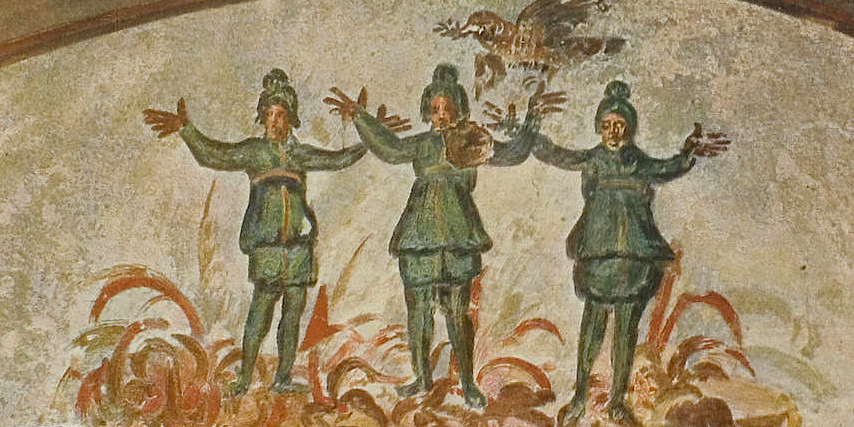
The Festival of All Saints – Pr. Faugstad sermon
Text: Daniel 3:13-28
In Christ Jesus, who leads us in triumphal procession through the fiery trials of this world until we reach the blessed gates of His heavenly kingdom, dear fellow redeemed:
Shadrach, Meshach, and Abednego stood out. It wasn’t just that as Israelites, they looked different than the Babylonians. They stood out in how they conducted themselves, how they approached their work and their life. It started when they were young. They were among the exiles brought back to Babylon after Jerusalem was overcome. The Babylonian king, Nebuchadnezzar, chose them and other youths to learn “the literature and language” of their captors (Dan. 1:4).
These three were close friends of Daniel who served as the spokesman for their little group, and who later wrote the book that bears his name. God blessed the studies and abilities of these four Israelites, so that they rose higher than their fellow students. The king recognized their talents and selected them to stand in his presence. “And in every matter of wisdom and understanding about which the king inquired of them, he found them ten times better than all the magicians and enchanters that were in all his kingdom” (1:20).
When God gave Daniel the ability to interpret one of the king’s dreams, the king set him over the whole province of Babylon and all its wise men. Daniel then asked that Shadrach, Meshach, and Abednego also be elevated in the province of Babylon (2:48-49). It was quite a promotion for these Israelite exiles! And no doubt, it caused great jealousy toward them among the other Babylonian officials.
As favorable as their situation seemed, Daniel, Shadrach, Meshach, and Abednego were still servants of a king and administration that did not acknowledge the true God but worshipped gods of their own making. This is highlighted in today’s reading. King Nebuchadnezzar set up a huge statue overlaid with gold that rose up ninety feet in the air. It would have been seen from miles around, especially with the sunlight shining off it.
The king was very proud of his statue. He summoned his government officials to attend the dedication of this monument. When the music began to play, the people were ordered to “fall down and worship the golden image that King Nebuchadnezzar [had] set up” (3:5). What’s more, they were told in no uncertain terms that “whoever does not fall down and worship shall immediately be cast into a burning fiery furnace” (v. 6). If the people couldn’t be coaxed, they could be compelled.
So the music began to play, and the people dutifully bowed down—except for three: Shadrach, Meshach, and Abednego—with Daniel apparently away at this time. If you had been a friend of theirs, what would you have said to them? “Just bow down, guys! Think of how much good you are doing in your government positions. Do you want to throw that all away? You don’t have to worship any false gods; just worship the true God when you bow down. No one has to know. God will understand.” Is that what you would say? Or would you stand, knees shaking, pale-faced, right next to them?
It’s hard to know what we would do in a situation like this. We like to imagine we would stand there bravely ready to face death for the Lord. But we also think about the times when our life was not on the line, and we still failed to confess the truth because we were afraid of being made fun of or rejected. Examples like this one with Shadrach, Meshach, and Abednego are good for us because they show us the courage of fellow believers, and especially, they show us the faithfulness of God.
In the Holy Gospel for today, we hear Jesus promising His people: “Blessed are those who are persecuted for righteousness’ sake, for theirs is the kingdom of heaven” (Mat. 5:10). He told His disciples, “If anyone would come after me, let him deny himself and take up his cross and follow me” (Mat. 16:24). The life of believers in the world, He said, would not be easy. “If the world hates you, know that it has hated me before it hated you” (Joh. 15:18). But the hatred of the world cannot prevail. “In the world you will have tribulation. But take heart; I have overcome the world” (Joh. 16:33).
The believer in Christ will stand out in this world. That’s because we aren’t made for this sinful world. We are made for God’s eternal kingdom where there is only righteousness, peace, and joy. We would much rather fit in there than fit in here! We were made heirs of His glorious kingdom starting with our Baptism. That is when the Lord called you “out of darkness into his marvelous light” (1Pe. 2:9). That is when He called you to stand while everyone else bows to the idols of the world. That is when He called you to continuously acknowledge Him before men, so you would also be acknowledged before your heavenly Father (Mat. 10:32).
At your Baptism, you were called to be a holy one, a saint, before God. You don’t have to be like Mother Theresa to be considered a saint. You don’t need to be subject to a vote of your Christian peers. You are a saint, a holy one, by faith in Jesus Christ, the holy One. It is the sacrifice of His holy body that paid for your sins. It is His perfect keeping of God’s Law that has been credited to you. It is His holiness that covers you. You are not holy because of what you have done for God. You are holy because of what He has done for you.
So He does not owe you anything; He has already given you everything! But what do you owe Him? Nothing that could earn you greater favor with Him or a higher place in His kingdom. As one of His blessed holy ones, what you freely offer to Him is all your heart, all your soul, all your strength, and all your mind. These are not perfect offerings by any means since everything we have and do is corrupted by our sin, but He uses them for great things. He employs you to carry out His gracious work in your family, your workplace, your congregation, your community. Even small acts of faithfulness, small moments of courage, and small demonstrations of love make a big difference.
But you cannot expect the world to pat you on the back for speaking the truth and for doing what is good and right. No one spoke sweeter words or did more wonderful things than Jesus, and He was still nailed to a cross to die while His enemies stood around Him jeering. Shadrach, Meshach, and Abednego did nothing wrong, but they became objects of the king’s furious rage. When they would not obey his command to “serve [his] gods or worship the golden image that [he had] set up… He ordered the furnace heated seven times more than it was usually heated.” If they wouldn’t do what he said, then they would burn.
Their response? “So be it; we will not serve your gods or worship the golden image that you have set up.” Thanks be to God for their faith! Thanks be to God for their courage! They feared neither the king nor his fiery furnace. They feared the LORD their God (Mat. 10:28). They were resigned to the possibility that this was the day of their death. Whatever happened, they trusted that their lives were in God’s hands.
Nebuchadnezzar had them bound and wrapped in layers of their clothing. The furnace was so hot that the flames killed the soldiers who threw them in. But Shadrach, Meshach, and Abednego did not burn. Watching with astonishment, the king asked, “Did we not cast three men bound into the fire?… But I see four men unbound, walking in the midst of the fire, and they are not hurt; and the appearance of the fourth is like a son of the gods.” The LORD had sent His angel to protect His saints. It may be that the Man walking in the fire with them was the pre-incarnate Christ Himself, the Son of God.
This is how close our Lord is to us. We are not able to see Him like the three men did. But He is as near as the preaching of His Word and the administration of His Sacraments. He comes again and again to forgive us our sins, confirm us in the faith, and place His holiness over us and in us.
These are the gifts He regularly gave to our dear friends who departed within the last year: Marketta, Ann, Harold, Paul, and other friends in the faith. They faced difficult trials in their life by which the devil wanted to destroy their faith. But God is faithful. He never forgot about them or left them, and now their souls are safely in His holy presence.
He is preparing you for the same blessed end. The holy waters that cleansed them and all the saints triumphant are the same holy waters that cleanse you. The holy words they heard are the same holy words you hear. The holy food and drink they received is the same holy food and drink you receive. Where God’s holy ones now stand in His presence, so you will stand.
But there are more trials to face before that time comes. There are more golden idols to tempt you and fiery furnaces to threaten you. The apostle Peter wrote, “Beloved, do not be surprised at the fiery trial when it comes upon you to test you, as though something strange were happening to you. But rejoice insofar as you share Christ’s sufferings, that you may also rejoice and be glad when his glory is revealed” (1Pe. 4:12-13). You share in Christ’s sufferings now, so that you will rejoice when He returns to bring His people to His kingdom, body and soul.
He is with you always until that Day comes, powerfully present though unseen. And He will rescue you from the narrow chamber of your grave when He comes again in all His glory. This is why The World’s Fury Cannot Harm God’s Holy Ones. You are safe with your Lord. “For to live is Christ, and to die is gain” (Phi. 1:21).
Glory be to the Father and to the Son and to the Holy Ghost; as it was in the beginning, is now, and ever shall be, forevermore. Amen.
+ + +
(picture from the Catacomb of Priscilla in Rome, 3rd century)

The Sixth Sunday after Trinity – Pr. Faugstad sermon
Text: 2 Samuel 16:5-14
In Christ Jesus, who accepted the curse of God’s Law and suffered death in our place, so we would be declared righteous before God, dear fellow redeemed:
Have you ever been cursed out before? Have you had someone attack you with words, bitter words, words that cut deep? Perhaps this has happened to you, and it came as no surprise. It was a reaction to something hurtful or harmful you had said or done. Or maybe this happened to you, and you didn’t see it coming. You became a target of someone’s anger when you didn’t deserve it.
Today’s reading describes a difficult time in King David’s life, when his son Absalom was seeking to take his throne and David was on the run. As David hurried away from Jerusalem and toward the Jordan River, a relative of King Saul named Shimei met him with continuous cursing. He accused David of having blood on his hands with regard to the house of Saul. He blamed David for the downfall of Saul, even though Saul’s unfaithfulness to the LORD was the reason he lost the throne.
While Shimei called down curses from the LORD on David, he also threw stones at him and flung dust in the air. He was making a very bad day even worse. The military men around David offered to dispatch the head of this troublesome man. Why should they have to put up with his cursing and stone throwing? David was the king; the king should be respected. All David had to do was give the order, and Shimei would be permanently silenced.
But even though Shimei was wrong in his accusations of David, David did nothing to stop him. He accepted the cursing as a chastening from the Lord. He recognized that his present troubles had come upon him from his own house because of his sin with a married woman named Bathsheba. He had seduced her, conceived a child with her, and then plotted to have her husband killed, so that he could marry her. When the LORD sent the prophet Nathan to confront David about his sin, He said, “The sword shall never depart from your house,” and “I will raise up evil against you out of your own house” (2Sa. 12:10,11).
The condemnation of God’s Law hit home. David repented of his sin. And Nathan told him, “The LORD also has put away your sin; you shall not die” (v. 13). But the consequences remained. Most immediately, the child David conceived with Bathsheba died. And now evil had come out of David’s own house, with his son Absalom seeking to kill him. As he listened to Shimei’s curses, David acknowledged that this was a consequence for his sin.
Sin always has consequences, some more severe and some less. If you steal from someone and get caught, or if you drive recklessly and harm someone, those sins will have the consequence of criminal charges and possibly jail time. If you are caught in a lie, that sin will have the consequence of people not trusting you. If you give way to wicked or lustful thoughts or contemplate things you know are wrong, those sins may not have obvious, tangible consequences, but they will contribute to a burden of guilt on your conscience.
But saying that sin has consequences is different than saying that sin is not forgiven. Every sin you have committed, no matter what it is, is forgiven by God. God the Father placed all your sin on His Son, and Jesus paid for every one of your trespasses. He suffered and died for your sin as though He is the one who committed it. So when God sends or allows consequences for your sin, this is not to punish you. These consequences are intended to keep you humble and train you in righteous living.
We are so stubborn in our sin that if there were never consequences for bad behavior or wicked words, we would just be more emboldened to keep sinning. Why should I stop doing something bad if I never have to answer for it? We must be taught from our youth that there is a difference between right and wrong. We must be required to answer for our bad behavior. We shouldn’t get away with talking back to our parents, harming others physically or verbally, or taking what doesn’t belong to us.
By learning this discipline in our youth, we are more willing to receive correction and accept consequences for sin when we are older. When a family member, a friend, or a fellow Christian calls us out for our selfishness or greed, our judgmental attitude or unkind words, we recognize in their voice the voice of God. We remember the Ten Commandments which clearly reveal the will of God for us. If we refuse to hear correction from His Word, we are saying that we are not really as bad as God says we are. We are saying that we are righteous even while our actions, words, and thoughts conflict with God’s Word.
David acknowledged his sin, and he accepted the cursing of Shimei as a wholesome chastening from the LORD. Shimei was not correct in his accusations, but instead of acting out in anger toward him, David in humility accepted the verbal attack. He left justice to the LORD. He said, “It may be that the LORD will look on the wrong done to me, and that the LORD will repay me with good for his cursing today.”
In our litigious culture, where everyone wants to counter-attack and sue as soon as they feel offended about something or wronged in some way, David’s example is important for us Christians. He was willing to receive chastening for his imperfect life. He was willing to endure a fiery trial for the testing and strengthening of his faith. He was willing to suffer out of love for God.
Jesus teaches all His followers to do this. In His Sermon on the Mount, He teaches us to “turn the other cheek” when we are attacked (Mat. 5:39). He says that we should remember that even our enemies are our neighbors, and that we should love all our neighbors as we love ourselves (v. 44). This is the teaching of the Law, which is summarized by perfect love for Him and perfect love for one another (v. 48). That is what a righteous life looks like.
Sometimes our life resembles this, but often it does not. Because we have not perfectly kept God’s Law, we can’t put any trust in what we do. In today’s Holy Gospel, Jesus says, “Unless your righteousness exceeds that of the scribes and Pharisees, you will never enter the kingdom of heaven” (Mat. 5:20). Unless your righteousness is a million times better than the people who are considered the most holy and good, you cannot get yourself to heaven. That is why your confidence must be in Jesus, the holy Son of God and Son of Man, who did perfectly keep the holy Law.
In David, you see a picture of what Jesus would later endure for your salvation. David was the true king, but he was forced out of Jerusalem where he was met with wrongful cursing by his enemies. Jesus was the king of all creation, but He was forced out of Jerusalem wearing a crown of thorns and carrying a cross. When He was crucified on Calvary, he was met with all sorts of cursing and reviling from His enemies. “Let the Christ, the King of Israel, come down now from the cross that we may see and believe” (Mar. 15:32), they said in mockery. “He trusts in God; let God deliver him now, if he desires him” (Mat. 27:43).
If anyone had the right to defend Himself and call down curses on His enemies, it was Jesus. He had done no wrong. No court committed to justice would have ever found Him guilty. We are quick to cry out whenever some little wrong is done to us. We hold grudges. We plot our revenge. But look at Jesus! His apostle Peter wrote, “He committed no sin, neither was deceit found in his mouth. When he was reviled, he did not revile in return; when he suffered, he did not threaten, but continued entrusting himself to him who judges justly” (1Pe. 2:22-23).
That is righteousness. That is a holy life before God. He lived a perfect life of love toward God and neighbor. That perfect life is the reason you have confidence before God today. Jesus lived His holy, righteous life for you. He willingly suffered every injustice for you. He went to the cross for you, to pay for your sins. His righteous life and His sacrifice in your place now give you the courage and strength to endure afflictions in your life.
When you are unjustly attacked like David was, you can remember how Jesus humbly suffered for you. You may not receive justice in this life, but you are right with the God of heaven. Trouble may meet you at every turn, but your faithful God promises to hold you up by His grace. Peace may elude you in the world, but you have “peace with God through our Lord Jesus Christ” (Rom. 5:1).
At the end of today’s reading, we hear that David arrived weary at the Jordan River, where “he refreshed himself.” The Jordan River is where 1,000 years later, Jesus was baptized “to fulfill all righteousness” (Mat. 3:15). Your Baptism brought His righteousness to you. Your Baptism is where the “great exchange” happened for you, the exchange described by St. Paul, “For our sake [God] made [Christ] to be sin who knew no sin, so that in him we might become the righteousness of God” (2Co. 5:21).
You are righteous “in him,” by faith in Him—the faith brought to you at your Baptism. In Him, you have the forgiveness of all your sins, strength for every difficulty, and the promise of eternal life. No matter what trials you have to go through, whether as consequences for your sin that the Lord works for your good, or as training in righteousness that the Lord gives for the strengthening of your faith, He will at the same time provide refreshment through His Word and Sacraments. “Come to me, all who labor and are heavy laden,” He says, “and I will give you rest” (Mat. 11:28).
Glory be to the Father and to the Son and to the Holy Ghost; as it was in the beginning, is now, and ever shall be, forevermore. Amen.
+ + +
(picture from stained glass at Redeemer Lutheran Church)