

Maundy Thursday – Pr. Faugstad homily
Text: St. John 13:1-15
In Christ Jesus, who produces the fruit of humble service through us by serving us through His powerful Word and Sacraments, dear fellow redeemed:
“Greatness” is often defined as being better than everyone else at something. Athletes are said to achieve greatness when they break long-standing records or win the world championship. Professional singers achieve greatness when they reach the top of the music charts or get inducted into the hall of fame. Business people achieve greatness when they hit a record-breaking level of sales or become CEO.
Jesus defines greatness in a very different way. He says, “whoever would be great among you must be your servant, and whoever would be first among you must be slave of all” (Mar. 10:43-44). In today’s reading from the Gospel of St. John, Jesus taught this greatness first with actions and then with words.
Jesus had arranged to eat the Passover meal with His disciples in Jerusalem. They did not know how quickly His death would come, but He did. John tells us that He knew that His death was near, and that He would soon return to His heavenly Father. In these last hours before His death, Jesus did something that surprised His disciples. He set aside His outer garments, tied a towel around His waist, and proceeded to wash their dirty feet.
When He got to Peter, Peter would not have it. Without knowing why Jesus was doing this or being willing to learn why, he blurted out, “You shall never wash my feet.” It was like Peter’s statement some weeks before this when Jesus predicted His suffering, death, and resurrection. “Far be it from you, Lord!” he said. “This shall never happen to you” (Mat. 16:22). Peter was so sure of himself, so certain that he saw and understood things clearly.
Peter was proud. Who was he to tell Jesus, the Son of God, what He should and should not be doing? And yet, we fall into the same sin when we criticize God for not fixing the problems in society, or when we question why He doesn’t give us more in this life or make things better for us. We act like we are in charge, like Peter did. First, Peter wanted to tell Jesus what to do: “Do not wash my feet.” Then when Jesus warned him about rejecting His service, Peter wanted to tell Jesus how to serve him: “Lord, not my feet only but also my hands and my head!”
Jesus had to teach Peter to receive humbly the gifts He was giving. He knew what Peter needed, just as He knows what we need. When Peter asked for a whole body washing, Jesus replied, “The one who has bathed does not need to wash, except for his feet, but is completely clean.” Then He added, “And you are clean, but not every one of you.” The one who was not clean was Judas Iscariot who was about to betray Jesus for money. Judas had fallen from faith. He was no longer under God’s grace.
But the other disciples, despite their pride and their confusion about Jesus’ work, were clean in God’s sight. They believed that Jesus was the Messiah sent by the Father for the world’s salvation. You are clean like they were because you also believe that Jesus is your Savior. You believe that He gave His body to be crucified in your place and shed His blood to wash away your sins.
This cleansing was applied to you in Holy Baptism when you became a member of the holy body of Christ. Baptism brought you the forgiveness of sins, but that doesn’t mean your sinning stopped at your Baptism. This is why you need continuous cleansing through Jesus’ Word and Sacraments. Jesus demonstrated this by washing the disciples’ feet. He was showing them and us that we need His ongoing, sanctifying work in order to remain clean.
This is why He instituted the Sacrament of the Altar on this holy day. He took the unleavened bread from the Passover meal and said, “This is My body.” Then He took the cup of wine and said, “This is My blood.” He also told them what it was for: “for the remission of sins” (Mat. 26:28). We continue to partake of His body and blood because we continue to sin. Jesus humbly meets us in this Supper with His grace, stooping down to remove the dirt of sin that has become stuck inside us.
But it is possible to reject this work that Jesus comes to do among us. Like Peter, we could misunderstand what Jesus is doing and act like Holy Communion is a service we render to God instead of a gift He gives to us. Or like Judas, we could watch Jesus stooping down to serve us but despise Him in our hearts. Isn’t it shocking: Jesus knew that Judas was going to betray Him, and He still knelt before him to wash his feet. In the same way, Jesus gives His body and blood to all who partake of the Supper, but it only benefits those who believe His words.
Those who receive His body and blood without faith, take the Supper to their spiritual harm. 1 Corinthians 11:27 says, “Whoever, therefore, eats the bread or drinks the cup of the Lord in an unworthy manner will be guilty concerning the body and blood of the Lord.” This is why we insist on meeting with visitors who attend our services before they take Communion. We have the same concern for our members who have fallen into public sin. We want to ensure that they are repentant of their sin and recognize what Jesus is giving in the Supper before we invite them to commune.
That same examination must happen with all of us before we come forward to receive Christ’s body and blood. 1 Corinthians 11:28 says, “Let a person examine himself, then, and so eat of the bread and drink of the cup.” We examine ourselves by acknowledging that “our feet are dirty,” so to speak. We admit the sins we have committed in our thoughts, our words, and our actions. We also confess our trust in Jesus’ atoning sacrifice, that He shed His blood to pay for our sins. We acknowledge that He is present to give us His holy body and blood. And we express our intention to stop our sinning and do better.
That last point is difficult. We might think to ourselves: Do I really want to stop the sins I keep falling into? Do I want to stop hating my enemy? Do I want to stop listening to and watching what I know I shouldn’t? Do I want to stop drinking too much, eating too much, lying, gossiping, prioritizing my pleasure and my plans above everything else? These are all sins of selfishness.
Jesus calls us to set aside these sins, leave them behind, and receive His body and blood to wash our guilt away. No sin is too great that He cannot forgive it. Jesus died on the cross to pay for all sins, every single one. As we come forward for Holy Communion, burdened by our sins, we remember why Jesus instituted this Supper. It is for our forgiveness.
As we leave the Communion rail cleansed and return to our homes and our work, Jesus also directs us to the needs of our neighbors. He says, “If I then, your Lord and Teacher, have washed your feet, you also ought to wash one another’s feet. For I have given you an example, that you also should do just as I have done to you.”
This is where true greatness is found: first in Jesus’ humble service to us, and then in the humble service toward one another that He moves us to do. This sort of greatness might not impress the world, but it is the sort of greatness that changes the world, that changes hearts, just as the sacrificial work of Jesus has changed ours. “For the Son of Man came not to be served but to serve, and to give his life as a ransom for many” (Mar. 10:45).
Thanks be to God. Amen.
+ + +
(picture from painting by Giotto di Bondone, c. 1267-1337)
The Eighth Sunday after Trinity – Pr. Faugstad sermon
Text: 1 Kings 12:26-33
In Christ Jesus, who faithfully carried out His work of redeeming love for the salvation of our weak and sinful hearts, dear fellow redeemed:
For seven years, King Solomon built a beautiful temple in Jerusalem. Its dimensions were estimated to be 90 feet in length, 30 feet in width, and 45 feet in height. The walls and floors were lined with boards of cedar and cypress. Intricate carvings were made in the wood, and then the wood was overlaid with pure gold. The Holy Place and the Most Holy Place were built within the temple. The Most Holy Place is where the Ark of the Covenant of the LORD was kept. When the Ark was brought into the temple, the LORD came in a cloud, and His glory filled the temple (1Ki. 8:10-11).
The LORD was pleased with Solomon’s faithful work. He told Solomon that if he would walk “with integrity of heart and uprightness” as David had and would follow His Commandments, then Solomon’s throne would be established over Israel forever (1Ki. 9:4-5). But He warned that if Solomon turned aside from following Him and followed other gods, his great kingdom would crumble, and even the temple would become a heap of ruins.
As the chronicle of Solomon’s life continues, we learn that he took for himself 700 wives and 300 concubines. When he was old, these wives who came from foreign lands turned his heart away from the LORD to serve their gods. Solomon built altars to their gods and joined his wives in worshipping them. So the LORD raised up adversaries against Solomon, one of whom was a man named Jeroboam. This is the Jeroboam we hear about in today’s reading.
When Solomon died, his son Rehoboam began to reign in his place. And when the people from the northern tribes of Israel asked Rehoboam to be more merciful than his father Solomon had been, Rehoboam listened to bad advice and said that he would be much harsher than his father had been. So the people in the northern tribes of Israel rebelled against Rehoboam and decided to make Jeroboam their king. This all happened according to God’s will because of Solomon’s unfaithfulness. The LORD told Jeroboam that if he would be faithful to Him, his kingdom would be firmly established.
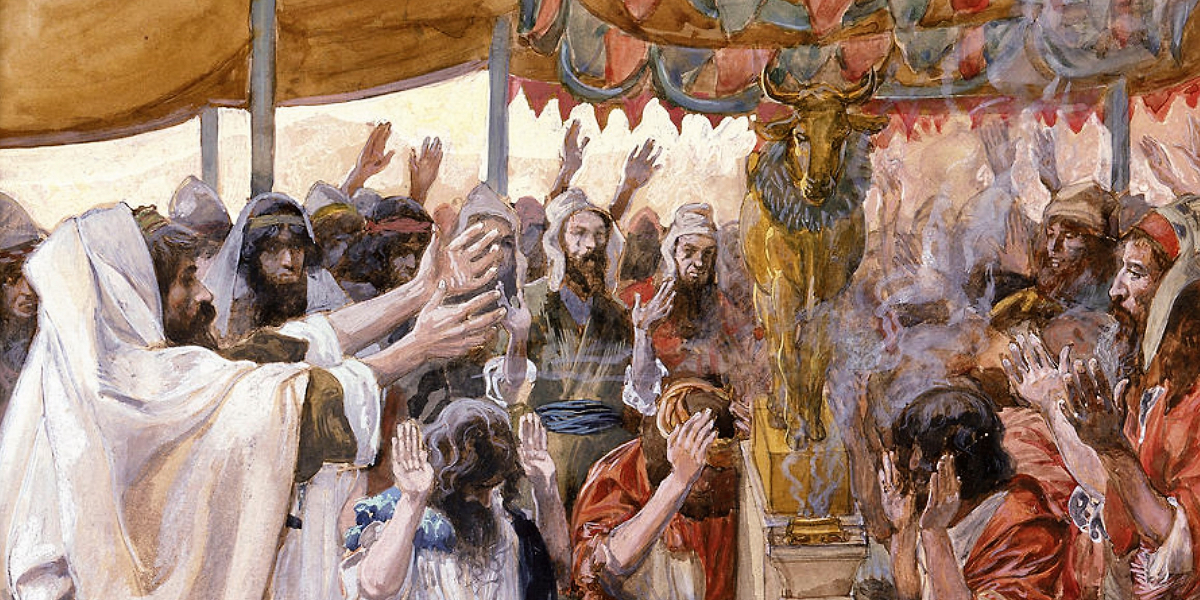
But Jeroboam did not remain faithful, as we learn about today. He was jealous to keep his power. He worried that if the Israelites went to the temple in Jerusalem to make sacrifices to the LORD, then Rehoboam might win them back. So he made a plan. He would set up new places of worship where the people could go, so they wouldn’t go to Jerusalem. He set up two calves of gold, one in Bethel and the other in Dan. And where have we heard about golden calves before? That’s the idol the Israelites made right after the LORD led them out of their slavery in Egypt.
What the Israelites said then is basically what Jeroboam said now about the golden calves, “Behold your gods, O Israel, who brought you up out of the land of Egypt.” Jeroboam’s idolatrous plan “became a sin,” as our reading says. He promoted this idolatry by making temples on high places, appointing priests not from the Levites, and establishing a feast day “in the month that he had devised from his own heart.” This grand idea started in his heart and was guided all along the way by his heart. He would have fit right in in our culture today.
We often hear that we can’t go wrong if we just follow our heart. Following your heart is seen as the path to happiness. Ignoring what your heart tells you could lead to a lifetime of regret and unhappiness. But why do people think the heart is such a reliable guide? Has anyone’s heart ever led him wrong? Listen to how the heart is described in the time before the Flood: “The LORD saw that the wickedness of man was great in the earth, and that every intention of the thoughts of his heart was only evil continually” (Gen. 6:5). Through the prophet Jeremiah, the LORD said, “The heart is deceitful above all things, and desperately sick” (17:9). Then we have Jesus’ own words about the heart: “For out of the heart come evil thoughts, murder, adultery, sexual immorality, theft, false witness, slander” (Mat. 15:19).
Clearly the heart can steer us wrong. It is not a trustworthy guide. It can and often has led us astray. So how can we know if the feelings and thoughts of our heart are good and beneficial, or if they are leading us in the wrong direction? We know this by comparing what we are thinking and feeling with what God tells us in his holy Law.
So if my heart is telling me to disobey my parents and do things they tell me I shouldn’t, then my heart is contradicting the Fourth Commandment. If my heart tells me to pursue a sexual relationship outside the blessed boundaries of marriage, then my heart is going against the Sixth Commandment. If my heart tells me to attack someone else’s reputation in an attempt to elevate myself, then my heart is violating the Eighth Commandment.
The theme of today’s service is “Beware of False Prophets.” The false prophet to be most aware of is the false prophet that lives within us, within our heart. It is the old Adam that disobeys God, and that looks with desire at what God says is sin. There are two ways that the old Adam in coordination with the devil works: One is outright opposing what God says in His Word; the other is twisting what God says in His Word.
The first is when we are tempted to reject or ignore what God says because it doesn’t agree with the way we think. We don’t want to be outsiders in the world; we want to fit in. Maybe we want to accommodate our own sin or the sin of someone else, so we write off something in the Bible as being outdated or unclear or unhelpful for the mission of the church. The other way the old Adam operates is to subtly change the Word of God, soften it, explain away something that challenges us. Maybe we excuse someone’s sin and even lend our support to it because, after all, God tells us to love our neighbor, and we interpret love as never questioning someone’s choices.
Jeroboam directly contradicted the Holy Scriptures in everything he did and said to keep the Israelites away from Jerusalem. How does Jesus tell us in today’s Holy Gospel that we will recognize false prophets? He says we will “recognize them by their fruits” (Mat. 7:16), especially by what they say. Do we say things that contradict what the Bible says? Then that is the old Adam talking and not our new man of faith.
Jesus says that those who will enter the kingdom of heaven are those who by faith do the will of His Father who is in heaven. Doing the Father’s will is believing and following exactly what He says in His Word. This is how we “hallow His name,” as we say in the Lord’s Prayer. We hallow God’s name by teaching His Word in its truth and purity and by living holy lives according to it as His dear children (Luther’s Explanation to the First Petition).
There is a reason we have to pray for this. A pure life lived according to God’s Word doesn’t come naturally to us. We struggle to hold to His Word. We struggle to do what is right. Our life is full of failures to “fear, love, and trust in God above all things” (Luther’s Explanation to the First Commandment). We have at times followed the god of self-satisfaction. We have followed the god of pride and personal glory. We have followed the god of popularity and acceptance by the world.
We pray along with King David, “Create in me a clean heart, O God” (Psa. 51:10), because we know how unclean our heart has been. David wrote these words after following his heart and succumbing to terrible sins. God forgave him those sins, just as He forgives you your sins. He knows how evil and desperately sick your heart is by nature. If it were good or even neutral, He would not have needed to send His Son to die on the cross in your place.
But He did send His Son. The coming of His Son in the flesh was necessary for you and every sinner. We needed Him to apply His perfectly pure heart to keeping the Law of God in our place, so we would be credited with His perfect love toward God and neighbor. We needed Him to hallow God’s name in every way by obeying His Father’s will and offering up His holy life for you and me.
You can’t find what you need for life and salvation in your own heart with all its wayward passions and desires. But you can find what you need in Jesus’ heart. He makes His love known to you by inviting you to partake of His means of grace, to hear His Word of truth and salvation and to feast on His holy body and blood.
What He gives you here through His Word and Sacraments may not seem as exciting or impressive as what is going on with the golden calves of prosperity, power, and pleasure that are worshipped by the world. But just as the LORD promised to be present in the Most Holy Place of the temple, so He has promised to be present here in this most holy place, where He comes to bless you with His gifts.
This is where He expresses His faithfulness to you, and where He strengthens your faithfulness to Him. This is where He cleanses your heart and pours His love into it, so it is ready for fruitful service to the people around you. This is the good plan and purpose for your life that the LORD formed in His own heart and revealed to you in His holy Word. By hearing and trusting His Word, you are submitting your heart to His will. And when you follow His heart, you will ever have His joy, His life, and His peace.
Glory be to the Father and to the Son and to the Holy Ghost; as it was in the beginning, is now, and ever shall be, forevermore. Amen.
+ + +
(picture from “The Golden Calf” by James Tissot, 1836-1902)
Maundy Thursday sermon – Vicar Cody Anderson
Text: St. John 13:1-15
In Christ Jesus, who continued to teach His disciples even hours before His death, who continues to teach and provides for you, dear fellow redeemed:
My mother has a sign in her house that says, “Dust is a country collectable.” As much as we try to keep our houses clean of that country collectable, we see that it doesn’t take much for our houses to continue to be dirty. Not only can our houses be dirty, but around here our cars can get dirty. When our houses, cars, and whatever else get dirty, then usually we must take the time to attempt to clean them. This is a chore that no one really wants to do and most of the time we wait until the last minute. In our text we see the humility of our Savior. Jesus takes time from the Passover meal to wash His disciples’ feet. This humble act shows how much He loved His disciples; it also shows how much He loves us. Jesus says, “I have washed you; you are clean!
Earlier in the week on Palm Sunday, Jesus’ rode into Jerusalem. He has done His teaching of the people in the temple. He has rested and now is with His disciples for one more gathering. Jesus instructed His disciples to have a room prepared so that they might eat the Passover meal. Now during the supper, Jesus does something that would have been out of the ordinary. He takes off His outer garment, wraps His waist with a towel, and then He begins to wash His disciple’s feet. A task that would have been done by a servant or a slave. As Jesus washes their feet, in our text He explains why He does it. This explanation is applied directly to us.
Jesus said to [Peter], “The one who has bathed does not need to wash, except for his feet, but is completely clean. Peter at first doesn’t want the Lord to wash him. He thinks that Jesus is degrading Himself. Jesus says if He doesn’t wash Peter’s feet then Peter can have no share with him. Jesus also points out that He knows and sees all. He says, “Not all of you are clean.” Judas currently has fallen into complete unbelief. He is only thinking about how he can betray Jesus. Jesus washed his feet and gave him bread. Jesus is giving him opportunities to come back but Judas does not take them. The devil then enters his heart. The Upper Room activity on this Maundy Thursday points out the actions of Peter and Judas and why we need to be washed. We need to be washed daily because of our sins. We have inherited our sin from our first parents. We must be washed clean because of our sins, but we are unable to do so on our own.
Jesus tells us that He wants to wash us clean. Like Peter, we can tell Jesus that we don’t want His washing. Most of the time the sins that we commit, we want to do it. Why would we want Jesus to wash something away that we enjoy doing? He wants to do it. He wants us clean. Most people want Jesus to only help them out on their terms.
There are many dangers when we stay persistent in our sins. Jesus warns us of this in the text. Peter said to him, “You shall never wash my feet.” Jesus answered him, “If I do not wash you, you have no share with me.” The biggest danger is that the devil comes into our heart, and we live in unbelief. The devil’s goal is to lead people astray. This unbelief happens because of our choices to give up on God. The devil wants that separation. This is not what Jesus wants but we can give up on Him.
Our text for today reveals the amount of Jesus’ love. “Now before the Feast of the Passover, when Jesus knew that his hour had come to depart out of this world to the Father, having loved his own who were in the world, he loved them to the end.” He loved His disciples to the end, and we know that He loves us until the end. As Jesus teaches the love that He has for us, we see how much love we lack at times. Jesus tells us to do for others as He has done for us. But we know how often we have failed to love as we should.
Jesus teaches and shows His disciples how they are to love each other. He washes their feet. This was the job of a servant, a slave. He washes their feet, but more importantly, He washes them completely with His blood. Jesus is bringing the gospel out with the washing of His disciple’s feet. Their sins are washed away by His power. The sins that they have committed to this point and the sins that they are going to commit. They are all washed away by Christ.
Jesus knows that He is going back to the Father. The plan is being carried out, Jesus’ great love for you. Jesus is not only washing His disciple’s feet clean, but He is also going to die for them. He told them earlier, “For even the Son of Man came not to be served but to serve, and to give his life as a ransom for many” (Mark 10:45). He loves you and He was willing to die for your sins. He knew His time on earth was up. He would have to go back to His Father. He also knew what it would take for Him to go back. Jesus knew that He would suffer and die. He did it for you. He became a servant and died for you.
Jesus’ death on the cross and resurrection saves you because He could serve you perfectly. He obeyed God the Father and He knew what kind of sacrifice was needed. Jesus doesn’t lead people astray; He is the way, the truth, and the life. He washes away the sins that are easy to quit, and the sins that are hard to shake. He cleanses you with His blood. You received these gifts from Christ through your baptism. You died and rose with Christ because of this washing. This washing stays with you. Jesus then gave the Lord’s Supper. He proclaims to you that you are forgiven by His body and blood.
Jesus invites you to often go to the Lord’s Supper. He taught it to you saying that it brings you forgiveness of sins, life, and salvation. You are clean by faith in Him, but you will continually sin. Jesus tells you to eat and drink often in remembrance of Him. This is your medicine here on earth. He brings you comfort and strength for the days ahead.
As the sacrament provides us with comfort and strength, it also is Jesus’ last will and testament. By Christians taking the sacrament, we are proclaiming Jesus’ death and resurrection until He comes again. Knowing that our sins are forgiven, it doesn’t mean that we are perfect. We will still give in to sin. It is the Holy Spirit who works faith in our hearts to receive His forgiveness and the Holy Spirit creates fruits of faith. It is through the Holy Spirit that we serve others with a good heart, having their best interests in mind.
As you keep your Savior in front of you, knowing what He has done for you, He teaches you love for one another. “If I then, your Lord and Teacher, have washed your feet, you also ought to wash one another’s feet. For I have given you an example, that you also should do just as I have done to you.” Who would have thought we could learn so much from a simple washing of feet? This is great humility that came with a price. Jesus gave His life as a ransom for many. That is the undeserved love that you receive. Jesus also gave you His medicine to remind you about this foot washing, and to give you the strength to make it through the week. His Supper is a gift that He wants you to receive often. It shows you that even those who are clean by faith continually need to be cleansed. You will give in to sin. But the Lord’s Supper gives you forgiveness. You take it for your comfort and strength. Through it you pronounce the Lord’s death and resurrection until He comes again. Amen.
Glory be to the Father and to the Son and to the Holy Ghost; as it was in the beginning, is now, and ever shall be, forevermore. Amen.
+ + +
(picture from painting by Giotto di Bondone, c. 1267-1337)