

Midweek Lent 2 – Pr. Faugstad homily
Text: St. John 18:33-38
In Christ Jesus, the King of kings and Lord of lords, dear fellow redeemed:
As the Roman governor of Judea, Pontius Pilate had authority to administer justice on behalf of the Roman Caesar, or king. He typically did not live in Jerusalem, but he went there at the time of the Passover when many more people would be in the city than usual. Now early on Friday morning, the Jewish leaders brought him a so-called criminal, someone named “Jesus of Nazareth.” They would have preferred to execute Jesus on their own, but this was something the Roman officials did not allow. Any cases involving the death penalty had to come before the governor.
Pilate asked them a reasonable opening question: “What accusation do you bring against this man?” (Joh. 18:29). That was a difficult question because Jesus had done nothing deserving of death. The religious leaders initially refused to give Pilate a straight answer. But then they made their case: “We found this man misleading our nation and forbidding us to give tribute to Caesar, and saying that he himself is Christ, a king” (Luk. 23:2).
The first part of their accusation was false. Jesus did not mislead the nation in any way, as if He were trying to overthrow the Roman authorities. That very week He had underscored their responsibility toward both God and government officials when He said, “render to Caesar the things that are Caesar’s, and to God the things that are God’s” (Luk. 20:25). The second part of their accusation was true. Jesus was the Christ, the King over all. But they wanted Pilate to think that Jesus was setting Himself up as an earthly king who would cause problems for both Governor Pilate and Caesar. Better, they said, to have Him eliminated.
Pilate must have heard something about Jesus before this. He was the governor in Judea the entire time that Jesus carried out His three-year public ministry. Jesus traveled all over the region teaching and performing miracles, even raising some people from the dead. King Herod was certainly aware of His activities, and “he sought to see him” (Luk. 9:9). Pilate must have known something about His work, too, though he made no reference to it when he questioned Jesus.
He cut right to the chase: “Are You the King of the Jews?” Pilate’s main interest was to find out if Jesus was someone who was a threat to Roman rule and the peace of the region. He hardly regarded Jesus as a king. Jesus hardly looked like one. What Pilate did not realize is that he was in the presence of the King of the universe from whom all earthly authority came. It was something like “Undercover Boss,” when a store manager has no idea he is talking to the one who has all the power.
Jesus said, “My kingdom is not of this world. If My kingdom were of this world, My servants would have been fighting, that I might not be delivered over to the Jews. But My kingdom is not from the world.” So yes, He was a King, but not the kind that the Jews accused Him of being. Pilate agreed. “For he perceived that it was out of envy that the chief priests had delivered him up” (Mar. 15:10).
Then Jesus stated His purpose for coming into the world, that He came “to bear witness to the truth.” He said, “Everyone who is of the truth listens to My voice.” Pilate must have felt uncomfortable at these words of Jesus. The whole conversation had not gone as Pilate expected. We imagine how Jesus looked at him, like He could see right through him (because He could). Pilate may have thought to himself: “Does this Jesus think that I, Pilate, would want to listen to Him, to care what He had to say?” Pilate brushed it all aside: “What is truth?” he said.
But there is one thing about Jesus that Pilate was convinced was true. He was convinced that Jesus was innocent of any crime that would justify the death penalty. So he told the Jews, “I find no guilt in Him.” He had seen and heard enough to know that Jesus was not what the Jews made Him out to be. What Pilate did not know was that he was an unwitting part of God’s plan for the salvation of the world. Jesus had to die, and it had to be on a tree, a cross, cursed for the whole world’s sins (Gal. 3:13).
God had used a decree of Caesar Augustus to get Joseph and Mary to Bethlehem where the Christ had to be born. And now God utilized the authority of a pagan governor to have His Son, the Lamb of God, sacrificed for all people. This reminds us who is really in control. It is not the ruler-of-the-moment in local, state, or national government, no matter how powerful or influential they may seem. Everyone in these positions must answer to a power much higher than their own.
Jesus said as much to Pilate when Pilate wasn’t getting the answers from Jesus that he wanted. Pilate said, “Do you not know that I have authority to release you and authority to crucify you?” (Joh. 19:10). Jesus replied, “You would have no authority over me at all unless it had been given you from above” (v. 11). That applies not only to the authority of government, but also to authority in society, church, and home.
Whatever authority God gives you in any sphere of life, He wants it to be used in service to your neighbor. Husbands and fathers are to use their authority in the home not to manipulate or harm, but to give and guide. Ephesians 6:4 says, “Fathers, do not provoke your children to anger [by misusing your authority], but bring them up in the discipline and instruction of the Lord.” Regarding earthly masters, like employers and managers, God says that they should not mistreat those under them, knowing that they have a Master in heaven, and “there is no partiality with him” (Eph. 6:9).
God could have used His authority as the Creator of the world to punish Adam and Eve and we their descendants for all our sins. Instead, the Father used His authority to send His only-begotten Son to suffer and die for everyone. Jesus willingly and perfectly obeyed His Father’s will, never deviating from the path that led Him to the agony and torment of God’s eternal punishment.
As Jesus stood before Pilate, remaining silent while accusations and lies were hurled at Him, neither the Gentile Pilate nor the religious leaders of the Jews understood that Jesus was suffering for them, out of love for them. He was suffering for you, too, for your failure to acknowledge the authorities He has placed over you, and for the times that you used your authority to harm instead of help. His holy blood, the blood of the King of kings and Lord of lords, cleanses you from all those sins. This is most certainly true.
What punishment so strange is suffered yonder!
The Shepherd dies for sheep that loved to wander;
The Master pays the debt His servants owe Him,
Who would not know Him.
The sinless Son of God must die in sadness;
The sinful child of man may live in gladness;
Man forfeited his life and is acquitted—
God is committed. (Evangelical Lutheran Hymnary #292, vv. 4-5)
Glory be to the Father and to the Son and to the Holy Ghost; as it was in the beginning, is now, and ever shall be, forevermore. Amen.
+ + +
(picture from “Christ before Pilate” by Mihály Munkácsy, 1881)

Midweek Lent 5 – Pr. Faugstad homily
Text: St. Matthew 26:62-68
In Christ Jesus, “the Alpha and the Omega, the first and the last, the beginning and the end” (Rev. 22:13), dear fellow redeemed:
Holy Week was filled with prophecies from Jesus. Some of them were fulfilled in a matter of days, some after a number of years, and some have not been fulfilled yet. In our midweek services, we have heard Jesus’ prophecy that Jerusalem and its temple would be destroyed (Mat. 24:1-2). That happened about forty years later in the year A. D. 70 when the Romans overtook the city. We heard Jesus predict His crucifixion (26:1-2), His burial (26:6-13), the desertion of His disciples, and Peter’s denials (26:31-35). Those were all fulfilled by the end of that week.
There are many other Holy Week prophecies by Jesus that we have not considered. During Holy Week, He spoke extensively about the end times. He described what His followers would have to endure as the end approached, and He encouraged them to stay awake and alert for His coming. He described His return in glory and His sitting on the throne of judgment on the last day (chs. 24-25).
He spoke again about His return to judge the living and the dead when He was brought before the high priest Caiaphas and the members of the Jewish Council. This happened in the early morning hours of Friday after Jesus’ arrest in the Garden of Gethsemane. His disciple Matthew records the fact that the high priest and the members of the Council “were seeking false testimony against Jesus that they might put him to death” (26:59).
In order for a charge to be considered, it had to come from at least two independent witnesses. But when people are telling lies, it is very difficult to get their false testimony to line up. That’s what happened in this sham trial. And no matter what lies were told about Him, Jesus stood there in silence. He was not there to defend Himself; “like a lamb that is led to the slaughter, and like a sheep that before its shearers is silent, so he opened not his mouth” (Isa. 53:7).
Caiaphas could see that the attempt to pin a lie on Jesus was not working. So he pulled something different from his bag of tricks. He would put Jesus under oath. This would force Jesus to either deny that He was the Christ which would disappoint all the people. Or He would identify Himself as the Christ and be charged with blasphemy for presenting Himself as God. Caiaphas said, “I adjure You by the living God, tell us if You are the Christ, the Son of God.”
To his fellow religious leaders, Caiaphas seemed very powerful in this moment, and Jesus looked very small. There Jesus stood with hands tied, no disciples to defend Him, and no crowds to protect Him. All those gathered around Jesus were feeling very confident. They had Jesus right where they wanted Him. Soon they would be done with Him; soon He would be dead. But how would Jesus respond to Caiaphas’ pointed question about who He was?
Jesus said to him, “You have said so”—“I am” (Mar. 14:62). Then He added these words which should have made every member of the Council shake in his sandals, “But I tell you, from now on you will see the Son of Man seated at the right hand of Power and coming on the clouds of heaven.” The leaders acted like they only heard the first part of what Jesus said. He had told them under oath that He was “the Christ, the Son of God,” and that’s all they needed to hear. They accused Him of blasphemy and called for His death.
If they had truly been listening to what Jesus said, they might have realized that His prophecy about the Son of Man coming on the clouds of heaven sounded a lot like what the prophet Daniel wrote: “I saw in the night visions, and behold, with the clouds of heaven there came one like a son of man, and he came to the Ancient of Days and was presented before him” (7:13). This was an Old Testament prophecy about the work of the Messiah, who would carry out the will of His Father by suffering, dying, and rising again. Then He would return to the Father in glory as true God and true Man and reign over an everlasting kingdom (v. 14).
This is the reign Jesus now informed the high priest about. He told Caiaphas that He would be seated at the right hand of Power—a fitting way to describe God the Father who is almighty. Jesus appeared to be powerless in that human court, but He made it known that there is an authority far above anything we have here. Caiaphas and all the influential men around him were nothing compared to the power of God. They may have looked impressive on earth, but a little bug might feel important, too, until a heavy boot lands on him.
The heavy boot for the religious leaders was the pricking of their conscience as they condemned an innocent man. It was Jesus’ words of love for them as the soldiers nailed Him to the cross: “Father, forgive them, for they know not what they do” (Luk. 23:34). It was His tender care for His mother and for the thief hanging next to Him. That heavy boot was His willful death and the earthquake that followed it. It was the tearing of the temple curtain in two. It was the report from the guards that an angel had rolled away the stone from the tomb, and Jesus wasn’t there!
We do not know how many of these religious leaders later repented of their sinful actions. Some of them must have, since three thousand Jews were baptized on Pentecost and their number quickly increased to five thousand and more. But no doubt others of them did not repent. They were glad to be rid of Jesus. Now they didn’t have to listen to His embarrassing and infuriating criticisms anymore. They could go back to the way things were before He came on the scene.
But when they finally faced the time of their death, they learned just how wrong they were. They learned that “it is a fearful thing to fall into the hands of the living God” (Heb. 10:31). They learned that apart from Jesus, there is no hope of eternal life. And on the last day, they will see with their own eyes what Jesus prophesied the day of His death, “you will see the Son of Man seated at the right hand of Power and coming on the clouds of heaven.” All eyes will see Jesus come in glory on the last day. Unbelievers will wish they could hide from His presence. Believers will welcome His coming with joy.
These words of Jesus were not just meant for the religious leaders at His trial. They were meant for us and all people. Jesus is seated at the right hand of God. He is in the position of all power and authority, where He rules over the whole creation and bestows His blessings on the church. We must not forget this fact. When in our pride we act like the religious leaders eager for the world’s glory, and in our faithlessness act like Jesus is weak, then we need to repent and throw ourselves at the feet of Him who conquered death itself.
He died on that cross for you. No human authority made Him do it. He willingly went there out of love for you. He wanted to save you. He wants you to know that your sins are forgiven through the shedding of His blood, and that a place in heaven is prepared for you by His grace. He will come again in glory on the clouds of heaven. That will be the great day of vindication for all who trust in Him. That will be the great day when every prophecy Jesus made will finally be counted as fulfilled. Thanks be to God! Amen.
+ + +
(picture from Jesus on trial by José de Madrazo y Agudo, 1803)

The Sixteenth Sunday after Trinity – Pr. Faugstad sermon
Text: Ephesians 3:13-21
In Christ Jesus, who carried out His Father’s loving will by suffering and dying on the cross to set us free from sin and death for all eternity, dear fellow redeemed:
What do you most want for your children or your grandchildren? When you imagine their future, how would you want it to look? About two years ago, the Pew Research Center conducted a survey of parents with children under age eighteen (“Parenting in America Today” posted online, Jan. 24, 2023). When asked what they most wanted for their kids when they grow up,
- It is probably no surprise that 88% said it is very important that their kids be financially independent as adults, and that their kids have jobs or careers they enjoy.
- It might surprise you that only about 20% said it is very important that their kids get married, and that their kids have kids.
- Around 90% said it is very important that their kids are honest, ethical, and hardworking.
- Only 35% said it is very important that their kids have similar religious beliefs to their own.
Does this match what you want for your children and grandchildren? Of course you want them to be successful and happy when they grow up. You want them to live fulfilling lives with rich purpose. You want them to be honest and kind, ready to help others in need. But is that what you most want for them, or are there things you would put higher on your list?
The Apostle Paul in today’s reading gives us a roadmap for how to think through these things. He presents here the main things he wanted for the Christians in Ephesus. He spent more time with this congregation than with the others he helped establish, so there was a close relationship between Paul and the people. He loved and cared for them as we do our children, and they looked up to him and respected him as we do our parents.
Where our reading begins in chapter three, Paul is reassuring the Christians in Ephesus. Although he has been put in prison for preaching Christ, it is all part of God’s plan to have the Gospel preached to the Gentile people. Paul recognized that his suffering was for the glory of those who heard the saving truth, so he suffered faithfully and willingly.
Instead of looking for their pity, Paul expressed his love and concern for the Ephesians. He told them very clearly what he wanted for them by how he prayed for them. He bowed his knees before God the Father asking that God would grant them “to be strengthened with power through His Spirit in your inner being.” This first part of Paul’s prayer was that the people would remain connected to the Word of God by gladly hearing and learning it.
This is how the Holy Spirit carries out His work of creating and strengthening faith—through the Word. Even as the Ephesians read Paul’s inspired letter, the Holy Spirit was powerfully working to strengthen their faith. This happens every time the Gospel (the good news) of Jesus’ saving work is proclaimed. As Paul said in another of his letters, “[The Gospel] is the power of God for salvation to everyone who believes” (Rom. 1:16). If the Ephesians held tightly to the Gospel, they would be strengthened by the Holy Spirit’s power.
And where the Holy Spirit was at work, the Ephesians could be certain that their Lord Jesus Christ was also present. He is not stuck in heaven since His bodily ascension; He is seated at the right hand of God who is present everywhere. This means that Jesus rules over all things and fills all things as the God-Man. When the Holy Spirit brings Jesus’ forgiveness, righteousness, and life to believing hearts, He is bringing Jesus Himself. Paul prayed for the Holy Spirit to deliver these gifts, “so that Christ may dwell in your hearts through faith.”
That’s a comforting thought. For all the doubts we have had, for all the sins we have committed, for all the bad things we have imagined in our hearts, our Savior Jesus still wants to dwell inside us. He is not ashamed to be connected with us. He willingly poured out His blood to save our souls. He became one with us in His Incarnation, He suffered and died for every single one of our sins, and He made us one with Him in Holy Baptism. Jesus specifically prayed for this union the night before His death. He said to the Father, “The glory that you have given me I have given to them, that they may be one even as we are one, I in them and you in me, that they may become perfectly one” (Joh. 17:22-23).
When we are joined to Jesus by faith, we are joined to His love. Paul describes it as “being rooted and grounded in love.” The love of Christ is a greater love than any we know on earth, greater than the love we have for any family member or friend. His love compelled Him to enter the world that had rebelled against its holy Creator, to suffer all sorts of mistreatment and abuse, and finally to be nailed to a cross to die. No one made Him do it. He followed His Father’s will and laid down His life of His own accord (Joh. 10:18).
The incomprehensible part of this love is that Jesus suffered eternal hell for every single wrong we have done. He suffered for our failures as parents, grandparents, siblings, and children. He suffered for our selfishness, our pride, and the bad example we have been at various times. He felt agony and anguish for all of it. With His enemies mocking Him and laughing at Him—and we should picture ourselves in that crowd gathered at His cross—He was atoning for all of our sins.
This perfect love flows into you and fills you when He dwells in your heart by faith. It replaces the guilt and shame you feel for your wrongs and the anger you have toward yourself or others. His love changes the way you see yourself and the people around you. Yes, we are sinners, but more than that, we are ones who have been graciously rescued—redeemed from our sin and death.
Jesus looked at us in all our weakness and sin, going our own way, heading toward eternal death, and He decided that we were worth His perfect life. We were worth His sacrifice on the cross. He had compassion on us in our procession of death like He had compassion on that funeral procession outside the town of Nain (Luk. 7:11-17). Paul expressed the wonder of this in his epistle to the Romans, “For one will scarcely die for a righteous person—though perhaps for a good person one would dare even to die—but God shows his love for us in that while we were still sinners, Christ died for us” (5:7-8).
As the Holy Spirit worked powerfully in the Ephesians through this Gospel, Paul prayed that they “may have strength to comprehend with all the saints what is the breadth and length and height and depth, and to know the love of Christ that surpasses knowledge, that you may be filled with all the fullness of God.” By focusing on Christ’s love for us, we forget our love for ourselves and our desire to have things go just the way we want in this life. We empty ourselves of our selfishness and greed, so that we are ready to receive the rich blessings of God. When we “know the love of Christ,” writes Paul, we are “filled with all the fullness of God.”
You notice that Paul did not pray for the Ephesians’ financial security, for their good health, or for their happiness in this life. He did not pray that they might avoid all trouble and pain, or that the future would be brighter than the past. He prayed for the strengthening of their faith, for their joy in Christ, for their salvation.
If the survey I mentioned is any indication, that is not want parents today especially want for their children. They want their kids to be successful and happy in life and have a good reputation with others. But they are not especially concerned if God’s truth is passed on to their kids, or that their kids carry these beliefs into marriage and the raising of children.
I’ll go back to the question I asked at the very beginning of the sermon: What do you most want for your children or your grandchildren? It’s a very important question. How you answer it will shape how you raise them, how you teach them, how you guide them. To help you answer it, try changing the question to this: What does God most want for your children and grandchildren?
He wants them “to be saved and to come to the knowledge of the truth” (1Ti. 2:4). He wants them to know their sin is forgiven, that heaven is open to them, that eternal life is given to all who trust in Him. He wants them to find their identity not in popularity or achievements that fade, not in possessions that fail, not in success that is quickly forgotten. He wants them to find their identity in His love for them, in His perfect, finished work to save their soul, in the blessings He promises and gives to all His children.
This is what He wants not just for your children and grandchildren, but for your other relatives, your friends, your co-workers, your neighbors. And not just for the people around you—this is what God wants for you. He wants you to have exactly what Paul prayed for.
So Paul’s prayer can be and is our constant prayer for one another, that each of us would be strengthened in faith by the Holy Spirit through the Word, that Christ would continue to dwell in our hearts, that we would stay rooted and grounded in His unchanging, incomprehensible love, and that we would be filled with all the fullness of God, both now and forevermore. God grant us these gifts for Jesus’ sake. Amen.
Now to Him who is able to do far more abundantly than all that we ask or think, according to the power at work within us, to Him be glory in the church and in Christ Jesus throughout all generations, forever and ever. Amen.
+ + +
(picture from the altarpiece in Weimar by Lucas Cranach the Younger, 1555)

The Twenty-Third Sunday after Trinity – Pr. Faugstad sermon
Text: St. Matthew 22:15-22
In Christ Jesus, who reigns in power over all things in heaven and on earth, and who shares His righteousness and glory with us sinners, dear fellow redeemed:
Jesus called the people who tried to trick Him “hypocrites.” Our English word comes right from the Greek word: hypocritai. The word literally means “play-actors,” people who play the part of someone else, who pretend to be something they are not. These people pretended to be friendly toward Jesus, admirers of His. They pretended to be on His side, but they were actually opposed to Him. They didn’t really care about truth. They cared about maintaining the influence they had in society.
That sounds like the way some government officials operate today. They pretend to care about their community. They claim to stand for higher principles. They use flattery to win people over to their side. It doesn’t matter where you stand politically. Each of us can think of politicians who fit this description. They are hypocritai—play-actors, pretenders—people who pursue their own interests above all else.
We certainly wouldn’t expect God to tell us to respect people like these. By their selfish actions, they should be disqualified. We shouldn’t have to give them any obedience or honor. But that is not what Jesus teaches in today’s reading. Without saying anything about Caesar’s worthiness to demand or receive tax money, Jesus said, “render to Caesar the things that are Caesar’s.” In other words, “Honor the ruler. Follow the law. Pay your taxes.”
Jesus is teaching us about authority. We need this lesson, because all of us are inclined to want things our own way. That is the old Adam in us: “I don’t care if God told me to stay away from this fruit. I’m going to eat it!” Each of us can think of examples from our childhood when we disobeyed our parents, because we didn’t want to do what they said. Or maybe when we were older we talked back to a teacher, a boss, or a police officer. We might have felt strong in our defiance, but we learned that the consequences for actions like these are often unpleasant.
The apostles sent out by Jesus taught this same respect for authority. The apostle Paul wrote: “Let every soul be subject to the governing authorities. For there is no authority except from God, and the authorities that exist are appointed by God…. Render therefore to all their due: taxes to whom taxes are due, customs to whom customs, fear to whom fear, honor to whom honor” (Rom. 13:1,7, NKJV). The apostle Peter said much the same thing: “Submit yourselves to every ordinance of man for the Lord’s sake, whether to the king as supreme, or to governors” (1Pe. 2:13-14a, NKJV).
What is remarkable about these statements is that they were made at a time when the Roman officials were not friendly toward Christianity. Christians were persecuted, not because they refused to pay their taxes or obey civil laws, but because they would not regard the emperor as divine, as a god. Even at this time of unjust persecution, the apostles said, “Respect the authorities.” But why? Why is it so important to respect those who are not respectable, to honor those who are not honorable?
If you only respected the people you thought deserved it, what would your relationship with your parents have been like when you were younger? Did you always feel like your parents deserved your respect? Of course not! A lot of the time, you probably thought their perspective on things was unreasonable, mean, or just plain dumb. Why couldn’t they just trust you to make your own choices? It’s not like you were going to go commit crimes or anything!
But as you got older, you realized that your parents maybe weren’t so crazy after all. It’s like the son who as a teenager thought his dad was not too bright, but then couldn’t believe how much smarter his dad had gotten just a decade later! As we get older and wiser, we can see why our parents didn’t let us do everything we wanted. They were trying to protect us from bad choices, from situations that we weren’t mature enough to handle. Far from being unable to understand, they understood well the challenges we were up against.
This is why God gives us governing authorities in the home, the church, and society. It is to maintain order, so that everyone does not do whatever he feels like doing. And it is to protect us from harm, so that we are free to pursue what is good. Paul writes that this is why we pray for the authorities, “that we may lead a quiet and peaceable life in all godliness and reverence” (1Ti. 2:2, NKJV).
But what if the authorities want to take away our peace? What if they frown on our godliness and reverence toward God and act like our enemies? This happens when government officials forget who gave them their authority, when they act like there is no authority higher than their own. Jesus reminded Pilate about this when Pilate wasn’t getting the answers he wanted. Pilate said to Jesus, “Do you not know that I have authority to release you and authority to crucify you?” And Jesus replied, “You would have no authority over me at all unless it had been given you from above” (Joh. 19:10,11).
All authority comes from God who is the ultimate authority. That is why we honor our earthly authorities. We honor them because “there is no authority except from God.” We honor them “for the Lord’s sake.” We honor them because God put them in their position for His purposes—purposes that may or may not ever become clear to us.
Now that does not mean we have no recourse if the authorities act wickedly or unjustly. In our country, we have the freedom to vote against any current office holders and to vote for other candidates. We can also challenge the decisions of the officials through our freedom of speech or through the court system. These are rights we are granted by the constitution as citizens of this nation.
At the same time, the Word of God cautions us against putting too much hope in government officials. Psalm 146 says, “Put not your trust in princes, in a son of man, in whom there is no salvation. When his breath departs, he returns to the earth; on that very day his plans perish” (vv. 3-4). The elected officials we have are all the same in this respect: they are all sinners. None of them will rule perfectly. None of them can save us from the problems we face. They can help point us in a better direction by their adherence to the moral law of God. But we will not have and we cannot make a perfect society on earth.
That is clear enough by the reception Jesus received—the only perfect person to walk this earth. His disciple Peter wrote: “He committed no sin, neither was deceit found in his mouth. When he was reviled, he did not revile in return; when he suffered, he did not threaten, but continued entrusting himself to him who judges justly” (1Pe. 2:22-23). This is how Jesus was treated by the civil and religious authorities. He was reviled. He was abused. He was nailed to a cross to die. And through all of this, He continuously entrusted Himself to His Father in heaven, “to him who judges justly.”
And how does God judge us? Have we like Jesus honored the authorities even while they mistreated us? Have we been willing to suffer for doing what is right and good? Have we continued to put our trust in our Lord, even while everything in society seems to be going wrong? We know the answers to these questions. We may have done well sometimes, but God knows the times we felt anger and hatred in our hearts toward the governing authorities. He knows when we willingly broke just laws. He knows when we failed to trust in His help and His strength.
But God does not judge us by our many violations of His holy law. He judges us by His Son. When Jesus was sinned against, He did not retaliate, He did not threaten, He did not punish. He took the suffering that we and every other sinner deserved. He made our sin His own. He appealed to His Father, the just Judge, to judge Him in our place, to judge Him instead. And God the Father did. He let the earthly authorities do their worst, so that they, and you, and I would have a Savior.
Because Jesus suffered and died in your place, your failure to respect the authorities by not following the laws of the land, not paying your share of taxes, not speaking well of them, and not praying for them—these sins are all forgiven. God does not hold them against you, not your sins of today or your sins from years ago against your parents and any others whom God placed over you. Jesus shed His holy blood to wash these sins away.
Through Baptism He has applied His forgiveness and holiness to us. He has made us His people, and He calls us to “follow in his steps” (1Pe. 2:22). No earthly authority can take away the victory we have in Him. No matter how bad it gets in this world, Jesus has triumphed over death itself and now reigns at the right hand of His Father. Nothing happens that He does not see. No injustice is done that will not be set right on the last day. Earthly authority is temporary. Earthly kingdoms and rulers come and go. The authority of our Lord Jesus Christ and His kingdom are eternal.
After describing how we should respect the authorities in the home and the workplace, Paul writes this, “Whatever you do, work heartily, as for the Lord and not for men, knowing that from the Lord you will receive the inheritance as your reward. You are serving the Lord Christ” (Col. 3:23-24). This is our motivation. This is our confidence. No matter who is ruling over us here on earth, we see the opportunity through our respect and obedience for the governing authorities to give honor to our almighty Lord and Savior.
It is because of Him that our debt with God is paid. It is because of Him that we stand righteous before the throne of heaven. It is because of Him that we are free to help and serve our neighbors, including the authorities, just as He helped and served us. We Give to Caesar out of Love for Christ.
Glory be to the Father and to the Son and to the Holy Ghost; as it was in the beginning, is now, and ever shall be, forevermore. Amen.
+ + +
(picture from “The Tribute Money” by James Tissot, 1836-1902)
The Eighteenth Sunday after Trinity – Pr. Faugstad sermon
Text: St. Matthew 23:34-46
In Christ Jesus, who fulfilled the Old Testament and ushered in the New Testament, dear fellow redeemed:
It was the week of Passover. The city of Jerusalem was full of Jewish people who had traveled there from all directions. Everyone was buzzing about “Jesus of Nazareth” who had recently raised Lazarus from the dead. Some viewed Him as a great prophet, a miracle worker, and perhaps even the Messiah. Others regarded Him as an imposter, a blasphemer, an enemy. The religious leaders had been plotting His destruction for some time, but they didn’t want to create an uproar among the people by arresting Him in public.
So they waited for a good opportunity. While they waited, they decided to try to catch Him saying something false, something they could use against Him in a trial. First the Herodians came asking Him if it was lawful to pay taxes to Caesar or not. They went away marveling at His expert answer. Then the Sadducees came with a question about marriage in the resurrection. In His answer, Jesus quoted from the Old Testament Scriptures, showing that the Sadducees did not know what they claimed to know.
Then the Pharisees came. They fancied themselves as experts of the Law, the best of the best. If anyone could expose Jesus as false, they could. Their confidence in their own abilities is laughable. It was like pee-wee league players facing off against professionals. They didn’t know who they were dealing with. Their pride was about to be checked.
“Teacher,” one of them said, “which is the great commandment in the Law?” It’s hard to know how they were trying to trip Him up with this. Jesus’ answer came from the classic Old Testament creed in the book of Deuteronomy: “Hear, O Israel: The LORD our God, the LORD is one. You shall love the LORD your God with all your heart and with all your soul and with all your might” (6:4-5). Then Jesus added a second great commandment from the book of Leviticus: “You shall love your neighbor as yourself” (19:18). “This is the summary of God’s commands in the Scriptures,” He said. “These are the hooks on which they ‘hang.’”
All that God asks of us is found in these two commandments: love God with our whole being and love our neighbors as ourselves. But what kind of love is God talking about? People use “love” today to describe things like their favorite food, their favorite musical artist, or their favorite color. Regarding relationships, our culture likes to say that “love is love,” meaning any form of affection we might have toward another is a proper love, even if is actually harmful to ourselves or others.
The definition of love given by Jesus from the Old Testament is clearly a self-sacrificing, humble love. How should we love God? With “all our heart… all our soul… all our mind.” That means we should attune each of our desires, plans, and beliefs to the will of God. We should apply our intellect and our thoughts to His service and dedicate ourselves to studying His Word of truth above all else.
And how should we love our neighbor? Just as we love ourselves. This means that my neighbors should matter to me as much as I matter to me. Their needs should be just as important as my needs, their struggles as my struggles, their pain and sorrow as my pain and sorrow. This is not necessarily a mutual love, as in, “I love you; you love me.” This is a love that does not require or expect a return. It is love spilling over from one to another, and even to an enemy.
This is the love Jesus had for the religious leaders who wanted to destroy Him. He didn’t show them love by affirming them in their pride and self-righteousness. Love does not mean supporting people in every choice they make. If that is the way we parented our children, they would be spoiled brats and would almost certainly reject the saving truth of the Bible. Instead, we correct them, call out their bad decisions, rebuke them for the untrue or unkind things they say, challenge their selfish thinking. That is love.
And we need God to do the same to us. We need to hear these two great commands of God and ask ourselves how well we have kept them. All our heart, soul, and mind? Love for others as we love ourselves? Most of the time, we can’t rightly say that God has even half our heart, soul, and mind. So often we are focused on earthly concerns, things like our health, money, influence, future plans, pleasures. And our neighbors? The people closest to us don’t always get our best; they might more likely get the leftovers. Instead of thinking about what I can do for them, we think about what they can do for me. We need the Holy Spirit to convict us through the Law for our lack of love.
But while the Pharisees were still gathered together, Jesus shifted the focus from the Law with a question of His own. He asked them whose son the Christ, or the “Anointed One,” is. They said, “the Son of David,” meaning that the Christ would descend from the royal line of David. Jesus followed that with a quotation from one of David’s Psalms, where David recorded a conversation between “the LORD,” and “[his] Lord.” Then Jesus asked, “If then David calls Him Lord, how is He his Son?”
Where were the experts now? Didn’t they claim to know the Law like no one else? Their mouths were shut. They didn’t know what to say. The evangelist Matthew, who was a witness to all these things, said about them, “no one was able to answer Him a word, nor from that day did anyone dare to ask Him any more questions.” Jesus had exposed their ignorance. But His goal was not to win a verbal battle. His goal was to open their heart, soul, and mind to the beautiful promise of the Scriptures.
The central promise, the core message of the Old Testament is not first of all the Law of God. The Old Testament is first of all about the LORD’s promise to send a Savior for sinners. The promise came right after Adam’s fall into sin. The written Law came much later, probably thousands of years later, through God’s servant Moses. Jesus was calling the Pharisees to consider this central teaching. He wanted them to recognize that the promised Christ was both David’s Son and David’s Lord. He was both human and divine.
And what would this Christ do? The Jews were hoping for a man who would return Israel to its former glory like it had under King David. That is probably how the Pharisees understood Psalm 110, from which Jesus was quoting. And this Psalm does speak in terms of conquest. The first verse says, “The LORD says to my Lord: ‘Sit at my right hand, until I make your enemies your footstool.’” And later in the Psalm: “The Lord is at your right hand; he will shatter kings on the day of his wrath. He will execute judgment among the nations, filling them with corpses; he will shatter chiefs over the wide earth” (vv. 5-6).
It certainly sounds like the coming Christ would be a conqueror of nations. That is probably how we would have understood it too. But now we know that this Psalm is much more. Defeating the powerful leaders of the territory would be impressive. Jesus did something infinitely more impressive. He took on the enemies that have vexed and conquered humanity ever since the fall into sin. He took on the poison of sin, the power of death, and the devil that pulls the strings of all that is evil and destructive in the world.
These are the enemies that would become Jesus’ footstool. But first He had to perfectly fulfill the command to love God and neighbor by going to the cross. His Father sent Him into the world for this very purpose, and Jesus willingly offered His perfect life for the lives of all His neighbors, for all the sinners of all time. What wondrous love is this! It is perfect love.
This love was poured out for you when Jesus shed His holy blood. He went to the cross as your substitute carrying the many ways you have failed in love toward God and your neighbors. He carried your selfishness, the anger you have felt toward others, the grudges you have nursed, and your reluctance to help those who needed you. On the cross, He paid for all those transgressions as though they were His own, all those violations of God’s clear commands. His death in your place freed you from the culpability and blame of all your sin.
You do not love God with all your heart, soul, and mind or your neighbor as yourself, but Jesus did, for you. Romans 10:4 declares that “Christ is the end of the law for righteousness to everyone who believes.” Because He fulfilled the Law, you share in that fulfillment by faith in Him. His life of perfect love is credited to each one of us by His grace alone.
This is the comfort we find in the Word of God as recorded in the Old and the New Testaments. We certainly become more aware of our sin when we hear and learn the Word, but we also learn about our Savior, the promised Christ, from the beginning of Genesis all the way to the end of Revelation. As Jesus said to the religious leaders on another occasion, “You search the Scriptures because you think that in them you have eternal life; and it is they that bear witness about me” (Joh. 5:39).
With these words, Jesus is teaching us to look for Him and His saving work all through the pages of the Bible. He is The Anointed One who Fulfills the Scriptures. This Son of David and Lord of David, Jesus the Christ, did not come to make a spectacle out of us sinners. He came to save us. He came to carry out the mission His Father sent Him to do, until His enemies—and our enemies—were made a footstool under His feet. Jesus, the Son of God incarnate, reigns over sin, death, and the devil, now and forever. He won the victory for us sinners, just as the Scriptures said He would.
Glory be to the Father and to the Son and to the Holy Ghost; as it was in the beginning, is now, and ever shall be, forevermore. Amen.
+ + +
(picture from the altarpiece in Weimar by Lucas Cranach the Younger, 1555)
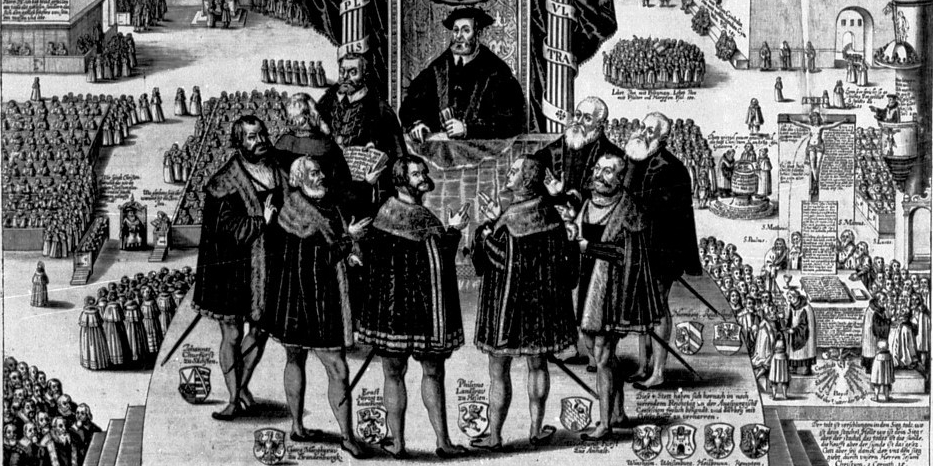
The Presentation of the Augsburg Confession – Pr. Faugstad homily
Text: Psalm 119:46
493 years ago on June 25, 1530, the Lutheran princes of Germany stood before Emperor Charles V and publicly read their confession of faith to all who were gathered there. They stated that they would rather die than compromise the truth of God’s Word.
+ + +
In Christ Jesus, who in His testimony before Pontius Pilate made the good confession (1Ti. 6:13), and who calls us to do the same when we are asked for a reason for the hope that is in us (1Pe. 3:15), dear fellow redeemed:
The men who read the words of the Augsburg Confession before Emperor Charles V were not pastors or theological professors. They were laymen. And they understood and believed every word they spoke. They were powerful men in Germany—dukes, princes, and wealthy landowners—, which meant that they had a lot to lose. They were willing to risk it all because of the Gospel message of salvation they had heard and believed.
By speaking the truth of God’s Word, you also could face the possible loss of your job, your standing in the community, or your favor with friends. Telling God’s truth is the most courageous thing you can do, and it is also the most difficult. The world does not welcome the truth. It actively opposes it and wants the clear teaching of God to be silenced.
But while the unbelieving world may succeed in intimidating us and winning some battles against us, it cannot conquer the Church of God in Christ. He assures us, “In the world you will have tribulation. But take heart; I have overcome the world” (Joh. 16:33). He also reminds us how important our confession of the truth is. Not only is it a matter of eternal life or death for us, it is also a matter of eternal life or death for those we associate with. Jesus says, “So everyone who acknowledges me before men, I also will acknowledge before my Father who is in heaven, but whoever denies me before men, I also will deny before my Father who is in heaven” (Mat. 10:32-33).
The laymen at Augsburg confessed the pure Gospel of Jesus in the presence of some of the most powerful people of their day. We still stand on this confession. We believe what they believed. We teach what they taught. By the grace of God, we have the received His treasures of forgiveness, righteousness, and peace through the preaching of His Word. We have been made members of the body of Christ through faith in Him who died for all our sins and rose from the dead in victory. There is no hope apart from Him, and every confidence in Him.
But we have not always been confident, and we have not always been hopeful. At various times in our lives, we have lost sight of this most important thing. We have listened to the promises of the world. We have sometimes chosen sin over salvation, friendships over faithfulness, peace and security in the world instead of the peace that surpasses all understanding. We think back on these things, and we feel ashamed.
Shame is always waiting for those who walk the way of the world and not the way of God’s Word. You and I find plenty to be ashamed of when we look at our own hearts and minds. But we find nothing to be ashamed of when we look to Jesus. He also stood before powerful authorities. Though they attacked Him and told lies about Him, He did not give in, and He did not retaliate. They sentenced Him unjustly to death by crucifixion, and He endured this suffering willingly.
He did all of it for you, so that His blood would cleanse you of all your sins of weakness and unfaithfulness, and so that His holy life would cover you like a royal robe. You do not face the threats of the world alone. You stand in Him, who has overcome the world, the devil, and death for you. Whether you speak His testimony before kings or before your boss or co-workers or anyone else around you, you have nothing to be ashamed of, because Jesus Christ is “the way, and the truth, and the life” (Joh. 14:6).
The Word of God has not changed and will not change. Every power and influence in this world will pass away, but the Word of our God will endure forever. The men at Augsburg spoke timeless truths, which is why we still speak them today. The Lutheran Church which confesses this truth is not a new church or even a 500-year-old church. It is the continuation of the one holy Christian and Apostolic Church from its New Testament origin to the present day.
We pray that God keeps us faithful to this saving truth, and that He gives us the courage to speak His truth to all who need to hear it.
Glory be to the Father and to the Son and to the Holy Ghost; as it was in the beginning, is now, and ever shall be, forevermore. Amen.
+ + +
(picture of Emperor Charles V receiving the Augsburg Confession)

The Feast of the Holy Nativity of Our Lord – Pr. Faugstad exordium & sermon
Festival exordium:
“Merry Christmas!” It rolls easily off the tongue this time of year. We might not use the word “merry” in any other month, but it seems perfectly fitting in December. In this otherwise dark time of year, we want people to find joy and happiness in Christmas. The word “Christmas” was first recorded in an old English source from A. D. 1038 as “Crīstesmæsse.” It is the combination of two words: “Christ” and “mass.”
“Christ” is the special title given to the Savior of the world. It means, “anointed one.” So when we say, “Jesus Christ,” we are saying, “Jesus, the anointed one.” Jesus was officially anointed as the Savior at His baptism in the Jordan River. The heavens opened, and the Holy Spirit descended upon Him in the form of a dove while the Father spoke from above, “This is my beloved Son, with whom I am well pleased” (Mat. 3:17). The incarnate Son of God was anointed “to seek and to save the lost” (Luk. 19:10), to give Himself as the atoning sacrifice for all sin.
But what about the word “mass”? That comes from the Latin term “missa” which has long been associated with the Service of Holy Communion. “Christmas”—“Christ-mass”—means the coming of the Christ to us in His Supper. In Holy Communion, we receive more than bread and wine. We receive the life-giving body and blood of the incarnate Son of God.
The eternal God took on flesh in the virgin Mary’s womb and came to win our salvation by the sacrifice of His body and the shedding of His blood. He gives this same body and blood to us now for our forgiveness, our comfort, and our strength. Jesus’ coming to save us and His continued presence with us is the reason we can be joyful today, even as we carry various burdens and sorrows.
So I say again, “Merry Christmas!”—“Merry Christ-mass!” The Christ was born for you, and He still comes to bless you. For these wonderful gifts, let us rise and sing our festival hymn, #142 (“Rejoice, Rejoice This Happy Morn!”):
Rejoice, rejoice this happy morn!
A Savior unto us is born,
The Christ, the Lord of glory.
His lowly birth in Bethlehem
The angels from on high proclaim
And sing redemption’s story.
My soul,
Extol
God’s great favor;
Bless Him ever
For salvation.
Give Him praise and adoration!
+ + +
Sermon text: St. John 1:1-14
In Christ Jesus, who came down from His exalted throne in heaven with gifts for you and me and all people, dear fellow redeemed:
The artistic depictions of the nativity often show the baby Jesus as the source of light. The faces of Mary, Joseph, and the shepherds shine as they look down on Jesus in the manger. One of our favorite Christmas hymns puts this idea into words: “Son of God, love’s pure light / Radiant beams from Thy holy face” (ELH #140, v. 3). But in reality, Jesus did not glow with an inner light. He looked just like any other baby. What set Him apart for the witnesses of His birth was the word of the angels.
The angel Gabriel told Mary, “the child to be born will be called holy—the Son of God” (Luk. 1:35). An angel of the Lord told Joseph, “do not fear to take Mary as your wife, for that which is conceived in her is from the Holy Spirit” (Mat. 1:20). And then the angel told the shepherds the night of Jesus’ birth, “For unto you is born this day in the city of David a Saviour, which is Christ the Lord” (Luk. 2:11, KJV). They would find Him in Bethlehem not by looking for a shining baby, but for a baby wrapped in swaddling clothes and lying in a humble manger.
So as they worshiped Him that day, they worshiped Him not because of what their eyes saw, but because of what their ears heard. And that is why we worship Him today. We worship Him because of what has been revealed to us about Him in God’s holy Word. The Christian religion is not based on what we can see. It is a religion of faith—believing what we do not see.
That does not satisfy the people of the world. They demand proof of God’s existence, proof of the virgin birth, proof of Christ’s resurrection, proof that He still comes among us today. The proof that the Bible provides won’t do—it has to be proof on their terms. But if we’re talking about Santa Claus, then it’s all about faith. “Don’t ask questions; just believe!” I suppose in their minds, faith is fine when we’re talking fantasy, but it isn’t fine when we’re talking fact.
So why is it that we are so confident that Jesus is who the Bible says He is? Why do we believe in Him? We believe because God the Holy Spirit has worked faith in our hearts through the powerful Word. We didn’t decide to believe in Jesus; God decided to pull us out of the darkness of our sin and death and into the light of His grace.
But our faith is not a “blind faith” that has no evidence to go by. We have the evidence of eyewitnesses who saw what Jesus did and heard what He said. The evangelist John in today’s reading says, “the Word became flesh and dwelt among us, and we have seen His glory.” “The Word” is a special term that John uses to describe the Son of God. He writes that “the Word” was in the beginning, “the Word” was with God, and here’s the part that makes it clear who He is: “the Word was God.”
Once I was talking to a Jehovah’s Witness about who Jesus was. She would not agree with me that the Bible calls Jesus God. I asked her to look up John 1 in her Bible. There her translation (a total mistranslation) said that “the Word was a god,” in the sense of being “divine” or “holy.” But that is not what John wrote. He said, “the Word was God.” God the Son has always existed with God the Father and God the Holy Spirit. All things that were made in the beginning were made through the Son. All life and all light came through Him.
This Lord of life and light is the One the Father sent to be clothed in our flesh. He looked like a regular human being, but He was much more. The apostle Paul wrote about the Christ that “in him the whole fullness of deity dwells bodily” (Col. 2:9). That means that the Son of God was not just partially present in Jesus, but His entire person was now found in a human body.
Why not let His glory be seen by everyone around Him? Why not let His eternal light beam through His skin? It was because no sinner could have endured His bright presence. When Moses wanted to see God’s glory, the LORD said, “you cannot see my face, for man shall not see me and live” (Exo. 33:20). The Son of God incarnate kept His glory hidden for our sake. He “made himself nothing, taking the form of a servant” (Phi. 2:7). He came to humble Himself, to put Himself below us in order to save us.
And that is hard to believe. Why would God do this for us? What is in it for Him? We think there always has to be an angle. For us there often is, but not for God. God sent His Son to take on our flesh out of love for us. He sent His Son to do for us what we are incapable of doing. The Son of God did not put Himself above the Law; He put Himself beneath it, so that He could fulfill God’s commands for us. And He willingly went the way of suffering and the cross, so that full payment would be made for our sins.
If Jesus were just a man, nothing He did could count for you. But because He is God incarnate, “the Word made flesh,” everything He accomplished counts for you. His perfect keeping of the Law is for your righteousness. His innocent death on the cross is for your salvation. These gifts were intended for you long before you were born and long before Jesus was born. Right after the fall into sin, God revealed His plan to send a Savior, the woman’s Seed, the devil’s Destroyer.
That promised Savior was the infant baby Jesus lying in a manger in a little town with a bunch of poor people gathered around Him. “He was in the world, and the world was made through Him, yet the world did not know Him.” No one knew except those who had received a special invitation. They were not rich or famous or influential. They were people like us, sinful people, whose eyes of faith looked in awe upon the Promise fulfilled, Hope incarnate.
We are invited to join them in beholding this great mystery. Jesus was not born for them alone, but for all people of all time. You are hearing the good news today, because God wants you to hear it. He wants you to know that a Savior was born for you to save you from your sins—that there is a solution for the darkness in your heart and mind which has caused you to do dark things.
“The Word became flesh” not to bring God’s righteous wrath down on your head, the punishment you deserve for your sins. The Son of God came down to earth “full of grace and truth.” That’s far better than presents spilling out from under your Christmas tree or brightly-colored boxes stacked in your living room. Jesus came to reconcile you with God the Father through His death in your place. He came to bring peace on earth by the shedding of His blood.
That is why when we hear again the account of our Savior’s birth today, we see more than a baby in a manger. We see “the breadth and length and height and depth” of God’s love for us (Eph. 3:18). We see “the true Light, which enlightens everyone… coming into the world.” We see His glory, “glory as of the only Son from the Father.” It is beyond our human comprehension, but it has been granted us to know it and to understand it by faith.
By His grace, through His Word of truth, Jesus has given us “the right to become children of God, who were born, not of blood nor of the will of the flesh nor of the will of man, but of God.” Because you were baptized into Him, all of His life and light and glory and grace are now yours. You couldn’t ask for better gifts at Christmas, and these gifts last forever.
Glory be to the Father and to the Son and to the Holy Ghost; as it was in the beginning, is now, and ever shall be, forevermore. Amen.
+ + +
(picture from “Adoration of the Shepherds” by Gerard van Honthorst, 1592-1656)