

The Feast of the Holy Nativity of Our Lord – Pr. Faugstad exordium & sermon
Festival exordium:
At 3 weeks from conception, the tiny heart of Christ started beating, the same heart that would feel the stress of intense suffering as He sweat drops of blood in the Garden of Gethsemane.
At 4 weeks, His arms and legs began to develop, the same arms and legs that would be stretched out on the cross.
At 6 weeks, the fingers of His hands had taken definite shape, the same fingers that would close in searing pain over the nails.
At 12 weeks, brain impulses moved His facial muscles, the same face that would twist in agony as He suffered the punishment of hell.
At 17 weeks, His ears heard the sound of Mary’s voice, the same ears that would hear the crowd’s jeering and the sobs of His dear mother as they gathered around His cross.
It’s somewhat unnatural to put Christmas and Calvary together, Christ’s birth and His death. Christmas is about a tiny Baby, born on a quiet night with angels singing His praises. That is a warm picture in our minds. Calvary is where a grown Man hung bleeding on a cross paying for all the world’s sin. That picture is cold.
And yet, it is the same Christ. The Baby in Mary’s womb was no ordinary baby. He was God incarnate, God in the flesh! The components of His human body were developing, even as He reigned as Lord over all things. He looked so helpless, yet He was the all-powerful God. He seemed so vulnerable, yet He had come to “destroy the works of the devil” (1Jo. 3:8).
The unbelievers of the world laugh at this. They laugh at your supposed God-in-the-flesh. They find Santa from the North Pole more compelling than this. And we admit that this does seem foolish. Why would God spend nine months in the dark womb of a poor woman? Why would He choose to enter the world in this way, as a little Baby, in the humblest of settings? Why would He put Himself under the care of Mary and Joseph?
The Son of God came to redeem every second of your life and every inch of your person, from your tiny first existence in your mother’s womb to the final breath of your life on earth. He came to live it, experience it, sanctify it—the womb, childhood, adulthood—and then redeem you through the sacrifice of His perfect life in your place.
This is what God was doing at Christmas, for you and me and whole world. Please join me in singing our festival hymn, #142:
Rejoice, rejoice this happy morn!
A Savior unto us is born,
The Christ, the Lord of glory.
His lowly birth in Bethlehem
The angels from on high proclaim
And sing redemption’s story.
My soul,
Extol
God’s great favor;
Bless Him ever
For salvation.
Give Him praise and adoration!
+ + +
Sermon text: St. Luke 2:15-20
In Christ Jesus, the Savior of the shepherds, Mary and Joseph, and you and me, dear fellow redeemed:
What was the most fantastic sight the shepherds saw on the first Christmas night? It’s hard to imagine anything more amazing than the angel of the Lord appearing while the glory of the Lord shone around them, followed by a multitude of angels filling the sky and singing the praises of God. But I don’t think the shepherds would tell you that was the most amazing thing they saw. They would tell you it was the tiny Baby lying in a manger.
It wasn’t so much His appearance as the explanation of who He was. The angel said to them, “For unto you is born this day in the city of David a Saviour, which is Christ the Lord” (Luk. 2:11). As they gathered around the little Baby, they knew they were looking upon more than a Baby. They were looking upon God in the flesh. They did not know how it could be; they did not fully understand it; they did not grasp what this Child would do. But they believed, they trusted.
That is the first thing we hear about in today’s reading. They TRUSTED the message that the Lord delivered to them through the angel. This trust got their feet moving: “Let us now go even unto Bethlehem,” they said, “and see this thing which is come to pass, which the Lord hath made known unto us.” They didn’t take their time; they “came with haste,” and searched diligently through the town until they found “the Babe lying in a manger.”
The setting was not impressive. Mary and Joseph did not look like much. Jesus appeared to be an ordinary Baby. Was He really “Christ the Lord”? Was He really the promised Savior? Was He really God in the flesh? There is no indication that they viewed the Child with suspicion or doubt. They trusted what they had heard. They trusted that here in the manger lay their Savior and the Savior of the whole world.
Their trust was evident in what they did next. They TOLD. “And when they had seen it, they made known abroad the saying which was told them concerning this Child.” As unlikely as it is that these shepherds were the first witnesses to see the Christ-Child, it is just as unlikely that they became the first evangelists, the first to spread the good news about Jesus. God didn’t choose the priests to do this or some practiced orators or the powerful and influential to spread the message. He chose shepherds.
But then their lowly status is consistent with the way God does His work. He chose to work through humble Mary and the fishermen disciples, and today He even works through unimpressive you and me. 1 Corinthians 1 reveals this shocking strategy of God: “But God chose what is foolish in the world to shame the wise; God chose what is weak in the world to shame the strong; God chose what is low and despised in the world, even things that are not, to bring to nothing things that are, so that no human being might boast in the presence of God” (vv. 27-29).
So the shepherds traveled all over telling everyone what they had heard and seen, but especially what they had heard. The angel’s words about the Christ-Child were so clear and comforting. It’s safe to say the people in and around Bethlehem had never heard the shepherds talk so much about spiritual things. What had gotten in to these men? “And all they that heard it wondered at those things which were told them by the shepherds.” The message of the shepherds filled them with wonder and amazement. Could what they were saying actually be true? But why would God reveal it to the shepherds, of all people?
The shepherds did not worry about how their message was received. Whether it was received warmly or with disdain, they could not but speak of what they had seen and heard (Act. 4:20). News this great could not be kept to themselves. Call them crazy, but they would not stop telling what the angel had “told unto them.”
The last thing we hear about these shepherds is how they THANKED God. As they returned to watch over their sheep in the field, they were “glorifying and praising God for all the things that they had heard and seen.” They could not explain why they were chosen for this tremendous privilege. Why should the angel appear to them? Why should they be chosen to lay eyes on the Christ-Child? It was all a gift.
God had mercy on those men, just as He has on the entire human race. He delivered a gift in special wrapping—a “Babe wrapped in swaddling clothes, lying in a manger.” No one earned this gift; no one was worthy of it. But God sent it in love. “For God so loved the world that He gave His only-begotten Son” (Joh. 3:16). The Son of God entered the world as a Baby to rescue sinners from eternal death in hell.
So we see how the shepherds TRUSTED the message of the angel and went to see the Christ. They TOLD everyone about the amazing events of that night. And they THANKED God, glorifying and praising Him that He had revealed these glad tidings to sinners such as them. My dear friends in Christ, do you stand where those shepherds stood? Do you see what they saw? Do You Hear What They Heard? Because the Christ-Child came for you too.
What did the angel tell the shepherds? “I bring you good tidings of great joy, which shall be to all people.” The good news was not just meant for them; it was given “to all people”—“to the Jew first and also to the Greek” (Rom. 1:16). That means the angel’s announcement was meant for you. God sent His Son to earth for you. He was born in lowliness for you. When the shepherds looked upon Jesus in the manger, they were looking at your Savior too.
Those shepherds provide a good pattern for us, a good roadmap to follow. Just as they heard the good news and received it with joy, so do we. We have gathered here today for this very purpose. We have heard the Christmas message many times before, but it never gets old. We listen in wonder and amazement what God has done for us sinners. Like Mary, we treasure all these things and ponder them in our hearts.
But we don’t keep the good news to ourselves. As individuals and as a congregation, we make known abroad that a Savior has come for all people. We share the glad tidings of the forgiveness of sin and eternal life through Jesus. We tell our neighbors, no matter how disinterested, prideful, or stubborn they may seem, that the Son of God took on flesh for them too. Like the shepherds, we can’t point to anything in ourselves that causes God to show us mercy, but we know that He does. The Proof is wrapped in swaddling clothes, hanging on a cross, and leaving the tomb empty on the third day.
Like the shepherds, we also give thanks today. There may be a lot of things in your life that are causing your Christmas to be less than merry. You may be carrying regret or sadness or pain. You may see no end to your troubles. The Christ was born for you. Your Father in heaven wants you to know it and hear it. Jesus came to bear your griefs and carry your sorrows. He came to redeem your soul and open the way for you to heaven.
You are not insignificant to Him, a nameless face that He does not recognize. He sees you and chose you like He chose those lowly shepherds. He has great things in store for you just as He did for them.
Now let us all with gladsome cheer
Follow the shepherds and draw near
To see this wondrous gift of God,
Who hath His only Son bestowed. (Evangelical Lutheran Hymnary #123, v. 6)
Glory be to the Father and to the Son and to the Holy Ghost; as it was in the beginning, is now, and ever shall be, forevermore. Amen.
+ + +
(picture from “The Shepherds and the Angel” by Carl Bloch, 1879)
Christmas Eve – Pr. Faugstad homilies
Text: St. Luke 2:8-14
I. And there were in the same country shepherds abiding in the field, keeping watch over their flock by night.
It was a normal night as far as the shepherds were concerned. They were used to working under the stars. Their job was to keep the sheep safe from predators and thieves. They were totally unaware that something had just happened in the nearby town of Bethlehem that would change not just their lives but the whole course of human history. They were unaware of these workings of God, but He was not unaware of them.
Even more closely than they kept watch over their sheep, the LORD kept watch over these shepherds. He knew each one. He loved them. He had chosen them to be unwitting witnesses of the fulfillment of His greatest promise—the sending of His Son in human flesh to save the world of sinners. Whatever concerns occupied their minds—workplace tensions, money problems, relationship issues, personal struggles—these concerns were about to melt away like snow in springtime.
The LORD looks upon you with the same love and care as those Bethlehem shepherds. He knows the troubles you face in your life, the burdens that weigh you down. He knows you personally, and He loves you. For you, just as much as for the shepherds, God the Father sent His only-begotten Son. He sent His Son to bear your sin and conquer your death. In the fields outside the little town of Bethlehem, the shepherds’ entire outlook changed on the night of Jesus’ birth, just as it has for you. Life is no longer dullness and despair. It is hope and peace and joy through the incarnate Son of God.
Hymn #137.1-3 – “O Little Town of Bethlehem”
II. And, lo, the angel of the Lord came upon them, and the glory of the Lord shone round about them: and they were sore afraid.
Standing in the holy presence of the LORD made their un-holiness all the more obvious. They felt exposed. They wanted to hide. That was the condition of Adam and Eve after they disobeyed the command of God and fell into sin. When they heard the sound of the Lord walking in the Garden of Eden, “they hid themselves from the presence of the Lord God” (Gen. 3:8).
But they couldn’t really hide, not from God. Hebrews 4 says that “no creature is hidden from his sight, but all are naked and exposed to the eyes of him to whom we must give account” (v. 13). This is why the shepherds were “sore afraid,” literally, why “they were afraid with a great fear.” They could not see God, but they were surrounded by His glory, and that was enough to get their knees shaking. They knew in that moment what St. Paul later wrote about all mankind, “all have sinned and fall short of the glory of God” (Rom. 3:23).
We have all inherited Adam’s sin, and we have heaped up piles and piles of our own sins. If the glory of the Lord surrounded us right now, we would cower in fear too. But the fear that the shepherds felt was soon removed by the comforting words of the angel. The glory of the Lord shone around them because God had come to earth not to destroy sinners but to save them.
Hymn #126.1-3 – “God Rest You Merry”
III. And the angel said unto them, “Fear not: for, behold, I bring you good tidings of great joy, which shall be to all people. For unto you is born this day in the city of David a Saviour, which is Christ the Lord.”
The angel did not tell the shepherds, “Fear not, for you are good men. God is pleased with your righteous lives.” He did not say, “Fear not, for God has seen your humble efforts to do what is good and kind, as opposed to the proud and the powerful who harm others.” If the angel had said that, I imagine the shepherds would have continued to be afraid because they knew their own sinful hearts.
The angel said “fear not” because he had good news to share with them, “good tidings of great joy.” And it wasn’t just good news for them; it was good news for all people: “For unto you—for you—is born this day in the city of David a Saviour, which is Christ the Lord.” The cowering shepherds were comforted by the message that God had kept His promise, the promise first delivered to Adam and Eve. The promise was that the Seed of the woman would crush Satan’s head and free all people from his kingdom of darkness and death.
The details shared by the angel were mind boggling. This Savior was the Christ, the anointed One prophesied throughout the Old Testament. He was the Lord—the true God—and yet the angel said He had been born! How could this be? How could the Lord be born a Baby? How could God take on flesh? The shepherds were about to find out because this amazing birth had taken place “in the city of David,” in Bethlehem, within sight of where they were. So now their fear turned to wonder as they—and we with them—ponder these “glad tidings of great joy.”
Hymn #123.1-5 – “From Heaven Above to Earth I Come”
IV. “And this shall be a sign unto you; Ye shall find the Babe wrapped in swaddling clothes, lying in a manger.”
The sign for the shepherds to find the Christ-Child was not to look for a Baby glowing with heavenly light or to look for a Child surrounded by the rich and famous. The sign was a Baby wrapped in swaddling clothes—not so uncommon for a newborn—and lying in a manger—now that was unique! They would not have to enter any gated communities or knock on any palace doors this night. They were sent to look for a little stable with a humble manger that held the greatest treasure the world had ever seen.
The Son of God entered the world as a lowly Baby instead of a powerful King, so He could redeem the entire human race from the moment of conception throughout childhood and into adulthood. He lived a perfect life at every stage to fulfill God’s Commandments for us. Then He was laid upon another rough piece of wood, so that His hands and feet could be nailed to the cross for His atoning death in our place.
Hebrews 2 explains why all this had to be: “Since therefore the children share in flesh and blood, he himself likewise partook of the same things, that through death he might destroy the one who has the power of death, that is, the devil, and deliver all those who through fear of death were subject to lifelong slavery” (vv. 14-15). In that Baby “wrapped in swaddling clothes, lying in a manger,” we find our salvation and our life.
Hymn #119 – “Away in a Manger”
V. And suddenly there was with the angel a multitude of the heavenly host praising God, and saying, “Glory to God in the highest, and on earth peace, good will toward men!”
The angel had delivered the message. He had shared the good news about God entering His creation to redeem mankind. Why would God show such compassion for these weak beings who sinned against Him? What made them worth it? These thoughts did not even cross the minds of the holy angels. They know that everything God does is good and right. They perfectly obey the will of the holy God and gladly serve Him.
And now, a great multitude of angels filled the night sky outside Bethlehem singing the praises of God and glorifying His name. “Glory to God in the highest,” they sang, “and on earth peace, good will toward men!” That summed it all up. In His mercy, God the Father did not want to destroy sinners; He wanted to save them. He sent His Son to make peace, to atone for all sin by shedding His holy blood.
We still sing this song of the angels. Each Sunday in the Divine Service, we sing these words after hearing the absolution announced by the pastor: “By the authority of God and of my holy office I forgive you all your sins, in the name of the Father and of the Son and of the Holy Spirit.” That is what Jesus came to do for us—forgive our sins and win for us eternal life. So hearing what God has accomplished for you and me, we join the angels in giving “Glory to God in the highest” for His gifts of goodness and peace.
Hymn #125.1-3 – “Hark! The Herald Angels Sing”
+ + +
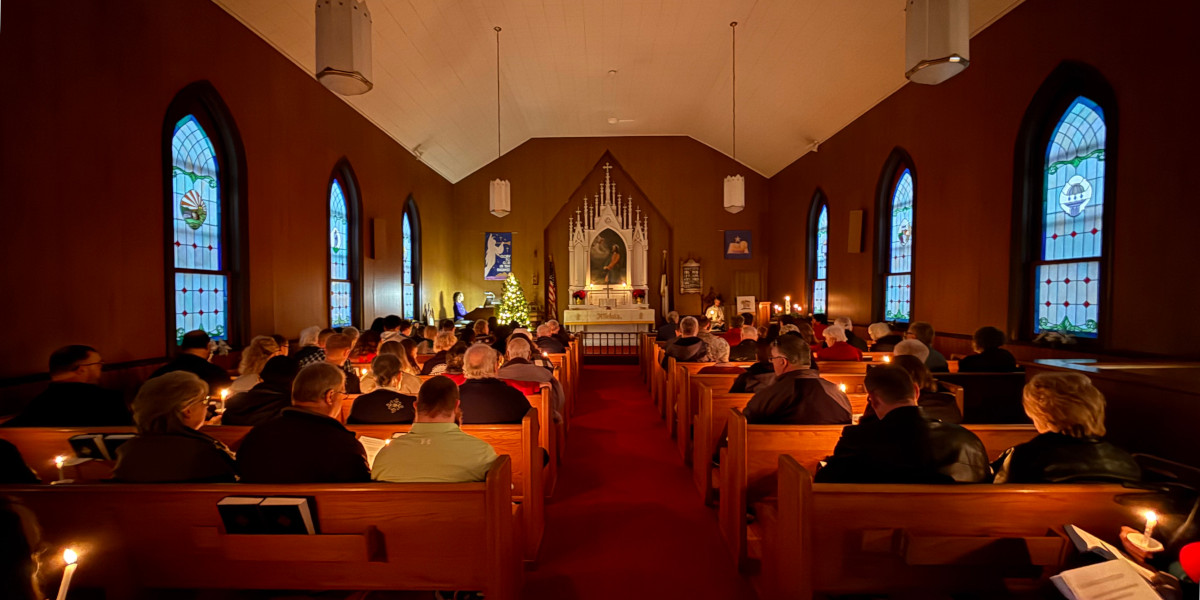
(picture from the Candlelight Service at Redeemer Lutheran Church)
The First Sunday after Christmas – Pr. Faugstad sermon
Text: Genesis 22:1-14
In Christ Jesus, through whose sacrifice we are redeemed from all sin and adopted as God’s beloved sons, dear fellow redeemed:
Occasionally the newspaper has a story about an old building or an old town where now there is nothing but a parking lot or grass. It may have been a thriving place at one time, but except for a newspaper article, it is all but forgotten. It works the opposite, too, that a place with little activity is now well-known and busy. This church is one example. For most of history, my guess is that this particular location, this exact place, has never had such a gathering of people as in modern times since the church was built. Before the congregation chose this spot, it was a meadow for livestock or wild game, or for ancient peoples traveling through.
Another location like this is the land of Moriah mentioned in today’s reading. It doesn’t go by that name anymore, but you know the place. It is where Jerusalem now sits on Mount Zion. It is here that God told Abraham to bring his son Isaac and offer him as a burnt offering. Setting aside this shocking command for a moment, let us remember how Abraham and his wife Sarah were given this son.
God promised offspring to Abraham when he was seventy-five years old. God did not fulfill this promise until Abraham was one hundred and his wife Sarah was ninety! It was a miraculous birth. But even more than that, God made it clear that through them, “all the families of the earth shall be blessed” (Gen. 12:3). All would be blessed because the Messiah, the world’s Savior, would come through them and their son Isaac. About Isaac, the LORD specifically promised, “I will establish my covenant with him as an everlasting covenant for his offspring after him” (Gen. 17:19).
And now God commanded Abraham to kill Isaac and burn him as an offering. The thought of this is horrific. We shudder when we read about the corrupt kings of Judah who offered their sons as burnt offerings to try to appease false gods (2Ki. 16:3, 21:6). We are sickened by the thought of the tens of millions of aborted babies in our own land who have been offered to the idols of selfishness, greed, and sexual “freedom.”
Why would the LORD tell Abraham to sacrifice his son? I’m sure Abraham wondered the same thing. Was this a punishment of some sort? Was God angry with him? What would Sarah think? What would Isaac think? The thought of taking up a knife to kill his beloved son was unbearable. And what would this mean for God’s promise of salvation? Had God changed His mind? No, that couldn’t be! Abraham hardly slept that night, troubled as he was by these questions and the task God had given him.
He got up early in the morning and made preparations for the journey. We are given details about the preparation that seem unimportant, but each one was accompanied by Abraham’s tremendous suffering. He saddled the donkey. He summoned two of his servants. He called his son. He cut wood for the burnt offering. They set off for the mountain God had designated. On the third day of their travels, Abraham saw the place in the distance, and he and Isaac continued on without the servants.
We are not told how old Isaac was at this time, but he must have at least been in his teens or perhaps his early twenties. He was strong enough to carry the wood for the burnt offering as they climbed the mountain. Abraham brought the knife and the fire. But something was missing. “My father,” said Isaac, “Where is the lamb?” Abraham replied, “God will provide for Himself the lamb for a burnt offering, my son.” They reached the place, and Abraham built the altar and laid the wood on top. Then we are told matter-of-factly that Abraham “bound Isaac his son and laid him on the altar, on top of the wood.”
How could Abraham have carried this out without Isaac trying to escape him or fight against the ropes? Since it seems obvious that Isaac could have done these things, there must be another explanation. Though we are not given the details, it seems very likely that Abraham had a straightforward conversation with his son, along the lines of: “This is what God commanded me to do. We dare not disobey His command. He has promised salvation through our line. That must mean, my dear son, that He will make a way to raise you back to life after you have turned to ashes.” That certainly seems to have been Abraham’s confidence when he said to his two servants, “I and the boy will go over there and worship and come again to you.”
The New Testament book of Hebrews explains exactly this. It says that Abraham “considered that God was able even to raise [Isaac] from the dead” (11:19). This is a tremendous account of Abraham’s faith. He could not imagine that God had taken back the promise of salvation through Isaac. God is no liar. So Abraham would do what God said and offer up his son, and leave it to God to carry out what He promised. The fact that Isaac was willing to be tied up and placed on the altar also shows his confidence in God’s promise.
Wouldn’t it be awesome to have a faith like this that clings to God’s promises even when the opposite seems to be happening! But when we wish for a stronger faith, what we often want is for God to fill us up with faith like we might fill a car with gasoline—just so quickly and easily. But Abraham’s faith did not grow out of ease and comfort. He bore the cross of a move away from his family and homeland to a strange place, the cross of waiting twenty-five years in his old age for the fulfillment of God’s promise of a son, the cross of then having to sacrifice his son Isaac. The devil tried to use these trials to drive faith out of Abraham. God used these trials to drive faith deeper in Abraham’s heart.
Times of suffering are when people either hold tightly to God’s promises or when they loosen the grip of faith. Some people think their suffering is a sign of God’s punishment or a sign that He doesn’t really care for or love them. The devil wants us to think this too. But we learn from God’s testing of Abraham that He works all suffering for our good. This is what the Bible consistently teaches. Romans 8:28 says: “[W]e know that for those who love God all things work together for good, for those who are called according to his purpose.”
And God did work Abraham’s and Isaac’s trial for good. He reinforced for them that His Word and promise was stronger than any love they had for each other. He trained their focus forward in time when His great promise of salvation would be carried out. “I will surely bless you,” the LORD said to Abraham, “and I will surely multiply your offspring as the stars of heaven and as the sand that is on the seashore. And your offspring shall possess the gate of his enemies, and in your offspring shall all the nations of the earth be blessed, because you have obeyed my voice” (Gen. 22:17-18).
This account has a happy ending. Abraham and Isaac returned home rejoicing. Will your faith be rewarded as theirs was? It already has been. Through all the trials and troubles of your life—the death of loved ones, the harm done to you by others, the stresses of your own weaknesses and failures—through all of it, the LORD has neither left you nor forsaken you. He has brought you back here to receive the forgiveness of your sins, peace in your heart, and rest from your weariness. Here through His Word and Sacraments, He does strengthen your faith, so that you are prepared for whatever crosses the Lord sends for your good.
He has these wonderful gifts to give you because God Provided the Lamb for the Offering, a Lamb to be sacrificed in your place. This Lamb, Jesus Christ, was born—where else?—in a stable. He was wrapped in cloths and laid in a manger. Forty days after His birth, Joseph and Mary brought Jesus to the temple in Jerusalem to present Him to the LORD as the Law of God commanded. It was the first time the Son of God entered the city of Jerusalem in the flesh.
The mountain on which Jerusalem was built is where Abraham and Isaac once went up to build an altar to the LORD. Just as Isaac carried the wood of the burnt offering up the mountain, Jesus would carry the wood of His cross toward Calvary. Just as Isaac let himself be bound and placed on the altar, Jesus would let Himself be bound and nailed to the altar of the cross. This was God the Father’s only Son, His beloved Son, with whom He was well pleased (Mat. 3:17).
No angel stopped this sacrifice. God the Father poured out His fiery wrath on His Son, and Jesus willingly took it, so that you would be saved. He suffered and died for you, so that your doubting of God’s commands, your unwillingness to do what He says, and your impatience in suffering would not be counted against you. Jesus suffered and died for you, so that all your sins would be blotted out, taken away, eternally forgiven.
And just as the mountain on the third day of Abraham’s and Isaac’s travels changed from a place of death to a place of rejoicing and life, so it was on the third day after Jesus’ death. In His garden tomb outside Jerusalem, an angel rolled away the stone and declared, “He is not here, for he has risen, as he said” (Mat. 28:6).
This is what we have gathered today to celebrate. We celebrate the birth of Jesus because we know why He came. “God sent forth His Son, born of woman, born under the law, to redeem those who were under the law”—Abraham and Isaac and you and me and all sinners—, “so that we might receive adoption as sons” (Gal. 4:4-5).
Glory be to the Father and to the Son and to the Holy Ghost; as it was in the beginning, is now, and ever shall be, forevermore. Amen.
+ + +
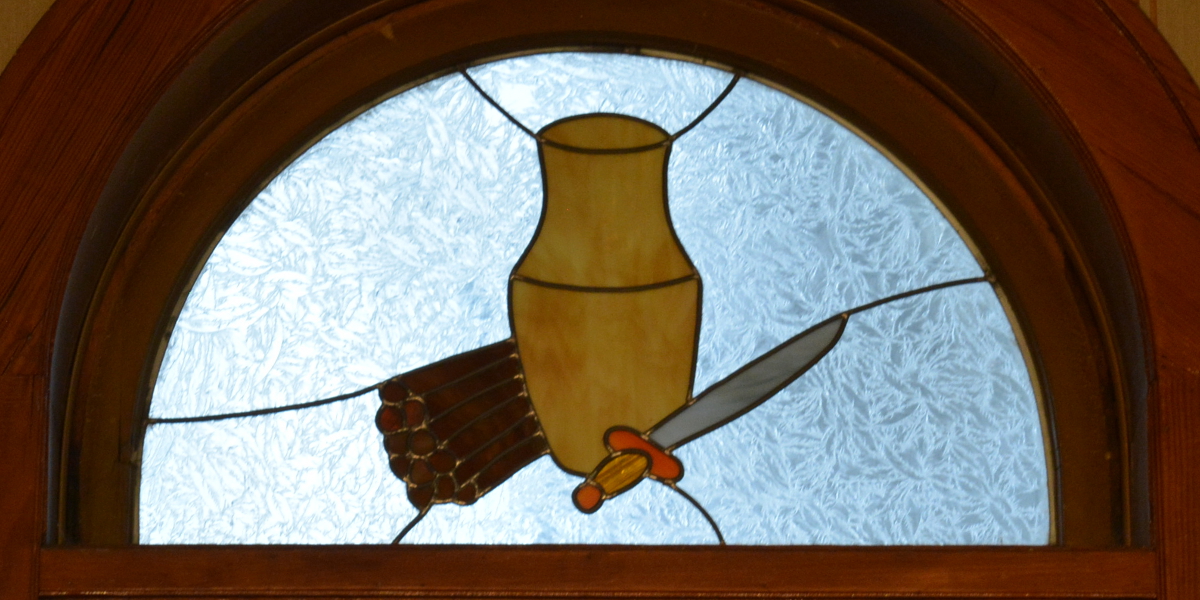
(picture from Saude stained glass depicting the wood, knife, and jar with fire for the sacrifice of Isaac)

The Feast of the Holy Nativity of Our Lord – Pr. Faugstad exordium & sermon
Festival exordium:
What would your life be like without the church? Let’s say you woke up tomorrow believing everything you believe now, but the church building is gone and the congregation you were a part of no longer exists. No pastor. No worshiping together. No services on Christmas Eve or Christmas Day. No Saturday evening or Sunday morning opportunities to hear the Word, receive the Lord’s Supper, and enjoy fellowship together.
Because we have congregations and church buildings, we don’t have to think about these things. We expect they will be here for us, just as they were for our parents, our grandparents, and others before them. I pray that our congregations will continue for a long time. But we are also witnessing a decline in church attendance throughout our country, as people shift their time and attention to other pursuits, other priorities.
We can learn something from the Bethlehem shepherds today. As impressive as it was to see the heavenly hosts fill the sky and the Baby lying in a manger, they were more impressed by what they heard. After visiting the Christ-Child, “they made known abroad the saying which was told them concerning this child.” They told everyone what the angel told them: “Behold, I bring you good tidings of great joy, which shall be to all people. For unto you is born this day in the city of David a Saviour, which is Christ the Lord.”
“A Savior is born for you!” they shouted in the streets of Bethlehem. That message is as important today as it was 2,000 years ago. You and I need a Savior, our neighbors need a Savior, people all around the world need a Savior. If our churches suddenly disappeared, this message of salvation would bring us together. Once you hear the good news, you can’t un-hear it. Once you know what Jesus came to do for you, you can’t keep that news to yourself.
This is why we keep coming together. We come here to wonder at the glad tidings of salvation we have heard from God. We come to ponder and learn what Jesus has done. And we come to be strengthened and renewed through His Word and Sacraments, so we are ready to glorify and praise God in every station of our life, wherever we are and in everything we do.
A Savior is born—born for you—Christ the Lord! Let us rise and sing our festival hymn, #142:
Rejoice, rejoice this happy morn!
A Savior unto us is born,
The Christ, the Lord of glory.
His lowly birth in Bethlehem
The angels from on high proclaim
And sing redemption’s story.
My soul,
Extol
God’s great favor;
Bless Him ever
For salvation.
Give Him praise and adoration!
+ + +
Sermon text: St. Luke 2:8-14
In Christ Jesus, who hides His glory in humble means, so you can receive His forgiveness, His righteousness, and His life, dear fellow redeemed:
Just another day on the job, or rather another night. The shepherds were in the fields around Bethlehem protecting their sheep from predators that might be lurking about. It was an important job, but perhaps not one that everyone wanted to have. The night shift is a long one. It is difficult to stay awake and alert when the body wants to rest. But for the shepherds on this night, that weary feeling was about to go away.
Out of nowhere, an angel of the Lord appeared to them. I suppose they had never seen an angel before, but since he was accompanied by the glory of the Lord shining all around, they were able to put it together. This was an angel from heaven, a messenger from God! We get a sense of what “the glory of the Lord” was like that night from a few references in the Old Testament. When Moses went up Mount Sinai to receive the Law from God, the LORD’s glory was there in a thick cloud. To the people of Israel watching from a distance, “the appearance of the glory of the LORD was like a devouring fire on the top of the mountain” (Exo. 24:17).
Some time after this when Moses finished building the tabernacle, “the cloud covered the tent of meeting, and the glory of the LORD filled [it]” (Exo. 40:34). The same thing happened many years later when King Solomon built the temple in Jerusalem (1Ki. 8:11). On these two occasions fire came from the LORD’s presence to consume the sacrifices offered (Lev. 9:24, 2Ch. 7:1). So “the glory of the Lord” was hidden in a cloud and accompanied by fire. Anyone who witnessed these things trembled at the power of God and fell down before Him.
This is how the shepherds reacted—“they were sore afraid.” They were filled with a great fear as the glory of the Lord surrounded them. But there were still more surprises coming. The angel announced that he was bringing “good tidings of great joy,” a wonderful message intended not just for the shepherds but for all people of all time. “For unto you—FOR YOU—is born this day in the city of David a Saviour, which is Christ the Lord.”
“Christ” means “anointed one,” the same title in the Greek language as “Messiah” in the Hebrew language. The child born in Bethlehem was the anointed One, the One chosen by God to redeem the world of sinners. Here was the Offspring of the woman first promised to Adam and Eve (Gen. 3:15). Here was the son of Abraham, the son of David, the son of Mary. Here was the eternal Son of God wrapped in human flesh. Just a little baby, and yet the Lord of heaven and earth. Just a lowly manger and yet the King enthroned on high.
The angels could not contain their excitement. God parted the veil separating heaven from earth to let the shepherds hear their heavenly praises. The night sky filled with the angels of God’s army, as “a multitude of the heavenly host” appeared. They sang about what the coming of this Savior meant. It meant “Glory to God in the highest,” and it meant “on earth peace, good will toward men.” Jesus was born to give glory to God the Father by following His holy will throughout His earthly life, and to bring peace between God and man through the shedding of His blood.
So the shepherds had seen the glory of the Lord all around them, an angel had spoken to them, and then an entire host of angels appeared to sing God’s praises. But there was something still more amazing, still more wonderful, for them to see this night. They immediately set off to find “the babe wrapped in swaddling clothes, lying in a manger.” And they did find Him just as the angel said, with Mary and Joseph by His side.
It is a strange contrast—the glory of the Lord filling the night sky with the dimly lit stable, the angels arrayed in heavenly garments with a baby swaddled in strips of cloth, the heavenly host singing for joy with the quiet breathing of a baby asleep. The shepherds had never seen anything like it. No one had. For all the poverty of the surroundings, this little baby was more than met the eye. When the shepherds looked at Jesus’ face, they were looking at the face of God. When they heard His little cooing noises, they were hearing the voice of God.
Human reason says, “This can’t be! How can God be a baby? How can He require the care of a human mother and the protection of a mortal man? How can this poor, helpless baby do anything for us?” The shepherds might have thought the same thing if the angel hadn’t said, “[This] is Christ the Lord.” God calls us today to look through their eyes, to see what they saw. This was no ordinary baby lying in a manger; this was God incarnate.
He took on flesh for you. He was born for you. He humbled Himself to be Your servant, to take your place under God’s holy Law, to accept the punishment for your sin, to die your death. He came so that one day you could see the glory of the Lord with your own eyes and hear the angels singing the praises of God in heaven. He came to save you from this world of darkness, to shine the light of His grace into your heart and your home.
But it is natural to wonder if these things are really so. How can we be sure? How can we know that everything in the Bible happened just as we are told it did? If the angels appeared to the shepherds to bring them good news, why don’t they do the same for us? Why doesn’t God give us a glimpse of His glory? These things would go a long way, we think, toward addressing our doubts, calming our fears and anxieties, and giving us strength.
But what was the sign the shepherds were told to look for? Not a royal procession of the saints and angels marching before their King, and not the Son of God descending from heaven in a blaze of glory. The sign was this: “Ye shall find the babe wrapped in swaddling clothes, lying in a manger.” They found the Christ-child, with His glory hidden in baby skin, swaddling clothes, and straw.
And so it is true for us today. Jesus is not found in a great mansion or palace hanging out with the rich and famous, or even where religious institutions appear to be most impressive and successful. Jesus is found where He tells us He is, wrapped up in His Word, in Water, in Bread and Wine. He is present for us in His holy means of grace, the Gospel message in His Word and Sacraments.
Our sinful reason says that this cannot be! How can eternal life come to us through the preaching of a weak pastor? How can Jesus’ righteousness be placed on us at the baptismal font? How can the forgiveness of sins come to us by eating and drinking bread and wine? Here is the key: the means Jesus instituted to give us His grace offer no benefit to us if we just go through the motions, if we view them as nothing more than empty rituals or silly traditions.
My preaching does no good, the application of water has no benefit, eating and drinking at the Communion rail gives no blessing—without faith in the Word of Jesus, without believing that what He promises, He gives you. And that faith is not a choice you make or a work you do. Saving faith is a gift worked through the Word by God the Holy Spirit, who moves you to repent of your sins and to believe that these sins are forgiven by the One who took on flesh to save you.
The angel’s message was not just for the shepherds. It was for you and for every sinner. God wants you to know that you have a Savior. Christ was born for you. He came to atone for your sins. He came to rescue you from this world of darkness. He came to bring you to His kingdom of light, where His glory will surround you, and you will not be afraid forever and ever.
Glory be to the Father and to the Son and to the Holy Ghost; as it was in the beginning, is now, and ever shall be, forevermore. Amen.
+ + +
(picture from “Adoration of the Shepherds” by Gerard van Honthorst, 1592-1656)

Christmas Eve – Pr. Faugstad homilies
St. Luke 2:1-7
I. And it came to pass in those days, that there went out a decree from Caesar Augustus, that all the world should be taxed. (And this taxing was first made when Cyrenius was governor of Syria.)
Caesar Augustus was powerful. He decreed that everyone needed to return to their hometowns to be registered, so they could be taxed. And everyone obeyed. One man spoke, and the whole Roman world started moving. No one in our country has that kind of power, and we are thankful for that! But Caesar was a man under authority, whether he knew it or not. He was an instrument of One much higher and more powerful than he. Caesar was focused on taxes and revenue, but his decree set events in motion that irreversibly changed the course of human history, events that have led to our gathering together in this place on this day.
Caesar couldn’t have known and wouldn’t have cared that his decree caused a poor man from Nazareth and his pregnant fiancé to set off on the several day journey to Bethlehem where Joseph’s family was from. Many passed by them along the way. Probably few noticed them. Maybe some felt compassion for the pregnant mother. They did not know who she carried in her womb. Mary and Joseph and perhaps a few others knew, but they didn’t really know. How could they?
How could anyone comprehend that God had become incarnate through Mary? How could they guess that the eternal Son of God now had a human brain and heart and a soul? How could they understand what He came to do for the world of sinners? This is what God brought to pass “in those days.” Caesar’s part in it was small. This was God’s plan. He chose this point in history. He chose this time. Galatians 4:4-5: “When the fullness of time had come, God sent forth his Son, born of woman, born under the law, to redeem those who were under the law, so that we might receive adoption as sons.”
Hymn: #127.1-4 – “I Am So Glad When Christmas Comes”
II. And all went to be taxed, every one into his own city. And Joseph also went up from Galilee, out of the city of Nazareth, into Judaea, unto the city of David, which is called Bethlehem; (because he was of the house and lineage of David:)
When the angel Gabriel visited the virgin Mary, he told her that she would conceive and bear a son. “And,” he said, “the Lord God will give to him the throne of his father David” (Luk. 1:32). So it was fitting that Jesus was born in Bethlehem where David had been born 1,000 years earlier. Jesus was the son of David through the blood line of Mary and through the legal line of Joseph. But as great as David was, Jesus would prove to be much greater.
Jesus was not just the child of Mary and a descendant of David. He is true God, begotten of His Father from eternity. He put David in his position as king to prepare for the time when many years later He would take on flesh through David’s line. Yes, Jesus was David’s son, but He was also David’s Lord (Mat. 22:41-45).
This is just how the prophet Micah said it would be some 700 years before the birth of Christ: “But you, O Bethlehem Ephrathah, who are too little to be among the clans of Judah, from you shall come forth for me one who is to be ruler in Israel, whose coming forth is from of old, from ancient days” (5:2). Jesus would be “ruler in Israel,” but not of a temporary kingdom on earth. As Gabriel announced, “he will reign over the house of Jacob forever, and of his kingdom there will be no end” (Luk. 1:32).
Hymn: #137 – “O Little Town of Bethlehem”
III. To be taxed with Mary his espoused wife, being great with child.
When Joseph learned that Mary was pregnant, he was understandably distressed. He loved Mary. They had agreed to be husband and wife. But the child in her womb was certainly not his. She had betrayed his trust! She had cheated on him! His heart broken, he resolved to end their marriage plans. But as he was preparing to do this, “an angel of the Lord appeared to him in a dream, saying, ‘Joseph, son of David, do not fear to take Mary as your wife, for that which is conceived in her is from the Holy Spirit. She will bear a son, and you shall call his name Jesus, for he will save his people from their sins” (Mat. 1:20-21).
But what would everyone think? If Joseph tried to explain Mary’s pregnancy and the dream he had, who would believe it? If he said nothing, what would they say about his and Mary’s character? The Jewish people all knew from the Sixth Commandment that sexual relations were to be reserved for marriage. In fact, there were strict penalties for those who broke this commandment. But Joseph obeyed what God told him to do. He did not let a potential scandal stop him. He honored his promise to Mary. He stayed by her side and was very likely the first to lay eyes on the Christ-Child at His birth.
The baby in Mary’s womb was conceived by God the Holy Spirit. Jesus had no biological father. That is why He was able to be born without sin. That is why He was able to take our sins on Himself and to offer Himself as a pure sacrifice to God in heaven. Isaiah foretold this by the power of the Holy Spirit long before it took place: “Behold, the virgin shall conceive and bear a son, and shall call his name Immanuel” (Isa. 7:14). And what does “Immanuel” mean? Immanuel means “God with us” (Mat. 1:23).
Hymn: #113.1-2, 4 – “A Great and Mighty Wonder”
IV. And so it was, that, while they were there, the days were accomplished that she should be delivered. And she brought forth her firstborn son,
“Firstborn son” emphasizes that Mary had no children prior to Jesus. But it also points to something more. Jesus is referred to as “firstborn” in several other passages in the New Testament. Colossians 1 says, “He is the image of the invisible God, the firstborn of all creation. For by him all things were created…. And he is before all things, and in him all things hold together” (vv. 15-16,17). The Son of God is the source of all life. All things were created through Him at the direction of the Father.
And now, the Son of God entered His creation. He took on the flesh that He created for Adam in the beginning. He came to do something new for mankind, something that had not been done before and would not need to be done again. He came to draw all sin to Himself, so that payment could be made for all of it. He came to enter death, so that death could be conquered. None of the people who gathered around His manger could imagine what He would do or how He would do it.
But God in His heavenly council knew. The plan was set. This newborn baby, the firstborn, would one day climb the hill to Jerusalem and offer His life there as the atonement for all sin. Then He would be laid in the grave for a short rest before rising from the dead in victory on the third day. His death was the atonement for your sins. His resurrection was the victory over your death. This “firstborn of all creation” is also “the firstborn from the dead” (Col. 1:18). Because He rose from the dead, all who trust in Him will also rise to eternal life (Rom. 8:29).
Hymn: #145.1-2 – “What Child Is This?”
V. and wrapped Him in swaddling clothes, and laid Him in a manger; because there was no room for them in the inn.
Because of Caesar’s census, Bethlehem was a little more full than usual. Joseph and Mary had to make do with a stable, even for the delivery of a baby. For baby’s first bed, they laid Him in a manger. It was enough out of the ordinary that the angel gave it as the sign for the shepherds, “Ye shall find the babe wrapped in swaddling clothes, lying in a manger” (Luk. 2:12). Martin Luther includes several stanzas in his Christmas hymn about the humble birth of the Christ-Child and what that means to us: “Thus hath it pleased Thee to make plain / The truth to sinners poor and vain, / That this world’s honor, wealth and might / Are naught and worthless in Thy sight” (ELH 123, v. 12).
When we see how our Savior arrived so humbly for our sakes, “this world’s honor, wealth, and might” should seem worthless to us. This is how much God valued you and me. The Son of God was willing to “make himself of no reputation, taking the form of a bondservant” (Phi. 2:7). He came to endure every sort of temptation, mockery, and abuse. He came to suffer and die for the world that hated Him.
He did all this out of love, out of love for you. He took on your sin, so you would have salvation. He received hell, so you would have heaven. 2 Corinthians 8:9: “For you know the grace of our Lord Jesus Christ, that though he was rich, yet for your sake he became poor, so that you by his poverty might become rich.”
Hymn: #119 – “Away in a Manger”
+ + +
(picture from stained glass at Redeemer Lutheran Church)

The First Sunday after Christmas – Pr. Faugstad sermon
Text: Galatians 4:1-7
In Christ Jesus, who paid the price of our redemption, so we might be set free from sin and death, dear fellow redeemed:
On September 22, 1862, Abraham Lincoln issued the Emancipation Proclamation, declaring that all slaves in the southern states were freed from slavery effective January 1 of the following year. But the Confederate army did not surrender until April 9, 1865, more than two years later. Even then, slavery persisted in several outlying areas in the south, especially in the state of Texas where the Union army did not have a strong presence.
The order of emancipation was not read and enforced in Texas until June 19, 1865. So even though the freedom of the slaves had been declared two and a half years earlier, the slaves did not gain their freedom until word was brought right to them. To mark the day of their freedom, some former slaves celebrated a “jubilee day” the following year on June 19, a day that is now known as “Juneteenth” and observed as a national holiday.
Long before all these events took place, St. Paul spoke about slavery on a much broader scale. In fact, he referred to all people as slaves. In today’s reading, he said that “when we were children, [we] were enslaved to the elementary principles of the world.” These “elementary principles” were the things that agreed with human thinking. For the Jews, this included their extra demands placed on top of God’s Law which were not about words and actions of love but about maintaining outward obedience. For the Gentiles, these “elementary principles” were their methods of operating in the world which often violated the moral Law of God.
Many of the people who heard Paul preach and teach probably laughed when he called them slaves. Many people still laugh at this idea. Unbelieving people in our community and around the world think that freedom consists in establishing their own set of rules, living by their own thoughts and plans, doing whatever they feel like doing. And sometimes believers are tricked by this. Believers may think of themselves as restricted, tied down, by the rules and regulations of “the church,” and they long to experience what it is like to live totally free—to live “totally for me.”
That, writes St. Paul, that is slavery. Because if you decide to follow your heart wherever it leads you—away from responsibility, away from family, away from the needs of your neighbor, away from the Word of God—you will not find the freedom you seek. You may find pleasure for a while like the prodigal son did. But people’s sin and guilt always have a way of catching up with them. So does their mortality. Do you think the rich and famous care much about the wild life they lived when the cold eyes of death are staring them right in the face?
True freedom, the emancipation of ourselves, cannot be found by “doing it my way.” Whatever we try to do, whether trying to live a strict life of discipline or living a reckless life of indulgence, cannot free us from our sin and death and the holy Law of God that condemns us. And since we cannot secure our own freedom, we either have no hope of freedom at all, or another has to secure it for us.
St. Paul has sweet words for us, something we might call “God’s Emancipation Proclamation”: “But when the fullness of time had come, God sent forth His Son, born of woman, born under the law, to redeem those who were under the law, so that we might receive adoption as sons.” Of course there is more to the Proclamation than this, more details that this passage doesn’t cover. But those details are at least summarized by the one word “redeem.”
To “redeem” means to “buy back,” and the one doing the redeeming is the eternal Son of God, whom the Father sent to be “born of woman, born under the law.” He had to be born under the law like we are, so He could redeem us by His perfect life and His innocent suffering and death. It is difficult to imagine a free person willingly taking the place of a slave subject to terrible abuse at the hands of his master. But that is exactly what Jesus did for us.
“[T]hough he was rich, yet for your sake he became poor, so that you by his poverty might become rich” (2Co. 8:9). He became poor by “taking the form of a servant, being born in the likeness of men. And being found in human form, he humbled himself by becoming obedient to the point of death, even death on a cross” (Phi. 2:7-8). He let Himself be attacked again and again by “the father of lies” (Joh. 8:44), who tried to tempt Him to give up His mission of salvation. He let Himself be falsely accused, repeatedly struck, spit on, whipped, and crowned with thorns by the hands of both the Jews and the Gentiles.
Then nails were pounded through Jesus’ hands and feet, and He was put on display on the cross for all to mock and laugh at Him. This is what the Father sent His Son to do. This is what the Son faithfully did to redeem you. As Paul wrote earlier in Galatians, “Christ redeemed us from the curse of the law by becoming a curse for us—for it is written, ‘Cursed is everyone who is hanged on a tree.’” Jesus redeemed you—He bought you back—from your sin and death, by shedding His precious blood for you and dying in your place (1Pe. 1:18-19).
That is how your freedom was gained. He won it for you. He entered your slavery, so you would have His freedom. He became poor, so you would be rich. This is true of every single person who is a slave to sin and death. Jesus did not suffer and die only for some. He did it for everyone. John the Baptizer stated it clearly at the beginning of Jesus’ public work: “Behold, the Lamb of God, who takes away the sin of the world!” (Joh. 1:29).
But what if you don’t feel like your sin is taken away? What if you continue to be plagued by the guilt of sinful things you have done? Or what if you are terrified of death, or you carry a heavy burden of sorrow because someone you dearly loved has died, and it feels like you will never see them again?
The slaves in Texas were legally free for a long time, but they didn’t know it. And when word finally reached them of their emancipation, I’m sure there were many who doubted it could be true. All they had known was slavery. They were slaves, as their fathers were before them, and as their fathers were before them.
The same is true in our case. We were born into Adam’s slavery of sin and death, and it seems too good to be true that we could actually be free of it. We keep on sinning, and each day is a day closer to our death. So many wonderful, faithful people have died. Are we really free? How can we be sure? Today’s reading says that the Son of God redeemed us, “so that we might receive adoption as sons.” He purchased us from our slavery, so that we “might be His own” and “live under Him in His kingdom” (Luther’s Explanation to the Second Article).
That purchase agreement was sealed with your name on it when the Holy Spirit worked faith in your heart at your Baptism. Your Baptism is when God officially adopted you as His own. He washed you clean of your sin by water and the Word and transferred you from a state of death to His inheritance of life. When He brought you to faith through the Word, He put you in the position of His Son, because all who believe in Jesus are members of His holy body.
Since you are adopted as God’s son, you stand to inherit everything Jesus obtained in perfect obedience to His Father’s will. God the Father put His stamp of approval on everything Jesus did “by raising him from the dead” (Act. 17:31). That means the holy life Jesus lived perfectly fulfilled God’s Law and cancels out your sinful life. And the payment He made by His death on the cross satisfies the debt you have with God.
So even though you may not feel like you are forgiven and you struggle with guilt, by faith in Jesus you are no longer a slave to sin. He set you free by the price of His blood. And even though you may fear death or grieve the death of a loved one, Jesus assures you, “I am the resurrection and the life…. Because I live, you also will live” (Joh. 11:25, 14:19).
These are promises that we need to hear again and again, just as I’m sure the slaves in Texas wanted to hear the Juneteenth proclamation over and over again. The Word and Sacraments are God’s proclamation of grace toward us sinners. They are the means by which He calms our consciences, comforts our hearts, and strengthens our faith. Through these means, God sends “the Spirit of His Son into our hearts, crying, ‘Abba! Father!’”
The Spirit’s powerful work in us through the Word is the reason we came to church all through this past year, and the reason we will keep coming in the year ahead. It is no surprise that the Simeon and Anna in today’s Gospel account were led by the Holy Spirit to Jesus in the temple—in church (Luk. 2:25-38).
Here, the Holy Spirit brings us Jesus with all His saving gifts. Here, the Holy Spirit prepares us to share the sweet message of freedom with others who have been freed from their slavery but haven’t heard the good news yet. Here, the Holy Spirit says to each one of us personally, no matter how difficult or stained our past might be: “You Are No Longer a Slave, but a Son.” And since you are a son of God, all that is His is yours.
Glory be to the Father and to the Son and to the Holy Ghost; as it was in the beginning, is now, and ever shall be, forevermore. Amen.
+ + +
(picture from “Presentation of Jesus in the Temple” by Rembrandt, 1631)
The Feast of the Holy Nativity of Our Lord – Pr. Faugstad exordium & sermon
Festival exordium:
If you set two Christmas presents next to each other, all wrapped up, and one of them is really big while the other is quite small, which one would a child choose? Which one would any of us choose? The possibilities seem so much greater in something big.
The emphasis at Christmas is often on the big things—a house covered with lights on the outside and filled with decorations on the inside, gifts piled up around the tree, great feasts shared with family and friends, grand gestures of charity. All of these are wonderful things, and all of them are tied to Christmas. But none of these big Christmas things is the main thing.
The main thing appears much smaller, hardly significant, easily missed. To find Christmas, you have to look past the lights and decorations and presents and food, and even past friends and family. You have to look back to a humble place in a little town where a poor man and woman welcomed a tiny Baby into the world.
That Baby, wrapped up in swaddling clothes, surrounded with straw like gift bag tissue paper, and placed in the box of a manger, is the greatest gift that has ever been given. That Baby was a gift from the God who made all things on earth and in heaven. That Baby was a gift for you.
But what could this Baby do for you? If He were just a regular baby, He could do nothing for you. If He were just a regular baby, we certainly wouldn’t be gathered here today. But He was no regular baby.
He appeared so small, and yet He was exceedingly great. He appeared so weak, and yet His power was immeasurable. He appeared so helpless, and yet He was the One who would conquer death itself.
That Baby who looked like nothing special was the Son of God incarnate, the Son of God in the flesh—your flesh. He came to be your Brother, to exchange His perfect life for your sinful one, to exchange His joy for your sorrow, to exchange His life for your death.
He is the greatest gift ever given, and He was given for you. Let us rise and sing our festival hymn, #142:
Rejoice, rejoice this happy morn!
A Savior unto us is born,
The Christ, the Lord of glory.
His lowly birth in Bethlehem
The angels from on high proclaim
And sing redemption’s story.
My soul,
Extol
God’s great favor;
Bless Him ever
For salvation.
Give Him praise and adoration!
+ + +
Sermon text: St. Luke 2:1-7
In Christ Jesus, “the founder and perfecter of our faith” (Heb. 12:2), “the Alpha and the Omega, the first and the last, the beginning and the end” (Rev. 22:13), dear fellow redeemed:
We hear stories from time to time about people who rose up from difficult circumstances to become very successful. They started with nothing and now have great wealth and power. But that doesn’t change the fact that who they are in their genetic make-up had nothing to do with them. We came from our parents, who came from their parents, who came from their parents, and so on.
In that way, we are all inheritors; we inherit both what is good and what is bad from those who came before us. For the good things we inherit, we see the great privilege and the great responsibility that is handed to us. If a good name has been handed down to us, we want to live up to the name. If wealth has been handed to us, we want to use our inheritance wisely.
At the time of Jesus’ birth, it was especially the firstborn son who felt this privilege and responsibility. He received the greatest portion of the family inheritance. The honor and influence that his ancestors had gained were passed on to him. The firstborn son had a lot to live up to and a lot to lose!
The Holy Gospel for today identifies Jesus as the “firstborn son” of Mary. The original Greek states it even more emphatically, “And she gave birth to her son, the firstborn.” This is a way of emphasizing that Mary had no children prior to Jesus. In fact it was impossible for her to have children before Jesus, because she was a virgin (Isa. 7:14; Luk. 1:34).
As the “firstborn son” of Mary, Jesus was descended from the line of King David, who in turn had descended from the great patriarchs Jacob, Isaac, and Abraham who could draw their line back through Noah to the first man Adam. So Jesus had a tremendous inheritance of family, faithfulness, and history funneling down to Him. But there was one thing—one very important thing—He did not inherit. He did not inherit His forefathers’ sin.
All the rest of us do. We were all conceived in the natural way, which means the sin of Adam has come down through the generations all the way to us. The apostle Paul writes, “Therefore, just as sin came into the world through one man, and death through sin, and so death spread to all men because all sinned” (Rom. 5:12). And, “For as by the one man’s disobedience the many were made sinners” (v. 19). Adam’s sin is ours, as though we were right with him reaching out and taking a bite from the fruit in disobedience to God.
But Adam’s sin did not reach Jesus, because He was conceived in Mary’s womb by the Holy Spirit. The angel Gabriel told Mary, “The Holy Spirit will come upon you, and the power of the Most High will overshadow you; therefore the child to be born will be called holy—the Son of God” (Luk. 1:35). So Jesus was the firstborn son of Mary, but He was also the first child to be born without sin. He represented the human line He came from, but His birth was also the start of something new, something the world of men had never seen before.
Jesus was not just the firstborn Son of Mary; He is the only-begotten Son of God. There was never a time when the Son of God was not. He is begotten of God the Father from eternity. And “when the fullness of time had come, God sent forth his Son” (Gal. 4:4). He sent Him to take on flesh in Mary’s womb by the power of God the Holy Spirit, so He could be the Redeemer of all sinners.
Once this happened, once God entered our world and took on our flesh, our future became very clear and very bright. What we see Him doing was all done for us. His perfect love for God and neighbor was to fulfill God’s holy Law for us. His innocent suffering and death was to atone for our sins. And His resurrection on the third day was to conquer and cancel our death.
The Bible wraps up all His work for us in the term “firstborn.” St. Paul describes the Christ as “the firstborn of all creation… all things were created through him and for him. And he is before all things, and in him all things hold together. And he is the head of the body, the church” (Col. 1:15,16-17). This tells us that we have nothing apart from Him, and we are nothing apart from Him. “[A]ll things were created through him and for him… in him all things hold together”—and especially His holy Church of all believers.
The Son of God came down to earth and clothed Himself in our flesh, so He could clothe us in His righteousness and take us with Him to heaven. The way that He causes us to be spiritually reborn and connected to Him is through His Sacrament of Baptism. He joins us to His holy body and therefore makes us inheritors, heirs, of all that He has fulfilled and done according to the will of His Father.
By the faith given to us at our Baptism, we inherit what is His. Galatians 3:26-27 says, “for in Christ Jesus you are all sons of God, through faith. For as many of you as were baptized into Christ have put on Christ.” Whatever the only-begotten Son of God and firstborn Son of Mary has, we have. This was God’s intention all along, even before the beginning of time. Romans 8:29 tells us that we whom God the Father has elected to salvation are “conformed to the image of his Son, in order that he might be the firstborn among many brothers” (Rom. 8:29).
So we keep a close eye on the events of Jesus’ life, because in His life, we see our future unfolding. How can I hope to escape God’s wrath and enter into heaven? Because Jesus lived a perfect life of love for me and paid for all my sins through His death on the cross. How can I hope to live when death will one day take me as it has taken so many others? Because Jesus rose from the dead in triumph over death, so that all who trust in Him share in this victory.
In fact, this is another way that Jesus is referred to as “firstborn.” The same Colossians passage that calls Him “the firstborn of all creation,” later says, “He is the beginning, the firstborn from the dead, that in everything he might be preeminent” (Col. 1:15,18). He was the first to be born in holiness, so that we could enter that holiness through our Baptism into Him. He was the first to rise from the dead, so that we could be assured of our resurrection on the last day.
Apart from Jesus, there is no clear way forward, no real hope for the future. Apart from Jesus, all we have to look forward to is getting older and dying. But because “the firstborn of all creation,” entered our world and destroyed sin and death, rising as “the firstborn from the dead,” we know what our future holds. It is a future in Him, covered in His righteousness, filled with His life, going on where He has gone. Jesus First—We Follow.
“Therefore, if anyone is in Christ, he is a new creation. The old has passed away; behold, the new has come” (2Co. 5:17). We have nothing to add to His redemptive work. All of it is done for us. This is why the Christ came. This is what we celebrate at Christmas. With the angels, we worship this holy Firstborn, our Savior, and glorify His name (Heb. 1:6).
Glory be to the Father and to the Son and to the Holy Ghost; as it was in the beginning, is now, and ever shall be, forevermore. Amen.
+ + +
(picture from “Adoration of the Shepherds” by Gerard van Honthorst, 1592-1656)
Christmas Eve – Pr. Faugstad homilies
St. Luke 1:31-35,38
I. The angel Gabriel said to Mary: “And behold, you will conceive in your womb and bear a Son, and you shall call His name Jesus.”
This scene has a specific context, a context that stretched back thousands of years. The reason an angel of the almighty God appeared to a young woman named Mary is because of another woman who lived long before this, all the way back in the beginning of time. That woman had a blissful and holy existence with her husband in a beautiful garden. They had no sin. They felt no pain. They lacked nothing.
But then a tempter came to the woman. “Wouldn’t you like to have even more?” he said. The woman gave in to the temptation, and so did her husband. They ate fruit from the one tree God had forbidden. Now they had sin. Now they knew pain. Now they were left with nothing. They hid from the presence of their Creator!
But God still loved them. He had mercy on them. He told the tempter, “I will put enmity between you and the woman, and between your offspring and her offspring; he shall bruise your head, and you shall bruise his heel” (Gen. 3:15). Adam thought the LORD was referring to Eve and her firstborn son (3:20, 4:1). But He was especially referring to another woman—to Mary, lowly Mary, Mary of Nazareth, who wouldn’t be born for several thousands of years.
In this evening’s reading, we see that God keeps His promises. He sent an angel to tell Mary that she was the one. She was the one who would bear the Son who would crush the head of Satan. She was the one who would bear the Son who would pay for all the sin of Adam & Eve and all their descendants. She was the one who would bear the Son whose name revealed His purpose. He was to be called “Jesus”—the One who saves.
Hymn: #119 – “Away in a Manger”
II. “He will be great and will be called the Son of the Most High.”
When Jesus lay there “asleep on the hay,” He did not look very impressive; He did not look so “great.” He looked like an ordinary little baby who needed what all babies need—milk, sleep, and new diapers. But this particular Baby was much more than met the eye. In the mystery of all mysteries, “the Son of the Most High,” the Son of God, had taken on human flesh.
We heard how His coming was prophesied right after the fall into sin. But the plan was actually in place before God the Father made the world and everything in it. God the Holy Spirit inspired the apostle Peter to write that our Lord Jesus Christ “was foreknown before the foundation of the world but was made manifest in the last times for the sake of you” (1Pe. 1:20).
The Son of God was incarnate, the Christ was made manifest, “the Word became flesh and dwelt among us” (Joh. 1:14). This great Lord, this “Son of the Most High,” came in the most unexpected of ways. He did not come down from heaven on the clouds in all His brilliant glory. He did not enter the world in the court of a powerful king. He came to the womb of a poor woman and was born in a little town. He “made Himself of no reputation, taking the form of a bondservant, and coming in the likeness of men” (Phi. 2:7, NKJV).
But why would He do this? Why would the God of eternity come down to us in this way? The apostle Paul tells us, “For you know the grace of our Lord Jesus Christ, that though he was rich, yet for your sake he became poor, so that you by his poverty might become rich” (2Co. 8:9).
Hymn: #123.1-4,15 – “From Heaven Above to Earth I Come”
III. “And the Lord God will give to Him the throne of His father David, and He will reign over the house of Jacob forever, and of His kingdom there will be no end.”
These words describe both the divine and human natures of the Christ: “And the Lord God will give to Him the throne of His father David.” The Lord God, God the Father from eternity, sent His only-begotten Son to join a human line. It was the line of Adam and Noah, Abraham, Isaac, and Jacob, the line of Jesse and his son David who was called from keeping sheep to be Israel’s king.
God promised that after David’s death, He would raise up an Offspring of David after him and “establish the throne of his kingdom forever” (2Sa. 7:13). That promise endured one thousand years through the crumbling and captivity of Judah and its return from exile until the birth of Jesus. Although the glory had long since departed from David’s royal line, Mary could trace her lineage to him.
More importantly, Mary was tied to the Promise, the Promise first made in the Garden of Eden, a Seed of Promise passed down from generation to generation, until it was planted in Mary’s womb by the Holy Spirit. The Child in her womb was both Man and God, both David’s Son and David’s Lord.
Though the world did not know it, He was a great King. He was the greatest King who ever walked on this earth, and He still reigns. He reigns with power and grace over His people. He sits on the throne of a kingdom that has no end.
Hymn: #143.1-2,7-9 – “The Happy Christmas Comes Once More”
IV. And Mary said to the angel, “How will this be, since I am a virgin?” And the angel answered her, “The Holy Spirit will come upon you, and the power of the Most High will overshadow you; therefore the Child to be born will be called holy—the Son of God.”
“How will this be, since I am a virgin?” Do we find it strange that Mary brings this up? Why does she feel compelled to mention her virginity? If Mary were living now, she would be told, “Mary, what you do with your body is no one’s business but yours.” But in fact what I do with my body and what you do with yours isn’t just our own business. What we do with our bodies is part of something bigger.
All who are baptized into Christ become part of His holy body. He was covered with our sins, so we would be clothed in His righteousness. He died in our place, so we would live. The apostle Paul writes that Christ “died for all, that those who live might no longer live for themselves but for him who for their sake died and was raised” (2Co. 5:15).
It does matter that Mary was a virgin. It means that the child in her womb was not conceived in her by a sinful man. That would mean their child was a sinner like them. But Jesus had no sin. He was conceived in Mary’s womb by God the Holy Spirit and therefore was “called holy.” Jesus had to be holy, so that He could take the place of you and me and all people, and offer Himself as a holy sacrifice for our sins.
Hymn: #113.1-2,4 – “A Great and Mighty Wonder”
V. And Mary said, “Behold, I am the servant of the Lord; let it be to me according to your word.” (ESV)
What a beautiful faith we find in Mary! She heard the stunning words of the angel which seemed to violate all sense, and she believed. “Behold, I am the servant of the Lord; let it be to me according to your word.” Martin Luther wrote that at her faithful hearing of God’s Word, Mary conceived “through her ear.” The day the angel visited her was the day God became man, starting as a tiny embryo in her womb.
Our minds are unable to comprehend the incarnation of God. How could the God of the universe spend nine months growing in a dark womb? How could He who has no beginning and no end be born of a woman and cradled in her arms? We cannot understand it any more than Mary could.
But we can rejoice. We can give thanks that the eternal Son of God was born for us. He was born to let nails and spear pierce Him through. He was born to bear the cross for me, for you. We don’t understand it. We don’t deserve it. But God declares it to us. “It is for you,” He says. So we reply, each one of us, with a believing heart, “Behold, I am the servant of the Lord; let it be to me according to your word.”
Hymn: #145 – “What Child Is This?”
+ + +
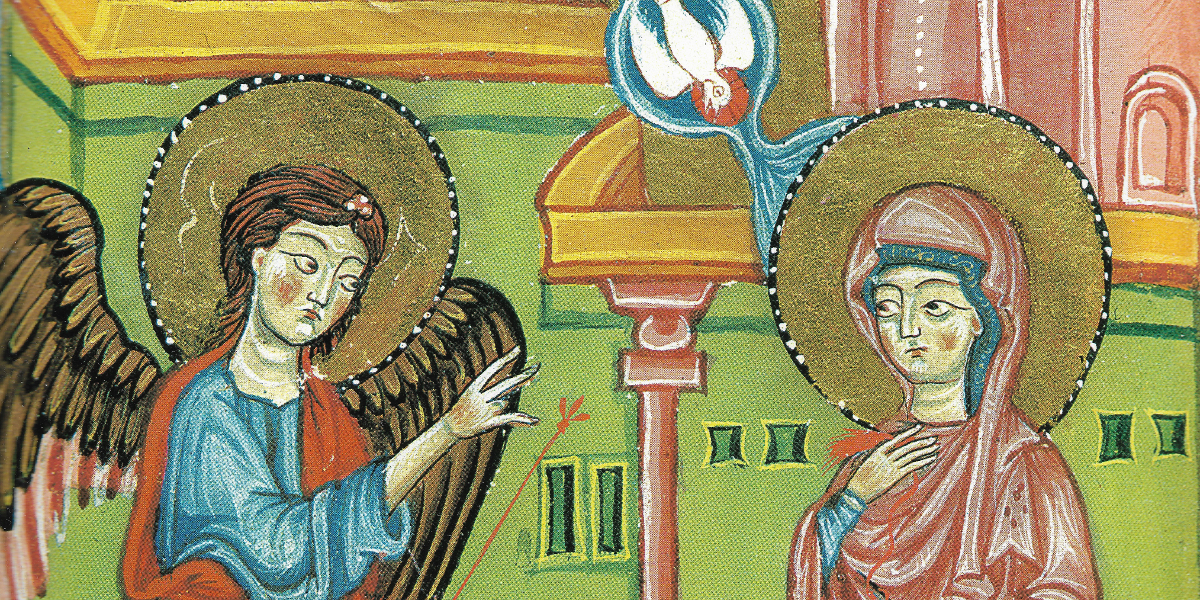
(picture from “The Annunciation” by Toros Taronetsi, 1323)

Circumcision and Name of Jesus – Vicar Anderson sermon
Text: St. Luke 2:21
In Christ Jesus, who when the fulness of time had come, He came down from heaven, was born of flesh and under the law for you, dear fellow redeemed:
When I was studying to go into law enforcement, I went on some ride-along’s with my local police department. On those ride-along’s, I was able to hear the question asked from an officer’s point of view, “do you know the reason why I pulled you over?” This is the question that no one wants to hear because when you hear this question, it means that you have probably done something wrong. And, usually you know you did something wrong. Depending how serious the crime is, someone could find themselves in court. They might get their time reduced, or they might hear that judge bring the gavel down and say guilty. Laws keep us safe from danger. We know that these laws keep us safe yet we usually don’t like to follow them. We also see God’s laws and find ourselves relaxed in following those too. In fact, we have broken every one of them. What will He do to us? Will the perfect judge condemn us? God shows how much he cares about us with the text for today. He knows that we can’t fulfill the Law, so the lawgiver himself has come to fulfill it!
Mary and Joseph waste no time in following the commands of God. The law states that “on the eighth day the flesh of his foreskin shall be circumcised” (Leviticus 12:3). We see the care that Mary and Joseph had for the Word of God. They were devout believers in His promises. They followed what the law said concerning their new born son. However, this law is more than a Law handed down by Moses. Circumcision started long before this in the command that God gave Abraham in Genesis 17. [God] said to Abraham, “this is my covenant, which you shall keep, between me and you and your offspring after you: Every male among you shall be circumcised. You shall be circumcised in the flesh of your foreskins, and it shall be a sign of the covenant between me and you. He who is eight days old among you shall be circumcised…Any uncircumcised male who is not circumcised in the flesh of his foreskin shall be cut off from his people; he has broken my covenant (10-12, 14.)”
What is so special about this covenant? This is God giving Abraham a promise and setting Abraham and his descendants apart from the nations around them. This promise is that God would be with him. Abraham would be the father of many nations. His name would be great! There was also the promise of the Savior that would come through him. God told him when he called him that, “in you all the families of the earth shall be blessed” (Gen 12: 3). Now the Savior had come from the line of Abraham. To keep the promise given to Abraham, Jesus is circumcised, made a member of the people of the covenant, placed under the law. Jesus has no need to obey the law for himself as He is God. The law was given to the people. God told them that they are to keep these laws. When they keep the law they are showing that they trust God. It also shows how they are separate from the heathen nations. The heathen nations did despicable things. If the people of the covenant, God’s chosen people sinned, then they had to repent.
Looking in the Old Testament, it is apparent that many of the Israelites did not follow God’s law. They simply defied them. They were God’s chosen people. Yet they were often at war with God and his laws that He had given them. They were punished for their sins and when they repented, God would come to them as a loving Father to his children. As the Jews attempted and failed often to obey God’s law, they had to bring sacrifices to God. They needed many, many animals to shed their blood. This was done to look ahead to the coming one. But often the Israelites would only go through the motions with these sacrifices and were not actually sorry for their sins. Or they thought that the sacrifice was what did the job. The Israelites deserved the punishment that was given them because of the law that they had broken.
Like the Israelites of old, we see God’s law and we fail to follow them. We work very hard at it, but it never comes to fruition even if we are trying our best. We also can find ourselves going through the motions. We might not think about the prayers that we are saying. Some of the prayers that we say we might not even mean them. If we fail to repent of our sins, then our confession is meaningless. It can be easy to do that if we believe that “God will just forgive me anyway, he knows that I’m trying. He knows that I’m not as bad as other people.” If we don’t repent of sins and are sorry for them, we can go to communion and take it to our harm. This is the danger of getting set in the motions because then why should we be at church at all. This is the danger of being stuck in our sins.
This time of year is a great example of this taking place. Now is the time that people are going to start their new year’s resolutions. We will start them with great anticipation and the hope that they will stay with it. Unfortunately, we are very quick to lose interest in something that could help us. We make the promise and then we break it. We treat our sins the same. We will promise God that we will try our best to keep his law. We make a promise and then we don’t keep it. We lose interest and we keep doing them. We need someone to fulfill the law for us.
Jesus follows the commands of God not for himself, but for sinners. This event is the first time in Jesus early life that he sheds his blood. At eight days old Jesus had already shed blood for you. We know this shedding of blood would have to be more. This is the start. Jesus following the law at eight days old makes him obligated to keep the law. From His infancy to adulthood, He fulfilled the law completely for you. He then shed his blood and gave his life for you on the cross. He didn’t have to do it. He was perfect in every way. But He wanted to do it for you. Only the lawgiver, God in the flesh, could come down and keep the law for you and take away your sins. We see that in our text today. Jesus as a baby, being put under the law.
The name He was given also described His purpose. He is given a name of utmost importance. A name whose definition is the sole reason that he came down from heaven, for our salvation. Mary and Joseph were both told that they would name this child Jesus because “He will save his people from their sins” (Matthew 1:21). Jesus fulfilled the law to redeem all people. He took on the pain, woe, and suffering for all people of all time. He did not live this life for himself, he lived it for us.
Paul’s letter to the Galatians shows us how important it is that Jesus went under the law for us. Paul writes, “But when the fullness of time had come God sent forth his Son, born of woman, born under the law, to redeem those who were under the law, so that we might receive adoptions as sons” (Galatians 4:4-5). Because of what Jesus has done, we can go to God as children go to their dear Father. God sees that the law has been completed by His son Jesus Christ. He lived out His life as an act of obedience. This act of circumcision obeyed the Old Testament law for baby boys. This was only the beginning. Jesus continued to obey the Old Testament law up to his death on the cross.
Jesus’ circumcision fulfilled the promise that was given to Abraham and his descendants. With Jesus being circumcised, being brought into the Abrahamic covenant, all families of the earth have been blessed. Now that Jesus has fulfilled the law for us, what about circumcision? Is it needed? We see the battles that Paul fought in the New Testament that this is not the case. Circumcision does not bind us to the promise, but Jesus instituted something else that does. Paul explains that we have been circumcised in another way.
“In him also you were circumcised with a circumcision made without hands, by putting off the body of the flesh, by the circumcision of Christ, having been buried with him in baptism, in which you were also raised with him through faith in the powerful working of God, who raised him from the dead” (Colossians 2:11-12). Your baptism connects you to what Christ has done. In your baptism you are buried with Christ and you now walk in newness of life. Your Savior, God in the flesh, has obeyed the law for you. He began his journey as a baby, going to the cross, completing it.
No one can imagine a lawgiver being the one who has to fulfill his own law. Now we see Jesus our Savior. He was given a name that was known from eternity. He was put under the law for us. We don’t have to despair when we fall short of God’s law. He sent his only Son to obey his law willingly for us and Jesus shed his blood willingly. He is our Savior. His name tells us so. His obedience shows us so. Our sins have been washed away. At eight days old we see how much Jesus loved us. He did this for us in our place. We can begin the new year with no worries since the law has been fulfilled! Amen.
Glory be to the Father and to the Son and to the Holy Ghost; as it was in the beginning, is now, and ever shall be, forevermore. Amen.
+ + +
(picture from “The Nativity at Night” by Geertgen tot Sint Jans, c. 1490)
The Feast of the Holy Nativity of Our Lord – Pr. Faugstad exordium & sermon
Festival exordium:
“Merry Christmas!” It rolls easily off the tongue this time of year. We might not use the word “merry” in any other month, but it seems perfectly fitting in December. In this otherwise dark time of year, we want people to find joy and happiness in Christmas. The word “Christmas” was first recorded in an old English source from A. D. 1038 as “Crīstesmæsse.” It is the combination of two words: “Christ” and “mass.”
“Christ” is the special title given to the Savior of the world. It means, “anointed one.” So when we say, “Jesus Christ,” we are saying, “Jesus, the anointed one.” Jesus was officially anointed as the Savior at His baptism in the Jordan River. The heavens opened, and the Holy Spirit descended upon Him in the form of a dove while the Father spoke from above, “This is my beloved Son, with whom I am well pleased” (Mat. 3:17). The incarnate Son of God was anointed “to seek and to save the lost” (Luk. 19:10), to give Himself as the atoning sacrifice for all sin.
But what about the word “mass”? That comes from the Latin term “missa” which has long been associated with the Service of Holy Communion. “Christmas”—“Christ-mass”—means the coming of the Christ to us in His Supper. In Holy Communion, we receive more than bread and wine. We receive the life-giving body and blood of the incarnate Son of God.
The eternal God took on flesh in the virgin Mary’s womb and came to win our salvation by the sacrifice of His body and the shedding of His blood. He gives this same body and blood to us now for our forgiveness, our comfort, and our strength. Jesus’ coming to save us and His continued presence with us is the reason we can be joyful today, even as we carry various burdens and sorrows.
So I say again, “Merry Christmas!”—“Merry Christ-mass!” The Christ was born for you, and He still comes to bless you. For these wonderful gifts, let us rise and sing our festival hymn, #142 (“Rejoice, Rejoice This Happy Morn!”):
Rejoice, rejoice this happy morn!
A Savior unto us is born,
The Christ, the Lord of glory.
His lowly birth in Bethlehem
The angels from on high proclaim
And sing redemption’s story.
My soul,
Extol
God’s great favor;
Bless Him ever
For salvation.
Give Him praise and adoration!
+ + +
Sermon text: St. John 1:1-14
In Christ Jesus, who came down from His exalted throne in heaven with gifts for you and me and all people, dear fellow redeemed:
The artistic depictions of the nativity often show the baby Jesus as the source of light. The faces of Mary, Joseph, and the shepherds shine as they look down on Jesus in the manger. One of our favorite Christmas hymns puts this idea into words: “Son of God, love’s pure light / Radiant beams from Thy holy face” (ELH #140, v. 3). But in reality, Jesus did not glow with an inner light. He looked just like any other baby. What set Him apart for the witnesses of His birth was the word of the angels.
The angel Gabriel told Mary, “the child to be born will be called holy—the Son of God” (Luk. 1:35). An angel of the Lord told Joseph, “do not fear to take Mary as your wife, for that which is conceived in her is from the Holy Spirit” (Mat. 1:20). And then the angel told the shepherds the night of Jesus’ birth, “For unto you is born this day in the city of David a Saviour, which is Christ the Lord” (Luk. 2:11, KJV). They would find Him in Bethlehem not by looking for a shining baby, but for a baby wrapped in swaddling clothes and lying in a humble manger.
So as they worshiped Him that day, they worshiped Him not because of what their eyes saw, but because of what their ears heard. And that is why we worship Him today. We worship Him because of what has been revealed to us about Him in God’s holy Word. The Christian religion is not based on what we can see. It is a religion of faith—believing what we do not see.
That does not satisfy the people of the world. They demand proof of God’s existence, proof of the virgin birth, proof of Christ’s resurrection, proof that He still comes among us today. The proof that the Bible provides won’t do—it has to be proof on their terms. But if we’re talking about Santa Claus, then it’s all about faith. “Don’t ask questions; just believe!” I suppose in their minds, faith is fine when we’re talking fantasy, but it isn’t fine when we’re talking fact.
So why is it that we are so confident that Jesus is who the Bible says He is? Why do we believe in Him? We believe because God the Holy Spirit has worked faith in our hearts through the powerful Word. We didn’t decide to believe in Jesus; God decided to pull us out of the darkness of our sin and death and into the light of His grace.
But our faith is not a “blind faith” that has no evidence to go by. We have the evidence of eyewitnesses who saw what Jesus did and heard what He said. The evangelist John in today’s reading says, “the Word became flesh and dwelt among us, and we have seen His glory.” “The Word” is a special term that John uses to describe the Son of God. He writes that “the Word” was in the beginning, “the Word” was with God, and here’s the part that makes it clear who He is: “the Word was God.”
Once I was talking to a Jehovah’s Witness about who Jesus was. She would not agree with me that the Bible calls Jesus God. I asked her to look up John 1 in her Bible. There her translation (a total mistranslation) said that “the Word was a god,” in the sense of being “divine” or “holy.” But that is not what John wrote. He said, “the Word was God.” God the Son has always existed with God the Father and God the Holy Spirit. All things that were made in the beginning were made through the Son. All life and all light came through Him.
This Lord of life and light is the One the Father sent to be clothed in our flesh. He looked like a regular human being, but He was much more. The apostle Paul wrote about the Christ that “in him the whole fullness of deity dwells bodily” (Col. 2:9). That means that the Son of God was not just partially present in Jesus, but His entire person was now found in a human body.
Why not let His glory be seen by everyone around Him? Why not let His eternal light beam through His skin? It was because no sinner could have endured His bright presence. When Moses wanted to see God’s glory, the LORD said, “you cannot see my face, for man shall not see me and live” (Exo. 33:20). The Son of God incarnate kept His glory hidden for our sake. He “made himself nothing, taking the form of a servant” (Phi. 2:7). He came to humble Himself, to put Himself below us in order to save us.
And that is hard to believe. Why would God do this for us? What is in it for Him? We think there always has to be an angle. For us there often is, but not for God. God sent His Son to take on our flesh out of love for us. He sent His Son to do for us what we are incapable of doing. The Son of God did not put Himself above the Law; He put Himself beneath it, so that He could fulfill God’s commands for us. And He willingly went the way of suffering and the cross, so that full payment would be made for our sins.
If Jesus were just a man, nothing He did could count for you. But because He is God incarnate, “the Word made flesh,” everything He accomplished counts for you. His perfect keeping of the Law is for your righteousness. His innocent death on the cross is for your salvation. These gifts were intended for you long before you were born and long before Jesus was born. Right after the fall into sin, God revealed His plan to send a Savior, the woman’s Seed, the devil’s Destroyer.
That promised Savior was the infant baby Jesus lying in a manger in a little town with a bunch of poor people gathered around Him. “He was in the world, and the world was made through Him, yet the world did not know Him.” No one knew except those who had received a special invitation. They were not rich or famous or influential. They were people like us, sinful people, whose eyes of faith looked in awe upon the Promise fulfilled, Hope incarnate.
We are invited to join them in beholding this great mystery. Jesus was not born for them alone, but for all people of all time. You are hearing the good news today, because God wants you to hear it. He wants you to know that a Savior was born for you to save you from your sins—that there is a solution for the darkness in your heart and mind which has caused you to do dark things.
“The Word became flesh” not to bring God’s righteous wrath down on your head, the punishment you deserve for your sins. The Son of God came down to earth “full of grace and truth.” That’s far better than presents spilling out from under your Christmas tree or brightly-colored boxes stacked in your living room. Jesus came to reconcile you with God the Father through His death in your place. He came to bring peace on earth by the shedding of His blood.
That is why when we hear again the account of our Savior’s birth today, we see more than a baby in a manger. We see “the breadth and length and height and depth” of God’s love for us (Eph. 3:18). We see “the true Light, which enlightens everyone… coming into the world.” We see His glory, “glory as of the only Son from the Father.” It is beyond our human comprehension, but it has been granted us to know it and to understand it by faith.
By His grace, through His Word of truth, Jesus has given us “the right to become children of God, who were born, not of blood nor of the will of the flesh nor of the will of man, but of God.” Because you were baptized into Him, all of His life and light and glory and grace are now yours. You couldn’t ask for better gifts at Christmas, and these gifts last forever.
Glory be to the Father and to the Son and to the Holy Ghost; as it was in the beginning, is now, and ever shall be, forevermore. Amen.
+ + +
(picture from “Adoration of the Shepherds” by Gerard van Honthorst, 1592-1656)