
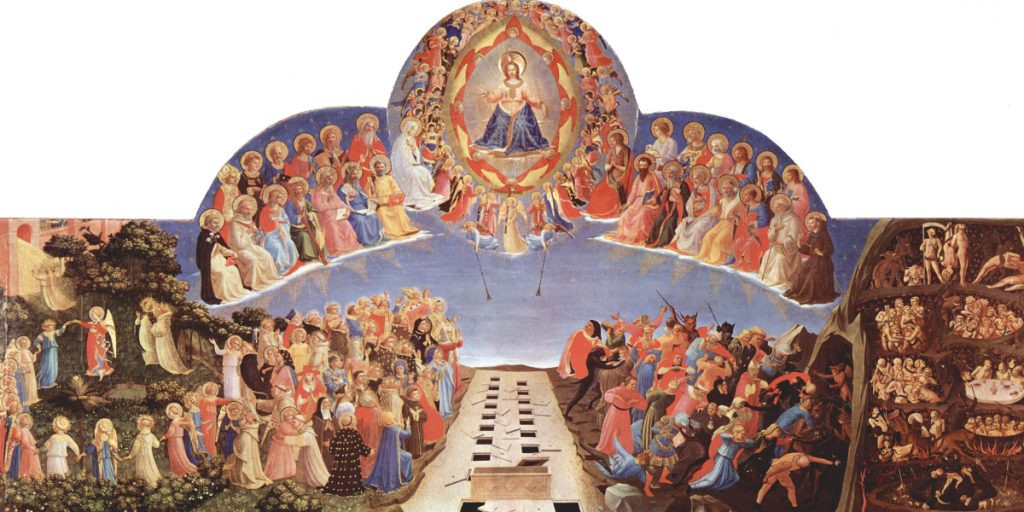
The Second-Last Sunday of the Church Year – Pr. Faugstad sermon
Text: St. Matthew 25:31-46
In Christ Jesus, the righteous Judge, who will award the crown of righteousness to all who eagerly look for His return (2Ti. 4:8), dear fellow redeemed:
Let’s say you traveled around the country conducting a survey of the people of America. And the only question you asked them is this: “If there were a higher power, an almighty God, who was going to judge you for everything you had done in your life, would you be excited to stand before him or not?”
Now certainly a good number of people you tried to survey would not give you a straight answer. They would say something like: “There is no god, so what’s the point of answering your hypothetical question?” Or maybe they would hit you with an answer like: “If there is a god, I absolutely would want to stand before him, so I could ask him why he had the power to help everyone but didn’t.” This is the answer of self-righteousness and pride.
But if people took a little time to think it through, I don’t think there are many who would say they would be excited to stand before the judgment seat of an almighty God. Because if there is an almighty God who will judge us, that must mean He has given us rules that we are supposed to live by. And if our conscience is any sort of reliable guide, we all have the inner sense (a sinking feeling) that we have not met the standard. We have not lived up to how we are supposed to be and what we are supposed to do.
The return of God to judge the world is not hypothetical. Jesus makes this very clear. He says, “When the Son of Man comes—not “If” but “When”—When the Son of Man comes in His glory, and all the angels with Him, then He will sit on His glorious throne.” Jesus spoke this prophecy before He had died, risen again, and ascended into heaven. His disciples did not understand what He was saying, but afterward they did understand, and they taught it to others. At Jesus’ ascension, the angels told the disciples and the whole Church to be ready for His return, when they said, “This Jesus, who was taken up from you into heaven, will come in the same way as you saw him go into heaven” (Act. 1:11).
Most of the people living today, including many Christians, do not live as though they think Jesus is actually coming back. Our time is sort of like the time of the Old Testament, when very few expected God to send the Messiah like He had promised. God repeated the promise for thousands of years that He would send a Savior, and He kept that promise “when the fullness of time had come” (Gal. 4:4). It has been two thousand years since Jesus promised to return in glory, and He will keep that promise, too, when the end of all time comes.
St. Paul, who did not hear the prophecies of Jesus when He first spoke them, received special revelation from the Holy Spirit that matches exactly what Jesus told His disciples. In his First Letter to the Thessalonians, Paul described Jesus’ return on the last day: “For the Lord himself will descend from heaven with a cry of command, with the voice of an archangel, and with the sound of the trumpet of God. And the dead in Christ will rise first” (4:16).
The Lord Jesus will come to judge the living and the dead. Unbelievers might think—and often do think—that there is no afterlife. “When I die, I die—that’s it.” So they might feel like they can do bad things in this life, and as long as they don’t get caught, they will never have to answer for what they have done after they die. But that is not true. Jesus says in today’s reading: “Before Him will be gathered all the nations, and He will separate people one from another as a shepherd separates the sheep from the goats.”
“All the nations” includes all who have ever lived or will still be living when Jesus returns. We confess this each week in the Creeds. The Nicene Creed says, “And He shall come again with glory to judge both the living and the dead.” This comes directly from the Bible. The apostle Peter preached that “[Jesus] is the one appointed by God to be judge of the living and the dead” (Act. 10:42). In his First Epistle, he wrote that the ungodly “will give account to him who is ready to judge the living and the dead” (4:5). And the apostle Paul wrote to Timothy that “Christ Jesus… is to judge the living and dead” (2Ti. 4:1).
Jesus will call all the dead out of their graves. All human beings will be brought before the throne of Jesus to be judged, whether they lived thousands of years ago or were just born that day. There is no getting around it, no hiding from it. Everyone will be judged. Abraham, Isaac, and Jacob will be judged. Samuel, David, and Solomon will be judged. Peter, James, and John will be judged. You and I will be judged.
The thought of that Day of Judgment troubles us. We come across passages in the Bible like these:
– “For we will all stand before the judgment seat of God,” and “each of us will give an account of himself to God” (Rom. 14:10,12).
– “[N]o creature is hidden from his sight, but all are naked and exposed to the eyes of him to whom we must give account” (Heb. 4:13).
– “For we must all appear before the judgment seat of Christ, so that each one may receive what is due for what he has done in the body, whether good or evil” (2Co. 5:10).
We might imagine Jesus in all His glory staring down at us, seeing right through us, finding so much sin and so little righteousness, and judging us to be unworthy to enter the kingdom of heaven.
But that is not what Jesus describes in today’s reading. After He separates people as a shepherd separates the sheep from the goats, He will say to the sheep at His right: “Come, you who are blessed by My Father, inherit the kingdom prepared for you from the foundation of the world.” These are gracious words! They are not what we expect to hear. But could we actually hope that these words are meant for us? Maybe they are meant for people who are much better than we are. Because Jesus goes on to talk about the many good things they did. He even states that they did these good things for Him!
He says that when He was hungry, they gave Him food. When He was thirsty, they gave Him drink. When He was a stranger, they welcomed Him, and so on. But here is an important key to the whole thing: the sheep at His right, whom Jesus calls “the righteous,” will not be nodding their heads in agreement with what Jesus is saying. They won’t reply: “That’s right, Jesus, we did all that for You! Now we’re ready to receive our reward!” No, they will be surprised to hear what Jesus says: “Lord, when did we see You hungry, thirsty, a stranger, naked, sick, and in prison, and help You?” Then Jesus the King will answer, “Truly, I say to you, as you did it to one of the least of these My brothers, you did it to Me.”
We need to be clear about what Jesus is saying and what He is not saying. He IS saying that He counts the works that we do for others—spouse, children, siblings, neighbors, co-workers, strangers—as works done for Him. He is NOT saying that these works earn us a place in heaven. We don’t become righteous before God by being good enough. We are righteous before God only by faith in Jesus. Remember what Jesus said at another time about the sheep: “My sheep hear my voice, and I know them, and they follow me. I give them eternal life” (Joh. 10:27-28).
Eternal life is a gift from God. It comes through the Word of Jesus. The righteous are right to ask when they did all the good works that Jesus said they did. They know—we know—that there is so much more good that we should have done, should be doing, but haven’t. They know—we know—that we should be punished by God for our sins. But that is not the judgment we will hear from Jesus on the Last Day.
Jesus calls Himself “the Son of Man” in this reading. He, the eternal Son of God, was born of the virgin Mary to redeem humankind from sin and death. He is not a vindictive, wrathful God who is eager to punish you. He is a gracious, merciful God who is eager to save you. He is our Brother in the flesh. He willingly went to the cross to pay for and blot out every one of our sins—the transgressions we committed by doing what was wrong, and the ones we committed by failing to do what was right.
He will judge you holy, righteous, because He has made you His own. He has joined you to His holy body. He has covered you in His perfect righteousness through Holy Baptism. He has imparted the forgiveness of sins to you through His Holy Word. He has satisfied your spiritual hunger and thirst through His Holy Sacrament. Everything you need to get into heaven is already yours by faith in Him.
Because of what He has done for you, you do not need to be afraid to stand before His judgment seat. You do not need to worry that He will drag all your sins out in the open as the evidence requiring your condemnation. You truly can look forward to the Last Day with excitement. Jesus says that when you see “the Son of Man coming in a cloud with power and great glory…, straighten up and raise your heads, because your redemption is drawing near” (Luk. 21:27-28).
On that day, even if you had been buried in the grave, even if hundreds of years had passed and your body had turned to dust, you will “come forth and arise.” Then you will see your gracious Lord, the Son of Man. Then you will be ushered by the angels to His right with the rest of the righteous. And you will hear the beautiful verdict, the words of your everlasting acquittal: “Come, you who are blessed by My Father, inherit the kingdom prepared for you from the foundation of the world.”
Glory be to the Father and to the Son and to the Holy Ghost; as it was in the beginning, is now, and ever shall be, forevermore. Amen.
+ + +
(picture from “The Last Judgment” by Fra Angelico, c. 1395-1455)


Copyright 2020 © Saude, Jerico, & Redeemer Lutherans. All rights reserved.