
The Festival of All Saints – Pr. Faugstad sermon
Text: St. Matthew 5:1-12
In Christ Jesus, who did not come “into the world to condemn the world, but in order that the world might be saved through him” (Joh. 3:17), dear fellow redeemed:
If Jesus suddenly appeared in this church, looked all around the room, and opened His mouth to speak, what do you think He would say? Would His words be pointed and harsh, condemning you for your weaknesses, your spirit of fear, or your regular sinning? Would He speak words of comfort and encouragement, urging you to trust in His grace? Would He speak words of instruction, teaching you how to navigate the challenges of life in this fallen world?
I think He might say just what He did at the beginning of His “Sermon on the Mount.” These words were written down for you and me, for us to hear and apply to ourselves today. The first word Jesus spoke when He opened His mouth is “makarioi” in Greek and in English “blessed.” It is the first of nine statements known as “the Beatitudes” that begin with this word: “blessed.”
The first is: “Blessed are the poor in spirit.” Nobody wants to be poor. But Jesus is speaking about something worse than poverty in money or possessions. “Poor in spirit” means that there is nothing in my innermost being, nothing in my soul that has earned or deserves the rich grace of God. The “poor in spirit” have nothing to boast about. “The poor in spirit” are sinners who have fallen short of the glory of God (Rom. 3:23). They do not have anything they can use to buy righteousness or salvation from God. What would God want with people like this, people like us?
But in the first surprise of the Beatitudes, Jesus says “the poor in spirit” are blessed and declares that “theirs is the kingdom of heaven.” But how can we sinners who have nothing be given everything by God, even the perfect kingdom of heaven? What is in it for God? What is His motivation? St. Paul explains in 2 Corinthians 8: “For you know the grace of our Lord Jesus Christ, that though he was rich, yet for your sake he became poor, so that you by his poverty might become rich” (v. 9).
Jesus continues: “Blessed are those who mourn.” “Those who mourn” are those who see that everything is not right in the world, and everything is not right with me. This mourning started right after the fall into sin. The LORD God told Eve and Adam that there would be pain in childbearing, difficulties in relationships, hardship at work, and finally death because of their sin (Gen. 3:16-19). This curse of sin still afflicts us and weighs us down. We grieve our poverty of spirit and our propensity to sin.
But once again, Jesus surprises us: we who mourn are blessed, “for [we] shall be comforted.” What comforts us is what comforted Adam and Eve—the Promise. God told the devil that One would come to crush his head and destroy his wicked work (Gen. 3:15). God the Father’s only-begotten Son would redeem all people from their sins, destroy their death, and finally wipe every tear from the eyes of all who trust in Him. We who mourn over sin and death are blessed and comforted that we have a God who loves us and forgives us our sins.
Next, Jesus says, “Blessed are the meek.” “The meek” are unimpressive. They would be voted “least likely to succeed.” They have nothing to boast about. They have nothing to barter with. They can’t win. So Jesus in His mercy shares His victory with them. After His resurrection, He said, “All authority in heaven and on earth has been given to me” (Mat. 28:18). The kingdom, the power, and the glory are all His. And He gives His victory over sin, death, and the grave to all who trust in Him, even to meek and weak ones like you and me. Because we are blessed by Him, we will rise from the dead with all the faithful, all the saints, and we “shall inherit the earth.”
“Blessed are those who hunger and thirst for righteousness.” We are righteous by faith in Jesus; we are justified by His grace. But we are not completely sanctified; we are not perfect in our thoughts, words, and actions. We want to be better. That’s the “hunger and thirst for righteousness.” When a sick person feels the need to eat and drink, that is a sign that his condition is improving. He is getting better. When we have the desire to please God and live according to His will, this is a sign that the Holy Spirit is at work in us, sanctifying us through the Word. Jesus promises that we who are in this blessed state of faith “shall be satisfied.”
Then Jesus says, “Blessed are the merciful, for they shall receive mercy.” This sounds like Jesus is saying that if we are merciful to others, then He will be merciful to us. But we cannot earn anything from God. He gives according to His mercy. Mercy is not really mercy if there are strings attached. We do not say, “I will be merciful to you if you are good.” That would not be mercy; that would be offering a reward. Mercy is freely given. God is merciful to us; He does not hold our sins against us. Comforted by this gift, we are blessed to show the same mercy to others.
In the sixth beatitude, Jesus says, “Blessed are the pure in heart.” If we had to make our own heart pure, we would despair. Our heart is not pure. That’s why King David, once described by God as “a man after his own heart” (1Sa. 13:14), still prayed “Create in me a clean heart, O God” (Psa. 51:10). And God does cleanse your heart. He first did it on the day of your Baptism when the sign of the cross was made over your heart and head. And He keeps cleansing your heart by His Word of absolution and the Holy Meal of His body and His blood “given and shed for you for the remission of sins.” “Blessed are the pure in heart,” He says, “for they shall see God.”
Then “peacemakers”! “Blessed are the peacemakers.” This is not just the role of parents as they deal with fighting kids, or employers and employees who want to keep the workplace peaceful and productive. The best kind of peacemakers—and the ones that are most needed—are those who bring the peace and light of Jesus to unbelieving hearts. “We have peace with God through our Lord Jesus Christ” (Rom. 5:1). Jesus reconciled us sinners with the Father, “making peace by the blood of his cross” (Col. 1:20). Through this message of peace, more and more are converted and join us as peacemakers. Then they are blessed as we are, “for they shall be called sons of God.”
But peace with God means struggle and conflict in the world. The unbelieving world and its prince, the devil, are opposed to the Word and work of God. This is why Jesus says, “Blessed are those who are persecuted for righteousness’ sake.” Persecution will come to all who pursue righteousness, to all who confess Jesus as Lord. It makes no sense that the meek, the merciful, the peacemakers should have targets on their back. But Jesus reminds us: “If the world hates you, know that it has hated me before it hated you. If you were of the world, the world would love you as its own; but because you are not of the world, but I chose you out of the world, therefore the world hates you” (Joh. 15:18-19). He chose us out of the world. That means we are blessed, “for [ours] is the kingdom of heaven.”
Then Jesus leans in, and He makes the message more personal, changing from “Blessed are those” to “Blessed are you.” “Blessed are you when others revile you and persecute you and utter all kinds of evil against you falsely on My account.” That does not sound like blessing until we hear that the evil charged against us is done “falsely,” and it is because of our connection to Jesus. When we are unjustly attacked through the wicked schemes of the devil, this is because of his hatred of God. These attacks on us are a sign that we are not with the devil, but we are with God. So Jesus says, “Rejoice and be glad, for your reward is great in heaven.”
What Jesus describes in the Beatitudes is not a blueprint for how to earn favor with God like some people teach. It is not a list of positive mental attitudes that will improve our outlook on life. The Beatitudes are a description of God’s grace toward us sinners; they are promises of His ongoing mercy.
Jesus spoke the Beatitudes for the saints, for all those who trust in Him for salvation. Part of the focus of our All Saints’ Day observance is remembering the believers whose souls are with the Lord in heaven and whose bodies lie in peaceful sleep awaiting the resurrection. We can learn much from their faithful example. But we are also saints even now by faith in Jesus. We don’t just become saints when we die. We stand as holy ones before God because Jesus’ blood cleanses us from all sin and His righteousness covers us and everyone who trusts in Him.
The Beatitudes give no impression that salvation comes by our works or that righteousness comes by our attitude or efforts. Righteousness and salvation are gifts from God to us. They are blessings won by Jesus distributed to us by the Holy Spirit through His Word and Sacraments. In view of this rich grace of God toward us, we might sum up the Beatitudes in this way: Blessed Are the Sinners Saved by Jesus.
Glory be to the Father and to the Son and to the Holy Ghost; as it was in the beginning, is now, and ever shall be, forevermore. Amen.
+ + +
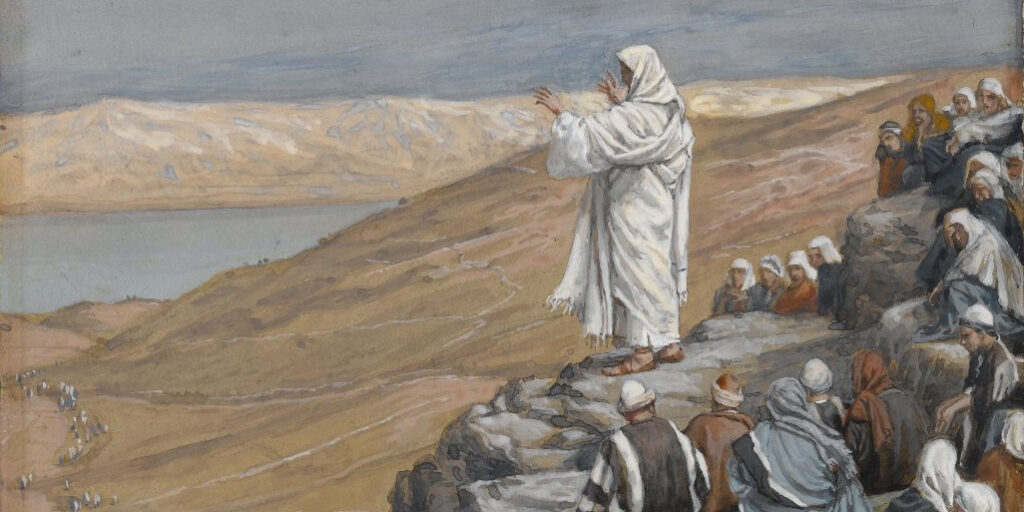
(picture from “The Sermon of the Beatitudes” by James Tissot, 1836-1902)
For more on the Beatitudes, see S. C. Ylvisaker’s essay: https://els.org/resources/document-archive/convention-essays/essay1955-ylvisaker/.

Copyright 2020 © Saude, Jerico, & Redeemer Lutherans. All rights reserved.